
ISSN 1004-5759 CN 62-1105/S
Acta Prataculturae Sinica ›› 2025, Vol. 34 ›› Issue (11): 31-39.DOI: 10.11686/cyxb2024489
Previous Articles Next Articles
Rong MA1,2( ), Jun-yao LI1,3, Ping YUE1, Xu-jun MA1, Zhen BAI4, Ling ZHUANG4, Jing BAI5, Xue-yong ZHAO1, Shao-kun WANG1()
Received:2024-12-12
Revised:2025-02-17
Online:2025-11-20
Published:2025-10-09
Contact:
Shao-kun WANG
Rong MA, Jun-yao LI, Ping YUE, Xu-jun MA, Zhen BAI, Ling ZHUANG, Jing BAI, Xue-yong ZHAO, Shao-kun WANG. Regulatory mechanisms of biomass allocation governed by functional traits of dominant plants in desert steppe under precipitation changes[J]. Acta Prataculturae Sinica, 2025, 34(11): 31-39.
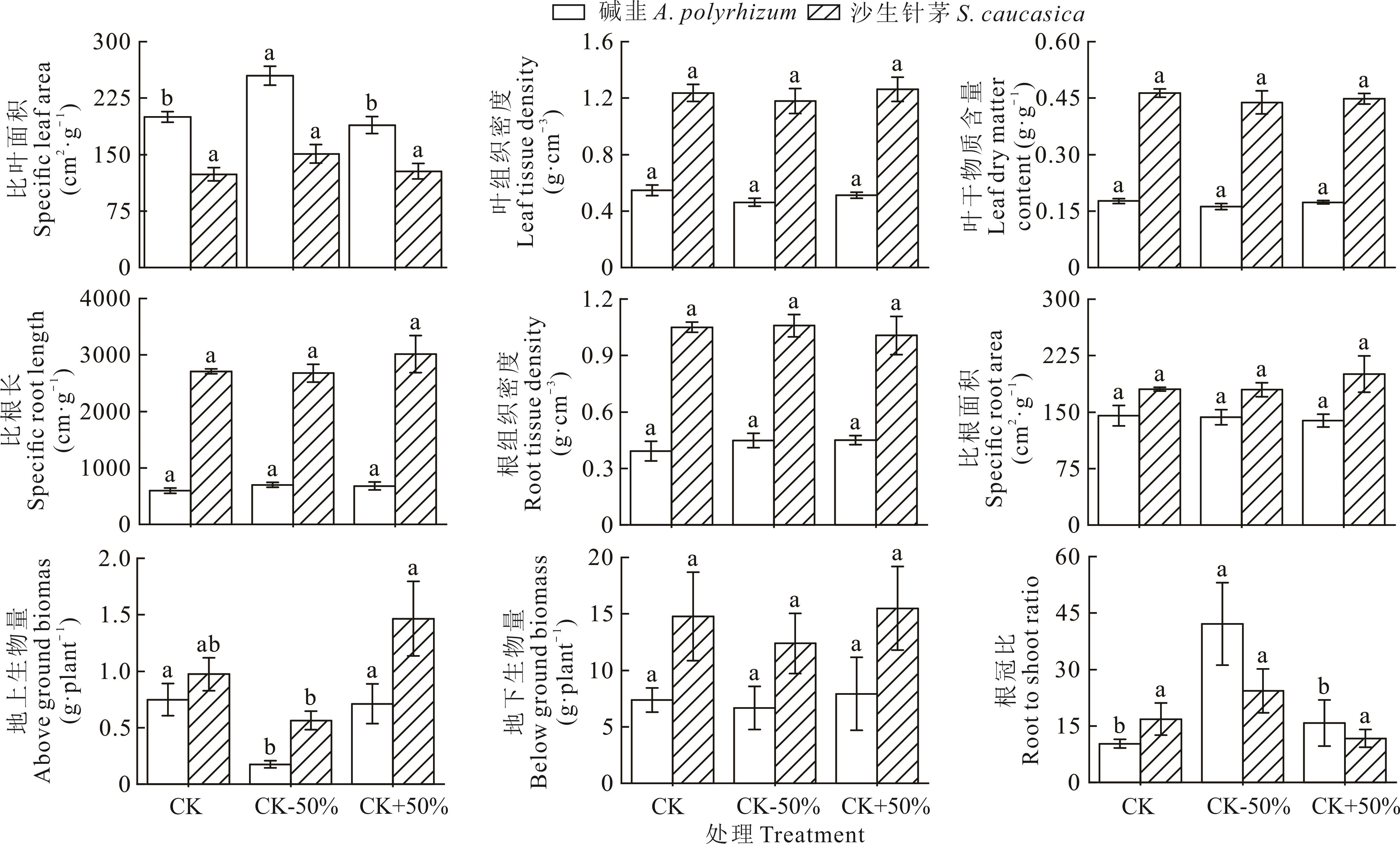
Fig.1 Effects of precipitation changes on aboveground and belowground functional traits and biomass of S. caucasica and A. polyrhizum
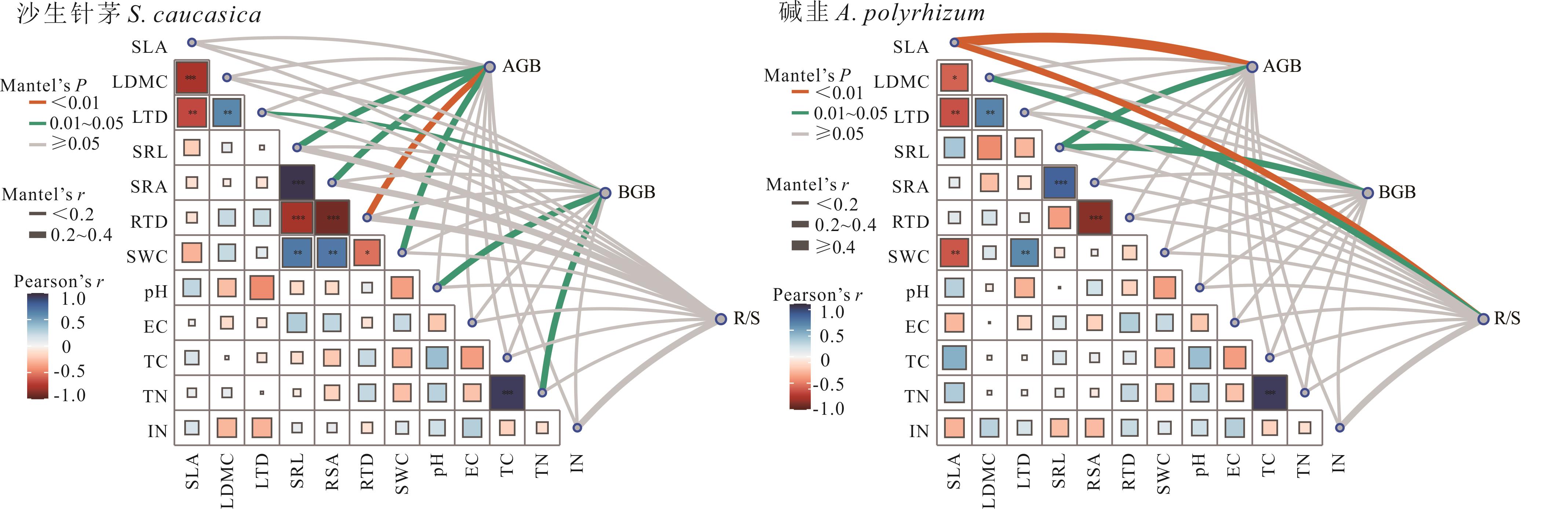
Fig.2 The Mantel test for the biomass, functional traits, and soil factors of S. caucasica and A. polyrhizum
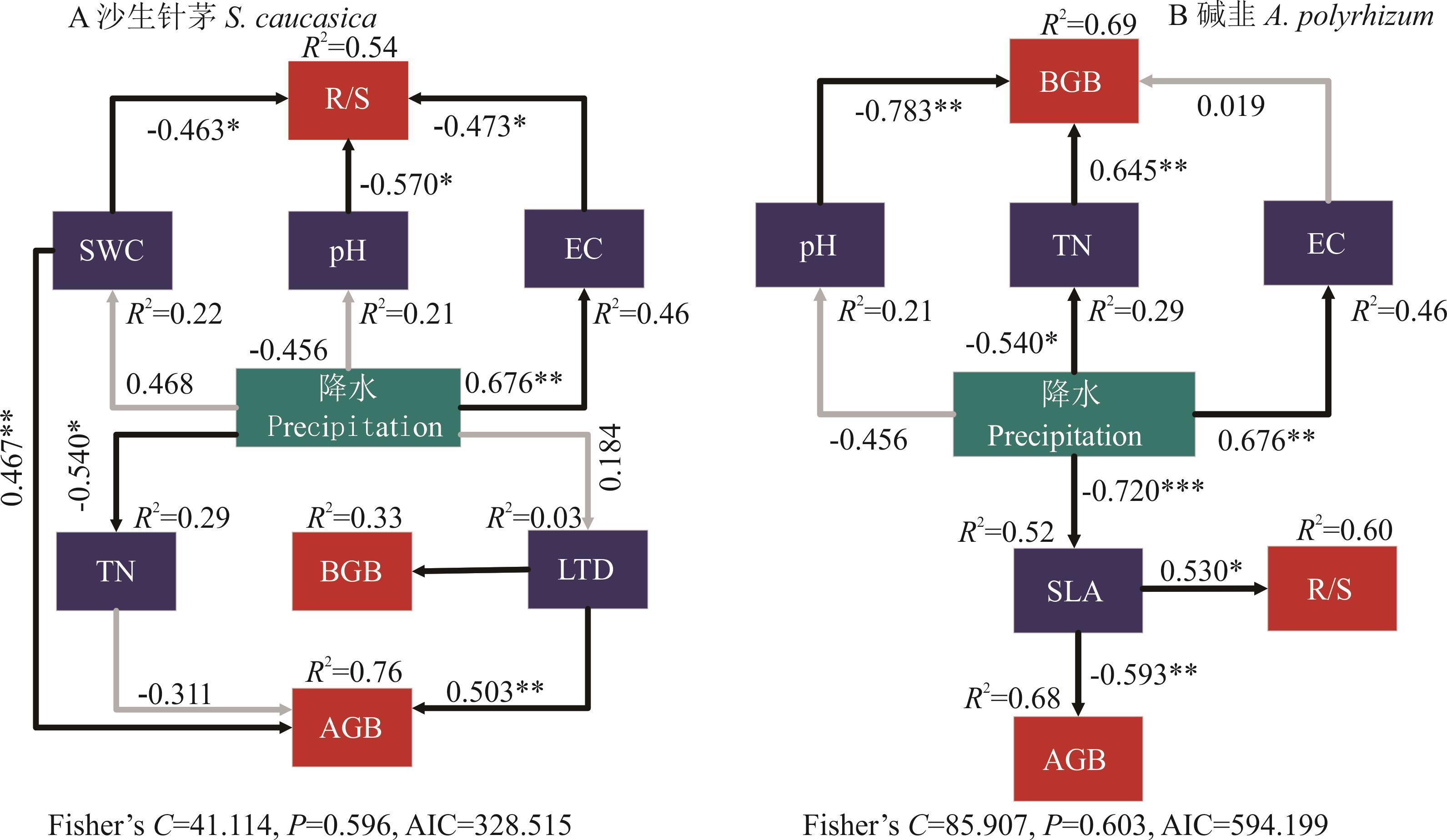
Fig.3 Structural equation models of direct and indirect effects of plant traits and soil factors on biomass allocation of S. caucasica and A. polyrhizum under precipitation variation
| [1] | The Intergovernmental Panel on Climate Change (IPCC). Climate change 2021: The physical science basis. Cambridge: Cambridge University Press, 2021. |
| [2] | Kim J B, So J M, Bae D H. Global warming impacts on severe drought characteristics in Asia Monsoon Region. Water, 2020, 12(5): 1360-1381. |
| [3] | Isbell F, Craven D, Connolly J, et al. Biodiversity increases the resistance of ecosystem productivity to climate extremes. Nature, 2015, 526(7574): 574-577. |
| [4] | Lyu X M, Wang Y H, Zhou G S, et al. Interactive effects of changing precipitation and elevated temperatures on plant biomass and its allocation of Stipa breviflora. Acta Ecologica Sinica, 2015, 35(3): 752-760. |
| 吕晓敏, 王玉辉, 周广胜, 等. 温度与降水协同作用对短花针茅生物量及其分配的影响. 生态学报, 2015, 35(3): 752-760. | |
| [5] | Liu X J, Ma K P. Plant functional traits-concepts, applocations and future directions. Scientia Sinica Vitae, 2015, 45(4): 325-339. |
| 刘晓娟, 马克平. 植物功能性状研究进展. 中国科学: 生命科学, 2015, 45(4): 325-339. | |
| [6] | Meng T T, Ni J, Wang G H. Plant functional traits, environmental and ecosystem functioning. Journal of Plant Ecology, 2007, 31(1): 150-165. |
| 孟婷婷, 倪健, 王国宏. 植物功能性状与环境和生态系统功能. 植物生态学报, 2007, 31(1): 150-165. | |
| [7] | Reich P B. The world-wide ‘fast-slow’ plant economic spectrum: A traits manifesto. Journal of Ecology, 2014, 102(2): 275-301. |
| [8] | Li C B, Zheng Z, Peng Y F, et al. Precipitation and nitrogen addition enhance biomass allocation to aboveground in an alpine steppe. Ecology and Evolution, 2019, 9(21): 12193-12201. |
| [9] | Jin H R, Fan C K, Zhu H Y, et al. Responses of plant biomass allocation to changed precipitation timing in a semi-arid steppe. Plant and Soil, 2024, DOI: 10.1007/s11104-024-06928-9. |
| [10] | Li R, Shan L S, Xie T T, et al. Variation in the leaf functional traits of typical desert shrubs under precipitation gradient. Arid Zone Research, 2023, 40(3): 425-435. |
| 李瑞, 单立山, 解婷婷, 等. 典型荒漠灌木叶片功能性状特征随降水梯度的变化研究. 干旱区研究, 2023, 40(3): 425-435. | |
| [11] | Sun L, Wang Y, Li Y, et al. Non-linear response of leaf functional traits to precipitation in alpine grassland, Qinghai-Tibet Plateau. Acta Ecologica Sinica, 2023, 43(2): 756-767. |
| 孙乐, 王毅, 李洋, 等. 青藏高原高寒草地群落叶片功能性状对降水的非线性响应. 生态学报, 2023, 43(2): 756-767. | |
| [12] | Zhao Y H, Gong X W, Ning Q R, et al. Plasticity and coordination of branch and leaf traits in Ulmus pumila along a precipitation gradient. Chinese Journal of Applied Ecology, 2023, 34(2): 324-332. |
| 赵宇航, 龚雪伟, 宁秋蕊, 等. 沿降水梯度白榆的枝叶性状可塑性与协同变异. 应用生态学报, 2023, 34(2): 324-332. | |
| [13] | Xia L, Ji H, Zhang J Y, et al. Effects of different precipitation on root and leaf functional traits of plants in Inner Mongolia temperate steppe. Acta Botanica Boreali-Occidentalia Sinica, 2022, 42(12): 2112-2122. |
| 夏蕾, 吉卉, 张家铱, 等. 降水差异对内蒙古温带草原植物根系和叶片功能性状的影响. 西北植物学报, 2022, 42(12): 2112-2122. | |
| [14] | Ryalls J M W, Moore B D, Johnson S N, et al. Root responses to domestication, precipitation and silicification: Weeping meadow grass simplifies and alters toughness. Plant and Soil, 2018, 427(1): 291-304. |
| [15] | Isaac M E, Martin A R, Rapidel B, et al. Intraspecific trait variation and coordination: Root and leaf economics spectra in coffee across environmental gradients. Frontiers in Plant Science, 2017, 8(2): 1196-1209. |
| [16] | Li H B, Liu B T, Mccormack M L, et al. Diverse belowground resource strategies underlie plant species coexistence and spatial distribution in three grasslands along a precipitation gradient. New Phytologist, 2017, 216(4): 1140-1150. |
| [17] | Zhou M, Wang J, Bai W, et al. The response of root traits to precipitation changes of herbaceous species in temperate grasslands. Functional Ecology, 2019, 33(10): 2030-2041. |
| [18] | Li X Y, Zuo X A, Yue P, et al. Drought of early time in growing season decreases community aboveground biomass, but increases belowground biomass in a desert steppe. BMC Ecology and Evolution, 2021, 21(1): 106-119. |
| [19] | Zuo X A, Zhang J, Lv P, et al. Plant functional diversity mediates the effects of vegetation and soil properties on community level plant nitrogen use in the restoration of semiarid sandy grassland. Ecological Indicators, 2016, 64: 272-280. |
| [20] | Du Z Y, An H, Wang B, et al. Effects of nutrient addition and precipitation manipulation on plant species diversity and biomass of in a desert grassland. Acta Agrestia Sinica, 2020, 28(4): 1100-1110. |
| 杜忠毓, 安慧, 王波, 等. 养分添加和降水变化对荒漠草原植物群落物种多样性和生物量的影响. 草地学报, 2020, 28(4): 1100-1110. | |
| [21] | Long M, Wu H H, Smith D M, et al. Nitrogen deposition promotes phosphorus uptake of plants in a semi-arid temperate grassland. Plant and Soil, 2016, 408(1/2): 475-484. |
| [22] | Guo X X, Yue P, Li X Y, et al. Effects of precipitation on above-ground biomass of Peganum harmala in desert steppe in Inner Mongolia, China. Journal of Desert Research, 2022, 42(2): 164-172. |
| 郭新新, 岳平, 李香云, 等. 降水量对荒漠草原骆驼蓬(Peganum harmala)地上生物量的影响. 中国沙漠, 2022, 42(2): 164-172. | |
| [23] | Guo X X, Zuo X A, Yue P, et al. Responses of leaf morphological traits of three dominant plants to water and nitrogen in desert steppe of Inner Mongolia. Journal of Desert Research, 2021, 41(1): 137-144. |
| 郭新新, 左小安, 岳平, 等. 内蒙古荒漠草原沙生针茅(Stipa glareosa)、碱韭(Allium polyrhizum)和骆驼蓬(Peganum harmala)叶形态性状对土壤水氮耦合的响应. 中国沙漠, 2021, 41(1): 137-144. | |
| [24] | Wang S K, Zhao X Y, Jia K F, et al. Soil bacterial diversity and its vertical distribution in Stipa klemenzii community of Urad desert steppe. Journal of Desert Research, 2016, 36(6): 1564-1570. |
| 王少昆, 赵学勇, 贾昆峰, 等. 乌拉特荒漠草原小针茅(Stipa klemenzii)群落土壤细菌多样性及垂直分布特征. 中国沙漠, 2016, 36(6): 1564-1570. | |
| [25] | Bao P A, Qiu K Y, Huang Y Y, et al. Leaf functional trait characteristics and plasticity of desert steppe plants under nitrogen and phosphorus addition. Acta Prataculturae Sinica, 2024, 33(3): 97-106. |
| 鲍平安, 邱开阳, 黄业芸, 等.荒漠草原植物在氮磷添加下叶功能性状特征及其可塑性. 草业学报, 2024, 33(3): 97-106. | |
| [26] | Liu Y, Zhong Q L, Xu Z B, et al. Relationship between fine root functional traits and rhizosphere microenvironment of Machilus pauhoi at different sizes. Chinese Journal of Plant Ecology, 2024, 48(6): 744-759. |
| 刘瑶, 钟全林, 徐朝斌, 等. 不同大小刨花楠细根功能性状与根际微环境关系.植物生态学报, 2024, 48(6): 744-759. | |
| [27] | Jing M H, Jia X T, Zhang Y L, et al. Effects of long-term nitrogen addition on community aboveground and belowground biomass and their ratio in a typical steppe of Inner Mongolia. Chinese Journal of Ecology, 2020, 39(10): 3185-3193. |
| 景明慧, 贾晓彤, 张运龙, 等. 长期氮添加对内蒙古典型草原植物地上、地下生物量及根冠比的影响. 生态学杂志, 2020, 39(10): 3185-3193. | |
| [28] | Reynolds S. The gravimetric method of soil moisture determination Part IA study of equipment, and methodological problems. Journal of Hydrology, 1970, 11(3): 258-273. |
| [29] | Huang C B, Zeng F J, Lei J Q. Growth and functional trait responses of Alhagi sparsifolia seedlings to water and nitrogen addition. Acta Prataculturae Sinica, 2016, 25(12): 150-160. |
| 黄彩变, 曾凡江, 雷加强. 骆驼刺幼苗生长和功能性状对不同水氮添加的响应. 草业学报, 2016, 25(12): 150-160. | |
| [30] | Luong J C, Holl K D, Loik M E. Leaf traits and phylogeny explain plant survival and community dynamics in response to extreme drought in a restored coastal grassland. Journal of Applied Ecology, 2021, 58(8): 1670-1680. |
| [31] | Shi Y, Wen Z M, Gong S H. Comparisons of relationships between leaf and fine root traits in hilly area of the Loess Plateau, Yanhe River basin, Shaanxi Province, China. Acta Ecologica Sinica, 2011, 31(22): 6805-6814. |
| 施宇, 温仲明, 龚时慧. 黄土丘陵区植物叶片与细根功能性状关系及其变化. 生态学报, 2011, 31(22): 6805-6814. | |
| [32] | Wright I J, Reich P B, Westoby M. Strategy shifts in leaf physiology, structure and nutrient content between species of high- and low-rainfall and high- and low-nutrient habitats. Functional Ecology, 2001, 15(4): 423-434. |
| [33] | Weemstra M, Mommer L, Visser E J W, et al. Towards a multidimensional root trait framework: A tree root review. The New Phytologist, 2016, 211(4): 1159-1169. |
| [34] | Eapen D, Barroso M L, Ponce G, et al. Hydrotropism: Root growth responses to water. Trends in Plant Science, 2005, 10(1): 44-50. |
| [35] | Sun Y, He M Z, Wang L. Effects of precipitation control on plant diversity and biomass in a desert region. Acta Ecologica Sinica, 2018, 38(7): 2425-2433. |
| 孙岩, 何明珠, 王立. 降水控制对荒漠植物群落物种多样性和生物量的影响. 生态学报, 2018, 38(7): 2425-2433. | |
| [36] | Lu W T, Chong P F, Tian Y L, et al. Effects of simulated precipitation changes and nitrogen deposition on biomass allocation patterns of Reaumuria soongarica and Salsola passerina seedlings under different growth modes. Pratacultural Science, 2021, 38(11): 2144-2154. |
| 陆文涛, 种培芳, 田艳丽, 等. 模拟氮沉降及降水作用下红砂和珍珠猪毛菜幼苗生物量的分配模式. 草业科学, 2021, 38(11): 2144-2154. | |
| [37] | Yan W. Biomass allocation pattern and its influcing factors across typical terrestrial ecosystems in China. Shanghai: East China Normal University, 2017. |
| 颜韦. 中国典型陆地生态系统的生物量分配及其影响因素分析. 上海: 华东师范大学, 2017. | |
| [38] | Kou L, Wu Z M, Yang X D, et al. Responses of root system architecture to water stress at multiple levels: A Meta-analysis of trials under controlled conditions. Frontiers in Plant Science, 2022, 13(1): 1085409. |
| [39] | Wang X, Chen X, Xu J, et al. Precipitation dominates the allocation strategy of above- and belowground biomass in plants on macro scales. Plants, 2023, 12(15): 2843-2855. |
| [40] | Fan R, Lyu S, Ding Y, et al. Interactive effects of soil water, nutrients and clonal fragmentation on root growth of xerophilic plant Stipa breviflora. Agriculture, 2022, 12(12): 2112-2124. |
| [41] | Justin M V, Kekoa C N, Marco C M. Functional traits and drought strategy predict leaf thermal tolerance. Conservation Physiology, 2023, 11(1): 85-100. |
| [1] | Jia-yi YONG, Shuang MA, Feng-hua MA, Xiao-na ZHAO, Yi-yin ZHANG, Hai-ying HU. Effects of drought stress and rehydration on biomass allocation and osmotic regulation characteristics of Indigofera bungeana [J]. Acta Prataculturae Sinica, 2025, 34(7): 158-170. |
| [2] | Wen-hui DENG, Ke-chen SONG, Hao ZHANG, Si-yu GUAN, Jia-yi YONG, Hai-ying HU. Structure and diversity characteristics of the rhizosphere microbial community of dominant plants on the desert steppe under changing precipitation [J]. Acta Prataculturae Sinica, 2025, 34(5): 12-26. |
| [3] | Zhen-hao ZHANG, Zi-yu JIA, Xin-yu LI, Yun-xiang CHENG. Grazing behavior traits of cattle and sheep on mixed pasture in desert steppe [J]. Acta Prataculturae Sinica, 2025, 34(1): 226-237. |
| [4] | Shi-long HE, He YE, Jing LI, Ya-ling ZHANG, Hai-shan DE, Mei HONG. Effects of nitrogen deposition and precipitation changes in different time spans on community structure and diversity of soil meso- and micro-fauna in Stipa breviflora desert steppe [J]. Acta Prataculturae Sinica, 2024, 33(9): 140-154. |
| [5] | Yang-yi-dan HE, Chang-ming CHEN, Xiao-xia HUANG, Guo-mei SHI, Ke-jian HE. A study of the relationship between plant functional traits and environmental factors in the alpine meadows of western Sichuan [J]. Acta Prataculturae Sinica, 2024, 33(9): 28-39. |
| [6] | Ying CAO, Ming-he NIE, Yan SHEN, Yan HU, Deng-bao MA, Dong LI, Teng-si HOU, Peng FANG, Xue-qin WANG. Changes in vegetation and soil characteristics and their correlations in grasslands at different stages of degradation on the desert steppe in an arid wind-sandy area of Ningxia [J]. Acta Prataculturae Sinica, 2024, 33(8): 1-14. |
| [7] | Teng-si HOU, Yan SHEN, Hong-bin MA, Peng FANG, Ying CAO. Effects of Caragana intermedia stubble on soil water characteristics and water balance on the desert steppe [J]. Acta Prataculturae Sinica, 2024, 33(8): 15-24. |
| [8] | Hai-xin JIANG, Yao ZHOU, Ke HU, Zhan-sheng DING, Hong-bin MA. Effects of different grazing times on soil particle composition and fractal dimension in the desert steppe [J]. Acta Prataculturae Sinica, 2024, 33(6): 17-28. |
| [9] | Ya-nan ZHAO, Hong-mei WANG, Zhi-li LI, Zhen-jie ZHANG, Yan-shuo CHEN, Rong-xia SU. Responses of spatial pattern and driving factors for soil water deficit of desert grassland-shrubland transition sites [J]. Acta Prataculturae Sinica, 2024, 33(4): 22-34. |
| [10] | Jun-yao LI, Xing-chi JIANG, Jin-yu HU, Dong-guang WEI, Xue-yong ZHAO, Shao-kun WANG. The effect of microbial organic fertilizers application on vegetation-soil-microbe in desert steppe [J]. Acta Prataculturae Sinica, 2024, 33(3): 34-45. |
| [11] | Ping-an BAO, Kai-yang QIU, Ye-yun HUANG, Si-yao WANG, Lu-yao CUI, Xin-yi LUO, Yun-tao YANG, Ying-zhong XIE. Leaf functional trait characteristics and plasticity of desert steppe plants under nitrogen and phosphorus addition [J]. Acta Prataculturae Sinica, 2024, 33(3): 97-106. |
| [12] | Ping-an BAO, Bo JI, Guo SUN, Na ZHANG, Xu-dong WU, Jian-long HE, Zhan-jun WANG, Ying TIAN. Effects of photovoltaic power station construction on plant community and soil characteristics [J]. Acta Prataculturae Sinica, 2024, 33(12): 23-33. |
| [13] | Yi-ran CHANG, Jia-mei SHI, Dong-mei XU, Ru-long KANG, Yuan MA. Trade-off relationships between biomass and nutrient allocation in different natural populations of Agropyron mongolicum on the desert steppe [J]. Acta Prataculturae Sinica, 2024, 33(11): 186-197. |
| [14] | Min ZHAO, Kun ZHAO, Yun-bo WANG, Guo-mei YIN, Si-bo LIU, Bao-long YAN, Wei-jun MENG, Shi-jie LYU, Guo-dong HAN. Long-term grazing disturbance reduced plant diversity in Stipa breviflora desert steppe [J]. Acta Prataculturae Sinica, 2023, 32(9): 39-49. |
| [15] | Xin-lei LIU, He-qiang DU, Xiu-fan LIU, Ya-wei FAN. Response of aeolian activity to grazing intensities in the desert steppe, Northern China [J]. Acta Prataculturae Sinica, 2023, 32(7): 1-11. |
| Viewed | ||||||
|
Full text |
|
|||||
|
Abstract |
|
|||||
