
ISSN 1004-5759 CN 62-1105/S
Acta Prataculturae Sinica ›› 2026, Vol. 35 ›› Issue (5): 72-84.DOI: 10.11686/cyxb2025163
Previous Articles Next Articles
Tong LIU1,2( ), Surilige1,3, Na JIANG1, Bo PANG1, Wurilige1,3, Tao-yang YANG1,2, Hai-fang ZHANG1(), Jian-ning ZHAO1,2, Dian-lin YANG1
Received:2025-04-29
Revised:2025-08-28
Online:2026-05-20
Published:2026-03-11
Contact:
Hai-fang ZHANG
Tong LIU, Surilige, Na JIANG, Bo PANG, Wurilige, Tao-yang YANG, Hai-fang ZHANG, Jian-ning ZHAO, Dian-lin YANG. Impacts of Euphorbia fischeriana invasion on plant community succession and soil physicochemical properties in Hulunbuir grassland[J]. Acta Prataculturae Sinica, 2026, 35(5): 72-84.
| 序号No. | 植物名Plant name | CK | T1 | T2 | T3 | 序号No. | 植物名Plant name | CK | T1 | T2 | T3 |
|---|---|---|---|---|---|---|---|---|---|---|---|
| 1 | 柄状薹草C. pediformis | 16.63 | 16.46 | 17.33 | 17.96 | 23 | 直立黄芩Scutellaria orthocalyx | - | - | - | 1.54 |
| 2 | 线叶菊F. sibiricum | 16.98 | 12.24 | 20.33 | 15.80 | 24 | 防风Saposhnikovia divaricata | 0.49 | - | 0.73 | 0.14 |
| 3 | 胡枝子L. bicolor | 25.93 | 11.33 | 10.79 | 13.66 | 25 | 冷蒿Artemisia frigida | 0.46 | 0.30 | - | 0.48 |
| 4 | 黄芩S. baicalensis | 3.87 | 25.00 | 13.73 | 10.74 | 26 | 地榆Sanguisorba officinalis | 0.21 | 0.32 | 0.58 | - |
| 5 | 狼毒大戟E. fischeriana | - | 8.30 | 16.93 | 18.90 | 27 | 二裂叶委陵菜Potentilla bifurca | 0.28 | - | - | 0.45 |
| 6 | 瓣蕊唐松草Thalictrum petaloideum | 8.48 | 2.61 | 3.35 | 2.18 | 28 | 草地早熟禾Poa pratensis | - | - | 0.42 | 0.30 |
| 7 | 羊草Leymus chinensis | 5.58 | 6.99 | 1.51 | 1.91 | 29 | 蓬子菜Galium verum | 0.06 | 0.29 | 0.15 | 0.19 |
| 8 | 沙参Adenophora stricta | 1.59 | 3.32 | 4.50 | 3.92 | 30 | 山韭Allium senescens | 0.23 | - | 0.35 | - |
| 9 | 贝加尔针茅Stipa baicalensis | 4.50 | 3.08 | 0.27 | 0.11 | 31 | 鸦葱Takhtajaniantha austriaca | - | - | 0.11 | 0.36 |
| 10 | 棉团铁线莲Clematis hexapetala | 2.15 | 1.14 | 1.38 | 2.59 | 32 | 猪毛蒿Artemisia scoparia | - | 0.16 | 0.24 | 0.06 |
| 11 | 花苜蓿Medicago ruthenica | 3.57 | 2.74 | 0.36 | 0.17 | 33 | 轮叶委陵菜Potentilla verticillaris | 0.12 | 0.07 | - | 0.24 |
| 12 | 细叶白头翁Pulsatilla turczaninovii | 1.87 | 1.25 | 0.49 | 1.08 | 34 | 野鸢尾Iris dichotoma | - | - | 0.34 | - |
| 13 | 裂叶蒿Artemisia laciniata | 0.33 | 2.70 | 0.91 | 0.18 | 35 | 狗舌草Senceio campestris | 0.19 | 0.09 | - | - |
| 14 | 北柴胡Bupleurum chinense | 0.59 | 0.39 | 1.87 | 1.35 | 36 | 羽茅Achnatherum sibiricum | - | - | - | 0.28 |
| 15 | 囊花鸢尾Iris ventricosa | 0.58 | 0.96 | 1.02 | 1.00 | 37 | 星毛委陵菜Potentilla acaulis | - | - | - | 0.27 |
| 16 | 菊叶委陵菜Potentilla tanacetifolia | 1.11 | 0.77 | 1.25 | 0.46 | 38 | 柳叶婆婆纳Veronica linariifolia | - | 0.09 | 0.12 | 0.05 |
| 17 | 牧马豆Thermopsis lanceolata | 1.21 | 0.70 | - | 1.21 | 39 | 大头委陵菜Potentilla conferta | 0.21 | - | - | - |
| 18 | 北麻花头Serratula komarovii | 2.47 | 0.36 | - | 0.12 | 40 | 洽草Koeleria macrantha | - | - | - | 0.16 |
| 19 | 大黄花Cymbaria daurica | 0.23 | 0.42 | 0.23 | 1.25 | 41 | 石竹Dianthus chinensis | 0.10 | - | - | - |
| 20 | 多叶棘豆Oxytropis myriophylla | 0.51 | 0.73 | 0.57 | 0.14 | 42 | 粗根鸢尾Iris tigridia | 0.09 | - | - | - |
| 21 | 大野豌豆Vicia sinogigantea | 0.46 | 0.75 | 0.14 | 0.39 | 43 | 柳穿鱼Linaria vulgaris | - | - | - | 0.05 |
| 22 | 大针茅Stipa grandis | 0.63 | 0.64 | - | 0.30 |
Table 1 Dominance of plant community under different infestation levels of E. fischeriana (%)
| 序号No. | 植物名Plant name | CK | T1 | T2 | T3 | 序号No. | 植物名Plant name | CK | T1 | T2 | T3 |
|---|---|---|---|---|---|---|---|---|---|---|---|
| 1 | 柄状薹草C. pediformis | 16.63 | 16.46 | 17.33 | 17.96 | 23 | 直立黄芩Scutellaria orthocalyx | - | - | - | 1.54 |
| 2 | 线叶菊F. sibiricum | 16.98 | 12.24 | 20.33 | 15.80 | 24 | 防风Saposhnikovia divaricata | 0.49 | - | 0.73 | 0.14 |
| 3 | 胡枝子L. bicolor | 25.93 | 11.33 | 10.79 | 13.66 | 25 | 冷蒿Artemisia frigida | 0.46 | 0.30 | - | 0.48 |
| 4 | 黄芩S. baicalensis | 3.87 | 25.00 | 13.73 | 10.74 | 26 | 地榆Sanguisorba officinalis | 0.21 | 0.32 | 0.58 | - |
| 5 | 狼毒大戟E. fischeriana | - | 8.30 | 16.93 | 18.90 | 27 | 二裂叶委陵菜Potentilla bifurca | 0.28 | - | - | 0.45 |
| 6 | 瓣蕊唐松草Thalictrum petaloideum | 8.48 | 2.61 | 3.35 | 2.18 | 28 | 草地早熟禾Poa pratensis | - | - | 0.42 | 0.30 |
| 7 | 羊草Leymus chinensis | 5.58 | 6.99 | 1.51 | 1.91 | 29 | 蓬子菜Galium verum | 0.06 | 0.29 | 0.15 | 0.19 |
| 8 | 沙参Adenophora stricta | 1.59 | 3.32 | 4.50 | 3.92 | 30 | 山韭Allium senescens | 0.23 | - | 0.35 | - |
| 9 | 贝加尔针茅Stipa baicalensis | 4.50 | 3.08 | 0.27 | 0.11 | 31 | 鸦葱Takhtajaniantha austriaca | - | - | 0.11 | 0.36 |
| 10 | 棉团铁线莲Clematis hexapetala | 2.15 | 1.14 | 1.38 | 2.59 | 32 | 猪毛蒿Artemisia scoparia | - | 0.16 | 0.24 | 0.06 |
| 11 | 花苜蓿Medicago ruthenica | 3.57 | 2.74 | 0.36 | 0.17 | 33 | 轮叶委陵菜Potentilla verticillaris | 0.12 | 0.07 | - | 0.24 |
| 12 | 细叶白头翁Pulsatilla turczaninovii | 1.87 | 1.25 | 0.49 | 1.08 | 34 | 野鸢尾Iris dichotoma | - | - | 0.34 | - |
| 13 | 裂叶蒿Artemisia laciniata | 0.33 | 2.70 | 0.91 | 0.18 | 35 | 狗舌草Senceio campestris | 0.19 | 0.09 | - | - |
| 14 | 北柴胡Bupleurum chinense | 0.59 | 0.39 | 1.87 | 1.35 | 36 | 羽茅Achnatherum sibiricum | - | - | - | 0.28 |
| 15 | 囊花鸢尾Iris ventricosa | 0.58 | 0.96 | 1.02 | 1.00 | 37 | 星毛委陵菜Potentilla acaulis | - | - | - | 0.27 |
| 16 | 菊叶委陵菜Potentilla tanacetifolia | 1.11 | 0.77 | 1.25 | 0.46 | 38 | 柳叶婆婆纳Veronica linariifolia | - | 0.09 | 0.12 | 0.05 |
| 17 | 牧马豆Thermopsis lanceolata | 1.21 | 0.70 | - | 1.21 | 39 | 大头委陵菜Potentilla conferta | 0.21 | - | - | - |
| 18 | 北麻花头Serratula komarovii | 2.47 | 0.36 | - | 0.12 | 40 | 洽草Koeleria macrantha | - | - | - | 0.16 |
| 19 | 大黄花Cymbaria daurica | 0.23 | 0.42 | 0.23 | 1.25 | 41 | 石竹Dianthus chinensis | 0.10 | - | - | - |
| 20 | 多叶棘豆Oxytropis myriophylla | 0.51 | 0.73 | 0.57 | 0.14 | 42 | 粗根鸢尾Iris tigridia | 0.09 | - | - | - |
| 21 | 大野豌豆Vicia sinogigantea | 0.46 | 0.75 | 0.14 | 0.39 | 43 | 柳穿鱼Linaria vulgaris | - | - | - | 0.05 |
| 22 | 大针茅Stipa grandis | 0.63 | 0.64 | - | 0.30 |
| 项目Item | CK | T1 | T2 | T3 |
|---|---|---|---|---|
| 狼毒大戟E. fischeriana | 0±0d | 24.79±4.79c | 39.76±2.79b | 52.91±6.02a |
| 线叶菊F. sibiricum | 60.96±18.55a | 22.08±8.91b | 29.29±5.11b | 34.87±6.50b |
| 柄状薹草C. pediformis | 37.71±3.76a | 26.21±3.20b | 29.79±3.16ab | 31.96±3.98ab |
| 胡枝子L. bicolor | 87.76±11.28a | 26.92±7.54b | 16.90±3.73b | 27.71±3.91b |
| 黄芩S. baicalensis | 8.66±5.02b | 74.83±20.75a | 30.56±3.98b | 27.04±7.34b |
| 沙参A. stricta | 4.45±2.45b | 5.71±1.81ab | 9.08±2.90ab | 11.55±1.22a |
| 棉团铁线莲C. hexapetala | 14.97±11.23a | 2.79±2.63a | 3.36±2.40a | 8.99±3.36a |
| 瓣蕊唐松草T. petaloideum | 26.22±6.70a | 2.28±0.72b | 3.03±2.03b | 2.34±1.15b |
| 贝加尔针茅S. baicalensis | 12.44±5.16a | 3.85±1.52b | 0.10±0.10b | 0.13±0.13b |
| 羊草L. chinensis | 9.03±5.12a | 7.01±5.46a | 1.13±1.13a | 1.29±1.01a |
| 其他植物Other plants | 35.22±5.29a | 18.45±3.69b | 7.93±1.94b | 12.70±4.07b |
| 合计Total | 297.40±23.74a | 202.47±18.31b | 170.93±6.57b | 217.06±14.40b |
Table 2 Aboveground biomass of dominant plant species under different infestation levels of E. fischeriana (g·m-2)
| 项目Item | CK | T1 | T2 | T3 |
|---|---|---|---|---|
| 狼毒大戟E. fischeriana | 0±0d | 24.79±4.79c | 39.76±2.79b | 52.91±6.02a |
| 线叶菊F. sibiricum | 60.96±18.55a | 22.08±8.91b | 29.29±5.11b | 34.87±6.50b |
| 柄状薹草C. pediformis | 37.71±3.76a | 26.21±3.20b | 29.79±3.16ab | 31.96±3.98ab |
| 胡枝子L. bicolor | 87.76±11.28a | 26.92±7.54b | 16.90±3.73b | 27.71±3.91b |
| 黄芩S. baicalensis | 8.66±5.02b | 74.83±20.75a | 30.56±3.98b | 27.04±7.34b |
| 沙参A. stricta | 4.45±2.45b | 5.71±1.81ab | 9.08±2.90ab | 11.55±1.22a |
| 棉团铁线莲C. hexapetala | 14.97±11.23a | 2.79±2.63a | 3.36±2.40a | 8.99±3.36a |
| 瓣蕊唐松草T. petaloideum | 26.22±6.70a | 2.28±0.72b | 3.03±2.03b | 2.34±1.15b |
| 贝加尔针茅S. baicalensis | 12.44±5.16a | 3.85±1.52b | 0.10±0.10b | 0.13±0.13b |
| 羊草L. chinensis | 9.03±5.12a | 7.01±5.46a | 1.13±1.13a | 1.29±1.01a |
| 其他植物Other plants | 35.22±5.29a | 18.45±3.69b | 7.93±1.94b | 12.70±4.07b |
| 合计Total | 297.40±23.74a | 202.47±18.31b | 170.93±6.57b | 217.06±14.40b |
| 指标Index | CK | T1 | T2 | T3 |
|---|---|---|---|---|
| 丰富度指数Species richness index (S) | 18.33±0.76a | 15.00±0.82b | 13.83±0.70b | 19.60±0.51a |
| Shannon-Wiener指数Shannon-Wiener index (H) | 2.18±0.04a | 2.09±0.09a | 2.12±0.06a | 2.22±0.07a |
| Simpson指数Simpson index (D) | 0.84±0.01a | 0.83±0.02a | 0.85±0.01a | 0.83±0.01a |
| Pielou指数Pielou index (E) | 0.75±0.01a | 0.77±0.03a | 0.81±0.02a | 0.78±0.01a |
Table 3 Plant community richness and diversity
| 指标Index | CK | T1 | T2 | T3 |
|---|---|---|---|---|
| 丰富度指数Species richness index (S) | 18.33±0.76a | 15.00±0.82b | 13.83±0.70b | 19.60±0.51a |
| Shannon-Wiener指数Shannon-Wiener index (H) | 2.18±0.04a | 2.09±0.09a | 2.12±0.06a | 2.22±0.07a |
| Simpson指数Simpson index (D) | 0.84±0.01a | 0.83±0.02a | 0.85±0.01a | 0.83±0.01a |
| Pielou指数Pielou index (E) | 0.75±0.01a | 0.77±0.03a | 0.81±0.02a | 0.78±0.01a |
| 植物名Plant name | CK | T1 | T2 | T3 |
|---|---|---|---|---|
| 狼毒大戟E. fischeriana | - | 5.70 | 5.93 | 5.81 |
| 柄状薹草C. pediformis | 5.86 | 5.95 | 5.86 | 5.77 |
| 线叶菊F. sibiricum | 4.36 | 3.17 | 5.60 | 5.39 |
| 胡枝子L. bicolor | 5.78 | 5.16 | 4.15 | 5.39 |
| 黄芩S. baicalensis | 2.38 | 5.50 | 4.23 | 4.45 |
| 沙参A. stricta | 2.47 | 3.84 | 4.27 | 5.72 |
| 棉团铁线莲C. hexapetala | 1.78 | 1.22 | 3.57 | 4.44 |
| 瓣蕊唐松草T. petaloideum | 4.78 | 3.78 | 3.03 | 3.42 |
| 羊草L. chinensis | 3.44 | 1.95 | 1.00 | 1.89 |
| 北柴胡B. chinense | - | - | 2.64 | 3.52 |
| 贝加尔针茅S. baicalensis | 2.96 | 4.00 | 1.00 | 1.00 |
Table 4 Niche breadth of dominant community plant species under different infestation levels of E. fischeriana
| 植物名Plant name | CK | T1 | T2 | T3 |
|---|---|---|---|---|
| 狼毒大戟E. fischeriana | - | 5.70 | 5.93 | 5.81 |
| 柄状薹草C. pediformis | 5.86 | 5.95 | 5.86 | 5.77 |
| 线叶菊F. sibiricum | 4.36 | 3.17 | 5.60 | 5.39 |
| 胡枝子L. bicolor | 5.78 | 5.16 | 4.15 | 5.39 |
| 黄芩S. baicalensis | 2.38 | 5.50 | 4.23 | 4.45 |
| 沙参A. stricta | 2.47 | 3.84 | 4.27 | 5.72 |
| 棉团铁线莲C. hexapetala | 1.78 | 1.22 | 3.57 | 4.44 |
| 瓣蕊唐松草T. petaloideum | 4.78 | 3.78 | 3.03 | 3.42 |
| 羊草L. chinensis | 3.44 | 1.95 | 1.00 | 1.89 |
| 北柴胡B. chinense | - | - | 2.64 | 3.52 |
| 贝加尔针茅S. baicalensis | 2.96 | 4.00 | 1.00 | 1.00 |
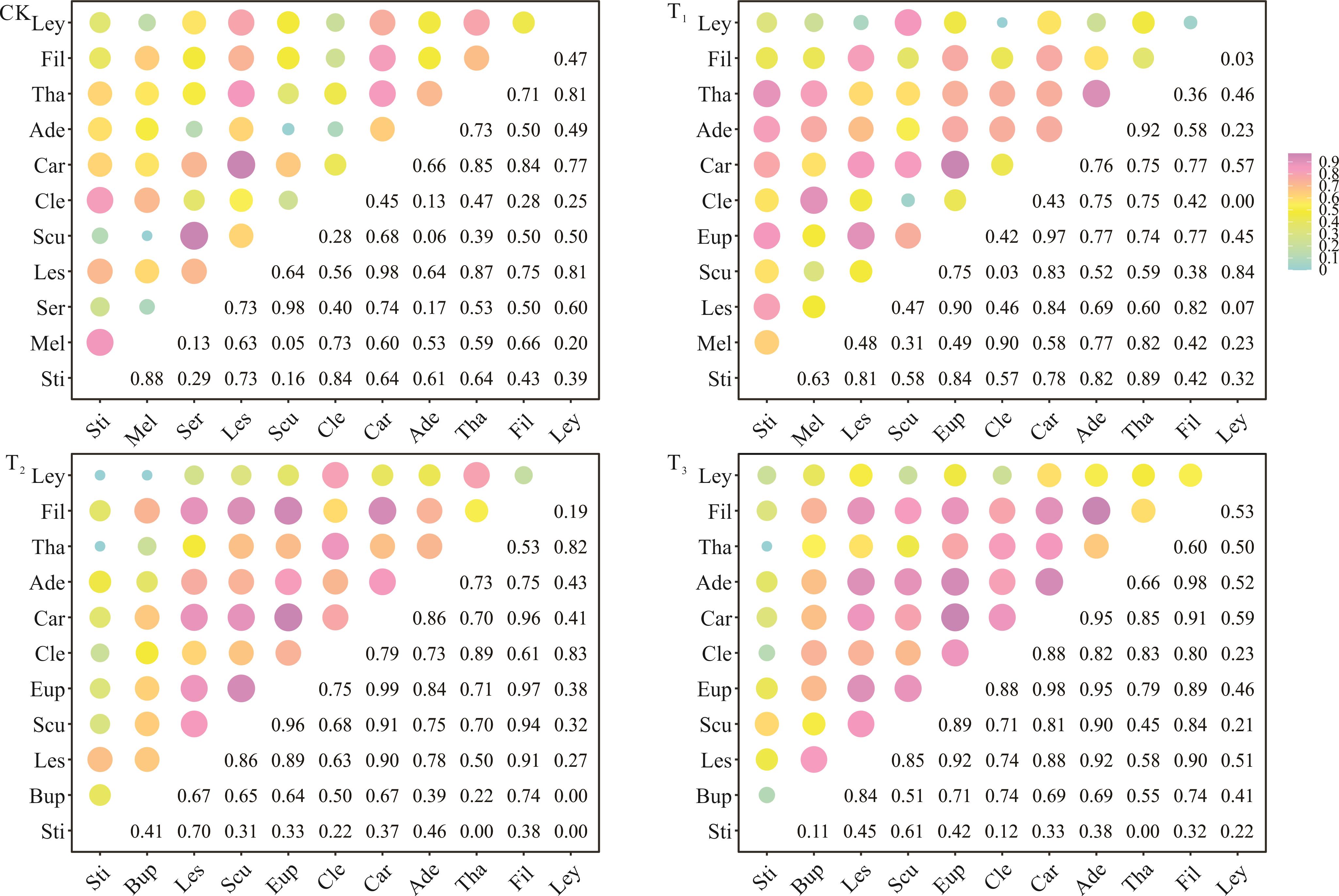
Fig.1 Niche overlap index of dominant grassland species under different infestation levels of E. fischeriana
| 指标Index | CK | T1 | T2 | T3 |
|---|---|---|---|---|
| pH | 7.68±0.12a | 7.88±0.03a | 7.74±0.07a | 7.75±0.10a |
| 土壤含水量Soil water content (%) | 14.67±0.67a | 13.52±0.30a | 14.20±0.53a | 13.55±0.21a |
| 有机质Soil organic matter (g·kg-1) | 61.31±1.35b | 57.67±1.00c | 59.28±0.38bc | 69.31±0.37a |
| 全氮Total nitrogen (g·kg-1) | 1.04±0.01b | 1.32±0.05a | 1.40±0.13a | 1.41±0.05a |
| 铵态氮Ammonium nitrogen (mg·kg-1) | 12.27±0.17a | 11.39±0.41c | 12.64±0.22bc | 14.70±0.47a |
| 硝态氮Nitrate nitrogen (mg·kg-1) | 15.49±0.40a | 14.61±0.29a | 14.57±0.52a | 13.12±0.30b |
| 全磷Total phosphorus (g·kg-1) | 0.48±0.02a | 0.42±0.02ab | 0.38±0.03b | 0.40±0.03b |
| 速效磷Available phosphorus (mg·kg-1) | 5.30±0.17b | 5.47±0.11b | 5.79±0.21b | 6.88±0.30a |
Table 5 Soil physicochemical properties under different infestation levels of E. fischeriana
| 指标Index | CK | T1 | T2 | T3 |
|---|---|---|---|---|
| pH | 7.68±0.12a | 7.88±0.03a | 7.74±0.07a | 7.75±0.10a |
| 土壤含水量Soil water content (%) | 14.67±0.67a | 13.52±0.30a | 14.20±0.53a | 13.55±0.21a |
| 有机质Soil organic matter (g·kg-1) | 61.31±1.35b | 57.67±1.00c | 59.28±0.38bc | 69.31±0.37a |
| 全氮Total nitrogen (g·kg-1) | 1.04±0.01b | 1.32±0.05a | 1.40±0.13a | 1.41±0.05a |
| 铵态氮Ammonium nitrogen (mg·kg-1) | 12.27±0.17a | 11.39±0.41c | 12.64±0.22bc | 14.70±0.47a |
| 硝态氮Nitrate nitrogen (mg·kg-1) | 15.49±0.40a | 14.61±0.29a | 14.57±0.52a | 13.12±0.30b |
| 全磷Total phosphorus (g·kg-1) | 0.48±0.02a | 0.42±0.02ab | 0.38±0.03b | 0.40±0.03b |
| 速效磷Available phosphorus (mg·kg-1) | 5.30±0.17b | 5.47±0.11b | 5.79±0.21b | 6.88±0.30a |
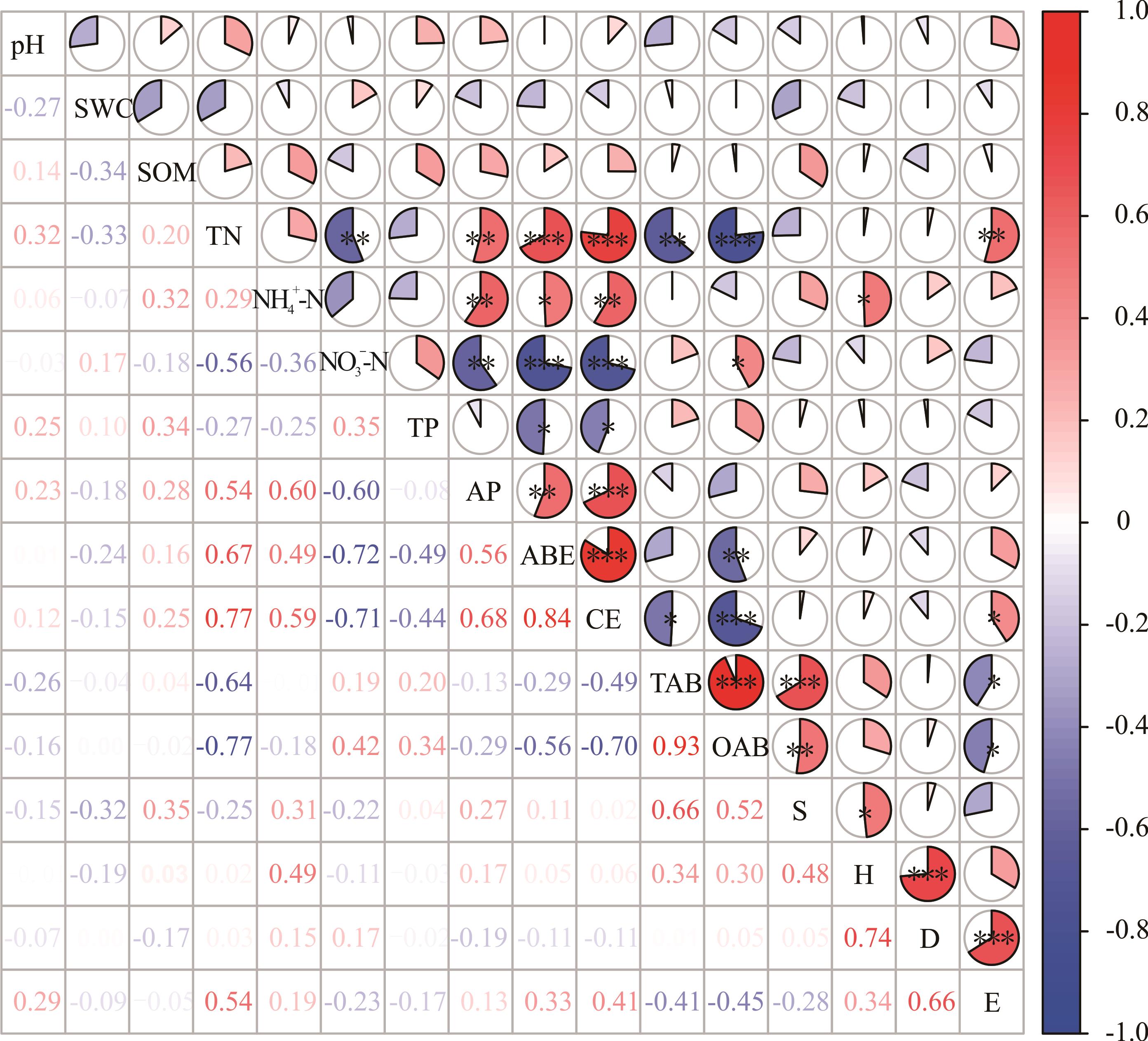
Fig.2 Correlation coefficient between aboveground plant biomass, community diversity indices, and soil physicochemical factors
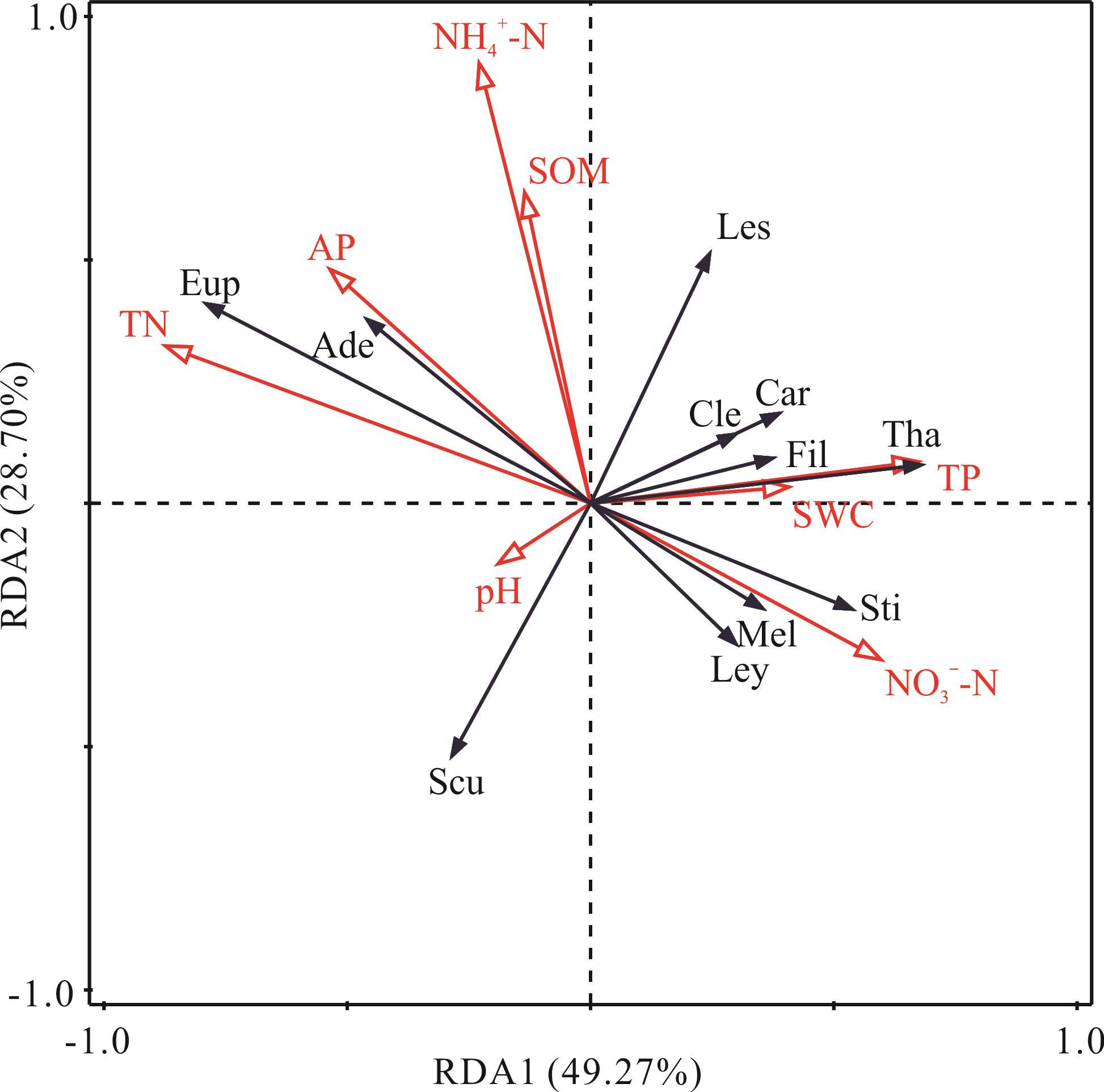
Fig.3 Redundancy analysis (RDA) of main plant species and soil physicochemical factors in the community
| [1] | Gu C, Jia Z Q, Du B B, et al. Reviews and prospects of ecological restoration measures for degraded grasslands of China. Ecology and Environmental Sciences, 2022, 31(7): 1465-1475. |
| 古琛, 贾志清, 杜波波, 等. 中国退化草地生态修复措施综述与展望. 生态环境学报, 2022, 31(7): 1465-1475. | |
| [2] | Wang S X, Yang S L, Gao W, et al. Hulunbuir grassland resource area change analysis. Inner Mongolia Prataculture, 2008(1): 49-51. |
| 王世新, 杨胜利, 高娃, 等. 呼伦贝尔草原资源面积变化分析. 内蒙古草业, 2008(1): 49-51. | |
| [3] | Sun G, Luo P, Wu N, et al. Stellera chamaejasme L. increases soil N availability, turnover rates and microbial biomass in an alpine meadow ecosystem on the eastern Tibetan Plateau of China. Soil Biology and Biochemistry, 2009, 41(1): 86-91. |
| [4] | Zhang Y, Cui Z B, Wang T T, et al. Expansion of native plant Stellera chamaejasme L. alters the structure of soil diazotrophic community in a salinized meadow grassland, northeast China. Agronomy, 2021, 11(10): 2085. |
| [5] | Yang C, Sharikou, Surilage, et al.Research progress on distribution, toxicity, control and utilization of poisonous grass species in natural grassland of China. Journal of Domestic Animal Ecology, 2022, 43(11): 88-96. |
| 杨晨, 沙日扣, 苏日拉格, 等. 中国天然草原毒害草种类分布、毒性及防控与利用研究进展. 家畜生态学报, 2022, 43(11): 88-96. | |
| [6] | Zhou Q W, Zhao B Y, Lu H, et al. The research and control situation of ecology and animal poisoning of locoweed in western natural grassland of China. Scientia Agricultura Sinica, 2013, 46(6): 1280-1296. |
| 周启武, 赵宝玉, 路浩, 等. 中国西部天然草地疯草生态及动物疯草中毒研究与防控现状. 中国农业科学, 2013, 46(6): 1280-1296. | |
| [7] | Chi X X, Guo S Q, Wang Z W, et al. Control methods of Euphorbia fischeriana in grassland. Grassland and Prataculture, 2022, 34(1): 47-50. |
| 迟晓雪, 郭司群, 王志伟, 等. 草原狼毒大戟防控方法研究. 草原与草业, 2022, 34(1): 47-50. | |
| [8] | Higgins S I, Richardson D M. Invasive plants have broader physiological niches. Proceedings of the National Academy of Sciences, 2014, 111(29): 10610-10614. |
| [9] | Carboni L J, Biganzoli F, Cipriotti P A. Niche shifts drive the global distribution of a widespread plant invader of rangelands. Biological Invasions, 2024, 27(1): 25-27. |
| [10] | Huang B, Wang Y, Deng X B, et al. Study on the effects of different degradation types in alpine grasslands on plant diversity and interspecific relationships-A case study of Li County. Journal of Sichuan Forestry Science and Technology, 2024, 45(5): 85-91. |
| 黄波, 王悦, 邓小兵, 等. 高寒草地不同退化类型对植物多样性与种间关系的影响研究——以理县为例. 四川林业科技, 2024, 45(5): 85-91. | |
| [11] | HulunBuir Forestry and Grassland Bureau. Technical specification for integrated control of Euphorbia fischeriana steud: DB1507/T 96-2023. Hulunbuir: Hulunbuir Market Supervision and Administration Bureau, 2023: 3. |
| 呼伦贝尔市林业和草原局. 狼毒大戟综合防治技术规程: DB1507/T 96-2023. 呼伦贝尔市: 呼伦贝尔市市场监督管理局, 2023: 3. | |
| [12] | Bao S D. Soil analysis in agricultural chemistry. Beijing: China Agriculture Press, 2008. |
| 鲍士旦. 土壤农化分析. 北京: 中国农业出版社, 2008. | |
| [13] | Song S H, Wang R J, Xin Y, et al. Rapid determination of inorganic nitrogen in soil by spectrophotometry with microplate reader. Chinese Journal of Inorganic Analytical Chemistry, 2019, 9(2): 35-41. |
| 宋书会, 王汝健, 辛宇, 等. 全波长扫描式多功能读数仪-分光光度法测定土壤中无机氮. 中国无机分析化学, 2019, 9(2): 35-41. | |
| [14] | Rong G H, Zhou J Y, Wu H Y, et al. Comparative study on the flow analyzer and the Kjeldahl nitrogen analyzer for measuring soil total nitrogen. Research of Soil and Water Conservation, 2023, 30(1): 204-208. |
| 荣国华, 周景云, 吴鸿宇, 等. 流动分析仪与凯氏定氮仪测定土壤全氮含量之比较研究. 水土保持研究, 2023, 30(1): 204-208. | |
| [15] | Peng Y Z, Xiao H C, Lin Y Y, et al. Determination of total phosphorus in soil using continuous flow analysis and ammonium molybdate spectrophotometry. Journal of Fujian Normal University (Natural Science Edition), 2024, 40(3): 24-28, 53. |
| 彭园珍, 肖华翠, 林燕语, 等. 连续流动-钼酸铵分光光度法测定土壤全磷. 福建师范大学学报(自然科学版), 2024, 40(3): 24-28, 53. | |
| [16] | Qin R M, Wei J J, Ma L, et al. Effects of Pedicularis kansuensis expansion on plant community characteristics and soil nutrients in an alpine grassland. Plants, 2022, 11(13): 1673. |
| [17] | Ren H, Zhao C Z, An L J. Spatial point patterns of Stellera chamaejasme and Stipa krylovii populations in degraded grassland of noxious and miscellaneous types based on Ripley’s K(r) function. Journal of Arid Land Resources and Environment, 2015, 29(1): 59-64. |
| 任珩, 赵成章, 安丽涓. 基于Ripley的K(r)函数的“毒杂草”型退化草地狼毒与西北针茅种群空间分布格局. 干旱区资源与环境, 2015, 29(1): 59-64. | |
| [18] | Yin H Y, Chu X H, Shan G L, et al. Study on the community structure and species diversity of degraded subalpine meadow with different coverages of Euphorbia jolkinii. Journal of Yunnan Agricultural University (Natural Science), 2019, 34(3): 473-478. |
| 尹海燕, 初晓辉, 单贵莲, 等. 不同大狼毒覆盖度退化亚高山草甸群落结构及物种多样性研究. 云南农业大学学报(自然科学), 2019, 34(3): 473-478. | |
| [19] | Zhang P, Liang Y H, Zhao X L, et al. Artificial cultivation of Euphorbia fischeriana and development of biopesticides: A comprehensive study. Shelterbelt Technology, 2005(5): 87, 5. |
| 张萍, 梁延海, 赵雪岭, 等. 狼毒大戟人工栽培及其生物农药开发. 防护林科技, 2005(5): 87, 5. | |
| [20] | Tedersoo L, Bahram M, Zobel M. How mycorrhizal associations drive plant population and community biology. Science, 2020, 367(6480): eaba1223. |
| [21] | Zhang Z C, Sun J, Liu M, et al. Don’t judge toxic weeds on whether they are native but on their ecological effects. Ecology and Evolution, 2020, 10(17): 9014-9025. |
| [22] | Wang H Y, Guo J Y, Dong Z, et al. Effect of degradation on the community structure and plant species diversity of Stipa grandis steppe. Journal of Arid Land Resources and Environment, 2016, 30(3): 106-111. |
| 王合云, 郭建英, 董智, 等. 退化程度对大针茅草原植物群落结构特征及物种多样性的影响. 干旱区资源与环境, 2016, 30(3): 106-111. | |
| [23] | Liu Z L, Wang W, Hao D Y, et al. Discussion on the mechanism of degradation and restoration succession of Inner Mongolian grassland. Journal of Arid Land Resources and Environment, 2002, 16(1): 84-91. |
| 刘钟龄, 王炜, 郝敦元, 等. 内蒙古草原退化与恢复演替机理的探讨. 干旱区资源与环境, 2002, 16(1): 84-91. | |
| [24] | Valliere J M, Balch S, Bell C, et al. Repeated mowing to restore remnant native grasslands invaded by nonnative annual grasses: Upsides and downsides above and below ground. Restoration Ecology, 2019, 27(2): 261-268. |
| [25] | Qu S M, Peng F H, He S Z, et al. Research on the effect of herbicides in controlling Euphorbia fischeriana. Modern Animal Husbandry, 2017(24): 63-65. |
| 曲善民, 彭芳华, 何树志, 等. 除草剂灭杀狼毒大戟效果研究. 当代畜牧, 2017(24): 63-65. | |
| [26] | Buisson E, Stradic S L, Silveira F A O, et al. Resilience and restoration of tropical and subtropical grasslands, savannas, and grassy woodlands. Biological Reviews, 2019, 94(2): 590-609. |
| [27] | Liu X M, Luo J F, Chen D Z, et al. Floristic assembly and dominant population niches in degraded grasslands on the Zoigê Plateau. Journal of Zhejiang A&F University, 2019, 36(2): 289-297. |
| 刘学敏, 罗久富, 陈德朝, 等. 若尔盖高原不同退化程度草地植物种群生态位特征. 浙江农林大学学报, 2019, 36(2): 289-297. | |
| [28] | Xie C P, Fang Y, Fang Y M. Analysis on the tree stratum niche characteristics of Quercus phillyraeoides communities. Science of Soil and Water Conservation, 2011, 9(1): 108-114, 120. |
| 谢春平, 方彦, 方炎明. 乌冈栎群落乔木层种群生态位分析. 中国水土保持科学, 2011, 9(1): 108-114, 120. | |
| [29] | Ma J G, Li Y M, Wang S L, et al. Soil and vegetation characteristics during the formation of typical Ligularia virgaurea degraded grassland. Chinese Journal of Applied Ecology, 2023, 34(8): 2153-2160. |
| 马建国, 李玉满, 王树林, 等. 典型黄帚橐吾型退化草地形成过程中土壤和植被特征. 应用生态学报, 2023, 34(8): 2153-2160. | |
| [30] | Pianka E R. Niche overlap and diffuse competition. Proceedings of the National Academy of Sciences, 1974, 71(5): 2141-2145. |
| [31] | Colwell R K, Futuyma D J. On the measurement of niche breadth and overlap. Ecology, 1971, 52(4): 567-576. |
| [32] | Xiang X, De K J, Lin W, et al. The ecological niche characteristics and interspecific associations of plant species in the alpine meadow of the Tibetan Plateau affected plant species diversity under nitrogen addition. PeerJ, 2024, 12: e18526. |
| [33] | Lv S J, Liu H M, Wu Y L, et al. Effect of grazing on niche of constructive and dominant species in the desert steppe. Ecology and Environmental Sciences, 2014, 23(10): 1600-1609. |
| 吕世杰, 刘红梅, 吴艳玲, 等. 放牧对荒漠草原建群种和优势种生态位的影响. 生态环境学报, 2014, 23(10): 1600-1609. | |
| [34] | Bao G S, Wang Y Q, Song M L, et al. Effects of Stellera chamaejasme patches on the surrounding grassland community and on soil physical-chemical properties in degraded grasslands susceptible to S.chamaejasme invasion. Acta Prataculturae Sinica, 2019, 28(3): 51-61. |
| 鲍根生, 王玉琴, 宋梅玲, 等. 狼毒斑块对狼毒型退化草地植被和土壤理化性质影响的研究. 草业学报, 2019, 28(3): 51-61. | |
| [35] | Song Z B, Yue P, Li X Y, et al. Variation and influencing mechanism of soil multifunctionality in grassland ecosystem. Journal of Desert Research, 2023, 43(6): 151-165. |
| 宋兆斌, 岳平, 李香云, 等. 草原生态系统土壤多功能性及影响机制研究进展. 中国沙漠, 2023, 43(6): 151-165. | |
| [36] | Sun J Y. Effects of Stellera chamaejasme expansion on microbial community structure and function in Inner Mongolia grassland. Yangling: Northwest A&F University, 2024. |
| 孙洁瑜. 狼毒扩张对内蒙古草地微生物群落结构与功能的影响. 杨凌: 西北农林科技大学, 2024. | |
| [37] | Bai Y, Cotrufo M F. Grassland soil carbon sequestration: Current understanding, challenges, and solutions. Science, 2022, 377(6606): 603-608. |
| [38] | Spohn M, Bagchi S, Biederman L A, et al. The positive effect of plant diversity on soil carbon depends on climate. Nature Communications, 2023, 14(1): 6624. |
| [39] | Yang S S, Sun J Y, Liu C, et al. Stellera chamaejasme expansion promotes the restoration of soil microbial diversity and ecosystem multifunctionality in degraded grasslands. Catena, 2024, 241: 108020. |
| [40] | Moscatiello R, Squartini A, Mariani P, et al. Flavonoid-induced calcium signalling in Rhizobium leguminosarum bv. viciae. New Phytologist, 2010, 188(3): 814-823. |
| [41] | Shi Y X, He J, Zhang J, et al. Study on chemical constituents of Euphorbia fischeriana. Chinese Herb Medicine, 2020, 51(8): 2107-2111. |
| 史影雪, 赫军, 张佳, 等. 狼毒大戟化学成分研究. 中草药, 2020, 51(8): 2107-2111. | |
| [42] | Helfenstein J, Ringeval B, Tamburini F, et al. Understanding soil phosphorus cycling for sustainable development: A review. One Earth, 2024, 7(10): 1727-1740. |
| [43] | Shan G L, Yin H Y, Liu Y, et al. Effect of Euphorbia jolkinii boiss proliferation on the soil nutrients and microbial characteristics of subalpine meadow in northwest Yunnan. Journal of Yunnan Agricultural University (Natural Science), 2021, 36(3): 494-499. |
| 单贵莲, 尹海燕, 刘洋, 等. 大狼毒种群扩散增殖对滇西北亚高山草甸土壤养分及微生物特性的影响. 云南农业大学学报(自然科学), 2021, 36(3): 494-499. | |
| [44] | Pang B, Hai X, Zhang H F, et al. Effects of spread of Veratrum nigrum on vegetation characteristics and soil physicochemical properties in mountain meadow steppe. Ecology and Environmental Sciences, 2024, 33(8): 1174-1181. |
| 庞波, 海香, 张海芳, 等. 藜芦扩散对山地草甸草地植被特征和土壤理化性质的影响. 生态环境学报, 2024, 33(8): 1174-1181. | |
| [45] | Cheng J N, Jin H, Zhang J L, et al. Effects of allelochemicals, soil enzyme activities, and environmental factors on rhizosphere soil microbial community of Stellera chamaejasme L. along a growth-coverage gradient. Microorganisms, 2022, 10(1): 158. |
| [46] | Margalef O, Sardans J, Maspons J, et al. The effect of global change on soil phosphatase activity. Global Change Biology, 2021, 27(22): 5989-6003. |
| [1] | Jian-nan LI, Kai TANG, Jian-yu MENG, Fu-ying FENG, Xiu-juan ZHAO, Xue-fei LI, Zi-yi ZHAO, Xiang-yang CHEN. A study of the core bacterial community and its functions in the rhizosphere soil of desert plants [J]. Acta Prataculturae Sinica, 2026, 35(4): 67-85. |
| [2] | Ze-yu XIANG, Zhong-bing TANG, Xin-heng PENG, Xiao-long YANG, Chuang-ming YANG, Xiang-dong QIU, Chun-fa CHEN, Yan-song PENG, Sai-xia ZHOU. Plant community characteristics and niches in mountain meadows of Wugong Mountain [J]. Acta Prataculturae Sinica, 2025, 34(9): 12-25. |
| [3] | Bin FENG, Xiao-xia YANG, Yu-zhen LIU, Wen-ting LIU, Wei-dong LYU, Yan-fen ZHANG, Quan-min DONG. Effects of different livestock classes on species diversity, niches, and interspecific associations in alpine grassland [J]. Acta Prataculturae Sinica, 2025, 34(8): 1-14. |
| [4] | Rui-bing WANG, Huan CHEN, Zhen-zhen PAN, Wei ZHAO, Shao-hao BANG, Xiao-long ZHOU, Zheng-wei REN. Mechanisms of species diversity loss in an alpine meadow community after adding different types and numbers of resources [J]. Acta Prataculturae Sinica, 2025, 34(5): 1-11. |
| [5] | Xue-ping LI, Shi-yang XU, Jian-jun LI, Yong-hong QI. Bacterial diversity and community structural changes in rhizosphere soil of naked barley disturbed by root rot [J]. Acta Prataculturae Sinica, 2025, 34(5): 118-129. |
| [6] | Na LYU, Ji-xi GAO, Zheng-hai LI, Chun-he YOU, Xiao-man LIU, Biao ZHANG, Yu MO, Sa-ning ZHU, Yang PENG, Xue YANG. Effects of fertilizer application during mid-growing season on vegetation community biomass and species diversity in meadow grasslands [J]. Acta Prataculturae Sinica, 2025, 34(2): 109-122. |
| [7] | Ze-hua LIU, Lin CHEN, Ya-qi ZHANG, Jin-xiao LONG, Xue-bin LI, Dan-bo PANG. The impact of shrub encroachment on species niches and interspecific associations of the Artemisia scoparia community in desert grassland [J]. Acta Prataculturae Sinica, 2025, 34(10): 1-15. |
| [8] | Xiao-lei HOU, Chun-li WU, Ya-yuan DENG, Wen-zhang MA, Ting-ning ZHAO, Wen-jie ZENG, Zi-han GONG, Zhi-yuan LU, Guo-wei WU. Niche and interspecific association of dominant plant species in artificial plant communities, the coal gangue dump of the Ningdong coal base, Middle East Ningxia [J]. Acta Prataculturae Sinica, 2025, 34(1): 1-16. |
| [9] | Jing GUO, Yue WANG, Cun-ying QI, Jing LI. Effects of endophytic fungi seed soaking on growth and root endophytic fungal communities of Avena sativa [J]. Acta Prataculturae Sinica, 2025, 34(1): 151-160. |
| [10] | Bao WANG, Zhan-ling XIE, Jing GUO, Yong-peng TANG, Qing MENG, Qing-qing PENG, Jia-bao YANG, De-yu DONG, Hong-yan XU, Tai-zhen GAO, Fan ZHANG, Ying-zhu DUAN. Effects of seed soaking of Avena sativa in fungal fermentation broth on rhizosphere fungal community structure and drought resistance of oats [J]. Acta Prataculturae Sinica, 2024, 33(9): 126-139. |
| [11] | Zheng-yan LI, Zhi-ming XU, Yan LI, Yang LI. Effects of short-term continuous cropping of alfalfa on the growth and soil microenvironment of subsequent sorghum-sudan grass hybrid crops in the Jianghuai area [J]. Acta Prataculturae Sinica, 2024, 33(9): 155-168. |
| [12] | An-lin WANG, Rui MA, Yan-jun MA, Teng LIU, Yong-sheng TIAN, Zheng-hu DONG, Qiao-di CHAI. Effects of compound sand control measures on soil bacterial community structure and function [J]. Acta Prataculturae Sinica, 2024, 33(3): 46-60. |
| [13] | Chen-yang ZHANG, Meng-jun JIN, Yong-feng XU, Cheng-de YANG. Effects of maize continuous cropping on soil microbial community structure based on metagenomic analysis [J]. Acta Prataculturae Sinica, 2024, 33(12): 160-174. |
| [14] | Xiao-lei ZHOU, Fu-qiang YANG, Ming-jun WANG, Hai-xia HUANG, Qing TIAN, Xu-jiao ZHOU, An ZHAO, Wan-peng HE, Yan-li ZHAO, Li-hong JIANG. Important species’ niche characteristics of population in herbaceous communities at Picea asperata-Abies fargesii forest burned area on the northeastern margin of the Qinghai-Tibetan Plateau [J]. Acta Prataculturae Sinica, 2023, 32(7): 23-37. |
| [15] | Bo WANG, Ru ZHANG, Jing LIU, Zhi-gang LI. Effects of incorporated and mulched tree branches on arbuscular mycorrhizal fungi in the desertified soil and root of alfalfa in arid areas [J]. Acta Prataculturae Sinica, 2023, 32(2): 15-25. |
| Viewed | ||||||
|
Full text |
|
|||||
|
Abstract |
|
|||||
