
ISSN 1004-5759 CN 62-1105/S
Acta Prataculturae Sinica ›› 2026, Vol. 35 ›› Issue (6): 1-12.DOI: 10.11686/cyxb2025264
Yu-long MA1,3,4( ), Kai-yang QIU1,3,4(), Xin-yi LUO1,3,4, Jing-jing ZHANG2, Yu-hang WANG1,3,4, Guo-hui WANG1,3,4, Xiang ZHENG1, Xu-ying HAI1, Bin XUE5, Ying-zhong XIE1,3,4
Received:2025-06-26
Revised:2025-09-09
Online:2026-06-20
Published:2026-04-13
Contact:
Kai-yang QIU
Yu-long MA, Kai-yang QIU, Xin-yi LUO, Jing-jing ZHANG, Yu-hang WANG, Guo-hui WANG, Xiang ZHENG, Xu-ying HAI, Bin XUE, Ying-zhong XIE. Effects of different sand-fixing vegetation restoration modes on soil physicochemical properties, enzyme activities, and herbaceous plant diversity[J]. Acta Prataculturae Sinica, 2026, 35(6): 1-12.
样地类型 Sample plot type | 营造方式 Establishment method | 平均高度 Average height (cm) | 密度Density (plant/clump·m-2) |
|---|---|---|---|
| 沙鞭P. villosa | 草方格固沙+雨季人工播种Straw checkerboard sand-fixing+artificial seeding in rainy season | 45.76 | 13~30 |
| 拧条锦鸡儿C. korshinskii | 草方格固沙+雨季人工播种Straw checkerboard sand-fixing+artificial seeding in rainy season | 163.43 | 0.05~0.13 |
| 细枝羊柴C. scoparium | 草方格固沙+雨季人工播种Straw checkerboard sand-fixing+artificial seeding in rainy season | 154.74 | 0.12~0.21 |
拧条锦鸡儿×细枝羊柴 C. korshinskii×C. scoparium | 草方格固沙+雨季人工播种Straw checkerboard sand-fixing+artificial seeding in rainy season | 152.87 | 0.07~0.17 |
Table 1 Basic characteristics of the different sand-fixing plots in the study area
样地类型 Sample plot type | 营造方式 Establishment method | 平均高度 Average height (cm) | 密度Density (plant/clump·m-2) |
|---|---|---|---|
| 沙鞭P. villosa | 草方格固沙+雨季人工播种Straw checkerboard sand-fixing+artificial seeding in rainy season | 45.76 | 13~30 |
| 拧条锦鸡儿C. korshinskii | 草方格固沙+雨季人工播种Straw checkerboard sand-fixing+artificial seeding in rainy season | 163.43 | 0.05~0.13 |
| 细枝羊柴C. scoparium | 草方格固沙+雨季人工播种Straw checkerboard sand-fixing+artificial seeding in rainy season | 154.74 | 0.12~0.21 |
拧条锦鸡儿×细枝羊柴 C. korshinskii×C. scoparium | 草方格固沙+雨季人工播种Straw checkerboard sand-fixing+artificial seeding in rainy season | 152.87 | 0.07~0.17 |
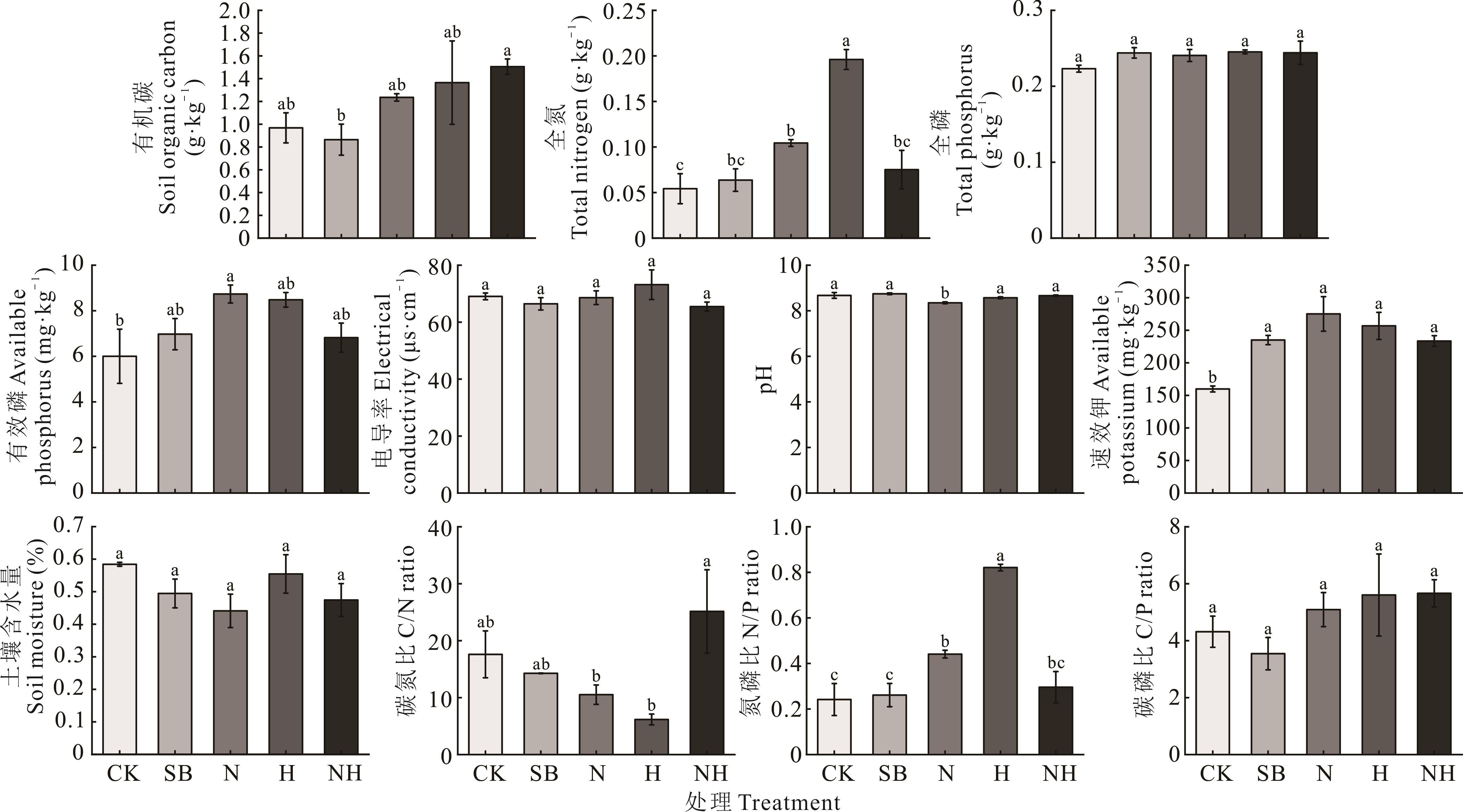
Fig.1 Change of soil physico-chemical properties under different sand-fixing modes
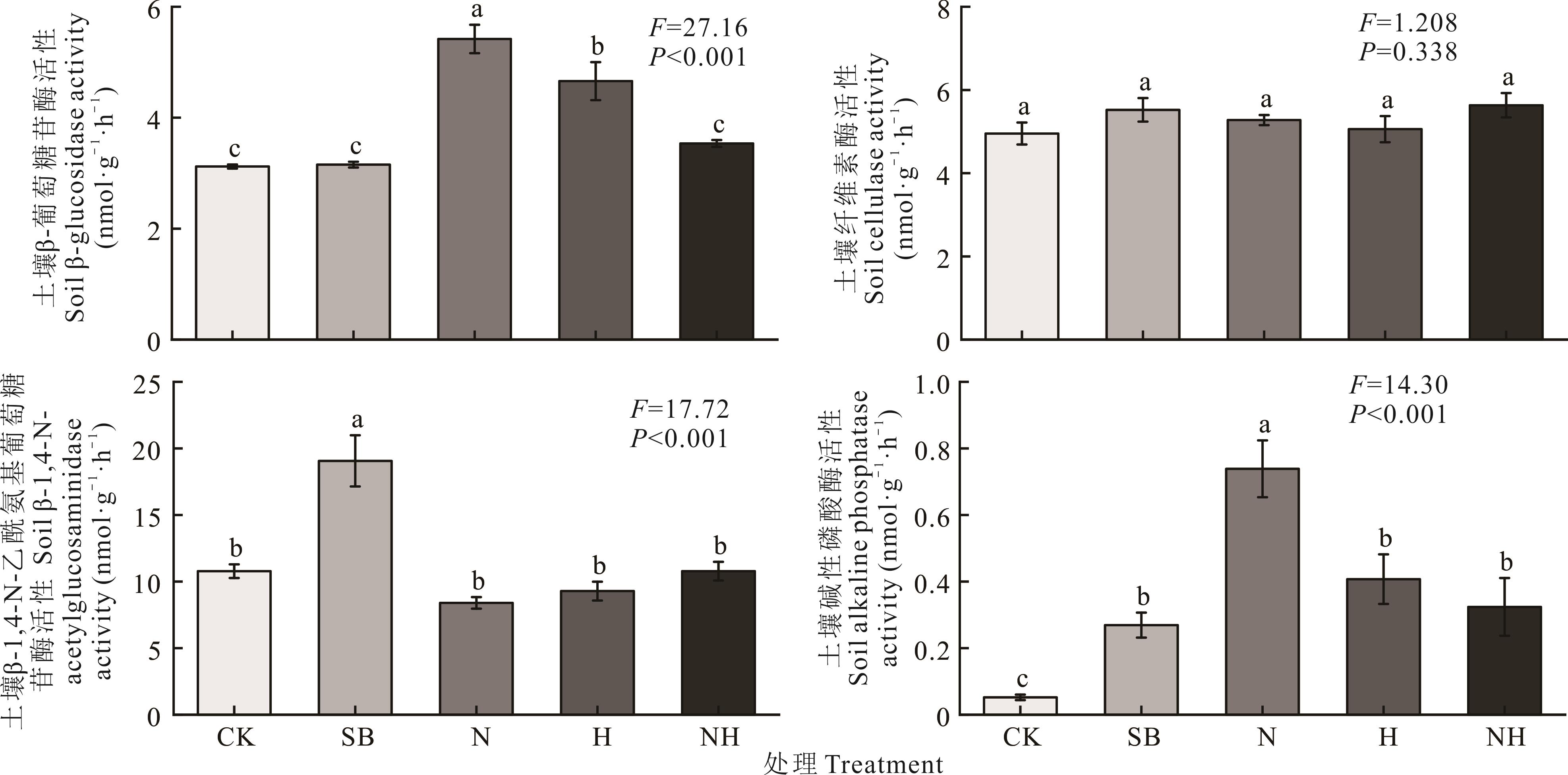
Fig.2 Changes of soil enzyme activities under different sand-fixing modes
| 项目Item | SB | N | H | NH | F | |
|---|---|---|---|---|---|---|
重要值 Importance value | 雾冰藜Grubovia dasyphylla | 0.015 | 0.304 | 0.273 | 0.188 | |
| 刺沙蓬Salsola tragus | 0.151 | 0.415 | 0.312 | |||
| 黑沙蒿Artemisia ordosica | 0.015 | 0.006 | ||||
| 短花针茅Stipa breviflora | 0.042 | 0.018 | 0.039 | 0.071 | ||
| 猪毛菜Salsola collina | 0.431 | |||||
| 软毛虫实Corispermum puberulum | 0.158 | 0.193 | 0.356 | |||
| 沙鞭P. villosa | 0.733 | |||||
| 沙米Agriophyllum pungens | 0.089 | 0.034 | 0.065 | |||
| 狗尾草Setaria viridis | 0.037 | 0.004 | ||||
| 阿尔泰狗娃花Aster altaicus | 0.008 | |||||
| 九顶草Enneapogon desvauxii | 0.003 | |||||
| 虎尾草Chloris virgata | 0.003 | |||||
| 猪毛蒿Artemisia scoparia | 0.032 | 0.006 | 0.004 | |||
| 物种丰富度指数Species richness index | 5.00±0.71a | 3.60±0.55a | 4.20±2.16a | 3.60±0.89a | 1.40ns | |
| Simpson优势度指数Simpson’s dominance index | 0.44±0.08b | 0.58±0.08a | 0.55±0.14ab | 0.56±0.05ab | 2.30ns | |
| Shannon-Wiener多样性指数Shannon-Wiener diversity index | 0.81±0.10a | 0.99±0.18a | 0.99±0.40a | 0.96±0.06a | 0.74ns | |
| Pielou均匀度指数Pielou’s evenness index | 0.51±0.07b | 0.78±0.11a | 0.73±0.10a | 0.78±0.15a | 6.64** | |
| 地上生物量Aboveground biomass (g·plant-1) | 79.64±12.89a | 62.48±24.18ab | 60.48±17.51ab | 40.30±12.03b | 4.31* | |
Table 2 Species composition, species diversity characteristics and aboveground biomass of herbaceous plants under different sand-fixing patterns
| 项目Item | SB | N | H | NH | F | |
|---|---|---|---|---|---|---|
重要值 Importance value | 雾冰藜Grubovia dasyphylla | 0.015 | 0.304 | 0.273 | 0.188 | |
| 刺沙蓬Salsola tragus | 0.151 | 0.415 | 0.312 | |||
| 黑沙蒿Artemisia ordosica | 0.015 | 0.006 | ||||
| 短花针茅Stipa breviflora | 0.042 | 0.018 | 0.039 | 0.071 | ||
| 猪毛菜Salsola collina | 0.431 | |||||
| 软毛虫实Corispermum puberulum | 0.158 | 0.193 | 0.356 | |||
| 沙鞭P. villosa | 0.733 | |||||
| 沙米Agriophyllum pungens | 0.089 | 0.034 | 0.065 | |||
| 狗尾草Setaria viridis | 0.037 | 0.004 | ||||
| 阿尔泰狗娃花Aster altaicus | 0.008 | |||||
| 九顶草Enneapogon desvauxii | 0.003 | |||||
| 虎尾草Chloris virgata | 0.003 | |||||
| 猪毛蒿Artemisia scoparia | 0.032 | 0.006 | 0.004 | |||
| 物种丰富度指数Species richness index | 5.00±0.71a | 3.60±0.55a | 4.20±2.16a | 3.60±0.89a | 1.40ns | |
| Simpson优势度指数Simpson’s dominance index | 0.44±0.08b | 0.58±0.08a | 0.55±0.14ab | 0.56±0.05ab | 2.30ns | |
| Shannon-Wiener多样性指数Shannon-Wiener diversity index | 0.81±0.10a | 0.99±0.18a | 0.99±0.40a | 0.96±0.06a | 0.74ns | |
| Pielou均匀度指数Pielou’s evenness index | 0.51±0.07b | 0.78±0.11a | 0.73±0.10a | 0.78±0.15a | 6.64** | |
| 地上生物量Aboveground biomass (g·plant-1) | 79.64±12.89a | 62.48±24.18ab | 60.48±17.51ab | 40.30±12.03b | 4.31* | |
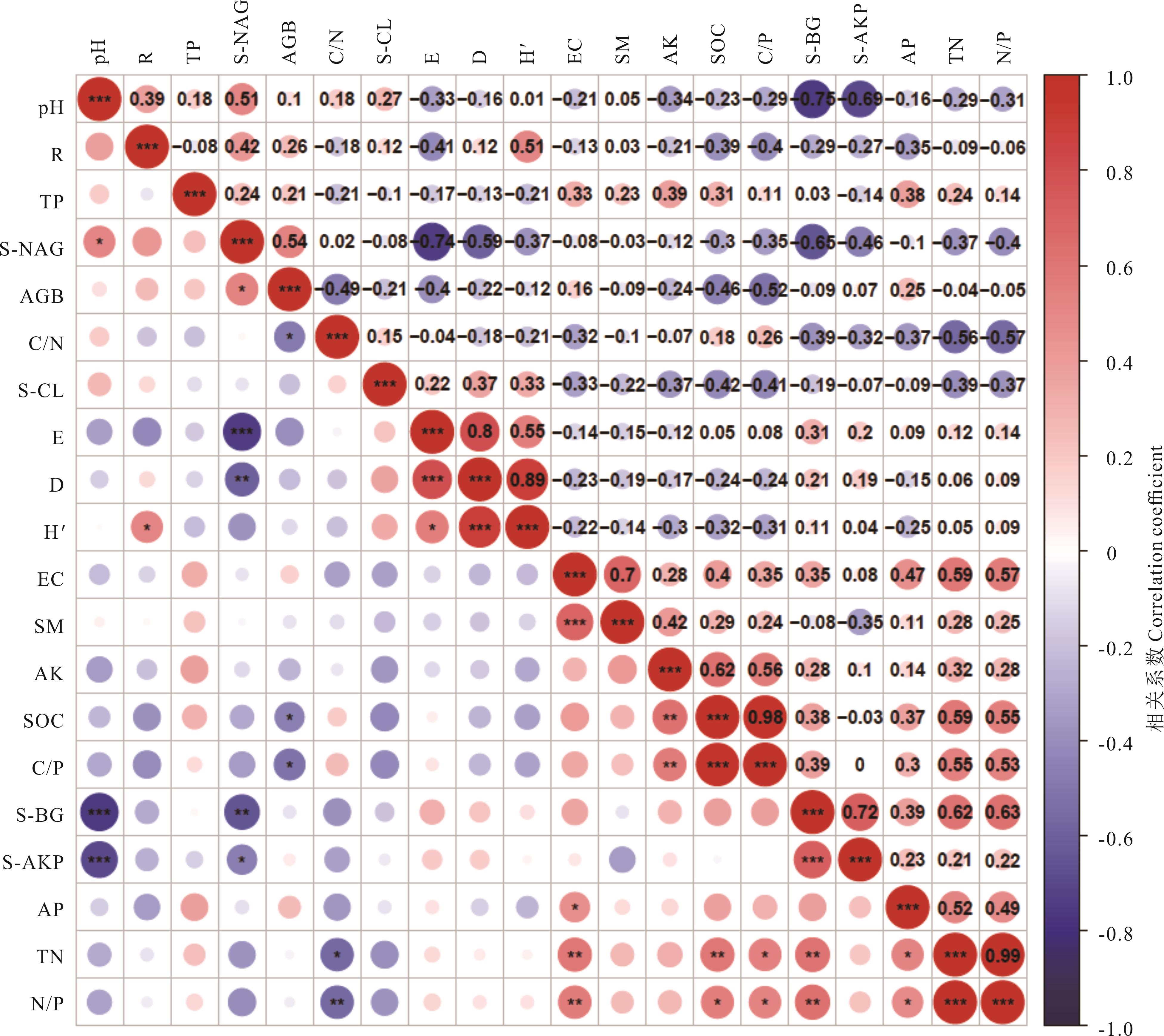
Fig.3 Pearson correlation analysis of soil physico-chemical properties, enzyme activities and herbaceous plant diversity under different sand-fixing modes
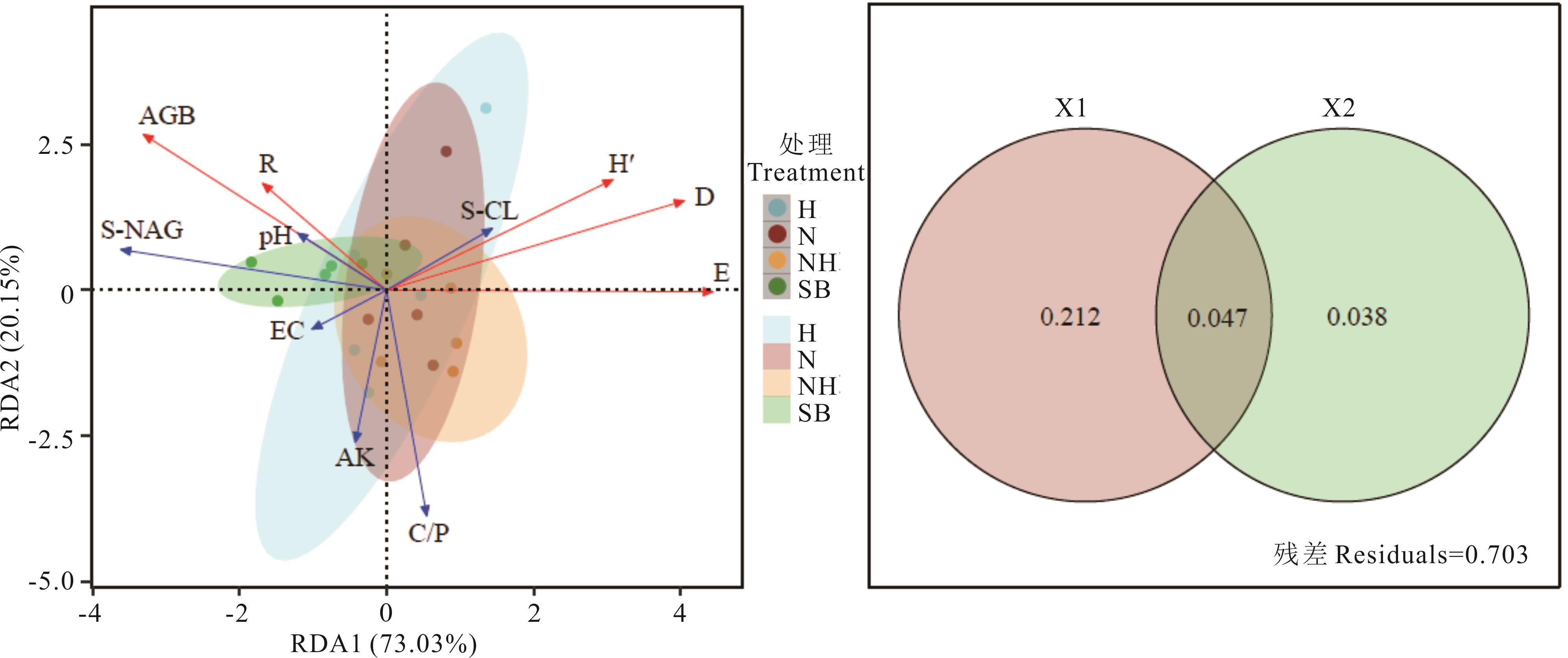
Fig.4 RDA and VPA of effects of soil physico-chemical properties and enzyme activities on species diversity and biomass of herbaceous plants under different sand-fixing modes
| [1] | Zou X Y, Li J F, Cheng H, et al. Spatial variation of topsoil features in soil wind erosion areas of northern China. Catena, 2018, 167: 429-439. |
| [2] | Xie L N, Wu Q Q, Wang Y M, et al. Ecological processes of preventing arid grasslands from changing into deserts by Caragana shrubs. Acta Ecologica Sinica, 2024, 44(4): 1680-1691. |
| 解李娜, 吴祺琪, 王宇萌, 等. 锦鸡儿属灌木阻止干旱草地沙漠化生态过程. 生态学报, 2024, 44(4): 1680-1691. | |
| [3] | Chen X N, Cui B C, Gui D W, et al. Global temporal and spatial changes of vegetation in desert steppe ecosystems: Impacts of climate driving factors. Ecological Indicators, 2025, 172: 113333. |
| [4] | Feng X, Qu J J, Fan Q B, et al. Characteristics of desertification and short-term effectiveness of differing treatments on shifting sand dune stabilization in an alpine rangeland. International Journal of Environmental Research and Public Health, 2019, 16(24): 4968. |
| [5] | Jiang R S. Application of grass checkerboard sand barrier in windbreak and sand fixation. Agricultural Disaster Research, 2020, 10(9): 126-127. |
| 蒋仁山. 浅析草方格沙障在防风固沙中的应用. 农业灾害研究, 2020, 10(9): 126-127. | |
| [6] | Furey G N, Tilman D. Plant biodiversity and the regeneration of soil fertility. Proceedings of the National Academy of Sciences, 2021, 118(49): e2111321118. |
| [7] | Zheng X X, Ge N, Liu Y P, et al. C, N, and P stoichiometry characterization in soil of Hedysarum scoparium community at northeastern edge of Tengger Desert. Bulletin of Soil and Water Conservation, 2025, 45(1): 74-81. |
| 郑晓霞, 葛楠, 刘艳萍, 等. 腾格里沙漠东北缘花棒群落土壤C, N, P的化学计量特征. 水土保持通报, 2025, 45(1): 74-81. | |
| [8] | Li Y L, Cui J Y, Zhang T H, et al. Effectiveness of sand-fixing measures on desert land restoration in Kerqin sandy land, northern China. Ecological Engineering, 2009, 35(1): 118-127. |
| [9] | Zhang Y L, Chen L J, Chen X H, et al. Response of soil enzyme activity to long-term restoration of desertified land. Catena, 2015, 133: 64-70. |
| [10] | Wang G Z, Jia J Y, Zhang J L. Plant soil feedback theory and its applications and prospects in natural and agricultural ecosystems. Acta Ecologica Sinica, 2021, 41(23): 9130-9143. |
| 王光州, 贾吉玉, 张俊伶. 植物-土壤反馈理论及其在自然和农田生态系统中的应用研究进展. 生态学报, 2021, 41(23): 9130-9143. | |
| [11] | Li M, Zhang E P, Zhang S H, et al. Comparison of soil enzyme activities and microbial C metabolism in installed vegetable fields under long-term different fertilization. Journal of Plant Nutrition and Fertilizers, 2017, 23(1): 44-53. |
| 李猛, 张恩平, 张淑红, 等. 长期不同施肥设施菜地土壤酶活性与微生物碳源利用特征比较. 植物营养与肥料学报, 2017, 23(1): 44-53. | |
| [12] | Wang Z W, Wan S Z, Jiang H M, et al. Soil enzyme activities and their influencing factors among different alpine grasslands on the Qingzang Plateau. Chinese Journal of Plant Ecology, 2021, 45(5): 528-538. |
| 汪子微, 万松泽, 蒋洪毛, 等. 青藏高原不同高寒草地类型土壤酶活性及其影响因子. 植物生态学报, 2021, 45(5): 528-538. | |
| [13] | Qiao H, Mo X Q, Luo Y H, et al. Patterns of soil ecoenzymatic stoichiometry and its influencing factors during stand development in Camellia oleifera plantations. Acta Ecologica Sinica, 2019, 39(6): 1887-1896. |
| 乔航, 莫小勤, 罗艳华, 等. 不同林龄油茶人工林土壤酶化学计量及其影响因素. 生态学报, 2019, 39(6): 1887-1896. | |
| [14] | Mo X, Chen F J, You C, et al. Characteristics and factors of soil enzyme activity for different plant communities in Yellow River Delta. Environmental Science, 2020, 41(2): 895-904. |
| 莫雪, 陈斐杰, 游冲, 等. 黄河三角洲不同植物群落土壤酶活性特征及影响因子分析. 环境科学, 2020, 41(2): 895-904. | |
| [15] | Zhao L Y, Gao D D, Xiong B Q, et al. Relationship between the aboveground biomass and species diversity of sandy communities during the process of restoring succession in the Horqin Sandy Land, China. Acta Ecologica Sinica, 2017, 37(12): 4108-4117. |
| 赵丽娅, 高丹丹, 熊炳桥, 等. 科尔沁沙地恢复演替进程中群落物种多样性与地上生物量的关系. 生态学报, 2017, 37(12): 4108-4117. | |
| [16] | Yu S, Li X W, Wang R X, et al. Succession mechanism and dynamics in artificial Caragana korshinskii sand-fixing forests of different ages in Baijitan of Lingwu. Acta Prataculturae Sinica, 2024, 33(3): 13-23. |
| 于双, 李小伟, 王瑞霞, 等. 灵武白芨滩不同年限柠条固沙林林下草本群落演替规律及机制. 草业学报, 2024, 33(3): 13-23. | |
| [17] | Bao S D. Agricultural chemistry analysis of soil properties. Beijing: China Agriculture Press, 2000: 10-29. |
| 鲍士旦. 土壤农化分析. 北京: 中国农业出版社, 2000: 10-29. | |
| [18] | Guan S Y. Soil enzyme and its research method. Beijing: China Agriculture Press, 1986: 320-338. |
| 关松荫. 土壤酶及其研究法. 北京: 中国农业出版社, 1986: 320-338. | |
| [19] | Chen B L, Tang L, Chen H Q, et al. Dynamic changes of plant community species diversity and soil anti-scourability in Panzhihua tailings pond. Chinese Journal of Ecology, 1-13. https://link.cnki.net/urlid/21.1148.Q.20250721.1500.008. |
| 陈波兰, 唐岚, 陈辉琴, 等. 攀枝花尾矿库植物群落物种多样性和土壤抗冲性的动态变化. 生态学杂志, 1-13. https://link.cnki.net/urlid/21.1148.Q.20250721.1500.008. | |
| [20] | Chen X, Taylor A R, Reich P B, et al. Tree diversity increases decadal forest soil carbon and nitrogen accrual. Nature, 2023, 618(7963): 94-101. |
| [21] | Guo J, Yu L H, Fang X, et al. Litter production and turnover in four types of subtropical forests in China. Acta Ecologica Sinica, 2015, 35(14): 4668-4677. |
| 郭婧, 喻林华, 方晰, 等. 中亚热带4种森林凋落物量、组成、动态及其周转期. 生态学报, 2015, 35(14): 4668-4677. | |
| [22] | Bai X J, Zhai G Q, Yan Z F, et al. Effects of microbial groups on soil organic carbon accrual and mineralization during high- and low-quality litter decomposition. Catena, 2024, 241: 108051. |
| [23] | Liu J Q, Liang Y, Xiao F, et al. Main sources of soil phosphorus and their seasonal changes across different vegetation restoration stages in Karst region of southwest China. Chinese Journal of Applied Ecology, 2023, 34(12): 3313-3321. |
| 刘家齐, 梁燕, 肖凡, 等. 西南喀斯特区域不同植被恢复阶段土壤磷主要来源及其季节变化. 应用生态学报, 2023, 34(12): 3313-3321. | |
| [24] | Guo L, Feng T Y, Xue Z Z, et al. Effects of nitrogen form and phosphorus fertilizer on phosphorus-solubilizing bacteria and phosphatase of maize rhizosphere in acidic red soil. Acta Pedologica Sinica, 2023, 60(5): 1493-1506. |
| 郭龙, 冯童禹, 薛壮壮, 等. 氮形态和磷肥对红壤玉米根际解磷微生物群落和磷酸酶活性的影响. 土壤学报, 2023, 60(5): 1493-1506. | |
| [25] | Tian J, Liang C Y, Lu X, et al. Mechanism of root exudates regulating plant responses to phosphorus deficiency. Journal of South China Agricultural University, 2019, 40(5): 175-185. |
| 田江, 梁翠月, 陆星, 等. 根系分泌物调控植物适应低磷胁迫的机制. 华南农业大学学报, 2019, 40(5): 175-185. | |
| [26] | Wang Y L, Lambers H. Root-released organic anions in response to low phosphorus availability: Recent progress, challenges and future perspectives. Plant and Soil, 2020, 447(1): 135-156. |
| [27] | Dai J X, Wang Y J, Guo J J, et al. Analysis of stress resistance and phylogenesis of rhizobia isolated from Caragsana spp. Agricultural Research in the Arid Areas, 2011, 29(4): 223-227. |
| 代金霞, 王玉炯, 郭晶静, 等. 荒漠植物柠条根瘤菌的抗逆性及其系统发育分析. 干旱地区农业研究, 2011, 29(4): 223-227. | |
| [28] | Zheng H H, Yi W L, Tian M, et al. Ecological stoichiometry of different vegetation types in the southern margin of Mu us Sandy Land. Journal of Baoji University of Arts and Sciences (Natural Science Edition), 2022, 42(1): 74-79. |
| 郑浩浩, 易文利, 田苗, 等. 毛乌素沙地南缘不同植被类型生态化学计量特征. 宝鸡文理学院学报(自然科学版), 2022, 42(1): 74-79. | |
| [29] | Xu F, Zhong X C, Sun R C, et al. Anatomy, ultrastructure and lignin distribution in cell wall of Caragana korshinskii. Industrial Crops and Products, 2006, 24(2): 186-193. |
| [30] | An S S, Huang Y M. Study on the ameliorate benefits of Caragana korshinskii shrubwood to soil properties in loess hilly area. Scientia Silvae Sinicae, 2006, 42(1): 70-74. |
| 安韶山, 黄懿梅. 黄土丘陵区柠条林改良土壤作用的研究. 林业科学, 2006, 42(1): 70-74. | |
| [31] | Ferraz-Almeida R, Naves E, Mota R. Soil quality: Enzymatic activity of soil β-glucosidase. Global Journal of Agricultural Research and Reviews, 2015, 3(2): 46-150. |
| [32] | Li Y, Kuramae E E, Nasir F, et al. Addition of cellulose degrading bacterial agents promoting keystone fungal-mediated cellulose degradation during aerobic composting: Construction the complex co-degradation system. Bioresource Technology, 2023, 381: 129132. |
| [33] | Zhang R, Zhou J P, Song Z F, et al. Enzymatic properties of β-N-acetylglucosaminidases. Applied Microbiology and Biotechnology, 2018, 102(1): 93-103. |
| [34] | Lyu L X, Song L, Liu Z L, et al. Response of soil enzyme activity and chemical properties to nitrogen addition in a Korean pine plantation. Environmental Science, 2020, 41(4): 1960-1967. |
| 吕来新, 宋蕾, 刘志理, 等. 红松人工林土壤酶活性与化学性质对氮添加的响应. 环境科学, 2020, 41(4): 1960-1967. | |
| [35] | Li Q, Huang Y X, Zhou D W, et al. Mechanism of the trade-off between biological nitrogen fixation and phosphorus acquisition strategies of herbaceous legumes under nitrogen and phosphorus addition. Chinese Journal of Plant Ecology, 2021, 45(3): 286-297. |
| 李强, 黄迎新, 周道玮, 等. 土壤氮磷添加下豆科草本植物生物固氮与磷获取策略的权衡机制. 植物生态学报, 2021, 45(3): 286-297. | |
| [36] | Gou X M, Ren Y Q, Qin X, et al. Global patterns of soil phosphatase responses to nitrogen and phosphorus fertilization. Pedosphere, 2024, 34(1): 200-210. |
| [37] | Ross M H, Ely J O, Archer J G. Alkaline phosphatase activity and pH optima. Journal of Biological Chemistry, 1951, 192(2): 561-568. |
| [38] | Liu F, Ma Z L, Liu T, et al. Fruiting of Psammochloa villosa, an endemic desert plant, under different ecological and environmental conditions. Guihaia, 2021, 41(9): 1457-1464. |
| 刘峰, 马子兰, 刘涛, 等. 不同生态环境条件沙生植物沙鞭的结实研究. 广西植物, 2021, 41(9): 1457-1464. | |
| [39] | Mori T. Does ecoenzymatic stoichiometry really determine microbial nutrient limitations? Soil Biology and Biochemistry, 2020, 146: 107816. |
| [40] | Ding N, Lin H, Zhang X H, et al. Interaction mechanism between root secretion and rhizosphere microorganisms: A review. Chinese Journal of Soil Science, 2022, 53(5): 1212-1219. |
| 丁娜, 林华, 张学洪, 等. 植物根系分泌物与根际微生物交互作用机制研究进展. 土壤通报, 2022, 53(5): 1212-1219. | |
| [41] | Hu J, Amor D R, Barbier M, et al. Emergent phases of ecological diversity and dynamics mapped in microcosms. Science, 2022, 378(6615): 85-89. |
| [1] | Yang LIU, Hong XIAO, Chang-lin XU, Ming-yue DENG, Wen-qiang WEI, Ao HAN, Kai MA, Yun WANG. Impact of Salix oritrepha shrub encroachment on characteristics of herbaceous plant communities in the alpine meadows of the Eastern Qilian Mountains [J]. Acta Prataculturae Sinica, 2026, 35(3): 13-25. |
| [2] | Hui-teng WANG, Wen-lan LIU, Hong TANG, Xiao-juan LIU, Rong HAN, Jie SONG. Responses of species and functional diversity of spontaneous vegetation to urbanization in Lanzhou riverside parks [J]. Acta Prataculturae Sinica, 2026, 35(3): 96-113. |
| [3] | Shi-jie ZHOU, Yi-lian WANG, Pan SUN, Jing SHANG, Wen-yu YANG, Xue-gui WANG, Ji-zhi YANG. Analysis of weed species and community characteristics in soybean-maize fields with a banded compound planting pattern in Sichuan Province [J]. Acta Prataculturae Sinica, 2026, 35(2): 143-154. |
| [4] | Jia-qi HE, Lin WU, Zhi-min QIU, Xu-yong GAO, Lun-lun GAO, Shuang-bin FU, Yan-ping YANG, Pei-long WANG, Wan XU, Zhuang ZHOU. Species diversity and community characteristics of weeds on the banks of the Wenzhou expressway [J]. Acta Prataculturae Sinica, 2026, 35(2): 40-53. |
| [5] | Shuang YAN, Fei XIA, Wei WEI, Jing-long WANG, Hao-yang WU, Lin-ling RAN, Yun-yin XUE, Hao SHI, Shai-kun ZHENG, Jun-qiang WANG, Jun-dong HE. Differences along an erosion gradient in alpine meadow plant community diversity and factors influencing diversity [J]. Acta Prataculturae Sinica, 2025, 34(6): 1-13. |
| [6] | Shun-hua LUO, Xin-yu LIU, Bao-ping MENG, Xuan-li CHEN, Ren-jie HU, Hong-yan YU, Xian-ying WANG, Bo ZHANG, Yu QIN. A study of functional group diversity and productivity of alpine grassland in Qilian Mountain National Park [J]. Acta Prataculturae Sinica, 2025, 34(6): 14-26. |
| [7] | Xue-ping LI, Shi-yang XU, Jian-jun LI, Yong-hong QI. Bacterial diversity and community structural changes in rhizosphere soil of naked barley disturbed by root rot [J]. Acta Prataculturae Sinica, 2025, 34(5): 118-129. |
| [8] | Shou-xing WANG, Hua-kun ZHOU, Li-peng OU, Cheng-xian LI, Yan-he WANG, Xiao-chun NING, Qiang GU, Dai-jun WEI, Ming-xin YANG. Vegetation and soil microbial diversity and their relationships with soil factors in different grassland types of the three river headwaters region [J]. Acta Prataculturae Sinica, 2025, 34(4): 16-26. |
| [9] | Xin GONG, Xin-ru HUO, Wen LI, Yan-dong YANG, Chao LIU, Wei-chun QIN, Yan SHEN, Guo-hui WANG, Hong-bin MA. Vegetation community characteristics and spatial differentiation in mountain grassland in Luoshan, Ningxia [J]. Acta Prataculturae Sinica, 2025, 34(2): 1-15. |
| [10] | Ye-xin LYU, Mao YE, Jiao-rong QIAN, Wei-long CHEN, Jing CHE, Miao-miao LI, Guo-yan ZENG. Biodiversity and phylogenetic diversity of grasslands in the Habahe forest area of Xinjiang and analysis of the influencing factors [J]. Acta Prataculturae Sinica, 2025, 34(12): 50-61. |
| [11] | Qian LIU, Yan-fen DING, Shan-shan SONG, Wen-jie XU, Wei YANG. Quantitative classification and ordination analysis of spontaneous vegetation communities in herb layer along the green belt of Nanjing Ming City Wall [J]. Acta Prataculturae Sinica, 2024, 33(5): 1-15. |
| [12] | Sheng-ran HE, Xiao-jing LIU, Ya-jiao ZHAO, Xue WANG, Jing WANG. Effects of alfalfa/sweet sorghum intercropping on rhizosphere soil characteristics and microbial community characteristics [J]. Acta Prataculturae Sinica, 2024, 33(5): 92-105. |
| [13] | Hao SHI, Cai-hong YANG, Fei XIA, Jun-qiang WANG, Wei WEI, Jing-long WANG, Yun-yin XUE, Shai-kun ZHENG, Hao-yang WU, Lin-ling RAN, Shuang YAN, Xiao-min JIANG. Initial effects of short-term warming on the productivity of alpine degraded grassland in northern Tibet during the restoration process [J]. Acta Prataculturae Sinica, 2024, 33(11): 30-45. |
| [14] | Si-yao WANG, Kai-yang QIU, Jian-yu WANG. Evaluation of soil quality change over time when retiring cultivated farmland on gravel-sand mulched fields in central Ningxia [J]. Acta Prataculturae Sinica, 2024, 33(11): 58-68. |
| [15] | Zi-li LYU, Bin LIU, Feng CHANG, Zi-jing MA, Qiu-mei CAO. Species diversity and phylogenetic diversity in Bayinbrook alpine grasslands: elevation gradient distribution patterns and drivers [J]. Acta Prataculturae Sinica, 2023, 32(7): 12-22. |
| Viewed | ||||||
|
Full text |
|
|||||
|
Abstract |
|
|||||
