

ISSN 1004-5759 CN 62-1105/S
草业学报 ›› 2026, Vol. 35 ›› Issue (8): 157-169.DOI: 10.11686/cyxb2025359
• 研究论文 • 上一篇
李倩( ), 段伟(), 张雪莉, 刘丽君, 王玉祥
收稿日期:2025-09-03
修回日期:2025-10-20
出版日期:2026-08-20
发布日期:2026-06-22
作者简介:李倩(1992-),女,山东郓城人,讲师,博士。E-mail:540794898@qq.com基金资助:
Qian LI(), Wei DUAN(), Xue-li ZHANG, Li-jun LIU, Yu-xiang WANG
Received:2025-09-03
Revised:2025-10-20
Online:2026-08-20
Published:2026-06-22
摘要:
干旱胁迫制约植物生长与农业生产,挖掘抗旱基因并解析其机制对分子育种至关重要。黄花苜蓿MfERF053属于AP2/ERF家族,前期发现其在干旱下表达上调且过表达拟南芥具有抗旱表型,但机制未明。本研究以拟南芥Col-0野生型(Col)及MfERF053过表达株系(#19、#20、#33)为材料,经自然干旱胁迫处理后,测定植株表型、生理及分子指标,以明确其抗旱机制。结果显示:干旱胁迫下,过表达株系萎蔫延迟、复水恢复好;相对含水量显著高于Col(P<0.05),相对电导率与丙二醛含量显著低于Col(P<0.05);光系统Ⅱ功能更稳定,最大光化学效率、电子传递速率显著高于Col(P<0.05);过表达株系叶片氯化硝基四氮唑蓝(NBT)、3,3'-二氨基联苯胺(DAB)染色程度明显浅于Col,表明·O??、H?O?积累减少,且过氧化氢酶和过氧化物酶活性显著高于Col(P<0.05)。分子层面,干旱胁迫下MfERF053过表达株系中,活性氧(ROS)清除相关基因(AtCAT1、AtPOD3、AtSOD4)及干旱响应(AtRD22、AtRD29A)、低温/干旱交叉响应(AtCOR15A、AtCOR47)、钾离子转运(AtHAK5)、脱落酸(ABA)信号通路(AtABI5)等抗逆相关基因的表达量均显著上调(P<0.05),且多数基因表达量显著高于Col(P<0.05),仅AtRD29A和AtABI5在个别过表达株系中与Col无显著差异。综上,MfERF053可通过增强ROS清除能力、上调抗逆相关基因的表达、协同改善拟南芥干旱下的生理稳态与分子响应,最终提高其抗旱性,为耐旱作物/牧草分子育种提供重要的基因资源与理论依据。
李倩, 段伟, 张雪莉, 刘丽君, 王玉祥. MfERF053增强活性氧清除能力和抗逆相关基因表达提高拟南芥抗旱性[J]. 草业学报, 2026, 35(8): 157-169.
Qian LI, Wei DUAN, Xue-li ZHANG, Li-jun LIU, Yu-xiang WANG. MfERF053 enhances drought resistance of Arabidopsis thaliana by improving reactive oxygen species scavenging capacity and promoting expression of stress-resistance-related genes[J]. Acta Prataculturae Sinica, 2026, 35(8): 157-169.
引物 Primer | 正向引物/反向引物 Forward primer/reverse primer (5′-3′) |
|---|---|
| qAtactin-F | CGCCATCCAAGCTGTTCTC |
| qAtactin-R | TCACGTCCAGCAAGGTCAAG |
| AtCAT1-F | GTCCTGGGATTCAGACAGGC |
| AtCAT1-R | GGCTCACGTTAAGACGAGT |
| AtPOD3-F | CCAATCCAGAAACGGAAGTG |
| AtPOD3-R | TCTGACGCTTCTGACGACAC |
| AtSOD4-F | GAAGAACCTTGCTCCTTCCAG |
| AtSOD4-R | GATTGGCAGTTGTGTCAACAAC |
| AtRD22-F | ACTTGGTAAATATCACGTCAGGCT |
| AtRD22-R | CTGAGGTGTTCTTGTGGCATACC |
| AtRD29A-F | GATATCGACAAGGATGTGCCG |
| AtRD29A-R | GTATCCAGGTCTTCCCTTCGC |
| AtCOR47-F | GCTTCGTCGTCGTTTCTCT |
| AtCOR47-R | CCAATGTATCTGCGGTTTGA |
| AtHAK5-F | TGCATCACTGGGACGGAGGCA |
| AtHAK5-R | GTACGCAGCCTGCCCGCAAT |
| AtABI5-F | AGAGGGATAGCGAACGAGTCTAGTC |
| AtABI5-R | GTTCGGTTTGGATTAGGTTTAGG |
表1 PCR引物
Table 1 PCR primers
引物 Primer | 正向引物/反向引物 Forward primer/reverse primer (5′-3′) |
|---|---|
| qAtactin-F | CGCCATCCAAGCTGTTCTC |
| qAtactin-R | TCACGTCCAGCAAGGTCAAG |
| AtCAT1-F | GTCCTGGGATTCAGACAGGC |
| AtCAT1-R | GGCTCACGTTAAGACGAGT |
| AtPOD3-F | CCAATCCAGAAACGGAAGTG |
| AtPOD3-R | TCTGACGCTTCTGACGACAC |
| AtSOD4-F | GAAGAACCTTGCTCCTTCCAG |
| AtSOD4-R | GATTGGCAGTTGTGTCAACAAC |
| AtRD22-F | ACTTGGTAAATATCACGTCAGGCT |
| AtRD22-R | CTGAGGTGTTCTTGTGGCATACC |
| AtRD29A-F | GATATCGACAAGGATGTGCCG |
| AtRD29A-R | GTATCCAGGTCTTCCCTTCGC |
| AtCOR47-F | GCTTCGTCGTCGTTTCTCT |
| AtCOR47-R | CCAATGTATCTGCGGTTTGA |
| AtHAK5-F | TGCATCACTGGGACGGAGGCA |
| AtHAK5-R | GTACGCAGCCTGCCCGCAAT |
| AtABI5-F | AGAGGGATAGCGAACGAGTCTAGTC |
| AtABI5-R | GTTCGGTTTGGATTAGGTTTAGG |
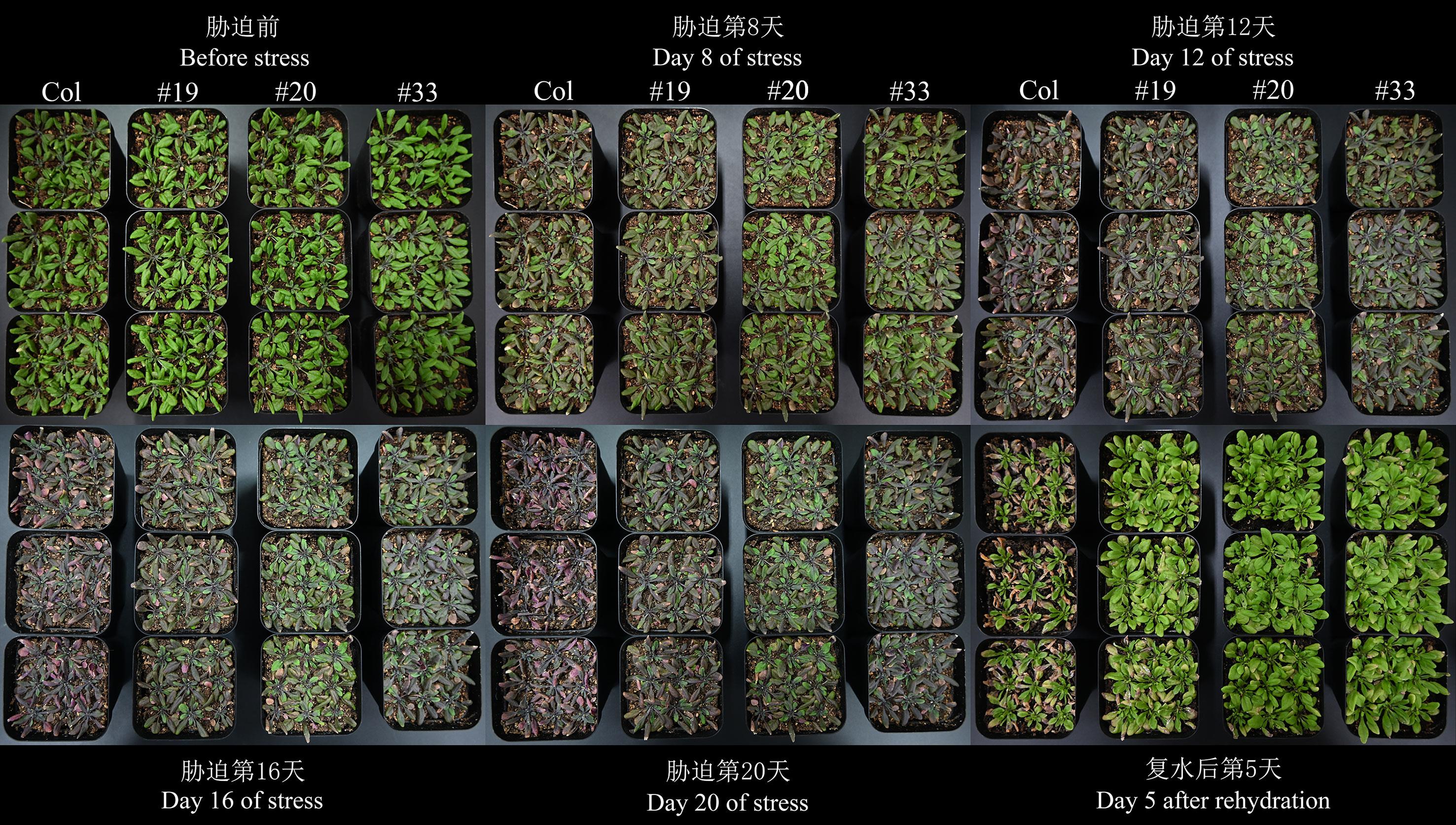
图1 自然干旱胁迫下野生型和过表达MfERF053拟南芥的表型Col: 野生型Wild type; #19、#20、#33: MfERF053过表达的3个独立株系3 independent MfERF053-overexpressing lines; 下同The same below.
Fig.1 Phenotypes of wild-type and MfERF053-overexpressing A. thaliana under natural drought stress
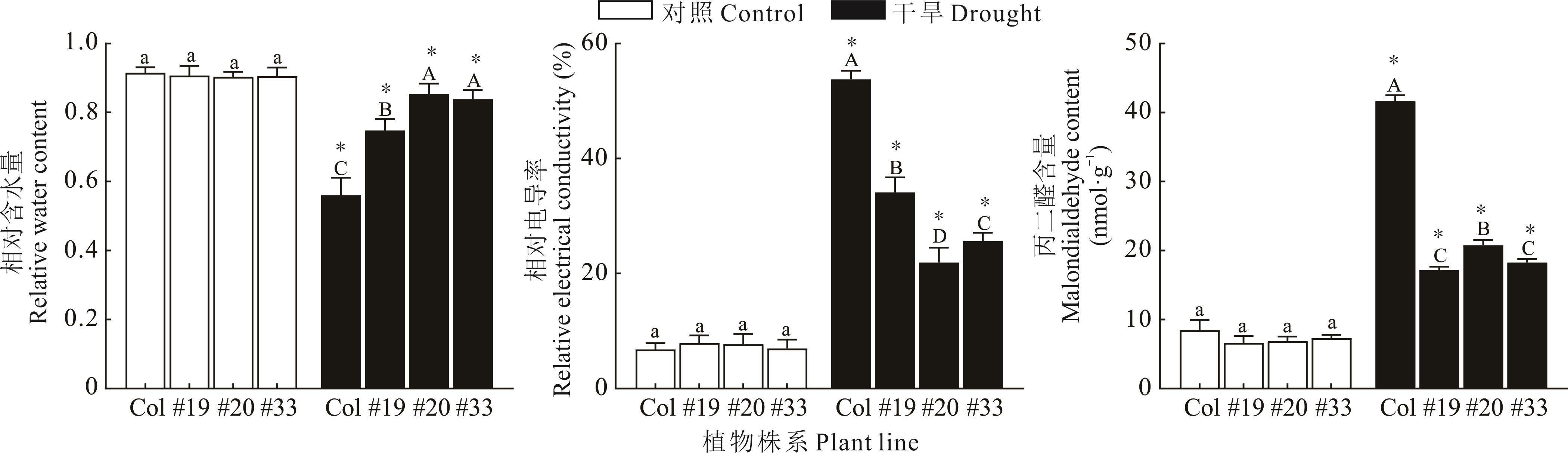
图2 干旱胁迫下野生型和过表达MfERF053拟南芥的相对含水量、相对电导率及丙二醛含量对比*表示同一株系在对照与干旱胁迫间差异显著(P<0.05),不同小写字母表示在对照组中各株系之间差异显著(P<0.05),不同大写字母表示在干旱胁迫组中各株系之间差异显著(P<0.05),下同。* indicate a significant difference (P<0.05) between the control and drought stress group for the same line. Different lowercase letters indicate significant differences (P<0.05) among different plant lines in the control group, while different uppercase letters indicate significant differences (P<0.05) among different plant lines in the drought stress group, the same below.
Fig.2 Comparison of relative water content, relative electrical conductivity, and malondialdehyde content between wild-type and MfERF053-overexpressing A. thaliana under drought stress
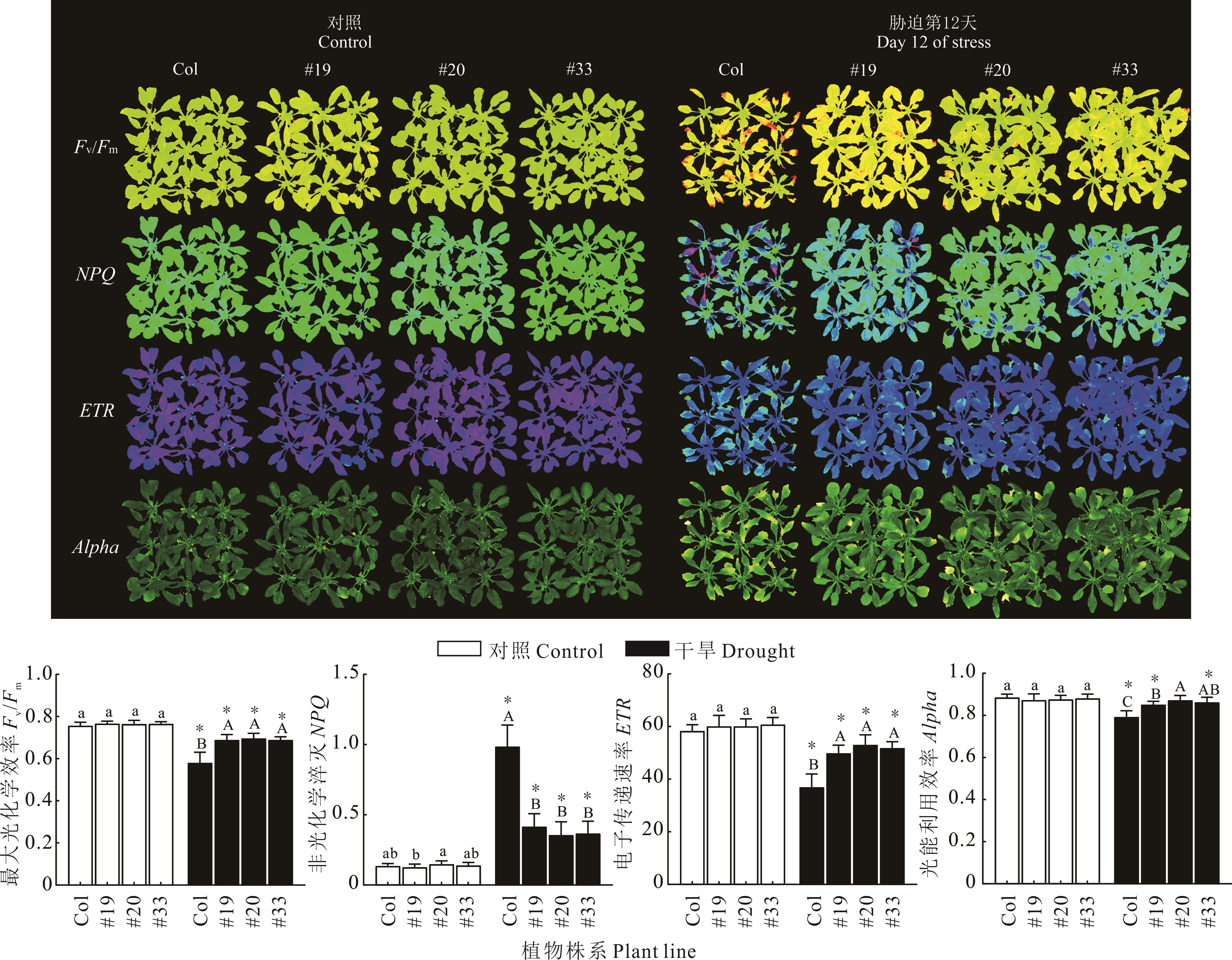
图3 干旱胁迫下野生型和过表达MfERF053拟南芥的叶绿素荧光对比Fv/Fm: 最大光化学效率Maximum photochemical efficiency; NPQ: 非光化学淬灭Non-photochemical quenching; ETR: 电子传递效率Electron transport rate; Alpha: 光能利用效率Light use efficiency.
Fig.3 Comparison of chlorophyll fluorescence between wild-type and MfERF053-overexpressing A. thaliana under drought stress
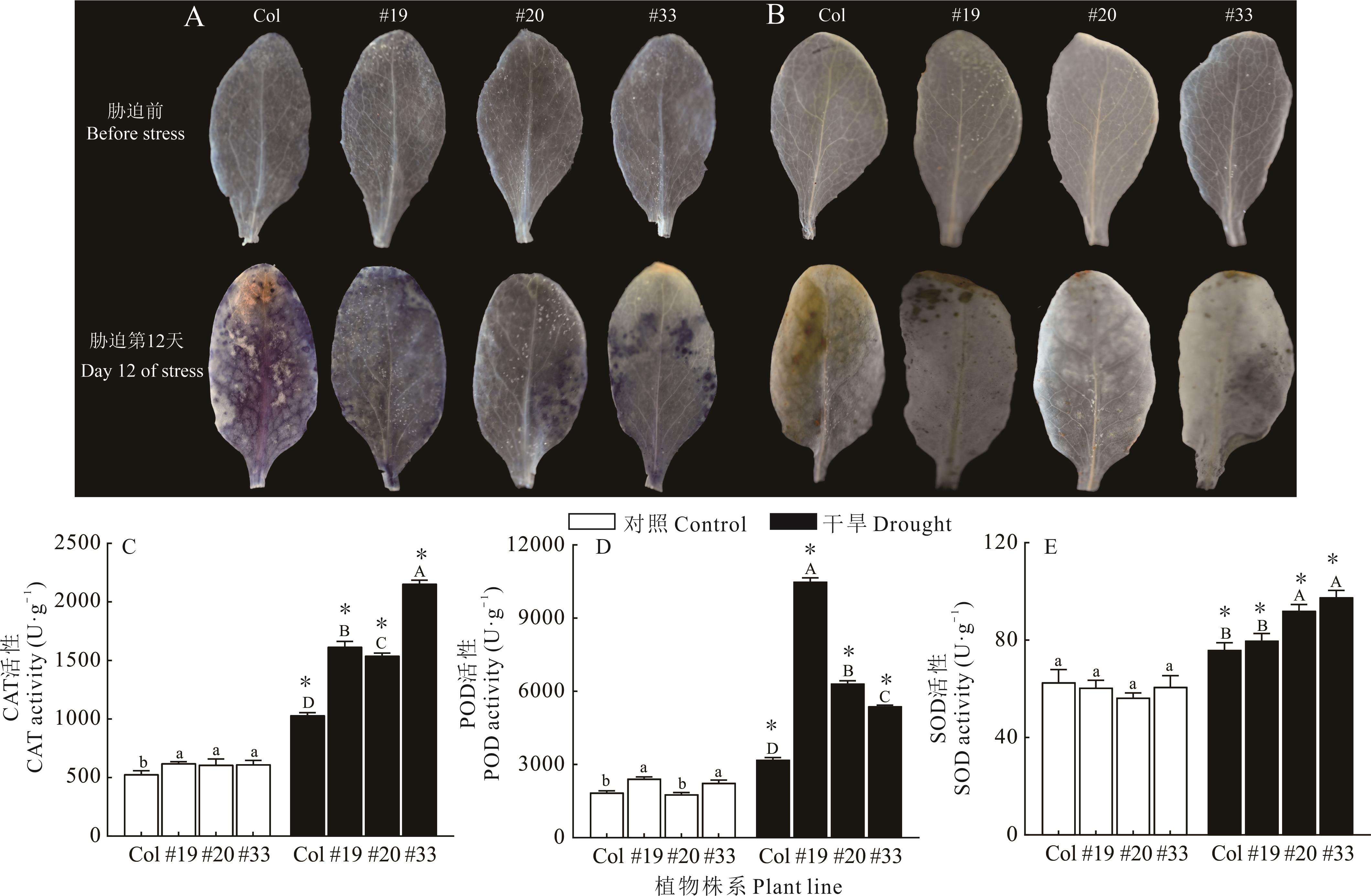
图4 干旱胁迫下野生型和过表达MfERF053拟南芥的活性氧含量及抗氧化酶活性对比A: 氯化硝基四氮唑蓝染色[用于超氧阴离子(·O2-)定位检测] Nitroblue tetrazolium chloride (NBT) staining for localization detection of superoxide anion (·O??); B: 3,3'-二氨基联苯胺染色[用于过氧化氢(H2O2)定位检测] 3,3'-diaminobenzidine (DAB) staining for localization detection of hydrogen peroxide (H?O?); CAT: 过氧化氢酶 Catalase; POD: 过氧化物酶 Peroxidase; SOD: 超氧化物歧化酶 Superoxide dismutase.
Fig.4 Comparison of reactive oxygen species content and antioxidant enzyme activities between wild-type and MfERF053-overexpressing A. thaliana under drought stress
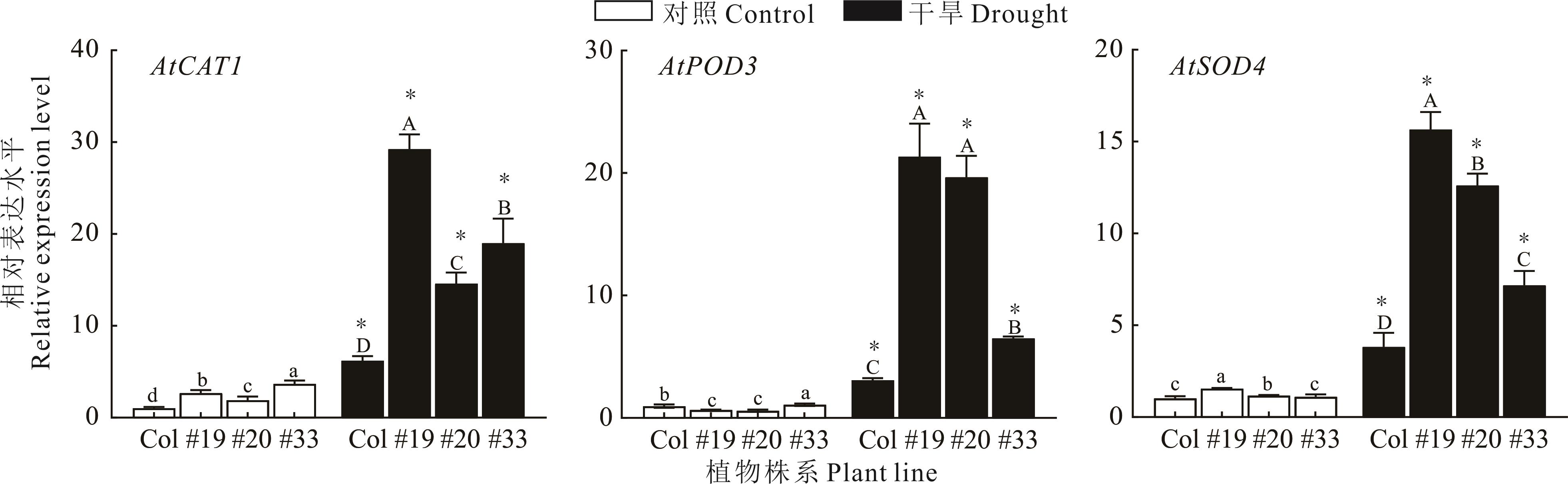
图5 干旱胁迫下野生型和过表达MfERF053拟南芥的抗氧化酶相关基因表达对比AtCAT1: 拟南芥过氧化氢酶1基因 A. thaliana catalase 1 gene; AtPOD3: 拟南芥过氧化物酶3基因 A. thaliana peroxidase 3 gene; AtSOD4: 拟南芥超氧化物歧化酶4基因 A. thaliana superoxide dismutase 4 gene.
Fig.5 Comparison of antioxidant enzyme-related gene expression between wild-type and MfERF053-overexpressing A. thaliana under drought stress
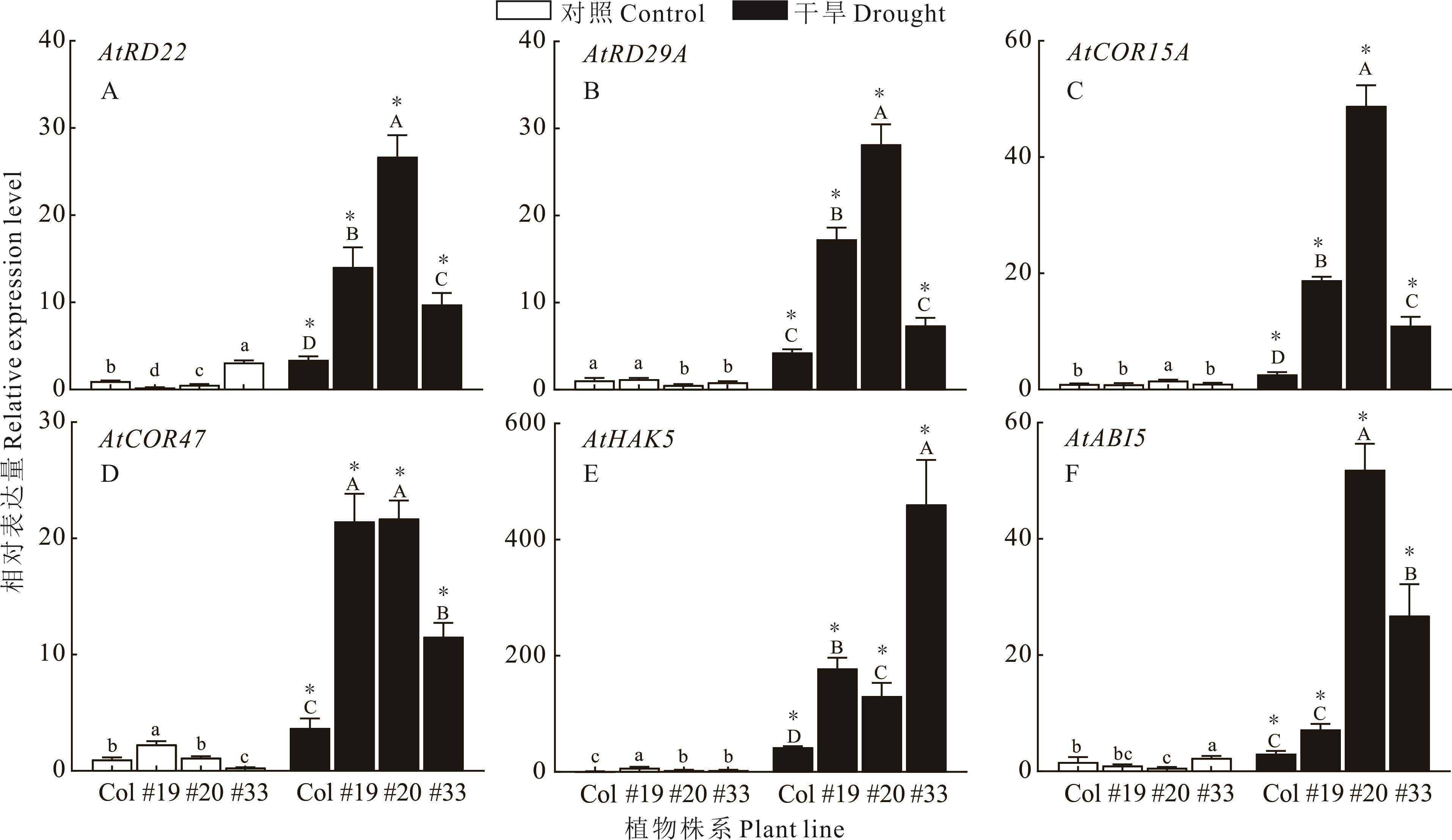
图6 干旱胁迫下野生型和过表达MfERF053拟南芥中抗逆相关基因的相对表达量AtRD22: 拟南芥干旱响应蛋白22基因 A. thaliana responsive to dehydration 22 gene; AtRD29A: 拟南芥干旱响应蛋白29A基因 A. thaliana responsive to dehydration 29A gene; AtCOR15A: 拟南芥冷调节蛋白15A基因 A. thaliana cold-regulated 15A gene; AtCOR47: 拟南芥冷调节蛋白47基因 A. thaliana cold-regulated 47 gene; AtHAK5: 拟南芥高亲和钾转运蛋白5基因 A. thaliana high-affinity K? transporter 5 gene; AtABI5: 拟南芥脱落酸不敏感5基因 A. thaliana abscisic acid insensitive 5 gene.
Fig.6 Relative expression of stress-resistant-related genes in wild-type and MfERF053-overexpressing A. thaliana under drought stress
| [1] | D’Odorico P, Schonbeck L, Vitali V, et al. Drone-based physiological index reveals long-term acclimation and drought stress responses in trees. Plant, Cell & Environment, 2021, 44(11): 3552-3570. |
| [2] | Bao A K, Du B Q, Touil L, et al. Coexpression of tonoplast cation/H+ antiporter and H+-pyrophosphatase from xerophyte Zygophyllum xanthoxylum improves alfalfa plant growth under salinity, drought and field conditions. Plant Biotechnology Journal, 2016, 14(3): 964-975. |
| [3] | Luo D, Wu Y G, Liu J, et al. Comparative transcriptomic and physiological analyses of Medicago sativa L. indicates that multiple regulatory networks are activated during continuous ABA treatment. International Journal of Molecular Sciences, 2019, 20(1): 47. |
| [4] | Ma Y T, Zhai Q Y, Liu Z P, et al. Genome-wide identification and characterization of alfalfa-specific genes in drought stress tolerance. Plant Physiology and Biochemistry, 2025, 220: 108945. |
| [5] | Luo D, Liu J, Wu Y G, et al. NUCLEAR TRANSPORT FACTOR 2-LIKE improves drought tolerance by modulating leaf water loss in alfalfa (Medicago sativa L.). The Plant Journal, 2022, 112(2): 429-450. |
| [6] | Zhang W Y, Wang J, Xu L, et al. Drought stress responses in maize are diminished by Piriformospora indica. Plant Signaling & Behavior, 2018, 13(1): e1414121. |
| [7] | Cosme M. Mycorrhizas drive the evolution of plant adaptation to drought. Communications Biology, 2023, 6(1): 346. |
| [8] | Nakano T, Suzuki K, Fujimura T, et al. Genome-wide analysis of the ERF gene family in Arabidopsis and rice. Plant Physiology, 2006, 140(2): 411-432. |
| [9] | Ohme-Takagi M, Shinshi H. Ethylene-inducible DNA binding proteins that interact with an ethylene-responsive element. The Plant Cell, 1995, 7(2): 173-182. |
| [10] | Xu Z S, Chen M, Li L C, et al. Functions of the ERF transcription factor family in plants. Botany, 2008, 86(10): 969-977. |
| [11] | Gasch P, Fundinger M, Müller J T, et al. Redundant ERF-Ⅶ transcription factors bind to an evolutionarily conserved cis-motif to regulate hypoxia-responsive gene expression in Arabidopsis. The Plant Cell, 2016, 28(1): 160-180. |
| [12] | Xie Z L, Nolan T, Jiang H, et al. The AP2/ERF transcription factor TINY modulates brassinosteroid regulated plant growth and drought responses in Arabidopsis. The Plant Cell, 2019, 31(8): 1788-1806. |
| [13] | Chen N N, Qin J J, Tong S F, et al. One AP2/ERF transcription factor positively regulates Pi uptake and drought tolerance in poplar. International Journal of Molecular Sciences, 2022, 23(9): 5241. |
| [14] | Jung H, Chung P J, Park S H, et al. Overexpression of OsERF48 causes regulation of OsCML16, a calmodulin-like protein gene that enhances root growth and drought tolerance. Plant Biotechnology Journal, 2017, 15(10): 1295-1308. |
| [15] | Zhu Y Q, Liu Y, Zhou K M, et al. Overexpression of ZmEREBP60 enhances drought tolerance in maize. Journal of Plant Physiology, 2022, 275: 153763. |
| [16] | Huan X H, Wang X Q, Zou S Q, et al. Transcription factor ERF194 modulates the stress-related physiology to enhance drought tolerance of poplar. International Journal of Molecular Sciences, 2023, 24(1): 788. |
| [17] | Zhang G Y, Chen M, Li L C, et al. Overexpression of the soybean GmERF3 gene, an AP2/ERF type transcription factor for increased tolerances to salt, drought, and diseases in transgenic tobacco. Journal of Experimental Botany, 2009, 60(13): 3781-3796. |
| [18] | An J P, Zhang X W, Bi S Q, et al. The ERF transcription factor MdERF38 promotes drought stress-induced anthocyanin biosynthesis in apple. The Plant Journal, 2020, 101(3): 573-589. |
| [19] | Jung S E, Bang S W, Kim S H, et al. Overexpression of OsERF83, a vascular tissue-specific transcription factor gene, confers drought tolerance in rice. International Journal of Molecular Sciences, 2021, 22(14): 7656. |
| [20] | Quan R D, Hu S J, Zhang Z L, et al. Overexpression of an ERF transcription factor TSRF1 improves rice drought tolerance. Plant Biotechnology Journal, 2010, 8(4): 476-488. |
| [21] | Li Z J, Tian Y S, Xu J, et al. A tomato ERF transcription factor, SlERF84, confers enhanced tolerance to drought and salt stress but negatively regulates immunity against Pseudomonas syringae pv. tomato DC3000. Plant Physiology and Biochemistry, 2018, 132: 683-695. |
| [22] | Yang S U, Kim H, Kim R J, et al. AP2/DREB transcription factor RAP2.4 activates cuticular wax biosynthesis in Arabidopsis leaves under drought. Frontiers in Plant Science, 2020, 11: 895. |
| [23] | Li Q, Jiang W B, Jiang Z H, et al. Transcriptome and functional analyses reveal ERF053 from Medicago falcata as key regulator in drought resistances. Frontiers in Plant Science, 2022, 13: 995754. |
| [24] | Li Q. Transcriptome analysis of Medicago falcata in response to drought stress and functional characterization of MfERF053 gene. Urumqi: Xinjiang Agricultural University, 2022. |
| 李倩. 黄花苜蓿干旱胁迫响应的转录组分析及MfERF053基因的功能研究. 乌鲁木齐: 新疆农业大学, 2022. | |
| [25] | Clough S J, Bent A F. Floral dip: A simplified method for Agrobacterium-mediated transformation of Arabidopsis thaliana. The Plant Journal, 1998, 16(6): 735-743. |
| [26] | Zhang Y G, Zhang Y, Wang C, et al. Enhancement of salt tolerance of alfalfa: physiological and molecular responses of transgenic alfalfa plants expressing Syntrichia caninervis-derived ScABI3. Plant Physiology and Biochemistry, 2024, 207: 108335. |
| [27] | Tao Q B, Sun J P, Nie Y T, et al. Evaluation of seed vigor and prediction of field seedling emergence of Chinese milk vetch (Astragalus sinicus L.) by conductivity method. Chinese Journal of Grassland, 2022, 44(4): 95-103. |
| 陶奇波, 孙继鹏, 聂宇婷, 等. 电导率法评价紫云英种子活力并预测田间出苗表现. 中国草地学报, 2022, 44(4): 95-103. | |
| [28] | Liu Y, Zhang L N, Liu X H, et al. Research progress from individual plant physiological response to ecological model prediction under drought stress. Acta Ecologica Sinica, 2023, 43(24): 10042-10053. |
| 刘燕, 张凌楠, 刘晓宏, 等. 干旱胁迫植物个体生理响应及其生态模型预测研究进展. 生态学报, 2023, 43(24): 10042-10053. | |
| [29] | Hao X R, Jiang Y, Wang Y Q, et al. Overexpression of poplar PtoXTH34 gene to enhance drought resistance of tobacco. Journal of Beijing Forestry University, 2025, 47(1): 63-71. |
| 郝玄瑞, 姜妍, 王宇倩, 等. 杨树PtoXTH34基因过表达提高烟草抗旱性. 北京林业大学学报, 2025, 47(1): 63-71. | |
| [30] | Kishor P B K, Hong Z, Miao G H, et al. Overexpression of Δ¹-pyrroline-5-carboxylate synthetase increases proline production and confers osmotolerance in transgenic plants. Plant Physiology, 1995, 108(4): 1387-1394. |
| [31] | Liu Y B, Qin L J, Han L Z, et al. Overexpression of maize SDD1 (ZmSDD1) improves drought resistance in Zea mays L. by reducing stomatal density. Plant Cell, Tissue and Organ Culture, 2015, 122(1): 147-159. |
| [32] | Talbi S, Rojas J A, Sahrawy M, et al. Effect of drought on growth, photosynthesis and total antioxidant capacity of the saharan plant Oudeneya africana. Environmental and Experimental Botany, 2020, 176: 104099. |
| [33] | Chen J H, Chen S T, He N Y, et al. Nuclear-encoded synthesis of the D1 subunit of photosystem Ⅱ increases photosynthetic efficiency and crop yield. Nature Plants, 2020, 6(5): 570-580. |
| [34] | Bassi R, Dall’Osto L. Dissipation of light energy absorbed in excess: The molecular mechanisms. Annual Review of Plant Biology, 2021, 72(1): 47-76. |
| [35] | Mittler R, Vanderauwera S, Gollery M, et al. Reactive oxygen gene network of plants. Trends in Plant Science, 2004, 9(10): 490-498. |
| [36] | Gill S S, Tuteja N. Reactive oxygen species and antioxidant machinery in abiotic stress tolerance in crop plants. Plant Physiology and Biochemistry, 2010, 48(12): 909-930. |
| [37] | Mizoi J, Shinozaki K, Yamaguchi-Shinozaki K. AP2/ERF family transcription factors in plant abiotic stress responses. Biochimica et Biophysica Acta (BBA)-Gene Regulatory Mechanisms, 2012, 1819(2): 86-96. |
| [38] | Shinozaki K, Yamaguchi-Shinozaki K. Molecular responses to dehydration and low temperature: Differences and cross-talk between two stress signaling pathways. Current Opinion in Plant Biology, 2000, 3(3): 217-223. |
| [39] | Thomashow M F. PLANT COLD ACCLIMATION: Freezing tolerance genes and regulatory mechanisms. Annual Review of Plant Physiology and Plant Molecular Biology, 1999, 50(1): 571-599. |
| [40] | Gierth M, Mäser P, Schroeder J I. The potassium transporter AtHAK5 functions in K(+) deprivation-induced high-affinity K(+) uptake and AKT1 K(+) channel contribution to K(+) uptake kinetics in Arabidopsis roots. Plant Physiology, 2005, 137(3): 1105-1114. |
| [41] | Hsu P K, Dubeaux G, Takahashi Y, et al. Signaling mechanisms in abscisic acid-mediated stomatal closure. The Plant Journal, 2021, 105(2): 307-321. |
| [42] | Bi C, Ma Y, Wu Z, et al. Arabidopsis ABI5 plays a role in regulating ROS homeostasis by activating CATALASE1 transcription in seed germination. Plant Molecular Biology, 2017, 94(1/2): 197-213. |
| [43] | Sakuma Y, Maruyama K, Osakabe Y, et al. Functional analysis of an Arabidopsis transcription factor, DREB2A, involved in drought-responsive gene expression. The Plant Cell, 2006, 18(5): 1292-1309. |
| [1] | 张继元, 安海全, 潘靖一, 刘畅, 龙思思, 赵丽丽. 7个紫花苜蓿品种种子萌发及幼苗生长的抗旱性评价[J]. 草业学报, 2026, 35(2): 68-82. |
| [2] | 未丽, 邓育轩, 赵静, 刘俊良, 马克华, 王锁民. 旱生植物霸王ZxCER6的基因克隆及功能分析[J]. 草业学报, 2026, 35(1): 154-169. |
| [3] | 蒋学乾, 杨青川, 康俊梅. 紫花苜蓿在干旱胁迫下的产量损失与抗旱性遗传研究进展[J]. 草业学报, 2025, 34(7): 219-234. |
| [4] | 赵媛媛, 蒲小剑, 徐成体, 王伟, 傅云洁. 蒺藜苜蓿MtBMI1基因克隆及抗旱性分析[J]. 草业学报, 2025, 34(6): 139-153. |
| [5] | 陈彩锦, 包明芳, 王文虎, 尚继红, 曾燕霞, 沙晓弟, 朱新忠, 王学敏, 刘文辉. 紫花苜蓿抗旱育种研究现状及展望[J]. 草业学报, 2025, 34(3): 204-223. |
| [6] | 汪欣瑶, 彭亚萍, 姚立蓉, 汪军成, 司二静, 张宏, 杨轲, 马小乐, 孟亚雄, 王化俊, 李葆春. 盐生草HgS5基因的克隆与抗旱性鉴定[J]. 草业学报, 2025, 34(2): 184-195. |
| [7] | 王少鹏, 刘佳, 洪军, 林积圳, 张义, 史昆, 王赞. 紫花苜蓿MsPPR1基因的克隆及抗旱功能分析[J]. 草业学报, 2023, 32(7): 49-60. |
| [8] | 王文娟, 师尚礼, 何龙, 武蓓, 刘旵旵. 干旱胁迫下多胺在植物体内的积累及其作用[J]. 草业学报, 2023, 32(6): 186-202. |
| [9] | 张晴, 邢静, 姚佳明, 殷庭超, 黄心如, 何悦, 张敬, 徐彬. 多年生黑麦草细胞分裂素信号通路B类ARR转录因子LpARR10的耐镉功能分析[J]. 草业学报, 2022, 31(5): 135-143. |
| [10] | 尉春雪, 何飞, 许蕾, 李霄, 张立霞, 李明娜, 陈林, 康俊梅, 杨青川, 龙瑞才. 紫花苜蓿甘氨酸脱羧酶H-蛋白基因MsGDC-H1功能分析[J]. 草业学报, 2022, 31(12): 95-105. |
| [11] | 林涛, 张立娇, 韩蓉蓉, 玉永雄, 蒋曹德. Gm4CL2基因对拟南芥和紫花苜蓿耐铝性的影响[J]. 草业学报, 2022, 31(10): 122-134. |
| [12] | 候怡谣, 李霄, 龙瑞才, 杨青川, 康俊梅, 郭长虹. 过量表达紫花苜蓿MsHB7基因对拟南芥耐旱性的影响[J]. 草业学报, 2021, 30(4): 170-179. |
| [13] | 畅志鹏, 孙莹莹, 李佳阳, 龚春梅. 柠条CkCAD基因的克隆转化及其抗旱功能分析[J]. 草业学报, 2021, 30(3): 68-80. |
| [14] | 蔺豆豆, 赵桂琴, 琚泽亮, 宫文龙. 15份燕麦材料苗期抗旱性综合评价[J]. 草业学报, 2021, 30(11): 108-121. |
| [15] | 何海锋, 闫承宏, 吴娜, 刘吉利, 贾瑜琀. 不同施氮水平对柳枝稷光合特性及抗旱性的影响[J]. 草业学报, 2021, 30(1): 107-115. |
| 阅读次数 | ||||||
|
全文 |
|
|||||
|
摘要 |
|
|||||
