

ISSN 1004-5759 CN 62-1105/S
草业学报 ›› 2026, Vol. 35 ›› Issue (12): 113-123.DOI: 10.11686/cyxb2025498
• 研究论文 • 上一篇
崔可儿1( ), 王艳艳1, 周天宇1, 李国栋2, 张建国1, 田静1()
收稿日期:2025-12-09
修回日期:2026-03-02
出版日期:2026-12-20
发布日期:2026-11-02
通讯作者:
田静
作者简介:E-mail: tianjing@scau.edu.cn基金资助:
Ke-er CUI1(), Yan-yan WANG1, Tian-yu ZHOU1, Guo-dong LI2, Jian-guo ZHANG1, Jing TIAN1()
Received:2025-12-09
Revised:2026-03-02
Online:2026-12-20
Published:2026-11-02
Contact:
Jing TIAN
摘要:
本研究基于高产奶牛的营养需求明确不同比例甜叶菊渣替代王草并添加糖蜜对发酵全混合日粮(FTMR)特性的影响。以甜叶菊渣和王草为原料,将甜叶菊渣分别按鲜物质0、25%以及50%的比例替代王草制作全混合日粮(TMR),设无添加糖蜜为对照(CK)以及添加2%糖蜜(TM),青贮60 d,测定发酵品质、有氧稳定性、细菌多样性和抗氧化能力。结果表明,未添加糖蜜的处理中,甜叶菊渣替代50%王草显著增加其FTMR的乙酸含量[9.75至12.85 g·kg-1 干物质(DM)],显著降低其氨态氮(NH3-N)含量[24.24至22.23 g·kg-1总氮(TN)];添加糖蜜显著(P<0.05)提高了替代50%时FTMR的乳酸(49.13至52.95 g·kg-1 DM)和乙酸含量(12.85至16.81 g·kg-1 DM);甜叶菊渣替代王草显著提高了FTMR的有氧稳定性,替代比例为50%时,有氧稳定性最好(>6 d);替代比例的提高显著降低了FTMR有氧暴露期间的干物质损失率,无添加糖蜜FTMR的干物质损失率由6.78%下降为2.04%,添加糖蜜的干物质损失率由4.94%下降为2.23%。甜叶菊渣替代王草的FTMR优势细菌属由寡食杆菌属变为慢乳杆菌属。此外,随甜叶菊渣替代比例增加,FTMR的自由基清除能力也显著提高。综上,以50%甜叶菊渣替代王草并添加2%糖蜜的处理组合,可使FTMR获得最优的发酵品质和有氧稳定性,为高产奶牛FTMR的原料优化提供了理论依据与实践参考。
崔可儿, 王艳艳, 周天宇, 李国栋, 张建国, 田静. 甜叶菊渣替代王草及添加糖蜜对发酵全混合日粮的影响研究[J]. 草业学报, 2026, 35(12): 113-123.
Ke-er CUI, Yan-yan WANG, Tian-yu ZHOU, Guo-dong LI, Jian-guo ZHANG, Jing TIAN. An evaluation of the impact on dairy cow fermented total mixed ration nutritional value of substitution of king grass with stevia residue and molasses addition[J]. Acta Prataculturae Sinica, 2026, 35(12): 113-123.
项目 Item | 甜叶菊渣 Stevia residue | 王草 King grass |
|---|---|---|
| 干物质 Dry matter (%FM) | 37.22±0.30 | 18.02±0.51 |
| 粗蛋白Crude protein (%DM) | 16.30±0.40 | 5.41±0.57 |
| 粗灰分Crude ash (%DM) | 6.99±1.09 | 10.32±0.32 |
| pH | 5.86±0.04 | 5.84±0.05 |
| 缓冲能BC (mEq·kg-1 DM) | 73.13±11.79 | 302.81±25.52 |
| 中性洗涤纤维NDF (%DM) | 66.08±3.02 | 75.03±0.85 |
| 酸性洗涤纤维ADF (%DM) | 49.50±1.34 | 49.35±1.54 |
| 水溶性碳水化合物WSC (%DM) | 1.36±0.01 | 7.42±0.02 |
| 总黄酮TF (mg RE·g-1 DM) | 10.41±0.85 | 8.64±0.60 |
| DPPH (mg TE·g-1 DM) | 2.59±0.05 | 1.74±0.06 |
| ABTS (mg TE·g-1 DM) | 7.24±0.22 | 3.62±0.38 |
| FRAP (mg TE·g-1 DM) | 3.00±0.31 | 1.88±0.17 |
表1 甜叶菊渣和王草的营养及活性成分
Table 1 Nutritional and active components of stevia residue and king grass
项目 Item | 甜叶菊渣 Stevia residue | 王草 King grass |
|---|---|---|
| 干物质 Dry matter (%FM) | 37.22±0.30 | 18.02±0.51 |
| 粗蛋白Crude protein (%DM) | 16.30±0.40 | 5.41±0.57 |
| 粗灰分Crude ash (%DM) | 6.99±1.09 | 10.32±0.32 |
| pH | 5.86±0.04 | 5.84±0.05 |
| 缓冲能BC (mEq·kg-1 DM) | 73.13±11.79 | 302.81±25.52 |
| 中性洗涤纤维NDF (%DM) | 66.08±3.02 | 75.03±0.85 |
| 酸性洗涤纤维ADF (%DM) | 49.50±1.34 | 49.35±1.54 |
| 水溶性碳水化合物WSC (%DM) | 1.36±0.01 | 7.42±0.02 |
| 总黄酮TF (mg RE·g-1 DM) | 10.41±0.85 | 8.64±0.60 |
| DPPH (mg TE·g-1 DM) | 2.59±0.05 | 1.74±0.06 |
| ABTS (mg TE·g-1 DM) | 7.24±0.22 | 3.62±0.38 |
| FRAP (mg TE·g-1 DM) | 3.00±0.31 | 1.88±0.17 |
项目 Item | 替代比例 Replacement ratio | 标准误 SEM | 显著性 Significance | ||
|---|---|---|---|---|---|
| 0 | 25% | 50% | |||
| 干物质 Dry matter (%FM) | 45.32b | 48.52ab | 52.97a | 1.30 | * |
| 粗蛋白Crude protein (%DM) | 18.77b | 20.11ab | 21.35a | 0.42 | ** |
| 粗灰分Crude ash (%DM) | 7.22a | 6.98a | 6.83a | 0.09 | NS |
| pH | 6.03a | 5.92b | 5.83c | 0.03 | ** |
| 缓冲能BC (mEq·kg-1 DM) | 292.53a | 277.60a | 243.98b | 7.54 | ** |
| 中性洗涤纤维NDF (%DM) | 37.93b | 39.72ab | 41.17a | 0.56 | * |
| 酸性洗涤纤维ADF (%DM) | 21.59a | 22.71a | 25.29a | 0.79 | NS |
| 水溶性碳水化合物WSC (%DM) | 10.29a | 9.39a | 10.78a | 0.85 | NS |
| 乳酸菌LAB (lg cfu·g-1 FM) | 5.64c | 6.01b | 6.75a | 0.16 | ** |
| 好氧细菌AB (lg cfu·g-1 FM) | 6.75b | 6.87b | 7.55a | 0.13 | ** |
| 酵母菌Yeast (lg cfu·g-1 FM) | 4.28a | 4.49a | 4.46a | 0.06 | NS |
| 霉菌Mold (lg cfu·g-1 FM) | 3.00b | 3.46a | 3.10b | 0.08 | * |
表2 甜叶菊渣替代王草全混合日粮的营养成分和微生物组成
Table 2 Nutritional composition and microbial counts of total mixed ration formulated with stevia residue in place of king grass
项目 Item | 替代比例 Replacement ratio | 标准误 SEM | 显著性 Significance | ||
|---|---|---|---|---|---|
| 0 | 25% | 50% | |||
| 干物质 Dry matter (%FM) | 45.32b | 48.52ab | 52.97a | 1.30 | * |
| 粗蛋白Crude protein (%DM) | 18.77b | 20.11ab | 21.35a | 0.42 | ** |
| 粗灰分Crude ash (%DM) | 7.22a | 6.98a | 6.83a | 0.09 | NS |
| pH | 6.03a | 5.92b | 5.83c | 0.03 | ** |
| 缓冲能BC (mEq·kg-1 DM) | 292.53a | 277.60a | 243.98b | 7.54 | ** |
| 中性洗涤纤维NDF (%DM) | 37.93b | 39.72ab | 41.17a | 0.56 | * |
| 酸性洗涤纤维ADF (%DM) | 21.59a | 22.71a | 25.29a | 0.79 | NS |
| 水溶性碳水化合物WSC (%DM) | 10.29a | 9.39a | 10.78a | 0.85 | NS |
| 乳酸菌LAB (lg cfu·g-1 FM) | 5.64c | 6.01b | 6.75a | 0.16 | ** |
| 好氧细菌AB (lg cfu·g-1 FM) | 6.75b | 6.87b | 7.55a | 0.13 | ** |
| 酵母菌Yeast (lg cfu·g-1 FM) | 4.28a | 4.49a | 4.46a | 0.06 | NS |
| 霉菌Mold (lg cfu·g-1 FM) | 3.00b | 3.46a | 3.10b | 0.08 | * |
添加剂 Additive | 替代比例 R | pH | 有机酸Organic acid (g·kg-1 DM) | NH3-N (g·kg-1 TN) | 微生物Microorganism (lg cfu·g-1 FM) | |||||
|---|---|---|---|---|---|---|---|---|---|---|
乳酸 LA | 乙酸 AA | 丙酸PA | 丁酸BA | 好氧细菌 AB | 酵母菌 Yeast | 霉菌Mold | ||||
| CK | 0 | 4.15±0.02a | 54.59±2.76a | 9.75±0.59c | ND | ND | 24.24±0.59ab | 4.20±0.04a | 2.28±0.49b | <2.00 |
| 25% | 4.11±0.01ab | 54.10±1.31a | 12.52±0.13b | ND | ND | 21.30±0.14d | 4.13±0.17a | <2.00 | <2.00 | |
| 50% | 4.10±0.06ab | 49.13±0.32b | 12.85±1.79b | ND | ND | 22.23±1.43cd | 4.14±0.14a | <2.00 | <2.00 | |
| TM | 0 | 4.14±0.03ab | 51.05±1.39ab | 13.79±1.10b | ND | ND | 25.19±0.80a | 4.25±0.14a | 3.06±0.12a | <2.00 |
| 25% | 4.08±0.01b | 52.12±3.18ab | 16.28±0.68a | ND | ND | 24.16±1.12ab | 3.99±0.19a | <2.00 | <2.00 | |
| 50% | 4.13±0.03ab | 52.95±1.80ab | 16.81±1.48a | ND | ND | 23.15±0.73b | 4.22±0.10a | <2.00 | <2.00 | |
显著性 Significance | A | NS | NS | ** | NS | NS | ** | NS | * | NS |
| R | * | NS | ** | NS | NS | ** | NS | ** | NS | |
| I | NS | * | NS | NS | NS | NS | NS | ** | NS | |
表3 不同比例甜叶菊渣替代王草发酵全混合日粮的发酵品质
Table 3 Fermentation quality of fermented total mixed ration formulated with stevia residue in place of king grass
添加剂 Additive | 替代比例 R | pH | 有机酸Organic acid (g·kg-1 DM) | NH3-N (g·kg-1 TN) | 微生物Microorganism (lg cfu·g-1 FM) | |||||
|---|---|---|---|---|---|---|---|---|---|---|
乳酸 LA | 乙酸 AA | 丙酸PA | 丁酸BA | 好氧细菌 AB | 酵母菌 Yeast | 霉菌Mold | ||||
| CK | 0 | 4.15±0.02a | 54.59±2.76a | 9.75±0.59c | ND | ND | 24.24±0.59ab | 4.20±0.04a | 2.28±0.49b | <2.00 |
| 25% | 4.11±0.01ab | 54.10±1.31a | 12.52±0.13b | ND | ND | 21.30±0.14d | 4.13±0.17a | <2.00 | <2.00 | |
| 50% | 4.10±0.06ab | 49.13±0.32b | 12.85±1.79b | ND | ND | 22.23±1.43cd | 4.14±0.14a | <2.00 | <2.00 | |
| TM | 0 | 4.14±0.03ab | 51.05±1.39ab | 13.79±1.10b | ND | ND | 25.19±0.80a | 4.25±0.14a | 3.06±0.12a | <2.00 |
| 25% | 4.08±0.01b | 52.12±3.18ab | 16.28±0.68a | ND | ND | 24.16±1.12ab | 3.99±0.19a | <2.00 | <2.00 | |
| 50% | 4.13±0.03ab | 52.95±1.80ab | 16.81±1.48a | ND | ND | 23.15±0.73b | 4.22±0.10a | <2.00 | <2.00 | |
显著性 Significance | A | NS | NS | ** | NS | NS | ** | NS | * | NS |
| R | * | NS | ** | NS | NS | ** | NS | ** | NS | |
| I | NS | * | NS | NS | NS | NS | NS | ** | NS | |
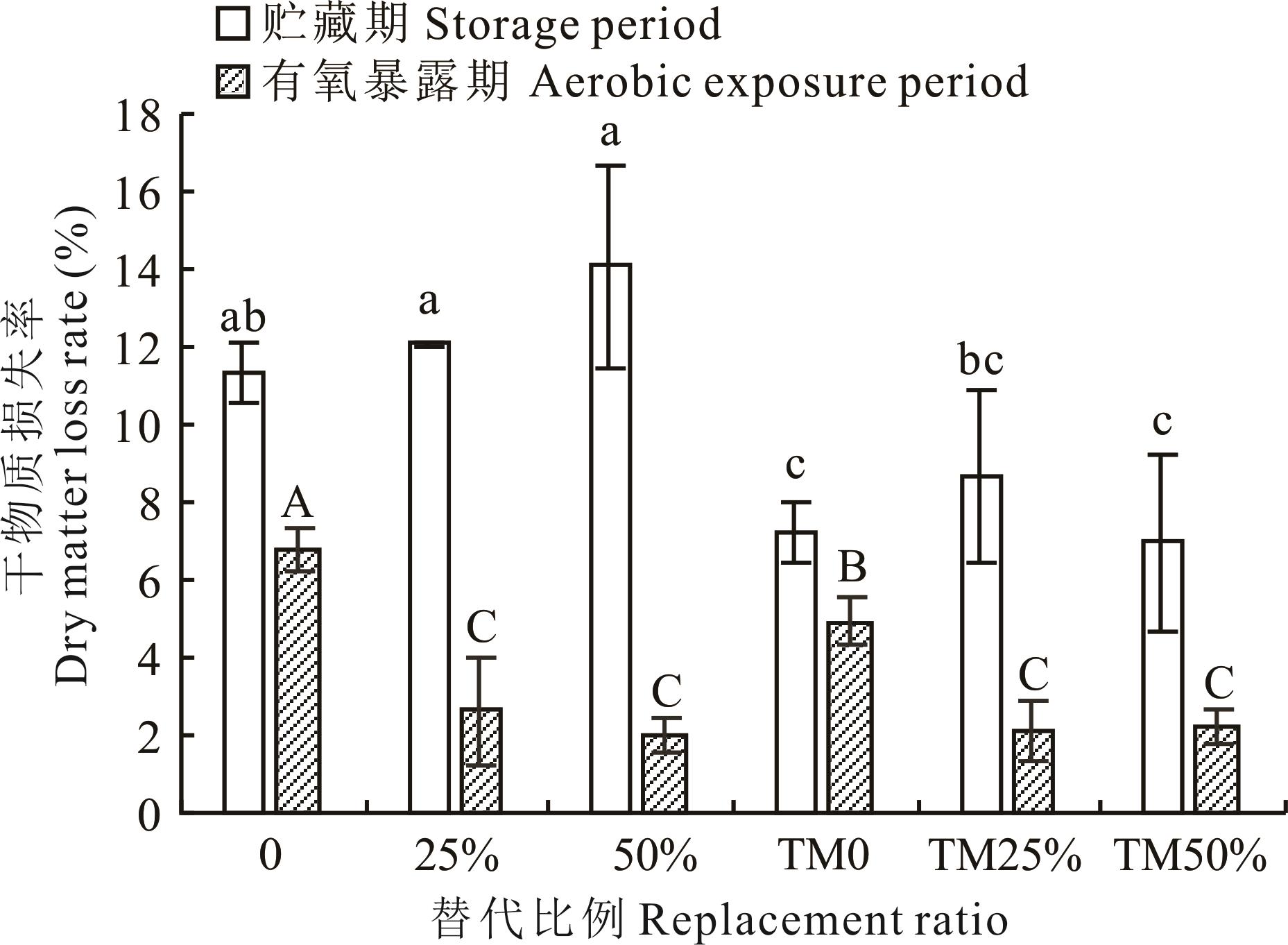
图1 甜叶菊渣替代王草发酵全混合日粮的干物质损失率TM: 添加2%糖蜜Addition of 2% molasses; 不同小写字母表示贮藏期所有处理间差异显著(P<0.05)Different lowercase letters indicate significant differences among different additives and replacement ratios during storage period (P<0.05); 不同大写字母表示有氧暴露期所有处理间差异显著(P<0.05)Different uppercase letters indicate significant differences among different additives and replacement ratios during aerobic exposure period (P<0.05); 下同The same below.
Fig.1 The dry matter loss rate of fermented total mixed ration formulated with stevia residue in place of king grass
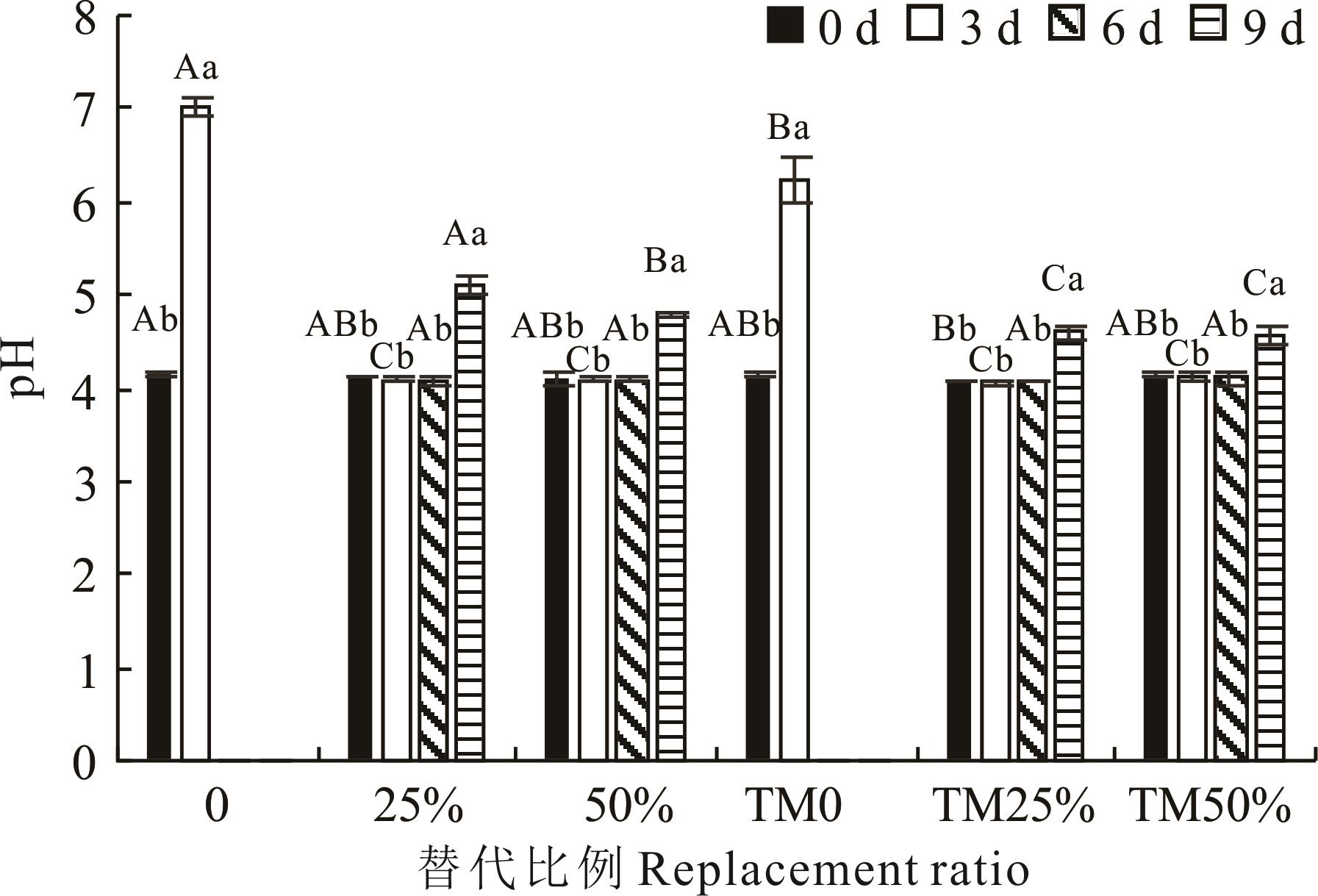
图2 甜叶菊渣替代王草的发酵全混合日粮有氧暴露期间的pH变化不同大写字母表示同一有氧暴露天数不同替代比例间的差异显著(P<0.05)Different uppercase letters indicate significant differences in different substitution ratios on the same aerobic exposure day (P<0.05); 不同小写字母表示同一替代比例不同有氧暴露天数间差异显著(P<0.05)Different lowercase letters indicate significant differences in different aerobic exposure days at the same substitution ratio (P<0.05); 0、TM0在6和9 d未取样Samples were not collected for 0 and TM0 at 6 and 9 d.
Fig. 2 The pH changes of fermented total mixed ration formulated with stevia residue in place of king grass
项目 Item | 添加剂 A | 替代比例 R | 有氧暴露天数Duration of aerobic exposure | 显著性Significance | |||||||||
|---|---|---|---|---|---|---|---|---|---|---|---|---|---|
| 0 d | 3 d | 6 d | 9 d | A | R | D | A×R | A×D | R×D | I | |||
好氧 细菌 AB | CK | 0 | 4.20±0.04aB | 8.85±0.07aA | - | - | ** | ** | ** | ** | ** | ** | ** |
| 25% | 4.13±0.17aB | 4.13±0.12cB | 5.02±0.24aA | - | |||||||||
| 50% | 4.14±0.14aB | 4.26±0.11cB | 4.80±0.13aA | - | |||||||||
| TM | 0 | 4.25±0.14aB | 8.29±0.12bA | - | - | ||||||||
| 25% | 3.99±0.19aB | 4.21±0.08cB | 4.17±0.16bB | 6.98±1.22aA | |||||||||
| 50% | 4.22±0.10aB | 4.29±0.07cB | 4.39±0.17bB | 6.93±1.02aA | |||||||||
酵母菌 Yeast | CK | 0 | 2.28±0.49bB | 8.69±0.13aA | - | - | NS | * | ** | NS | ** | ** | ** |
| 25% | ND | 1.70±1.57bB | 6.64±0.07aA | - | |||||||||
| 50% | ND | 1.53±1.46bB | 6.51±0.06aA | - | |||||||||
| TM | 0 | 3.06±0.12aB | 7.94±0.09aA | - | - | ||||||||
| 25% | ND | 2.29±0.55bB | 2.84±0.26bB | 4.92±1.60aA | |||||||||
| 50% | ND | 1.74±1.54bBC | 2.84±0.18bAB | 4.44±2.15aA | |||||||||
表4 甜叶菊渣替代王草的发酵全混合日粮有氧暴露期间的微生物数量
Table 4 Microbial counts of fermented total mixed ration formulated with stevia residue in place of king grass during aerobic exposure (lg cfu·g-1 FM)
项目 Item | 添加剂 A | 替代比例 R | 有氧暴露天数Duration of aerobic exposure | 显著性Significance | |||||||||
|---|---|---|---|---|---|---|---|---|---|---|---|---|---|
| 0 d | 3 d | 6 d | 9 d | A | R | D | A×R | A×D | R×D | I | |||
好氧 细菌 AB | CK | 0 | 4.20±0.04aB | 8.85±0.07aA | - | - | ** | ** | ** | ** | ** | ** | ** |
| 25% | 4.13±0.17aB | 4.13±0.12cB | 5.02±0.24aA | - | |||||||||
| 50% | 4.14±0.14aB | 4.26±0.11cB | 4.80±0.13aA | - | |||||||||
| TM | 0 | 4.25±0.14aB | 8.29±0.12bA | - | - | ||||||||
| 25% | 3.99±0.19aB | 4.21±0.08cB | 4.17±0.16bB | 6.98±1.22aA | |||||||||
| 50% | 4.22±0.10aB | 4.29±0.07cB | 4.39±0.17bB | 6.93±1.02aA | |||||||||
酵母菌 Yeast | CK | 0 | 2.28±0.49bB | 8.69±0.13aA | - | - | NS | * | ** | NS | ** | ** | ** |
| 25% | ND | 1.70±1.57bB | 6.64±0.07aA | - | |||||||||
| 50% | ND | 1.53±1.46bB | 6.51±0.06aA | - | |||||||||
| TM | 0 | 3.06±0.12aB | 7.94±0.09aA | - | - | ||||||||
| 25% | ND | 2.29±0.55bB | 2.84±0.26bB | 4.92±1.60aA | |||||||||
| 50% | ND | 1.74±1.54bBC | 2.84±0.18bAB | 4.44±2.15aA | |||||||||

图3 甜叶菊渣替代王草的发酵全混合日粮在门(a)、属(b)和种(c)水平的细菌多样性F: 全混合日粮Total mixed ration; S: 发酵全混合日粮Fermented total mixed ration; R1、R2、R3: 甜叶菊渣替代王草比例0、25%、50% The ratios of stevia residue replacing king grass at 0, 25%, and 50% respectively.
Fig.3 Bacterial diversity of the fermented total mixed ration with stevia residue replacing king grass at the phylum (a), genus (b) and species (c) levels
添加剂 Additive | 替代比例 Replacement ratio | 自由基清除能力Free radical scavenging capacity (mg TE·g -1 DM) | 总黄酮TF (mg RE·g-1 DM) | ||
|---|---|---|---|---|---|
| DPPH | ABTS | FRAP | |||
| F | 0 | 1.34±0.10d | 2.98±0.12e | 1.24±0.07e | 6.02±0.21c |
| 25% | 1.54±0.04d | 3.50±0.15d | 1.50±0.05de | 6.40±0.68c | |
| 50% | 1.85±0.15c | 3.78±0.54bcd | 1.56±0.20d | 7.12±0.53c | |
| CK | 0 | 2.25±0.20b | 3.32±0.18e | 2.36±0.34c | 12.55±0.43ab |
| 25% | 2.37±0.06ab | 4.21±0.15ab | 2.76±0.04ab | 11.51±1.11ab | |
| 50% | 2.24±0.03b | 4.13±0.05abc | 2.33±0.11c | 10.30±0.44b | |
| TM | 0 | 2.33±0.14b | 3.68±0.12cd | 2.42±0.03cd | 11.92±0.15ab |
| 25% | 2.66±0.34a | 4.44±0.33a | 2.52±0.07bc | 12.97±3.22a | |
| 50% | 2.54±0.24ab | 4.48±0.43a | 2.86±0.25a | 12.08±0.84ab | |
显著性 Significance | A | ** | ** | ** | ** |
| R | * | ** | ** | NS | |
| I | NS | NS | * | NS | |
表5 甜叶菊渣替代王草的发酵全混合日粮自由基清除能力和总黄酮含量
Table 5 Free radical scavenging capacity and total flavonoid content of fermented total mixed ration formulated with stevia residue in place of king grass
添加剂 Additive | 替代比例 Replacement ratio | 自由基清除能力Free radical scavenging capacity (mg TE·g -1 DM) | 总黄酮TF (mg RE·g-1 DM) | ||
|---|---|---|---|---|---|
| DPPH | ABTS | FRAP | |||
| F | 0 | 1.34±0.10d | 2.98±0.12e | 1.24±0.07e | 6.02±0.21c |
| 25% | 1.54±0.04d | 3.50±0.15d | 1.50±0.05de | 6.40±0.68c | |
| 50% | 1.85±0.15c | 3.78±0.54bcd | 1.56±0.20d | 7.12±0.53c | |
| CK | 0 | 2.25±0.20b | 3.32±0.18e | 2.36±0.34c | 12.55±0.43ab |
| 25% | 2.37±0.06ab | 4.21±0.15ab | 2.76±0.04ab | 11.51±1.11ab | |
| 50% | 2.24±0.03b | 4.13±0.05abc | 2.33±0.11c | 10.30±0.44b | |
| TM | 0 | 2.33±0.14b | 3.68±0.12cd | 2.42±0.03cd | 11.92±0.15ab |
| 25% | 2.66±0.34a | 4.44±0.33a | 2.52±0.07bc | 12.97±3.22a | |
| 50% | 2.54±0.24ab | 4.48±0.43a | 2.86±0.25a | 12.08±0.84ab | |
显著性 Significance | A | ** | ** | ** | ** |
| R | * | ** | ** | NS | |
| I | NS | NS | * | NS | |
| [1] | Lemus-Mondaca R, Vega-Gálvez A, Zura-Bravo L, et al. Stevia rebaudiana Bertoni, source of a high-potency natural sweetener: A comprehensive review on the biochemical, nutritional and functional aspects. Food Chemistry, 2012, 132(3): 1121-1132. |
| [2] | Ding H R, Hong L Z, Zhao B Q, et al. The main uses and the problems of Stevia in current production. Sugar Crops of China, 2016, 38(6): 77-78. |
| 丁海荣, 洪立洲, 赵宝泉, 等. 甜叶菊主要用途及当前生产中存在的问题. 中国糖料, 2016, 38(6): 77-78. | |
| [3] | Molina-Calle M, Priego-Capote F, Luque D C M. Characterization of Stevia leaves by LC-QTOF MS/MS analysis of polar and non-polar extracts. Food Chemistry, 2017, 219: 329-338. |
| [4] | Wu L J, Ou X, Cao X H, et al. The effect of the mixing ratio of mulberry and sweet leaf chrysanthemum residue on the quality and microbial diversity of silage feed. Chinese Journal of Animal Science, 2024, 60(12): 276-281. |
| 吴丽娟, 欧翔, 操贤洪, 等. 饲料桑与甜叶菊渣混合比例对青贮饲料品质及微生物多样性的影响. 中国畜牧杂志, 2024, 60(12): 276-281. | |
| [5] | Long S H, Li X F, Pan J X, et al. Study on silage quality and microbial community diversity of ‘Reyan No.4’ king grass harvested at different growth days. Acta Agrestia Sinica, 2022, 30(7): 1900-1908. |
| 龙仕和, 李雪枫, 潘俊歆, 等. 不同生长天数‘热研4号’王草青贮品质和微生物群落多样性研究. 草地学报, 2022, 30(7): 1900-1908. | |
| [6] | Li M, Zi X J, Bai C J, et al. Effect of different temperatures on fermentation quality of king grass silage. China Animal Husbandry and Veterinary Medicine, 2014, 41(10): 91-94. |
| 李茂, 字学娟, 白昌军, 等. 不同贮藏温度对王草青贮发酵品质的影响. 中国畜牧兽医, 2014, 41(10): 91-94. | |
| [7] | Jiang F G, Cheng H J, Wei C, et al. Effects of addition amount of molasses on the fermentation quality and microbial diversity of hybrid Broussonetia papyrifera L. Vent silage. Biotechnology Bulletin, 2021, 37(9): 68-76. |
| 姜富贵, 成海建, 魏晨, 等. 糖蜜添加量对杂交构树青贮发酵品质和微生物多样性的影响. 生物技术通报, 2021, 37(9): 68-76. | |
| [8] | Li X B, Cheng Y Z, Yang F F, et al. Improving total mixed ration silage: effects of lactic acid bacteria inoculants and antimicrobial additives on fermentation quality and aerobic stability. Agronomy, 2024, 14(8): 1602. |
| [9] | Li Y M, Duan X H, Zhang W H, et al.Research progress of TMR for beef cattle. China Feed, 2024(14): 5-9. |
| 李艳梅, 段新慧, 张旺宏, 等. 肉牛全混合日粮(TMR)应用的研究进展. 中国饲料, 2024(14): 5-9. | |
| [10] | Wang S R, Ding C L, Tian J P, et al. Effects of biological and antifungal additives on ensiling characteristics, in vitro digestibility, gas production, and aerobic stability of fermented total mixed ration including wet brewers’ grains. Acta Prataculturae Sinica, 2025, 34(6): 213-226. |
| 王思然, 丁成龙, 田吉鹏, 等. 乳酸菌和抗真菌添加剂对湿啤酒糟全混合日粮青贮发酵品质、体外消化率及有氧稳定性的影响. 草业学报, 2025, 34(6): 213-226. | |
| [11] | Ji H Q, Meng L N, Yu M, et al. Effect of TMR particles on growth performance, digestion and metabolism, and serum indicators of Liaoning cashmere goats. Feed Research, 2025, 48(18): 19-23. |
| 冀红芹, 孟令楠, 于明, 等. TMR颗粒对辽宁绒山羊生长性能、消化代谢和血清指标的影响. 饲料研究, 2025, 48(18): 19-23. | |
| [12] | Wang L, Jin S, Wang P, et al. Fermented total mixed ration enhances nutrient digestibility and modulates the milk components and fecal microbial community in lactating holstein dairy cows. Frontiers in Veterinary Science, 2024, 11: 1408348. |
| [13] | Yang X L, Wang Z L, Yu Z, et al. Effect of various roughage compositions on the fermentation quality of total mixed ration (TMR). Pratacultural Science, 2010, 27(2): 139-143. |
| 杨晓亮, 王宗礼, 玉柱, 等. 不同的粗饲料搭配对TMR饲料发酵品质的影响. 草业科学, 2010, 27(2): 139-143. | |
| [14] | Playne M J, Mcdonald P. The buffering constituents of herbage and of silage. Journal of the Science of Food and Agriculture, 1966, 17(6): 264-265. |
| [15] | Zhang L Y. Feed analysis and feed quality detection technology. Beijing: China Agricultural Science and Technology Press, 2003: 46-75. |
| 张丽英. 饲料分析及饲料质量检测技术. 北京: 中国农业科技出版社, 2003: 46-75. | |
| [16] | Han Y S. Food chemistry experiment guide. Beijing: Beijing Agricultural University Press, 1996: 19-22. |
| 韩雅珊. 食品化学实验指导. 北京: 北京农业大学出版社, 1996: 19-22. | |
| [17] | Murphy R P. A method for the extraction of plant samples and the determination of total soluble carbohydrates. Journal of the Science of Food and Agriculture, 1958, 9(11): 714-717. |
| [18] | Van Soest P J, Robertson J B, Lewis B A. Methods for dietary fiber, neutral detergent fiber, and nonstarch polysaccharides in relation to animal nutrition. Journal of Dairy Science, 1991, 74(10): 3583-3597. |
| [19] | Huang X L. Microbiological test guidance. Beijing: Higher Education Press, 2000. |
| 黄秀梨. 微生物学试验指导. 北京: 高等教育出版社, 2000. | |
| [20] | Broderick G A, Kang J H. Automated simultaneous determination of ammonia and total amino acids in ruminal fluid and in vitro media. Journal of Dairy Science, 1980, 63(1): 64-75. |
| [21] | Xie J H, Shen M Y, Xie M Y, et al. Ultrasonic-assisted extraction, antimicrobial and antioxidant activities of Cyclocarya paliurus (Batal.) Iljinskaja polysaccharides. Carbohydrate Polymers, 2012, 89(1): 177-184. |
| [22] | Abdennacer B, Karim M, Yassine M, et al. Determination of phytochemicals and antioxidant activity of methanol extracts obtained from the fruit and leaves of Tunisian Lycium intricatum Boiss. Food Chemistry, 2015, 174: 577-584. |
| [23] | Singh R S G, Negi P S, Radha C. Phenolic composition, antioxidant and antimicrobial activities of free and bound phenolic extracts of Moringa oleifera seed flour. Journal of Functional Foods, 2013, 5(4): 1883-1891. |
| [24] | Wang J. Study on the mixed silage of rice straw or corn stover and agricultural by-products. Nanjing: Nanjing Agricultural University, 2017. |
| 王坚. 水稻、玉米秸秆与农副产品混合青贮研究. 南京: 南京农业大学, 2017. | |
| [25] | Mcdonald P, Henderson A R, Heron S J E. The biochemistry of silage. Marlow, Bucks, UK: Chalcombe Publications, 1991. |
| [26] | Kondo M, Naoki N, Kazumi K, et al. Enhanced lactic acid fermentation of silage by the addition of green tea waste. Journal of the Science of Food and Agriculture, 2004, 84(7): 728-734. |
| [27] | Teng D M, Hao M J. Effects of herbage silage on fermentation quality. China Feed, 2020(22): 122-125. |
| 滕道明, 郝明静. 不同牧草青贮对发酵品质的影响. 中国饲料, 2020(22): 122-125. | |
| [28] | Zhang G N, Fang X P, Feng G Z, et al. Silage fermentation, bacterial community, and aerobic stability of total mixed ration containing wet corn gluten feed and corn stover prepared with different additives. Animals, 2020, 10(10): 1775. |
| [29] | Myint K Z, Zhou Z, Shi Q, et al. Stevia polyphenols, their antimicrobial and anti-inflammatory properties, and inhibitory effect on digestive enzymes. Molecules, 2023, 28(22): 7572. |
| [30] | Nishino N, Hattori H, Wada H, et al. Biogenic amine production in grass, maize and total mixed ration silages inoculated with Lactobacillus casei or Lactobacillus buchneri. Journal of Applied Microbiology, 2007, 103(2): 325-332. |
| [31] | Xiao S H, Yuan X J, Dong Z H, et al. Effects of inoculant and molasses additives on fermentation quality of mixed silages of tall fescue (Festuca arundinacea Schreb) and common vetch (Vicia sativa L). Journal of Nanjing Agricultural University, 2016, 39(6): 1017-1022. |
| 肖慎华, 原现军, 董志浩, 等. 添加乳酸菌制剂和糖蜜对箭筈豌豆和苇状羊茅混合青贮发酵品质的影响. 南京农业大学学报, 2016, 39(6): 1017-1022. | |
| [32] | Borreani G, Piano S, Tabacco E. Aerobic stability of maize silage stored under plastic films with different oxygen permeability. Journal of the Science of Food and Agriculture, 2014, 94(13): 2684-2690. |
| [33] | Pang H L, Qin G Y, Tan Z F, et al. Natural populations of lactic acid bacteria associated with silage fermentation as determined by phenotype, 16S ribosomal RNA and recA gene analysis. Systematic and Applied Microbiology, 2011, 34(3): 235-241. |
| [34] | Zhang L, Zhou X K, Gu Q C, et al. Analysis of the correlation between bacteria and fungi in sugarcane tops silage prior to and after aerobic exposure. Bioresource Technology, 2019, 291: 121835. |
| [35] | Guo X, Chen D D, Huang P S, et al. Effects of tannin-tolerant lactic acid bacteria in combination with tannic acid on the fermentation quality, protease activity and bacterial community of stylo silage. Journal of the Science of Food and Agriculture, 2025, 105(4): 2540-2551. |
| [36] | Li J Z, Li G M, Zhang H S, et al. The fermentation quality, antioxidant activity, and bacterial community of mulberry leaf silage with Pediococcus, Bacillus, and wheat bran. Fermentation-Basel, 2024, 10(4): 214. |
| [37] | He L W, Lv H J, Chen N, et al. Improving fermentation, protein preservation and antioxidant activity of Moringa oleifera leaves silage with gallic acid and tannin acid. Bioresource Technology, 2020, 297: 122390. |
| [38] | Iqbal S, Younas U, Sirajuddin, et al. Proximate composition and antioxidant potential of leaves from three varieties of mulberry (Morus sp.): A comparative study. International Journal of Molecular Sciences, 2012, 13(6): 6651-6664. |
| [1] | 庞凯悦, 冯彦龙, 刘合云, 苏少峰, 杜家华, 吴佳海, 曾兵. 发酵全混合日粮及其在反刍动物应用的研究进展[J]. 草业学报, 2026, 35(9): 211-235. |
| [2] | 王涛, 李静, 卢强, 柯文灿, 黄帅. 蒲公英黄酮和枯草芽孢杆菌对燕麦青贮品质、抗氧化活性及微生物群落结构的影响[J]. 草业学报, 2026, 35(6): 108-121. |
| [3] | 刘志昊, 李文龙, 张晨, 刘美英, 陶雅. 养殖废水灌溉下青贮添加剂对全株玉米青贮饲料品质的影响[J]. 草业学报, 2026, 35(6): 60-72. |
| [4] | 陈姝妍, 陶思印, 杜金舆, 李耀坤, 柳广斌, 孙宝丽, 郭勇庆, 刘德武, 邓铭. 不同微生物协同黑曲霉对木薯渣发酵品质和微生物多样性的影响[J]. 草业学报, 2026, 35(12): 103-112. |
| [5] | 欧翔, 张强, 操贤洪, 陈荣强, 连海, 黄志文, 康美如, 刘峥, 雷小文. 不同外源硒对镉污染土地中王草生长、营养品质及镉、硒富集的影响[J]. 草业学报, 2026, 35(11): 184-200. |
| [6] | 马亚玲. 北方天然草地牧草青贮利用研究现状和发展趋势[J]. 草业学报, 2026, 35(11): 227-240. |
| [7] | 吴娟燕, 田静, 郭香, 黄莉莹, 张建国. 籽实青贮的研究与利用进展[J]. 草业学报, 2025, 34(8): 211-220. |
| [8] | 王思然, 丁成龙, 田吉鹏, 程云辉, 许能祥, 张文洁, 王欣, 刘蓓一. 乳酸菌和抗真菌添加剂对湿啤酒糟全混合日粮青贮发酵品质、体外消化率及有氧稳定性的影响[J]. 草业学报, 2025, 34(6): 213-226. |
| [9] | 毛开, 许艺, 王学梅, 柴欢, 黄帅, 王坚, 郇树乾, 玉柱, 王目森. 植物乳植杆菌与糖蜜对花生秧青贮饲料发酵品质、生物胺含量及细菌群落的影响[J]. 草业学报, 2025, 34(5): 146-158. |
| [10] | 王思然, 刘蓓一, 田吉鹏, 程云辉, 许能祥, 张文洁, 王欣, 丁成龙. 复合乳酸菌添加剂对低温环境下意大利黑麦草青贮发酵品质的影响[J]. 草业学报, 2025, 34(5): 159-170. |
| [11] | 梁宇成, 张晓雯, 邵涛, 王文博, 原现军. 乳酸菌对全株玉米青贮发酵品质和霉菌毒素含量的影响[J]. 草业学报, 2025, 34(3): 123-133. |
| [12] | 欧翔, 连海, 陈荣强, 邱静芸, 吴丽娟, 操贤洪, 张强, 雷小文. 不同施肥处理种植王草后对稀土尾矿土壤理化性质和酶活性的影响[J]. 草业学报, 2025, 34(2): 94-108. |
| [13] | 韦竣玲, 刘晓琪, 王宛青, 邓铭, 孙宝丽, 郭勇庆. 玉米秸秆与毛豆茎叶混合比例对青贮发酵品质和微生物群落的影响[J]. 草业学报, 2025, 34(12): 111-120. |
| [14] | 邓清源, 付东青, 黄嵘峥, 张凡凡, 孙国君. 松针精油对构树青贮品质及有氧稳定性的影响[J]. 草业学报, 2025, 34(10): 85-94. |
| [15] | 郭田心, 阮诗诗, 郭香, 詹佳琦, 梁秋雨, 陈晓阳, 周玮, 张庆. 不同复合菌酶添加对中药渣青贮饲料的营养价值及发酵品质的影响[J]. 草业学报, 2024, 33(10): 194-202. |
| 阅读次数 | ||||||
|
全文 |
|
|||||
|
摘要 |
|
|||||
