

ISSN 1004-5759 CN 62-1105/S
草业学报 ›› 2025, Vol. 34 ›› Issue (5): 146-158.DOI: 10.11686/cyxb2024224
• 研究论文 • 上一篇
毛开1( ), 许艺1, 王学梅1, 柴欢1, 黄帅1, 王坚1, 郇树乾1, 玉柱2, 王目森1()
收稿日期:2024-06-11
修回日期:2024-08-30
出版日期:2025-05-20
发布日期:2025-03-20
通讯作者:
王目森
作者简介:E-mail: wangms@hainanu.edu.cn基金资助:
Kai MAO1(), Yi XU1, Xue-mei WANG1, Huan CHAI1, Shuai HUANG1, Jian WANG1, Shu-qian HUAN1, Zhu YU2, Mu-sen WANG1()
Received:2024-06-11
Revised:2024-08-30
Online:2025-05-20
Published:2025-03-20
Contact:
Mu-sen WANG
摘要:
花生秧青贮过程中真蛋白发生大量降解,游离氨基酸可在氨基酸脱羧酶作用下进一步脱羧形成生物胺。为降低花生秧青贮饲料生物胺含量,本试验设置以下处理:蒸馏水(对照),2%糖蜜,植物乳植杆菌(1×10⁶菌落形成单位),2%糖蜜和植物乳植杆菌复合处理;每个处理4次重复,青贮28 d并分析样品发酵品质、生物胺含量及细菌群落。结果表明,花生秧自然青贮发酵品质差,主要生物胺是酪胺(1338.36 mg·kg-1干物质)和尸胺(417.58 mg·kg-1干物质);糖蜜与糖蜜和菌复合处理可显著改善发酵品质(P<0.001),降低酪胺、尸胺及总生物胺含量(P<0.05)。花生秧原料主要细菌是猪副杆菌(17.51%)、蝙蝠假单胞菌(13.06%)、分散泛菌(5.63%)及柠檬色短小杆菌(5.53%);自然青贮后细菌种类复杂,以类肠膜魏斯氏菌(22.71%)、植物乳植杆菌(10.67%)、发酵粘液乳杆菌(10.38%)、坎氏魏斯氏菌(9.27%)、戊糖片球菌(8.34%)、蝙蝠假单胞菌(8.07%)、格氏乳球菌(6.74%)及人参皂苷伴生乳杆菌(5.10%)为主。与对照组相比,糖蜜提高了植物乳植杆菌和类肠膜魏斯氏菌相对丰度,降低了戊糖片球菌和坎氏魏斯氏菌丰度;糖蜜和菌复合处理增加了植物乳植杆菌和桥粘液乳杆菌丰度,优化了细菌群落结构。斯皮尔曼相关性分析表明,酪胺和尸胺与pH、丁酸、氨态氮、猪副杆菌、人参皂苷伴生乳杆菌及坎氏魏斯氏菌呈显著正相关(P<0.05)。综合发酵品质、营养成分及生物胺含量,糖蜜与糖蜜和菌复合处理组效果较好。
毛开, 许艺, 王学梅, 柴欢, 黄帅, 王坚, 郇树乾, 玉柱, 王目森. 植物乳植杆菌与糖蜜对花生秧青贮饲料发酵品质、生物胺含量及细菌群落的影响[J]. 草业学报, 2025, 34(5): 146-158.
Kai MAO, Yi XU, Xue-mei WANG, Huan CHAI, Shuai HUANG, Jian WANG, Shu-qian HUAN, Zhu YU, Mu-sen WANG. Effect of Lactiplantibacillus plantarum and molasses on the fermentation quality, biogenic amines contents and bacterial community of peanut vine silage[J]. Acta Prataculturae Sinica, 2025, 34(5): 146-158.
氨态氮/总氮 Ammonia-N/total nitrogen (%) | 乙酸+丙酸 Acetic acid and propionic acid | 丁酸及其他挥发性脂肪酸 Butyric acid and other volatile fatty acids | V-score评分 V-score scoring | |||
|---|---|---|---|---|---|---|
| XN | 计算式Formula (YN) | XA | 计算式Formula (YA) | XB | 计算式Formula (YB) | |
| ≤5 | YN=50 | ≤0.2 | YA=10 | 0~0.5 | YB=40-80XB | Y=YN+YA+YB |
| 5~10 | YN=60-2XN | 0.2~1.5 | YA=(150-100XA)/13 | >0.5 | 0 | |
| 10~20 | YN=80-4XN | >1.5 | YA=0 | |||
| >20 | YN=0 | |||||
表1 V-score评分标准
Table 1 V-score scoring criteria
氨态氮/总氮 Ammonia-N/total nitrogen (%) | 乙酸+丙酸 Acetic acid and propionic acid | 丁酸及其他挥发性脂肪酸 Butyric acid and other volatile fatty acids | V-score评分 V-score scoring | |||
|---|---|---|---|---|---|---|
| XN | 计算式Formula (YN) | XA | 计算式Formula (YA) | XB | 计算式Formula (YB) | |
| ≤5 | YN=50 | ≤0.2 | YA=10 | 0~0.5 | YB=40-80XB | Y=YN+YA+YB |
| 5~10 | YN=60-2XN | 0.2~1.5 | YA=(150-100XA)/13 | >0.5 | 0 | |
| 10~20 | YN=80-4XN | >1.5 | YA=0 | |||
| >20 | YN=0 | |||||
| 项目Items | 含量Content |
|---|---|
| 干物质DM (g·kg-1 FM) | 292.83 |
| 粗蛋白CP (g·kg-1 DM) | 169.69 |
| 氨态氮Ammonia-N (g·kg-1 TN) | 7.02 |
| 游离氨基酸氮FAA-N (g·kg-1 TN) | 4.99 |
| 水溶性碳水化合物WSC (g·kg-1 DM) | 29.71 |
| pH | 5.90 |
| 中性洗涤纤维NDF (g·kg-1 DM) | 376.90 |
| 酸性洗涤纤维ADF (g·kg-1 DM) | 239.05 |
| 相对饲用价值RFV | 173.40 |
| 组胺Histamine (mg·kg-1 DM) | 0.00 |
| 腐胺Putrescine (mg·kg-1 DM) | 9.70 |
| 尸胺Cadaverine (mg·kg-1 DM) | 10.49 |
| 亚精胺Spermidine (mg·kg-1 DM) | 28.76 |
| 酪胺Tyramine (mg·kg-1 DM) | 2.87 |
| 精胺Spermine (mg·kg-1 DM) | 15.05 |
| 苯乙胺Phenethylamine (mg·kg-1 DM) | 4.88 |
| 色胺Tryptamine (mg·kg-1 DM) | 2.41 |
| 总生物胺Total biogenic amine (mg·kg-1 DM) | 74.16 |
表2 花生秧原料化学成分与生物胺含量
Table 2 Chemical composition and biogenic amines contents of peanut vine before ensiling
| 项目Items | 含量Content |
|---|---|
| 干物质DM (g·kg-1 FM) | 292.83 |
| 粗蛋白CP (g·kg-1 DM) | 169.69 |
| 氨态氮Ammonia-N (g·kg-1 TN) | 7.02 |
| 游离氨基酸氮FAA-N (g·kg-1 TN) | 4.99 |
| 水溶性碳水化合物WSC (g·kg-1 DM) | 29.71 |
| pH | 5.90 |
| 中性洗涤纤维NDF (g·kg-1 DM) | 376.90 |
| 酸性洗涤纤维ADF (g·kg-1 DM) | 239.05 |
| 相对饲用价值RFV | 173.40 |
| 组胺Histamine (mg·kg-1 DM) | 0.00 |
| 腐胺Putrescine (mg·kg-1 DM) | 9.70 |
| 尸胺Cadaverine (mg·kg-1 DM) | 10.49 |
| 亚精胺Spermidine (mg·kg-1 DM) | 28.76 |
| 酪胺Tyramine (mg·kg-1 DM) | 2.87 |
| 精胺Spermine (mg·kg-1 DM) | 15.05 |
| 苯乙胺Phenethylamine (mg·kg-1 DM) | 4.88 |
| 色胺Tryptamine (mg·kg-1 DM) | 2.41 |
| 总生物胺Total biogenic amine (mg·kg-1 DM) | 74.16 |
项目 Items | 处理Treatments | 标准误 SEM | P值 P-value | |||
|---|---|---|---|---|---|---|
| CK | M | L | ML | |||
| pH | 5.45A | 4.93B | 5.55A | 4.88B | 0.048 | <0.001 |
| 乳酸Lactic acid (g·kg-1 DM) | 23.67B | 50.13A | 18.20C | 48.90A | 2.100 | <0.001 |
| 乙酸Acetic acid (g·kg-1 DM) | 17.83B | 22.43A | 24.97A | 21.00A | 1.750 | 0.010 |
| 乳乙比Lactic acid to acetic acid | 1.52B | 2.37A | 0.78C | 2.36A | 0.120 | <0.001 |
| 丙酸Propionic acid (g·kg-1 DM) | 16.39B | 22.12A | 20.70A | 20.08A | 1.390 | 0.011 |
| 丁酸Butyric acid (g·kg-1 DM) | 10.64B | 2.56C | 11.72A | 2.23C | 0.120 | <0.001 |
| 氨态氮Ammonia-N (g·kg-1 TN) | 92.78B | 79.88C | 107.12A | 66.87D | 4.420 | <0.001 |
| V-score评分V-score scoring | 63.12C | 81.87B | 56.14D | 84.29A | 0.920 | <0.001 |
| 干物质DM (g·kg-1 FM) | 271.87AB | 276.35A | 263.05B | 280.18A | 0.450 | 0.015 |
| 粗蛋白CP (g·kg-1 DM) | 158.37 | 161.18 | 152.05 | 157.03 | 3.740 | 0.147 |
| 游离氨基酸氮FAA-N (g·kg-1 TN) | 180.19B | 189.44B | 233.22A | 166.04B | 8.180 | <0.001 |
| 水溶性碳水化合物WSC (g·kg-1 DM) | 5.89D | 8.05B | 6.75C | 8.84A | 0.290 | <0.001 |
| 中性洗涤纤维NDF (g·kg-1 DM) | 388.36 | 352.76 | 363.30 | 363.88 | 20.300 | 0.129 |
| 酸性洗涤纤维ADF (g·kg-1 DM) | 248.85 | 226.13 | 243.65 | 242.28 | 9.820 | 0.053 |
| 相对饲用价值RFV | 168.02 | 188.43 | 179.11 | 180.44 | 11.300 | 0.387 |
表3 花生秧青贮饲料发酵特性
Table 3 Fermentation characteristics of peanut vine silage
项目 Items | 处理Treatments | 标准误 SEM | P值 P-value | |||
|---|---|---|---|---|---|---|
| CK | M | L | ML | |||
| pH | 5.45A | 4.93B | 5.55A | 4.88B | 0.048 | <0.001 |
| 乳酸Lactic acid (g·kg-1 DM) | 23.67B | 50.13A | 18.20C | 48.90A | 2.100 | <0.001 |
| 乙酸Acetic acid (g·kg-1 DM) | 17.83B | 22.43A | 24.97A | 21.00A | 1.750 | 0.010 |
| 乳乙比Lactic acid to acetic acid | 1.52B | 2.37A | 0.78C | 2.36A | 0.120 | <0.001 |
| 丙酸Propionic acid (g·kg-1 DM) | 16.39B | 22.12A | 20.70A | 20.08A | 1.390 | 0.011 |
| 丁酸Butyric acid (g·kg-1 DM) | 10.64B | 2.56C | 11.72A | 2.23C | 0.120 | <0.001 |
| 氨态氮Ammonia-N (g·kg-1 TN) | 92.78B | 79.88C | 107.12A | 66.87D | 4.420 | <0.001 |
| V-score评分V-score scoring | 63.12C | 81.87B | 56.14D | 84.29A | 0.920 | <0.001 |
| 干物质DM (g·kg-1 FM) | 271.87AB | 276.35A | 263.05B | 280.18A | 0.450 | 0.015 |
| 粗蛋白CP (g·kg-1 DM) | 158.37 | 161.18 | 152.05 | 157.03 | 3.740 | 0.147 |
| 游离氨基酸氮FAA-N (g·kg-1 TN) | 180.19B | 189.44B | 233.22A | 166.04B | 8.180 | <0.001 |
| 水溶性碳水化合物WSC (g·kg-1 DM) | 5.89D | 8.05B | 6.75C | 8.84A | 0.290 | <0.001 |
| 中性洗涤纤维NDF (g·kg-1 DM) | 388.36 | 352.76 | 363.30 | 363.88 | 20.300 | 0.129 |
| 酸性洗涤纤维ADF (g·kg-1 DM) | 248.85 | 226.13 | 243.65 | 242.28 | 9.820 | 0.053 |
| 相对饲用价值RFV | 168.02 | 188.43 | 179.11 | 180.44 | 11.300 | 0.387 |
项目 Items | 处理Treatments | 标准误 SEM | P值 P-value | |||
|---|---|---|---|---|---|---|
| CK | M | L | ML | |||
| 酪胺Tyramine | 1338.36A | 561.57C | 968.54B | 274.68D | 92.63 | <0.001 |
| 尸胺Cadaverine | 417.58A | 164.17C | 289.00B | 58.45D | 30.47 | <0.001 |
| 组胺Histamine | 11.78B | 408.42A | 57.72B | 461.57A | 33.72 | <0.001 |
| 腐胺Putrescine | 68.94A | 50.05AB | 57.88A | 37.55B | 7.97 | 0.024 |
| 苯乙胺Phenethylamine | 62.90A | 10.35C | 17.03B | 6.36D | 2.44 | <0.001 |
| 亚精胺Spermidine | 29.18B | 33.45A | 22.28C | 24.93C | 1.69 | <0.001 |
| 精胺Spermine | 8.90B | 12.75A | 11.68A | 12.58A | 0.96 | 0.013 |
| 色胺Tryptamine | 19.28AB | 13.75B | 24.88A | 3.30C | 2.70 | <0.001 |
| 总生物胺Total biogenic amine | 1956.91A | 1254.50B | 1449.01B | 879.42C | 128.11 | <0.001 |
表4 花生秧青贮饲料生物胺含量
Table 4 Biogenic amines contents of peanut vine silage (mg·kg-1 DM)
项目 Items | 处理Treatments | 标准误 SEM | P值 P-value | |||
|---|---|---|---|---|---|---|
| CK | M | L | ML | |||
| 酪胺Tyramine | 1338.36A | 561.57C | 968.54B | 274.68D | 92.63 | <0.001 |
| 尸胺Cadaverine | 417.58A | 164.17C | 289.00B | 58.45D | 30.47 | <0.001 |
| 组胺Histamine | 11.78B | 408.42A | 57.72B | 461.57A | 33.72 | <0.001 |
| 腐胺Putrescine | 68.94A | 50.05AB | 57.88A | 37.55B | 7.97 | 0.024 |
| 苯乙胺Phenethylamine | 62.90A | 10.35C | 17.03B | 6.36D | 2.44 | <0.001 |
| 亚精胺Spermidine | 29.18B | 33.45A | 22.28C | 24.93C | 1.69 | <0.001 |
| 精胺Spermine | 8.90B | 12.75A | 11.68A | 12.58A | 0.96 | 0.013 |
| 色胺Tryptamine | 19.28AB | 13.75B | 24.88A | 3.30C | 2.70 | <0.001 |
| 总生物胺Total biogenic amine | 1956.91A | 1254.50B | 1449.01B | 879.42C | 128.11 | <0.001 |
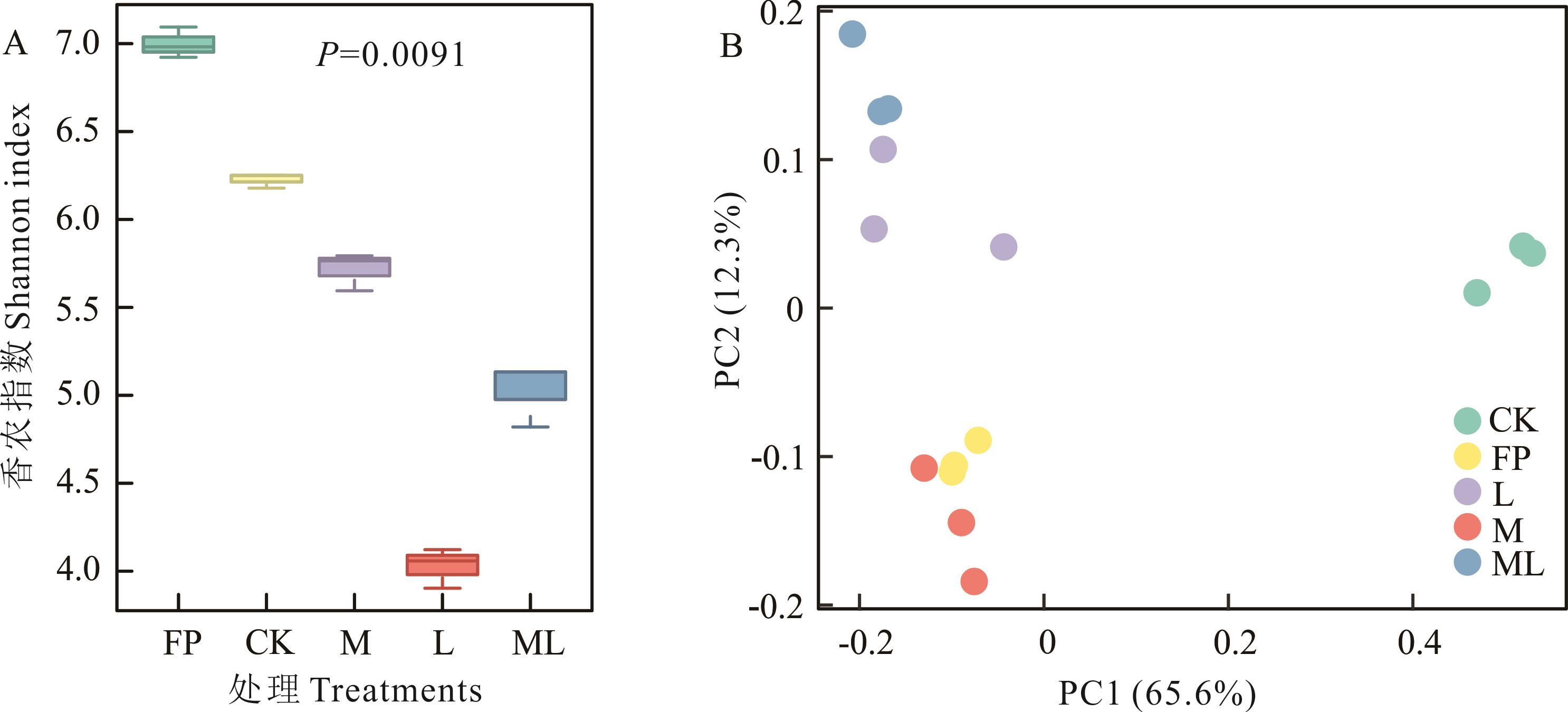
图1 花生秧原料及其青贮饲料香农指数和主坐标分析A: 细菌群落香农指数Bacterial community Shannon index; B: 细菌群落主坐标分析Bacterial community principal coordinate analysis. FP: 花生秧鲜样Fresh peanut vine; CK: 蒸馏水Distilled water; M: 2%糖蜜2% molasses; L: 植物乳植杆菌Lacti. plantarum MTD1; ML: 2%糖蜜和植物乳植杆菌 2% molasses and Lacti. plantarum MTD1. 下同The same below.
Fig.1 Shannon index and principal coordinate analysis of fresh and ensiled peanut vine

图2 花生秧原料及其青贮饲料细菌群落A: 属水平相对丰度Relative abundance of bacterial community at the genus level; B: 种水平相对丰度Relative abundance of bacterial community at the species level.
Fig.2 Bacterial community of fresh and ensiled peanut vine

图3 花生秧青贮饲料发酵特性和优势细菌与生物胺相关性分析A: 花生秧青贮饲料发酵特性与生物胺相关性分析The correlation analysis between fermentation characteristics and biogenic amines; B: 优势细菌与生物胺相关性分析The correlation analysis between predominant bacteria and biogenic amines. NDF: 中性洗涤纤维Neutral detergent fiber; DM: 干物质Dry matter; ADF: 酸性洗涤纤维Acid detergent fiber; FAA-N: 游离氨基酸氮Free amino acid nitrogen; RFV: 相对饲用价值Relative feed value; CP: 粗蛋白Crude protein; Ammonia-N: 氨态氮Ammonia nitrogen; LA: 乳酸Lactic acid; AA: 乙酸Acetic acid; PA: 丙酸Propionic acid; WSC: 水溶性碳水化合物Water-soluble carbohydrates; BA: 丁酸Butyric acid; LA to AA: 乳乙比Lactic acid to acetic acid. *表示相关性显著(P<0.05),**表示相关性极显著(P<0.01),***表示相关性极显著(P<0.001)。 * indicates significant correlation (P<0.05), ** indicates extremely significant correlation (P<0.01), *** indicates extremely significant correlation (P<0.001).
Fig.3 Correlation analysis between fermentation characteristics and predominant bacteria with biogenic amines
| 1 | Tang M Q, Hou P J, Ding L, et al. Comparison of yield and nutritional value of different varieties of peanut. Acta Ecologiae Animalis Domastici, 2020, 41(12): 56-60. |
| 唐梦琪, 侯沛君, 丁丽, 等. 不同花生品种花生秧产量及营养价值的比较. 家畜生态学报, 2020, 41(12): 56-60. | |
| 2 | Liang F, Li B Z, Rolf D V, et al. Straw return exacerbates soil acidification in major Chinese croplands. Resources, Conservation and Recycling, 2023, 198: 107176. |
| 3 | Suo X J, Zhang N, Yang Q P, et al. Effects of peanut vine and alfalfa meal on weight gain performance, internal organ development, and blood indexes of Boer×Macheng crossbred goats. Acta Prataculturae Sinica, 2021, 30(5): 146-154. |
| 索效军, 张年, 杨前平, 等. 日粮添加花生秧和苜蓿草粉对波麻杂交羊增重性能、内脏器官发育及血液指标的影响. 草业学报, 2021, 30(5): 146-154. | |
| 4 | He L W, Wang Y M, Guo X, et al. Evaluating the effectiveness of screened lactic acid bacteria in improving crop residues silage: fermentation parameter, nitrogen fraction, and bacterial community. Frontiers in Microbiology, 2022, 13: 680988. |
| 5 | Li B B, Lu S L. The importance of amine-degrading enzymes on the biogenic amine degradation in ermented foods: A review. Process Biochemistry, 2020, 99: 331-339. |
| 6 | Scherer R, Gerlach K, Südekum K H. Biogenic amines and gamma-amino butyric acid in silages: Formation, occurrence and influence on dry matter intake and ruminant production. Animal Feed Science and Technology, 2015, 210: 1-16. |
| 7 | Olt A, Krt O, Kaldme H, et al. The effect of additive and dry matter content on silage protein degradability and biogenic amine content. Journal of Agricultural Science, 2005, 16(2): 110-116. |
| 8 | Steidlová Š, Kalač P. The effects of lactic acid bacteria inoculants and formic acid on the formation of biogenic amines in grass silages. Archives of Animal Nutrition, 2004, 58(3): 245-254. |
| 9 | Steidlová Š, Kalač P. The effects of using lactic acid bacteria inoculants in maize silage on the formation of biogenic amines. Archives of Animal Nutrition, 2003, 57(5): 359-368. |
| 10 | Nishino N, Hattori H, Wada H, et al. Biogenic amine production in grass, maize and total mixed ration silages inoculated with Lactobacillus casei or Lactobacillus buchneri. Journal of Applied Microbiology, 2007, 103(2): 325-332. |
| 11 | Van Os M, Van Wikselaar P G, Spoelstra S F. Formation of biogenic amines in well fermented grass silages. The Journal of Agricultural Science, 1996, 127(1): 97-107. |
| 12 | Krizsan S J, Randby A T. The effect of fermentation quality on the voluntary intake of grass silage by growing cattle fed silage as the sole feed. Journal of Animal Science, 2007, 85(4): 984-996. |
| 13 | Li R R, Zheng M L, Zheng M H, et al. Metagenomic analysis reveals the linkages between bacteria and the functional enzymes responsible for potential ammonia and biogenic amine production in alfalfa silage. Journal of Applied Microbiology, 2022, 132(4): 2594-2604. |
| 14 | Mao K, Franco M, Xu Y, et al. Fermentation parameters, amino acids profile, biogenic amines formation, and bacterial community of ensiled stylo treated with formic acid or sugar. Animals, 2024, 14(16): 2397. |
| 15 | Jia T T, Yun Y, Yu Z. Propionic acid and sodium benzoate affected biogenic amine formation, microbial community, and quality of oat silage. Frontiers in Microbiology, 2021, 12: 750920. |
| 16 | Zhang Y X, Ke W C, Bai J, et al. The effect of Pediococcus acidilactici J17 with high-antioxidant activity on antioxidant, α-tocopherol, β-carotene, fatty acids, and fermentation profiles of alfalfa silage ensiled at two different dry matter contents. Animal Feed Science and Technology, 2020, 268: 114614. |
| 17 | Broderick G A, Kang J H. Automated simultaneous determination of ammonia and total amino acids in ruminal fluid and in vitro media. Journal of Dairy Science, 1980, 63(1): 64-75. |
| 18 | Association of Official Analytical Chemists. Official methods of analysis the 15th edition. Arrington: Association of Official Analytical Chemists, 1990(2): 22. |
| 19 | Van Soest P J, Robertson J B, Lewis B A. Methods for dietary fiber, neutral detergent fiber, and non-starch polysaccharides in relation to animal nutrition. Journal of Dairy Science, 1991, 74(10): 3583-3597. |
| 20 | Owens V N, Albrecht K A, Muck R E, et al. Protein degradation and fermentation characteristics of red clover and alfalfa silage harvested with varying levels of total nonstructural carbohydrates. Crop Science, 1999, 39(6): 1873-1880. |
| 21 | Linn J G, Martin N P. Forage quality analyses and interpretation. Veterinary Clinics of North America: Food Animal Practice, 1991, 7(2): 509-523. |
| 22 | Guo X S, Ding W R, Yu Z. The evaluation system of fermentation quality of ensiled forage and its improvement. Chinese Journal of Grassland, 2008, 30(4): 100-106. |
| 郭旭生, 丁武蓉, 玉柱. 青贮饲料发酵品质评定体系及其新进展. 中国草地学报, 2008, 30(4): 100-106. | |
| 23 | Wang M S, Chen M Y, Bai J, et al. Ensiling characteristics, in vitro rumen fermentation profile, methane emission and archaeal and protozoal community of silage prepared with alfalfa, sainfoin and their mixture. Animal Feed Science and Technology, 2022, 284: 115154. |
| 24 | Ming H X, Fan J F, Liu J W, et al. Full-length 16S rRNA gene sequencing reveals spatiotemporal dynamics of bacterial community in a heavily polluted estuary, China. Environmental Pollution, 2021, 275: 116567. |
| 25 | Mosher J J, Bernberg E L, Shevchenko O, et al. Efficacy of a 3rd generation high-throughput sequencing platform for analyses of 16S rRNA genes from environmental samples. Journal of Microbiological Methods, 2013, 95(2): 175-181. |
| 26 | Ni K K, Wang F F, Zhu B G, et al. Effects of lactic acid bacteria and molasses additives on the microbial community and fermentation quality of soybean silage. Bioresource Technology, 2017, 238: 706-715. |
| 27 | Wang L B, Sun L N, Gao X J, et al. Peanut by product nutrition proprities and application in pasturage. Feed Review, 2011, 3(3): 30-32. |
| 王利宾, 孙利娜, 郜希君, 等. 花生副产品的营养特点及其在畜牧生产中的应用. 饲料博览, 2011, 3(3): 30-32. | |
| 28 | Flythe M D, Russell J B. The effect of pH and a bacteriocin (bovicin HC5) on Clostridium sporogenes MD1, a bacterium that has the ability to degrade amino acids in ensiled plant materials. FEMS Microbiology Ecology, 2004, 47(2): 215-222. |
| 29 | Jia T T, Yu Z. Effect of temperature and fermentation time on fermentation characteristics and biogenic amine formation of oat silage. Fermentation, 2022, 8(8): 352. |
| 30 | Wang S R, Guo G, Li J F, et al. Improvement of fermentation profile and structural carbohydrate compositions in mixed silages ensiled with fibrolytic enzymes, molasses and Lactobacillus plantarum MTD-1. Italian Journal of Animal Science, 2019, 18(1): 328-335. |
| 31 | Jahanzad E, Sadeghpour A, Hashemi M, et al. Silage fermentation profile, chemical composition and economic evaluation of millet and soya bean grown in monocultures and as intercrops. Grass and Forage Science, 2016, 71(4): 584-594. |
| 32 | Wang Q, Wang Z, Awasthi M K, et al. Evaluation of medical stone amendment for the reduction of nitrogen loss and bioavailability of heavy metals during pig manure composting. Bioresoure Technology, 2016, 220: 297-304. |
| 33 | Zhao J, Dong Z H, Li J F, et al. Evaluation of Lactobacillus plantarum MTD1 and waste molasses as fermentation modifier to increase silage quality and reduce ruminal greenhouse gas emissions of rice straw. Science of the Total Environment, 2019, 688: 143-152. |
| 34 | Wang F M, Zhang A Z, Jiang N, et al. GI and RFV determination and comparison study of common ruminant forage in Heilongjiang Province. Chinese Journal of Animal Science, 2014, 50(17): 33-39. |
| 王法明, 张爱忠, 姜宁, 等. 黑龙江省反刍动物常用粗饲料分级指数及饲料相对值的测定与比较研究. 中国畜牧杂志, 2014, 50(17): 33-39. | |
| 35 | Selwet M, Galbas M, Porzucek F, et al. Effects of the method of alfalfa ensiling on the content of biogenic amines and numbers of some strains of Lactobacillus spp. Medycyna Weterynaryjna, 2013, 69(6): 358-362. |
| 36 | Scherer R, Gerlach K, Taubert J, et al. Effect of forage species and ensiling conditions on silage composition and quality and the feed choice behaviour of goats. Grass and Forage Science, 2019, 74(2): 297-313. |
| 37 | Suzzi G, Gardini F. Biogenic amines in dry fermented sausages: a review. International Journal of Food Microbiology, 2003, 88(1): 41-54. |
| 38 | Min J S, Lee S O, Jang A, et al. Control of microorganisms and reduction of biogenic amines in chicken breast and thigh by irradiation and organic acids. Poultry Science, 2007, 86(9): 2034-2041. |
| 39 | Jin Y H, Lee J H, Park Y K, et al. The occurrence of biogenic amines and determination of biogenic amine-producing lactic acid bacteria in Kkakdugi and Chonggak kimchi. Foods, 2019, 8(2): 73. |
| 40 | Xu D M, Wang N, Rinne M, et al. The bacterial community and metabolome dynamics and their interactions modulate fermentation process of whole crop corn silage prepared with or without inoculants. Microbial Biotechnology, 2020, 14(2): 561-576. |
| 41 | Wang Y, He L W, Xing Y Q, et al. Bacterial diversity and fermentation quality of Moringa oleifera leaves silage prepared with lactic acid bacteria inoculants and stored at different temperatures. Bioresource Technology, 2019, 284: 349-358. |
| 42 | Zhao J, Yin X J, Wang S R, et al. Effects of storage time on the fermentation quality, bacterial community composition, and functional profile of sweet sorghum silage. Acta Prataculturae Sinica, 2023, 32(8): 164-175. |
| 赵杰, 尹雪敬, 王思然, 等. 贮藏时间对甜高粱青贮发酵品质、微生物群落组成和功能的影响. 草业学报, 2023, 32(8): 164-175. | |
| 43 | Zheng J S, Wittouck S, Salvetti E, et al. A taxonomic note on the genus Lactobacillus: description of 23 novel genera, emended description of the genus Lactobacillus beijerinck 1901, and union of Lactobacillaceae and Leuconostocaceae. International Journal of Systematic and Evolutionary Microbiology, 2020, 70(4): 2782-2858. |
| 44 | Zhang H, Wu J W, Zhao X L, et al. Improving aerobic stability and methane production of maize stover silage with lactic acid bacteria inoculants: focus on pentose-fermentation. Industrial Crops and Products, 2023, 201: 116861. |
| 45 | Hu G Y, Wang Y J, Chen J, et al. Synergistic fermentation with functional bacteria for production of salt-reduced soy sauce with enhanced aroma and saltiness. Food Bioscience, 2024, 57: 103459. |
| 46 | Ma J J, Zhang J J, Zhang L J, et al. Systematic analysis of key fermentation parameters influencing biogenic amines production in spontaneous fermentation of soy sauce. Food Bioscience, 2023, 52: 102484. |
| 47 | Sang X, Ma X X, Hao H S, et al. Evaluation of biogenic amines and microbial composition in the Chinese traditional fermented food grasshopper sub shrimp paste. LWT-Food Science and Technology, 2020, 134: 109979. |
| 48 | Qin S, Zeng X M, Jiang M, et al. Genomic and biogenic amine-reducing characterization of Lactiplantibacillus planatraum JB1 isolated from fermented dry sausage. Food Control, 2023, 154: 109971. |
| [1] | 梁宇成, 张晓雯, 邵涛, 王文博, 原现军. 乳酸菌对全株玉米青贮发酵品质和霉菌毒素含量的影响[J]. 草业学报, 2025, 34(3): 123-133. |
| [2] | 何升然, 刘晓静, 赵雅姣, 汪雪, 王静. 紫花苜蓿/甜高粱间作对根际土壤特性及微生物群落特征的影响[J]. 草业学报, 2024, 33(5): 92-105. |
| [3] | 郭田心, 阮诗诗, 郭香, 詹佳琦, 梁秋雨, 陈晓阳, 周玮, 张庆. 不同复合菌酶添加对中药渣青贮饲料的营养价值及发酵品质的影响[J]. 草业学报, 2024, 33(10): 194-202. |
| [4] | 赵杰, 尹雪敬, 王思然, 董志浩, 李君风, 贾玉山, 邵涛. 贮藏时间对甜高粱青贮发酵品质、微生物群落组成和功能的影响[J]. 草业学报, 2023, 32(8): 164-175. |
| [5] | 凌文卿, 张磊, 李珏, 冯启贤, 李妍, 周燚, 刘一佳, 阳伏林, 周晶. 布氏乳杆菌和不同糖类联用对紫花苜蓿青贮营养成分、发酵品质、瘤胃降解率及有氧稳定性的影响[J]. 草业学报, 2023, 32(7): 122-134. |
| [6] | 党浩千, 覃娟清, 郭宇康, 张富, 王迎港, 刘庆华. 不同添加剂发酵笋壳对湖羊生产性能及瘤胃发酵的影响[J]. 草业学报, 2023, 32(7): 135-148. |
| [7] | 梁梦琪, 武齐丰, 邵涛, 吴艾丽, 刘秦华. 添加剂对多花黑麦草青贮发酵品质、α-生育酚和β-胡萝卜素含量的影响[J]. 草业学报, 2023, 32(5): 180-189. |
| [8] | 史正军, 潘松, 冯世秀, 袁峰均. 园林废弃物地表覆盖处理对植物生长及土壤细菌群落的影响[J]. 草业学报, 2023, 32(4): 153-160. |
| [9] | 徐远志, 刘新平, 王立龙, 胡鸿姣, 何玉惠, 张铜会, 景家琪. 华北驼绒藜青贮加工及营养价值评价[J]. 草业学报, 2023, 32(12): 150-159. |
| [10] | 覃娟清, 党浩千, 金华云, 郭宇康, 张富, 刘庆华. 不同添加剂处理笋壳对其发酵品质及湖羊瘤胃微生物的影响[J]. 草业学报, 2023, 32(11): 155-167. |
| [11] | 付东青, 贾春英, 张力, 张凡凡, 马春晖. 南疆干旱灌溉区青贮玉米农艺性状和发酵品质动态分析及评价[J]. 草业学报, 2022, 31(8): 111-125. |
| [12] | 李影正, 程榆林, 徐璐璐, 李万松, 严旭, 李晓锋, 何如钰, 周阳, 郑军军, 汪星宇, 张德龙, 程明军, 夏运红, 何建美, 唐祈林. 不同玉米品种(系)的全株、果穗与秸秆青贮特性比较[J]. 草业学报, 2022, 31(8): 144-156. |
| [13] | 吴永杰, 丁浩, 邵涛, 赵杰, 董东, 代童童, 尹雪敬, 宗成, 李君风. 酶制剂对水稻秸秆青贮发酵品质及体外消化特性的影响[J]. 草业学报, 2022, 31(8): 167-177. |
| [14] | 李媛媛, 徐婷婷, 艾喆, 周兆娜, 马飞. 锦鸡儿属植物功能性状与根际土壤细菌群落结构的关系[J]. 草业学报, 2022, 31(7): 38-49. |
| [15] | 李君风, 赵杰, 唐小月, 代童童, 董东, 宗成, 邵涛. 瘤胃纤维素降解菌系对灭菌水稻秸秆结构性碳水化合物降解的影响[J]. 草业学报, 2022, 31(7): 85-95. |
| 阅读次数 | ||||||
|
全文 |
|
|||||
|
摘要 |
|
|||||
