

ISSN 1004-5759 CN 62-1105/S
草业学报 ›› 2025, Vol. 34 ›› Issue (5): 159-170.DOI: 10.11686/cyxb2024226
• 研究论文 • 上一篇
王思然1,2( ), 刘蓓一1,2, 田吉鹏1,2, 程云辉1,2, 许能祥1,2, 张文洁1,2, 王欣1,2, 丁成龙1,2()
收稿日期:2024-06-11
修回日期:2024-09-12
出版日期:2025-05-20
发布日期:2025-03-20
通讯作者:
丁成龙
作者简介:E-mail: dingcl@jaas.ac.cn基金资助:
Si-ran WANG1,2(), Bei-yi LIU1,2, Ji-peng TIAN1,2, Yun-hui CHENG1,2, Neng-xiang XU1,2, Wen-jie ZHANG1,2, Xin WANG1,2, Cheng-long DING1,2()
Received:2024-06-11
Revised:2024-09-12
Online:2025-05-20
Published:2025-03-20
Contact:
Cheng-long DING
摘要:
环境温度对青贮发酵品质具有重要影响。在寒冷地区,低温是限制青贮发酵的一个关键因素,然而目前关于提高低温环境下青贮发酵品质的研究较少。本试验旨在研究从青藏高原分离筛选出的4株乳酸菌(乳酸片球菌LOG9、戊糖片球菌LO7、棒状乳杆菌亚种LM8、植物乳杆菌M1)特性,并评价它们在3种环境温度(10、15、25 ℃)下对意大利黑麦草青贮发酵品质的组合添加效果。对筛选得到的菌株进行形态学和生理生化指标检测,随后在不同环境温度下(10、15、25 ℃)将其分别组合(LO7+LM8、LO7+M1、LOG9+LM8、LOG9+M1)添加至意大利黑麦草中(添加量: 1×10⁵ cfu·g-1鲜重),在实验室青贮罐(1 L)内发酵60 d后开启。4株菌株均可在5~20 ℃、pH 3.5~7.0、NaCl(3.0%、6.5%)条件下正常生长。青贮60 d后, 与不同温度下对照组相比,各组合添加剂均可明显改善意大利黑麦草青贮发酵品质, 显著提高乳酸含量和乳酸/乙酸(P<0.05),并显著降低pH、氨态氮含量和不良微生物数量(P<0.05)。在10和15 ℃环境温度下,与LO7+LM8/M1处理组相比,LOG9+LM8/M1处理组显著提高了乳酸含量和乳酸/乙酸(P<0.05),并显著降低了氨态氮含量(P<0.05)。相较于LOG9+M1处理组,LOG9+LM8处理组显著提高了乳酸含量和乳酸菌数量(P<0.05),并显著降低了氨态氮含量(P<0.05)。综合考虑, LOG9+LM8组最适宜作为提高低温环境下意大利黑麦草青贮发酵品质的复合乳酸菌添加剂。
王思然, 刘蓓一, 田吉鹏, 程云辉, 许能祥, 张文洁, 王欣, 丁成龙. 复合乳酸菌添加剂对低温环境下意大利黑麦草青贮发酵品质的影响[J]. 草业学报, 2025, 34(5): 159-170.
Si-ran WANG, Bei-yi LIU, Ji-peng TIAN, Yun-hui CHENG, Neng-xiang XU, Wen-jie ZHANG, Xin WANG, Cheng-long DING. Improvement in the fermentation quality of Italian ryegrass silage by ensiling with combined lactic acid bacteria inoculants at low temperature[J]. Acta Prataculturae Sinica, 2025, 34(5): 159-170.
| 项目Items | LOG9 | LO7 | LM8 | M1 |
|---|---|---|---|---|
| 形状Shape | 球菌Cocci | 球菌Cocci | 杆菌Rod | 杆菌Rod |
| 发酵类型Fermentation type | 同型Homo | 同型Homo | 同型Homo | 同型Homo |
| 革兰氏染色Gram stain | + | + | + | + |
| 过氧化氢酶活性Catalase activity | - | - | - | - |
| 葡萄糖产气试验Gas from glucose | - | - | - | - |
| 温度Temperature (℃) | ||||
| 5 | + | + | + | + |
| 10 | + | + | + | + |
| 15 | + | + | + | + |
| 20 | + | + | + | + |
| pH | ||||
| 3.0 | W | - | - | W |
| 3.5 | + | + | + | + |
| 4.0 | + | + | + | + |
| 4.5 | + | + | + | + |
| 5.0 | + | + | + | + |
| 6.0 | + | + | + | + |
| 7.0 | + | + | + | + |
| 盐度NaCl (%) | ||||
| 3.0 | + | + | + | + |
| 6.5 | + | + | + | + |
表1 乳酸菌的生理生化特性
Table 1 The physiological and biochemical characteristics of lactic acid bacteria strains
| 项目Items | LOG9 | LO7 | LM8 | M1 |
|---|---|---|---|---|
| 形状Shape | 球菌Cocci | 球菌Cocci | 杆菌Rod | 杆菌Rod |
| 发酵类型Fermentation type | 同型Homo | 同型Homo | 同型Homo | 同型Homo |
| 革兰氏染色Gram stain | + | + | + | + |
| 过氧化氢酶活性Catalase activity | - | - | - | - |
| 葡萄糖产气试验Gas from glucose | - | - | - | - |
| 温度Temperature (℃) | ||||
| 5 | + | + | + | + |
| 10 | + | + | + | + |
| 15 | + | + | + | + |
| 20 | + | + | + | + |
| pH | ||||
| 3.0 | W | - | - | W |
| 3.5 | + | + | + | + |
| 4.0 | + | + | + | + |
| 4.5 | + | + | + | + |
| 5.0 | + | + | + | + |
| 6.0 | + | + | + | + |
| 7.0 | + | + | + | + |
| 盐度NaCl (%) | ||||
| 3.0 | + | + | + | + |
| 6.5 | + | + | + | + |
| 项目Items | LOG9 | LO7 | LM8 | M1 | 项目Items | LOG9 | LO7 | LM8 | M1 |
|---|---|---|---|---|---|---|---|---|---|
| L-阿拉伯糖L-arabinose | ++ | ++ | - | ++ | 蜜二糖Melibiose | ++ | ++ | ++ | ++ |
| 核糖Ribose | ++ | ++ | - | ++ | 蔗糖Saccharose | ++ | ++ | - | ++ |
| 鼠李糖Rhamnose | + | - | - | - | 海藻糖Trehalose | ++ | ++ | - | ++ |
| 甘露醇Mannitol | ++ | - | ++ | ++ | 松三糖Melezitose | ++ | - | - | ++ |
| 山梨醇Sorbitol | ++ | - | ++ | ++ | D-棉籽糖D-raffinose | ++ | - | ++ | ++ |
α-甲基-D-甘露糖苷 α-methyl-D-mannoside | ++ | - | - | ++ | β-龙胆二糖β-gentiobiose | + | + | - | + |
| D-松二糖D-turanose | ++ | - | - | ++ | |||||
| 苦杏仁苷Amygdaline | ++ | ++ | - | ++ | L-岩藻糖L-fucose | - | - | + | - |
| 七叶灵Esculine | ++ | ++ | - | ++ | D-阿拉伯糖醇D-arabitol | W | - | - | W |
| 纤维二糖Cellobiose | ++ | ++ | - | ++ | 葡萄糖酸盐Gluconate | W | W | - | + |
| 乳糖Lactose | ++ | ++ | - | ++ |
表2 乳酸菌糖发酵试验
Table 2 The carbohydrate fermentation experiment of lactic acid bacteria strains
| 项目Items | LOG9 | LO7 | LM8 | M1 | 项目Items | LOG9 | LO7 | LM8 | M1 |
|---|---|---|---|---|---|---|---|---|---|
| L-阿拉伯糖L-arabinose | ++ | ++ | - | ++ | 蜜二糖Melibiose | ++ | ++ | ++ | ++ |
| 核糖Ribose | ++ | ++ | - | ++ | 蔗糖Saccharose | ++ | ++ | - | ++ |
| 鼠李糖Rhamnose | + | - | - | - | 海藻糖Trehalose | ++ | ++ | - | ++ |
| 甘露醇Mannitol | ++ | - | ++ | ++ | 松三糖Melezitose | ++ | - | - | ++ |
| 山梨醇Sorbitol | ++ | - | ++ | ++ | D-棉籽糖D-raffinose | ++ | - | ++ | ++ |
α-甲基-D-甘露糖苷 α-methyl-D-mannoside | ++ | - | - | ++ | β-龙胆二糖β-gentiobiose | + | + | - | + |
| D-松二糖D-turanose | ++ | - | - | ++ | |||||
| 苦杏仁苷Amygdaline | ++ | ++ | - | ++ | L-岩藻糖L-fucose | - | - | + | - |
| 七叶灵Esculine | ++ | ++ | - | ++ | D-阿拉伯糖醇D-arabitol | W | - | - | W |
| 纤维二糖Cellobiose | ++ | ++ | - | ++ | 葡萄糖酸盐Gluconate | W | W | - | + |
| 乳糖Lactose | ++ | ++ | - | ++ |
菌株 Strain | 登录号 Accession number | 16S rRNA基因测序数据(近源种) 16S rRNA gene sequencing data (closest relative) | 相似度 Similarity (%) |
|---|---|---|---|
| LOG9 | KJ779095 | 乳酸片球菌DSM 20284 P. acidilactici DSM 20284 | 99 |
| LO7 | KJ779092 | 戊糖片球菌DSM 20336 P. pentosaceus DSM 20336 | 99 |
| LM8 | KJ779090 | 棒状乳杆菌亚种torquens 30 L. coryniformis subsp. torquens 30 | 99 |
| M1 | KJ779098 | 植物乳杆菌JCM 1149 L. plantarum JCM 1149 | 99 |
表3 乳酸菌菌株的16S rRNA基因测序结果
Table 3 16S rRNA gene sequencing results of lactic acid bacteria strains
菌株 Strain | 登录号 Accession number | 16S rRNA基因测序数据(近源种) 16S rRNA gene sequencing data (closest relative) | 相似度 Similarity (%) |
|---|---|---|---|
| LOG9 | KJ779095 | 乳酸片球菌DSM 20284 P. acidilactici DSM 20284 | 99 |
| LO7 | KJ779092 | 戊糖片球菌DSM 20336 P. pentosaceus DSM 20336 | 99 |
| LM8 | KJ779090 | 棒状乳杆菌亚种torquens 30 L. coryniformis subsp. torquens 30 | 99 |
| M1 | KJ779098 | 植物乳杆菌JCM 1149 L. plantarum JCM 1149 | 99 |
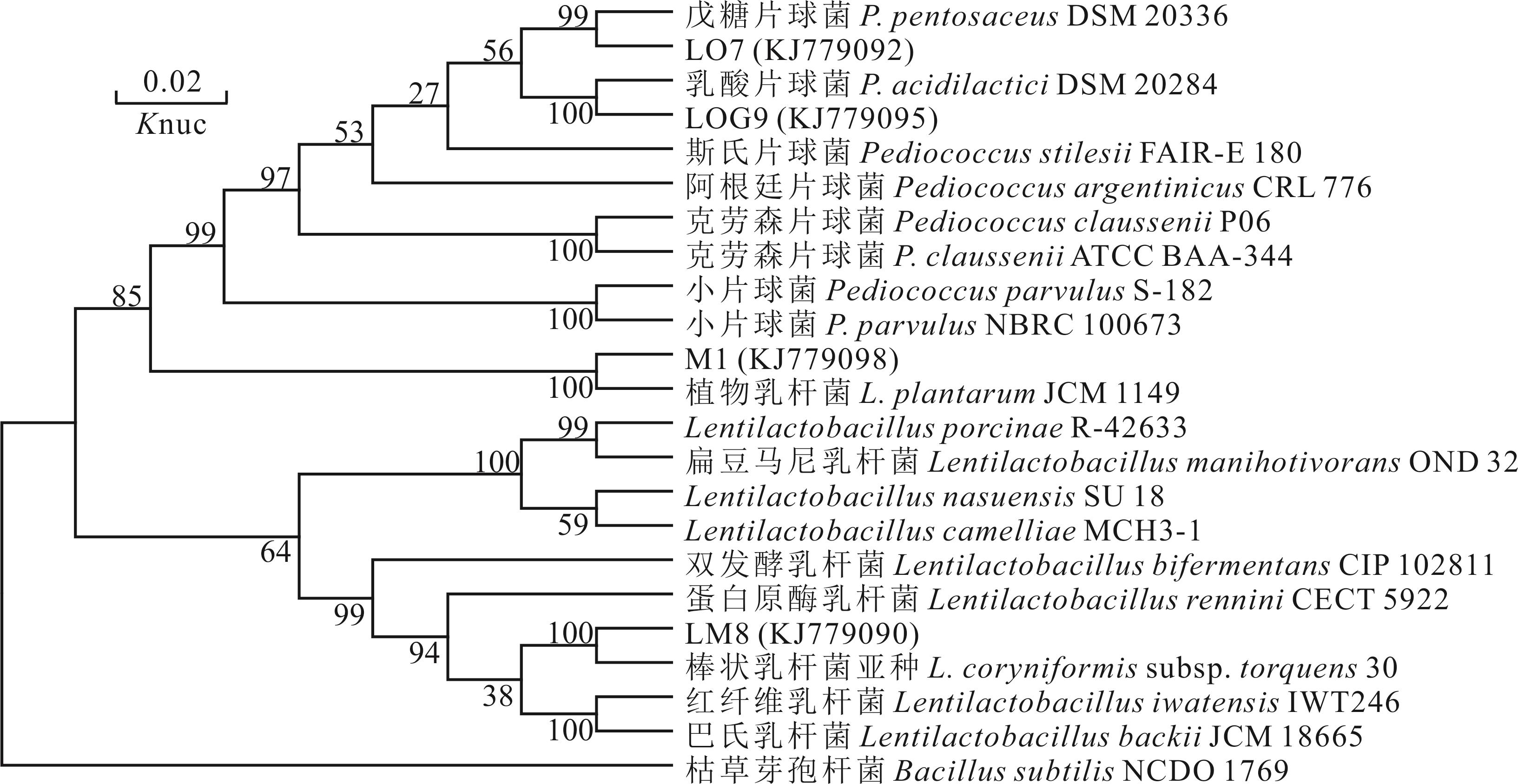
图1 基于16S rDNA序列比对的乳酸菌菌株LOG9、LO7、LM8和M1及相关菌种的系统进化树Knuc: 核苷酸取代率Nucleotide substitution rates. 以枯草芽孢杆菌为外族群。B. subtilis was used as the outgroup. LOG9: 乳酸片球菌P. acidilactici; LO7: 戊糖片球菌P. pentosaceus; LM8: 棒状乳杆菌亚种L. coryniformis subsp.; M1: 植物乳杆菌L. plantarum. 下同The same below.
Fig.1 Phylogenetic tree of lactic acid bacteria strains LOG9, LO7, LM8 and M1 and related species based on 16S rDNA sequence alignment
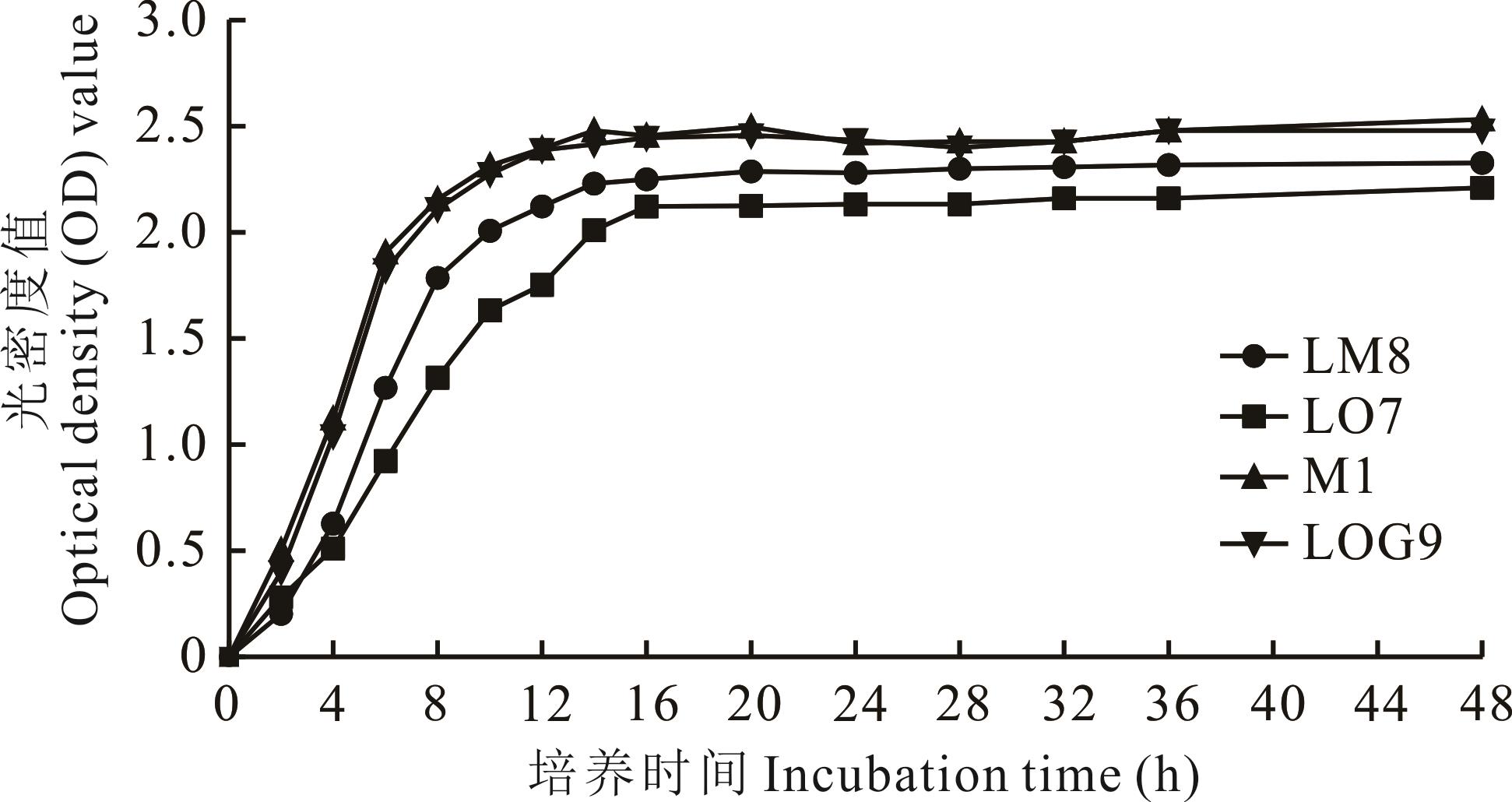
图2 4株乳酸菌菌株在MRS液体培养基培养过程中600 nm处的光密度值
Fig.2 The optical density values at 600 nm of four lactic acid bacteria strains in de Man, Rogosa, Sharpe broth with the process of incubation
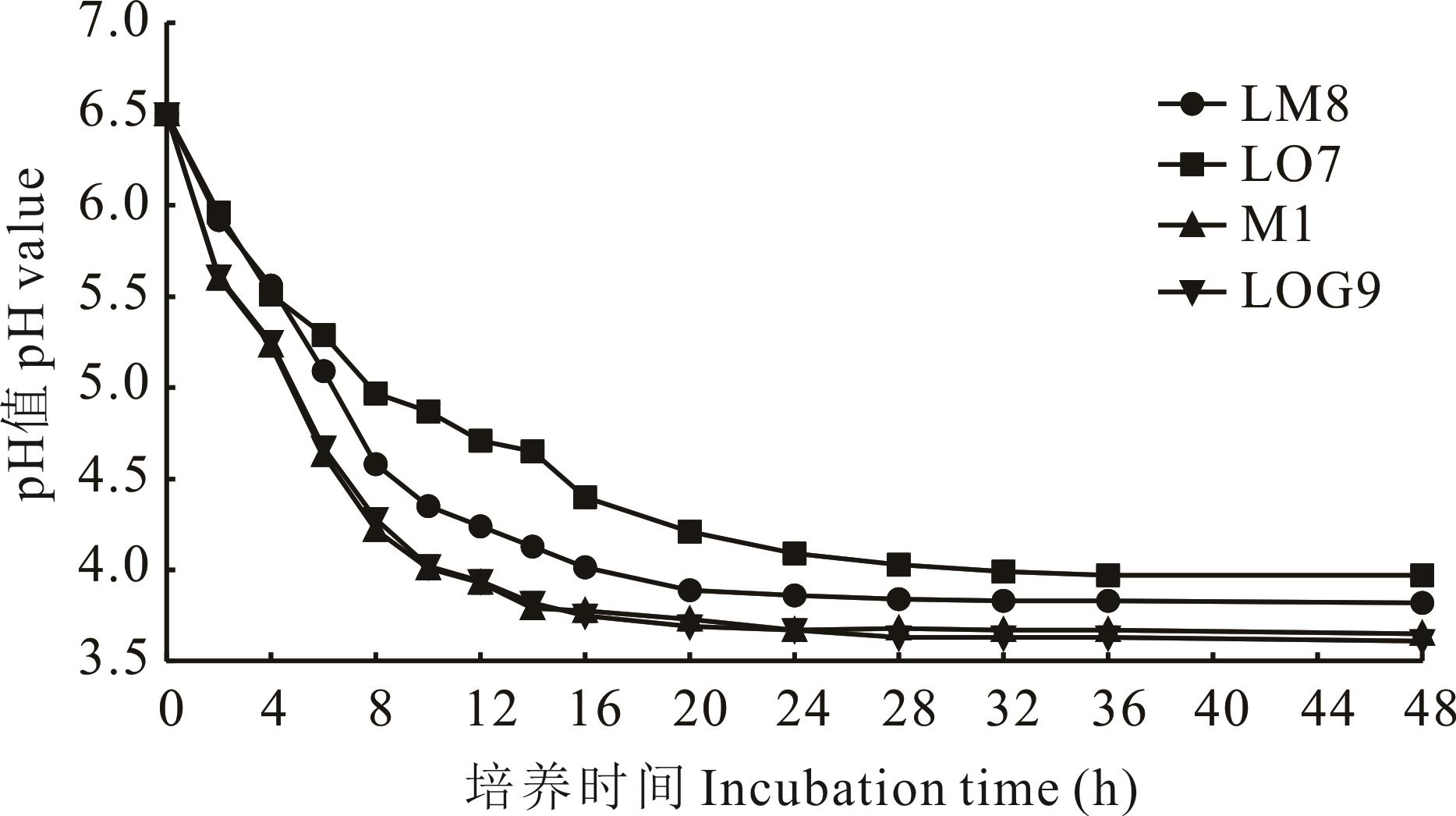
图3 4株乳酸菌菌株在MRS液体培养基培养过程中pH值的变化
Fig.3 Changes of pH values of four lactic acid bacteria strains in de Man, Rogosa, Sharpe broth with the process of incubation
| 项目Items | 指标Index | 意大利黑麦草Italian ryegrass |
|---|---|---|
化学成分 Chemical compositions | 干物质Dry matter (g·kg-1 FW) | 247.0±3.13 |
| 粗蛋白Crude protein (g·kg-1 DM) | 67.1±1.34 | |
| 水溶性碳水化合物Water soluble carbohydrate (g·kg-1 DM) | 106.5±1.68 | |
| 缓冲能Buffering capacity (mEq·kg-1 DM) | 88.9±1.05 | |
微生物数量 Microbial populations (log cfu·g-1 FW) | 乳酸菌Lactic acid bacteria | 4.37±0.09 |
| 好氧菌Aerobic bacteria | 6.43±0.58 | |
| 酵母菌Yeasts | 4.61±0.13 | |
| 霉菌Molds | 4.03±0.12 |
表4 新鲜意大利黑麦草的化学成分及微生物数量
Table 4 Chemical compositions and microbial populations of Italian ryegrass prior to ensiling
| 项目Items | 指标Index | 意大利黑麦草Italian ryegrass |
|---|---|---|
化学成分 Chemical compositions | 干物质Dry matter (g·kg-1 FW) | 247.0±3.13 |
| 粗蛋白Crude protein (g·kg-1 DM) | 67.1±1.34 | |
| 水溶性碳水化合物Water soluble carbohydrate (g·kg-1 DM) | 106.5±1.68 | |
| 缓冲能Buffering capacity (mEq·kg-1 DM) | 88.9±1.05 | |
微生物数量 Microbial populations (log cfu·g-1 FW) | 乳酸菌Lactic acid bacteria | 4.37±0.09 |
| 好氧菌Aerobic bacteria | 6.43±0.58 | |
| 酵母菌Yeasts | 4.61±0.13 | |
| 霉菌Molds | 4.03±0.12 |
项目 Items | pH | 干物质 Dry matter (g·kg-1 FW) | 乳酸 Lactic acid (LA, g·kg-1 DM) | 乙酸 Acetic acid (AA, g·kg-1 DM) | 乳酸/ 乙酸 LA/AA | 氨态氮 NH3-N (g·kg-1 TN) | 水溶性碳水化合物WSC (g·kg-1 DM) |
|---|---|---|---|---|---|---|---|
| 10 ℃ | |||||||
| 对照组Control | 5.87a | 230a | 42.0i | 39.6a | 1.06f | 135.0a | 8.2d |
| LO7+LM8 | 4.48c | 228a | 75.5g | 25.1c | 3.01e | 88.1c | 17.7b |
| LO7+M1 | 4.39c | 228a | 84.9f | 16.3d | 5.21e | 74.1e | 19.5b |
| LOG9+LM8 | 4.01de | 230a | 121.7c | 8.4e | 14.64abc | 32.3h | 30.5a |
| LOG9+M1 | 4.04de | 228a | 96.8e | 8.2e | 11.90cd | 45.2g | 16.3bc |
| 15 ℃ | |||||||
| 对照组Control | 4.82b | 230a | 63.9h | 34.5b | 1.85ef | 108.2b | 10.5cd |
| LO7+LM8 | 3.93efg | 233a | 97.8e | 10.4e | 9.47d | 75.5de | 19.8b |
| LO7+M1 | 3.94ef | 227a | 101.1e | 10.3e | 9.90d | 74.6e | 18.4b |
| LOG9+LM8 | 3.74h | 222a | 131.8b | 9.4e | 14.10abc | 41.8g | 26.8b |
| LOG9+M1 | 3.83fgh | 225a | 113.7d | 9.1e | 12.60bc | 54.1f | 19.9b |
| 25 ℃ | |||||||
| 对照组Control | 4.12d | 225a | 77.0g | 27.0c | 2.85ef | 83.3cd | 14.6cd |
| LO7+LM8 | 3.82gh | 231a | 140.4a | 8.8e | 15.97ab | 72.7e | 17.1b |
| LO7+M1 | 3.79h | 223a | 140.3a | 8.5e | 16.50a | 42.3g | 17.2b |
| LOG9+LM8 | 3.77h | 223a | 141.7a | 8.9e | 15.97ab | 43.2g | 17.3b |
| LOG9+M1 | 3.85fgh | 224a | 141.3a | 8.4e | 17.07a | 42.5g | 17.9b |
| SEM | 0.08 | 0.80 | 4.62 | 1.55 | 0.87 | 4.19 | 0.83 |
| 不同环境温度下平均值Mean values at different ambient temperatures | |||||||
| 10 ℃ | 4.56a | 229a | 84.2c | 19.5a | 7.17c | 74.9a | 18.4ab |
| 15 ℃ | 4.05b | 228a | 101.6b | 14.7b | 9.58b | 70.9b | 19.1a |
| 25 ℃ | 3.87c | 225a | 128.1a | 12.3c | 13.67a | 56.8c | 16.8b |
| 不同乳酸菌添加剂处理下平均值Mean values under different lactic acid bacteria additive treatments | |||||||
| 对照组Control | 4.94a | 228a | 61.0e | 33.7a | 1.92c | 108.8a | 11.1c |
| LO7+LM8 | 4.08b | 231a | 104.5d | 14.8b | 9.48b | 78.8b | 18.2b |
| LO7+M1 | 4.04b | 226a | 108.7c | 11.7c | 10.54b | 63.7c | 18.4b |
| LOG9+LM8 | 3.84d | 225a | 131.7a | 8.9c | 14.90a | 39.1e | 24.9a |
| LOG9+M1 | 3.91c | 226a | 117.3b | 8.6c | 13.86a | 47.3d | 18.0b |
| 显著性Significance | |||||||
| 环境温度Ambient temperature | <0.001 | 0.117 | <0.001 | <0.001 | <0.001 | <0.001 | 0.019 |
| 乳酸菌添加剂LAB inoculants | <0.001 | 0.106 | <0.001 | <0.001 | <0.001 | <0.001 | <0.001 |
| 环境温度与乳酸菌添加剂的交互作用Ambient temperature×LAB inoculants | <0.001 | 0.569 | <0.001 | <0.001 | <0.001 | <0.001 | <0.001 |
表5 复合乳酸菌添加剂对不同温度下意大利黑麦草青贮发酵品质的影响
Table 5 Effects of combined lactic acid bacteria inoculants on the silage quality of Italian ryegrass at different temperatures
项目 Items | pH | 干物质 Dry matter (g·kg-1 FW) | 乳酸 Lactic acid (LA, g·kg-1 DM) | 乙酸 Acetic acid (AA, g·kg-1 DM) | 乳酸/ 乙酸 LA/AA | 氨态氮 NH3-N (g·kg-1 TN) | 水溶性碳水化合物WSC (g·kg-1 DM) |
|---|---|---|---|---|---|---|---|
| 10 ℃ | |||||||
| 对照组Control | 5.87a | 230a | 42.0i | 39.6a | 1.06f | 135.0a | 8.2d |
| LO7+LM8 | 4.48c | 228a | 75.5g | 25.1c | 3.01e | 88.1c | 17.7b |
| LO7+M1 | 4.39c | 228a | 84.9f | 16.3d | 5.21e | 74.1e | 19.5b |
| LOG9+LM8 | 4.01de | 230a | 121.7c | 8.4e | 14.64abc | 32.3h | 30.5a |
| LOG9+M1 | 4.04de | 228a | 96.8e | 8.2e | 11.90cd | 45.2g | 16.3bc |
| 15 ℃ | |||||||
| 对照组Control | 4.82b | 230a | 63.9h | 34.5b | 1.85ef | 108.2b | 10.5cd |
| LO7+LM8 | 3.93efg | 233a | 97.8e | 10.4e | 9.47d | 75.5de | 19.8b |
| LO7+M1 | 3.94ef | 227a | 101.1e | 10.3e | 9.90d | 74.6e | 18.4b |
| LOG9+LM8 | 3.74h | 222a | 131.8b | 9.4e | 14.10abc | 41.8g | 26.8b |
| LOG9+M1 | 3.83fgh | 225a | 113.7d | 9.1e | 12.60bc | 54.1f | 19.9b |
| 25 ℃ | |||||||
| 对照组Control | 4.12d | 225a | 77.0g | 27.0c | 2.85ef | 83.3cd | 14.6cd |
| LO7+LM8 | 3.82gh | 231a | 140.4a | 8.8e | 15.97ab | 72.7e | 17.1b |
| LO7+M1 | 3.79h | 223a | 140.3a | 8.5e | 16.50a | 42.3g | 17.2b |
| LOG9+LM8 | 3.77h | 223a | 141.7a | 8.9e | 15.97ab | 43.2g | 17.3b |
| LOG9+M1 | 3.85fgh | 224a | 141.3a | 8.4e | 17.07a | 42.5g | 17.9b |
| SEM | 0.08 | 0.80 | 4.62 | 1.55 | 0.87 | 4.19 | 0.83 |
| 不同环境温度下平均值Mean values at different ambient temperatures | |||||||
| 10 ℃ | 4.56a | 229a | 84.2c | 19.5a | 7.17c | 74.9a | 18.4ab |
| 15 ℃ | 4.05b | 228a | 101.6b | 14.7b | 9.58b | 70.9b | 19.1a |
| 25 ℃ | 3.87c | 225a | 128.1a | 12.3c | 13.67a | 56.8c | 16.8b |
| 不同乳酸菌添加剂处理下平均值Mean values under different lactic acid bacteria additive treatments | |||||||
| 对照组Control | 4.94a | 228a | 61.0e | 33.7a | 1.92c | 108.8a | 11.1c |
| LO7+LM8 | 4.08b | 231a | 104.5d | 14.8b | 9.48b | 78.8b | 18.2b |
| LO7+M1 | 4.04b | 226a | 108.7c | 11.7c | 10.54b | 63.7c | 18.4b |
| LOG9+LM8 | 3.84d | 225a | 131.7a | 8.9c | 14.90a | 39.1e | 24.9a |
| LOG9+M1 | 3.91c | 226a | 117.3b | 8.6c | 13.86a | 47.3d | 18.0b |
| 显著性Significance | |||||||
| 环境温度Ambient temperature | <0.001 | 0.117 | <0.001 | <0.001 | <0.001 | <0.001 | 0.019 |
| 乳酸菌添加剂LAB inoculants | <0.001 | 0.106 | <0.001 | <0.001 | <0.001 | <0.001 | <0.001 |
| 环境温度与乳酸菌添加剂的交互作用Ambient temperature×LAB inoculants | <0.001 | 0.569 | <0.001 | <0.001 | <0.001 | <0.001 | <0.001 |
| 项目Items | 乳酸菌LAB | 好氧菌Aerobic bacteria | 酵母菌Yeasts | 霉菌Molds |
|---|---|---|---|---|
| 10 ℃ | ||||
| 对照组Control | 5.42h | 7.69a | 4.78b | 5.29a |
| LO7+LM8 | 8.66cd | 5.27d | 3.54de | 3.51d |
| LO7+M1 | 8.55cde | 5.22d | 3.15ef | 3.35d |
| LOG9+LM8 | 8.93b | 3.53e | 2.74fg | 2.32e |
| LOG9+M1 | 8.70c | 3.57e | 2.71g | 2.31e |
| 15 ℃ | ||||
| 对照组Control | 6.81g | 7.17b | 5.74a | 5.60a |
| LO7+LM8 | 8.67cd | 5.17d | 4.54bc | 4.27bc |
| LO7+M1 | 8.45de | 5.15d | 4.43bc | 4.22c |
| LOG9+LM8 | 8.94b | 5.14d | 4.45bc | 4.24c |
| LOG9+M1 | 8.61cd | 5.10d | 4.33c | 4.12c |
| 25 ℃ | ||||
| 对照组Control | 7.18f | 6.69c | 5.83a | 4.63b |
| LO7+LM8 | 8.36e | 5.03d | 3.55de | 4.05c |
| LO7+M1 | 8.75bc | 5.07d | 3.62d | 4.08c |
| LOG9+LM8 | 10.92a | 5.06d | 3.56de | 4.07c |
| LOG9+M1 | 8.33e | 5.08d | 3.57d | 4.08c |
| SEM | 0.18 | 0.16 | 0.14 | 0.13 |
| 不同环境温度下平均值Mean values at different ambient temperatures | ||||
| 10 ℃ | 8.05c | 5.06c | 3.39c | 3.35c |
| 15 ℃ | 8.30b | 5.55a | 4.70a | 4.49a |
| 25 ℃ | 8.71a | 5.39b | 4.03b | 4.18b |
| 不同乳酸菌添加剂处理下平均值Mean values under different lactic acid bacteria additive treatments | ||||
| 对照组Control | 6.47c | 7.18a | 5.45a | 5.17a |
| LO7+LM8 | 8.56b | 5.15b | 3.88b | 3.94b |
| LO7+M1 | 8.58b | 5.15b | 3.73bc | 3.88b |
| LOG9+LM8 | 9.60a | 4.58c | 3.58cd | 3.54c |
| LOG9+M1 | 8.55b | 4.59c | 3.54d | 3.50c |
| 显著性Significance | ||||
| 环境温度Ambient temperature | <0.001 | <0.001 | <0.001 | <0.001 |
| 乳酸菌添加剂LAB inoculants | <0.001 | <0.001 | <0.001 | <0.001 |
| 环境温度与乳酸菌添加剂的交互作用Ambient temperature×LAB | <0.001 | <0.001 | <0.001 | <0.001 |
表6 复合乳酸菌添加剂对不同温度下意大利黑麦草青贮饲料中微生物数量的影响
Table 6 Effects of combined lactic acid bacteria inoculants on the microbial populations of Italian ryegrass silage (log cfu·g-1 FW)
| 项目Items | 乳酸菌LAB | 好氧菌Aerobic bacteria | 酵母菌Yeasts | 霉菌Molds |
|---|---|---|---|---|
| 10 ℃ | ||||
| 对照组Control | 5.42h | 7.69a | 4.78b | 5.29a |
| LO7+LM8 | 8.66cd | 5.27d | 3.54de | 3.51d |
| LO7+M1 | 8.55cde | 5.22d | 3.15ef | 3.35d |
| LOG9+LM8 | 8.93b | 3.53e | 2.74fg | 2.32e |
| LOG9+M1 | 8.70c | 3.57e | 2.71g | 2.31e |
| 15 ℃ | ||||
| 对照组Control | 6.81g | 7.17b | 5.74a | 5.60a |
| LO7+LM8 | 8.67cd | 5.17d | 4.54bc | 4.27bc |
| LO7+M1 | 8.45de | 5.15d | 4.43bc | 4.22c |
| LOG9+LM8 | 8.94b | 5.14d | 4.45bc | 4.24c |
| LOG9+M1 | 8.61cd | 5.10d | 4.33c | 4.12c |
| 25 ℃ | ||||
| 对照组Control | 7.18f | 6.69c | 5.83a | 4.63b |
| LO7+LM8 | 8.36e | 5.03d | 3.55de | 4.05c |
| LO7+M1 | 8.75bc | 5.07d | 3.62d | 4.08c |
| LOG9+LM8 | 10.92a | 5.06d | 3.56de | 4.07c |
| LOG9+M1 | 8.33e | 5.08d | 3.57d | 4.08c |
| SEM | 0.18 | 0.16 | 0.14 | 0.13 |
| 不同环境温度下平均值Mean values at different ambient temperatures | ||||
| 10 ℃ | 8.05c | 5.06c | 3.39c | 3.35c |
| 15 ℃ | 8.30b | 5.55a | 4.70a | 4.49a |
| 25 ℃ | 8.71a | 5.39b | 4.03b | 4.18b |
| 不同乳酸菌添加剂处理下平均值Mean values under different lactic acid bacteria additive treatments | ||||
| 对照组Control | 6.47c | 7.18a | 5.45a | 5.17a |
| LO7+LM8 | 8.56b | 5.15b | 3.88b | 3.94b |
| LO7+M1 | 8.58b | 5.15b | 3.73bc | 3.88b |
| LOG9+LM8 | 9.60a | 4.58c | 3.58cd | 3.54c |
| LOG9+M1 | 8.55b | 4.59c | 3.54d | 3.50c |
| 显著性Significance | ||||
| 环境温度Ambient temperature | <0.001 | <0.001 | <0.001 | <0.001 |
| 乳酸菌添加剂LAB inoculants | <0.001 | <0.001 | <0.001 | <0.001 |
| 环境温度与乳酸菌添加剂的交互作用Ambient temperature×LAB | <0.001 | <0.001 | <0.001 | <0.001 |
| 1 | Cui Z M, Guo G, Yuan X J, et al. Characterization and identification of high quality lactic acid bacteria from hulless barley straw silage. Acta Agrestia Sinica, 2015, 23(3): 607-615. |
| 崔棹茗, 郭刚, 原现军, 等. 青稞秸秆青贮饲料中优良乳酸菌的筛选及鉴定. 草地学报, 2015, 23(3): 607-615. | |
| 2 | Pang H L, Tan Z, Qin G, et al. Phenotypic and phylogenetic analysis of lactic acid bacteria isolated from forage crops and grasses in the Tibetan Plateau.The Journal of Microbiology, 2012, 50(1): 63-71. |
| 3 | Zhang J, Guo G, Chen L, et al. Effect of applying lactic acid bacteria and propionic acid on fermentation quality and aerobic stability of oats-common vetch mixed silage on the Tibetan Plateau. Animal Science Journal, 2015, 86(6): 595-602. |
| 4 | Lin D D, Ju Z L, Chai J K, et al. Screening and identification of low temperature tolerant lactic acid bacterial epiphytes from oats on the Qinghai-Tibetan Plateau. Acta Prataculturae Sinica, 2022, 31(5): 103-114. |
| 蔺豆豆, 琚泽亮, 柴继宽, 等. 青藏高原燕麦附着耐低温乳酸菌的筛选与鉴定. 草业学报, 2022, 31(5): 103-114. | |
| 5 | Weinberg Z G, Szakacs G, Ashbell G Y. The effect of temperature on the ensiling process of corn and wheat. Journal of Applied Microbiology, 2001, 90(4): 561-566. |
| 6 | Ali M, Cone J W, Khan N A, et al. Effect of temperature and duration of ensiling on in vitro degradation of maize silages in rumen fluid. Journal of Animal Physiology and Animal Nutrition, 2015, 99(2): 251-257. |
| 7 | Kung L. Understanding the biology of silage preservation to maximize quality and protect the environment. (2010-12-01)[2024-06-10]. https://alfalfasymposium.ucdavis.edu/+symposium/proceedings/2010/10-41.pdf. |
| 8 | Zhou Y, Drouin P, Lafrenière C. Effect of temperature (5-25 ℃) on epiphytic lactic acid bacteria populations and fermentation of whole-plant corn silage. Journal of Applied Microbiology, 2016, 121(3): 657-671. |
| 9 | Kim K H, Uchida S. Comparative studies of ensiling characteristics between temperate and tropical species. 1. The effects of various ensiling conditions on the silage quality of Italian ryegrass (Lolium multiflorum Lam.) and rhodes grass (Chloris gayana Kunth.). Japanese Journal of Grassland Science, 1990, 36(3): 292-299. |
| 10 | Weinberg Z G, Muck R E. New trends in development and use of inoculants for silage. FEMS Microbiology Reviews, 1996, 19(1): 53-68. |
| 11 | Zielińska K J, Fabiszewska A U. Improvement of the quality of maize grain silage by a synergistic action of selected lactobacilli strains. World Journal of Microbiology and Biotechnology, 2018, 34(1): 9. |
| 12 | Parvin S, Nishino N. Succession of lactic acid bacteria in wilted rhodegrass silage assessed by plate culture and denaturing gradient gel electrophoresis. Grassland Science, 2010, 56(1): 51-55. |
| 13 | Oliveira A S, Weinberg Z G, Ogunade I M, et al. Meta-analysis of effects of inoculation with homofermentative and facultative heterofermentative lactic acid bacteria on silage fermentation, aerobic stability, and the performance of dairy cows. Journal of Dairy Science, 2017, 100(6): 4587-4603. |
| 14 | Cai Y M, Benno Y, Ogawa M, et al. Influence of Lactobacillus spp. from an inoculant and of Weissella and Leuconostoc spp. from forage, crops on silage fermentation. Applied and Environmental Microbiology, 1998, 64(8): 2982-2987. |
| 15 | Avila C L S, Carvalho B F, Pinto J C, et al. The use of Lactobacillus species as starter cultures for enhancing the quality of sugar cane silage. Journal of Dairy Science, 2014, 97(2): 940-951. |
| 16 | Cai Y M, Kumai S, Ogawa M, et al. Characterization and identification of Pediococcus species isolated from forage crops and their application for silage preparation. Applied and Environmental Microbiology, 1999, 65(7): 2901-2906. |
| 17 | Yang X D, Yuan X J, Guo G, et al. Isolation and identification of low temperature-tolerant lactic bacteria from legume silages in Tibet. Acta Prataculturae Sinica, 2015, 24(6): 99-107. |
| 杨晓丹, 原现军, 郭刚, 等. 西藏豆科牧草青贮饲料中耐低温优良乳酸菌的筛选. 草业学报, 2015, 24(6): 99-107. | |
| 18 | Boone D R, Garrity G M, Castenholz R W, et al. Bergey’s manual of systematic bacteriology: The Firmicutes. New York: Springer, 2001. |
| 19 | Zhang Q, Yu Z, Wang X. Isolating and evaluating lactic acid bacteria strains with or without sucrose for effectiveness of silage fermentation. Grassland Science, 2015, 61(3): 167-176. |
| 20 | Zhang H J, Yu Z, Wang L, et al. Isolation and identification of lactic acid bacteria from silage and filtering of excellent strains. Acta Agrestia Sinica, 2011, 19(1): 137-141. |
| 张慧杰, 玉柱, 王林, 等. 青贮饲料中乳酸菌的分离鉴定及优良菌株筛选. 草地学报, 2011, 19(1): 137-141. | |
| 21 | Zhang J M, Guan H, Li H P, et al. Effects of oat∶feed pea sowing ratio and lactic acid bacteria addition on crop silage fermentation and ruminal degradation characteristics of the resulting total mixed ration. Acta Prataculturae Sinica, 2024, 33(1): 169-181. |
| 张珈敏, 关皓, 李海萍, 等. 混播比例及乳酸菌剂对燕麦-饲用豌豆发酵TMR品质及瘤胃降解特性的影响. 草业学报, 2024, 33(1): 169-181. | |
| 22 | Owens V, Albrecht K, Muck R, et al. Protein degradation and fermentation characteristics of red clover and alfalfa silage harvested with varying levels of total nonstructural carbohydrates. Crop Science, 1999, 39(6): 1873-1880. |
| 23 | Jasaitis D K, Wohlt J E, Evans J L. Influence of feed ion content on buffering capacity of ruminant feedstuffs in vitro. Journal of Dairy Science, 1987, 70(7): 1391-1403. |
| 24 | Tian J P, Liu B Y, Gu H R, et al. Effects of lactic acid bacteria and calcium propionate on fermentation quality and mycotoxin contents of whole plant maize and oat silages. Acta Prataculturae Sinica, 2022, 31(8): 157-166. |
| 田吉鹏, 刘蓓一, 顾洪如, 等. 乳酸菌及丙酸钙对全株玉米和燕麦青贮饲料发酵品质和霉菌毒素含量的影响. 草业学报, 2022, 31(8): 157-166. | |
| 25 | Broderick G A, Kang J H. Automated simultaneous determination of ammonia and total amino acids in ruminal fluid and in vitro media. Journal of Dairy Science, 1980, 63(1): 64-75. |
| 26 | Pang H L, Qing Y, Tan Z F, et al. Natural populations of lactic acid bacteria associated with silage fermentation as determined by phenotype, 16S ribosomal RNA and recA gene analysis. Systematic and Applied Microbiology, 2011, 34(3): 235-241. |
| 27 | Nakanishi K, Tokuda H, Ando T, et al. Screening of lactic acid bacteria having the ability to produce reuterin: Screening of LAB to produce reuterin. Japanese Journal of Lactic Acid Bacteria, 2002, 13(1): 37-45. |
| 28 | Derzelle S, Hallet B, Francis K P, et al. Changes in cspL, cspP, and cspC mRNA abundance as a function of cold shock and growth phase in Lactobacillus plantarum. Journal of Bacteriology, 2000, 182(18): 5105-5113. |
| 29 | Song S, Bae D W, Lim K, et al. Cold stress improves the ability of Lactobacillus plantarum l67 to survive freezing. International Journal of Food Microbiology, 2014, 191(17): 135-143. |
| 30 | Huang L J, Sun R J, Gao W J, et al. Screening and identification of whole rice surface dominant lactic acid bacteria. Acta Prataculturae Sinica, 2024, 33(1): 117-125. |
| 黄丽娟, 孙镕基, 高文婧, 等. 全株水稻表面优势乳酸菌的筛选与鉴定. 草业学报, 2024, 33(1): 117-125. | |
| 31 | Wang S R, Li J F, Dong Z H, et al. Effect of microbial inoculants on the fermentation characteristics, nutritive value, and in vitro digestibility of various forages. Animal Science Journal, 2019, 90(2): 178-188. |
| 32 | Aguilar A, Ingemansson T, Magnien E. Extremophile microorganisms as cell factories: support from the European Union. Extremophiles, 1998, 2(3): 367-373. |
| 33 | McDonald P, Henderson A R, Heron S J E. The biochemistry of silage. London: Chalcombe Publications, 1991. |
| 34 | Saarisalo E, Skyttä E, Haikara A, et al. Screening and selection of lactic acid bacteria strains suitable for ensiling grass.Journal of Applied Microbiology, 2007, 102(2): 327-336. |
| 35 | Darwin C. On the origin of species by means of natural selection. American Anthropologist, 1963, 61(1): 176-177. |
| 36 | Wang S R, Shao T, Li J F, et al. Fermentative products and bacterial community structure of C4 forage silage in response to epiphytic microbiota from C3 forages. Animal Bioscience, 2022, 35(12): 1860-1870. |
| 37 | Wang S R, Dong Z H, Li J F, et al. Pediococcus acidilactici strains as silage inoculants for improving the fermentation quality, nutritive value and in vitro ruminal digestibility in different forages. Journal of Applied Microbiology, 2019, 126(2): 424-434. |
| [1] | 毛开, 许艺, 王学梅, 柴欢, 黄帅, 王坚, 郇树乾, 玉柱, 王目森. 植物乳植杆菌与糖蜜对花生秧青贮饲料发酵品质、生物胺含量及细菌群落的影响[J]. 草业学报, 2025, 34(5): 146-158. |
| [2] | 梁宇成, 张晓雯, 邵涛, 王文博, 原现军. 乳酸菌对全株玉米青贮发酵品质和霉菌毒素含量的影响[J]. 草业学报, 2025, 34(3): 123-133. |
| [3] | 王敏, 李莉, 贾蓉, 包爱科. 10种紫花苜蓿在低温胁迫下的生理特性及耐寒性评价[J]. 草业学报, 2024, 33(6): 76-88. |
| [4] | 郭田心, 阮诗诗, 郭香, 詹佳琦, 梁秋雨, 陈晓阳, 周玮, 张庆. 不同复合菌酶添加对中药渣青贮饲料的营养价值及发酵品质的影响[J]. 草业学报, 2024, 33(10): 194-202. |
| [5] | 赵杰, 尹雪敬, 王思然, 董志浩, 李君风, 贾玉山, 邵涛. 贮藏时间对甜高粱青贮发酵品质、微生物群落组成和功能的影响[J]. 草业学报, 2023, 32(8): 164-175. |
| [6] | 凌文卿, 张磊, 李珏, 冯启贤, 李妍, 周燚, 刘一佳, 阳伏林, 周晶. 布氏乳杆菌和不同糖类联用对紫花苜蓿青贮营养成分、发酵品质、瘤胃降解率及有氧稳定性的影响[J]. 草业学报, 2023, 32(7): 122-134. |
| [7] | 党浩千, 覃娟清, 郭宇康, 张富, 王迎港, 刘庆华. 不同添加剂发酵笋壳对湖羊生产性能及瘤胃发酵的影响[J]. 草业学报, 2023, 32(7): 135-148. |
| [8] | 张适阳, 刘凤民, 崔均涛, 何磊, 冯月燕, 张伟丽. 三种外源物质对低温胁迫下柱花草生理与荧光特性的影响[J]. 草业学报, 2023, 32(6): 85-99. |
| [9] | 柴继宽, 琚泽亮, 赵桂琴. 低温和低pH胁迫下青贮乳酸菌OL77的内参基因筛选及CspP基因的表达模式分析[J]. 草业学报, 2023, 32(5): 147-158. |
| [10] | 梁梦琪, 武齐丰, 邵涛, 吴艾丽, 刘秦华. 添加剂对多花黑麦草青贮发酵品质、α-生育酚和β-胡萝卜素含量的影响[J]. 草业学报, 2023, 32(5): 180-189. |
| [11] | 孙守江, 唐艺涵, 马馼, 李曼莉, 毛培胜. 紫花苜蓿种子吸胀期胚根线粒体AsA-GSH循环对低温胁迫的响应[J]. 草业学报, 2023, 32(3): 152-162. |
| [12] | 徐远志, 刘新平, 王立龙, 胡鸿姣, 何玉惠, 张铜会, 景家琪. 华北驼绒藜青贮加工及营养价值评价[J]. 草业学报, 2023, 32(12): 150-159. |
| [13] | 覃娟清, 党浩千, 金华云, 郭宇康, 张富, 刘庆华. 不同添加剂处理笋壳对其发酵品质及湖羊瘤胃微生物的影响[J]. 草业学报, 2023, 32(11): 155-167. |
| [14] | 付东青, 贾春英, 张力, 张凡凡, 马春晖. 南疆干旱灌溉区青贮玉米农艺性状和发酵品质动态分析及评价[J]. 草业学报, 2022, 31(8): 111-125. |
| [15] | 李影正, 程榆林, 徐璐璐, 李万松, 严旭, 李晓锋, 何如钰, 周阳, 郑军军, 汪星宇, 张德龙, 程明军, 夏运红, 何建美, 唐祈林. 不同玉米品种(系)的全株、果穗与秸秆青贮特性比较[J]. 草业学报, 2022, 31(8): 144-156. |
| 阅读次数 | ||||||
|
全文 |
|
|||||
|
摘要 |
|
|||||
