

ISSN 1004-5759 CN 62-1105/S
草业学报 ›› 2026, Vol. 35 ›› Issue (12): 78-89.DOI: 10.11686/cyxb2025508
赵微1( ), 赵江红1, 王玉建2, 王正江1, 李振轮1()
收稿日期:2025-12-11
修回日期:2026-01-26
出版日期:2026-12-20
发布日期:2026-11-02
通讯作者:
李振轮
作者简介:E-mail: lizhlun4740@sina.com基金资助:
Wei ZHAO1(), Jiang-hong ZHAO1, Yu-jian WANG2, Zheng-jiang WANG1, Zhen-lun LI1()
Received:2025-12-11
Revised:2026-01-26
Online:2026-12-20
Published:2026-11-02
Contact:
Zhen-lun LI
摘要:
目前黄连种植缺乏科学施肥方案,主要依赖化肥,导致土壤微生态破坏和土壤质量退化,严重影响黄连的生长发育、产量和品质。以一年生黄连为对象,设置传统化肥(CK)、单施有机肥(T1,牛粪发酵生产)、有机肥+有益菌剂(T2)、有机肥+生物炭(T3)、有机肥+有益菌剂+生物炭(T4)5个处理,有机肥处理均添加相同比例碳铵以平衡碳氮比。测定不同施肥条件下黄连植株生长及养分积累、土壤理化性质以及微生物群落结构特征。结果表明,相较于CK,各处理的根鲜重分别提高了64.7%、5.6%、52.2%、40.1%。T4处理效果最优,对黄连植株根长、株高的增幅分别为43.4%和16.8%,整株黄连氮磷钾积累量分别较CK处理显著提高了48.7%、17.7%和32.0%,土壤有效磷、速效钾和有机质含量分别较CK显著提高了10.0%、116.4%、7.2%,并有效提升了黄连根际土壤中细菌、真菌、放线菌含量,较CK提高了8.9%、4.2%、6.5%。相关性分析显示,土壤有效磷是影响黄连根际土壤微生物的关键土壤因子。T4处理下的黄连植株生理生长综合指数(PGCI)和土壤综合肥力指数(IFI)均达最高值,优于其余处理,能有效促进植株生长并提升土壤肥力。研究结果为黄连种植提供了一种施肥方案。
赵微, 赵江红, 王玉建, 王正江, 李振轮. 有机肥配施有益菌及生物炭促进黄连生长和提升土壤综合肥力的探究[J]. 草业学报, 2026, 35(12): 78-89.
Wei ZHAO, Jiang-hong ZHAO, Yu-jian WANG, Zheng-jiang WANG, Zhen-lun LI. Exploration of organic fertilizer combined with beneficial bacteria and biochar to promote the growth of Coptis chinensis and enhance comprehensive soil fertility[J]. Acta Prataculturae Sinica, 2026, 35(12): 78-89.
| pH | OM (g·kg-1) | TN (g·kg-1) | TP (g·kg-1) | TK (g·kg-1) | AN (mg·kg-1) | AP (mg·kg-1) | AK (mg·kg-1) |
|---|---|---|---|---|---|---|---|
| 5.12 | 25.99 | 1.20 | 0.60 | 6.13 | 144.56 | 35.37 | 41.61 |
表1 试验地初始养分情况
Table 1 The initial nutrient status of the experimental site
| pH | OM (g·kg-1) | TN (g·kg-1) | TP (g·kg-1) | TK (g·kg-1) | AN (mg·kg-1) | AP (mg·kg-1) | AK (mg·kg-1) |
|---|---|---|---|---|---|---|---|
| 5.12 | 25.99 | 1.20 | 0.60 | 6.13 | 144.56 | 35.37 | 41.61 |
有机物料 Organic material | C (%) | N (%) | P2O5 (%) | K2O (%) | pH |
|---|---|---|---|---|---|
| 有机肥Organic fertilizer | 30.00 | 0.13 | 0.90 | 0.20 | 6.87 |
| 生物炭Biochar | 78.00 | 1.50 | 0.15 | 3.00 | 7.00 |
表2 各有机物料干基养分和pH
Table 2 Nutrient content and pH value of each organic material on dry basis
有机物料 Organic material | C (%) | N (%) | P2O5 (%) | K2O (%) | pH |
|---|---|---|---|---|---|
| 有机肥Organic fertilizer | 30.00 | 0.13 | 0.90 | 0.20 | 6.87 |
| 生物炭Biochar | 78.00 | 1.50 | 0.15 | 3.00 | 7.00 |
| 分级Classify | 有机质OM (g·kg-1) | 全氮TN (g·kg-1) | 全磷TP (g·kg-1) | 全钾TK (g·kg-1) | 碱解氮AN (mg·kg-1) | 速效钾AK (mg·kg-1) |
|---|---|---|---|---|---|---|
| Xa | 10 | 0.75 | 0.4 | 5 | 60 | 40 |
| Xc | 20 | 1.50 | 0.6 | 20 | 120 | 100 |
| Xp | 30 | 2.00 | 1.0 | 25 | 180 | 150 |
表3 6个土壤指标的分级标准
Table 3 Classification criteria for six soil indicators
| 分级Classify | 有机质OM (g·kg-1) | 全氮TN (g·kg-1) | 全磷TP (g·kg-1) | 全钾TK (g·kg-1) | 碱解氮AN (mg·kg-1) | 速效钾AK (mg·kg-1) |
|---|---|---|---|---|---|---|
| Xa | 10 | 0.75 | 0.4 | 5 | 60 | 40 |
| Xc | 20 | 1.50 | 0.6 | 20 | 120 | 100 |
| Xp | 30 | 2.00 | 1.0 | 25 | 180 | 150 |
处理 Treatment | 叶片数 No. of leaves (No.·plant-1) | 根长 Root length (cm) | 株高 Plant height (cm) | 根鲜重 Root fresh weight (g·plant-1) | 根冠比 Root-shoot ratio |
|---|---|---|---|---|---|
| CK | 19.17±2.71a | 12.67±2.07b | 34.67±5.28bc | 6.04±1.18c | 0.96±0.18a |
| T1 | 21.00±7.69a | 13.83±2.99b | 37.00±3.22abc | 9.95±3.72a | 0.95±0.34a |
| T2 | 19.57±7.96a | 12.00±1.91b | 31.29±4.03c | 6.38±1.80bc | 0.79±0.22a |
| T3 | 20.57±6.02a | 15.86±4.71ab | 42.00±6.63a | 9.19±2.11ab | 0.73±0.16a |
| T4 | 20.00±7.80a | 18.17±2.86a | 40.50±3.21ab | 8.46±1.80abc | 0.71±0.15a |
表4 不同施肥处理对黄连农艺性状的影响
Table 4 Effects of different fertilization treatments on the agronomic traits of C. chinensis
处理 Treatment | 叶片数 No. of leaves (No.·plant-1) | 根长 Root length (cm) | 株高 Plant height (cm) | 根鲜重 Root fresh weight (g·plant-1) | 根冠比 Root-shoot ratio |
|---|---|---|---|---|---|
| CK | 19.17±2.71a | 12.67±2.07b | 34.67±5.28bc | 6.04±1.18c | 0.96±0.18a |
| T1 | 21.00±7.69a | 13.83±2.99b | 37.00±3.22abc | 9.95±3.72a | 0.95±0.34a |
| T2 | 19.57±7.96a | 12.00±1.91b | 31.29±4.03c | 6.38±1.80bc | 0.79±0.22a |
| T3 | 20.57±6.02a | 15.86±4.71ab | 42.00±6.63a | 9.19±2.11ab | 0.73±0.16a |
| T4 | 20.00±7.80a | 18.17±2.86a | 40.50±3.21ab | 8.46±1.80abc | 0.71±0.15a |
| 处理Treatment | 全氮Total nitrogen | 全磷Total phosphorus | 全钾Total potassium | 可溶性糖Soluble sugar | ||||
|---|---|---|---|---|---|---|---|---|
| 含量Content (g·kg-1) | NAA (mg·plant-1) | 含量Content (g·kg-1) | NAA (mg·plant-1) | 含量Content (g·kg-1) | NAA (mg·plant-1) | 含量Content (g·kg-1) | NAA (mg·plant-1) | |
| CK | 19.03±1.46a | 67.21±5.17b | 4.07±0.13a | 14.39±0.47b | 12.06±0.12a | 42.60±0.40c | 54.02±13.94a | 190.83±49.25ab |
| T1 | 19.45±0.57a | 90.35±2.65a | 3.27±0.20c | 15.17±0.92b | 11.13±0.33b | 51.69±1.55b | 54.21±11.49a | 251.86±53.37a |
| T2 | 20.62±0.46a | 66.48±1.50b | 3.67±0.32b | 11.82±1.03c | 10.89±0.21b | 35.10±0.68d | 43.06±6.81a | 138.82±21.92b |
| T3 | 19.36±2.56a | 88.85±11.77a | 3.44±0.08bc | 15.76±0.37ab | 11.93±0.52a | 54.73±2.39a | 31.69±8.20a | 145.44±37.63ab |
| T4 | 21.41±2.15a | 99.93±10.04a | 3.63±0.10bc | 16.94±0.46a | 12.05±0.23a | 56.25±1.07a | 50.58±17.05a | 236.06±79.55ab |
表5 不同施肥处理对黄连植株养分及可溶性糖含量的影响
Table 5 Effects of different fertilization treatments on nutrients and soluble sugar of C. chinensis
| 处理Treatment | 全氮Total nitrogen | 全磷Total phosphorus | 全钾Total potassium | 可溶性糖Soluble sugar | ||||
|---|---|---|---|---|---|---|---|---|
| 含量Content (g·kg-1) | NAA (mg·plant-1) | 含量Content (g·kg-1) | NAA (mg·plant-1) | 含量Content (g·kg-1) | NAA (mg·plant-1) | 含量Content (g·kg-1) | NAA (mg·plant-1) | |
| CK | 19.03±1.46a | 67.21±5.17b | 4.07±0.13a | 14.39±0.47b | 12.06±0.12a | 42.60±0.40c | 54.02±13.94a | 190.83±49.25ab |
| T1 | 19.45±0.57a | 90.35±2.65a | 3.27±0.20c | 15.17±0.92b | 11.13±0.33b | 51.69±1.55b | 54.21±11.49a | 251.86±53.37a |
| T2 | 20.62±0.46a | 66.48±1.50b | 3.67±0.32b | 11.82±1.03c | 10.89±0.21b | 35.10±0.68d | 43.06±6.81a | 138.82±21.92b |
| T3 | 19.36±2.56a | 88.85±11.77a | 3.44±0.08bc | 15.76±0.37ab | 11.93±0.52a | 54.73±2.39a | 31.69±8.20a | 145.44±37.63ab |
| T4 | 21.41±2.15a | 99.93±10.04a | 3.63±0.10bc | 16.94±0.46a | 12.05±0.23a | 56.25±1.07a | 50.58±17.05a | 236.06±79.55ab |
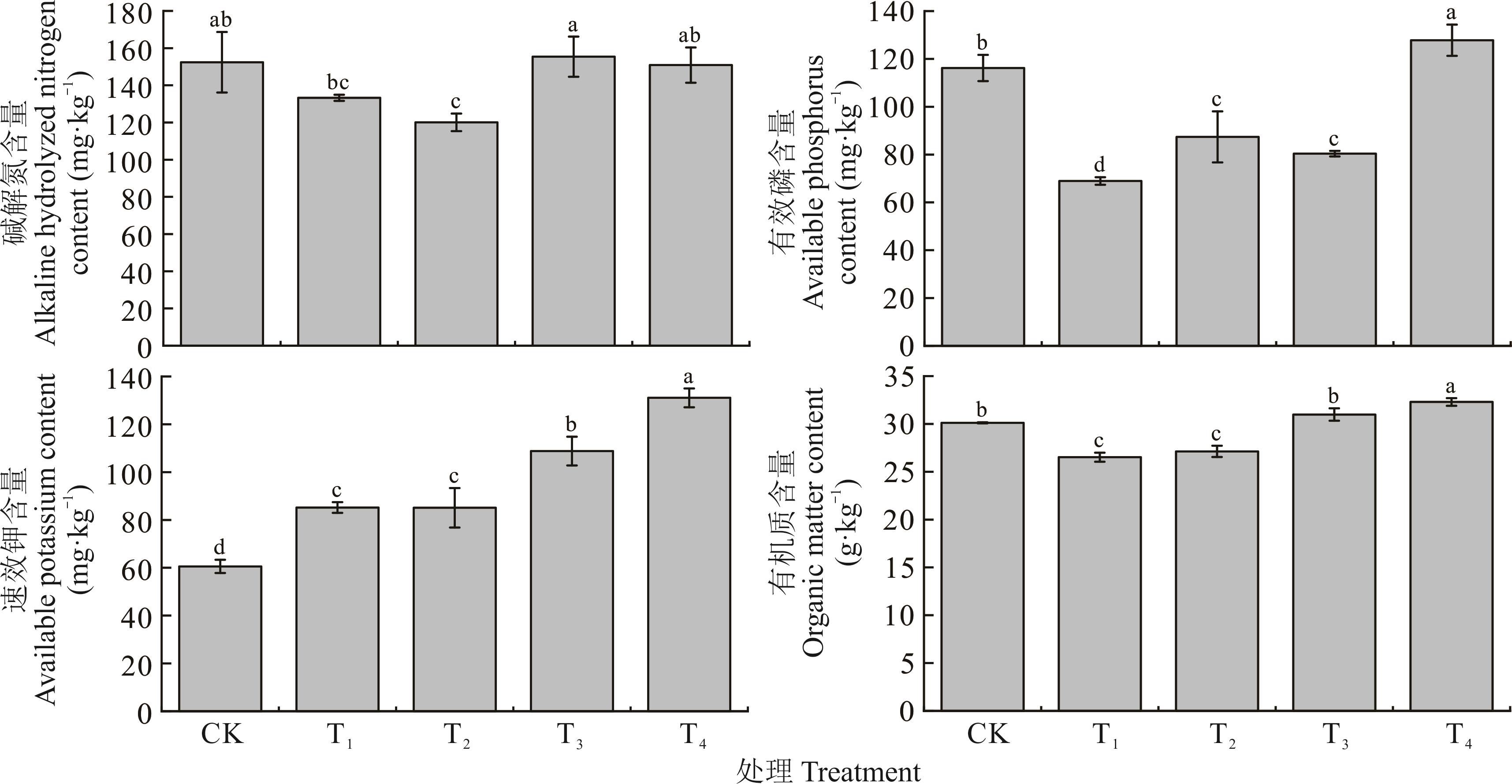
图1 不同施肥处理下黄连土壤的养分情况不同小写字母表示不同施肥处理之间差异显著(P<0.05),下同Different lowercase letters indicate significant differences (P<0.05) among different fertilization treatments, the same below.
Fig.1 Nutrient status of C. chinensis soil under different fertilization treatments

图2 不同施肥处理根际土壤微生物的PLFA类型和含量
Fig.2 PLFA types and content of rhizosphere soil microorganisms in different fertilization treatments
处理 Treatment | Shannon-Wiener指数 Shannon-Wiener index (H) | 均匀度指数 Pielou index (J) | Simpson指数 Simpson index (D) |
|---|---|---|---|
| CK | 1.44±0.00a | 0.29±0.01ab | 0.39±0.03a |
| T1 | 1.47±0.02a | 0.32±0.01a | 0.45±0.07a |
| T2 | 1.47±0.04a | 0.32±0.02a | 0.47±0.00a |
| T3 | 1.34±0.04b | 0.29±0.01ab | 0.43±0.01a |
| T4 | 1.41±0.05ab | 0.28±0.00b | 0.40±0.01a |
表6 不同施肥处理下土壤微生物多样性指数
Table 6 Soil microbial diversity index under different fertilization treatments
处理 Treatment | Shannon-Wiener指数 Shannon-Wiener index (H) | 均匀度指数 Pielou index (J) | Simpson指数 Simpson index (D) |
|---|---|---|---|
| CK | 1.44±0.00a | 0.29±0.01ab | 0.39±0.03a |
| T1 | 1.47±0.02a | 0.32±0.01a | 0.45±0.07a |
| T2 | 1.47±0.04a | 0.32±0.02a | 0.47±0.00a |
| T3 | 1.34±0.04b | 0.29±0.01ab | 0.43±0.01a |
| T4 | 1.41±0.05ab | 0.28±0.00b | 0.40±0.01a |
指标 Index | 总PLFA Total PLFA | 细菌 Bacteria | 真菌 Fungi | 放线菌 Actinomycetes | 真核生物 Eukaryotes | G+ | G- | F/B | G+/G- |
|---|---|---|---|---|---|---|---|---|---|
| pH | 0.153 | 0.195 | 0.041 | -0.050 | -0.104 | -0.100 | -0.012 | -0.329 | 0.014 |
| 有机质Organic matter | 0.737 | 0.778 | 0.609 | 0.483 | 0.456 | 0.509 | 0.594 | -0.187 | -0.347 |
| 全氮Total nitrogen | 0.566 | 0.619 | 0.422 | 0.270 | 0.242 | 0.321 | 0.397 | -0.386 | -0.137 |
| 全磷Total phosphorus | 0.695 | 0.720 | 0.623 | 0.506 | 0.507 | 0.630 | 0.638 | -0.083 | -0.278 |
| 全钾Total potassium | 0.336 | 0.394 | 0.214 | 0.011 | -0.071 | 0.129 | 0.150 | -0.444 | 0.132 |
| 碱解氮Alkali-hydrolyzable nitrogen | -0.001 | 0.064 | -0.129 | -0.347 | -0.385 | -0.151 | -0.174 | -0.776 | 0.524 |
| 有效磷Available phosphorus | 0.963** | 0.958* | 0.920* | 0.937* | 0.943* | 0.845 | 0.948* | 0.433 | -0.869 |
| 速效钾Available potassium | 0.200 | 0.234 | 0.084 | 0.058 | 0.040 | -0.085 | 0.054 | -0.250 | -0.162 |
表7 黄连土壤因子与根际土壤微生物群落结构之间的相关性分析
Table 7 Correlation analysis between soil factors and rhizosphere soil microbial community structure of C. chinensis
指标 Index | 总PLFA Total PLFA | 细菌 Bacteria | 真菌 Fungi | 放线菌 Actinomycetes | 真核生物 Eukaryotes | G+ | G- | F/B | G+/G- |
|---|---|---|---|---|---|---|---|---|---|
| pH | 0.153 | 0.195 | 0.041 | -0.050 | -0.104 | -0.100 | -0.012 | -0.329 | 0.014 |
| 有机质Organic matter | 0.737 | 0.778 | 0.609 | 0.483 | 0.456 | 0.509 | 0.594 | -0.187 | -0.347 |
| 全氮Total nitrogen | 0.566 | 0.619 | 0.422 | 0.270 | 0.242 | 0.321 | 0.397 | -0.386 | -0.137 |
| 全磷Total phosphorus | 0.695 | 0.720 | 0.623 | 0.506 | 0.507 | 0.630 | 0.638 | -0.083 | -0.278 |
| 全钾Total potassium | 0.336 | 0.394 | 0.214 | 0.011 | -0.071 | 0.129 | 0.150 | -0.444 | 0.132 |
| 碱解氮Alkali-hydrolyzable nitrogen | -0.001 | 0.064 | -0.129 | -0.347 | -0.385 | -0.151 | -0.174 | -0.776 | 0.524 |
| 有效磷Available phosphorus | 0.963** | 0.958* | 0.920* | 0.937* | 0.943* | 0.845 | 0.948* | 0.433 | -0.869 |
| 速效钾Available potassium | 0.200 | 0.234 | 0.084 | 0.058 | 0.040 | -0.085 | 0.054 | -0.250 | -0.162 |
| 处理Treatment | PGI1 | PGI2 | PGI3 | PGI4 | PGI5 | PGI6 | PGI7 | PGCI |
|---|---|---|---|---|---|---|---|---|
| T1 | 0.087 | 0.063 | 0.084 | 0.393 | 0.396 | 0.022 | 0.029 | 1.074 |
| T2 | 0.021 | -0.098 | -0.053 | 0.053 | 0.145 | 0.077 | -0.068 | 0.078 |
| T3 | 0.068 | 0.175 | 0.201 | 0.342 | 0.434 | 0.017 | -0.315 | 0.922 |
| T4 | 0.042 | 0.144 | 0.303 | 0.286 | 0.394 | 0.111 | -0.116 | 1.164 |
表8 不同施肥处理下黄连生理生长综合指数差异
Table 8 Differences in the physiological growth comprehensive index of C. chinensis under different fertilizer treatments
| 处理Treatment | PGI1 | PGI2 | PGI3 | PGI4 | PGI5 | PGI6 | PGI7 | PGCI |
|---|---|---|---|---|---|---|---|---|
| T1 | 0.087 | 0.063 | 0.084 | 0.393 | 0.396 | 0.022 | 0.029 | 1.074 |
| T2 | 0.021 | -0.098 | -0.053 | 0.053 | 0.145 | 0.077 | -0.068 | 0.078 |
| T3 | 0.068 | 0.175 | 0.201 | 0.342 | 0.434 | 0.017 | -0.315 | 0.922 |
| T4 | 0.042 | 0.144 | 0.303 | 0.286 | 0.394 | 0.111 | -0.116 | 1.164 |
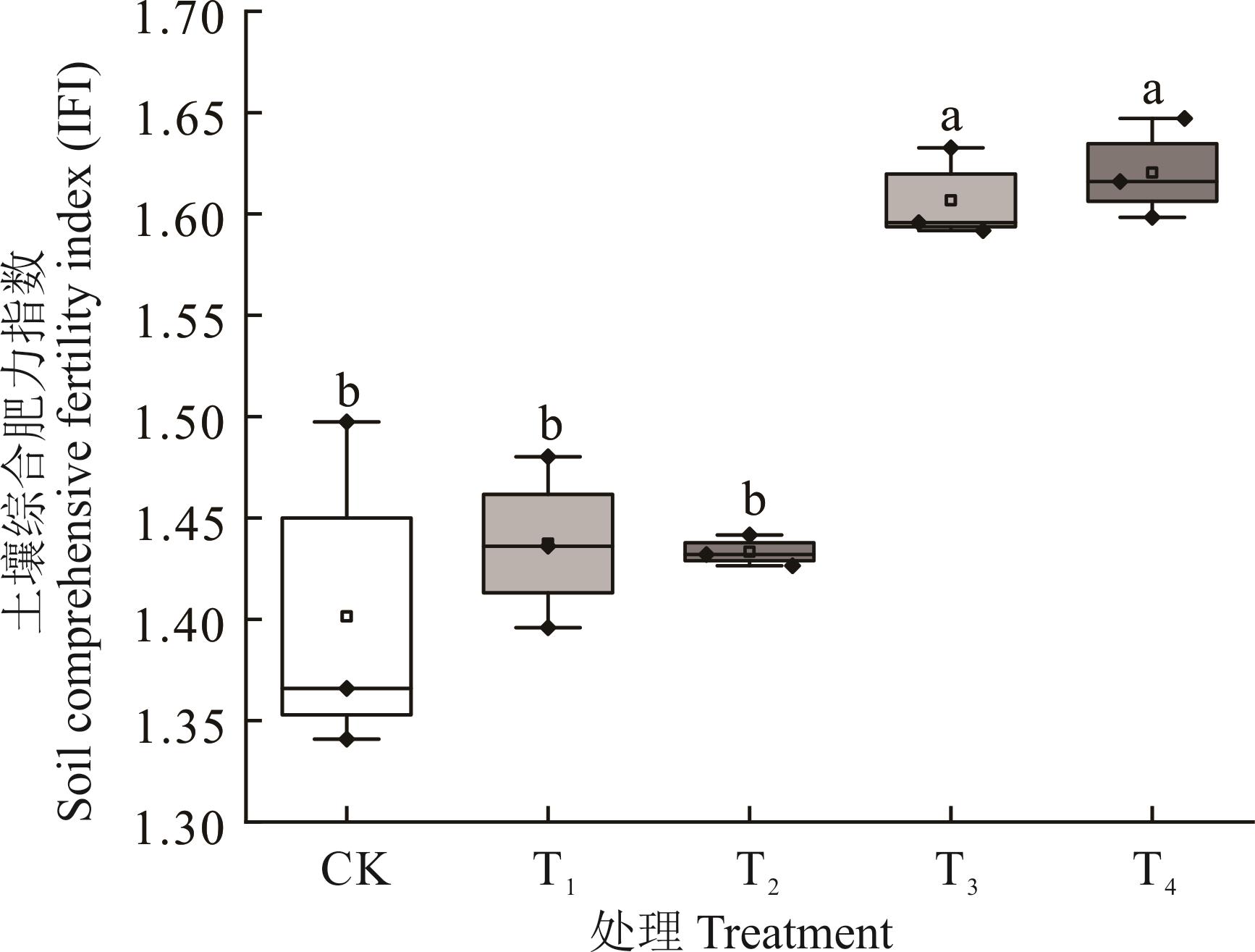
图3 不同施肥处理下土壤综合肥力指数
Fig.3 Soil comprehensive fertility index under different fertilization treatments
| [1] | Du Y X, Jiang J Y, Xu Y, et al. Progress in studies and control strategies for diseases of Coptis chinensis. China Journal of Chinese Materia Medica, 2021, 46(5): 1067-1072. |
| 杜用玺, 蒋靖怡, 徐扬, 等. 黄连常见病害研究进展与防治策略. 中国中药杂志, 2021, 46(5): 1067-1072. | |
| [2] | Liu S B. The effect of fertilizers application the growth and the main active ingredients and yield of Coptis chinensis Franch in the late cultivation. Wuhan: Huazhong Agricultural University, 2015. |
| 刘三波. 栽培后期施肥对黄连生长及主要活性成分与产量的影响. 武汉: 华中农业大学, 2015. | |
| [3] | Zhao J H, Zhao W, Zhang M, et al. SWOT analysis of Shizhu Coptis chinensis Franch cultivation under ecological transformation. Journal of Southwest University (Natural Science Edition), 2025, 47(3): 60-70. |
| 赵江红, 赵微, 张敏, 等. 生态转型下石柱黄连种植的SWOT分析. 西南大学学报(自然科学版), 2025, 47(3): 60-70. | |
| [4] | Zeng Y, Wang X K, Zhou B, et al. Effects of different fertilizer treatments on nutrient content and quality of Coptis chinensis Franch in middle growing stage. Southwest China Journal of Agricultural Sciences, 2013, 26(5): 1924-1928. |
| 曾烨, 王学奎, 周波, 等. 配方施肥对生长中期黄连养分和品质的影响. 西南农业学报, 2013, 26(5): 1924-1928. | |
| [5] | Yu J J, Liu Y, Luo W H, et al. Research on the pollution characteristics and effective control of heavy metals in co-cultivation rice field. Chinese Journal of Eco-Agriculture, 2025, 33(2): 374-386. |
| 余俊杰, 刘洋, 罗文浩, 等. 稻田共作模式中重金属的污染特征及有效性控制研究. 中国生态农业学报, 2025, 33(2): 374-386. | |
| [6] | Lu L L, Yang X Q, Zhao S X, et al. Effects of compound application of organic and chemical fertilizers on growth, quality of Pogostemon cablin and soil nutrient. Journal of Agricultural Machinery, 2015, 46(10): 184-191. |
| 卢丽兰, 杨新全, 赵世翔, 等. 有机肥与化肥配施对广藿香生长、品质及土壤养分的影响. 农业机械学报, 2015, 46(10): 184-191. | |
| [7] | Guan C L, Wang Q L, Hu X F. Effects of different fertilizers on growth, antioxidant enzyme activity and polysaccharide accumulation of Dendrobium officinalis. Journal of Zhejiang Sci-Tech University (Natural Science), 2016, 35(6): 933-938. |
| 管成林, 王巧丽, 胡秀芳. 不同肥料对铁皮石斛生长、抗氧化酶活性及多糖积累的影响. 浙江理工大学学报(自然科学版), 2016, 35(6): 933-938. | |
| [8] | Tang H M. Effects of microbial fertilizer and biochar applications on the yield and quality of Pinellia ternata and soil microecology. Wuhan: Huazhong Agricultural University, 2019. |
| 唐汉萌. 微生物菌剂和生物炭对半夏产量、品质及土壤微生态的影响. 武汉: 华中农业大学, 2019. | |
| [9] | Chen J Q, Guo D, Chen D, et al. The effects of biochar, organic fertilizer, and calcium magnesium phosphate fertilizer on Cd content in Panax notoginseng. Journal of Agro-Environmental Science, 2016, 35(10): 1909-1916. |
| 陈建清, 郭栋, 陈德, 等. 生物质炭、有机肥和钙镁磷肥对三七(Panax notoginseng)Cd含量的影响. 农业环境科学学报, 2016, 35(10): 1909-1916. | |
| [10] | Yang L, Wen Z W, Fu J, et al. Effect of biochar on seedling and soil quality of continuous cropping Panax ginseng. Journal of Chinese Medicinal Materials, 2020, 43(4): 791-796. |
| 杨莉, 文子伟, 付婧, 等. 生物质炭对连作参地人参种苗与土壤质量的影响. 中药材, 2020, 43(4): 791-796. | |
| [11] | Zhou L J, Wang Y J, Xie Z K, et al. Improvement effect of biochar on the degraded soil of Lanzhou lily field. Journal of Desert Research, 2019, 39(2): 134-143. |
| 周丽靖, 王亚军, 谢忠奎, 等. 生物炭对兰州百合(Lilium davidii var. unicolor)连作土壤的改良作用. 中国沙漠, 2019, 39(2): 134-143. | |
| [12] | Geng J Z. Effects of calcium carbonate and organic matter on the organic carbon components and microbial community structure in the rhizosphere and non-rhizosphere soils of highly acidic vegetable fields. Chongqing: Southwest University, 2024. |
| 耿锦沼. 碳酸钙和有机物对强酸性菜地根际/非根际土壤有机碳组分及微生物群落结构的影响. 重庆: 西南大学, 2024. | |
| [13] | Bao S D. Soil agrochemical analysis. Beijing: China Agriculture Press, 2000. |
| 鲍士旦. 土壤农化分析. 北京: 中国农业出版社, 2000. | |
| [14] | Wang X K. Principles and techniques of plant physiology and biochemistry experiments (2nd Edition). Beijing: Higher Education Press, 2006. |
| 王学奎. 植物生理生化实验原理和技术(第2版). 北京: 高等教育出版社, 2006. | |
| [15] | Zelles L, Bai Q Y, Beck T, et al. Signature fatty acids in phospholipids and lipopolysaccharides as indicators of microbial biomass and community structure in agricultural soils. Soil Biology and Biochemistry, 1992, 24: 317-323. |
| [16] | Bossio D A, Scow K M. Impacts of carbon and flooding on soil microbial communities: Phospholipid fatty acid profiles and substrate utilization patterns. Microbial Ecology, 1998, 35(3/4): 265-278. |
| [17] | Ma J P, Pang D B, Chen L, et al. Phospholipid fatty acid analysis of soil microbes in typical vegetation types at different elevation on the east slope of Helan Mountain. Acta Ecologica Sinica, 2022, 42(12): 5045-5058. |
| 马进鹏, 庞丹波, 陈林, 等. 贺兰山东坡不同海拔典型植被带土壤微生物磷酸脂肪酸分析. 生态学报, 2022, 42(12): 5045-5058. | |
| [18] | Xiang J, Fan L H, Zhang N N, et al. Effects of phosphorus application on soil nutrients and soil microbial community in rhizosphere of Fargesia under drought stress. Acta Ecologica Sinica, 2021, 41(23): 9422-9431. |
| 向君, 樊利华, 张楠楠, 等. 施磷对干旱胁迫下箭竹根际土壤养分及微生物群落的影响. 生态学报, 2021, 41(23): 9422-9431. | |
| [19] | Williamson G B, Richardson D. Bioassays for allelopathy: Measuring treatment responses with independent controls. Journal of Chemical Ecology, 1988, 14(1): 181. |
| [20] | Duan Y Y, Liu X H, Wu J Q, et al. Effects of intercropping patterns on physiological and growth traits of Coptis chinensis and rhizospheric soil physicochemical properties. Journal of Ecology, 2020, 39(11): 3676-3685. |
| 段媛媛, 刘晓洪, 吴佳奇, 等. 间作模式对黄连生理生长性状及根际土壤理化性质的影响. 生态学杂志, 2020, 39(11): 3676-3685. | |
| [21] | Wei Y, Wang S, Zhao J K, et al. Characteristics of nutrient distribution and comprehensive evaluation of fertility of Zanthoxylum bungeanum orchards soil in Chongqing. Journal of Southwest University (Natural Science Edition), 2022, 44(7): 48-58. |
| 魏勇, 王帅, 赵敬坤, 等. 重庆花椒主产区土壤养分分布特征及综合肥力评价. 西南大学学报(自然科学版), 2022, 44(7): 48-58. | |
| [22] | National Soil Census Office. Chinese soil. Beijing: China Agriculture Press, 1998. |
| 全国土壤普查办公室. 中国土壤. 北京: 中国农业出版社, 1998. | |
| [23] | Abideen Z, Koyro H W, Huchzermeyer B, et al. Ameliorating effects of biochar on photosynthetic efficiency and antioxidant defence of Phragmites karka under drought stress. Plant Biology, 2020, 22(2): 259-266. |
| [24] | Jahromi N B, Fulcher A, Walker F, et al. Photosynthesis, growth, and water use of Hydrangea paniculata “Silver Dollar” using a physiological-based or a substrate physical properties-based irrigation schedule and a biochar substrate amendment. Irrigation Science, 2020, 38(3):1-12. |
| [25] | Zhang Q H, Qin Z H, Wan H Y, et al. Analysis of growth index of Coptis chinensis Franch under different fertilizer treatments. Northern Horticulture, 2022(8): 89-94. |
| 张乔会, 覃章辉, 万海英, 等. 不同肥料处理下黄连生长指数分析. 北方园艺, 2022(8): 89-94. | |
| [26] | Chen M. Effects of biochar and different organic fertilizers on the improvement of severe saline-alkali land and Astragalus growth. Hohhot: Inner Mongolia Agricultural University, 2020. |
| 陈蒙. 生物炭及不同有机肥对重度盐碱地改良效果及黄芪生长试验研究. 呼和浩特: 内蒙古农业大学, 2020. | |
| [27] | Gu W Q, Wang Y N, Feng Z B, et al. Long-term effects of biochar application with reduced chemical fertilizer on paddy soil properties and japonica rice production system. Frontiers in Environmental Science, 2022, 10: 1-13. |
| [28] | Pu Z T, Wang H, Zhao B, et al. Effects of different soil amendments on growth of Scutellaria baicalensis and soil enzyme activities in continuous cropping. Journal of Agricultural Science and Technology, 2024, 26(7): 189-198. |
| 蒲子天, 王红, 赵斌, 等. 不同土壤改良物料对连作黄芩生长及土壤酶活性的影响. 中国农业科技导报, 2024, 26(7): 189-198. | |
| [29] | Liu W K, Lei Y Z, Wang L, et al. Effects of chemical fertilizer reduction combined with bio-organic fertilizer application on growth physiology and nutrient absorption of Chinese cabbage in open fields on plateau in summer. Acta Agriculturae Universitatis Jiangxiensis, 2024, 46(2): 340-355. |
| 柳文凯, 雷永忠, 王莉, 等. 化肥减量配施生物有机肥对高原夏季露地大白菜生长生理及养分吸收的影响. 江西农业大学学报, 2024, 46(2): 340-355. | |
| [30] | Gao Y B, Wang S X, Wei M, et al. Effects of nitrogen, phosphorus and potassium dosage on the yield, root morphology, rhizosphere microbial quantity and enzyme activity of eggplant under substrate cultivation. Scientia Agricultura Sinica, 2021, 54(21): 4623-4634. |
| 郜永博, 王世显, 魏珉, 等. 氮磷钾用量对基质培茄子产量、根系形态和根际微生物数量与酶活性的影响. 中国农业科学, 2021, 54(21): 4623-4634. | |
| [31] | Chen A G, Li M J, Zhang B, et al. Review on catastrophe mechanism of medicinal plant and its rhizosphere microecosystem mediated by consecutive monoculture. Modern Chinese Medicine, 2016, 18(2): 239-245. |
| 陈爱国, 李明杰, 张宝, 等. 连作介导的药用植物及其根际微生态灾变机制研究展望. 中国现代中药, 2016, 18(2): 239-245. | |
| [32] | Amini S, Asoodar M A. The effect of conservation tillage on crop yield production (The review). New York Science Journal, 2015, 8(3): 25-29. |
| [33] | Verma B, Reddy S M. Biochar augmentation improves ectomycorrhizal colonisation, plant growth and soil fertility. Soil Research, 2020, 58(7): 673-682. |
| [34] | Xu Y X, He L L, Liu Y X, et al. Effects of biochar addition on enzyme activity and fertility in paddy soil after six years. Chinese Journal of Applied Ecology, 2019, 30(4): 1110-1118. |
| 许云翔, 何莉莉, 刘玉学, 等. 施用生物炭6年后对稻田土壤酶活性及肥力的影响. 应用生态学报, 2019, 30(4): 1110-1118. | |
| [35] | Ma Z, Huang K W, Zhang Z M, et al. Effects of adding biochar on availability of soil phosphorus: A review. Journal of Northeast Agricultural University, 2021, 52(8): 89-96. |
| 马珍, 黄凯文, 张珍明, 等. 添加生物炭对土壤磷素有效性影响研究进展. 东北农业大学学报, 2021, 52(8): 89-96. | |
| [36] | Liu J W. Effect of long-term biochar application with organic fertilizer on the main physicochemical and biological properties of pepper soils in facilities and biological traits of the soil. Nanjing: Nanjing Agricultural University, 2022. |
| 刘佳伟. 长期生物炭配施有机肥对设施辣椒土壤主要理化及生物学性状的影响. 南京: 南京农业大学, 2022. | |
| [37] | Fotis B, Dimitrios K, Clive R, et al. Biochar application as a soil potassium management strategy: A review. The Science of the Total Environment, 2022, 858(P1): 159782. |
| [38] | Yu W L. Effects of replacing chemical fertilizer with organic fertilizer on alkaloid content and rhizosphere soil microbial of Coptis chinensis Franch. Wuhan: Huazhong Agricultural University, 2022. |
| 喻伟龙. 有机肥替减化肥对黄连生物碱含量及根际土壤微生物的影响. 武汉: 华中农业大学, 2022. | |
| [39] | Hamed A A, Fauziah C I, Singh D K, et al. Efficiency of rice husk biochar with poultry litter co-composts in oxisols for improving soil physico-chemical properties and enhancing maize performance. Agronomy, 2021, 11(12): 2409. |
| [40] | Orlova N, Abakumov E, Orlova E, et al. Soil organic matter alteration under biochar amendment: Study in the incubation experiment on the Podzol soils of the Leningrad region (Russia). Journal of Soils and Sediments, 2019, 19(6): 2708-2716. |
| [41] | Yu S P, Xiong Y B, Liao T, et al. Comprehensive evaluation of continuous chemical fertilizer reduction with organic fertilizer application to improve soil fertility quality of planted tobacco. Soil and Fertilizer Sciences in China, 2024(1): 70-78. |
| 余顺平, 熊于斌, 廖涛, 等. 连续化肥减量配施有机肥提升植烟土壤肥力质量的综合评价. 中国土壤与肥料, 2024(1): 70-78. | |
| [42] | Huang X C, Yang Y H, Li Y, et al. Effects of long-term fertilization on integrated fertility and rice yield in yellow paddy soil. Journal of Southern Agriculture, 2023, 54(2): 506-515. |
| 黄兴成, 杨叶华, 李渝, 等. 长期施肥对黄壤性水稻土综合肥力和水稻产量的影响. 南方农业学报, 2023, 54(2): 506-515. | |
| [43] | Chen X, Henriksen M T, Svensson K, et al. Long-term effects of agricultural production systems on structure and function of the soil microbial community. Applied Soil Ecology, 2020, 147: 103387. |
| [44] | Qi J J, Fu D Q, Wang X Z, et al. The effect of alfalfa cultivation on improving physicochemical properties soil microorganisms community structure of grey desert soil. Scientific Reports, 2023, 13(1): 13747. |
| [45] | Li X, Cai K, Li X, et al. Rhizobia-legume symbiosis modulates the rhizosphere microbiota and proteins which affect the growth and development of pear rootstock. Scientia Horticulturae, 2024, 334: 113328. |
| [46] | Wang D, Felice L M, Scow M K. Impacts and interactions of biochar and biosolids on agricultural soil microbial communities during dry and wet-dry cycles. Applied Soil Ecology, 2020, 152: 103570. |
| [47] | Zhang K, Qiao J X, Li J S, et al. Effects of different restoration materials on soil physicochemical properties and microbial communities in degraded alpine grassland. Acta Prataculturae Sinica, 2025, 34(8): 132-148. |
| 张琨, 乔建霞, 李金升, 等. 不同修复材料对退化高寒草地土壤理化性质及微生物群落的影响. 草业学报, 2025, 34(8): 132-148. | |
| [48] | Tessa C, Kay G P, Johannes L, et al. Soil fungal mycelia have unexpectedly flexible stoichiometric C∶N and C∶P ratio. Ecology Letters, 2021, 24(2): 208-218. |
| [49] | Cao X, Liu J, Zhang L, et al. Response of soil microbial ecological functions and biological characteristics to organic fertilizer combined with biochar in dry direct-seeded paddy fields. Science of the Total Environment, 2024, 948: 174844. |
| [50] | Jiang X T, Huang L H, Liu B S, et al. Effects of long-term fertilization on soil microbial quantity and community structure in saline sodic paddy fields. Journal of Agro-Environmental Science, 2024, 43(8): 1786-1795. |
| 蒋小曈, 黄立华, 刘伯顺, 等. 长期不同施肥措施对盐碱地稻田土壤微生物数量和群落结构的影响. 农业环境科学学报, 2024, 43(8): 1786-1795. | |
| [51] | Zhu M Y. Effects of long-term apply organic fertilizers on physicochemical properties and microbial community of tobacco planting soil. Wuhan: Huazhong Agricultural University, 2022. |
| 朱梦遥. 长期施用有机肥对植烟土壤理化性质和微生物群落的影响. 武汉: 华中农业大学, 2022. |
| [1] | 李若鸿, 李长然, 傅佳怡, 胡新雨, 毛培胜. 纳米铁引发和生物炭结壳包衣对中华羊茅种子萌发和幼苗生长耐盐性的影响[J]. 草业学报, 2026, 35(8): 32-44. |
| [2] | 王奕涵, 史路萌, 李志坚, 周帮伟. 草种及生物炭添加对东北苏打盐碱地改良及牧草生长的影响[J]. 草业学报, 2026, 35(5): 139-150. |
| [3] | 聂莹莹, 徐丽君, 徐修远, 薛玮, 吴欣珈, 袁波, 张钊, 张洪志, 周琼, 李禹霖. 养分添加对科尔沁盐碱化草地植物多样性和地上生物量的影响[J]. 草业学报, 2026, 35(5): 61-71. |
| [4] | 刘畅, 陈积山, 朱瑞芬, 孙万斌, 姚博, 董世魁. 有机肥和生物炭添加对亚热带人工草地土壤微生物碳、磷限制的缓解作用[J]. 草业学报, 2026, 35(4): 54-66. |
| [5] | 臧家艺, 徐明杰, 谢济骋, 沈禹颖, 来兴发. 有机肥等氮替代化肥对旱作区青贮玉米/饲用大豆间作系统饲草产量和水分利用效率的影响[J]. 草业学报, 2026, 35(3): 83-95. |
| [6] | 甘芮, 杨国斌, 隋晓青, 齐静, 靳瑰丽, 王玉祥, 彭建. 生物炭对盐碱胁迫下无芒雀麦幼苗生理和基因表达的影响[J]. 草业学报, 2026, 35(10): 117-128. |
| [7] | 张颖, 贺善睦, 何傲蕾, 李昌宁, 姚拓. 微生物菌剂与有机钙蛋白配施对紫花苜蓿生长和土壤酶活性的影响[J]. 草业学报, 2026, 35(1): 25-39. |
| [8] | 吕卉, 伍晓丽, 杨赞, 赵晓, 郑天润, 罗钰佳, 付新宇, 陈大霞. 黄连属植物真菌病害研究进展[J]. 草业学报, 2025, 34(12): 206-216. |
| [9] | 李争艳, 徐智明, 李岩, 李杨. 江淮地区苜蓿短期连作对后作高丹草生长及土壤微环境的影响[J]. 草业学报, 2024, 33(9): 155-168. |
| [10] | 李俊瑶, 蒋星驰, 胡晋瑜, 魏栋光, 赵学勇, 王少昆. 生物有机肥施加对荒漠草原植被-土壤-微生物的影响[J]. 草业学报, 2024, 33(3): 34-45. |
| [11] | 吕自立, 刘彬, 常凤, 马紫荆, 曹秋梅. 巴音布鲁克高寒草甸物种多样性与系统发育多样性沿海拔梯度分布格局及驱动因子[J]. 草业学报, 2023, 32(7): 12-22. |
| [12] | 陈意超, 孙晓莹, 解智杰, 周攀, 张露, 高雪莉, 李东, 刘晓风. 根际促生菌的筛选及其在尾矿改良中的应用[J]. 草业学报, 2022, 31(7): 50-63. |
| [13] | 汪精海, 李广, 银敏华, 齐广平, 康燕霞, 马彦麟. 调亏灌溉对高寒荒漠区人工混播草地土壤环境与牧草生长的影响[J]. 草业学报, 2022, 31(1): 95-106. |
| [14] | 肖婉君, 郭凤霞, 陈垣, 刘兰兰, 陈永中, 焦旭升, 张碧全, 白刚, 金建琴. 施用有机肥对当归药材性状、产量及抗病性的影响[J]. 草业学报, 2021, 30(3): 189-199. |
| [15] | 孙娇, 梁锦秀, 孔德杰, 郭鑫年, 魏永东, 周涛. 生物炭与秸秆还田对风沙土壤-微生物-胞外酶化学计量特征的影响[J]. 草业学报, 2021, 30(11): 29-39. |
| 阅读次数 | ||||||
|
全文 |
|
|||||
|
摘要 |
|
|||||
