

ISSN 1004-5759 CN 62-1105/S
草业学报 ›› 2026, Vol. 35 ›› Issue (2): 107-119.DOI: 10.11686/cyxb2025118
乔雅楠1( ), 王洪强2, 李颖1(), 庾强1()
收稿日期:2025-04-07
修回日期:2025-05-16
出版日期:2026-02-20
发布日期:2025-12-24
通讯作者:
李颖,庾强
作者简介:yuq@bjfu.edu.cn基金资助:
Ya-nan QIAO1(), Hong-qiang WANG2, Ying LI1(), Qiang YU1()
Received:2025-04-07
Revised:2025-05-16
Online:2026-02-20
Published:2025-12-24
Contact:
Ying LI,Qiang YU
摘要:
全球气候变化加剧导致极端干旱事件频发,严重威胁植物存活与生态系统功能。叶片性状网络通过整合多种功能性状及其相互作用,揭示植物对环境胁迫的综合响应。虽然已有研究关注极端干旱下单一或少数性状的变化,但叶片性状网络的整体结构及其核心性状对极端干旱的响应尚未明确。本研究以内蒙古典型草原为对象,设置两种极端干旱类型:每年5-8月降水量减少66%(CHR)和每年6-7月降水量减少100%(INT),系统测定20种叶片性状,并基于性状网络分析方法,评估极端干旱对叶片性状变化及其性状关系网络的影响。结果显示,极端干旱显著降低叶片水势,提高镁元素含量,并削弱网络连通性和复杂度,表现为网络边数、边密度及平均聚类系数下降。进一步将所选性状划分为叶片水力学性状、组成性状和形态学性状后发现,水力学性状在两类极端干旱处理中均表现出最高的度、紧密度与介数,表明其在网络中居于核心调控地位,主导其他功能性状对干旱胁迫的响应与协调。本研究从性状网络视角揭示了植物适应极端干旱的调控机制,为深入理解植物抗旱策略及其生态适应性提供了新见解,并为预测气候变化背景下植物的生态响应奠定了理论基础。
乔雅楠, 王洪强, 李颖, 庾强. 内蒙古典型草原植物叶片性状网络对极端干旱的响应[J]. 草业学报, 2026, 35(2): 107-119.
Ya-nan QIAO, Hong-qiang WANG, Ying LI, Qiang YU. Responses of leaf trait networks to extreme drought in typical steppe plants of Inner Mongolia[J]. Acta Prataculturae Sinica, 2026, 35(2): 107-119.
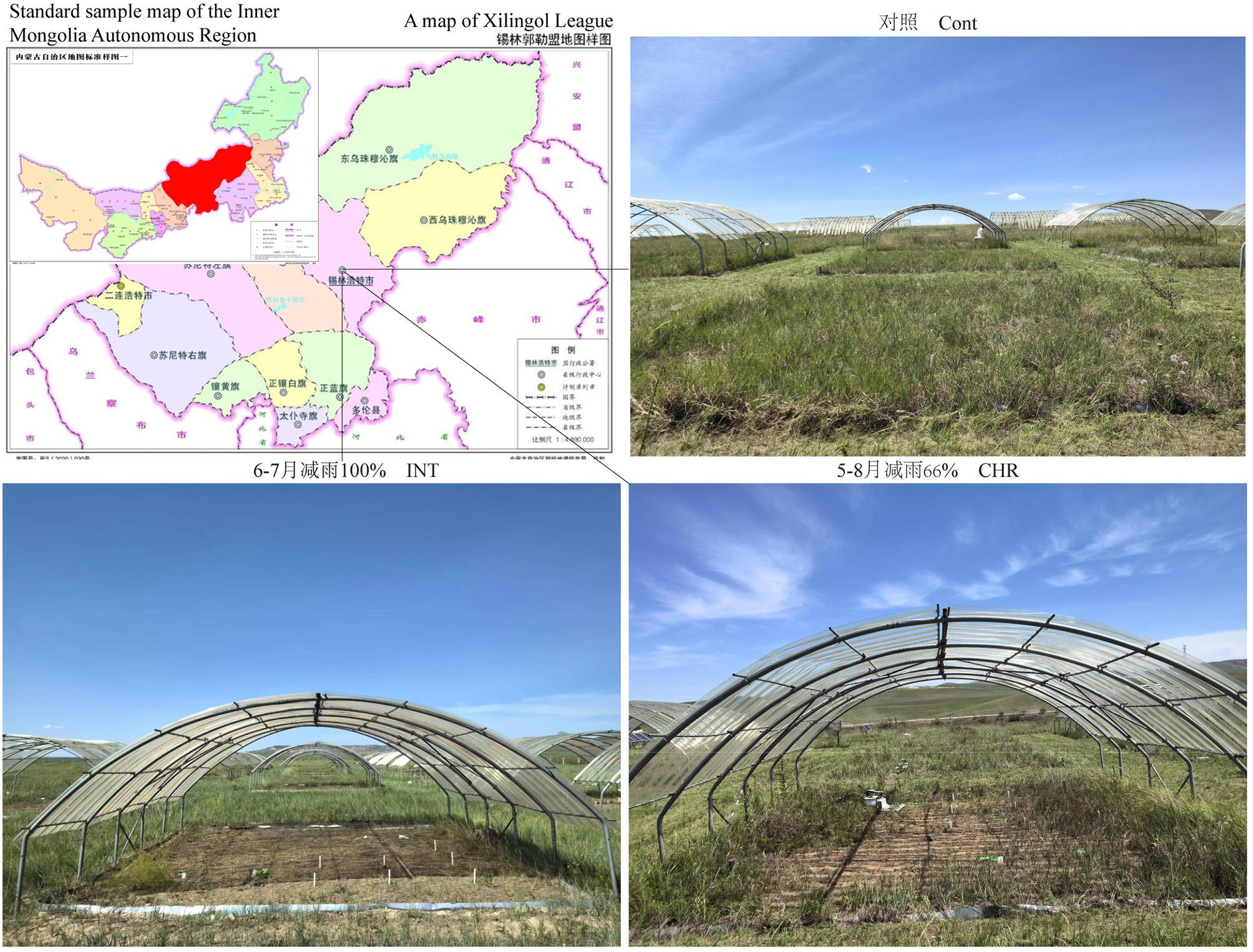
图1 试验研究样地布设基于自然资源部标准地图服务网站蒙S(2017)026号和蒙S(2020)030号标准地图制作,底图边界均无修改。Based on the standard map service website Mongolian S (2017) No. 026 and Mongolian S (2020) No. 030 of the Ministry of Natural Resources, the boundary of the base map is not modified.
Fig.1 Experimental study layout
| 分类 Sort | 性状 Traits | 单位 Unit | 缩写 Abbreviation |
|---|---|---|---|
叶片水力学性状 Leaf hydraulic traits | 叶片含水量Leaf water concentration | % | LWC |
| 气孔器长Stomatal length | μm | SL | |
| 气孔器宽Stomatal width | μm | SW | |
| 气孔长Stomatal pore length | μm | PL | |
| 气孔面积Stomatal area | μm2 | SA | |
| 气孔密度Stomatal density | pores·mm-2 | SD | |
| 气孔面积指数Stomatal area fraction | % | SAF | |
| 叶片水势Leaf water potential | Mpa | LWP | |
叶片组成性状 Leaf composition traits | 叶片钙含量Leaf calcium concentration | mg·g-1 | Ca |
| 叶片铁含量Leaf iron concentration | mg·g-1 | Fe | |
| 叶片钾含量Leaf potassium concentration | mg·g-1 | K | |
| 叶片镁含量Leaf magnesium concentration | mg·g-1 | Mg | |
| 叶片磷含量Leaf phosphorus concentration | mg·g-1 | P | |
| 叶片硫含量Leaf sulfur concentration | mg·g-1 | S | |
| 叶片锌含量Leaf zinc concentration | mg·g-1 | Zn | |
| 叶绿素含量Chlorophyll concentration | - | SPAD | |
叶片形态学性状 Leaf morphological traits | 叶片厚度Leaf thickness | mm | LT |
| 叶片面积Leaf area | cm2 | LA | |
| 比叶面积Specific leaf area | mm2·mg-1 | SLA | |
| 叶片干物质含量Leaf dry matter concentration | % | LDMC |
表1 叶片性状的分类、单位及缩写
Table 1 Plant leaf traits and their categories, units and abbreviations
| 分类 Sort | 性状 Traits | 单位 Unit | 缩写 Abbreviation |
|---|---|---|---|
叶片水力学性状 Leaf hydraulic traits | 叶片含水量Leaf water concentration | % | LWC |
| 气孔器长Stomatal length | μm | SL | |
| 气孔器宽Stomatal width | μm | SW | |
| 气孔长Stomatal pore length | μm | PL | |
| 气孔面积Stomatal area | μm2 | SA | |
| 气孔密度Stomatal density | pores·mm-2 | SD | |
| 气孔面积指数Stomatal area fraction | % | SAF | |
| 叶片水势Leaf water potential | Mpa | LWP | |
叶片组成性状 Leaf composition traits | 叶片钙含量Leaf calcium concentration | mg·g-1 | Ca |
| 叶片铁含量Leaf iron concentration | mg·g-1 | Fe | |
| 叶片钾含量Leaf potassium concentration | mg·g-1 | K | |
| 叶片镁含量Leaf magnesium concentration | mg·g-1 | Mg | |
| 叶片磷含量Leaf phosphorus concentration | mg·g-1 | P | |
| 叶片硫含量Leaf sulfur concentration | mg·g-1 | S | |
| 叶片锌含量Leaf zinc concentration | mg·g-1 | Zn | |
| 叶绿素含量Chlorophyll concentration | - | SPAD | |
叶片形态学性状 Leaf morphological traits | 叶片厚度Leaf thickness | mm | LT |
| 叶片面积Leaf area | cm2 | LA | |
| 比叶面积Specific leaf area | mm2·mg-1 | SLA | |
| 叶片干物质含量Leaf dry matter concentration | % | LDMC |
性状 Traits | 对照 Control | 5-8月降水量减少66% The precipitation decreased by 66% from May to August | 6-7月降水量减少100% The precipitation in June and July decreased by 100% |
|---|---|---|---|
| 叶片厚度 Leaf thickness (mm) | 0.245±0.016a | 0.225±0.017a | 0.231±0.033a |
| 叶片面积 Leaf area (cm2) | 7.905±2.221a | 7.706±1.831a | 8.149±0.238a |
| 叶片含水量 Leaf water content (%) | 0.661±0.058a | 0.734±0.046a | 0.743±0.061a |
| 比叶面积 Specific leaf area (mm2·mg-1) | 54.420±17.597a | 51.927±6.112a | 57.729±6.550a |
| 叶片干物质含量 Leaf dry matter content (%) | 0.598±0.041a | 0.648±0.007a | 0.620±0.025a |
| 叶片水势 Leaf water potential (MPa) | 12.825±1.402a | 8.305±1.026b | 9.428±0.282ab |
| 叶绿素含量 Chlorophyll concentration | 25.287±6.395a | 35.097±0.608a | 31.326±3.697a |
| 气孔密度 Stomatal density (pores·mm-2) | 1187.711±254.074a | 615.443±53.889a | 511.659±200.541a |
| 气孔器长 Stomatal length (μm) | 0.020±0.004a | 0.022±0.002a | 0.024±0.001a |
| 气孔器宽 Stomatal width (μm) | 0.015±0.003a | 0.014±0.002a | 0.015±0.001a |
| 气孔长 Stomatal pore length (μm) | 0.013±0.002a | 0.013±0.002a | 0.015±0.001a |
| 气孔面积 Stomatal area (μm2) | 214.365±78.887a | 200.715±40.244a | 216.898±21.307a |
| 气孔面积指数 Stomatal area fraction (%) | 0.112±0.007a | 0.063±0.021a | 0.065±0.024a |
| 叶片钙含量 Leaf calcium concentration (mg·g?1) | 64.993±9.344a | 81.673±11.979a | 90.204±12.828a |
| 叶片铁含量 Leaf iron concentration (mg·g?1) | 1.484±0.072a | 2.977±0.895a | 2.008±0.286a |
| 叶片钾含量 Leaf potassium concentration (mg·g?1) | 147.292±16.118a | 170.308±21.986a | 180.783±38.755a |
| 叶片镁含量 Leaf magnesium concentration (mg·g?1) | 11.728±1.476b | 17.276±1.531a | 19.460±1.773a |
| 叶片磷含量 Leaf phosphorus concentration (mg·g?1) | 11.004±0.331a | 15.368±2.723a | 16.454±1.176a |
| 叶片硫含量 Leaf sulfur concentration (mg·g?1) | 18.695±4.075a | 23.280±3.084a | 24.832±1.907a |
| 叶片锌含量 Leaf zinc concentration (mg g-1) | 0.265±0.009a | 0.365±0.053a | 0.328±0.011a |
表2 叶片性状对不同干旱处理的响应
Table 2 Response of leaf traits to different drought treatments
性状 Traits | 对照 Control | 5-8月降水量减少66% The precipitation decreased by 66% from May to August | 6-7月降水量减少100% The precipitation in June and July decreased by 100% |
|---|---|---|---|
| 叶片厚度 Leaf thickness (mm) | 0.245±0.016a | 0.225±0.017a | 0.231±0.033a |
| 叶片面积 Leaf area (cm2) | 7.905±2.221a | 7.706±1.831a | 8.149±0.238a |
| 叶片含水量 Leaf water content (%) | 0.661±0.058a | 0.734±0.046a | 0.743±0.061a |
| 比叶面积 Specific leaf area (mm2·mg-1) | 54.420±17.597a | 51.927±6.112a | 57.729±6.550a |
| 叶片干物质含量 Leaf dry matter content (%) | 0.598±0.041a | 0.648±0.007a | 0.620±0.025a |
| 叶片水势 Leaf water potential (MPa) | 12.825±1.402a | 8.305±1.026b | 9.428±0.282ab |
| 叶绿素含量 Chlorophyll concentration | 25.287±6.395a | 35.097±0.608a | 31.326±3.697a |
| 气孔密度 Stomatal density (pores·mm-2) | 1187.711±254.074a | 615.443±53.889a | 511.659±200.541a |
| 气孔器长 Stomatal length (μm) | 0.020±0.004a | 0.022±0.002a | 0.024±0.001a |
| 气孔器宽 Stomatal width (μm) | 0.015±0.003a | 0.014±0.002a | 0.015±0.001a |
| 气孔长 Stomatal pore length (μm) | 0.013±0.002a | 0.013±0.002a | 0.015±0.001a |
| 气孔面积 Stomatal area (μm2) | 214.365±78.887a | 200.715±40.244a | 216.898±21.307a |
| 气孔面积指数 Stomatal area fraction (%) | 0.112±0.007a | 0.063±0.021a | 0.065±0.024a |
| 叶片钙含量 Leaf calcium concentration (mg·g?1) | 64.993±9.344a | 81.673±11.979a | 90.204±12.828a |
| 叶片铁含量 Leaf iron concentration (mg·g?1) | 1.484±0.072a | 2.977±0.895a | 2.008±0.286a |
| 叶片钾含量 Leaf potassium concentration (mg·g?1) | 147.292±16.118a | 170.308±21.986a | 180.783±38.755a |
| 叶片镁含量 Leaf magnesium concentration (mg·g?1) | 11.728±1.476b | 17.276±1.531a | 19.460±1.773a |
| 叶片磷含量 Leaf phosphorus concentration (mg·g?1) | 11.004±0.331a | 15.368±2.723a | 16.454±1.176a |
| 叶片硫含量 Leaf sulfur concentration (mg·g?1) | 18.695±4.075a | 23.280±3.084a | 24.832±1.907a |
| 叶片锌含量 Leaf zinc concentration (mg g-1) | 0.265±0.009a | 0.365±0.053a | 0.328±0.011a |
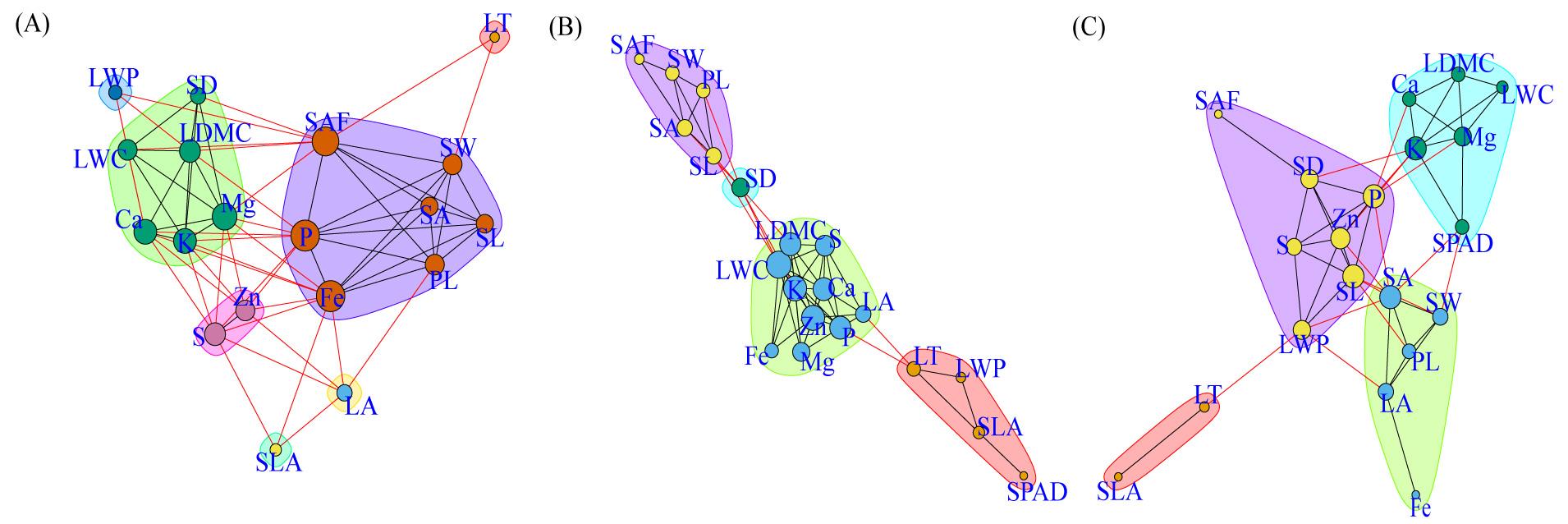
图2 叶片性状网络(A)为对照处理下的叶片性状网络;(B)为5-8月减雨66%处理下的叶片性状网络;(C)为6-7月减雨100%处理下的叶片性状网络。在图中,叶片性状网络(leaf trait networks, LTNs)被划分为不同的模块,同一颜色的节点属于同一模块。黑色线条表示同一模块内节点之间的连接,而红色线条表示不同模块节点之间的连接。LT,叶片厚度;LA,叶片面积;SLA,比叶面积;LDMC,叶片干物质含量;LWC,叶片含水量;LWP,叶片水势;SD,气孔密度;SL,气孔器长;SW,气孔器宽;PL,气孔长;SA,气孔面积;SAF,气孔面积指数;Ca,叶片钙含量;Fe,叶片铁含量;K,叶片钾含量;Mg,叶片镁含量;P,叶片磷含量;S,叶片硫含量;Zn,叶片锌含量。SPAD,叶片叶绿素含量。不同的颜色表示不同的叶片功能模块。下同。(A) represents the leaf trait network under the control treatment; (B) represents the leaf trait network under the 66% precipitation reduction from May to August; (C) represents the leaf trait network under the 100% precipitation reduction during June and July. In the figure, leaf trait networks are divided into different modules, with nodes of the same color belonging to the same module. Black lines represent connections between nodes within the same module, while red lines indicate connections between nodes from different modules. LT, leaf thickness; LA, leaf area; SLA, specific leaf area; LDMC, leaf dry matter content; LWC, leaf water content; LWP, leaf water potential; SD, stomatal density; SL, stomatal length; SW, stomatal width; PL, Stomatal pore length; SA, stomatal area; SAF, stomatal area fraction; Ca, leaf calcium content; Fe, leaf iron content; K, leaf potassium content; Mg, leaf magnesium content; P, leaf phosphorus content; S, leaf sulfur content; Zn, leaf zinc content; SPAD, leaf chlorophyll content. Different colors represent different leaf functional modules. The same below.
Fig.2 Leaf trait network
处理 Treatment | 节点数 Number of nodes | 边数 Number of edges | 边密度 Edge density | 直径 Diameter | 平均路径长度 Average path length | 模块度 Modularity | 平均聚类系数 Average clustering coefficient |
|---|---|---|---|---|---|---|---|
| 对照Control | 19 | 69 | 0.404 | 3 | 1.061 | 0.194 | 0.726 |
5-8月降水量减少66% The precipitation decreased by 66% from May to August | 20 | 55 | 0.290 | 7 | 1.775 | 0.355 | 0.700 |
6-7月降水量减少100% The precipitation in June and July decreased by 100% | 20 | 48 | 0.253 | 5 | 1.607 | 0.365 | 0.559 |
表3 叶片性状网络的整体参数
Table 3 Overall parameters of leaf trait network
处理 Treatment | 节点数 Number of nodes | 边数 Number of edges | 边密度 Edge density | 直径 Diameter | 平均路径长度 Average path length | 模块度 Modularity | 平均聚类系数 Average clustering coefficient |
|---|---|---|---|---|---|---|---|
| 对照Control | 19 | 69 | 0.404 | 3 | 1.061 | 0.194 | 0.726 |
5-8月降水量减少66% The precipitation decreased by 66% from May to August | 20 | 55 | 0.290 | 7 | 1.775 | 0.355 | 0.700 |
6-7月降水量减少100% The precipitation in June and July decreased by 100% | 20 | 48 | 0.253 | 5 | 1.607 | 0.365 | 0.559 |
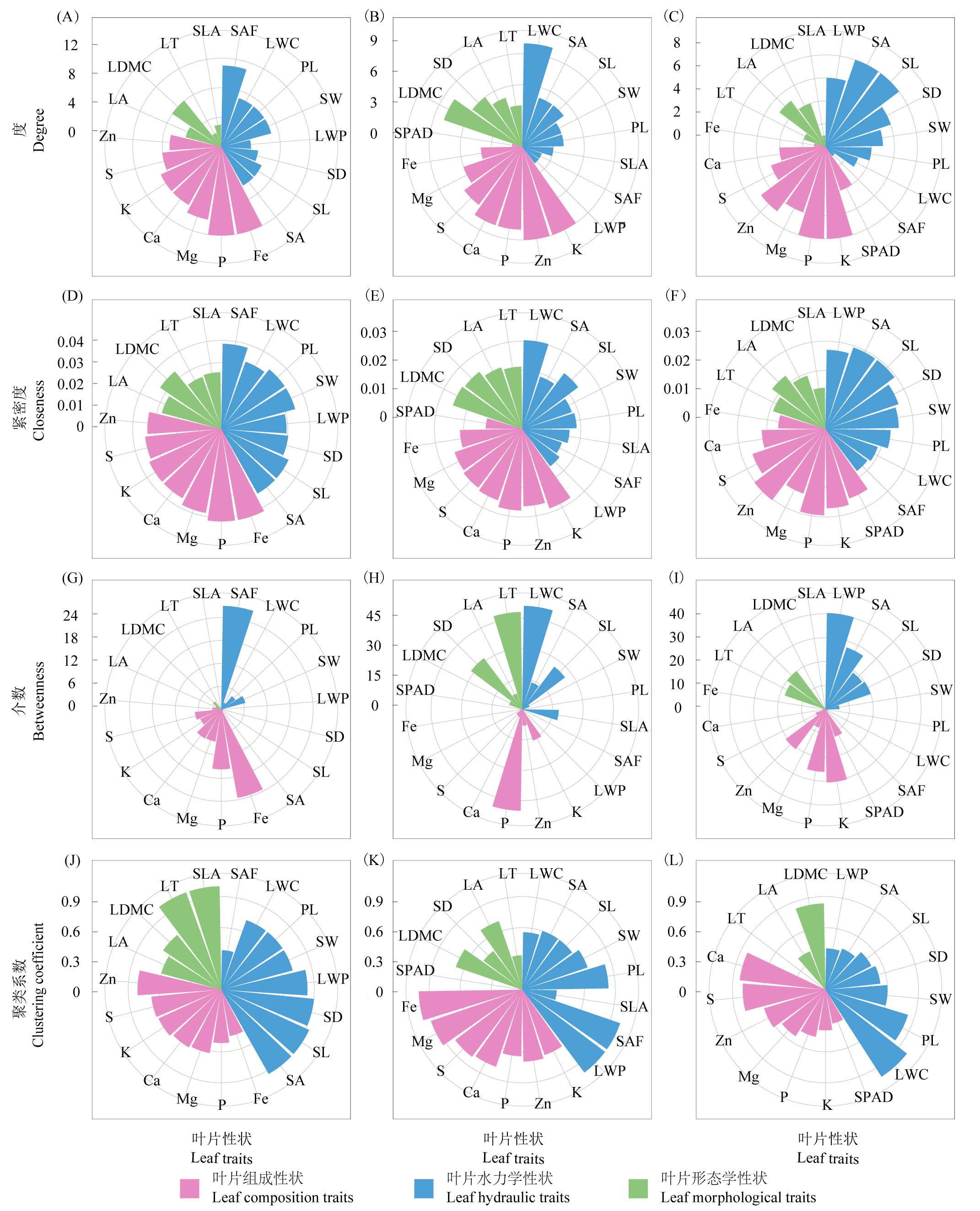
图3 不同处理下叶片性状网络节点参数的变化(A)~(C)分别为对照组、5-8月降水量减少66%、6-7月降水量减少100%处理下的度;(D)~(F)分别为3种处理下的紧密度;(G)~(I)分别为3种处理下的介数;(J)~(L)分别为3种处理下的聚类系数。(A)-(C) represent the degree under the control, 66% precipitation reduction from May to August, and 100% precipitation reduction during June and July, respectively; (D)-(F) show the closeness centrality under the three treatments; (G)-(I) show the betweenness centrality under the three treatments; (J)-(L) show the clustering coefficient under the three treatments.
Fig.3 Changes in leaf trait network node parameters under different treatments
| [1] | Hao Z, Li W, Singh V P, et al. Impact of dependence changes on the likelihood of hot extremes under drought conditions in the United States. Journal of Hydrology, 2020, 581: 124410. |
| [2] | Kang X M, Yan L, Cui L J, et al. Reduced carbon dioxide sink and methane source under extreme drought condition in an alpine peatland. Sustainability, 2018, 10(11): 4285. |
| [3] | Intergovernmental Panel on Climate Change. Climate change 2013: The physical science basis// Stocker T F, Qin D, Plattner G K, et al. Contribution of working group I to the fifth assessment report of the intergovernmental panel on climate change. Cambridge, UK: Cambridge University Press, 2013. |
| [4] | Maestre F T, Quero J L, Gotelli N J, et al. Plant species richness and ecosystem multifunctionality in global drylands. Science, 2012, 335(6065): 214-218. |
| [5] | Wright I J, Reich P B, Westoby M, et al. The worldwide leaf economics spectrum. Nature, 2004, 428(6985): 821-827. |
| [6] | Lavorel S, Garnier E. Predicting changes in community composition and ecosystem functioning from plant traits: Revisiting the Holy Grail. Functional Ecology, 2002, 16(5): 545-556. |
| [7] | Poorter H, Niinemets V, Poorter L, et al. Causes and consequences of variation in leaf mass per area (LMA): A meta-analysis. New Phytologist, 2009, 182(3): 565-588. |
| [8] | Violle C, Navas M L, Vile D, et al. Let the concept of trait be functional! Oikos, 2007, 116(5): 882-892. |
| [9] | Aguirre-Gutiérrez J, Rifai S W, Deng X, et al. Canopy functional trait variation across earths tropical forests. Nature, 2025, 641: 129-136. |
| [10] | Díaz S, Kattge J, Cornelissen J H C, et al. The global spectrum of plant form and function. Nature, 2016, 529(7585): 167-171. |
| [11] | Bruelheide H, Dengler J, Purschke O, et al. Global trait-environment relationships of plant communities. Nature Ecology & Evolution, 2018, 2(12): 1906-1917. |
| [12] | Doughty C E, Santos-Andrade P E, Shenkin A, et al. Tropical forest leaves may darken in response to climate change. Nature Ecology & Evolution, 2018, 2(12): 1918-1924. |
| [13] | He N P, Li Y, Liu C C, et al. Plant trait networks: improved resolution of the dimensionality of adaptation. Trends in Ecology & Evolution, 2020, 35(10): 908-918. |
| [14] | Li Y. Variation of leaf trait network among different vegetation types and its influencing factors. Beijing: Beijing Forestry University, 2020. |
| 李颖. 叶片性状网络在不同植被类型间的变异规律及其影响因素. 北京: 北京林业大学, 2020. | |
| [15] | Intergovernmental Panel on Climate Change. Climate change 2021: The physical science basis//Masson-Delmotte V, Zhai P, Pirani A, et al. Contribution of working group I to the sixth assessment report of the intergovernmental panel on climate change. Cambridge: Cambridge University Press, 2021: 1767-1926. |
| [16] | Yu Q, Xu C, Wu H H, et al. Contrasting drought sensitivity of Eurasian and North American grasslands. Nature, 2025, 639(1): 114-118. |
| [17] | Joshi J, Stocker B D, Hofhansl F, et al. Towards a unified theory of plant photosynthesis and hydraulics. Nature Plants, 2022, 8(11): 1304-1316. |
| [18] | Lu J N, Zhao X Y, Wang S K, et al. Untangling the influence of abiotic and biotic factors on leaf C, N, and P stoichiometry along a desert-grassland transition zone in northern China. Science of the Total Environment, 2023, 884: 163902. |
| [19] | Lens F, Gleason S M, Bortolami G, et al. Functional xylem characteristics associated with drought-induced embolism in angiosperms. New Phytologist, 2022, 236(6): 2019-2036. |
| [20] | Song W, Song R Z, Zhao Y, et al. Research on the characteristics of drought stress state based on plant stem water content. Sustainable Energy Technologies and Assessments, 2023, 56: 103080. |
| [21] | Wellstein C, Poschlod P, Gohlke A, et al. Effects of extreme drought on specific leaf area of grassland species: A meta-analysis of experimental studies in temperate and sub-mediterranean systems. Global Change Biology, 2017, 23(6): 2473-2481. |
| [22] | Anderegg W R L, Konings A G, Trugman A T, et al. Hydraulic diversity of forests regulates ecosystem resilience during drought. Nature, 2018, 561(7724): 538-541. |
| [23] | Gutierrez V. Understanding the role of plant hydraulic traits in ecological processes. Minnesota: University of Minnesota, 2021. |
| [24] | Martínez-Vilalta J, García-Valdés R, Jump A, et al. Accounting for trait variability and coordination in predictions of drought-induced range shifts in woody plants. New Phytologist, 2023, 240(1): 23-40. |
| [25] | Choat B, Brodribb T J, Brodersen C R, et al. Triggers of tree mortality under drought. Nature, 2018, 558(7711): 531-539. |
| [26] | Li X M, Xi B Y, Wu X C, et al. Unlocking drought-induced tree mortality: Physiological mechanisms to modeling. Frontiers in Plant Science, 2022, 13: 835921. |
| [27] | Mantova M, Herbette S, Cochard H, et al. Hydraulic failure and tree mortality: From correlation to causation. Trends in Plant Science, 2022, 27(4): 335-345. |
| [28] | Song Y J, Sterck F, Zhou X Q, et al. Drought resilience of conifer species is driven by leaf lifespan but not by hydraulic traits. New Phytologist, 2022, 235(3): 978-992. |
| [29] | Ploughe L W, Jacobs E M, Frank G S, et al. Community response to extreme drought (CRED): A framework for drought-induced shifts in plant-plant interactions. New Phytologist, 2019, 222(1): 52-69. |
| [30] | Li Y, Liu C C, Sack L, et al. Leaf trait network architecture shifts with species-richness and climate across forests at continental scale. Ecology Letters, 2022, 25(6): 1442-1457. |
| [31] | Beaulieu J M, Leitch I J, Patel S G, et al. Genome size is a strong predictor of cell size and stomatal density in angiosperms. New Phytologist, 2008, 179(4): 975-986. |
| [32] | Kleyer M, Trinogga J, Cebrián-Piqueras M A, et al. Trait correlation network analysis identifies biomass allocation traits and stem specific length as hub traits in herbaceous perennial plants. Journal of Ecology, 2019, 107(2): 829-842. |
| [33] | Naikwade P V. Plant responses to drought stress: Morphological, physiological, molecular approaches, and drought resistance. Plant Metabolites under Environmental Stress, 2023: 149-183. |
| [34] | Flexas J, Bota J, Loreto F, et al. Diffusive and metabolic limitations to photosynthesis under drought and salinity in C3 plants. Plant Biology, 2004, 6(3): 269-279. |
| [35] | Sardans J, Janssens I A, Ciais P, et al. Recent advances and future research in ecological stoichiometry. Perspectives in Plant Ecology, Evolution and Systematics, 2021, 50: 125611. |
| [36] | Bartlett M K, Scoffoni C, Sack L. The determinants of leaf turgor loss point and prediction of drought tolerance of species and biomes: a global meta-analysis. Ecology Letters, 2012, 15(5): 393-405. |
| [37] | Anderegg W R L, Klein T, Bartlett M, et al. Meta-analysis reveals that hydraulic traits explain cross-species patterns of drought-induced tree mortality across the globe. Proceedings of the National Academy of Sciences of the United States of America, 2016, 113(18): 5024-5029. |
| [38] | Marschner H. Marschner’s mineral nutrition of higher plants. Pittsburgh, USA: Academic Press, 2011. |
| [39] | Cakmak I, Kirkby E A. Role of magnesium in carbon partitioning and alleviating photooxidative damage. Physiologia Plantarum, 2008, 133(4): 692-704. |
| [40] | Tränkner M, Jákli B, Tavakol E, et al. Magnesium deficiency decreases biomass water-use efficiency and increases leaf water-use efficiency and oxidative stress in barley plants. Plant and Soil, 2016, 406: 409-423. |
| [41] | Medeiros C D, Trueba S, Henry C, et al. Simplification of woody plant trait networks among communities along a climatic aridity gradient. Journal of Ecology, 2025, 113(4): 896-912. |
| [42] | Wang M, Zheng Q S, Shen Q R, et al. The critical role of potassium in plant stress response. International Journal of Molecular Sciences, 2013, 14(4): 7370-7390. |
| [43] | Hasanuzzaman M, Bhuyan M H M B, Nahar K, et al. Potassium: a vital regulator of plant responses and tolerance to abiotic stresses. Agronomy, 2018, 8(3): 31. |
| [44] | Ahmad S, Muhammad I, Wang G Y, et al. Ameliorative effect of melatonin improves drought tolerance by regulating growth, photosynthetic traits and leaf ultrastructure of maize seedlings. BMC Plant Biology, 2021, 21(1): 368. |
| [45] | Abuelsoud W, Hirschmann F, Papenbrock J. Sulfur metabolism and drought stress tolerance in plants. Drought Stress Tolerance in Plants, Volume 1: Physiology and Biochemistry, 2016: 227-249. |
| [46] | Li Y, Liu C C, Xu L, et al. Leaf trait networks based on global data: Representing variation and adaptation in plants. Frontiers in Plant Science, 2021, 12: 710530. |
| [47] | Perez-Harguindeguy N, Diaz S, Garnier E, et al. Corrigendum to: New handbook for standardised measurement of plant functional traits worldwide. Australian Journal of Botany, 2016, 64(8): 715-716. |
| [48] | McDowell N G, Ryan M G, Zeppel M J B, et al. Improving our knowledge of drought-induced forest mortality through experiments, observations, and modeling. New Phytologist, 2013, 200(2): 289-293. |
| [49] | Lawson T, Blatt M R. Stomatal size, speed, and responsiveness impact on photosynthesis and water use efficiency. Plant Physiology, 2014, 164(4): 1556-1570. |
| [50] | Bartlett M K, Klein T, Jansen S, et al. The correlations and sequence of plant stomatal, hydraulic, and wilting responses to drought. Proceedings of the National Academy of Sciences of the United States of America, 2016, 113(46): 13098-13103. |
| [1] | 索晓晶, 项磊, 高贺, 运向军, 哈斯巴根, 吴金蕊, 董文成, 滑博伟, 牟金燚, 王琪. 不同利用方式对大针茅草原植被群落特征的影响[J]. 草业学报, 2024, 33(4): 12-21. |
| [2] | 李妍, 马富龙, 韩路, 王海珍. 美国‘WL’系列不同秋眠级苜蓿品种在南疆的生产性能与适应性评价[J]. 草业学报, 2024, 33(3): 139-149. |
| [3] | 王琪, 郑佳华, 赵萌莉, 张军. 刈割强度对大针茅草原植物群落特征和土壤理化性质的影响[J]. 草业学报, 2023, 32(2): 26-34. |
| [4] | 张静静, 刘尊驰, 鄢创, 王云霞, 刘凯, 时新荣, 袁志友. 土壤pH值变化对3种草原类型土壤碳氮磷生态化学计量特征的影响[J]. 草业学报, 2021, 30(2): 69-81. |
| [5] | 刘荣荣, 王平, 代心灵, 陈科宇, 李国梁, 宛新荣, 纪宝明. 不同密度布氏田鼠对内蒙古典型草原菌根真菌群落的影响[J]. 草业学报, 2021, 30(11): 76-86. |
| [6] | 宿婷婷, 马红彬, 周瑶, 贾希洋, 张蕊, 张双乔, 胡艳莉. 黄土丘陵典型草原土壤理化性质对生态恢复措施的响应[J]. 草业学报, 2019, 28(4): 34-46. |
| [7] | 聂明鹤, 沈艳, 饶丽仙. 宁夏典型草原区退耕草地群落演替序列与环境解释[J]. 草业学报, 2018, 27(8): 11-20. |
| [8] | 贾希洋, 马红彬, 周瑶, 张蕊, 宿婷婷, 张双乔, 张俊. 不同生态恢复措施下宁夏黄土丘陵区典型草原植物群落数量分类和演替[J]. 草业学报, 2018, 27(2): 15-25. |
| [9] | 张蕊, 马红彬, 贾希洋, 周瑶, 宿婷婷, 蔡育蓉, 周静静. 不同生态恢复措施下宁夏黄土丘陵区典型草原土壤种子库特征[J]. 草业学报, 2018, 27(1): 32-41. |
| [10] | 饶丽仙, 沈艳, 聂明鹤. 宁夏典型草原不同退耕年限草地植物-土壤生态化学计量特征[J]. 草业学报, 2017, 26(4): 43-52. |
| [11] | 周瑶, 马红彬, 贾希洋, 张蕊, 宿婷婷, 周静静, 吴兴旺. 不同恢复措施对宁夏典型草原土壤碳氮储量的影响[J]. 草业学报, 2017, 26(12): 236-242. |
| [12] | 赵凌平, 谭世图, 白欣, 王占彬. 封育年限对云雾山典型草原植物繁殖与植被更新的影响[J]. 草业学报, 2017, 26(10): 1-9. |
| [13] | 孙永秀, 严成, 徐海量, 姚艳丽. 受损矿区草原群落物种多样性和地上生物量对覆土厚度的响应[J]. 草业学报, 2017, 26(1): 54-62. |
| [14] | 闫玉龙, 张立欣, 万志强, 谷蕊, 苏力德, 杨劼, 高清竹. 模拟增温与增雨对克氏针茅光合作用的影响[J]. 草业学报, 2016, 25(2): 240-250. |
| [15] | 赵凌平, 白欣, 王占彬, 程积民, 谭世图, 王清义. 火烧对黄土高原典型草原地上植被和繁殖更新的影响[J]. 草业学报, 2016, 25(1): 108-116. |
| 阅读次数 | ||||||
|
全文 |
|
|||||
|
摘要 |
|
|||||
