

ISSN 1004-5759 CN 62-1105/S
草业学报 ›› 2026, Vol. 35 ›› Issue (6): 13-23.DOI: 10.11686/cyxb2025271
吴逊文1( ), 许银龙1, 莫宇1,2, 罗清1, 李佳欣1, 张伊琳1, 于杰1, 张靖1, 赵钰1, 鲍雅静1()
收稿日期:2025-07-02
修回日期:2025-08-28
出版日期:2026-06-20
发布日期:2026-04-13
通讯作者:
鲍雅静
作者简介:Corresponding author. E-mail: byj@dlnu.edu.cn基金资助:
Xun-wen WU1(), Yin-long XU1, Yu MO1,2, Qing LUO1, Jia-xin LI1, Yi-lin ZHANG1, Jie YU1, Jing ZHANG1, Yu ZHAO1, Ya-jing BAO1()
Received:2025-07-02
Revised:2025-08-28
Online:2026-06-20
Published:2026-04-13
Contact:
Ya-jing BAO
摘要:
为了探究草甸草原生态系统的能量固定与分配机制,本研究通过对内蒙古额尔古纳草甸草原中的36种植物进行热值分析,系统探讨了不同功能群(豆科、禾草、杂类草)及不同水分生态类型(旱生、中旱生、旱中生、中生、湿中生)及其植物器官的热值变化规律和能量分配。研究表明:1)36种植物的平均热值为17.31 kJ·g-1,其中植物器官果的平均热值最高,花与叶的平均热值次之,茎的平均热值最低,且均呈现显著差异(P<0.05),在主要科中,豆科植物热值最高,显著高于菊科、毛茛科、石蒜科等,而蔷薇科植物热值则与石蒜科差异不显著。2)在功能群中,豆科热值显著高于禾草与杂类草(P<0.05),其中豆科植物的叶热值显著高于其他器官(P<0.05),禾草的叶热值高于茎,而杂类草则是以花、果热值显著高于茎、叶(P<0.05)。3)在不同水分生态功能群中,植物整株热值之间并未表现出显著差异(P>0.05),除中旱生植物外,其他水分生态功能群均呈现花果热值显著高于茎叶(P<0.05)的结果,水分生态功能群中热值对于器官水平响应显著。4)植物整株热值与碳含量呈显著正相关,表明碳含量是影响植物能量储存的关键基础,植物各器官热值与碳含量同样呈显著正相关,但器官相关性强度不同(花>叶>茎>果),其中花器官相关性最强(r=0.91),果器官呈现相对较低的相关性(r=0.79)。
吴逊文, 许银龙, 莫宇, 罗清, 李佳欣, 张伊琳, 于杰, 张靖, 赵钰, 鲍雅静. 内蒙古额尔古纳草甸草原植物器官热值研究[J]. 草业学报, 2026, 35(6): 13-23.
Xun-wen WU, Yin-long XU, Yu MO, Qing LUO, Jia-xin LI, Yi-lin ZHANG, Jie YU, Jing ZHANG, Yu ZHAO, Ya-jing BAO. Calorific values of plant organs of vegetation growing on the Erguna Meadow Steppe, Inner Mongolia[J]. Acta Prataculturae Sinica, 2026, 35(6): 13-23.
科 Family | 学名 Scientific name | 功能群 Functional group | 水分生态类型 Water ecological type | 平均热值 Average calorific value |
|---|---|---|---|---|
| 石蒜科Amaryllidaceae | 野韭Allium ramosum | F | XM | 16.84±0.37 |
| 细叶韭Allium tenuissimum | F | X | 16.65±0.17 | |
| 唇形科Lamiaceae | 裂叶荆芥Schizonepeta tenuifolia | F | M | 16.96±0.39 |
| 豆科Legumes | 花苜蓿Medicago ruthenica | L | MX | 17.52±0.39 |
| 草木樨状黄芪Astragalus melilotoides | L | MX | 17.79±0.29 | |
| 披针叶野决明Thermopsis lanceolata | L | M | 18.24±0.41 | |
| 野豌豆Vicia sepium | L | M | 17.85±0.25 | |
| 斜茎黄芪Astragalus laxmannii | L | MX | 17.62±0.53 | |
| 禾本科Poaceae | 早熟禾Poa annua | P | M | 16.98±0.17 |
| 狼针草Stipa baicalensis | P | X | 17.78±0.23 | |
| 糙隐子草Cleistogenes squarrosa | P | X | 17.46±0.00 | |
| 洽草Koeleria macrantha | P | X | 17.25±0.33 | |
| 羊草Leymus chinensis | P | XM | 17.48±0.24 | |
| 西伯利亚羽茅Achnatherum sibiricum | P | X | 17.54±0.37 | |
| 桔梗科Campanulaceae | 长柱沙参Adenophora stenanthina | F | M | 17.40±0.25 |
| 菊科Asteraceae | 阿尔泰狗娃花Aster altaicus | F | MX | 17.40±0.24 |
| 艾Artemisia argyi | F | M | 17.88±0.00 | |
| 柔毛蒿Artemisia pubescens | F | MX | 18.00±0.05 | |
| 猪毛蒿Artemisia scoparia | F | XM | 17.55±0.40 | |
| 冷蒿Artemisia frigida | F | X | 17.92±0.32 | |
| 裂叶蒿Artemisia tanacetifolia | F | M | 16.98±0.17 | |
| 麻花头Klasea centauroides | F | MX | 16.90±0.29 | |
| 狭叶青蒿Artemisia dracunculus | F | M | 17.73±0.36 | |
| 蓼科Polygonaceae | 叉分蓼Koenigia divaricata | F | XM | 16.56±0.26 |
| 毛茛科Ranunculaceae | 唐松草Thalictrum aquilegiifolium | F | M | 17.24±0.31 |
| 细叶白头翁Pulsatilla turczaninovii | F | M | 16.22±0.17 | |
| 茜草科Rubiaceae | 蓬子菜Galium verum | F | M | 17.20±0.24 |
| 蔷薇科Rosaceae | 地榆Sanguisorba officinalis | F | M | 16.30±0.57 |
| 二裂委陵菜Potentilla bifurca | F | X | 16.65±0.35 | |
| 菊叶委陵菜Potentilla tanacetifolia | F | MX | 16.49±0.32 | |
| 伞形科Apiaceae | 线叶柴胡Bupleurum angustissimum | F | X | 17.81±0.39 |
| 防风Saposhnikovia divaricata | F | M | 17.29±0.59 | |
| 莎草科Cyperaceae | 寸草苔Carex duriuscula | F | WM | 17.31±0.31 |
| 玄参科Scrophulariaceae | 达乌里芯芭Cymbaria dahurica | F | X | 17.34±0.41 |
| 鸢尾科Iridaceae | 细叶鸢尾Iris tenuifolia | F | M | 15.79±0.77 |
| 大戟科Euphorbiaceae | 乳浆大戟Euphorbia esula | F | XM | 18.53±0.00 |
表1 内蒙古草甸草原植物功能群分类
Table 1 Classification of plant functional groups in the meadow steppe of Inner Mongolia(kJ·g-1)
科 Family | 学名 Scientific name | 功能群 Functional group | 水分生态类型 Water ecological type | 平均热值 Average calorific value |
|---|---|---|---|---|
| 石蒜科Amaryllidaceae | 野韭Allium ramosum | F | XM | 16.84±0.37 |
| 细叶韭Allium tenuissimum | F | X | 16.65±0.17 | |
| 唇形科Lamiaceae | 裂叶荆芥Schizonepeta tenuifolia | F | M | 16.96±0.39 |
| 豆科Legumes | 花苜蓿Medicago ruthenica | L | MX | 17.52±0.39 |
| 草木樨状黄芪Astragalus melilotoides | L | MX | 17.79±0.29 | |
| 披针叶野决明Thermopsis lanceolata | L | M | 18.24±0.41 | |
| 野豌豆Vicia sepium | L | M | 17.85±0.25 | |
| 斜茎黄芪Astragalus laxmannii | L | MX | 17.62±0.53 | |
| 禾本科Poaceae | 早熟禾Poa annua | P | M | 16.98±0.17 |
| 狼针草Stipa baicalensis | P | X | 17.78±0.23 | |
| 糙隐子草Cleistogenes squarrosa | P | X | 17.46±0.00 | |
| 洽草Koeleria macrantha | P | X | 17.25±0.33 | |
| 羊草Leymus chinensis | P | XM | 17.48±0.24 | |
| 西伯利亚羽茅Achnatherum sibiricum | P | X | 17.54±0.37 | |
| 桔梗科Campanulaceae | 长柱沙参Adenophora stenanthina | F | M | 17.40±0.25 |
| 菊科Asteraceae | 阿尔泰狗娃花Aster altaicus | F | MX | 17.40±0.24 |
| 艾Artemisia argyi | F | M | 17.88±0.00 | |
| 柔毛蒿Artemisia pubescens | F | MX | 18.00±0.05 | |
| 猪毛蒿Artemisia scoparia | F | XM | 17.55±0.40 | |
| 冷蒿Artemisia frigida | F | X | 17.92±0.32 | |
| 裂叶蒿Artemisia tanacetifolia | F | M | 16.98±0.17 | |
| 麻花头Klasea centauroides | F | MX | 16.90±0.29 | |
| 狭叶青蒿Artemisia dracunculus | F | M | 17.73±0.36 | |
| 蓼科Polygonaceae | 叉分蓼Koenigia divaricata | F | XM | 16.56±0.26 |
| 毛茛科Ranunculaceae | 唐松草Thalictrum aquilegiifolium | F | M | 17.24±0.31 |
| 细叶白头翁Pulsatilla turczaninovii | F | M | 16.22±0.17 | |
| 茜草科Rubiaceae | 蓬子菜Galium verum | F | M | 17.20±0.24 |
| 蔷薇科Rosaceae | 地榆Sanguisorba officinalis | F | M | 16.30±0.57 |
| 二裂委陵菜Potentilla bifurca | F | X | 16.65±0.35 | |
| 菊叶委陵菜Potentilla tanacetifolia | F | MX | 16.49±0.32 | |
| 伞形科Apiaceae | 线叶柴胡Bupleurum angustissimum | F | X | 17.81±0.39 |
| 防风Saposhnikovia divaricata | F | M | 17.29±0.59 | |
| 莎草科Cyperaceae | 寸草苔Carex duriuscula | F | WM | 17.31±0.31 |
| 玄参科Scrophulariaceae | 达乌里芯芭Cymbaria dahurica | F | X | 17.34±0.41 |
| 鸢尾科Iridaceae | 细叶鸢尾Iris tenuifolia | F | M | 15.79±0.77 |
| 大戟科Euphorbiaceae | 乳浆大戟Euphorbia esula | F | XM | 18.53±0.00 |
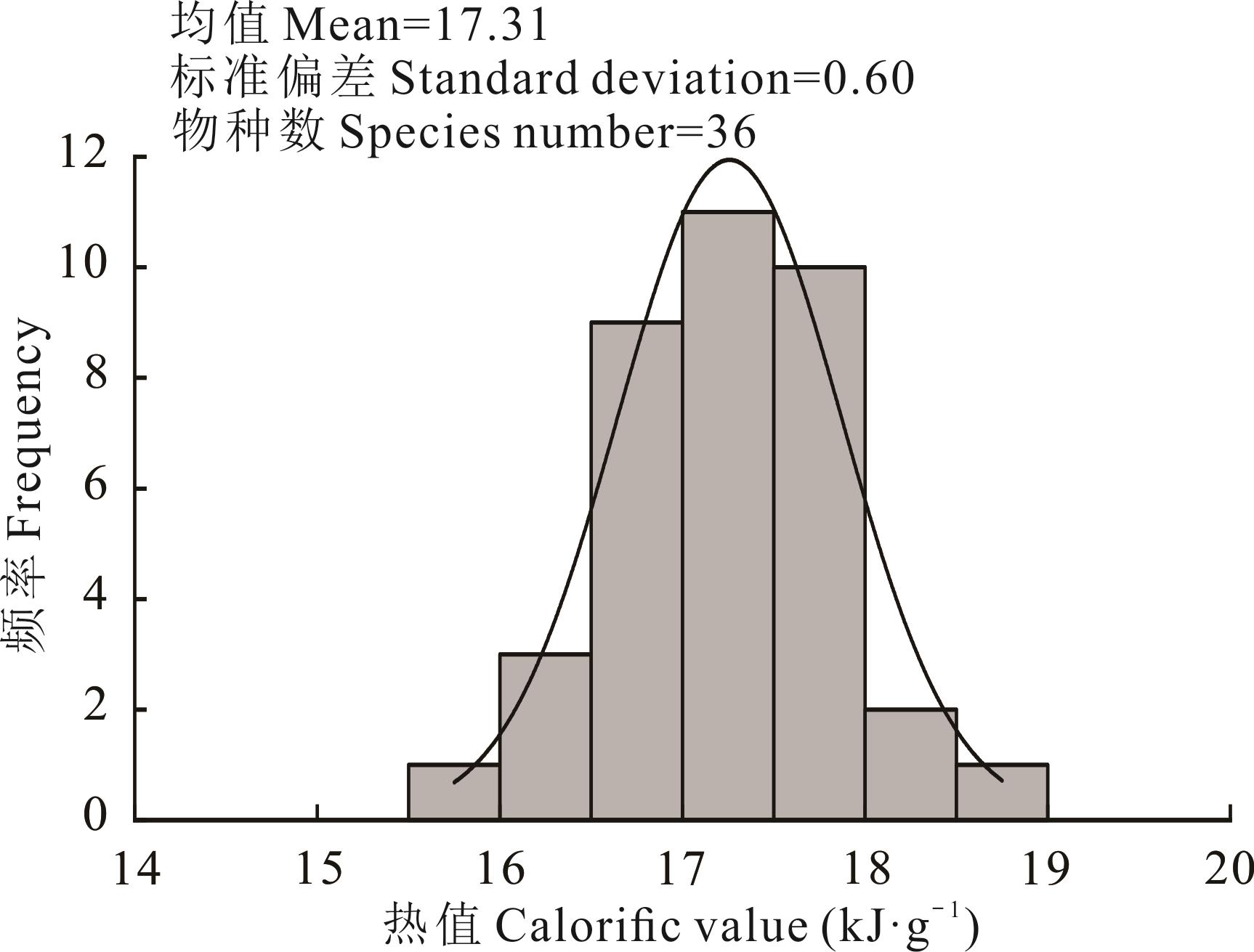
图1 内蒙古草甸草原植物热值分布频率
Fig.1 Distribution frequency of plant calorific values in the meadow steppe of Inner Mongolia
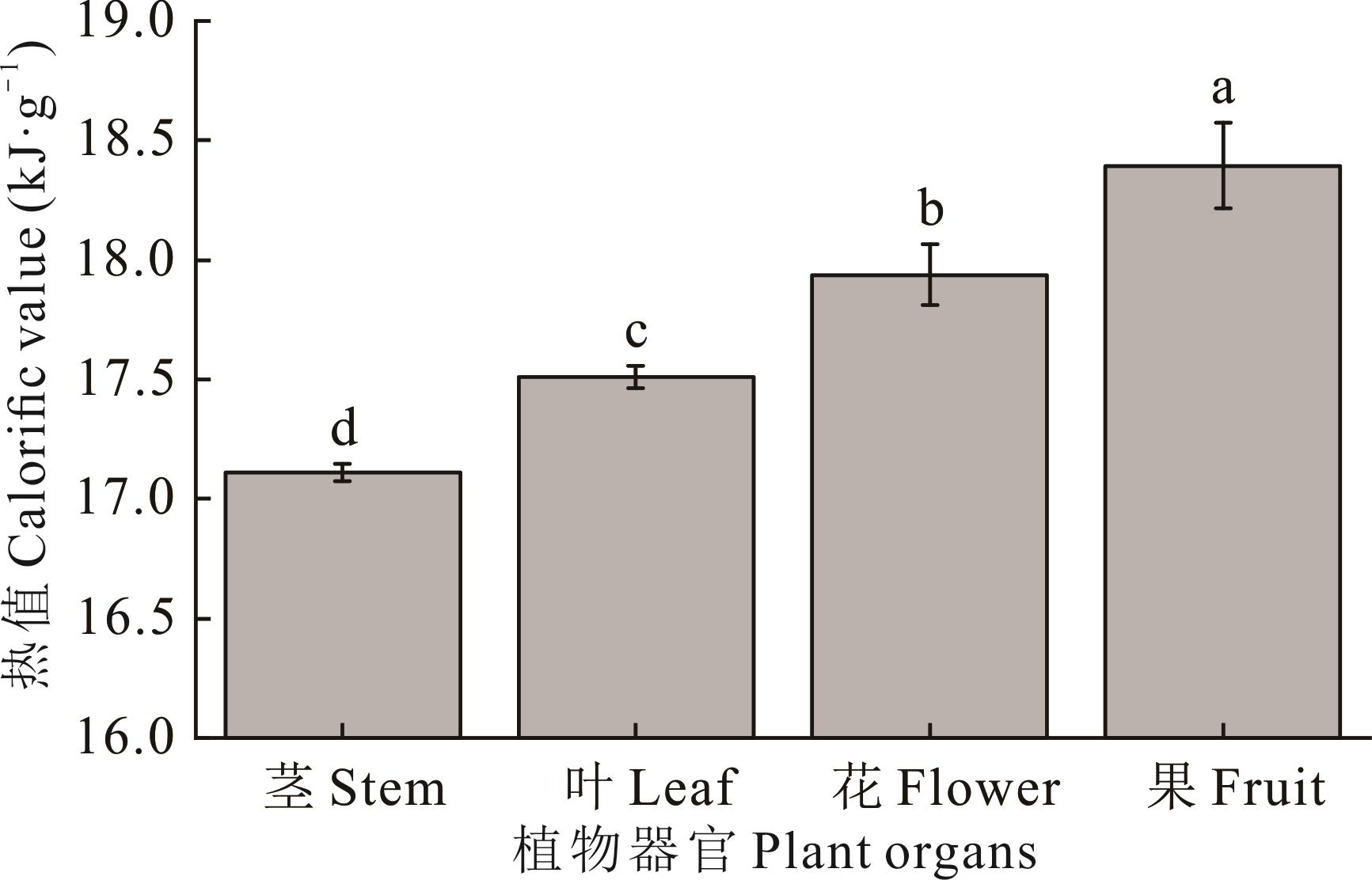
图2 内蒙古草甸草原植物器官热值分析不同小写字母表示差异显著(P<0.05),下同。Different lowercase letters indicate significant differences (P<0.05). The same below.
Fig. 2 Analysis of calorific values in plant organs from the meadow steppe of Inner Mongolia
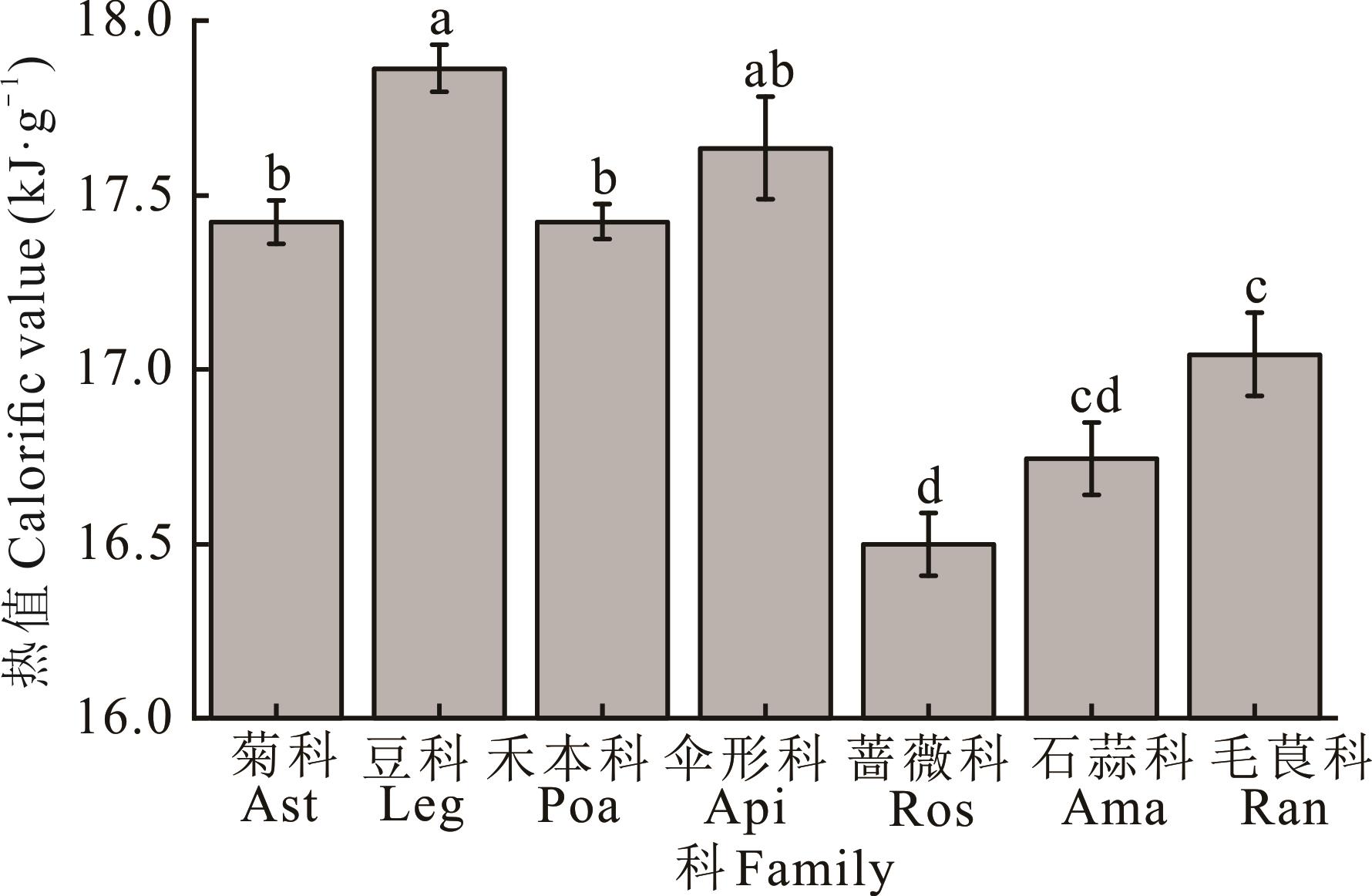
图3 主要科的热值分析Ast:Asteraceae;Leg:Legumes;Poa:Poaceae;Api:Apiaceae;Ros:Rosaceae;Ama:Amaryllidaceae;Ran:Ranunculaceae.
Fig. 3 Analysis of calorific values of major families
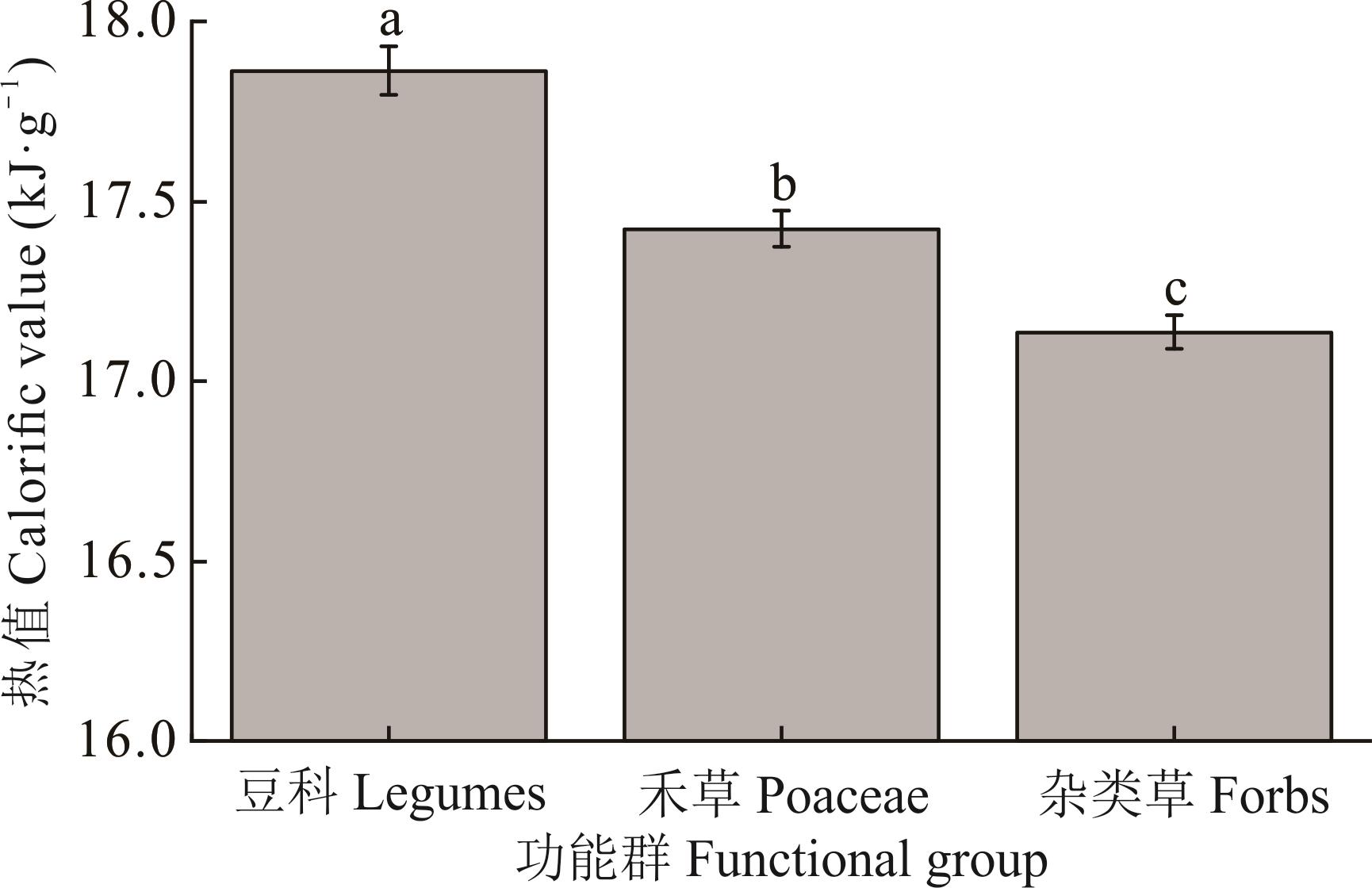
图4 基于不同功能群的热值分析
Fig.4 Analysis of calorific values based on different functional groups
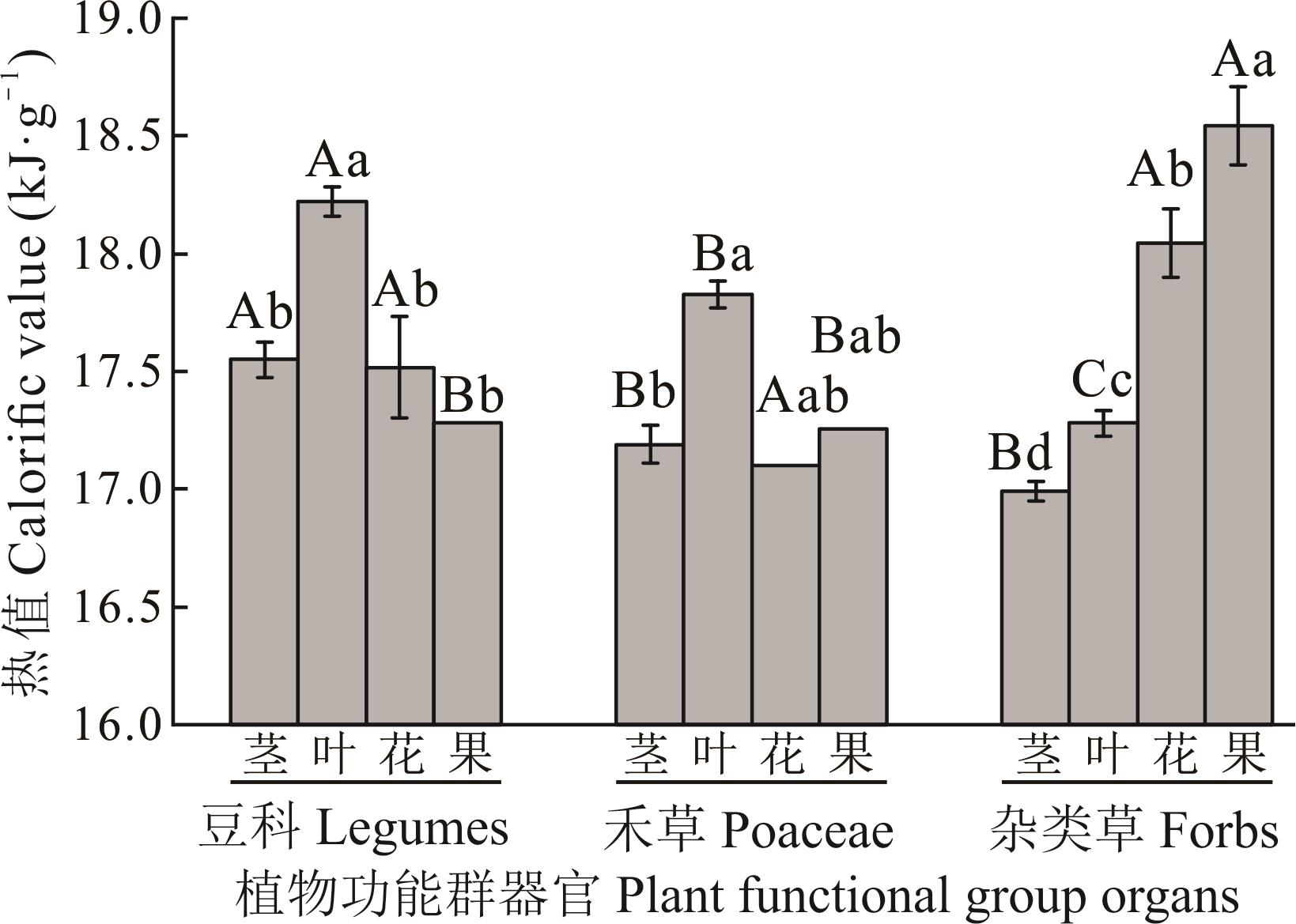
图5 基于不同功能群器官的热值分析大写字母表示同一器官下不同功能群间差异显著、小写字母表示同一功能群下不同器官间差异显著。Capital letters indicate significant differences among functional groups within the same plant organ, whereas lowercase letters indicate significant differences among plant organs within the same functional group. 茎:Stem;叶:Leaf;花:Flower;果:Fruit.下同。The same below.
Fig.5 Analysis of calorific values based on organs of different functional groups
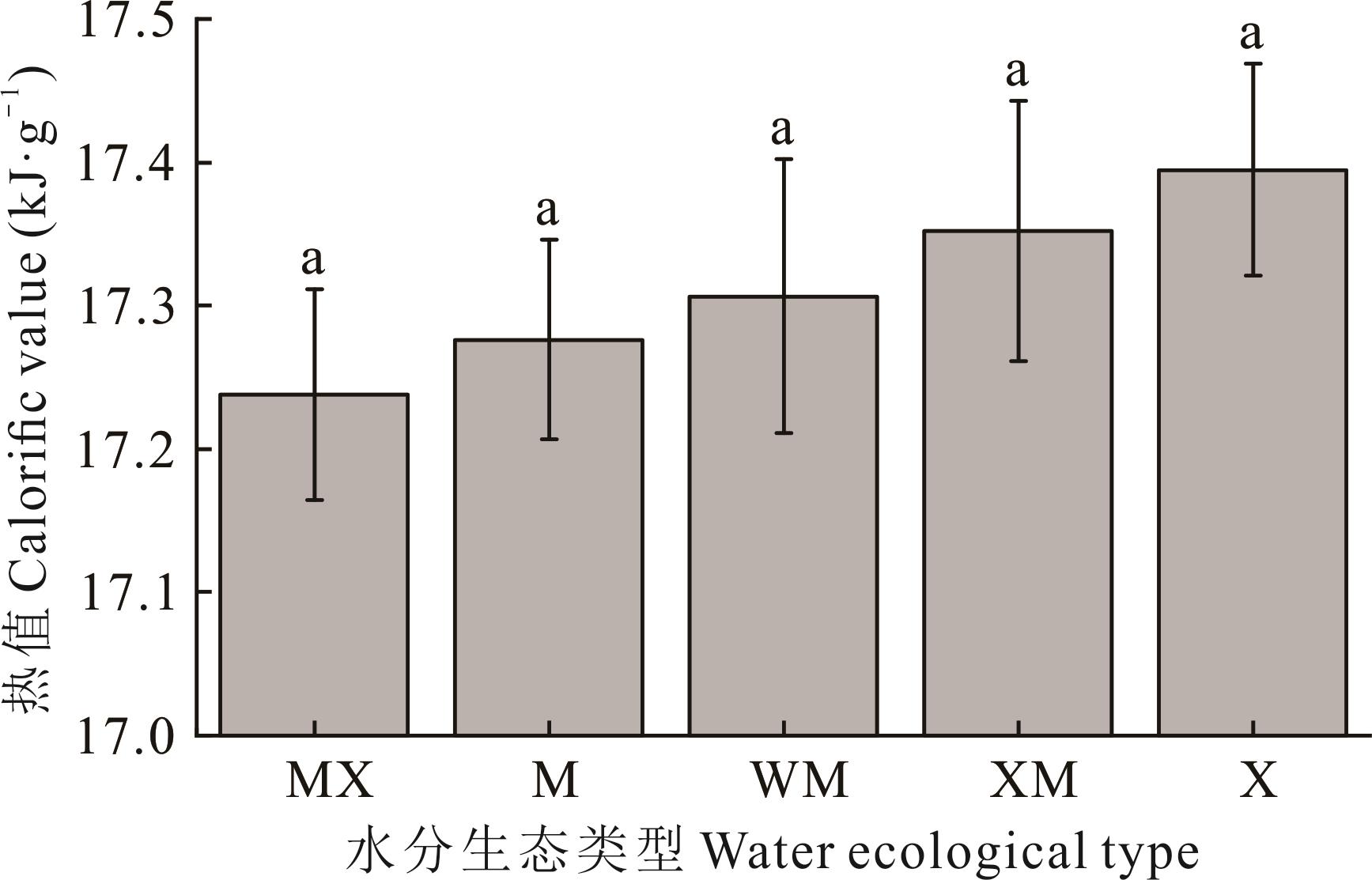
图6 基于不同水分生态功能群的热值分析MX:中旱生植物Meso-xerophytes;M:中生植物Mesophytes;WM:湿中生植物Wet-mesophytes;XM:旱中生植物Xero-mesophytes;X:旱生植物Xerophytes.下同The same below.
Fig.6 Analysis of calorific values based on different water ecological functional groups
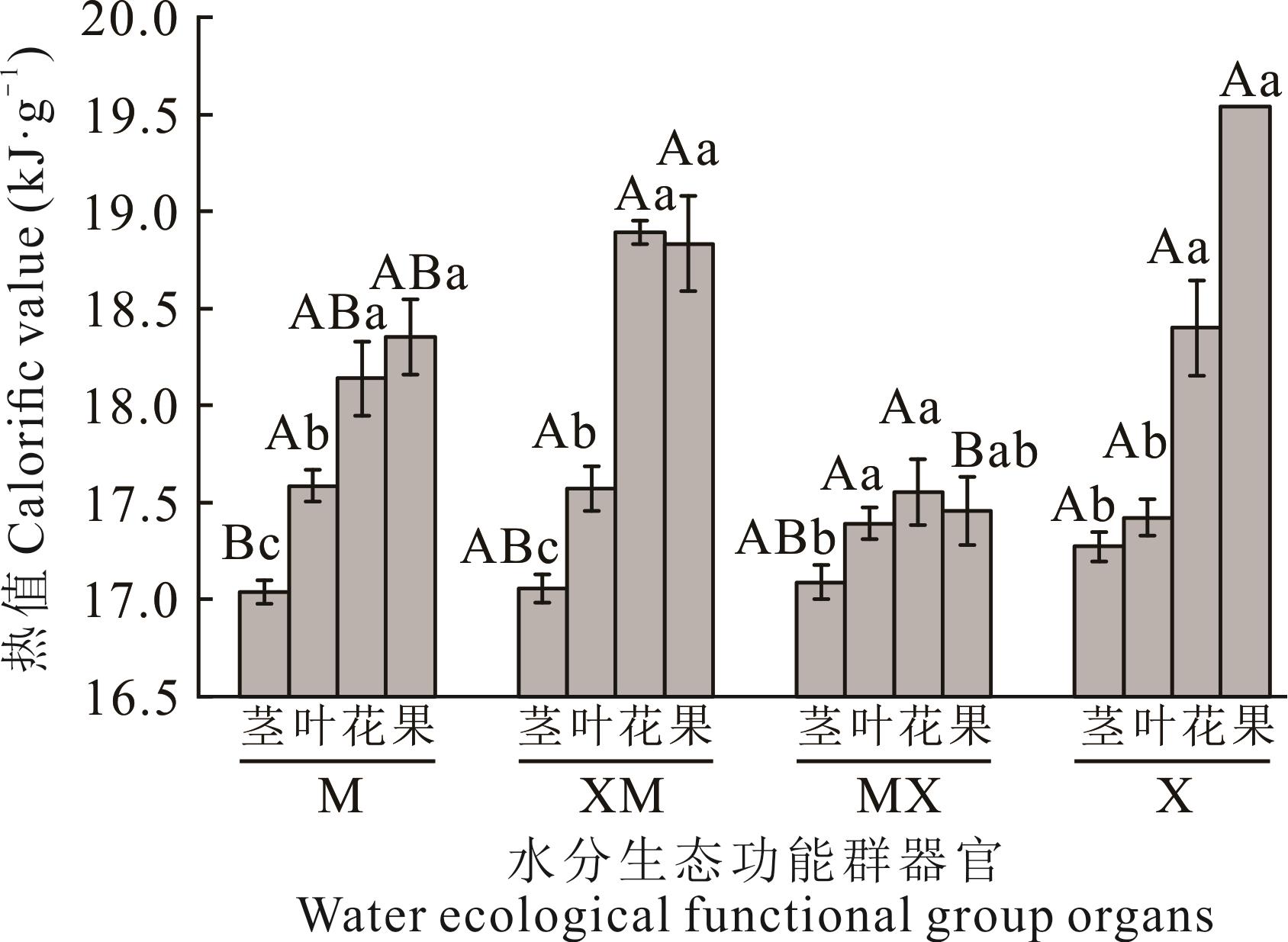
图7 基于不同水分生态功能群的植物器官热值分析不同大写字母表示同一器官下不同水分生态类型间差异显著、不同小写字母表示同一水分生态类型下不同器官间差异显著。Different capital letters indicate significant differences among different water ecotypes within the same organ, while different lowercase letters indicate significant differences among different organs within the same water ecotype.
Fig.7 Analysis of calorific values in plant organs based on different water ecological functional groups
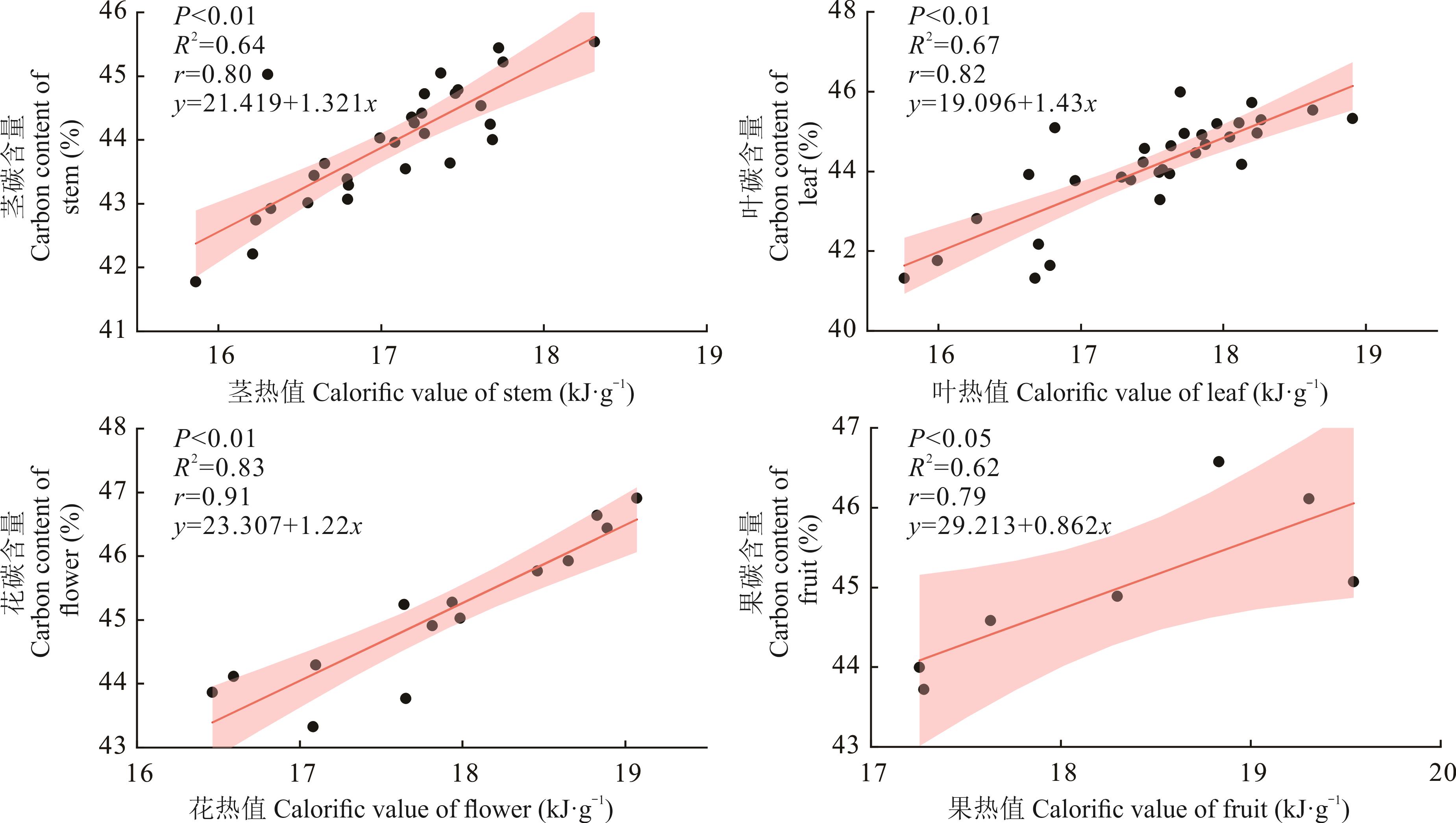
图8 植物器官热值与碳含量的相关性分析
Fig. 8 Correlation analysis between calorific value and carbon content in plant organs
| [1] | Bardgett R D, Bullock J M, Lavorel S, et al. Combatting global grassland degradation. Nature Reviews Earth & Environment, 2021, 2(10): 720-735. |
| [2] | Zhao H L, Zhou R L, Zhang T H, et al. Range vegetation, and its characteristics, ecological-problems in the northern agri-pastoral transition zone, China. Chinese Journal of Grassland, 2003, 25(3): 2-9. |
| 赵哈林, 周瑞莲, 张铜会, 等. 我国北方农牧交错带的草地植被类型、特征及其生态问题. 中国草地, 2003, 25(3): 2-9. | |
| [3] | Lewandowski I, Scurlock J M O, Lindvall E, et al. The development and current status of perennial rhizomatous grasses as energy crops in the US and Europe. Biomass & Bioenergy, 2003, 25(4): 335-361. |
| [4] | Yan P, Xiao C W, Xu L, et al. Biomass energy in China’s terrestrial ecosystems: Insights into the nation’s sustainable energy supply. Renewable and Sustainable Energy Reviews, 2020, 127: 109857. |
| [5] | Pan Q M, Yang Y H, Huang J H. Limiting factors of degraded grassland restoration in China and related basic scientific issues. Bulletin of National Natural Science Foundation of China, 2023, 37(4): 571-579. |
| 潘庆民, 杨元合, 黄建辉. 我国退化草原恢复的限制因子及需要解决的基础科学问题. 中国科学基金, 2023, 37(4): 571-579. | |
| [6] | Li B. The rangeland degradation in north China and its preventive strategy. Scientia Agricultura Sinica, 1997, 30(6): 2-10. |
| 李博. 中国北方草地退化及其防治对策. 中国农业科学, 1997, 30(6): 2-10. | |
| [7] | Guan L L, Zhou X Y, Luo Y. A review on the study of plant caloric value in China. Chinese Journal of Ecology, 2005, 24(4): 452-457. |
| 官丽莉, 周小勇, 罗艳. 我国植物热值研究综述. 生态学杂志, 2005, 24(4): 452-457. | |
| [8] | Bao Y J, Li Z H, Han X G, et al. Plant caloric value and its bio-ecological attributes. Chinese Journal of Ecology, 2006, 25(9): 1095-1103. |
| 鲍雅静, 李政海, 韩兴国, 等. 植物热值及其生物生态学属性. 生态学杂志, 2006, 25(9): 1095-1103. | |
| [9] | Huang S Y. Characteristics and influencing factors of surface energy balance in an Artemisia ordosica shrub ecosystem in the Mu Us Desert. Beijing: Beijing Forestry University, 2020. |
| 黄松宇. 毛乌素沙地油蒿灌丛生态系统表面能量平衡特征及影响因素. 北京: 北京林业大学, 2020. | |
| [10] | Yang F L, Zhou G S. Characteristics and driving factors of energy budget over a temperate desert steppe in Inner Mongolia. Acta Ecologica Sinica, 2010, 30(21): 5769-5780. |
| 阳伏林, 周广胜. 内蒙古温带荒漠草原能量平衡特征及其驱动因子. 生态学报, 2010, 30(21): 5769-5780. | |
| [11] | Qu G H, Wen M Z, Guo J X. Energy accumulation and allocation of main plant populations in Aneurolepidium chinense grassland in Songnen Plain. Chinese Journal of Applied Ecology, 2003, 14(5): 685-689. |
| 曲国辉, 温明章, 郭继勋. 松嫩平原羊草草甸草原主要植物种群能量积累和分配. 应用生态学报, 2003, 14(5): 685-689. | |
| [12] | Bao Y J, Li Z H, Han X G, et al. The caloric content of plant species and its role in a Leymus chinensis steppe community of Inner Mongolia, China. Acta Ecologica Sinica, 2007, 27(11): 4443-4451. |
| 鲍雅静, 李政海, 韩兴国, 等. 内蒙古羊草草原植物种能量含量及其在群落中的作用. 生态学报, 2007, 27(11): 4443-4451. | |
| [13] | Tan Y C, Bao Y J, Li Z H, et al. Calorific values of grassland plant population and functional groups in the agro-pastoral ecotone of Inner Mongolia and Liaoning Province border. Acta Agrestia Sinica, 2019, 27(1): 15-21. |
| 谭嫣辞, 鲍雅静, 李政海, 等. 蒙辽农牧交错区草地植物种群和功能群热值研究. 草地学报, 2019, 27(1): 15-21. | |
| [14] | Yan P, Li X, He N P. Variation in the calorific values of different plants organs in China. PLoS One, 2018, 13(6): e0199762. |
| [15] | Zhao F Y, Wei C Z, Lv X T, et al. Responses of plant species with different genome size to water and nitrogen addition in Inner Mongolia Grassland, China. Chinese Journal of Applied Ecology, 2019, 30(8): 2675-2681. |
| 赵芳媛, 魏存争, 吕晓涛, 等. 内蒙古草原不同基因组大小植物对氮水添加的响应. 应用生态学报, 2019, 30(8): 2675-2681. | |
| [16] | Long S Y, Bao Y J, Li Z H, et al. The carbon contents and the relationship with the calorific values of 67 plant species in Inner Mongolia grasslands. Acta Prataculturae Sinica, 2013, 22(1): 112-119. |
| 龙世友, 鲍雅静, 李政海, 等. 内蒙古草原67种植物碳含量分析及与热值的关系研究. 草业学报, 2013, 22(1): 112-119. | |
| [17] | Gao K, Xie Z B, Xu S T, et al. Characterization of caloric value in fifteen plant species in Leymus chinensis steppe in Xilin River Basin, Inner Mongolia. Acta Ecologica Sinica, 2012, 32(2): 588-594. |
| 高凯, 谢中兵, 徐苏铁, 等. 内蒙古锡林河流域羊草草原15种植物热值特征. 生态学报, 2012, 32(2): 588-594. | |
| [18] | Du P C, Pan Y Z, Hou S L, et al. Effects of nitrogen and phosphorus addition on litter decomposition in Hulunber steppe. Acta Prataculturae Sinica, 2023, 32(2): 44-53. |
| 杜鹏冲, 潘昱臻, 侯双利, 等. 氮磷添加对呼伦贝尔草地凋落物分解的影响. 草业学报, 2023, 32(2): 44-53. | |
| [19] | Zhao Y Z, Zhao L Q, Cao R. Flora intramongolica (the third edition). Hohhot: Inner Mongolia People’s Publishing House, 2020. |
| 赵一之, 赵利清, 曹瑞.内蒙古植物志 (第三版). 呼和浩特: 内蒙古人民出版社, 2020. | |
| [20] | Guo J X, Wang R D, Bao G Z. Caloric value of northeast Aneurolepidium chinense grassland species. Chinese Journal of Plant Ecology, 2001, 25(6): 746-750. |
| 郭继勋, 王若丹, 包国章. 东北羊草草原主要植物热值. 植物生态学报, 2001, 25(6): 746-750. | |
| [21] | Zhao Y Z, Wang H M, Wang Z Q. The role of leguminous plants and rhizobium in ecological environment. Journal of Agricultural Resources and Environment, 2013, 30(4): 7-12. |
| 赵叶舟, 王浩铭, 汪自强. 豆科植物和根瘤菌在生态环境中的地位和作用. 农业环境与发展, 2013, 30(4): 7-12. | |
| [22] | Xiao Y B. Interspecific competition for nutrients and nitrogen transfer between the intercropped legume and cereal. Beijing: China Agricultural University, 2003. |
| 肖焱波. 豆科/禾本科间作体系中养分竞争和氮素转移研究. 北京: 中国农业大学, 2003. | |
| [23] | Zhu X Q, Wang C Y, Sheng M, et al. Effects of arbuscular mycorrhizal fungi on calorific value and contents of carbon and ash in Robinia pseudoacacia. Chinese Journal of Plant Ecology, 2013, 37(11): 1028-1034. |
| 朱晓琴, 王春燕, 盛敏, 等. 丛枝菌根真菌对刺槐热值、碳和灰分含量的影响. 植物生态学报, 2013, 37(11): 1028-1034. | |
| [24] | Hu H Y, Zhang Z C, Li X. Influences of salinity on mass and energy dynamics during decomposition of Kandelia candel leaf litter. Chinese Journal of Plant Ecology, 2010, 34(12): 1377-1385. |
| 胡宏友, 张朝潮, 李雄. 盐度对秋茄凋落叶分解过程中物质与能量动态的影响. 植物生态学报, 2010, 34(12): 1377-1385. | |
| [25] | Weng R X. The photosynthetic characteristics of Miscanthus species in Taiwan. Grassland of China, 1994(1): 14-25, 34. |
| 翁仁宪. 台湾芒草之光合作用特性. 中国草地, 1994(1): 14-25, 34. | |
| [26] | Chen S P, Bai Y F, Han X G, et al. Variations in foliar carbon isotope composition and adaptive strategies of Carex korshinskyi along a soil moisture gradient. Chinese Journal of Plant Ecology, 2004, 28(4): 515-522. |
| 陈世苹, 白永飞, 韩兴国, 等. 沿土壤水分梯度黄囊苔草碳同位素组成及其适应策略的变化. 植物生态学报, 2004, 28(4): 515-522. | |
| [27] | Blank L, Rozenberg G, Gafni R. Spatial and temporal aspects of weeds distribution within agricultural fields-A review. Crop Protection, 2023, 172(000): 8. |
| [28] | Hou J, Du L T, Liu K, et al. Characteristics of vegetation activity and its responses to climate change in desert/grassland biome transition zones in the last 30 years based on GIMMS3g. Theoretical and Applied Climatology, 2019, 136: 915-928. |
| [29] | Lloret F, Verdu’ M, Flores-Herna’ ndez N, et al. Fire and resprouting in Mediterranean ecosystems: insights from an external biogeographical region, the mexical shrubland. American Journal of Botany, 1999, 86(12): 1655-1661. |
| [30] | Chen X, Li B L. Spatial variability of plant functional types of trees along Northeast China Transect. Applied Ecology & Environmental Research, 2005, 3(2): 39-49. |
| [31] | Yang L M, Han M, Lin H M. Study on biomass changes of plant ecological type groups in the Leymus chinensis communities along Northeast China Transect. Journal of Jilin Agricultural University, 2005, 27(5): 46-50. |
| 杨利民, 韩梅, 林红梅. 中国东北样带羊草群落植物水分生态类型功能群生物量变化研究. 吉林农业大学学报, 2005, 27(5): 46-50. | |
| [32] | Bao Y J, Li Z H. Caloric values of steppe plant populations and functional groups in Xilin River Basin of Inner Mongolia. Journal of Dalian Nationalities University, 2008, 10(3): 197-202. |
| 鲍雅静, 李政海. 内蒙古锡林河流域草原植物种群和功能群热值研究. 大连民族大学学报, 2008, 10(3): 197-202. | |
| [33] | Zhao N, Yu G R, He N P, et al. Coordinated pattern of multi-element variability in leaves and roots across Chinese forest biomes. Global Ecology and Biogeography, 2016, 25(3): 359-367. |
| [34] | Xu Z W, Yu G R, Zhang X Y, et al. Soil enzyme activity and stoichiometry in forest ecosystems along the North-South Transect in eastern China (NSTEC). Soil Biology and Biochemistry, 2017, 104: 152-163. |
| [35] | Wang R L, Yu G R, He N P, et al. Latitudinal variation of leaf morphological traits from species to communities along a forest transect in eastern China. Journal of Geographical Sciences, 2016, 26(1): 15-26. |
| [1] | 金磊, 王彦平, 那日苏, 包永生, 张敬超. 日尺度下水热因子变化对呼伦贝尔草甸草原生产力的影响特征[J]. 草业学报, 2026, 35(3): 1-12. |
| [2] | 秦文利, 张静, 肖广敏, 崔素倩, 叶建勋, 智健飞, 张立锋, 谢楠, 冯伟, 刘振宇, 潘璇, 代云霞, 刘忠宽. 绿肥部分替代化肥氮对土壤物理性状的影响[J]. 草业学报, 2025, 34(6): 27-45. |
| [3] | 曲艳, 赵坤, 韩子晨, 吕世海, 沃强, 戎郁萍. 短期氮磷添加对呼伦贝尔辉河流域草地土壤温室气体排放的影响[J]. 草业学报, 2024, 33(2): 68-79. |
| [4] | 宫珂, 靳瑰丽, 刘文昊, 马建, 刘智彪, 李嘉欣, 李莹. 模拟增温对无芒雀麦生长特性的影响[J]. 草业学报, 2023, 32(9): 93-103. |
| [5] | 杜鹏冲, 潘昱臻, 侯双利, 王智慧, 王洪义. 氮磷添加对呼伦贝尔草地凋落物分解的影响[J]. 草业学报, 2023, 32(2): 44-53. |
| [6] | 汪梦寒, 董利利, 李富翠, 韩烈保, 王祥. 不同有机/无机氮添加对草原土壤氮素分配和转化特征的影响[J]. 草业学报, 2022, 31(1): 36-46. |
| [7] | 张静静, 刘尊驰, 鄢创, 王云霞, 刘凯, 时新荣, 袁志友. 土壤pH值变化对3种草原类型土壤碳氮磷生态化学计量特征的影响[J]. 草业学报, 2021, 30(2): 69-81. |
| [8] | 聂莹莹, 陈金强, 辛晓平, 徐丽君, 杨桂霞, 王旭. 呼伦贝尔草甸草原区主要植物种群生态位特征与物种多样性对封育年限响应[J]. 草业学报, 2021, 30(10): 15-25. |
| [9] | 聂莹莹, 徐丽君, 辛晓平, 陈宝瑞, 张保辉. 围栏封育对温性草甸草原植物群落构成及生态位特征的影响[J]. 草业学报, 2020, 29(11): 11-22. |
| [10] | 那亚, 孙启忠, 王红梅. 呼伦贝尔草甸草原牧草青贮饲料脂肪酸成分研究[J]. 草业学报, 2017, 26(2): 215-223. |
| [11] | 李小龙, 曹文侠, 李文, 张晓燕, 徐长林, 韦应莉, 师尚礼. 划破草皮对不同地形高寒草甸草原土壤特征及地下生物量的影响[J]. 草业学报, 2016, 25(6): 26-33. |
| [12] | 胡飞龙, 闫妍, 卢晓强, 吴军, 丁晖, 刘志民. 内蒙古草甸草原生物量碳分配格局[J]. 草业学报, 2016, 25(4): 36-44. |
| [13] | 李惠霞, 彭焕, 彭德良, 朱锐东, 徐鹏刚, 李建荣. 甘肃省高寒草原牧草孢囊线虫的鉴定[J]. 草业学报, 2015, 24(8): 174-180. |
| [14] | 谭红妍,闫瑞瑞,闫玉春,陈宝瑞,辛晓平. 不同放牧强度下温性草甸草原土壤微生物群落结构PLFAs分析[J]. 草业学报, 2015, 24(3): 115-121. |
| [15] | 李文, 曹文侠, 刘皓栋, 李小龙, 徐长林, 师尚礼, 冯今, 周传猛. 不同放牧管理模式对高寒草甸草原土壤呼吸特征的影响[J]. 草业学报, 2015, 24(10): 22-32. |
| 阅读次数 | ||||||
|
全文 |
|
|||||
|
摘要 |
|
|||||
