

ISSN 1004-5759 CN 62-1105/S
草业学报 ›› 2025, Vol. 34 ›› Issue (8): 1-14.DOI: 10.11686/cyxb2024363
• 研究论文 •
冯斌1,3,4( ), 杨晓霞2,3, 刘玉祯2,3, 刘文亭2,3, 吕卫东2,3, 张艳芬5, 董全民2,3()
收稿日期:2024-09-24
修回日期:2024-12-02
出版日期:2025-08-20
发布日期:2025-06-16
通讯作者:
董全民
作者简介:E-mail: qmdong@qhu.edu.cn基金资助:
Bin FENG1,3,4(), Xiao-xia YANG2,3, Yu-zhen LIU2,3, Wen-ting LIU2,3, Wei-dong LYU2,3, Yan-fen ZHANG5, Quan-min DONG2,3()
Received:2024-09-24
Revised:2024-12-02
Online:2025-08-20
Published:2025-06-16
Contact:
Quan-min DONG
摘要:
为明晰中度放牧条件家畜类型及其组合对高寒草地物种多样性、生态位与种间联结性的影响,并探究中度放牧下高寒草地稳定性的维持机制,本研究基于中度放牧强度,设置了牦牛单牧、藏羊单牧、牦牛藏羊1∶6混牧、牦牛藏羊1∶4混牧和牦牛藏羊1∶2混牧5个控制性放牧试验处理和1个禁牧处理。研究结果表明:1)重要值较大的12个物种在群落中具有较大的生态位宽度;2)物种重要值与生态位宽度间呈显著正相关关系(P<0.05);3)群落总体联结性呈显著负相关关系,而种间联结性以不显著的负相关关系为主;4)生态位相似性、重叠值与种间联结性之间存在显著正相关关系;5)群落物种生态位特征和种间联结性的分析结果表明,优势物种较好的空间结构和种间关系增强了草地生态系统的稳定性。高寒草地生态系统对中度放牧干扰的敏感性从物种到功能群到群落逐渐降低,基于优势种高的生态位宽度和弱的种间联结性,各放牧处理间无显著差异,中度放牧条件下不同放牧方式均维持了高寒草地生态系统的多样性和稳定性,从植被层面而言群落中弱的种间关系和强的资源竞争能力极大地提高了群落的抗干扰能力,从物种生态位和联结性的角度阐述了高寒草地在放牧干扰下维持草地生态系统生物多样性和稳定性的潜在机制。
冯斌, 杨晓霞, 刘玉祯, 刘文亭, 吕卫东, 张艳芬, 董全民. 不同放牧方式对高寒草地物种多样性、生态位与种间联结性的影响[J]. 草业学报, 2025, 34(8): 1-14.
Bin FENG, Xiao-xia YANG, Yu-zhen LIU, Wen-ting LIU, Wei-dong LYU, Yan-fen ZHANG, Quan-min DONG. Effects of different livestock classes on species diversity, niches, and interspecific associations in alpine grassland[J]. Acta Prataculturae Sinica, 2025, 34(8): 1-14.

图1 青海省高寒草地-家畜系统适应性管理技术平台概况a: 试验点地图Map of trial sites; b: 放牧试验中的藏羊Tibetan sheep in grazing trials; c: 放牧试验中的牦牛Yaks in grazing trial. 基于自然资源部标准地图网站GS(2019)3333号标准地图制作,底图边界无修改Based on the standard map No. GS(2019)3333 from the Standard Map Website of the Ministry of Natural Resources, with no modifications made to the base map boundaries.
Fig.1 Description of the Qinghai Provincial alpine grassland-livestock adaptive management technology platform
| 功能群Functional group | 物种Species | 功能群Functional group | 物种Species |
|---|---|---|---|
禾本科 Poaceae | 西北针茅Stipa sareptana var. krylovii | 杂类草 Forb | 鸡冠茶Sibbaldianthe bifurca |
| 紫花针茅Stipa purpurea | 白花枝子花Dracocephalum heterophyllum | ||
| 赖草Leymus secalinus | 猪毛蒿Artemisia scoparia | ||
| 早熟禾Poa annua | 冷蒿Artemisia frigida | ||
| 洽草Koeleria macrantha | 蒲公英Taraxacum mongolicum | ||
| 扁穗冰草Agropyron cristatum | 毛莓草Sibbaldianthe adpressa | ||
| 垂穗披碱草Elymus nutans | 白苞筋骨草Ajuga lupulina | ||
| 芨芨草Neotrinia splendens | 车前Plantago asiatica | ||
| 醉马草Achnatherum inebrians | 狼毒Stellera chamaejasme | ||
莎草科 Cyperaceae | 矮生嵩草Carex alatauensis | 鳞叶龙胆Gentiana squarrosa | |
| 干生薹草Carex aridula | 狗娃花Aster hispidus | ||
豆科 Fabaceae | 白花棘豆Oxytropis coerulea f. albiflora | 唐松草Thalictrum aquilegiifolium var. sibiricum | |
| 斜茎黄芪Astragalus laxmannii | 湿生扁蕾Gentianopsis paludosa | ||
| 青海苜蓿Medicago archiducis-nicolai | 北柴胡Bupleurum chinense | ||
| 披针叶野决明Thermopsis lanceolata | 蚓果芥Braya humilis | ||
杂类草 Forb | 星毛委陵菜Potentilla acaulis | 达乌里秦艽Gentiana dahurica | |
| 多茎委陵菜Potentilla multicaulis | 麻花艽Gentiana straminea |
表1 试验区域植被群落组成概况
Table 1 Description of the vegetation community composition in the trial area
| 功能群Functional group | 物种Species | 功能群Functional group | 物种Species |
|---|---|---|---|
禾本科 Poaceae | 西北针茅Stipa sareptana var. krylovii | 杂类草 Forb | 鸡冠茶Sibbaldianthe bifurca |
| 紫花针茅Stipa purpurea | 白花枝子花Dracocephalum heterophyllum | ||
| 赖草Leymus secalinus | 猪毛蒿Artemisia scoparia | ||
| 早熟禾Poa annua | 冷蒿Artemisia frigida | ||
| 洽草Koeleria macrantha | 蒲公英Taraxacum mongolicum | ||
| 扁穗冰草Agropyron cristatum | 毛莓草Sibbaldianthe adpressa | ||
| 垂穗披碱草Elymus nutans | 白苞筋骨草Ajuga lupulina | ||
| 芨芨草Neotrinia splendens | 车前Plantago asiatica | ||
| 醉马草Achnatherum inebrians | 狼毒Stellera chamaejasme | ||
莎草科 Cyperaceae | 矮生嵩草Carex alatauensis | 鳞叶龙胆Gentiana squarrosa | |
| 干生薹草Carex aridula | 狗娃花Aster hispidus | ||
豆科 Fabaceae | 白花棘豆Oxytropis coerulea f. albiflora | 唐松草Thalictrum aquilegiifolium var. sibiricum | |
| 斜茎黄芪Astragalus laxmannii | 湿生扁蕾Gentianopsis paludosa | ||
| 青海苜蓿Medicago archiducis-nicolai | 北柴胡Bupleurum chinense | ||
| 披针叶野决明Thermopsis lanceolata | 蚓果芥Braya humilis | ||
杂类草 Forb | 星毛委陵菜Potentilla acaulis | 达乌里秦艽Gentiana dahurica | |
| 多茎委陵菜Potentilla multicaulis | 麻花艽Gentiana straminea |
处理 Treatment | 数量Number | 小区Plot | ||
|---|---|---|---|---|
牦牛 Yak | 藏羊 Sheep | 面积 Area (hm2) | 数量 Number | |
| 禁牧NG | 0 | 0 | 0.05 | 3 |
| 藏羊单牧SG | 0 | 2 | 0.17 | 3 |
| MG1∶6 | 1 | 6 | 0.77 | 3 |
| MG1∶4 | 1 | 4 | 0.60 | 3 |
| MG1∶2 | 1 | 2 | 0.43 | 3 |
| 牦牛单牧YG | 1 | 0 | 0.26 | 3 |
表2 放牧试验设计概况
Table 2 Trial description of different livestock assembly grazing
处理 Treatment | 数量Number | 小区Plot | ||
|---|---|---|---|---|
牦牛 Yak | 藏羊 Sheep | 面积 Area (hm2) | 数量 Number | |
| 禁牧NG | 0 | 0 | 0.05 | 3 |
| 藏羊单牧SG | 0 | 2 | 0.17 | 3 |
| MG1∶6 | 1 | 6 | 0.77 | 3 |
| MG1∶4 | 1 | 4 | 0.60 | 3 |
| MG1∶2 | 1 | 2 | 0.43 | 3 |
| 牦牛单牧YG | 1 | 0 | 0.26 | 3 |
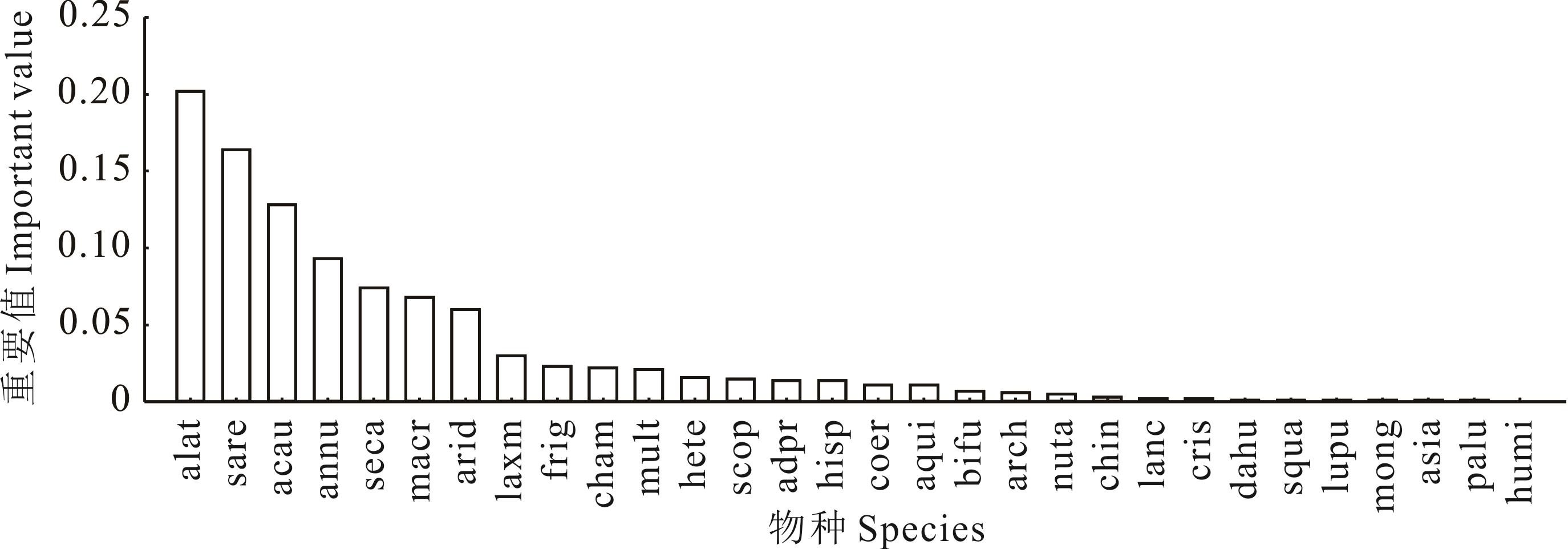
图2 试验样地物种重要值排序alat: 矮生嵩草C. alatauensis; sare: 西北针茅S. sareptana var. krylovii; acau: 星毛委陵菜P. acaulis; annu: 早熟禾P. annua; seca: 赖草L. secalinus; macr: 洽草K. macrantha; arid: 干生薹草C. aridula; laxm: 斜茎黄芪A. laxmannii; frig: 冷蒿A. frigida;cham: 狼毒S. chamaejasme; mult: 多茎委陵菜P. multicaulis; hete: 白花枝子花D. heterophyllum; scop: 猪毛蒿A. scoparia; adpr: 毛莓草S. adpressa; hisp: 狗娃花A. hispidus; coer: 白花棘豆O. coerulea f. albiflora; aqui: 唐松草T. aquilegiifolium var. sibiricum; bifu: 鸡冠茶S. bifurca; arch: 青海苜蓿M. archiducis-nicolai; nuta: 垂穗披碱草E. nutans; chin: 北柴胡B. chinense; lanc: 披针叶野决明T. lanceolata; cris: 扁穗冰草A. cristatum; dahu: 达乌里秦艽G. dahurica; squa: 鳞叶龙胆G. squarrosa; lupu: 白苞筋骨草A. lupulina; mong: 蒲公英T. mongolicum; asia: 车前P. asiatica; palu: 湿生扁蕾G. paludosa; humi: 蚓果芥B. humilis.
Fig.2 Ranking of species importance values in the trial sites
编号 No. | 优势物种 Dominant species | 重要值 Importance value | 生态位宽度 Niche breadth | |
|---|---|---|---|---|
| BS | BL | |||
| 1 | 矮生嵩草 C. alatauensis | 0.20 | 4.95 | 134.98 |
| 2 | 西北针茅 S. sareptana var. krylovii | 0.16 | 4.99 | 133.82 |
| 3 | 星毛委陵菜 P. acaulis | 0.13 | 4.86 | 113.20 |
| 4 | 早熟禾 P. annua | 0.09 | 4.96 | 131.26 |
| 5 | 赖草 L. secalinus | 0.07 | 4.98 | 132.94 |
| 6 | 洽草 K. macrantha | 0.07 | 4.90 | 126.83 |
| 7 | 干生薹草 C. aridula | 0.06 | 4.76 | 98.57 |
| 8 | 斜茎黄芪 A. laxmannii | 0.03 | 4.79 | 101.14 |
| 9 | 冷蒿 A. frigida | 0.02 | 4.37 | 51.56 |
| 10 | 狼毒 S. chamaejasme | 0.02 | 4.00 | 46.11 |
| 11 | 多茎委陵菜 P. multicaulis | 0.02 | 4.59 | 82.41 |
| 12 | 白花枝子花D. heterophyllum | 0.02 | 4.58 | 79.82 |
表3 优势植物种重要值与生态位宽度
Table 3 The important value and niche breadth of dominant plants
编号 No. | 优势物种 Dominant species | 重要值 Importance value | 生态位宽度 Niche breadth | |
|---|---|---|---|---|
| BS | BL | |||
| 1 | 矮生嵩草 C. alatauensis | 0.20 | 4.95 | 134.98 |
| 2 | 西北针茅 S. sareptana var. krylovii | 0.16 | 4.99 | 133.82 |
| 3 | 星毛委陵菜 P. acaulis | 0.13 | 4.86 | 113.20 |
| 4 | 早熟禾 P. annua | 0.09 | 4.96 | 131.26 |
| 5 | 赖草 L. secalinus | 0.07 | 4.98 | 132.94 |
| 6 | 洽草 K. macrantha | 0.07 | 4.90 | 126.83 |
| 7 | 干生薹草 C. aridula | 0.06 | 4.76 | 98.57 |
| 8 | 斜茎黄芪 A. laxmannii | 0.03 | 4.79 | 101.14 |
| 9 | 冷蒿 A. frigida | 0.02 | 4.37 | 51.56 |
| 10 | 狼毒 S. chamaejasme | 0.02 | 4.00 | 46.11 |
| 11 | 多茎委陵菜 P. multicaulis | 0.02 | 4.59 | 82.41 |
| 12 | 白花枝子花D. heterophyllum | 0.02 | 4.58 | 79.82 |
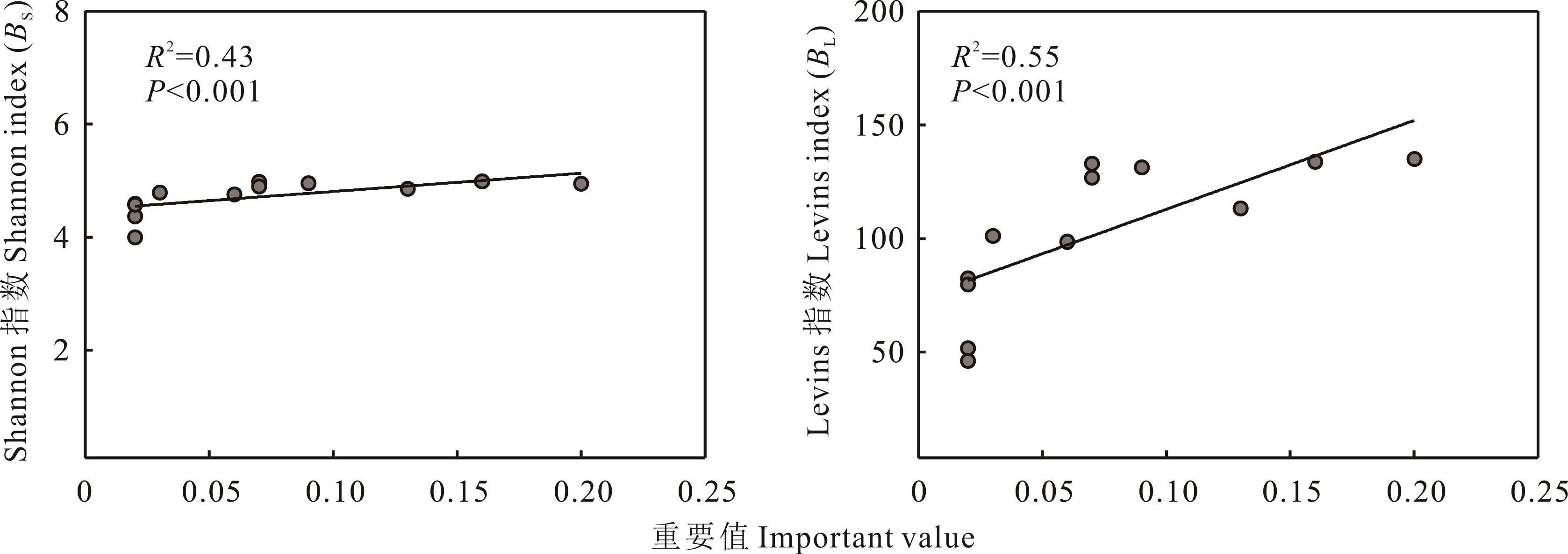
图3 优势植物种重要值与生态位宽度回归分析
Fig. 3 Regression analysis of important value and niche breadth of dominant plant species
| 编号No. | 1 | 2 | 3 | 4 | 5 | 6 | 7 | 8 | 9 | 10 | 11 | 12 |
|---|---|---|---|---|---|---|---|---|---|---|---|---|
| 1 | 0.786 | 0.821 | 0.801 | 0.813 | 0.860 | 0.677 | 0.814 | 0.747 | 0.829 | 0.770 | 0.743 | |
| 2 | 0.782 | 0.759 | 0.793 | 0.848 | 0.810 | 0.829 | 0.761 | 0.651 | 0.749 | 0.880 | 0.809 | |
| 3 | 0.752 | 0.698 | 0.634 | 0.626 | 0.674 | 0.713 | 0.689 | 0.682 | 0.671 | 0.565 | 0.561 | |
| 4 | 0.790 | 0.786 | 0.683 | 0.805 | 0.832 | 0.805 | 0.846 | 0.919 | 0.747 | 0.886 | 0.930 | |
| 5 | 0.807 | 0.845 | 0.678 | 0.810 | 0.807 | 0.777 | 0.792 | 0.776 | 0.790 | 0.905 | 0.857 | |
| 6 | 0.834 | 0.788 | 0.713 | 0.818 | 0.788 | 0.740 | 0.739 | 0.811 | 0.655 | 0.749 | 0.761 | |
| 7 | 0.579 | 0.711 | 0.665 | 0.697 | 0.669 | 0.652 | 0.574 | 0.703 | 0.555 | 0.569 | 0.597 | |
| 8 | 0.704 | 0.662 | 0.651 | 0.742 | 0.691 | 0.660 | 0.582 | 0.715 | 0.608 | 0.592 | 0.747 | |
| 9 | 0.461 | 0.404 | 0.460 | 0.576 | 0.483 | 0.517 | 0.508 | 0.511 | 0.241 | 0.269 | 0.368 | |
| 10 | 0.485 | 0.440 | 0.428 | 0.443 | 0.465 | 0.395 | 0.379 | 0.410 | 0.228 | 0.276 | 0.232 | |
| 11 | 0.602 | 0.691 | 0.482 | 0.702 | 0.713 | 0.604 | 0.521 | 0.534 | 0.340 | 0.370 | 0.581 | |
| 12 | 0.571 | 0.625 | 0.471 | 0.725 | 0.664 | 0.604 | 0.537 | 0.663 | 0.457 | 0.305 | 0.571 |
表4 优势植物种生态位相似比与重叠值
Table 4 The ecological niche similarity ratio and overlap value of dominant plant species
| 编号No. | 1 | 2 | 3 | 4 | 5 | 6 | 7 | 8 | 9 | 10 | 11 | 12 |
|---|---|---|---|---|---|---|---|---|---|---|---|---|
| 1 | 0.786 | 0.821 | 0.801 | 0.813 | 0.860 | 0.677 | 0.814 | 0.747 | 0.829 | 0.770 | 0.743 | |
| 2 | 0.782 | 0.759 | 0.793 | 0.848 | 0.810 | 0.829 | 0.761 | 0.651 | 0.749 | 0.880 | 0.809 | |
| 3 | 0.752 | 0.698 | 0.634 | 0.626 | 0.674 | 0.713 | 0.689 | 0.682 | 0.671 | 0.565 | 0.561 | |
| 4 | 0.790 | 0.786 | 0.683 | 0.805 | 0.832 | 0.805 | 0.846 | 0.919 | 0.747 | 0.886 | 0.930 | |
| 5 | 0.807 | 0.845 | 0.678 | 0.810 | 0.807 | 0.777 | 0.792 | 0.776 | 0.790 | 0.905 | 0.857 | |
| 6 | 0.834 | 0.788 | 0.713 | 0.818 | 0.788 | 0.740 | 0.739 | 0.811 | 0.655 | 0.749 | 0.761 | |
| 7 | 0.579 | 0.711 | 0.665 | 0.697 | 0.669 | 0.652 | 0.574 | 0.703 | 0.555 | 0.569 | 0.597 | |
| 8 | 0.704 | 0.662 | 0.651 | 0.742 | 0.691 | 0.660 | 0.582 | 0.715 | 0.608 | 0.592 | 0.747 | |
| 9 | 0.461 | 0.404 | 0.460 | 0.576 | 0.483 | 0.517 | 0.508 | 0.511 | 0.241 | 0.269 | 0.368 | |
| 10 | 0.485 | 0.440 | 0.428 | 0.443 | 0.465 | 0.395 | 0.379 | 0.410 | 0.228 | 0.276 | 0.232 | |
| 11 | 0.602 | 0.691 | 0.482 | 0.702 | 0.713 | 0.604 | 0.521 | 0.534 | 0.340 | 0.370 | 0.581 | |
| 12 | 0.571 | 0.625 | 0.471 | 0.725 | 0.664 | 0.604 | 0.537 | 0.663 | 0.457 | 0.305 | 0.571 |
方差比率 Variance ratio (VR) | 检验统计量 Statistic (W) | 卡方临界值χ2 threshold | 检验结果 Inspection result | |
|---|---|---|---|---|
| (0.05,162) | (0.95,162) | |||
| 0.0048 | 0.7795 | 133.5725 | 192.7001 | 显著负联结Significant negative correlation |
表5 优势植物种总体联结性
Table 5 The overall association of dominant plant species
方差比率 Variance ratio (VR) | 检验统计量 Statistic (W) | 卡方临界值χ2 threshold | 检验结果 Inspection result | |
|---|---|---|---|---|
| (0.05,162) | (0.95,162) | |||
| 0.0048 | 0.7795 | 133.5725 | 192.7001 | 显著负联结Significant negative correlation |
| 编号No. | 1 | 2 | 3 | 4 | 5 | 6 | 7 | 8 | 9 | 10 | 11 |
|---|---|---|---|---|---|---|---|---|---|---|---|
| 2 | - | ||||||||||
| 3 | - | - | |||||||||
| 4 | - | - | - | ||||||||
| 5 | - | + | - | - | |||||||
| 6 | + | - | - | + | - | ||||||
| 7 | - | + | + | - | - | - | |||||
| 8 | - | - | - | + | - | - | - | ||||
| 9 | - | - | - | + | - | + | + | + | |||
| 10 | - | - | - | - | - | - | - | - | - | ||
| 11 | - | + | - | + | + | - | - | - | - | - | |
| 12 | - | - | - | + | + | - | - | + | +* | -* | +* |
表6 优势植物种种间联结性χ2检验
Table 6 The inspection results of interspecific associations χ2 of dominant plants
| 编号No. | 1 | 2 | 3 | 4 | 5 | 6 | 7 | 8 | 9 | 10 | 11 |
|---|---|---|---|---|---|---|---|---|---|---|---|
| 2 | - | ||||||||||
| 3 | - | - | |||||||||
| 4 | - | - | - | ||||||||
| 5 | - | + | - | - | |||||||
| 6 | + | - | - | + | - | ||||||
| 7 | - | + | + | - | - | - | |||||
| 8 | - | - | - | + | - | - | - | ||||
| 9 | - | - | - | + | - | + | + | + | |||
| 10 | - | - | - | - | - | - | - | - | - | ||
| 11 | - | + | - | + | + | - | - | - | - | - | |
| 12 | - | - | - | + | + | - | - | + | +* | -* | +* |
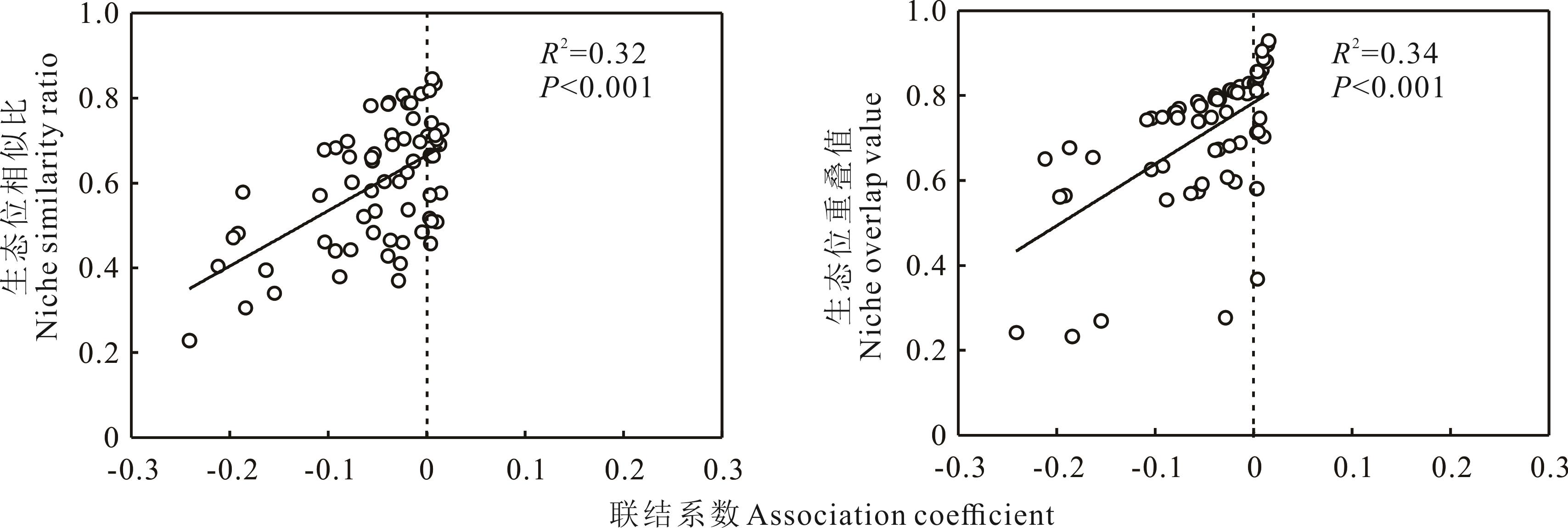
图4 优势植物种种间联结性与生态位相似比和生态位重叠值回归分析
Fig.4 Regression analysis of interspecific association, niche similarity ratio and overlap value among dominant plant species

图5 不同放牧方式对优势植物种重要值的影响NG: 禁牧No grazing; SG: 藏羊单牧Only Tibetan sheep grazing; MG1∶6: 牦牛藏羊1∶6混牧Yak and Tibetan sheep grazing mixed as 1∶6; MG1∶4:牦牛藏羊1∶4混牧Yak and Tibetan sheep grazing mixed as 1∶4; MG1∶2:牦牛藏羊1∶2混牧Yak and Tibetan sheep grazing mixed as 1∶2; YG: 牦牛单牧Only yak grazing; 不同小写字母代表不同处理之间差异显著(P<0.05),下同. Different lowercase letters indicate significant differences among the different treatments at the 0.05 level, the same below.
Fig.5 Effect of different livestock assembly grazing on the importance value of dominant species
| 处理Treatment | 禾本科Poaceae | 莎草科Cyperaceae | 豆科Fabaceae | 杂类草Forbs |
|---|---|---|---|---|
| NG | 0.389±0.018Abc | 0.243±0.018Ca | 0.056±0.009Dab | 0.312±0.013Bab |
| SG | 0.437±0.021Aab | 0.263±0.013Ba | 0.048±0.008Cab | 0.251±0.019Bcd |
| MG1∶6 | 0.473±0.020Aa | 0.258±0.019Ba | 0.037±0.005Cb | 0.232±0.016Bd |
| MG1∶4 | 0.374±0.012Ac | 0.289±0.012Ba | 0.048±0.005Cab | 0.289±0.015Babc |
| MG1∶2 | 0.375±0.021Ac | 0.243±0.015Ba | 0.048±0.004Cab | 0.334±0.018Aa |
| YG | 0.397±0.011Abc | 0.273±0.011Ba | 0.060±0.009Ca | 0.270±0.013Bbcd |
表7 不同放牧方式对植被功能群重要值的影响
Table 7 Effect of different livestock assembly grazing on the importance values of vegetation functional groups
| 处理Treatment | 禾本科Poaceae | 莎草科Cyperaceae | 豆科Fabaceae | 杂类草Forbs |
|---|---|---|---|---|
| NG | 0.389±0.018Abc | 0.243±0.018Ca | 0.056±0.009Dab | 0.312±0.013Bab |
| SG | 0.437±0.021Aab | 0.263±0.013Ba | 0.048±0.008Cab | 0.251±0.019Bcd |
| MG1∶6 | 0.473±0.020Aa | 0.258±0.019Ba | 0.037±0.005Cb | 0.232±0.016Bd |
| MG1∶4 | 0.374±0.012Ac | 0.289±0.012Ba | 0.048±0.005Cab | 0.289±0.015Babc |
| MG1∶2 | 0.375±0.021Ac | 0.243±0.015Ba | 0.048±0.004Cab | 0.334±0.018Aa |
| YG | 0.397±0.011Abc | 0.273±0.011Ba | 0.060±0.009Ca | 0.270±0.013Bbcd |
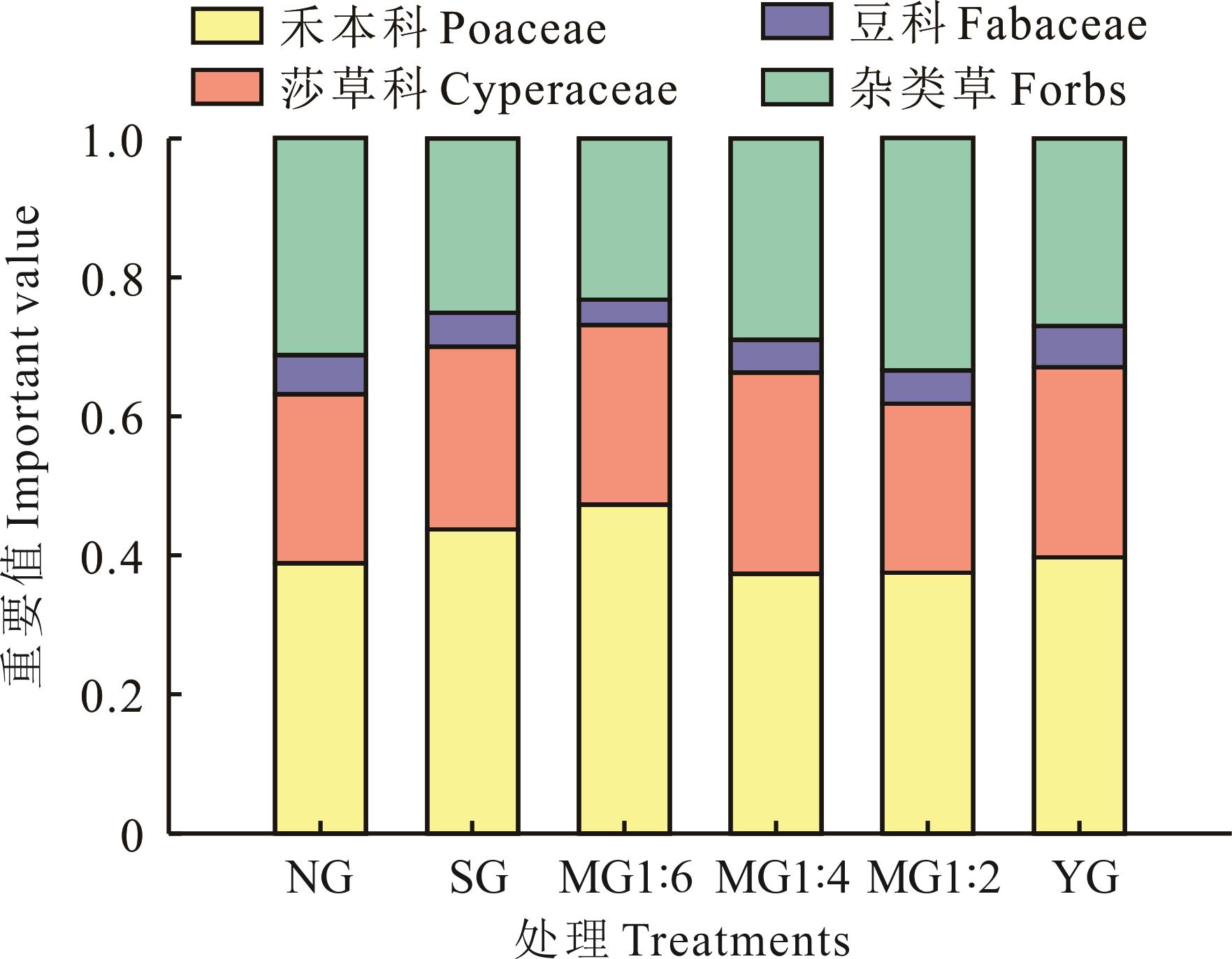
图6 不同放牧方式对植被功能群重要值的影响
Fig.6 Effect of different livestock assembly grazing on the importance values of vegetation functional groups
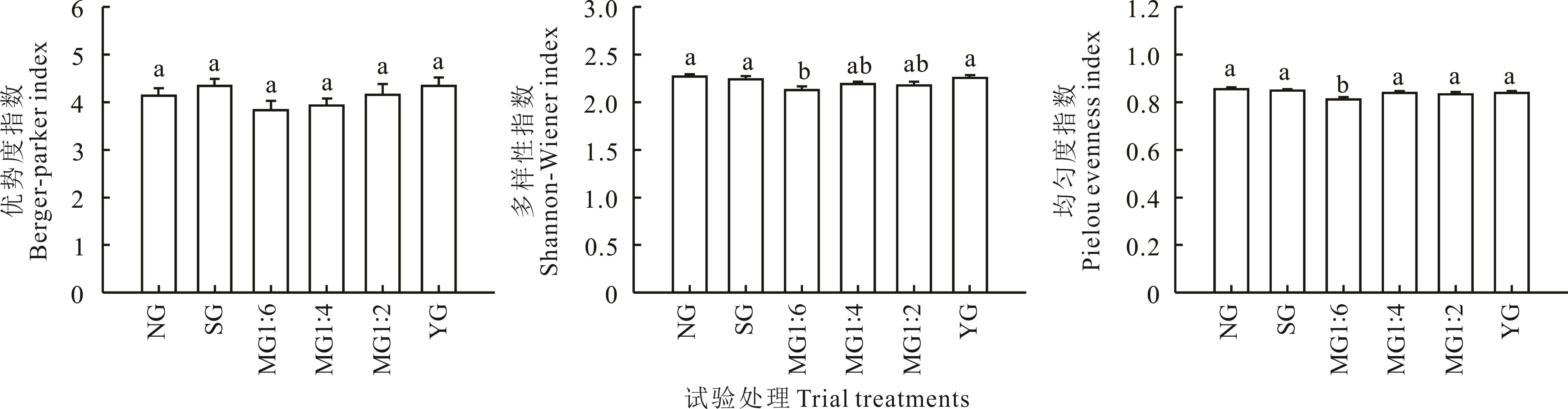
图7 不同放牧方式对群落多样性指数的影响
Fig.7 Effect of different livestock assembly grazing on community diversity indices
| 1 | Stevens N, Bond W, Feurdean A, et al. Grassy ecosystems in the Anthropocene. Annual Review of Environment and Resources, 2022, 47(1): 261-289. |
| 2 | Zhao G L. Trends in grassland science: Based on the shift analysis of research themes since the early 1900s. Fundamental Research, 2023, 3(2): 201-208. |
| 3 | Olofsson J. Effects of simulated reindeer grazing, trampling, and waste products on nitrogen mineralization and primary production. Arctic, Antarctic, and Alpine Research, 2009, 41(3): 330-338. |
| 4 | Bullock J M, Pakeman R J. Grazing of lowland heath in England: Management methods and their effects on healthland vegetation. Biological Conservation, 1997, 79(1): 1-13. |
| 5 | Rook A J, Dumont B, Isselstein J, et al. Matching type of livestock to desired biodiversity outcomes in pastures-a review. Biological Conservation, 2004, 119(2): 137-150. |
| 6 | Olofsson J, Hulme P E, Suominen O O. Importance of large and small mammalian herbivores for the plant community structure in the forest tundra ecotone. Oikos, 2004, 106(2): 324-334. |
| 7 | Han O, Ritchie M E. Effects of herbivores on grassland plant diversity. Trends in Ecology & Evolution, 1998, 13(7): 261-265. |
| 8 | Sitters J, Olde Venterink H. The need for a novel integrative theory on feedbacks between herbivores, plants and soil nutrient cycling. Plant and Soil, 2015, 396: 421-426. |
| 9 | Wang L, Delgado-Baquerizo M, Wang D, et al. Diversifying livestock promotes multidiversity and multifunctionality in managed grasslands. Proceedings of the National Academy of Science, 2019, 116(13): 6187-6192. |
| 10 | Wang L, Zhang M N, Xu M, et al. A scientific basis for promoting grassland ecosystem multifunctionality by diversifying grazing livestock: a review. Chinese Science Bulletin, 2021, 66(30): 3791-3798. |
| 王岭, 张敏娜, 徐曼, 等. 草地多功能提升的多样化家畜放牧理论及应用. 科学通报, 2021, 66(30): 3791-3798. | |
| 11 | Dueñas M A, Hemming D J, Roberts A, et al. The threat of invasive species to IUCN-listed critically endangered species: a systematic review. Global Ecology and Conservation, 2021, 26: e01476. |
| 12 | Ye P C, Zhang G F, Zhao X, et al. Potential geographical distribution and environmental explanations of rare and endangered plant species through combined modeling: a case study of Northwest Yunnan, China. Ecology and Evolution, 2021, 11(19): 13052-13067. |
| 13 | Isbell F, Craven D, Connolly J, et al. Biodiversity increases the resistance of ecosystem productivity to climate extremes. Nature, 2015, 526(7574): 574-577. |
| 14 | Tilman D, Downing J A. Biodiversity and stability in grasslands. Nature, 1994, 367(6461): 363-365. |
| 15 | Loreau M, De Mazancourt C. Biodiversity and ecosystem stability: a synthesis of underlying mechanisms. Ecology Letters, 2013, 16(S1): 106-115. |
| 16 | Dale M R. Spatial pattern analysis in plant ecology. Cambridge: Cambridge University Press, 2000: 1-2. |
| 17 | Li Y, Hu X K, Wei H D, et al. Spatial patterns of the main populations of the natural vegetation community in the south margin area of Tenggeli Desert. Journal of Northwest Forestry University, 2017, 32(2): 67-72. |
| 李亚, 胡小柯, 魏怀东, 等. 腾格里沙漠南缘天然群落主要种群空间分布格局研究. 西北林学院学报, 2017, 32(2): 67-72. | |
| 18 | May F, Huth A, Wiegand T. Moving beyond abundance distributions: neutral theory and spatial patterns in a tropical forest. Proceedings of the Royal Society B: Biological Sciences, 2015, 282(1802): 20141657. |
| 19 | Grinnell J. The niche-relationships of the California thrasher. The Auk, 1917, 34(4): 427-433. |
| 20 | Levins R. Evolution in changing environments. Princeton: Princeton University Press, 1968: 178-213. |
| 21 | May R M. On the theory of niche overlap. Theoretical Population Biology, 1974, 5(1): 297-332. |
| 22 | Laland K N, Odling-Smee F J, Feldman M W. Evolutionary consequences of niche construction: a theoretical investigation using two-locus theory. Journal of Evolutionary Biology, 1996, 9(3): 293-316. |
| 23 | Pulla S, Suresh H S, Dattaraja H S, et al. Multidimensional tree niches in a tropical dry forest. Ecology, 2017, 98(5): 1334-1348. |
| 24 | Ma Y M, Li Q H, Pan S P, et al. Niche and interspecific associations of Pseudoanabaena limnetica-exploring the influencing factors of its succession stage. Ecological Indicators, 2022, 138: 108806. |
| 25 | Ruifrok J L, Postma F, Olff H, et al. Scale-dependent effects of grazing and topographic heterogeneity on plant species richness in a Dutch salt marsh ecosystem. Applied Vegetation Science, 2014, 17(4): 615-624. |
| 26 | Meyers L M, Dekeyser E S, Norland J E. Differences in spatial autocorrelation (SAc), plant species richness and diversity, and plant community composition in grazed and ungrazed grasslands along a moisture gradient, North Dakota, USA. Applied Vegetation Science, 2014, 17(1): 53-62. |
| 27 | Alrababah M A, Alhamad M A, Suwaileh M, et al. Biodiversity of semi-arid Mediterranean grasslands: impact of grazing and afforestation. Applied Vegetation Science, 2007, 10(2): 257-264. |
| 28 | Wu Y L, Wei Z J, Yun X J, et al. Effects of continuous grazing on niche and ecological attribute of plant populations in Stipa breviflora desert steppe. Chinese Journal of Grassland, 2018, 40(2): 81-88. |
| 吴艳玲, 卫智军, 运向军, 等. 放牧对短花针茅荒漠草原植物种群生态位及生态属性的影响. 中国草地学报, 2018, 40(2): 81-88. | |
| 29 | Zheng W, Dong Q M, Li S X, et al. Effects of grazing on niche of major plant populations in alpine steppe in Qinghai Lake region. Pratacultural Science, 2013, 30(12): 2040-2046. |
| 郑伟, 董全民, 李世雄, 等. 放牧对环青海湖高寒草原主要植物种群生态位的影响. 草业科学, 2013, 30(12): 2040-2046. | |
| 30 | Dong Q M, Zhao X Q, Ma Y S, et al. Niche of main plant populations on a warm-seasonal pastureland of alpine Kobrecia parva meadow. Chinese Journal of Ecology, 2006, 25(11): 1323-1327. |
| 董全民, 赵新全, 马玉寿, 等. 高寒小嵩草草甸暖季草场主要植物种群的生态位. 生态学杂志, 2006, 25(11): 1323-1327. | |
| 31 | Wang X F, Wu Y X, Xiao H L, et al. Features of soil aggregates and plant interspecific affinity along degraded alpine grasslands in Three Rivers region. Acta Agrestia Sinica, 2021, 29(9): 2001-2009. |
| 王晓芬, 吴玉鑫, 肖海龙, 等. 三江源退化高寒草原植物种间亲和性和土壤团聚体特征. 草地学报, 2021, 29(9): 2001-2009. | |
| 32 | Feng B, Dong Q M, Liu W T, et al. Response mechanisms of Kobresia humilis to grazing of yaks and Tibetan sheep. Pratacultural Science, 2022, 39(6): 1129-1139. |
| 冯斌, 董全民, 刘文亭, 等. 矮生嵩草对牦牛和藏羊放牧的响应机制. 草业科学, 2022, 39(6): 1129-1139. | |
| 33 | Li J T, Mu J, Shen K P, et al. Niche and interspecific association of dominant woody plants in Camellia luteoflora community. Acta Ecologica Sinica, 2024, 44(1): 283-294. |
| 李锦婷, 穆君, 申开平, 等. 小黄花茶群落优势木本植物生态位及种间联结性. 生态学报, 2024, 44(1): 283-294. | |
| 34 | Costa D S, Gerschlauer F, Kiese R, et al. Plant niche breadths along environmental gradients and their relationship to plant functional traits. Diversity and Distributions, 2018, 24(12): 1869-1882. |
| 35 | Chen B, Zhou X M. Analyses of niche breadths and overlaps of several plant species in three Kobresia communities of an alpine meadow. Acta Phytoecologica Sinica, 1995, 19(2): 158-169. |
| 陈波, 周兴民. 三种嵩草群落中若干植物种的生态位宽度与重叠分析. 植物生态学报, 1995, 19(2): 158-169. | |
| 36 | Altesor A, Oesterheld M, Leoni E, et al. Effect of grazing on community structure and productivity of a Uruguayan grassland. Plant Ecology, 2005, 179(1): 83-91. |
| 37 | Augustine D J, Derner J D, Milchunas D, et al. Grazing moderates increases in C3 grass abundance over seven decades across a soil texture gradient in shortgrass steppe. Journal of Vegetation Science, 2017, 28(3): 562-572. |
| 38 | Huston M. A general hypothesis of species diversity. American Naturalist, 1979, 113(1): 81-101. |
| 39 | Grime J P. Control of species density in herbaceous vegetation. Journal of Environmental Management, 1973, 1: 151-167. |
| 40 | Connell J H. Diversity in tropical rain forests and coral reefs. Science, 1978, 199(4335): 1302-1310. |
| 41 | Wu N, Liu J, Yan Z. Grazing intensity on the plant diversity of alpine meadow in the eastern Tibetan plateau. Rangifer, 2004, 24(4): 9-15. |
| 42 | Ren H, Schönbach P, Wan H, et al. Effects of grazing intensity and environmental factors on species composition and diversity in typical steppe of Inner Mongolia, China. PLoS One, 2012, 7(12): e52180. |
| 43 | Yang D L, Han G D, Hu Y G, et al. Effects of grazing intensity on plant diversity and aboveground biomass of Stipa baicalensis grassland. Chinese Journal of Ecology, 2006, 25(12): 1470-1475. |
| 杨殿林, 韩国栋, 胡跃高, 等. 放牧对贝加尔针茅草原群落植物多样性和生产力的影响. 生态学杂志, 2006, 25(12): 1470-1475. | |
| 44 | Deng L, Sweeney S, Shangguan Z. Grassland responses to grazing disturbance: plant diversity changes with grazing intensity in a desert steppe. Grass and Forage Science, 2014, 69(3): 524-533. |
| 45 | Zhao L P, Gillet F. Long-term effects of grazing exclusion on aboveground and belowground plant species diversity in a steppe of the Loess Plateau, China. Plant Ecology & Evolution, 2011, 144(3): 313-320. |
| 46 | Wang Z W. Effect of stocking rate on ecosystem stability of Stipa breviflora desert steppe. Hohhot: Inner Mongolia Agricultural University, 2009. |
| 王忠武. 载畜率对短花针茅荒漠草原生态系统稳定性的影响. 呼和浩特: 内蒙古农业大学, 2009. | |
| 47 | Olofsson J. Plant diversity and resilience to reindeer grazing. Arctic Antarctic & Alpine Research, 2006, 38(1): 131-135. |
| [1] | 王瑞兵, 陈欢, 潘珍珍, 赵维, 蚌绍豪, 周小龙, 任正炜. 基于资源类型和数目的高寒草甸物种丧失机制研究[J]. 草业学报, 2025, 34(5): 1-11. |
| [2] | 侯晓磊, 武春丽, 邓雅元, 麻文章, 赵廷宁, 曾文杰, 巩子涵, 芦治源, 吴国伟. 宁东煤炭基地排矸场人工植物群落优势种生态位和种间关系研究[J]. 草业学报, 2025, 34(1): 1-16. |
| [3] | 靳生伟, 韩银仓, 孙永刚, 丁维芹, 刘亚倩, 祁增源, 周建强. 冷季不同饲养方式对牦牛生长性能及血液生理生化指标的影响[J]. 草业学报, 2025, 34(1): 215-225. |
| [4] | 杨得玉, 黄文植, 冯宇哲, 薛斌, 张晓卫, 崔占鸿. 暖季补饲矿物质盐砖对放牧牦牛生长性能、瘤胃发酵、血液和被毛矿物质含量的影响[J]. 草业学报, 2024, 33(7): 105-118. |
| [5] | 丁维芹, 孙永刚, 韩银仓, 刘亚倩, 靳生伟. 牦牛皮下脂肪组织miRNA的鉴定与分析[J]. 草业学报, 2024, 33(6): 227-235. |
| [6] | 张峰硕, 季秋蓉, 何婷莉, 苏曲杨昂毛, 王志有, 侯生珍, 桂林生. 低蛋白日粮中不同比例氨基酸对藏羊背腰最长肌肉品质、氨基酸和脂肪酸组成以及维生素和矿物质含量的影响[J]. 草业学报, 2024, 33(3): 198-208. |
| [7] | 张永亮, 滕泽, 郝凤, 于铁峰, 张玉霞. 苜蓿混播方式及比例对混播草地生产力和稳定性的影响[J]. 草业学报, 2024, 33(2): 185-197. |
| [8] | 者玉琦, 武志娟, 王吉坤, 钟金城, 柴志欣, 信金伟. 基于mtDNA COX3基因对西藏特色牦牛群体遗传结构的分析[J]. 草业学报, 2023, 32(9): 231-240. |
| [9] | 周晓雷, 杨富强, 王明军, 黄海霞, 田青, 周旭姣, 赵安, 贺万鹏, 赵艳丽, 姜礼红. 青藏高原东北边缘云杉-巴山冷杉林火烧迹地草本植物群落主要种生态位特征[J]. 草业学报, 2023, 32(7): 23-37. |
| [10] | 雷石龙, 廖李容, 王杰, 张路, 叶振城, 刘国彬, 张超. 高寒草地植物多样性与Godron群落稳定性关系及其环境驱动因素[J]. 草业学报, 2023, 32(3): 1-12. |
| [11] | 周力, 侯生珍, 王志有, 杨葆春, 韩丽娟, 桂林生. 棕榈粕替代部分玉米对藏羊母羊小肠形态发育、消化酶活性及抗氧化功能的影响[J]. 草业学报, 2023, 32(3): 118-127. |
| [12] | 聂洪辛, 李毓敏, 庞凯悦, 柴沙驼, 申迪, 曾子铭, 廖扬, 王迅, 薛斌, 刘书杰, 王书祥, 杨英魁. 不同精粗比对牦牛粪便菌群结构的影响[J]. 草业学报, 2023, 32(12): 189-197. |
| [13] | 冯斌, 杨晓霞, 刘文亭, 刘玉祯, 吕卫东, 张振祥, 孙彩彩, 周沁苑, 王芳草, 于泽航, 董全民. 暖季草场不同放牧方式对牦牛藏羊生产力的影响[J]. 草业学报, 2023, 32(12): 58-67. |
| [14] | 吴刀知才让, 裴成芳, 马志远, 刘红山, 曹旭亮, 刘虎, 周建伟. 燕麦干草不同饲喂水平对牦牛日增重、血液生理生化指标及瘤胃发酵参数的影响[J]. 草业学报, 2023, 32(11): 119-129. |
| [15] | 段嘉钰, 张博, 操君, 刘书杰, 崔占鸿. 70~100 kg牦牛犊牛钠、钾、镁元素分布规律及生长需要量[J]. 草业学报, 2023, 32(11): 130-139. |
| 阅读次数 | ||||||
|
全文 |
|
|||||
|
摘要 |
|
|||||
