

ISSN 1004-5759 CN 62-1105/S
草业学报 ›› 2026, Vol. 35 ›› Issue (6): 122-130.DOI: 10.11686/cyxb2025272
• 研究论文 • 上一篇
甘芮( ), 吉尔尔格null, 隋晓青(), 刘海军, 刘雨旋, 靳瑰丽, 穆耶赛尔·麦麦提null
收稿日期:2025-07-02
修回日期:2025-09-09
出版日期:2026-06-20
发布日期:2026-04-13
通讯作者:
隋晓青
作者简介:Corresponding author. E-mail: sxq303@xjau.edu.cn基金资助:
Rui GAN(), Jiererge, Xiao-qing SUI(), Hai-jun LIU, Yu-xuan LIU, Gui-li JIN, MAIMAITI·Mu-yesaier
Received:2025-07-02
Revised:2025-09-09
Online:2026-06-20
Published:2026-04-13
Contact:
Xiao-qing SUI
摘要:
为探究接种丛枝菌根真菌(arbuscular mycorrhizal fungi, AMF)对无芒雀麦植株生长特性及糖含量的影响,以‘乌苏1号’无芒雀麦为试验材料,通过盆栽试验法对无芒雀麦接种3种丛枝菌根真菌,即摩西管柄囊霉、根内根孢囊霉和异形根孢囊霉。结果表明,单一接种和复合接种均能有效地侵染无芒雀麦根系,其侵染率为69.83%~80.29%,接种丛枝菌根提高了无芒雀麦生长指标和叶绿素含量,并改善了无芒雀麦根总长、根表面积、根体积、根尖数和交叉数等,其中摩西管柄囊霉和根内根孢囊霉复合接种效果最显著,使总生物量、根总长和根表面积分别较对照提高107.67%、73.34%和79.63%。单一接种和复合接种均显著提高了无芒雀麦叶片和根系的蔗糖及葡萄糖含量,其中复合接种效果更显著。通过隶属函数综合分析得出,摩西管柄囊霉和异形根孢囊霉的复合接种处理对无芒雀麦根系构型的建立和糖含量的改善效果最佳。
甘芮, 吉尔尔格null, 隋晓青, 刘海军, 刘雨旋, 靳瑰丽, 穆耶赛尔·麦麦提null. 接种丛枝菌根真菌对无芒雀麦生长特性及糖含量的影响[J]. 草业学报, 2026, 35(6): 122-130.
Rui GAN, Jiererge, Xiao-qing SUI, Hai-jun LIU, Yu-xuan LIU, Gui-li JIN, MAIMAITI·Mu-yesaier. Effects of arbuscular mycorrhizal fungi on growth characteristics and sugar content of Bromus inermis[J]. Acta Prataculturae Sinica, 2026, 35(6): 122-130.
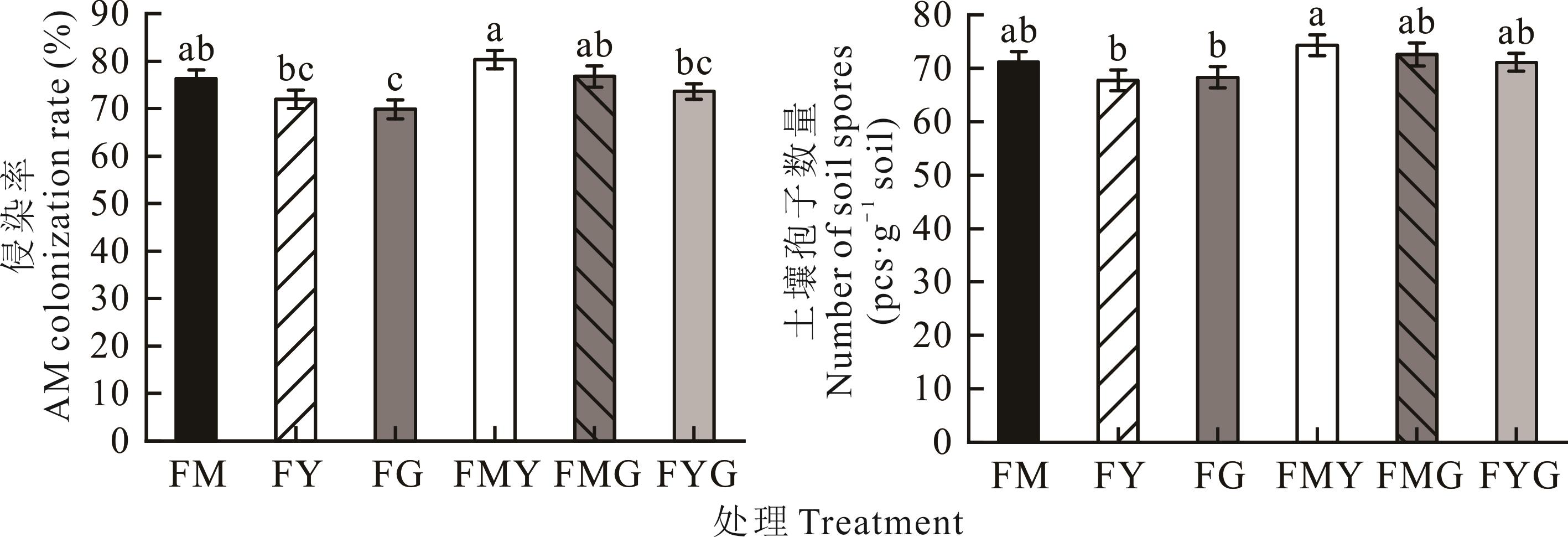
图1 AMF对根系侵染率和土壤孢子密度的影响FM:摩西管柄囊霉 F. mosseae;FG:根内根孢囊霉 R. intraradices;FY:异形根孢囊霉 R. irregularis;FMG:摩西管柄囊霉+根内根孢囊霉 F. mosseae+R. intraradices;FMY:摩西管柄囊霉+异形根孢囊霉 F. mosseae+R. irregularis;FYG:异形根孢囊霉+根内根孢囊霉 R. irregularis+R. intraradices。不同小写字母表示处理间差异显著(P<0.05)。Different lowercase letters mean significant difference among treatments at 0.05 level.
Fig.1 Effect of AMF on root colonization rate and soil spore density
处理 Treatment | 茎粗 Stem thickness (cm) | 单株地上生物量 Above-ground biomass (g·plant-1) | 单株地下生物量 Below-ground biomass (g·plant-1) | 单株总生物量 Total biomass (g·plant-1) | 根冠比 Root-crown ratio | 叶片数 Number of leaves |
|---|---|---|---|---|---|---|
| CK | 1.01±0.04d | 3.74±0.10d | 7.83±0.29b | 8.86±0.34d | 0.47±0.08cd | 39.25±1.49b |
| FM | 1.40±0.14ab | 5.73±0.95a | 10.08±0.57ab | 15.80±0.69ab | 0.57±0.06a | 45.00±2.45a |
| FY | 1.48±0.06a | 5.53±0.36ab | 10.15±0.46ab | 15.68±0.41ab | 0.54±0.04ab | 46.25±1.37a |
| FG | 1.34±0.05abc | 4.45±0.31abc | 10.50±0.84ab | 14.90±0.94abc | 0.43±0.04cd | 48.25±1.90a |
| FMY | 1.39±0.05abc | 4.12±0.18c | 8.40±0.81b | 12.73±1.24bc | 0.49±0.09c | 42.00±1.13a |
| FMG | 1.18±0.04cd | 4.08±0.30c | 8.18±0.96b | 12.29±0.88bc | 0.50±0.08b | 41.75±0.47a |
| FYG | 1.34±0.04abc | 4.63±0.44abc | 13.78±0.95a | 18.40±1.27a | 0.35±0.03d | 44.75±1.10a |
表1 AMF对无芒雀麦生长指标的影响
Table 1 Effect of AMF on the growth indexes of B. inermis
处理 Treatment | 茎粗 Stem thickness (cm) | 单株地上生物量 Above-ground biomass (g·plant-1) | 单株地下生物量 Below-ground biomass (g·plant-1) | 单株总生物量 Total biomass (g·plant-1) | 根冠比 Root-crown ratio | 叶片数 Number of leaves |
|---|---|---|---|---|---|---|
| CK | 1.01±0.04d | 3.74±0.10d | 7.83±0.29b | 8.86±0.34d | 0.47±0.08cd | 39.25±1.49b |
| FM | 1.40±0.14ab | 5.73±0.95a | 10.08±0.57ab | 15.80±0.69ab | 0.57±0.06a | 45.00±2.45a |
| FY | 1.48±0.06a | 5.53±0.36ab | 10.15±0.46ab | 15.68±0.41ab | 0.54±0.04ab | 46.25±1.37a |
| FG | 1.34±0.05abc | 4.45±0.31abc | 10.50±0.84ab | 14.90±0.94abc | 0.43±0.04cd | 48.25±1.90a |
| FMY | 1.39±0.05abc | 4.12±0.18c | 8.40±0.81b | 12.73±1.24bc | 0.49±0.09c | 42.00±1.13a |
| FMG | 1.18±0.04cd | 4.08±0.30c | 8.18±0.96b | 12.29±0.88bc | 0.50±0.08b | 41.75±0.47a |
| FYG | 1.34±0.04abc | 4.63±0.44abc | 13.78±0.95a | 18.40±1.27a | 0.35±0.03d | 44.75±1.10a |
处理 Treatment | 单株根总长 Root length (cm·plant-1) | 单株根表面积 Root surface area (cm2·plant-1) | 单株根体积 Root volume (cm3·plant-1) | 单株根直径 Root diameter (mm·plant-1) | 根尖数 Root tips number | 交叉数 Crossings |
|---|---|---|---|---|---|---|
| CK | 119.16±16.67d | 9.08±0.54e | 0.051±0.004b | 0.19±0.04b | 216±19.78b | 147±5.01c |
| FM | 191.71±24.75ab | 13.19±0.62bc | 0.069±0.005a | 0.21±0.03ab | 260±7.43ab | 182±7.96b |
| FY | 140.63±19.89bc | 11.83±1.03cd | 0.067±0.003a | 0.22±0.02b | 265±10.08a | 191±7.58b |
| FG | 156.85±17.34b | 9.98±0.46d | 0.065±0.003a | 0.25±0.04b | 257±24.35ab | 176±5.18b |
| FMY | 198.20±26.14ab | 15.03±0.75ab | 0.076±0.002a | 0.28±0.05a | 282±11.63a | 223±19.97a |
| FMG | 206.55±31.25a | 16.31±0.37a | 0.071±0.004a | 0.23±0.05ab | 273±11.72a | 214±11.55a |
| FYG | 203.23±19.57a | 15.73±0.54a | 0.069±0.006a | 0.24±0.07ab | 250±9.62ab | 217±14.45a |
表2 AMF对无芒雀麦根系构型的影响
Table 2 Effect of AMF on the root conformation of B. inermis
处理 Treatment | 单株根总长 Root length (cm·plant-1) | 单株根表面积 Root surface area (cm2·plant-1) | 单株根体积 Root volume (cm3·plant-1) | 单株根直径 Root diameter (mm·plant-1) | 根尖数 Root tips number | 交叉数 Crossings |
|---|---|---|---|---|---|---|
| CK | 119.16±16.67d | 9.08±0.54e | 0.051±0.004b | 0.19±0.04b | 216±19.78b | 147±5.01c |
| FM | 191.71±24.75ab | 13.19±0.62bc | 0.069±0.005a | 0.21±0.03ab | 260±7.43ab | 182±7.96b |
| FY | 140.63±19.89bc | 11.83±1.03cd | 0.067±0.003a | 0.22±0.02b | 265±10.08a | 191±7.58b |
| FG | 156.85±17.34b | 9.98±0.46d | 0.065±0.003a | 0.25±0.04b | 257±24.35ab | 176±5.18b |
| FMY | 198.20±26.14ab | 15.03±0.75ab | 0.076±0.002a | 0.28±0.05a | 282±11.63a | 223±19.97a |
| FMG | 206.55±31.25a | 16.31±0.37a | 0.071±0.004a | 0.23±0.05ab | 273±11.72a | 214±11.55a |
| FYG | 203.23±19.57a | 15.73±0.54a | 0.069±0.006a | 0.24±0.07ab | 250±9.62ab | 217±14.45a |
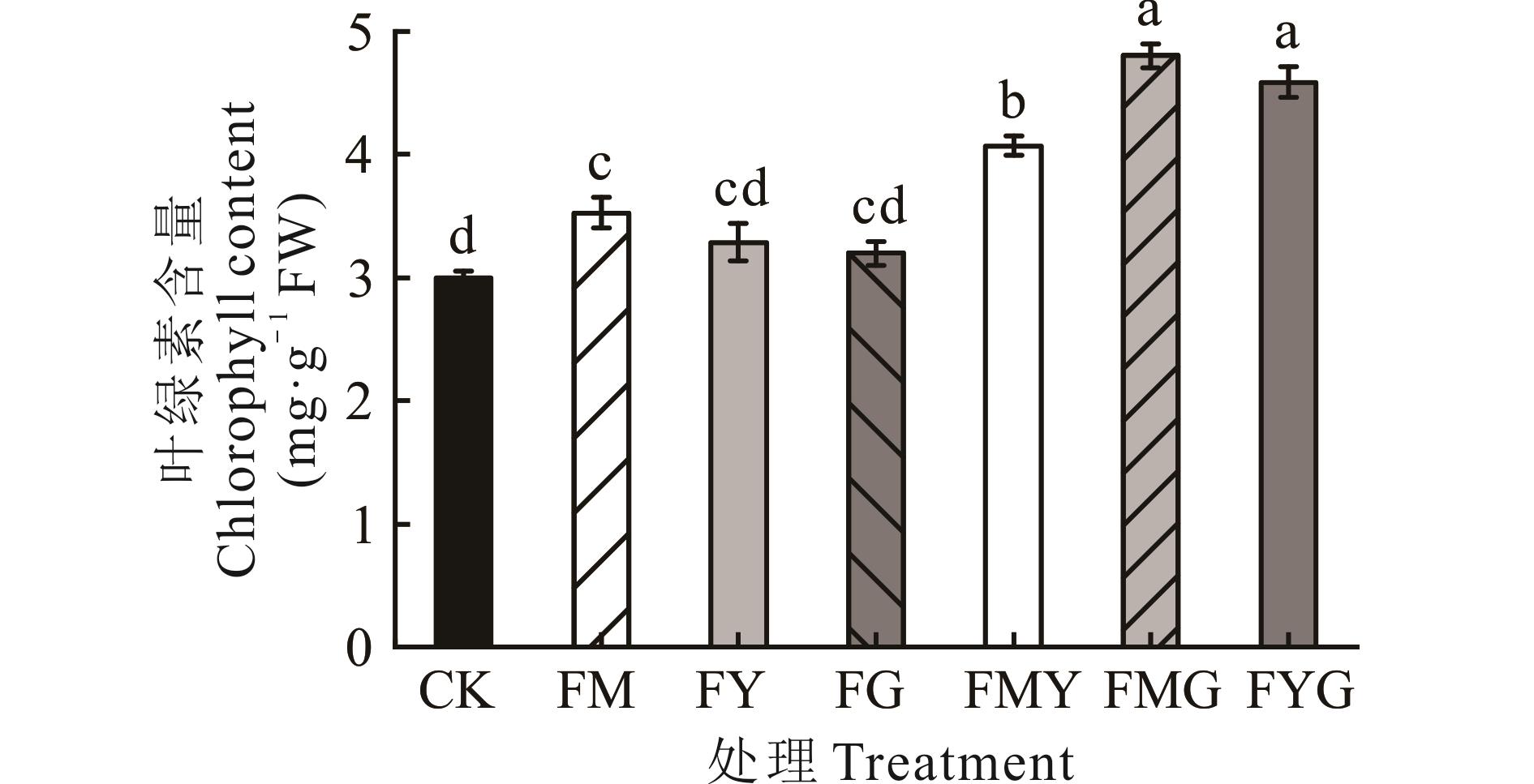
图2 AMF对无芒雀麦叶绿素含量的影响
Fig.2 Effect of AMF on chlorophyll content of B. inermis
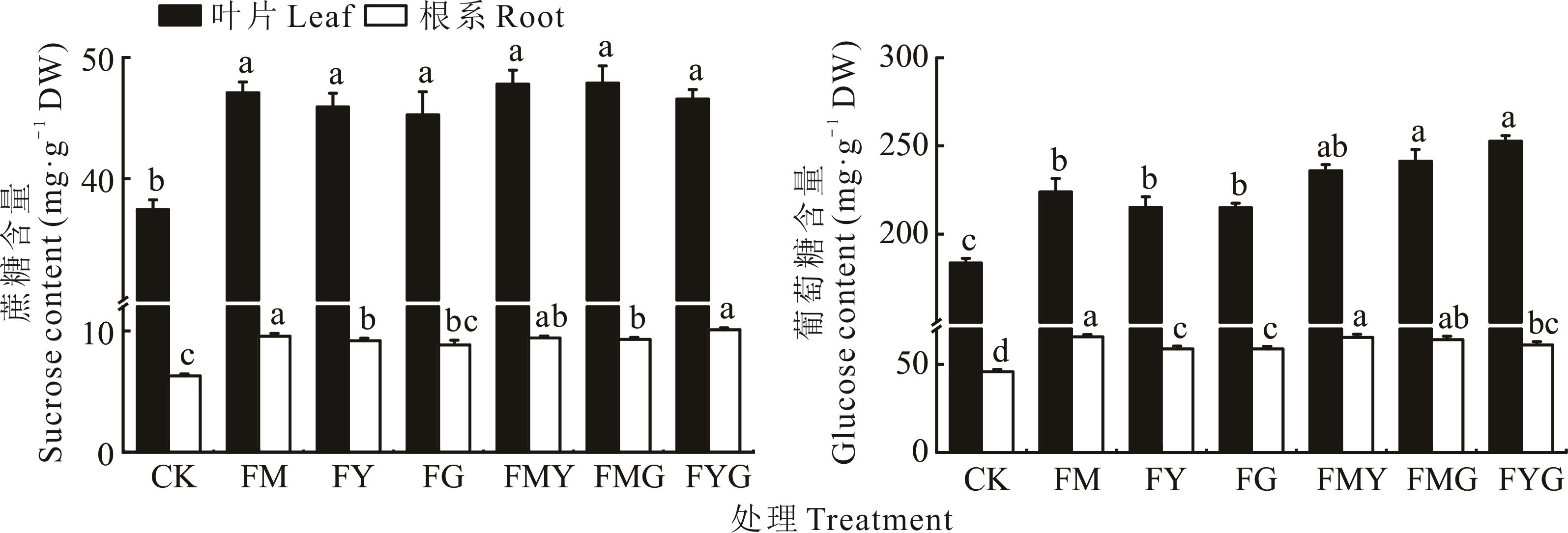
图3 AMF对无芒雀麦蔗糖含量和葡萄糖含量的影响
Fig.3 Effect of AMF on sucrose and glucose content of B. inermis
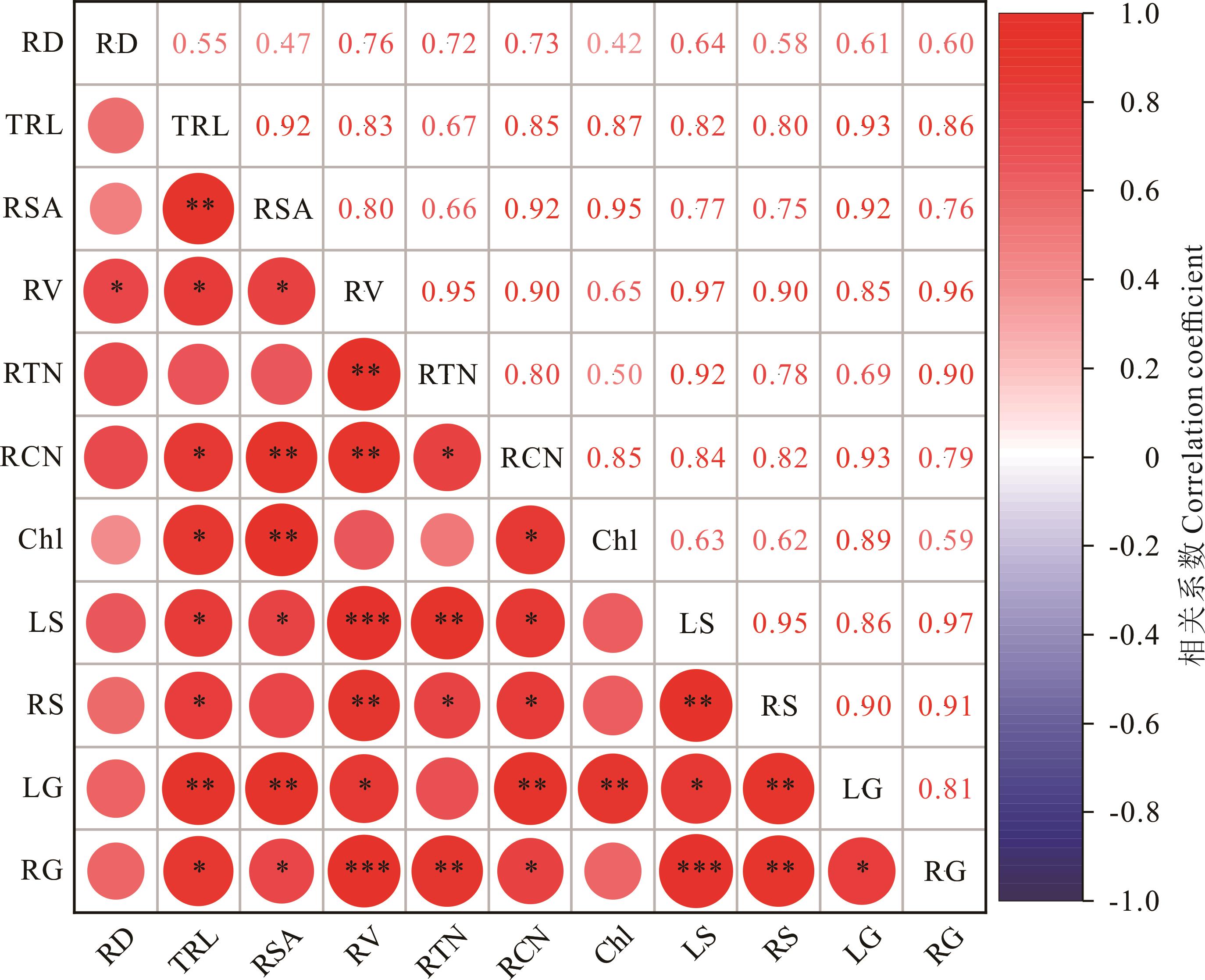
图4 无芒雀麦植株各指标的相关性分析热图*:P<0.05;**:P<0.01;***:P<0.001. RD:根直径 Root diameter;TRL:根总长 Total root length;RSA:根表面积 Root surface area;RV:根体积 Root volume;RTN:根尖数 Number of root tips;RCN:交叉数 Number of root crossings;Chl:叶绿素 Chlorophyll;LS:叶片蔗糖 Leaf sucrose;RS:根系蔗糖 Root sucrose;LG:叶片葡萄糖 Leaf glucose;RG:根系葡萄糖 Root glucose.
Fig.4 Heat map of correlation analysis of various indicators of B. inermis
处理 Treatment | 隶属函数值 Membership function value | D值 D value | 排序 Rank | ||||||||||
|---|---|---|---|---|---|---|---|---|---|---|---|---|---|
| TRL | RSA | RV | RD | RTN | RCN | Chl | LS | RS | LG | RG | |||
| CK | 0.00 | 0.00 | 0.00 | 0.00 | 0.00 | 0.00 | 0.00 | 0.00 | 0.00 | 0.00 | 0.00 | 0.00 | 7 |
| FM | 0.83 | 0.57 | 0.72 | 0.22 | 0.67 | 0.46 | 0.29 | 0.92 | 0.86 | 0.58 | 1.00 | 0.65 | 4 |
| FY | 0.25 | 0.38 | 0.64 | 0.33 | 0.74 | 0.58 | 0.16 | 0.81 | 0.76 | 0.46 | 0.65 | 0.52 | 5 |
| FG | 0.43 | 0.12 | 0.56 | 0.66 | 0.62 | 0.38 | 0.11 | 0.75 | 0.67 | 0.45 | 0.65 | 0.49 | 6 |
| FMY | 0.90 | 0.82 | 1.00 | 1.00 | 1.00 | 1.00 | 0.59 | 0.99 | 0.82 | 0.76 | 0.98 | 0.89 | 1 |
| FMG | 1.00 | 1.00 | 0.80 | 0.44 | 0.86 | 0.88 | 1.00 | 1.00 | 0.79 | 0.84 | 0.92 | 0.87 | 2 |
| FYG | 0.96 | 0.91 | 0.72 | 0.56 | 0.51 | 0.92 | 0.88 | 0.87 | 1.00 | 1.00 | 0.76 | 0.83 | 3 |
表3 隶属函数综合评价
Table 3 Comprehensive evaluation of the subordinate function
处理 Treatment | 隶属函数值 Membership function value | D值 D value | 排序 Rank | ||||||||||
|---|---|---|---|---|---|---|---|---|---|---|---|---|---|
| TRL | RSA | RV | RD | RTN | RCN | Chl | LS | RS | LG | RG | |||
| CK | 0.00 | 0.00 | 0.00 | 0.00 | 0.00 | 0.00 | 0.00 | 0.00 | 0.00 | 0.00 | 0.00 | 0.00 | 7 |
| FM | 0.83 | 0.57 | 0.72 | 0.22 | 0.67 | 0.46 | 0.29 | 0.92 | 0.86 | 0.58 | 1.00 | 0.65 | 4 |
| FY | 0.25 | 0.38 | 0.64 | 0.33 | 0.74 | 0.58 | 0.16 | 0.81 | 0.76 | 0.46 | 0.65 | 0.52 | 5 |
| FG | 0.43 | 0.12 | 0.56 | 0.66 | 0.62 | 0.38 | 0.11 | 0.75 | 0.67 | 0.45 | 0.65 | 0.49 | 6 |
| FMY | 0.90 | 0.82 | 1.00 | 1.00 | 1.00 | 1.00 | 0.59 | 0.99 | 0.82 | 0.76 | 0.98 | 0.89 | 1 |
| FMG | 1.00 | 1.00 | 0.80 | 0.44 | 0.86 | 0.88 | 1.00 | 1.00 | 0.79 | 0.84 | 0.92 | 0.87 | 2 |
| FYG | 0.96 | 0.91 | 0.72 | 0.56 | 0.51 | 0.92 | 0.88 | 0.87 | 1.00 | 1.00 | 0.76 | 0.83 | 3 |
| [1] | Zhang X L, Xu J, An T T, et al. Relationship between rhizosphere soil properties and yield of maize at different nitrogen levels. Scientia Agricultura Sinica, 2016, 49(14): 2687-2699. |
| 张学林, 徐钧, 安婷婷, 等. 不同氮肥水平下玉米根际土壤特性与产量的关系. 中国农业科学, 2016, 49(14): 2687-2699. | |
| [2] | Bago B, Pfeffer P E, Shachar-Hill Y. Carbon metabolism and transport in arbuscular mycorrhizas. Plant Physiology, 2000, 124: 949-958. |
| [3] | Bago B, Pfeffer P E, Abubaker J, et al. Carbon export from arbuscular mycorrhizal roots involves the translocation of carbohydrate as well as lipid. Plant Physiology, 2003, 131(3): 1496-1507. |
| [4] | Liu J X, Sun P, Zhao X Y, et al. Regulation of antioxidant metabolic pathways in ryegrass by biochar and arbuscular mycorrhizal fungi under salt stress. Periodical of Ocean University of China, 2025, 55(4): 81-89. |
| 刘佳鑫, 孙萍, 赵新月, 等. 盐胁迫下生物炭和丛枝菌根真菌对黑麦草抗氧化代谢路径的调节作用. 中国海洋大学学报(自然科学版), 2025, 55(4): 81-89. | |
| [5] | Schellenbaum L, Berta G, Ravolanirina F, et al. Influence of endomycorrhizal infection on root morphology in a micropropagated woody plant species (Vitis vinifera L.). Annals of Botany, 1991, 68(2): 135-141. |
| [6] | Kan H M, Xu H K, Lu J N, et al. The infuence of different arbuscular mycorrhizal fungi inoculation on the growth characteristics of three forage species. Acta Agrectir Sinica, 2023, 31(7): 1922-1930. |
| 阚海明, 徐恒康, 鲁佳男, 等. 不同丛枝菌根真菌接种对3种草地植物生长特性的影响. 草地学报, 2023, 31(7): 1922-1930. | |
| [7] | Guo H, Zhou H, Zhuang J J, et al. Effects of arbuscular mycorrhizal fungi on wheat physiological characteristics and rhizosphere soil enzyme activities under cadmium stress. Journal of Henan Agricultural Sciences, 2022, 51(8): 20-27. |
| 郭晖, 周慧, 庄静静, 等. 镉胁迫下丛枝菌根真菌对小麦生理特性和根际土壤酶活性的影响. 河南农业科学, 2022, 51(8): 20-27. | |
| [8] | Wu Q S, Yuan F Y, Fei Y J, et al. Effects of arbuscular mycorrhizal fungi on root system architecture and sugar contents of white clover. Acta Prataculturae Sinica, 2014, 23(1): 199-204. |
| 吴强盛, 袁芳英, 费永俊, 等. 丛枝菌根真菌对白三叶根系构型和糖含量的影响. 草业学报, 2014, 23(1): 199-204. | |
| [9] | Guo Y E, Li F, Li Y D, et al. Progress in the elucidation of the mechanisms of arbuscular mycorrhizal fungi in promotion of phosphorus uptake and utilization by plants. Pratacultural Science, 2016, 33(12): 2379-2390. |
| 郭艳娥, 李芳, 李应德, 等. AM真菌促进植物吸收利用磷元素的机制. 草业科学, 2016, 33(12): 2379-2390. | |
| [10] | Gianinazzi S, Gollotte A, Binet M, et al. Agroecology: The key role of arbuscular mycorrhizas in ecosystem services. Mycorrhiza, 2010, 20(8): 519-530. |
| [11] | Qu L L, Guo X F, Jia Z Y, et al. Review on the progress of adaptability to abiotic stress adversity by arbuscular mycorrhizal fungi in plants. Journal of Grassland and Forage Science, 2024(1): 4-9. |
| 屈璐璐, 郭秀芳, 贾振宇, 等. 丛枝菌根真菌提高植物非生物逆境胁迫适应性研究进展. 草学, 2024(1): 4-9. | |
| [12] | Zhu W Y. Effects of arbuscular mycorrhizal fungi on root characteristics of two maize varieties and cadmium-lead migration in soil. Kunming: Yunnan Agricultural University, 2023. |
| 朱文雅. 丛枝菌根真菌对2个品种玉米根系性状与土壤镉铅迁移的影响. 昆明: 云南农业大学, 2023. | |
| [13] | Hou Y N, Jiang F, Zhou S Y, et al. Arbuscular mycorrhizal fungi improve physiological metabolism and ameliorate root damage of Coleus scutellarioides under cadmium stress. Chinese Journal of Biotechnology, 2025, 41(2): 680-692. |
| 侯亚男, 江帆, 周舒扬, 等. 镉胁迫下丛枝菌根真菌对彩叶草生理代谢和根系损伤的影响. 生物工程学报, 2025, 41(2): 680-692. | |
| [14] | Lu W, Yang X R, Tan Y, et al. The influence of AMF on the growth and nutrient absorption of grape cutting seedlings under drought stress. South China Fruits, 2022, 51(2): 129-133, 138. |
| 鲁薇, 杨秀蓉, 谭焱, 等. 干旱胁迫下AMF对葡萄扦插苗生长及养分吸收的影响. 中国南方果树, 2022, 51(2): 129-133, 138. | |
| [15] | Malamy J E. Intrinsic and environmental response pathways that regulate root system architecture. Plant, Cell and Environment, 2005, 28: 67-77. |
| [16] | Luo Y Q, Zhao X Y, Li M X. Ecological effect of plant root exudates and related affecting factors: A review. Chinese Journal of Applied Ecology, 2012, 23(12): 3496-3504. |
| 罗永清, 赵学勇, 李美霞. 植物根系分泌物生态效应及其影响因素研究综述. 应用生态学报, 2012, 23(12): 3496-3504. | |
| [17] | Zhang X S, Dai L Y, Wang Z J, et al. The king of grass feed-smooth bluegrass. Animal Husbandry in Xinjiang, 2002(4): 28-29. |
| 张希山, 代连义, 王志杰, 等. 禾草饲料之王-无芒雀麦. 新疆畜牧业, 2002(4): 28-29. | |
| [18] | Wang W, Feng S D, Yang Z X, et al. Effects of sludge/soil ratio on the remedidation of PAH-contaminated sludge by smooth bromegras. Acta Prataculturae Sinica, 2015, 24(2): 148-160. |
| 王伟, 冯圣东, 杨志新, 等. 无芒雀麦-污泥系统中泥/土不同比例对PAHs修复效果的影响. 草业学报, 2015, 24(2): 148-160. | |
| [19] | Huang Y D, Zhang S B, Li L, et al. Efficient propagation of arbuscular mycorrhizal fungal propagules. Microbiology China, 2023, 50(2): 503-513. |
| 黄玉丹, 张淑彬, 李琳, 等. 丛枝菌根真菌繁殖体的高效扩繁. 微生物学通报, 2023, 50(2): 503-513. | |
| [20] | Vierhrilig H, Coughlan A P, Wyss U. Ink and vinegar, a simple staining technique for arbuscular-mycorrhizal fungi. Applied and Environmental Microbiology, 1998, 64(12): 5004-5007. |
| [21] | Wu Q S, Zou Y N, Zhan T T, et al. Polyamines participate in mycorrhizal and root development of citrus (Citrus tangerine) seeding. Notulae Botanicae Horti Agrobotanici Cluj-Napoca, 2010, 38: 25-31. |
| [22] | Zhao J L, He X L.Effects of AM fungi on the growth and drought-resistance of Artemisia ordosica. Acta Agriculturae Boreali-Sinica, 2007, 22(5): 184-188. |
| 赵金莉, 贺学礼. AM真菌对油蒿生长和抗旱性的影响. 华北农学报, 2007, 22(5): 184-188. | |
| [23] | Huang W J. Effects of inoculation with arbuscular mycorrhizal fungi on the morphology and physiology of Rosa rugosa ‘Feng Hua’. Changsha: Agricultural University of Hunan, 2022. |
| 黄文镜. 接种丛枝菌根真菌对‘丰花’玫瑰的形态与生理的影响. 长沙: 湖南农业大学, 2022. | |
| [24] | Feng Y H, Gao X, Song C W, et al. Effects of inoculation with Funneliformis mosseae on net photosynthetic rate, yield and quality of soybean. Soybean Science, 2020, 39(6): 926-931. |
| 冯宇涵, 高翔, 宋丛威, 等. 接种摩西管柄囊霉(Funneliformis mosseae)对大豆净光合速率及产量和品质的影响. 大豆科学, 2020, 39(6): 926-931. | |
| [25] | Huang H Z, Liu Y, Chen A, et al. Inoculating arbuscular mycorrhizal fungi promotes the growth and phosphorus uptake of phosphorus-efficient soybean genotype. Journal of Plant Nutrition and Fertilizers, 2024, 30(12): 2354-2365. |
| 黄活志, 刘洋, 陈阿, 等. 接种丛枝菌根真菌促进磷高效基因型大豆生长和磷吸收. 植物营养与肥料学报, 2024, 30(12): 2354-2365. | |
| [26] | Bi N, Guo W, Guo J Y, et al. Effect of arbuscular mycorrhizal fungi (Rhizophagus intraradices) on the maize growth in the three types of coal mine spoilt soil. Journal of Safety and Environment, 2016, 16(2): 194-199. |
| 毕娜, 郭伟, 郭江源, 等. 丛枝菌根真菌(Rhizophagus intraradices)对玉米在3种煤矸石中生长的影响. 安全与环境学报, 2016, 16(2): 194-199. | |
| [27] | Koch A M, Antunes P M, Maherali H, et al. Evolutionary asymmetry in the arbuscular mycorrhizal symbiosis: Conservatism in fungal morphology does not predict host plant growth. The New Phytologist, 2017, 214(3): 1330-1337. |
| [28] | Fang J, Wu S, Meng S J, et al. Effects of complex inoculation with two species arbuscular effects of complex inoculation with two species Arbuscular pseudo-cathayana×P. deltoides. Journal of Northeast Forestry University, 2024, 52(4): 17-22. |
| 方静, 武帅, 孟昭军, 等. 两种丛枝菌根真菌复合接种对青山杨生长生理指标的影响. 东北林业大学学报, 2024, 52(4): 17-22. | |
| [29] | Wang P R, Zhang F T, Gao J X, et al. An overview of chlorophyll biosynthesis in higher plants. Acta Botanica Boreali-Occidentalia Sinica, 2009, 29(3): 629-636. |
| 王平荣, 张帆涛, 高家旭, 等. 高等植物叶绿素生物合成的研究进展. 西北植物学报, 2009, 29(3): 629-636. | |
| [30] | Shi Y Y, Lv L X, Tuo D F. Effects of AMF and PGPR on growth and nutrient absorption of Matthiola incana under low temperature and weak light stress. Acta Agriculturae Zhejiangensis, 2025, 37(8): 1694-1705. |
| 师阳阳, 吕丽霞, 脱登峰. 低温弱光胁迫下AMF和PGPR对紫罗兰生长及营养吸收的影响. 浙江农业学报, 2025, 37(8): 1694-1705. | |
| [31] | Wen T, You X, Wu J, et al. Effects of two AMF combinations on leaf growth and photosynthetic efficiency of Lycoris radiata. Acta Agriculturae Universitatis Jiangxiensis, 2024, 46(6): 1436-1444. |
| 温婷, 游欣, 吴靖, 等. 两种AMF组合对石蒜叶生长及光合效能的影响. 江西农业大学学报, 2024, 46(6): 1436-1444. | |
| [32] | Zhao L, Wang L. Effects of different AMF inoculations on root activity and growth characteristics of Ophiopogon japonicus seedlings. Northern Horticulture, 2024(9): 41-46. |
| 赵乐, 王雷. 不同丛枝菌根真菌(AMF)接种量对麦冬幼苗根系活力及生长特性的影响. 北方园艺, 2024(9): 41-46. | |
| [33] | Wang Y T. The effect of strip intercropping on soybean morphology and distribution of photosynthetic assimilateshesis. Chengdu: Sichuan Agricultural University, 2024. |
| 王雨婷. 带状间作对大豆形态及光合同化物分配的影响. 成都: 四川农业大学, 2024. | |
| [34] | Zhu J X, Lei M, Huang Z J, et al.Effects of different types of arbuscular mycorrhizal fungi inoculation on nitrogen and phosphorus nutrient uptake and losses of Cunninghamia lanceolata seedlings. Acta Ecologica Sinica, 2025, 45(17): 1-12. |
| 祝嘉新, 雷梅, 黄智军, 等. 不同种类丛枝菌根真菌接种对杉木幼苗氮磷养分吸收和流失的影响. 生态学报, 2025, 45(17): 1-12. |
| [1] | 李小聪, 闫聚辉, 王星, 胡鹏飞, 叶雨浓, 伏兵哲. 紫花苜蓿/无芒雀麦间作对草地生产性能和土壤理化特性的影响[J]. 草业学报, 2026, 35(5): 113-125. |
| [2] | 马祥, 李中兴, 杨容尘, 琚泽亮, 贾志锋, 杨培志. 盐胁迫对不同耐盐性燕麦糖类及内源激素含量变化的影响[J]. 草业学报, 2026, 35(3): 235-244. |
| [3] | 郭亮, 胡雨彤, 廖雨, 龚成毓, 杨晓燕, 管上淇, 鞠成琦. 磷添加和丛枝菌根真菌对羊草根系构型以及植株养分吸收利用的影响[J]. 草业学报, 2025, 34(8): 165-178. |
| [4] | 谭英, 尹豪. 盐胁迫下根施AMF和褪黑素对紫花苜蓿生长、光合特征以及抗氧化系统的影响[J]. 草业学报, 2024, 33(6): 64-75. |
| [5] | 段海霞, 师茜, 康生萍, 苟海青, 罗崇亮, 熊友才. 丛枝菌根真菌和根瘤菌与植物共生研究进展[J]. 草业学报, 2024, 33(5): 166-182. |
| [6] | 马路平, 石兆勇, 韦文敬, 杨爽. 基于Meta分析菌根菌对植物叶片生理的影响[J]. 草业学报, 2024, 33(4): 99-109. |
| [7] | 卢晓瑜, 刘雅洁, 白彩霞, 李进华, 王子贺, 杨春雪. 虎尾草伴生和丛枝菌根真菌对碱胁迫下羊草生长的影响[J]. 草业学报, 2024, 33(11): 69-83. |
| [8] | 刘选帅, 孙延亮, 马春晖, 张前兵. 菌磷耦合下紫花苜蓿的干物质产量及磷素空间分布特征[J]. 草业学报, 2023, 32(9): 104-115. |
| [9] | 姜瑛, 张辉红, 魏畅, 徐正阳, 赵颖, 刘芳, 李鸽子, 张雪海, 柳海涛. 外源褪黑素对干旱胁迫下玉米幼苗根系发育及生理生化特性的影响[J]. 草业学报, 2023, 32(9): 143-159. |
| [10] | 宫珂, 靳瑰丽, 刘文昊, 马建, 刘智彪, 李嘉欣, 李莹. 模拟增温对无芒雀麦生长特性的影响[J]. 草业学报, 2023, 32(9): 93-103. |
| [11] | 安晓霞, 张盈盈, 马春晖, 李曼, 张前兵. 施磷与接种丛枝菌根真菌对苜蓿产量和磷素利用效率的影响[J]. 草业学报, 2023, 32(6): 71-84. |
| [12] | 叶婷, 吴晓娟, 芦奕晓, 刘生娟, 姜卓慧, 杨惠敏. 混播比例对两种苜蓿混播草地产量和种群密度稳定性的影响[J]. 草业学报, 2023, 32(5): 127-137. |
| [13] | 赵艳兰, 曾鑫奕, 弓晋超, 李香君, 李旭旭, 刘珊, 张新全, 周冀琼. 丛枝菌根真菌接种对白车轴草耐盐性的影响[J]. 草业学报, 2023, 32(3): 179-188. |
| [14] | 刘选帅, 孙延亮, 安晓霞, 马春晖, 张前兵. 施磷和接种解磷菌对紫花苜蓿光合特性及生物量的影响[J]. 草业学报, 2023, 32(3): 189-199. |
| [15] | 卫宏健, 贺文员, 王越, 唐明, 陈辉. 丛枝菌根真菌与褪黑素对多年生黑麦草耐热性的影响[J]. 草业学报, 2023, 32(12): 126-138. |
| 阅读次数 | ||||||
|
全文 |
|
|||||
|
摘要 |
|
|||||
