
ISSN 1004-5759 CN 62-1105/S
Acta Prataculturae Sinica ›› 2025, Vol. 34 ›› Issue (8): 165-178.DOI: 10.11686/cyxb2024362
Liang GUO1( ), Yu-tong HU1,2,3(), Yu LIAO1, Cheng-yu GONG1, Xiao-yan YANG1, Shang-qi GUAN1, Cheng-qi JU1
Received:2024-09-24
Revised:2024-11-11
Online:2025-08-20
Published:2025-06-16
Contact:
Yu-tong HU
Liang GUO, Yu-tong HU, Yu LIAO, Cheng-yu GONG, Xiao-yan YANG, Shang-qi GUAN, Cheng-qi JU. The impact of phosphorus addition and arbuscular mycorrhizal fungi on root architecture and nutrient utilization in Leymus chinensis[J]. Acta Prataculturae Sinica, 2025, 34(8): 165-178.

Fig.1 Effects of different phosphorus gradients and arbuscular mycorrhizal fungi (AMF) on aboveground biomass, belowground biomass, total biomass, and root to shoot ratio of L. chinensis
因子 Factor | 生物量Biomass | 根冠比 Root/shoot | ||
|---|---|---|---|---|
地上 Above ground | 地下 Below ground | 总计 Total | ||
| AMF | 6.383** | 7.930*** | 9.503*** | 3.151* |
| P | 3.709 | 15.810*** | 16.496*** | 7.266* |
| AMF×P | 1.500 | 0.377 | 0.254 | 1.115 |
Table1 Two-way ANOVA of the effects of different phosphorus (P) gradients and arbuscular mycorrhizal fungi (AMF) treatments on the L. chinensis biomass and root to shoot ratio
因子 Factor | 生物量Biomass | 根冠比 Root/shoot | ||
|---|---|---|---|---|
地上 Above ground | 地下 Below ground | 总计 Total | ||
| AMF | 6.383** | 7.930*** | 9.503*** | 3.151* |
| P | 3.709 | 15.810*** | 16.496*** | 7.266* |
| AMF×P | 1.500 | 0.377 | 0.254 | 1.115 |

Fig.2 Effects of different phosphorus gradients and arbuscular mycorrhizal fungi (AMF) treatments on total root length,total surface area, average root diameter, total root volume, number of root tips, and number of branches of L. chinensis
因子 Factor | 总根长 Total root length | 总根表面积 Total root surface area | 根平均直径 Root average diameter | 总根体积 Root volume | 根尖数 Number of root tips | 分枝数 Number of branches |
|---|---|---|---|---|---|---|
| AMF | 4.307* | 0.981 | 42.882*** | 12.547** | 0.078 | 2.472 |
| P | 7.596*** | 9.542*** | 1.081 | 8.692*** | 5.250** | 6.261** |
| AMF×P | 0.916 | 1.210 | 2.529 | 2.032 | 0.258 | 0.355 |
Table 2 Two-way ANOVA of the effects of different phosphorus (P) gradients and arbuscular mycorrhizal fungi (AMF) treatments on the root architectural parameters of L. chinensis
因子 Factor | 总根长 Total root length | 总根表面积 Total root surface area | 根平均直径 Root average diameter | 总根体积 Root volume | 根尖数 Number of root tips | 分枝数 Number of branches |
|---|---|---|---|---|---|---|
| AMF | 4.307* | 0.981 | 42.882*** | 12.547** | 0.078 | 2.472 |
| P | 7.596*** | 9.542*** | 1.081 | 8.692*** | 5.250** | 6.261** |
| AMF×P | 0.916 | 1.210 | 2.529 | 2.032 | 0.258 | 0.355 |

Fig.3 Effects of different phosphorus gradients and arbuscular mycorrhizal fungi (AMF)treatments on the specific root surface area, branching density, fractal dimension, and fractal abundance of L.chinensis
因子 Factor | 比表面积 Specific surface area | 分枝密度 Branching density | 分形维数 Fractal dimension | 分形丰度 Fractal abundance |
|---|---|---|---|---|
| AMF | 10.029** | 36.231*** | 5.014* | 8.025** |
| P | 1.456 | 2.053 | 4.436* | 2.188 |
| AMF×P | 1.091 | 0.168 | 4.404* | 7.236*** |
Table 3 Two-way ANOVA of the effects of different phosphorus (P) gradients and arbuscular mycorrhizal fungi (AMF) treatments on the spatial geometric parameters of L. chinensis
因子 Factor | 比表面积 Specific surface area | 分枝密度 Branching density | 分形维数 Fractal dimension | 分形丰度 Fractal abundance |
|---|---|---|---|---|
| AMF | 10.029** | 36.231*** | 5.014* | 8.025** |
| P | 1.456 | 2.053 | 4.436* | 2.188 |
| AMF×P | 1.091 | 0.168 | 4.404* | 7.236*** |
菌处理 Fungal treatment | 处理 Treatment | 侵染频率 MCF (%) | 侵染强度 MCI (%) |
|---|---|---|---|
| +AMF | P0 | 100a | 38.27±1.93a |
| P1 | 100a | 40.13±1.45a | |
| P2 | 100a | 34.50±3.56b | |
| P3 | 100a | 27.04±1.19c |
Table 4 Mycorrhizal colonization frequency (MCF) and mycorrhizal colonization intensity (MCI) under different phosphorus treatments (%)
菌处理 Fungal treatment | 处理 Treatment | 侵染频率 MCF (%) | 侵染强度 MCI (%) |
|---|---|---|---|
| +AMF | P0 | 100a | 38.27±1.93a |
| P1 | 100a | 40.13±1.45a | |
| P2 | 100a | 34.50±3.56b | |
| P3 | 100a | 27.04±1.19c |
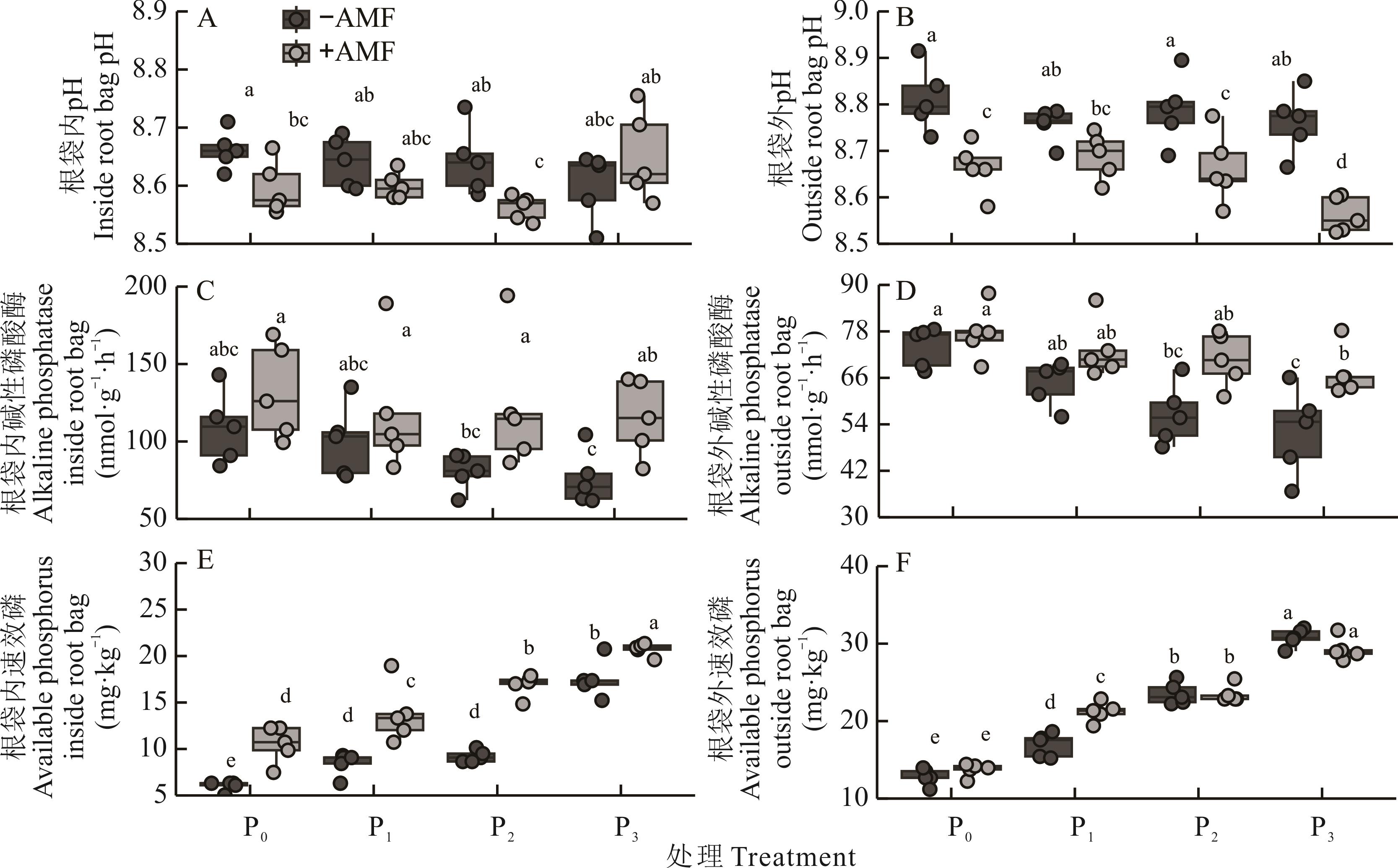
Fig.4 Effects of different phosphorus gradients and arbuscular mycorrhizal fungi (AMF) treatments on the pH, alkaline phosphatase, and soil available phosphorus inside and outside the root bag of L. chinensis
因子 Factor | pH | 碱性磷酸酶Alkaline phosphatase | 速效磷Soil available phosphorus | |||
|---|---|---|---|---|---|---|
根袋内 Inside root bag | 根袋外 Outside root bag | 根袋内 Inside root bag | 根袋外 Outside root bag | 根袋内 Inside root bag | 根袋外 Outside root bag | |
| AMF | 5.094* | 50.631*** | 11.273** | 19.580*** | 98.149*** | 5.166* |
| P | 0.603 | 3.175* | 1.390 | 8.869** | 77.561*** | 321.517*** |
| AMF×P | 3.687* | 2.058 | 0.407 | 1.284 | 3.230* | 9.735*** |
Table 5 Two-way ANOVA of the effects of different phosphorus (P) gradients and arbuscular mycorrhizal fungi (AMF) treatments on soil pH, alkaline phosphatase activity, and soil available phosphorus content
因子 Factor | pH | 碱性磷酸酶Alkaline phosphatase | 速效磷Soil available phosphorus | |||
|---|---|---|---|---|---|---|
根袋内 Inside root bag | 根袋外 Outside root bag | 根袋内 Inside root bag | 根袋外 Outside root bag | 根袋内 Inside root bag | 根袋外 Outside root bag | |
| AMF | 5.094* | 50.631*** | 11.273** | 19.580*** | 98.149*** | 5.166* |
| P | 0.603 | 3.175* | 1.390 | 8.869** | 77.561*** | 321.517*** |
| AMF×P | 3.687* | 2.058 | 0.407 | 1.284 | 3.230* | 9.735*** |

Fig.5 Effects of different phosphorus gradients and arbuscular mycorrhizal fungi (AMF)treatments on the carbon, phosphorus, and nitrogen contents of the aboveground and belowground parts of L. chinensis
因子 Factor | 碳含量Carbon content | 磷含量Phosphorus content | 氮含量Nitrogen content | |||
|---|---|---|---|---|---|---|
| 地上Aboveground | 地下Belowground | 地上Aboveground | 地下Belowground | 地上Aboveground | 地下Belowground | |
| AMF | 0.466 | 27.113*** | 4.164* | 5.542** | 2.063 | 16.627*** |
| P | 2.516 | 1.125 | 106.267*** | 22.699*** | 19.191*** | 2.771 |
| AMF×P | 0.539 | 0.368 | 27.343*** | 1.490 | 0.298 | 0.465 |
Table 6 Two-way ANOVA of the effects of different phosphorus (P) gradients and arbuscular mycorrhizal fungi (AMF) treatments on the carbon, phosphorus, and nitrogen contents of the aboveground and belowground parts of L. chinensis
因子 Factor | 碳含量Carbon content | 磷含量Phosphorus content | 氮含量Nitrogen content | |||
|---|---|---|---|---|---|---|
| 地上Aboveground | 地下Belowground | 地上Aboveground | 地下Belowground | 地上Aboveground | 地下Belowground | |
| AMF | 0.466 | 27.113*** | 4.164* | 5.542** | 2.063 | 16.627*** |
| P | 2.516 | 1.125 | 106.267*** | 22.699*** | 19.191*** | 2.771 |
| AMF×P | 0.539 | 0.368 | 27.343*** | 1.490 | 0.298 | 0.465 |

Fig.6 Effects of different phosphorus gradients and arbuscular mycorrhizal fungi (AMF) treatments on the nitrogen to phosphorus ratio, phosphorus uptake, phosphorus acquisition efficiency, and phosphorus utilization efficiency of L. chinensis
因子 Factor | 氮磷比 N/P | 磷吸收量 Phosphorus uptake | 磷吸收效率 Phosphorus acquisition efficiency | 磷利用效率 Phosphorus utilization efficiency |
|---|---|---|---|---|
| AMF | 2.240 | 23.806*** | 2.910* | 29.650*** |
| P | 66.151*** | 11.322** | 0.038 | 1.504 |
| AMF×P | 1.547 | 2.009 | 0.226 | 5.288** |
Table 7 Two-way ANOVA of the effects of different phosphorus (P) gradients and arbuscular mycorrhizal fungi (AMF)treatments on the nitrogen to phosphorus ratio, phosphorus uptake,phosphorus acquisition efficiency, and phosphorus utilization efficiency of L. chinensis
因子 Factor | 氮磷比 N/P | 磷吸收量 Phosphorus uptake | 磷吸收效率 Phosphorus acquisition efficiency | 磷利用效率 Phosphorus utilization efficiency |
|---|---|---|---|---|
| AMF | 2.240 | 23.806*** | 2.910* | 29.650*** |
| P | 66.151*** | 11.322** | 0.038 | 1.504 |
| AMF×P | 1.547 | 2.009 | 0.226 | 5.288** |
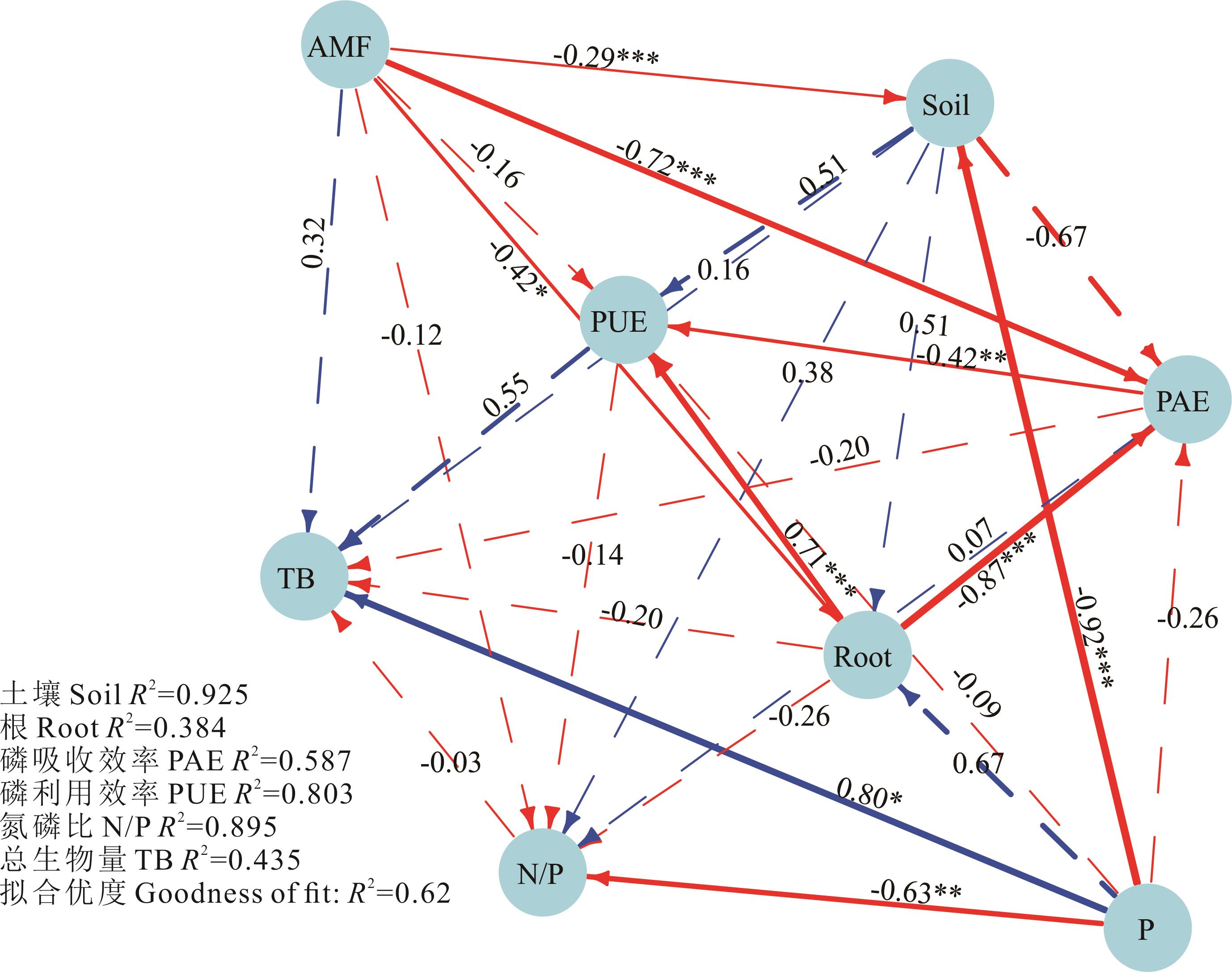
Fig.7 Partial least squares path modeling (PLS-PM) analysis of the effects of different phosphorus (P) gradients and arbuscular mycorrhizal fungi (AMF) treatments on soil, root configuration (Root), nitrogen to phosphorus ratio (N/P), phosphorus absorption efficiency (PAE), phosphorus use efficiency (PUE), and total biomass (TB)

Fig.8 Direct and indirect effects of different phosphorus (P) gradients and arbuscular mycorrhizal fungi (AMF) treatments on soil, root morphology, nitrogen to phosphorus ratio, phosphorus uptake efficiency, phosphorus utilization efficiency, and total biomass
| 1 | Tilman D, Balzer C, Hill J, et al. Global food demand and the sustainable intensification of agriculture. Proceedings of the National Academy of Sciences of the United States of America, 2011, 108(50): 20260-20264. |
| 2 | Shen J, Yuan L, Zhang J, et al. Phosphorus dynamics: from soil to plant. Plant Physiology, 2011, 156(3): 997-1005. |
| 3 | Wang L, Zhang L, George T S, et al. A core microbiome in the hyphosphere of arbuscular mycorrhizal fungi has functional significance in organic phosphorus mineralization. New Phytologist, 2023, 238(2): 859-873. |
| 4 | Lynch J P. Root phenes for enhanced soil exploration and phosphorus acquisition: tools for future crops. Plant Physiology, 2011, 156(3): 1041-1049. |
| 5 | Begum N, Qin C, Ahanger M A, et al. Role of arbuscular mycorrhizal fungi in plant growth regulation: implications in abiotic stress tolerance. Frontiers in Plant Science, 2019, 10: 1068. |
| 6 | Qiu Q, Bender S F, Mgelwa A S, et al. Arbuscular mycorrhizal fungi mitigate soil nitrogen and phosphorus losses: a Meta-analysis. Science of the Total Environment, 2022, 807(1): 150857. |
| 7 | Chandrasekaran M. A Meta-analytical approach on arbuscular mycorrhizal fungi inoculation efficiency on plant growth and nutrient uptake. Agriculture, 2020, 10(9): 370. |
| 8 | Qi S, Wang J, Wan L, et al. Arbuscular mycorrhizal fungi contribute to phosphorous uptake and allocation strategies of Solidago canadensis in a phosphorous-deficient environment. Frontiers in Plant Science, 2022, 13(2): 831654. |
| 9 | Bruce A, Smith S E, Tester M. The development of mycorrhizal infection in cucumber: effects of P supply on root growth, formation of entry points and growth of infection units. New Phytologist, 1994, 127(3): 507-514. |
| 10 | Lekberg Y, Jansa J, McLeod M, et al. Carbon and phosphorus exchange rates in arbuscular mycorrhizas depend on environmental context and differ among co-occurring plants. New Phytologist, 2024, 242(4): 1576-1588. |
| 11 | Zhang D, Lyu Y, Li H, et al. Neighbouring plants modify maize root foraging for phosphorus: coupling nutrients and neighbours for improved nutrient-use efficiency. New Phytologist, 2020, 226(1): 244-253. |
| 12 | Smith S E, Read D J. Mycorrhizal symbiosis (the third edition). San Diego: Academic Press, 2008. |
| 13 | Plassard C, Dell B. Phosphorus nutrition of mycorrhizal trees. Tree Physiology, 2010, 30(9): 1129-1139. |
| 14 | Javot H, Penmetsa R V, Terzaghi N, et al. A Medicago truncatula phosphate transporter indispensable for the arbuscular mycorrhizal symbiosis. Proceedings of the National Academy of Sciences of the United States of America, 2007, 104(5): 1720-1725. |
| 15 | Smith F A, Jakobsen I, Grønlund M, et al. Roles of arbuscular mycorrhizas in plant phosphorus nutrition: interactions between pathways of phosphorus uptake in arbuscular mycorrhizal roots have important implications for understanding and manipulating plant phosphorus acquisition. Plant Physiology, 2011, 156(3): 1050-1057. |
| 16 | Xu H B, Xin X P, Baoyintaogetao, et al. Effects of grazing on biomass distribution in Leymus chinensis meadow steppe of Hulunbuir. Acta Agrestia Sinica, 2020, 28(3): 768-774. |
| 许宏斌, 辛晓平, 宝音陶格涛, 等. 放牧对呼伦贝尔羊草草甸草原生物量分布的影响. 草地学报, 2020, 28(3): 768-774. | |
| 17 | Li Y, Gong J R, Liu M, et al. Defense strategies of dominant plants under different grazing intensity in the typical temperate steppe of Nei Mongol, China. Chinese Journal of Plant Ecology, 2020, 44(6): 642-653. |
| 李颖, 龚吉蕊, 刘敏, 等. 不同放牧强度下内蒙古温带典型草原优势种植物防御策略. 植物生态学报, 2020, 44(6): 642-653. | |
| 18 | Qi Y C, Dong Y S, Geng Y B, et al. The progress in the carbon cycle researches in grassland ecosystem in China. Progress in Geography, 2003, 22(4): 342-352. |
| 齐玉春, 董云社, 耿元波, 等. 我国草地生态系统碳循环研究进展.地理科学进展, 2003, 22(4): 342-352. | |
| 19 | Balei. Competition and coexistence of Leymus chinensis and its main companion species in the Songnen grasslands. Changchun: Northeast Normal University, 2005. |
| 巴雷.松嫩草地羊草与其主要伴生种竞争与共存研究. 长春: 东北师范大学,2005. | |
| 20 | Zhen L N, Wang R M, Zhou F, et al. Influence of AM fungi on the growth of Leymus chinensis under phosphorus applying at different rate. Chinese Journal of Grassland, 2015, 37(6): 56-61. |
| 甄莉娜, 王润梅, 周凤, 等. 不同施磷水平下AM真菌对羊草生长的影响.中国草地学报, 2015, 37(6): 56-61. | |
| 21 | Shan L W, Zhang Q, Zhu R F, et al. Effects of AMF on growth and photosynthetic physiological characteristics of Leymus chinensis and Medicago sativa with and without nitrogen and phosphorus application. Acta Prataculturae Sinica, 2020, 29(8):46-57. |
| 单立文, 张强, 朱瑞芬, 等. 氮、磷添加下AMF对羊草和苜蓿生长与光合生理特性的影响. 草业学报, 2020, 29(8): 46-57. | |
| 22 | Shan L S. Studies on morphology and function of root of typical desert plant and its drought-resistant physiology characteristics on northwest China. Lanzhou: Gansu Agricultural University, 2013. |
| 单立山. 西北典型荒漠植物根系形态结构和功能及抗旱生理研究. 兰州: 甘肃农业大学, 2013. | |
| 23 | Ketipearachchi K W, Tatsumi J. Local fractal dimensions and multifractal analysis of the root system of legumes. Plant Production Science, 2000, 3(3): 289-295. |
| 24 | Liu R J, Luo X S. A new method to quantify the inoculum potential of arbuscular mycorrhizal fungi. New Phytologist, 1994, 128(1): 89-92. |
| 25 | Bao S D. Soil agrochemical analysis (the third edition). Beijing: China Agriculture Press, 2000. |
| 鲍士旦. 土壤农化分析(第3版). 北京: 中国农业出版社, 2000. | |
| 26 | Lyu Y, Tang H L, Li H G, et al. Major crop species show differential balance between root morphological and physiological responses to variable phosphorus supply. Frontiers in Plant Science, 2016, 7: 1939-1954. |
| 27 | Karlova R, Boer D, Hayes S, et al. Root plasticity under abiotic stress. Plant Physiology, 2021, 187(3): 1057-1070. |
| 28 | Razaq M, Zhang P, Shen H, et al. Influence of nitrogen and phosphorous on the growth and root morphology of Acer mono. PLoS One, 2017, 12(2): e0171321. |
| 29 | Vain S, Tamm I, Tamm Ü, et al. Negative relationship between topsoil root production and grain yield in oat and barley. Agriculture, Ecosystems & Environment, 2023, 349(2): 108467. |
| 30 | Sun J, Rong Z, Yang L, et al. Effects of AMF inoculation on the growth, photosynthesis and root physiological morphology of root-pruned Robinia pseudoacacia seedlings. Tree Physiology, 2024, 44(1): tpad130. |
| 31 | Zhang T, Zou X H, Li L X, et al. Research progress on the cost and benefit of root acquisition metabolism from plant resources. Journal of Northwest Forestry University, 2023, 38(4): 149-155. |
| 张婷, 邹显花, 李林鑫, 等. 根系获取资源过程中的代谢成本权衡策略研究进展. 西北林学院学报, 2023, 38(4): 149-155. | |
| 32 | Liu D. Root developmental responses to phosphorus nutrition. Journal of Integrative Plant Biology, 2021, 63(6): 1065-1090. |
| 33 | de Souza Kulmann M S, Aguilar M V M, Tassinari A, et al. Effects of increasing soil phosphorus and association with ectomycorrhizal fungi (Pisolithus microcarpus) on morphological, nutritional, biochemical, and physiological parameters of Pinus taeda L. Forest Ecology and Management, 2023, 544: 121207. |
| 34 | Gruber B D, Giehl R F H, Friedel S, et al. Plasticity of the Arabidopsis root system under nutrient deficiencies. Plant Physiology, 2013, 163(1): 161-179. |
| 35 | de Vries J, Evers J B, Kuyper T W, et al. Mycorrhizal associations change root functionality: a 3D modelling study on competitive interactions between plants for light and nutrients. New Phytologist, 2021, 231(3): 1171-1182. |
| 36 | Walk T C, Van Erp E, Lynch J P. Modelling applicability of fractal analysis to efficiency of soil exploration by roots. Annals of Botany, 2004, 94(1): 119-128. |
| 37 | Yang M Q, Wu R C, Wang X H, et al. Effects of slow-release fertilizer and mycorrhizal fungi on the root growth and architecture of Cyclobalanopsis gilva container seedlings. Journal of Plant Nutrition and Fertilizer, 2023, 29(9): 1761-1770. |
| 杨孟晴, 吴仁超, 王秀花, 等. 赤皮青冈容器苗根系生长和构型对缓释肥和菌根菌的响应. 植物营养与肥料学报, 2023, 29(9): 1761-1770. | |
| 38 | Vance C P, Uhde-Stone C, Allan D L. Phosphorus acquisition and use:critical adaptations by plants for securing a nonrenewable resource. New Phytologist, 2003, 157(3): 423-447. |
| 39 | Qin M, Zhang Q, Pan J, et al. Effect of arbuscular mycorrhizal fungi on soil enzyme activity is coupled with increased plant biomass. European Journal of Soil Science, 2020, 71(1): 84-92. |
| 40 | Yu L, Zhang H, Zhang W, et al. Cooperation between arbuscular mycorrhizal fungi and plant growth-promoting bacteria and their effects on plant growth and soil quality. PeerJ, 2022, 10(1): e13080. |
| 41 | Delavaux C S, Smith-Ramesh L M, Kuebbing S E. Beyond nutrients: a Meta-analysis of the diverse effects of arbuscular mycorrhizal fungi on plants and soils. Ecology, 2017, 98(8): 2111-2119. |
| 42 | Li Y L, Mao W, Zhao X Y, et al. Leaf nitrogen and phosphorus stoichiometry in typical desert and desertified regions, North China. Environmental Science, 2010, 31(8): 1716-1725. |
| 李玉霖, 毛伟, 赵学勇, 等. 北方典型荒漠及荒漠化地区植物叶片氮磷化学计量特征研究. 环境科学, 2010, 31(8): 1716-1725. |
| [1] | Wen-wen QI, Hong-yuan MA, Ya-xiao LI, Yan DU, Meng-dan SUN, Hai-tao WU. Progress in research on breeding methods to produce new, high-quality forage varieties [J]. Acta Prataculturae Sinica, 2024, 33(6): 187-202. |
| [2] | Ying TAN, Hao YIN. Effects of root application of an arbuscular mycorrhizal fungus and melatonin on the growth, photosynthetic characteristics, and antioxidant system of Medicago sativa under salt stresss [J]. Acta Prataculturae Sinica, 2024, 33(6): 64-75. |
| [3] | Hai-xia DUAN, Qian SHI, Sheng-ping KANG, Hai-qing GOU, Chong-liang LUO, You-cai XIONG. Advances in research on the interactions among arbuscular mycorrhizal fungi, rhizobia, and plants [J]. Acta Prataculturae Sinica, 2024, 33(5): 166-182. |
| [4] | Lu-ping MA, Zhao-yong SHI, Wen-jing WEI, Shuang YANG. Meta-analysis of the effects of mycorrhizal fungi on plant leaf physiology [J]. Acta Prataculturae Sinica, 2024, 33(4): 99-109. |
| [5] | Xiao-yu LU, Ya-jie LIU, Cai-xia BAI, Jin-hua LI, Zi-he WANG, Chun-xue YANG. Effects of Chloris virgata and arbuscular mycorrhizal fungi on the growth of Leymus chinensis under alkali stress [J]. Acta Prataculturae Sinica, 2024, 33(11): 69-83. |
| [6] | Si-qi YANG, Ya-jing BAO, Jia-qi YE, Shuai WU, Meng ZHANG, Meng-ran XU, Yu ZHAO, Xiao-tao LYU, Xing-guo HAN. Comparison of photosynthetic-CO2 response process and models of Leymus chinensis under differing nitrogen addition and mowing conditions [J]. Acta Prataculturae Sinica, 2023, 32(9): 160-172. |
| [7] | Yan KANG, Yao-hui WANG, Tian-hui NIU, Zhe TENG, Zhi QI, Jia YANG. Functional identification of iron transport of LcZIP1 in Leymus chinensis [J]. Acta Prataculturae Sinica, 2023, 32(9): 173-180. |
| [8] | Xiao-xia AN, Ying-ying ZHANG, Chun-hui MA, Man LI, Qian-bing ZHANG. Effects of phosphorus application and inoculation with arbuscular mycorrhizal fungi on alfalfa yield and phosphorus use efficiency [J]. Acta Prataculturae Sinica, 2023, 32(6): 71-84. |
| [9] | Ji FENG, Zhi-kuo LIU, Hai-yan LI, Yun-fei YANG, Jian GUO. Effects of enclosure and long-term mowing on vegetative reproduction characteristics of Leymus chinensis and Arundinella hirta populations in the Songnen Grassland, China [J]. Acta Prataculturae Sinica, 2023, 32(5): 50-60. |
| [10] | Yan-lan ZHAO, Xin-yi ZENG, Jin-chao GONG, Xiang-jun LI, Xu-xu LI, Shan LIU, Xin-quan ZHANG, Ji-qiong ZHOU. Effect of arbuscular mycorrhizal fungi on the salt tolerance of Trifolium repens [J]. Acta Prataculturae Sinica, 2023, 32(3): 179-188. |
| [11] | Hong-jian WEI, Wen-yuan HE, Yue WANG, Ming TANG, Hui CHEN. The effects of arbuscular mycorrhizal fungi and melatonin on the heat tolerance of perennial ryegrass [J]. Acta Prataculturae Sinica, 2023, 32(12): 126-138. |
| [12] | Jin-rui WU, Meng-zhen LI, Yong YANG, Ai-jun LIU, Pu-chang WANG, Hasibagen, Shi-jie LYU, Xiang-jun YUN. Spatial distribution of the Leymus chinensis population under different grazing intensities in a typical steppe area [J]. Acta Prataculturae Sinica, 2023, 32(12): 68-76. |
| [13] | Ya TAO, Li-jun XU, Feng LI, Wen-long LI, Qi-zhong SUN, Chang XU, Ke-jian LIN. The Leymus chinensis industry in China needs to be urgently revitalized [J]. Acta Prataculturae Sinica, 2023, 32(11): 188-198. |
| [14] | Ying JIANG, Chang WEI, Qiu-juan JIAO, Feng-min SHEN, Ge-zi LI, Xue-hai ZHANG, Fang YANG, Hai-tao LIU. Effects of exogenous silicon application on physiological parameters, root architecture and diameter distribution of maize under cadmium stress [J]. Acta Prataculturae Sinica, 2022, 31(9): 139-154. |
| [15] | Ze-dong ZHOU, Hui-ling MA, Xu HAN, Yuan-heng LI, Xi-liang LI, Kun-na LI. Responses of photosynthetic characteristics of Leymus chinensis in temperate typical steppe to component factors of simulated grazing [J]. Acta Prataculturae Sinica, 2022, 31(8): 81-89. |
| Viewed | ||||||
|
Full text |
|
|||||
|
Abstract |
|
|||||
