
ISSN 1004-5759 CN 62-1105/S
Acta Prataculturae Sinica ›› 2026, Vol. 35 ›› Issue (4): 14-28.DOI: 10.11686/cyxb2025198
Previous Articles Next Articles
Jing-juan MA1,2( ), Xi-lai LI1,2(), Tong-jiang YIN2, Yu-ying BAO1,2, Yu-fang ZHANG1,2, Bei-qiao DING1,2, Ying YUAN1,2
Received:2025-05-19
Revised:2025-08-08
Online:2026-04-20
Published:2026-02-07
Contact:
Xi-lai LI
Jing-juan MA, Xi-lai LI, Tong-jiang YIN, Yu-ying BAO, Yu-fang ZHANG, Bei-qiao DING, Ying YUAN. Effects of recovery succession of degraded patches on soil water holding capacity in an alpine meadow[J]. Acta Prataculturae Sinica, 2026, 35(4): 14-28.

Fig.1 Experimental design and distribution characteristics of sampling plots
演替阶段 Succession stages | 演替年限 Years of succession (a) | 主要优势种 Main dominant species | 基本特征 Basic feature | 植被盖度 Vegetation coverage (%) |
|---|---|---|---|---|
| BP | - | - | 土壤裸露疏松、偶有植物生长Soil exposed loose, occasional plant growth | 0 |
| SRP | 3~5 | 密花香薷E. densa; 西藏微孔草M. tibetica | 高原鼠兔停止干扰活动,有少量杂类草定植Plateau pikas stopped interfering activities, and a small number of forbs were planted | 20~40 |
| LRP | >5, <30 | 黑褐苔草Carex atrofusca | 正在进行自然生态恢复,还未形成草皮Natural ecological restoration is underway, and the turf has not yet been formed | 50~80 |
| HAM | >30 | 矮生嵩草C. alatauensis; 高山嵩草C. parvula | 没有发生退化的高寒草甸Alpine meadow without degradation | >90 |
Table 1 Summary of basic information of the patchily degraded alpine meadow at four recovery succession stages
演替阶段 Succession stages | 演替年限 Years of succession (a) | 主要优势种 Main dominant species | 基本特征 Basic feature | 植被盖度 Vegetation coverage (%) |
|---|---|---|---|---|
| BP | - | - | 土壤裸露疏松、偶有植物生长Soil exposed loose, occasional plant growth | 0 |
| SRP | 3~5 | 密花香薷E. densa; 西藏微孔草M. tibetica | 高原鼠兔停止干扰活动,有少量杂类草定植Plateau pikas stopped interfering activities, and a small number of forbs were planted | 20~40 |
| LRP | >5, <30 | 黑褐苔草Carex atrofusca | 正在进行自然生态恢复,还未形成草皮Natural ecological restoration is underway, and the turf has not yet been formed | 50~80 |
| HAM | >30 | 矮生嵩草C. alatauensis; 高山嵩草C. parvula | 没有发生退化的高寒草甸Alpine meadow without degradation | >90 |
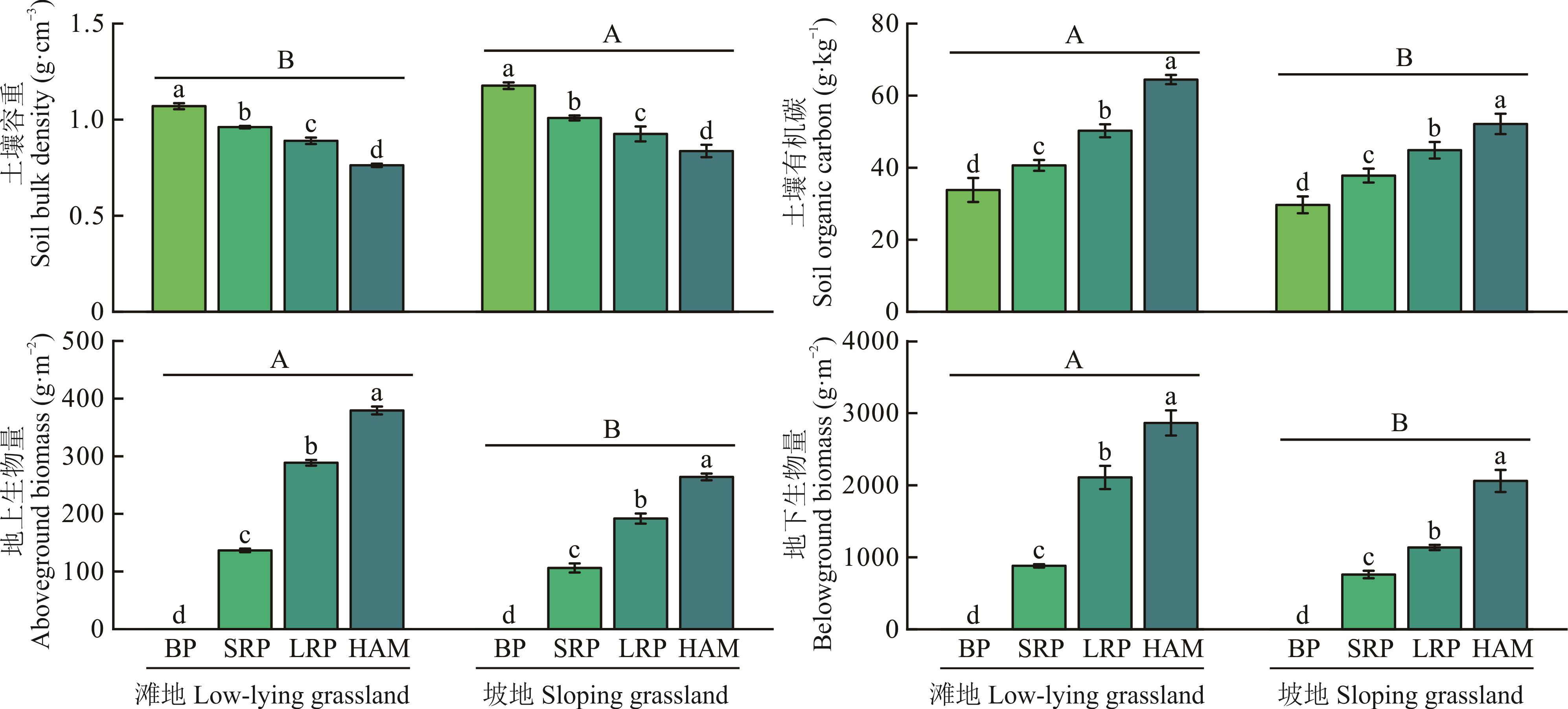
Fig.2 Variations of soil bulk density, organic carbon, aboveground and underground biomass of low-lying and sloping grasslands at different recovery succession stages

Fig.3 Changes in soil porosity of low-lying and sloping grasslands at different recovery succession stages

Fig. 4 Changes in soil water holding capacity of low-lying and sloping grasslands at different recovery succession stages
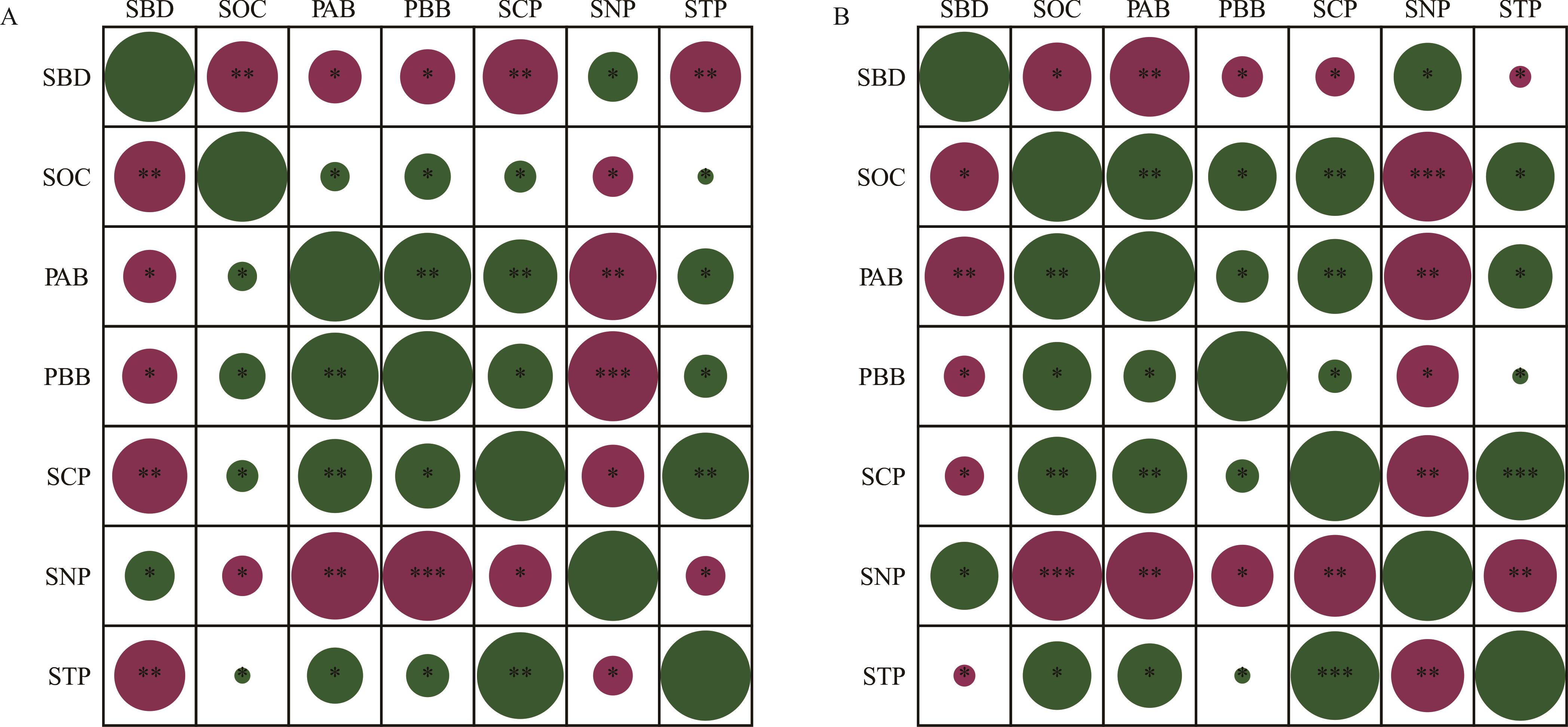
Fig. 5 Intra-group correlation of soil capillary porosity, noncapillary porosity, total porosity, bulk density, organic carbon and aboveground and underground biomass in the patchily degraded alpine meadow during recovery succession
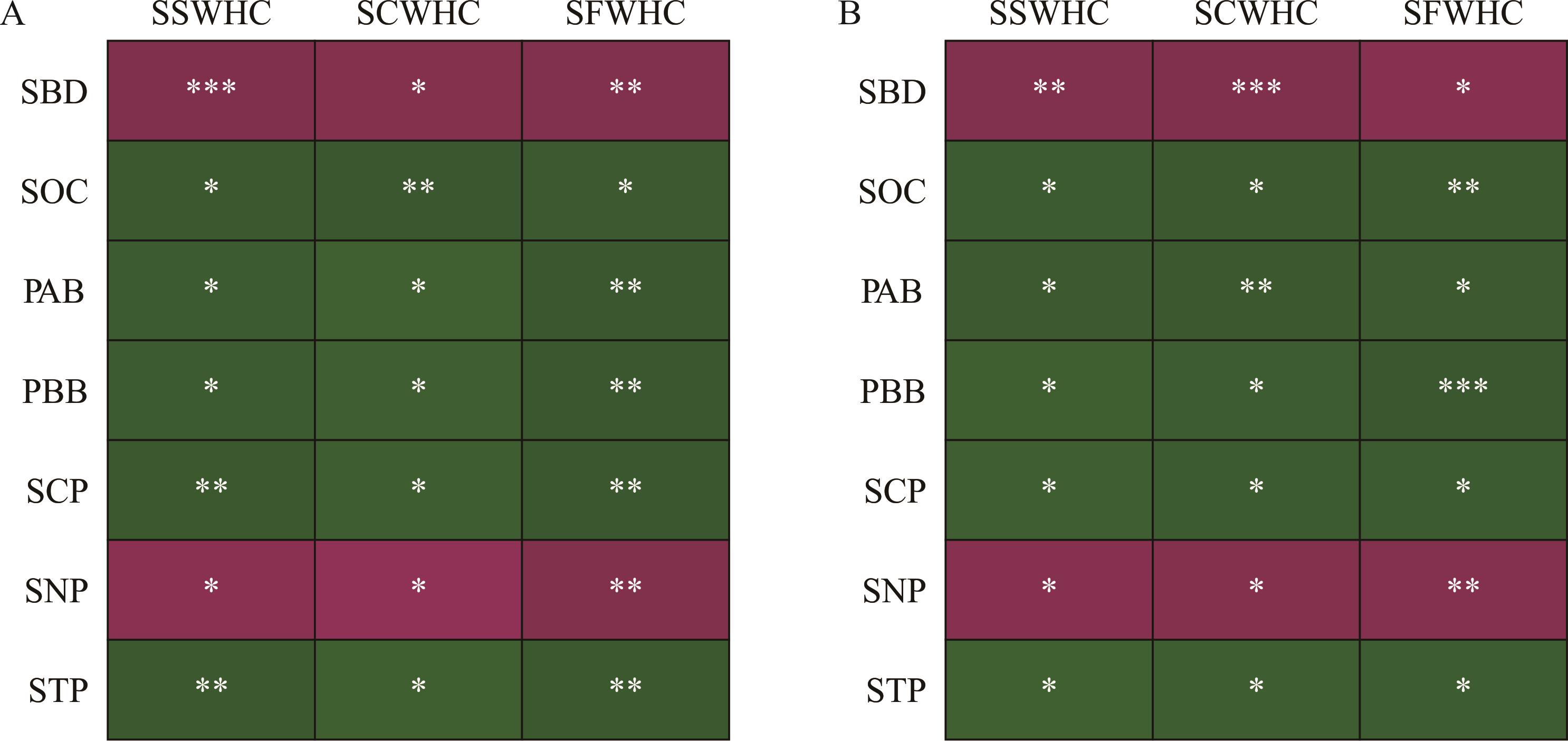
Fig.6 Inter-group correlation between soil water holding capacity and soil porosity, bulk density, organic carbon, aboveground and underground biomass in the patchily degraded alpine meadow during recovery succession
| [1] | Zhao J M, Zhang D G, Liu C Z. The effect of land use patterns on soil moisture retention capacity and soil infiltration property in eastern Qilian mountains. Journal of Natural Resources, 2012, 27(3): 422-429. |
| 赵锦梅, 张德罡, 刘长仲. 东祁连山土地利用方式对土壤持水能力和渗透性的影响. 自然资源学报, 2012, 27(3): 422-429. | |
| [2] | Wang Z W, Huang L M, Shao M A, et al. Soil water holding capacity under different land use patterns in the Qinghai alpine region. Arid Zone Research, 2021, 38(6): 1722-1730. |
| 王紫薇, 黄来明, 邵明安, 等. 青海高寒区不同土地利用方式下土壤持水能力及影响因素. 干旱区研究, 2021, 38(6): 1722-1730. | |
| [3] | Liu Y, Gao M S, Wu W, et al. The effects of conservation tillage practices on the soil water-holding capacity of a non-irrigated apple orchard in the Loess Plateau, China. Soil and Tillage Research, 2013, 130: 7-12. |
| [4] | Sun Y, Yang Y S, He Q, et al. Responses of soil water conservation function and soil physicochemical properties to a range of degradation conditions in alpine meadows of the Three River Headwater Region. Acta Prataculturae Sinica, 2023, 32(6): 16-29. |
| 孙玉, 杨永胜, 何琦, 等. 三江源高寒草甸水源涵养功能及土壤理化性质对退化程度的响应. 草业学报, 2023, 32(6): 16-29. | |
| [5] | Gao Z Y, Lin Z J, Niu F J, et al. Soil water dynamics in the active layers under different land-cover types in the permafrost regions of the Qinghai-Tibet Plateau, China. Geoderma, 2020, 364: 114176. |
| [6] | Zhang Y W, Wang K B, Wang J, et al. Changes in soil water holding capacity and water availability following vegetation restoration on the Chinese Loess Plateau. Scientific Reports, 2021, 11(1): 9692. |
| [7] | Li Y X, Yu M, Cao G C. Research on soil physical properties and water holding capacity of lands with different use type in the southern slope of Qilian mountains. Journal of Ningxia University (Natural Science Edition), 2020, 41(2): 191-197. |
| 李银霞, 虞敏, 曹广超. 祁连山南坡不同土地利用类型土壤物理特性及其持水能力研究. 宁夏大学学报(自然科学版), 2020, 41(2): 191-197. | |
| [8] | Duan C W, Li X L, Li C Y, et al. Formation mechanism of alpine meadow bare patches and key factors limiting their restoration in the Source Zone of the Yellow River. Acta Ecologica Sinica, 2024, 44(16): 6952-6964. |
| 段成伟, 李希来, 李成一, 等. 黄河源区高寒草甸裸露斑块形成机理与生态修复关键限制因子. 生态学报, 2024, 44(16): 6952-6964. | |
| [9] | Qin L P, Luo T X, Feng Z L, et al. Study on soil water capacity change of natural steppe with different utilization methods. China Herbivore Science, 2023, 43(5): 66-69. |
| 秦丽萍, 罗天旭, 冯兆林, 等. 不同利用方式天然草原土壤涵水能力变化研究. 中国草食动物科学, 2023, 43(5): 66-69. | |
| [10] | Zhu J B, He H D, Li H Q, et al. Characteristics of soil bulk density and soil water-holding capacity in alpine meadow under grazing gradients. Research of Soil and Water Conservation, 2018, 25(5): 66-71. |
| 祝景彬, 贺慧丹, 李红琴, 等. 牧压梯度下高寒草甸土壤容重及持水能力的变化特征. 水土保持研究, 2018, 25(5): 66-71. | |
| [11] | Li H Q, Wu X L, Zhang F W, et al. The response of soil water holding capacity of alpine meadow in winter pasture to enclosure. Chinese Journal of Grassland, 2021, 43(8): 1-8. |
| 李红琴, 吴夏璐, 张法伟, 等. 高寒草甸冬季牧场土壤持水能力对草地封育的响应. 中国草地学报, 2021, 43(8): 1-8. | |
| [12] | Chen G R, Hu J, Li C Y, et al. Repercussions of recovering patchy alpine meadows on soil nematode communities in the meadow ecosystems of the Yellow River source region, west China. Global Ecology and Conservation, 2025: e03565. |
| [13] | Wang Y M, Li G R, Li X L, et al. Spatial heterogeneity of alpine meadow patchiness and its topographic factor influence. Acta Agrestia Sinica, 2024, 32(2): 570-578. |
| 王祎明, 李国荣, 李希来, 等. 高寒草甸斑块化空间分异性及其地形因子影响. 草地学报, 2024, 32(2): 570-578. | |
| [14] | Duan C W, Li X L, Li C Y, et al. Positive effects of fungal β diversity on soil multifunctionality mediated by pH in the natural restoration succession stages of alpine meadow patches. Ecological Indicators, 2023, 148: 110122. |
| [15] | Yang S W, Zhang D G, Niu Y J, et al. Effect of short-term grazing on surface soil infiltration and soil water retention in alpine meadow. Journal of Soil and Water Conservation, 2016, 30(4): 96-101. |
| 杨思维, 张德罡, 牛钰杰, 等. 短期放牧对高寒草甸表层土壤入渗和水分保持能力的影响. 水土保持学报, 2016, 30(4): 96-101. | |
| [16] | Ma H X, Zhang D G, Chen J, et al. Change in factors influencing soil water holding capacity at microsites along a slope transect in alpine meadow in the eastern Qilian mountains. Acta Prataculturae Sinica, 2020, 29(1): 28-37. |
| 马海霞, 张德罡, 陈瑾, 等. 祁连山东段高寒草甸土壤持水能力在小尺度不同坡面位置的分异特征. 草业学报, 2020, 29(1): 28-37. | |
| [17] | Yang Y S, Zhang L, Wei Y X, et al. Effects of degradation degree on soil physicochemical properties and soil water-holding capacity in Zeku alpine meadow in the Headwater Region of Three Rivers in China. Chinese Journal of Grassland, 2017, 39(5): 54-61. |
| 杨永胜, 张莉, 未亚西, 等. 退化程度对三江源泽库高寒草甸土壤理化性质及持水能力的影响. 中国草地学报, 2017, 39(5): 54-61. | |
| [18] | Fan Y J, Hou X Y, Zhao D P, et al. Preliminary study on soil water-holding capacity along degradation gradients of alpine meadow. Journal of Southwest Minzu University (Natural Science Edition), 2019, 45(1): 10-15. |
| 范月君, 侯向阳, 赵得萍, 等. 不同退化演替阶段高寒草甸表层土壤持水特性的初步研究. 西南民族大学学报(自然科学版), 2019, 45(1): 10-15. | |
| [19] | Ning L, Yao Z Y, Gao T M, et al. The influence of different slope positions on the characteristics of desert grassland plant communities. Journal of Northeast Forestry University, 2025, 53(1): 15-22. |
| 宁璐, 要振宇, 高天明, 等. 不同坡位对荒漠草原植物群落特征的影响. 东北林业大学学报, 2025, 53(1): 15-22. | |
| [20] | Ning L. Effects of different slope positions on community characteristics and functional traits of dominant plants in desert steppe. Hohhot: Inner Mongolia Agricultural University, 2023. |
| 宁璐. 不同坡位对荒漠草原群落特征及优势植物功能性状的影响. 呼和浩特: 内蒙古农业大学, 2023. | |
| [21] | Yang P N, Li X L, Li C Y, et al. Response of soil microbial diversity to long-term enclosure in degraded patches of alpine meadow in the Source Zone of the Yellow River. Environmental Science, 2023, 44(4): 2293-2303. |
| 杨鹏年, 李希来, 李成一, 等. 黄河源区斑块化退化高寒草甸土壤微生物多样性对长期封育的响应. 环境科学, 2023, 44(4): 2293-2303. | |
| [22] | Song Z H, Li X L, Li J X, et al. Response of snowmelt patches on alpine meadow to grassland mowing and pika density. Grassland and Turf, 2020, 40(5): 15-22. |
| 宋梓涵, 李希来, 李杰霞, 等. 高寒草甸融雪斑块对植物刈割强度和高原鼠兔密度的响应. 草原与草坪, 2020, 40(5): 15-22. | |
| [23] | Gao P, Li X L, Chai Y, et al. Effects of sheep plate manure and bacterial fertilizer on the soil nutrient and enzyme activity of degenerate alpine meadow. Soil and Fertilizer Sciences in China, 2024(11): 29-36. |
| 高佩, 李希来, 柴瑜, 等. 羊板粪与枯草芽孢杆菌配施对退化高寒草甸土壤养分及酶活性的影响. 中国土壤与肥料, 2024(11): 29-36. | |
| [24] | Su X X, Li X L, Sun H F, et al. Effects of plateau pika and mowing disturbances on plant community and soil physical and chemical properties in alpine meadow. Acta Ecologica Sinica, 2024, 44(22): 10189-10199. |
| 苏晓雪, 李希来, 孙华方, 等. 高原鼠兔和刈割扰动对高寒草甸植物群落和土壤特征的影响. 生态学报, 2024, 44(22): 10189-10199. | |
| [25] | Song Z H, Li X L, Li J X, et al. Effects of plateau pika (Ochotona curzoniae) trails on enlargement and connection of degraded patches in alpine meadow. Chinese Journal of Ecology, 2020, 39(10): 3276-3284. |
| 宋梓涵, 李希来, 李杰霞, 等. 高原鼠兔跑道对高寒草甸退化斑块扩大与连通的影响. 生态学杂志, 2020, 39(10): 3276-3284. | |
| [26] | Chai Y, Li X L, Ma P P, et al. Effects of fertilization and rodent control on plant soil and microorganism carbon, nitrogen and phosphorus stoichiometry characteristics in degraded alpine meadows. Chinese Journal of Grassland, 2023, 45(1): 12-22. |
| 柴瑜, 李希来, 马盼盼, 等. 施肥和控鼠对退化高寒草甸植物-土壤-微生物碳氮磷化学计量特征的影响. 中国草地学报, 2023, 45(1): 12-22. | |
| [27] | Li Q, He G X, Wen T, et al. Response of soil physical and chemical properties to altitude and aspect of alpine meadow in the eastern Qilian Mountains and their relationships with vegetation characteristics. Arid Land Geography, 2022, 45(5): 1559-1569. |
| 李强, 何国兴, 文铜, 等. 东祁连山高寒草甸土壤理化性质对海拔和坡向的响应及其与植被特征的关系. 干旱区地理, 2022, 45(5): 1559-1569. | |
| [28] | Lamaocao. A study on limiting factors for vegetation restoration in the bald patch damaged by plateau pika and evaluation of vegetation restoration measures in alpine meadow. Lanzhou: Gansu Agricultural University, 2023. |
| 拉毛草. 高寒草甸鼠害型秃斑植被恢复限制因子分析及恢复措施评价. 兰州: 甘肃农业大学, 2023. | |
| [29] | Bao S D. Soil agrochemical analysis (the third edition). Beijing: China Agricultural Publishing House, 2000. |
| 鲍士旦. 土壤农化分析(3版). 北京: 中国农业出版社, 2000. | |
| [30] | Duan C W, Li X L, Li C Y, et al. Analysis on the soil physical, chemical, and microbial community properties of different alpine meadow patches in the Source Zone of the Yellow River, west China. Ecological Indicators, 2022, 144: 109531. |
| [31] | Feng Z Q, Sun W Y, Mu X M, et al. Effects of vegetation restoration methods on soil moisture in the small basins of Loess Plateau gully region. Science of Soil and Water Conservation, 2023, 21(4): 1-10. |
| 凤紫棋, 孙文义, 穆兴民, 等. 黄土高塬沟壑区植被恢复方式对小流域土壤水分的影响. 中国水土保持科学, 2023, 21(4): 1-10. | |
| [32] | Zhang H, Mu X M, Gao P. Variation of litter accumulation and water holding capacity at different site conditions in the Loess Plateau. Research of Soil and Water Conservation, 2021, 28(3): 45-52. |
| 张缓, 穆兴民, 高鹏. 黄土高原不同立地条件下枯落物蓄积量及持水特征. 水土保持研究, 2021, 28(3): 45-52. | |
| [33] | Liang Q Y, Fu D X, Zhan J M, et al. Effects of terrain on soil hydrological characteristics of alpine grasslands. Journal of Forest and Environment, 2024, 44(4): 367-375. |
| 梁秦杨, 付殿霞, 赵锦梅, 等. 地形对高寒草地土壤水文特征的影响. 森林与环境学报, 2024, 44(4): 367-375. | |
| [34] | Sun Z Y. Effects of vegetation restoration on soil moisture on slopes in Karst area and its influencing factors. Guiyang: Guizhou Normal University, 2020. |
| 孙智妍. 喀斯特坡地植被恢复的土壤水分效应及其影响因素研究. 贵阳: 贵州师范大学, 2020. | |
| [35] | Zhang X, Liu M X, Chen X J, et al. Species coexistence mechanism of plant communities on different slopes of Gannan sub-alpine meadows. Acta Ecologica Sinica, 2025, 45(6): 2582-2594. |
| 张鑫, 刘旻霞, 陈雪娇, 等. 甘南亚高寒草甸不同坡位植物群落物种共存机制. 生态学报, 2025, 45(6): 2582-2594. | |
| [36] | Zeng Z Q, Tian Y X, Deng Y H, et al. The runoff and soil water storage of different restoration patterns. Hunan Forestry Science & Technology, 2016, 43(4): 81-85. |
| 曾掌权, 田育新, 邓鹰鸿, 等. 不同植被恢复模式地表径流与土壤贮水能力研究. 湖南林业科技, 2016, 43(4): 81-85. | |
| [37] | Zhong Z L. Study on soil water characteristics of different plant communities in subalpine meadows of Wugong mountain. Nanchang: Jiangxi Agricultural University, 2017. |
| 钟支亮. 武功山山地草甸不同植物群落土壤水分特征研究. 南昌: 江西农业大学, 2017. | |
| [38] | Song C G, Zhang M Y, He Q, et al. Effects of grazing prohibition on vegetation community structure and soil moisture characteristics of alpine meadows on the Southern slope of the Qilian mountains. Chinese Journal of Grassland, 2023, 45(4): 22-32. |
| 宋成刚, 张铭洋, 何琦, 等. 禁牧封育对祁连山南麓高寒草甸植被群落结构及土壤水分特征的影响. 中国草地学报, 2023, 45(4): 22-32. | |
| [39] | Zhang Y H, Zhang L, Zhang X J, et al. Effects of degradation degree on plant communities and soil water holding capacity of Maqin alpine meadow. Pratacultural Science, 2022, 39(2): 235-246. |
| 张宇恒, 张莉, 张秀娟, 等. 退化程度对玛沁高寒草甸植物群落及土壤持水能力的影响. 草业科学, 2022, 39(2): 235-246. | |
| [40] | Duan C W. Study on mechanisms of alpine meadow patchy degradation and its restoration in the Source Zone of the Yellow River. Xining: Qinghai University, 2023. |
| 段成伟. 黄河源区高寒草甸斑块化退化机理与其恢复研究. 西宁: 青海大学, 2023. | |
| [41] | Shui W, Bai J P, Jian X M, et al. Changes in water conservation and soil physicochemical properties during the recovery of decertified grassland in Zoigê, China. Acta Ecologica Sinica, 2017, 37(1): 277-285. |
| 税伟, 白剑平, 简小枚, 等. 若尔盖沙化草地恢复过程中土壤特性及水源涵养功能. 生态学报, 2017, 37(1): 277-285. | |
| [42] | Yang Y H, Wu J C, Zhao S W, et al. Comparison of soil water-holding and water-supplying ability of the different grassland in Loess Hilly region. Chinese Journal of Soil Science, 2009, 40(5): 1010-1013. |
| 杨永辉, 武继承, 赵世伟, 等. 黄土丘陵沟壑区草地土壤持水、供水性能比较. 土壤通报, 2009, 40(5): 1010-1013. | |
| [43] | Li L, He H D, Wei Y X, et al. Response of vegetation community structure, soil carbon sequestration, and water-holding capacity in returning farmland to grassland plots, in the agro-pastoral transitional zone in the Three Rivers Source Region. Pratacultural Science, 2017, 34(10): 1999-2008. |
| 李令, 贺慧丹, 未亚西, 等. 三江源农牧交错区植被群落及土壤固碳持水能力对退耕还草措施的响应. 草业科学, 2017, 34(10): 1999-2008. | |
| [44] | Yang Y S, Li H Q, Zhang L, et al. Effects of fencing measurement on vegetation community structure and soil water-holding capacity in Batang alpine meadow. Mountain Research, 2016, 34(5): 606-614. |
| 杨永胜, 李红琴, 张莉, 等. 封育措施对巴塘高寒草甸植被群落结构及土壤持水能力的影响. 山地学报, 2016, 34(5): 606-614. | |
| [45] | Li W, Liu J P, Chen J, et al. Slope position effect on vegetation recovery and soil characteristics in an alpine meadow hill section. Chinese Journal of Grassland, 2024, 46(3): 110-117. |
| 李威, 刘金平, 陈俊, 等. 坡位对高寒草甸山体断面重建植被及土壤性状的影响. 中国草地学报, 2024, 46(3): 110-117. | |
| [46] | Pan R R, Li X Y, Hu G R, et al. Characteristics of soil organic carbon distribution and its controlling factors on hillslope in seasonal frozen area of Qinghai Lake Basin. Acta Ecologica Sinica, 2020, 40(18): 6374-6384. |
| 潘蕊蕊, 李小雁, 胡广荣, 等. 青海湖流域季节性冻土区坡面土壤有机碳分布特征及其影响因素. 生态学报, 2020, 40(18): 6374-6384. | |
| [47] | Ma S J, Zhou J W, Wang F C, et al. Effect of soil erosion of plateau zokor new mound in alpine meadow. Journal of Soil and Water Conservation, 2019, 33(5): 58-63, 71. |
| 马素洁, 周建伟, 王福成, 等. 高寒草甸区高原鼢鼠新生土丘水土流失特征. 水土保持学报, 2019, 33(5): 58-63, 71. | |
| [48] | Du J J, Wei P J, Bahadur A, et al. The impacts of revegetation on ecosystem services in the extremely degraded alpine grassland of permafrost regions. Sustainability, 2025, 17(4): 1512. |
| [49] | He H D, Li H Q, Zhu J B, et al. Soil water holding capacity under the condition of fencing in alpine meadow of the Source Region of Yellow River. Chinese Journal of Grassland, 2017, 39(5): 62-67. |
| 贺慧丹, 李红琴, 祝景彬, 等. 黄河源高寒草甸封育条件下的土壤持水能力. 中国草地学报, 2017, 39(5): 62-67. | |
| [50] | Wu Q H, Mao S J, Liu X Q, et al. Analysis of the soil water-holding capacity in alpine forb meadow under grazing gradient and relevant influence factors. Journal of Glaciology and Geocryology, 2014, 36(3): 590-598. |
| 吴启华, 毛绍娟, 刘晓琴, 等. 牧压梯度下高寒杂草类草甸土壤持水能力及影响因素分析. 冰川冻土, 2014, 36(3): 590-598. | |
| [51] | Zhang M Y, Li X J, Yang Y S, et al. Effects of forbidden grazing and enclosure on vegetation community structure and soil moisture characteristics in alpine meadow of the Yellow River Source. Acta Botanica Boreali-Occidentalia Sinica, 2023, 43(7): 1185-1197. |
| 张铭洋, 李小娟, 杨永胜, 等. 禁牧封育对黄河源高寒草甸植被群落结构及土壤水分特征的影响. 西北植物学报, 2023, 43(7): 1185-1197. | |
| [52] | Wang W L, He K N, Zhang T, et al. Effects of mechanical components and physical and chemical properties of soil in water conservation forests in cold highland area of Qinghai on its saturated hydraulic conductivity and water holding capacity. Journal of Plant Resources and Environment, 2020, 29(2): 69-77. |
| 王玮璐, 贺康宁, 张潭, 等. 青海高寒区水源涵养林土壤机械组成和理化性质对其饱和导水率和持水能力的影响. 植物资源与环境学报, 2020, 29(2): 69-77. | |
| [53] | Yi X S, Li G S, Li K, et al. Effect of grassland vegetation degradation on soil water holding capacity in the headwaters area of Yangtze River. Resources and Environment in the Yangtze Basin, 2018, 27(4): 907-918. |
| 易湘生, 李国胜, 李阔, 等. 长江源区草地植被退化对土壤持水能力影响. 长江流域资源与环境, 2018, 27(4): 907-918. | |
| [54] | Yan S, Xia F, Wei W, et al. Differences along an erosion gradient in alpine meadow plant community diversity and factors influencing diversity. Acta Prataculturae Sinica, 2025, 34(6): 1-13. |
| 严双, 夏菲, 魏巍, 等. 高寒草甸不同侵蚀样地植物多样性的差异及其关键影响因子. 草业学报, 2025, 34(6): 1-13. | |
| [55] | Zhang Y, Hu J, Zhou Q P, et al. Effects of shrub removal management measures on soil water conservation function in alpine shrub-encroached grassland. Acta Agrestia Sinica, 2025, 33(6): 1912-1923. |
| 张怡, 胡健, 周青平, 等. 高寒灌丛化草地灌木去除管理措施对土壤水源涵养功能的影响. 草地学报, 2025, 33(6): 1912-1923. | |
| [56] | Zhang Y H, Liu C, Fu Z Y, et al. Research progress of hydrological process and soil organic carbon migration in slope field. Chinese Journal of Soil Science, 2023, 54(3): 730-738. |
| 张宇恒, 刘春, 付智勇, 等. 坡面水文过程与土壤有机碳迁移研究进展. 土壤通报, 2023, 54(3): 730-738. | |
| [57] | Ma R, Zhao J M. Relationship between the grassland and soil conditions in the Eastern Qilian mountains. Arid Zone Research, 2020, 37(2): 374-381. |
| 马瑞, 赵锦梅. 东祁连山河谷高寒草地植被群落特征及其与土壤性状的关系. 干旱区研究, 2020, 37(2): 374-381. | |
| [58] | Sha X W, Wu Y X, Jia G D, et al. Effects of vegetation restoration on soil erodibility and nutrients at different slope sites in Northern Hebei mountains. Journal of Soil and Water Conservation, 2024, 38(4): 11-19, 28. |
| 沙晓玮, 武昱鑫, 贾国栋, 等. 冀北山地植被恢复对不同坡位土壤可蚀性与养分的影响. 水土保持学报, 2024, 38(4): 11-19, 28. | |
| [59] | Wang Z S, Tang Y H, Fang Z Y, et al. Numerical simulation of downburst wind field under continuous mountains. Journal of Hunan University (Natural Sciences), 2019, 46(3): 90-98. |
| 汪之松, 唐阳红, 方智远, 等. 山脉地形下击暴流风场数值模拟. 湖南大学学报(自然科学版), 2019, 46(3): 90-98. | |
| [60] | Guo W F, Li X, Chen Y M, et al. Evaluation of the coupling relationship between vegetation and soil system under different management measures in Taihang mountains. Acta Ecologica Sinica, 2023, 43(15): 6170-6181. |
| 郭文芳, 李鑫, 陈艳梅, 等. 太行山坡地不同管理措施植被-土壤系统耦合关系. 生态学报, 2023, 43(15): 6170-6181. | |
| [61] | Sun F D, Gou W L, Zhu C, et al. Ranking and parameters for rodents damaged rangelands and adaptive management in Northwest Plateau of Sichuan Province. Acta Agrestia Sinica, 2018, 26(1): 152-159. |
| 孙飞达, 苟文龙, 朱灿, 等. 川西北高原鼠荒地危害程度分级及适应性管理对策. 草地学报, 2018, 26(1): 152-159. | |
| [62] | Zhou R. The response of individuals and populations in plateau pika (Ochotona curzoniae) to predation risk and changes of habitat vegetation communities. Lanzhou: Gansu Agricultural University, 2020. |
| 周睿. 高原鼠兔个体和种群对捕食风险的响应及其栖息地植物群落的变化. 兰州: 甘肃农业大学, 2020. | |
| [63] | Song Z H, Li X L, Su X X, et al. Analyzing the recovery mechanisms of patchy degradation and its response to mowing and plateau pika disturbances in alpine meadow. Ecological Indicators, 2023, 154: 110565. |
| [64] | Song Z H, Li X L, Li J X, et al. Characteristics of plant functional groups and root-soil complexes of different disturbed patches in alpine meadow. Ecological Science, 2022, 41(1): 31-38. |
| 宋梓涵, 李希来, 李杰霞, 等. 高寒草甸不同扰动斑块植物功能群和根土复合体特征变化研究. 生态科学, 2022, 41(1): 31-38. | |
| [65] | Yang P N, Li X L, Li C Y, et al. Effects of long-term exclosure on main plant functional groups and their biochemical properties in a patchily degraded alpine meadow in the Source Zone of the Yellow River, West China. Agronomy, 2023, 13(11): 2781. |
| [66] | Li X L, Ma Y Q, Duan C W, et al. Effects of fertilization and reseeding on biomass and species diversity of patchy degraded alpine meadows with different slope directions. Chinese Journal of Grassland, 2024, 46(5): 1-13. |
| 李希来, 马昀峤, 段成伟, 等. 施肥和补播对不同坡向斑块化退化高寒草甸生物量和物种多样性的影响. 中国草地学报, 2024, 46(5): 1-13. | |
| [67] | Chai Y, Li X L, Li C Y, et al. Soil moisture regulates soil-microbe-enzyme stoichiometries during recovery succession in patchily degraded alpine meadows on the Qinghai-Tibet Plateau. Ecological Engineering, 2024, 204: 107287. |
| [1] | Ping MA, Zhi-guo LIU, Yu-shu SHA, Ya-ling LIU, Xiao-mei TUO, Bing-zhe FU, Xue-qing GAO. Nitrogen utilization characteristics of alfalfa at the seedling stage and screening of nitrogen-efficient varieties [J]. Acta Prataculturae Sinica, 2026, 35(4): 112-123. |
| [2] | Jian-jian LI, Xi-wen XU, Yuan ZHANG, Huan WANG, Hao-ran WANG, Xiao-hui LI, Hui-quan SHEN, Shao-bin SHEN, Jun-qin ZONG, Hai-lin GUO. Evaluation of major agronomic traits and nutritional quality of forage barley varieties in the Nanjing region [J]. Acta Prataculturae Sinica, 2026, 35(3): 114-127. |
| [3] | Xiang LI, Hang LI, Run-jie LI, Yong-kun ZHANG. Response of soil hydraulic properties to alpine swamp meadow degradation and sown grassland planting [J]. Acta Prataculturae Sinica, 2026, 35(3): 52-67. |
| [4] | Shuang YAN, Fei XIA, Wei WEI, Jing-long WANG, Hao-yang WU, Lin-ling RAN, Yun-yin XUE, Hao SHI, Shai-kun ZHENG, Jun-qiang WANG, Jun-dong HE. Differences along an erosion gradient in alpine meadow plant community diversity and factors influencing diversity [J]. Acta Prataculturae Sinica, 2025, 34(6): 1-13. |
| [5] | Rui-bing WANG, Huan CHEN, Zhen-zhen PAN, Wei ZHAO, Shao-hao BANG, Xiao-long ZHOU, Zheng-wei REN. Mechanisms of species diversity loss in an alpine meadow community after adding different types and numbers of resources [J]. Acta Prataculturae Sinica, 2025, 34(5): 1-11. |
| [6] | Jia-juan HUO, Ming-hua SONG. Changes in nitrogen uptake rate of plant species in different degradation stages of an alpine meadow on the Qinghai-Tibet Plateau [J]. Acta Prataculturae Sinica, 2025, 34(2): 16-26. |
| [7] | Xiao-dong TU, Jun-fang CUI, Fu-hong KUANG, Chun-pei LI, Jiu-zhen DU, Hong-lan WANG, Xiang-yu TANG. Effects of conversion of alpine meadow to cultivated land on the soil microbial community in northwest Sichuan [J]. Acta Prataculturae Sinica, 2025, 34(2): 54-66. |
| [8] | Xin-you WANG, Xiao-lan WANG, Wan-chang ZHANG, Ying LI, Yong-ling MA, Xiao-yin WANG, Jian-gang WANG, Hai-qing WANG, Bei-fan YUE, Yong-fu LIU, Yong-hong WANG, Shan LIU, Mei-ting BAI. Selection of optimal varieties of silage maize and methods for cultivation in mountainous forest-margin areas of southeast Gansu Province [J]. Acta Prataculturae Sinica, 2025, 34(1): 191-202. |
| [9] | Yang-yi-dan HE, Chang-ming CHEN, Xiao-xia HUANG, Guo-mei SHI, Ke-jian HE. A study of the relationship between plant functional traits and environmental factors in the alpine meadows of western Sichuan [J]. Acta Prataculturae Sinica, 2024, 33(9): 28-39. |
| [10] | Zhong-li LI, Cong-ze JIANG, Ren-shi MA, Wei GAO, Na SHOU, Yu-ying SHEN, Xian-long YANG. Suitability of five forage sweet sorghum varieties for production in the dry plateau area of Longdong [J]. Acta Prataculturae Sinica, 2024, 33(8): 50-62. |
| [11] | Xiang-jiao TAN, Kui-cai DONG, Hua ZHANG, Chuan-chuan TANG, Yan YANG. Effects of snow addition on soil phosphorus availability in an alpine meadow of the Tibetan Plateau [J]. Acta Prataculturae Sinica, 2024, 33(7): 205-214. |
| [12] | Rui-min QIN, Si-jia CHENG, Li MA, Zhong-hua ZHANG, Jing-jing WEI, Hong-ye SU, Zheng-chen SHI, Tao CHANG, Xue HU, De-ha-ze A, Fang YUAN, Shan LI, Hua-kun ZHOU. Effects of grazing exclusion and fertilization on alpine meadow community characteristics and vegetation carbon and nitrogen pools [J]. Acta Prataculturae Sinica, 2024, 33(4): 1-11. |
| [13] | Hong-fei LI, Bang-wei ZHOU, Miao ZHANG, Shu-nan SHI, Zhi-jian LI. Adaptability evaluation of different oat varieties introduced in the Hulunbuir region [J]. Acta Prataculturae Sinica, 2024, 33(4): 60-72. |
| [14] | Zhi-yuan YOU, Shu-juan MA, Chang-ting WANG, Lu-ming DING, Xiao-yan SONG, Gao-fei YIN, Jun MAO. Using the model MaxEnt to predict plant distribution patterns of different functional groups in the alpine meadow ecosystem on Sichuan-Yunnan Plateau [J]. Acta Prataculturae Sinica, 2024, 33(3): 1-12. |
| [15] | Yuan MA, Xiao-li WANG, Yu-shou MA, De-gang ZHANG. Effects of the degree of alpine meadow degradation on the rhizosphere soil fungal community and the ecological network of dominant species [J]. Acta Prataculturae Sinica, 2024, 33(2): 125-137. |
| Viewed | ||||||
|
Full text |
|
|||||
|
Abstract |
|
|||||
