
ISSN 1004-5759 CN 62-1105/S
Acta Prataculturae Sinica ›› 2026, Vol. 35 ›› Issue (1): 79-92.DOI: 10.11686/cyxb2025071
Previous Articles Next Articles
Han-xing YANG1( ), Ning-ge LIU1, Yu-lou TANG1, Huan LI1, Yi-ming ZHU1, Jia-meng GUO1,2, Hao WANG1,2, Rui-xin SHAO1,2, Yong-chao WANG1,2,3(), Qing-hua YANG1,2()
Received:2025-03-05
Revised:2025-04-29
Online:2026-01-20
Published:2025-11-13
Contact:
Yong-chao WANG,Qing-hua YANG
Han-xing YANG, Ning-ge LIU, Yu-lou TANG, Huan LI, Yi-ming ZHU, Jia-meng GUO, Hao WANG, Rui-xin SHAO, Yong-chao WANG, Qing-hua YANG. Effects of salicylic acid on antioxidant and photosynthetic capacity of maize under high temperature, drought and their combined stress[J]. Acta Prataculturae Sinica, 2026, 35(1): 79-92.
处理 Treatment | 营养液 Nutrient solution | 温度(昼/夜) Temperature (Day/night) | 干旱处理 Drought treatment | SA溶液浓度 SA solution concentration (mmol·L-1) |
|---|---|---|---|---|
| 对照Control (CK) | 1/2 Hoagland | 28 ℃/25 ℃ | 无Nothing | 0.0 |
| SA处理SA treatment (CKS) | 1/2 Hoagland | 28 ℃/25 ℃ | 无Nothing | 2.5 |
| 高温High temperature (T) | 1/2 Hoagland | 40 ℃/28 ℃ | 无Nothing | 0.0 |
| 高温+SA处理High temperature+SA treatment (TS) | 1/2 Hoagland | 40 ℃/28 ℃ | 无Nothing | 2.5 |
| 干旱Drought (D) | 1/2 Hoagland | 28 ℃/25 ℃ | 20% PEG-6000 | 0.0 |
| 干旱+SA处理Drought+SA treatment (DS) | 1/2 Hoagland | 28 ℃/25 ℃ | 20% PEG-6000 | 2.5 |
| 高温干旱High temperature and drought (TD) | 1/2 Hoagland | 40 ℃/28 ℃ | 20% PEG-6000 | 0.0 |
| 高温干旱+SA处理High temperature and drought+SA treatment (TDS) | 1/2 Hoagland | 40 ℃/28 ℃ | 20% PEG-6000 | 2.5 |
Table 1 Information and numbers of different treatments
处理 Treatment | 营养液 Nutrient solution | 温度(昼/夜) Temperature (Day/night) | 干旱处理 Drought treatment | SA溶液浓度 SA solution concentration (mmol·L-1) |
|---|---|---|---|---|
| 对照Control (CK) | 1/2 Hoagland | 28 ℃/25 ℃ | 无Nothing | 0.0 |
| SA处理SA treatment (CKS) | 1/2 Hoagland | 28 ℃/25 ℃ | 无Nothing | 2.5 |
| 高温High temperature (T) | 1/2 Hoagland | 40 ℃/28 ℃ | 无Nothing | 0.0 |
| 高温+SA处理High temperature+SA treatment (TS) | 1/2 Hoagland | 40 ℃/28 ℃ | 无Nothing | 2.5 |
| 干旱Drought (D) | 1/2 Hoagland | 28 ℃/25 ℃ | 20% PEG-6000 | 0.0 |
| 干旱+SA处理Drought+SA treatment (DS) | 1/2 Hoagland | 28 ℃/25 ℃ | 20% PEG-6000 | 2.5 |
| 高温干旱High temperature and drought (TD) | 1/2 Hoagland | 40 ℃/28 ℃ | 20% PEG-6000 | 0.0 |
| 高温干旱+SA处理High temperature and drought+SA treatment (TDS) | 1/2 Hoagland | 40 ℃/28 ℃ | 20% PEG-6000 | 2.5 |
处理 Treatment | 株高 Plant height (cm) | 叶面积 Leaf area (cm2·plant-1) | 茎叶干质量 Shoot dry weight (g·plant-1) | 根系干质量 Root dry weight (g·plant-1) | 根冠比 Root-shoot ratio |
|---|---|---|---|---|---|
| CK | 23.90±0.81a | 36.79±0.47a | 0.095±0.003a | 0.074±0.004a | 0.780±0.023a |
| CKS | 24.97±1.43a | 37.01±0.33a | 0.100±0.009a | 0.078±0.004a | 0.780±0.036a |
| T | 17.23±0.23bc | 28.54±1.55bc | 0.065±0.002bcd | 0.025±0.004de | 0.380±0.050d |
| TS | 18.47±0.78b | 31.41±0.40b | 0.081±0.001b | 0.035±0.002c | 0.430±0.031cd |
| D | 15.87±0.32c | 27.17±1.69c | 0.061±0.003cd | 0.033±0.003cd | 0.550±0.039bc |
| DS | 19.13±0.77b | 30.32±0.78b | 0.077±0.006bc | 0.051±0.003b | 0.660±0.075ab |
| TD | 11.60±0.40d | 18.66±0.75d | 0.057±0.002d | 0.024±0.003e | 0.420±0.055d |
| TDS | 13.10±0.40d | 21.18±0.68d | 0.071±0.003bc | 0.033±0.001cd | 0.470±0.003cd |
Table 2 Effects of salicylic acid on growth of the stem and leaf and dry weight of whole plant of maize
处理 Treatment | 株高 Plant height (cm) | 叶面积 Leaf area (cm2·plant-1) | 茎叶干质量 Shoot dry weight (g·plant-1) | 根系干质量 Root dry weight (g·plant-1) | 根冠比 Root-shoot ratio |
|---|---|---|---|---|---|
| CK | 23.90±0.81a | 36.79±0.47a | 0.095±0.003a | 0.074±0.004a | 0.780±0.023a |
| CKS | 24.97±1.43a | 37.01±0.33a | 0.100±0.009a | 0.078±0.004a | 0.780±0.036a |
| T | 17.23±0.23bc | 28.54±1.55bc | 0.065±0.002bcd | 0.025±0.004de | 0.380±0.050d |
| TS | 18.47±0.78b | 31.41±0.40b | 0.081±0.001b | 0.035±0.002c | 0.430±0.031cd |
| D | 15.87±0.32c | 27.17±1.69c | 0.061±0.003cd | 0.033±0.003cd | 0.550±0.039bc |
| DS | 19.13±0.77b | 30.32±0.78b | 0.077±0.006bc | 0.051±0.003b | 0.660±0.075ab |
| TD | 11.60±0.40d | 18.66±0.75d | 0.057±0.002d | 0.024±0.003e | 0.420±0.055d |
| TDS | 13.10±0.40d | 21.18±0.68d | 0.071±0.003bc | 0.033±0.001cd | 0.470±0.003cd |
处理 Treatment | 根长 Root length (cm) | 根表面积 Root surface area (cm2·plant-1) | 根体积 Root volume (cm3·plant-1) | 根平均直径 Root mean diameter (mm) |
|---|---|---|---|---|
| CK | 216±20.3bc | 42.2±0.505ab | 0.546±0.0291a | 0.585±0.0118a |
| CKS | 218±20.0abc | 45.8±3.707a | 0.593±0.0463a | 0.509±0.0184bc |
| T | 141±8.0d | 26.0±1.042d | 0.382±0.0157c | 0.587±0.0176a |
| TS | 212±22.9c | 36.4±2.641bc | 0.497±0.0508ab | 0.550±0.0146ab |
| D | 229±13.6abc | 29.5±1.654cd | 0.399±0.0321bc | 0.479±0.0090cd |
| DS | 270±25.5a | 39.4±0.647ab | 0.591±0.0182a | 0.592±0.0340a |
| TD | 206±6.9c | 35.8±1.439bc | 0.383±0.0227c | 0.429±0.0044d |
| TDS | 266±13.9ab | 42.1±3.474ab | 0.435±0.0446bc | 0.466±0.0177cd |
Table 3 Effects of salicylic acid on growth of maize roots
处理 Treatment | 根长 Root length (cm) | 根表面积 Root surface area (cm2·plant-1) | 根体积 Root volume (cm3·plant-1) | 根平均直径 Root mean diameter (mm) |
|---|---|---|---|---|
| CK | 216±20.3bc | 42.2±0.505ab | 0.546±0.0291a | 0.585±0.0118a |
| CKS | 218±20.0abc | 45.8±3.707a | 0.593±0.0463a | 0.509±0.0184bc |
| T | 141±8.0d | 26.0±1.042d | 0.382±0.0157c | 0.587±0.0176a |
| TS | 212±22.9c | 36.4±2.641bc | 0.497±0.0508ab | 0.550±0.0146ab |
| D | 229±13.6abc | 29.5±1.654cd | 0.399±0.0321bc | 0.479±0.0090cd |
| DS | 270±25.5a | 39.4±0.647ab | 0.591±0.0182a | 0.592±0.0340a |
| TD | 206±6.9c | 35.8±1.439bc | 0.383±0.0227c | 0.429±0.0044d |
| TDS | 266±13.9ab | 42.1±3.474ab | 0.435±0.0446bc | 0.466±0.0177cd |
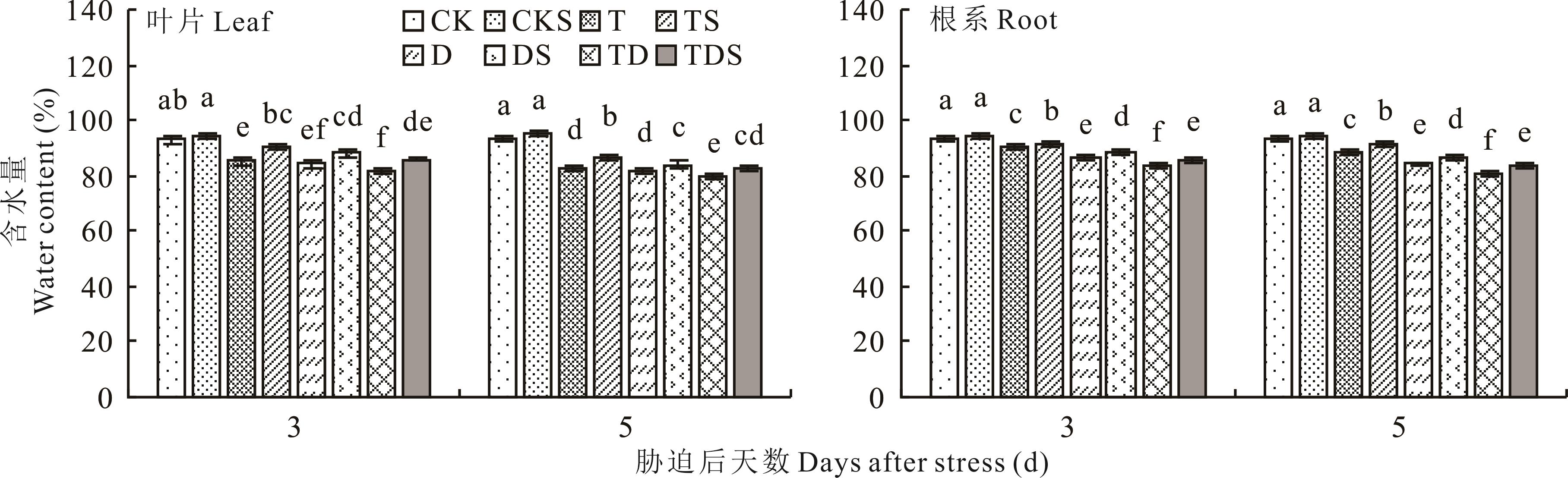
Fig.1 Effects of salicylic acid on water content of maize under different stresses
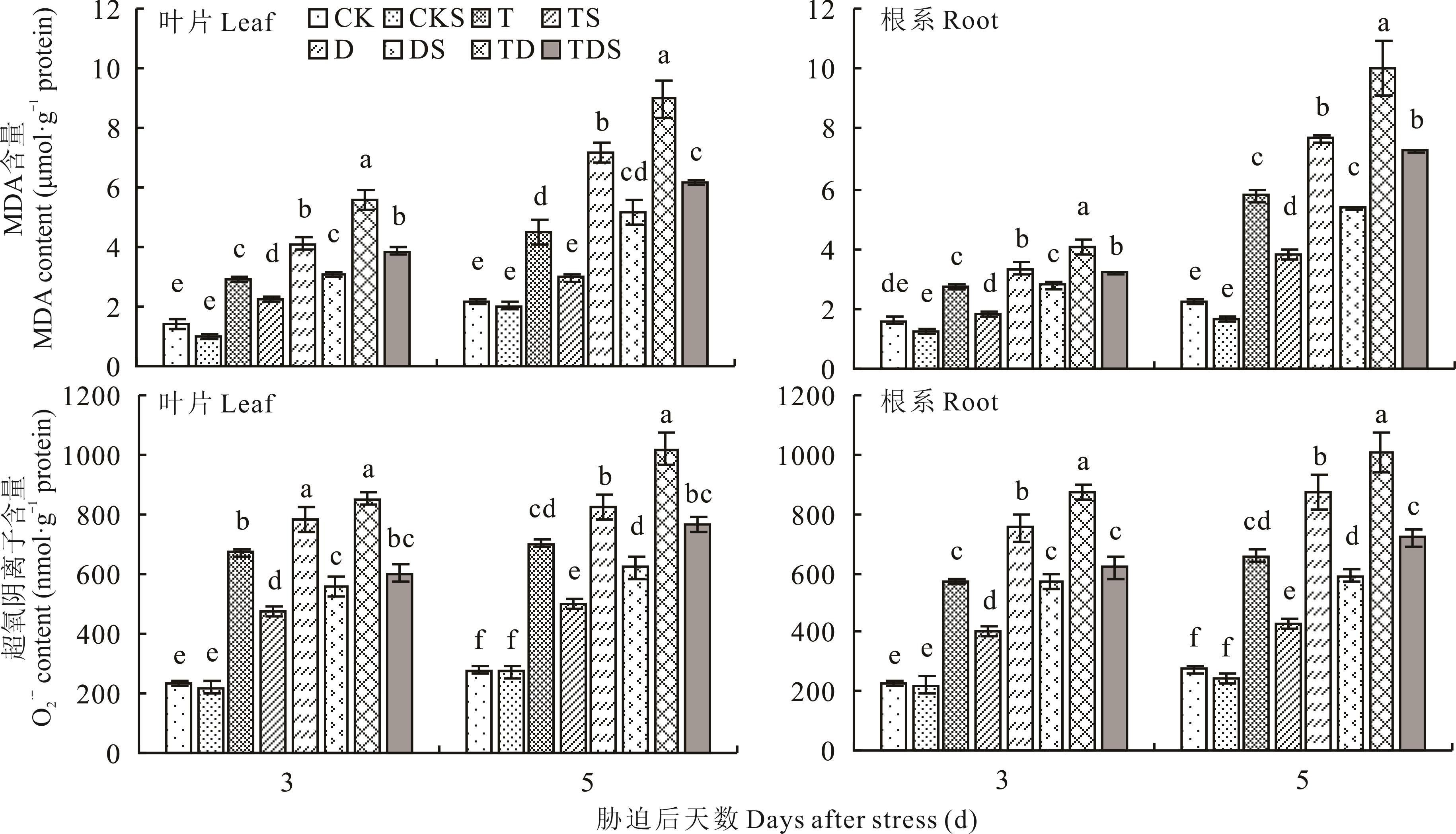
Fig.2 Effects of salicylic acid on oxidative damage of maize under different stresses
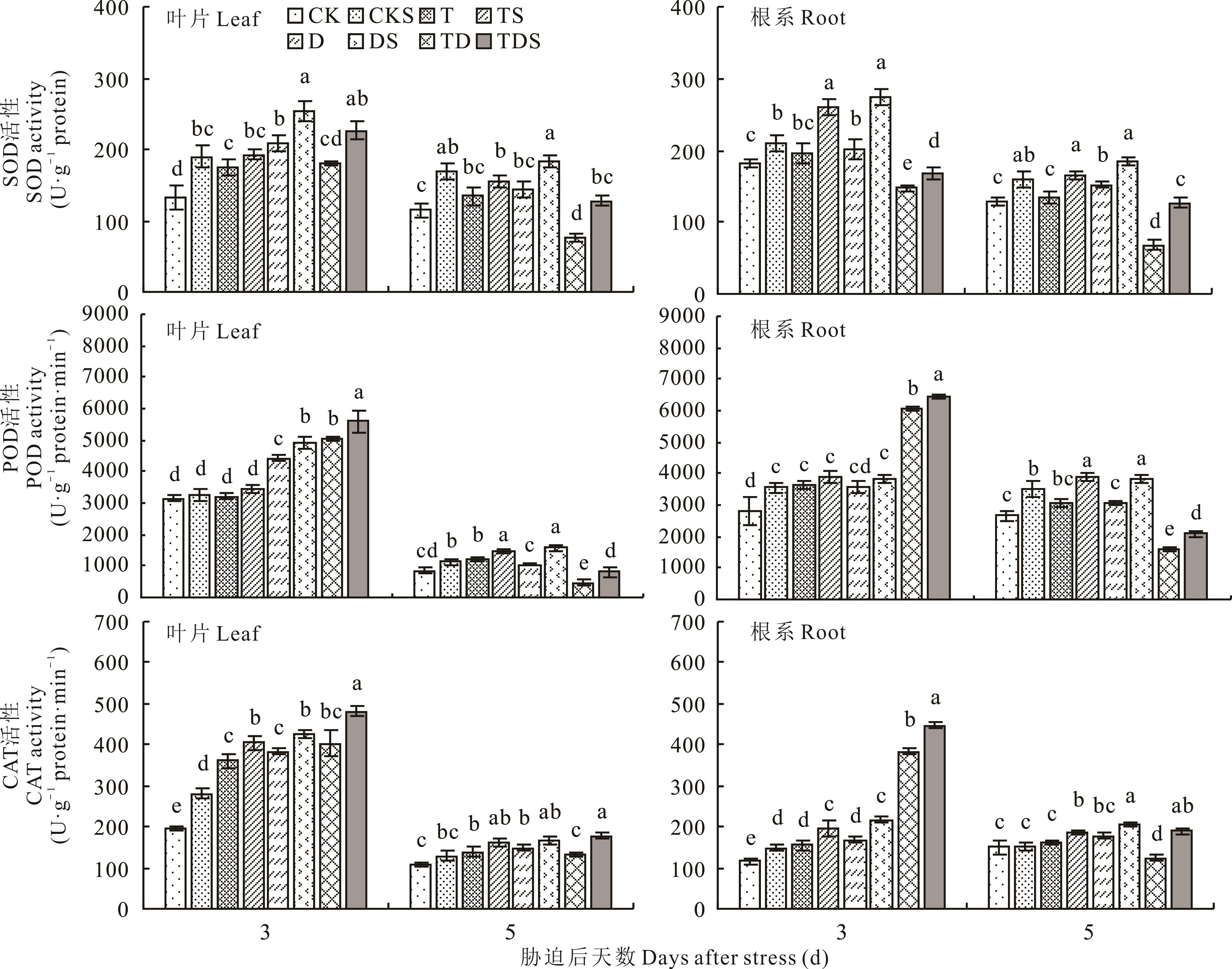
Fig.3 Effects of salicylic acid on antioxidant enzyme activity of maize under different stresses
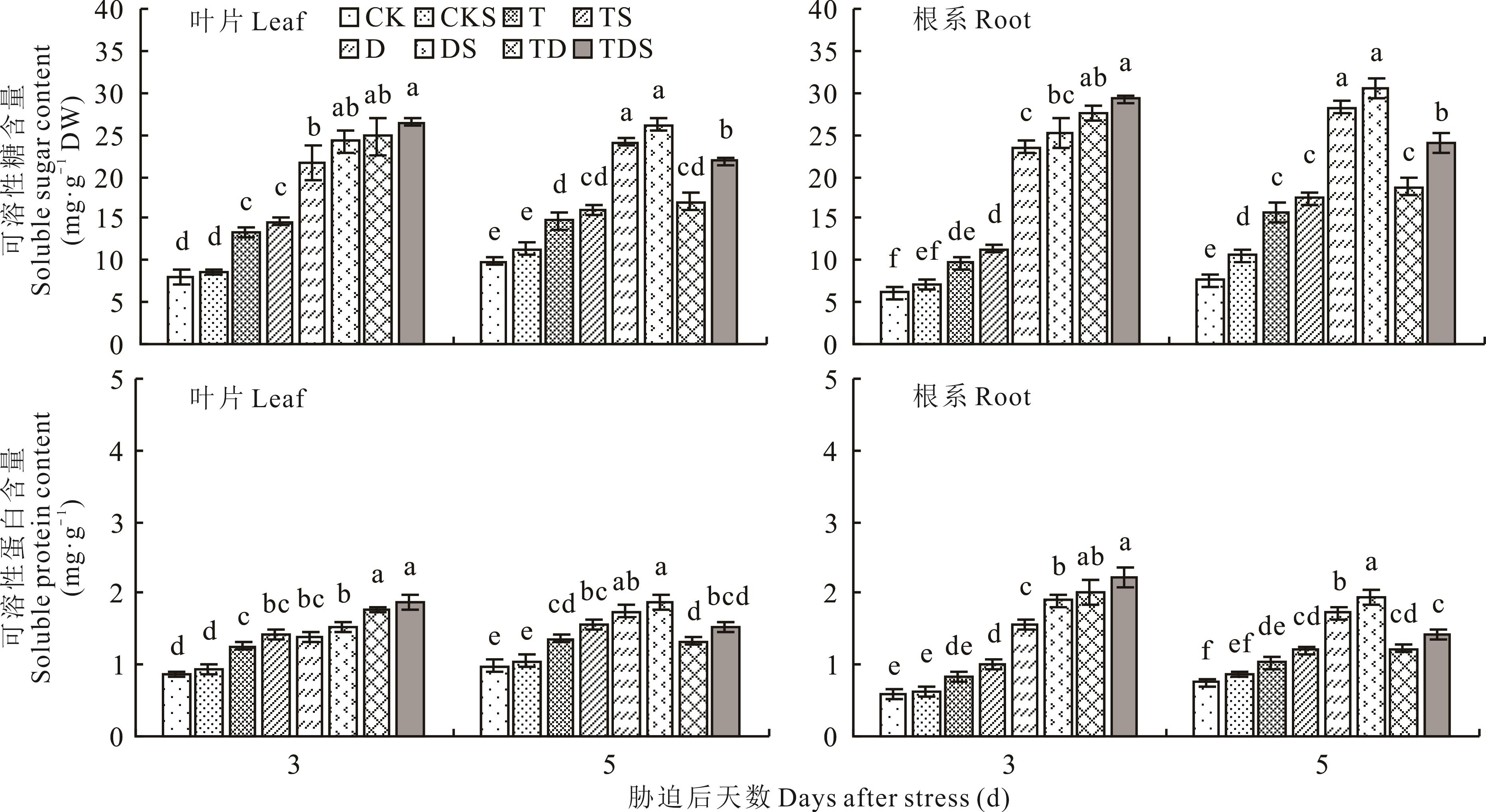
Fig.4 Effects of salicylic acid on soluble sugar and soluble protein content of maize under different stresses
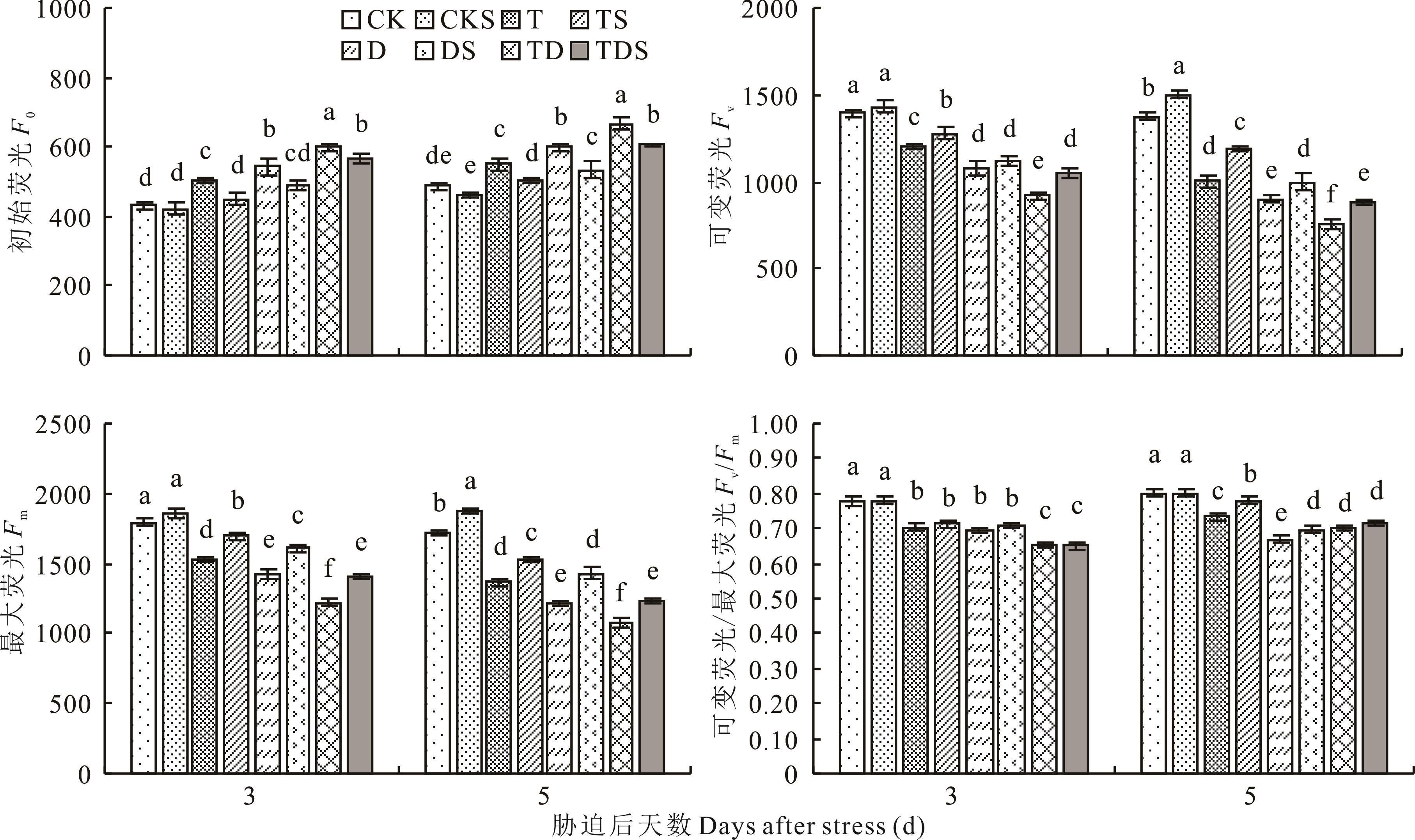
Fig.5 Effects of salicylic acid on chlorophyll fluorescence of maize leaves under different stresses

Fig.6 Effects of salicylic acid on photosynthetic rate of maize leaves under different stresses
| 指标Index | 处理Treatment | DWS | DWR | MDA | SOD | POD | CAT | SS |
|---|---|---|---|---|---|---|---|---|
| MDA | A | -0.94** | -0.85* | |||||
| B | -0.52 | -0.85* | ||||||
| C | -0.91** | -0.48 | ||||||
| SOD | A | 0.51 | 0.44 | -0.41 | ||||
| B | 0.52 | 0.77* | -0.80* | |||||
| C | 0.93** | 0.92** | -0.70 | |||||
| POD | A | 0.85* | 0.75* | -0.92** | 0.70 | |||
| B | 0.41 | 0.87* | -0.97** | 0.76* | ||||
| C | 0.85** | 0.84* | -0.81* | 0.93** | ||||
| CAT | A | 0.72 | 0.63 | -0.76 | 0.85* | 0.97** | ||
| B | 0.94** | 0.81* | -0.77 | 0.72 | 0.63 | |||
| C | 0.88** | 0.81* | -0.82* | 0.93** | 0.99** | |||
| SS | A | 0.84* | 0.78* | -0.92** | 0.66 | 0.99** | 0.93** | |
| B | 0.68 | 0.77* | -0.83* | 0.64 | 0.68 | 0.81* | ||
| C | 0.96** | 0.64 | -0.90** | 0.84** | 0.87* | 0.88** | ||
| SP | A | 0.76* | 0.60 | -0.83* | 0.51 | 0.88* | 0.77* | 0.90** |
| B | 0.73* | 0.90** | -0.92** | 0.85* | 0.88** | 0.90** | 0.80* | |
| C | 0.56 | 0.33 | -0.74 | 0.53 | 0.72 | 0.72 | 0.60 |
Table 4 Correlation coefficients of various indexes under different stress treatments
| 指标Index | 处理Treatment | DWS | DWR | MDA | SOD | POD | CAT | SS |
|---|---|---|---|---|---|---|---|---|
| MDA | A | -0.94** | -0.85* | |||||
| B | -0.52 | -0.85* | ||||||
| C | -0.91** | -0.48 | ||||||
| SOD | A | 0.51 | 0.44 | -0.41 | ||||
| B | 0.52 | 0.77* | -0.80* | |||||
| C | 0.93** | 0.92** | -0.70 | |||||
| POD | A | 0.85* | 0.75* | -0.92** | 0.70 | |||
| B | 0.41 | 0.87* | -0.97** | 0.76* | ||||
| C | 0.85** | 0.84* | -0.81* | 0.93** | ||||
| CAT | A | 0.72 | 0.63 | -0.76 | 0.85* | 0.97** | ||
| B | 0.94** | 0.81* | -0.77 | 0.72 | 0.63 | |||
| C | 0.88** | 0.81* | -0.82* | 0.93** | 0.99** | |||
| SS | A | 0.84* | 0.78* | -0.92** | 0.66 | 0.99** | 0.93** | |
| B | 0.68 | 0.77* | -0.83* | 0.64 | 0.68 | 0.81* | ||
| C | 0.96** | 0.64 | -0.90** | 0.84** | 0.87* | 0.88** | ||
| SP | A | 0.76* | 0.60 | -0.83* | 0.51 | 0.88* | 0.77* | 0.90** |
| B | 0.73* | 0.90** | -0.92** | 0.85* | 0.88** | 0.90** | 0.80* | |
| C | 0.56 | 0.33 | -0.74 | 0.53 | 0.72 | 0.72 | 0.60 |
| [1] | Guo Y, Ren H, Wang H Z, et al. High temperature and drought combined stress inhibited photosystem Ⅱ performance and decreased grain yield of summer maize. Scientia Agricultura Sinica, 2024, 57(21): 4205-4220. |
| 郭娅, 任昊, 王洪章, 等. 高温干旱复合胁迫抑制夏玉米光系统Ⅱ性能降低籽粒产量. 中国农业科学, 2024, 57(21): 4205-4220. | |
| [2] | La M, Jemo M, Datla R, et al. Heat and drought stresses in crops and approaches for their mitigation. Frontiers in Chemistry, 2018, 6: 26. |
| [3] | Wang L, Xiong W, Wen X L, et al. Effect of climatic factors such as temperature, precipitation on maize production in China. Transactions of the Chinese Society of Agricultural Engineering, 2014, 30(21): 138-146. |
| 王柳, 熊伟, 温小乐, 等. 温度降水等气候因子变化对中国玉米产量的影响. 农业工程学报, 2014, 30(21): 138-146. | |
| [4] | Rizhsky L, Liang H J, Shuman J, et al. When defense pathways collide. The response of Arabidopsis to a combination of drought and heat stress. Plant Physiology, 2004, 134(4): 1683-1696. |
| [5] | Prasad P V V, Pisipati S R, Momcilovic I, et al. Independent and combined effects of high temperature and drought stress during grain filling on plant yield and chloroplast EF-Tu expression in spring wheat. Journal of Agronomy and Crop Science, 2011, 197: 430-441. |
| [6] | Zhao X Y. Effects of high temperature and drought on yield and growth of summer maize. Tai’an: Shandong Agricultural University, 2023. |
| 赵新宇. 高温干旱对夏玉米产量和生长发育的影响. 泰安: 山东农业大学, 2023. | |
| [7] | Wang P. The biosynthesis and roles of amino acid bioactive substances in regulating tomato growth and development under high temperature and drought stress. Hangzhou: Zhejiang University, 2023. |
| 王萍. 高温干旱逆境应答中番茄氨基酸类生物活性物质的合成响应及其对生长发育的调控作用研究. 杭州: 浙江大学, 2023. | |
| [8] | Apel K, Hirt H. Reactive oxygen species: Metabolism, oxidative stress, and signal transduction. Annual Review of Plant Biology, 2004, 55: 373-399. |
| [9] | Wang Y C, Zhang Y L, Yan D L, et al. Physiological role of γ-aminobutyric acid in protecting the photosynthetic system of maize seedlings under drought stress. Acta Prataculturae Sinica, 2020, 29(6): 191-203. |
| 王泳超, 张颖蕾, 闫东良, 等. 干旱胁迫下γ-氨基丁酸保护玉米幼苗光合系统的生理响应. 草业学报, 2020, 29(6): 191-203. | |
| [10] | Chen Y, Yue L J, Liu Y H, et al. Effects of continuous high temperature treatment during vegetative stages on maize leaf transcriptome and biochemical indicators. Journal of Maize Sciences, 2022, 30(4): 48-55, 61. |
| 陈岩, 岳丽杰, 刘永红, 等. 营养生长期持续高温处理对玉米叶片转录组及生化指标的影响. 玉米科学, 2022, 30(4): 48-55, 61. | |
| [11] | Wang Z T, Guo J, Luo W X, et al. Salicylic acid cooperates with lignin and sucrose signals to alleviate waxy maize leaf senescence under heat stress. Plant, Cell & Environment, 2025, 48(6): 4341-4355. |
| [12] | Wang F, Li Y S, Wang H N, et al. Effect of calcium on growth and physiological characteristics of maize seedling under lead stress. Journal of Soil and Water Conservation, 2016, 30(3): 202-207. |
| 王芳, 李永生, 王汉宁, 等. 钙对铅胁迫下玉米幼苗生长及生理特性的影响. 水土保持学报, 2016, 30(3): 202-207. | |
| [13] | Zhao S J. Experimental guidance of plant physiology. Beijing: China Agriculture Press, 2016. |
| 赵世杰. 植物生理学实验指导. 北京: 中国农业出版社, 2016. | |
| [14] | Xie Z X, Duan L S, Tian X L, et al. Coronatine alleviates salinity stress in cotton by improving the antioxidative defense system and radical-scavenging activity. Journal of Plant Physiology, 2008, 165(4): 375-384. |
| [15] | Bo X P, Wang M X, Cui L, et al. Evaluation on correlations of three kinds of osmoregulation substances in tea fresh leaves with low temperature during winter and spring respectively and their difference among cultivars. Scientia Agricultura Sinica, 2016, 49(19): 3807-3817. |
| 薄晓培, 王梦馨, 崔林, 等. 茶树3类渗透调节物质与冬春低温相关性及其品种间的差异评价. 中国农业科学, 2016, 49(19): 3807-3817. | |
| [16] | Monreal J A, Jimenez E T, Remesal E, et al. Proline content of sugar beet storage roots: Response to water deficit and nitrogen fertilization at field conditions. Environmental and Experimental Botany, 2007, 60: 257-267. |
| [17] | Rehman A, Farooq M, Asif M, et al. Supra-optimal growth temperature exacerbates adverse effects of low Zn supply in wheat. Journal of Plant Nutrition and Soil Science, 2019, 182: 656-666. |
| [18] | Yang X Y, Zhou G K, Wang F. Alleviative effect of exogenous melatonin on the root system of maize seedlings under drought stress. Journal of Maize Sciences, 2025, 33(1):56-65, 76. |
| 杨馨仪, 周广阔, 王芳. 外源褪黑素对干旱胁迫下玉米幼苗根系的缓解效应研究. 玉米科学, 2025, 33(1): 56-65, 76. | |
| [19] | Song Y L, Wang K Q, Wang S, et al. Physiological responses of three kinds of cool season turfgrasses under continuous drought stress, heat stress and their interaction. Acta Agrestia Sinica, 2018, 26(3): 705-717. |
| 宋娅丽, 王克勤, 王莎, 等. 3种冷季型草坪草对持续干旱、高温及其互作的生理生态响应. 草地学报, 2018, 26(3): 705-717. | |
| [20] | Kang S Y, Pang C H, Zhang Y Q, et al. Effects of spraying salicylic acid on drought-resistance and yield of quinoa. Journal of Arid Land Resources and Environment, 2022, 36(12): 151-157. |
| 康书瑜, 庞春花, 张永清, 等. 干旱胁迫下外源水杨酸对藜麦生理效应及产量的影响. 干旱区资源与环境, 2022, 36(12): 151-157. | |
| [21] | Yan S B, Cai J B, Wang Y, et al. Effects of exogenous salicylic acid on seed germination of perennial ryegrass under high temperature stress. Acta Agrestia Sinica, 2025, 33(3): 968-974. |
| 闫三博, 蔡家邦, 汪阳, 等. 外源水杨酸对高温胁迫下多年生黑麦草种子萌发的影响. 草地学报, 2025, 33(3): 968-974. | |
| [22] | Li L, Liu Y M, Wang M, et al. Physiological response mechanism of three kinds of Acer rubrum L. under continuous high temperature and drought stress. Acta Ecologica Sinica, 2014, 34(22): 6471-6480. |
| 李力, 刘玉民, 王敏, 等. 3种北美红枫对持续高温干旱胁迫的生理响应机制. 生态学报, 2014, 34(22): 6471-6480. | |
| [23] | Xiao X J, Huang Q, Luo C Y, et al. Effect of salicylic acid soaking on seed germination and seedling growth of corn under drought stress. Fujian Journal of Agricultural Sciences, 2017, 32(6): 583-586. |
| 肖小君, 黄倩, 罗陈勇, 等. 水杨酸浸种对干旱胁迫下玉米种子萌发及幼苗生长的影响. 福建农业学报, 2017, 32(6): 583-586. | |
| [24] | Yi X L, Li M Y, Chi H, et al. Influences of salicylic acid (SA) on the contents of endogenous hormones and osmotic adjustment substances in purple majesty under drought and/or high temperature. Journal of Southwest University (Natural Science Edition), 2014, 36(2): 62-67. |
| 易小林, 李名扬, 池浩, 等. 水杨酸缓解干旱、高温及双重胁迫下对紫御谷内源激素及渗透调节物质的影响. 西南大学学报(自然科学版), 2014, 36(2): 62-67. | |
| [25] | Wang L J, Liu Y F, Liu Q J, et al. Effects of salicylic acid and KCl2 on photosynthesis and chlorophyll fluorescence of citrus under heat and drought stress. Jiangxi Science, 2003(3): 201-205. |
| 王利军, 刘允芬, 刘琪璟, 等. 高温干旱胁迫下水杨酸和钾对温州蜜柑光合作用和叶绿素荧光的影响. 江西科学, 2003(3): 201-205. | |
| [26] | He J L, Zhou J T, Wan H X, et al. Rootstock-scion interaction affects cadmium accumulation and tolerance of malus. Frontiers in Plant Science, 2020, 11: 1264. |
| [27] | Su X, Fan X, Shao R, et al. Physiological and iTRAQ-based proteomic analyses reveal that melatonin alleviates oxidative damage in maize leaves exposed to drought stress. Plant Physiology and Biochemistry, 2019, 142: 263-274. |
| [28] | Zhang C M, Shi S L, Liu Z, et al. Drought tolerance in alfalfa (Medicago sativa L.) varieties is associated with enhanced antioxidative protection and declined lipid peroxidation. Journal of Plant Physiology, 2019, 232: 226-240. |
| [29] | Yancey P H. Organic osmolytes as compatible, metabolic and counteracting cytoprotectants in high osmolarity and other stresses. The Journal of Experimental Biology, 2005, 208(15): 2819-2830. |
| [30] | Luo C, Min W, Akhtasr M, et al. Melatonin enhances drought tolerance in rice seedlings by modulating antioxidant systems, osmoregulation, and corresponding gene expression. International Journal of Molecular Sciences, 2022, 23: 12075. |
| [31] | Huang B, Chen Y E, Zhao Y Q, et al. Exogenous melatonin alleviates oxidative damages and protects photosystem Ⅱ in maize seedlings under drought stress. Frontiers in Plant Science, 2019, 10: 677. |
| [32] | Sun X C, Huang W J, Li B. Effects of exogenous salicylic acid on physiological and biochemical indexes and related gene expression in Platycodon grandiflorus under drought stress. Journal of Agricultural Science and Technology, 2022, 24(1): 63-70. |
| 孙晓春, 黄文静, 李铂. 水杨酸对干旱胁迫下桔梗幼苗生理生化指标及相关基因表达的影响. 中国农业科技导报, 2022, 24(1): 63-70. | |
| [33] | Guha A, Senguta D, Reddy R A. Polyphasic chlorophyll a fluorescence kinetics and leaf protein analyses to track dynamics of photosynthetic performance in mulberry during progressive drought. Journal of Photochemistry Photobiology, B: Biology, 2013, 119: 71-83. |
| [34] | Li B, Zhang X, Morita S, et al. Are crop deep roots always beneficial for combating drought: A review of root structure and function, regulation and phenotyping. Agricultural Water Management, 2022, 271: 107781. |
| [35] | Wang F L, Huang Z F, Liang S Z, et al. Effects of exogenous salicylic acid on physiological characteristics of Euphorbia pulcherrima Willd. under drought stress. Journal of Southwest China Normal University (Natural Science Edition), 2016, 41(2): 53-57. |
| 王凤兰, 黄子锋, 梁淑贞, 等. 外源水杨酸对干旱胁迫下一品红生理特性的影响. 西南师范大学学报(自然科学版), 2016, 41(2): 53-57. | |
| [36] | Farquhar G D, Sharkey T D. Stomatal conductance and photosynthesis. Annual Review of Plant Physiology, 1982, 33: 317-345. |
| [37] | Cao S H, Li N Y. Effects of salicylic acid on heat resistance of Zinnia elegans seedlings under high temperature stress. Journal of Shenyang Agricultural University, 2014, 45(1): 91-94. |
| 曹淑红, 李宁毅. 水杨酸对高温胁迫下百日草幼苗耐热性的影响. 沈阳农业大学学报, 2014, 45(1): 91-94. | |
| [38] | Wang F, Sang X H, Gu W, et al. Effects of salicylic acid on photosynthetic characteristics and physiological indexes of Atractylodes lancea (Thunb.) DC. under drought stress. Molecular Plant Breeding, 2020, 18(9): 3060-3067. |
| 王帆, 桑晓华, 谷巍, 等. 外源水杨酸对干旱胁迫下茅苍术光合参数和抗氧化酶活性的影响. 分子植物育种, 2020, 18(9): 3060-3067. |
| [1] | Li WEI, Yu-xuan DENG, Jing ZHAO, Jun-liang LIU, Ke-hua MA, Suo-min WANG. Cloning and functional analysis of ZxCER6 from the xerophyte Zygophyllum xanthoxylum [J]. Acta Prataculturae Sinica, 2026, 35(1): 154-169. |
| [2] | Bin CHEN, Yan-ting LIU, Sheng-yan CHEN, Qing XUE, Meng-yu LI, Ji-jia WANG, Ying SUN, Miao HE. Bioinformatics analysis of CiMYB4 in Chrysanthemum indicum var. aromaticum and functional characterization of its role in drought resistance [J]. Acta Prataculturae Sinica, 2026, 35(1): 179-191. |
| [3] | Wen-hui DENG, Ke-chen SONG, Hao ZHANG, Si-yu GUAN, Jia-yi YONG, Tie-na XIE, Hai-ying HU. Effects of changes in precipitation on stomatal morphology and photosynthetic and physiological characteristics of major species in desert steppe plant communities [J]. Acta Prataculturae Sinica, 2026, 35(1): 65-78. |
| [4] | Yuan-yuan LIU, Xu WANG, Qi WEI, Li-juan CHE, Meng YUAN, Bo WANG. The role of HaFT-9, a 14-3-3 protein from Haloxylon ammodendron, in the cross regulation of high temperature and drought stress [J]. Acta Prataculturae Sinica, 2025, 34(9): 134-146. |
| [5] | Xing-long ZHANG, Li-shan SHAN, Hong-yong WANG, Ting-ting XIE, Jing MA. Effect of drought stress on the hydraulic traits of Salsola passerina [J]. Acta Prataculturae Sinica, 2025, 34(9): 87-96. |
| [6] | Chang-qing LI, Ya-ru SONG, Fan XIAO, Chun-yu MIAO, Meng-yu SUN, Meng JI, Zhi-mei SUN. Analysis of main agronomic traits of low-fertility-tolerant and high-yielding maize varieties [J]. Acta Prataculturae Sinica, 2025, 34(9): 97-110. |
| [7] | Bin GUO, Wei-cheng LUO, Li-shan SHAN, Ning AN, Bing LIU. Effects of simulated warming on photosynthesis of typical desert shrubs in the Hexi Corridor [J]. Acta Prataculturae Sinica, 2025, 34(7): 145-157. |
| [8] | Jia-yi YONG, Shuang MA, Feng-hua MA, Xiao-na ZHAO, Yi-yin ZHANG, Hai-ying HU. Effects of drought stress and rehydration on biomass allocation and osmotic regulation characteristics of Indigofera bungeana [J]. Acta Prataculturae Sinica, 2025, 34(7): 158-170. |
| [9] | Hui-ling LI, Yong-xing ZHU, Meng CHEN, Shu LIU, Jiao WANG, Yi-qing LIU, Xue-mei ZHANG, Hui-hui MA. Effects of drought stress and re-watering on the growth and physiological characteristics of Helianthus tuberosus seedlings [J]. Acta Prataculturae Sinica, 2025, 34(7): 171-184. |
| [10] | Xue-qian JIANG, Qing-chuan YANG, Jun-mei KANG. Research progress on yield loss under drought stress and drought resistance genetics of alfalfa (Medicago sativa) [J]. Acta Prataculturae Sinica, 2025, 34(7): 219-234. |
| [11] | Yuan-yuan ZHAO, Xiao-jian PU, Cheng-ti XU, Wei WANG, Yun-jie FU. Cloning of the MtBMI1 gene from Medicago truncatula and its role in drought tolerance [J]. Acta Prataculturae Sinica, 2025, 34(6): 139-153. |
| [12] | Xiao-Yue WEN, Ying ZHAO, Bao-qiang WANG, Xian WANG, Xiao-lin ZHU, Yi-zhen WANG, Xiao-hong WEI. Expression analysis of AP2/ERFs genes in alfalfa regulated by exogenous NO under drought stress [J]. Acta Prataculturae Sinica, 2025, 34(6): 154-167. |
| [13] | Pei-pei JIANG, Jin-hua GUO, Hui-shu XIAO, Yan-min PENG, Jun ZHANG, Wen-zhong TIAN, Jun-jie Lyu, Jin-zhi WU, He-zheng WANG, Guo-zhan FU, Ming HUANG, You-jun LI. Effect of rotational tillage patterns on the crop yield and quality in a maize-wheat (Zea mays-Triticum aestivum) double cropping system in dryland agriculture [J]. Acta Prataculturae Sinica, 2025, 34(6): 181-192. |
| [14] | Zong-yang KUANG, Lin MU, Lan WEI, Yang GUO, Gui XU, Yao CHEN, Xue-yun SHI, Zhong-shan WEI, Zhi-fei ZHANG. Effects of different mixture ratios and lactic acid bacteria on the quality and aerobic stability of mixed silage made from whole maize (Zea mays) and soybean (Glycine max) plants [J]. Acta Prataculturae Sinica, 2025, 34(6): 227-238. |
| [15] | Wen-li QIN, Jing ZHANG, Guang-min XIAO, Su-qian CUI, Jian-xun YE, Jian-fei ZHI, Li-feng ZHANG, Nan XIE, Wei FENG, Zhen-yu LIU, Xuan PAN, Yun-xia DAI, Zhong-kuan LIU. Effects of partial replacement of chemical nitrogen fertilizers with green manure on soil physical properties and maize (Zea mays) yield [J]. Acta Prataculturae Sinica, 2025, 34(6): 27-45. |
| Viewed | ||||||
|
Full text |
|
|||||
|
Abstract |
|
|||||
