
ISSN 1004-5759 CN 62-1105/S
Acta Prataculturae Sinica ›› 2025, Vol. 34 ›› Issue (6): 227-238.DOI: 10.11686/cyxb2024347
Zong-yang KUANG1( ), Lin MU1, Lan WEI1, Yang GUO1, Gui XU1, Yao CHEN1, Xue-yun SHI1, Zhong-shan WEI2, Zhi-fei ZHANG1()
Received:2024-09-09
Revised:2024-10-31
Online:2025-06-20
Published:2025-04-03
Contact:
Zhi-fei ZHANG
Zong-yang KUANG, Lin MU, Lan WEI, Yang GUO, Gui XU, Yao CHEN, Xue-yun SHI, Zhong-shan WEI, Zhi-fei ZHANG. Effects of different mixture ratios and lactic acid bacteria on the quality and aerobic stability of mixed silage made from whole maize (Zea mays) and soybean (Glycine max) plants[J]. Acta Prataculturae Sinica, 2025, 34(6): 227-238.
青贮材料 Ensilage materials | 干物质 Dry matter (%FW) | 粗蛋白 Crude protein (%DM) | 可溶性碳水化合物 Water soluble carbohydrate (%DM) | 中性洗涤纤维 Neutral detergent fiber (%DM) | 酸性洗涤纤维 Acid detergent fiber (%DM) | 粗脂肪 Ether extract (%DM) | 粗灰分 Crude ash (%DM) |
|---|---|---|---|---|---|---|---|
| 全株玉米Whole-plant maize | 37.84±0.33 | 9.81±0.37 | 6.74±0.29 | 45.10±1.00 | 19.90±0.98 | 1.29±0.18 | 4.92±0.06 |
| 全株大豆Whole-plant soybean | 29.85±0.37 | 20.74±0.36 | 5.56±0.04 | 43.42±1.47 | 28.15±0.94 | 7.11±0.56 | 9.30±0.13 |
Table 1 Chemical composition of ensilage materials
青贮材料 Ensilage materials | 干物质 Dry matter (%FW) | 粗蛋白 Crude protein (%DM) | 可溶性碳水化合物 Water soluble carbohydrate (%DM) | 中性洗涤纤维 Neutral detergent fiber (%DM) | 酸性洗涤纤维 Acid detergent fiber (%DM) | 粗脂肪 Ether extract (%DM) | 粗灰分 Crude ash (%DM) |
|---|---|---|---|---|---|---|---|
| 全株玉米Whole-plant maize | 37.84±0.33 | 9.81±0.37 | 6.74±0.29 | 45.10±1.00 | 19.90±0.98 | 1.29±0.18 | 4.92±0.06 |
| 全株大豆Whole-plant soybean | 29.85±0.37 | 20.74±0.36 | 5.56±0.04 | 43.42±1.47 | 28.15±0.94 | 7.11±0.56 | 9.30±0.13 |
项目 Item | 指标 Index | 显著性 Significance | 大豆混合占比 Soybean mix proportion | ||
|---|---|---|---|---|---|
混合比例 Mixing ratio | 乳酸菌剂Lactic acid bacteria agent | 交互作用 Interactions | 相关性 Correlation# | ||
营养品质 Nutrient quality | 干物质Dry matter (%FW) | ** | ** | NS | -0.862** |
| 粗蛋白Crude protein (%DM) | ** | * | ** | 0.986** | |
| 可溶性碳水化合物Water soluble carbohydrate (%DM) | ** | ** | NS | -0.863** | |
| 中性洗涤纤维Neutral detergent fiber (%DM) | ** | ** | ** | -0.024 | |
| 酸性洗涤纤维Acid detergent fiber (%DM) | ** | ** | NS | 0.804** | |
| 酸性洗涤木质素Acid detergent lignin (%DM) | ** | ** | ** | 0.781** | |
| 粗脂肪Ether extract (%DM) | ** | ** | ** | 0.988** | |
| 粗灰分Crude ash (%DM) | ** | ** | ** | 0.977** | |
发酵品质 Fermentation quality | pH值pH value | ** | ** | ** | 0.876** |
| 乳酸Lactic acid (%DM) | ** | ** | ** | -0.447** | |
| 乙酸Acetic acid (%DM) | ** | ** | ** | 0.715** | |
| 丙酸Propionic acid (%DM) | ** | ** | ** | 0.698** | |
| 丁酸Butyric acid (%DM) | ** | NS | NS | 0.488** | |
| 氨态氮/总氮Ammonia-N/total-N (%) | ** | ** | ** | 0.796** | |
| 有氧稳定时长Aerobic stability time (h) | ** | ** | ** | 0.758** | |
Table 2 Inter-subject effect test of whole maize-soybean mixed silage indexes
项目 Item | 指标 Index | 显著性 Significance | 大豆混合占比 Soybean mix proportion | ||
|---|---|---|---|---|---|
混合比例 Mixing ratio | 乳酸菌剂Lactic acid bacteria agent | 交互作用 Interactions | 相关性 Correlation# | ||
营养品质 Nutrient quality | 干物质Dry matter (%FW) | ** | ** | NS | -0.862** |
| 粗蛋白Crude protein (%DM) | ** | * | ** | 0.986** | |
| 可溶性碳水化合物Water soluble carbohydrate (%DM) | ** | ** | NS | -0.863** | |
| 中性洗涤纤维Neutral detergent fiber (%DM) | ** | ** | ** | -0.024 | |
| 酸性洗涤纤维Acid detergent fiber (%DM) | ** | ** | NS | 0.804** | |
| 酸性洗涤木质素Acid detergent lignin (%DM) | ** | ** | ** | 0.781** | |
| 粗脂肪Ether extract (%DM) | ** | ** | ** | 0.988** | |
| 粗灰分Crude ash (%DM) | ** | ** | ** | 0.977** | |
发酵品质 Fermentation quality | pH值pH value | ** | ** | ** | 0.876** |
| 乳酸Lactic acid (%DM) | ** | ** | ** | -0.447** | |
| 乙酸Acetic acid (%DM) | ** | ** | ** | 0.715** | |
| 丙酸Propionic acid (%DM) | ** | ** | ** | 0.698** | |
| 丁酸Butyric acid (%DM) | ** | NS | NS | 0.488** | |
| 氨态氮/总氮Ammonia-N/total-N (%) | ** | ** | ** | 0.796** | |
| 有氧稳定时长Aerobic stability time (h) | ** | ** | ** | 0.758** | |
混合 比例Mixing ratio | 乳酸菌剂 Lactic acid bacteria agent | 干物质 Dry matter (%FW) | 粗蛋白 Crude protein (%DM) | 可溶性碳水化合物 Water soluble carbohydrate (%DM) | 中性洗涤纤维 Neutral detergent fiber (%DM) | 酸性洗涤纤维 Acid detergent fiber (%DM) | 酸性洗涤木质素 Acid detergent lignin (%DM) | 粗脂肪 Ether extract (%DM) | 粗灰分 Crude ash (%DM) |
|---|---|---|---|---|---|---|---|---|---|
| A1 | LB | 33.99±0.42Ab | 8.34±0.10Eb | 1.42±0.14Aa | 48.58±0.68Ab | 23.49±1.90Cab | 1.56±0.21Db | 2.18±0.12Ea | 4.50±0.02Eb |
| LP | 36.53±0.39Aa | 8.57±0.22Eb | 1.18±0.09Aa | 48.21±1.27Ab | 21.05±1.59Db | 1.19±0.02Ec | 1.25±0.10Eb | 4.04±0.06Ec | |
| L0 | 34.49±0.63Ab | 9.38±0.23Ea | 1.43±0.13Aa | 51.95±1.13Aa | 24.89±0.39Ca | 2.39±0.12Ea | 2.27±0.04Ea | 4.73±0.03Ea | |
| A2 | LB | 32.63±0.47Bb | 14.09±0.08Da | 1.17±0.00Ba | 49.57±1.67Aa | 24.61±0.33Ca | 2.51±0.10Cb | 5.65±0.29Da | 6.34±0.07Da |
| LP | 34.99±0.70Ba | 13.91±0.75Da | 1.06±0.02Ab | 43.50±1.14Cb | 21.43±0.33Db | 1.96±0.06Dc | 4.31±0.25Db | 5.36±0.04Dc | |
| L0 | 33.90±1.10ABab | 13.55±0.30Da | 1.25±0.07Ba | 49.73±2.05ABa | 24.75±2.61Ca | 3.33±0.52Da | 4.80±0.05Db | 5.63±0.03Db | |
| A3 | LB | 32.03±0.66Bb | 17.20±0.09Ca | 0.95±0.07Ca | 43.48±0.43Ba | 23.37±1.13Ca | 2.86±0.20BCb | 6.97±0.53Ca | 6.80±0.06Ca |
| LP | 34.24±0.83Ba | 15.63±0.15Cb | 0.92±0.04Ba | 42.99±1.61Cb | 24.45±1.17Ca | 3.97±0.22Ca | 6.56±0.19Ca | 6.04±0.03Cc | |
| L0 | 33.56±0.74ABab | 15.31±0.03Cc | 0.90±0.04Ca | 44.04±1.36Ca | 23.92±0.82Ca | 3.85±0.30Ca | 6.68±0.20Ca | 6.25±0.11Cb | |
| A4 | LB | 31.86±0.72Bb | 19.07±0.30Ba | 0.89±0.07Ca | 51.19±1.27Aa | 28.25±1.61Ba | 3.99±0.35Ab | 8.19±0.16Ba | 7.34±0.02Ba |
| LP | 32.46±0.31Ca | 18.54±0.07Bb | 0.85±0.05BCa | 46.87±0.64ABb | 27.55±0.19Ba | 4.63±0.09Bb | 7.63±0.17Bb | 7.14±0.01Bb | |
| L0 | 32.13±1.06Ba | 17.46±0.04Bc | 0.84±0.04Ca | 47.62±1.53Bb | 29.89±0.60Ba | 6.27±0.32Ba | 7.24±0.01Bc | 7.07±0.04Bc | |
| A5 | LB | 28.69±0.10Cb | 21.46±0.23Ab | 0.83±0.02Ca | 49.86±1.05Aa | 32.48±1.75Aab | 3.14±0.33Bc | 11.41±0.17Aa | 9.19±0.13Aab |
| LP | 29.37±0.13Da | 21.89±0.08Aa | 0.75±0.05Ca | 45.30±0.97BCb | 29.97±0.63Ab | 6.38±0.18Ab | 10.21±0.02Aa | 9.03±0.02Ab | |
| L0 | 29.09±0.27Cab | 21.65±0.08Aab | 0.79±0.04Ca | 51.81±0.52Aa | 34.80±0.21Aa | 8.60±0.13Aa | 11.33±0.20Aa | 9.36±0.05Aa |
Table 3 Nutritional quality of whole maize-soybean mixed silage
混合 比例Mixing ratio | 乳酸菌剂 Lactic acid bacteria agent | 干物质 Dry matter (%FW) | 粗蛋白 Crude protein (%DM) | 可溶性碳水化合物 Water soluble carbohydrate (%DM) | 中性洗涤纤维 Neutral detergent fiber (%DM) | 酸性洗涤纤维 Acid detergent fiber (%DM) | 酸性洗涤木质素 Acid detergent lignin (%DM) | 粗脂肪 Ether extract (%DM) | 粗灰分 Crude ash (%DM) |
|---|---|---|---|---|---|---|---|---|---|
| A1 | LB | 33.99±0.42Ab | 8.34±0.10Eb | 1.42±0.14Aa | 48.58±0.68Ab | 23.49±1.90Cab | 1.56±0.21Db | 2.18±0.12Ea | 4.50±0.02Eb |
| LP | 36.53±0.39Aa | 8.57±0.22Eb | 1.18±0.09Aa | 48.21±1.27Ab | 21.05±1.59Db | 1.19±0.02Ec | 1.25±0.10Eb | 4.04±0.06Ec | |
| L0 | 34.49±0.63Ab | 9.38±0.23Ea | 1.43±0.13Aa | 51.95±1.13Aa | 24.89±0.39Ca | 2.39±0.12Ea | 2.27±0.04Ea | 4.73±0.03Ea | |
| A2 | LB | 32.63±0.47Bb | 14.09±0.08Da | 1.17±0.00Ba | 49.57±1.67Aa | 24.61±0.33Ca | 2.51±0.10Cb | 5.65±0.29Da | 6.34±0.07Da |
| LP | 34.99±0.70Ba | 13.91±0.75Da | 1.06±0.02Ab | 43.50±1.14Cb | 21.43±0.33Db | 1.96±0.06Dc | 4.31±0.25Db | 5.36±0.04Dc | |
| L0 | 33.90±1.10ABab | 13.55±0.30Da | 1.25±0.07Ba | 49.73±2.05ABa | 24.75±2.61Ca | 3.33±0.52Da | 4.80±0.05Db | 5.63±0.03Db | |
| A3 | LB | 32.03±0.66Bb | 17.20±0.09Ca | 0.95±0.07Ca | 43.48±0.43Ba | 23.37±1.13Ca | 2.86±0.20BCb | 6.97±0.53Ca | 6.80±0.06Ca |
| LP | 34.24±0.83Ba | 15.63±0.15Cb | 0.92±0.04Ba | 42.99±1.61Cb | 24.45±1.17Ca | 3.97±0.22Ca | 6.56±0.19Ca | 6.04±0.03Cc | |
| L0 | 33.56±0.74ABab | 15.31±0.03Cc | 0.90±0.04Ca | 44.04±1.36Ca | 23.92±0.82Ca | 3.85±0.30Ca | 6.68±0.20Ca | 6.25±0.11Cb | |
| A4 | LB | 31.86±0.72Bb | 19.07±0.30Ba | 0.89±0.07Ca | 51.19±1.27Aa | 28.25±1.61Ba | 3.99±0.35Ab | 8.19±0.16Ba | 7.34±0.02Ba |
| LP | 32.46±0.31Ca | 18.54±0.07Bb | 0.85±0.05BCa | 46.87±0.64ABb | 27.55±0.19Ba | 4.63±0.09Bb | 7.63±0.17Bb | 7.14±0.01Bb | |
| L0 | 32.13±1.06Ba | 17.46±0.04Bc | 0.84±0.04Ca | 47.62±1.53Bb | 29.89±0.60Ba | 6.27±0.32Ba | 7.24±0.01Bc | 7.07±0.04Bc | |
| A5 | LB | 28.69±0.10Cb | 21.46±0.23Ab | 0.83±0.02Ca | 49.86±1.05Aa | 32.48±1.75Aab | 3.14±0.33Bc | 11.41±0.17Aa | 9.19±0.13Aab |
| LP | 29.37±0.13Da | 21.89±0.08Aa | 0.75±0.05Ca | 45.30±0.97BCb | 29.97±0.63Ab | 6.38±0.18Ab | 10.21±0.02Aa | 9.03±0.02Ab | |
| L0 | 29.09±0.27Cab | 21.65±0.08Aab | 0.79±0.04Ca | 51.81±0.52Aa | 34.80±0.21Aa | 8.60±0.13Aa | 11.33±0.20Aa | 9.36±0.05Aa |
混合比例 Mixing ratio | 乳酸菌剂 Lactic acid bacteria agent | pH值 pH value | 乳酸 Lactic acid (%DM) | 乙酸 Acetic acid (%DM) | 丙酸 Propionic acid (%DM) | 丁酸 Butyric acid (%DM) | 氨态氮/总氮 Ammonia-N/ total-N (%) |
|---|---|---|---|---|---|---|---|
| A1 | LB | 4.01±0.00Ea | 5.02±0.41Ac | 2.61±0.94Ba | ND | 0.03±0.02Aa | 8.65±0.31Ba |
| LP | 3.60±0.01Ec | 10.42±0.14Ba | 0.39±0.01Db | 0.21±0.01Cb | ND | 4.63±0.41Cb | |
| L0 | 3.75±0.01Eb | 7.56±0.30Bb | 1.04±0.28Cb | 0.39±0.01Ba | ND | 4.72±0.31Cb | |
| A2 | LB | 4.27±0.00Da | 3.22±0.47Bc | 3.17±0.51ABa | 0.14±0.02Ba | ND | 8.40±0.15Ba |
| LP | 3.79±0.01Dc | 14.94±1.18Aa | 0.52±0.04Db | 0.15±0.11Ca | ND | 4.62±0.34Cb | |
| L0 | 3.93±0.01Db | 9.97±0.57Ab | 1.28±0.35Cb | 0.30±0.01Ba | ND | 5.24±0.55Cb | |
| A3 | LB | 4.40±0.00Ca | 4.83±0.60ABc | 2.83±0.21Ba | 0.14±0.01Bb | ND | 8.42±0.62Ba |
| LP | 3.91±0.02Cc | 14.60±6.88Aa | 0.78±0.04Cc | 1.26±0.22Ba | ND | 6.87±0.15Ba | |
| L0 | 4.07±0.01Cb | 10.31±0.51Ab | 2.39±0.08Bb | 0.29±0.02Bab | ND | 7.07±0.93Ba | |
| A4 | LB | 4.50±0.02Ba | 5.32±1.44Ab | 2.87±0.08Ba | 0.15±0.01Bb | ND | 8.90±0.57Ba |
| LP | 4.07±0.03Bc | 10.03±0.94Ba | 3.18±0.18Ba | ND | 0.06±0.05Ba | 7.38±0.31Bb | |
| L0 | 4.30±0.02Bb | 10.10±0.66Aa | 2.51±0.96Ba | 0.30±0.05Ba | ND | 7.90±0.06Bb | |
| A5 | LB | 5.14±0.01Ac | 1.09±0.04Cc | 4.02±0.05Ab | 1.72±0.09Aa | 0.05±0.03Aa | 15.62±0.32Aa |
| LP | 5.25±0.01Aa | 1.59±0.03Ca | 3.91±0.03Ab | 1.91±0.34Aa | 0.01±0.01Aa | 12.52±0.15Ac | |
| L0 | 5.20±0.01Ab | 1.31±0.11Cb | 4.34±0.17Aa | 1.79±0.10Aa | 0.12±0.01Aa | 13.62±0.33Ab |
Table 4 Fermentation quality of whole maize-soybean mixed silage
混合比例 Mixing ratio | 乳酸菌剂 Lactic acid bacteria agent | pH值 pH value | 乳酸 Lactic acid (%DM) | 乙酸 Acetic acid (%DM) | 丙酸 Propionic acid (%DM) | 丁酸 Butyric acid (%DM) | 氨态氮/总氮 Ammonia-N/ total-N (%) |
|---|---|---|---|---|---|---|---|
| A1 | LB | 4.01±0.00Ea | 5.02±0.41Ac | 2.61±0.94Ba | ND | 0.03±0.02Aa | 8.65±0.31Ba |
| LP | 3.60±0.01Ec | 10.42±0.14Ba | 0.39±0.01Db | 0.21±0.01Cb | ND | 4.63±0.41Cb | |
| L0 | 3.75±0.01Eb | 7.56±0.30Bb | 1.04±0.28Cb | 0.39±0.01Ba | ND | 4.72±0.31Cb | |
| A2 | LB | 4.27±0.00Da | 3.22±0.47Bc | 3.17±0.51ABa | 0.14±0.02Ba | ND | 8.40±0.15Ba |
| LP | 3.79±0.01Dc | 14.94±1.18Aa | 0.52±0.04Db | 0.15±0.11Ca | ND | 4.62±0.34Cb | |
| L0 | 3.93±0.01Db | 9.97±0.57Ab | 1.28±0.35Cb | 0.30±0.01Ba | ND | 5.24±0.55Cb | |
| A3 | LB | 4.40±0.00Ca | 4.83±0.60ABc | 2.83±0.21Ba | 0.14±0.01Bb | ND | 8.42±0.62Ba |
| LP | 3.91±0.02Cc | 14.60±6.88Aa | 0.78±0.04Cc | 1.26±0.22Ba | ND | 6.87±0.15Ba | |
| L0 | 4.07±0.01Cb | 10.31±0.51Ab | 2.39±0.08Bb | 0.29±0.02Bab | ND | 7.07±0.93Ba | |
| A4 | LB | 4.50±0.02Ba | 5.32±1.44Ab | 2.87±0.08Ba | 0.15±0.01Bb | ND | 8.90±0.57Ba |
| LP | 4.07±0.03Bc | 10.03±0.94Ba | 3.18±0.18Ba | ND | 0.06±0.05Ba | 7.38±0.31Bb | |
| L0 | 4.30±0.02Bb | 10.10±0.66Aa | 2.51±0.96Ba | 0.30±0.05Ba | ND | 7.90±0.06Bb | |
| A5 | LB | 5.14±0.01Ac | 1.09±0.04Cc | 4.02±0.05Ab | 1.72±0.09Aa | 0.05±0.03Aa | 15.62±0.32Aa |
| LP | 5.25±0.01Aa | 1.59±0.03Ca | 3.91±0.03Ab | 1.91±0.34Aa | 0.01±0.01Aa | 12.52±0.15Ac | |
| L0 | 5.20±0.01Ab | 1.31±0.11Cb | 4.34±0.17Aa | 1.79±0.10Aa | 0.12±0.01Aa | 13.62±0.33Ab |
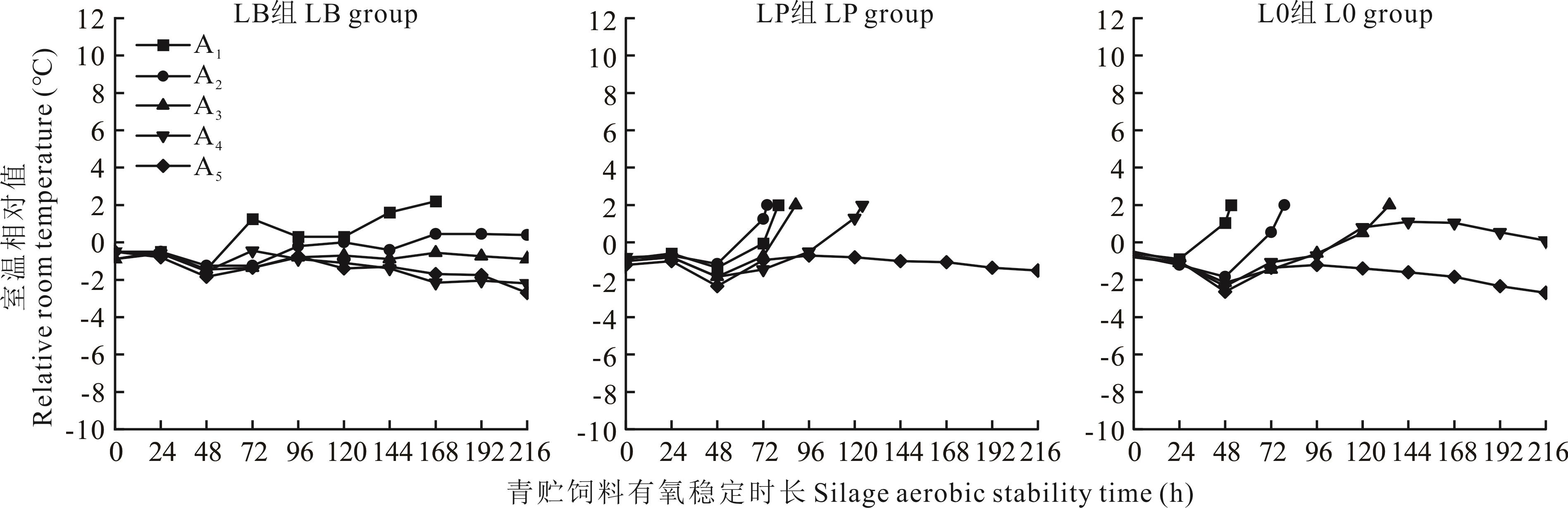
Fig.1 Silage aerobic stability time
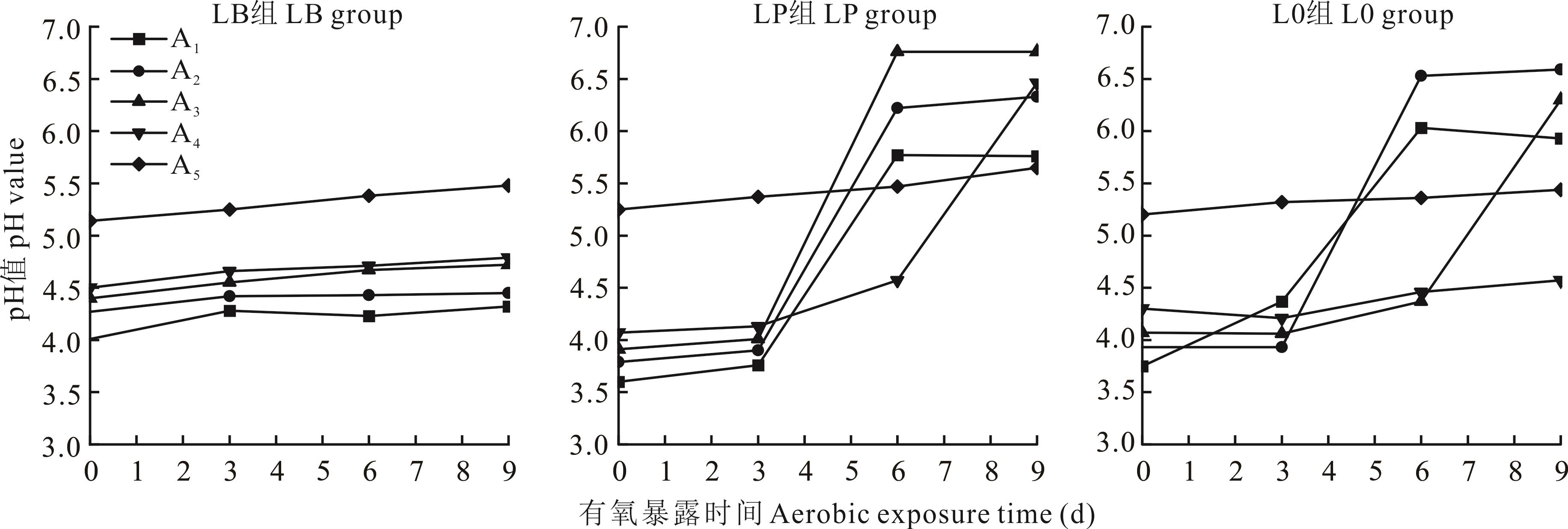
Fig.2 pH changes of silage during aerobic exposure
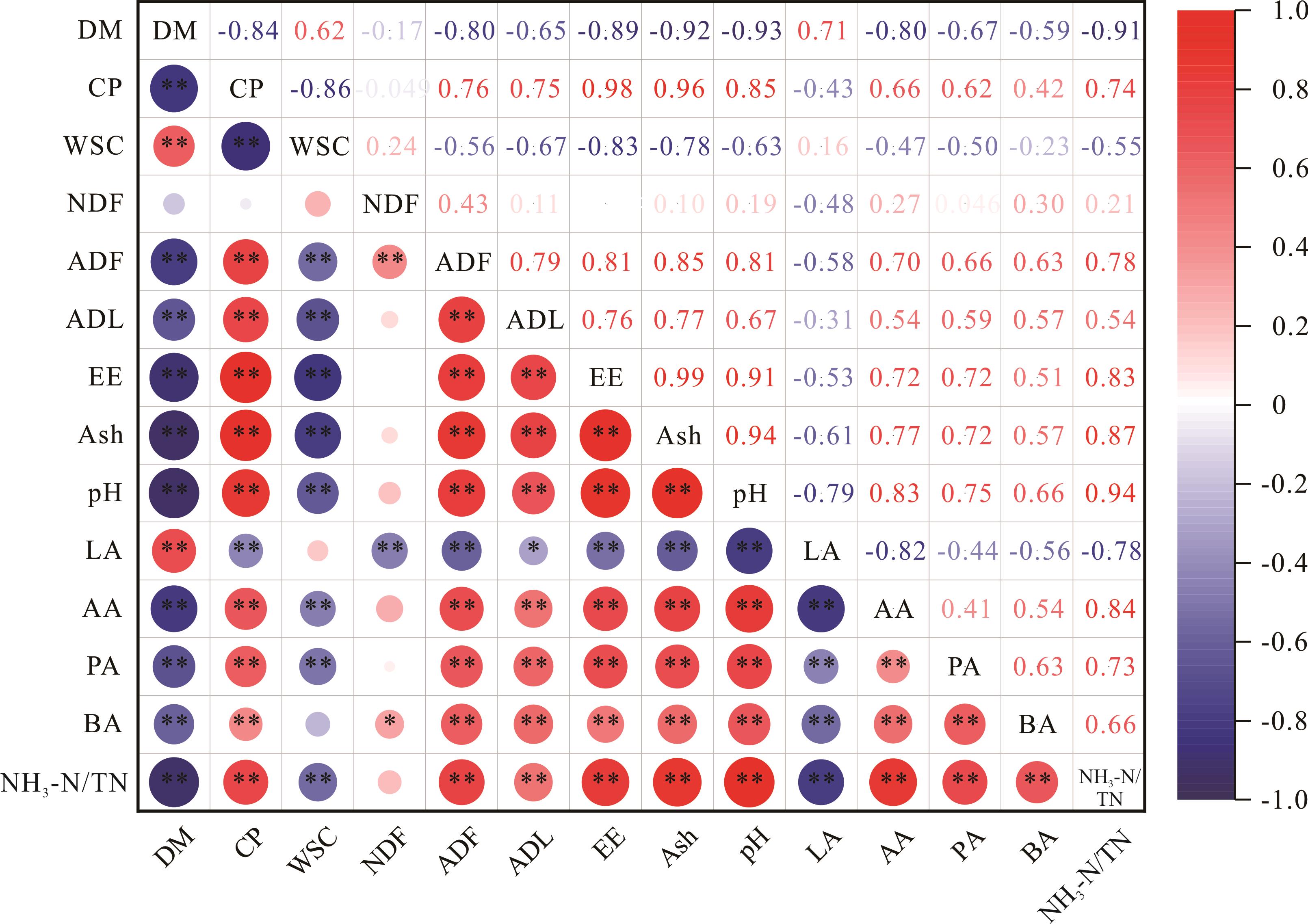
Fig.3 Correlation analysis between the nutrient quality and fermentation quality of whole maize-soybean silage
混合比例 Mixing ratio | 乳酸菌剂 Lactic acid bacteria agent | 加权关联度 Weighted correlation degree | 加权排名 Weighted ranking |
|---|---|---|---|
| A1 | LB | 0.595 | 10 |
| LP | 0.649 | 3 | |
| L0 | 0.555 | 12 | |
| A2 | LB | 0.618 | 8 |
| LP | 0.683 | 1 | |
| L0 | 0.570 | 11 | |
| A3 | LB | 0.670 | 2 |
| LP | 0.632 | 4 | |
| L0 | 0.631 | 5 | |
| A4 | LB | 0.597 | 9 |
| LP | 0.621 | 7 | |
| L0 | 0.625 | 6 | |
| A5 | LB | 0.516 | 15 |
| LP | 0.540 | 13 | |
| L0 | 0.521 | 14 |
Table 5 Correlation and ranking of different mixing ratios and lactic acid bacteria additive groups
混合比例 Mixing ratio | 乳酸菌剂 Lactic acid bacteria agent | 加权关联度 Weighted correlation degree | 加权排名 Weighted ranking |
|---|---|---|---|
| A1 | LB | 0.595 | 10 |
| LP | 0.649 | 3 | |
| L0 | 0.555 | 12 | |
| A2 | LB | 0.618 | 8 |
| LP | 0.683 | 1 | |
| L0 | 0.570 | 11 | |
| A3 | LB | 0.670 | 2 |
| LP | 0.632 | 4 | |
| L0 | 0.631 | 5 | |
| A4 | LB | 0.597 | 9 |
| LP | 0.621 | 7 | |
| L0 | 0.625 | 6 | |
| A5 | LB | 0.516 | 15 |
| LP | 0.540 | 13 | |
| L0 | 0.521 | 14 |
| 1 | Duan J X. Construction of silage maize and amaranth planting patterns and quality evaluation of mixed forage. Kunming: Yunnan Agricultural University, 2023. |
| 段佳鑫. 青贮玉米和籽粒苋种植模式构建及混贮饲草品质评价. 昆明: 云南农业大学, 2023. | |
| 2 | Zeng T R, Wu Y S, Xin Y F, et al. Silage quality and output of different maize-soybean strip intercropping patterns. Fermentation, 2022, 8(4): 174. |
| 3 | Fu L D, Ji L Z, Fan H. Yield and benefit analysis of different soybean varieties under the combined planting model of soybean and maize strip. Modern Agricultural Science and Technology, 2023(23): 21-23. |
| 付立冬, 季林章, 范辉. 大豆玉米带状复合种植模式下不同大豆品种产量及效益分析. 现代农业科技, 2023(23): 21-23. | |
| 4 | Yuan X T, Wang T, Luo K, et al. Effects of bandwidth and plant spacing on biomass accumulation and allocation and yield formation in strip intercropping soybean. Acta Agronomica Sinica, 2024, 50(1): 161-171. |
| 袁晓婷, 王甜, 罗凯, 等. 带宽和株距对带状间作大豆物质积累分配及产量形成的影响. 作物学报, 2024, 50(1): 161-171. | |
| 5 | Gao C, Chen P, Du Q, et al. Effects of sowing date and density on stem, leaf growth, and yield formation in strip intercropping soybean. Acta Agronomica Sinica, 2023, 49(11): 3090-3099. |
| 高超, 陈平, 杜青, 等. 播期、密度对带状间作大豆茎叶生长及产量形成的影响. 作物学报, 2023, 49(11): 3090-3099. | |
| 6 | Sui H M J L. Effects of different mixing ratios on silage quality, aerobic stability, microbial diversity and rumen degradation characteristics of whole plant corn with whole plant soybean. Tongliao: Inner Mongolia Minzu University, 2023. |
| 隋胡木吉勒. 不同混合比例对全株玉米与全株大豆混合青贮品质、有氧稳定性、微生物多样性及瘤胃降解特性的影响. 通辽: 内蒙古民族大学, 2023. | |
| 7 | Li R R, Zheng M H, Cui X Y, et al. Screening of lactic acid bacteria and its effect on fermentation characteristics of alfalfa silage. Chinese Journal of Grassland, 2021, 43(11): 69-75, 104. |
| 李荣荣, 郑猛虎, 崔欣雨, 等. 优良乳酸菌的筛选及对苜蓿青贮发酵品质的影响. 中国草地学报, 2021, 43(11): 69-75, 104. | |
| 8 | Xu D M, Ding W R, Ke W C, et al. Modulation of metabolome and bacterial community in whole crop corn silage by inoculating homofermentative Lactobacillus plantarum and heterofermentative Lactobacillus buchneri. Frontiers in Microbiology, 2018(9): 3299. |
| 9 | Cui B, Wang J T, Zhang X F, et al. Effects of the quality of whole corn silage and its evaluation method. China Feed, 2022(7): 116-121. |
| 崔彪, 王继彤, 张晓峰, 等. 影响全株玉米青贮饲料质量的因素及质量评价方法. 中国饲料, 2022(7): 116-121. | |
| 10 | Thompson S J, Jenny K, Silva L S, et al. Forage mass and nutritive value of grain- and forage-type soybean cultivars managed under different row spacings and clipping heights. Agronomy, 2023, 13(2): 487. |
| 11 | Li X L. Biomass yield and fermentation quality of silage corn and soybean grown in strip intercropping system. Chengdu: Sichuan Agricultural University, 2023. |
| 李小铃. 青贮玉米与大豆带状间作对生物产量及发酵品质的影响. 成都: 四川农业大学, 2023. | |
| 12 | Xiao Z M, Fan X, Ma D X, et al. Determination of crude protein in feed, GB/T 6432-2018. Beijing: China Standard Press, 2018. |
| 肖志明, 樊霞, 马东霞, 等. 饲料中粗蛋白的测定, GB/T 6432-2018. 北京: 中国标准出版社, 2018. | |
| 13 | Thomas T A. An automated procedure for the determination of soluble carbohydrates in herbage. Journal of Food Science, 1977(28): 639-642. |
| 14 | Zhang L Y. Feed analysis and feed quality detection technology. Beijing: China Agriculture University Press, 2007. |
| 张丽英. 饲料分析及饲料质量检测技术. 北京: 中国农业大学出版社, 2007. | |
| 15 | General Administration of Quality Supervosopm, Inspection and Quarantine of the People’s Republic of China, Standardization Administration of China. Determination of crude fat in feeds, GB/T 6433-2006. Beijing: Standard Press of China, 2006. |
| 中华人民共和国国家质量监督检验检疫总局, 中国国家标准化管理委员会. 饲料中粗脂肪的测定, GB/T 6433-2006. 北京: 中国标准出版社, 2006. | |
| 16 | Wu R X, Yang L, He Y F, et al. Determination of crude ash content in feed, GB/T 6438-2007. Beijing: China Standard Press, 2007. |
| 武润仙, 杨林, 何一帆, 等. 饲料中粗灰分的测定, GB/T 6438-2007. 北京: 中国标准出版社, 2007. | |
| 17 | Xu Q F, Yu Z, Han J G, et al. Determining organic acid in alfalfa silage by HPLC. Grassland and Turf, 2007, 2(17): 63-65, 67. |
| 许庆方, 玉柱, 韩建国, 等. 高效液相色谱法测定紫花苜蓿青贮中的有机酸. 草原与草坪, 2007, 2(17): 63-65, 67. | |
| 18 | Lin L F. Effects of add sorbic acid and ethanol on the fermentation quality of alfalfa and white clover silages. Nanjing: Nanjing Agricultural University, 2013. |
| 林丽芳. 添加山梨酸、乙醇对紫花苜蓿和白三叶发酵品质的影响. 南京: 南京农业大学, 2013. | |
| 19 | Li H P, Guan H, Jia Z F, et al. Screening of antifreeze-thawed lactic acid bacteria and their effects on oat silage fermentation quality and aerobic stability. Acta Prataculturae Sinica, 2022, 31(12): 158-170. |
| 李海萍, 关皓, 贾志锋, 等. 抗冻融乳酸菌的筛选及其对燕麦青贮品质和有氧稳定性的影响. 草业学报, 2022, 31(12): 158-170. | |
| 20 | Meng Y, Tian W Z, Wen P F, et al. Comprehensive evaluation of drought resistance of wheat varieties based on synergy of different developmental stages. Acta Agronomica Sinica, 2023, 49(2): 570-582. |
| 孟雨, 田文仲, 温鹏飞, 等. 基于不同发育阶段协同的小麦品种抗旱性综合评判. 作物学报, 2023, 49(2): 570-582. | |
| 21 | Yan Y H, Li J L, Guo X S, et al. A study on fermentation quality of Italian ryegrass and soybean straw mixed silage. Acta Prataculturae Sinica, 2014, 23(4): 94-99. |
| 闫艳红, 李君临, 郭旭生, 等. 多花黑麦草与大豆秸秆混合青贮发酵品质的研究. 草业学报, 2014, 23(4): 94-99. | |
| 22 | Chen P F, Bai S Q, Yang F Y, et al. Effects of additives and moisture on fermentation quality of smooth vetch silage. Acta Prataculturae Sinica, 2013, 22(2): 80-86. |
| 陈鹏飞, 白史且, 杨富裕, 等. 添加剂和水分对光叶紫花苕青贮品质的影响. 草业学报, 2013, 22(2): 80-86. | |
| 23 | Sa R L. Effects of lactic acid bacteria on fermentation quality, aerobic stability and microbial diversity of whole corn and soybean mixed silage. Tongliao: Inner Mongolia Minzu University, 2023. |
| 萨如拉. 乳酸菌对全株玉米大豆混合青贮发酵品质、有氧稳定性及微生物多样性的影响. 通辽: 内蒙古民族大学, 2023. | |
| 24 | Kung L, Shaver R, Grant R, et al. Silage review: Interpretation of chemical, microbial, and organoleptic components of silages. Journal of Dairy Science, 2018, 101(5): 4020-4033. |
| 25 | Chen Y. Effects of soybean variety and sowing date on yield and quality of mixed silage with soybean-maize strip intercropping. Chengdu: Sichuan Agricultural University, 2023. |
| 陈阳. 大豆品种及播期对大豆玉米带状间作混合青贮产量及品质的影响. 成都: 四川农业大学, 2023. | |
| 26 | Costa A C M, Jara G E S, Orrico M J A, et al. Fermentative parameters and chemical composition of mixed silages from corn-Crotalaria intercropping. Animal Feed Science and Technology, 2023(305): 115779. |
| 27 | Jahanzad E, Sadeghpour A, Hashemi M, et al. Silage fermentation profile, chemical composition and economic evaluation of millet and soya bean grown in monocultures and as intercrops. Grass and Forage Science, 2016, 71(4): 584-594. |
| 28 | Zhan J Q, Chen D D, Guo T X, et al. Effects of different additives on silage quality of Chinese medicinal residue. Acta Agrestia Sinica, 2023, 31(12): 3851-3857. |
| 詹佳琦, 陈丹丹, 郭田心, 等. 不同添加剂对中药渣青贮品质的影响. 草地学报, 2023, 31(12): 3851-3857. | |
| 29 | Parra C, Bolson D, Jacovaci F, et al. Influence of soybean-crop proportion on the conservation of maize-soybean bi-crop silage. Animal Feed Science and Technology, 2019(257): 114295. |
| 30 | Zeng T, Li X L, Guan H, et al. Dynamic microbial diversity and fermentation quality of the mixed silage of corn and soybean grown in strip intercropping system. Bioresource Technology, 2020(313): 123655. |
| 31 | Nascimento C M A, Gomes O P, Paula V S D, et al. Fermentative profile and lactic acid bacterial dynamics in non-wilted and wilted alfalfa silage in tropical conditions. Molecular Biology Reports, 2018, 46(1): 451-460. |
| 32 | Muck R E, Nadeau E M G, McAllister T A, et al. Silage review: Recent advances and future uses of silage additives. Journal of Dairy Science, 2018, 101(5): 3980-4000. |
| 33 | Bai J, Ding Z T, Su R N, et al. Storage temperature is more effective than lactic acid bacteria inoculations in manipulating fermentation and bacterial community diversity, co-occurrence and functionality of the whole-plant corn silage. Microbiology Spectrum, 2022, 10(2): 10122. |
| 34 | Xu J Z, Ma J F, Sa R L, et al. Effects of lactic acid bacteria inoculants on the nutrient composition, fermentation quality, and microbial diversity of whole-plant soybean-corn mixed silage. Frontiers in Microbiology, 2024(15): 1347293. |
| 35 | Érica S D B, Martinele D C, Mauro E S, et al. The effects of Lactobacillus hilgardii 4785 and Lactobacillus buchneri 40788 on the microbiome, fermentation, and aerobic stability of corn silage ensiled for various times. Journal of Dairy Science, 2021, 104(10): 10678-10698. |
| 36 | Jonas J, Vilma V, Rafael C D A, et al. Influence of ensiling timing and inoculation on whole plant maize silagefermentation and aerobic stability (preliminary research). Plants, 2024, 13(20): 2894. |
| [1] | Si-ran WANG, Cheng-long DING, Ji-peng TIAN, Yun-hui CHENG, Neng-xiang XU, Wen-jie ZHANG, Xin WANG, Bei-yi LIU. Effects of biological and antifungal additives on ensiling characteristics, in vitro digestibility, gas production, and aerobic stability of fermented total mixed ration including wet brewers’ grains [J]. Acta Prataculturae Sinica, 2025, 34(6): 213-226. |
| [2] | Si-ran WANG, Bei-yi LIU, Ji-peng TIAN, Yun-hui CHENG, Neng-xiang XU, Wen-jie ZHANG, Xin WANG, Cheng-long DING. Improvement in the fermentation quality of Italian ryegrass silage by ensiling with combined lactic acid bacteria inoculants at low temperature [J]. Acta Prataculturae Sinica, 2025, 34(5): 159-170. |
| [3] | Yu-cheng LIANG, Xiao-wen ZHANG, Tao SHAO, Wen-bo WANG, Xian-jun YUAN. Effects of different lactic acid bacteria strains on fermentation quality and mycotoxin contents of whole-plant corn silage [J]. Acta Prataculturae Sinica, 2025, 34(3): 123-133. |
| [4] | Ying TANG, Xiao-jing LIU, Ya-jiao ZHAO, Lin DONG. Characteristics and driving factors of lactic acid bacteria communities in silage made from alfalfa in different regions of Gansu Province [J]. Acta Prataculturae Sinica, 2024, 33(2): 112-124. |
| [5] | Li-juan HUANG, Rong-ji SUN, Wen-jing GAO, Zhi-fei ZHANG, Gui-hua CHEN. Screening and identification of whole rice surface dominant lactic acid bacteria [J]. Acta Prataculturae Sinica, 2024, 33(1): 117-125. |
| [6] | Jing TIAN, Cai-xia CAO, Li-ying HUANG, Juan-yan WU, Jian-guo ZHANG. Screening low-nutrient-tolerant lactic acid bacteria and their effects on the fermentation quality of silages from poor materials [J]. Acta Prataculturae Sinica, 2023, 32(9): 222-230. |
| [7] | Ting YE, Xiao-juan WU, Yi-xiao LU, Sheng-juan LIU, Zhuo-hui JIANG, Hui-min YANG. Effect of planting ratio on the stability of forage yield and population density in two alfalfa-grass mixtures [J]. Acta Prataculturae Sinica, 2023, 32(5): 127-137. |
| [8] | Ji-peng TIAN, Bei-yi LIU, Hong-ru GU, Cheng-long DING, Yun-hui CHENG, Zhu YU. Effects of lactic acid bacteria and calcium propionate on fermentation quality and mycotoxin contents of whole plant maize and oat silages [J]. Acta Prataculturae Sinica, 2022, 31(8): 157-166. |
| [9] | Dou-dou LIN, Ze-liang JU, Ji-kuan CHAI, Gui-qin ZHAO. Screening and identification of low temperature tolerant lactic acid bacterial epiphytes from oats on the Qinghai-Tibetan Plateau [J]. Acta Prataculturae Sinica, 2022, 31(5): 103-114. |
| [10] | Hai-ping LI, Hao GUAN, Zhi-feng JIA, Wen-hui LIU, Xiang MA, Yong LIU, Hui WANG, Li MA, Qing-ping ZHOU. Screening of antifreeze-thawed lactic acid bacteria and their effects on oat silage fermentation quality and aerobic stability [J]. Acta Prataculturae Sinica, 2022, 31(12): 158-170. |
| [11] | Li-qin HUANG, Song-qiao LI, Zhen-zhong YUAN, Jing TANG, Jing-cai YAN, Qi-yuan TANG. Effects of feeding co-fermented whole plant rice and spent mushroom (Pleurotus ostreatus) substrate on slaughter performance, meat quality and organ size indexes of Liuyang black goats [J]. Acta Prataculturae Sinica, 2021, 30(6): 133-140. |
| [12] | Xiao-fei YU, Xiao-nong GUO, Yan ZHANG, Zi-wei LIU, Xi-wen ZHANG, Ke-xin XU, Zhi-yong Wu. Optimization of fermentation technology for production of quinoa straw feed using response surface methodology [J]. Acta Prataculturae Sinica, 2021, 30(5): 155-164. |
| [13] | Zhan XIE, Lin MU, Zhi-fei ZHANG, Gui-hua CHEN, Yang LIU, Shuai GAO, Zhong-shan WEI. Effects on fermentation in alfalfa mixed silage of added lactic acid bacteria or organic acid salt combined with urea [J]. Acta Prataculturae Sinica, 2021, 30(5): 165-173. |
| [14] | Hong-jian LV, Xiang GUO, De-kui CHEN, Xiao-yang CHEN, Qing ZHANG. Effect of lactic acid bacteria and storage temperature on the quality of Moringa oleifera leaf silage [J]. Acta Prataculturae Sinica, 2021, 30(3): 121-128. |
| [15] | Xin-zhu CHEN, Jian-guo ZHANG. Effects of cutting time and plant height of ‘Reyan No.4’ king grass on distribution of lactic acid bacteria and silage fermentation quality [J]. Acta Prataculturae Sinica, 2021, 30(1): 150-158. |
| Viewed | ||||||
|
Full text |
|
|||||
|
Abstract |
|
|||||
