
ISSN 1004-5759 CN 62-1105/S
Acta Prataculturae Sinica ›› 2025, Vol. 34 ›› Issue (4): 82-92.DOI: 10.11686/cyxb2024188
Previous Articles Next Articles
Guang-pei WANG( ), Yan WEI, Yun CHEN()
Received:2024-05-21
Revised:2024-08-09
Online:2025-04-20
Published:2025-02-19
Contact:
Yun CHEN
Guang-pei WANG, Yan WEI, Yun CHEN. Changes in Medicago sativa root system architecture and mechanical characteristics during the growing period[J]. Acta Prataculturae Sinica, 2025, 34(4): 82-92.
生长时间 Growth time (d) | 土壤容重 Soil bulk density (g·cm-3) | 自然含水率 Soil water content (%) | 总孔隙度 Total porosity (%) | 水稳性团聚体 Water-stable aggregates (>0.25 mm, %) | 有机质 Soil organic matter (g·kg-1) |
|---|---|---|---|---|---|
| 0 | 1.40±0.07 | 8.84±1.86 | 47.35±2.50 | 66.64±1.87 | 15.94±1.82 |
| 60 | 1.49±0.10 | 12.14±0.71 | 43.73±3.68 | 78.47±3.23 | 14.15±3.00 |
| 90 | 1.29±0.03 | 9.16±0.53 | 51.31±1.14 | 75.71±2.92 | 9.62±3.40 |
| 120 | 1.37±0.01 | 9.30±0.26 | 48.14±1.58 | 75.56±2.56 | 17.83±2.04 |
| 150 | 1.41±0.06 | 2.45±0.60 | 46.94±3.35 | 76.33±0.70 | 18.49±1.31 |
Table 1 Soil physical and chemical properties in the study area
生长时间 Growth time (d) | 土壤容重 Soil bulk density (g·cm-3) | 自然含水率 Soil water content (%) | 总孔隙度 Total porosity (%) | 水稳性团聚体 Water-stable aggregates (>0.25 mm, %) | 有机质 Soil organic matter (g·kg-1) |
|---|---|---|---|---|---|
| 0 | 1.40±0.07 | 8.84±1.86 | 47.35±2.50 | 66.64±1.87 | 15.94±1.82 |
| 60 | 1.49±0.10 | 12.14±0.71 | 43.73±3.68 | 78.47±3.23 | 14.15±3.00 |
| 90 | 1.29±0.03 | 9.16±0.53 | 51.31±1.14 | 75.71±2.92 | 9.62±3.40 |
| 120 | 1.37±0.01 | 9.30±0.26 | 48.14±1.58 | 75.56±2.56 | 17.83±2.04 |
| 150 | 1.41±0.06 | 2.45±0.60 | 46.94±3.35 | 76.33±0.70 | 18.49±1.31 |
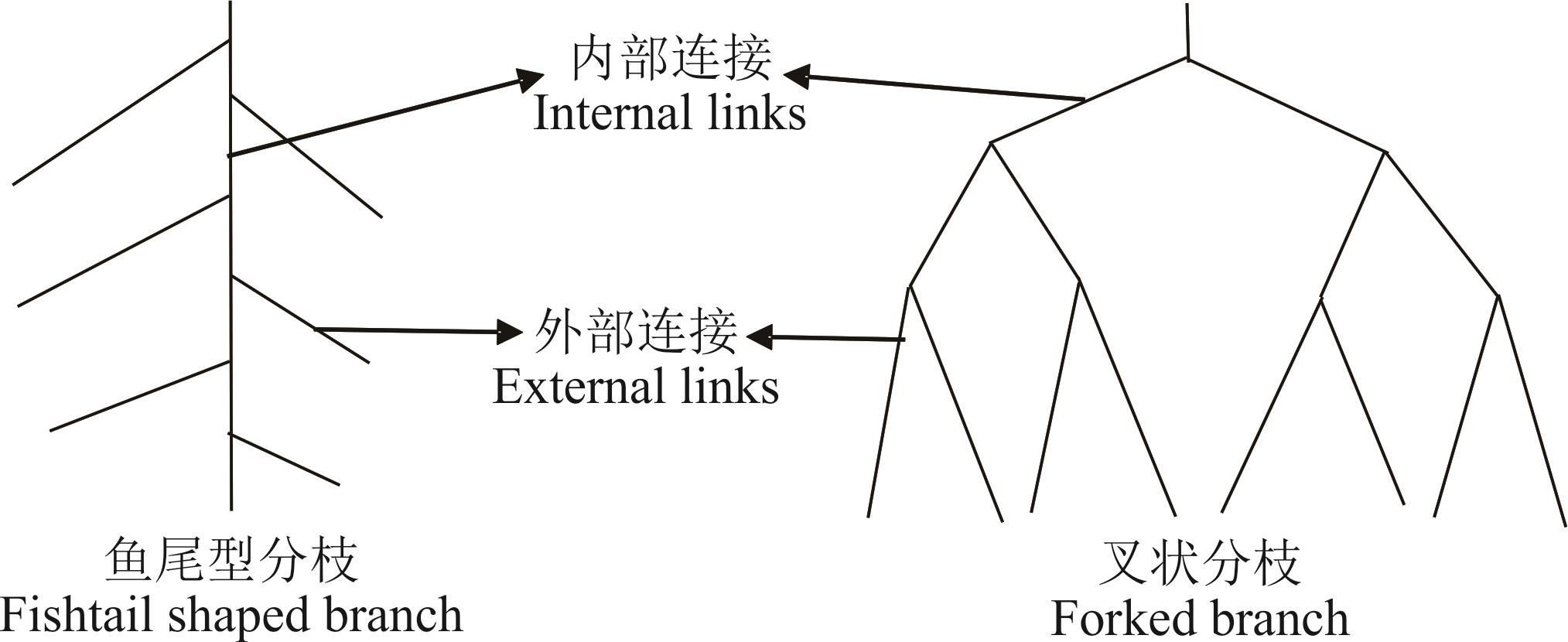
Fig.1 Schematic diagram of root topology
生长时间 Growth time (d) | 平均根径 Average root diameter (mm) | 总根长 Total root length (cm) | 总根表面积 Total root surface area (cm2) | 总根体积 Total root volume (cm3) | 根尖数 Root tips |
|---|---|---|---|---|---|
| 60 | 0.62±0.08ab | 39.01±16.78c | 7.71±3.88c | 0.12±0.08c | 66.10±37.87c |
| 90 | 0.56±0.15b | 66.54±15.42bc | 11.71±3.99c | 0.17±0.09c | 95.10±22.09bc |
| 120 | 0.69±0.17a | 116.93±32.03b | 24.56±5.41b | 0.43±0.16b | 151.80±36.98b |
| 150 | 0.53±0.08b | 309.03±149.00a | 49.21±20.45a | 0.63±0.23a | 448.60±165.36a |
Table 2 Root morphological indexes of M. sativa at different growth times
生长时间 Growth time (d) | 平均根径 Average root diameter (mm) | 总根长 Total root length (cm) | 总根表面积 Total root surface area (cm2) | 总根体积 Total root volume (cm3) | 根尖数 Root tips |
|---|---|---|---|---|---|
| 60 | 0.62±0.08ab | 39.01±16.78c | 7.71±3.88c | 0.12±0.08c | 66.10±37.87c |
| 90 | 0.56±0.15b | 66.54±15.42bc | 11.71±3.99c | 0.17±0.09c | 95.10±22.09bc |
| 120 | 0.69±0.17a | 116.93±32.03b | 24.56±5.41b | 0.43±0.16b | 151.80±36.98b |
| 150 | 0.53±0.08b | 309.03±149.00a | 49.21±20.45a | 0.63±0.23a | 448.60±165.36a |

Fig.2 Root fractal parameters and topological index of M. sativa at different growth times

Fig.3 Relationship between pull-out strength and diameter of M. sativa root system at different growth times
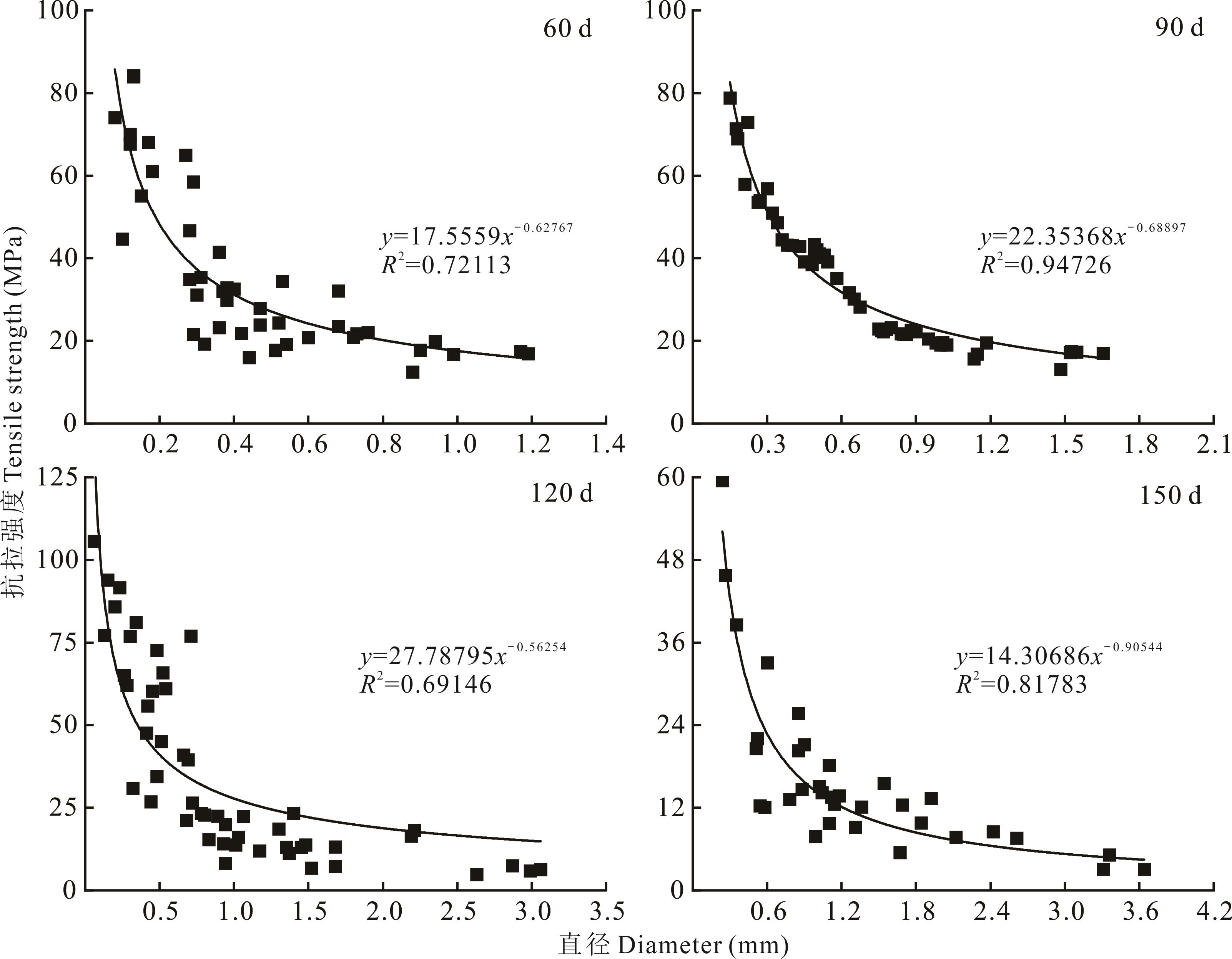
Fig.4 Relationship between tensile strength and diameter of M. sativa root system at different growth times
| 指标 Index | RL | RSA | RV | RT | FD | FA | TI | AL | TS | PS |
|---|---|---|---|---|---|---|---|---|---|---|
| 容重Soil bulk density | 0.239 | 0.232 | 0.204 | 0.300 | -0.293 | 0.352 | -0.261 | 0.070 | 0.155 | 0.085 |
| 自然含水率Soil water content | 0.021 | 0.035 | 0.091 | 0.256 | -0.172 | 0.133 | 0.140 | 0.063 | 0.748** | 0.811** |
| 总孔隙度Total porosity | 0.203 | 0.217 | 0.196 | 0.249 | 0.284 | 0.336 | 0.280 | -0.147 | -0.182 | -0.133 |
| 水稳性团聚体Water-stable aggregates (>0.25 mm) | 0.280 | 0.224 | 0.189 | 0.371 | -0.021 | 0.287 | -0.133 | -0.622* | 0.119 | 0.315 |
| 有机质Soil organic matter | 0.014 | 0.123 | 0.144 | 0.151 | -0.188 | 0.011 | -0.400 | 0.196 | -0.498 | -0.632* |
Table 3 Correlation analysis of soil physical and chemical properties and root parameters
| 指标 Index | RL | RSA | RV | RT | FD | FA | TI | AL | TS | PS |
|---|---|---|---|---|---|---|---|---|---|---|
| 容重Soil bulk density | 0.239 | 0.232 | 0.204 | 0.300 | -0.293 | 0.352 | -0.261 | 0.070 | 0.155 | 0.085 |
| 自然含水率Soil water content | 0.021 | 0.035 | 0.091 | 0.256 | -0.172 | 0.133 | 0.140 | 0.063 | 0.748** | 0.811** |
| 总孔隙度Total porosity | 0.203 | 0.217 | 0.196 | 0.249 | 0.284 | 0.336 | 0.280 | -0.147 | -0.182 | -0.133 |
| 水稳性团聚体Water-stable aggregates (>0.25 mm) | 0.280 | 0.224 | 0.189 | 0.371 | -0.021 | 0.287 | -0.133 | -0.622* | 0.119 | 0.315 |
| 有机质Soil organic matter | 0.014 | 0.123 | 0.144 | 0.151 | -0.188 | 0.011 | -0.400 | 0.196 | -0.498 | -0.632* |
| 指标 Index | RL | RSA | RV | RT | FD | FA | TI | AL |
|---|---|---|---|---|---|---|---|---|
| TS | -0.557** | -0.616** | -0.653** | -0.551** | -0.567** | -0.711** | 0.057 | 0.508** |
| PS | -0.328* | -0.369* | -0.401* | -0.309 | -0.502** | -0.439** | 0.012 | 0.428** |
Table 4 Correlation analysis of root configuration parameters and mechanical parameters
| 指标 Index | RL | RSA | RV | RT | FD | FA | TI | AL |
|---|---|---|---|---|---|---|---|---|
| TS | -0.557** | -0.616** | -0.653** | -0.551** | -0.567** | -0.711** | 0.057 | 0.508** |
| PS | -0.328* | -0.369* | -0.401* | -0.309 | -0.502** | -0.439** | 0.012 | 0.428** |
| 指标 Index | FA | FD | RSA | AL | RT | RL | RV | TI |
|---|---|---|---|---|---|---|---|---|
| 贡献率Contribution rate (%) | 75.1 | 13.6 | 3.2 | 1.5 | 2.1 | 1.1 | 2.1 | 1.3 |
| P | 0.002 | 0.044 | 0.318 | 0.532 | 0.436 | 0.622 | 0.424 | 0.614 |
Table 5 Contribution of root configuration parameters to mechanical parameters estimated based on redundancy analysis
| 指标 Index | FA | FD | RSA | AL | RT | RL | RV | TI |
|---|---|---|---|---|---|---|---|---|
| 贡献率Contribution rate (%) | 75.1 | 13.6 | 3.2 | 1.5 | 2.1 | 1.1 | 2.1 | 1.3 |
| P | 0.002 | 0.044 | 0.318 | 0.532 | 0.436 | 0.622 | 0.424 | 0.614 |
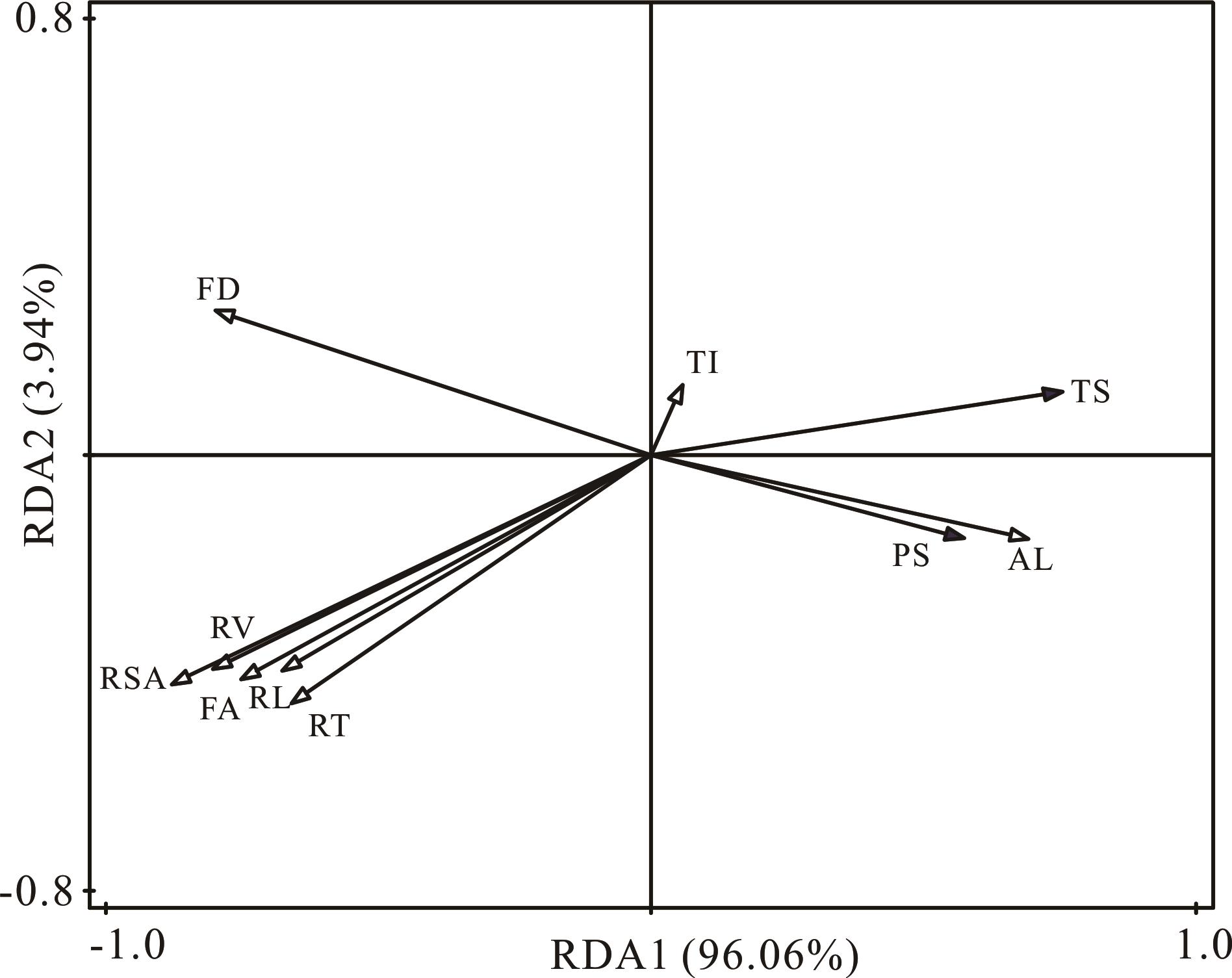
Fig.5 Redundancy analysis of root configuration and mechanical properties
| 1 | Baets D S, Poesen J, Reubens B, et al. Root tensile strength and root distribution of typical Mediterranean plant species and their contribution to soil shear strength. Plant and Soil, 2008, 305(1/2): 207-226. |
| 2 | Zhao W J, Dong Q Q, Yan T T, et al. Relationship between slope spectrum’s information entropy and terrain factors in water erosion areas of purple soil in southwest China. Transactions of the Chinese Society of Agricultural Engineering, 2020, 36(9): 160-167, 342. |
| 赵维军, 董奇群, 燕婷婷, 等. 西南紫色土水蚀区坡谱信息熵与地形因子关系分析. 农业工程学报, 2020, 36(9): 160-167, 342. | |
| 3 | Ma Y, He B H, He J L, et al. Confirmation of critical distance between hedgerows for non-point pollution control based on hydro-dynamics in purple soil area. Transactions of the Chinese Society of Agricultural Engineering, 2011, 27(4): 60-64. |
| 马云, 何丙辉, 何建林, 等. 基于水动力学的紫色土区植物篱控制面源污染的临界带间距确定. 农业工程学报, 2011, 27(4): 60-64. | |
| 4 | Guo Y F, Zhang Z Q, Qi W. Comparison of root structure and root tensile resistance of different shrubs in arsenic sandstone area. Journal of Soil and Water Conservation, 2023, 37(3): 273-280. |
| 郭月峰, 张志强, 祁伟. 砒砂岩区不同灌木根系构型及根系抗拉对比. 水土保持学报, 2023, 37(3): 273-280. | |
| 5 | Shan L S, Li Y, Ren W, et al. Root architecture of two desert plants in central Hexi Corridor of Northwest China. Chinese Journal of Applied Ecology, 2013, 24(1): 25-31. |
| 单立山, 李毅, 任伟, 等. 河西走廊中部两种荒漠植物根系构型特征. 应用生态学报, 2013, 24(1): 25-31. | |
| 6 | Zhang Y, Li C Y, Han S J, et al. Root architecture of main tree species and the effects on soil reinforcement in typical black soil region. Chinese Journal of Applied Ecology, 2021, 32(5): 1726-1734. |
| 张扬, 李程远, 韩少杰, 等. 典型黑土区主要树种根系构型特征及其对固土能力的影响. 应用生态学报, 2021, 32(5): 1726-1734. | |
| 7 | Ren J, Zhao C Z, Zhao X W, et al. Fractal characteristics of Agriophyllum squarrosum roots in desert-oasis ecotone in Jinta County, Gansu Province. Acta Ecologica Sinica, 2020, 40(15): 5298-5305. |
| 任杰, 赵成章, 赵夏纬, 等. 金塔绿洲荒漠交错带沙蓬根系分形特征. 生态学报, 2020, 40(15): 5298-5305. | |
| 8 | Tang Z Q, Chen Y J, Hu J, et al. Analysis of root architecture and rhizosheath characteristics of seven forage species in desertified grassland of Northwest Sichuan. Chinese Journal of Grassland, 2020, 42(2): 22-31. |
| 唐子钦, 陈有军, 胡健, 等. 川西北沙化草地7种牧草根系构型及根鞘特征分析. 中国草地学报, 2020, 42(2): 22-31. | |
| 9 | Genet M, Stokes A, Salin F, et al. The influence of cellulose content on tensile strength in tree roots. Plant and Soil, 2005, 278(1/2): 1-9. |
| 10 | Liu X H. The effects of terrace hedgerows roots on the erodibility of the root-soil complex in the purple soil area. Chongqing: Southwest University, 2021. |
| 刘枭宏. 紫色土区地埂篱根系对根-土复合体抗侵蚀性能的影响. 重庆: 西南大学, 2021. | |
| 11 | Wei Y, Liu Y B, Liu X H, et al. Study on shear strength of root-soil composite of Dolichos lablab and Medicago sativa in purple soil region. Acta Prataculturae Sinica, 2023, 32(8): 82-90. |
| 魏艳, 刘有斌, 刘枭宏, 等. 紫色土区拉巴豆和紫花苜蓿根-土复合体抗剪性能研究. 草业学报, 2023, 32(8): 82-90. | |
| 12 | Zhang W H, Wang G Y, Hu S H, et al. Indoor experimental study on the pull-out force of Symplocos anomala Brand root. Science of Soil and Water Conservation, 2020, 18(3): 22-30. |
| 张文豪, 王桂尧, 胡圣辉, 等. 薄叶山矾根系抗拔力的室内试验研究. 中国水土保持科学, 2020, 18(3): 22-30. | |
| 13 | Fan C C, Lai Y F. Influence of the spatial layout of vegetation on the stability of slopes. Plant and Soil, 2014, 377(1/2): 83-95. |
| 14 | Pu J Z, Lv X Z, Zhang Q F, et al. Characteristics and influencing factors of runoff and sediment yield of typical grassland in loess hilly and gully region. Research of Soil and Water Conservation, 2023, 30(2): 1-6. |
| 普隽泽, 吕锡芝, 张秋芬, 等. 黄土丘陵沟壑区典型草被产流产沙特征及其影响因素. 水土保持研究, 2023, 30(2): 1-6. | |
| 15 | Institute of Soil Physics, Nanjing Soil Research Institute, Chinese Academy of Sciences. Physical properties of soil. Beijing: Beijing Science Press, 1978. |
| 中国科学院南京土壤研究所土壤物理研究室. 土壤物理性质测定法. 北京: 科学出版社, 1978. | |
| 16 | Zhang L Y, Duan Q S, Li Y M. Soybean roots architecture and the mechanical properties of the root-soil complex in mountain red soil on sloping farmland. Chinese Journal of Eco-Agriculture, 2022, 30(9): 1464-1476. |
| 张立芸, 段青松, 李永梅. 坡耕地山原红壤大豆根系构型及根土复合体力学特性. 中国生态农业学报, 2022, 30(9): 1464-1476. | |
| 17 | Fitter A H. An architectural approach to the comparative ecology of plant root systems. New Phytologist, 2008, 106(S1): 61-77. |
| 18 | Yang J S, Wu B, Kang R J, et al. Effects of different phosphogypsum content on root characteristics and pull-out mechanical properties of bermudagrass in vegetation concrete. Journal of China Three Gorges University (Natural Sciences), 2023: http://kns.cnki.net/kcms/detail/42.1735.TV.20230705.0904.002.html. |
| 杨嘉槊, 吴彬, 康柔嘉, 等. 植被混凝土不同磷石膏掺量对狗牙根根系特性及抗拔力学性能的影响. 三峡大学学报(自然科学版), 2023: http://kns.cnki.net/kcms/detail/42.1735.TV.20230705.0904.002.html. | |
| 19 | Wang Y H, Xu J W, Han Y J, et al. Characteristics of root morphology of five salt tolerance species of seedlings in Yellow River delta area. Research of Soil and Water Conservation, 2014, 21(1): 261-266. |
| 王月海, 许景伟, 韩友吉, 等. 黄河三角洲5个耐盐树种苗木根系形态结构特征. 水土保持研究, 2014, 21(1): 261-266. | |
| 20 | Huang B F, Xin J L, Dai H W, et al. Root morphological responses of three hot pepper cultivars to Cd exposure and their correlations with Cd accumulation. Environmental Science and Pollution Research International, 2015, 22(2): 1151-1159. |
| 21 | Margitta D, Arthur B. Fractal geometry and root system structures of heterogeneous plant communities. Plant and Soil, 2005, 272(1/2): 61-76. |
| 22 | Yan L, Yang F S, Li H E, et al. Fractal features of Hippophae rhamnoides roots under different site conditions in soft sandstone area. Arid Zone Research, 2019, 36(2): 467-473. |
| 闫励, 杨方社, 李怀恩, 等. 砒砂岩区不同立地下沙棘根系分形特征. 干旱区研究, 2019, 36(2): 467-473. | |
| 23 | Ma X Z, Wang X P. Root architecture and adaptive strategy of two desert plants in the Alxa Plateau. Acta Ecologica Sinica, 2020, 40(17): 6001-6008. |
| 马雄忠, 王新平. 阿拉善高原2种荒漠植物根系构型及生态适应性特征. 生态学报, 2020, 40(17): 6001-6008. | |
| 24 | Yang X L, Zhang X M, Li Y L, et al. Analysis and estimation of root architecture in the hinterland of Taklimakan desert base on the fractal theory. Journal of Arid Land Resources and Environment, 2015, 29(8): 145-150. |
| 杨小林, 张希明, 李义玲, 等. 基于分形理论的塔克拉玛干沙漠腹地自然植物根系构型特征分析. 干旱区资源与环境, 2015, 29(8): 145-150. | |
| 25 | Yan Z X, Song Y, Jiang P, et al. Mechanical analysis of interaction between plant roots and rock and soil mass in slope vegetation. Applied Mathematics and Mechanics, 2010, 31(5): 617-622. |
| 26 | Liu D L, Zhang H, Cao X C, et al. Impacts of heat stress on the photosynthetic physiology of alfalfa. Acta Agrestia Sinica, 2014, 22(3): 657-660. |
| 刘大林, 张华, 曹喜春, 等. 夏季高温胁迫对紫花苜蓿光合生理机制的影响研究. 草地学报, 2014, 22(3): 657-660. | |
| 27 | Li S C, Sun H L, Yang Z R, et al. Mechanical characteristics of interaction between root system of plants and rock for rock slope protection. Chinese Journal of Rock Mechanics and Engineering, 2006(10): 2051-2057. |
| 李绍才, 孙海龙, 杨志荣, 等. 护坡植物根系与岩体相互作用的力学特性. 岩石力学与工程学报, 2006(10): 2051-2057. | |
| 28 | Zheng M X, Huang G, Peng J. Tensile-pullout properties of roots of Magnolia multiflora in different growth stages and stability of slope with its root. Transactions of the Chinese Society of Agricultural Engineering, 2018, 34(20): 175-182. |
| 郑明新, 黄钢, 彭晶. 不同生长期多花木兰根系抗拉拔特性及其根系边坡的稳定性. 农业工程学报, 2018, 34(20): 175-182. | |
| 29 | Yuan S J, Niu G Q, Liu J, et al. Instantaneous anti-tension and tensile strength of single root of four plant species in two growth periods. Bulletin of Soil and Water Conservation, 2009, 29(5): 21-25. |
| 苑淑娟, 牛国权, 刘静, 等. 瞬时拉力下两个生长期4种植物单根抗拉力与抗拉强度的研究. 水土保持通报, 2009, 29(5): 21-25. | |
| 30 | Ye C, Guo Z L, Cai C F, et al. Relationship between root tensile mechanical properties and main chemical components of five herbaceous species. Pratacultural Science, 2017, 34(3): 598-606. |
| 叶超, 郭忠录, 蔡崇法, 等. 5种草本植物根系理化特性及其相关性. 草业科学, 2017, 34(3): 598-606. | |
| 31 | Ji J N, Zhang Z Q, Guo J T, et al. Finite element numerical simulation of Black Locust (Robinia pseudoacacia) and Arborvitae (Platycladus orientalis) roots on slope stability on Loess Plateau of China. Transactions of the Chinese Society of Agricultural Engineering, 2014, 30(19): 146-154. |
| 及金楠, 张志强, 郭军庭, 等. 黄土高原刺槐和侧柏根系固坡的有限元数值模拟. 农业工程学报, 2014, 30(19): 146-154. | |
| 32 | Zhang X L, Hu X S, Li G R, et al. Time effect of young shrub roots on slope protection of loess area in Northeast Qinghai-Tibetan Plateau. Transactions of the Chinese Society of Agricultural Engineering, 2012, 28(4): 136-141. |
| 张兴玲, 胡夏嵩, 李国荣, 等. 青藏高原东北部黄土区灌木幼林根系护坡的时间效应. 农业工程学报, 2012, 28(4): 136-141. | |
| 33 | Zhu Z H, Meng C, Wang X, et al. Geometric distribution, formation, and topological structure of soil aggregates after introduction of Caragana korshinskii on the desert steppe. Acta Prataculturae Sinica, 2023, 32(11): 53-64. |
| 朱志昊, 孟晨, 王兴, 等. 荒漠草原人工柠条引入后土壤团聚体几何分布及拓扑结构演变特征. 草业学报, 2023, 32(11): 53-64. | |
| 34 | Liu Y B, Yu D M, Fu J T, et al. Experimental study on root-soil friction mechanical mechanism of Caragana korshinskii Kom. in loess area. Transactions of the Chinese Society of Agricultural Engineering, 2017, 33(10): 198-205. |
| 刘亚斌, 余冬梅, 付江涛, 等. 黄土区灌木柠条锦鸡儿根-土间摩擦力学机制试验研究. 农业工程学报, 2017, 33(10): 198-205. |
| Viewed | ||||||
|
Full text |
|
|||||
|
Abstract |
|
|||||
