
ISSN 1004-5759 CN 62-1105/S
Acta Prataculturae Sinica ›› 2026, Vol. 35 ›› Issue (3): 195-209.DOI: 10.11686/cyxb2025132
Previous Articles Next Articles
Peng-yu TIAN1( ), Yi-ru ZHANG1, Xu-kai LI2, Min-li SONG1()
Received:2025-04-17
Revised:2025-06-16
Online:2026-03-20
Published:2026-01-19
Contact:
Min-li SONG
Peng-yu TIAN, Yi-ru ZHANG, Xu-kai LI, Min-li SONG. Identification and expression analysis of the SiCCoAOMT gene family in Setaria italica[J]. Acta Prataculturae Sinica, 2026, 35(3): 195-209.
| 基因名称Gene name | 上游引物Forward primer (5'-3') | 下游引物Reverse primer (3'-5') |
|---|---|---|
| SiActin7 | AGGGCTGTCTTCCCGAGTAT | ATGGCTCACACCATCACCAG |
| SiCCoAOMT1 | TGATCCATCCGAATCGCCAG | CACCGAGCACGGAGATTGAT |
| SiCCoAOMT2 | TCGGGTTCGACTTGGAATGG | TCCACAGCGTGTTGTCGTAG |
| SiCCoAOMT3 | GGCAGCCCTGCTTCACATTA | TGAATCGCAATGCGGCAATC |
| SiCCoAOMT4 | GCGAGTACTACGAGATCGGC | GACGTCCAGACGGAATGGAA |
| SiCCoAOMT5 | GGTGCGCCAAGCCTAAACTG | GGCGTTCAAGGGACGGTACT |
Table 1 qRT-PCR primer sequences
| 基因名称Gene name | 上游引物Forward primer (5'-3') | 下游引物Reverse primer (3'-5') |
|---|---|---|
| SiActin7 | AGGGCTGTCTTCCCGAGTAT | ATGGCTCACACCATCACCAG |
| SiCCoAOMT1 | TGATCCATCCGAATCGCCAG | CACCGAGCACGGAGATTGAT |
| SiCCoAOMT2 | TCGGGTTCGACTTGGAATGG | TCCACAGCGTGTTGTCGTAG |
| SiCCoAOMT3 | GGCAGCCCTGCTTCACATTA | TGAATCGCAATGCGGCAATC |
| SiCCoAOMT4 | GCGAGTACTACGAGATCGGC | GACGTCCAGACGGAATGGAA |
| SiCCoAOMT5 | GGTGCGCCAAGCCTAAACTG | GGCGTTCAAGGGACGGTACT |
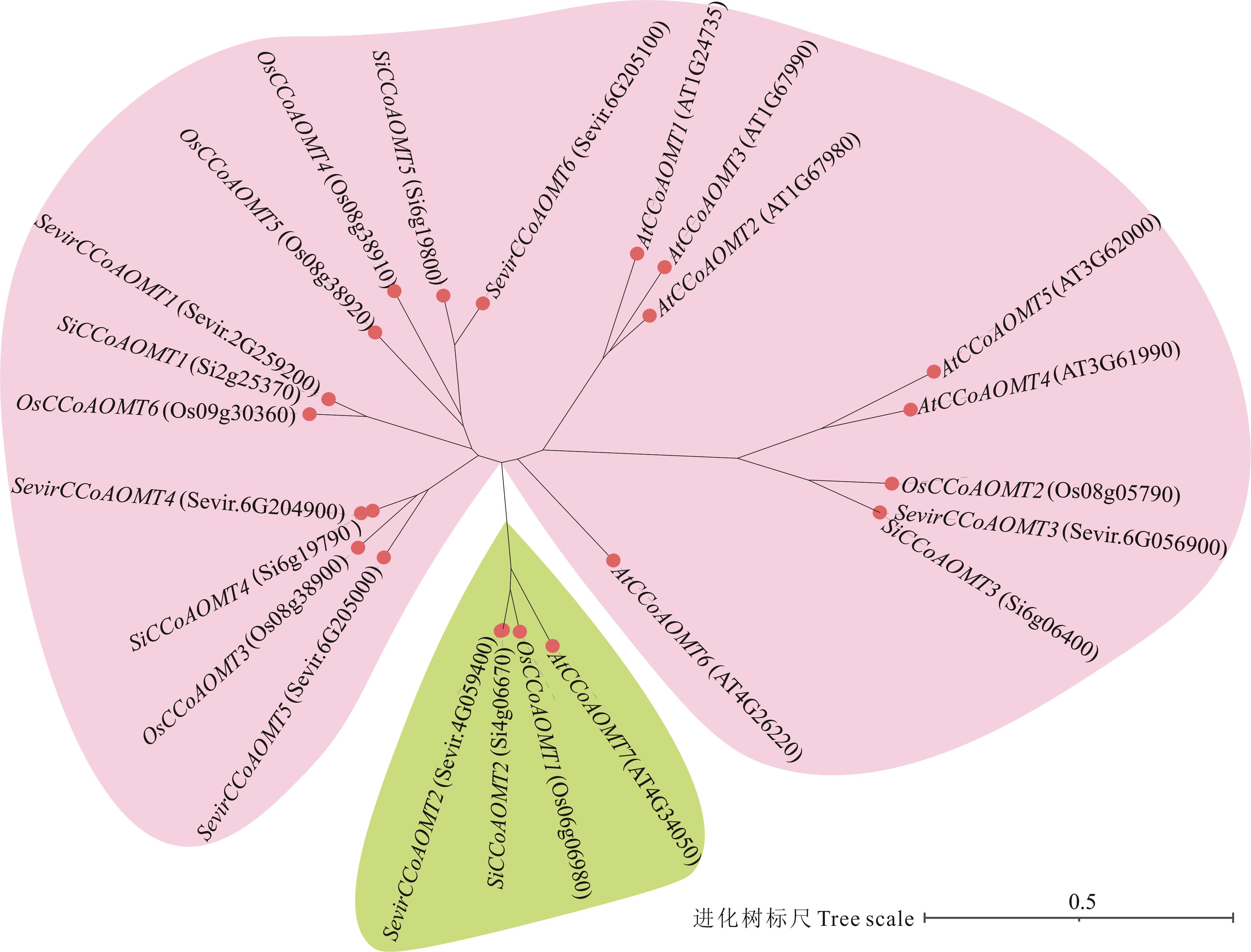
Fig.1 Phylogenetic relationships of the CCoAOMT family proteins in S. italica, A. thaliana, O. sativa and S. viridis
基因名称 Gene name | 基因号 Gene ID | 蛋白长度 Protein length (aa) | 分子量 Molecular weight (Da) | 等电点 Isoelectric point | 不稳定指数 Instability index | 亚细胞定位 Subcellular localization |
|---|---|---|---|---|---|---|
| SiCCoAOMT1 | Si2g25370 | 242 | 25798.61 | 5.04 | 33.80 | 叶绿体Chloroplast |
| SiCCoAOMT2 | Si4g06670 | 265 | 29517.68 | 5.24 | 26.54 | 细胞质Cytoplasmic |
| SiCCoAOMT3 | Si6g06400 | 295 | 32293.69 | 9.01 | 50.34 | 叶绿体Chloroplast, 线粒体Mitochondrion |
| SiCCoAOMT4 | Si6g19790 | 202 | 22591.96 | 5.26 | 26.21 | 细胞质Cytoplasmic |
| SiCCoAOMT5 | Si6g19800 | 544 | 58335.97 | 4.93 | 48.70 | 细胞质Cytoplasmic, 叶绿体Chloroplast |
| AtCCoAOMT1 | AT1G24735 | 291 | 33157.44 | 6.89 | 31.20 | 细胞质Cytoplasmic |
| AtCCoAOMT2 | AT1G67980 | 232 | 26114.06 | 5.16 | 20.45 | 细胞质Cytoplasmic |
| AtCCoAOMT3 | AT1G67990 | 233 | 26350.49 | 5.25 | 19.47 | 细胞质Cytoplasmic |
| AtCCoAOMT4 | AT3G61990 | 290 | 32168.92 | 5.23 | 41.90 | 叶绿体Chloroplast, 细胞核Nucleus |
| AtCCoAOMT5 | AT3G62000 | 352 | 39671.76 | 9.05 | 38.35 | 细胞核Nucleus |
| AtCCoAOMT6 | AT4G26220 | 232 | 25945.79 | 5.37 | 36.58 | 细胞质Cytoplasmic |
| AtCCoAOMT7 | AT4G34050 | 286 | 32473.04 | 5.81 | 39.11 | 细胞质Cytoplasmic |
| OsCCoAOMT1 | LOC_Os06g06980 | 260 | 28847.77 | 5.21 | 27.11 | 细胞质Cytoplasmic |
| OsCCoAOMT2 | LOC_Os08g05790 | 317 | 34307.55 | 9.08 | 36.74 | 叶绿体Chloroplast |
| OsCCoAOMT3 | LOC_Os08g38900 | 252 | 27771.74 | 5.11 | 29.60 | 细胞质Cytoplasmic |
| OsCCoAOMT4 | LOC_Os08g38910 | 292 | 31897.36 | 5.34 | 43.26 | 细胞质Cytoplasmic |
| OsCCoAOMT5 | LOC_Os08g38920 | 234 | 25883.49 | 5.57 | 29.56 | 细胞质Cytoplasmic, 叶绿体Chloroplast |
| OsCCoAOMT6 | LOC_Os09g30360 | 258 | 27132.08 | 5.09 | 34.32 | 细胞质Cytoplasmic, 叶绿体Chloroplast |
| SevirCCoAOMT1 | Sevir.2G259200 | 242 | 25798.61 | 5.04 | 33.80 | 叶绿体Chloroplast |
| SevirCCoAOMT2 | Sevir.4G059400 | 265 | 29544.71 | 5.24 | 25.82 | 细胞质Cytoplasmic |
| SevirCCoAOMT3 | Sevir.6G056900 | 297 | 32568.99 | 9.01 | 49.82 | 叶绿体Chloroplast, 线粒体Mitochondrion |
| SevirCCoAOMT4 | Sevir.6G204900 | 246 | 27324.29 | 5.09 | 31.64 | 细胞质Cytoplasmic |
| SevirCCoAOMT5 | Sevir.6G205000 | 245 | 26808.57 | 5.17 | 29.79 | 细胞质Cytoplasmic |
| SevirCCoAOMT6 | Sevir.6G205100 | 309 | 33724.22 | 6.27 | 47.54 | 叶绿体Chloroplast, 线粒体Mitochondrion |
Table 2 Physicochemical properties of CCoAOMT family proteins encoded by the genes of four plant species
基因名称 Gene name | 基因号 Gene ID | 蛋白长度 Protein length (aa) | 分子量 Molecular weight (Da) | 等电点 Isoelectric point | 不稳定指数 Instability index | 亚细胞定位 Subcellular localization |
|---|---|---|---|---|---|---|
| SiCCoAOMT1 | Si2g25370 | 242 | 25798.61 | 5.04 | 33.80 | 叶绿体Chloroplast |
| SiCCoAOMT2 | Si4g06670 | 265 | 29517.68 | 5.24 | 26.54 | 细胞质Cytoplasmic |
| SiCCoAOMT3 | Si6g06400 | 295 | 32293.69 | 9.01 | 50.34 | 叶绿体Chloroplast, 线粒体Mitochondrion |
| SiCCoAOMT4 | Si6g19790 | 202 | 22591.96 | 5.26 | 26.21 | 细胞质Cytoplasmic |
| SiCCoAOMT5 | Si6g19800 | 544 | 58335.97 | 4.93 | 48.70 | 细胞质Cytoplasmic, 叶绿体Chloroplast |
| AtCCoAOMT1 | AT1G24735 | 291 | 33157.44 | 6.89 | 31.20 | 细胞质Cytoplasmic |
| AtCCoAOMT2 | AT1G67980 | 232 | 26114.06 | 5.16 | 20.45 | 细胞质Cytoplasmic |
| AtCCoAOMT3 | AT1G67990 | 233 | 26350.49 | 5.25 | 19.47 | 细胞质Cytoplasmic |
| AtCCoAOMT4 | AT3G61990 | 290 | 32168.92 | 5.23 | 41.90 | 叶绿体Chloroplast, 细胞核Nucleus |
| AtCCoAOMT5 | AT3G62000 | 352 | 39671.76 | 9.05 | 38.35 | 细胞核Nucleus |
| AtCCoAOMT6 | AT4G26220 | 232 | 25945.79 | 5.37 | 36.58 | 细胞质Cytoplasmic |
| AtCCoAOMT7 | AT4G34050 | 286 | 32473.04 | 5.81 | 39.11 | 细胞质Cytoplasmic |
| OsCCoAOMT1 | LOC_Os06g06980 | 260 | 28847.77 | 5.21 | 27.11 | 细胞质Cytoplasmic |
| OsCCoAOMT2 | LOC_Os08g05790 | 317 | 34307.55 | 9.08 | 36.74 | 叶绿体Chloroplast |
| OsCCoAOMT3 | LOC_Os08g38900 | 252 | 27771.74 | 5.11 | 29.60 | 细胞质Cytoplasmic |
| OsCCoAOMT4 | LOC_Os08g38910 | 292 | 31897.36 | 5.34 | 43.26 | 细胞质Cytoplasmic |
| OsCCoAOMT5 | LOC_Os08g38920 | 234 | 25883.49 | 5.57 | 29.56 | 细胞质Cytoplasmic, 叶绿体Chloroplast |
| OsCCoAOMT6 | LOC_Os09g30360 | 258 | 27132.08 | 5.09 | 34.32 | 细胞质Cytoplasmic, 叶绿体Chloroplast |
| SevirCCoAOMT1 | Sevir.2G259200 | 242 | 25798.61 | 5.04 | 33.80 | 叶绿体Chloroplast |
| SevirCCoAOMT2 | Sevir.4G059400 | 265 | 29544.71 | 5.24 | 25.82 | 细胞质Cytoplasmic |
| SevirCCoAOMT3 | Sevir.6G056900 | 297 | 32568.99 | 9.01 | 49.82 | 叶绿体Chloroplast, 线粒体Mitochondrion |
| SevirCCoAOMT4 | Sevir.6G204900 | 246 | 27324.29 | 5.09 | 31.64 | 细胞质Cytoplasmic |
| SevirCCoAOMT5 | Sevir.6G205000 | 245 | 26808.57 | 5.17 | 29.79 | 细胞质Cytoplasmic |
| SevirCCoAOMT6 | Sevir.6G205100 | 309 | 33724.22 | 6.27 | 47.54 | 叶绿体Chloroplast, 线粒体Mitochondrion |
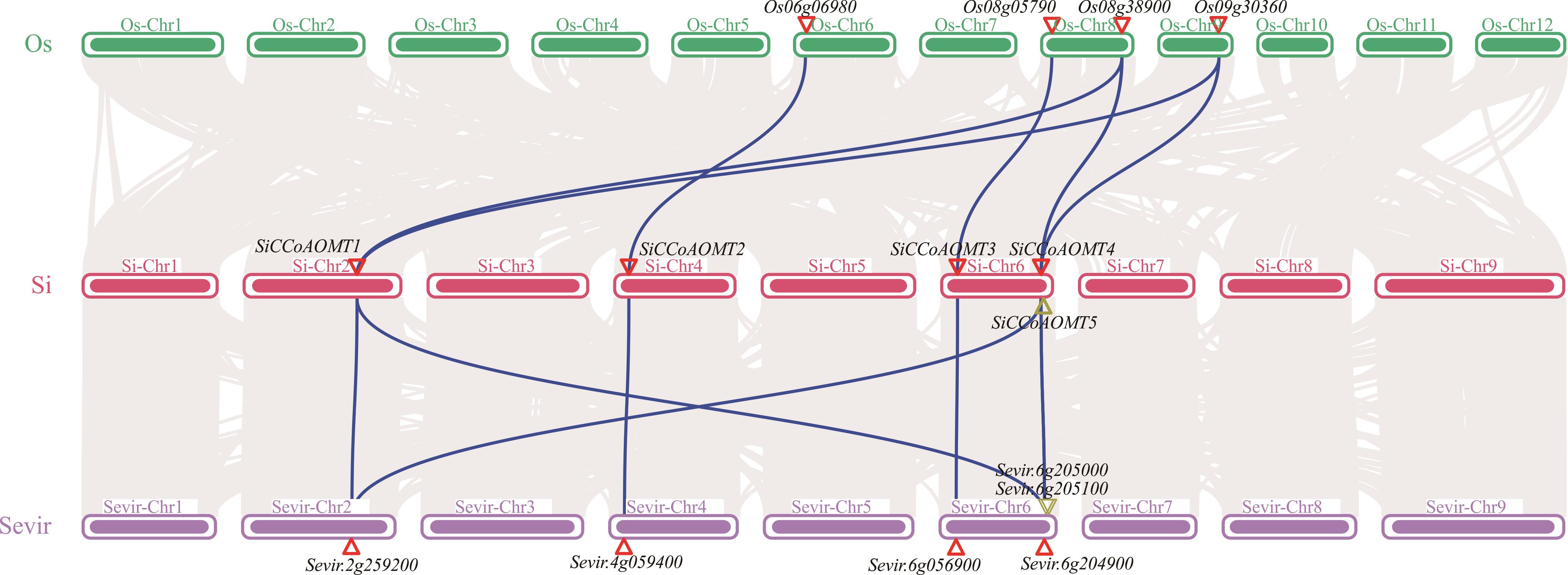
Fig.2 Synteny of CCoAOMT family genes among millet, rice, and foxtail millet
同源基因 Homologous gene | 同义替 换率 (Ks ) | 非同义替换率 (Ka ) | 非同义替换/同义替换 (Ka/Ks ) |
|---|---|---|---|
| SiCCoAOMT1-LOC_Os08g38900 | 0.3068 | 0.3415 | 1.113103 |
| SiCCoAOMT1-LOC_Os09g30360 | 0.0515 | 0.1322 | 2.566990 |
| SiCCoAOMT1-Sevir.2G259200 | 1.3027 | 1.3657 | 1.048361 |
| SiCCoAOMT1-Sevir.6G204900 | 1.4866 | 1.6951 | 1.140253 |
| SiCCoAOMT2-LOC_Os06g06980 | 0.0585 | 0.1486 | 2.540171 |
| SiCCoAOMT2-Sevir.4G059400 | 1.3714 | 1.3570 | 0.989500 |
| SiCCoAOMT3-LOC_Os08g05790 | 0.1405 | 0.1639 | 1.166548 |
| SiCCoAOMT3-Sevir.6G056900 | 2.1684 | 1.5731 | 0.725466 |
| SiCCoAOMT4-LOC_Os08g38900 | 0.1196 | 0.2554 | 2.135452 |
| SiCCoAOMT4-LOC_Os09g30360 | 0.2908 | 0.3400 | 1.169188 |
| SiCCoAOMT4-Sevir.2G259200 | 1.1080 | 1.2859 | 1.160560 |
| SiCCoAOMT4-Sevir.6G204900 | 1.7213 | 1.6205 | 0.941440 |
Table 3 Ka/Ks values of syntenic gene pairs for CCoAOMT in millet, rice, and foxtail millet calculated
同源基因 Homologous gene | 同义替 换率 (Ks ) | 非同义替换率 (Ka ) | 非同义替换/同义替换 (Ka/Ks ) |
|---|---|---|---|
| SiCCoAOMT1-LOC_Os08g38900 | 0.3068 | 0.3415 | 1.113103 |
| SiCCoAOMT1-LOC_Os09g30360 | 0.0515 | 0.1322 | 2.566990 |
| SiCCoAOMT1-Sevir.2G259200 | 1.3027 | 1.3657 | 1.048361 |
| SiCCoAOMT1-Sevir.6G204900 | 1.4866 | 1.6951 | 1.140253 |
| SiCCoAOMT2-LOC_Os06g06980 | 0.0585 | 0.1486 | 2.540171 |
| SiCCoAOMT2-Sevir.4G059400 | 1.3714 | 1.3570 | 0.989500 |
| SiCCoAOMT3-LOC_Os08g05790 | 0.1405 | 0.1639 | 1.166548 |
| SiCCoAOMT3-Sevir.6G056900 | 2.1684 | 1.5731 | 0.725466 |
| SiCCoAOMT4-LOC_Os08g38900 | 0.1196 | 0.2554 | 2.135452 |
| SiCCoAOMT4-LOC_Os09g30360 | 0.2908 | 0.3400 | 1.169188 |
| SiCCoAOMT4-Sevir.2G259200 | 1.1080 | 1.2859 | 1.160560 |
| SiCCoAOMT4-Sevir.6G204900 | 1.7213 | 1.6205 | 0.941440 |
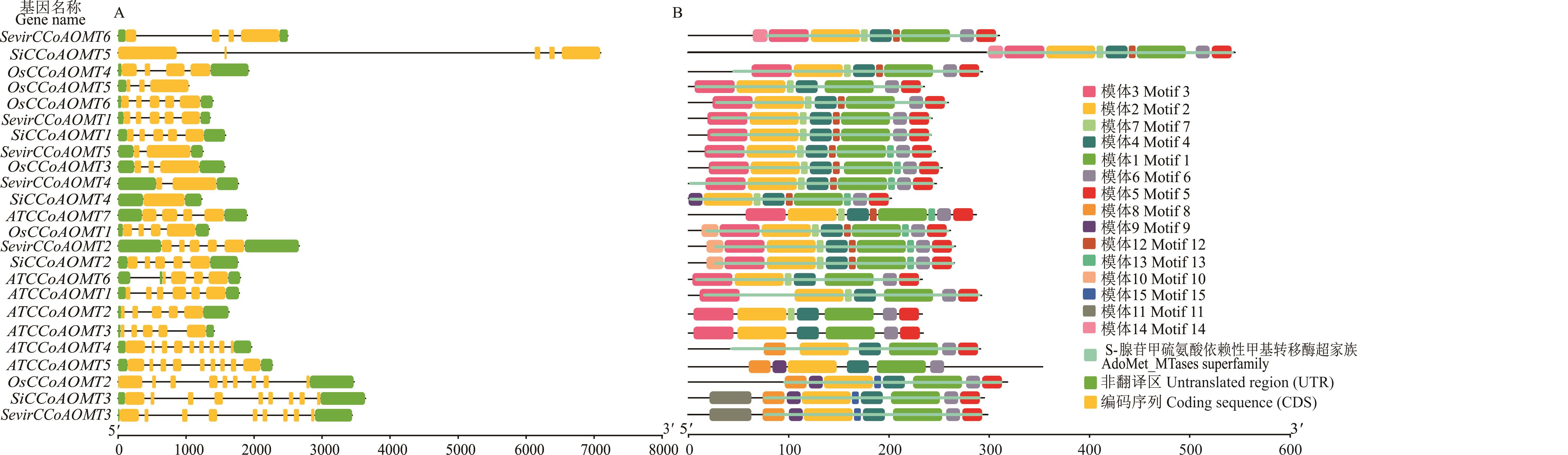
Fig.3 Structural of the CCoAOMT family genes in millet, arabidopsis, rice, and foxtail millet

Fig.4 Cis-acting element analysis of CCoAOMT family gene promoters in millet, arabidopsis, rice, and foxtail millet

Fig.5 Local network diagrams of millet CCoAOMT family-related genes

Fig.6 Expression profiles of SiCCoAOMT family members in millet across different developmental stages and tissues
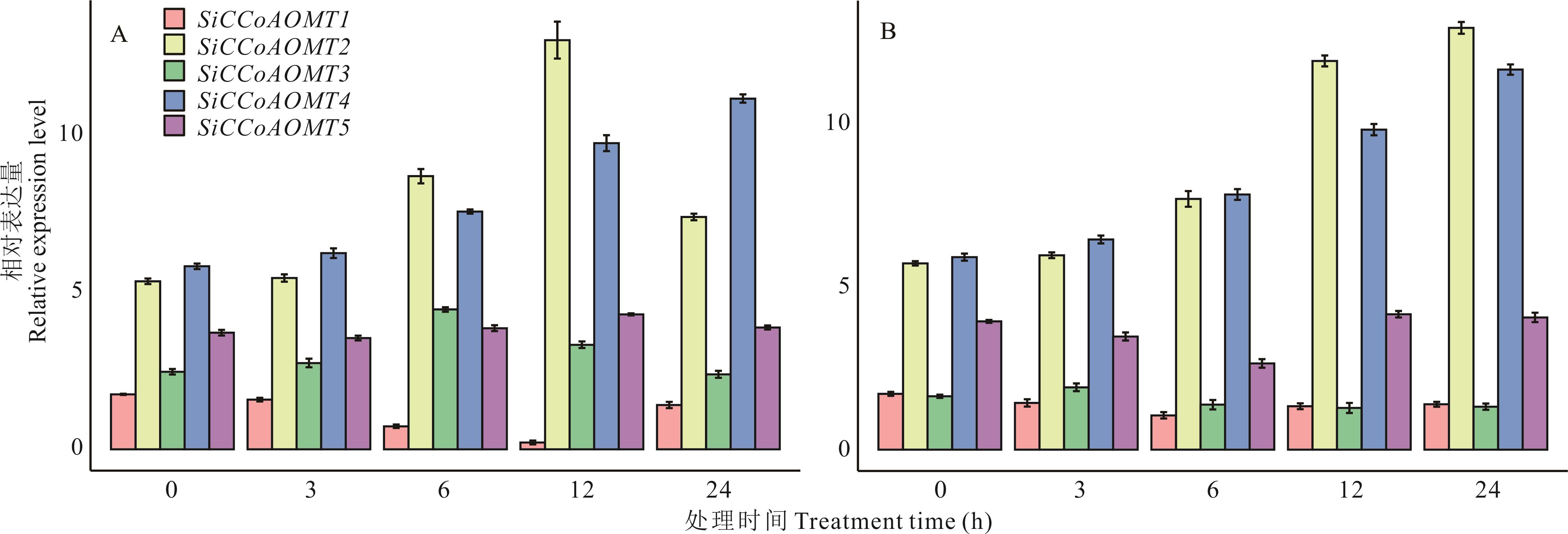
Fig.7 Expression patterns of SiCCoAOMT gene family in response to abiotic stress
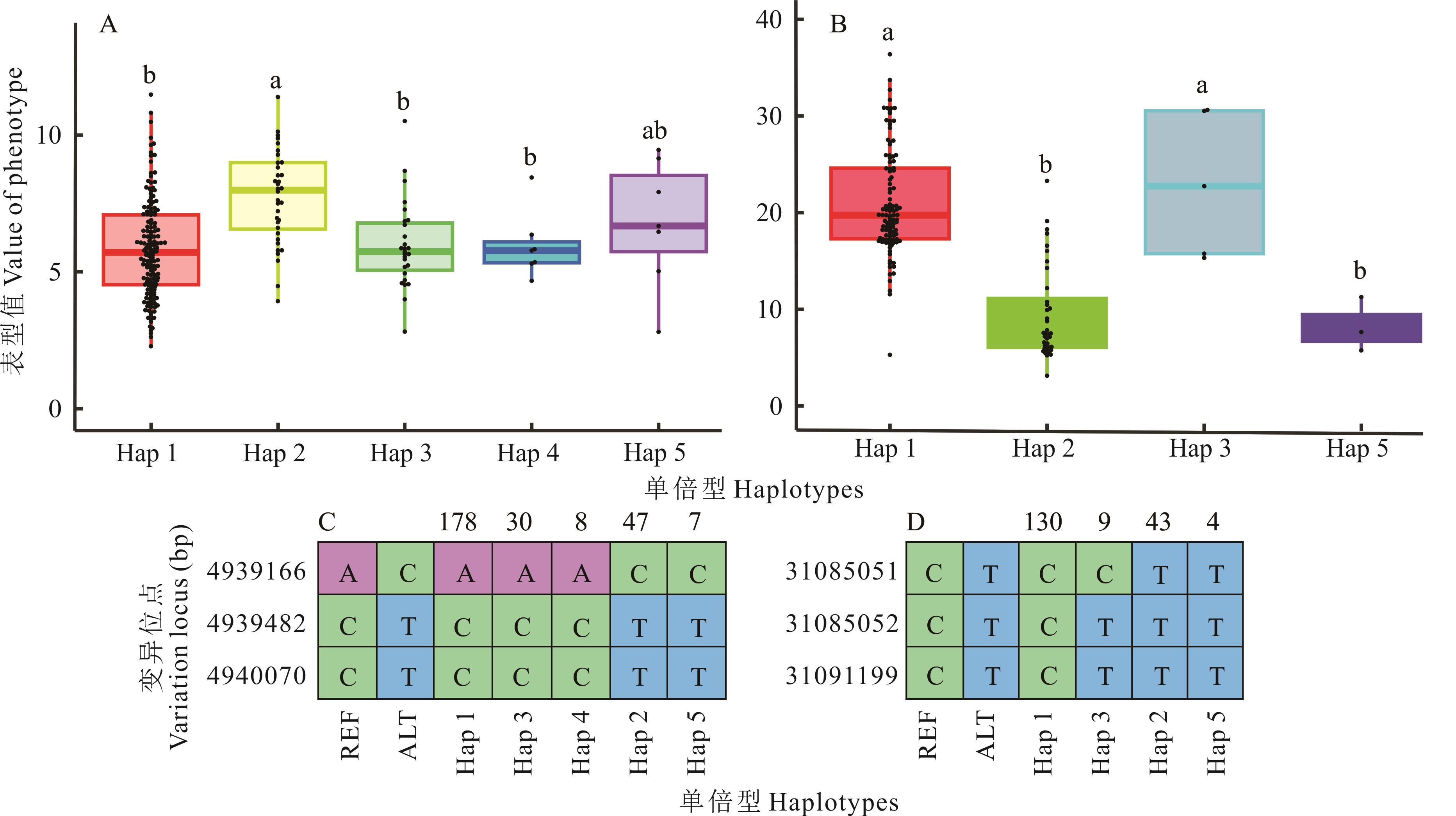
Fig.8 SiCCoAOMT gene dominant haplotype
| [1] | Kahie M A, Wang Y, Fang P, et al. Evolution and expression analysis of the caffeoyl-CoA 3-O-methyltransferase (CCoAOMT) gene family in jute (Corchorus L.). BMC Genomics, 2023, 24: 204. |
| [2] | Liu Q, Luo L, Zheng L Q. Lignins: biosynthesis and biological functions in plants.International Journal of Molecular Sciences, 2018, 19: 335. |
| [3] | Hongo S, Sato K, Yokoyama R, et al. Demethylesterification of the primary wall by PECTIN METHYLESTERASE35 provides mechanical support to the Arabidopsis stem. Plant Cell, 2012, 24: 2624-2634. |
| [4] | Zhao H Y, Sheng Q X, Lv S Y, et al. Characterization of three rice CCoAOMT genes. Chinese Science Bulletin, 2004, 49: 1602-1606. |
| [5] | Shan C R, Chen X H, Ding Y F, et al. Functional analysis of FmCCoAOMT gene in Fraxinus mandshurica during lignin synthesis and abiotic stress. Bulletin of Botanical Research, 2023, 43(5): 768-778. |
| 单超然, 陈晓慧, 丁云飞, 等. 水曲柳FmCCoAOMT基因在木质素合成及非生物胁迫中的功能分析. 植物研究, 2023, 43(5): 768-778. | |
| [6] | Kühnl T, Koch U, Heller W, et al. Elicitor induced S-adenosyl-l-methionine: caffeoyl-CoA 3-O-methyltransferase from carrot cell suspension cultures. Plant Science, 1989, 60: 21-25. |
| [7] | Schmitt D, Pakusch A E, Matern U. Molecular cloning, induction and taxonomic distribution of caffeoyl-CoA 3-O-methyltransferase, an enzyme involved in disease resistance. Journal of Biological Chemistry, 1991, 266: 17416-17423. |
| [8] | Ye Z H, Kneusel R E, Matern U, et al. Multiple cDNAs for caffeoyl-CoA O-methyltransferase in plant tissues. Plant Journal, 1994, 6: 211-219. |
| [9] | Ibrahim R K, Bruneau A, Bantignies B. Plant O-methyltransferases: molecular analysis, common signature and classification. Plant Molecular Biology, 1998, 36: 1-10. |
| [10] | Zhang G Y, Zhang Y J, Xu J T, et al. The CCoAOMT1 gene from jute (Corchorus capsularis L.) is involved in lignin biosynthesis in Arabidopsis thaliana. Gene,2014, 546: 398-402. |
| [11] | Zhao H Y, Shen Q X, Lv S Y, et al. Expression analysis of caffeoyl-CoA-O-methyltransferase gene (CCoAOMT) in rice. Chinese Science Bulletin, 2004, 49(14): 1390-1394. |
| 赵华燕, 沈庆喜, 吕世友, 等. 水稻咖啡酰辅酶A-O-甲基转移酶基因(CCoAOMT)表达特性分析. 科学通报, 2004, 49(14): 1390-1394. | |
| [12] | Brutnell T P, Wang L, Swartwood K, et al. Setaria viridis: a model for C4 photosynthesis. Plant Cell,2010, 22: 2537-2544. |
| [13] | Wang Y G, Lyu X Y, Ji M C, et al. Stress tolerance improvement by BvM14-CCoAOMT gene in sugar beet M14 strain. Chinese Agricultural Science Bulletin, 2018, 34(34): 30-35. |
| 王宇光, 吕笑言, 季美超, 等. 甜菜M14品系咖啡酰辅酶A-O-甲基转移酶提高植物抗逆性功能分析. 中国农学通报, 2018, 34(34): 30-35. | |
| [14] | Riccardi F, Gazeau P, de Vienne D, et al. Protein changes in response to progressive water deficit in maize: quantitative variation and polypeptide identification. Plant and Cell Physiology,1998, 117: 1253-1263. |
| [15] | Salekdeh G H, Siopongco J, Wade L J, et al. A proteomic approach to analyzing drought- and salt-responsiveness in rice. Field Crops Research, 2002, 76: 199-219. |
| [16] | Wang C, Chen J F, Zhi H, et al. Population genetics of foxtail millet and its wild ancestor. BMC Genetics, 2010, 11: 1-13. |
| [17] | Yan W M. The origin of agriculture and Chinese civilization. Chinese Rural Discovery, 2016, 8(5): 38-45. |
| 严文明. 农业起源与中华文明. 中国乡村发现, 2016, 8(5): 38-45. | |
| [18] | Diao X M. Breeding innovation creates new development of millet seed industry. China Seed Industry, 2022, 4(4): 4-7. |
| 刁现民. 育种创新造就谷子种业新发展. 中国种业, 2022, 4(4): 4-7. | |
| [19] | Liu Q. We should attach great importance to the strategic value of “planting belt moving north”. Farmers Daily, 2021-11-27(004). |
| 刘强.应高度重视“种植带北移”的战略价值. 农民日报, 2021-11-27(004). | |
| [20] | Yang Z R, Zhang H S, Li X K, et al. A mini foxtail millet with an Arabidopsis-like life cycle as a C4 model system. Nature Plants, 2020, 6: 1167-1178. |
| [21] | Song L N, Zhang Y M, Hu C S, et al. Comprehensive analysis of emissions and global warming effects of greenhouse gases in winter-wheat fields in the high-yield agro-region of north China Plain. Chinese Journal of Ecological Agriculture, 2013, 21(3): 297-307. |
| 宋利娜, 张玉铭, 胡春胜, 等. 华北平原高产农区冬小麦农田土壤温室气体排放及其综合温室效应.中国生态农业学报, 2013, 21(3): 297-307. | |
| [22] | Ferreira S S, Simões M S, Carvalho G G, et al. The lignin toolbox of the model grass Setaria viridis. Plant Molecular Biology,2019, 101: 235-255. |
| [23] | Chen C J, Wu Y, Li J W, et al. TBtools-II: A “one for all, all for one” bioinformatics platform for biological big-data mining. Molecular Plant, 2023, 16: 1733-1742. |
| [24] | Tamura K, Stecher G, Kumar S. MEGA11: molecular evolutionary genetics analysis version 11. Molecular Biology and Evolution, 2021, 38: 3022-3027. |
| [25] | Bailey T L, Johnson J, Grant C E, et al. The MEME suite. Nucleic Acids Research, 2015, 43: W39-W49. |
| [26] | Yu C S, Lin C J, Hwang J K. Predicting subcellular localization of proteins for Gram-negative bacteria by support vector machines based on n-peptide compositions.Protein Science, 2004, 13: 1402-1406. |
| [27] | Sun R, Yang Y Y, Li Y J, et al. Genome-wide identification and analysis of PLATZ transcription factor gene family in foxtail millet. Chinese Bulletin of Botany, 2023, 58(4): 548-559. |
| 孙蓉, 杨宇琭, 李亚军, 等. 谷子PLATZ转录因子基因家族的鉴定和分析. 植物学报, 2023, 58(4): 548-559. | |
| [28] | Livak K J, Schmittgen T D. Analysis of relative gene expression data using real-time quantitative PCR and the 2-ΔΔ C T method. Methods, 2001, 25: 402-408. |
| [29] | Li X K, Gao J, Song J, et al. Multi-omics analyses of 398 foxtail millet accessions reveal genomic regions associated with domestication, metabolite traits, and anti-inflammatory effects. Molecular Plant, 2022, 15: 1367-1383. |
| [30] | Li X K, Shi Z, Gao J, et al. CandiHap: a haplotype analysis toolkit for natural variation study. Molecular Breeding, 2023, 43: 21. |
| [31] | Lee Y J, Kim B G, Chong Y, et al. Cation dependent O-methyltransferases from rice. Planta, 2008, 227: 641-647. |
| [32] | Kim J S, Mizoi J, Yoshida T, et al. An ABRE promoter sequence is involved in osmotic stress-responsive expression of the DREB2A gene, which encodes a transcription factor regulating drought-inducible genes in Arabidopsis. Plant and Cell Physiology, 2011, 52: 2136-2146. |
| [33] | Hu J, Liu T, Huo H, et al. Genome-wide characterization, evolutionary analysis, and expression pattern analysis of the trihelix transcription factor family and gene expression analysis under MeJA treatment in Panax ginseng. BMC Plant Biology, 2023, 23: 376. |
| [34] | Jalmi S K, Bhagat P K, Verma D, et al. Traversing the links between heavy metal stress and plant signaling. Frontiers in Plant Science, 2018, 9: 12. |
| [35] | Yao T, Zhang J, Xie M, et al. Transcriptional regulation of drought response in Arabidopsis and woody plants.Frontiers in Plant Science, 2021, 11: 572137. |
| [36] | Guo B, Qin J F, Li N, et al. Genome-wide identification and expression analysis of SHMT gene family in foxtail millet (Setaria italica L.). Acta Agronomica Sinica, 2025, 51(3): 586-597. |
| 郭冰, 秦家范, 李娜, 等. 谷子SHMT基因家族全基因组鉴定与表达分析. 作物学报, 2025, 51(3): 586-597. | |
| [37] | Guo Z W, Si X Y, Jiao L P, et al. Cloning and bioinformatics of CCoAOMT relating to resistance of soybean to cyst nematodes. Fujian Journal of Agricultural Sciences, 2023, 38(5): 616-623. |
| 郭子雯, 司修洋, 焦莉苹, 等. 大豆咖啡酰辅酶A-O-甲基转移酶(CCoAOMT)基因克隆及结构分析. 福建农业学报, 2023, 38(5): 616-623. | |
| [38] | Lu C, Zhang X Y, Lu M, et al. Identification and bioinformatics analysis of RrCCoAOMT gene family in Rosa roxburghii. Molecular Plant Breeding, 2023, 21(3): 764-771. |
| 卢晨, 张小英, 鲁敏, 等. 刺梨RrCCoAOMT基因家族的鉴定与生物信息学分析. 分子植物育种, 2023, 21(3): 764-771. | |
| [39] | Ma Q, Yan Q, Zhang Z S, et al. Identification, evolution and expression analysis of the CCoAOMT family genes in Medicago sativa. Acta Prataculturae Sinica, 2021, 30(11): 144-156. |
| 马倩, 闫启, 张正社, 等. 紫花苜蓿CCoAOMT基因家族的鉴定、进化及表达分析. 草业学报, 2021, 30(11): 144-156. | |
| [40] | Peng S N, Li Y K, Luo D D, et al. Identification and expression analysis of flavonoid O-methyltransferase gene family in Artemisia argyi. Acta Pharmaceutical Sinica, 2023, 58(4): 1069-1078. |
| 彭赛男, 李宇琨, 罗丹丹, 等. 艾叶类黄酮O-甲基转移酶基因家族的鉴定及表达分析. 药学学报, 2023, 58(4): 1069-1078. | |
| [41] | Suo Q Q, Wu N, Yang H, et al. Prokaryotic expression, antibody preparation and application of rice caffeoyl-CoA-O-methyltransferase gene. Biotechnology Bulletin, 2022, 38(8): 135-141. |
| 索青青, 吴楠, 杨慧, 等. 水稻咖啡酰辅酶A-O-甲基转移酶基因的原核表达、抗体制备和应用. 生物技术通报, 2022, 38(8): 135-141. | |
| [42] | Rakoczy M, Femiak I, Alejska M, et al. Sorghum CCoAOMT and CCoAOMT-like gene evolution, structure, expression and the role of conserved amino acids in protein activity. Molecular Genetics and Genomics, 2018, 293: 1077-1089. |
| [43] | Yang Q, He Y, Kabahuma M, et al. A gene encoding maize caffeoyl-CoA O-methyltransferase confers quantitative resistance to multiple pathogens. Nature Genetics, 2017, 49: 1364-1372. |
| [44] | Luo T R, Ma J Z, Du M Y, et al. Identification and expression analysis of LACS gene family members in Medicago sativa. Acta Prataculturae Sinica, 2025, 34(4): 124-136. |
| 罗天蓉, 马健芝, 杜明阳, 等. 紫花苜蓿LACS基因家族成员鉴定及表达分析. 草业学报, 2025, 34(4): 124-136. |
| [1] | Jia-le LIU, Juan QI, Wen-liang LI, Xin LU, Qi YUAN, Ming-jie LI, Ao-long ZHANG, Wang-yi DU. Identification and expression analysis of EsJRL genes in Elymus sibiricus [J]. Acta Prataculturae Sinica, 2026, 35(1): 206-222. |
| [2] | Wei-peng ZOU, Yi LIU, Jia-xing ZHAI, Si-yi ZHOU, Zhi-yi GONG, Hui-fang CEN, Hui-sen ZHU, Tao XU. Cloning of MsNAC053 from alfalfa and analysis of its transcript profile in response to abiotic stresses [J]. Acta Prataculturae Sinica, 2025, 34(9): 121-133. |
| [3] | Ran XIAN, Yu DENG, Qiu-yue FU, Jing-xia JIANG, Jia-li TAO, Tao XU, Hui-sen ZHU, Hui-fang CEN. Cloning of alfalfa MsMYB86 and analysis of its transcriptional response to abiotic stress [J]. Acta Prataculturae Sinica, 2025, 34(9): 162-172. |
| [4] | Zhi-fang ZUO, Yong-long LI, Yu-jia WEI, Sheng-hui ZHOU, Yan LI, Guo-feng YANG. Identification of DREB genes from Zoysia japonica and their transcript profiles in response to abiotic stress [J]. Acta Prataculturae Sinica, 2025, 34(5): 74-88. |
| [5] | Xin-yue ZHOU, Li-ping WANG, Qing-xue JIANG, Xiao-ran MA, Deng-xia YI, Xue-min WANG. Isolation of the low-temperature induced proteinMsLTI65 from alfalfa and its response to different stresses [J]. Acta Prataculturae Sinica, 2025, 34(5): 89-104. |
| [6] | Tian-rong LUO, Jian-zhi MA, Ming-yang DU, Jie-cuo DUO, Hui-yan XIONG, Rui-jun DUAN. Identification and expression analysis of LACS gene family members in Medicago sativa [J]. Acta Prataculturae Sinica, 2025, 34(4): 124-136. |
| [7] | Xiao-tong WANG, Xiao-hong LI, Xu-xia MA, Wen-qi CAI, Xue-li FENG, Shu-xia LI. Identification and analysis of members of the FBA gene family in alfalfa [J]. Acta Prataculturae Sinica, 2024, 33(9): 81-93. |
| [8] | Guo-qiang WU, Zu-long YU, Ming WEI. The mechanism of PGPR regulating plant response to abiotic stress [J]. Acta Prataculturae Sinica, 2024, 33(6): 203-218. |
| [9] | Hao LIU, Xian-yang LI, Fei HE, Xue WANG, Ming-na LI, Rui-cai LONG, Jun-mei KANG, Qing-chuan YANG, Lin CHEN. Identification of the alfalfa SAUR gene family and its expression pattern under abiotic stress [J]. Acta Prataculturae Sinica, 2024, 33(4): 135-153. |
| [10] | Xian-yang LI, Hao LIU, Fei HE, Xue WANG, Ming-na LI, Rui-cai LONG, Jun-mei KANG, Qing-chuan YANG, Lin CHEN. Identification and expression pattern of the WRKY transcription factor family in Medicago sativa [J]. Acta Prataculturae Sinica, 2024, 33(4): 154-170. |
| [11] | Ze-bin LI, Yong-zheng QIU, Yan-jie LIU, Jin-qiu YU, Bai-ji WANG, Qian-ning LIU, Yue WANG, Guo-wen CUI. Identification of the BZR gene family in alfalfa and analysis of its transcriptional responses to abiotic stress [J]. Acta Prataculturae Sinica, 2024, 33(11): 106-122. |
| [12] | Xiao-xiao LI, Pan ZHANG, Yuan LU, Ting LI, Na ZHAO, Jia-wen WU. Abiotic stress priming affects the responses of maize (Zea mays) plants to cadmium stress [J]. Acta Prataculturae Sinica, 2024, 33(11): 135-148. |
| [13] | Xin-miao ZHANG, Guo-qiang WU, Ming WEI. The role of MAPK in plant response to abiotic stress [J]. Acta Prataculturae Sinica, 2024, 33(1): 182-197. |
| [14] | Xian-fei SHI, Yu GAO, Xu-sheng HUANG, Ya-li ZHOU, Gui-ping CAI, Xin-ru LI, Run-zhi LI, Jin-ai XUE. Functional characterization of Cyperus esculentus CeWRKY transcription factors in response to abiotic stress [J]. Acta Prataculturae Sinica, 2023, 32(8): 186-201. |
| [15] | Jie ZHANG, Kai CHENG, Ying-chun WANG. Analysis of the calcium-dependent protein kinase RtCDPK16 response to abiotic stress in Reaumuria trigyna [J]. Acta Prataculturae Sinica, 2023, 32(2): 97-109. |
| Viewed | ||||||
|
Full text |
|
|||||
|
Abstract |
|
|||||
