
ISSN 1004-5759 CN 62-1105/S
Acta Prataculturae Sinica ›› 2026, Vol. 35 ›› Issue (4): 67-85.DOI: 10.11686/cyxb2025195
Previous Articles Next Articles
Jian-nan LI1( ), Kai TANG1, Jian-yu MENG1(), Fu-ying FENG2, Xiu-juan ZHAO2, Xue-fei LI2, Zi-yi ZHAO2, Xiang-yang CHEN2
Received:2025-05-19
Revised:2025-07-01
Online:2026-04-20
Published:2026-02-07
Contact:
Jian-yu MENG
Jian-nan LI, Kai TANG, Jian-yu MENG, Fu-ying FENG, Xiu-juan ZHAO, Xue-fei LI, Zi-yi ZHAO, Xiang-yang CHEN. A study of the core bacterial community and its functions in the rhizosphere soil of desert plants[J]. Acta Prataculturae Sinica, 2026, 35(4): 67-85.
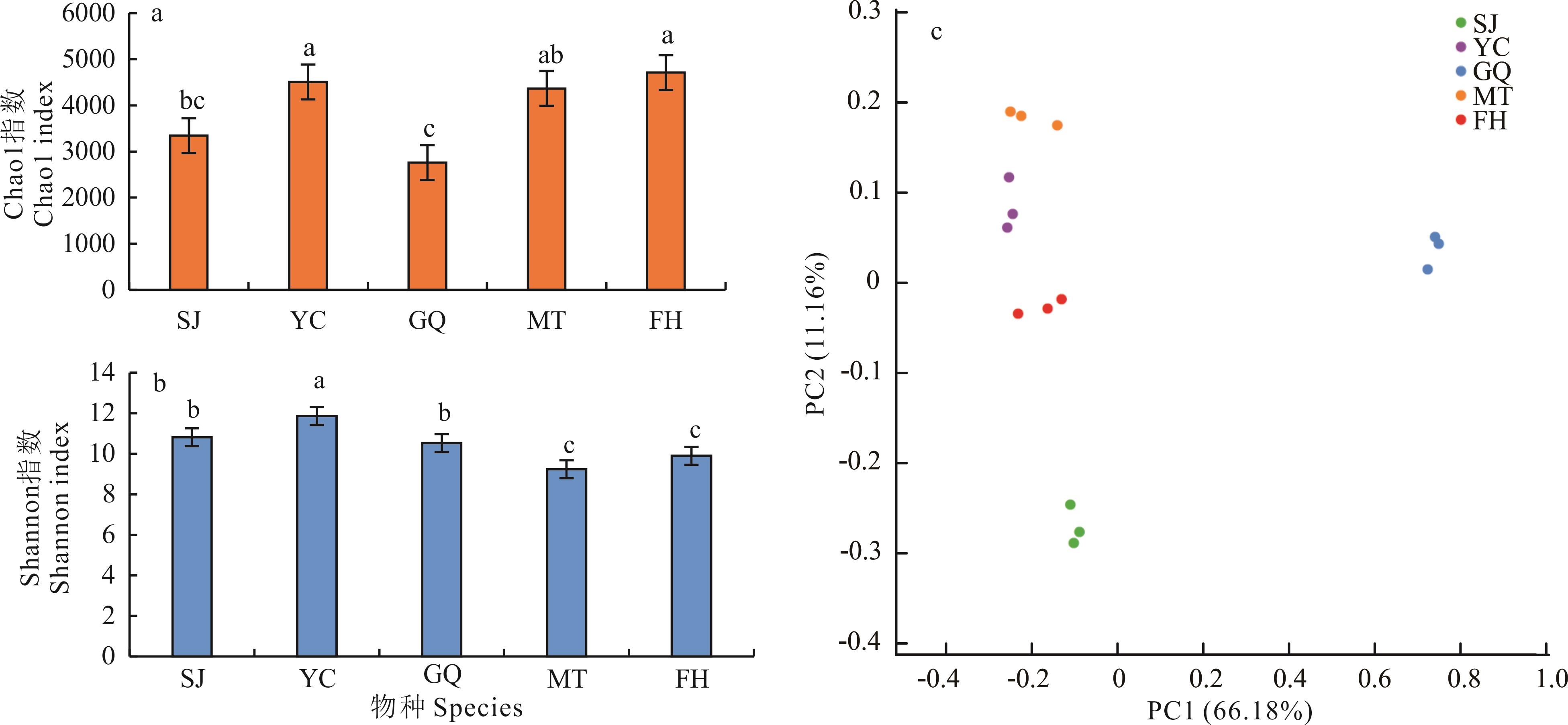
Fig.1 Five desert plants rhizosphere soil bacterial community diversity indices and PCoA analysis

Fig.2 Relative abundances of rhizosphere bacterial communities at the genus level for five desert plant species

Fig.3 Relative abundances of rhizospheres bacterial communities at the species level for five desert plant species

Fig.4 The distribution of significant species LDA values of rhizosphere bacteria for five desert plant species
样品 Sample | 有机质 Organic matter (g·kg-1) | 速效磷 Available phosphorus(mg·kg-1) | 速效氮 Available nitrogen (mg·kg-1) | pH | 电导率 Electrical conductivity (μs·cm-1) |
|---|---|---|---|---|---|
| 沙韭A. bidentatum | 51.83±2.12bc | 96.92±9.62c | 4.68±1.17c | 7.93±0.15b | 295.45±7.01b |
| 杨柴H. mongolicum | 53.31±1.49b | 106.62±8.17bc | 5.62±1.12b | 7.97±0.12b | 307.62±11.38ab |
| 枸杞L. chinense | 56.82±1.81ab | 111.15±7.33b | 5.89±0.98ab | 7.84±0.15b | 328.70±9.55a |
| 猫头刺O. aciphylla | 50.38±2.35c | 98.01±9.22c | 6.11±1.23a | 8.17±0.06a | 297.32±10.41b |
| 大果沙棘H. rhamnoides | 57.92±1.24a | 121.31±5.21a | 5.12±1.29b | 7.82±0.15b | 329.88±9.28a |
Table 1 Physicochemical indicators of rhizosphere soil for five desert plant species
样品 Sample | 有机质 Organic matter (g·kg-1) | 速效磷 Available phosphorus(mg·kg-1) | 速效氮 Available nitrogen (mg·kg-1) | pH | 电导率 Electrical conductivity (μs·cm-1) |
|---|---|---|---|---|---|
| 沙韭A. bidentatum | 51.83±2.12bc | 96.92±9.62c | 4.68±1.17c | 7.93±0.15b | 295.45±7.01b |
| 杨柴H. mongolicum | 53.31±1.49b | 106.62±8.17bc | 5.62±1.12b | 7.97±0.12b | 307.62±11.38ab |
| 枸杞L. chinense | 56.82±1.81ab | 111.15±7.33b | 5.89±0.98ab | 7.84±0.15b | 328.70±9.55a |
| 猫头刺O. aciphylla | 50.38±2.35c | 98.01±9.22c | 6.11±1.23a | 8.17±0.06a | 297.32±10.41b |
| 大果沙棘H. rhamnoides | 57.92±1.24a | 121.31±5.21a | 5.12±1.29b | 7.82±0.15b | 329.88±9.28a |
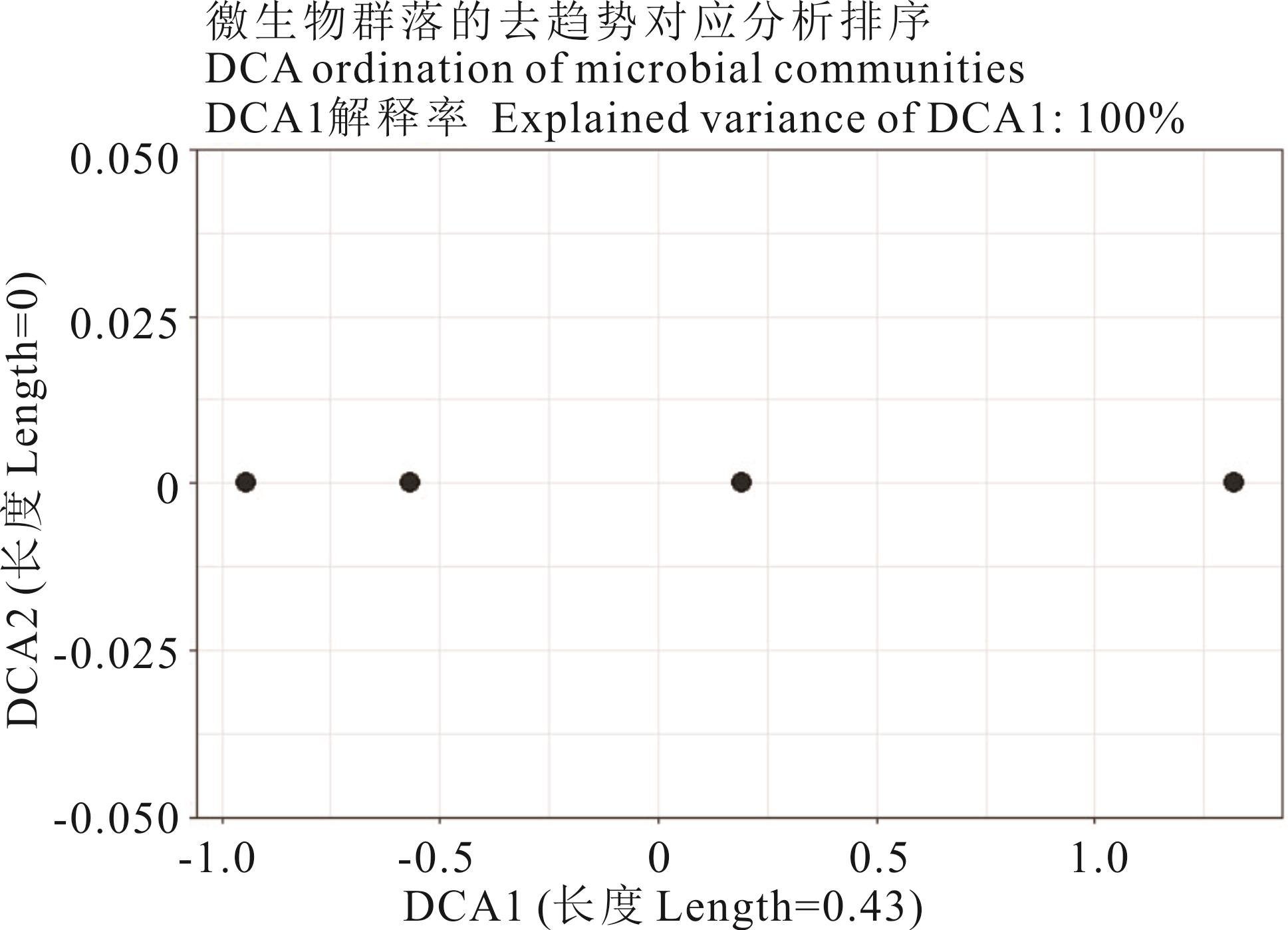
Fig.5 DCA ordination of rhizosphere bacteria for five desert plant species
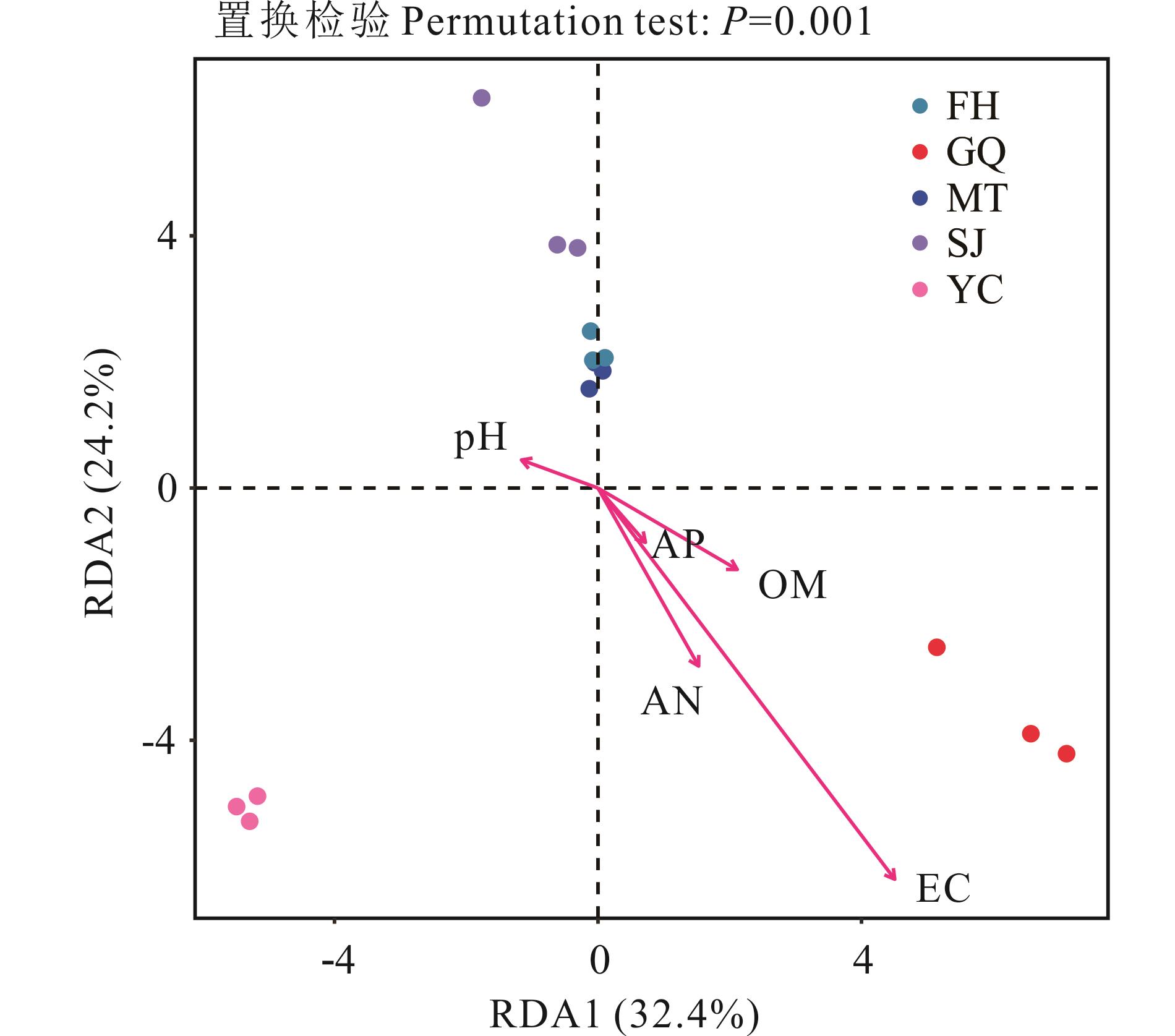
Fig.6 RDA analysis of influencing factors of rhizosphere bacterial community structure for five desert plant species

Fig.7 Core microbial network analysis of rhizosphere bacteria for five desert plant species
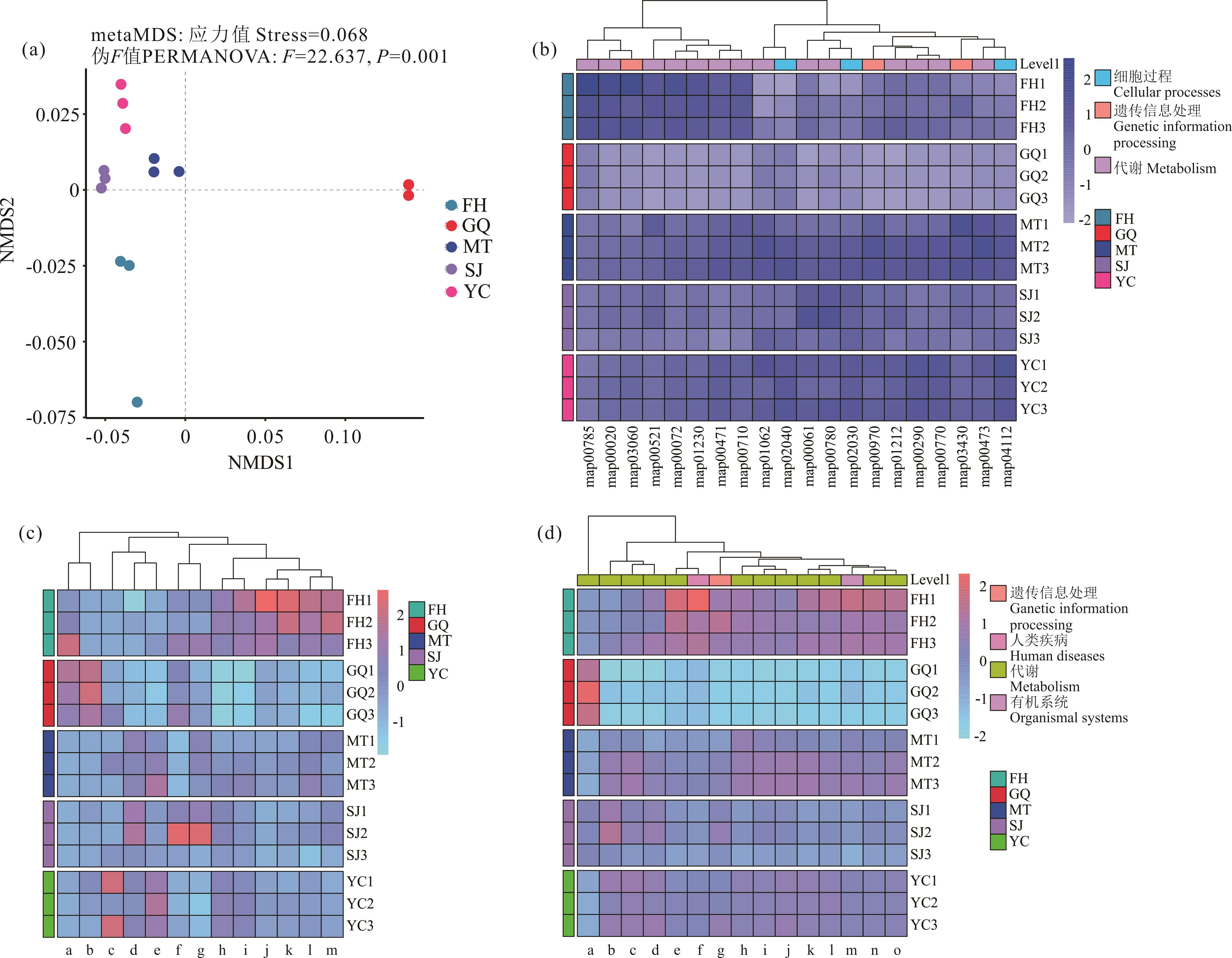
Fig.8 Analysis of functional differences in rhizosphere soil bacteria of five desert plants and heatmap of functional genes, enzymes, and metabolic pathways
| [1] | Liu J H, Zhou H S, Guo Q. The effects of desertification control on the patterns of vegetation in arid and semi-arid regions of northern China. Journal of Desert Research, 2023, 43(5): 204-213. |
| 刘俊壕, 周海盛, 郭群. 中国北方干旱半干旱区沙漠化治理对植被格局的影响. 中国沙漠, 2023, 43(5): 204-213. | |
| [2] | Li Z L. Proceedings of the 2018 annual academic conference of China society of sand control and sand industry//Proceedings of the 2018 Annual Conference of the China Desertification Control and Sand Industry Association. Geermu: China Desertification Control and Sand Industry Association, 2018: 35-48. |
| 李卓玲. 内蒙古自治区荒漠化现状与防治//中国治沙暨沙业学会2018年学术年会论文集. 格尔木: 中国治沙暨沙业学会, 2018: 35-48. | |
| [3] | Wei Z J, Niu F B, Liu H M, et al. Study on response of niche of Stipa breviflora desert steppe plant populations to grazing. Chinese Journal of Grassland, 2015, 37(5): 24-32. |
| 卫智军, 牛富宝, 刘红梅, 等. 短花针茅荒漠草原植物种群生态位对放牧的响应. 中国草地学报, 2015, 37(5): 24-32. | |
| [4] | Wang C S. The analysis on forming reason and mechanism of Reaumuria soongorica community in steppe region. Hohhot: Inner Mongolia University, 2010. |
| 王常顺. 草原区红砂群落形成原因与机理分析. 呼和浩特: 内蒙古大学, 2010. | |
| [5] | Jia X H, Wu B, Yu X X, et al. Research and demonstration on key technologies for desertification control in the Beijing-Tianjin-Hebei sand source area. Acta Ecologica Sinica, 2016, 36(22): 7040-7044. |
| 贾晓红, 吴波, 余新晓, 等. 京津冀风沙源区沙化土地治理关键技术研究与示范. 生态学报, 2016, 36(22): 7040-7044. | |
| [6] | Mu W Q, Kang S M, Li P L. Advances in rhizosphere growth-promoting bacteria function on plant growth facilitation and their mechanisms. Chinese Bulletin of Life Sciences, 2022, 34(2): 118-127. |
| 穆文强, 康慎敏, 李平兰. 根际促生菌对植物的生长促进作用及机制研究进展. 生命科学, 2022, 34(2): 118-127. | |
| [7] | Li W Y, Peng Z P, Yu J H, et al. Progress and prospect on plant growth- promoting rhizobacteria of banana rhizosphere. Chinese Journal of Tropical Crops, 2011, 32(1): 182-187. |
| 李文英, 彭智平, 于俊红, 等. 香蕉根际促生菌的研究展望. 热带作物学报, 2011, 32(1): 182-187. | |
| [8] | Xu D L. Diversity of mycorrhizal and symbiotic microoganisms of six rare plants in western Ordos desert. Hohhot: Inner Mongolia University, 2021. |
| 徐道龙. 西鄂尔多斯荒漠6种珍稀植物菌根及共生微生物多样性研究. 呼和浩特: 内蒙古大学, 2021. | |
| [9] | Lucas S, Yan Z C, Martinus S, et al. Synthetic bacterial community derived from a desert rhizosphere confers salt stress resilience to tomato in the presence of a soil microbiome. The ISME Journal Emultidisciplinary Journal of Microbial Ecology, 2022, 16(8): 1907-1920. |
| [10] | Chen F B, Bai J, Lin Q Q, et al. Application of plant growth-promoting rhizobacteria(PGPR)for reducing zinc stress on paddy rice. Journal of Agro-Environment Science, 2012, 31(1): 67-74. |
| 陈佛保, 柏珺, 林庆祺, 等. 植物根际促生菌(PGPR)对缓解水稻受土壤锌胁迫的作用. 农业环境科学学报, 2012, 31(1): 67-74. | |
| [11] | Wang X Y, Bao X G, Zhang F, et al. Characteristics of bacterial community and soil enzyme activity in rhizosphere soil of desert plant Reaumuria soongorica. Acta Agrestia Sinica, 2024, 32(12): 3764-3773. |
| 王雪莹, 包新光, 张峰, 等. 荒漠植物红砂根际土壤细菌群落特征及土壤酶活性研究. 草地学报, 2024, 32(12): 3764-3773. | |
| [12] | Yang H R. Diversity and community structure of rhizospheric bacteria associated with desert shrubs in sestern Ordos. Hohhot: Inner Mongolia Agricultural University, 2016. |
| 杨鸿儒. 西鄂尔多斯荒漠灌木根际细菌多样性和群落结构的研究. 呼和浩特: 内蒙古农业大学, 2016. | |
| [13] | Zhang X X, Wu J X, Kong Z S. Cellular basis of the legume-rhizobium symbiosis. Plant Communications, 2024, 5(11):5-17. |
| [14] | Li M, Bi J T, Wang J. Bacterial community structure and key influence factors in saline soil of different sites in Ningxia. Acta Ecologica Sinica, 2020, 40(4): 1316-1330. |
| 李明, 毕江涛, 王静. 宁夏不同地区盐碱化土壤细菌群落多样性分布特征及其影响因子. 生态学报, 2020, 40(4): 1316-1330. | |
| [15] | Zhang J E. Common experimental research methods and techniques in ecology. Beijing: Chemical Industry Press, 2007. |
| 章家恩. 生态学常用实验研究方法与技术. 北京: 北京化学工业出版社, 2007. | |
| [16] | Braak C J F T, Smilauer P J. CANOCO reference manual and user’s guide to Canoco for Windows: Software for canonical community ordination (Version 4). Wageningen, Netherlands: Wageningen University & Research, 1998. |
| [17] | Sun L Y, Li G L, Zhao J, et al. Core microbiota drive multi-functionality of the soil microbiome in the Cinnamomum camphora coppice planting. BMC Microbiology, 2024, 24(1): 18. |
| [18] | Cordovez V, Dini-Andreote F, Víctor J. et al. Ecology and evolution of plant microbiomes. Annual Review of Microbiology, 2019, 73(1): 69-88. |
| [19] | Kong H G, Song G C, Ryu C M. Inheritance of seed and rhizosphere microbial communities through plant-soil feedback and soil memory. Environmental Microbiology Reports, 2019, 11(4): 479-486. |
| [20] | Patel S, Naik J H, Amaresan N. Isolation and characterization of drought resistance bacteria for plant growth promoting properties and their effect on chilli (Capsicum annuum) seedling under salt stress. Biocatalysis & Agricultural Biotechnology, 2017, 12: 85-89. |
| [21] | Etesami H, Beattie G A. Mining halophytes for plant growth-promoting halotolerant bacteria to enhance the salinity tolerance of non-halophytic crops. Front in Microbiology, 2018, 9: 1-20 |
| [22] | Nan J. Soil microbial diversity in rhizosphere of three Stipa species with substituted distribution in central and eastern steppe of Inner Mongolia. Hohhot: Inner Mongolia University, 2024. |
| 楠极. 内蒙古中东部草原替代分布的三个针茅种群的根际土壤微生物多样性. 呼和浩特: 内蒙古大学, 2024. | |
| [23] | Chen L L, Yala S X, Ru Y, et al. Characterization of soil microbes associated with a grazing-tolerant grass species, Stipa breviflora, in the Inner Mongolian desert steppe. Ecology and Evolution, 2020, 10(19): 10607-10618. |
| [24] | Fierer N, Jackson R B, Vilgalys R. The diversity and biogeography of soil bacterial communities. Proceedings of the National Academy of Sciences, 2006, 102(28): 9996-10001. |
| [25] | Zhan Y H, Yan Y L, Deng Z P, et al. The novel regulatory ncRNA, nfiS, optimizes nitrogen fixation via base pairing with the nitrogenase gene nifK mRNA in Pseudomonas stutzeri A1501. Proceedings of the National Academy of Sciences of the United States of America, 2016, 13(30): 113. |
| [26] | Peng G, Jiang Q K, Tan J, et al. Selection and field evaluation of antagonistic fungi against tobacco black shank. China Tobacco Science, 2018, 39(1): 8. |
| 彭阁, 姜乾坤, 谭军, 等. 烟草黑胫病拮抗真菌的筛选及活性评价. 中国烟草科学, 2018, 39(1): 8. | |
| [27] | Cheng L. Study on rhizosphere soil bacterial diversity of different desert steppe and major plants. Lanzhou: Lanzhou University of Technology, 2017. |
| 程琳. 不同荒漠草原和主要植物根际土壤细菌多样性研究. 兰州: 兰州理工大学, 2017. | |
| [28] | Yao J N, Dai J X,Liu S, et al. Analysis of bacterial community structure and function in rhizosphere soil of typical shrub in desert steppe of Ningxia. Acta Ecologica Sinica, 2024, 44(20): 9285-9299. |
| 姚佳妮, 代金霞, 刘爽, 等. 宁夏荒漠草原典型灌丛根际土壤细菌群落结构与功能. 生态学报, 2024, 44(20): 9285-9299. | |
| [29] | Jiang X C, Li J Y, Chen F, et al. Soil bacterial characteristics of six plant communities in the desert areas to the north of Yinshan Mountains. Arid Zone Research, 2022, 39(4): 1122-1132. |
| 蒋星驰, 李俊瑶, 陈峰, 等. 阴山北麓荒漠区6种植物群落的土壤细菌特征. 干旱区研究, 2022, 39(4): 1122-1132. | |
| [30] | Gong R H. Diversity of plant growth promoting bacteria related with primary plant dominant species in the desert steppe of Siziwang Banner. Hohhot: Inner Mongolia Agricultural University, 2024. |
| 巩瑞红. 四子王旗荒漠草原主要植物优势种的促生细菌多样性. 呼和浩特: 内蒙古农业大学, 2024. | |
| [31] | Zheng H, Qiu C, Tian H, et al. Host restriction factors against porcine epidemic diarrhea virus: A mini-review. Veterinary Research, 2025, 56(1): 1-10. |
| [32] | Meng J Y, Li H, Yang H R, et al. Diversity of phosphorus-solubilizing bacteria in rhizosphere of desert shrubs in Inner Mongolia and their phosphorus-solubilizing and siderophore-producing capabilities. Research of Environmental Sciences, 2021, 34(11): 2714-2721. |
| 孟建宇, 李蘅, 杨鸿儒, 等. 内蒙古荒漠灌木根际解磷菌多样性及其解磷和产铁载体能力. 环境科学研究, 2021, 34(11): 2714-2721. | |
| [33] | Neal A L, Shakoor A, Ruth G W, et al. Benzoxazinoids in root exudates of maize attract Pseudomonas putida to the rhizosphere. PLoS One, 2012, 7(4): 498. |
| [34] | Huo W W, Hou J Y, Gao M, et al. Correlation between abnormal leaf color phenomenon and endophytic bacteria of Loropetalum chinense var. rubrum. Guihaia, 2024, 44(10): 1827-1838. |
| 霍雯雯, 侯嘉怡, 高敏, 等. 红花檵木异常叶色现象与叶片内生细菌的相关性. 广西植物, 2024, 44(10): 1827-1838. | |
| [35] | Xie J. Screening, identification, and antagonistic mechanisms of plant pathogenic fungi antagonistic microorganisms. Chengdu: Sichuan University, 2004. |
| 谢晶. 植物病原菌拮抗微生物的筛选、鉴定及拮抗机理研究. 成都: 四川大学, 2004. | |
| [36] | Taman, Kaur J, Walia S S. Co-inoculation of indigenous Pseudomonas sp. and Priestia sp. to improve the soil health, plant growth, yield and fruit quality parameters of tomato (Solanum lycopersicum L.). Current Microbiology, 2025, 82(5): 210. |
| [37] | Lin Y, Xu Q, Xu C S, et al. Screening, identification, and fermentation condition optimization of actinobacteria antagonistic to tobacco wilt pathogen//Compilation of Excellent Papers from China Tobacco Society (2016), 2016. |
| 林勇, 徐茜, 徐辰生, 等. 烟草青枯病菌拮抗放线菌的筛选、鉴定及发酵条件优化//中国烟草学会2016年度优秀论文汇编, 2016. | |
| [38] | Yu S, He R, Song A, et al. Spatial and temporal dynamics of bacterioplankton community composition in a subtropical dammed Karst river of southwestern China. Microbiology Open, 2019, 8(2): 849. |
| [39] | Li Z, Lu L H, Guo J S, et al. Responses of spatial-temporal dynamics of bacterioplankton community to large-scale reservoir operation: A case study in the Three Gorges Reservoir, China. Scientific reports, 2017, 7: 42-46. |
| [40] | Chen G J, Zong J. Woeseia oceani Gen. nov. sp nov. a chemoheterotrophic member of the order Chromatiales, and proposal of Woeseiaceae fam. nov. International Journal of Systematic and Evolutionary Microbiology, 2016, 66: 107-112. |
| [41] | Tang M, Ren J H, Hu J J, et al. Mechanism of arbuscular mycorrhizal fungi (AMF) in enhancing the drought resistance of hippophae. Beijing: The 5th Youth Academic Annual Conference of the Chinese Forestry of Society, 2001. |
| 唐明, 任嘉红, 胡景江, 等. 丛枝菌根真菌(AMF)提高沙棘抗旱的机制. 北京: 中国林学会第五届青年学术年会, 2001. | |
| [42] | Zhao S C. Isolation, screening and promoting effect of rhizosphere soil functional strains of four endangered plants in desert. Hohhot: Inner Mongolia University, 2019. |
| 赵世超. 四种荒漠珍稀植物根际土壤功能菌株的分离筛选及其促生作用研究. 呼和浩特: 内蒙古大学, 2019. | |
| [43] | Yu Q L, Zhao Z R, Liu L. Advance in the function and regulation of rhizosphere microbiota. Journal of Microbiology, 2023, 43(5): 1-8. |
| 喻其林, 赵梓润, 刘琳. 根际微生物群落功能与调控的研究进展. 微生物学杂志, 2023, 43(5): 1-8. | |
| [44] | Yang L, Qi Y, Liu S X, et al. Structure and function of plant stress-related protein kinases. Journal of Plant Genetic Resources, 2013, 14(4): 659-667. |
| [45] | Aziz R K, Bartels D, Best A A, et al. The RAST server: Rapid annotations using subsystems technology. BMC Genomics, 2008, 9: 1-15. |
| [46] | Poole P, Ramachandran V, Terpolilli J. Rhizobia: From saprophytes to endosymbionts. Nature Reviews Microbiology, 2018, 16(5): 291-303. |
| [47] | Alori E T, Glick B R, Babalola O O. Microbial phosphorus solubilization and its potential for use in sustainable agriculture. Frontiers in Microbiology, 2017, 8: 971. |
| [48] | Barwinska-Sendra A, Garcia Y M, Sendra K M, et al. An evolutionary path to altered cofactor specificity in a metalloenzyme. Nature Communications, 2020, 11(1): 16478. |
| [49] | Fan W Q. Study on the mechanism of alfalfa recruited rhizosphere microbiome in response to drought and salt stress. Hohhot: Inner Mongolia Agricultural University, 2024. |
| 范文强. 苜蓿招募根际微生物响应干旱和盐胁迫的机制研究. 呼和浩特: 内蒙古农业大学, 2024. | |
| [50] | Wang Q W, Zhang H L, Meng Q Y, et al. Cloning and expression analysis of a Na+/H+ antiporter gene (nhaA) from Pseudomonas stutzeri. Chinese Agricultural Science Bulletin, 2010, 37(15): 19-24. |
| 王全伟, 张海玲, 孟庆英, 等. 施氏假单胞菌Na+/H+逆向转运蛋白基因nhaA的克隆与表达分析. 中国农学通报, 2010, 37(15): 19-24. | |
| [51] | Nishino S F, Spain J C. Biodegradation of 3-nitrotyrosine by Burkholderia sp. strain JS165 and Variovorax paradoxus JS171. Applied & Environmental Microbiology, 2006, 72(2): 1040-1044. |
| [1] | Guo-qiang WU, Zu-long YU, Ming WEI. The mechanism of PGPR regulating plant response to abiotic stress [J]. Acta Prataculturae Sinica, 2024, 33(6): 203-218. |
| [2] | Xin-yu CHENG, Ji-lian WANG, Mairiyangu·Yasheng, Ming-yuan LI. Isolation and growth-promoting characteristics of rhizobacteria producing indole-3-acetic acid from the rhizosphere soil of Kalidium foliatum [J]. Acta Prataculturae Sinica, 2024, 33(4): 110-121. |
| [3] | Yang-yang MIAO, Yan-rui ZHANG, Biao SONG, Xu-tong LIU, An-qi ZHANG, Jin-ze LV, Hao ZHANG, Xiao-hua ZHANG, Jia-hui OUYANG, Wang LI, Shan-min QU. Effects of Suaeda glauca rhizobacteria and endophytic bacterial strains on alfalfa growth under salt-alkaline stress [J]. Acta Prataculturae Sinica, 2022, 31(9): 107-117. |
| [4] | Xiao-ting LIU, Tuo YAO. Screening, identification and characteristics of low-temperature-tolerant plant growth promoting rhizobacteria in alpine meadow [J]. Acta Prataculturae Sinica, 2022, 31(8): 178-187. |
| [5] | Yi-chao CHEN, Xiao-ying SUN, Zhi-jie XIE, Pan ZHOU, Lu ZHANG, Xue-li GAO, Dong LI, Xiao-feng LIU. Screening of rhizosphere growth promoting bacteria and their application in tailings improvement [J]. Acta Prataculturae Sinica, 2022, 31(7): 50-63. |
| [6] | Hui-li WU, Wei TIAN, Yan-ling JI, Lai-qing LOU, Qing-sheng CAI. Screening for plant growth-promoting rhizobacteria that promote cadmium absorption and accumulation and their effects on annual ryegrass [J]. Acta Prataculturae Sinica, 2021, 30(7): 53-61. |
| [7] | Jing MAN, Bo TANG, Bo DENG, Jia-huan LI, Yu-juan HE, Jia-liang ZHANG. Isolation, screening and beneficial effects of plant growth-promoting rhizobacteria (PGPR) in the rhizosphere of Leymus chinensis [J]. Acta Prataculturae Sinica, 2021, 30(1): 59-71. |
| [8] | LI Wen-bin, NING Chu-han, LI Wei, LI Feng, GUO Shao-xia. Responses of AMF and PGPR to Festuca elata under phenanthrene and pyrene stress [J]. Acta Prataculturae Sinica, 2019, 28(8): 84-94. |
| [9] | LI Xin-le, BAO Fang, WU Bo, CAO Yan-li, LIU Ming-hu, DUAN Rui-bing. Distribution of newly fixed carbon of Nitraria tangutorum in the plant-soil system [J]. Acta Prataculturae Sinica, 2019, 28(2): 33-40. |
| [10] | BAI Meng-jie, TAO Qi-bo, HAN Yun-hua, WANG Yan-rong. Germination response to temperature of ten desert plant species [J]. Acta Prataculturae Sinica, 2019, 28(12): 53-62. |
| [11] | MA Cong-Yu, ZHANG Ying, MA Wen-Bin, LI Jian-Hong, YAO Tuo. Identification of plant growth promoting rhizobacteria Astragalus membranaceus and their effectives [J]. Acta Prataculturae Sinica, 2017, 26(1): 149-159. |
| [12] | SUN Guang-Zheng, YAO Tuo, ZHAO Gui-Qin, LI Jian-Hong, CHEN Long, LIU Huan. An assessment of the level of control of two fungal pathogens by various plant growth promoting rhizobacteria [J]. Acta Prataculturae Sinica, 2016, 25(8): 154-163. |
| [13] | LIU Ting, YAO Tuo, CHEN Jian-Gang, MA Wen-Bin, LIU Huan, MA Cong-Yu, JIANG Yong-Mei. Identification and study on the effects of plant growth promoting rhizobacteria of Carex enervis [J]. Acta Prataculturae Sinica, 2016, 25(12): 130-139. |
| [14] | LI Jian-Hong, LI Xue-Ping, MA Wen-Wen, YAO Tuo, SUN Jian-Jun, JIANG Yong-Mei, ZHANG Jian-Gui, SHI Shang-Li. The study of plant growth promoting rhizobacteria (PGPR) from several Poaceous species in the East Chi-lien Mountains of China [J]. Acta Prataculturae Sinica, 2016, 25(11): 173-177. |
| [15] | RONG Liangyan, CHAI Qiang, YAO Tuo, ZHANG Rong, FENG Jin, YANG Hao, CAO Lei, ZHU Qian. Partial replacement of chemical fertilizer by compound microbial inoculant and potential for promoting growth of intercropped Zea mays and Pisum sativum [J]. Acta Prataculturae Sinica, 2015, 24(2): 22-30. |
| Viewed | ||||||
|
Full text |
|
|||||
|
Abstract |
|
|||||
