
ISSN 1004-5759 CN 62-1105/S
Acta Prataculturae Sinica ›› 2026, Vol. 35 ›› Issue (12): 54-63.DOI: 10.11686/cyxb2025527
Previous Articles Next Articles
Yun-rui YANG1( ), Jin-yu CHEN1, Dan ZHAO1, Fan YANG1, Shuang-li HOU2, Zhi-hui WANG1, Hong-yi WANG1()
Received:2025-12-25
Revised:2026-03-09
Online:2026-12-20
Published:2026-11-02
Contact:
Hong-yi WANG
Yun-rui YANG, Jin-yu CHEN, Dan ZHAO, Fan YANG, Shuang-li HOU, Zhi-hui WANG, Hong-yi WANG. Effects of long-term nitrogen and phosphorus addition on the legume functional group in the Hulunbuir meadow steppe[J]. Acta Prataculturae Sinica, 2026, 35(12): 54-63.
处理 Treatment | 豆科相对生物量Legume relative biomass | 豆科地上生物量 Legume aboveground biomass | 群落地上总生物量 Total aboveground biomass | 豆科相对盖度 Legume relative coverage | 豆科相对高度 Legume relative height | 豆科重要值 Legume importance values |
|---|---|---|---|---|---|---|
| Y | 78.11*** | 120.23*** | 360.11*** | 4.62*** | 7.52*** | 19.02*** |
| N | 17.96*** | 400.38*** | 223.23*** | 1.25ns | 6.46* | 4.78* |
| P | 799.81*** | 1104.15*** | 21.52*** | 59.58*** | 11.55** | 150.79*** |
| Y×N | 276.71*** | 524.91*** | 67.60*** | 28.73*** | 12.98*** | 65.40*** |
| Y×P | 60.81*** | 13.75*** | 10.19*** | 5.21*** | 12.28*** | 25.28*** |
| N×P | 44.57*** | 22.10*** | 3.57ns | 10.35** | 0.11ns | 11.74** |
| Y×N×P | 78.10*** | 58.50*** | 0.02ns | 0.78ns | 0.05ns | 2.32ns |
Table 1 Three-way ANOVA of legume functional group characteristics and community aboveground biomass
处理 Treatment | 豆科相对生物量Legume relative biomass | 豆科地上生物量 Legume aboveground biomass | 群落地上总生物量 Total aboveground biomass | 豆科相对盖度 Legume relative coverage | 豆科相对高度 Legume relative height | 豆科重要值 Legume importance values |
|---|---|---|---|---|---|---|
| Y | 78.11*** | 120.23*** | 360.11*** | 4.62*** | 7.52*** | 19.02*** |
| N | 17.96*** | 400.38*** | 223.23*** | 1.25ns | 6.46* | 4.78* |
| P | 799.81*** | 1104.15*** | 21.52*** | 59.58*** | 11.55** | 150.79*** |
| Y×N | 276.71*** | 524.91*** | 67.60*** | 28.73*** | 12.98*** | 65.40*** |
| Y×P | 60.81*** | 13.75*** | 10.19*** | 5.21*** | 12.28*** | 25.28*** |
| N×P | 44.57*** | 22.10*** | 3.57ns | 10.35** | 0.11ns | 11.74** |
| Y×N×P | 78.10*** | 58.50*** | 0.02ns | 0.78ns | 0.05ns | 2.32ns |
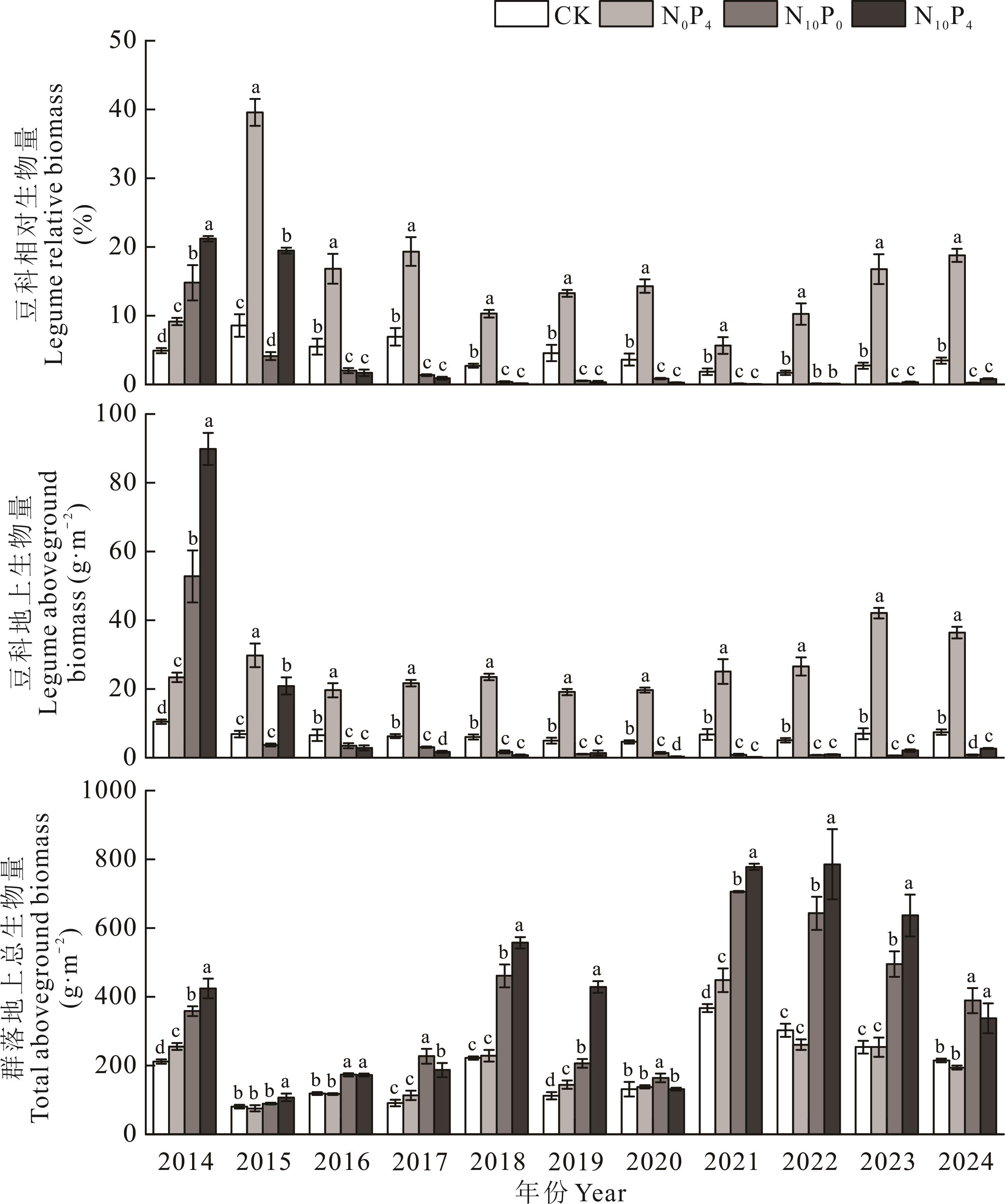
Fig.1 Interannual variation in the relative biomass and aboveground biomass of legumes, and total aboveground biomass under different nitrogen and phosphorus addition treatments
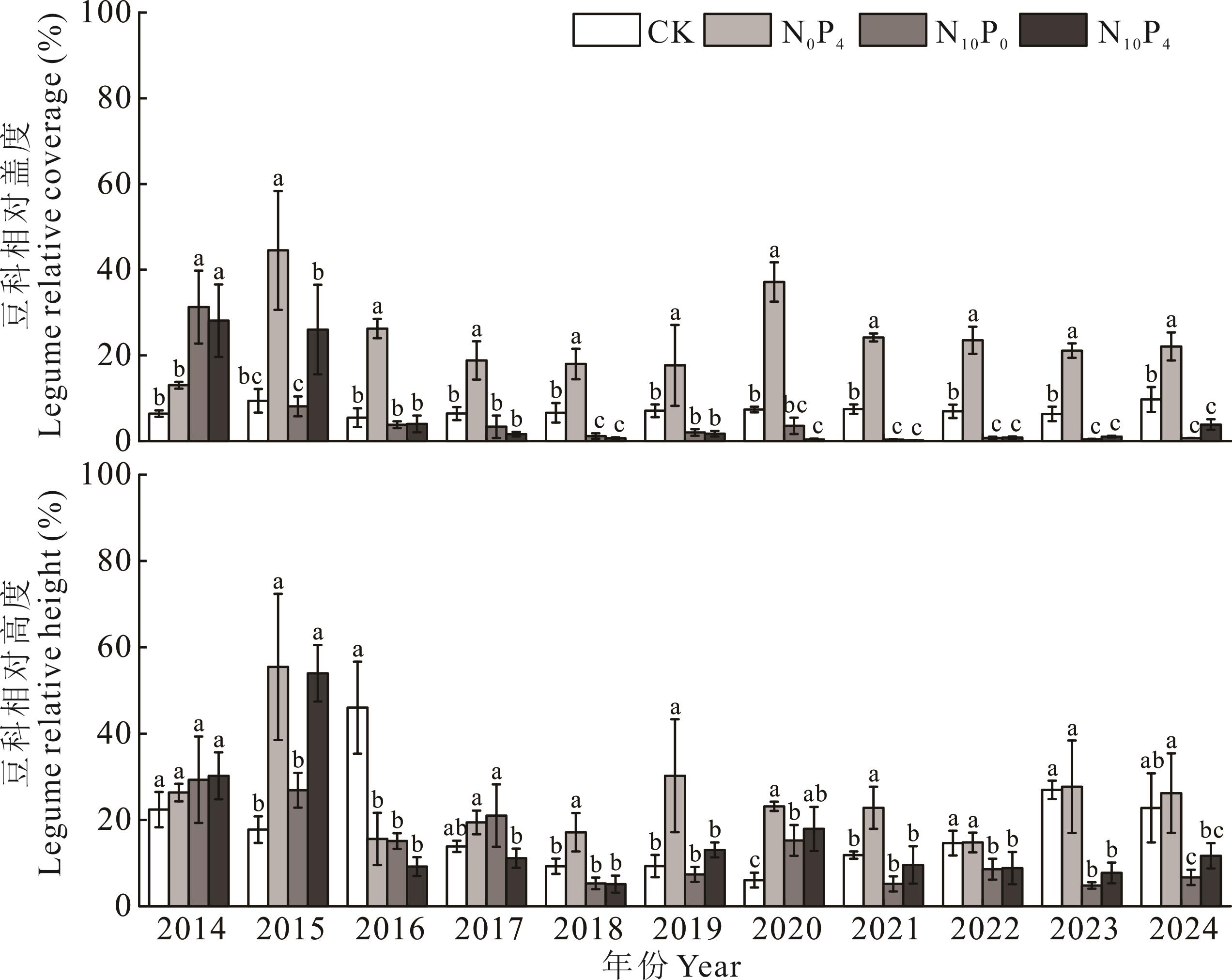
Fig.2 Interannual variation in the relative coverage and relative height of legumes under different nitrogen and phosphorus addition treatments
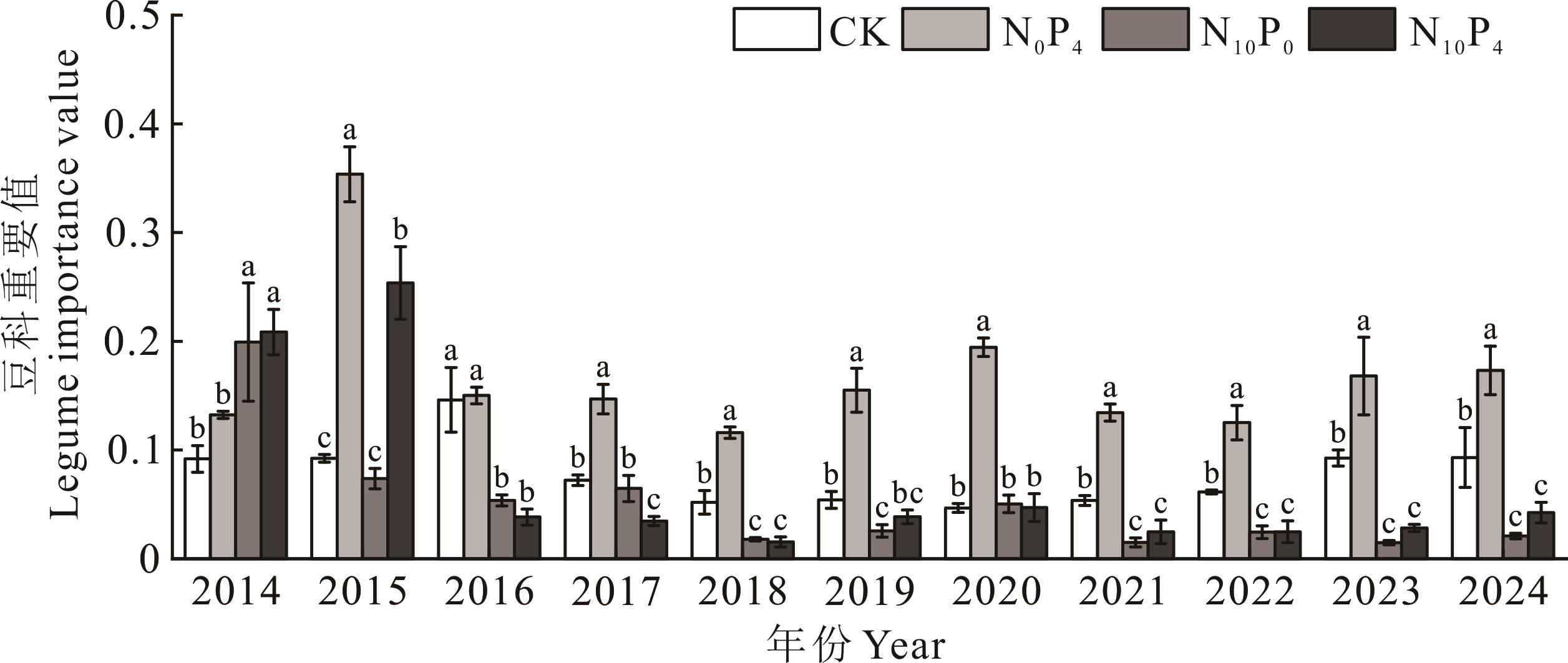
Fig.3 Interannual variation in the importance value of legumes under different nitrogen and phosphorus addition treatments
年份 Year | Margalef丰富度指数 Margalef richness index | Shannon-Wiener多样性指数 Shannon-Wiener diversity index | Pielou均匀度指数 Pielou evenness index | |||||||||
|---|---|---|---|---|---|---|---|---|---|---|---|---|
| CK | N0P4 | N10P0 | N10P4 | CK | N0P4 | N10P0 | N10P4 | CK | N0P4 | N10P0 | N10P4 | |
| 2014 | 1.89±0.13a | 1.81±0.01a | 1.43±0.04b | 1.38±0.06b | 1.47±0.09a | 1.47±0.01a | 1.24±0.04b | 1.13±0.04c | 0.75±0.04a | 0.75±0.01a | 0.69±0.02a | 0.63±0.02b |
| 2015 | 0.77±0.04c | 1.52±0.02b | 0.73±0.18c | 1.79±0.07a | 0.79±0.04b | 1.33±0.12a | 0.43±0.09c | 1.38±0.01a | 0.72±0.04a | 0.74±0.06a | 0.63±0.13a | 0.71±0.01a |
| 2016 | 1.36±0.07 | 0.36±0.01 | 0 | 0 | 0.84±0.18 | 0.48±0.02 | 0 | 0 | 0.52±0.11 | 0.70±0.03 | - | - |
| 2017 | 0.70±0.01 | 0.70±0.01 | 0 | 0 | 0.53±0.02 | 0.92±0.02 | 0 | 0 | 0.49±0.02 | 0.84±0.02 | - | - |
| 2018 | 0.32±0.02 | 0.62±0.01 | 0 | 0 | 0.44±0.02 | 0.97±0.01 | 0 | 0 | 0.64±0.03 | 0.88±0.01 | - | - |
| 2019 | 0 | 0.68±0.01 | 0 | 0 | 0 | 0.70±0.04 | 0 | 0 | - | 0.64±0.04 | - | - |
| 2020 | 0.56±0.05 | 0.33±0.02 | 0 | 0 | 0.66±0.02 | 0.69±0.01 | 0 | 0 | 0.96±0.03 | 0.99±0.01 | - | - |
| 2021 | 0 | 0.92±0.05 | 0 | - | 0 | 1.05±0.07 | 0 | 0 | - | 0.76±0.05 | - | - |
| 2022 | 0.99±0.05 | 0.33±0.01 | 0 | - | 0.69±0.02 | 0.68±0.02 | 0 | 0 | 0.50±0.01 | 0.97±0.03 | - | - |
| 2023 | 1.04±0.05 | 0.88±0.05 | 0 | 0 | 0.87±0.02 | 1.19±0.03 | 0 | 0 | 0.63±0.01 | 0.86±0.02 | - | - |
| 2024 | 0.74±0.08 | 0.61±0.01 | 0 | - | 0.68±0.02 | 0.89±0.05 | 0 | - | 0.62±0.02 | 0.81±0.05 | - | - |
Table 2 Interannual variation in the diversity indices of the legume functional group under different nitrogen and phosphorus addition treatments
年份 Year | Margalef丰富度指数 Margalef richness index | Shannon-Wiener多样性指数 Shannon-Wiener diversity index | Pielou均匀度指数 Pielou evenness index | |||||||||
|---|---|---|---|---|---|---|---|---|---|---|---|---|
| CK | N0P4 | N10P0 | N10P4 | CK | N0P4 | N10P0 | N10P4 | CK | N0P4 | N10P0 | N10P4 | |
| 2014 | 1.89±0.13a | 1.81±0.01a | 1.43±0.04b | 1.38±0.06b | 1.47±0.09a | 1.47±0.01a | 1.24±0.04b | 1.13±0.04c | 0.75±0.04a | 0.75±0.01a | 0.69±0.02a | 0.63±0.02b |
| 2015 | 0.77±0.04c | 1.52±0.02b | 0.73±0.18c | 1.79±0.07a | 0.79±0.04b | 1.33±0.12a | 0.43±0.09c | 1.38±0.01a | 0.72±0.04a | 0.74±0.06a | 0.63±0.13a | 0.71±0.01a |
| 2016 | 1.36±0.07 | 0.36±0.01 | 0 | 0 | 0.84±0.18 | 0.48±0.02 | 0 | 0 | 0.52±0.11 | 0.70±0.03 | - | - |
| 2017 | 0.70±0.01 | 0.70±0.01 | 0 | 0 | 0.53±0.02 | 0.92±0.02 | 0 | 0 | 0.49±0.02 | 0.84±0.02 | - | - |
| 2018 | 0.32±0.02 | 0.62±0.01 | 0 | 0 | 0.44±0.02 | 0.97±0.01 | 0 | 0 | 0.64±0.03 | 0.88±0.01 | - | - |
| 2019 | 0 | 0.68±0.01 | 0 | 0 | 0 | 0.70±0.04 | 0 | 0 | - | 0.64±0.04 | - | - |
| 2020 | 0.56±0.05 | 0.33±0.02 | 0 | 0 | 0.66±0.02 | 0.69±0.01 | 0 | 0 | 0.96±0.03 | 0.99±0.01 | - | - |
| 2021 | 0 | 0.92±0.05 | 0 | - | 0 | 1.05±0.07 | 0 | 0 | - | 0.76±0.05 | - | - |
| 2022 | 0.99±0.05 | 0.33±0.01 | 0 | - | 0.69±0.02 | 0.68±0.02 | 0 | 0 | 0.50±0.01 | 0.97±0.03 | - | - |
| 2023 | 1.04±0.05 | 0.88±0.05 | 0 | 0 | 0.87±0.02 | 1.19±0.03 | 0 | 0 | 0.63±0.01 | 0.86±0.02 | - | - |
| 2024 | 0.74±0.08 | 0.61±0.01 | 0 | - | 0.68±0.02 | 0.89±0.05 | 0 | - | 0.62±0.02 | 0.81±0.05 | - | - |
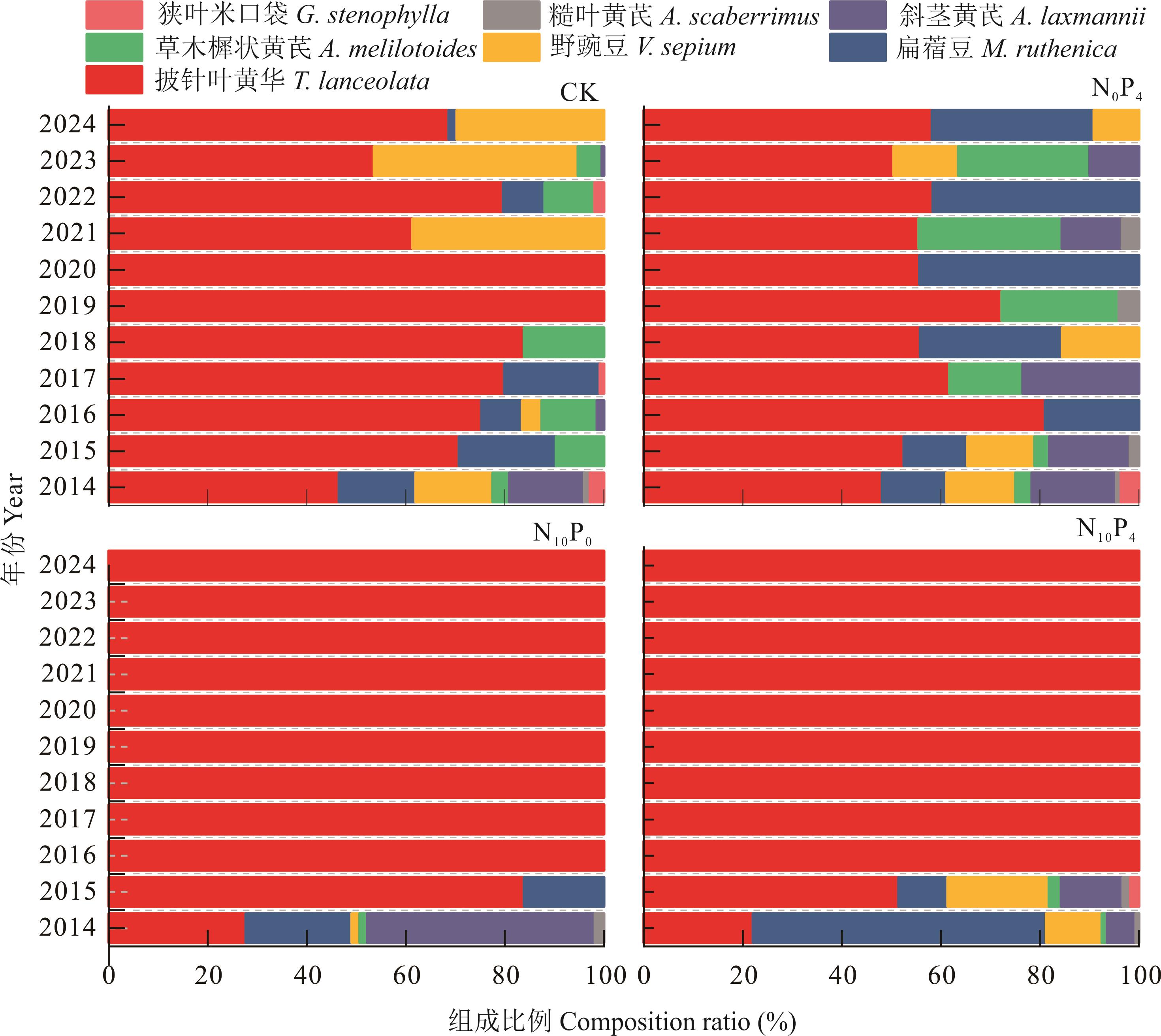
Fig.4 Interannual variation in biomass composition ratio of legume species within the legume functional group under different nitrogen and phosphorus addition treatments
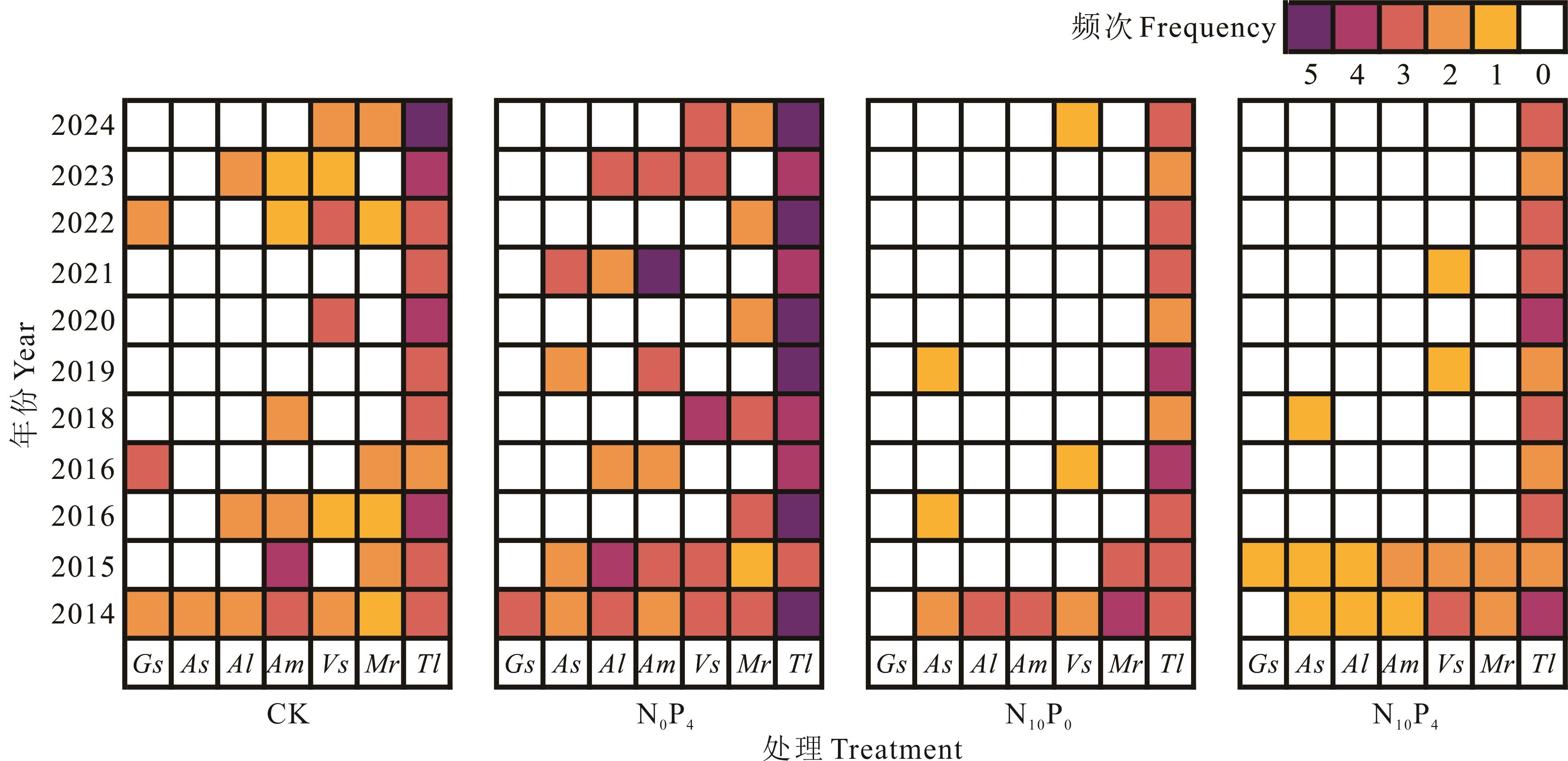
Fig.5 Frequency of occurrence of legume species under different nitrogen and phosphorus addition treatments
| [1] | Zhao Y Y, Liu Z F, Wu J G. Grassland ecosystem services: A systematic review of research advances and future directions. Landscape Ecology, 2020, 35(4): 793-814. |
| [2] | Katoch R, Parmar V, Sankhyan N K, et al. Grasslands in focus: Evaluating and monitoring ecosystem services//Revealing ecosystem services through geospatial technologies: Beyond the surface. Cham: Springer Nature Switzerland, 2025: 59-80. |
| [3] | Galloway J N, Townsend A R, Erisman J W, et al. Transformation of the nitrogen cycle: Recent trends, questions, and potential solutions. Science, 2008, 320(5878): 889-892. |
| [4] | Han W J, Cao J Y, Liu J L, et al. Impacts of nitrogen deposition on terrestrial plant diversity: A Meta-analysis in China. Journal of Plant Ecology, 2019, 12(6): 1025-1033. |
| [5] | Yang B J, Qiao N, Xu X L, et al. Symbiotic nitrogen fixation by legumes in two Chinese grasslands estimated with the 15N dilution technique. Nutrient Cycling in Agroecosystems, 2011, 91(1): 91-98. |
| [6] | Xie K Y, Wang Y X, Wan J C, et al. Mechanisms and factors affecting nitrogen transfer in mixed legume/grass swards: A review. Acta Prataculturae Sinica, 2020, 29(3): 157-170. |
| 谢开云, 王玉祥, 万江春, 等. 混播草地中豆科/禾本科牧草氮转移机理及其影响因素. 草业学报, 2020, 29(3): 157-170. | |
| [7] | Tang J, Li W, Wei T, et al. Patterns and mechanisms of legume responses to nitrogen enrichment: A global Meta-analysis. Plants, 2024, 13(22): 3244. |
| [8] | Tognetti P M, Prober S M, Báez S, et al. Negative effects of nitrogen override positive effects of phosphorus on grassland legumes worldwide. Proceedings of the National Academy of Sciences, 2021, 118(28): e2023718118. |
| [9] | Ren F, Song W M, Chen L, et al. Phosphorus does not alleviate the negative effect of nitrogen enrichment on legume performance in an alpine grassland. Journal of Plant Ecology, 2017, 10(5): 822-830. |
| [10] | Vázquez E, Schleuss P M, Borer E T, et al. Nitrogen but not phosphorus addition affects symbiotic N2 fixation by legumes in natural and semi-natural grasslands located on four continents. Plant and Soil, 2022, 478(1): 689-707. |
| [11] | Shen H, Dong S K, Ditommaso A, et al. Eco-physiological processes are more sensitive to simulated N deposition in leguminous forbs than non-leguminous forbs in an alpine meadow of the Qinghai-Tibetan Plateau. Science of the Total Environment, 2020, 744: 140612. |
| [12] | Yang Y F. Vegegraphy of China (Volume 18, Part 1: Leymus chinensis grassland). Beijing: Science Press, 2025. |
| 杨允菲. 中国植被志(第十八卷第一册羊草草地). 北京: 科学出版社, 2025. | |
| [13] | Magurran A E. Measuring biological diversity. Oxford: Blackwell Publishing, 2003. |
| [14] | R Core Team. R: A language and environment for statistical computing. Vienna, Austria: R foundation for statistical computing, 2021. |
| [15] | Wickham H. Data analysis//ggplot2: Elegant graphics for data analysis. Cham: Springer International Publishing, 2016: 189-201. |
| [16] | Borer E T, Seabloom E W, Gruner D S, et al. Herbivores and nutrients control grassland plant diversity via light limitation. Nature, 2014, 508(7497): 517-520. |
| [17] | Song L, Bao X M, Liu X J, et al. Nitrogen enrichment enhances the dominance of grasses over forbs in a temperate steppe ecosystem. Biogeosciences, 2011, 8(8): 2341-2350. |
| [18] | Wang Y L, Niu G X, Rousk K, et al. Nitrogen addition drives local extinction of legumes in meadow steppe. Journal of Ecology, 2025. 113: 2248-2262. |
| [19] | Luo Z P, Xie F. Mechanisms of nitrate regulation of symbiotic nitrogen fixation in legumes and rhizobia. Biotechnology Bulletin, 2019, 35(10): 34-39. |
| 罗振鹏, 谢芳. 硝酸盐调控豆科植物与根瘤菌共生固氮的机制研究. 生物技术通报, 2019, 35(10): 34-39. | |
| [20] | Streeter J, Wong P P. Inhibition of legume nodule formation and N2 fixation by nitrate. Critical Reviews in Plant Sciences, 1988, 7(1): 1-23. |
| [21] | Yao Y B, Yuan H M, Wu G W, et al. Nitrogen fixation capacity and metabolite responses to phosphorus in soybean nodules. Symbiosis, 2022, 88(1): 21-35. |
| [22] | Chen H, Wang R B, Pan Z Z, et al. Effects of nitrogen and phosphorus addition on plant biomass and species diversity in alpine meadows of the Gannan region. Chinese Journal of Grassland, 2025, 47(6): 1-9. |
| 陈欢, 王瑞兵, 潘珍珍, 等. 氮磷添加对甘南高寒草甸植物生物量和物种多样性的影响. 中国草地学报, 2025, 47(6): 1-9. | |
| [23] | Zong N, Shi P L. Differential responses of community structure and production, and the sensitivities of different alpine grasslands to nitrogen addition. Acta Ecologica Sinica, 2020, 40(12): 4000-4010. |
| 宗宁, 石培礼. 不同类型高寒草地群落结构与生产对施氮的响应及其敏感性. 生态学报, 2020, 40(12): 4000-4010. | |
| [24] | Ren Z W, Zhao W, Bang S H, et al. The role of nutrients, light, and litter in species loss in an alpine meadow community. Acta Oecologica, 2024, 122: 103984. |
| [25] | Tian D S, Niu S L. A global analysis of soil acidification caused by nitrogen addition. Environmental Research Letters, 2015, 10(2): 024019. |
| [26] | Stevens C J, Duprè C, Dorland E, et al. Nitrogen deposition threatens species richness of grasslands across Europe. Environmental Pollution, 2010, 158(9): 2940-2945. |
| [27] | Wang Y B, Sun Y H, Ding W, et al. Effects and pathways of long-term nitrogen addition on plant diversity and primary productivity in a typical steppe. Chinese Journal of Plant Ecology, 2020, 44(1): 22-32. |
| 王玉冰, 孙毅寒, 丁威, 等. 长期氮添加对典型草原植物多样性与初级生产力的影响及途径. 植物生态学报, 2020, 44(1): 22-32. | |
| [28] | Tian Q Y, Liu N N, Bai W M, et al. A novel soil manganese mechanism drives plant species loss with increased nitrogen deposition in a temperate steppe. Ecology, 2016, 97(1): 65-74. |
| [29] | Lan Z C, Bai Y F. Testing mechanisms of N-enrichment-induced species loss in a semiarid Inner Mongolia grassland: Critical thresholds and implications for long-term ecosystem responses. Philosophical Transactions of the Royal Society B: Biological Sciences, 2012, 367(1606): 3125-3134. |
| [30] | Schwember A R, Schulze J, Del Pozo A, et al. Regulation of symbiotic nitrogen fixation in legume root nodules. Plants, 2019, 8(9): 333. |
| [31] | Li Q, Philp J, Denton M D, et al. Stoichiometric homeostasis of N∶P ratio drives species-specific symbiotic N fixation inhibition under N addition. Frontiers in Plant Science, 2023, 14: 1076894. |
| [1] | Jia-hui KANG, Min-na ZHENG, Rui-jie GONG, Zhi-shun HAN, Yan-ni CHEN, Xiu-zhi LIANG. Effects of nitrogen and phosphorus supplementation on ecological stoichiometric characteristics of soil microbial-extracellular enzymes in annual artificial grassland [J]. Acta Prataculturae Sinica, 2026, 35(1): 13-24. |
| [2] | Gen-sheng BAO, Yuan LI, Xiao-yun FENG, Qian ZHAO. Effects of intercropping planting patterns and nitrogen addition level on nitrogen absorption and biomass within oat-pea intercropping systems [J]. Acta Prataculturae Sinica, 2025, 34(11): 161-173. |
| [3] | Yan QU, Kun ZHAO, Zi-chen HAN, Shi-hai LV, Qiang WO, Yu-ping RONG. Effects of short-term nitrogen and phosphorus addition on soil greenhouse gas emissions under different moisture conditions in the Hui River Basin of Hulun Buir [J]. Acta Prataculturae Sinica, 2024, 33(2): 68-79. |
| [4] | Si-qi YANG, Ya-jing BAO, Jia-qi YE, Shuai WU, Meng ZHANG, Meng-ran XU, Yu ZHAO, Xiao-tao LYU, Xing-guo HAN. Comparison of photosynthetic-CO2 response process and models of Leymus chinensis under differing nitrogen addition and mowing conditions [J]. Acta Prataculturae Sinica, 2023, 32(9): 160-172. |
| [5] | Xin LU, Juan QI, Shang-li SHI, Mei-mei CHE, Xia LI, Shuang-shuang DU, Ning-gang SAI, Yan-wei JIA. Effects of broad-leaved grass inhibitors combined with nitrogen on soil characteristics of alpine meadow [J]. Acta Prataculturae Sinica, 2023, 32(7): 38-48. |
| [6] | Peng-chong DU, Yu-zhen PAN, Shuang-li HOU, Zhi-hui WANG, Hong-yi WANG. Effects of nitrogen and phosphorus addition on litter decomposition in Hulunber steppe [J]. Acta Prataculturae Sinica, 2023, 32(2): 44-53. |
| [7] | Juan-juan ZHOU, Yun-fei LIU, Jing-long WANG, Wei WEI. Effect of short-term nutrient addition on aboveground biomass, plant diversity, and functional traits of swampy alpine meadow in Tibet [J]. Acta Prataculturae Sinica, 2023, 32(11): 17-29. |
| [8] | Guo-hong YOU, Dan LIU, Yan-li WANG, Chang-ting WANG. Response of plant leaf ecological stoichiometric characteristics to long-term nitrogen addition in alpine meadow [J]. Acta Prataculturae Sinica, 2022, 31(9): 50-62. |
| [9] | Xiao-yu HAN, Ning GUO, Dong-dong LI, Ming-yang XIE, Feng JIAO. Effects of nitrogen addition on soil carbon and nitrogen and biomass change in different grassland types in Inner Mongolia [J]. Acta Prataculturae Sinica, 2022, 31(1): 13-25. |
| [10] | Li-tao TANG, Rui MAO, Chang-ting WANG, Jie LI, Lei HU, Hong-biao ZI. Effects of nitrogen and phosphorus addition on root characteristics of alpine meadow [J]. Acta Prataculturae Sinica, 2021, 30(9): 105-116. |
| [11] | Yan PENG, Jing-yuan SUN, Su-jie MA, Xiang-tao WANG, Lei SUN, Xue-hong WEI. Effects of nitrogen and phosphorus addition on production performance and nutritive value of pasture species in Northern Tibet [J]. Acta Prataculturae Sinica, 2021, 30(5): 52-64. |
| [12] | LIU Hong-mei, ZHANG Hai-fang, ZHAO Jian-ning, WANG Hui, QIN Jie, YANG Dian-lin, ZHANG Nai-qin. Effects of nitrogen addition on labile soil organic carbon and carbon pool management index of Stipa baicalensis steppe in Inner Mongolia, China [J]. Acta Prataculturae Sinica, 2020, 29(8): 18-26. |
| [13] | WANG Hong-yi, DING Rui, WANG Zhi-hui, YANG Feng-jun. Effects of nitrogen and phosphorus addition on C∶N∶P ecological stoichiometry in leaves and roots of different canopy species in Hulunbuir grassland [J]. Acta Prataculturae Sinica, 2020, 29(8): 37-45. |
| [14] | Cheng-yi LI, Xi-lai LI, Yuan-wu YANG, Hong-lin LI, De-fei LIANG. Effect of nitrogen addition on soil bacterial diversity in alpine degraded grasslands of differing slope [J]. Acta Prataculturae Sinica, 2020, 29(12): 161-170. |
| [15] | LIU Hong-mei, YANG Dian-lin, ZHANG Hai-fang, ZHAO Jian-ning, WANG Hui, ZHANG Nai-qin. Effects of nitrogen addition on the soil bacterial community structure of Stipa baicalensis steppe [J]. Acta Prataculturae Sinica, 2019, 28(9): 23-32. |
| Viewed | ||||||
|
Full text |
|
|||||
|
Abstract |
|
|||||
