
ISSN 1004-5759 CN 62-1105/S
Acta Prataculturae Sinica ›› 2025, Vol. 34 ›› Issue (11): 161-173.DOI: 10.11686/cyxb2024452
Gen-sheng BAO1,2,3( ), Yuan LI1,2,3, Xiao-yun FENG1,2,3, Qian ZHAO1,2,3
Received:2024-11-18
Revised:2025-03-17
Online:2025-11-20
Published:2025-10-09
Contact:
Gen-sheng BAO
Gen-sheng BAO, Yuan LI, Xiao-yun FENG, Qian ZHAO. Effects of intercropping planting patterns and nitrogen addition level on nitrogen absorption and biomass within oat-pea intercropping systems[J]. Acta Prataculturae Sinica, 2025, 34(11): 161-173.
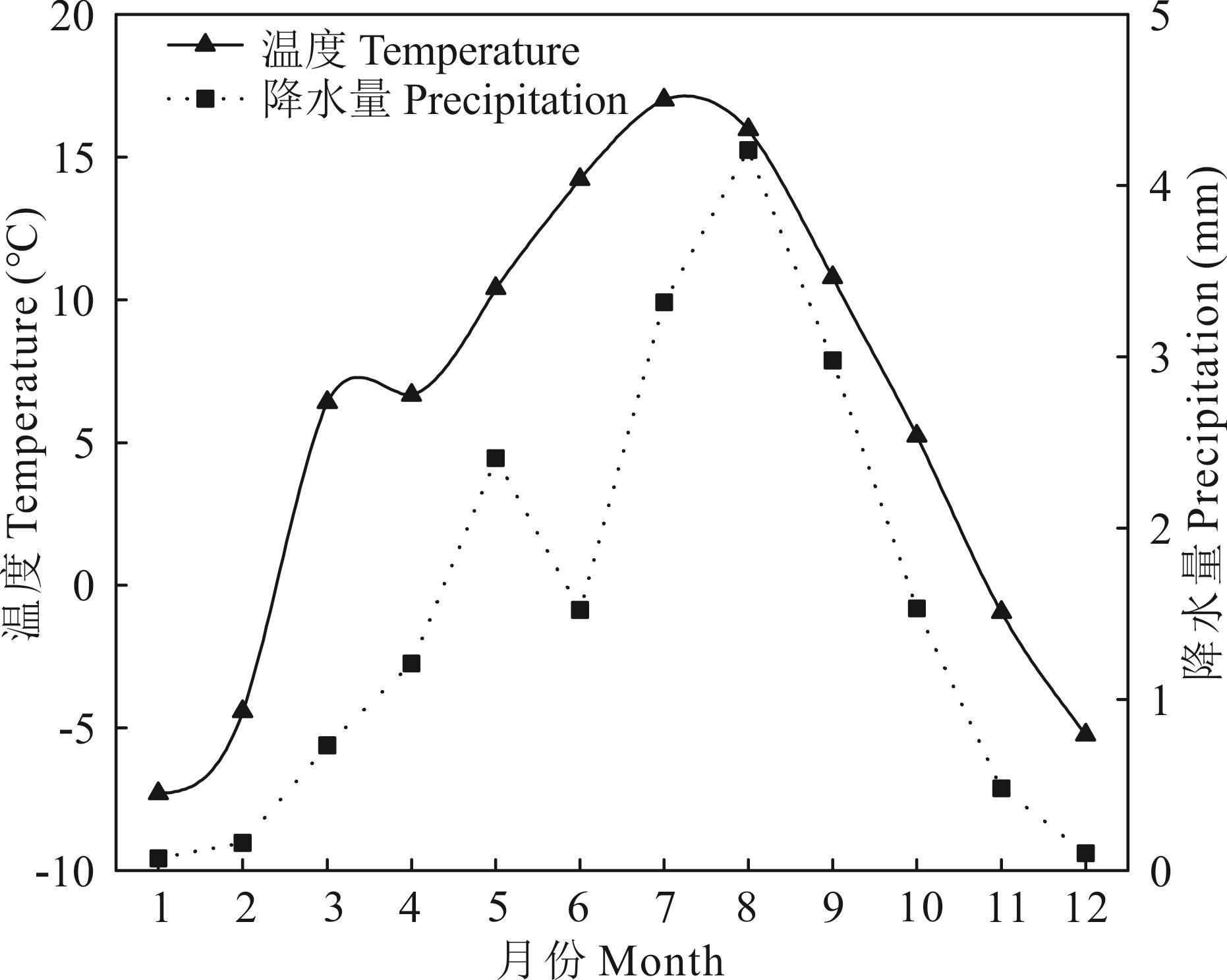
Fig.1 Average temperature and precipitation in different months of the pilot area in 2022
处理 Treatment | 自由度 Degree of freedom | 地上生物量Aboveground biomass | 地下生物量Belowground biomass | ||||||
|---|---|---|---|---|---|---|---|---|---|
| 燕麦Oat | 豌豆Pea | 燕麦Oat | 豌豆Pea | ||||||
| F | P | F | P | F | P | F | P | ||
| 间作种植模式Intercropping planting patterns (I) | 2 | 7.84 | <0.01 | 23.26 | <0.01 | 8.40 | <0.01 | 17.82 | <0.01 |
| 氮添加水平Nitrogen (N) | 2 | 17.46 | <0.01 | 21.21 | 0.01 | 106.94 | <0.01 | 1.89 | 0.17 |
| 间作种植模式×施氮水平 (I×N) | 4 | 3.63 | <0.01 | 8.43 | 0.01 | 3.63 | <0.01 | 1.23 | 0.32 |
Table 1 Results of two-way ANOVA of different intercropped planting patterns and nitrogen addition levels on aboveground and belowground biomass of oats and peas
处理 Treatment | 自由度 Degree of freedom | 地上生物量Aboveground biomass | 地下生物量Belowground biomass | ||||||
|---|---|---|---|---|---|---|---|---|---|
| 燕麦Oat | 豌豆Pea | 燕麦Oat | 豌豆Pea | ||||||
| F | P | F | P | F | P | F | P | ||
| 间作种植模式Intercropping planting patterns (I) | 2 | 7.84 | <0.01 | 23.26 | <0.01 | 8.40 | <0.01 | 17.82 | <0.01 |
| 氮添加水平Nitrogen (N) | 2 | 17.46 | <0.01 | 21.21 | 0.01 | 106.94 | <0.01 | 1.89 | 0.17 |
| 间作种植模式×施氮水平 (I×N) | 4 | 3.63 | <0.01 | 8.43 | 0.01 | 3.63 | <0.01 | 1.23 | 0.32 |
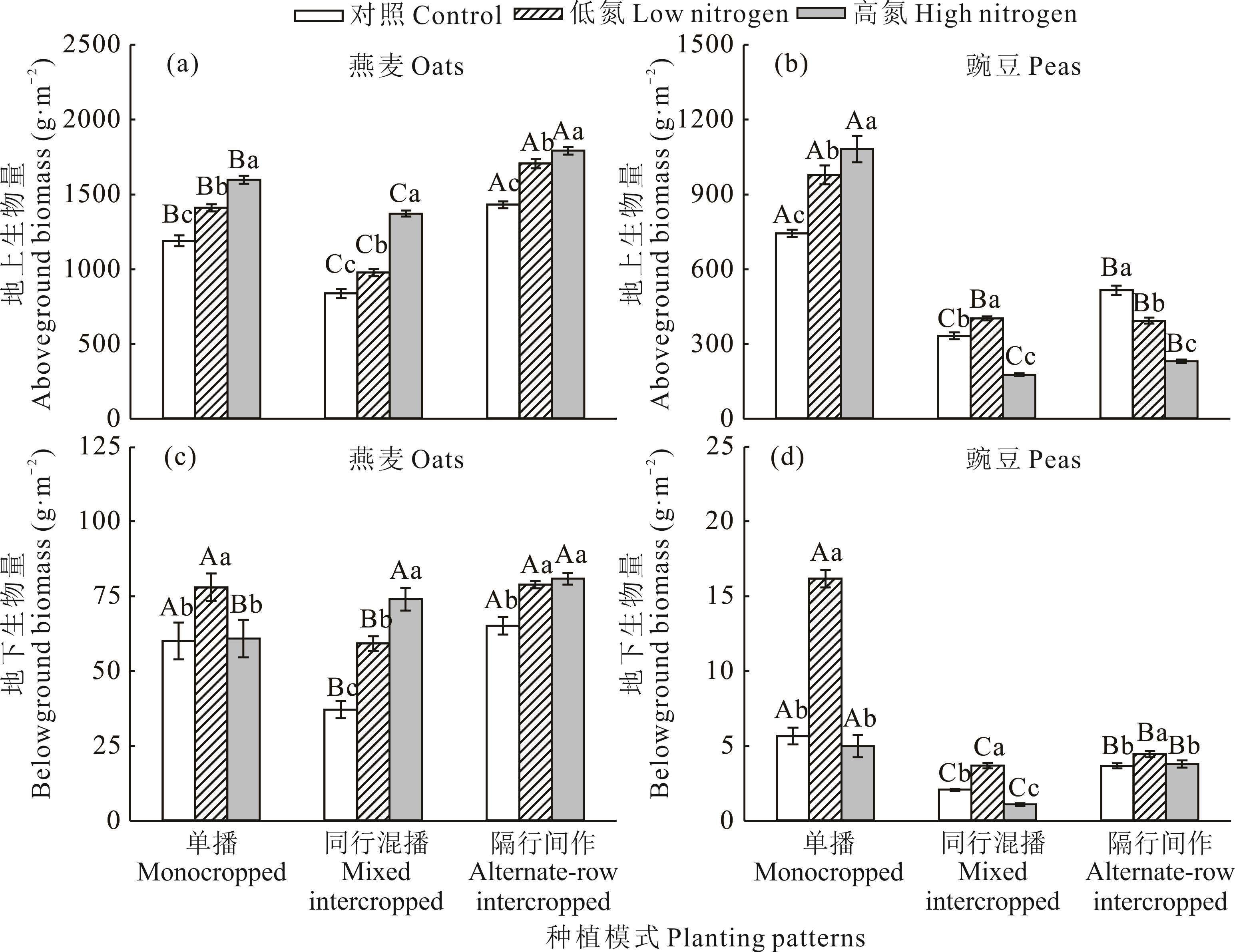
Fig.2 Effects of nitrogen addition levels on aboveground and belowground biomass of oats and peas among different intercropped planting patterns
物种 Species | 处理 Treatment | 自由度 Degree of freedom | 茎叶全氮含量 Total nitrogen content of stems and leaves | 根系全氮含量 Total nitrogen content of roots | ||
|---|---|---|---|---|---|---|
| F | P | F | P | |||
| 豌豆Peas | 间作种植模式 Intercropping planting patterns (I) | 2 | 9.87 | <0.01 | 45.61 | <0.01 |
| 氮添加水平 Nitrogen (N) | 2 | 4.75 | <0.05 | 10.76 | <0.01 | |
| 间作种植模式×施氮水平 (I×N) | 4 | 28.44 | <0.01 | 18.96 | <0.01 | |
| 燕麦Oats | 间作种植模式 Intercropping planting patterns (I) | 2 | 37.23 | <0.01 | 5.37 | <0.01 |
| 氮添加水平 Nitrogen (N) | 2 | 4.00 | <0.05 | 36.00 | <0.01 | |
| 间作种植模式×施氮水平 (I×N) | 4 | 11.17 | <0.01 | 6.75 | <0.01 | |
Table 2 Results of two-way ANOVA of total nitrogen content in stems and leaves, roots of oats and peas with combined effects of different intercropped planting patterns and nitrogen addition levels
物种 Species | 处理 Treatment | 自由度 Degree of freedom | 茎叶全氮含量 Total nitrogen content of stems and leaves | 根系全氮含量 Total nitrogen content of roots | ||
|---|---|---|---|---|---|---|
| F | P | F | P | |||
| 豌豆Peas | 间作种植模式 Intercropping planting patterns (I) | 2 | 9.87 | <0.01 | 45.61 | <0.01 |
| 氮添加水平 Nitrogen (N) | 2 | 4.75 | <0.05 | 10.76 | <0.01 | |
| 间作种植模式×施氮水平 (I×N) | 4 | 28.44 | <0.01 | 18.96 | <0.01 | |
| 燕麦Oats | 间作种植模式 Intercropping planting patterns (I) | 2 | 37.23 | <0.01 | 5.37 | <0.01 |
| 氮添加水平 Nitrogen (N) | 2 | 4.00 | <0.05 | 36.00 | <0.01 | |
| 间作种植模式×施氮水平 (I×N) | 4 | 11.17 | <0.01 | 6.75 | <0.01 | |
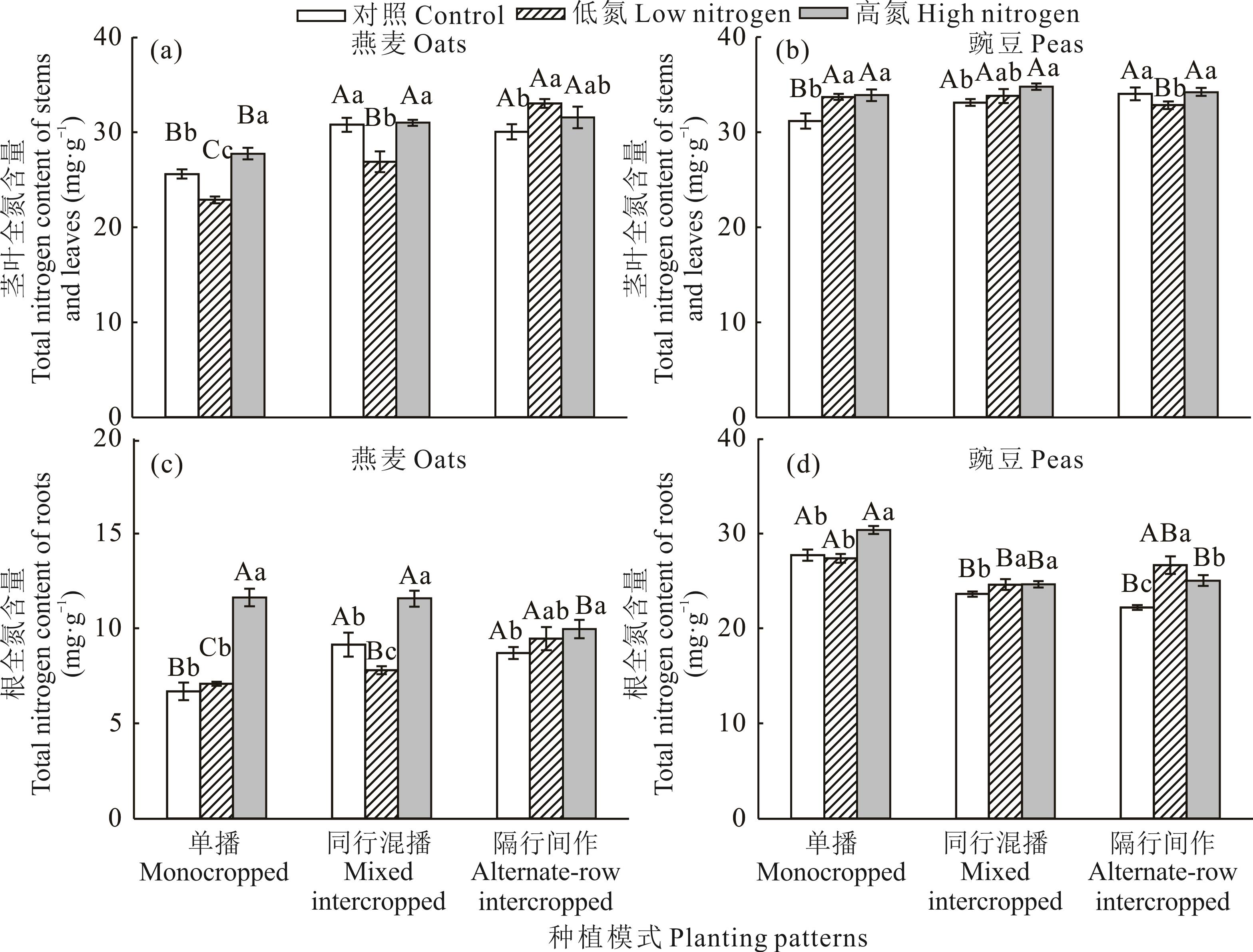
Fig.3 Effects of nitrogen addition levels on total nitrogen contents in stems and leaves and roots of oats and peas among different intercropped planting patterns
处理 Treatment | 自由度 Degree of freedom | 土壤全氮含量 Total nitrogen content in soil | 土壤铵态氮含量 NH4+-N content in soil | 土壤硝态氮含量 NO3--N content in soil | |||
|---|---|---|---|---|---|---|---|
| F | P | F | P | F | P | ||
| 间作种植模式 Intercropping planting patterns (I) | 2 | 2.96 | <0.05 | 3.83 | <0.05 | 26.37 | <0.01 |
| 氮添加水平 Nitrogen (N) | 2 | 1.01 | 0.37 | 6.50 | <0.01 | 53.82 | <0.01 |
| 间作种植模式×施氮水平 (I×N) | 4 | 1.32 | 0.26 | 5.22 | <0.01 | 7.96 | <0.01 |
Table 3 Results of two-way ANOVA of soil nitrogen content under different intercropped planting patterns of oats and peas combined with nitrogen addition levels
处理 Treatment | 自由度 Degree of freedom | 土壤全氮含量 Total nitrogen content in soil | 土壤铵态氮含量 NH4+-N content in soil | 土壤硝态氮含量 NO3--N content in soil | |||
|---|---|---|---|---|---|---|---|
| F | P | F | P | F | P | ||
| 间作种植模式 Intercropping planting patterns (I) | 2 | 2.96 | <0.05 | 3.83 | <0.05 | 26.37 | <0.01 |
| 氮添加水平 Nitrogen (N) | 2 | 1.01 | 0.37 | 6.50 | <0.01 | 53.82 | <0.01 |
| 间作种植模式×施氮水平 (I×N) | 4 | 1.32 | 0.26 | 5.22 | <0.01 | 7.96 | <0.01 |

Fig.4 Effects of nitrogen addition on total nitrogen, NO3--N and NH4+-N contents of soil in different intercropped patterns between oats and peas
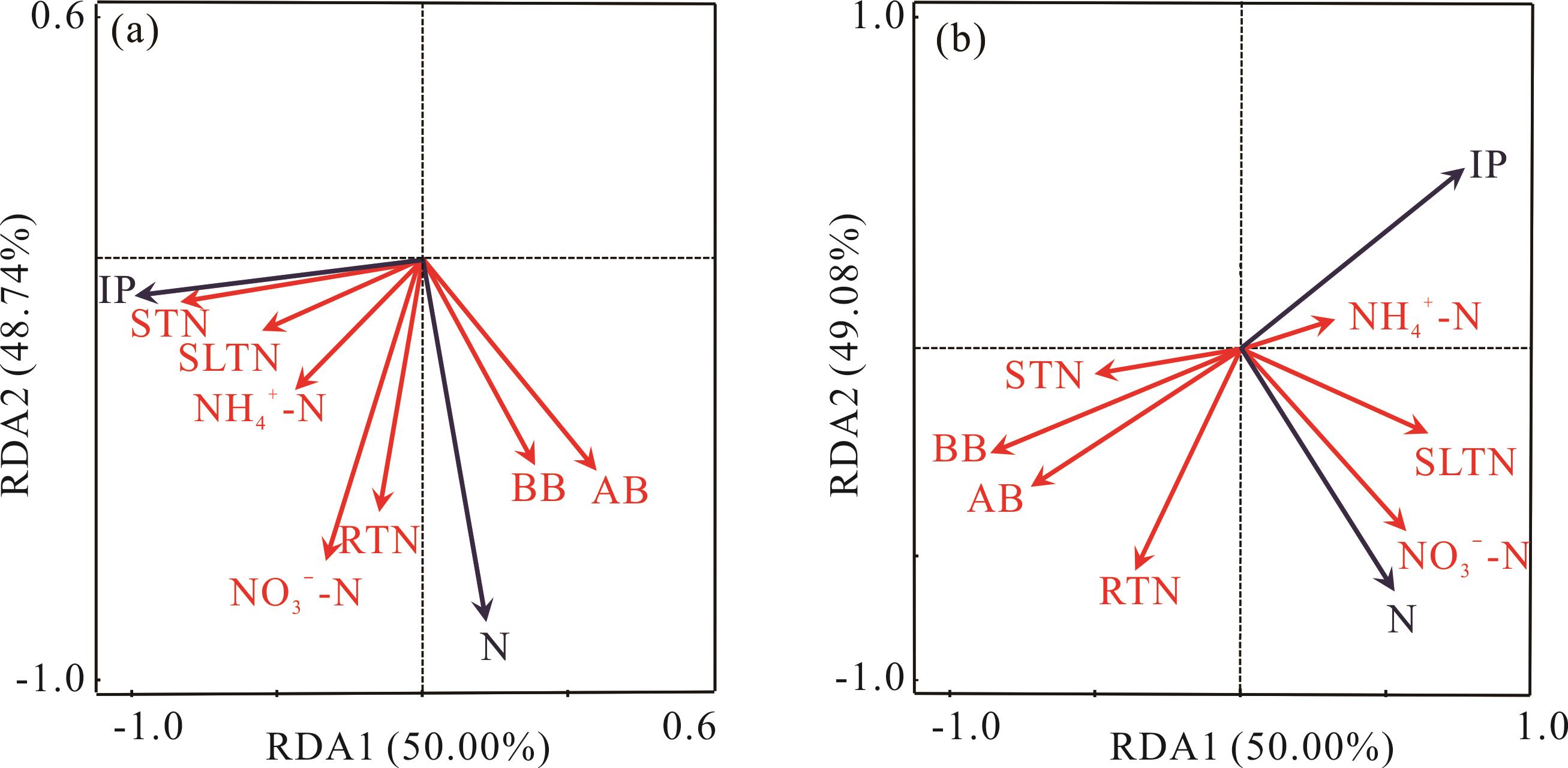
Fig.5 Redundancy analysis (RDA) of biomass and nitrogen contents in oats (a) and peas (b) with intercropping patterns and nitrogen addition
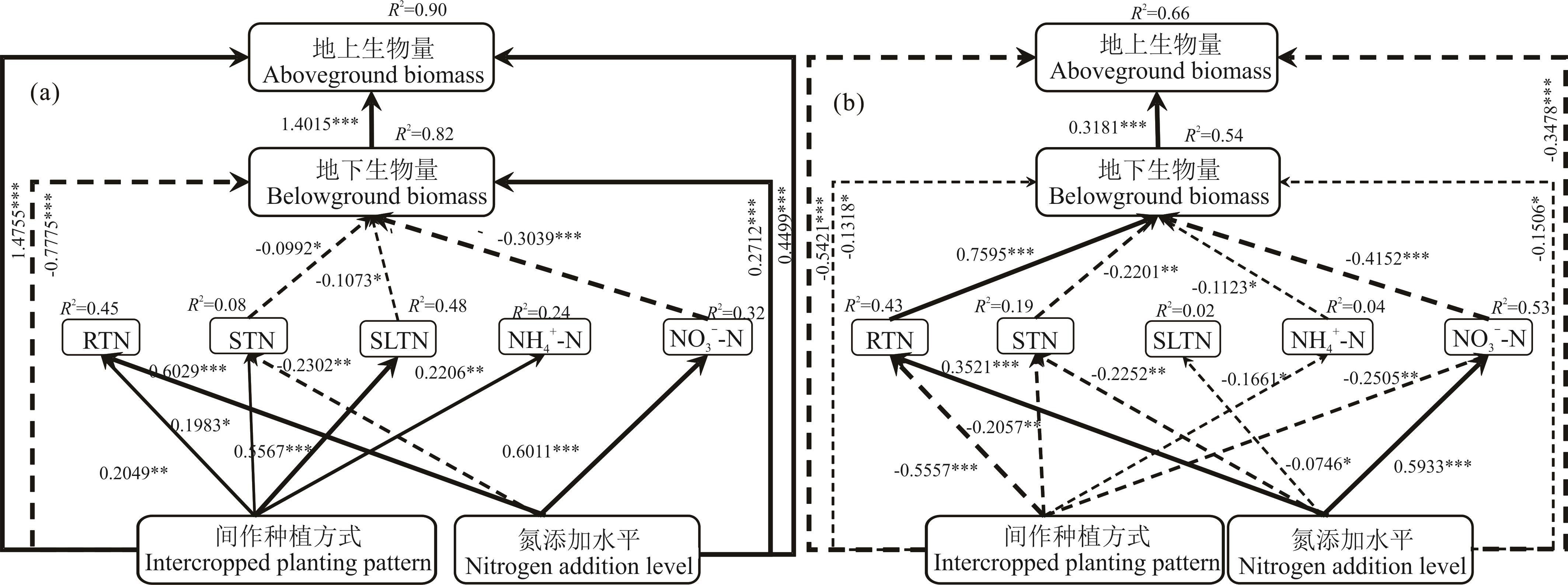
Fig.6 Structural equation model (SEM) based on effects of nitrogen addition levels and intercropped planting patterns on shoots (including stems and leaves), root and soil nitrogen contents and above- and belowground biomass of oats and peas
| [1] | Mousavi S R, Eskandari H. A general overview on intercropping and its advantages in sustainable agriculture. Journal of Applied Environmental and Biological Sciences, 2011, 1(11): 482-486. |
| [2] | Brooker R W, Bennett A E, Cong W F, et al. Improving intercropping: a synthesis of research in agronomy, plant physiology and ecology. New Phytologist, 2015, 206(1): 107-117. |
| [3] | Li L, Tilman D, Lambers H, et al. Plant diversity and overyielding: insights from belowground facilitation of intercropping in agriculture. New Phytologist, 2014, 203(1): 63-69. |
| [4] | Maitra S, Hossain A, Brestic M, et al. Intercropping-A low input agricultural strategy for food and environmental security. Agronomy, 2021, 11(2): 343. |
| [5] | Li X F, Wang Z G, Bao X G, et al. Long-term increased grain yield and soil fertility from intercropping. Nature Sustainability, 2021, 4(11): 943-950. |
| [6] | Ryan M R. Crops better when grown together. Nature Sustainability, 2021, 4(11): 926-927. |
| [7] | Ma H Y, Zhou J, Ge J Y, et al. Intercropping improves soil ecosystem multifunctionality through enhanced available nutrients but depends on regional factors. Plant and Soil, 2022, 480(1/2): 71-84. |
| [8] | Zhang D, Lyu Y, Li H, et al. Neighbouring plants modify maize root foraging for phosphorus: coupling nutrients and neighbours for improved nutrient-use efficiency. New Phytologist, 2020, 226(1): 244-253. |
| [9] | Garland G, Edlinger A, Banerjee S, et al. Crop cover is more important than rotational diversity for soil multifunctionality and cereal yields in European cropping systems. Nature Food, 2021, 2(1): 28-37. |
| [10] | Yan H L, Gu S S, Li S Z, et al. Grass legume mixtures enhance forage production via the bacterial community. Agriculture, Ecosystems & Environment, 2022, 338: 108087. |
| [11] | Neugschwandtner R W, Kaul H P, Moitzi G, et al. A low nitrogen fertiliser rate in oat-pea intercrops does not impair N2 fixation. Acta Agriculturae Scandinavica, Section B-Soil & Plant Science, 2021, 71(3): 182-190. |
| [12] | Bao G S, Zhang P, Ma X, et al. Effect of nitrogen addition on forage and seed yields of intercropping system of Avena sativa and Pisum sativum in alpine regions. Acta Agrestia Sinica, 2023, 31(7): 2210-2219. |
| 鲍根生, 张鹏, 马祥, 等. 高寒区氮添加对禾豆间作系统牧草和种子产量的影响. 草地学报, 2023, 31(7): 2210-2219. | |
| [13] | Wang Z K, Zhang X M, Ma Q H. Seed mixture of oats and common vetch on fertilizer and water-use reduction in a semi-arid alpine region. Soil and Tillage Research, 2022, 219: 105329. |
| [14] | Wang X, Zeng Z H, Zhu B, et al. Effect of different intercropping and mixture modes on forage yield and quality of oat and common vetch. Acta Agronomica Sinica, 2007, 33(11): 1892-1895. |
| 王旭, 曾昭海, 朱波, 等. 箭筈豌豆与燕麦不同间作混播模式对产量和品质的影响. 作物学报, 2007, 33(11): 1892-1895. | |
| [15] | Liu M, Qiao N, Zhang Q, et al. Cropping regimes affect NO3 - versus NH4 + uptake by Zea mays and Glycine max. Plant and Soil, 2018, 426(1): 241-251. |
| [16] | Yu Y, Stomph T J, Makowski D, et al. Temporal niche differentiation increases the land equivalent ratio of annual intercrops: A meta-analysis. Field Crops Research, 2015, 184: 133-144. |
| [17] | Xu Z, Li C J, Zhang C C, et al. Intercropping maize and soybean increases efficiency of land and fertilizer nitrogen use; A meta-analysis. Field Crops Research, 2020, 246: 107661. |
| [18] | Taylor B N, Menge D N. Light regulates tropical symbiotic nitrogen fixation more strongly than soil nitrogen. Nature Plants, 2018, 4(9): 655-661. |
| [19] | Cui Z L, Zhang H Y, Chen X P, et al. Pursuing sustainable productivity with millions of smallholder farmers. Nature, 2018, 555(7696): 363-366. |
| [20] | Wang X Y, Gao Y Z. Advances in the mechanism of cereal/legume intercropping promotion of symbiotic nitrogen fixation. Chinese Science Bulletin, 2020, 65(2/3): 142-149. |
| 王新宇, 高英志. 禾本科/豆科间作促进豆科共生固氮机理研究进展. 科学通报, 2020, 65(2/3): 142-149. | |
| [21] | Feng X Y, Hou T L, Bao G S, et al. Effects of nitrogen addition on CNP stoichiometric traits of oat-pea intercropping system. Acta Agrestia Sinica, 2024, 32(2): 450-461. |
| 冯晓云, 侯统璐, 鲍根生, 等. 氮添加对燕麦/豌豆间作体系碳氮磷化学计量特征的影响. 草地学报, 2024, 32(2): 450-461. | |
| [22] | Duan L X, Ma X, Ju Z L, et al. Effects of nitrogen reduction combined with organic fertilizer on photosynthetic characteristics and yield of Avena sativa ‘Qinghai’. Acta Agrestia Sinica, 2022, 30(2): 471-478. |
| 段连学, 马祥, 琚泽亮, 等. 减氮配施有机肥对‘青海甜燕麦’光合特性和产量的影响. 草地学报, 2022, 30(2): 471-478. | |
| [23] | Bao G S, Li Y, Feng X Y, et al. Interactive effects of intercropping patterns and nitrogen addition on root architectural characteristics of oat and pea in an alpine region. Acta Prataculturae Sinica, 2024, 33(3): 73-84. |
| 鲍根生, 李媛, 冯晓云, 等. 高寒区氮添加和间作种植互作对燕麦和豌豆根系构型影响的研究. 草业学报, 2024, 33(3): 73-84. | |
| [24] | Wu X R, Ye X S, Zhao Z Q. Comparison of determining the soil total nitrogen concentration with a continuous flow injection analyzer and Kjeldahl method. Journal of Huazhong Agricultural University, 2009, 28(5): 560-563. |
| 吴晓荣, 叶祥盛, 赵竹青. 流动注射法与凯氏定氮法测定土壤全氮的比较. 华中农业大学学报, 2009, 28(5): 560-563. | |
| [25] | Lonati M, Moot D J, Aceto P, et al. Thermal time requirements for germination, emergence and seedling development of adventive legume and grass species. New Zealand Journal of Agricultural Research, 2009, 52(1): 17-29. |
| [26] | Xiao Y B, Li L, Zhang F S. Effect of root contact on interspecific competition and N transfer between wheat and fababean using direct and indirect 15N techniques. Plant and Soil, 2004, 262: 45-54. |
| [27] | Hauggaard-Nielsen H, Ambus P, Jensen E S. The comparison of nitrogen use and leaching in sole cropped versus intercropped pea and barley. Nutrient Cycling in Agroecosystems, 2003, 65: 289-300. |
| [28] | Li Y Y, Yu C B, Cheng X, et al. Intercropping alleviates the inhibitory effect of N fertilization on nodulation and symbiotic N2 fixation of faba bean. Plant and Soil, 2009, 323: 295-308. |
| [29] | Hichri I, Meilhoc E, Boscari A, et al. Nitric oxide: jack-of-all-trades of the nitrogen-fixing symbiosis? Advances in Botanical Research, 2016, 77: 193-218. |
| [30] | Zhu Y Q, Zheng W, Wang X, et al. Effects plant spacing pattern on root morphological and architectural characteristics of legume-grass mixtures. Acta Prataculturae Sinica, 2018, 27(1): 73-85. |
| 朱亚琼, 郑伟, 王祥, 等. 混播方式对豆禾混播草地植物根系构型特征的影响. 草业学报, 2018, 27(1): 73-85. | |
| [31] | Fan M S, Sun Y Q, Shao J W, et al. Influence of nitrogen forms on oat growth and phosphorus uptake. Acta Agronomica Sinica, 2005, 31(1): 114-118. |
| 樊明寿, 孙亚卿, 邵金旺, 等. 不同形态氮素对燕麦营养生长和磷素利用的影响. 作物学报, 2005, 31(1): 114-118. | |
| [32] | Xia X, Gong Z P. Research advance on the relationship between nitrogen and leguminous nitrogen fixation. Journal of Northeast Agricultural University, 2017, 48(1): 79-88. |
| 夏玄, 龚振平. 氮素与豆科作物固氮关系研究进展. 东北农业大学学报, 2017, 48(1): 79-88. | |
| [33] | Xu R X, Zhao H M, Liu G B, et al. Effects of nitrogen and maize plant density on forage yield and nitrogen uptake in an alfalfa-silage maize relay intercropping system in the north China Plain. Field Crops Research, 2021, 263: 108068. |
| [34] | Yu Y, Stomph T J, Makowski D, et al. A meta-analysis of relative crop yields in cereal/legume mixtures suggests options for management. Field Crops Research, 2016, 198: 269-279. |
| [35] | Hu F L, Zhao C, Feng F X, et al. Improving N management through intercropping alleviates the inhibitory effect of mineral N on nodulation in pea. Plant and Soil, 2017, 412: 235-251. |
| [36] | Li C J, Dong Y, Li H G, et al. The dynamic process of interspecific interactions of competitive nitrogen capture between intercropped wheat (Triticum aestivum L.) and faba bean (Vicia faba L.). PLoS One, 2014, 9(12): e115804. |
| [37] | Fan F L, Zhang F S, Song Y N, et al. Nitrogen fixation of faba bean (Vicia faba L.) interacting with a non-legume in two contrasting intercropping systems. Plant and Soil, 2006, 283: 275-286. |
| [38] | Xiao J X, Yin X H, Ren J B, et al. Complementation drives higher growth rate and yield of wheat and saves nitrogen fertilizer in wheat and faba bean intercropping. Field Crops Research, 2018, 221: 119-129. |
| [39] | Hauggaard-Nielsen H, Gooding M, Ambus P, et al. Pea-barley intercropping for efficient symbiotic N2-fixation, soil N acquisition and use of other nutrients in European organic cropping systems. Field Crops Research, 2009, 113(1): 64-71. |
| [40] | Feng X Y, Zhang P, Li Y, et al. Effects of nitrogen addition and intercropping patterns on agronomic traits of oats and peas in alpine regions. Pratacultural Science, 2024, 41(3): 718-730. |
| 冯晓云, 张鹏, 李媛, 等. 高寒区燕麦、豌豆农艺性状对氮添加和间作模式的响应. 草业科学, 2024, 41(3): 718-730. | |
| [41] | Li C J, Stomph T J, Makowski D, et al. The productive performance of intercropping. Proceedings of the National Academy of Sciences, 2023, 120(2): e2201886120. |
| [42] | Li C J, Hoffland E, Kuyper T W, et al. Syndromes of production in intercropping impact yield gains. Nature Plants, 2020, 6(6): 653-660. |
| [43] | Li C J, Li Y Y, Yu C B, et al. Crop nitrogen use and soil mineral nitrogen accumulation under different crop combinations and patterns of strip intercropping in northwest China. Plant and Soil, 2011, 342: 221-231. |
| [44] | Markham J H, Zekveld C. Nitrogen fixation makes biomass allocation to roots independent of soil nitrogen supply. Canadian Journal of Botany, 2007, 85(9): 787-793. |
| [1] | Yi-yin ZHANG, Bin WANG, Teng-fei WANG, Jian LAN, Hai-ying HU. Effects of intercropping triticale with alfalfa on system yield, resource utilization, and alfalfa seed yield [J]. Acta Prataculturae Sinica, 2025, 34(8): 43-53. |
| [2] | Ying WANG, Ming-yuan LI, Mairiyangu·Yasheng, Ji-lian WANG. Comparative study of rhizosphere soil fungal community structure among different plants in Tomur Peak, Xinjiang [J]. Acta Prataculturae Sinica, 2025, 34(7): 83-94. |
| [3] | Ying-hao ZHANG, Chu-bo LIU, Kun ZHOU, Jia-cun GUO, Shi-peng LIU, Luan-zi SUN. Effects of jujube tree on the growth of alfalfa and orchardgrass in different positions within an orchard [J]. Acta Prataculturae Sinica, 2025, 34(6): 203-212. |
| [4] | Kai MAO, Yi XU, Xue-mei WANG, Huan CHAI, Shuai HUANG, Jian WANG, Shu-qian HUAN, Zhu YU, Mu-sen WANG. Effect of Lactiplantibacillus plantarum and molasses on the fermentation quality, biogenic amines contents and bacterial community of peanut vine silage [J]. Acta Prataculturae Sinica, 2025, 34(5): 146-158. |
| [5] | Ya-jiao ZHAO, Xiao-jing LIU, Fang LIN. Selection of intercropping combinations suitable for alfalfa and Poaceae forages in semi-arid areas of the Loess Plateau [J]. Acta Prataculturae Sinica, 2025, 34(3): 97-110. |
| [6] | Wen-yan MA, Jie-dong LI, Zhen-lei ZHOU, Dong CAO, Bao-long LIU, Huai-gang ZHANG, Dong-xia WANG. Effects of interactions among fertilizer, water retention agent, and seeding rate on the yield production performance of oat (Avena sativa) [J]. Acta Prataculturae Sinica, 2025, 34(10): 107-119. |
| [7] | Yan MING, Zi-yi DOU, Wei ZHENG, Ning-xin WANG, Xue CHEN. Quantitative analysis of nitrogen transfer pathways in intercropping systems between alfalfa and Korla pear [J]. Acta Prataculturae Sinica, 2025, 34(10): 51-61. |
| [8] | Wen-pan DU, Gui-qin ZHAO, Ji-kuan CHAI, Li YANG, Jian-gui ZHANG, Yi-chao SHI, Guan-lu ZHANG. Effects of root separation on aboveground biomass, soil nutrient contents, and root characters of intercropped oat and pea [J]. Acta Prataculturae Sinica, 2024, 33(8): 25-36. |
| [9] | Sheng-ran HE, Xiao-jing LIU, Ya-jiao ZHAO, Xue WANG, Jing WANG. Effects of alfalfa/sweet sorghum intercropping on rhizosphere soil characteristics and microbial community characteristics [J]. Acta Prataculturae Sinica, 2024, 33(5): 92-105. |
| [10] | Jie ZHAO, Heng-guang CHEN, Xiao-meng PEI, Hao YU, Yin-ying XU, Da-gan MAO. Effects of resveratrol supplementation in the perinatal diet on production performance, blood indexes, and transcript abundance of genes encoding inflammatory factors in goats [J]. Acta Prataculturae Sinica, 2024, 33(4): 210-220. |
| [11] | Hong-fei LI, Bang-wei ZHOU, Miao ZHANG, Shu-nan SHI, Zhi-jian LI. Adaptability evaluation of different oat varieties introduced in the Hulunbuir region [J]. Acta Prataculturae Sinica, 2024, 33(4): 60-72. |
| [12] | Ping MU, Ji-kuan CHAI, Wei-juan SU, Hai-long ZHANG, Gui-qin ZHAO. Phenotype and genetic variation analysis of forward and reverse hybrid progeny from different oat crosses [J]. Acta Prataculturae Sinica, 2024, 33(4): 73-86. |
| [13] | Gen-sheng BAO, Yuan LI, Xiao-yun FENG, Peng ZHANG, Si-yu MENG. Interactive effects of intercropping patterns and nitrogen addition on root architectural characteristics of oat and pea in an alpine region [J]. Acta Prataculturae Sinica, 2024, 33(3): 73-84. |
| [14] | Xue WANG, Xiao-jing LIU, Jing WANG, Yong WU, Chang-chun TONG. Root and carbon-nitrogen metabolism characteristics of alfalfa-oat mixed stands under continuous intercropping [J]. Acta Prataculturae Sinica, 2024, 33(3): 85-96. |
| [15] | Xing-fa GAO, Ying-ying NIE, Li-jun XU, Min YANG, Shu-hua XU, Meng ZHU. Adaptability evaluation of oat introduction in winter fallow field of Wumeng Mountain area under drought condition [J]. Acta Prataculturae Sinica, 2024, 33(11): 215-227. |
| Viewed | ||||||
|
Full text |
|
|||||
|
Abstract |
|
|||||
