

ISSN 1004-5759 CN 62-1105/S
草业学报 ›› 2025, Vol. 34 ›› Issue (9): 26-37.DOI: 10.11686/cyxb2024412
罗叙1( ), 马慧2, 韩翠1, 赵雅欣1, 赵莹1, 谢应忠1,3, 李建平1,3()
收稿日期:2024-10-22
修回日期:2024-12-13
出版日期:2025-09-20
发布日期:2025-07-02
通讯作者:
李建平
作者简介:E-mail: lijianpingsas@163.com基金资助:
Xu LUO1(), Hui MA2, Cui HAN1, Ya-xin ZHAO1, Ying ZHAO1, Ying-zhong XIE1,3, Jian-ping LI1,3()
Received:2024-10-22
Revised:2024-12-13
Online:2025-09-20
Published:2025-07-02
Contact:
Jian-ping LI
摘要:
草地生态系统的生产力在很大程度上受优势种和次优势种的影响。然而,关于优势种和次优势种不同组合建植的物种丰富度对地上生产力影响的研究相对较少。因此,为探究优势和次优势植物群落生产力的直接和间接驱动因素,本研究选取了宁夏北部盐池荒漠草原的3个优势种和7个次优势种进行单播和混播试验。确定了5个植物物种丰富度(单播,4、6、8和10种混播),并考察了不同物种组合的地上生物量、土壤微生物群落组成和胞外酶活性以及土壤理化性质。结果表明:1)优势种和次优势种混播均增加了优势细菌门(放线菌门、酸杆菌门和变形菌门)和优势真菌门(子囊菌门和担子菌门)的总相对丰度,优势细菌门总相对丰度的增加比优势真菌门明显。2)单播和混播的矢量长度为1.31~1.38,矢量角度均>45°。土壤微生物代谢主要受土壤碳(C)和磷(P)限制,单播土壤氮磷比(N/P)显著高于4种混播群落(P<0.05)。3)地上净初级生产力与物种丰富度表现出显著正相关关系(P<0.001),互补性效应和选择效应对所观察到的地上净初级生产力均有显著的积极贡献。4)结构方程模型(structural equation model, SEM)表明植物物种丰富度通过选择效应、互补效应和土壤理化性质间接积极影响植物群落地上生产力。研究结果将为保护草地生物多样性和加强草地生态系统恢复提供数据支持和理论指导。
罗叙, 马慧, 韩翠, 赵雅欣, 赵莹, 谢应忠, 李建平. 地上净初级生产力对植物物种丰富度的响应及影响因子分析[J]. 草业学报, 2025, 34(9): 26-37.
Xu LUO, Hui MA, Cui HAN, Ya-xin ZHAO, Ying ZHAO, Ying-zhong XIE, Jian-ping LI. Response of aboveground net primary productivity to plant species richness and identification of the factors of influence[J]. Acta Prataculturae Sinica, 2025, 34(9): 26-37.

图1 研究区降水和气温分布
Fig.1 Distribution of precipitation and air temperature in study area
物种丰富度 Species richness | 组合数量 Number of combinations | 功能群数量Number of functional groups | 物种名称及播种量 Species name and sowing quantity (g·25 m-2) |
|---|---|---|---|
单播 Monoculture | 10 | 1 | 甘草G. uralensis (187.50),牛枝子L. potaninii (160.00),草木樨A. melilotoides (300.00),苦豆子S. alopecuroides (375.00),沙芦草A. mongolicum (131.00),冰草A. cristatum (187.50),糙隐子草C. squarrosa (187.50),沙蒿A. desertorum (112.50),斜茎黄芪A. laxmannii (75.00),披碱草E. dahuricus (225.00) |
4种混播 4-species mixture | 3 | 2 | 糙隐子草C. squarrosa (25.00),牛枝子L. potaninii (53.30),斜茎黄芪A. laxmannii (67.00),草木樨A. melilotoides (25.00) |
| 3 | 甘草G. uralensis (62.50),糙隐子草C. squarrosa (37.50),沙蒿A. desertorum (37.50),牛枝子L. potaninii (53.30) | ||
| 3 | 牛枝子L. potaninii (53.30),冰草A. cristatum (62.50),沙蒿A. desertorum (57.50),草木樨A. melilotoides (25.00) | ||
6种混播 6-species mixture | 3 | 2 | 糙隐子草C. squarrosa (15.00),斜茎黄芪A. laxmannii (15.00),冰草A. cristatum (37.50),苦豆子S. alopecuroides (195.00),草木樨A. melilotoides (60.00),沙芦草A. mongolicum (54.00) |
| 3 | 甘草G. uralensis (73.50),糙隐子草C. squarrosa (67.50),沙蒿A. desertorum (67.50),冰草A. cristatum (89.50),草木樨A. melilotoides (60.00),沙芦草A. mongolicum (54.00) | ||
| 3 | 牛枝子L. potaninii (109.80),冰草A. cristatum (37.50),沙蒿A. desertorum (67.50),草木樨A. melilotoides (75.00),沙芦草A. mongolicum (80.20),甘草G. uralensis (36.00) | ||
8种混播 8-species mixture | 3 | 2 | 沙芦草A. mongolicum (39.73),牛枝子L. potaninii (82.37),斜茎黄芪A. laxmannii (10.73),冰草A. cristatum (26.80),苦豆子S. alopecuroides (105.58),甘草G. uralensis (64.80),糙隐子草C. squarrosa (44.81),草木樨A. melilotoides (10.71) |
| 3 | 甘草G. uralensis (64.80),糙隐子草C. squarrosa (16.08),沙蒿A. desertorum (49.08),冰草A. cristatum (26.80),草木樨A. melilotoides (42.88),牛枝子L. potaninii (98.37),沙芦草A. mongolicum (54.73),披碱草E. dahuricus (32.14) | ||
| 3 | 牛枝子L. potaninii (82.37),冰草A. cristatum (26.80),沙蒿A. desertorum (49.08),草木樨A. melilotoides (42.88),沙芦草A. mongolicum (47.73),苦豆子S. alopecuroides (105.58),糙隐子草C. squarrosa (10.73),甘草G. uralensis (38.00) | ||
10种混播 10-species mixture | 1 | 3 | 甘草G. uralensis (35.05),牛枝子L. potaninii (72.53),草木樨A. melilotoides (27.27),苦豆子S. alopecuroides (72.10),沙芦草A. mongolicum (25.93),冰草A. cristatum (17.05),糙隐子草C. squarrosa (37.08),沙蒿A. desertorum (30.25),斜茎黄芪A. laxmannii (21.83),披碱草E. dahuricus (20.30) |
表1 不同物种丰富度组合及播种量
Table 1 The combination of different species richness and sowing amount
物种丰富度 Species richness | 组合数量 Number of combinations | 功能群数量Number of functional groups | 物种名称及播种量 Species name and sowing quantity (g·25 m-2) |
|---|---|---|---|
单播 Monoculture | 10 | 1 | 甘草G. uralensis (187.50),牛枝子L. potaninii (160.00),草木樨A. melilotoides (300.00),苦豆子S. alopecuroides (375.00),沙芦草A. mongolicum (131.00),冰草A. cristatum (187.50),糙隐子草C. squarrosa (187.50),沙蒿A. desertorum (112.50),斜茎黄芪A. laxmannii (75.00),披碱草E. dahuricus (225.00) |
4种混播 4-species mixture | 3 | 2 | 糙隐子草C. squarrosa (25.00),牛枝子L. potaninii (53.30),斜茎黄芪A. laxmannii (67.00),草木樨A. melilotoides (25.00) |
| 3 | 甘草G. uralensis (62.50),糙隐子草C. squarrosa (37.50),沙蒿A. desertorum (37.50),牛枝子L. potaninii (53.30) | ||
| 3 | 牛枝子L. potaninii (53.30),冰草A. cristatum (62.50),沙蒿A. desertorum (57.50),草木樨A. melilotoides (25.00) | ||
6种混播 6-species mixture | 3 | 2 | 糙隐子草C. squarrosa (15.00),斜茎黄芪A. laxmannii (15.00),冰草A. cristatum (37.50),苦豆子S. alopecuroides (195.00),草木樨A. melilotoides (60.00),沙芦草A. mongolicum (54.00) |
| 3 | 甘草G. uralensis (73.50),糙隐子草C. squarrosa (67.50),沙蒿A. desertorum (67.50),冰草A. cristatum (89.50),草木樨A. melilotoides (60.00),沙芦草A. mongolicum (54.00) | ||
| 3 | 牛枝子L. potaninii (109.80),冰草A. cristatum (37.50),沙蒿A. desertorum (67.50),草木樨A. melilotoides (75.00),沙芦草A. mongolicum (80.20),甘草G. uralensis (36.00) | ||
8种混播 8-species mixture | 3 | 2 | 沙芦草A. mongolicum (39.73),牛枝子L. potaninii (82.37),斜茎黄芪A. laxmannii (10.73),冰草A. cristatum (26.80),苦豆子S. alopecuroides (105.58),甘草G. uralensis (64.80),糙隐子草C. squarrosa (44.81),草木樨A. melilotoides (10.71) |
| 3 | 甘草G. uralensis (64.80),糙隐子草C. squarrosa (16.08),沙蒿A. desertorum (49.08),冰草A. cristatum (26.80),草木樨A. melilotoides (42.88),牛枝子L. potaninii (98.37),沙芦草A. mongolicum (54.73),披碱草E. dahuricus (32.14) | ||
| 3 | 牛枝子L. potaninii (82.37),冰草A. cristatum (26.80),沙蒿A. desertorum (49.08),草木樨A. melilotoides (42.88),沙芦草A. mongolicum (47.73),苦豆子S. alopecuroides (105.58),糙隐子草C. squarrosa (10.73),甘草G. uralensis (38.00) | ||
10种混播 10-species mixture | 1 | 3 | 甘草G. uralensis (35.05),牛枝子L. potaninii (72.53),草木樨A. melilotoides (27.27),苦豆子S. alopecuroides (72.10),沙芦草A. mongolicum (25.93),冰草A. cristatum (17.05),糙隐子草C. squarrosa (37.08),沙蒿A. desertorum (30.25),斜茎黄芪A. laxmannii (21.83),披碱草E. dahuricus (20.30) |

图2 试验样地布局和航拍(2023年8月拍摄)
Fig.2 Experimental plot layout and aerial photography (taken in August 2023)

图3 不同植物物种丰富度下微生物群落组成(门水平)
Fig.3 Microbial community composition at different plant species richness (phylum level)

图4 不同植物物种丰富度下微生物代谢养分限制同一变量中不同小写字母表示不同植物物种丰富度在0.05水平上存在显著差异。Different lowercase letters in the same variable indicate significant differences in the richness of different plant species at the 0.05 level. 1:单播Monoculture;2:4种混播4-species mixture;3:6种混播6-species mixture;4:8种混播8-species mixture;5:10种混播10-species mixture. 下同The same below.
Fig.4 Nutrient limitation of microbial metabolism at different plant species richness

图5 植物物种丰富度下土壤理化特性同一变量中*表示不同植物物种丰富度在0.05水平上存在显著差异。* in the same variable indicate significant differences in the richness of different plant species at the 0.05 level.
Fig.5 Physical and chemical properties of soil among plant species richness

图6 植物物种丰富度下地上生物量及选择效应和互补效应
Fig.6 Aboveground biomass and selection and complementary effects among plant species richness
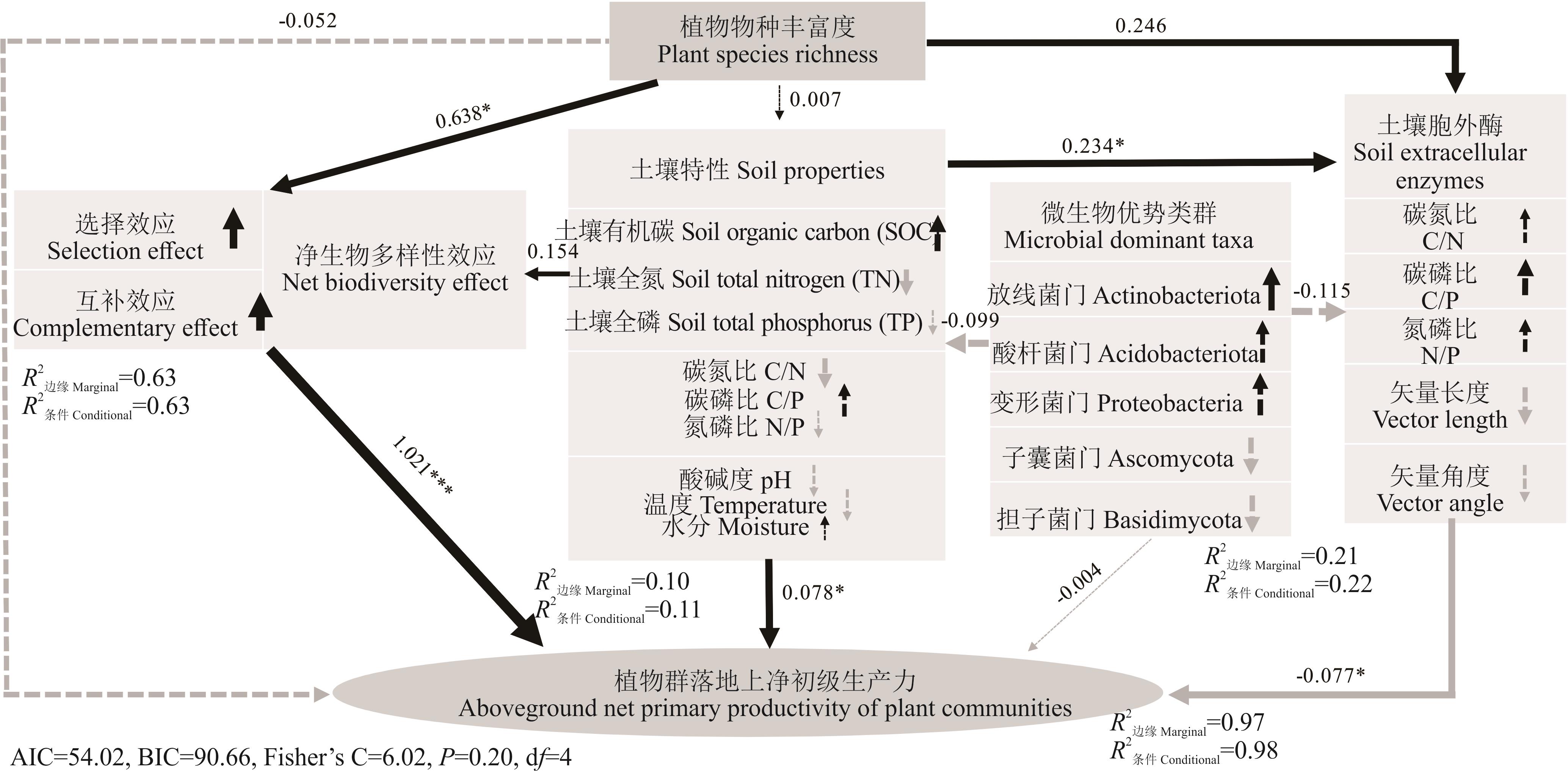
图7 植物物种丰富度间驱动植物地上生物量的主要途径黑色和灰色箭头分别表示积极影响和消极影响,实线和虚线表示影响显著(*: P<0.05,**: P<0.01,***: P<0.001)和不显著(P>0.05)。综合变量之间带数字的箭头代表直接路径和标准化路径系数,箭头的宽度与路径系数的强度成正比。Black and grey arrows indicate positive and negative impacts, respectively, with solid and dashed lines indicating significant (*: P<0.05, **: P<0.01, ***: P<0.001) and non-significant effect (P>0.05). Arrows with numbers among composite variables represent direct and standardized path coefficients, and the width of the arrow is proportional to the strength of the path coefficient.
Fig.7 Main pathways driving plant aboveground biomass among plant species richness
| [1] | Isbell F, Balvanera P, Mori A S, et al. Expert perspectives on global biodiversity loss and its drivers and impacts on people. Frontiers in Ecology and the Environment, 2023, 21(2): 94-103. |
| [2] | Van K R, Bowler D E, Gongalsky K B, et al. Meta-analysis reveals declines in terrestrial but increases in freshwater insect abundances. Science, 2020, 368(6489): 417-420. |
| [3] | de Vries F T, Manning P, Tallowin J R B, et al. Abiotic drivers and plant traits explain landscape-scale patterns in soil microbial communities. Ecology Letters, 2012, 15(11): 1230-1239. |
| [4] | Liang J J, Crowther T W, Picard N, et al. Positive biodiversity-productivity relationship predominant in global forests. Science, 2016, 354(6309): 196. |
| [5] | Mace G M. Whose conservation? Science, 2014, 345(6204): 1558-1560. |
| [6] | Fraser L H, Pither J, Jentsch A, et al. Worldwide evidence of a unimodal relationship between productivity and plant species richness. Science, 2015, 349(6245): 302-305. |
| [7] | Zhu Y, Veen G F, Heinen R, et al. Large mammalian herbivores affect arthropod food webs via changes in vegetation characteristics and microclimate. Journal of Ecology, 2023, 111(9): 2077-2089. |
| [8] | Jiang X L, Yue J, Zhang W G, et al. Biodiversity, ecosystem functioning and spatio-temporal scales. Acta Prataculturae Sinica, 2010, 19(1): 219-225. |
| 江小雷, 岳静, 张卫国, 等. 生物多样性, 生态系统功能与时空尺度. 草业学报, 2010, 19(1): 219-225. | |
| [9] | Loreau M. Separating sampling and other effects in biodiversity experiments. Oikos, 1998, 82(3): 600-602. |
| [10] | Giling D P, Beaumelle L, Phillips H R P, et al. A niche for ecosystem multifunctionality in global change research. Global Change Biology, 2019, 25(3): 763-774. |
| [11] | Yang X Q, Li Y, Niu B, et al. Temperature and precipitation drive elevational patterns of microbial beta diversity in alpine grasslands. Microbial Ecology, 2022, 84(4): 1141-1153. |
| [12] | Xiao W, Chen X, Jing X, et al. A meta-analysis of soil extracellular enzyme activities in response to global change. Soil Biology & Biochemistry, 2018, 123: 21-32. |
| [13] | Nemergut D R, Costello E K, Hamady M, et al. Global patterns in the biogeography of bacterial taxa. Environmental Microbiology, 2011, 13(1): 135-144. |
| [14] | Saunders A M, Albertsen M, Vollertsen J, et al. The activated sludge ecosystem contains a core community of abundant organisms. The ISME Journal, 2016, 10(1): 11-20. |
| [15] | Jousset A, Bienhold C, Chatzinotas A, et al. Where less may be more: how the rare biosphere pulls ecosystems strings. The ISME Journal, 2017, 11(4): 853-862. |
| [16] | Banerjee S, Thrall P H, Bissett A, et al. Linking microbial co-occurrences to soil ecological processes across a woodland-grassland ecotone. Ecology and Evolution, 2018, 8(16): 8217-8230. |
| [17] | Steinweg J M, Dukes J S, Paul E A, et al. Microbial responses to multi-factor climate change: effects on soil enzymes. Frontiers in Microbiology, 2013, 4: 146. |
| [18] | Baldrian P, Merhautová V, Petránková M, et al. Distribution of microbial biomass and activity of extracellular enzymes in a hardwood forest soil reflect soil moisture content. Applied Soil Ecology, 2010, 46(2): 177-182. |
| [19] | Sinsabaugh R L, Shah J J F. Ecoenzymatic stoichiometry and ecological theory. Annual Review of Ecology, Evolution, and Systematics, 2012, 43: 313-343. |
| [20] | Wang Y T. Impacts of precipitation change and nitrogen deposition on ecosystem multifunctionality of typical steppe in the Loess Plateau. Yinchuan: Ningxia University, 2023. |
| 王誉陶. 降水变化与氮沉降对黄土高原典型草原生态系统多功能性的影响. 银川: 宁夏大学, 2023. | |
| [21] | Yang Y, Qiu K Y, Xie Y Z, et al. Geographical, climatic, and soil factors control the altitudinal pattern of rhizosphere microbial diversity and its driving effect on root zone soil multifunctionality in mountain ecosystems. Science of the Total Environment, 2023, 904: 166932. |
| [22] | Qi R M, Li J, Lin Z A, et al. Temperature effects on soil organic carbon, soil labile organic carbon fractions, and soil enzyme activities under long-term fertilization regimes. Applied Soil Ecology, 2016, 102: 36-45. |
| [23] | Xu W, Hao J Q, Jiang T Y, et al. Response characteristics of farmland soil enzyme activity and microbial nutrient restriction under long-term mulching measures in the Loess Plateau. Environmental Science, 2025, 46(2): 1056-1064. |
| 徐文, 郝嘉琪, 姜天宇, 等. 黄土高原长期覆盖措施下农田土壤酶活性与微生物养分限制的响应特征. 环境科学, 2025, 46(2): 1056-1064. | |
| [24] | Roscher C, Temperton V M, Scherer Lorenzen M, et al. Overyielding in experimental grassland communities- irrespective of species pool or spatial scale. Ecology Letters, 2005, 8(4): 419-429. |
| [25] | Tian P, Zhao X C, Liu S G, et al. Soil microbial respiration in forest ecosystems along a north-south transect of eastern China: Evidence from laboratory experiments. Catena, 2022, 211: 105980. |
| [26] | Shade A, Handelsman J. Beyond the Venn diagram: the hunt for a core microbiome. Environmental Microbiology, 2012, 14(1): 4-12. |
| [27] | Wang S K, Zuo X A, Zhao X A, et al. Dominant plant species shape soil bacterial community in semiarid sandy land of northern China. Ecology and Evolution, 2018, 8(3): 1693-1704. |
| [28] | Yang S D, Liu H W, Xie P H, et al. Emerging pathways for engineering the rhizosphere microbiome for optimal plant health. Journal of Agricultural and Food Chemistry, 2023, 71(11): 4441-4449. |
| [29] | Rousk J, Bååth E, Brookes P C, et al. Soil bacterial and fungal communities across a pH gradient in an arable soil. The ISME Journal, 2010, 4(10): 1340-1351. |
| [30] | Jian Z J, Ni Y Y, Zeng L X, et al. Latitudinal patterns of soil extracellular enzyme activities and their controlling factors in Pinus massoniana plantations in subtropical China. Forest Ecology and Management, 2021, 495: 119358. |
| [31] | Liu X W, Li X W, Li X L, et al. Dominant plant identity determines soil extracellular enzyme activities of its entire community in a semi-arid grassland. Applied Soil Ecology, 2021, 161: 103872. |
| [32] | Yang M, Yang Z, Xu X, et al. Effects of different vegetation restoration types on extracellular enzymes and stoichiometric characteristics of soil in Lu-shi expressway slopes, Sichuan Province. Chinese Journal of Soil Science, 2024, 55(1): 161-172. |
| 杨敏, 阳珍, 胥晓, 等. 不同植被恢复类型对四川泸石高速公路边坡土壤胞外酶及化学计量特征的影响. 土壤通报, 2024, 55(1): 161-172. | |
| [33] | Sun S Y, Lu S X, Lu Y M, et al. Effects of Chinese fir interplanted with broadleaved trees on soil ecological enzyme activity and stoichiometry. Forest Research, 2021, 34(1): 106-113. |
| 孙思怡, 卢胜旭, 陆宇明, 等. 杉木林下套种阔叶树对土壤生态酶活性及其化学计量比的影响. 林业科学研究, 2021, 34(1): 106-113. | |
| [34] | Cui Y X, Fang L C, Guo X B, et al. Natural grassland as the optimal pattern of vegetation restoration in arid and semi-arid regions: Evidence from nutrient limitation of soil microbes. Science of the Total Environment, 2019, 648: 388-397. |
| [35] | Ma W J, Li J, Gao Y, et al. Responses of soil extracellular enzyme activities and microbial community properties to interaction between nitrogen addition and increased precipitation in a semi-arid grassland ecosystem. Science of the Total Environment, 2020, 703: 134691. |
| [36] | Marquard E, Weigelt A, Temperton V M, et al. Plant species richness and functional composition drive overyielding in a six-year grassland experiment. Ecology, 2009, 90(12): 3290-3302. |
| [37] | Li A, Du G Z. Influence of community structure of artificial grassland and soil nutrient on selection effect in eastern Tibetan Plateau. Ecological Science, 2014, 33(2): 307-312. |
| 李昂, 杜国祯. 青藏高原东缘人工草地群落结构和土壤养分对选择效应的影响. 生态科学, 2014, 33(2): 307-312. | |
| [38] | Li S S, Wang N X, Zheng W, et al. Comparison of transgressive overyielding effect and plant diversity effects of annual and perennial legume-grass mixtures. Chinese Journal of Plant Ecology, 2021, 45(1): 23-37. |
| 黎松松, 王宁欣, 郑伟, 等. 一年生和多年生豆禾混播草地超产与多样性效应的比较. 植物生态学报, 2021, 45(1): 23-37. | |
| [39] | Li A, Zhang M, Du G Z. Impacts of species composition,richness,sowing density,and soil nutrients on the complementary effect of plant communities. Chinese Journal of Ecology, 2012, 31(10): 2443-2448. |
| 李昂, 张鸣, 杜国祯. 物种组成、丰富度、播种密度和土壤养分对群落补偿效应的影响. 生态学杂志, 2012, 31(10): 2443-2448. | |
| [40] | Jiang Y, Zang R, Letcher S G, et al. Associations between plant composition/diversity and the abiotic environment across six vegetation types in a biodiversity hotspot of Hainan Island, China. Plant and Soil, 2016, 403(1/2): 21-35. |
| [41] | Xu S, Eisenhauer N, Ferlian O, et al. Species richness promotes ecosystem carbon storage: evidence from biodiversity-ecosystem functioning experiments. Proceedings of the Royal Society B, 2020, 287(1939): 20202063. |
| [42] | Dietrich P, Eisenhauer N, Roscher C. Linking plant diversity-productivity relationships to plant functional traits of dominant species and changes in soil properties in 15-year-old experimental grasslands. Ecology and Evolution, 2023, 13(3): e9883. |
| [43] | Ding W Y, Li Y N, Guo J W, et al. Effects of plastic film mulching and straw returning on soil nutrients and water and fertilizer productivity of wheat. Water Saving Irrigation, 2021(12): 8-13. |
| 丁午阳, 李援农, 郭俊文, 等. 不同种植模式对冬小麦土壤养分及水肥利用效率的影响. 节水灌溉, 2021(12): 8-13. | |
| [44] | Chen R F, Zeng Q C, Hu M, et al. Ecological stoichiometry characteristics of soil extracellular enzymes under different citrus ages and analysis of their driving factors. Chinese Journal of Eco-Agriculture, 2024, 32(10): 1709-1718. |
| 陈锐峰, 曾全超, 胡漫, 等. 不同柑橘种植年限土壤胞外酶生态化学计量特征及其驱动因子解析. 中国生态农业学报, 2024, 32(10): 1709-1718. | |
| [45] | Yuan X B, Niu D C, Gherardi L A, et al. Linkages of stoichiometric imbalances to soil microbial respiration with increasing nitrogen addition: Evidence from a long-term grassland experiment. Soil Biology & Biochemistry, 2019, 138: 107580. |
| [46] | Liu Z H, Lu S J, Wang Y X, et al. Effects of biodiversity on primary productivity and its mechanism in artificially sown clonal plant communities of the Sanjiangyuan region. Acta Prataculturae Sinica, 2023, 32(9): 27-38. |
| 刘增辉, 卢素锦, 王雨欣, 等. 三江源地区人工克隆植物群落生物多样性对初级生产力的影响及机制. 草业学报, 2023, 32(9): 27-38. |
| [1] | 张琨, 乔建霞, 李金升, 王育鹏, 刘克思. 不同修复材料对退化高寒草地土壤理化性质及微生物群落的影响[J]. 草业学报, 2025, 34(8): 132-148. |
| [2] | 邓文辉, 宋珂辰, 张浩, 管思雨, 雍嘉仪, 胡海英. 降水变化条件下荒漠草原优势植物根际微生物群落结构和多样性特征研究[J]. 草业学报, 2025, 34(5): 12-26. |
| [3] | 张晓娟, 魏娇娇, 陈彩锦, 李雪雪, 马宏秀, 李凯, 陈永伟, 孙权. 氮肥周年优化对灌区饲用小黑麦-青贮玉米复种系统生产力的影响[J]. 草业学报, 2025, 34(4): 38-52. |
| [4] | 吕娜, 高吉喜, 李政海, 尤春赫, 刘晓曼, 张彪, 莫宇, 朱萨宁, 彭阳, 杨雪. 植物生长中期施肥对草甸草原群落特征与物种多样性的影响[J]. 草业学报, 2025, 34(2): 109-122. |
| [5] | 涂晓东, 崔俊芳, 况福虹, 李春培, 杜玖珍, 王红兰, 唐翔宇. 川西北高寒草甸转为耕地对土壤微生物群落的影响[J]. 草业学报, 2025, 34(2): 54-66. |
| [6] | 李争艳, 徐智明, 李岩, 李杨. 江淮地区苜蓿短期连作对后作高丹草生长及土壤微环境的影响[J]. 草业学报, 2024, 33(9): 155-168. |
| [7] | 索晓晶, 项磊, 高贺, 运向军, 哈斯巴根, 吴金蕊, 董文成, 滑博伟, 牟金燚, 王琪. 不同利用方式对大针茅草原植被群落特征的影响[J]. 草业学报, 2024, 33(4): 12-21. |
| [8] | 石昊, 杨彩红, 夏菲, 王军强, 魏巍, 王敬龙, 薛云尹, 郑晒坤, 吴皓阳, 冉林灵, 严双, 姜晓敏. 短期增温对修复过程中藏北高寒退化草地生产力的初期影响[J]. 草业学报, 2024, 33(11): 30-45. |
| [9] | 李文龙, 李峰, 张仲鹃, 王殿清, 王欢, 靳慧卿, 特木热, 胡志玲, 陶雅. 鄂尔多斯高原北部一年两季燕麦种植模式生产性能评价[J]. 草业学报, 2024, 33(1): 159-168. |
| [10] | 韩其飞, 尹龙, 李超凡, 张润钢, 王文彪, 崔正南. 天山北坡典型草地施肥阈值及不确定性分析[J]. 草业学报, 2024, 33(1): 19-32. |
| [11] | 刘增辉, 卢素锦, 王雨欣, 张春辉, 尹鑫. 三江源地区人工克隆植物群落生物多样性对初级生产力的影响及机制[J]. 草业学报, 2023, 32(9): 27-38. |
| [12] | 赵杰, 尹雪敬, 王思然, 董志浩, 李君风, 贾玉山, 邵涛. 贮藏时间对甜高粱青贮发酵品质、微生物群落组成和功能的影响[J]. 草业学报, 2023, 32(8): 164-175. |
| [13] | 李美慧, 李玉华, 晏昕辉, 拓行行, 杨梦茹, 王子临, 李伟. 半灌木扩张驱动的草地植物多样性与地上生产力特征及其关系研究[J]. 草业学报, 2023, 32(5): 27-39. |
| [14] | 王琪, 郑佳华, 赵萌莉, 张军. 刈割强度对大针茅草原植物群落特征和土壤理化性质的影响[J]. 草业学报, 2023, 32(2): 26-34. |
| [15] | 冯斌, 杨晓霞, 刘文亭, 刘玉祯, 吕卫东, 张振祥, 孙彩彩, 周沁苑, 王芳草, 于泽航, 董全民. 暖季草场不同放牧方式对牦牛藏羊生产力的影响[J]. 草业学报, 2023, 32(12): 58-67. |
| 阅读次数 | ||||||
|
全文 |
|
|||||
|
摘要 |
|
|||||
