

ISSN 1004-5759 CN 62-1105/S
草业学报 ›› 2026, Vol. 35 ›› Issue (5): 212-224.DOI: 10.11686/cyxb2025205
• 综合评述 • 上一篇
闫蒙1( ), 高英志1,2()
收稿日期:2025-05-21
修回日期:2025-07-07
出版日期:2026-05-20
发布日期:2026-03-11
通讯作者:
高英志
作者简介:Corresponding author. E-mail: gaoyz108@nenu.edu.cn基金资助:
Meng YAN1(), Ying-zhi GAO1,2()
Received:2025-05-21
Revised:2025-07-07
Online:2026-05-20
Published:2026-03-11
Contact:
Ying-zhi GAO
摘要:
植物根瘤共生固氮对维持草地氮循环平衡和生态系统稳定至关重要。放牧作为常见的草地利用方式,对植物根瘤共生固氮有着复杂且深远的影响。本研究全面梳理放牧对植物根瘤共生固氮的影响机制,发现其主要通过生物和非生物因子多维度影响固氮过程。生物因素主要通过食草动物的啃食、践踏以及小型无脊椎动物的活动,改变了植物群落结构、微生物栖息地与土壤微生态,进而促进或抑制根瘤的共生固氮过程。放牧改变非生物因子如土壤温湿度、酸碱度、土壤养分等,重塑根瘤与植物共生的外部环境,进而影响共生固氮过程。大多数研究表明适度放牧可促进根瘤的形成与固氮效率的提升,过度放牧则导致根瘤的结构功能受损、固氮效能降低。本研究从植物根瘤共生固氮的全新视角,解析了放牧对其影响的机理,结果能为草地放牧科学管理提供理论依据,助力优化放牧策略,实现草地资源的可持续利用。
闫蒙, 高英志. 放牧对植物根瘤共生固氮影响的研究进展[J]. 草业学报, 2026, 35(5): 212-224.
Meng YAN, Ying-zhi GAO. Progress in research on the impact of grazing on symbiotic nitrogen fixation of plant root nodules[J]. Acta Prataculturae Sinica, 2026, 35(5): 212-224.
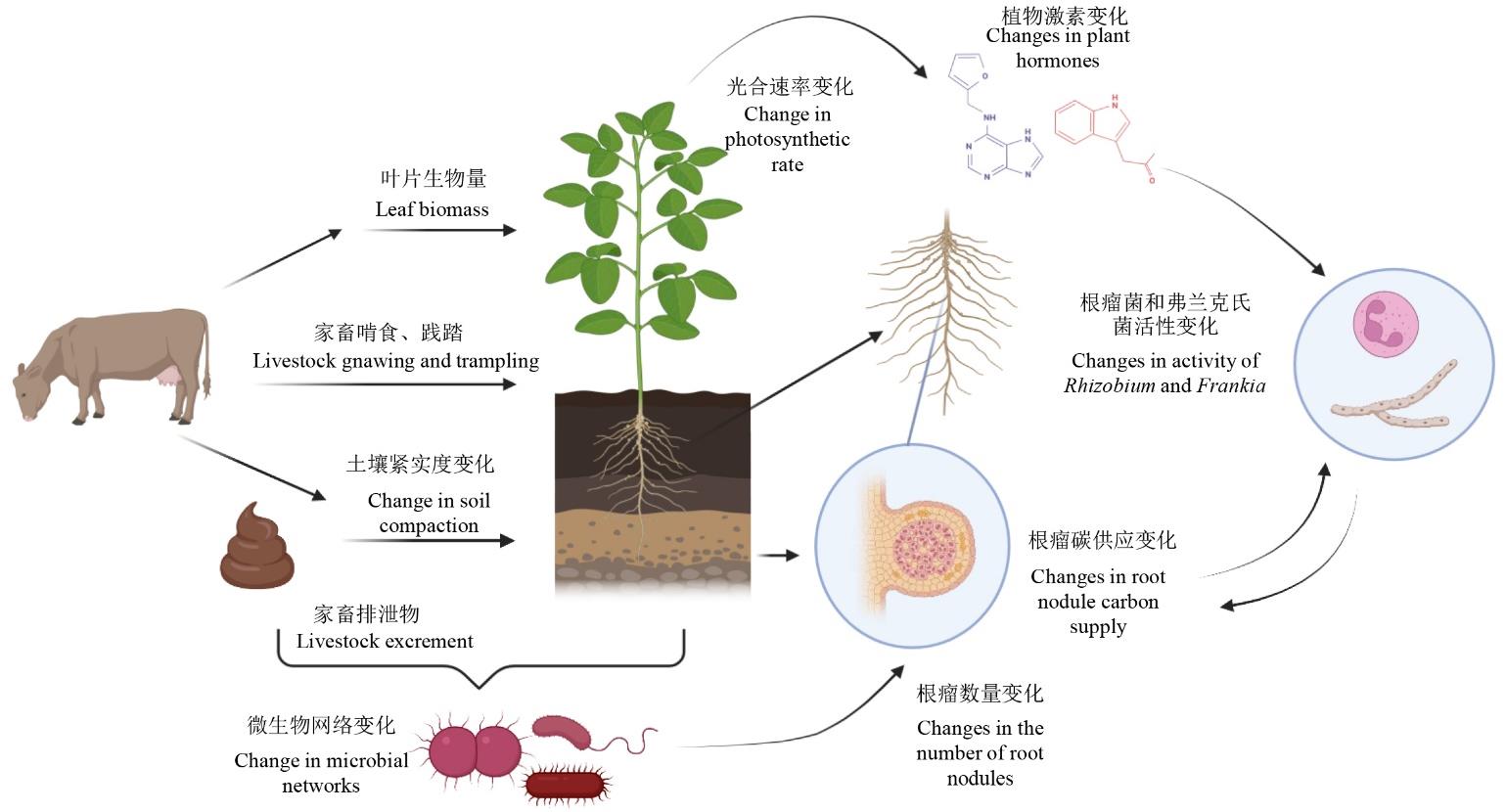
图1 放牧对植物-微生物共生固氮系统的作用路径框架家畜啃食、践踏等改变植物光合及土壤紧实度;家畜排泄物等改变微生物网络,进而影响根瘤菌等,改变共生固氮效率。Livestock gnawing and trampling alter plant photosynthesis and soil compaction, while livestock excrement modify microbial networks, thereby influencing rhizobia communities and ultimately modulating the efficiency of symbiotic nitrogen fixation.
Fig.1 Schematic diagram of the action pathway of grazing on the plant microbe symbiotic nitrogen fixation system
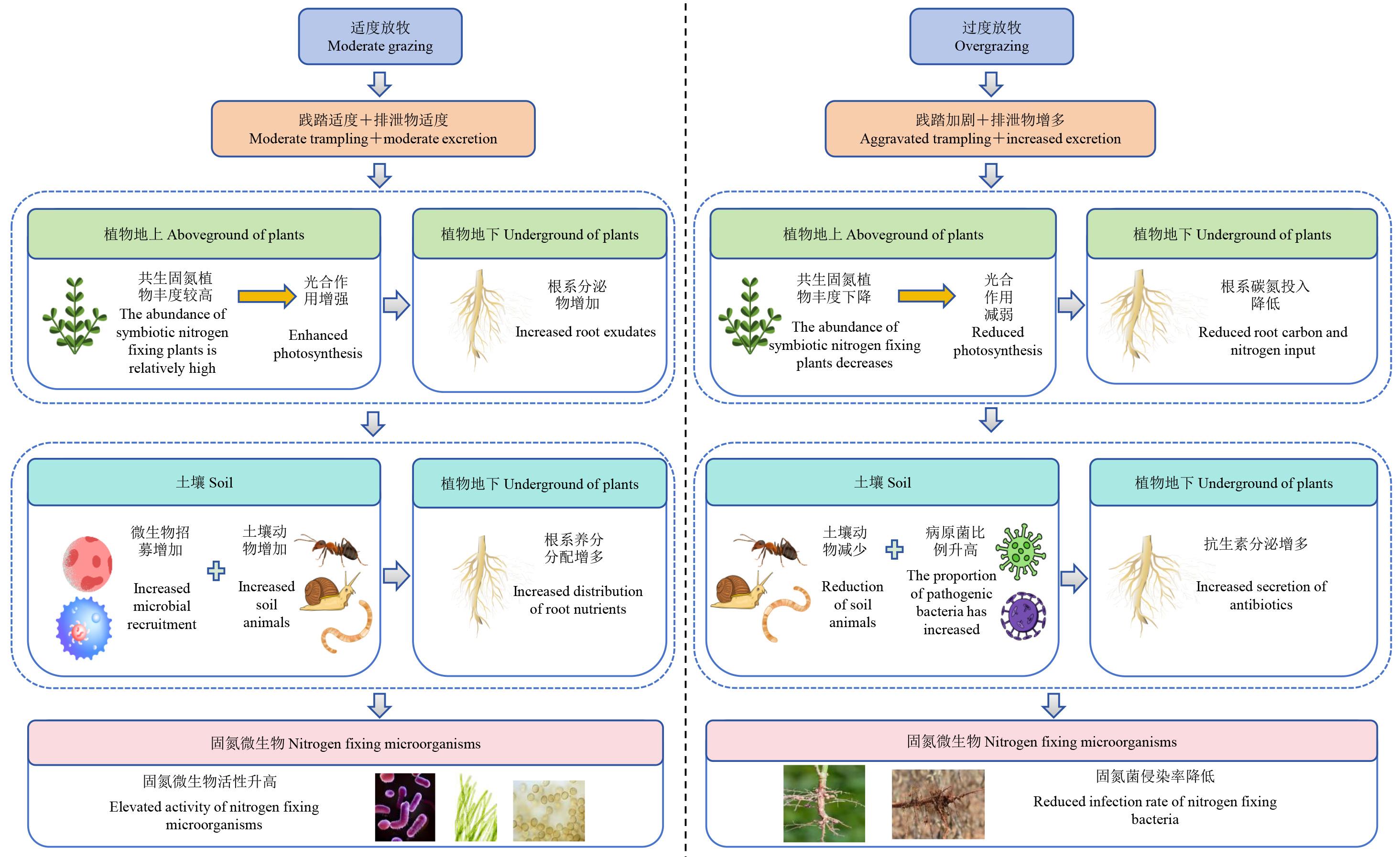
图2 放牧对植物共生固氮生物互作关系的影响
Fig.2 Effects of grazing on symbiotic nitrogen fixation as mediated by biotic interactions
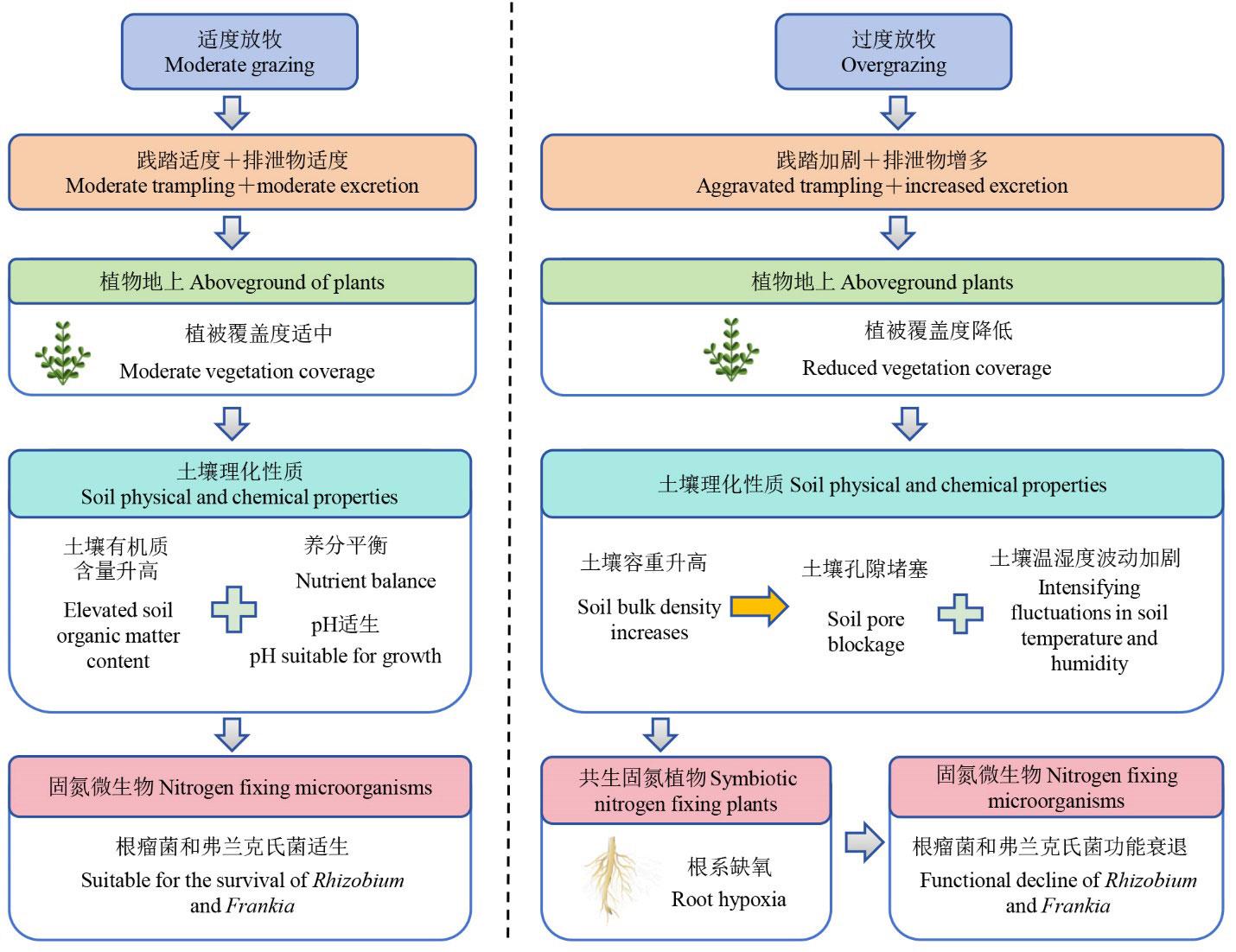
图3 放牧对植物共生固氮非生物因素的影响
Fig.3 Effects of grazing on abiotic factors influencing symbiotic nitrogen fixation
| [1] | Hu B, Wang W, Ou S J, et al. Variation in NRT1.1B contributes to nitrate-use divergence between rice subspecies. Nature Genetics, 2015, 47(7): 834-838. |
| [2] | González-Guerrero M, Navarro-Gómez C, Rosa-Núñez E, et al. Forging a symbiosis: transition metal delivery in symbiotic nitrogen fixation. New Phytologist, 2023, 239(6): 2113-2125. |
| [3] | Masson-Boivin C, Giraud E, Perret X, et al. Establishing nitrogen-fixing symbiosis with legumes: how many rhizobium recipes? Trends in Microbiology, 2009, 17(10): 458-466. |
| [4] | Gao Y Z, Ren J. Advances and prospects in plant root nodule symbiotic nitrogen fixation. Scientia Sinica(Vitae), 2025, 55(1): 131-145. |
| 高英志, 任健. 植物根瘤共生固氮研究进展与展望. 中国科学: 生命科学, 2025, 55(1): 131-145. | |
| [5] | Santi C, Bogusz D, Franche C. Biological nitrogen fixation in non-legume plants. Annals of Botany, 2013, 111(5): 743-767. |
| [6] | Carvalho L R, Pereira L E T, Hungria M, et al. Nodulation and biological nitrogen fixation (BNF) in forage peanut (Arachis pintoi) cv. Belmonte subjected to grazing regimes. Agriculture, Ecosystems & Environment, 2019, 278: 96-106. |
| [7] | Zhao T, Iwaasa A D. Rotational grazing increases purple prairie clover frequency in the rangeland plant communities under semi-arid environment. Canadian Journal of Plant Science, 2022, 102(3): 600-607. |
| [8] | Cao F F, Li W B, Jiang Y, et al. Effects of grazing on grassland biomass and biodiversity: A global synthesis. Field Crops Research, 2024, 306: 109204. |
| [9] | Yang H, Song J C, Hou Q Q, et al. Response of soil microbial α-diversity to grazing in grassland ecosystems: A meta-analysis. Land Degradation & Development, 2024, 35(2): 608-621. |
| [10] | Martin M L, Pervent M, Lambert I, et al. Localized osmotic stress activates systemic responses to N limitation in Medicago truncatula-Sinorhizobium symbiotic plants. Frontiers in Plant Science, 2023, 14(20): 1288070. |
| [11] | Zhou J, Ding Y, Tian Y Q, et al. Exploring grazing intensity effects: nitrogen uptake in grassland species and soil carbon allocation. Plant and Soil, 2024, 504(1): 833-846. |
| [12] | Zhao M, Zhao K, Wang Y B, et al. Long-term grazing disturbance reduced plant diversity in Stipa breviflora desert steppe. Acta Prataculturae Sinica, 2023, 32(9): 39-49. |
| 赵敏, 赵坤, 王赟博, 等. 长期放牧干扰降低了短花针茅荒漠草原植物多样性. 草业学报, 2023, 32(9): 39-49. | |
| [13] | Foyer C H, Nguyen H, Lam H M. Legumes-The art and science of environmentally sustainable agriculture. Plant, Cell & Environment, 2019, 42(1): 1-5. |
| [14] | Mi W T, Ren W B, Chi Y, et al. Heavy grazing reduces the potential for grassland restoration: a global meta-analysis. Environmental Research Letters, 2024, 19(10): 103001. |
| [15] | Li M S, Gao L, White J C, et al. Nano-enabled strategies to enhance biological nitrogen fixation. Nature Nanotechnology, 2023, 18(7): 688-691. |
| [16] | Ongaro A F B, Martuscello J A, Gimenes F M de A, et al. Canopy height impact on legume mass and Megathyrsus maximus tiller dynamics in mixed pastures. Acta Agriculturae Scandinavica, Section B-Soil & Plant Science, 2023, 73(1): 114-126. |
| [17] | Du C J, Zhou G Y, Gao Y H. Grazing exclusion alters carbon flux of alpine meadow in the Tibetan Plateau. Agricultural and Forest Meteorology, 2022, 314(1): 108774. |
| [18] | Gavrichkova O, Pretto G, Brugnoli E, et al. Consequences of grazing cessation for soil environment and vegetation in a subalpine grassland ecosystem. Plants, 2022, 11(16): 2121. |
| [19] | Ren M X, Ai J M, Zhang R L, et al. Research progress in mechanism and influencing factors of root nodule senescence in leguminous plants. Acta Microbiologica Sinica, 2024, 64(12): 4701-4726. |
| 任明霞, 艾加敏, 张瑞丽, 等. 豆科植物根瘤衰老机制与影响因素研究进展. 微生物学报, 2024, 64(12): 4701-4726. | |
| [20] | An H. Effect of grazing on morphological plasticity and biomass allocation of dominant species in desert steppe. Journal of Arid Land Resources and Environment, 2014, 28(11): 116-121. |
| 安慧. 放牧干扰对荒漠草原优势植物形态可塑性及生物量分配的影响. 干旱区资源与环境, 2014, 28(11): 116-121. | |
| [21] | Wang J, Xu M X, Sun H, et al. Effects of grazing on community characteristics of Robinia pseudoacacia forest in the hilly loess plateau region of northern Shaanxi Province. Acta Agrestia Sinica, 2023, 31(6): 1826-1833. |
| 王菊, 许明祥, 孙会, 等. 放牧对陕北黄土丘陵区刺槐林群落特征的影响. 草地学报, 2023, 31(6): 1826-1833. | |
| [22] | Mantovani D, Veste M, Boldt-Burisch K, et al. Carbon allocation, nodulation, and biological nitrogen fixation of black locust (Robinia pseudoacacia L.) under soil water limitation. Annals of Forest Research, 2015, 58(2): 259-274. |
| [23] | Li P, Bai X M, Chen X, et al. Ecological stoichiometry characteristics and nutrition strategy of Trifolium repens at different invasion degrees. Chinese Journal of Grassland, 2024, 46(12): 33-43. |
| 李萍, 白小明, 陈鑫, 等. 不同入侵程度白三叶的化学计量特征及其营养策略. 中国草地学报, 2024, 46(12): 33-43. | |
| [24] | Luo Z P, Xie F. Mechanism of nitrate regulating symbiotic nitrogen fixation between legumes and Rhizobium. Biotechnology Bulletin, 2019, 35(10): 34-39. |
| 罗振鹏, 谢芳. 硝酸盐调控豆科植物与根瘤菌共生固氮的机制研究. 生物技术通报, 2019, 35(10): 34-39. | |
| [25] | Lu Y D, Feng J, Shao Z, et al. Responses of plant communities, species composition, and diversity to mowing and long-term grazing in the Songnen meadow steppe. Pratacultural Science, 2024, 41(2): 271-283. |
| 卢彦达, 丰吉, 邵泽, 等. 松嫩草甸草原植物群落物种组成和多样性对刈割和长期放牧的响应. 草业科学, 2024, 41(2): 271-283. | |
| [26] | Qiao Y, Yang D, Zhang S B, et al. Nitrogen-fixing and non-nitrogen-fixing legume plants differ in leaf nutrient concentrations and relationships between photosynthetic and hydraulic traits. Tree Physiology, 2024, 44(5): tpae048. |
| [27] | Herrero‐Jáuregui C, Oesterheld M. Effects of grazing intensity on plant richness and diversity: A meta-analysis. Oikos, 2018, 127(6): 757-766. |
| [28] | Gao L, Zhang S W, Zhu Z Y, et al. Effects of grazing on plant communities and ecological functions in typical steppe. Research of Soil and Water Conservation, 2019, 26(6): 205-211. |
| 高露, 张圣微, 朱仲元, 等. 放牧对干旱半干旱草原植物群落结构和生态功能的影响. 水土保持研究, 2019, 26(6): 205-211. | |
| [29] | Radutoiu S, Madsen L H, Madsen E B, et al. Plant recognition of symbiotic bacteria requires two LysM receptor-like kinases. Nature, 2003, 425(6958): 585-592. |
| [30] | Limpens E, Franken C, Smit P, et al. LysM domain receptor kinases regulatingrhizobial nod factor-induced infection. Science, 2003(302): 630-633. |
| [31] | Lillo C, Lea U S, Ruoff P. Nutrient depletion as a key factor for manipulating gene expression and product formation in different branches of the flavonoid pathway. Plant, Cell & Environment, 2008, 31(5): 587-601. |
| [32] | Sharp J M, Edwards G R, Jeger M J. Impact of the spatial scale of grass-legume mixtures on sheep grazing behaviour, preference and intake, and subsequent effects on pasture. Animal, 2012, 6(11): 1848-1856. |
| [33] | Zhou X, Tian L, Zhang J F, et al. Rhizospheric fungi and their link with the nitrogen-fixing Frankia harbored in host plant Hippophae rhamnoides L. Journal of Basic Microbiology, 2017, 57(12): 1055-1064. |
| [34] | Tsurugi-Sakurada A, Kaneko T, Takemoto K, et al. Cyclic diarylheptanoids as potential signal compounds during actinorhizal symbiosis between Alnus sieboldiana and Frankia. Fitoterapia, 2022, 162: 105284. |
| [35] | Yang J, Liu C W, Li X, et al. Advances in the legume-rhizobia symbiosis. Plant Physiology Journal, 2023, 59(8): 1407-1435. |
| 杨军, 刘承武, 李霞, 等. 豆科植物-微生物共生固氮研究进展. 植物生理学报, 2023, 59(8): 1407-1435. | |
| [36] | Quilbé J, Lamy L, Brottier L, et al. Genetics of nodulation in Aeschynomene evenia uncovers mechanisms of the Rhizobium-legume symbiosis. Nature Communications, 2021, 12(1): 829. |
| [37] | Cao J J, Jiao Y M, Che R X, et al. The effects of grazer exclosure duration on soil microbial communities on the Qinghai-Tibetan Plateau. Science of the Total Environment, 2022, 15(839): 156238. |
| [38] | Sun C C, Dong Q M, Liu W T, et al. Effects of grazing modes on the community structure and diversity of soil arthropod in an alpine meadow on the Qinghai-Tibetan Plateau. Acta Prataculturae Sinica, 2022, 31(2): 62-75. |
| 孙彩彩, 董全民, 刘文亭, 等. 放牧方式对青藏高原高寒草地土壤节肢动物群落结构和多样性的影响. 草业学报, 2022, 31(2): 62-75. | |
| [39] | De H S, Zhao B Y N M L, Hong M, et al. Research progress on soil faunal community of grassland ecosystems in China: A review. Chinese Journal of Grassland, 2025, 47(3): 136-143. |
| 德海山, 赵巴音那木拉, 红梅, 等. 我国草原生态系统土壤动物群落特征研究进展. 中国草地学报, 2025, 47(3): 136-143. | |
| [40] | Teng Y L, Li W M, Wang D S, et al. Effects of adding basalt powder on organic carbon sequestration in red and yellow-brown soils under earthworm inoculation. Chinese Journal of Applied Ecology, 2025, 36(4): 1003-1012. |
| 滕雅琳, 李伟明, 王东升, 等. 接种蚯蚓条件下施用玄武岩粉对红壤和黄棕壤有机碳的影响. 应用生态学报, 2025, 36(4): 1003-1012. | |
| [41] | Liu R T. Ecological function of ants and its implication for ecological restoration of semiarid and arid ecosystems. Journal of Desert Research, 2024, 44(3): 213-221. |
| 刘任涛. 干旱半干旱区蚂蚁的生态功能综述. 中国沙漠, 2024, 44(3): 213-221. | |
| [42] | Whitford W G, Ginzburg O, Berg N, et al. Do long-lived ants affect soil microbial communities? Biology and Fertility of Soils, 2012, 48(2): 227-233. |
| [43] | Lai L, Kumar S. A global meta-analysis of livestock grazing impacts on soil properties. PLoS One, 2020, 15(8): e0236638. |
| [44] | Neilly H, Schwarzkopf L. Heavy livestock grazing negatively impacts a marsupial ecosystem engineer. Journal of Zoology, 2018, 305(1): 35-42. |
| [45] | Mipam T D, Jiang A, Jing L, et al. Divergent effects of grazing intensity on soil nutrient fractions in alpine meadows. Land Degradation & Development, 2024, 35(17): 5192-5199. |
| [46] | Yin J J, Guo H Q, Fry E L, et al. Plant roots send metabolic signals to microbes in response to long-term overgrazing. Science of the Total Environment, 2022, 10(842): 156241. |
| [47] | Gilmullina A, Rumpel C, Blagodatskaya E, et al. Management of grasslands by mowing versus grazing-impacts on soil organic matter quality and microbial functioning. Applied Soil Ecology, 2020, 1(156): 103701. |
| [48] | Wang H, Huang C L, Yang F S, et al. Root habitat flexibility of seabuckthorn in the Pisha sandstone area. Chinese Journal of Applied Ecology, 2019, 30(1): 157-164. |
| 王浩, 黄晨璐, 杨方社, 等. 砒砂岩区沙棘根系的生境适应性. 应用生态学报, 2019, 30(1): 157-164. | |
| [49] | Velandia K, Reid J B, Foo E. Right time, right place: The dynamic role of hormones in rhizobial infection and nodulation of legumes. Plant Communications, 2022, 3(5): 100327. |
| [50] | Ngom M, Gray K, Diagne N, et al. Symbiotic performance of diverse Frankia strains on salt-stressed Casuarina glauca and Casuarina equisetifolia plants. Frontiers in Plant Science, 2016, 7: 1331. |
| [51] | Narsing R M P, Lohmaneeratana K, Bunyoo C, et al. Actinobacteria-plant interactions in alleviating abiotic stress. Plants, 2022, 11(21): 2976. |
| [52] | Sun Z G, Yi M X, Liu X B, et al. Synergism between water management and phosphorus supply enhances the nodulation and root growth and development of Chinese milk vetch (Astragalus sinicus L.). Frontiers in Plant Science, 2022, 3(12): 784251. |
| [53] | Safronova V, Sazanova A, Belimov A, et al. Synergy between rhizobial co-microsymbionts leads to an increase in the efficiency of plant-microbe interactions. Microorganisms, 2023, 11(5): 1206. |
| [54] | Holland B L, Matthews M L, Bota P, et al. A genome-scale metabolic reconstruction of soybean and Bradyrhizobium diazoefficiens reveals the cost-benefit of nitrogen fixation. New Phytologist, 2023, 240(2): 744-756. |
| [55] | Svensk M, Pittarello M, Mariotte P, et al. Nitrogen translocation by highland cattle grazing in Alnus viridis-encroached pastures. Nutrient Cycling in Agroecosystems, 2023, 126(1): 127-141. |
| [56] | Kirova E, Kocheva K. Physiological effects of salinity on nitrogen fixation in legumes-a review. Journal of Plant Nutrition, 2021, 44(17): 2653-2662. |
| [57] | Zhang X M, Wang L, Lin M Z, et al. On the root system and function of sea buckthorn Ⅱ-Infection and nodulation by Frankia bacteria. Seabuckthorn Hippophae, 2006, 19(1): 1-11. |
| 张小民, 王岚, 林美珍, 等. 论沙棘根系与功能Ⅱ——Frankia菌侵染和结瘤. 沙棘, 2006, 19(1): 1-11. | |
| [58] | Chen W H, Li J, Yuan H W, et al. Plant growth regulators improve nitrogen metabolism, yield, and quality of soybean-rhizobia symbiosis. Annals of Microbiology, 2023, 73(1): 15. |
| [59] | Ghodhbane-Gtari F, D’Angelo T, Gueddou A, et al. Alone yet not alone: Frankia lives under the same roof with other bacteria in actinorhizal nodules. Frontiers in Microbiology, 2021, 12: 749760. |
| [60] | Ngom M, Oshone R, Diagne N, et al. Tolerance to environmental stress by the nitrogen-fixing actinobacterium Frankia and its role in actinorhizal plants adaptation. Symbiosis, 2016, 70: 17-29. |
| [61] | Baligar V C, Elson M K, He Z, et al. Light intensity effects on the growth, physiological and nutritional parameters of tropical perennial legume cover crops. Agronomy, 2020, 10(10): 1515. |
| [62] | Taylor B N, Menge D N. Light regulates tropical symbiotic nitrogen fixation more strongly than soil nitrogen. Nature Plants, 2018, 4(9): 655-661. |
| [63] | Valladares F, Niinemets Ü. Shade tolerance, a key plant feature of complex nature and consequences. Annual Review of Ecology, Evolution, and Systematics, 2008, 39(1): 237-257. |
| [64] | Ribeiro A, Graça I, Pawlowski K, et al. Actinorhizal plant defence-related genes in response to symbiotic Frankia. Functional Plant Biology, 2011, 38(9): 639-644. |
| [65] | Xu X M, Jiang J C, Niu X, et al. Evaluation of forage-livestock balance implementation via remote sensing inversion: A case study in Shandan County, Gansu Province. Acta Prataculturae Sinica, 2025, 34(4): 1-15. |
| 许雪梅, 姜佳昌, 牛欣, 等. 基于遥感反演的草畜平衡实施效果评估方法探讨——以山丹县为例. 草业学报, 2025, 34(4): 1-15. | |
| [66] | Zhang W, Li J, Struik P C, et al. Recovery through proper grazing exclusion promotes the carbon cycle and increases carbon sequestration in semiarid steppe. Science of the Total Environment, 2023, 20(892): 164423. |
| [67] | Venter Z S, Cramer M D, Hawkins H J. Rotational grazing management has little effect on remotely-sensed vegetation characteristics across farm fence-line contrasts. Agriculture, Ecosystems & Environment, 2019, 282: 40-48. |
| [68] | Liu Y J, Guo Z F, Shi H F. Rhizobium symbiosis leads to increased drought tolerance in Chinese milk vetch (Astragalus sinicus L.). Agronomy, 2022, 12(3): 725. |
| [69] | Yan J C, Li Y R, Chen R R, et al. Advances on plant endophytic actinomycetes. Biotic Resources, 2020, 42(1): 9-21. |
| 严佳成, 李艳如, 陈让让, 等. 植物内生放线菌研究进展. 生物资源, 2020, 42(1): 9-21. | |
| [70] | Zhang Y W, Peng Z C, Chang S H, et al. Growing season grazing promotes the shallow stratification of soil nutrients while non-growing season grazing sequesters the deep soil nutrients in a typical alpine meadow. Geoderma, 2022, 426: 116111. |
| [71] | Yang F, Wei B, Wang Y, et al. Response of yield, quality and root characteristics of alfalfa to cutting height. Acta Agrestia Sinica, 2022, 30(6): 1597-1602. |
| 杨帆, 韦宝, 王瑜, 等. 紫花苜蓿产量、品质和根系对刈割高度的响应. 草地学报, 2022, 30(6): 1597-1602. | |
| [72] | Liu K H, Yang S H, Huang Q Y, et al. Isolation and application of soybean rhizobia and symbiosis-promoting rhizobacteria from Heilongjiang Province. Biotechnology Bulletin, 2025, 41(1): 252-262. |
| 刘克寒, 杨升辉, 黄巧云, 等. 黑龙江大豆根瘤菌及根际促共生菌株的筛选及应用. 生物技术通报, 2025, 41(1): 252-262. | |
| [73] | Iturralde E T, Covelli J M, Alvarez F, et al. Soybean-nodulating strains with low intrinsic competitiveness for nodulation, good symbiotic performance, and stress-tolerance isolated from soybean-cropped soils in Argentina. Frontiers in Microbiology, 2019, 10: 1061. |
| [74] | Huang X R, Zhang C W, Zhang X X. The role of Rhizobium in remediation of contaminated soils. Soil and Fertilizer Sciences in China, 2016(5): 5-10. |
| 黄兴如, 张彩文, 张晓霞. 根瘤菌在污染土壤修复中的地位和作用. 中国土壤与肥料, 2016(5): 5-10. | |
| [75] | Luo F, Mi W, Liu W. Legume-grass mixtures improve biological nitrogen fixation and nitrogen transfer by promoting nodulation and altering root conformation in different ecological regions of the Qinghai-Tibet Plateau. Frontiers in Plant Science, 2024, 15: 1375166. |
| [76] | Kim J J, Ale S, Kreuter U P, et al. Evaluating the impacts of alternative grazing management practices on soil carbon sequestration and soil health indicators. Agriculture, Ecosystems & Environment, 2023, 342: 108234. |
| [77] | Deng L, Shangguan Z P, Bell S M, et al. Carbon in Chinese grasslands: meta-analysis and theory of grazing effects. Carbon Research, 2023, 2(1): 19. |
| [78] | Baker D, Huss-Danell K. Effects of oxygen and chloramphenicol on Frankia nitrogenase activity. Archives of Microbiology, 1986, 144(3): 233-236. |
| [1] | 冯斌, 杨晓霞, 刘玉祯, 刘文亭, 吕卫东, 张艳芬, 董全民. 不同放牧方式对高寒草地物种多样性、生态位与种间联结性的影响[J]. 草业学报, 2025, 34(8): 1-14. |
| [2] | 徐倩, 郭帅, 张亮亮, 王占军, 辛国省. 补饲对放牧滩羊生长性能、血清生化及代谢组的影响[J]. 草业学报, 2025, 34(6): 122-138. |
| [3] | 侯文璐, 康文娟, 陆保福, 韩宜霖, 关键, 王晶晶. 不同共生效应根瘤菌株对紫花苜蓿光合特性和呼吸代谢的影响[J]. 草业学报, 2025, 34(11): 66-80. |
| [4] | 柯丹霞, 侯仕博, 周兆源, 马云浩, 陈志杰, 宋晓莉, 林佳诺. 大豆GmPP2C28基因对百脉根结瘤固氮的功能研究[J]. 草业学报, 2025, 34(10): 164-173. |
| [5] | 张振豪, 贾子玉, 李鑫宇, 程云湘. 荒漠草原混牧牛羊的放牧行为特征[J]. 草业学报, 2025, 34(1): 226-237. |
| [6] | 杨得玉, 黄文植, 冯宇哲, 薛斌, 张晓卫, 崔占鸿. 暖季补饲矿物质盐砖对放牧牦牛生长性能、瘤胃发酵、血液和被毛矿物质含量的影响[J]. 草业学报, 2024, 33(7): 105-118. |
| [7] | 姜海鑫, 周瑶, 胡科, 丁占胜, 马红彬. 不同放牧时间对荒漠草原土壤颗粒组成及分形维数的影响[J]. 草业学报, 2024, 33(6): 17-28. |
| [8] | 于泽航, 俞旸, 曹铨, 刘玉祯, 冯斌, 张小芳, 董全民. 不同放牧管理下祁连山区冬季牧场植被-土壤协同耦合效应评价[J]. 草业学报, 2024, 33(12): 1-12. |
| [9] | 赵敏, 赵坤, 王赟博, 殷国梅, 刘思博, 闫宝龙, 孟卫军, 吕世杰, 韩国栋. 长期放牧干扰降低了短花针茅荒漠草原植物多样性[J]. 草业学报, 2023, 32(9): 39-49. |
| [10] | 刘继亮, 赵文智, 王永珍, 冯怡琳, 祁进贤, 李永元. 禁牧和放牧对祁连山高寒草原秋季大型和中型土壤节肢动物多样性的影响[J]. 草业学报, 2023, 32(8): 214-221. |
| [11] | 刘欣雷, 杜鹤强, 刘秀帆, 范亚伟. 内蒙古荒漠草原地表风沙活动对放牧强度的响应[J]. 草业学报, 2023, 32(7): 1-11. |
| [12] | 江奥, 敬路淮, 泽让东科, 田黎明. 放牧影响草地凋落物分解研究进展[J]. 草业学报, 2023, 32(4): 208-220. |
| [13] | 彭超, 李自健, 王虎成, 冯强, 沈禹颖. 黄土高原丘陵沟壑区放牧补饲和舍饲肉羊的屠宰与肉质性能比较研究[J]. 草业学报, 2023, 32(2): 140-147. |
| [14] | 李紫晶, 高翠萍, 王忠武, 韩国栋. 中国草地固碳减排研究现状及其建议[J]. 草业学报, 2023, 32(2): 191-200. |
| [15] | 冯斌, 杨晓霞, 刘文亭, 刘玉祯, 吕卫东, 张振祥, 孙彩彩, 周沁苑, 王芳草, 于泽航, 董全民. 暖季草场不同放牧方式对牦牛藏羊生产力的影响[J]. 草业学报, 2023, 32(12): 58-67. |
| 阅读次数 | ||||||
|
全文 |
|
|||||
|
摘要 |
|
|||||
