

ISSN 1004-5759 CN 62-1105/S
草业学报 ›› 2026, Vol. 35 ›› Issue (8): 144-156.DOI: 10.11686/cyxb2025345
• 研究论文 • 上一篇
刘进娣1,3( ), 陈仕勇2(), 李进1, 蒋涛2, 梁国玲1, 周青平2
收稿日期:2025-08-27
修回日期:2025-10-20
出版日期:2026-08-20
发布日期:2026-06-22
通讯作者:
陈仕勇
作者简介:Corresponding author. E-mail: chengshi8827@163.com基金资助:
Jin-di LIU1,3(), Shi-yong CHEN2(), Jin LI1, Tao JIANG2, Guo-ling LIANG1, Qing-ping ZHOU2
Received:2025-08-27
Revised:2025-10-20
Online:2026-08-20
Published:2026-06-22
Contact:
Shi-yong CHEN
摘要:
蔗糖转运蛋白(SUT)是高等植物体内蔗糖由源到库器官长距离转运的重要跨膜运输载体,在植物生长发育和抵抗逆境胁迫中具有重要作用。本研究利用生物信息学方法在燕麦全基因组中鉴定出9个AsSUTs基因家族成员,并对其理化性质、基因结构、染色体位置分布、系统进化、启动子元件及不同非生物胁迫下的表达模式进行分析。结果表明,AsSUTs编码氨基酸序列长度为490~687 aa,蛋白预测分子量(Mw)为52.51~73.45 kDa,理论等电点(pI)为6.13~9.72,分布在8条染色体上。启动子元件主要包括激素、生长发育及非生物胁迫响应。AsSUT成员的基因结构和蛋白结构具有高度保守性。通过表达模式分析得出,AsSUTs家族成员在干旱和碱胁迫下的表达水平普遍高于盐胁迫。在干旱胁迫下除AsSUT6,其他AsSUTs家族成员均表现出胁迫叶片中的表达量显著高于正常叶片;盐胁迫下AsSUT1、AsSUT4、AsSUT6均在受胁迫叶片中的表达量显著高于正常叶片;碱胁迫下除AsSUT7,其他AsSUTs家族成员均在受胁迫叶片中的表达量显著高于正常叶片。AsSUT1对不同的非生物胁迫表现出更强的响应,表明其可能在燕麦抵抗逆境胁迫中发挥重要作用,这为燕麦SUT家族及其响应环境胁迫进一步研究提供了理论依据。
刘进娣, 陈仕勇, 李进, 蒋涛, 梁国玲, 周青平. 燕麦蔗糖转运蛋白基因家族的鉴定及其对干旱和盐碱胁迫的响应[J]. 草业学报, 2026, 35(8): 144-156.
Jin-di LIU, Shi-yong CHEN, Jin LI, Tao JIANG, Guo-ling LIANG, Qing-ping ZHOU. Identification of the sucrose transporter gene family in oats and its response to drought and saline-alkali conditions[J]. Acta Prataculturae Sinica, 2026, 35(8): 144-156.
| 基因Gene | 正向引物Forward primer (5′-3′) | 反向引物Reverse primer (5′-3′) |
|---|---|---|
| AsSUT1 | GCCCAATTGCTGGCTTAGTG | CACCTCCTTGGCGAAGATCA |
| AsSUT2 | GCGCCATCATCGTCTACCTC | CCAGTCGGTGTCAAAGAGGA |
| AsSUT3 | TTGCTGGCCTAGTGGTTCAA | CCACTTGTGCCAGTTGTTTGT |
| AsSUT4 | TACTGTGCAAGGTCCAGCTC | AGGCCAGTTACAAGGAGCAC |
| AsSUT5 | TCATCGTCTACCTCATCGGC | CCCATCCAGTCGGTGTCAAA |
| AsSUT6 | CAGTACAAGGACCTGCTCGT | CTAAAACCGCTCCTGGTCCA |
| AsSUT7 | ATACCACTGAGCACTGCAGC | GAGACATTGTTTGTGTCCGCA |
| AsSUT8 | GACTCTAGGAATAGACCATGCCA | GACAGCCATCCATGAGCAGA |
| AsSUT9 | GATTCTGGCTCCTCGACGTC | CTCCCTCGGTAGATCTCCCG |
| AsFPGS | AGGACCGAGATTGTTCTTTA | AGAATCTTTCGAGATTTGCC |
表1 定量PCR引物
Table 1 Primers for RT-qPCR
| 基因Gene | 正向引物Forward primer (5′-3′) | 反向引物Reverse primer (5′-3′) |
|---|---|---|
| AsSUT1 | GCCCAATTGCTGGCTTAGTG | CACCTCCTTGGCGAAGATCA |
| AsSUT2 | GCGCCATCATCGTCTACCTC | CCAGTCGGTGTCAAAGAGGA |
| AsSUT3 | TTGCTGGCCTAGTGGTTCAA | CCACTTGTGCCAGTTGTTTGT |
| AsSUT4 | TACTGTGCAAGGTCCAGCTC | AGGCCAGTTACAAGGAGCAC |
| AsSUT5 | TCATCGTCTACCTCATCGGC | CCCATCCAGTCGGTGTCAAA |
| AsSUT6 | CAGTACAAGGACCTGCTCGT | CTAAAACCGCTCCTGGTCCA |
| AsSUT7 | ATACCACTGAGCACTGCAGC | GAGACATTGTTTGTGTCCGCA |
| AsSUT8 | GACTCTAGGAATAGACCATGCCA | GACAGCCATCCATGAGCAGA |
| AsSUT9 | GATTCTGGCTCCTCGACGTC | CTCCCTCGGTAGATCTCCCG |
| AsFPGS | AGGACCGAGATTGTTCTTTA | AGAATCTTTCGAGATTTGCC |
基因 Gene | 基因注释 Gene annotation (ID) | 外显子 Exons | 内含子 Introns | 生理特性Physiological properties | 等电点 pI | 亚细胞定位 Subcellular location | |
|---|---|---|---|---|---|---|---|
| 长度 Length (aa) | 分子量 Mw (Da) | ||||||
| AsSUT1 | AVESA.00001b.r3.1Dg0003257 | 1554 | 11 | 517 | 54824.20 | 8.68 | 质膜Plasma membrane |
| AsSUT2 | AVESA.00001b.r3.4Ag0000477 | 1794 | 4 | 597 | 63701.01 | 9.26 | 质膜Plasma membrane |
| AsSUT3 | AVESA.00001b.r3.4Ag0002269 | 1563 | 11 | 520 | 54981.37 | 8.67 | 质膜Plasma membrane |
| AsSUT4 | AVESA.00001b.r3.4Cg0001270 | 1473 | 11 | 490 | 52507.81 | 8.93 | 质膜Plasma membrane |
| AsSUT5 | AVESA.00001b.r3.4Dg0000827 | 1713 | 4 | 570 | 60921.90 | 8.90 | 质膜Plasma membrane |
| AsSUT6 | AVESA.00001b.r3.6Ag0002163 | 1833 | 14 | 610 | 65306.96 | 6.13 | 质膜Plasma membrane |
| AsSUT7 | AVESA.00001b.r3.6Cg0001159 | 1839 | 13 | 612 | 65052.66 | 6.49 | 质膜Plasma membrane |
| AsSUT8 | AVESA.00001b.r3.6Dg0001824 | 2064 | 13 | 687 | 73448.24 | 7.88 | 质膜Plasma membrane |
| AsSUT9 | AVESA.00001b.r3.7Cg0003044 | 1803 | 4 | 600 | 64428.00 | 9.72 | 质膜Plasma membrane |
表2 燕麦AsSUT基因家族的成员信息
Table 2 Information of oat AsSUT gene family members
基因 Gene | 基因注释 Gene annotation (ID) | 外显子 Exons | 内含子 Introns | 生理特性Physiological properties | 等电点 pI | 亚细胞定位 Subcellular location | |
|---|---|---|---|---|---|---|---|
| 长度 Length (aa) | 分子量 Mw (Da) | ||||||
| AsSUT1 | AVESA.00001b.r3.1Dg0003257 | 1554 | 11 | 517 | 54824.20 | 8.68 | 质膜Plasma membrane |
| AsSUT2 | AVESA.00001b.r3.4Ag0000477 | 1794 | 4 | 597 | 63701.01 | 9.26 | 质膜Plasma membrane |
| AsSUT3 | AVESA.00001b.r3.4Ag0002269 | 1563 | 11 | 520 | 54981.37 | 8.67 | 质膜Plasma membrane |
| AsSUT4 | AVESA.00001b.r3.4Cg0001270 | 1473 | 11 | 490 | 52507.81 | 8.93 | 质膜Plasma membrane |
| AsSUT5 | AVESA.00001b.r3.4Dg0000827 | 1713 | 4 | 570 | 60921.90 | 8.90 | 质膜Plasma membrane |
| AsSUT6 | AVESA.00001b.r3.6Ag0002163 | 1833 | 14 | 610 | 65306.96 | 6.13 | 质膜Plasma membrane |
| AsSUT7 | AVESA.00001b.r3.6Cg0001159 | 1839 | 13 | 612 | 65052.66 | 6.49 | 质膜Plasma membrane |
| AsSUT8 | AVESA.00001b.r3.6Dg0001824 | 2064 | 13 | 687 | 73448.24 | 7.88 | 质膜Plasma membrane |
| AsSUT9 | AVESA.00001b.r3.7Cg0003044 | 1803 | 4 | 600 | 64428.00 | 9.72 | 质膜Plasma membrane |
基因 Gene | α-螺旋 Alpha helix (Hh) | β转角 Beta turn (Tt) | 延伸链 Extended strand (Ee) | 无规则卷曲 Random coil (Cc) |
|---|---|---|---|---|
| AsSUT1 | 52.80 | 1.55 | 12.57 | 33.08 |
| AsSUT2 | 44.22 | 1.17 | 13.07 | 41.54 |
| AsSUT3 | 49.42 | 1.54 | 12.88 | 36.15 |
| AsSUT4 | 54.69 | 1.63 | 13.47 | 30.20 |
| AsSUT5 | 44.91 | 1.40 | 11.23 | 42.46 |
| AsSUT6 | 41.97 | 1.64 | 10.82 | 45.57 |
| AsSUT7 | 44.12 | 1.47 | 10.29 | 44.12 |
| AsSUT8 | 38.28 | 1.16 | 9.61 | 50.95 |
| AsSUT9 | 46.50 | 1.67 | 11.17 | 40.67 |
表3 燕麦AsSUT基因家族的蛋白质二级结构预测
Table 3 Prediction of secondary structure of oat AsSUT gene family proteins (%)
基因 Gene | α-螺旋 Alpha helix (Hh) | β转角 Beta turn (Tt) | 延伸链 Extended strand (Ee) | 无规则卷曲 Random coil (Cc) |
|---|---|---|---|---|
| AsSUT1 | 52.80 | 1.55 | 12.57 | 33.08 |
| AsSUT2 | 44.22 | 1.17 | 13.07 | 41.54 |
| AsSUT3 | 49.42 | 1.54 | 12.88 | 36.15 |
| AsSUT4 | 54.69 | 1.63 | 13.47 | 30.20 |
| AsSUT5 | 44.91 | 1.40 | 11.23 | 42.46 |
| AsSUT6 | 41.97 | 1.64 | 10.82 | 45.57 |
| AsSUT7 | 44.12 | 1.47 | 10.29 | 44.12 |
| AsSUT8 | 38.28 | 1.16 | 9.61 | 50.95 |
| AsSUT9 | 46.50 | 1.67 | 11.17 | 40.67 |
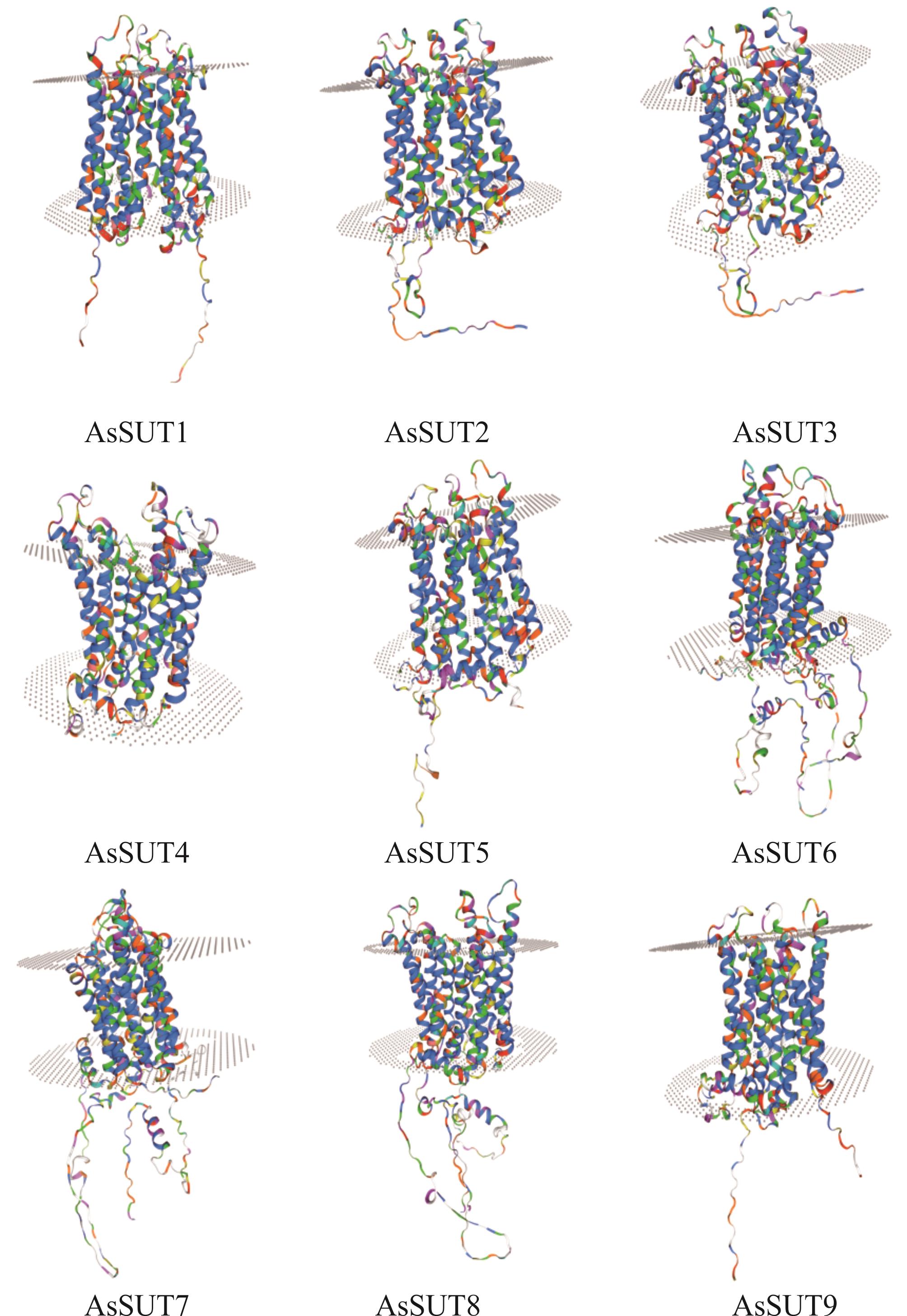
图1 燕麦AsSUT蛋白质的三级结构预测
Fig.1 Prediction of protein tertiary structure of oat AsSUT
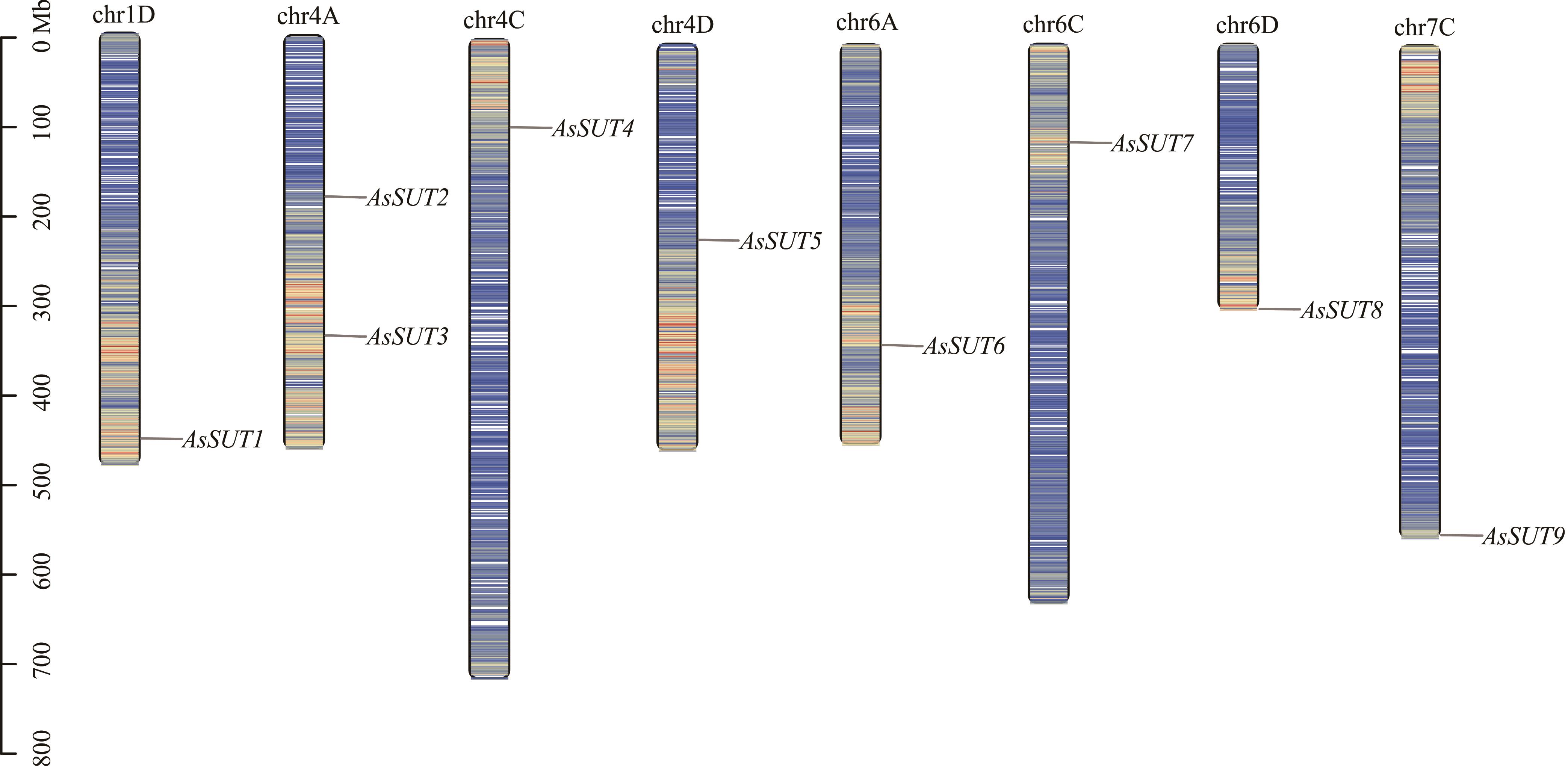
图2 燕麦AsSUT基因家族染色体分布chr为染色体,其后的数字为同源群编号,字母为祖先基因组来源chr is chromosome, the following number represents the homologous group, and the letter represents the ancestral genome of origin.
Fig.2 Chromosome distribution of oat AsSUT gene family
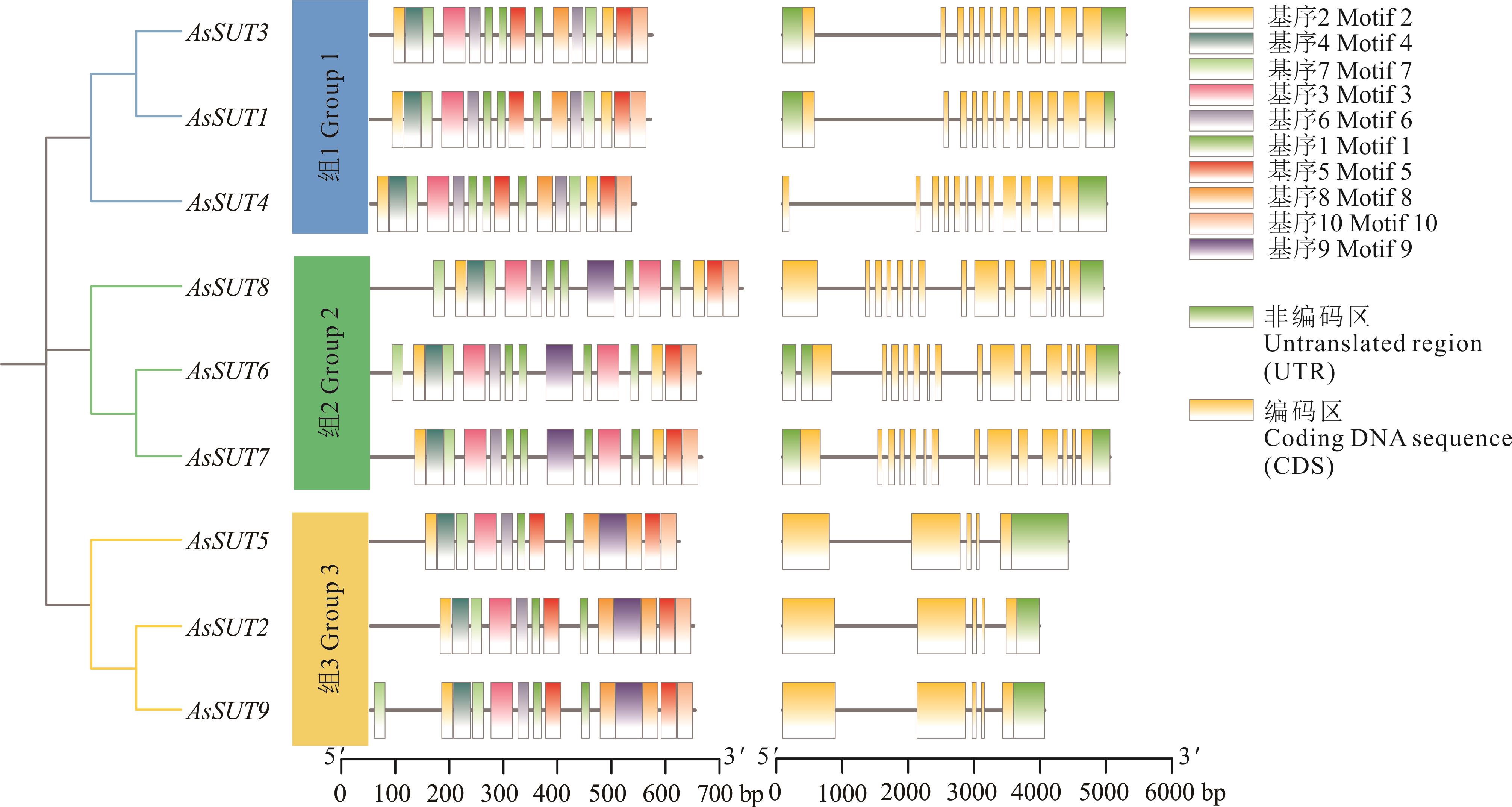
图3 燕麦AsSUT基因家族发育树、保守基序和基因结构分析
Fig.3 Phylogenetic tree, conserved motifs, and gene structure analysis of oat AsSUT gene family
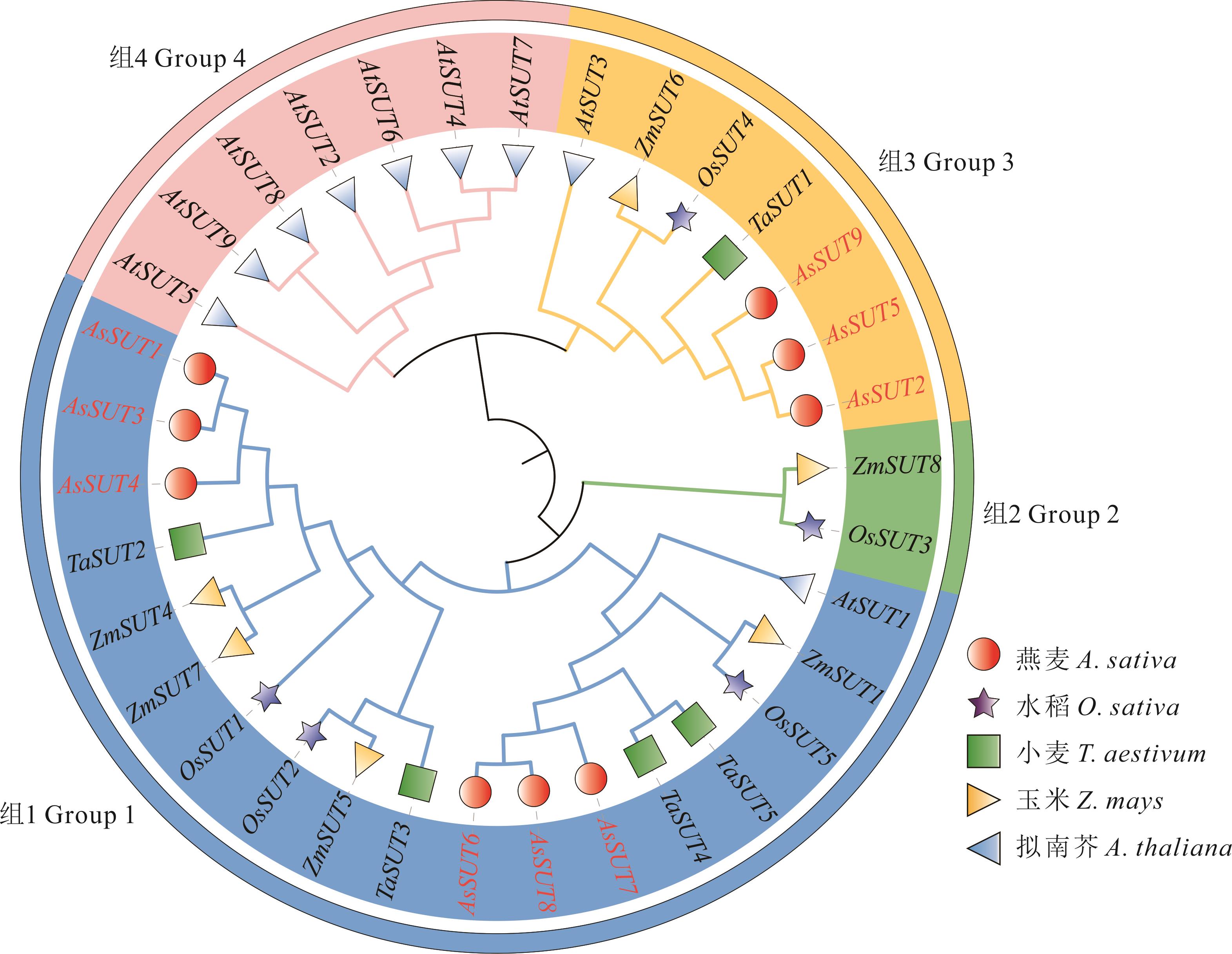
图4 SUT基因家族邻接法系统进化树
Fig.4 Neighbor-joining (NJ) phylogenetic tree of SUT gene family
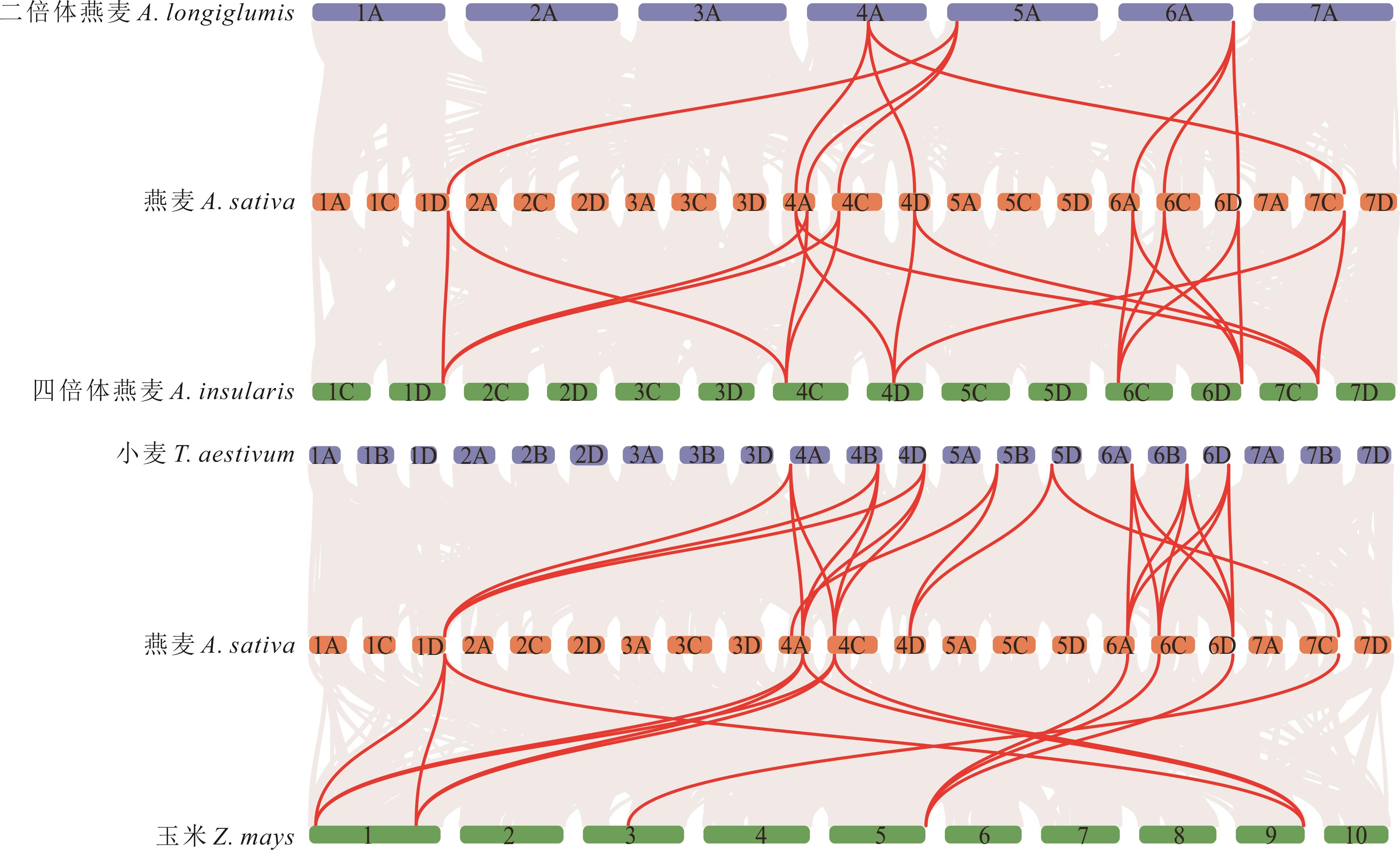
图5 多物种SUT基因家族种间共线性分析每个物种中数字代表染色体同源群编号,字母代表祖先基因组来源For each species, the number represents the homologous group, and the letter represents the ancestral genome from which it was derived.
Fig.5 Interspecies collinearity analysis of SUT gene families in multiple species
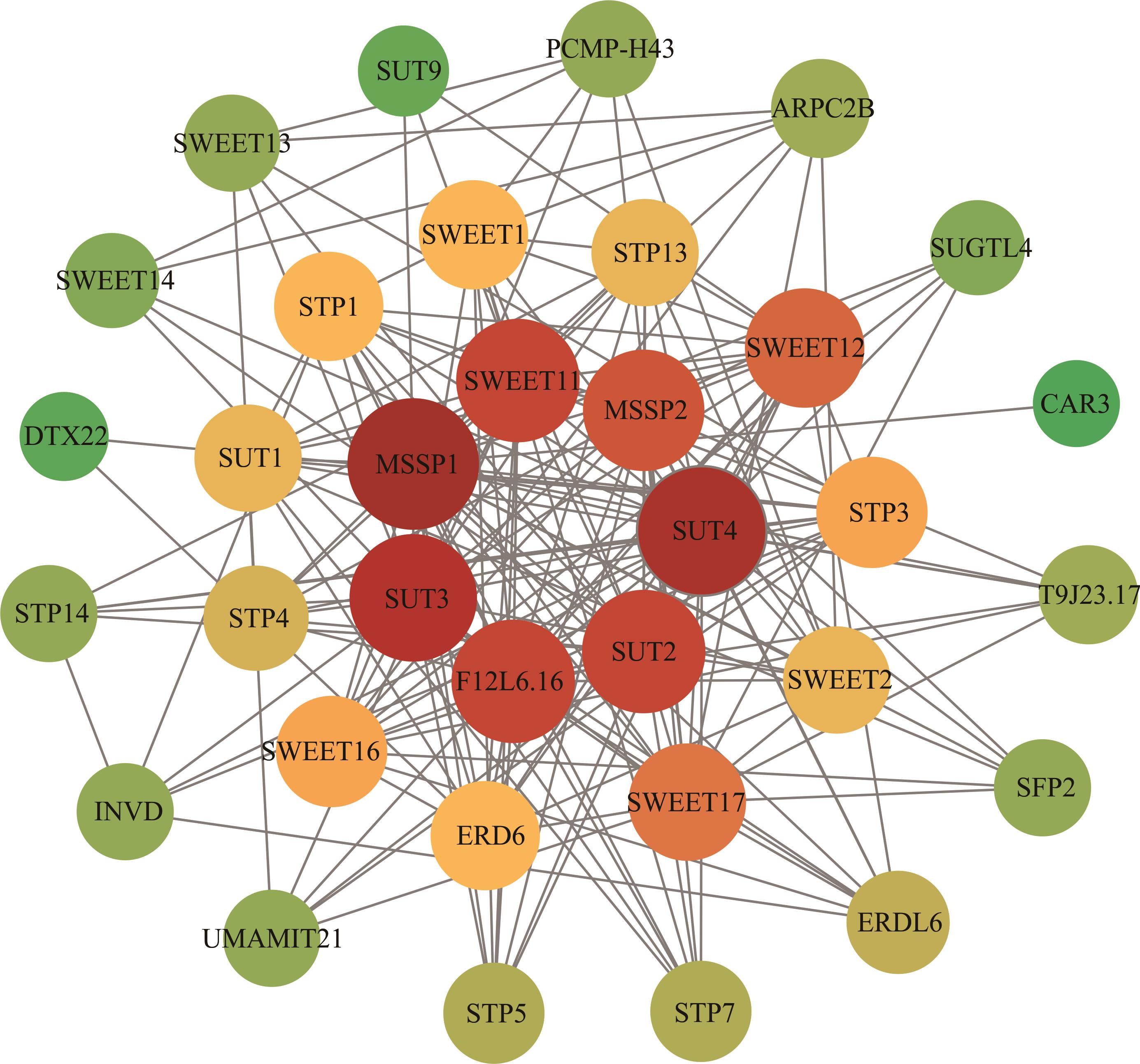
图6 燕麦AsSUT蛋白互作预测与分析SWEET: 糖外排转运蛋白Sugars will eventually be exported transporters; STP: 糖转运蛋白Sugar transporter protein; SUGTL4: 类糖转运蛋白Sugar transport protein; UMAMIT21: 氨基酸转运蛋白Usually multiple acids move in and out transporter; CAR3:C2结构域 ABA 相关蛋白 C2 domain ABA-related proteins; PCMP-H43: 植物组合模块蛋白Plant combinatorial and modular protein; MSSP: 单糖感应蛋白Maltose-signaling and sensor protein; ERD6: 脱水诱导早期应答蛋白Early responsive to dehydration protein; ERDL6: 脱水诱导早期应答同源蛋白Early responsive to dehydration-like; INVD: 糖基水解酶Glycosyl hydrolase; DTX22: 多药和有毒化合物外排转运蛋白Multidrug and toxic compound extrusion transporter protein; ARPC2B: 肌动蛋白相关蛋白Actin-related protein; SFP2: 蔗糖发酵刺激蛋白Sucrose fermentation stimulating protein; F12L6.16: 脱水响应元件结合蛋白Dehydration-responsive element binding protein; T9J23.17: 糖转运蛋白Sugar transporter protein.
Fig.6 Interaction prediction and analysis of oat AsSUT protein
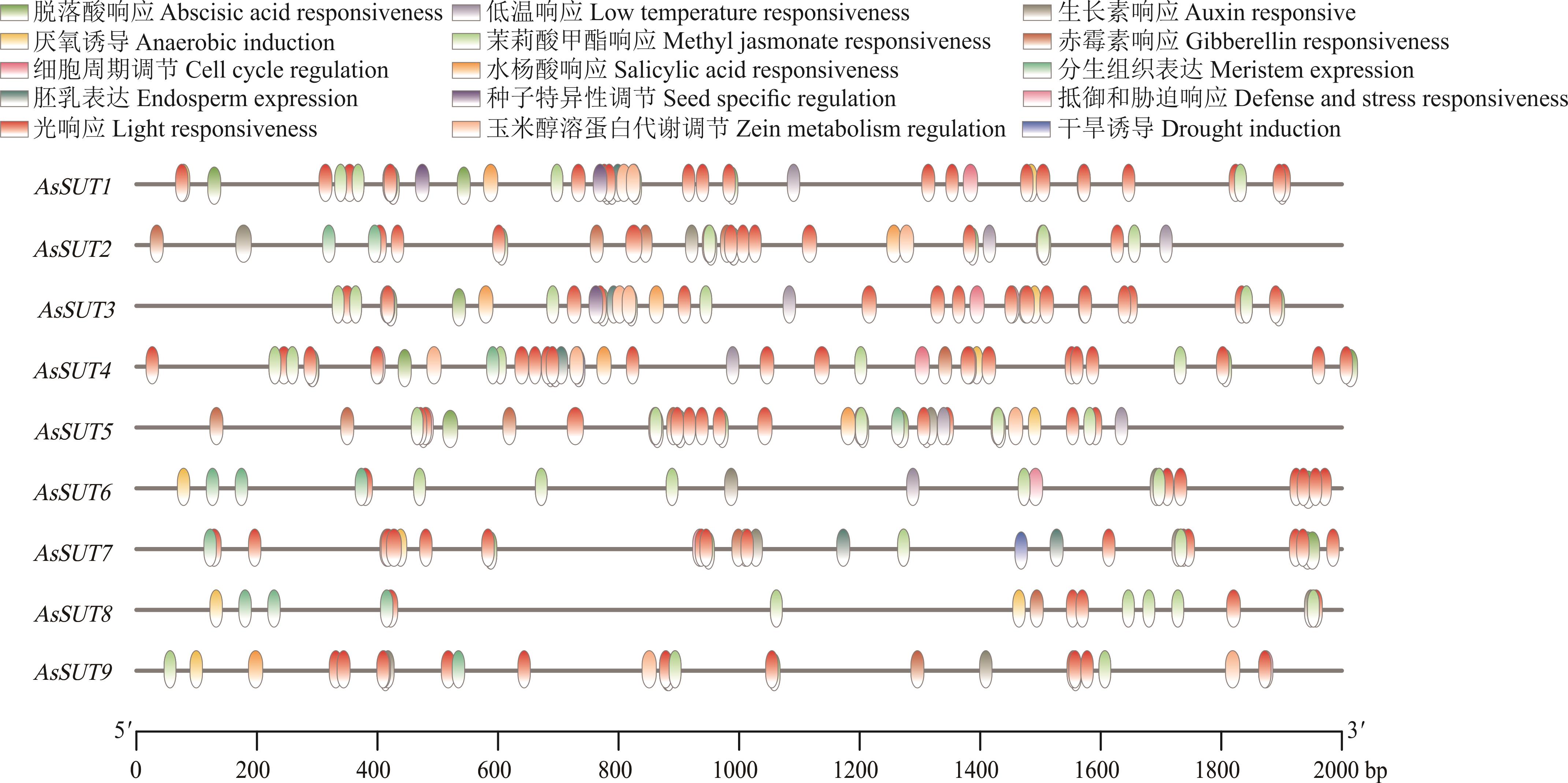
图7 燕麦AsSUT基因启动子区域顺式作用元件分析
Fig.7 Analysis of promoter region cis acting elements of oat AsSUT gene family
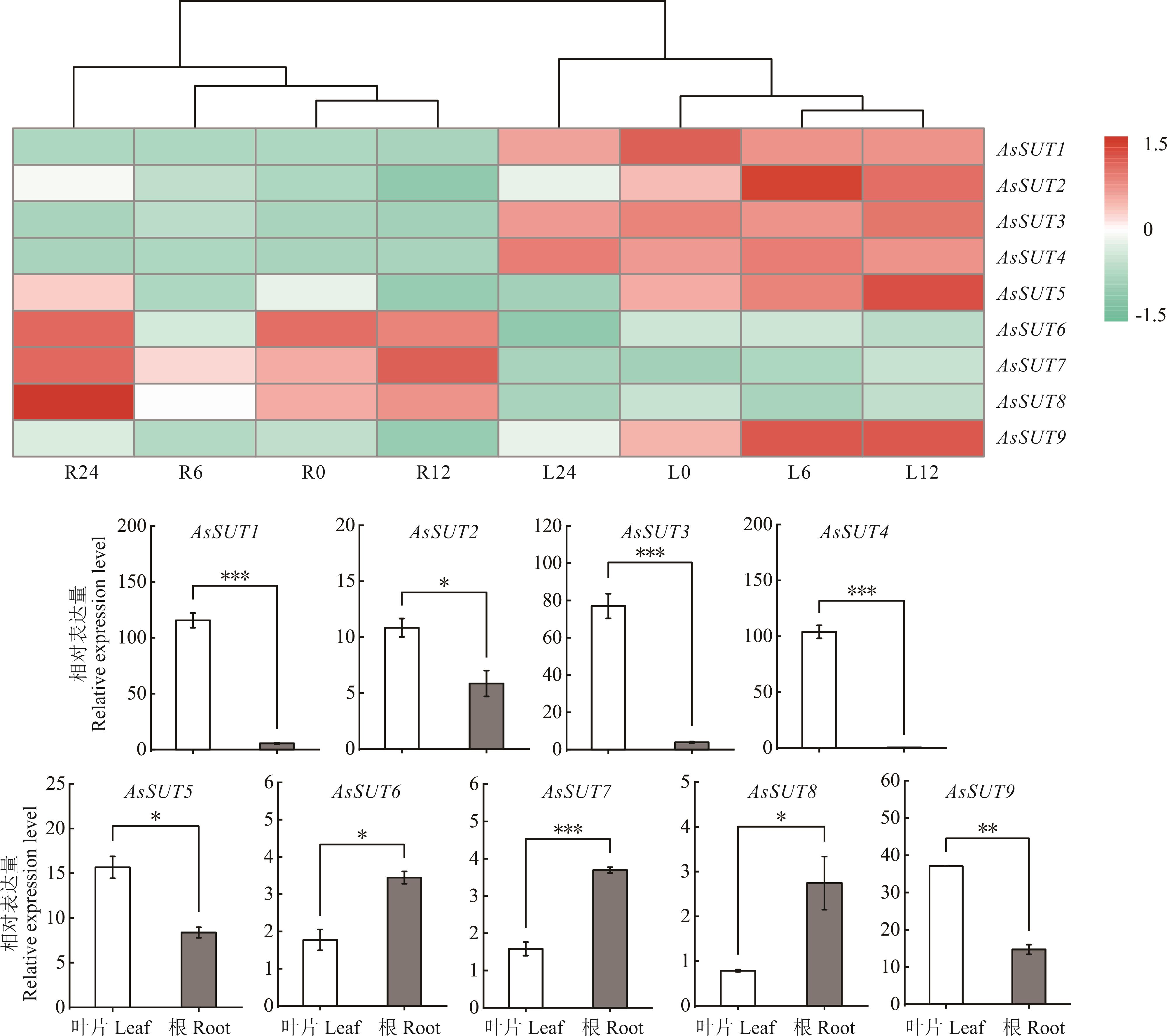
图8 燕麦AsSUT基因家族在不同组织的表达情况L: 叶片Leaf; R: 根Root; 0、6、12、24: 不同干旱胁迫时间(0、6、12和24 h) Different drought stress durations: 0, 6, 12, and 24 hours, respectively; *: P<0.05; **: P<0.01; ***: P<0.001.
Fig.8 Expression patterns of oat AsSUT gene family in various tissue

图9 燕麦叶片AsSUT在干旱、盐和碱胁迫下的相对表达情况小写字母表示同一胁迫处理下,CK及不同时间处理之间差异显著。Lowercase letters indicate significant differences among the CK and different time under the same stress treatment.
Fig.9 Relative expression of AsSUT in oat leavesunder drought, salt and alkali stresses
| [1] | Wang Y Z, Lv P, Chen Y, et al. Recent advances on the physiological functions and control mechanisms of plant sucrose transporters. Molecular Plant Breeding, 2020, 18(17): 5708-5715. |
| 王筠竹, 吕萍, 陈跃, 等. 植物蔗糖转运蛋白SUTs的生理功能及其调控研究进展. 分子植物育种, 2020, 18(17): 5708-5715. | |
| [2] | Sun L X, Deng R L, Liu J W, et al. An overview of sucrose transporter (SUT) genes family in rice. Molecular Biology Reports, 2022, 49(6): 5685-5695. |
| [3] | Chen W Q, Diao W P, Liu H Q, et al. Molecular characterization of SUT gene family in Solanaceae with emphasis on expression analysis of pepper genes during development and stresses. Bioengineered, 2022, 13(6): 14780-14798. |
| [4] | Luo W, Zhang J Q, Yang N, et al. Identification and tissue expression analysis of sucrose transporter (SUTs) gene family in Camellia sinensis. Journal of Tea Science, 2024, 44(4): 585-597. |
| 罗微, 张佳琪, 杨妮, 等. 茶树蔗糖转运蛋白(SUTs)基因家族鉴定及组织表达分析. 茶叶科学, 2024, 44(4): 585-597. | |
| [5] | Hirose T, Zhang Z J, Miyao A, et al. Disruption of a gene for rice sucrose transporter, OsSUT1, impairs pollen function but pollen maturation is unaffected. Journal of Experimental Botany, 2010, 61(13): 3639-3646. |
| [6] | Wu Y. Functional analysis of rice sucrose transporter protein in grain filling. Nanjing: Nanjing Agricultural University, 2022. |
| 巫月. 水稻蔗糖转运蛋白在籽粒灌浆中的功能分析. 南京:南京农业大学, 2022. | |
| [7] | Wang J, Cai Y M, Zhang N, et al. Regulatory factors and molecular mechanism of sucrose transporters’ expressions in plant. Biotechnology Bulletin, 2021, 37(3): 115-124. |
| 王洁, 蔡昱萌, 张楠, 等. 植物蔗糖转运蛋白表达的调控因素与分子机制. 生物技术通报, 2021, 37(3): 115-124. | |
| [8] | Zhang Q, Hu W C, Zhang J S. Sucrose transporters in plants. Chinese Journal of Tropical Crops, 2016, 37(1): 193-202. |
| 张清, 胡伟长, 张积森. 植物蔗糖转运蛋白研究进展. 热带作物学报, 2016, 37(1): 193-202. | |
| [9] | Gong X, Liu M L, Zhang L J, et al. Arabidopsis AtSUC2 and AtSUC4, encoding sucrose transporters, are required for abiotic stress tolerance in an ABA-dependent pathway. Physiologia Plantarum, 2015, 153(1): 119-136. |
| [10] | Ibraheem O, Dealtry G, Roux S, et al. The effect of drought and salinity on the expressional levels of sucrose transporters in rice (‘Oryza sativa’Nipponbare) cultivar plants. Plant Omics, 2011, 4(2): 68-74. |
| [11] | Ahmed S A, Zhang J J, Ma W J, et al. Contributions of TaSUTs to grain weight in wheat under drought. Plant Molecular Biology, 2018, 98(415): 333-347. |
| [12] | Zhang C J, Ren S L, Bian F, et al. Study on the grain yield and nutritional value of nine oat varieties in the semi-arid area of the Loess Plateau in central Gansu. Acta Agrestia Sinica, 2022, 30(11): 3082-3089. |
| 张成君, 任生兰, 边芳, 等. 陇中黄土高原半干旱区9个燕麦品种籽粒产量及其营养价值研究. 草地学报, 2022, 30(11): 3082-3089. | |
| [13] | Zhou Q P, Hu X W, Wang H, et al. The important role of oat in reinforcing the foundation of food security. Acta Prataculturae Sinica, 2024, 33(10): 171-182. |
| 周青平, 胡晓炜, 汪辉, 等. 燕麦在维护国家粮食安全中的重要作用. 草业学报, 2024, 33(10): 171-182. | |
| [14] | Han L P, Eneji A E, Steinberger Y, et al. Comparative biomass production of six oat varieties in a saline soil ecology. Communications in Soil Science and Plant Analysis, 2014, 45(19): 2552-2564. |
| [15] | Yu J D, Zhang R, Ma X, et al. Physiological mechanism of lodging resistance of oat stalk and analysis of transcriptome differences. Frontiers in Plant Science, 2025, 16: 1532216. |
| [16] | Peng Y Y, Yan H H, Guo L C, et al. Reference genome assemblies reveal the origin and evolution of allohexaploid oat. Nature Genetics, 2022, 54(8): 1248-1258. |
| [17] | Shou W S, Wang D, Shen J, et al. Identification and expression analysis of sucrose transporter SUT family of in watermelon in fruit development and stress response. Acta Agriculturae Zhejiangensis, 2024, 36(1): 94-102. |
| 寿伟松, 王铎, 沈佳, 等. 西瓜蔗糖转运蛋白SUT家族的鉴定及其在果实发育和逆境响应中的表达分析. 浙江农业学报, 2024, 36(1): 94-102. | |
| [18] | Horton P, Park K J, Obayashi T, et al. WoLF PSORT: Protein localization predictor. Nucleic Acids Research, 2007, 35(Web Server issue): 585-587. |
| [19] | Doncheva N T, Morris J H, Gorodkin J, et al. Cytoscape string app: Network analysis and visualization of proteomics data. Journal of Proteome Research, 2019, 18(2): 623-632. |
| [20] | Tamura K, Stecher G, Kunar S. MEGA 11 molecular evolutionary genetics analysis version 11. Molecular Biology and Evolution, 2021, 38(7): 3022-3027. |
| [21] | Ma Y, Liu H, Zhao G Q, et al. Identification of the oat sHSP gene family and its transcript profiles in response to high temperature and aging. Acta Prataculturae Sinica, 2024, 33(8): 145-158. |
| 马圆, 刘欢, 赵桂琴, 等. 燕麦sHSP基因家族的鉴定及其响应高温及老化的表达分析. 草业学报, 2024, 33(8): 145-158. | |
| [22] | Bailey T L, Johnson J, Grant C E, et al. The MEME suite. Nucleic Acids Research, 2015, 43(W1): W39-W49. |
| [23] | Passricha N, Saifi S, Ansari M W, et al. Prediction and validation of cis-regulatory elements in 5' upstream regulatory regions of lectin receptor-like kinase gene family in rice. Protoplasma, 2017, 254(2): 669-684. |
| [24] | Dhungana S R, Braun D M. Genomic analyses of SUT and TST sugar transporter families in low and high sugar accumulating sugarcane species (Saccharum spontaneum and Saccharum officinarum). Tropical Plant Biology, 2022, 15(3): 181-196. |
| [25] | Yang Y J, Li J, Yao M J, et al. Genome-wide identification of CAMTA gene family in oat (Avena sativa) and expression analysis under various abiotic stresses. Agronomy, 2024, 14(9): 2053. |
| [26] | Wen S Y, Neuhaus H E, Cheng J T, et al. Contributions of sugar transporters to crop yield and fruit quality. Journal of Experimental Botany, 2022, 73(8): 2275-2289. |
| [27] | Payyavula R S, Tay K H C, Tsai C J, et al. The sucrose transporter family in Populus: The importance of a tonoplast PtaSUT4 to biomass and carbon partitioning. Plant Journal, 2011, 65(5): 757-770. |
| [28] | Zhao G Q, Shi S L. The current situation of oat research and production problems and strategy in Tibetan Plateau. Pratacultural Science, 2004, 21(11): 17-21. |
| 赵桂琴, 师尚礼. 青藏高原饲用燕麦研究与生产现状、存在问题与对策. 草业科学, 2004, 21(11): 17-21. | |
| [29] | Baker R F, Leach K A, Boyer N R, et al. Sucrose transporter ZmSut1 expression and localization uncover new insights into sucrose phloem loading. Plant Physiology, 2016, 172(3): 1876-1898. |
| [30] | Cai X Y, Li Z J, Cheng X R, et al. Bioinformatics analysis of SUT gene family in Sorghum bicolor. Genomics and Applied Biology, 2020, 39(2): 674-683. |
| 蔡欣月, 李志江, 程欣然, 等. 高粱SUT基因家族的生物信息学分析. 基因组学与应用生物学, 2020, 39(2): 674-683. | |
| [31] | The Arabidopsis genome initiative. Analysis of the genome sequence of the flowering plant Arabidopsis thaliana. Nature, 2000, 408: 796-815. |
| [32] | Peng D, Gu X, Xue L J, et al. Bayesian phylogeny of sucrose transporters: Ancient origins, differential expansion and convergent evolution in monocots and dicots. Frontiers in Plant Science, 2014, 5: 615. |
| [33] | Wang L F, Qi X X, Huang X S, et al. Overexpression of sucrose transporter gene PbSUT2 from Pyrus bretschneideri, enhances sucrose content in Solanum lycopersicum fruit. Plant Physiology and Biochemistry, 2016, 105: 150-161. |
| [34] | Wang S S, Dou Q L, Zhang B L, et al. Cloning and expression analysis of a sucrose transporter gene BsSUT2 in Bletilla striata. Molecular Plant Breeding, 2023, 21(16): 5273-5280. |
| 王双双, 窦全丽, 张柏林, 等. 白芨蔗糖转运蛋白基因BsSUT2的克隆和表达分析. 分子植物育种, 2023, 21(16): 5273-5280. | |
| [35] | Xie H J, Ye G J, Wang J, et al. Overexpression of potato StSUT2 gene enhances salt tolerance in tobacco. Southwest China Journal of Agricultural Sciences, 2020, 33(4): 696-703. |
| 谢海娟, 叶广继, 王舰, 等. 马铃薯StSUT2基因在烟草中过表达提高其耐盐性. 西南农业学报, 2020, 33(4): 696-703. | |
| [36] | Cai Y M, Yan J, Tu W R, et al. Expression of sucrose transporters from Vitis vinifera confer high yield and enhances drought resistance in Arabidopsis. International Journal of Molecular Sciences, 2020, 21(7): 2624. |
| [37] | Zhao W, Meng H J, Shi J L, et al. Heterologous expression of the peach sucrose transporter (PpSUT2) in increased cold and drought stress tolerance in tobacco. The Journal of Horticultural Science and Biotechnology, 2022, 97(3): 315-327. |
| [1] | 张博鸿, 马祥, 琚泽亮, 段连学, 王小军, 贾志锋. 不同生态条件下燕麦种质资源遗传多样性分析与综合评价[J]. 草业学报, 2026, 35(7): 151-164. |
| [2] | 王涛, 李静, 卢强, 柯文灿, 黄帅. 蒲公英黄酮和枯草芽孢杆菌对燕麦青贮品质、抗氧化活性及微生物群落结构的影响[J]. 草业学报, 2026, 35(6): 108-121. |
| [3] | 袁绍燕, 刘元坤, 蔡世杰, 雷婷馨, 周萍萍, 王俊珍, 颜红海. 多样性燕麦种质资源苗期耐盐性综合评价[J]. 草业学报, 2026, 35(6): 49-59. |
| [4] | 李菲, 张琳, 德科加, 冯廷旭, 林伟山, 向雪梅, 魏希杰. 三江源区燕麦与箭筈豌豆混播对根际土壤微生物多样性的影响[J]. 草业学报, 2026, 35(5): 99-112. |
| [5] | 邓文辉, 赵小娜, 雍嘉仪, 管思雨, 胡国强, 王腾飞, 胡海英. 行比和燕麦密度对苜蓿种子产量及其构成因素的影响[J]. 草业学报, 2026, 35(4): 100-111. |
| [6] | 王一博, 明雪花, 张建勇, 袁琦, 杜建明, 王斌, 王腾飞, 张译尹, 兰剑, 牟乐. 宁夏干旱区燕麦新种质生产性能和种子产量综合评价研究[J]. 草业学报, 2026, 35(4): 86-99. |
| [7] | 马祥, 李中兴, 杨容尘, 琚泽亮, 贾志锋, 杨培志. 盐胁迫对不同耐盐性燕麦糖类及内源激素含量变化的影响[J]. 草业学报, 2026, 35(3): 235-244. |
| [8] | 第乙林, 刘思甜, 刘欣影, 杜泳, 李州. γ-氨基丁酸对镉胁迫下匍匐翦股颖耐受性及镉吸收转运的影响[J]. 草业学报, 2026, 35(2): 208-220. |
| [9] | 魏孔涛, 张春平, 俞旸, 张正社, 周泽, 张雪, 王鑫鑫, 岳思玉, 曹铨, 董全民. 环青海湖共和盆地不同燕麦品种的产量、营养价值及对土壤理化性质的影响[J]. 草业学报, 2026, 35(1): 107-118. |
| [10] | 柳家乐, 祁娟, 李文亮, 路欣, 袁琪, 李明洁, 张奥龙, 杜旺毅. 老芒麦EsJRL基因家族鉴定与表达分析[J]. 草业学报, 2026, 35(1): 206-222. |
| [11] | 窦苗苗, 姜晓东, 孙慧琼, 徐宏申, 王锡亮, 杨博慧, 柴文婷, 赵珊珊, 张春来. 藜麦CqSGT1基因克隆、表达模式与DNA变异分析[J]. 草业学报, 2026, 35(1): 223-240. |
| [12] | 张志鹏, 蒋庆雪, 周昕越, 苗童, 唐俊, 仪登霞, 王学敏, 马琳. 转录组和蛋白组联合筛选饲用燕麦株高性状候选基因[J]. 草业学报, 2025, 34(9): 147-161. |
| [13] | 韩航琪, 王梓凡, 丁赫, 陈玉荣, 王琦, 张晓庆. 燕麦干草与燕麦草块对绵羊瘤胃发酵及微生物组成影响的比较分析[J]. 草业学报, 2025, 34(5): 212-222. |
| [14] | 汪欣瑶, 彭亚萍, 姚立蓉, 汪军成, 司二静, 张宏, 杨轲, 马小乐, 孟亚雄, 王化俊, 李葆春. 盐生草HgS5基因的克隆与抗旱性鉴定[J]. 草业学报, 2025, 34(2): 184-195. |
| [15] | 胡泽龙, 梁国玲, 刘文辉, 王文虎. 两种粒色燕麦籽粒色素与光合特性动态变化[J]. 草业学报, 2025, 34(12): 145-156. |
| 阅读次数 | ||||||
|
全文 |
|
|||||
|
摘要 |
|
|||||
