

ISSN 1004-5759 CN 62-1105/S
草业学报 ›› 2026, Vol. 35 ›› Issue (11): 145-156.DOI: 10.11686/cyxb2025454
• 研究论文 • 上一篇
葛秋岑( ), 祁虹银(), 李州()
收稿日期:2025-11-05
修回日期:2026-01-22
出版日期:2026-11-20
发布日期:2026-10-12
通讯作者:
李州
作者简介:Corresponding author. E-mail: lizhou1986814@163.com基金资助:
Qiu-cen GE(), Hong-yin QI(), Zhou LI()
Received:2025-11-05
Revised:2026-01-22
Online:2026-11-20
Published:2026-10-12
Contact:
Zhou LI
摘要:
夏季高温胁迫不仅抑制了草坪草的正常生长发育,也增加了草坪养护管理成本。选取匍匐翦股颖耐热品种13M和热敏感品种Seaside Ⅱ为试验材料,研究在38 ℃的短期高温胁迫下两个不同耐热品种叶片内脂质成分和可溶性糖含量的差异变化,以期揭示不同耐热型匍匐翦股颖快速响应热胁迫的策略。研究结果显示,3 h的短期高温胁迫未引起两个品种叶片内果糖含量的显著变化,但显著提高了13M体内蔗糖的含量,而Seaside Ⅱ则显著增加了葡萄糖的积累。脂质组分析发现,短期热胁迫下热敏型材料Seaside Ⅱ体内的总脂质、磷脂、糖脂和鞘脂含量均显著下降,而耐热型品种13M的总脂质和鞘脂含量保持不变,磷脂含量有所上升,仅糖脂含量显著下降。耐热品种13M在短期高温胁迫下比热敏感品种Seaside Ⅱ积累了更多的总脂质、糖脂(磺基奎诺糖基单酰基甘油、单半乳糖基二酰基甘油、单半乳糖基单酰基甘油)、磷脂(磷脂酸、磷脂酰肌醇磷酸酯、溶血磷脂酰丝氨酸、溶血磷脂酰肌醇、溶血磷脂酰甘油、单溶血心磷脂)和鞘脂(二己糖基N-乙酰基己糖基神经酰胺、磷酸神经酰胺、二己糖神经酰胺、三己糖神经酰胺),这有利于热胁迫下13M保持较好的细胞膜完整性与稳定性,维持细胞正常功能。此外,在磷脂信号通路中13M与Seaside Ⅱ表现出了不同的高温响应策略,13M主要通过促进磷脂酸(PA)的积累,而Seaside Ⅱ则主要通过提高磷脂酰肌醇(PI)和磷脂酰肌醇三磷酸(PIP3)的合成以响应短期热胁迫。这些研究结果表明,耐热型不同的13M和Seaside Ⅱ在响应短期热胁迫时脂质和糖代谢有所不同,13M通过维持较高的脂质含量和脂质信号物质以增强自身耐热性。这些研究结果为改良冷季型草坪草的耐热性提供了新的思路。然而,13M和Seaside Ⅱ的耐热性差异是否与促进脂-糖转化有关仍需进一步深入研究。
葛秋岑, 祁虹银, 李州. 短期热胁迫对不同耐热型匍匐翦股颖品种可溶性糖与脂质变化的影响[J]. 草业学报, 2026, 35(11): 145-156.
Qiu-cen GE, Hong-yin QI, Zhou LI. Effects of short-term heat stress on the contents of soluble sugars and lipids in creeping bentgrass cultivars with different degrees of heat tolerance[J]. Acta Prataculturae Sinica, 2026, 35(11): 145-156.
名称 Name | 英文缩写 English abbreviation |
|---|---|
| 磺基奎诺糖基单酰基甘油Sulfoquinovosyl monoacylglycerol | SQMG |
| 磺基奎诺糖基二酰基甘油Sulfoquinovosyl diacylglycerol | SQDG |
| 单半乳糖基单酰基甘油Monogalactosyl monoacylglycerol | MGMG |
| 单半乳糖基二酰基甘油Monogalactosyl diacylglycerol | MGDG |
| 双半乳糖基单酰基甘油Digalactosyl monoacylglycerol | DGMG |
| 双半乳糖基二酰基甘油Digalactosyl diacylglycerol | DGDG |
| 磷脂酸Phosphatidic acid | PA |
| 磷脂酰丝氨酸Phosphatidylserine | PS |
| 磷脂酰甘油Phosphatidylglycerol | PG |
| 磷脂酰乙醇胺Phosphatidylethanolamine | PE |
| 卵磷脂Phosphatidylcholine | PC |
| 磷脂酰肌醇Phosphatidylinositol | PI |
| 磷脂酰肌醇磷酸酯Phosphatidylinositol phosphate | PIP |
| 磷脂酰肌醇二磷酸Phosphatidylinositol diphosphate | PIP2 |
| 磷脂酰肌醇三磷酸Phosphatidylinositol triphosphate | PIP3 |
| 溶血磷脂酰丝氨酸Lyso phosphatidylserine | LPS |
| 溶血磷脂酸Lyso phosphatidic acid | LPA |
| 溶血磷脂酰肌醇Lyso phosphatidylinositol | LPI |
| 溶血磷脂酰乙醇胺Lyso phosphatidylethanolamine | LPE |
| 溶血磷脂酰甘油Lyso phosphatidylglycerol | LPG |
| 溶血磷脂酰胆碱Lyso phosphatidylcholine | LPC |
| 心磷脂Cardiolipin | CL |
| 溶血素心磷脂Di-lyso cardiolipin | DLCL |
| 单溶血心磷脂Mono-lyso cardiolipin | MLCL |
| 神经酰胺Ceramide | Cer |
| 二己糖基 N-乙酰基己糖基神经酰胺Dihexosyl N-acetylhexosyl ceramide | CerG2GNAc1 |
| 磷酸神经酰胺Ceramide phosphate | CerP |
| 己糖神经酰胺Hexosyl ceramide | Hex1Cer |
| 二己糖神经酰胺Dihexosyl ceramide | Hex2Cer |
| 三己糖神经酰胺Trihexosyl ceramide | Hex3Cer |
表1 鉴定到的脂质种类及其简称
Table 1 The identified lipid classes and their abbreviations
名称 Name | 英文缩写 English abbreviation |
|---|---|
| 磺基奎诺糖基单酰基甘油Sulfoquinovosyl monoacylglycerol | SQMG |
| 磺基奎诺糖基二酰基甘油Sulfoquinovosyl diacylglycerol | SQDG |
| 单半乳糖基单酰基甘油Monogalactosyl monoacylglycerol | MGMG |
| 单半乳糖基二酰基甘油Monogalactosyl diacylglycerol | MGDG |
| 双半乳糖基单酰基甘油Digalactosyl monoacylglycerol | DGMG |
| 双半乳糖基二酰基甘油Digalactosyl diacylglycerol | DGDG |
| 磷脂酸Phosphatidic acid | PA |
| 磷脂酰丝氨酸Phosphatidylserine | PS |
| 磷脂酰甘油Phosphatidylglycerol | PG |
| 磷脂酰乙醇胺Phosphatidylethanolamine | PE |
| 卵磷脂Phosphatidylcholine | PC |
| 磷脂酰肌醇Phosphatidylinositol | PI |
| 磷脂酰肌醇磷酸酯Phosphatidylinositol phosphate | PIP |
| 磷脂酰肌醇二磷酸Phosphatidylinositol diphosphate | PIP2 |
| 磷脂酰肌醇三磷酸Phosphatidylinositol triphosphate | PIP3 |
| 溶血磷脂酰丝氨酸Lyso phosphatidylserine | LPS |
| 溶血磷脂酸Lyso phosphatidic acid | LPA |
| 溶血磷脂酰肌醇Lyso phosphatidylinositol | LPI |
| 溶血磷脂酰乙醇胺Lyso phosphatidylethanolamine | LPE |
| 溶血磷脂酰甘油Lyso phosphatidylglycerol | LPG |
| 溶血磷脂酰胆碱Lyso phosphatidylcholine | LPC |
| 心磷脂Cardiolipin | CL |
| 溶血素心磷脂Di-lyso cardiolipin | DLCL |
| 单溶血心磷脂Mono-lyso cardiolipin | MLCL |
| 神经酰胺Ceramide | Cer |
| 二己糖基 N-乙酰基己糖基神经酰胺Dihexosyl N-acetylhexosyl ceramide | CerG2GNAc1 |
| 磷酸神经酰胺Ceramide phosphate | CerP |
| 己糖神经酰胺Hexosyl ceramide | Hex1Cer |
| 二己糖神经酰胺Dihexosyl ceramide | Hex2Cer |
| 三己糖神经酰胺Trihexosyl ceramide | Hex3Cer |

图1 短期高温对13M与SeasideⅡ叶片中果糖、蔗糖和葡萄糖含量的影响不同字母表示在0.05水平上差异显著(P<0.05)。下同。DW为计算时的植物叶片干重。Different letters indicate significant difference at P<0.05 level. The same below. DW is the calculated dry weight of plant leaves.
Fig.1 Effects of short-term high temperature on the contents of fructose, sucrose and glucose in leaves of 13M and SeasideⅡ
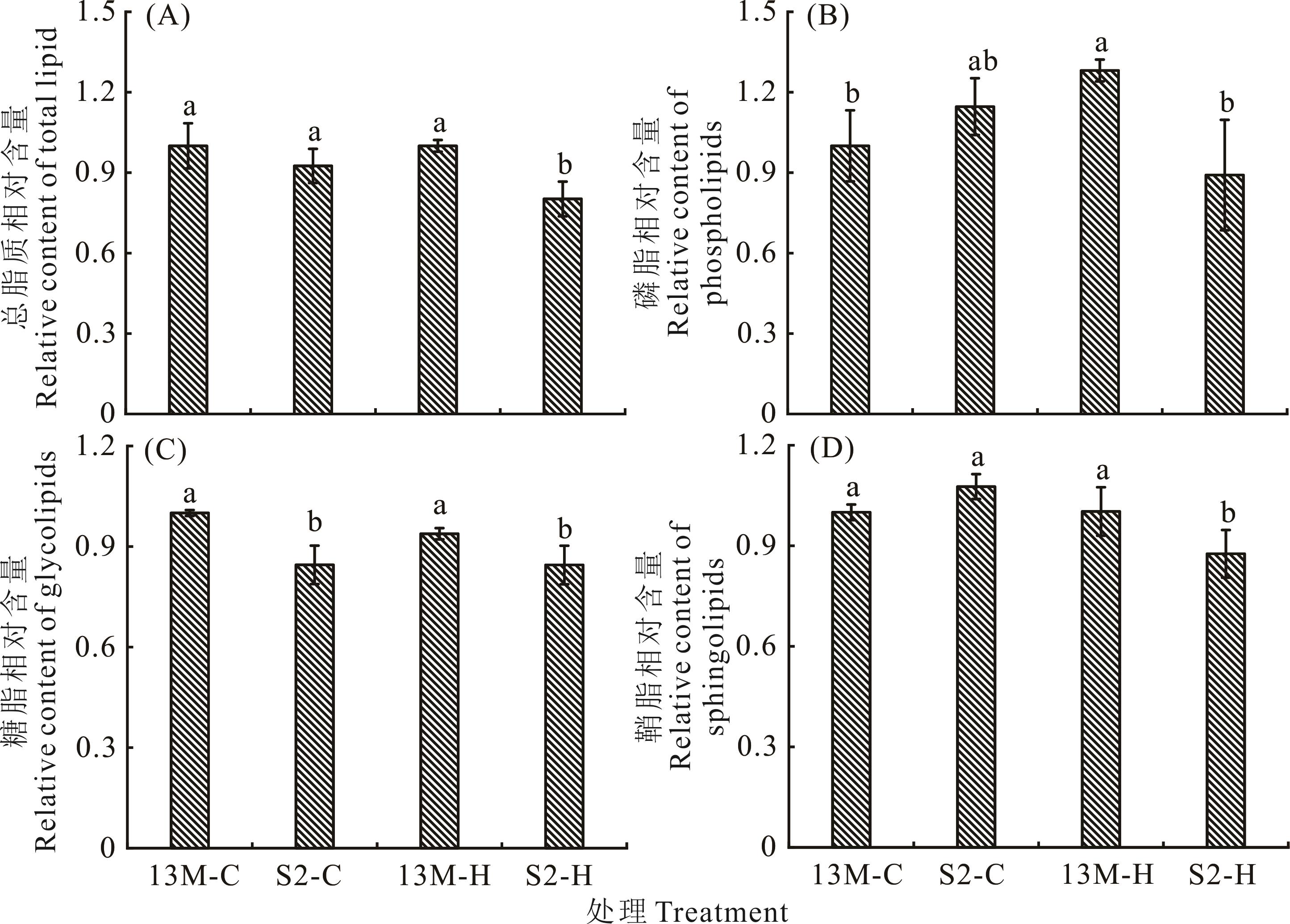
图2 短期高温对13M与SeasideⅡ 叶片中总脂质、磷脂、糖脂和鞘脂含量的影响
Fig.2 Effects of short-term high temperature on the contents of total lipids, phospholipids, glycolipids, and sphingolipids in leaves of 13M and SeasideⅡ
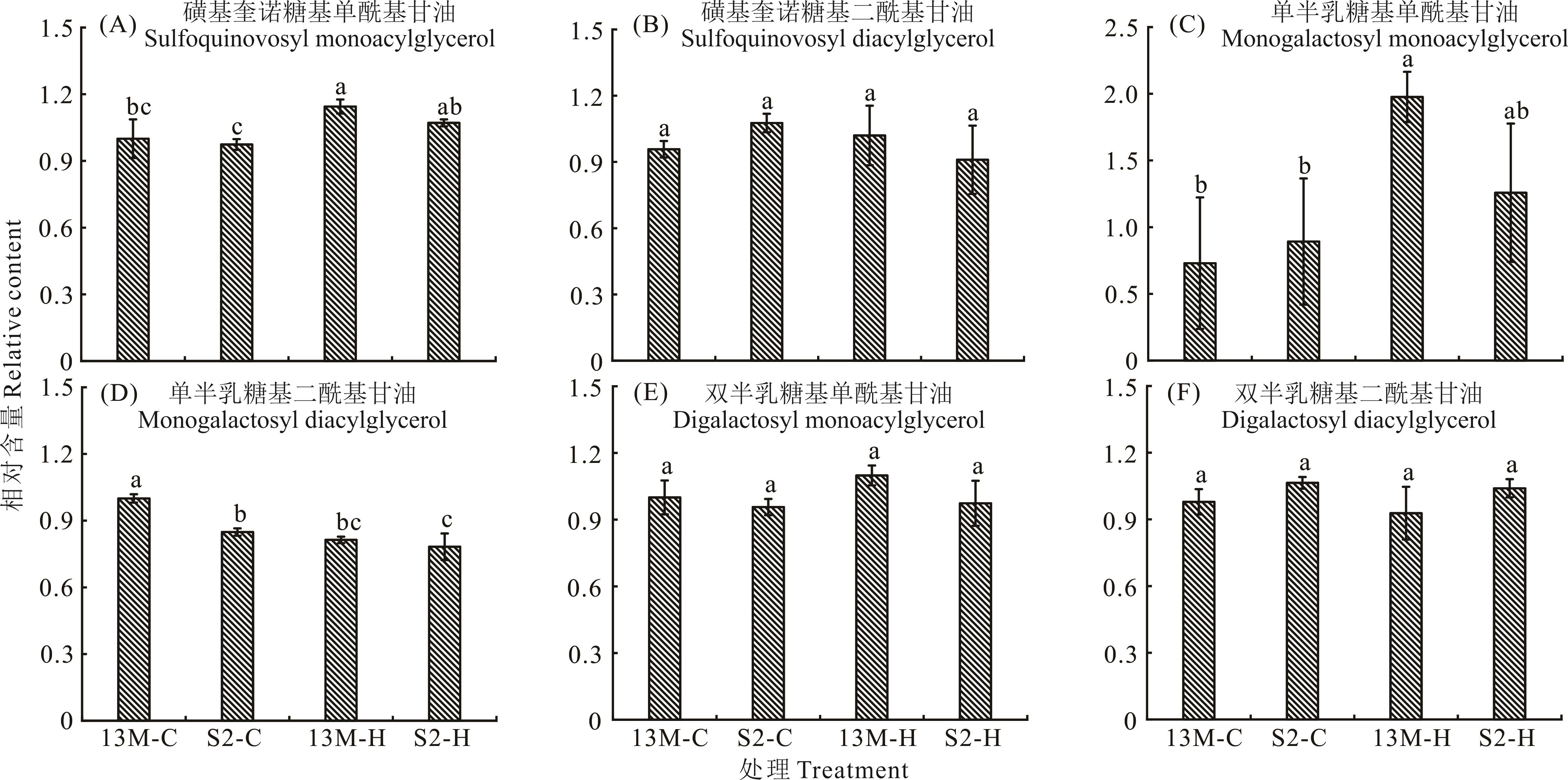
图3 短期高温对13M 与 Seaside Ⅱ叶片中不同糖脂含量的影响
Fig.3 Effects of short-term high temperature on the contents of different glycolipids in leaves of 13M and Seaside Ⅱ

图4 短期高温对13M与Seaside Ⅱ叶片内不同常规磷脂含量的影响
Fig.4 Effects of short-term high temperature on the contents of different common phospholipids in leaves of 13M and Seaside Ⅱ

图5 短期高温对13M与Seaside Ⅱ叶片内不同溶血磷脂和心磷脂含量的影响
Fig.5 Effects of short-term high temperature on the contents of different lysophospholipid and cardiolipin in leaves of 13M and Seaside Ⅱ

图6 短期高温对13M与Seaside Ⅱ 叶片内不同鞘脂含量的影响
Fig.6 Effects of short-term high temperature on the contents of different sphingolipids in leaves of 13M and Seaside Il
| [1] | Tu X J, Wang Q M, Rao L Q. Effects of high temperature stress on physiology and biochemistry of plant. Hunan Agricultural Science, 2013, 43(13): 28-30. |
| 屠小菊, 汪启明, 饶力群. 高温胁迫对植物生理生化的影响. 湖南农业科学, 2013, 43(13): 28-30. | |
| [2] | Xie Y L. Research progress on the effects of high temperature stress on plant physiology. Jilin Agriculture, 2019, 19(8): 107-108. |
| 解玉玲. 高温胁迫对植物生理影响的研究进展. 吉林农业, 2019, 19(8): 107-108. | |
| [3] | Huang C, Tian Y L, Zhang B B, et al. Chitosan (CTS) alleviates heat-induced leaf senescence in creeping bentgrass by regulating chlorophyll metabolism, antioxidant defense, and the heat shock pathway. Molecules, 2021, 26(17): 5337. |
| [4] | Zeng W, Hassan M J, Kang D, et al. Photosynthetic maintenance and heat shock protein accumulation relating to γ-aminobutyric acid (GABA)-regulated heat tolerance in creeping bentgrass. South African Journal of Botany, 2021, 141(6): 405-413. |
| [5] | Li Z, Zeng W H, Cheng B Z, et al. Turf quality and physiological responses to summer stress in four creeping bentgrass cultivars in a subtropical zone. Plants, 2022, 11(5): 665. |
| [6] | Yao N. Advances in plant lipid biology. Plant Physiology Journal, 2018, 54(12): 1747. |
| 姚楠. 植物脂质生物学进展. 植物生理学报, 2018, 54(12): 1747. | |
| [7] | Higashi Y, Saito K. Lipidomic studies of membrane glycerolipids in plant leaves under heat stress. Progress in Lipid Research, 2019, 75(3): 100990. |
| [8] | Cowan A K. Phospholipids as plant growth regulators. Plant Growth Regulation, 2006, 48(2): 97-109. |
| [9] | Chen J P, Burke J J, Xin Z G, et al. Characterization of the Arabidopsis thermosensitive mutant atts02 reveals an important role for galactolipids in thermotolerance. Plant Cell & Environment, 2006, 29(7): 1437-1448. |
| [10] | Zhou Y, Zeng L T, Fu X M, et al. The sphingolipid biosynthetic enzyme Sphingolipid delta8 desaturase is important for chilling resistance of tomato. Scientific Reports, 2016, 6(1): 38742. |
| [11] | Asad M A U, Yan Z, Zhou L, et al. How abiotic stresses trigger sugar signaling to modulate leaf senescence? Plant Physiology and Biochemistry, 2024, 210(5): 108650. |
| [12] | Lembrechts R, Ceusters N, Dd Proft M P, et al. Sugar and starch dynamics in the medium-root-leaf system indicate possibilities to optimize plant tissue culture. Scientia Horticulturae, 2017, 224(11): 226-231. |
| [13] | Kumar S, Thakur M, Mitra R, et al. Sugar metabolism during pre- and post-fertilization events in plants under high temperature stress. Plant Cell Reports, 2021, 41(3): 655-673. |
| [14] | Li Z, Yu J J, Peng Y, et al. Metabolic pathways regulated by abscisic acid, salicylic acid and γ‐aminobutyric acid in association with improved drought tolerance in creeping bentgrass. Physiologia Plantarum, 2017, 159(1): 42. |
| [15] | Li Z, Li Z, Tang M Y, et al. Adaptability to high temperature and stay-green genotypes associated with variations in antioxidant, chlorophyll metabolism, and γ-aminobutyric acid accumulation in creeping bentgrass species. Frontiers in Plant Science, 2021, 12(1): 750728. |
| [16] | Hassan M J, Qi H Y, Cheng B Z, et al. Enhanced adaptability to limited water supply regulated by diethyl aminoethyl hexanoate (DA-6) associated with lipidomic reprogramming in two white clover genotypes. Frontiers in Plant Science, 2022, 13(1): 879331. |
| [17] | Hou Q, Ufer G, Bartels D. Lipid signalling in plant responses to abiotic stress. Plant, Cell & Environment, 2016, 39(5): 1029-1048. |
| [18] | Dawid P, Sylwia K, Aneta S, et al. Remodeling of leaf cellular glycerolipid composition under drought and re-hydration conditions in grasses from the Lolium-Festuca complex. Frontiers in Plant Science, 2016, 7(1): 01027. |
| [19] | Gao Y L, Li M N, Zhang X X, et al. Up-regulation of lipid metabolism and glycine betaine synthesis are associated with choline‐induced salt tolerance in halophytic seashore paspalum. Plant, Cell & Environment, 2020, 43(1): 159-173. |
| [20] | Zhang X X, Xu Y, Huang B R. Lipidomic reprogramming associated with drought stress priming-enhanced heat tolerance in tall fescue (Festuca arundinacea). Plant, Cell & Environment, 2019, 42(3): 947-958. |
| [21] | Nagano M, Ishikawa T, Ogama Y, et al. Arabidopsis Bax inhibitor-1 promotes sphingolipid synthesis during cold stress by interacting with ceramide-modifying enzymes. Planta, 2014, 240(1): 77-89. |
| [22] | Narayanan S, Zoong-lwe Z S, Gandhi N, et al. Comparative lipidomic analysis reveals heat stress responses of two soybean genotypes differing in temperature sensitivity. Plants, 2020, 9(4): 457. |
| [23] | Lin L, Lin J N, Zhou M, et al. Lipid remodelling and the conversion of lipids into sugars associated with tolerance to cadmium toxicity during white clover seed germination. Physiologia Plantarum, 2024, 176(4): e14433. |
| [24] | Testerink C, Munnik T. Phosphatidic acid: a multifunctional stress signaling lipid in plants. Trends in Plant Science, 2005, 10(8): 368-375. |
| [25] | Heilmann I. Phosphoinositide signaling in plant development. Development, 2016, 143(12): 2044-2055. |
| [26] | Li W Q, Li M Y, Zhang W H, et al. The plasma membrane-bound phospholipase Dδ enhances freezing tolerance in Arabidopsis thaliana. Nature Biotechnology, 2004, 22(4): 427-433. |
| [27] | Wang X Y, Huang B R. Lipid- and calcium-signaling regulation of HsfA2c-mediated heat tolerance in tall fescue. Environmental & Experimental Botany, 2017, 136(4): 59-67. |
| [28] | Xue H W, Chen X, Mei Y. Function and regulation of phospholipid signalling in plants. Biochemical Journal, 2009, 421(2): 145-156. |
| [29] | Liu Y N, Lu X X, Ren A, et al. Conversion of phosphatidylinositol (PI) to PI4-phosphate (PI4P) and then to PI (4, 5) P2 is essential for the cytosolic Ca2+ concentration under heat stress in Ganoderma lucidum. Environmental Microbiology, 2018, 20(7): 2456-2468. |
| [30] | Lee S, Suh S, Kim S, et al. Systemic elevation of phosphatidic acid and lysophospholipid levels in wounded plants. The Plant Journal, 1997, 12(3): 547-556. |
| [31] | Wi S J, Seo S Y, Cho K, et al. Lysophosphatidylcholine enhances susceptibility in signaling pathway against pathogen infection through biphasic production of reactive oxygen species and ethylene in tobacco plants. Phytochemistry, 2014, 104(8): 48-59. |
| [32] | Lee B H, Choi S H, Kim H J, et al. Plant lysophosphatidic acids: A rich source for bioactive lysophosphatidic acids and their pharmacological applications. Biologic and Pharmaceutical, 2016, 39(2): 156-162. |
| [33] | Michaelson L V, Napier J A, Molino D, et al. Plant sphingolipids: Their importance in cellular organization and adaption. Biochimica et Biophysica Acta (BBA)-Molecular and Cell Biology of Lipids, 2016, 1861(9): 1329-1335. |
| [34] | Liang H, Yao N, Song J T, et al. Ceramides modulate programmed cell death in plants. Genes & Development, 2003, 17(21): 2636-2641. |
| [35] | Coursol S, Fan L M, Stunff H L, et al. Sphingolipid signalling in Arabidopsis guard cells involves heterotrimeric G proteins. Nature, 2003, 423(6940): 651-654. |
| [36] | Pineau B, Bourge M, Marion J, et al. The importance of cardiolipin synthase for mitochondrial ultrastructure, respiratory function, plant development, and stress responses in Arabidopsis. The Plant Cell, 2013, 25(10): 4195-4208. |
| [37] | Berkey R, Bendigeri D, Xiao S Y. Sphingolipids and plant defense/disease: the “death” connection and beyond. Frontiers in Plant Science, 2012, 3(1): 68. |
| [38] | Lester R L, Dickson R C. Sphingolipids with inositolphosphate-containing head groups. Advances in Lipid Research, 1993, 26(1): 253-274. |
| [39] | Tafesse F G, Ternes P, Holthuis J C M. The multigenic sphingomyelin synthase family. Journal of Biological Chemistry, 2006, 281(40): 29421-29425. |
| [40] | Lynch D V, Steponkus P L. Plasma membrane lipid alterations associated with cold acclimation of winter rye seedlings (Secale cereale). Plant Physiology, 1987, 83(4): 761-767. |
| [41] | Uemura M, Steponkus P L. A contrast of the plasma membrane lipid composition of oat and rye leaves in relation to freezing tolerance. Plant Physiology, 1994, 104(2): 479-496. |
| [42] | Sperling P, Heinz E. Plant sphingolipids: structural diversity, biosynthesis, first genes and functions. Biochimica et Biophysica Acta (BBA)-Molecular and Cell Biology of Lipids, 2003, 1632(1/2/3): 1-15. |
| [43] | Li Z, Cheng B Z, Zhao Y, et al. Metabolic regulation and lipidomic remodeling in relation to spermidine-induced stress tolerance to high temperature in plants. International Journal of Molecular Sciences, 2022, 23(20): 12247. |
| [44] | Cheng B Z, Zhou M, Tang T, et al. A Trifolium repens flavodoxin-like quinone reductase 1 (TrFQR1) improves plant adaptability to high temperature associated with oxidative homeostasis and lipids remodeling. The Plant Journal, 2023, 115(2): 369-385. |
| [45] | Liu Y H, Offler C E, Ruan Y L. Regulation of fruit and seed response to heat and drought by sugars as nutrients and signals. Frontiers in Plant Science, 2013, 4(1): 282. |
| [46] | Sharma M, Banday Z Z, Shukla B N, et al. Glucose-regulated HLP1 acts as a key molecule in governing thermomemory. Plant Physiology, 2019, 180(2): 1081-1100. |
| [47] | Wang Z T, Guo J, Luo W X, et al. Salicylic acid cooperates with lignin and sucrose signals to alleviate waxy maize leaf senescence under heat stress. Plant, Cell & Environment, 2025, 48(6): 4341-4355. |
| [48] | Du Y, Zhao Y, Li Z. Different heat tolerance of two creeping bentgrass cultivars related to altered accumulation of organic metabolites. Agronomy, 2025, 15(7): 1544. |
| [49] | Li Z, Zhou M, Qi H Y, et al. Foliar application of diethyl aminoethyl hexanoate (DA‐6) alleviated summer bentgrass decline and heat damage to creeping bentgrass. Crop Science, 2024, 64(2): 1039-1050. |
| [50] | Li Z, Yu J J, Peng Y, et al. Metabolic pathways regulated by γ-aminobutyric acid (GABA) contributing to heat tolerance in creeping bentgrass (Agrostis stolonifera). Scientific Reports, 2016, 6(1): 30338. |
| [51] | Huang S X, Liu Z Q, Cao W H, et al. The plant ESCRT component FREE1 regulates peroxisome-mediated turnover of lipid droplets in germinating Arabidopsis seedlings. The Plant Cell, 2022, 34(11): 4255-4273. |
| [52] | Aznar-moreno J A, Mukherjee T, Morley S A, et al. Suppression of SDP1 improves soybean seed composition by increasing oil and reducing undigestible oligosaccharides. Frontiers in Plant Science, 2022, 13(1): 863254. |
| [53] | Quettier A L, Shaw E, Eastmond P J. SUGAR-DEPENDENT6 encodes a mitochondrial flavin adenine dinucleotide-dependent glycerol-3-P dehydrogenase, which is required for glycerol catabolism and postgerminative seedling growth in Arabidopsis. Plant Physiology, 2008, 148(1): 519-528. |
| [54] | Zhou W G, Chen F, Zhao S H, et al. DA-6 promotes germination and seedling establishment from aged soybean seeds by mediating fatty acid metabolism and glycometabolism. Journal of Experimental Botany, 2019, 70(1): 101-114. |
| [1] | 刘进娣, 陈仕勇, 李进, 蒋涛, 梁国玲, 周青平. 燕麦蔗糖转运蛋白基因家族的鉴定及其对干旱和盐碱胁迫的响应[J]. 草业学报, 2026, 35(8): 144-156. |
| [2] | 第乙林, 刘思甜, 刘欣影, 杜泳, 李州. γ-氨基丁酸对镉胁迫下匍匐翦股颖耐受性及镉吸收转运的影响[J]. 草业学报, 2026, 35(2): 208-220. |
| [3] | 郝丽芬, 徐晓阳, 季玉, 王瑞, 吴德宝, 李宇宇, 林克剑. 长刺蒺藜草两异型种子形态和萌发过程的生理动态特征比较[J]. 草业学报, 2024, 33(9): 40-50. |
| [4] | 张俊豪, 柴雪茹, 马嵩科, 张冬霞, 张静, 乔唱唱, 李爽, 黄明, 王贺正. 秸秆还田配施磷肥对豫西旱地小麦碳同化物积累的影响及其生理机制[J]. 草业学报, 2024, 33(6): 89-104. |
| [5] | 徐蕊, 王峥, 王仪明, 苏连泰, 高鲤, 周鹏, 安渊. 紫花苜蓿对轮作水稻产量和蔗糖代谢的影响[J]. 草业学报, 2023, 32(8): 129-140. |
| [6] | 卫宏健, 贺文员, 王越, 唐明, 陈辉. 丛枝菌根真菌与褪黑素对多年生黑麦草耐热性的影响[J]. 草业学报, 2023, 32(12): 126-138. |
| [7] | 赵宁, 马晖玲, 张然, 张金青, 史毅. 丁二醇对热胁迫下匍匐翦股颖内源激素及其相关基因表达水平的调控[J]. 草业学报, 2022, 31(12): 118-132. |
| [8] | 段珍, 吴凡, 闫启, 张吉宇. 植物香豆素生物合成途径及关键酶基因研究进展[J]. 草业学报, 2022, 31(1): 217-228. |
| [9] | 高子奇, 王佳, 汤宇晨, 王迎春. 唐古特白刺类黄酮-3-O-葡萄糖基转移酶基因(NtUFGT)的克隆与功能分析[J]. 草业学报, 2020, 29(5): 159-170. |
| [10] | 王日明, 王志强, 向佐湘. γ-氨基丁酸对高温胁迫下黑麦草光合特性及碳水化合物代谢的影响[J]. 草业学报, 2019, 28(2): 168-178. |
| [11] | 姜寒玉, 王亚峰, 徐明, 甘培文, 张金林, 马晖玲. 乙烯对匍匐翦股颖ISR抗病反应中AsA-GSH循环及胼胝质沉积的影响[J]. 草业学报, 2018, 27(9): 120-131. |
| [12] | 熊丽丽, 闫霜, 李萍, 杨国柱, 尹卫, 严晓霞, 张韩. 葡萄糖-6-磷酸脱氢酶在紫花苜蓿干旱耐受性中的响应[J]. 草业学报, 2018, 27(2): 48-56. |
| [13] | 赵春旭, 姜寒玉, 董文科, 陈红, 方彦霞, 谢丽萍, 马晖玲. 外源复合激素对匍匐翦股颖抗褐斑病的诱导抗性[J]. 草业学报, 2018, 27(11): 120-130. |
| [14] | 于景金, 范宁丽, 李冉, 杨志民. 高浓度CO2对热胁迫条件下高羊茅生长和抗氧化系统的影响[J]. 草业学报, 2017, 26(8): 113-122. |
| [15] | 王艳, 马亚茹, 万学瑞, 王川, 吴润, 刘桂林, 刘原子, 吴自祥. 多粘类芽孢杆菌β-葡萄糖苷酶bglA、bglB和bgl基因在大肠杆菌中的表达[J]. 草业学报, 2017, 26(5): 189-196. |
| 阅读次数 | ||||||
|
全文 |
|
|||||
|
摘要 |
|
|||||
