

ISSN 1004-5759 CN 62-1105/S
草业学报 ›› 2026, Vol. 35 ›› Issue (11): 119-131.DOI: 10.11686/cyxb2025477
• 研究论文 • 上一篇
苏日力格1,2( ), 杨陶阳2,3, 乌日力格1,2, 姜娜2, 杨殿林2, 张海芳2(), 苏日古嘎1,4()
收稿日期:2025-11-24
修回日期:2026-01-05
出版日期:2026-11-20
发布日期:2026-10-12
通讯作者:
张海芳,苏日古嘎
作者简介:suriguga@imnu.edu.cn基金资助:
Surilige1,2(), Tao-yang YANG2,3, Wurilige1,2, Na JIANG2, Dian-lin YANG2, Hai-fang ZHANG2(), Suriguga1,4()
Received:2025-11-24
Revised:2026-01-05
Online:2026-11-20
Published:2026-10-12
Contact:
Hai-fang ZHANG, Suriguga
摘要:
近年来,由于过度放牧和全球气候变化共同作用,我国北方天然草地退化严重。有毒植物狼毒大戟在天然草地中迅速扩张,成为天然草原退化的主要特征之一,严重制约区域生态、生产安全和草牧业可持续发展。刈割作为物理防控天然草地有毒植物狼毒大戟的主要手段,研究探明刈割时期对草原有毒植物功能性状的影响,是理解其扩张机制与制定生态调控策略的重要科学问题。本研究以呼伦贝尔草原主要有毒植物狼毒大戟为对象,设置不刈割对照(CK)、盛花期单次刈割(FM)、结实期单次刈割(RM)、黄枯期单次刈割(SM)、盛花期和结实期重复刈割(TM)处理,分析不同刈割时期和刈割频次对狼毒大戟主要植物功能性状的影响。结果表明:1)刈割均抑制了狼毒大戟的生长,其中以盛花期和结果期重复刈割(TM)效果最为显著,使狼毒大戟株高、密度、地上生物量、地下生物量、生殖枝数量分别比对照下降57.28%、86.80%、59.05%、56.44%、71.83%。2)从叶和根性状来看,刈割显著降低了叶厚度、单叶面积、比根长、比根面积,同时显著提高了叶氮、叶磷含量(P<0.05),此外,盛花期和结果期重复刈割显著提高粗根全氮含量,盛花期单次刈割(FM)显著提高了细根直径(P<0.05);Pearson相关性分析结果可知,狼毒大戟叶片与根系性状在刈割干扰下呈显著相关性,说明地上与地下功能性状之间存在协同响应关系。3)生殖枝数量为刈割干扰响应最为敏感性状,叶干物质含量、比叶面积、比叶重、细根组织密度及叶厚度,为刈割干扰响应的惰性性状。综上所述,盛花期和结果期重复刈割处理对狼毒大戟各项生长和功能性状指标影响最大,对狼毒大戟再生和开花结实抑制效果最为理想。
苏日力格, 杨陶阳, 乌日力格, 姜娜, 杨殿林, 张海芳, 苏日古嘎. 刈割对呼伦贝尔草原有毒植物狼毒大戟主要功能性状的影响[J]. 草业学报, 2026, 35(11): 119-131.
Surilige, Tao-yang YANG, Wurilige, Na JIANG, Dian-lin YANG, Hai-fang ZHANG, Suriguga. Effects of mowing on key functional traits of the toxic plant Euphorbia fischeriana in the Hulunbuir grassland[J]. Acta Prataculturae Sinica, 2026, 35(11): 119-131.
| 编号NO. | 性状 Trait | 代码 Code | 单位 Unit | 生态学意义 Ecological significance |
|---|---|---|---|---|
| 1 | 株高Plant height | H | cm | 植物竞争光照能力的主要决定因素,是植物物种生态策略的关键组成部分[ |
| 2 | 分枝数Branches | B | 个No.·plant-1 | 反映核心生存策略,与提升光合面积和繁殖潜力密切相关。It reflects core survival strategies and is closely associated with increases in photosynthetic area and reproductive potential. |
| 3 | 叶面积Leaf area | LA | cm2 | 植物吸收和转化资源的能力取决于叶面积大小,与植物光合效率密切相关。The ability of plants to acquire and utilize resources depends on leaf area and is closely related to photosynthetic efficiency. |
| 4 | 比叶面积Specific leaf area | SLA | cm2·g-1 | 作为植物资源利用分类轴上对植物物种进行区分的关键性状,不仅反映植物的生长速率和资源获取策略,还与植物维持水分平衡和适应环境胁迫密切相关[ |
| 5 | 比叶重Specific leaf weight | SLW | mg·cm-2 | 反映植物生态策略的重要性状之一,可用于定量衡量单位叶面积上光合产物的投入[ |
| 6 | 叶干物质含量Leaf dry matter content | LDMC | g·g-1 | 反映了植物在资源使用策略轴上的位置,与叶片的化学组成和细胞结构密切相关。It reflects the position of plants along the resource-use strategy axis and is closely related to leaf chemical composition and cellular structures. |
| 7 | 叶厚度Leaf thickness | LT | mm | 反映植物在光合作用与资源利用上的保守策略,厚叶有助于保持水分和减少蒸腾。It reflects a conservative strategy of plants in photosynthesis and resource use, and thicker leaves help maintain water and reduce transpiration. |
| 8 | 比根长Specific root length | SRL | cm·g-1 | 细根功能性状从资源获取效率、碳投入经济、生理功能权衡及环境适应等多个层面,系统地揭示了植物的生态策略,是连接植物个体与生态系统功能的关键桥梁,是定量衡量植物地下部分碳投入效率的关键参数[ |
| 9 | 比根面积Specific root area | SRA | cm2·g-1 | |
| 10 | 细根组织密度Fine root tissue density | FRTD | g·cm-3 | |
| 11 | 细根直径Fine root diameter | FRD | mm | |
| 12 | 叶全氮含量Leaf total nitrogen content | LNC | g·kg-1 | 氮、磷是植物生长和新陈代谢的基本元素,植物器官的氮、磷含量反映其营养策略和环境适应能力,且与土壤肥力密切相关。Nitrogen and phosphorus are essential elements for plant growth and metabolism. The nitrogen and phosphorus contents of plant organs reflect their nutrient strategies and environmental adaptability and are closely related to soil fertility. |
| 13 | 叶全磷含量Leaf total phosphorus content | LPC | g·kg-1 | |
| 14 | 根全氮含量Root total nitrogen content | RNC | g·kg-1 | |
| 15 | 根全磷含量Root total phosphorus content | RPC | g·kg-1 |
表1 本研究中植物功能性状及其生态学意义
Table 1 Functional traits of plants and ecological significance in this research
| 编号NO. | 性状 Trait | 代码 Code | 单位 Unit | 生态学意义 Ecological significance |
|---|---|---|---|---|
| 1 | 株高Plant height | H | cm | 植物竞争光照能力的主要决定因素,是植物物种生态策略的关键组成部分[ |
| 2 | 分枝数Branches | B | 个No.·plant-1 | 反映核心生存策略,与提升光合面积和繁殖潜力密切相关。It reflects core survival strategies and is closely associated with increases in photosynthetic area and reproductive potential. |
| 3 | 叶面积Leaf area | LA | cm2 | 植物吸收和转化资源的能力取决于叶面积大小,与植物光合效率密切相关。The ability of plants to acquire and utilize resources depends on leaf area and is closely related to photosynthetic efficiency. |
| 4 | 比叶面积Specific leaf area | SLA | cm2·g-1 | 作为植物资源利用分类轴上对植物物种进行区分的关键性状,不仅反映植物的生长速率和资源获取策略,还与植物维持水分平衡和适应环境胁迫密切相关[ |
| 5 | 比叶重Specific leaf weight | SLW | mg·cm-2 | 反映植物生态策略的重要性状之一,可用于定量衡量单位叶面积上光合产物的投入[ |
| 6 | 叶干物质含量Leaf dry matter content | LDMC | g·g-1 | 反映了植物在资源使用策略轴上的位置,与叶片的化学组成和细胞结构密切相关。It reflects the position of plants along the resource-use strategy axis and is closely related to leaf chemical composition and cellular structures. |
| 7 | 叶厚度Leaf thickness | LT | mm | 反映植物在光合作用与资源利用上的保守策略,厚叶有助于保持水分和减少蒸腾。It reflects a conservative strategy of plants in photosynthesis and resource use, and thicker leaves help maintain water and reduce transpiration. |
| 8 | 比根长Specific root length | SRL | cm·g-1 | 细根功能性状从资源获取效率、碳投入经济、生理功能权衡及环境适应等多个层面,系统地揭示了植物的生态策略,是连接植物个体与生态系统功能的关键桥梁,是定量衡量植物地下部分碳投入效率的关键参数[ |
| 9 | 比根面积Specific root area | SRA | cm2·g-1 | |
| 10 | 细根组织密度Fine root tissue density | FRTD | g·cm-3 | |
| 11 | 细根直径Fine root diameter | FRD | mm | |
| 12 | 叶全氮含量Leaf total nitrogen content | LNC | g·kg-1 | 氮、磷是植物生长和新陈代谢的基本元素,植物器官的氮、磷含量反映其营养策略和环境适应能力,且与土壤肥力密切相关。Nitrogen and phosphorus are essential elements for plant growth and metabolism. The nitrogen and phosphorus contents of plant organs reflect their nutrient strategies and environmental adaptability and are closely related to soil fertility. |
| 13 | 叶全磷含量Leaf total phosphorus content | LPC | g·kg-1 | |
| 14 | 根全氮含量Root total nitrogen content | RNC | g·kg-1 | |
| 15 | 根全磷含量Root total phosphorus content | RPC | g·kg-1 |
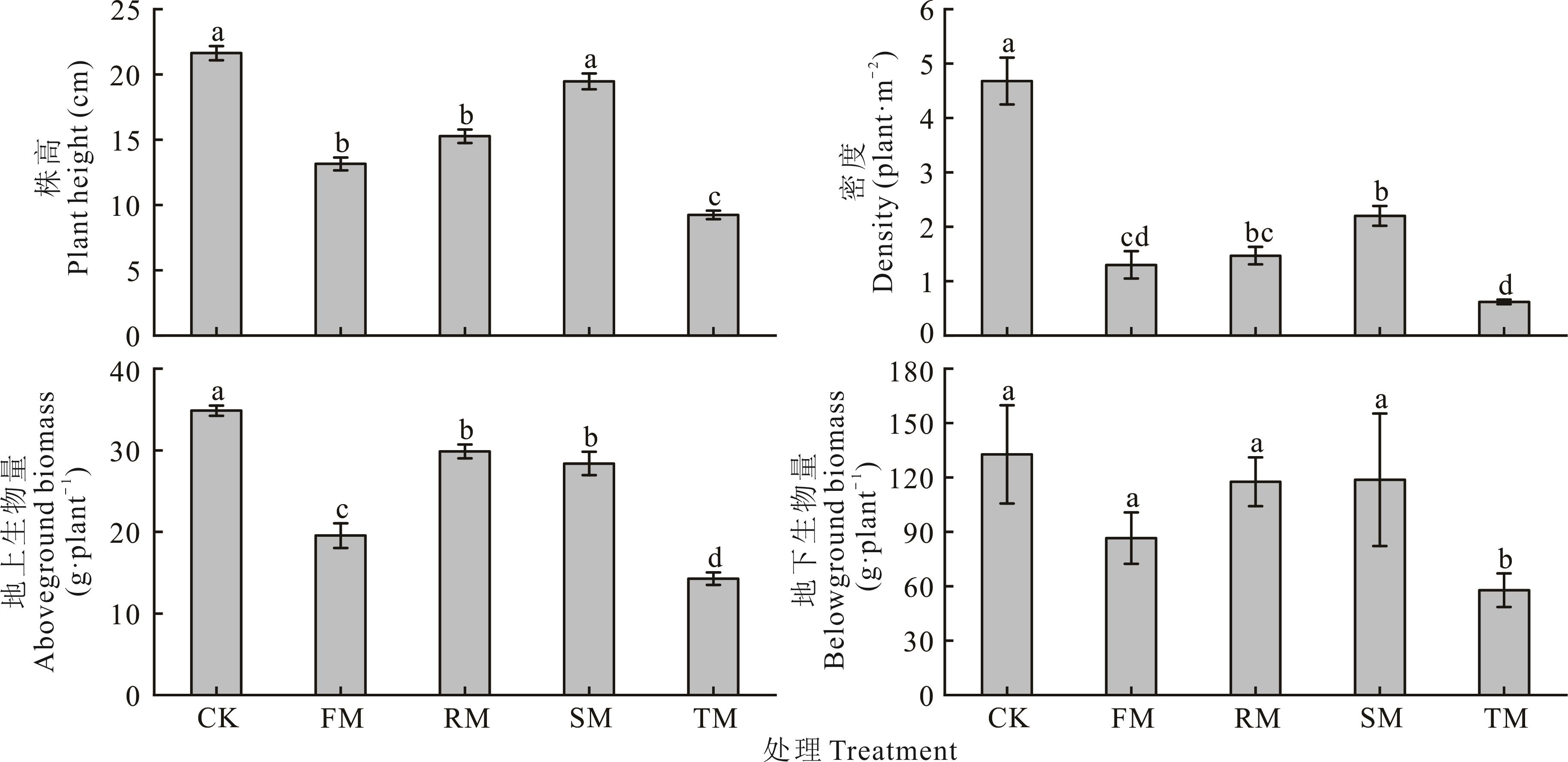
图1 刈割对狼毒大戟生长的影响CK: 不刈割No mowing; FM: 盛花期单次刈割Flowering-stage mowing; RM: 结实期单次刈割Reproductive-stage mowing; SM: 黄枯期单次刈割Senescent-stage mowing; TM: 盛花期和结实期重复刈割Repeated mowing at the flowering and fruiting stages. 不同小写字母表示处理间差异显著(P<0.05)。Different lowercase letters indicate significant differences among treatments (P<0.05). 下同The same below.
Fig.1 Effect of mowing on the growth of E. fischeriana
指标 Parameter | 处理Treatment | ||||
|---|---|---|---|---|---|
| CK | FM | RM | SM | TM | |
| 总分枝数量Total branch number | 8.83±0.42a | 5.35±0.45c | 5.89±0.47bc | 8.76±0.15a | 6.87±0.29b |
| 营养枝数量Vegetative branch number | 5.28±0.62a | 2.49±0.45b | 2.61±0.62b | 5.28±0.37a | 5.87±0.45a |
| 生殖枝数量Reproductive branch number | 3.55±0.29a | 2.87±0.10a | 3.29±0.31a | 3.47±0.28a | 1.00±0.41b |
表2 刈割后狼毒大戟分枝数的变化
Table 2 Changes in the number of branches of E. fischeriana after cutting (NO.·plant-1)
指标 Parameter | 处理Treatment | ||||
|---|---|---|---|---|---|
| CK | FM | RM | SM | TM | |
| 总分枝数量Total branch number | 8.83±0.42a | 5.35±0.45c | 5.89±0.47bc | 8.76±0.15a | 6.87±0.29b |
| 营养枝数量Vegetative branch number | 5.28±0.62a | 2.49±0.45b | 2.61±0.62b | 5.28±0.37a | 5.87±0.45a |
| 生殖枝数量Reproductive branch number | 3.55±0.29a | 2.87±0.10a | 3.29±0.31a | 3.47±0.28a | 1.00±0.41b |
形态性状 Morphological traits | 处理Treatment | ||||
|---|---|---|---|---|---|
| CK | FM | RM | SM | TM | |
| LT (mm) | 0.21±0.00a | 0.19±0.00bc | 0.18±0.00cd | 0.20±0.00b | 0.17±0.00d |
| LA (cm2) | 6.37±0.53a | 3.86±0.17c | 5.08±0.36bc | 5.87±0.53ab | 3.90±0.35c |
| SLA (cm2·g-1) | 165.93±5.70ab | 163.05±8.73ab | 160.52±5.34b | 165.32±7.20ab | 182.26±5.12a |
| SLW (mg·cm-2) | 6.08±0.20a | 6.27±0.36a | 6.31±0.21a | 6.12±0.30a | 5.57±0.15a |
| LDMC (g·g-1) | 0.75±0.01a | 0.75±0.00a | 0.74±0.01a | 0.75±0.00a | 0.75±0.01a |
| SRL (cm·g-1) | 33.08±1.19a | 23.08±1.22bc | 20.68±2.84c | 27.88±3.31ab | 24.97±1.11bc |
| SRA (cm2·g-1) | 263.66±12.54a | 187.57±6.87c | 190.59±17.39c | 232.71±18.07ab | 214.10±5.51bc |
| FRTD (g·cm-3) | 0.64±0.05a | 0.54±0.00a | 0.66±0.03a | 0.66±0.07a | 0.59±0.08a |
| FRD (mm) | 0.25±0.00b | 0.34±0.01a | 0.32±0.04ab | 0.30±0.02ab | 0.32±0.00ab |
表3 刈割后狼毒大戟形态性状的变化
Table 3 Changes of morphological traits of E. fischeriana after mowing
形态性状 Morphological traits | 处理Treatment | ||||
|---|---|---|---|---|---|
| CK | FM | RM | SM | TM | |
| LT (mm) | 0.21±0.00a | 0.19±0.00bc | 0.18±0.00cd | 0.20±0.00b | 0.17±0.00d |
| LA (cm2) | 6.37±0.53a | 3.86±0.17c | 5.08±0.36bc | 5.87±0.53ab | 3.90±0.35c |
| SLA (cm2·g-1) | 165.93±5.70ab | 163.05±8.73ab | 160.52±5.34b | 165.32±7.20ab | 182.26±5.12a |
| SLW (mg·cm-2) | 6.08±0.20a | 6.27±0.36a | 6.31±0.21a | 6.12±0.30a | 5.57±0.15a |
| LDMC (g·g-1) | 0.75±0.01a | 0.75±0.00a | 0.74±0.01a | 0.75±0.00a | 0.75±0.01a |
| SRL (cm·g-1) | 33.08±1.19a | 23.08±1.22bc | 20.68±2.84c | 27.88±3.31ab | 24.97±1.11bc |
| SRA (cm2·g-1) | 263.66±12.54a | 187.57±6.87c | 190.59±17.39c | 232.71±18.07ab | 214.10±5.51bc |
| FRTD (g·cm-3) | 0.64±0.05a | 0.54±0.00a | 0.66±0.03a | 0.66±0.07a | 0.59±0.08a |
| FRD (mm) | 0.25±0.00b | 0.34±0.01a | 0.32±0.04ab | 0.30±0.02ab | 0.32±0.00ab |
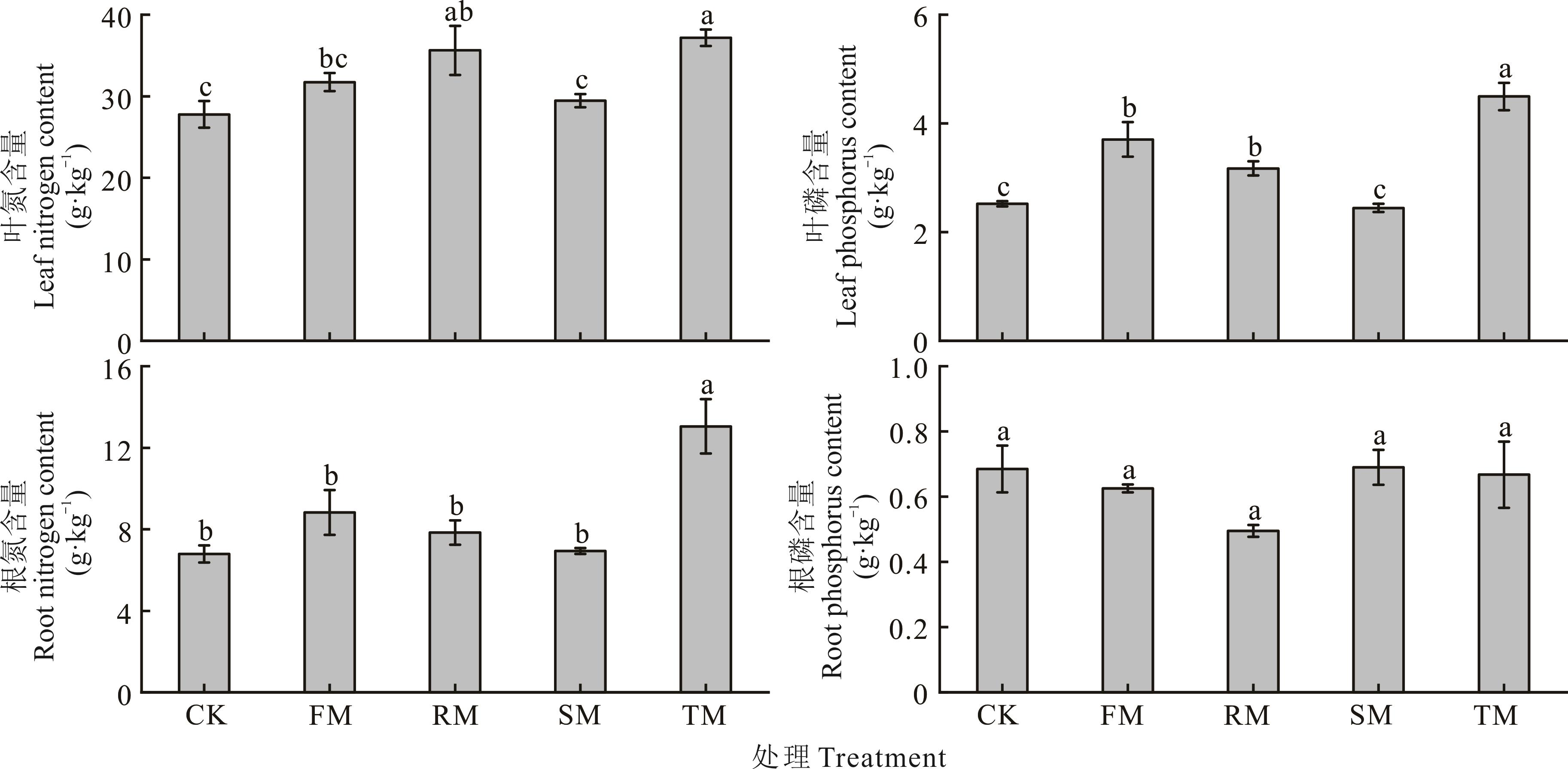
图2 刈割后狼毒大戟功能性状的变化
Fig.2 Changes of functional traits of E. fischeriana after mowing
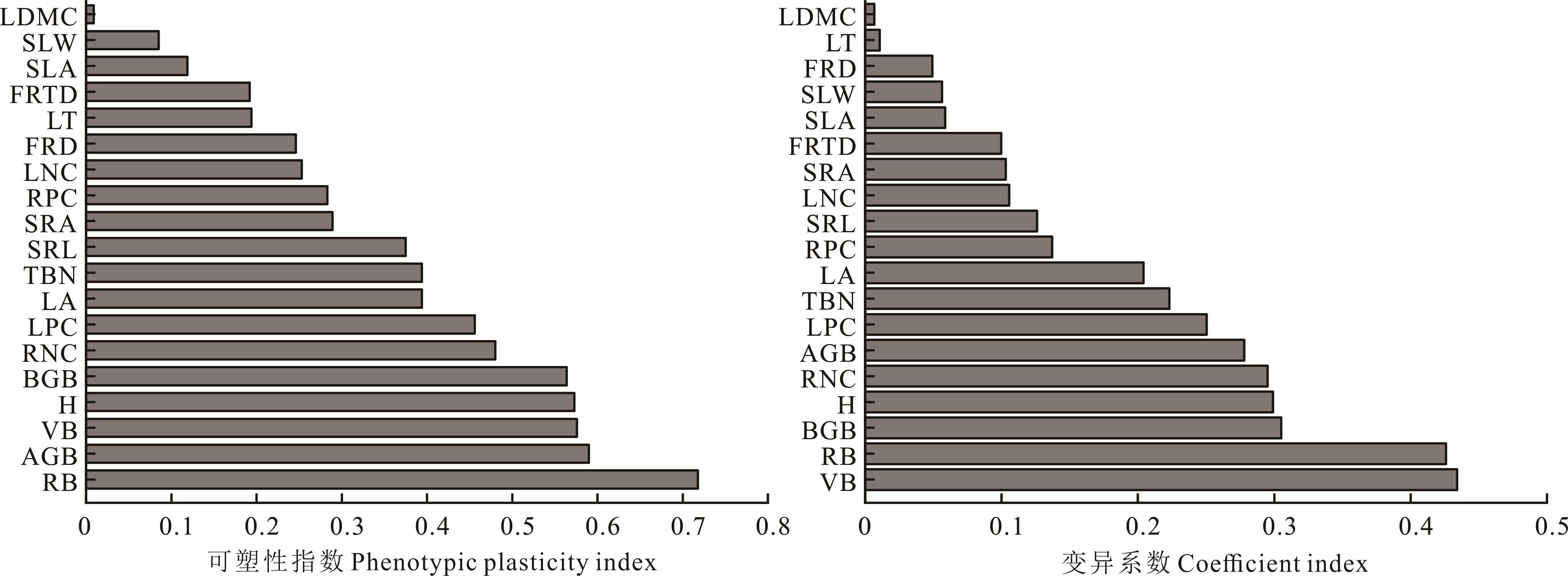
图3 狼毒大戟各性状在刈割处理下的可塑性指数和变异系数排序LDMC: 叶干物质含量Leaf dry matter content; SLW: 比叶重Specific leaf weight; SLA: 比叶面积Specific leaf area; FRTD: 细根组织密度Fine root tissue density; LT: 叶厚度Leaf thickness; FRD: 细根直径Fine root diameter; LNC: 叶全氮含量Leaf total nitrogen content; RPC: 粗根全磷含量Root total phosphorus content; SRA: 比根表面积Specific root area; SRL: 比根长Specific root length; TBN: 总分枝数Total branch number; LA: 单叶面积Leaf area; LPC: 叶全磷含量Leaf total phosphorus content; RNC: 粗根全氮含量Root total nitrogen content; BGB: 地下生物量Belowground biomass; H: 株高Plant height; VB: 营养枝数量Vegetative branch number; AGB: 地上生物量Aboveground biomass; RB: 生殖枝数量Reproductive branch number. 下同The same below.
Fig.3 Plasticity index (PI) and coefficient of variation (CV) ranking of E. fischeriana traits under different mowing treatments
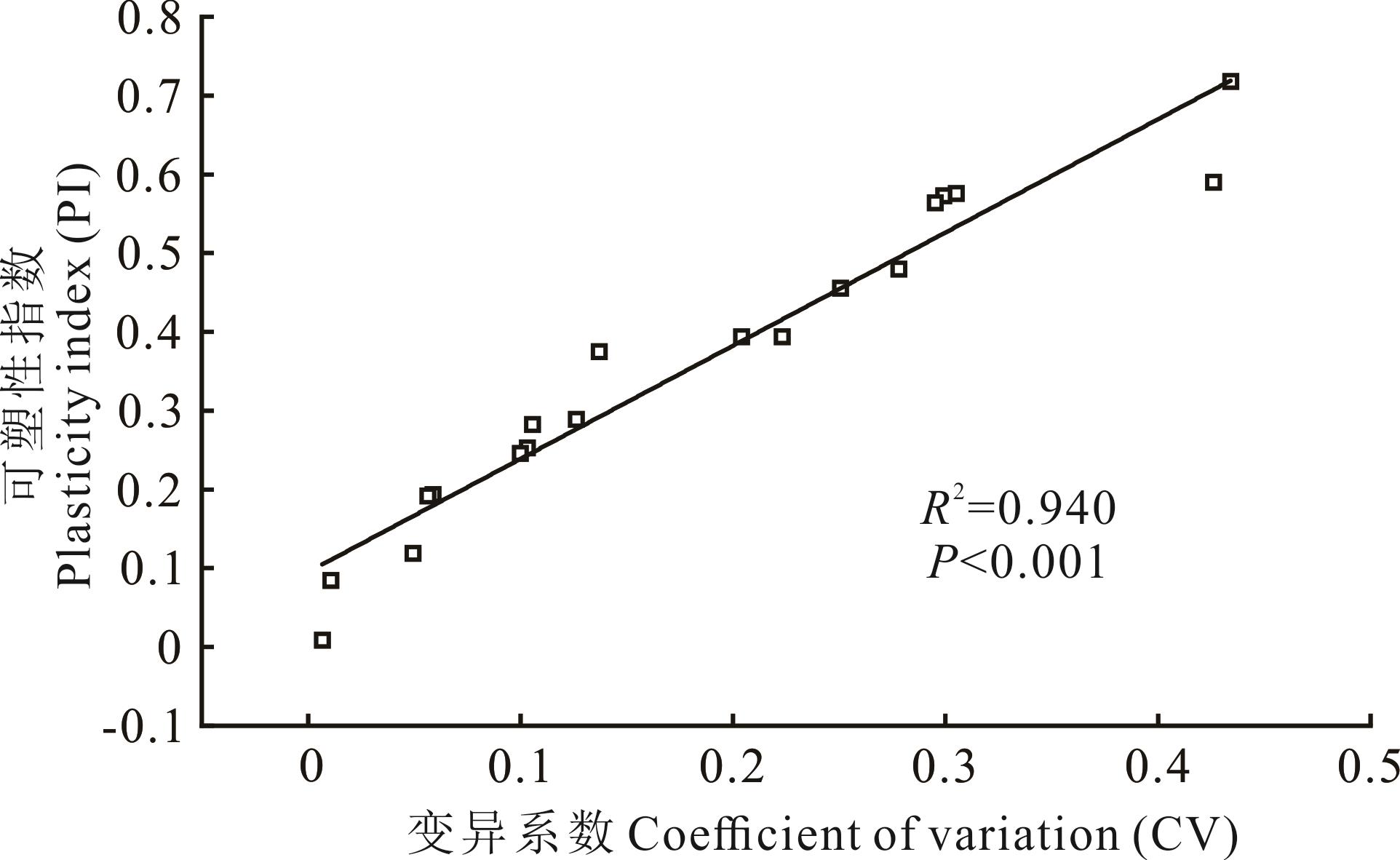
图4 狼毒大戟不同功能性状变异系数与可塑性指数的关系
Fig.4 Relationship between the coefficient of variation (CV) and plasticity index (PI) across different functional traits of E. fischeriana

图5 狼毒大戟叶片和根功能性状特征的相关性分析色阶条代表相关性,红色表示正相关,蓝色表示负相关,颜色深浅表示相关性强弱。The color bar reflects correlation coefficients: red indicates positive correlations, blue indicates negative correlations, with color intensity representing correlation strength. *: P<0.05; **: P<0.01.
Fig.5 Correlation analysis between leaf and root functional traits of E. fischeriana
| [1] | Violle C, Navas M L, Vile D, et al. Let the concept of trait be functional! Oikos, 2007, 116(5): 882-892. |
| [2] | Carmona C P, Bueno C G, Toussaint A, et al. Fine-root traits in the global spectrum of plant form and function. Nature, 2021, 597(7878): 683-687. |
| [3] | Bjorkman A D, Myers-Smith I H, Elmendorf S C, et al. Plant functional trait change across a warming tundra biome. Nature, 2018, 562(7725): 57-62. |
| [4] | Wright I J, Reich P B, Westoby M, et al. The worldwide leaf economics spectrum. Nature, 2004, 428(6985): 821-827. |
| [5] | Chen C F, Qin L, Duan Y X, et al. Effects of different management models on leaf functional traits and soil physical and chemical properties of natural secondary forest of Quercus mongolica. Acta Ecologica Sinica, 2018, 38(23): 8371-8382. |
| 陈超凡, 覃林, 段艺璇, 等. 不同经营模式对蒙古栎次生林叶功能性状和土壤理化性质的影响. 生态学报, 2018, 38(23): 8371-8382. | |
| [6] | McCormack M L, Dickie I A, Eissenstat D M, et al. Redefining fine roots improves understanding of below-ground contributions to terrestrial biosphere processes. New Phytologist, 2015, 207(3): 505-518. |
| [7] | Freschet G T, Roumet C, Comas L H, et al. Root traits as drivers of plant and ecosystem functioning: current understanding, pitfalls and future research needs. New Phytologist, 2021, 232(3): 1123-1158. |
| [8] | Diaz S, Hodgson J G, Thompson K, et al. The plant traits that drive ecosystems: Evidence from three continents. Journal of Vegetation Science, 2004, 15(3): 295-304. |
| [9] | Laliberté E. Below-ground frontiers in trait-based plant ecology. New Phytologist, 2017, 213(4): 1597-1603. |
| [10] | Yu H Y, Chen Y T, Zhou G S, et al. Coordination of leaf functional traits under climatic warming in an arid ecosystem. BMC Plant Biology, 2022, 22(1): 439. |
| [11] | Hu Y, Li X Y, Wang S K, et al. Patterns and driving factors of functional traits of desert species with different elevational distributions in the Tibetan Plateau and adjacent areas. BMC Plant Biology, 2024, 24(1): 371. |
| [12] | Wan H W, Yang Y, Bai S Q, et al. Variations in leaf functional traits of six species along a nitrogen addition gradient in Leymus chinensis steppe in Inner Mongolia. Chinese Journal of Plant Ecology, 2008, 32(3): 611-621. |
| 万宏伟, 杨阳, 白世勤, 等. 羊草草原群落6种植物叶片功能特性对氮素添加的响应. 植物生态学报, 2008, 32(3): 611-621. | |
| [13] | Adler P B, Milchunas D G, Lauenroth W K, et al. Functional traits of graminoids in semi-arid steppes: a test of grazing histories. Journal of Applied Ecology, 2004, 41(4): 653-663. |
| [14] | Döbert T F, Webber B L, Sugau J B, et al. Logging increases the functional and phylogenetic dispersion of understorey plant communities in tropical lowland rain forest. Journal of Ecology, 2017, 105(5): 1235-1245. |
| [15] | Ping Y, Zhang L Q. Study on long-term effects of physical control measures on Spartina alterniflora. Marine Environmental Science, 2010, 29(1): 32-35. |
| 平原, 张利权. 物理措施控制互花米草的长期效果研究. 海洋环境科学, 2010, 29(1): 32-35. | |
| [16] | Basky Z, Ladányi M, Simončič A. Efficient reduction of biomass, seed and season long pollen production of common ragweed (Ambrosia artemisiifolia L.). Urban Forestry & Urban Greening, 2017, 24(5): 134-140. |
| [17] | Zhang J H, Wang Z, Huang Y M, et al. Effects of grassland utilization on the functional traits of dominant plants in a temperate typical steppe. Chinese Journal of Plant Ecology, 2021, 45(8): 818-833. |
| 张景慧, 王铮, 黄永梅, 等. 草地利用方式对温性典型草原优势种植物功能性状的影响. 植物生态学报, 2021, 45(8): 818-833. | |
| [18] | Xu H M, Bai T X, An N, et al. Effect of different cutting system on Leymus chinensis functional traits.Chinese Journal of Grassland, 2016, 38(6): 60-65. |
| 徐慧敏, 白天晓, 安娜, 等. 不同刈割制度对典型草原羊草功能性状的影响. 中国草地学报, 2016, 38(6): 60-65. | |
| [19] | Luo H L, Zeng F J, Guo Z C, et al. Influence of spring and fall clipping on the leaf functional traits of Alhagi sparsifolia. Pratacultural Science, 2016, 33(4): 691-699. |
| 罗瀚林, 曾凡江, 郭自春, 等. 春季与秋季刈割对疏叶骆驼刺叶片功能性状的影响. 草业科学, 2016, 33(4): 691-699. | |
| [20] | Wang J G, Wei K, Li Z Y, et al. Effects of mowing on root biomass, soil properties, microbial biomass, and microbial diversity in grasslands: a Meta-analysis. Land Degradation & Development, 2025, 36(5): 1483-1491. |
| [21] | Fang J Y, Geng X Q, Zhao X, et al. How many areas of grasslands are there in China? Chinese Science Bulletin, 2018, 63(17): 1731-1739. |
| 方精云, 耿晓庆, 赵霞, 等. 我国草地面积有多大? 科学通报, 2018, 63(17): 1731-1739. | |
| [22] | Bai Y F, Pan Q M, Xing Q. Fundamental theories and technologies for optimizing the production functions and ecological functions in grassland ecosystems. Chinese Science Bulletin, 2016, 61(2): 201-212. |
| 白永飞, 潘庆民, 邢旗. 草地生产与生态功能合理配置的理论基础与关键技术. 科学通报, 2016, 61(2): 201-212. | |
| [23] | Zhang Z C, Sun J, Liu M, et al. Don’t judge toxic weeds on whether they are native but on their ecological effects. Ecology and Evolution, 2020, 10(17): 9014-9025. |
| [24] | Li Y N, Yang H, He J, et al. Chemical constituents and biological activities of Euphorbia fischeriana Steud. Chinese Pharmaceutical Journal, 2022, 57(17): 1419-1424. |
| 李雅楠, 杨华, 赫军, 等. 狼毒大戟化学成分及其生物活性研究. 中国药学杂志, 2022, 57(17): 1419-1424. | |
| [25] | Chi X X, Ma C Y, Zou Z H, et al. Efficacy test of five types of chemical herbicides on Euphorbia fisheriana. Journal of Weed Science, 2017, 35(2): 55-60. |
| 迟晓雪, 马崇勇, 邹志和, 等. 5种化学除草剂防除狼毒大戟药效试验. 杂草学报, 2017, 35(2): 55-60. | |
| [26] | Li Y N, He J, Zhang J, et al. Existing knowledge on Euphorbia fischeriana Steud. (Euphorbiaceae): Traditional uses, clinical applications, phytochemistry, pharmacology and toxicology. Journal of Ethnopharmacology, 2021, 275(1): 95-114. |
| [27] | Moles A T, Warton D I, Warman L, et al. Global patterns in plant height. Journal of Ecology, 2009, 97(5): 923-932. |
| [28] | Liu G F, Freschet G T, Pan X, et al. Coordinated variation in leaf and root traits across multiple spatial scales in Chinese semi-arid and arid ecosystems. New Phytologist, 2010, 188(2): 543-553. |
| [29] | Wright I J, Reich P B, Westoby M. Strategy shifts in leaf physiology, structure and nutrient content between species of high- and low-rainfall and high- and low-nutrient habitats. Functional Ecology, 2001, 15(4): 423-434. |
| [30] | Liu M X, Liang G L. Research progress on leaf mass per area. Chinese Journal of Plant Ecology, 2016, 40(8): 847-860. |
| 刘明秀, 梁国鲁. 植物比叶质量研究进展. 植物生态学报, 2016, 40(8): 847-860. | |
| [31] | Wang J, Defrenne C, McCormack M L, et al. Fine-root functional trait responses to experimental warming: a global Meta-analysis. New Phytologist, 2021, 230(5): 1856-1867. |
| [32] | Bao S D. Soil analysis in agricultural chemistry (The Third Edition). Beijing: China Agriculture Press, 2008. |
| 鲍士旦. 土壤农业化学分析(第三版). 北京: 中国农业出版社, 2008. | |
| [33] | Sultan S E. Phenotypic plasticity for plant development, function and life history. Trends in Plant Science, 2000, 5(12): 537-542. |
| [34] | Pélabon C, Hilde C H, Einum S, et al. On the use of the coefficient of variation to quantify and compare trait variation. Evolution Letters, 2020, 4(3): 180-188. |
| [35] | Yang Y Z, Kang L, Zhao J, et al. Quantifying leaf trait covariations and their relationships with plant adaptation strategies along an aridity gradient. Biology, 2021, 10(10): 1066. |
| [36] | Wang J, Cheng J M, Wan H E, et al. The influence of cutting on Achnatherum splendens growth. Pratacultural Science, 2005, 22(6): 58-61. |
| 王静, 程积民, 万惠娥, 等. 刈割对芨芨草生长的影响. 草业科学, 2005, 22(6): 58-61. | |
| [37] | Molina C D, Tognetti P M, Graff P, et al. Mowing does not redress the negative effect of nutrient addition on alpha and beta diversity in a temperate grassland. Journal of Ecology, 2021, 109(3): 1501-1510. |
| [38] | Ding X Y, Liu J J, Wang Y, et al. Effects of nitrogen addition on leaf functional traits of dominant species in Bayanbulak grassland, Xinjiang, China. Plants, 2025, 14(4): 597. |
| [39] | Li X L, Hou X Y, Wu X H, et al. Plastic responses of stem and leaf functional traits in Leymus chinensis to long-term grazing in a meadow steppe. Chinese Journal of Plant Ecology, 2014, 38(5): 440-451. |
| 李西良, 侯向阳, 吴新宏, 等. 草甸草原羊草茎叶功能性状对长期过度放牧的可塑性响应. 植物生态学报, 2014, 38(5): 440-451. | |
| [40] | Feng Q H, Shi Z M, Dong L L, et al. Functional traits of deciduous trees and their relationships with meteorological factors in NSTEC. Chinese Journal of Agrometeorology, 2009, 30(1): 79-83. |
| 冯秋红, 史作民, 董莉莉, 等. 南北样带落叶乔木功能性状及其与气象因子的关系. 中国农业气象, 2009, 30(1): 79-83. | |
| [41] | Liu Z Y, Baoyintaogetao, Sun J, et al. Plant sizes mediate mowing-induced changes in nutrient stoichiometry and allocation of a perennial grass in semi-arid grassland. Ecology and Evolution, 2018, 8(6): 3109-3118. |
| [42] | Ostonen I, Püttsepp Ü, Biel C, et al. Specific root length as an indicator of environmental change. Plant Biosystems, 2007, 141(3): 426-442. |
| [43] | Lv D G, Li F D, Qin S J, et al. Effect of mowing on ecological factors of near-surface grassfield in grass covered orchard. Northern Horticulture, 2007(11): 37-39. |
| 吕德国, 李芳东, 秦嗣军, 等. 刈割对自然生草果园近地表草域生态因子的影响. 北方园艺, 2007(11): 37-39. | |
| [44] | Zhang W W. Impacts of moving Krascheninnikovia ceratoides on rhizosphere soil microenvironment in the steppe desert. Hohhot: Inner Mongolia University, 2017. |
| 张微微. 刈割对草原化荒漠区蛇绒藜(Krascheninnikovia ceratoides)根际土壤微环境的影响. 呼和浩特: 内蒙古大学, 2017. | |
| [45] | Grover M, Bodhankar S, Sharma A, et al. PGPR mediated alterations in root traits: Way toward sustainable crop production. Frontiers in Sustainable Food Systems, 2021, 4(1): 618230. |
| [46] | Sun P, Xu M Y, Wang Y L, et al. Response of functional traits of Elymus nutans to long-term grazing in Guinan alpine meadow, Qinghai. Pratacultural Science, 2025, 43(12): 1-13. |
| 孙平, 许明圆, 王娅琳, 等. 青海贵南高寒草甸垂穗披碱草功能性状对长期放牧的响应. 草业科学, 2025, 43(12): 1-13. | |
| [47] | Chi X X, Guo S Q, Wang Z W, et al. Control methods of Euphorbia fischeriana in grassland. Grassland and Prataculture, 2022, 34(1): 47-50. |
| 迟晓雪, 郭司群, 王志伟, 等. 草原狼毒大戟防控方法研究. 草原与草业, 2022, 34(1): 47-50. | |
| [48] | Quan Q, He N P, Zhang R Y, et al. Plant height as an indicator for alpine carbon sequestration and ecosystem response to warming. Nature Plants, 2024, 10(6): 890-900. |
| [49] | Wang Q, Zheng J H, Zhao M L, et al. Effects of mowing intensity on community characteristics and soil physicochemical properties of Stipa grandis steppe, Inner Mongolia, China. Acta Prataculturae Sinica, 2023, 32(2): 26-34. |
| 王琪, 郑佳华, 赵萌莉, 等. 刈割强度对大针茅草原植物群落特征和土壤理化性质的影响. 草业学报, 2023, 32(2): 26-34. | |
| [50] | Zhang F, Yang Y, Qiao J R, et al. Effect of utilization on community functional diversity in Stipa grandis steppe. Grassland and Prataculture, 2018, 30(3): 36-43. |
| 张峰, 杨阳, 乔荠瑢, 等. 利用方式对大针茅草原群落功能多样性的影响. 草原与草业, 2018, 30(3): 36-43. | |
| [51] | Wang X, Li Z Q, Gu W B, et al. Systemic regulation of anatomic structure and photosynthetic characteristics of developing leaves in sorghum seedlings under salt stress. Acta Agronomica Sinica, 2010, 36(11): 1941-1949. |
| 王鑫, 李志强, 谷卫彬, 等. 盐胁迫下高粱新生叶片结构和光合特性的系统调控. 作物学报, 2010, 36(11): 1941-1949. | |
| [52] | Yang Z Z, Zhang C P, Cao Q, et al. Regulatory effects of mowing on biomass allocation and compensation growth mechanisms in Elymus species. Agriculture, 2025, 15(8): 1-20. |
| [53] | Ramula S. Annual mowing has the potential to reduce the invasion of herbaceous Lupinus polyphyllus. Biological Invasions, 2020, 22(10): 3163-3173. |
| [54] | Winter S, Jung L S, Eckstein R L, et al. Control of the toxic plant Colchicum autumnale in semi-natural grasslands: effects of cutting treatments on demography and diversity. Journal of Applied Ecology, 2014, 51(2): 524-533. |
| [1] | 杨陶阳, 苏日力格, 乌日力格, 姜娜, 杨殿林, 红梅, 张海芳, 赵建宁. 狼毒大戟的化学防除效果及对其他植物群落的影响[J]. 草业学报, 2026, 35(9): 129-141. |
| [2] | 王佳铭, 吴飞, 杨沂杰, 吕林有, 乌云娜, 宋彦涛. 施氮和刈割对辽西北退化草地3种优势植物生态化学计量变化的影响[J]. 草业学报, 2026, 35(7): 46-57. |
| [3] | 刘瞳, 苏日力格null, 姜娜, 庞波, 乌日力格null, 杨陶阳, 张海芳, 赵建宁, 杨殿林. 狼毒大戟扩散对呼伦贝尔草原植物群落演替及土壤理化性质的影响[J]. 草业学报, 2026, 35(5): 72-84. |
| [4] | 马蓉, 李俊瑶, 岳平, 马旭君, 白珍, 庄玲, 白敬, 赵学勇, 王少昆. 降水变化下荒漠草原优势植物功能性状对生物量分配的调节机制[J]. 草业学报, 2025, 34(11): 31-39. |
| [5] | 马远飞, 宋彦涛, 乌云娜, 方乘风. 施肥和刈割5年对呼伦贝尔草甸草原土壤微生物特征的影响[J]. 草业学报, 2024, 33(9): 242-251. |
| [6] | 张盼, 李霄霄, 严发能, 何远乐, 白朕卿, 吴佳文. 甜高粱刈割后再生及碳水化合物的分配规律[J]. 草业学报, 2024, 33(5): 69-79. |
| [7] | 鲍平安, 邱开阳, 黄业芸, 王思瑶, 崔璐瑶, 骆欣怡, 杨云涛, 谢应忠. 荒漠草原植物在氮磷添加下叶功能性状特征及其可塑性[J]. 草业学报, 2024, 33(3): 97-106. |
| [8] | 杨斯琪, 鲍雅静, 叶佳琦, 吴帅, 张萌, 徐梦冉, 赵钰, 吕晓涛, 韩兴国. 氮添加和刈割条件下羊草光合-CO2响应过程及模型比较研究[J]. 草业学报, 2023, 32(9): 160-172. |
| [9] | 李美慧, 李玉华, 晏昕辉, 拓行行, 杨梦茹, 王子临, 李伟. 半灌木扩张驱动的草地植物多样性与地上生产力特征及其关系研究[J]. 草业学报, 2023, 32(5): 27-39. |
| [10] | 王琪, 郑佳华, 赵萌莉, 张军. 刈割强度对大针茅草原植物群落特征和土壤理化性质的影响[J]. 草业学报, 2023, 32(2): 26-34. |
| [11] | 李变变, 张凤华, 赵亚光. 刈割高度对油莎豆氮代谢及产量和品质的影响[J]. 草业学报, 2023, 32(2): 84-96. |
| [12] | 周娟娟, 刘云飞, 王敬龙, 魏巍. 短期养分添加对西藏沼泽化高寒草甸地上生物量、植物多样性和功能性状的影响[J]. 草业学报, 2023, 32(11): 17-29. |
| [13] | 周娟娟, 魏巍. 施肥和刈割协同对藏北高原禾草混播群落动态和超产的影响[J]. 草业学报, 2023, 32(10): 28-39. |
| [14] | 陈卫东, 张玉霞, 张庆昕, 刘庭玉, 王显国, 王东儒. 末次刈割时间对苜蓿根颈抗氧化系统及抗寒性的影响[J]. 草业学报, 2022, 31(9): 129-138. |
| [15] | 齐昊昊, 庞晓攀, 周俗, 郭正刚. 高原鼠兔刈割对青海湖流域高寒草甸植物种间关联的影响[J]. 草业学报, 2022, 31(8): 61-71. |
| 阅读次数 | ||||||
|
全文 |
|
|||||
|
摘要 |
|
|||||
