

ISSN 1004-5759 CN 62-1105/S
草业学报 ›› 2026, Vol. 35 ›› Issue (11): 52-63.DOI: 10.11686/cyxb2025486
朱小姗( ), 龙胤芮, 段廷玉, 尚盼盼()
收稿日期:2025-12-01
修回日期:2026-01-12
出版日期:2026-11-20
发布日期:2026-10-12
通讯作者:
尚盼盼
作者简介:Corresponding author. E-mail: shangpp0903@163.com基金资助:
Xiao-shan ZHU(), Yin-rui LONG, Ting-yu DUAN, Pan-pan SHANG()
Received:2025-12-01
Revised:2026-01-12
Online:2026-11-20
Published:2026-10-12
Contact:
Pan-pan SHANG
摘要:
紫云英是重要的豆科牧草和绿肥作物,对提高土壤肥力和改善土壤生态有重要作用。近年来在我国江淮流域和沿江江南等地大力推广种植。菌核病是紫云英上常见且危害较重的真菌病害,严重影响其生长和产量。丛枝菌根(arbuscular mycorrhizal, AM)真菌和木霉菌均具有提高植物抗病性的潜力,但目前尚未有两者联合应用于紫云英菌核病防治的研究。因此,通过温室盆栽试验,研究分别接种AM真菌和木霉菌,以及两者联合接种对紫云英生长发育及抗病能力的影响。结果表明,核盘菌显著抑制紫云英生长,致其茎部软腐倒伏。木霉菌单独施用可缓解危害,使染病植株株高提升11.95%、发病率下降26.57%;使染病植株过氧化氢酶(CAT)活性显著提高24.7%(P<0.05)。但AM真菌与木霉菌菌联合接种产生负面效应,显著降低发病植株地下生物量。对不同处理下的叶际细菌进行16S测序分析发现,接种AM真菌和病原菌使叶际细菌扩增子序列变体(ASVs)增加。α多样性分析显示病原菌降低了ACE 和 Shannon 指数,而AM真菌、木霉菌及联合接种提高了发病条件下的α多样性。LEfSe分析显示病原菌处理富集假单胞菌属和无色杆菌属细菌,木霉菌处理富集寡养单胞菌属和芽孢杆菌属细菌。本研究揭示了紫云英叶际细菌群落对病原菌入侵及AM真菌、木霉菌接种的动态响应,为紫云英菌核病生物防控提供了理论支撑。
朱小姗, 龙胤芮, 段廷玉, 尚盼盼. 丛枝菌根真菌与木霉菌对紫云英菌核病的防控效果及叶际细菌群落响应[J]. 草业学报, 2026, 35(11): 52-63.
Xiao-shan ZHU, Yin-rui LONG, Ting-yu DUAN, Pan-pan SHANG. Effects of arbuscular mycorrhizal fungus and Trichoderma on the control of Sclerotinia rot of Astragalus sinicus and the response of phyllosphere bacterial communities[J]. Acta Prataculturae Sinica, 2026, 35(11): 52-63.
| 处理Treatment | 编号Code | 第3周Week 3 (3 w) | 第4周Week 4 (4 w) |
|---|---|---|---|
| 未接种None | NMT-S- | / | 收获Harvest |
| 仅接种哈茨木霉菌Inoculated with T. harzianum only | NMT+S- | / | 收获Harvest |
| 仅接种扭形球囊霉Inoculated with S. tortuosa only | AMT-S- | / | 收获Harvest |
| 接种扭形球囊霉和哈茨木霉菌Inoculated with S. tortuosa and T. harzianum | AMT+S- | / | 收获Harvest |
| 仅接种核盘菌Inoculated with S. sclerotiorum only | NMT-S+ | 核盘菌S. sclerotiorum | 收获Harvest |
| 接种哈茨木霉菌和核盘菌Inoculated with T. harzianum and S. sclerotiorum | NMT+S+ | 核盘菌S. sclerotiorum | 收获Harvest |
| 接种扭形球囊霉和核盘菌Inoculated with S. tortuosaand S. sclerotiorum | AMT-S+ | 核盘菌S. sclerotiorum | 收获Harvest |
| 接种扭形球囊霉、哈茨木霉菌和核盘菌Inoculated with S. tortuosa, T. harzianum and S. sclerotiorum | AMT+S+ | 核盘菌S. sclerotiorum | 收获Harvest |
表1 8种试验处理的编号及操作时间安排
Table 1 Treatment codes and timing of experimental manipulations of the eight treatment
| 处理Treatment | 编号Code | 第3周Week 3 (3 w) | 第4周Week 4 (4 w) |
|---|---|---|---|
| 未接种None | NMT-S- | / | 收获Harvest |
| 仅接种哈茨木霉菌Inoculated with T. harzianum only | NMT+S- | / | 收获Harvest |
| 仅接种扭形球囊霉Inoculated with S. tortuosa only | AMT-S- | / | 收获Harvest |
| 接种扭形球囊霉和哈茨木霉菌Inoculated with S. tortuosa and T. harzianum | AMT+S- | / | 收获Harvest |
| 仅接种核盘菌Inoculated with S. sclerotiorum only | NMT-S+ | 核盘菌S. sclerotiorum | 收获Harvest |
| 接种哈茨木霉菌和核盘菌Inoculated with T. harzianum and S. sclerotiorum | NMT+S+ | 核盘菌S. sclerotiorum | 收获Harvest |
| 接种扭形球囊霉和核盘菌Inoculated with S. tortuosaand S. sclerotiorum | AMT-S+ | 核盘菌S. sclerotiorum | 收获Harvest |
| 接种扭形球囊霉、哈茨木霉菌和核盘菌Inoculated with S. tortuosa, T. harzianum and S. sclerotiorum | AMT+S+ | 核盘菌S. sclerotiorum | 收获Harvest |
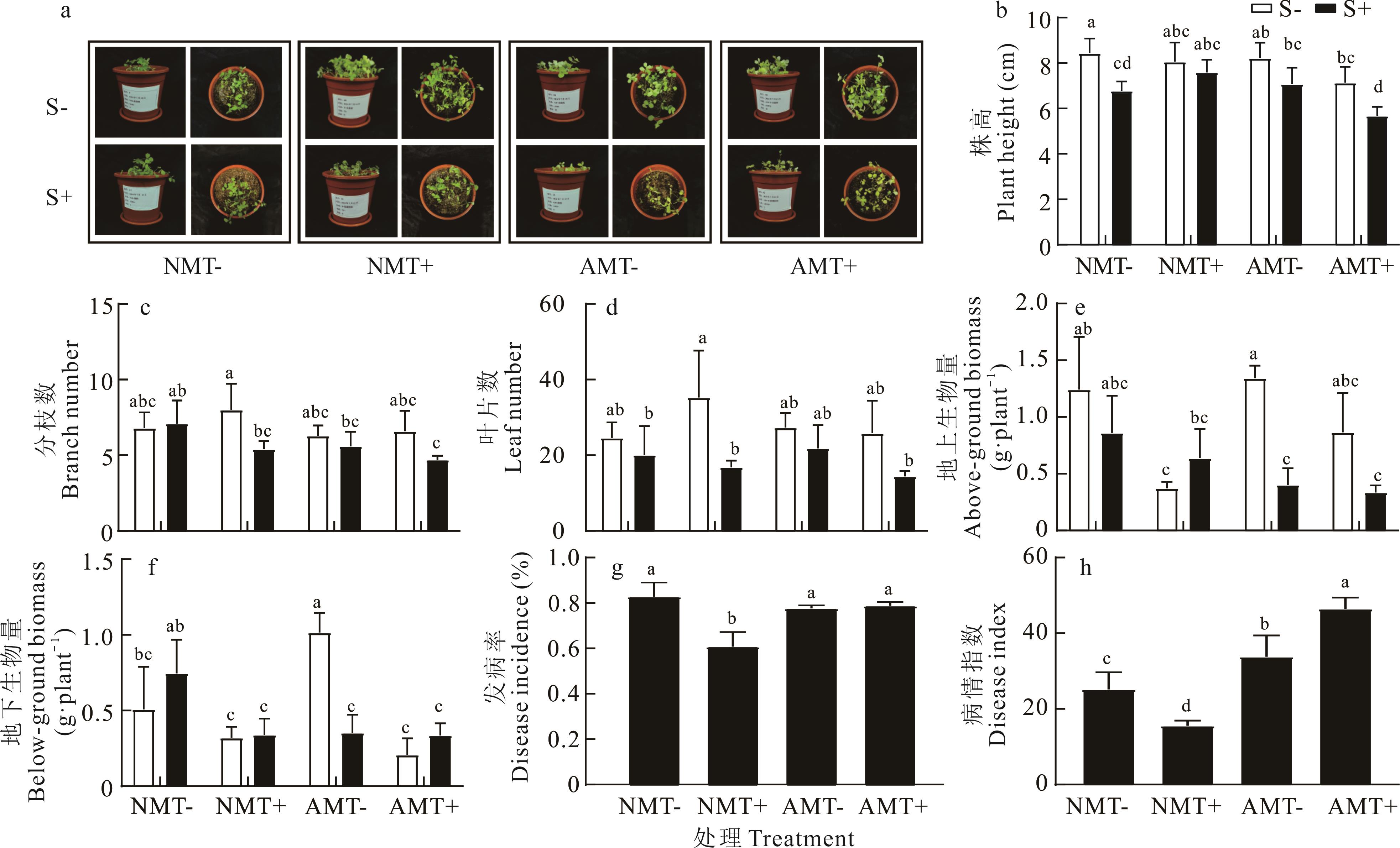
图1 不同接种处理下的植物生长情况(a): 植株生长情况Plant growth status; (b): 株高Plant height; (c): 分枝数Branch number; (d): 叶片数Leaf number; (e): 地上生物量Above-ground biomass; (f): 地下生物量Below-ground biomass; (g): 发病率Disease incidence; (h): 病情指数Disease index. 误差棒代表平均值±标准偏差(n=5)。不同的字母表示经Duncan检验后(P<0.05)处理间存在显著差异。下同。Each bar represents mean±standard deviation (n=5). Different letters indicate significant differences among treatments by Duncan’s test at P<0.05. The same below.
Fig.1 Plant growth under different inoculation treatments
指标 Parameter | 互作效应Interactions effect | |||||||
|---|---|---|---|---|---|---|---|---|
丛枝菌根真菌 Arbuscular mycorrhizal (AM) | 木霉菌 Trichoderma (T) | 核盘菌 Sclerotinia sclerotiorum (S) | AM×T | AM×S | T×S | AM×T×S | ||
| 株高Plant height (PH) | 0.002 | 0.016 | <0.001 | <0.001 | NS | NS | NS | |
| 叶片数Leaf number (LN) | NS | NS | <0.001 | NS | NS | 0.025 | NS | |
| 分枝数Number of branch (BN) | 0.007 | NS | 0.001 | NS | NS | 0.007 | NS | |
| 地上生物量Above-ground biomass (AGB) | NS | <0.001 | <0.001 | NS | 0.001 | 0.009 | NS | |
| 地下生物量Below-ground biomass (BGB) | NS | <0.001 | NS | NS | 0.002 | 0.019 | <0.001 | |
| 发病率Disease incidence | 0.004 | <0.001 | <0.001 | NS | 0.004 | <0.001 | NS | |
| 病情指数Disease index | <0.001 | NS | <0.001 | <0.001 | <0.001 | NS | <0.001 | |
| 超氧化物歧化酶活性Superoxide dismutase activity (SOD) | NS | NS | NS | NS | NS | NS | NS | |
| 过氧化物酶活性Peroxidase activity (POD) | NS | NS | NS | NS | NS | NS | NS | |
| 过氧化氢酶活性Catalase activity (CAT) | <0.001 | NS | 0.006 | NS | NS | 0.013 | <0.001 | |
| 多酚氧化酶活性Polyphenol oxidase activity (PPO) | NS | NS | NS | NS | NS | NS | NS | |
| 丙二醛含量Malondialdehyde content (MDA) | NS | NS | <0.001 | NS | NS | 0.010 | NS | |
| 可溶性糖含量Soluble sugar content (SS) | NS | NS | NS | NS | NS | NS | NS | |
表2 丛枝菌根真菌、木霉菌和病原菌及三者互作效应的方差分析
Table 2 Analysis of variance for arbuscular mycorrhizal fungi (AM), Trichoderma (T), pathogenic fungi (S) and their interactions
指标 Parameter | 互作效应Interactions effect | |||||||
|---|---|---|---|---|---|---|---|---|
丛枝菌根真菌 Arbuscular mycorrhizal (AM) | 木霉菌 Trichoderma (T) | 核盘菌 Sclerotinia sclerotiorum (S) | AM×T | AM×S | T×S | AM×T×S | ||
| 株高Plant height (PH) | 0.002 | 0.016 | <0.001 | <0.001 | NS | NS | NS | |
| 叶片数Leaf number (LN) | NS | NS | <0.001 | NS | NS | 0.025 | NS | |
| 分枝数Number of branch (BN) | 0.007 | NS | 0.001 | NS | NS | 0.007 | NS | |
| 地上生物量Above-ground biomass (AGB) | NS | <0.001 | <0.001 | NS | 0.001 | 0.009 | NS | |
| 地下生物量Below-ground biomass (BGB) | NS | <0.001 | NS | NS | 0.002 | 0.019 | <0.001 | |
| 发病率Disease incidence | 0.004 | <0.001 | <0.001 | NS | 0.004 | <0.001 | NS | |
| 病情指数Disease index | <0.001 | NS | <0.001 | <0.001 | <0.001 | NS | <0.001 | |
| 超氧化物歧化酶活性Superoxide dismutase activity (SOD) | NS | NS | NS | NS | NS | NS | NS | |
| 过氧化物酶活性Peroxidase activity (POD) | NS | NS | NS | NS | NS | NS | NS | |
| 过氧化氢酶活性Catalase activity (CAT) | <0.001 | NS | 0.006 | NS | NS | 0.013 | <0.001 | |
| 多酚氧化酶活性Polyphenol oxidase activity (PPO) | NS | NS | NS | NS | NS | NS | NS | |
| 丙二醛含量Malondialdehyde content (MDA) | NS | NS | <0.001 | NS | NS | 0.010 | NS | |
| 可溶性糖含量Soluble sugar content (SS) | NS | NS | NS | NS | NS | NS | NS | |
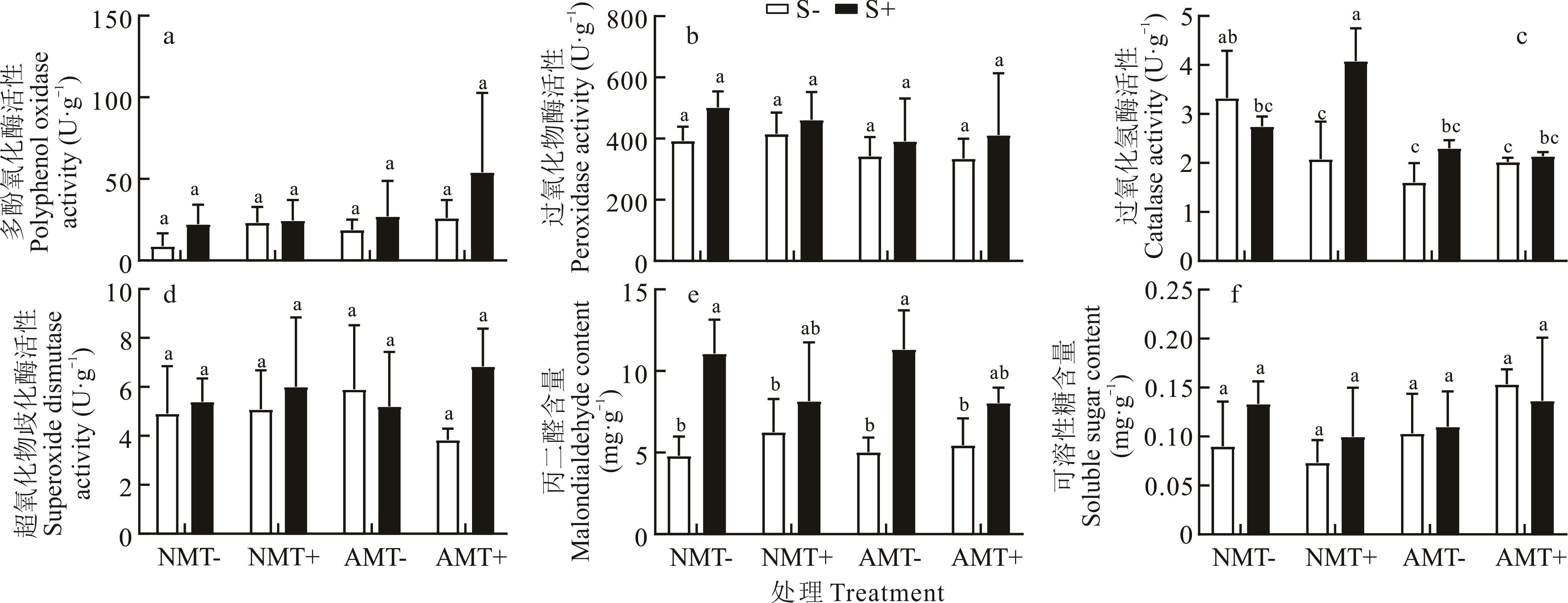
图2 不同接种处理下的生理指标变化
Fig.2 Changes in physiological indices under different inoculation treatments

图3 不同接种处理下细菌物种组成及群落多样性(a): 门水平下的物种组成Species composition at the phylum level; (b): 属水平下的物种组成Species composition at the genus level; (c): 不同处理组扩增子序列变体花瓣图Petalograms of amplicon sequence varians in different treatment groups; (d): 不同处理样本的主坐标分析Principal co-ordinates analysis of samples from different treatments.
Fig.3 Bacterial species composition and community diversity under different inoculation treatments

图4 不同接种处理下的生物标志物(a): LEfSe分析进化分枝图Evolutionary branching diagram of LEfSe analysis; (b): LDA值分布柱状图Histogram of linear discriminant analysis value distribution.
Fig.4 Biomarkers under different inoculation treatments

图5 细菌类群之间网络互作及生理指标相关性分析(a): 属水平各物种网络图Network diagram of each species at the genus level; (b): 植物生理指标相关性分析及叶际细菌扩增子序列变体的曼特尔分析Correlation analysis of plant physiological indicators and Mantel analysis of interleaf bacterial amplicon sequence varians.
Fig.5 Analysis of network interactions among bacterial communities and the correlation of physiological indicators
| [1] | Liu C L, He C M, Wang L M, et al. The study on comprehensive value of Chinese milk vetch as forage and green manure. Acta Agrestia Sinica, 2020, 28(3): 857-862. |
| 刘彩玲, 何春梅, 王利民, 等. 紫云英作为饲草和绿肥综合利用价值的研究. 草地学报, 2020, 28(3): 857-862. | |
| [2] | Cao W D, Huang H X. Ideas on restoration and development of green manures in China. Soils and Fertilizer Sciences in China, 2009(4): 1-3. |
| 曹卫东, 黄鸿翔. 关于我国恢复和发展绿肥若干问题的思考. 中国土壤与肥料, 2009(4): 1-3. | |
| [3] | Zhan Y. Occurrence and control techniques of Sclerotinia disease in forage Astragalus sinicus. China Agricultural Information, 2015(20): 94-95. |
| 詹杨. 饲用紫云英菌核病发生与防治技术. 中国农业信息, 2015(20): 94-95. | |
| [4] | Shi H F, Guo Z F. Advances in research on germplasm resources and genetic breeding of Astragalus sinicus. Pratacultural Science, 2020, 37(12): 2507-2519. |
| 施海帆, 郭振飞. 紫云英种质资源与遗传育种研究进展. 草业科学, 2020, 37(12): 2507-2519. | |
| [5] | Bolton M D, Thomma P H J, Nelson B D. Sclerotinia sclerotiorum (Lib.) de Bary: biology and molecular traits of a cosmopolitan pathogen. Molecular Plant Pathology, 2006, 7(1): 1-16. |
| [6] | Li E C, Xi Z, Zhu N, et al. Research advances on biocontrol of sclerotiniarot caused by Sclerotinia sclerotiorum. Journal of Yunnan Agricultural University (Natural Science), 2023, 38(4): 714-724. |
| 李恩琛, 郗征, 朱娜, 等. 核盘菌引起的菌核病生物防治研究进展. 云南农业大学学报(自然科学), 2023, 38(4): 714-724. | |
| [7] | Jia H M, Fang Q, Zhang S H, et al. Effects of AM fungi on growth and rhizosphere soil enzyme activities of Salvia miltiorrhiza. Acta Prataculturae Sinica, 2020, 29(6): 83-92. |
| 贾红梅, 方千, 张秫华, 等. AM真菌对丹参生长及根际土壤酶活性的影响. 草业学报, 2020, 29(6): 83-92. | |
| [8] | Li X Y, Yi L T, Li Y, et al.Advances in research on plant tolerance to abiotic stress by arbuscular mycorrhizal fungi. Journal of Zhejiang Forestry Science and Technology, 2022, 42(1): 101-110. |
| 李晓芸, 伊力塔, 李彦, 等. 丛枝菌根真菌提高植物非生物胁迫耐受性研究进展. 浙江林业科技, 2022, 42(1): 101-110. | |
| [9] | Wang G J, Xia S, Cui Y N, et al. Effects of AM fungi on plant stress resistance and the mechanisms. Journal of Changchun Normal University, 2019, 38(12): 79-81. |
| 王桂君, 夏霜, 崔亚男, 等. AM真菌对植物抗逆性的影响及机制探讨. 长春师范大学学报, 2019, 38(12): 79-81. | |
| [10] | Zhang W, Yang J Y, Lu X, et al. A preliminary study of the antifungal activity and antagonism mechanisms of Trichoderma spp. against turfgrass pathogens. Acta Prataculturae Sinica, 2021, 30(9): 137-149. |
| 章武, 杨锦玉, 卢翔, 等. 木霉菌对草坪草病原菌的抑菌效果及其机理初步研究. 草业学报, 2021, 30(9): 137-149. | |
| [11] | Chen Y R. Screening and disease prevention mechanism of biocontrol Trichoderma against Sclerotinia sclerotiorum in sunflower. Daqing: Heilongjiang Bayi Agricultural University, 2022. |
| 陈玉蓉. 向日葵菌核病生防木霉菌的筛选与防病机制研究. 大庆: 黑龙江八一农垦大学, 2022. | |
| [12] | Liang W B. Diversity in mycoviruses of Sclerotinia sclerotiorum from America on pinto and garden bean. Wuhan: Huazhong Agricultural University, 2021. |
| 梁炜博. 美国斑豆和菜豆菌核病菌中真菌病毒的多样性. 武汉: 华中农业大学, 2021. | |
| [13] | National Agricultural Technology Extension Service Center. Technical specification for the monitoring and reporting of sclerotinia stem rot in rapeseed: NY/T2038-2011. Beijing: China Agriculture Press, 2011. |
| 全国农业技术推广服务中心. 油菜菌核病测报技术规范: NY/T2038-2011. 北京: 中国农业出版社, 2011. | |
| [14] | Yang G, Qiao L, Lv Y H, et al. Field control effect of five fungicides on Sclerotinia trifoliorum. Chinese Agricultural Science Bulletin, 2017, 33(14): 109-112. |
| 杨光, 乔利, 吕玉虎, 等. 5种杀菌剂对紫云英菌核病大田防效测定. 中国农学通报, 2017, 33(14): 109-112. | |
| [15] | Li H S, Sun Q, Zhao S J, et al. Principles and techniques of plant physiology and biochemistry experiments. Beijing: Higher Education Press, 2015. |
| 李合生, 孙群, 赵世杰, 等. 植物生理生化实验原理与技术. 北京: 高等教育出版社, 2015. | |
| [16] | Lorrai R, Ferrari S. Host cell wall damage during pathogen infection: mechanisms of perception and role in plant-pathogen interactions. Plants, 2021, 10(2): 399. |
| [17] | Munzert K S, Engelsdorf T. Plant cell wall structure and dynamics in plant-pathogen interactions and pathogen defence. Journal of Experimental Botany, 2025, 76(2): 228-242. |
| [18] | Alfiky A, Weisskopf L. Deciphering Trichoderma-plant-pathogen interactions for better development of biocontrol applications. Journal of Fungi, 2021, 7(1): 61. |
| [19] | Chakraborty B N, Chakraborty U, Sunar K. Induced immunity developed by Trichoderma species in plants//Anil K S, Pratibha S. Trichoderma: Host pathogen interactions and applications. Singapore: Springer Singapore, 2020: 125-147. |
| [20] | Cai F, Chen W, Wei Z, et al. Colonization of Trichoderma harzianum strain SQR-T037 on tomato roots and its relationship to plant growth, nutrient availability and soil microflora. Plant and Soil, 2015, 338(1): 337-350. |
| [21] | Shang P P, Zheng R C, Li Y D, et al. Effect of AM fungi on the growth and powdery mildew development of Astragalus sinicus L. under water stress. Plant Physiology and Biochemistry, 2025, 219: 109422. |
| [22] | Li Y D, Duan T Y. Effects of AM fungi on alfalfa leaf spot caused by Phoma medicaginis and pea aphids Acyrthosiphon pisum. Chinese Journal of Ecology, 2020, 39(4): 1214-1221. |
| 李应德, 段廷玉. AM真菌对紫花苜蓿茎点霉叶斑病及豌豆蚜为害的影响. 生态学杂志, 2020, 39(4): 1214-1221. | |
| [23] | Zhang W Z, Ding T T, Duan T Y. Effect of two kinds of arbuscular mycorrhizal fungi on plant growth and anthracnose of Vicia sativa. Pratacultural Science, 2020, 37(2): 320-329. |
| 张伟珍, 丁婷婷, 段廷玉. 两种AM真菌对箭筈豌豆生长及炭疽病发生的影响. 草业科学, 2020, 37(2): 320-329. | |
| [24] | Anzano A, Bonanomi G, Mazzoleni S, et al. Plant metabolomics in biotic and abiotic stress: a critical overview. Phytochemistry Reviews, 2022, 21(2): 503-524. |
| [25] | Mishra N, Jiang C K, Chen L, et al. Achieving abiotic stress tolerance in plants through antioxidative defense mechanisms. Frontiers in Plant Science, 2023, 14: 1110622. |
| [26] | Constabel C P, Barbehenn R. Defensive roles of polyphenol oxidase in plants//Andreas S. Induced plant resistance to herbivory. Dordrecht, The Netherlands: Springer, 2008: 253-270. |
| [27] | Fujita M, Hasanuzzaman M. Approaches to enhancing antioxidant defense in plants. Antioxidants, 2022, 11(5): 925. |
| [28] | Selinski J, Scheibe R, Day D A, et al. Alternative oxidase is positive for plant performance. Trends in Plant Science, 2018, 23(7): 588-597. |
| [29] | Gong T, Xin X F. Phyllosphere microbiota: Community dynamics and its interaction with plant host. Journal of Integrative Plant Biology, 2021, 63(2): 297-304. |
| [30] | Chen T, Nomura K, Wang X, et al. A plant genetic network for preventing dysbiosis in the phyllospher. Nature, 2020, 580(7805): 653-657. |
| [31] | Sohrabi R, Paasch B C, Liber J A, et al. Phyllosphere microbiome. Annual Review of Plant Biology, 2023, 74(1): 539-568. |
| [32] | Wei Z, Hu J, Gu Y A, et al. Ralstonia solanacearum pathogen disrupts bacterial rhizosphere microbiome during an invasion. Soil Biology and Biochemistry, 2018, 118: 8-17. |
| [33] | Li T, Shi X T, Wang J G, et al. Turning antagonists into allies: Bacterial-fungal interactions enhance the efficacy of controlling Fusarium wilt disease. Science Advances, 2025, 11(7): eads5089. |
| [34] | Zhu R, Yan W, Wang Y J, et al. Plant growth-promoting rhizobacteria and Trichoderma shift common vetch (Vicia sativa) physiology and phyllosphere bacteria toward antagonism against anthracnose caused by Colletotrichum spinaciae. Grassland Research, 2024, 3(3): 275-289. |
| [35] | Custodio V, Salas-González I, Gopaulchan D, et al. Individual leaf microbiota tunes a genetic regulatory network to promote leaf growth. Cell Host & Microbe, 2025, 33(3): 436-450. |
| [1] | 林平冬, 缪伏荣, 刘景, 岳稳, 陈鑫珠. 不同添加剂对茶渣青贮品质和微生物多样性的影响[J]. 草业学报, 2026, 35(8): 123-133. |
| [2] | 刘璐瑶, 崔东, 刘淑琪, 江智诚, 吴昀昊, 刘泽征, 刘隽琦. 苦豆子成熟期-凋落期土壤节肢动物群落对氮磷输入的响应[J]. 草业学报, 2026, 35(8): 193-206. |
| [3] | 万里, 陈晓芬, 周国朋, 何小林, 秦文婧, 罗文文, 刘佳. 鄱阳湖流域机收双季晚稻田紫云英适宜播期与播量研究[J]. 草业学报, 2026, 35(8): 22-31. |
| [4] | 张博鸿, 马祥, 琚泽亮, 段连学, 王小军, 贾志锋. 不同生态条件下燕麦种质资源遗传多样性分析与综合评价[J]. 草业学报, 2026, 35(7): 151-164. |
| [5] | 马玉龙, 邱开阳, 骆欣怡, 张晶晶, 王雨航, 王国会, 郑翔, 海旭莹, 薛斌, 谢应忠. 不同固沙植被恢复模式对土壤理化性质、酶活性和草本植物多样性的影响[J]. 草业学报, 2026, 35(6): 1-12. |
| [6] | 甘芮, 吉尔尔格null, 隋晓青, 刘海军, 刘雨旋, 靳瑰丽, 穆耶赛尔·麦麦提null. 接种丛枝菌根真菌对无芒雀麦生长特性及糖含量的影响[J]. 草业学报, 2026, 35(6): 122-130. |
| [7] | 聂莹莹, 徐丽君, 徐修远, 薛玮, 吴欣珈, 袁波, 张钊, 张洪志, 周琼, 李禹霖. 养分添加对科尔沁盐碱化草地植物多样性和地上生物量的影响[J]. 草业学报, 2026, 35(5): 61-71. |
| [8] | 李豫悦, 魏浩男, 马兴忠, 姜海鑫, 聂明鹤, 周瑶, 代成江, 田小武, 王国会, 马红彬. 轮牧对荒漠草原土壤种子库特征的影响[J]. 草业学报, 2026, 35(4): 1-13. |
| [9] | 王贝贝, 杨畅, 朱文琰, 徐世晓, 孙平. 不同龄级瑞香狼毒根系周围微生物群落结构的空间差异研究[J]. 草业学报, 2026, 35(3): 128-157. |
| [10] | 刘阳, 肖红, 徐长林, 邓明月, 魏文强, 韩奥, 马凯, 王昀. 东祁连山高寒草甸山生柳灌木扩张对草本植物群落特征的影响[J]. 草业学报, 2026, 35(3): 13-25. |
| [11] | 王慧腾, 刘文兰, 唐红, 刘晓娟, 韩蓉, 宋捷. 兰州滨河公园自生植物物种多样性与功能多样性对城市化的响应[J]. 草业学报, 2026, 35(3): 96-113. |
| [12] | 周诗杰, 王义莲, 孙攀, 尚静, 杨文钰, 王学贵, 杨继芝. 四川省玉米大豆带状复合种植田杂草发生种类及群落特征分析[J]. 草业学报, 2026, 35(2): 143-154. |
| [13] | 何佳奇, 吴林, 邱智敏, 高绪勇, 高伦伦, 付双彬, 杨燕萍, 王培龙, 徐婉, 周庄. 温州绕城高速公路边坡杂草物种多样性及群落特征[J]. 草业学报, 2026, 35(2): 40-53. |
| [14] | 郁国梁, 杨尚剑, 王建成, 王喜勇. 新疆和静县草地物种多样性和系统发育多样性特征及其影响因子研究[J]. 草业学报, 2026, 35(11): 1-12. |
| [15] | 刘彩玲, 黄水珍, 黄毅斌, 叶红云, 何春梅, 钟少杰, 李清华, 王飞. 紫云英种质资源菜肥兼用价值综合评价[J]. 草业学报, 2026, 35(10): 91-105. |
| 阅读次数 | ||||||
|
全文 |
|
|||||
|
摘要 |
|
|||||
