

ISSN 1004-5759 CN 62-1105/S
草业学报 ›› 2026, Vol. 35 ›› Issue (8): 193-206.DOI: 10.11686/cyxb2025319
• 研究论文 • 上一篇
刘璐瑶1,2( ), 崔东1,3(), 刘淑琪1,3, 江智诚1,3, 吴昀昊1,3, 刘泽征1,3, 刘隽琦1,3
收稿日期:2025-08-05
修回日期:2025-09-20
出版日期:2026-08-20
发布日期:2026-06-22
通讯作者:
崔东
作者简介:Corresponding author. E-mail: cuidongw@126.com基金资助:
Lu-yao LIU1,2(), Dong CUI1,3(), Shu-qi LIU1,3, Zhi-cheng JIANG1,3, Yun-hao WU1,3, Ze-zheng LIU1,3, Jun-qi LIU1,3
Received:2025-08-05
Revised:2025-09-20
Online:2026-08-20
Published:2026-06-22
Contact:
Dong CUI
摘要:
本研究以新疆伊犁苦豆子型退化草地土壤动物为对象,在以苦豆子为优势物种的自由放牧草地设置氮添加(N)、磷添加(P)、氮磷添加(NP)和未施氮磷(CK)控制试验,研究苦豆子成熟期-凋落期养分添加下土壤动物群落和土壤环境因子的响应及其关键驱动因子。结果表明:1)氮添加、磷添加和氮磷添加均降低了土壤动物密度和类群数。苦豆子成熟期,氮添加、磷添加和氮磷添加均降低了Shannon-Wiener多样性指数和丰富度指数;凋落期,氮添加、磷添加和氮磷添加均增加了Shannon-Wiener多样性指数和均匀度指数,降低了优势度指数;并显著降低了捕食性土壤动物个体数(P<0.05)。2)氮添加、磷添加、氮磷添加和对照土壤有机碳、全磷、铵态氮含量和土壤含水率在成熟期均高于凋落期。3)成熟期,土壤含水率、有机碳是影响土壤动物群落结构的主要环境因子;凋落期,pH值是影响土壤动物群落结构的主要环境因子。综上,养分添加、成熟期-凋落期与环境因子共同驱动苦豆子型退化草地土壤动物多样性及功能类群变化,对深入理解及管理伊犁退化草地生态系统具有重要意义。
刘璐瑶, 崔东, 刘淑琪, 江智诚, 吴昀昊, 刘泽征, 刘隽琦. 苦豆子成熟期-凋落期土壤节肢动物群落对氮磷输入的响应[J]. 草业学报, 2026, 35(8): 193-206.
Lu-yao LIU, Dong CUI, Shu-qi LIU, Zhi-cheng JIANG, Yun-hao WU, Ze-zheng LIU, Jun-qi LIU. Response of the soil arthropod community to nitrogen and phosphorus inputs during the maturity-senescence period of Sophora alopecuroides[J]. Acta Prataculturae Sinica, 2026, 35(8): 193-206.
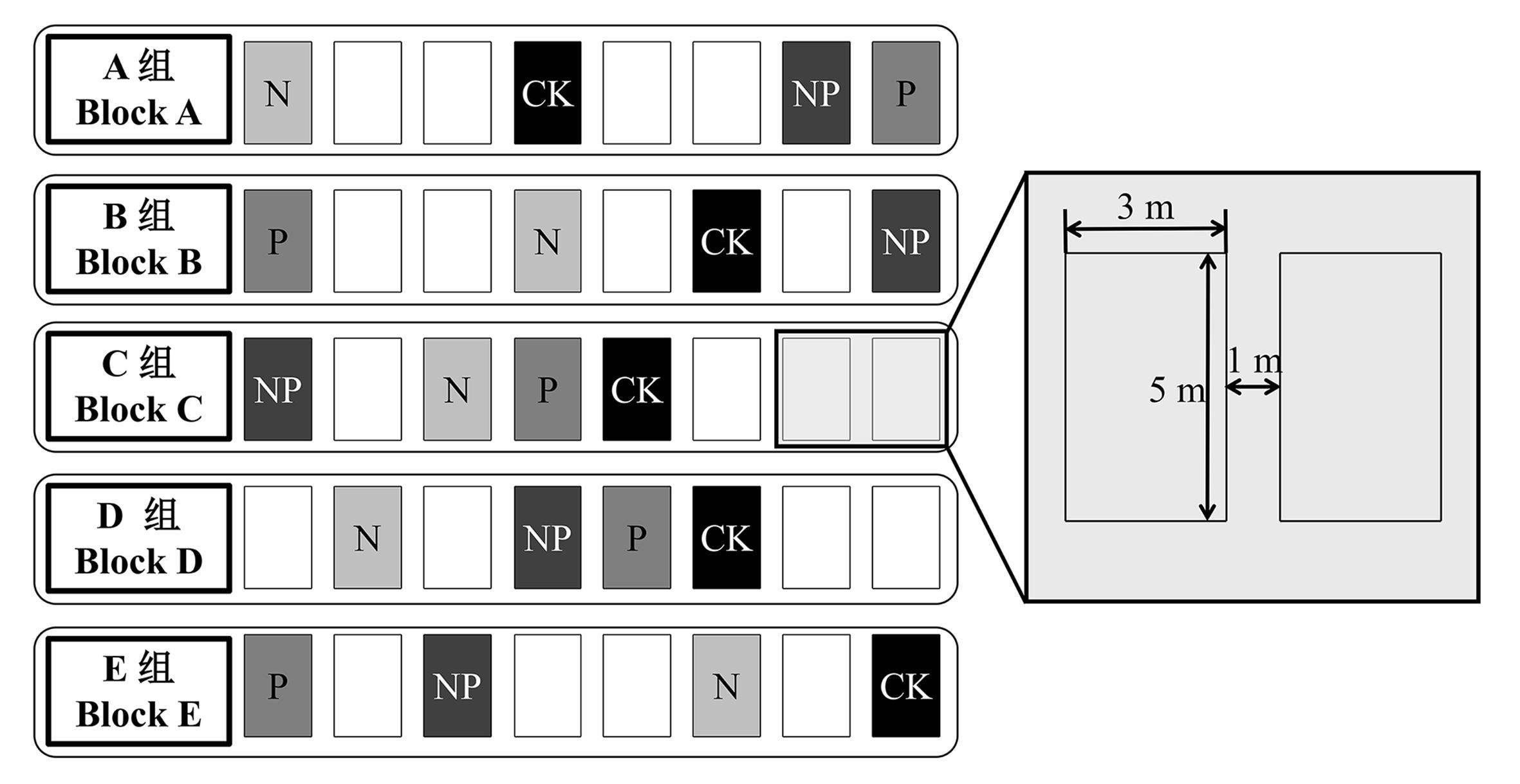
图1 研究样地设计
Fig.1 Sample plot design
类群 Taxa | 氮添加N | 磷添加P | 氮磷添加NP | 对照CK | ||||||||
|---|---|---|---|---|---|---|---|---|---|---|---|---|
| ni | Perc. | A | ni | Perc. | A | ni | Perc. | A | ni | Perc. | A | |
| 苦豆子成熟期Maturity stage of S. alopecuroides | ||||||||||||
| 胭螨科Rhodacaridae | 13 | 12.62 | +++ | 48 | 25.53 | +++ | 15 | 12.00 | +++ | 29 | 10.90 | +++ |
| 角绥螨科Antennoseiidae | 1 | 0.97 | + | 0 | 0.00 | 0 | 0.00 | 0 | 0.00 | |||
| 下盾螨科Hypoaspidae | 4 | 3.88 | ++ | 6 | 3.19 | ++ | 15 | 12.00 | +++ | 49 | 18.42 | +++ |
| 糙尾足螨科Trachyuropodidae | 0 | 0.00 | 2 | 1.06 | ++ | 0 | 0.00 | 17 | 6.39 | ++ | ||
| 裂胸螨科Aceosejidae | 0 | 0.00 | 3 | 1.60 | ++ | 2 | 1.60 | ++ | 0 | 0.00 | ||
| 派伦螨科Parholaspidae | 0 | 0.00 | 1 | 0.53 | + | 1 | 0.80 | + | 1 | 0.38 | + | |
| 尾足螨科Uropodidae | 0 | 0.00 | 22 | 11.70 | +++ | 1 | 0.80 | + | 17 | 6.39 | ++ | |
| 古甲螨科Palaeacaridae | 0 | 0.00 | 2 | 1.06 | ++ | 1 | 0.80 | + | 2 | 0.75 | + | |
| 奥甲螨科Oppiidae | 56 | 54.37 | +++ | 60 | 31.91 | +++ | 59 | 47.20 | +++ | 91 | 34.21 | +++ |
| 广缝甲螨科Cosmochthoniidae | 1 | 0.97 | + | 3 | 1.60 | ++ | 3 | 2.40 | ++ | 3 | 1.13 | ++ |
| 长单翼甲螨科Protoribatidae | 2 | 1.94 | ++ | 0 | 0.00 | 0 | 0.00 | 0 | 0.00 | |||
| 上罗甲螨科Epilohmanniidae | 0 | 0.00 | 0 | 0.00 | 0 | 0.00 | 1 | 0.38 | + | |||
| 懒甲螨科Nothridae | 0 | 0.00 | 0 | 0.00 | 0 | 0.00 | 3 | 1.13 | ++ | |||
| 缝甲螨科Hypochthoniidae | 0 | 0.00 | 0 | 0.00 | 0 | 0.00 | 1 | 0.38 | + | |||
| 步甲螨科Carabodidae | 0 | 0.00 | 0 | 0.00 | 0 | 0.00 | 2 | 0.75 | + | |||
| 赤螨科Erythraeidae | 2 | 1.94 | ++ | 1 | 0.53 | + | 6 | 4.80 | ++ | 5 | 1.88 | ++ |
| 莓螨科Rhagidiidae | 0 | 0.00 | 0 | 0.00 | 0 | 0.00 | 22 | 8.27 | ++ | |||
| 球角跳科Hypogastruridae | 1 | 0.97 | + | 0 | 0.00 | 0 | 0.00 | 0 | 0.00 | |||
| 棘跳科Onychiuridae | 3 | 2.91 | ++ | 0 | 0.00 | 0 | 0.00 | 0 | 0.00 | |||
| 长角跳科Entomobryidae | 1 | 0.97 | + | 0 | 0.00 | 2 | 1.60 | ++ | 1 | 0.38 | + | |
| 等节跳科Isotomidae | 0 | 0.00 | 2 | 1.06 | ++ | 0 | 0.00 | 4 | 1.50 | ++ | ||
| 叶蝉科Cicadellidae | 3 | 2.91 | ++ | 1 | 0.53 | + | 3 | 2.40 | ++ | 0 | 0.00 | |
| 蚜总科Aphididae | 0 | 0.00 | 2 | 1.06 | ++ | 0 | 0.00 | 1 | 0.38 | + | ||
| 蝉总科Cicadoidea | 0 | 0.00 | 1 | 0.53 | + | 0 | 0.00 | 1 | 0.38 | + | ||
| 蓟马科Thripidae | 0 | 0.00 | 0 | 0.00 | 1 | 0.80 | + | 0 | 0.00 | |||
| 隐翅虫科Staphylinidae | 2 | 1.94 | ++ | 0 | 0.00 | 0 | 0.00 | 0 | 0.00 | |||
| 步甲科Carabidae | 0 | 0.00 | 1 | 0.53 | + | 0 | 0.00 | 0 | 0.00 | |||
| 象甲科Curculionidae | 0 | 0.00 | 0 | 0.00 | 1 | 0.80 | + | 0 | 0.00 | |||
| 毛蚊科Bibionidae | 1 | 0.97 | + | 2 | 1.06 | ++ | 0 | 0.00 | 1 | 0.38 | + | |
| 蚊科Culicidae | 1 | 0.97 | + | 4 | 2.13 | ++ | 3 | 2.40 | ++ | 1 | 0.38 | + |
| 瘿蚊科Cecidomyiidae | 2 | 1.94 | ++ | 0 | 0.00 | 0 | 0.00 | 0 | 0.00 | |||
| 蚁科Formicidae | 5 | 4.85 | ++ | 15 | 7.98 | ++ | 11 | 8.80 | ++ | 2 | 0.75 | + |
| 小蜂总科Chalcidoidea | 0 | 0.00 | 4 | 2.13 | ++ | 0 | 0.00 | 1 | 0.38 | + | ||
| 鞘翅目幼虫Coleoptera larvae | 5 | 4.85 | ++ | 8 | 4.26 | ++ | 1 | 0.80 | + | 11 | 4.14 | ++ |
| 苦豆子凋落期Senescence stage of S. alopecuroides | ||||||||||||
| 蜘蛛目Araneida | 0 | 0.00 | 0 | 0.00 | 0 | 0.00 | 1 | 0.48 | + | |||
| 胭螨科Rhodacaridae | 6 | 5.56 | ++ | 5 | 3.31 | ++ | 9 | 7.83 | ++ | 15 | 7.21 | ++ |
| 下盾螨科Hypoaspidae | 11 | 10.19 | +++ | 17 | 11.26 | +++ | 13 | 11.30 | +++ | 29 | 13.94 | +++ |
| 糙尾足螨科Trachyuropodidae | 8 | 7.41 | ++ | 3 | 1.99 | ++ | 4 | 3.48 | ++ | 4 | 1.92 | ++ |
| 尾足螨科Uropodidae | 0 | 0.00 | 1 | 0.66 | + | 7 | 6.09 | ++ | 6 | 2.88 | ++ | |
| 裂胸螨科Aceosejidae | 6 | 5.56 | ++ | 4 | 2.65 | ++ | 1 | 0.87 | + | 3 | 1.44 | ++ |
| 派伦螨科Parholaspidae | 0 | 0.00 | 0 | 0.00 | 1 | 0.87 | + | 0 | 0.00 | |||
| 寄螨科Parasitidae | 0 | 0.00 | 0 | 0.00 | 0 | 0.00 | 1 | 0.48 | + | |||
| 孔洞螨科Trematuridae | 0 | 0.00 | 0 | 0.00 | 0 | 0.00 | 1 | 0.48 | + | |||
| 古甲螨科Palaeacaridae | 5 | 4.63 | ++ | 2 | 1.32 | ++ | 4 | 3.48 | ++ | 2 | 0.96 | + |
| 礼服甲螨科Trhypochthoniidae | 1 | 0.93 | + | 0 | 0.00 | 0 | 0.00 | 0 | 0.00 | |||
| 奥甲螨科Oppiidae | 21 | 19.44 | +++ | 38 | 25.17 | +++ | 28 | 24.35 | +++ | 88 | 42.31 | +++ |
| 广缝甲螨科Cosmochthoniidae | 2 | 1.85 | ++ | 0 | 0.00 | 4 | 3.48 | ++ | 4 | 1.92 | ++ | |
| 长单翼甲螨科Protoribates | 0 | 0.00 | 0 | 0.00 | 0 | 0.00 | 1 | 0.48 | + | |||
| 上罗甲螨科Epilohmanniidae | 1 | 0.93 | + | 8 | 5.30 | ++ | 3 | 2.61 | ++ | 8 | 3.85 | ++ |
| 珠甲螨科Damaeidae | 2 | 1.85 | ++ | 2 | 1.32 | ++ | 2 | 1.74 | ++ | 0 | 0.00 | |
| 步甲螨科Carabodidae | 0 | 0.00 | 0 | 0.00 | 0 | 0.00 | 1 | 0.48 | + | |||
| 大翼甲螨科Galumnidae | 0 | 0.00 | 0 | 0.00 | 0 | 0.00 | 3 | 1.44 | ++ | |||
| 耳头甲螨科Otocepheidae | 0 | 0.00 | 0 | 0.00 | 0 | 0.00 | 1 | 0.48 | + | |||
| 赤螨科Erythraeidae | 0 | 0.00 | 2 | 1.32 | ++ | 1 | 0.87 | + | 1 | 0.48 | + | |
| 莓螨科Rhagidiidae | 6 | 5.56 | ++ | 16 | 10.60 | +++ | 14 | 12.17 | +++ | 17 | 8.17 | ++ |
| 吸螨科Bdellidae | 0 | 0.00 | 2 | 1.32 | ++ | 2 | 1.74 | ++ | 0 | 0.00 | ||
| 粉螨科Acaridae | 2 | 1.85 | ++ | 29 | 19.21 | +++ | 1 | 0.87 | + | 0 | 0.00 | |
| 绒螨科Trombidiidae | 1 | 0.93 | + | 0 | 0.00 | 0 | 0.00 | 0 | 0.00 | |||
| 球角跳科Hypogastruridae | 2 | 1.85 | ++ | 0 | 0.00 | 0 | 0.00 | 1 | 0.48 | + | ||
| 棘跳科Onychiuridae | 2 | 1.85 | ++ | 0 | 0.00 | 3 | 2.61 | ++ | 0 | 0.00 | ||
| 长角跳科Entomobryidae | 5 | 4.63 | ++ | 5 | 3.31 | ++ | 3 | 2.61 | ++ | 10 | 4.81 | ++ |
| 等节跳科Isotomidae | 1 | 0.93 | + | 0 | 0.00 | 0 | 0.00 | 0 | 0.00 | |||
| 疣跳科Neanuridae | 0 | 0.00 | 0 | 0.00 | 0 | 0.00 | 1 | 0.48 | + | |||
| 粉蚧科Pseudococcidae | 0 | 0.00 | 1 | 0.66 | + | 0 | 0.00 | 0 | 0.00 | |||
| 象甲科Curculionidae | 0 | 0.00 | 1 | 0.66 | + | 3 | 2.61 | ++ | 2 | 0.96 | + | |
| 网蚊科Blephariceridae | 0 | 0.00 | 1 | 0.66 | + | 0 | 0.00 | 0 | 0.00 | |||
| 蚁科Formicidae | 23 | 21.30 | +++ | 7 | 4.64 | ++ | 5 | 4.35 | ++ | 1 | 0.48 | + |
| 啮虫科Psocidae | 1 | 0.93 | + | 0 | 0.00 | 1 | 0.87 | + | 0 | 0.00 | ||
| 地蜈蚣科Geophilidae | 0 | 0.00 | 0 | 0.00 | 0 | 0.00 | 1 | 0.48 | + | |||
| 鞘翅目幼虫Coleoptera larvae | 2 | 1.85 | ++ | 3 | 1.99 | ++ | 5 | 4.35 | ++ | 5 | 2.40 | ++ |
| 双翅目幼虫Diptera larvae | 0 | 0.00 | 3 | 1.99 | ++ | 1 | 0.87 | + | 1 | 0.48 | + | |
| 鳞翅目幼虫Lepidoptera larvae | 0 | 0.00 | 1 | 0.66 | + | 0 | 0.00 | 0 | 0.00 | |||
表1 养分添加对土壤动物个体数及所占比例的影响
Table 1 Response of soil fauna abundance and relative proportion to nutrient addition
类群 Taxa | 氮添加N | 磷添加P | 氮磷添加NP | 对照CK | ||||||||
|---|---|---|---|---|---|---|---|---|---|---|---|---|
| ni | Perc. | A | ni | Perc. | A | ni | Perc. | A | ni | Perc. | A | |
| 苦豆子成熟期Maturity stage of S. alopecuroides | ||||||||||||
| 胭螨科Rhodacaridae | 13 | 12.62 | +++ | 48 | 25.53 | +++ | 15 | 12.00 | +++ | 29 | 10.90 | +++ |
| 角绥螨科Antennoseiidae | 1 | 0.97 | + | 0 | 0.00 | 0 | 0.00 | 0 | 0.00 | |||
| 下盾螨科Hypoaspidae | 4 | 3.88 | ++ | 6 | 3.19 | ++ | 15 | 12.00 | +++ | 49 | 18.42 | +++ |
| 糙尾足螨科Trachyuropodidae | 0 | 0.00 | 2 | 1.06 | ++ | 0 | 0.00 | 17 | 6.39 | ++ | ||
| 裂胸螨科Aceosejidae | 0 | 0.00 | 3 | 1.60 | ++ | 2 | 1.60 | ++ | 0 | 0.00 | ||
| 派伦螨科Parholaspidae | 0 | 0.00 | 1 | 0.53 | + | 1 | 0.80 | + | 1 | 0.38 | + | |
| 尾足螨科Uropodidae | 0 | 0.00 | 22 | 11.70 | +++ | 1 | 0.80 | + | 17 | 6.39 | ++ | |
| 古甲螨科Palaeacaridae | 0 | 0.00 | 2 | 1.06 | ++ | 1 | 0.80 | + | 2 | 0.75 | + | |
| 奥甲螨科Oppiidae | 56 | 54.37 | +++ | 60 | 31.91 | +++ | 59 | 47.20 | +++ | 91 | 34.21 | +++ |
| 广缝甲螨科Cosmochthoniidae | 1 | 0.97 | + | 3 | 1.60 | ++ | 3 | 2.40 | ++ | 3 | 1.13 | ++ |
| 长单翼甲螨科Protoribatidae | 2 | 1.94 | ++ | 0 | 0.00 | 0 | 0.00 | 0 | 0.00 | |||
| 上罗甲螨科Epilohmanniidae | 0 | 0.00 | 0 | 0.00 | 0 | 0.00 | 1 | 0.38 | + | |||
| 懒甲螨科Nothridae | 0 | 0.00 | 0 | 0.00 | 0 | 0.00 | 3 | 1.13 | ++ | |||
| 缝甲螨科Hypochthoniidae | 0 | 0.00 | 0 | 0.00 | 0 | 0.00 | 1 | 0.38 | + | |||
| 步甲螨科Carabodidae | 0 | 0.00 | 0 | 0.00 | 0 | 0.00 | 2 | 0.75 | + | |||
| 赤螨科Erythraeidae | 2 | 1.94 | ++ | 1 | 0.53 | + | 6 | 4.80 | ++ | 5 | 1.88 | ++ |
| 莓螨科Rhagidiidae | 0 | 0.00 | 0 | 0.00 | 0 | 0.00 | 22 | 8.27 | ++ | |||
| 球角跳科Hypogastruridae | 1 | 0.97 | + | 0 | 0.00 | 0 | 0.00 | 0 | 0.00 | |||
| 棘跳科Onychiuridae | 3 | 2.91 | ++ | 0 | 0.00 | 0 | 0.00 | 0 | 0.00 | |||
| 长角跳科Entomobryidae | 1 | 0.97 | + | 0 | 0.00 | 2 | 1.60 | ++ | 1 | 0.38 | + | |
| 等节跳科Isotomidae | 0 | 0.00 | 2 | 1.06 | ++ | 0 | 0.00 | 4 | 1.50 | ++ | ||
| 叶蝉科Cicadellidae | 3 | 2.91 | ++ | 1 | 0.53 | + | 3 | 2.40 | ++ | 0 | 0.00 | |
| 蚜总科Aphididae | 0 | 0.00 | 2 | 1.06 | ++ | 0 | 0.00 | 1 | 0.38 | + | ||
| 蝉总科Cicadoidea | 0 | 0.00 | 1 | 0.53 | + | 0 | 0.00 | 1 | 0.38 | + | ||
| 蓟马科Thripidae | 0 | 0.00 | 0 | 0.00 | 1 | 0.80 | + | 0 | 0.00 | |||
| 隐翅虫科Staphylinidae | 2 | 1.94 | ++ | 0 | 0.00 | 0 | 0.00 | 0 | 0.00 | |||
| 步甲科Carabidae | 0 | 0.00 | 1 | 0.53 | + | 0 | 0.00 | 0 | 0.00 | |||
| 象甲科Curculionidae | 0 | 0.00 | 0 | 0.00 | 1 | 0.80 | + | 0 | 0.00 | |||
| 毛蚊科Bibionidae | 1 | 0.97 | + | 2 | 1.06 | ++ | 0 | 0.00 | 1 | 0.38 | + | |
| 蚊科Culicidae | 1 | 0.97 | + | 4 | 2.13 | ++ | 3 | 2.40 | ++ | 1 | 0.38 | + |
| 瘿蚊科Cecidomyiidae | 2 | 1.94 | ++ | 0 | 0.00 | 0 | 0.00 | 0 | 0.00 | |||
| 蚁科Formicidae | 5 | 4.85 | ++ | 15 | 7.98 | ++ | 11 | 8.80 | ++ | 2 | 0.75 | + |
| 小蜂总科Chalcidoidea | 0 | 0.00 | 4 | 2.13 | ++ | 0 | 0.00 | 1 | 0.38 | + | ||
| 鞘翅目幼虫Coleoptera larvae | 5 | 4.85 | ++ | 8 | 4.26 | ++ | 1 | 0.80 | + | 11 | 4.14 | ++ |
| 苦豆子凋落期Senescence stage of S. alopecuroides | ||||||||||||
| 蜘蛛目Araneida | 0 | 0.00 | 0 | 0.00 | 0 | 0.00 | 1 | 0.48 | + | |||
| 胭螨科Rhodacaridae | 6 | 5.56 | ++ | 5 | 3.31 | ++ | 9 | 7.83 | ++ | 15 | 7.21 | ++ |
| 下盾螨科Hypoaspidae | 11 | 10.19 | +++ | 17 | 11.26 | +++ | 13 | 11.30 | +++ | 29 | 13.94 | +++ |
| 糙尾足螨科Trachyuropodidae | 8 | 7.41 | ++ | 3 | 1.99 | ++ | 4 | 3.48 | ++ | 4 | 1.92 | ++ |
| 尾足螨科Uropodidae | 0 | 0.00 | 1 | 0.66 | + | 7 | 6.09 | ++ | 6 | 2.88 | ++ | |
| 裂胸螨科Aceosejidae | 6 | 5.56 | ++ | 4 | 2.65 | ++ | 1 | 0.87 | + | 3 | 1.44 | ++ |
| 派伦螨科Parholaspidae | 0 | 0.00 | 0 | 0.00 | 1 | 0.87 | + | 0 | 0.00 | |||
| 寄螨科Parasitidae | 0 | 0.00 | 0 | 0.00 | 0 | 0.00 | 1 | 0.48 | + | |||
| 孔洞螨科Trematuridae | 0 | 0.00 | 0 | 0.00 | 0 | 0.00 | 1 | 0.48 | + | |||
| 古甲螨科Palaeacaridae | 5 | 4.63 | ++ | 2 | 1.32 | ++ | 4 | 3.48 | ++ | 2 | 0.96 | + |
| 礼服甲螨科Trhypochthoniidae | 1 | 0.93 | + | 0 | 0.00 | 0 | 0.00 | 0 | 0.00 | |||
| 奥甲螨科Oppiidae | 21 | 19.44 | +++ | 38 | 25.17 | +++ | 28 | 24.35 | +++ | 88 | 42.31 | +++ |
| 广缝甲螨科Cosmochthoniidae | 2 | 1.85 | ++ | 0 | 0.00 | 4 | 3.48 | ++ | 4 | 1.92 | ++ | |
| 长单翼甲螨科Protoribates | 0 | 0.00 | 0 | 0.00 | 0 | 0.00 | 1 | 0.48 | + | |||
| 上罗甲螨科Epilohmanniidae | 1 | 0.93 | + | 8 | 5.30 | ++ | 3 | 2.61 | ++ | 8 | 3.85 | ++ |
| 珠甲螨科Damaeidae | 2 | 1.85 | ++ | 2 | 1.32 | ++ | 2 | 1.74 | ++ | 0 | 0.00 | |
| 步甲螨科Carabodidae | 0 | 0.00 | 0 | 0.00 | 0 | 0.00 | 1 | 0.48 | + | |||
| 大翼甲螨科Galumnidae | 0 | 0.00 | 0 | 0.00 | 0 | 0.00 | 3 | 1.44 | ++ | |||
| 耳头甲螨科Otocepheidae | 0 | 0.00 | 0 | 0.00 | 0 | 0.00 | 1 | 0.48 | + | |||
| 赤螨科Erythraeidae | 0 | 0.00 | 2 | 1.32 | ++ | 1 | 0.87 | + | 1 | 0.48 | + | |
| 莓螨科Rhagidiidae | 6 | 5.56 | ++ | 16 | 10.60 | +++ | 14 | 12.17 | +++ | 17 | 8.17 | ++ |
| 吸螨科Bdellidae | 0 | 0.00 | 2 | 1.32 | ++ | 2 | 1.74 | ++ | 0 | 0.00 | ||
| 粉螨科Acaridae | 2 | 1.85 | ++ | 29 | 19.21 | +++ | 1 | 0.87 | + | 0 | 0.00 | |
| 绒螨科Trombidiidae | 1 | 0.93 | + | 0 | 0.00 | 0 | 0.00 | 0 | 0.00 | |||
| 球角跳科Hypogastruridae | 2 | 1.85 | ++ | 0 | 0.00 | 0 | 0.00 | 1 | 0.48 | + | ||
| 棘跳科Onychiuridae | 2 | 1.85 | ++ | 0 | 0.00 | 3 | 2.61 | ++ | 0 | 0.00 | ||
| 长角跳科Entomobryidae | 5 | 4.63 | ++ | 5 | 3.31 | ++ | 3 | 2.61 | ++ | 10 | 4.81 | ++ |
| 等节跳科Isotomidae | 1 | 0.93 | + | 0 | 0.00 | 0 | 0.00 | 0 | 0.00 | |||
| 疣跳科Neanuridae | 0 | 0.00 | 0 | 0.00 | 0 | 0.00 | 1 | 0.48 | + | |||
| 粉蚧科Pseudococcidae | 0 | 0.00 | 1 | 0.66 | + | 0 | 0.00 | 0 | 0.00 | |||
| 象甲科Curculionidae | 0 | 0.00 | 1 | 0.66 | + | 3 | 2.61 | ++ | 2 | 0.96 | + | |
| 网蚊科Blephariceridae | 0 | 0.00 | 1 | 0.66 | + | 0 | 0.00 | 0 | 0.00 | |||
| 蚁科Formicidae | 23 | 21.30 | +++ | 7 | 4.64 | ++ | 5 | 4.35 | ++ | 1 | 0.48 | + |
| 啮虫科Psocidae | 1 | 0.93 | + | 0 | 0.00 | 1 | 0.87 | + | 0 | 0.00 | ||
| 地蜈蚣科Geophilidae | 0 | 0.00 | 0 | 0.00 | 0 | 0.00 | 1 | 0.48 | + | |||
| 鞘翅目幼虫Coleoptera larvae | 2 | 1.85 | ++ | 3 | 1.99 | ++ | 5 | 4.35 | ++ | 5 | 2.40 | ++ |
| 双翅目幼虫Diptera larvae | 0 | 0.00 | 3 | 1.99 | ++ | 1 | 0.87 | + | 1 | 0.48 | + | |
| 鳞翅目幼虫Lepidoptera larvae | 0 | 0.00 | 1 | 0.66 | + | 0 | 0.00 | 0 | 0.00 | |||
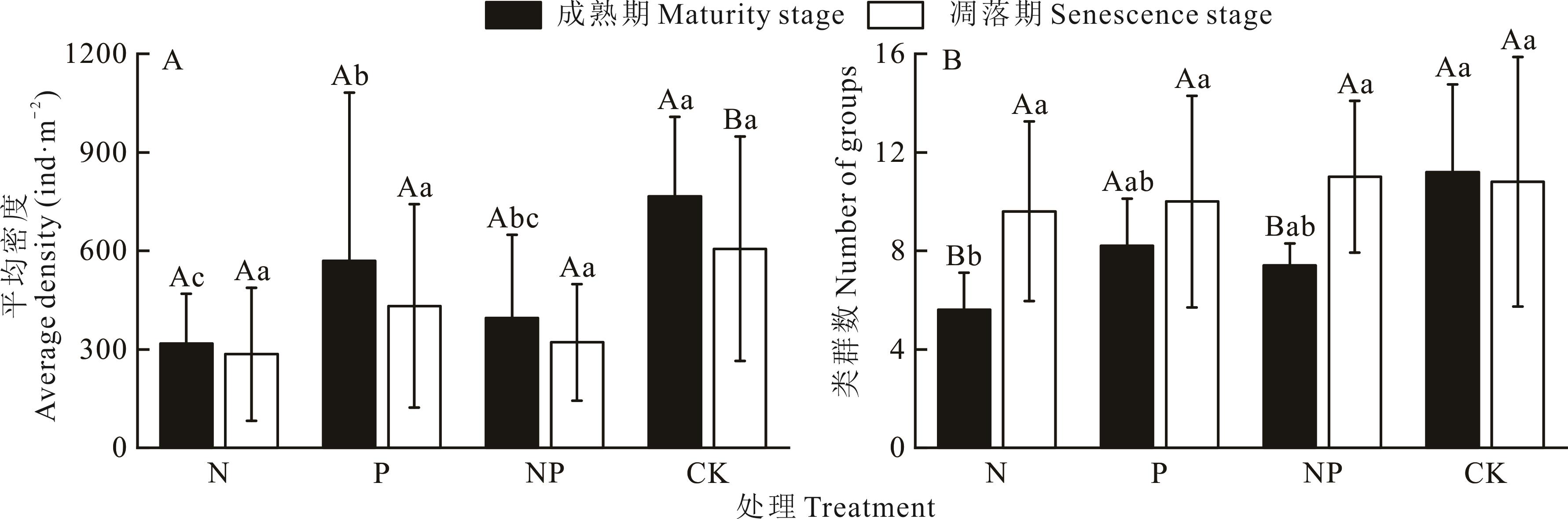
图2 养分添加对土壤动物种群平均密度和类群数的影响不同小写字母表示同一物候期不同处理间差异显著(P<0.05),不同大写字母表示同一处理下成熟期与凋落期差异显著(P<0.05)。下同。Different lowercase letters indicate significant differences (P<0.05) among different treatments within the same phenological period, while different uppercase letters indicate significant differences (P<0.05) between the maturity and senescence periods under the same treatment. The same below.
Fig.2 Effects of nutrient addition on the average density and number of groups of soil fauna
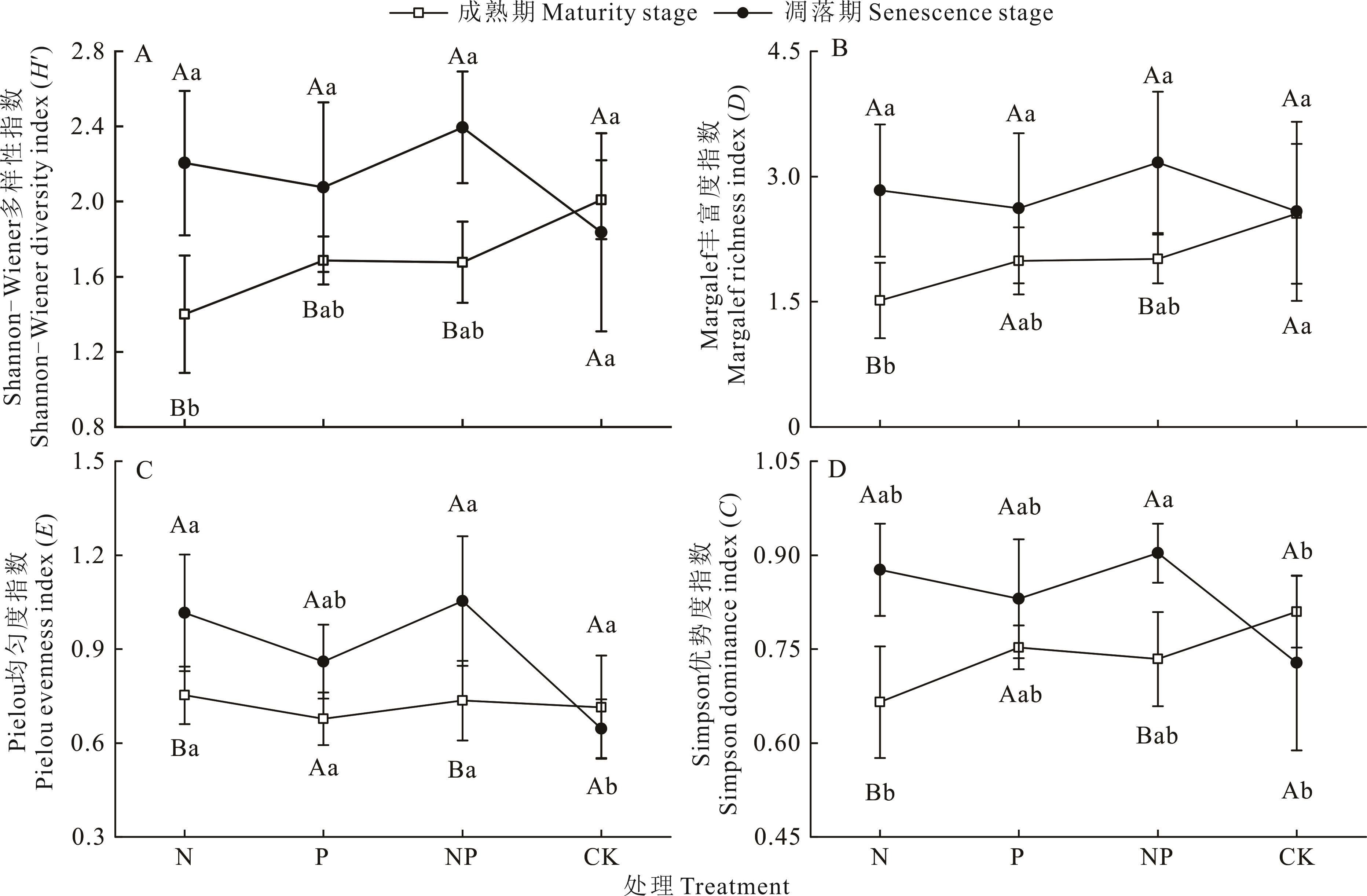
图3 养分添加对土壤动物多样性的影响
Fig.3 Effects of nutrient addition on soil fauna diversity
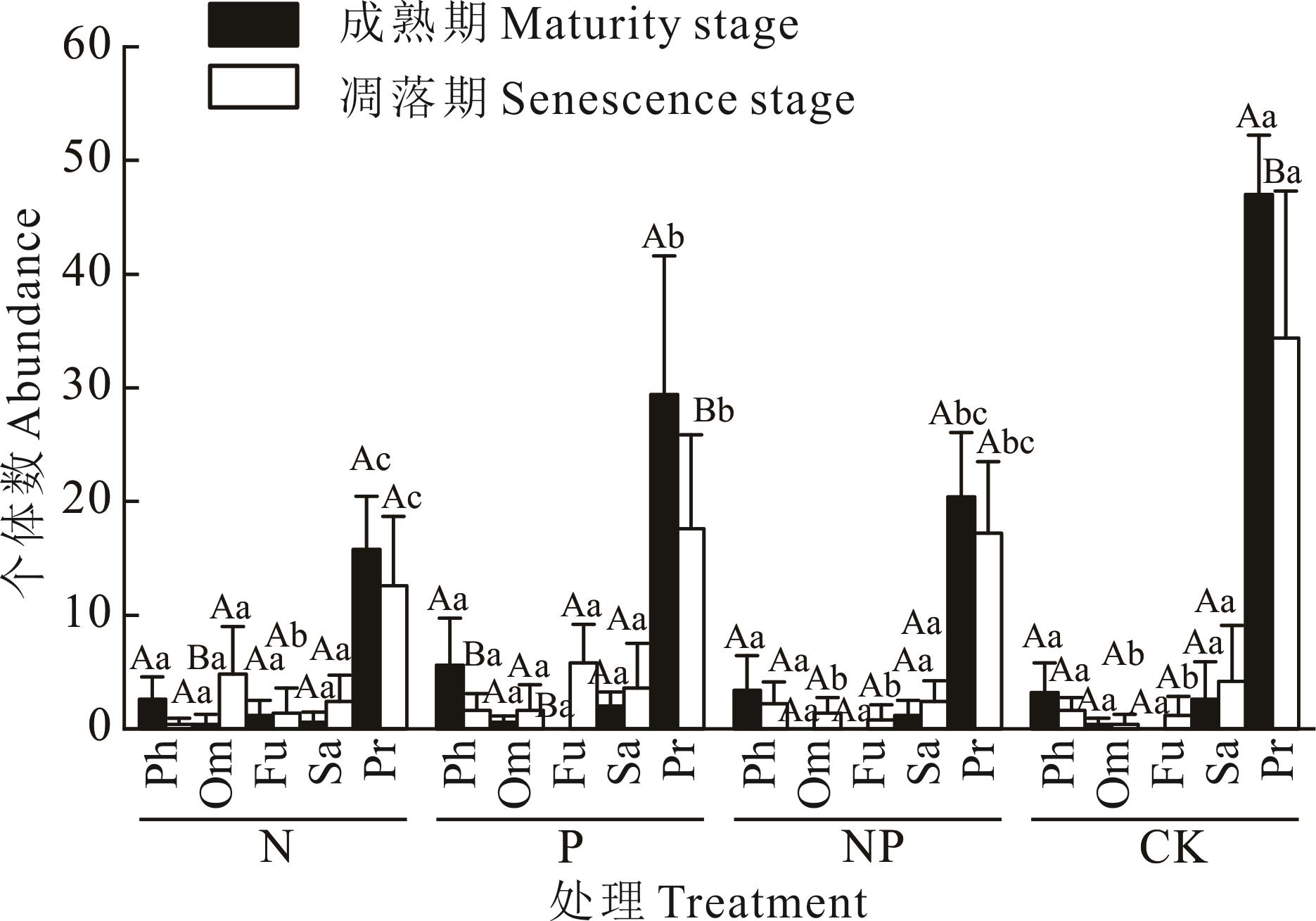
图4 养分添加对土壤动物功能类群个体数的影响Ph: 植食性Phytophages; Om: 杂食性Omnivores; Fu: 食真菌性Fungivores; Pr: 捕食性Predators; Sa: 腐食性Saprophages; 下同The same below.
Fig.4 Effects of nutrient addition on the abundance of soil fauna functional groups
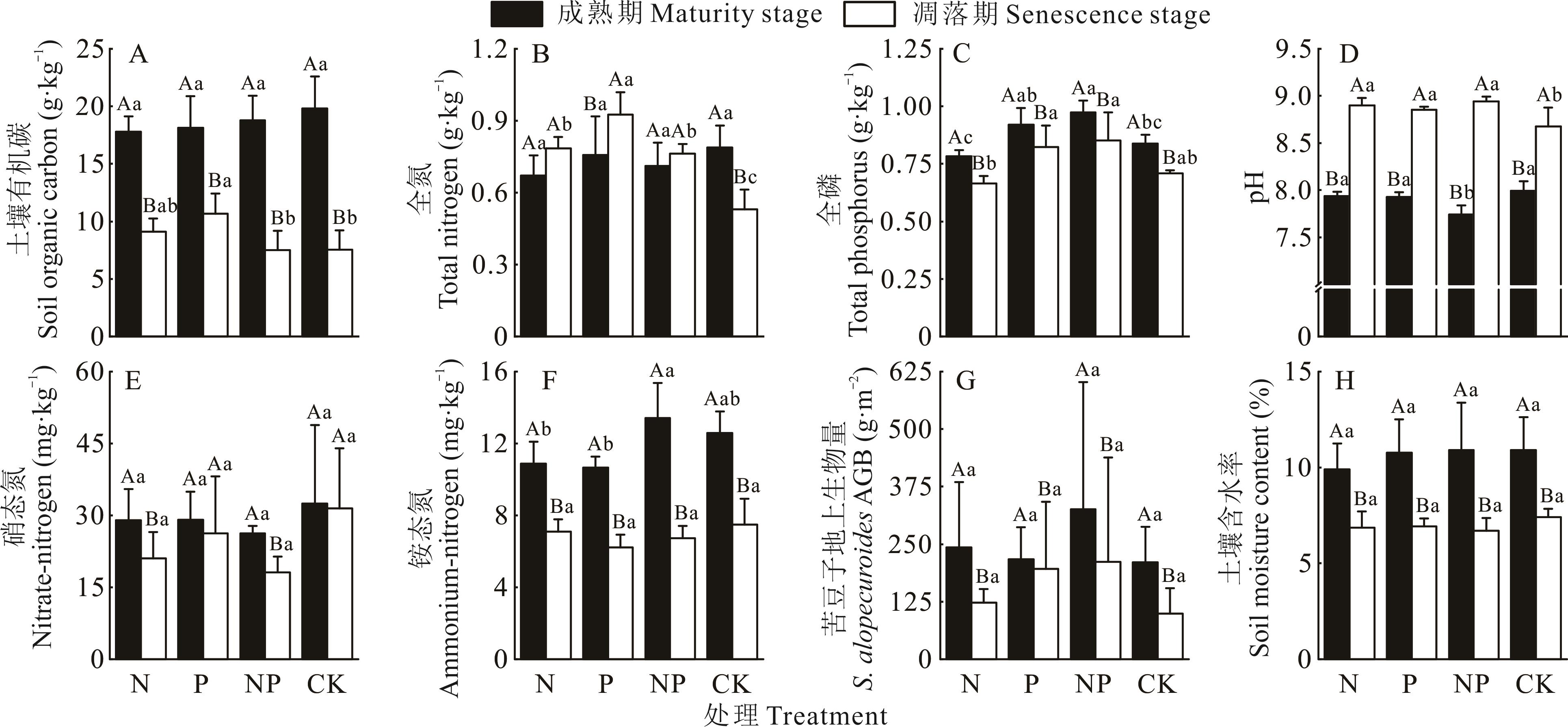
图5 养分添加对环境因子的影响AGB: 地上生物量Aboveground biomass.
Fig.5 Effects of nutrient addition on environmental factors
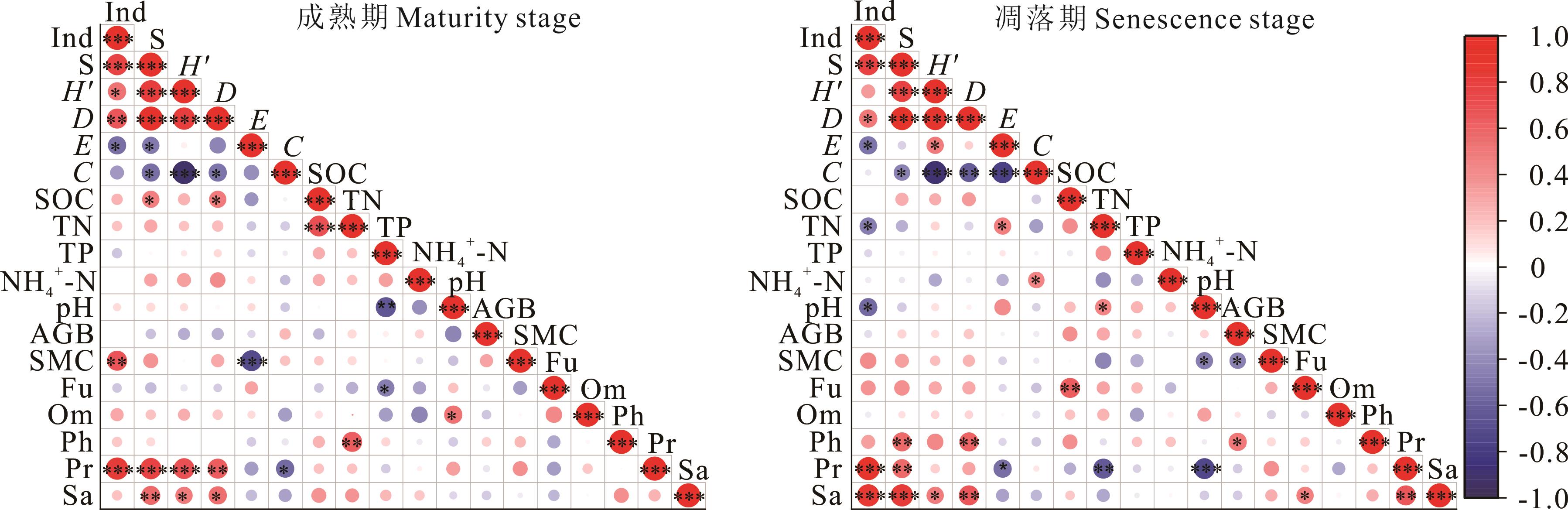
图 6 土壤动物群落特征、功能类群个体数和环境因子的Pearson相关性分析*: P<0.05; **: P<0.01; ***: P <0.001; 红色代表正相关,蓝色代表负相关,圆圈越大颜色越深,则相关性越强Red denotes positive correlations, blue represents negative correlations, with larger and darker circles indicating stronger associations; Ind: 个体数Individual number; S: 类群数Number of groups; H': 香农威纳多样性指数Shannon-Wiener diversity index; D: Margalef丰富度指数Margalef richness index; E: Pielou均匀度指数Pielou evenness index; C: Simpson优势度指数Simpson dominance index; SOC: 有机碳Soil organic carbon; TN: 全氮Total nitrogen; TP: 全磷Total phosphorus; NH4+-N: 铵态氮Ammonium-nitrogen; pH: pH值pH value; AGB: 苦豆子地上生物量S. alopecuroides aboveground biomass; SMC: 土壤含水率Soil moisture content.下同The same below.
Fig. 6 Pearson correlation analysis of soil fauna community characteristics, abundance of functional groups, and environmental factors
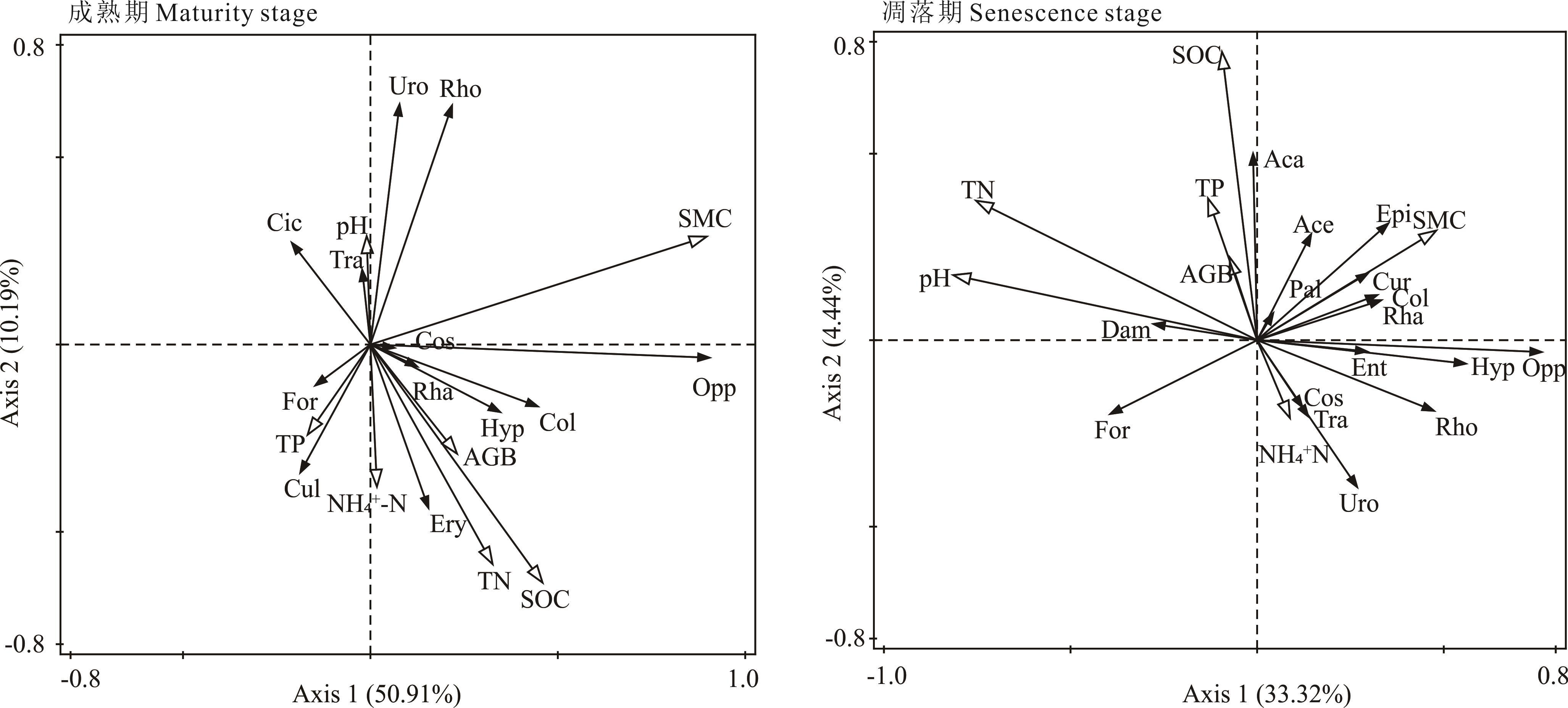
图 7 苦豆子成熟期和凋落期土壤动物物种群落组成与环境因子的冗余分析Opp: 奥甲螨科Oppiidae; Hyp: 下盾螨科Hypoaspidae; Ent: 长角跳科Entomobryidae; For: 蚁科Formicidae; Col: 鞘翅目幼虫 Coleoptera; Cur: 象甲科Curculionidae; Cos: 广缝甲螨科Cosmochthoniidae; Rho: 胭螨科Rhodacaridae; Epi: 上罗甲螨科Epilohmanniidae; Rha: 莓螨科Rhagidiidae; Aca: 粉螨科Acaridae; Tra: 糙尾足螨科Trachyuropodidae; Uro: 尾足螨科Uropodidae; Ace: 裂胸螨科Aceosejidae; Pal: 古甲螨科Palaeacaridae; Dam: 珠甲螨科Damaeidae; Cic: 叶蝉科Cicadellidae; Cul: 蚊科Culicidae; Ery: 赤螨科Erythraeidae.
Fig.7 Redundancy analysis (RDA) of soil fauna community composition and environmental factors during the maturity and senescence periods of S. alopecuroides
| [1] | Burrell A L, Evans J P, De Kauwe M G. Anthropogenic climate change has driven over 5 million km2 of drylands towards desertification. Nature Communications, 2020, 11(1): 3853. |
| [2] | Li J F. Climate of Xinjiang. Beijing: China Meteorological Press,1991. |
| 李江风.新疆气候.北京: 气象出版社,1991. | |
| [3] | Yan J J, Liu H J, Cui D, et al. Spatiotemporal dynamics of grassland degradation in Yili Valley of Xinjiang over the last 15 years. Pratacultural Science, 2018, 35(3): 508-520. |
| 闫俊杰, 刘海军, 崔东, 等. 近15年新疆伊犁河谷草地退化时空变化特征. 草业科学, 2018, 35(3): 508-520. | |
| [4] | Yin C A. Sophora alopecuroides resources and utilization in desert and semi desert areas. Journal of Arid Land Resources and Environment, 1995(2): 48-54. |
| 尹长安. 干旱荒漠半荒漠地区苦豆子的资源状况及开发利用. 干旱区资源与环境, 1995(2): 48-54. | |
| [5] | Li H, Chen W M, Chen X, et al. Poisonous weed species and their harmfulness in the grassland of Yili regions, xinjiang Uygur Autonomous Region of China. Pratacultural Science, 2010, 27(11): 171-173. |
| 李宏, 陈卫民, 陈翔, 等. 新疆伊犁草原毒害草种类及其发生与危害. 草业科学, 2010, 27(11): 171-173. | |
| [6] | Yang R R. Causes of grassland degradation and sustainable development analysis in western China. Pratacultural Science, 2002, 19(1): 23-27. |
| 杨汝荣. 我国西部草地退化原因及可持续发展分析. 草业科学, 2002, 19(1): 23-27. | |
| [7] | Yang G, Wagg C, Veresoglou S D, et al. How soil biota drive ecosystem stability.Trends in Plant Science, 2018, 23(12):1057-1067. |
| [8] | Blankinship J C, Niklaus P A, Hungate B A. A meta-analysis of responses of soil biota to global change. Oecologia, 2011, 165(3): 553-565. |
| [9] | Gerrit A, Anton P, Xavier F J, et al. Conceptualizing soil fauna effects on labile and stabilized soil organic matter. Nature Communications, 2024, 15(1): 5005. |
| [10] | Sundareshwar P V, Morris J T, Koepfler E K, et al. Phosphorus limitation of coastal ecosystem processes. Science, 2003, 299(5606): 563-565. |
| [11] | Cunha H F V, Andersen K M, Lugli L F, et al. Direct evidence for phosphorus limitation on Amazon forest productivity. Nature, 2022, 608(7923): 558-562. |
| [12] | Wu Z D, Hong M, Ma S F, et al. Effects of long-term nutrient addition on meso-micro soil arthropod communities in a Stipa baicalensis grassland. Chinese Journal of Applied and Environmental Biology, 2022, 28(6): 1534-1541. |
| 武振丹, 红梅, 马尚飞, 等. 长期养分添加对贝加尔针茅草原中小型土壤节肢动物群落的影响. 应用与环境生物学报, 2022, 28(6): 1534-1541. | |
| [13] | Boxman A W, Blanck K, Brandrud T E, et al. Vegetation and soil biota response to experimentally-changed nitrogen inputs in coniferous forest ecosystems of the NITREX project. Forest Ecology and Management, 1998, 101(1/2/3): 65-79. |
| [14] | Sun F, Tariq A, Chen H, et al. Effect of nitrogen and phosphorus application on agricultural soil food webs. Archives of Agronomy and Soil Science, 2017, 63(8): 1176-1186. |
| [15] | Wu H T, Lv X G, Yang Q, et al. Ecological characteristics and functions of soil fauna community. Acta Pedologica Sinica, 2006, 43(2): 314-323. |
| 武海涛, 吕宪国, 杨青, 等. 土壤动物主要生态特征与生态功能研究进展. 土壤学报, 2006, 43(2): 314-323. | |
| [16] | Xu G L, Mo J M, Brown S, et al. Effects of simulated N deposition on soil fauna. Acta Ecologica Sinica, 2004, 24(10): 2245-2251. |
| 徐国良, 莫江明, Brown Sandra, 等. 土壤动物对模拟N沉降的响应. 生态学报, 2004, 24(10): 2245-2251. | |
| [17] | Wan M W, Liu X Z, Methods of phenological observation in China. Beijing: Science Press, 1979. |
| 宛敏渭, 刘秀珍. 中国物候观测方法. 北京: 科学出版社, 1979. | |
| [18] | Lei C L, Rong X L. General entomology. Beijing: China Agriculture Press, 2003. |
| 雷朝亮, 荣秀兰. 普通昆虫学. 北京: 中国农业出版社, 2003. | |
| [19] | Yin S G, Bei N X, Chen W P. Soil gamasid mites in Northeast China. Beijing: China Agriculture Press, 2013. |
| 殷绥公, 贝纳新, 陈万鹏. 中国东北土壤革螨. 北京: 中国农业出版社, 2013. | |
| [20] | Sun Y, Wang Y, Liu X Y. Collembolan taxonomy and ecological diversity in Heilongjiang Province. Harbin: Heilongjiang University Press, 2012. |
| 孙元, 王颖, 刘晓颖. 黑龙江省弹尾虫分类与生态多样性研究. 哈尔滨: 黑龙江大学出版社, 2012. | |
| [21] | Bao S D. Soil and agrochemical chemistry analysis (The third edition). Beijing: China Agriculture Press, 2000. |
| 鲍士旦. 土壤农化分析(第3版). 北京: 中国农业出版社, 2000. | |
| [22] | Lin Y H, Zhu P, Zhang F D, et al. Effect of different fertilizer treatments on crop soil insect community at black soil district in Jilin Province. Acta Ecologica Sinica, 2006, 26(4): 1122-1130. |
| 林英华, 朱平, 张夫道, 等. 吉林黑土区不同施肥处理对农田土壤昆虫的影响. 生态学报, 2006, 26(4): 1122-1130. | |
| [23] | Chen X L, Guo Y H. Effects of nitrogen, phosphorus, and potassium on yield and matrine content of Sophora alopecuroides L. Journal of China Agricultural University, 2013, 18(1): 76-81. |
| 陈晓丽, 郭玉海. 氮磷钾肥料对苦豆子产量和苦参碱含量的影响. 中国农业大学学报, 2013, 18(1): 76-81. | |
| [24] | Ochoa-Hueso R, Rocha I, Stevens J C, et al. Simulated nitrogen deposition affects soil fauna from a semiarid Mediterranean ecosystem in central Spain. Biology and Fertility of Soils, 2014, 50(1): 191-196. |
| [25] | Wang X, Zhu X M, Fang Y Y, et al. Long-term nitrogen fertilization accelerates labile biomolecules decomposition and retains recalcitrant compounds in a temperate agroecosystem. Agriculture, Ecosystems & Environment, 2025, 379: 109373. |
| [26] | Yin X Q, Ma C, He H S, et al. Distribution and diversity patterns of soil fauna in different salinization habitats of Songnen Grasslands, China. Applied Soil Ecology, 2018, 123: 375-383. |
| [27] | Dong J H, Li R J, Zheng W F, et al. Elevation gradient distribution pattern and environmental driving factors of soil fauna functional groups in poplar-birch mixed forest in Guandi Mountain. Acta Ecologica Sinica, 2025, 45(2): 769-787. |
| 董江海, 李蓉姣, 郑文芳, 等. 关帝山杨桦混交林土壤动物功能群海拔梯度分布格局及其环境驱动因素. 生态学报, 2025, 45(2): 769-787. | |
| [28] | Xu Y P, Lu P, Tan F, et al. Composition and structure of cropland soil fauna in black soil area of Jilin as affected by exogenous carbon and nitrogen. Acta Pedologica Sinica, 2013, 50(4): 800-809. |
| 徐演鹏, 卢萍, 谭飞, 等. 外源C、N干扰下吉林黑土区农田土壤动物组成与结构. 土壤学报, 2013, 50(4): 800-809. | |
| [29] | Wang Y, Huang B B, Yan G Y, et al. Effects of long-term nitrogen addition and seasonal variation on soil faunal community structure in a temperate natural secondary forest. European Journal of Forest Research, 2022, 141(4): 547-560. |
| [30] | Zhou J J, Wang Q G, Sun Y, et al. Response of soil fauna to nitrogen deposition in a broad-leaved Korean pine forest in Xiaoxing’an Mountains. World Ecology, 2020, 9(2): 11 |
| 周娇娇, 王庆贵, 孙元, 等. 小兴安岭阔叶红松林土壤动物对氮沉降的响应.世界生态学, 2020, 9(2): 11. | |
| [31] | Bian C J, Liu S R, Ma X Q, et al. Fine root biomass mediates soil fauna community in response to nitrogen addition in poplar plantations (Populus deltoids) on the east coast of China. Forests, 2019, 10(2): 164. |
| [32] | Sullivan P T, Sullivan S D. Influence of nitrogen fertilization on abundance and diversity of plants and animals in temperate and boreal forests. Environmental Reviews, 2017, 26(1): 26-42. |
| [33] | Li J H, Zhang R, Cheng B H, et al. Effects of nitrogen and phosphorus additions on decomposition and accumulation of soil organic carbon in alpine meadows on the Tibetan Plateau. Land Degradation and Development, 2020, 32(3): 1467-1477. |
| [34] | Zhang H R, Yang T, Wu X J, et al. Phosphorus addition increases microbial necromass by increasing N availability in China: A Meta-analysis. Applied Soil Ecology, 2023, 190: 105009. |
| [35] | Li X, Wei X, Wang C T, et al. Effects of exogenous nutrient addition on alpine meadow soil arthropod communities. Acta Prataculturae Sinica, 2022, 31(4): 155-164. |
| 李鑫, 魏雪, 王长庭, 等. 外源性养分添加对高寒草甸土壤节肢动物群落的影响. 草业学报, 2022, 31(4): 155-164. | |
| [36] | Liu J R, Guo K X, Sheng Y, et al. Changes of soil arthropod community during litter decomposition in a subtropical forest. Acta Ecologica Sinica, 2021, 41(7): 2770-2782. |
| 刘静如, 郭可馨, 谌亚, 等. 亚热带森林凋落叶分解过程土壤节肢动物群落的变化特征. 生态学报, 2021, 41(7): 2770-2782. | |
| [37] | Zhang Y, Liu J, Peng B. Study on carbon, nitrogen, and phosphorus content and their stoichiometric characteristics of Agropyron cristatum at different phenological periods. Agriculture and Technology, 2022, 42(13): 22-25. |
| 张艳, 刘佳, 彭彬. 不同物候期高冰草碳氮磷含量及其化学计量特征研究. 农业与技术, 2022, 42(13): 22-25. | |
| [38] | Liu Y, Zhou G Y, Chu G W, et al. Seasonal dynamics of soil acidity and nutrient contents under coniferous and broad-leaved mixed forest at Dinghushan. Ecology and Environment, 2005, 4(1): 81-85 |
| 刘艳, 周国逸, 褚国伟, 等. 鼎湖山针阔叶混交林土壤酸度与土壤养分的季节动态. 生态环境, 2005, 4(1): 81-85. | |
| [39] | Liu H M, Li J, Wang L L, et al. Effects of nitrogen addition on the stoichiometric characteristics of plants and soil in the Stipa baicalensis grassland of Inner Mongolia, China. Acta Prataculturae Sinica, 2018, 27(7): 25-35. |
| 刘红梅, 李洁, 王丽丽, 等. 氮添加对贝加尔针茅草原植物和土壤化学计量特征的影响. 草业学报, 2018, 27(7): 25-35. | |
| [40] | Lawrie A C, Wheeler C T. Nitrogen fixation in the root nodules of Vicia faba L. in relation to the assimilation of carbon: I. Plant growth and metabolism of photosynthetic assimilates. New Phytologist, 1975, 74(3): 429-436. |
| [41] | Pöyry J, Carvalheiro G L, Heikkinen K R, et al. The effects of soil eutrophication propagate to higher trophic levels.Global Ecology and Biogeography, 2017, 26(1): 18-30. |
| [42] | Flores-Rios A, Thomas E, Peri P P, et al. Co-benefits of soil carbon protection for invertebrate conservation. Biological Conservation, 2020, 252: 108859. |
| [43] | Mao J H, Wang J S, Liao J S,et al. Plant nitrogen uptake preference and drivers in natural ecosystems at the global scale. New Phytologist, 2025, 246(3): 972-983. |
| [44] | Liu R T, Zhao H L, Zhao X Y, et al. Soil macro faunal response to sand dune conversion from mobile dunes to fixed dunes in Horqin sandy land, northern China. European Journal of Soil Biology, 2009, 45(5/6): 417-422. |
| [45] | Meunier C L, Gundale M J, Sanchez I S, et al. Impact of nitrogen deposition on forest and lake food webs in nitrogen-limited environments. Global change biology, 2016, 22(1): 164-179. |
| [46] | Johannes R, Erland B, Brookes P C, et al.Soil bacterial and fungal communities across a pH gradient in an arable soil. The ISME journal, 2010, 4(10): 1340-1351. |
| [47] | Cole L, Buckland S M, Bardgett R D. Influence of disturbance and nitrogen addition on plant and soil animal diversity in grassland. Soil Biology and Biochemistry, 2008, 40(2): 505-514. |
| [48] | Brussaard L. Soil fauna, guilds, functional groups and ecosystem processes. Applied Soil Ecology, 1998, 9(1/2/3): 123-135. |
| [1] | 林平冬, 缪伏荣, 刘景, 岳稳, 陈鑫珠. 不同添加剂对茶渣青贮品质和微生物多样性的影响[J]. 草业学报, 2026, 35(8): 123-133. |
| [2] | 张博鸿, 马祥, 琚泽亮, 段连学, 王小军, 贾志锋. 不同生态条件下燕麦种质资源遗传多样性分析与综合评价[J]. 草业学报, 2026, 35(7): 151-164. |
| [3] | 马玉龙, 邱开阳, 骆欣怡, 张晶晶, 王雨航, 王国会, 郑翔, 海旭莹, 薛斌, 谢应忠. 不同固沙植被恢复模式对土壤理化性质、酶活性和草本植物多样性的影响[J]. 草业学报, 2026, 35(6): 1-12. |
| [4] | 聂莹莹, 徐丽君, 徐修远, 薛玮, 吴欣珈, 袁波, 张钊, 张洪志, 周琼, 李禹霖. 养分添加对科尔沁盐碱化草地植物多样性和地上生物量的影响[J]. 草业学报, 2026, 35(5): 61-71. |
| [5] | 李豫悦, 魏浩男, 马兴忠, 姜海鑫, 聂明鹤, 周瑶, 代成江, 田小武, 王国会, 马红彬. 轮牧对荒漠草原土壤种子库特征的影响[J]. 草业学报, 2026, 35(4): 1-13. |
| [6] | 王贝贝, 杨畅, 朱文琰, 徐世晓, 孙平. 不同龄级瑞香狼毒根系周围微生物群落结构的空间差异研究[J]. 草业学报, 2026, 35(3): 128-157. |
| [7] | 刘阳, 肖红, 徐长林, 邓明月, 魏文强, 韩奥, 马凯, 王昀. 东祁连山高寒草甸山生柳灌木扩张对草本植物群落特征的影响[J]. 草业学报, 2026, 35(3): 13-25. |
| [8] | 王慧腾, 刘文兰, 唐红, 刘晓娟, 韩蓉, 宋捷. 兰州滨河公园自生植物物种多样性与功能多样性对城市化的响应[J]. 草业学报, 2026, 35(3): 96-113. |
| [9] | 周诗杰, 王义莲, 孙攀, 尚静, 杨文钰, 王学贵, 杨继芝. 四川省玉米大豆带状复合种植田杂草发生种类及群落特征分析[J]. 草业学报, 2026, 35(2): 143-154. |
| [10] | 何佳奇, 吴林, 邱智敏, 高绪勇, 高伦伦, 付双彬, 杨燕萍, 王培龙, 徐婉, 周庄. 温州绕城高速公路边坡杂草物种多样性及群落特征[J]. 草业学报, 2026, 35(2): 40-53. |
| [11] | 向泽宇, 唐忠炳, 彭昕桁, 杨晓龙, 杨创明, 邱相东, 陈春发, 彭焱松, 周赛霞. 武功山山地草甸植物群落特征和生态位[J]. 草业学报, 2025, 34(9): 12-25. |
| [12] | 唐伟, 李子光, 赵庆田, 孙娟. 燕麦种植密度对马唐和稗草生长及根际真菌群落结构的影响[J]. 草业学报, 2025, 34(8): 149-164. |
| [13] | 汤珊珊, 胡敏. 禾本科植物根际土壤酶活性和细菌群落结构差异[J]. 草业学报, 2025, 34(8): 99-108. |
| [14] | 王颖, 李明源, 麦日艳古·亚生null, 王继莲. 新疆托木尔峰不同植物根际土壤真菌群落结构比较研究[J]. 草业学报, 2025, 34(7): 83-94. |
| [15] | 孔天赐, 马学青, 贺晨帮, 樊泰延, 芦光新, 祁鹤兴. 青贮玉米真菌性病害对青贮发酵微生物多样性的影响[J]. 草业学报, 2025, 34(7): 95-106. |
| 阅读次数 | ||||||
|
全文 |
|
|||||
|
摘要 |
|
|||||
