

ISSN 1004-5759 CN 62-1105/S
草业学报 ›› 2026, Vol. 35 ›› Issue (8): 123-133.DOI: 10.11686/cyxb2025315
• 研究论文 • 上一篇
林平冬1( ), 缪伏荣1, 刘景1, 岳稳1, 陈鑫珠1,2()
收稿日期:2025-08-05
修回日期:2025-09-19
出版日期:2026-08-20
发布日期:2026-06-22
通讯作者:
陈鑫珠
作者简介:Corresponding author. E-mail: 010622051@163.com基金资助:
Ping-dong LIN1(), Fu-rong MIAO1, Jing LIU1, Wen YUE1, Xin-zhu CHEN1,2()
Received:2025-08-05
Revised:2025-09-19
Online:2026-08-20
Published:2026-06-22
Contact:
Xin-zhu CHEN
摘要:
为探究添加剂对茶渣青贮品质及微生物多样性的影响,本试验以茶渣作为基础原料,设置了6个添加剂处理组:乳酸菌单独处理组(T1组)、红糖单独处理组(T2组)、纤维素酶单独处理组(T3组)、乳酸菌+红糖组合处理组(T4组)、乳酸菌+纤维素酶组合处理组(T5组)、乳酸菌+红糖+纤维素酶组合处理组(T6组),以及无添加剂对照组(CK组)。每个处理组均设3个独立重复,青贮时间为30 d。青贮完成后,取样进行营养成分、发酵品质、抗营养因子等指标检测及微生物多样性分析。结果表明:1)添加剂处理显著提高了茶渣青贮的乳酸、可溶性蛋白、可溶性糖含量和植酸酶活性(P<0.05),同时显著降低了pH值、丙酸和植酸含量(P<0.05);与CK组相比,T4和T5组的干物质和总糖含量均显著增加(P<0.05),T1、T2及T5组的酸性洗涤纤维含量显著增加(P<0.05),T6组的总酚含量显著降低(P<0.05),T3组的单宁酶活性显著提高(P<0.05),T2、T4及T6组的挥发性脂肪酸含量均显著增加(P<0.05)。2)在微生物群落分析中,各组在门水平上的优势菌群为厚壁菌门、拟杆菌门、变形菌门和放线菌门;在属水平上,优势菌群包括乳杆菌属(相对丰度20.0%~81.9%)、醋杆菌属(0.4%~24.7%)、双歧杆菌属(1.1%~16.7%)和芽孢杆菌属(7.0%~11.3%);与CK组相比,T1、T4及T5组的韦荣氏球菌属相对丰度明显降低,而T4组的Alpha多样性指数表现出显著差异(P<0.05)。综上所述,添加剂处理能够明显改善茶渣青贮品质,有效调整青贮发酵微生物群落结构,且多种添加剂组合处理效果显著优于单个添加剂处理,为茶渣资源化利用提供了实用参考。
林平冬, 缪伏荣, 刘景, 岳稳, 陈鑫珠. 不同添加剂对茶渣青贮品质和微生物多样性的影响[J]. 草业学报, 2026, 35(8): 123-133.
Ping-dong LIN, Fu-rong MIAO, Jing LIU, Wen YUE, Xin-zhu CHEN. Effects of additives on the quality and microbial diversity of tea residue silage[J]. Acta Prataculturae Sinica, 2026, 35(8): 123-133.
| 项目Item | 含量Content (%) | 项目Item | 含量Content (%) | 项目Item | 含量Content |
|---|---|---|---|---|---|
| 氨基酸Amino acid | 13.36 | 干物质Dry matter | 97.40 | 钙Ca (%) | 0.53 |
| 粗蛋白质Crude protein | 16.64 | 粗灰分Crude ash | 3.80 | 铅Pb (mg·kg-1) | 1.64 |
| 粗纤维Crude fiber | 36.40 | 总磷Total phosphorus | 0.14 | 砷As (mg·kg-1) | 0.07 |
| 粗脂肪Crude fat | 2.90 | 氯化物Chloride | 0.61 | 汞Hg (mg·kg-1) | 未检测到No detected |
表1 茶渣原料的主要营养成分
Table 1 Main nutritional components of tea residue raw materials
| 项目Item | 含量Content (%) | 项目Item | 含量Content (%) | 项目Item | 含量Content |
|---|---|---|---|---|---|
| 氨基酸Amino acid | 13.36 | 干物质Dry matter | 97.40 | 钙Ca (%) | 0.53 |
| 粗蛋白质Crude protein | 16.64 | 粗灰分Crude ash | 3.80 | 铅Pb (mg·kg-1) | 1.64 |
| 粗纤维Crude fiber | 36.40 | 总磷Total phosphorus | 0.14 | 砷As (mg·kg-1) | 0.07 |
| 粗脂肪Crude fat | 2.90 | 氯化物Chloride | 0.61 | 汞Hg (mg·kg-1) | 未检测到No detected |
组别 Group | 干物质 DM (%) | 可溶性蛋白 SP (mg·g-1) | 可溶性糖 SS (mg·g-1) | 总糖 TS (mg·g-1) | 中性洗涤纤维 NDF (%DM) | 酸性洗涤纤维 ADF (%DM) | 半纤维素 HC (%DM) | 氨基酸总量 TAAC (%) |
|---|---|---|---|---|---|---|---|---|
| CK | 21.20±0.10b | 29.60±1.57b | 3.94±0.24c | 25.05±1.62c | 51.32±1.45d | 29.33±1.58c | 22.00±0.13a | 20.92±1.30ab |
| T1 | 21.27±0.21b | 35.03±0.56a | 4.56±0.20c | 26.81±2.06bc | 55.87±2.04abc | 36.19±1.76ab | 19.68±0.41b | 18.17±3.96b |
| T2 | 21.70±0.40bc | 35.38±0.74a | 5.32±0.29b | 27.60±1.40bc | 57.66±1.66a | 36.99±1.28a | 21.22±0.83ab | 22.17±0.69ab |
| T3 | 21.50±0.36bc | 34.88±2.67a | 4.46±0.43c | 26.07±0.74bc | 53.46±1.33bcd | 32.24±1.81bc | 20.66±1.44ab | 19.42±3.70ab |
| T4 | 22.25±0.35a | 36.48±0.84a | 6.03±1.02ab | 32.42±2.50a | 53.44±0.27bcd | 32.57±1.46bc | 20.88±1.20ab | 22.78±0.24a |
| T5 | 22.30±0.10a | 34.70±0.60a | 5.56±0.43b | 34.11±2.16a | 56.67±3.10ab | 35.57±3.96ab | 21.10±0.92ab | 21.77±0.37ab |
| T6 | 21.97±0.2ab | 34.42±1.74a | 6.67±0.18a | 28.92±1.73b | 52.30±0.46cd | 32.24±1.25bc | 20.06±1.07ab | 18.07±0.89b |
表2 不同添加剂对茶渣青贮营养成分的影响
Table 2 Effects of various additive on nutritional composition of tea residue silage
组别 Group | 干物质 DM (%) | 可溶性蛋白 SP (mg·g-1) | 可溶性糖 SS (mg·g-1) | 总糖 TS (mg·g-1) | 中性洗涤纤维 NDF (%DM) | 酸性洗涤纤维 ADF (%DM) | 半纤维素 HC (%DM) | 氨基酸总量 TAAC (%) |
|---|---|---|---|---|---|---|---|---|
| CK | 21.20±0.10b | 29.60±1.57b | 3.94±0.24c | 25.05±1.62c | 51.32±1.45d | 29.33±1.58c | 22.00±0.13a | 20.92±1.30ab |
| T1 | 21.27±0.21b | 35.03±0.56a | 4.56±0.20c | 26.81±2.06bc | 55.87±2.04abc | 36.19±1.76ab | 19.68±0.41b | 18.17±3.96b |
| T2 | 21.70±0.40bc | 35.38±0.74a | 5.32±0.29b | 27.60±1.40bc | 57.66±1.66a | 36.99±1.28a | 21.22±0.83ab | 22.17±0.69ab |
| T3 | 21.50±0.36bc | 34.88±2.67a | 4.46±0.43c | 26.07±0.74bc | 53.46±1.33bcd | 32.24±1.81bc | 20.66±1.44ab | 19.42±3.70ab |
| T4 | 22.25±0.35a | 36.48±0.84a | 6.03±1.02ab | 32.42±2.50a | 53.44±0.27bcd | 32.57±1.46bc | 20.88±1.20ab | 22.78±0.24a |
| T5 | 22.30±0.10a | 34.70±0.60a | 5.56±0.43b | 34.11±2.16a | 56.67±3.10ab | 35.57±3.96ab | 21.10±0.92ab | 21.77±0.37ab |
| T6 | 21.97±0.2ab | 34.42±1.74a | 6.67±0.18a | 28.92±1.73b | 52.30±0.46cd | 32.24±1.25bc | 20.06±1.07ab | 18.07±0.89b |
| 组别Group | pH | AN (%DM) | LA (%DM) | AA (%DM) | PA (%DM) | BA (%DM) | VFA (%DM) | LA/VFA |
|---|---|---|---|---|---|---|---|---|
| CK | 4.29±0.02a | 0.14±0.00a | 0.47±0.06c | 1.65±0.21a | 0.59±0.11b | 0.53±0.08a | 3.24±0.36c | 17.70±2.75c |
| T1 | 4.27±0.03a | 0.16±0.03a | 0.53±0.15c | 1.81±0.05a | 0.82±0.06a | 0.55±0.02a | 3.71±0.16bc | 18.30±4.21c |
| T2 | 3.96±0.03d | 0.13±0.05a | 2.73±0.06a | 1.50±0.24a | 0.22±0.05c | 0.00±0.00c | 4.45±0.25ab | 64.67±3.92a |
| T3 | 4.26±0.01a | 0.17±0.02a | 0.50±0.10c | 1.91±0.34a | 0.83±0.23a | 0.32±0.28b | 3.64±0.58bc | 18.17±5.60c |
| T4 | 4.02±0.01c | 0.13±0.00a | 2.70±0.28a | 1.40±0.08a | 0.14±0.01c | 0.00±0.00c | 4.23±0.21ab | 65.85±3.61a |
| T5 | 4.19±0.01b | 0.15±0.03a | 1.13±0.06b | 1.64±0.20a | 0.19±0.03c | 0.00±0.00c | 3.01±0.23c | 40.27±2.77b |
| T6 | 3.90±0.03e | 0.12±0.02a | 3.00±0.26a | 1.39±0.14a | 0.19±0.02c | 0.00±0.00c | 4.58±0.26a | 68.27±3.52a |
表3 不同添加剂对茶渣青贮发酵品质的影响
Table 3 Effects of various additive on fermentation quality of tea residue silage
| 组别Group | pH | AN (%DM) | LA (%DM) | AA (%DM) | PA (%DM) | BA (%DM) | VFA (%DM) | LA/VFA |
|---|---|---|---|---|---|---|---|---|
| CK | 4.29±0.02a | 0.14±0.00a | 0.47±0.06c | 1.65±0.21a | 0.59±0.11b | 0.53±0.08a | 3.24±0.36c | 17.70±2.75c |
| T1 | 4.27±0.03a | 0.16±0.03a | 0.53±0.15c | 1.81±0.05a | 0.82±0.06a | 0.55±0.02a | 3.71±0.16bc | 18.30±4.21c |
| T2 | 3.96±0.03d | 0.13±0.05a | 2.73±0.06a | 1.50±0.24a | 0.22±0.05c | 0.00±0.00c | 4.45±0.25ab | 64.67±3.92a |
| T3 | 4.26±0.01a | 0.17±0.02a | 0.50±0.10c | 1.91±0.34a | 0.83±0.23a | 0.32±0.28b | 3.64±0.58bc | 18.17±5.60c |
| T4 | 4.02±0.01c | 0.13±0.00a | 2.70±0.28a | 1.40±0.08a | 0.14±0.01c | 0.00±0.00c | 4.23±0.21ab | 65.85±3.61a |
| T5 | 4.19±0.01b | 0.15±0.03a | 1.13±0.06b | 1.64±0.20a | 0.19±0.03c | 0.00±0.00c | 3.01±0.23c | 40.27±2.77b |
| T6 | 3.90±0.03e | 0.12±0.02a | 3.00±0.26a | 1.39±0.14a | 0.19±0.02c | 0.00±0.00c | 4.58±0.26a | 68.27±3.52a |
组别 Group | CLa (μg·min-1·g-1) | TANa (μmol·min-1·g-1) | PAP (nmol·min-1·g-1) |
|---|---|---|---|
| CK | 1222.32±24.79a | 23.07±2.24c | 12.27±1.55e |
| T1 | 1196.37±97.98ab | 24.07±3.10c | 15.88±1.90de |
| T2 | 1229.03±29.78a | 27.52±1.67bc | 30.41±3.63b |
| T3 | 1149.60±28.31ab | 33.80±4.28a | 24.53±3.00bc |
| T4 | 1180.84±15.58ab | 25.66±0.49bc | 43.02±8.12a |
| T5 | 1119.13±42.30b | 30.88±3.95ab | 18.99±2.35cd |
| T6 | 1133.69±43.26ab | 29.35±3.75abc | 22.81±2.82c |
表4 不同添加剂对茶渣青贮水解酶活性的影响
Table 4 Effects of various additive on hydrolase activity in tea residue silage
组别 Group | CLa (μg·min-1·g-1) | TANa (μmol·min-1·g-1) | PAP (nmol·min-1·g-1) |
|---|---|---|---|
| CK | 1222.32±24.79a | 23.07±2.24c | 12.27±1.55e |
| T1 | 1196.37±97.98ab | 24.07±3.10c | 15.88±1.90de |
| T2 | 1229.03±29.78a | 27.52±1.67bc | 30.41±3.63b |
| T3 | 1149.60±28.31ab | 33.80±4.28a | 24.53±3.00bc |
| T4 | 1180.84±15.58ab | 25.66±0.49bc | 43.02±8.12a |
| T5 | 1119.13±42.30b | 30.88±3.95ab | 18.99±2.35cd |
| T6 | 1133.69±43.26ab | 29.35±3.75abc | 22.81±2.82c |
| 组别Group | 单宁Tannins | 植酸Phytic acid | 总酚Total phenol |
|---|---|---|---|
| CK | 3.50±0.03ab | 10.58±0.84a | 60.31±2.31a |
| T1 | 3.50±0.06ab | 8.35±0.37bc | 55.20±3.13ab |
| T2 | 3.43±0.05b | 9.58±0.45ab | 56.56±2.96ab |
| T3 | 3.54±0.03a | 8.44±0.84bc | 53.68±3.20bc |
| T4 | 3.50±0.04ab | 8.88±1.88bc | 55.86±3.90ab |
| T5 | 3.43±0.02b | 9.57±0.36ab | 59.43±0.57ab |
| T6 | 3.41±0.07b | 7.93±0.34c | 49.21±4.20c |
表5 不同添加剂对茶渣青贮抗营养因子及总酚含量的影响
Table 5 Effects of various additive on anti-nutritional factors and total phenol content in tea residue silage(mg·g-1)
| 组别Group | 单宁Tannins | 植酸Phytic acid | 总酚Total phenol |
|---|---|---|---|
| CK | 3.50±0.03ab | 10.58±0.84a | 60.31±2.31a |
| T1 | 3.50±0.06ab | 8.35±0.37bc | 55.20±3.13ab |
| T2 | 3.43±0.05b | 9.58±0.45ab | 56.56±2.96ab |
| T3 | 3.54±0.03a | 8.44±0.84bc | 53.68±3.20bc |
| T4 | 3.50±0.04ab | 8.88±1.88bc | 55.86±3.90ab |
| T5 | 3.43±0.02b | 9.57±0.36ab | 59.43±0.57ab |
| T6 | 3.41±0.07b | 7.93±0.34c | 49.21±4.20c |
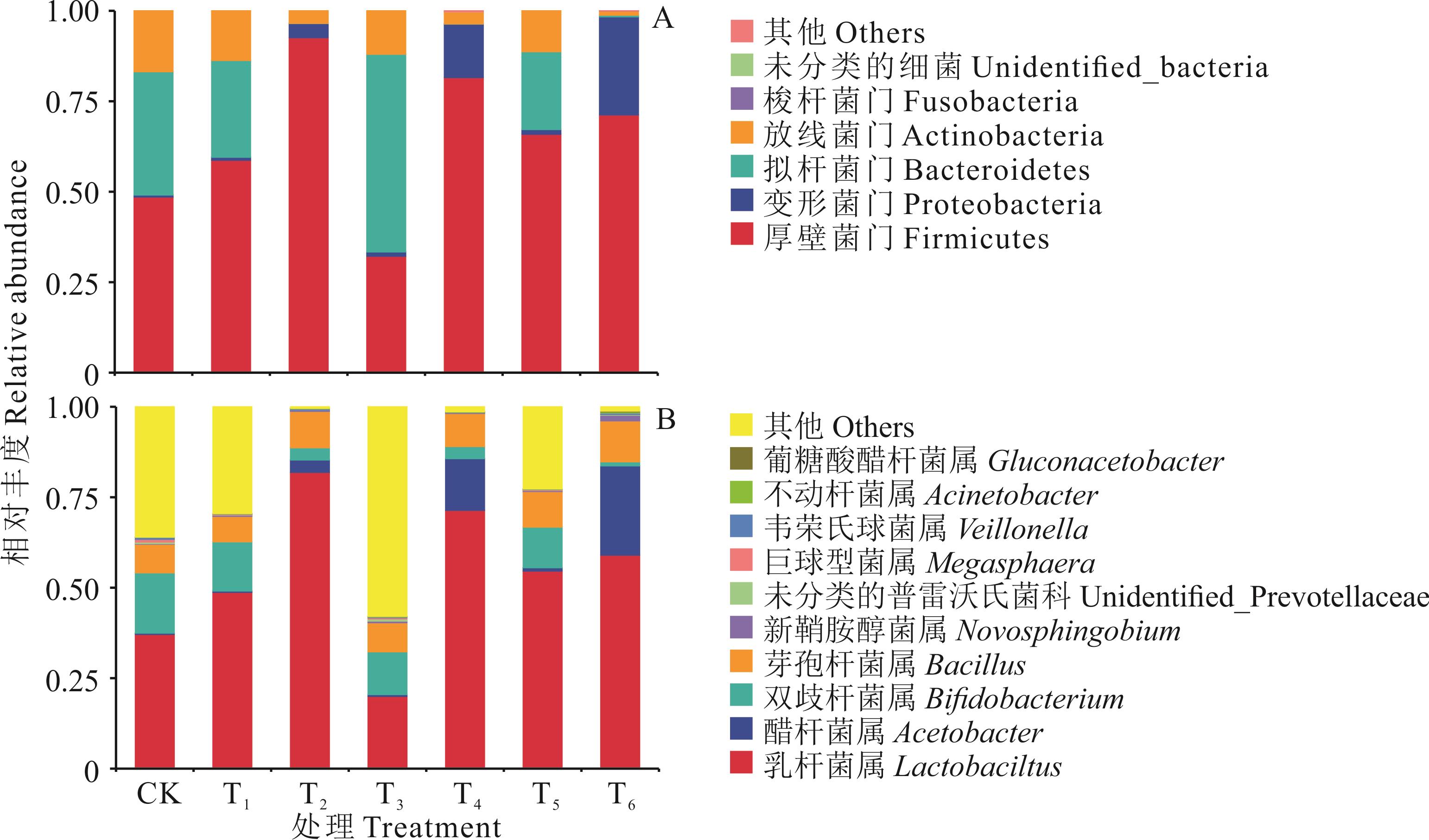
图1 茶渣青贮菌群在门水平(A)和属水平(B)上的相对丰度
Fig.1 Relative abundance of tea residue silage bacterial communities at the phylum (A) and genus levels (B)
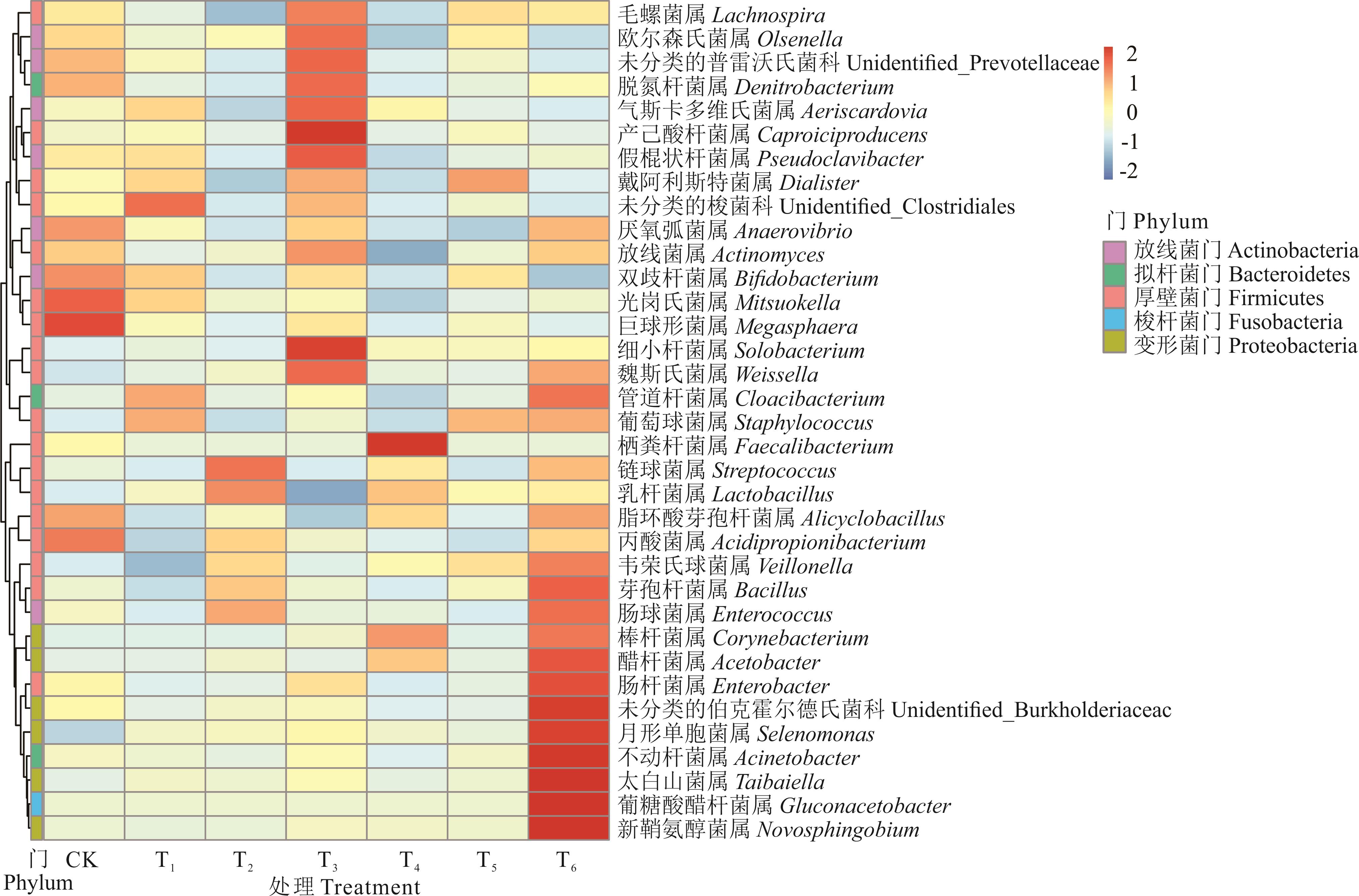
图2 茶渣青贮菌群在属水平上的物种聚类热图
Fig.2 Species clustering heat map of the tea residue silage bacterial community at the genus level
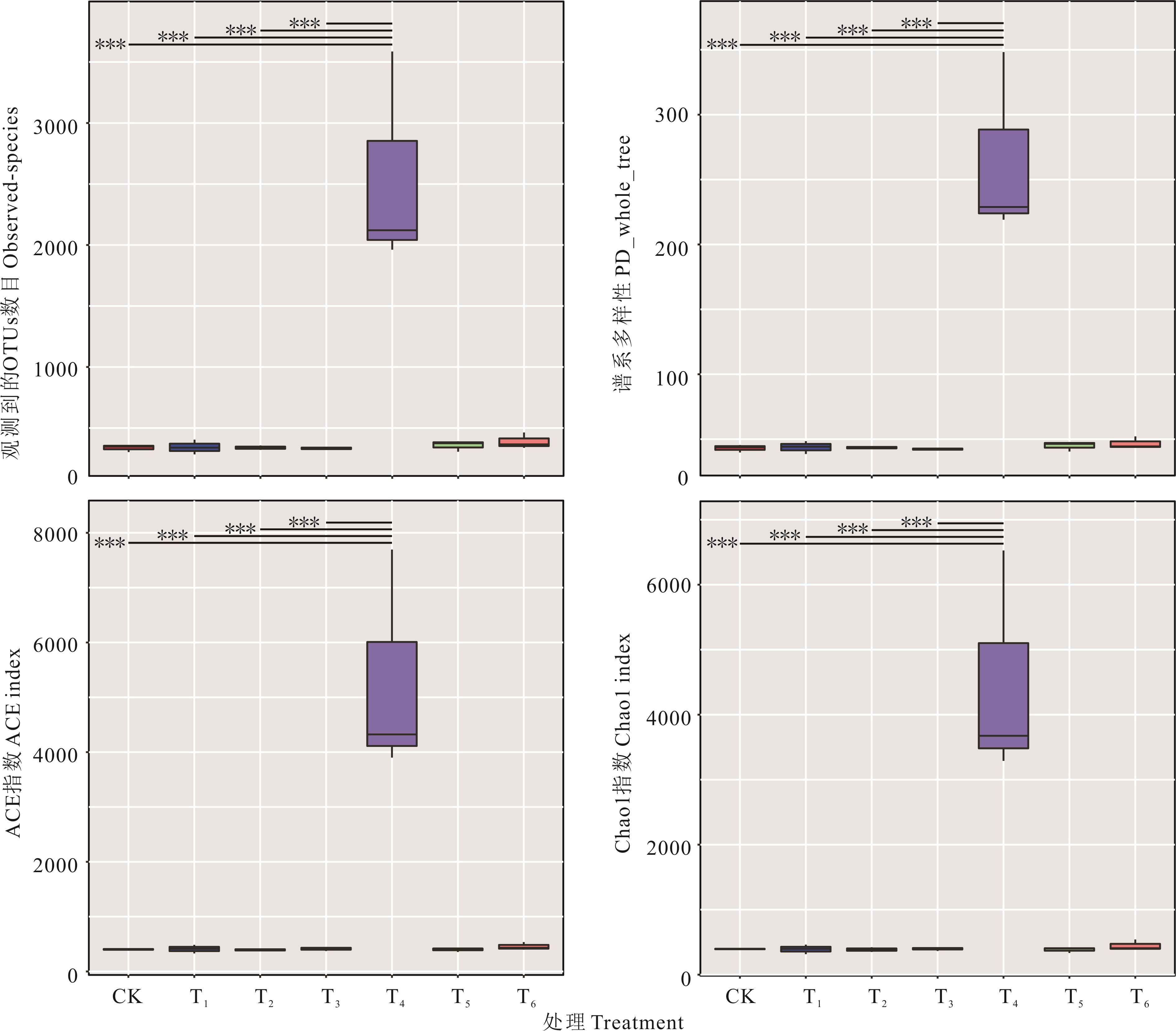
图3 茶渣青贮菌群的Alpha多样性指数差异***: P<0.001.
Fig.3 Differences in the Alpha diversity index of the tea residue silage bacterial community
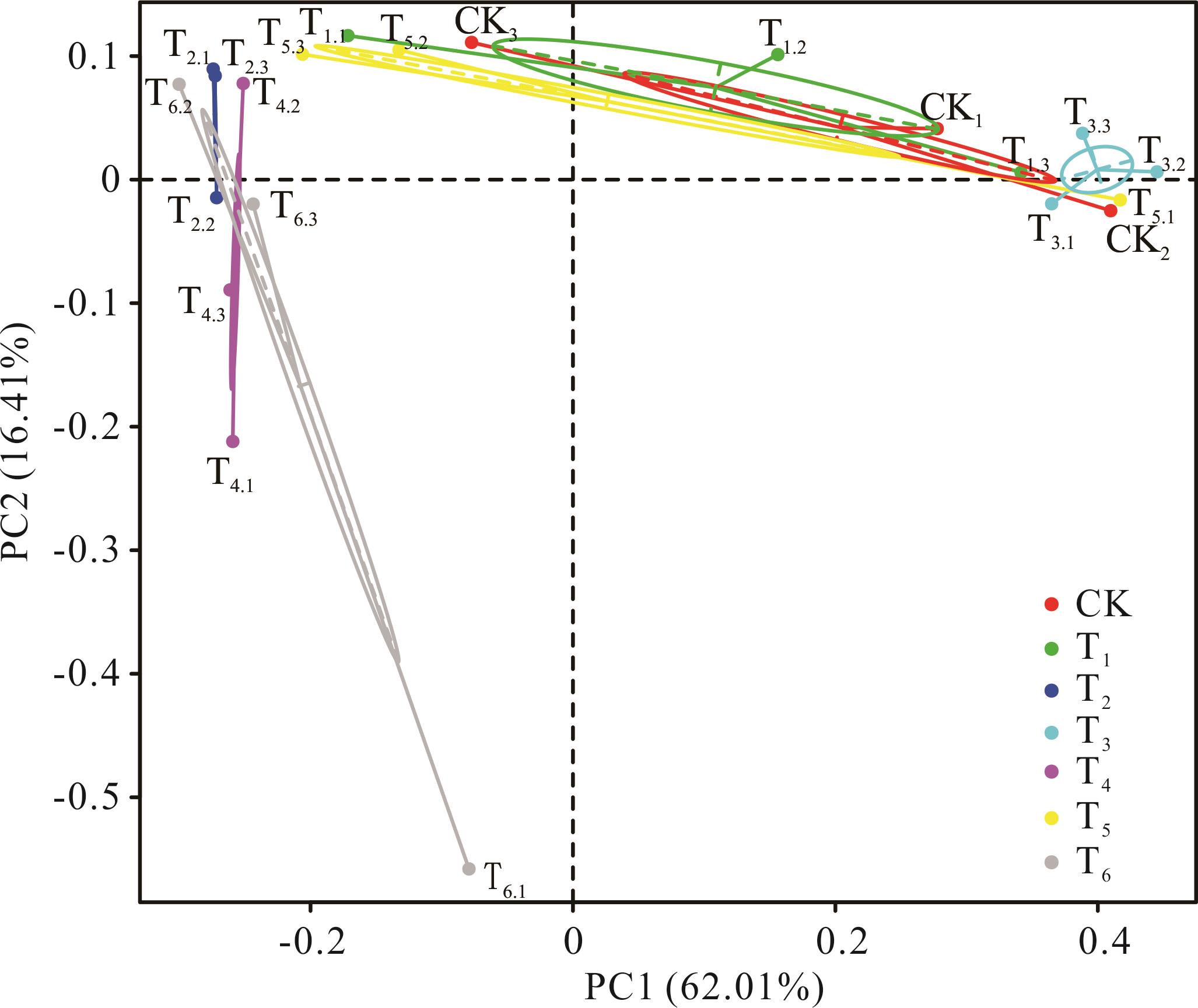
图4 茶渣青贮菌群的主坐标分析CK1、CK2、CK3, T1.1、T1.2、T1.3, T2.1、T2.2、T2.3, T3.1、T3.2、T3.3, T4.1、T4.2、T4.3, T5.1、T5.2、T5.3, T6.1、T6.2、T6.3: 分别为CK, T1, T2, T3, T4, T5,T6组的3个试验重复Denote the three replicates of the CK, T1, T2, T3, T4, T5,T6 treatment group, respectively.
Fig.4 Principal coordinates analysis (PCoA) of bacterial community in the tea residue silage
| [1] | Nasehi M, Torbatineja N M, Rezaie M, et al. Effects of partial substitution of alfalfa hay with green tea waste on growth performance and in vitro methane emission of fat-tailed lambs. Small Ruminant Research, 2018, 168: 52-59. |
| [2] | Kondo M, Kondo Y, Kita K, et al. Nutritive evaluation of spent green and black tea leaf silages by in vitro gas production characteristics, ruminal degradability and post-ruminal digestibility assessed with inhibitory activity of their tannins. Animal Science Journal, 2018, 89(12): 1656-1662. |
| [3] | Bai W F, Guo X Y, Ma L Q, et al. Chemical composition and sensory evaluation of fermented tea with medicinal mushrooms. Indian of Journal Microbiology, 2013, 53(1): 70-76. |
| [4] | Sui W J, Xiao Y, Liu R, et al. Steam explosion modification on tea waste to enhance bioactive compounds’ extractability and antioxidant capacity of extracts. Journal of Food Engineering, 2019, 261: 51-59. |
| [5] | Xu Q, Zhang Y L, Sun J J, et al. The application and thinking of tea dregs in livestock and poultry feed. Guangdong Feed, 2021, 30(6): 33-36. |
| 许晴, 张永亮, 孙加节, 等. 茶渣在畜禽饲料中的应用及思考. 广东饲料, 2021, 30(6): 33-36. | |
| [6] | Xia G H, Sun W T, Wu C R, et al. Research progress on the effect of plant tannins on silage quality and rumen fermentation. Feed Industry, 2023, 44(17): 63-69. |
| 夏光浩, 孙文涛, 吴长荣, 等. 植物单宁对青贮饲料品质及瘤胃发酵影响的研究进展. 饲料工业, 2023, 44(17): 63-69. | |
| [7] | Nascimento T V C, Bezerra L R, Menezes D R, et al. Condensed tannin-amended cassava silage: Fermentation characteristics, degradation kinetics and in-vitro gas production with rumen liquor. The Journal of Agricultural Science, 2018, 156(1): 83-91. |
| [8] | Huang X W, Fan X, Tang M H, et al. Research progress of effects of additives on the quality of forage grass silage. Feed Industry, 2023, 44(17): 81-85. |
| 黄秀文, 范雪, 唐明欢, 等. 青贮添加剂对牧草青贮品质影响的研究进展. 饲料工业, 2023, 44(17): 81-85. | |
| [9] | Zhu F, Ran L, Su D, et al. Effect of bran and lactic acid bacteria preparation on silage quality and nutrient content of a tea residue. Pratacultural Science, 2019, 36(1): 234-242. |
| 朱飞, 冉雷, 苏娣, 等. 麦麸与乳酸菌制剂对茶渣青贮品质和养分含量的影响. 草业科学, 2019, 36(1): 234-242. | |
| [10] | Chen Y Y, Zhu N, Liang Y, et al. Effect of additives on quality of herbal tea residue fermentation. Journal of Domestic Animal Ecology, 2020, 41(2): 55-59. |
| 陈奕业, 朱妮, 梁瑶, 等. 不同添加剂对凉茶渣发酵品质的影响. 家畜生态学报, 2020, 41(2): 55-59. | |
| [11] | Yu Q, Zhou Y T, Aibibula·Yimamu, et al. Effects of different silage additives on quality and microbial composition of extruded corn straw microage. Feed Research, 2025, 48(5): 126-132. |
| 于琴, 周宇婷, 艾比布拉·伊马木, 等. 不同青贮添加剂对膨化玉米秸秆微贮饲料品质及微生物组成的影响. 饲料研究, 2025, 48(5): 126-132. | |
| [12] | Yirule, Gegentu, Jia Y S, et al. Study on nutrient composition and fermentation quality of mixed silage with different proportions of corn straw and potato starch residue. Feed Research, 2023, 46(24): 94-99. |
| 意如乐, 格根图, 贾玉山, 等. 不同比例玉米秸秆与马铃薯淀粉渣混合青贮营养成分及发酵品质的研究. 饲料研究, 2023, 46(24): 94-99. | |
| [13] | Chen X Z, Lin P D, Yue W, et al. Effects of various additives on the quality and microbial diversity of broad bean straw silage. Acta Prataculturae Sinica, 2025, 34(4): 164-174. |
| 陈鑫珠, 林平冬, 岳稳, 等. 不同添加剂对蚕豆秸秆青贮品质及微生物多样性的影响. 草业学报, 2025, 34(4): 164-174. | |
| [14] | Wang H R, Gao F Q, Xue Y L, et al. Effects of different lactic acid bacteria additives on the quality and microbial diversity of oat silage. Chinese Journal of Grassland, 2024, 46(11): 82-90. |
| 王昊然, 高凤芹, 薛艳林, 等. 不同乳酸菌添加剂对燕麦青贮品质和微生物多样性的影响. 中国草地学报, 2024, 46(11): 82-90. | |
| [15] | Van Ranst G, Vandewalle M, Gadeyne F, et al. Lipid metabolism in mixtures of red clover (Trifolium repens) and perennial ryegrass (Lolium perenne) in lab scale silages and in vitro rumen incubations. Animal, 2013, 7(9): 1454-1463. |
| [16] | Yang S. Feed analysis and feed quality testing technology. Beijing: China Agricultural University Press, 1993: 19-33. |
| 杨胜. 饲料分析及饲料质量检测技术. 北京: 中国农业大学出版社, 1993: 19-33. | |
| [17] | Li B, Zhang X X, Guo F, et al. Characterization of tetracycline resistant bacterial community in saline activated sludge using batch stress incubation with high-throughput sequencing analysis. Water Research, 2013, 47(13): 4207-4216. |
| [18] | Minchin P R. An evaluation of the relative robustness of techniques for ecological ordination. Vegetatio, 1987, 69(1/2/3): 89-107. |
| [19] | Lei L L, Shen S B, Zhang S F, et al. The nutritional value of plant extract residues and its application in monogastric animals. Feed Research, 2021, 44(21): 133-136. |
| 雷丽莉, 沈水宝, 张淑芳, 等. 植物提取剩余物的营养价值及其在单胃动物上的应用研究进展. 饲料研究, 2021, 44(21): 133-136. | |
| [20] | Wang T S, Zhang J Y, Luo Y Q, et al. Application of tea residue in livestock and poultry breeding. Feed Review, 2023, 2: 19-23. |
| 王天松, 张晋源, 罗远琴, 等. 茶渣在畜禽养殖中的应用. 饲料博览, 2023, 2: 19-23. | |
| [21] | Cui Y Y, Li J Z, Deng D, et al. Solid-state fermentation by Aspergillus niger and Trichoderma koningii improves the quality of tea dregs for use as feed additives. PLoS One, 2021, 16(11): e260045. |
| [22] | Muck R E, Nadeau E M G, Mcallister T A, et al. Silage review: Recent advances and future uses of silage additives. Journal of Dairy Science, 2018, 101(5): 3980-4000. |
| [23] | Zhong S, Zhang X N, Yang Y G, et al. Effects of lactic acid bacteria and cellulase on alfalfa silage quality with different moisture. Chinese Journal of Animal Nutrition, 2017, 29(5): 1821-1830. |
| 钟书, 张晓娜, 杨云贵, 等. 乳酸菌和纤维素酶对不同含水量紫花苜蓿青贮品质的影响. 动物营养学报, 2017, 29(5): 1821-1830. | |
| [24] | Li W Y, Zhu Q, Chen B, et al. Effects of different enzyme-microbe combinations on silage quality of Pennisetum giganteum. Feed Research, 2025, 48(14): 125-130. |
| 李文优, 朱芹, 陈斌, 等. 添加不同复合菌酶对巨菌草青贮品质的影响. 饲料研究, 2025, 48(14): 125-130. | |
| [25] | Landete J M, Plaza-Vinuesa L, Montenegro C, et al. The use of Lactobacillus plantarum esterase genes: A biotechnological strategy to increase the bioavailability of dietary phenolic compounds in lactic acid bacteria. International Journal of Food Sciences and Nutrition, 2021, 72(8): 1035-1045. |
| [26] | Kim J H, Block D E, Shoemaker S P, et al. Conversion of rice straw to bio-based chemicals: An integrated process using Lactobacillus brevis. Applied Microbiology and Biotechnology, 2010, 86(5): 1375-1385. |
| [27] | Wang M, Lu X F. Exploring the synergy between cellobiose dehydrogenase from Phanerochaete chrysosporium and cellulase from Trichoderma reesei. Frontiers in Microbiology, 2016, 7: 620. |
| [28] | Wei J, Ding D D, Zhang G P. Effects of different silage additives on nutrient composition, fermentation quality, and CNCPS components of grain and grass silage. Feed Research, 2025, 48(11): 123-127. |
| 魏杰, 丁丹丹, 张广平. 不同青贮添加剂对谷草青贮营养成分、发酵品质及CNCPS组分的影响. 饲料研究, 2025, 48(11): 123-127. | |
| [29] | Rehman J U, Joe E N, Yoon H Y, et al. Lignin metabolism by selected fungi and microbial consortia for plant stimulation: Implications for biologically active humus genesis. Microbiology Spectrum, 2022, 10(6): e263722. |
| [30] | Xu D M, Zhang P, Ke W C, et al. Research process in silage microorganism and its effects on silage quality. Acta Agrestia Sinica, 2017, 25(3): 460-465. |
| 许冬梅, 张萍, 柯文灿, 等. 青贮微生物及其对青贮饲料发酵品质影响的研究进展. 草地学报, 2017, 25(3): 460-465. | |
| [31] | Zhang N J, Liu J L, Lin B, et al. Research progress on composition characteristics of epiphytic microorganisms of green forage and their effects on silage quality. Chinese Journal of Animal Nutrition, 2023, 35(5): 2828-2835. |
| 张男吉, 刘江莉, 林波, 等. 青绿饲料附生微生物组成特点及其对青贮品质影响的研究进展. 动物营养学报, 2023, 35(5): 2828-2835. | |
| [32] | Klang J, Szewzyk U, Bock D, et al. Nexus between the microbial diversity level and the stress tolerance within the biogas process. Anaerobe, 2019, 56: 8-16. |
| [1] | 田吉鹏, 王欣, Mudasir Nazar, 刘蓓一, 王思然, 丁成龙, 程云辉, 李捷. 青贮前后水稻秸秆非结构性碳水化合物的变化及添加剂对发酵和微生物群落结构的影响[J]. 草业学报, 2026, 35(6): 131-144. |
| [2] | 刘志昊, 李文龙, 张晨, 刘美英, 陶雅. 养殖废水灌溉下青贮添加剂对全株玉米青贮饲料品质的影响[J]. 草业学报, 2026, 35(6): 60-72. |
| [3] | 孔天赐, 马学青, 贺晨帮, 樊泰延, 芦光新, 祁鹤兴. 青贮玉米真菌性病害对青贮发酵微生物多样性的影响[J]. 草业学报, 2025, 34(7): 95-106. |
| [4] | 王思然, 丁成龙, 田吉鹏, 程云辉, 许能祥, 张文洁, 王欣, 刘蓓一. 乳酸菌和抗真菌添加剂对湿啤酒糟全混合日粮青贮发酵品质、体外消化率及有氧稳定性的影响[J]. 草业学报, 2025, 34(6): 213-226. |
| [5] | 王思然, 刘蓓一, 田吉鹏, 程云辉, 许能祥, 张文洁, 王欣, 丁成龙. 复合乳酸菌添加剂对低温环境下意大利黑麦草青贮发酵品质的影响[J]. 草业学报, 2025, 34(5): 159-170. |
| [6] | 陈鑫珠, 林平冬, 岳稳, 杨雅妮, 邱水玲, 郑向丽. 不同添加剂对蚕豆秸秆青贮品质及微生物多样性的影响[J]. 草业学报, 2025, 34(4): 164-174. |
| [7] | 陶惠赟, 杨闰艳, 李延灿, 刘亚鹏, 祁鹤兴. 黄河源区矮嵩草根际土壤微生物多样性及对环境因子的响应[J]. 草业学报, 2025, 34(12): 16-32. |
| [8] | 申迪, 曾子铭, 庞凯悦, 柴沙驼, 聂洪辛, 李毓敏, 廖扬, 王迅, 黄伟华, 刘书杰, 杨英魁, 王书祥. 低精料日粮和高精料日粮对牦牛生长性能和瘤胃菌群结构的影响[J]. 草业学报, 2024, 33(5): 155-165. |
| [9] | 黄佩珊, 臧美琪, 张炜灵, 陈俊戬, 刘立轩, 张庆. 黄梁木叶多酚提取工艺优化及其对柱花草青贮品质的影响[J]. 草业学报, 2024, 33(10): 159-170. |
| [10] | 郭田心, 阮诗诗, 郭香, 詹佳琦, 梁秋雨, 陈晓阳, 周玮, 张庆. 不同复合菌酶添加对中药渣青贮饲料的营养价值及发酵品质的影响[J]. 草业学报, 2024, 33(10): 194-202. |
| [11] | 党浩千, 覃娟清, 郭宇康, 张富, 王迎港, 刘庆华. 不同添加剂发酵笋壳对湖羊生产性能及瘤胃发酵的影响[J]. 草业学报, 2023, 32(7): 135-148. |
| [12] | 梁梦琪, 武齐丰, 邵涛, 吴艾丽, 刘秦华. 添加剂对多花黑麦草青贮发酵品质、α-生育酚和β-胡萝卜素含量的影响[J]. 草业学报, 2023, 32(5): 180-189. |
| [13] | 覃娟清, 党浩千, 金华云, 郭宇康, 张富, 刘庆华. 不同添加剂处理笋壳对其发酵品质及湖羊瘤胃微生物的影响[J]. 草业学报, 2023, 32(11): 155-167. |
| [14] | 戈建珍, 傅文慧, 张露, 蔺宝珺, 赵帅, 白玛噶翁, 寇建村. 多菌灵在果园白三叶青贮中的降解及其对微生物群落的影响[J]. 草业学报, 2022, 31(7): 64-75. |
| [15] | 崔艺燕, 李家洲, 田志梅, 邓盾, 鲁慧杰, 刘志昌, 容庭, 马现永. 康宁木霉固态发酵改善茶渣营养价值[J]. 草业学报, 2022, 31(7): 96-110. |
| 阅读次数 | ||||||
|
全文 |
|
|||||
|
摘要 |
|
|||||
