
欢迎访问《草业学报》官方网站,今天是

草业学报 ›› 2027, Vol. 36 ›› Issue (1): 180-189.DOI: 10.11686/cyxb2026014

• 研究论文 • 上一篇    

转录组与代谢组联合分析揭示田间冷驯化过程中麻叶荨麻的耐寒机制

徐凯琳1(), 刘思齐1,2(), 张晓庆1,3(), 赵金梅1   

  1. 1.中国农业科学院草原研究所,内蒙古 呼和浩特 010010
    2.国家养分利用与管理重点实验室,中国农业大学资源与环境学院,北京 100193
    3.中国农业科学院北方农牧业技术创新中心,内蒙古 呼和浩特 010010
  • 收稿日期:2026-01-13 修回日期:2026-03-23 出版日期:2027-01-20 发布日期:2026-11-25
  • 通讯作者: 张晓庆
  • 作者简介:E-mail: zhangxiaoqing@caas.cn
    徐凯琳(1998-),女,内蒙古呼和浩特人,在读博士。E-mail:1017077762@qq.com
    刘思齐(1998-),女,河北承德人,在读博士。E-mail:783296268@qq.com。第一联系人:共同第一作者
  • 基金资助:
    内蒙古自治区科技计划项目(2026YFDZ0058);内蒙古自然科学基金联合基金项目(2024LHMS03044);兴安盟科技计划项目(MBJH2025022);中国农业科学院草原研究所科技创新工程资助(CAAS-ASTIP-27-GRI-03-01)

Integrated transcriptomic and metabolomic analyses reveal cold tolerance mechanisms of Urtica cannabina during cold acclimation in the field

Kai-lin XU1(), Si-qi LIU1,2(), Xiao-qing ZHANG1,3(), Jin-mei ZHAO1   

  1. 1.Institute of Grassland Research,Chinese Academy of Agricultural Science,Hohhot 010010,China
    2.State Key Laboratory of Nutrient Use and Management,College of Resources and Environmental Sciences,China Agricultural University,Beijing 100193,China
    3.Northern Agriculture and Livestock Husbandry Technology Innovation Center,Chinese Academy of Agricultural Sciences,Hohhot 010010,China
  • Received:2026-01-13 Revised:2026-03-23 Online:2027-01-20 Published:2026-11-25
  • Contact: Xiao-qing ZHANG

摘要:

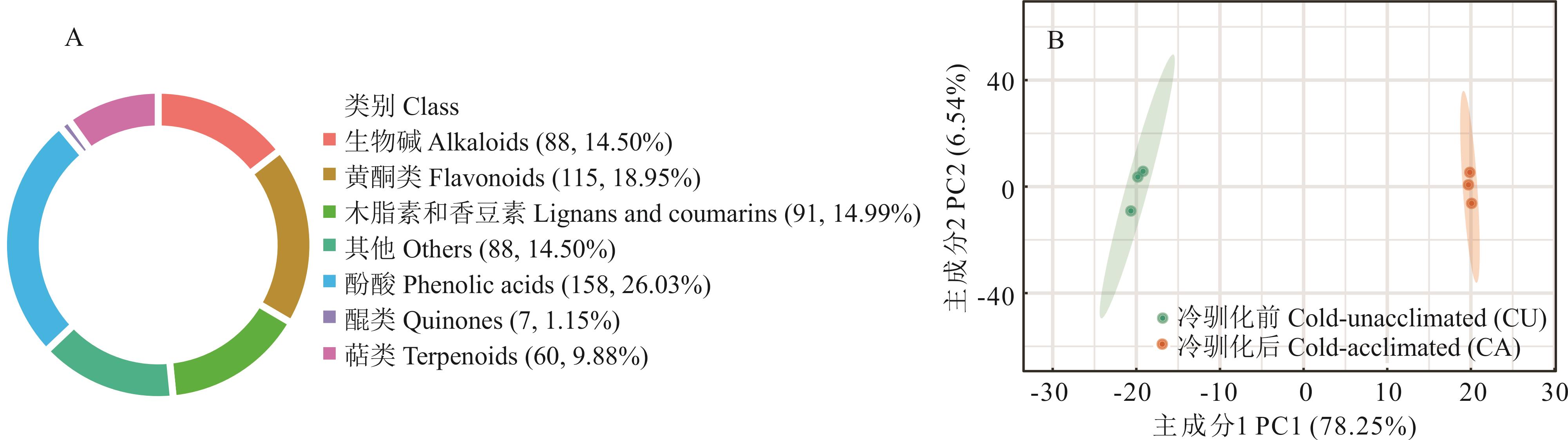
麻叶荨麻是内蒙古乡土优势植物种,越冬率高、耐寒能力强,但其耐寒生理与分子机制尚不明确。本研究旨在通过生理指标测定、代谢组学和转录组学联合分析,揭示冷驯化过程中麻叶荨麻根系的耐寒调控机制。以桑根达来麻叶荨麻为材料,对比分析冷驯化前(CU)和冷驯化后(CA)根系碳水化合物代谢指标、渗透调节物质含量以及氧化胁迫与抗氧化系统相关的生理指标变化,并结合代谢组学和转录组解析其耐寒机制。结果显示,冷驯化处理显著提高了麻叶荨麻根系中丙二醛(P=0.016)、可溶性糖(P=0.020)含量及过氧化物酶(P=0.013)活性,显著降低了超氧化物歧化酶(P=0.027)和过氧化氢酶(P=0.035)活性。代谢组测定结果显示,两组共鉴定出607个代谢物,主要为酚酸(26.03%)、黄酮类(18.95%)、木脂素和香豆素(14.99%)、生物碱(14.50%)和萜类(9.88%);与冷驯化前比较,黄酮类聚类模块总体下调,木脂素和香豆素聚类模块总体上调。排名前20位的差异代谢物中上调代谢物主要是酚酸类与木脂素和香豆素类,下调代谢物主要是生物碱类和萜类。这些差异代谢物在KEGG通路中主要集中在苯丙氨酸代谢、泛醌和其他萜类醌合成和苯丙烷合成途径。转录组测序结果显示,冷驯化前后两组共鉴定得到13996个差异基因,其中上调6695个、下调7301个,这些差异基因主要富集于代谢途径、淀粉和蔗糖代谢、次级代谢物生物合成、昼夜节律-植物等通路。转录组学和代谢组学联合分析结果显示冷驯化主要影响麻叶荨麻根系次级代谢物苯丙烷生物合成途径,并使相关木质素生物合成的松柏醇、绿原酸、咖啡酸、芥子酸和紫丁香苷明显积累;在木质素合成过程中编码4-香豆酸-CoA连接酶(4CL)和肉桂醇脱氢酶(CAD)的基因UrtcanEVm004476t1和UrtcanEVm003921t1表达量上调,从而促进木质素前体松柏醇和紫丁香苷的合成。综上所述,麻叶荨麻可能通过促进碳水化合物积累与木质素生物合成,从而增强耐寒能力。

关键词: 麻叶荨麻, 冷驯化, 次生代谢物, 转录组, 代谢组

Abstract:

Urtica cannabina is a dominant native species in Inner Mongolia, characterized by a high overwintering survival rate and strong cold tolerance. However, the physiological and molecular mechanisms underlying its cold tolerance remain unclear. In this study, we aimed to elucidate the regulatory mechanisms of cold tolerance in the roots of U. cannabina during cold acclimation through analyses of physiological indices, metabolomics, and transcriptomics. Carbohydrate metabolism indices, the levels of osmotic regulatory substances, and physiological indicators related to oxidative stress and the antioxidant system in roots were compared between plants of the U. cannabina cultivar ‘Sanggendalai’ before cold acclimation (CU) and after cold acclimation (CA). The results show that cold acclimation led to significant increases in the contents of malondialdehyde (P=0.016) and soluble sugars (P=0.020), as well as peroxidase activity (P=0.013) in the roots of U. cannabina, but significant decreases in the activities of superoxide dismutase (P=0.027) and catalase (P=0.035). Metabolomic analysis identified a total of 607 metabolites in the two groups, including phenolic acids (26.03%), flavonoids (18.95%), lignans and coumarins (14.99%), alkaloids (14.50%), and terpenoids (9.88%). Compared with the CU plants, the CA plants displayed downregulation of the flavonoid-related cluster module and upregulation of the lignan and coumarin cluster module. Among the top 20 differential metabolites between the CA and CU plants, the upregulated metabolites were mainly phenolic acids, lignans, and coumarins, whereas the down-regulated metabolites were primarily alkaloids and terpenoids. Kyoto Encylopedia of Genes and Genomes pathway analysis indicated that these differential metabolites were mainly enriched in phenylalanine metabolism, ubiquinone and other terpenoid-quinone biosynthesis, and phenylpropanoid biosynthesis pathways. Transcriptome sequencing identified 13996 differentially expressed genes between the CU and CA plants, including 6695 upregulated genes and 7301 down-regulated genes. These genes were mainly enriched in pathways related to general metabolic pathways, starch and sucrose metabolism, biosynthesis of secondary metabolites, and circadian rhythm-plant. Integrated transcriptomic and metabolomic analyses indicated that cold acclimation primarily affected the phenylpropanoid biosynthesis pathway of secondary metabolism. In particular, several lignin-related metabolites, including coniferyl alcohol, chlorogenic acid, caffeic acid, sinapic acid, and syringin accumulated in the CA group. During lignin biosynthesis, the synthesis of the lignin precursors coniferyl alcohol and syringin was likely promoted via upregulation of UrtcanEVm004476t1 and UrtcanEVm003921t1, which encode 4-coumarate-CoA ligase and cinnamyl alcohol dehydrogenase, respectively. In summary, U. cannabina may enhance its cold tolerance by promoting carbohydrate accumulation and lignin biosynthesis.

Key words: Urtica cannabina, cold acclimation, secondary metabolite, transcriptome, metabolome