

ISSN 1004-5759 CN 62-1105/S
草业学报 ›› 2026, Vol. 35 ›› Issue (12): 165-182.DOI: 10.11686/cyxb2025485
• 研究论文 • 上一篇
李欣钰1,2( ), 王学敏2, 李明娜2(), 朱梦妹1, 李如月2, 徐嫣然2, 丁旺3, 张夏香1()
收稿日期:2025-11-27
修回日期:2026-03-23
出版日期:2026-12-20
发布日期:2026-11-02
通讯作者:
李明娜,张夏香
作者简介:E-mail: xiaxiang.zhang@njau.edu.cn基金资助:
Xin-yu LI1,2(), Xue-min WANG2, Ming-na LI2(), Meng-mei ZHU1, Ru-yue LI2, Yan-ran XU2, Wang DING3, Xia-xiang ZHANG1()
Received:2025-11-27
Revised:2026-03-23
Online:2026-12-20
Published:2026-11-02
Contact:
Ming-na LI,Xia-xiang ZHANG
摘要:
扁穗冰草是一种具有重要生态与经济价值的多年生草本植物,因其较强的抗旱和耐寒能力,广泛分布于我国东北、西北及内蒙古等干旱半干旱地区。本研究结合第三代全长转录组测序与第二代转录组测序技术,对不同生长天数(20、28和42 d)的扁穗冰草叶片进行了转录组分析。通过三代全长转录组测序,共获得了61.17 GB的数据量,包含23889644条环形一致性序列(CCS),从中筛选出23862353条全长非嵌合序列(FLNC),在NCBI非冗余蛋白数据库(NR)、NCBI核酸序列数据库(NT)、基因本体数据库(GO)、京都基因与基因组百科全书(KEGG)和真核生物直系同源基因簇数据库(KOG)5大数据库进行基因功能注释后,共有95580个转录本在所有数据库中均被成功注释。表型观测结果显示,随着生长进程推进,扁穗冰草的株高、分蘖数和叶片生物量均显著增加,尤其是在28至42 d期间,生物量积累达到较高水平。基于二代测序数据的分析表明,在L_28与L_20比较组中鉴定出22380个差异基因,L_42与L_20比较组中鉴定出23789个,而L_42与L_28比较组中鉴定出7208个。KEGG富集分析显示,这些差异基因主要参与谷胱甘肽代谢、精氨酸和脯氨酸代谢、光合作用及植物激素信号转导等重要通路。进一步分析发现,光合作用相关基因及激素(如生长素、细胞分裂素)信号转导基因的表达水平在扁穗冰草不同生长阶段呈显著变化。此外,bHLH、AP2/ERF等转录因子家族也广泛参与扁穗冰草叶片生长调控。综上所述,本研究系统解析了扁穗冰草叶片在不同生长阶段中的转录组动态,为深入探究其生物学特性、特有表型形成的分子机制提供了参考和数据支持。
李欣钰, 王学敏, 李明娜, 朱梦妹, 李如月, 徐嫣然, 丁旺, 张夏香. 扁穗冰草全长转录组测序及不同生长时期叶片的转录组分析[J]. 草业学报, 2026, 35(12): 165-182.
Xin-yu LI, Xue-min WANG, Ming-na LI, Meng-mei ZHU, Ru-yue LI, Yan-ran XU, Wang DING, Xia-xiang ZHANG. Full-length transcriptome sequencing and comparative transcriptome analysis of leaves across different growth stages in Agropyron cristatum[J]. Acta Prataculturae Sinica, 2026, 35(12): 165-182.
| 引物Primer | 正向Forward (5′-3′) | 反向Reverse (5′-3′) |
|---|---|---|
| β-Actin | GAGCGTGGTTACTCATTCA | TGCCGTACAGATCCTTCC |
| COG1 | TGTCAATCCAGCTCACCACC | CCACACCTTGCCATTACCCT |
| FtsH11 | TCCCTAGTCCTGATGTGCGA | TCAGCCCCATTAAAGCCAGG |
| γ-ECS | TGCCCACTTTGAACGATT | CTTGGCTAACTGGAGAACAT |
| CPI1 | GAAGTGGGTCCTTTCCAGGG | CACCGTCTTGATTCGGGGAT |
| DHAR | CACTTGTGACCCCTCCTG | TTCGCCCCGCCGATGTAG |
| GR | CAACTGGTAGCCGAGCAA | ACTTCAGCACCCAACCCT |
表1 实时荧光定量PCR引物序列
Table 1 Primer sequences for RT-qPCR
| 引物Primer | 正向Forward (5′-3′) | 反向Reverse (5′-3′) |
|---|---|---|
| β-Actin | GAGCGTGGTTACTCATTCA | TGCCGTACAGATCCTTCC |
| COG1 | TGTCAATCCAGCTCACCACC | CCACACCTTGCCATTACCCT |
| FtsH11 | TCCCTAGTCCTGATGTGCGA | TCAGCCCCATTAAAGCCAGG |
| γ-ECS | TGCCCACTTTGAACGATT | CTTGGCTAACTGGAGAACAT |
| CPI1 | GAAGTGGGTCCTTTCCAGGG | CACCGTCTTGATTCGGGGAT |
| DHAR | CACTTGTGACCCCTCCTG | TTCGCCCCGCCGATGTAG |
| GR | CAACTGGTAGCCGAGCAA | ACTTCAGCACCCAACCCT |
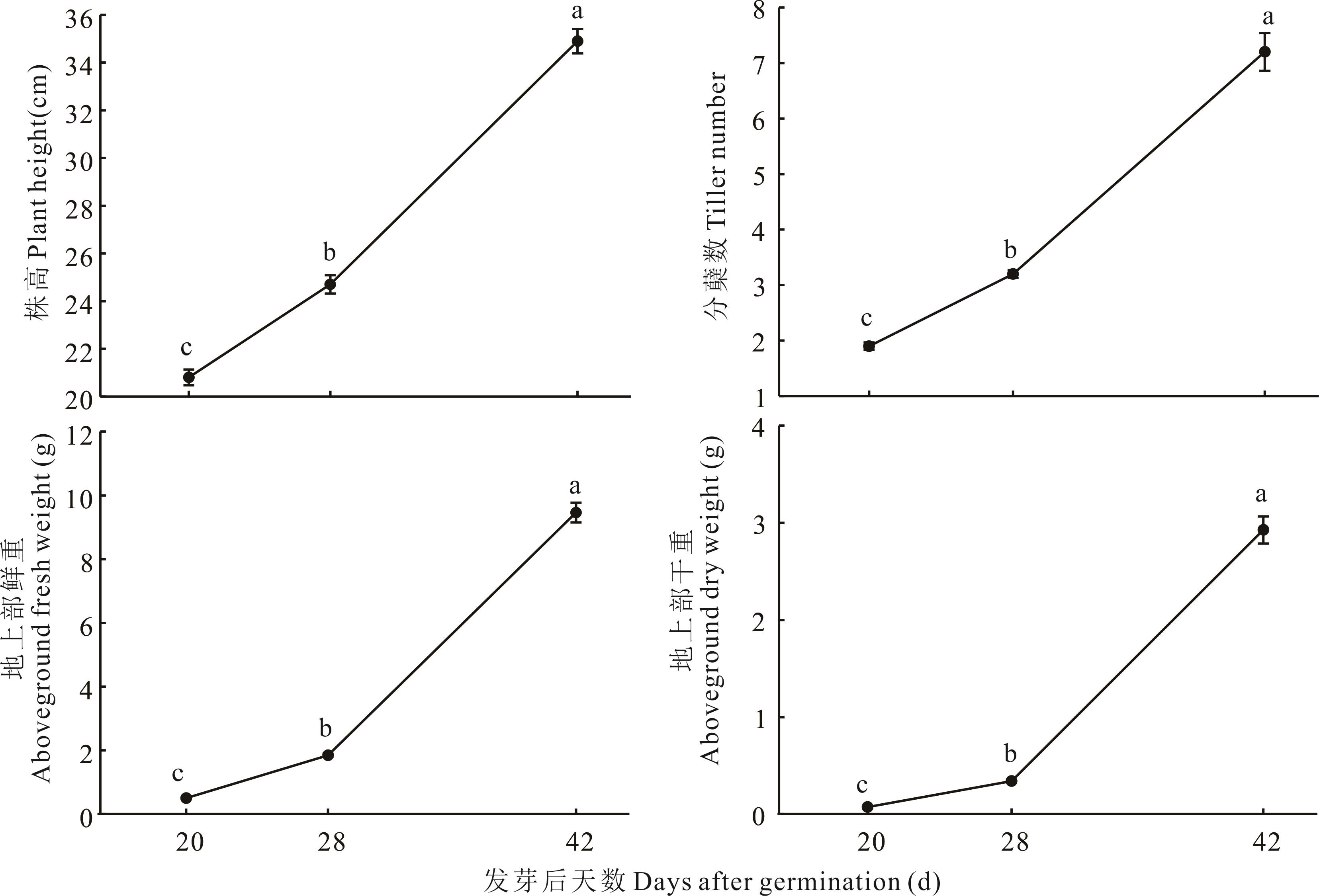
图1 不同生长天数扁穗冰草地上部形态指标图中所示地上部鲜重、地上部干重为4株扁穗冰草植株的生物量。不同小写字母表示差异显著(P<0.05)。The aboveground fresh weight and aboveground dry weight represent the biomass of four crested wheatgrass plants. Different lowercase letters indicate significant difference at the 0.05 level.
Fig.1 Morphological indicators of the aboveground part of A. cristatum during different growth stages

图2 扁穗冰草三代全长转录组结果分析A: 七大数据库注释结果统计Statistics of annotation results from seven major databases; B: 五大数据库注释维恩图Venn diagram of annotation from five major databases; C: NR数据库注释统计Statistics of NR database annotation; D: KEGG通路注释柱形图Bar chart of KEGG pathway annotations.
Fig.2 Analysis of full-length transcriptome of A. cristatum
样品 Sample | 总读取数 Total reads | 总映射数(比例) Total mapped reads (Proportion) |
|---|---|---|
| L_20-1 | 132019604 | 100351816 (76.01%) |
| L_20-2 | 123286334 | 101352978 (82.21%) |
| L_20-3 | 152294434 | 121825554 (79.99%) |
| L_28-1 | 125714796 | 108520384 (86.32%) |
| L_28-2 | 134285710 | 111815444 (83.27%) |
| L_28-3 | 152896860 | 131835092 (86.22%) |
| L_42-1 | 124362884 | 100460702 (80.78%) |
| L_42-2 | 184840476 | 151365264 (81.89%) |
| L_42-3 | 133727556 | 112686780 (84.27%) |
表2 各样本总读取数与总映射数比对情况
Table 2 Comparison of total reads and total mapped reads for each sample
样品 Sample | 总读取数 Total reads | 总映射数(比例) Total mapped reads (Proportion) |
|---|---|---|
| L_20-1 | 132019604 | 100351816 (76.01%) |
| L_20-2 | 123286334 | 101352978 (82.21%) |
| L_20-3 | 152294434 | 121825554 (79.99%) |
| L_28-1 | 125714796 | 108520384 (86.32%) |
| L_28-2 | 134285710 | 111815444 (83.27%) |
| L_28-3 | 152896860 | 131835092 (86.22%) |
| L_42-1 | 124362884 | 100460702 (80.78%) |
| L_42-2 | 184840476 | 151365264 (81.89%) |
| L_42-3 | 133727556 | 112686780 (84.27%) |
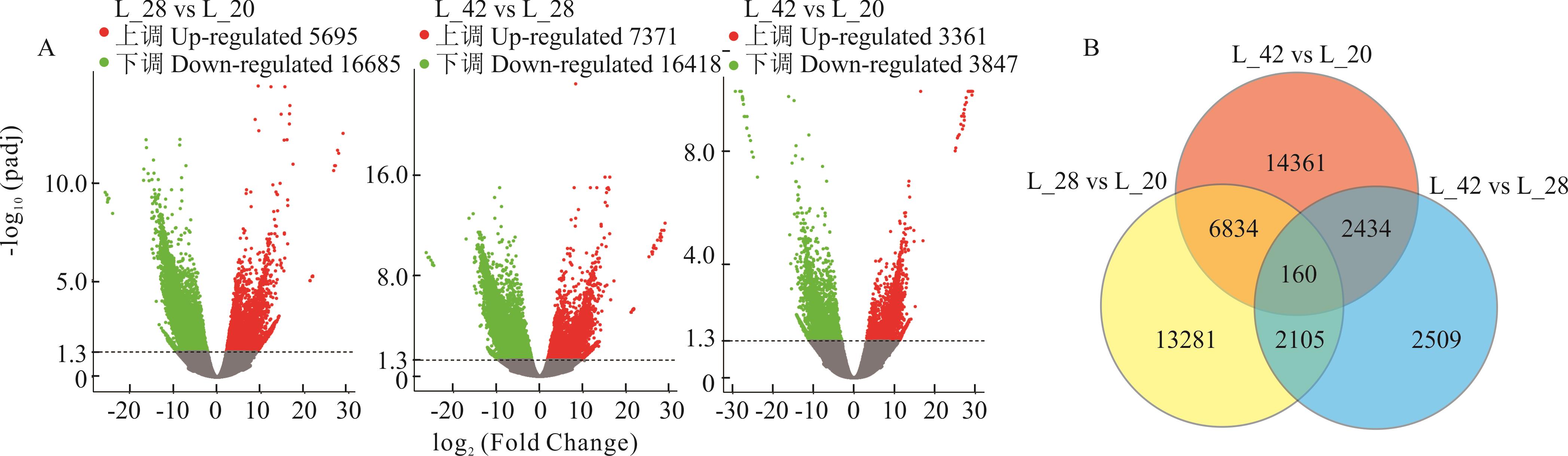
图3 不同生长阶段扁穗冰草叶片的差异表达基因分析A: 差异表达基因火山图Volcano plot of differentially expressed genes; B: 差异表达基因维恩图Venn diagram of differentially expressed genes.
Fig.3 Analysis of differentially expressed genes in A. cristatum leaves at different growth stages

图4 不同生长阶段扁穗冰草叶片差异表达基因的KEGG富集通路分析
Fig.4 KEGG enrichment analysis of differentially expressed genes in A. cristatum leaves at different growth stages

图5 富集在光合作用通路上的差异表达基因热图PsbO: 光系统Ⅱ放氧增强蛋白1 Photosystem Ⅱ oxygen-evolving enhancer protein 1; PsbP: 光系统Ⅱ放氧增强蛋白2 Photosystem Ⅱ oxygen-evolving enhancer protein 2; PsbR: 光系统Ⅱ 10 kDa蛋白Photosystem Ⅱ 10 kDa protein; Psb28: 光系统Ⅱ 28 kDa蛋白Photosystem Ⅱ 28 kDa protein; PsbB: 光系统Ⅱ CP47叶绿素脱辅基蛋白Photosystem Ⅱ CP47 chlorophyll apoprotein; PsbQ: 光系统Ⅱ放氧增强蛋白3 Photosystem Ⅱ oxygen-evolving enhancer protein 3; PPL1: PsbP类蛋白1 PsbP-like protein 1; PsbW: 光系统Ⅱ 6 kDa蛋白Photosystem Ⅱ 6 kDa protein; PsbY: 光系统Ⅱ 4.8 kDa蛋白Photosystem Ⅱ 4.8 kDa protein; Psb27: 光系统Ⅱ 27 kDa蛋白Photosystem Ⅱ 27 kDa protein; PsbS: 光系统Ⅱ S亚基Photosystem Ⅱ subunit S; PsaH: 光系统Ⅰ H亚基photosystem I subunit H; PsaF: 光系统Ⅰ F亚基Photosystem Ⅰ subunit F; PsaA: 光系统Ⅰ P700叶绿素a脱辅基蛋白A1 Photosystem Ⅰ P700 chlorophyll a apoprotein A1; PsaL: 光系统Ⅰ L亚基Photosystem Ⅰ subunit L; PsaN: 光系统Ⅰ N亚基Photosystem Ⅰ subunit N; PsaO: 光系统Ⅰ O亚基Photosystem Ⅰ subunit O; PsaG: 光系统Ⅰ G亚基Photosystem Ⅰ subunit G; PsaD: 光系统Ⅰ D亚基Photosystem Ⅰ subunit D; PsaB: 光系统Ⅰ P700叶绿素a脱辅基蛋白A2 Photosystem Ⅰ P700 chlorophyll a apoprotein A2; FNR: 铁氧还蛋白-NADP+还原酶Ferredoxin-NADP+ reductase; Pc: 质体蓝素Plastocyanin; FD3: 铁氧还蛋白3 Ferredoxin 3; FDC2: 铁氧还蛋白依赖型叶绿体蛋白2 Ferredoxin-dependent chloroplast protein 2.
Fig.5 Heatmap of differentially expressed genes enriched in the photosynthesis pathway

图6 富集在植物激素信号转导通路上的差异表达基因热图ARF: 生长素响应因子Auxin response factor; AUX: 生长素输入载体蛋白Auxin transporter; GH3.8: GH3早期响应蛋白3.8 Gretchen hagen protein 3.8; IAA: 生长素/吲哚-3-乙酸蛋白Auxin/indole-3-acetic acid protein; SAUR: SAUR早期响应蛋白Small auxin up-regulated protein; GH3.3-like: GH3.3类似蛋白GH3.3-like protein; TIFY: 茉莉酸TIFY结构域蛋白Jasmonic acid TIFY domain protein; ARR: 拟南芥反应调节蛋白Arabidopsis response regulator; AHK: 拟南芥组氨酸激酶Arabidopsis histidine kinase; BcrA: B类细胞分裂素响应调节蛋白A B-type cytokinin response regulator A; CRR: 细胞分裂素响应调节蛋白Cytokinin response regulator; ORR: 水稻反应调节蛋白O. sativa response regulator; PP2C: 蛋白磷酸酶2C Protein phosphatase 2C; PYL:PYR/PYL类蛋白PYR/PYL-like protein; SAPK: SnRK2类蛋白激酶SnRK2-type protein kinase; SNF: 蔗糖非发酵蛋白Sucrose non-fermenting protein; SnRK: 蔗糖非发酵相关蛋白激酶Sucrose non-fermenting-related protein kinase; EBF: EIN3结合F-box蛋白EIN3-binding F-box protein; EIN: 乙烯不敏感蛋白Ethylene insensitive protein; EIL3: 乙烯不敏感样蛋白Ethylene insensitive 3-like protein; CTR: 组成型三重反应Constitutive triple response; ERF-C: 乙烯响应因子C Ethylene response factor C; MAPK: MAPK级联相关蛋白激酶MAPK cascade-related protein kinase; bZIP: 碱性亮氨酸拉链蛋白Basic leucine zipper protein; HBP-1b(c1)-X2: HBP-1b(c1)蛋白X2亚型HBP-1b(c1) protein isoform X2; HBP-1b(c38)-X2: HBP-1b(c38)蛋白X2亚型HBP-1b(c38) protein isoform X2; NPR: 非表达致病相关基因Nonexpressor of pathogenesis-related genes 1-like; TGAL5-X: TGAL5蛋白X亚型TGAL5 protein isoform X; TGAL6-like-X: TGAL6类蛋白X亚型TGAL6-like protein isoform X; TGAL4-like-X: TGAL4类蛋白X亚型TGAL4-like protein isoform X; TGAL8-like-X: TGAL8类蛋白X亚型TGAL8-like protein isoform X; TGAL9-like-X: TGAL9类蛋白X亚型TGAL9-like protein isoform X; PR: 病程相关蛋白Pathogenesis-related protein; PRMS: 病程相关蛋白调节因子Pathogenesis-related protein modulator.
Fig.6 Heatmap of differentially expressed genes enriched in plant hormone signal transduction pathway

图7 差异表达基因中的转录因子分析A: 差异表达转录因子维恩图Venn diagram of differentially expressed transcription factors; B~D: 差异表达转录因子柱状图Bar chart of differentially expressed transcription factors; AUX/IAA: 生长素/吲哚-3-乙酸蛋白家族Auxin/indole-3-acetic acid protein family; AP2/ERF-ERF: AP2/乙烯响应因子家族AP2/ethylene response factor family; B3: B3结构域蛋白家族B3 domain-containing protein family; bHLH: 碱性螺旋-环-螺旋转录因子家族Basic helix-loop-helix transcription factor family; bZIP: 碱性亮氨酸拉链转录因子家族Basic leucine zipper transcription factor family; C2H2: C2H2型锌指蛋白家族C2H2 zinc finger protein family; C3H: C3H型锌指蛋白家族C3H zinc finger protein family; FAR1: FAR1转录因子家族FAR1 transcription factor family; GARP-G2-like: GARP-G2样蛋白家族GARP-G2-like protein family; HSF: 热激转录因子家族Heat shock factor family; mTERF: 线粒体转录终止因子家族Mitochondrial transcription termination factor family; MYB: MYB转录因子家族MYB transcription factor family; MYB-related: MYB相关转录因子家族MYB-related transcription factor family; NAC:NAC转录因子家族NAC transcription factor family; NF-YA:核因子YA亚基家族Nuclear factor Y subunit A family; Tify: TIFY转录因子家族TIFY transcription factor family; TRAF: TRAF结构域蛋白家族TRAF domain-containing protein family; WRKY:WRKY转录因子家族WRKY transcription factor family.
Fig.7 Analysis of transcription factors among differentially expressed genes

图8 差异表达的bHLH、B3及NF-YA家族转录因子热图bHLH: 碱性螺旋-环-螺旋转录因子Basic helix-loop-helix transcription factor; B3: B3结构域蛋白B3 domain protein; AP-4: 转录因子AP-4 Transcription factor AP-4; APG: PGL1拮抗因子Antagonist of PGL1; BIM: BIM蛋白BES1-interacting MYC-like protein; bzzz-bHLH35-like: 碱性螺旋-环-螺旋转录因子35类似物(bzzz型)Basic helix-loop-helix transcription factor 35-like (bzzz type); FAMA: FAMA转录因子FAMA transcription factor; HEC: 螺旋-环-螺旋蛋白 Helix-loop-helix protein; IRO: 铁调控转录因子Iron-related transcription factor; MXI: MAX相互作用蛋白MAX-interacting protein; ORG: 器官大小调节蛋白Organ size regulator; PIF: 光敏色素互作因子Phytochrome-interacting factor; UNE: 胚珠发育异常蛋白Unfertilized embryo sac; NF-YA: 核因子YA亚基Nuclear factor YA subunit; CBF-B: C重复结合因子B C-repeat binding factor B; WHAP6: CCAAT盒转录因子复合物CCAAT-box transcription factor complex.
Fig.8 Heatmap of differentially expressed bHLH, B3 and NF-YA family transcription factors

图9 差异表达的ERF及NAC家族转录因子热图ERF: 乙烯响应因子Ethylene response factor; AIL5: AINTEGUMENTA样蛋白5 AINTEGUMENTA-like protein 5; ABR1-like: ABA响应蛋白1类似物ABA-responsive protein 1-like; AP2-B: AP2结构域蛋白B AP2 domain protein B; BBM1: 体胚发生相关蛋白1 Baby boom-related protein 1; CBF: C重复结合因子C-repeat binding factor; CRF: 细胞分裂素响应因子Cytokinin response factor; DRF: 脱水响应因子Dehydration-responsive factor; DRFL: 脱水响应因子样蛋白Dehydration-responsive factor-like protein; PTI: Pto互作蛋白Pto-interacting protein; RAP: AP2相关蛋白Related to AP2 protein; RSR: 水稻淀粉调节因子Rice starch regulator.
Fig.9 Heatmap of differentially expressed ERF and NAC family transcription factors
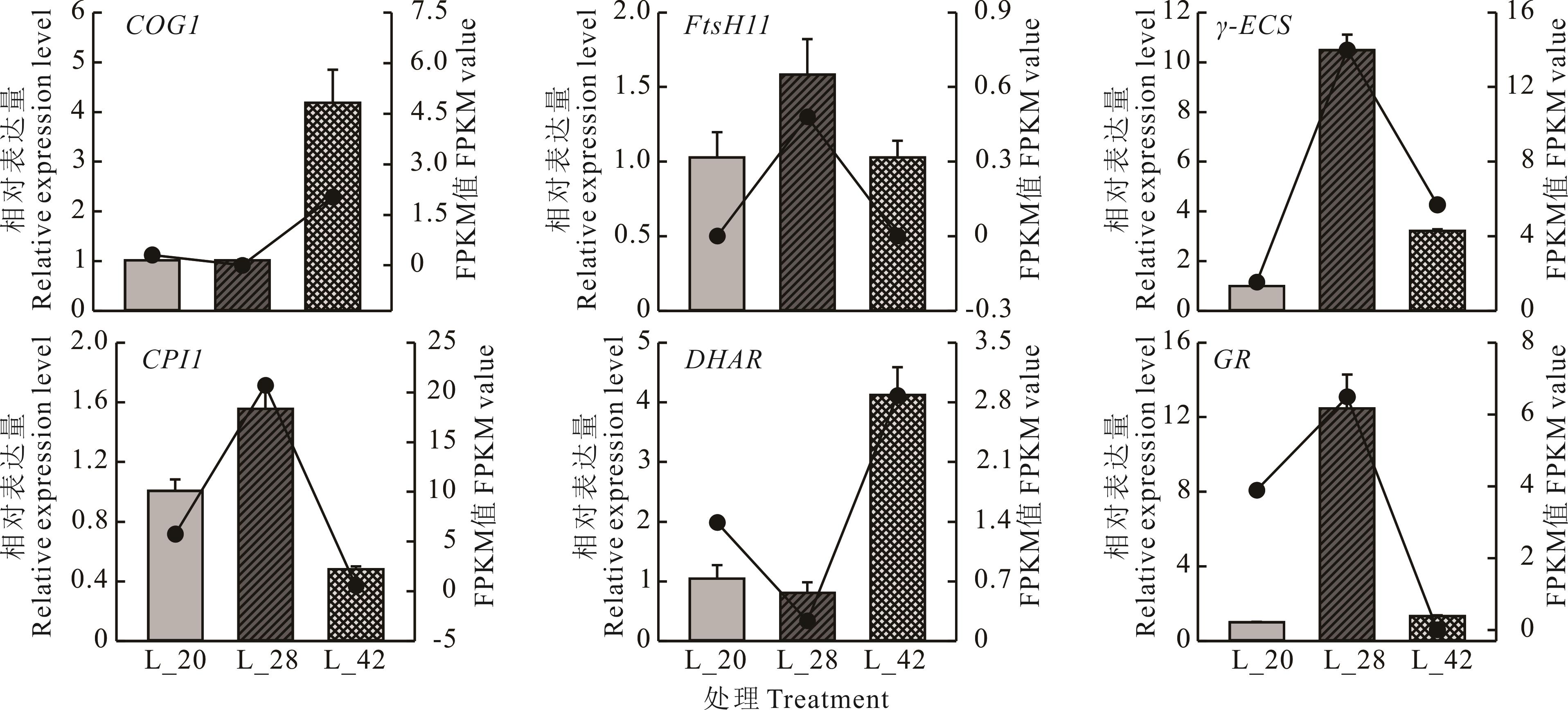
图10 实时荧光定量PCR验证转录组测序结果FPKM: 每百万个映射读数中每千碱基转录本的片段数Fragments per kilobase of transcript per million mapped reads.
Fig.10 Validation of the transcriptomic data with RT-qPCR
| [1] | Zhou X L, Yang L C, Li G Q, et al. Polymorphism analysis of Agropyron cristatum (L.) Gaertn and endemic species based on cpDNAtrnT-trnL sequences. Qinghai Prataculture, 2019, 28(3): 2-6. |
| 周学丽, 杨路存, 李桂全, 等. 扁穗冰草不同地理种群cpDNAtrnT-trnL多态性分析. 青海草业, 2019, 28(3): 2-6. | |
| [2] | Gao H J, Liu Z D, Sun R. Study on the production performance of newstrain of Agropyron cristatum (L.). Feed Review, 2019(5): 52-54. |
| 高海娟, 刘泽东, 孙蕊. 扁穗冰草新品系生产性能研究. 饲料博览, 2019(5): 52-54. | |
| [3] | Gao H J, Yun J F, Luo X Y, et al. A study on anatomy of vegetative organs of Agropyron cristatum. Pratacultural Science, 2012, 29(3): 429-433. |
| 高海娟, 云锦凤, 罗新义, 等. 扁穗冰草营养器官的解剖学研究. 草业科学, 2012, 29(3): 429-433. | |
| [4] | Xu C B, Mi F G, Wang Y, et al. Factors influencing plant regeneration systems in mature embryo culture of Agropyron. Acta Prataculturae Sinica, 2009, 18(1): 80-85. |
| 徐春波, 米福贵, 王勇, 等. 影响冰草成熟胚组织培养再生体系频率的因素. 草业学报, 2009, 18(1): 80-85. | |
| [5] | Fischer W W, Hemp J, Johnson E J. Evolution of oxygenic photosynthesis. Annual Review of Earth and Planetary Sciences, 2016, 44: 647-683. |
| [6] | Eberhard S, Finazzi G, Wollman F A. The dynamics of photosynthesis. Annual Review of Genetics, 2008, 42: 463-515. |
| [7] | Waters M T, Moylan E C, Langdale J A. GLK transcription factors regulate chloroplast development in a cell-autonomous manner. The Plant Journal, 2008, 56(3): 432-444. |
| [8] | Wu G, Park Y M, Conway R S, et al. The sequential action of miR156 and miR172 regulates developmental timing in Arabidopsis. Cell, 2009, 138(4): 750-759. |
| [9] | Allis C D, Jenuwein T. The molecular hallmarks of epigenetic control. Nature Reviews Genetics, 2016, 17(8): 487-500. |
| [10] | Chan K X, Phua S Y, Crisp P, et al. Learning the languages of the chloroplast: Retrograde signaling and beyond. Annual Review of Plant Biology, 2016, 67: 25-53. |
| [11] | Huang Y, Zhao Y C, Cui L L, et al. Research progress on effects of plant hormones and other regulatory factors on rice root growth and development. Fujian Journal of Agricultural Sciences, 2025, 40(1): 99-111. |
| 黄熠,赵永超,崔丽丽,等. 植物激素等调控因子对水稻根系生长发育的影响研究进展. 福建农业学报, 2025, 40(1): 99-111. | |
| [12] | Waadt R, Seller C A, Hsu P K, et al. Plant hormone regulation of abiotic stress responses. Nature Reviews Molecular Cell Biology, 2022, 23(10): 680-694. |
| [13] | Vanstraelen M, Benková E. Hormonal interactions in the regulation of plant development. Annual Review of Cell and Developmental Biology, 2012, 28: 463-487. |
| [14] | Zhao B Q, Liu Q Y, Wang B S, et al. Roles of phytohormones and their signaling pathways in leaf development and stress responses. Journal of Agricultural and Food Chemistry, 2021, 69(12): 3566-3584. |
| [15] | Müller D, Leyser O. Auxin, cytokinin and the control of shoot branching. Annals of Botany, 2011, 107(7): 1203-1212. |
| [16] | Woodward A W, Bartel B. Auxin: Regulation, action, and interaction. Annals of Botany, 2005, 95(5): 707-735. |
| [17] | Li Q F, Wang C M, Jiang L, et al. An interaction between BZR1 and DELLAs mediates direct signaling crosstalk between brassinosteroids and gibberellins in Arabidopsis. Science Signaling, 2012, 5(244): ra72. |
| [18] | Fan L, Tang J, Ma L, et al. Screening genes related to drought resistance in Agropyron mongolicum Keng based on transcriptome. Acta Agrestia Sinica, 2024, 32(11): 3344-3357. |
| 樊璐, 唐俊, 马琳, 等. 基于转录组测序筛选蒙古冰草抗旱相关基因. 草地学报, 2024, 32(11): 3344-3357. | |
| [19] | Wang H P, Zhao H B, Du J Y, et al. Full length transcriptome analysis of Agropyron mongolicum and identification of hydroxylase genes involved in lignin synthesis and drought response. Journal of Grassland and Forage Science, 2024(1): 10-22. |
| 王贺萍, 赵竑博, 杜锦瑜, 等. 蒙古冰草全长转录组分析及参与木质素合成和干旱响应的羟化酶基因鉴定. 草学, 2024(1): 10-22. | |
| [20] | Salmela L, Rivals E. LoRDEC: Accurate and efficient long read error correction. Bioinformatics, 2014, 30(24): 3506-3514. |
| [21] | Fu L M, Niu B F, Zhu Z W, et al. CD-HIT: Accelerated for clustering the next-generation sequencing data. Bioinformatics, 2012, 28(23): 3150-3152. |
| [22] | Chen S F, Zhou Y Q, Chen Y R, et al. fastp: An ultra-fast all-in-one FASTQ preprocessor. Bioinformatics, 2018, 34(17): i884-i890. |
| [23] | Li B, Dewey C N. RSEM: Accurate transcript quantification from RNA-Seq data with or without a reference genome. BMC Bioinformatics, 2011, 12(1): 323. |
| [24] | Shan C J, Liang Z S. Jasmonic acid regulates ascorbate and glutathione metabolism in Agropyron cristatum leaves under water stress. Plant Science, 2010, 178(2): 130-139. |
| [25] | Livak K J, Schmittgen T D. Analysis of relative gene expression data using real-time quantitative PCR and the 2-ΔΔCt method. Methods, 2001, 25(4): 402-408. |
| [26] | Zhu Q N, Zhang K Y, Chen W X, et al. Transcriptomic and metabolomic analyses reveal key factors regulating chilling stress-induced softening disorder in papaya fruit. Postharvest Biology and Technology, 2023, 205: 112534. |
| [27] | Zhang X F, Ma Y H, Fan B B, et al. Analysis of bHLH transcription factor family based on RNA-Seq in Agropyron mongolicum. Molecular Plant Breeding, 2023, 21(4): 1154-1163. |
| 张学峰, 马艳红, 范菠菠,等. 基于RNA-Seq的蒙古冰草bHLH转录因子家族分析. 分子植物育种, 2023, 21(4): 1154-1163. | |
| [28] | Chen X, Luo S Q, Duan C F, et al. Research advance on the transcription factors in higher plants. Anhui Agricultural Science Bulletin, 2008, 14(9): 48-52, 65. |
| 陈霞, 罗世巧, 段翠芳, 等. 高等植物转录因子研究进展. 安徽农学通报, 2008, 14(9): 48-52, 65. | |
| [29] | Ning M, Li Q Y, Wang Y, et al. Alternative splicing drives the functional diversification of a bHLH transcription factor in the control of growth and drought tolerance in rice. Science Bulletin, 2025, 70(2): 153-156. |
| [30] | Jia Y T. Function analysis of transcription factor bHLH146 in Arabidopsis thaliana. Changchun: Jilin University, 2022. |
| 贾雨彤. 拟南芥转录因子bHLH146的功能研究. 长春: 吉林大学, 2022. | |
| [31] | Gou Y L, Zhang L, Guo H, et al. Research progress on the AP2/ERF transcription factor in plants. Pratacultural Science, 2020, 37(6): 1150-1159. |
| 苟艳丽, 张乐, 郭欢, 等. 植物AP2/ERF类转录因子研究进展. 草业科学, 2020, 37(6): 1150-1159. | |
| [32] | Guo Y F, Ren G D, Zhang K W, et al. Leaf senescence: Progression, regulation, and application. Molecular Horticulture, 2021, 1: 5. |
| [33] | Wang S J, Zhou L D, Hu J, et al. Functional analysis of ERF transcription factors in regulating leaf morphological construction of poplar. Plant Physiology Journal, 2023, 59(6): 1157-1168. |
| 王升级, 周猎鼎, 胡佳, 等. ERF转录因子调控杨树叶片形态构建的功能分析. 植物生理学报, 2023, 59(6): 1157-1168. | |
| [34] | Lim C, Kang K, Shim Y, et al. Rice ETHYLENE RESPONSE FACTOR 101 promotes leaf senescence through jasmonic acid-mediated regulation of OsNAP and OsMYC2. Frontiers in Plant Science, 2020, 11: 1096. |
| [35] | Yu J Y, Gong C R. Advances in biological functions of plant NAC transcription factors. Henan Science, 2024, 42(11): 1589-1601. |
| 于婧瑶, 巩琛锐. 植物NAC转录因子的生物学功能研究进展. 河南科学, 2024, 42(11): 1589-1601. | |
| [36] | Kılıç M, Gollan P J, Lepistö A, et al. Gene expression and organization of thylakoid protein complexes in the PSII-less mutant of Synechocystis sp. PCC 6803. Plant Direct, 2022, 6(6): e409. |
| [37] | Tikhonov A N. The cytochrome b6f complex: Biophysical aspects of its functioning in chloroplasts//Harris J R, Boekema E J. Membrane protein complexes: Structure and function. Singapore: Springer Singapore, 2018: 287-328. |
| [38] | Wang Q Q, Marconi M, Guan C M, et al. Polar auxin transport modulates early leaf flattening. Proceedings of the National Academy of Sciences of the United States of America, 2022, 119(50): e2215569119. |
| [39] | Jia L Q, Dai Y D, Peng Z W, et al. The auxin transporter OsAUX1 regulates tillering in rice (Oryza sativa). Journal of Integrative Agriculture, 2024, 23(5): 1454-1467. |
| [40] | Liu Z H, Dai X H, Li J, et al. The type-B cytokinin response regulator ARR1 inhibits shoot regeneration in an ARR12-dependent manner in Arabidopsis. The Plant Cell, 2020, 32(7): 2271-2291. |
| [1] | 陈奋奇, 张金青, 禹一箭, 李振宇. 紫花苜蓿AP2亚家族基因鉴定、生信分析及MsBBM基因克隆[J]. 草业学报, 2026, 35(7): 117-134. |
| [2] | 孙朗, 任燕萍, 娜菲莎·木则帕尔, 谌能双, 马丽, 程聪, 李俐, 张桦. 梭梭WOX转录因子家族鉴定及HaWOX29和HaWOX54在根生长中的功能研究[J]. 草业学报, 2026, 35(1): 192-205. |
| [3] | 邓文辉, 宋珂辰, 张浩, 管思雨, 雍嘉仪, 谢铁娜, 胡海英. 降水变化对荒漠草原植物群落主要物种气孔形态和光合生理特性的影响[J]. 草业学报, 2026, 35(1): 65-78. |
| [4] | 杨寒星, 刘宁戈, 汤钰镂, 李欢, 朱一鸣, 郭家萌, 王浩, 邵瑞鑫, 王泳超, 杨青华. 水杨酸对高温、干旱及其复合胁迫下玉米抗氧化系统及光合能力的调控效应[J]. 草业学报, 2026, 35(1): 79-92. |
| [5] | 邹苇鹏, 刘怡, 翟佳兴, 周思懿, 宫祉祎, 岑慧芳, 朱慧森, 许涛. 紫花苜蓿MsNAC053基因克隆及其对非生物胁迫的响应分析[J]. 草业学报, 2025, 34(9): 121-133. |
| [6] | 郭彬, 罗维成, 单立山, 安宁, 刘冰. 模拟增温对河西走廊典型荒漠灌木光合作用的影响[J]. 草业学报, 2025, 34(7): 145-157. |
| [7] | 左志芳, 李永龙, 魏雨佳, 周生辉, 李岩, 杨国锋. 结缕草DREB基因家族的鉴定及非生物胁迫下的表达模式分析[J]. 草业学报, 2025, 34(5): 74-88. |
| [8] | 贺龙义, 谭萌萌, 车海涛, 张红鹰, 朱雨欣, 张彦妮. 细叶百合LpDREB9基因克隆及耐旱性分析[J]. 草业学报, 2025, 34(1): 161-173. |
| [9] | 魏娜, 敬文茂, 许尔文, 王荣新, 赵晶忠, 马雪娥, 张吉宇, 刘文献. 白花草木樨MaERF058基因耐旱功能验证[J]. 草业学报, 2024, 33(8): 159-169. |
| [10] | 王芳, 张世子, 戴镕徽, 杨丽云, 罗丽娟, 蒋凌雁. 柱花草SgMPK6互作蛋白的筛选与验证[J]. 草业学报, 2024, 33(7): 84-93. |
| [11] | 伍国强, 于祖隆, 魏明. PGPR调控植物响应逆境胁迫的作用机制[J]. 草业学报, 2024, 33(6): 203-218. |
| [12] | 李显炀, 刘昊, 何飞, 王雪, 李明娜, 龙瑞才, 康俊梅, 杨青川, 陈林. 全基因组水平紫花苜蓿WRKY转录因子家族鉴定与表达模式分析[J]. 草业学报, 2024, 33(4): 154-170. |
| [13] | 陈奋奇, 张金青, 马晖玲. 激素调控植物分枝/分蘖的研究进展[J]. 草业学报, 2024, 33(2): 212-225. |
| [14] | 刘昌壮, 陶雨朝, 李明, 张小明. 硫酸锰对盐碱胁迫下栽培稗幼苗光合与氮代谢的影响[J]. 草业学报, 2024, 33(12): 84-98. |
| [15] | 史先飞, 高宇, 黄旭升, 周雅莉, 蔡桂萍, 李昕儒, 李润植, 薛金爱. 油莎豆CeWRKY转录因子响应非生物胁迫的功能表征[J]. 草业学报, 2023, 32(8): 186-201. |
| 阅读次数 | ||||||
|
全文 |
|
|||||
|
摘要 |
|
|||||
