

ISSN 1004-5759 CN 62-1105/S
草业学报 ›› 2025, Vol. 34 ›› Issue (6): 14-26.DOI: 10.11686/cyxb2024286
罗顺华1( ), 刘新宇2,3,4, 孟宝平5,6, 陈璇黎5,6, 胡仁杰5,6, 于红妍7, 王贤颖7, 张勃1(), 秦彧2,3,4()
收稿日期:2024-07-17
修回日期:2024-08-08
出版日期:2025-06-20
发布日期:2025-04-03
通讯作者:
张勃,秦彧
作者简介:qiny@lzb.ac.cn基金资助:
Shun-hua LUO1(), Xin-yu LIU2,3,4, Bao-ping MENG5,6, Xuan-li CHEN5,6, Ren-jie HU5,6, Hong-yan YU7, Xian-ying WANG7, Bo ZHANG1(), Yu QIN2,3,4()
Received:2024-07-17
Revised:2024-08-08
Online:2025-06-20
Published:2025-04-03
Contact:
Bo ZHANG,Yu QIN
摘要:
物种多样性是维持祁连山草地生态系统功能,进而保障祁连山生态屏障作用的基础。目前关于祁连山高寒草地植物功能群物种多样性与生产力维持机制的研究较为匮乏。本研究基于2023年7月中下旬在祁连山国家公园青海片区7种典型高寒草地的无人机航拍-地面协同调查,分析了不同高寒草地的植物群落特征,阐明了植物功能群物种丰富度和地上生物量的特性,揭示了功能群物种多样性对生产力的影响机制。结果表明:1)高寒荒漠植被高度显著高于其他类型草地,但是山地草甸植被盖度、物种丰富度和地上生物量在7种草地中最高,分别为91.73%、16种和179.19 g·m-2,高寒沼泽草甸的植株密度最高,达到了4111株·m-2。2)杂类草是多种高寒草地的主要功能群,在山地草甸中杂类草物种丰富度高达8种,约占其总物种丰富度的50%;高寒沼泽草甸中莎草科贡献了地上生物量总量的90%以上,但是在高寒草甸、高寒草甸草原、高寒草原呈现出莎草科逐渐减少而禾本科增多的特征;高寒荒漠和高寒荒漠草原仅有2~3种功能群,物种少且生产力较低。3)高寒草地群落和功能群物种丰富度与地上生物量的关系总体上呈正相关,表明维持高寒草地植物功能群物种多样性有利于生态系统生产力的提高。
罗顺华, 刘新宇, 孟宝平, 陈璇黎, 胡仁杰, 于红妍, 王贤颖, 张勃, 秦彧. 祁连山国家公园高寒草地功能群多样性与生产力研究[J]. 草业学报, 2025, 34(6): 14-26.
Shun-hua LUO, Xin-yu LIU, Bao-ping MENG, Xuan-li CHEN, Ren-jie HU, Hong-yan YU, Xian-ying WANG, Bo ZHANG, Yu QIN. A study of functional group diversity and productivity of alpine grassland in Qilian Mountain National Park[J]. Acta Prataculturae Sinica, 2025, 34(6): 14-26.
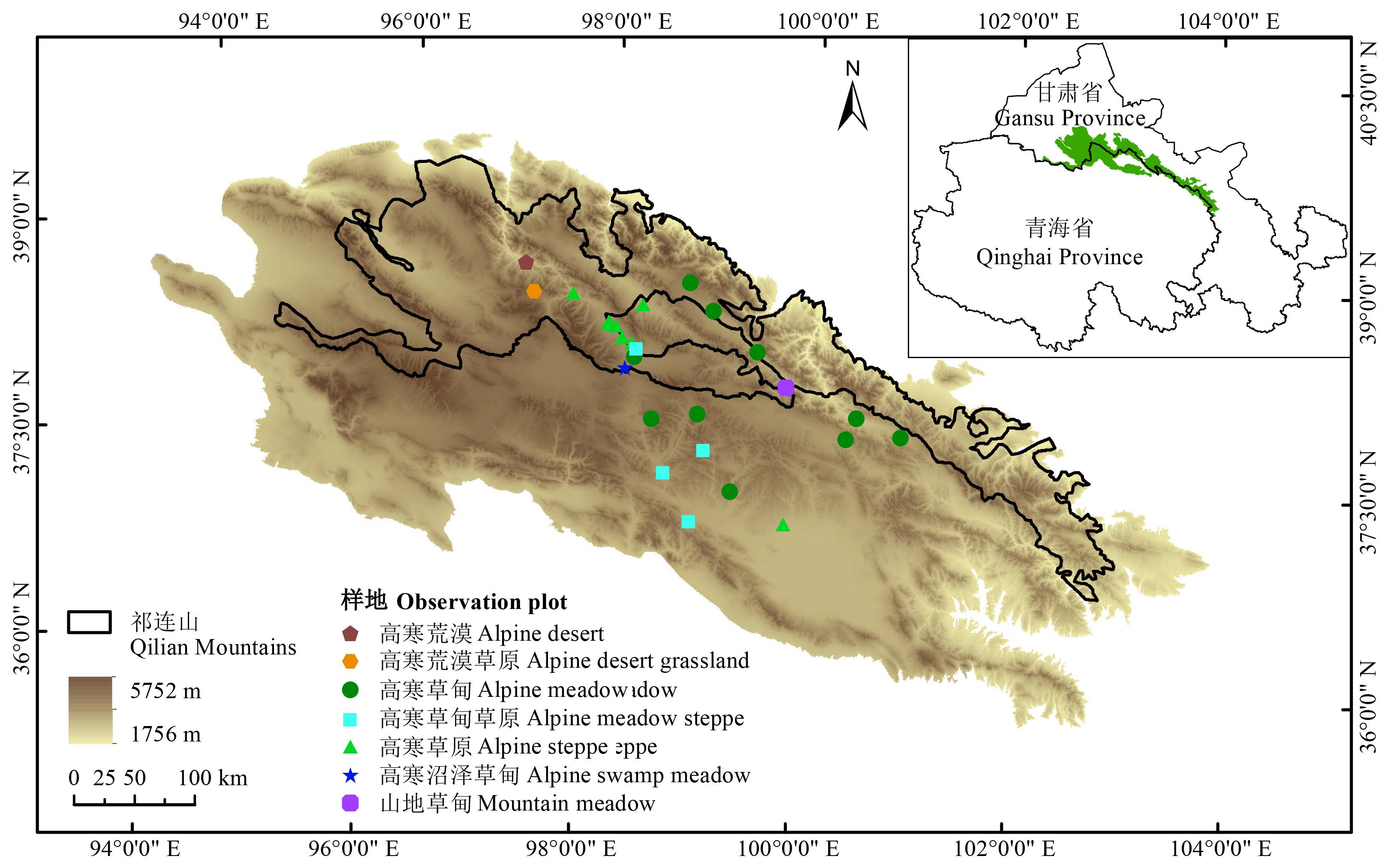
图1 研究区位置及样地分布基于自然资源部标准地图服务网站GS(2019)1822号标准地图制作,底图边界无修改。The map was based on the standard map service website of the Ministry of Natural Resources with the drawing review NO. GS (2019)1822, and the base map borders was not modified.
Fig.1 The location of study region and the distribution of observation plot
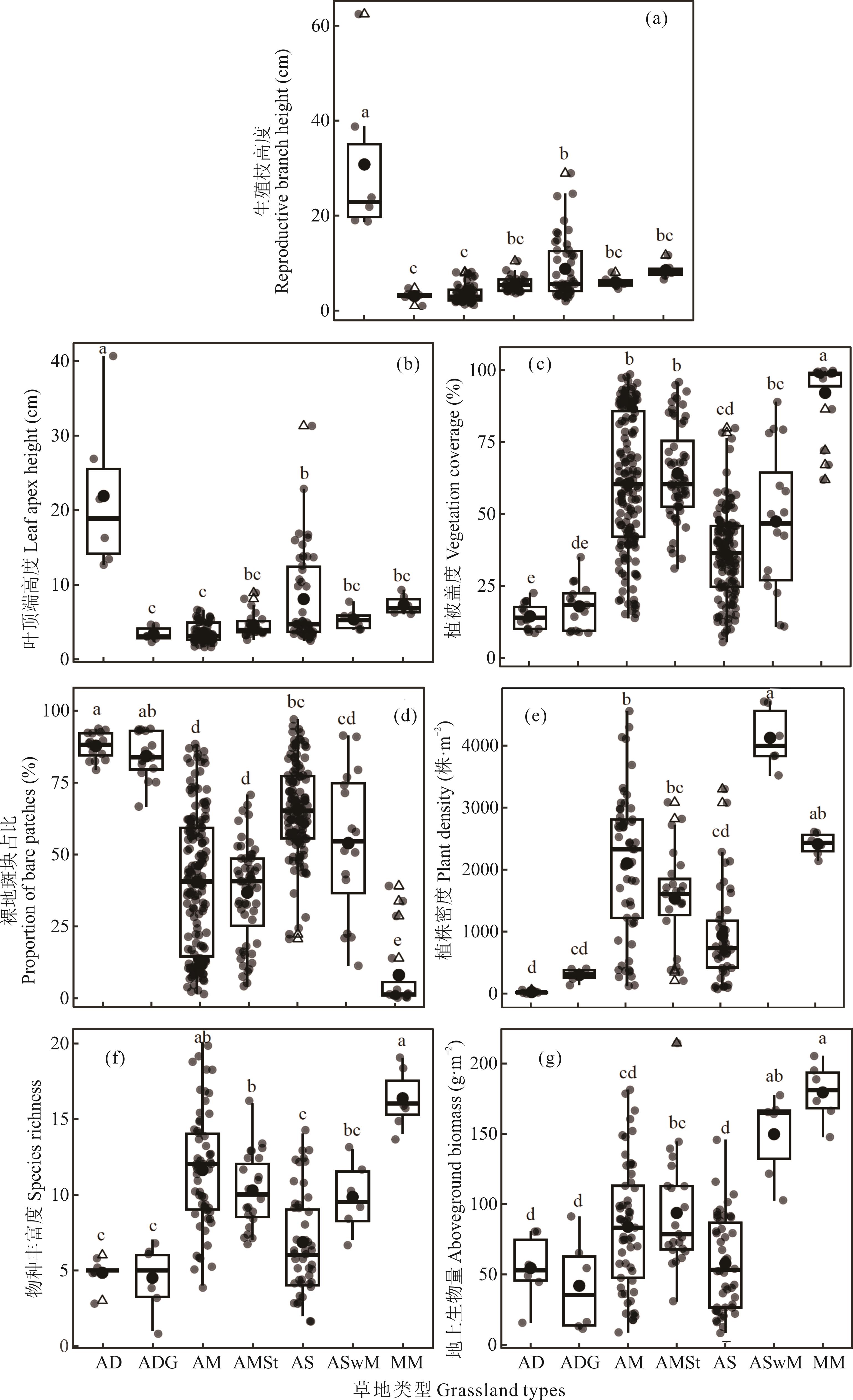
图2 不同类型高寒草地植物群落特征AD: 高寒荒漠Alpine desert; ADG: 高寒荒漠草原Alpine desert grassland; AM: 高寒草甸Alpine meadow; AMSt: 高寒草甸草原Alpine meadow steppe; AS: 高寒草原Alpine steppe; ASwM: 高寒沼泽草甸Alpine swamp meadow; MM: 山地草甸Mountain meadow. 灰色实心点表示所有样方的观测值,黑色实心点表示平均值,三角形表示离群值。不同小写字母表示不同草地类型平均值在0.05水平差异显著。下同。Solid gray dots represent the observed values of all quadrats, solid black dots represent the mean values, and triangles represent outliers. Different lowercase letters indicate the significant differences among the mean values of different grassland types at the level of 0.05. The same below.
Fig.2 Plant community characteristics of different types of alpine grassland
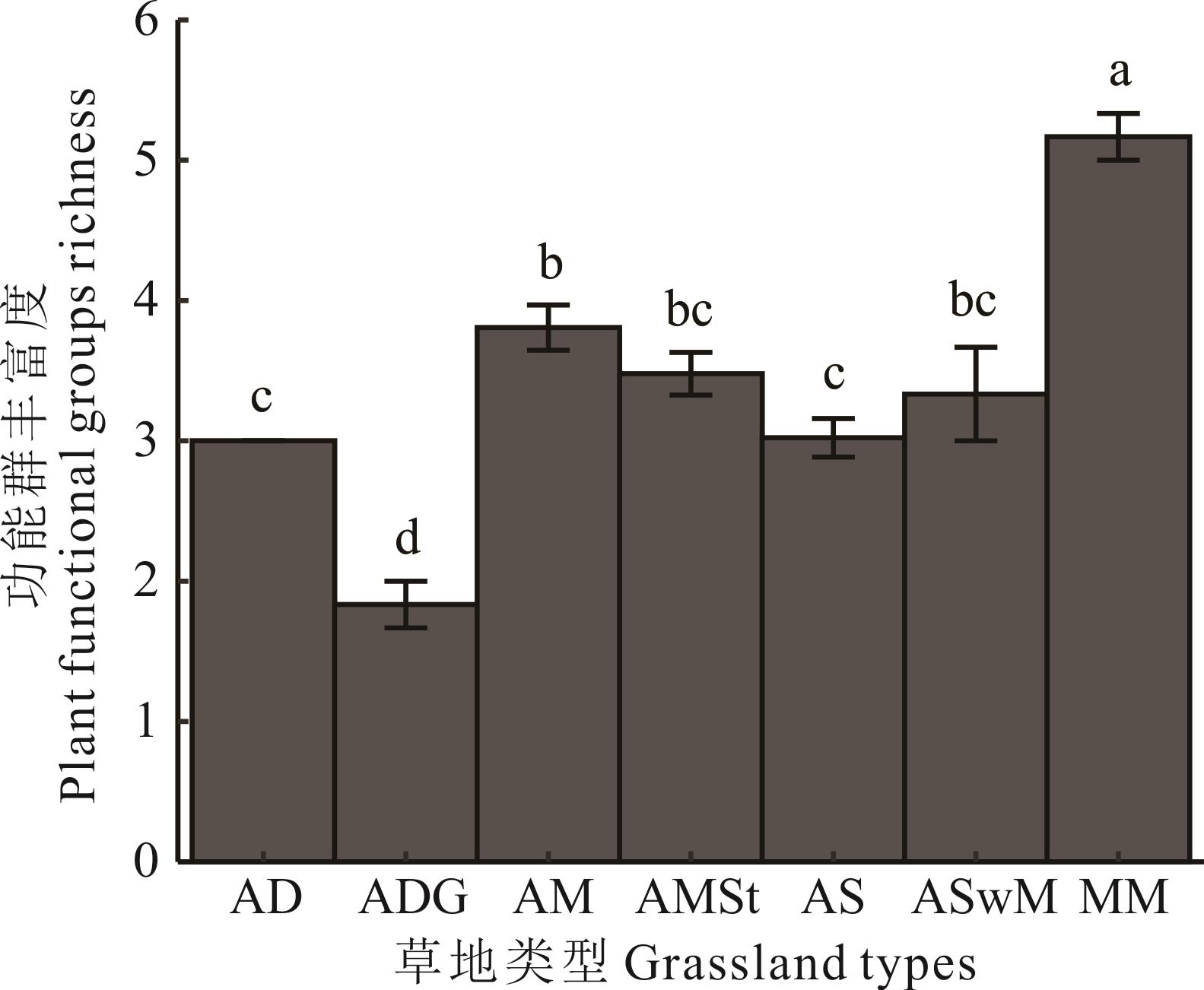
图3 不同类型高寒草地植物功能群丰富度误差棒表示±标准误,下同。The error bar means ± standard error, the same below.
Fig.3 Plant functional groups richness in different types of alpine grassland

图4 高寒草地植物功能群物种丰富度和地上生物量(a): 高寒草地系统Alpine grassland system; (b): 高寒荒漠Alpine desert; (c): 高寒荒漠草原Alpine desert grassland; (d): 高寒草甸Alpine meadow; (e): 高寒草甸草原Alpine meadow steppe; (f): 高寒草原Alpine steppe; (g): 高寒沼泽草甸Alpine swamp meadow; (h): 山地草甸Mountain meadow. 下同The same below. For: 杂类草Forbs; Gra: 禾本科Grasses; Leg: 豆科Legumes; Poi: 毒害草Poisonous-weeds; Sed: 莎草科Sedges; Shr: 灌木Shrubs. 不同小写字母表示同类型草地不同功能群平均值在0.05水平差异显著。Different lowercase letters indicate the significant differences among the mean value of different functional groups of the same type grassland at the level of 0.05.
Fig.4 Species richness and aboveground biomass of plant functional groups in alpine grassland

图5 高寒草地植物群落物种丰富度和功能群丰富度与其地上生物量的关系XT: 高寒草地系统Alpine grassland system.
Fig.5 Relationship between species richness and functional group richness of plant communities and aboveground biomass in alpine grassland
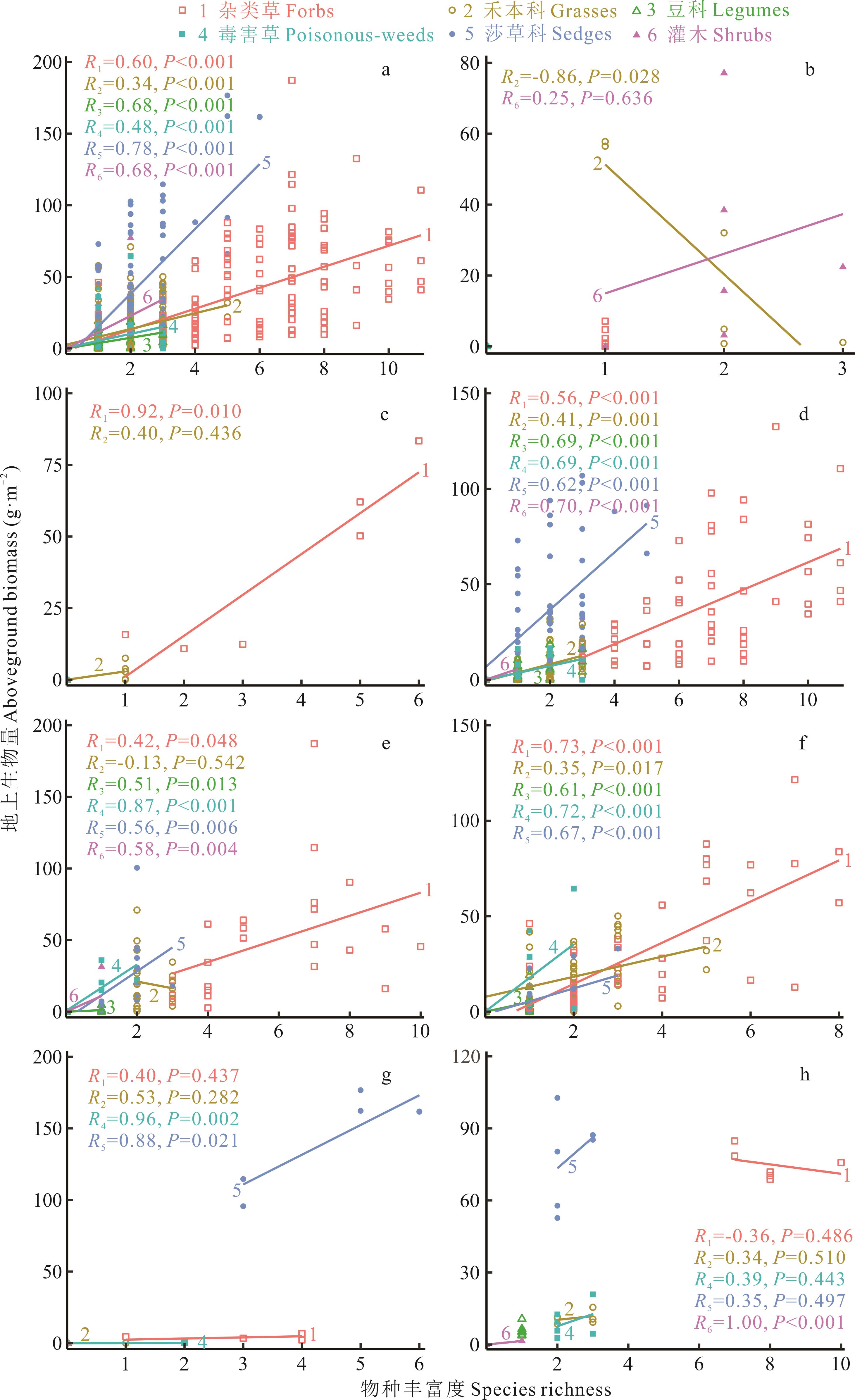
图6 高寒草地植物功能群物种丰富度与地上生物量的关系
Fig.6 Relationship between species richness and aboveground biomass of plant functional groups in alpine grassland
| 1 | Tilman D, Wedin D, Knops J. Productivity and sustainability influenced by biodiversity in grassland ecosystems. Nature, 1996, 379(6567): 718-720. |
| 2 | Tilman D, Lehman C L, Thomson K T. Plant diversity and ecosystem productivity: theoretical considerations. Proceedings of the National Academy of Sciences of the United States of America, 1997, 94(5): 1857-1861. |
| 3 | Zhang Z H, Zhou H K, Zhao X Q, et al. Relationship between biodiversity and ecosystem functioning in alpine meadows of the Qinghai-Tibet Plateau. Biodiversity Science, 2018, 26(2): 111-129. |
| 张中华, 周华坤, 赵新全, 等. 青藏高原高寒草地生物多样性与生态系统功能的关系. 生物多样性, 2018, 26(2): 111-129. | |
| 4 | Huang J H, Bai Y F, Han X G. Effects of species diversity on ecosystem functioning: mechanisms and hypotheses. Biodiversity Science, 2001, 9(1): 1-7. |
| 黄建辉, 白永飞, 韩兴国. 物种多样性与生态系统功能: 影响机制及有关假说. 生物多样性, 2001, 9(1): 1-7. | |
| 5 | Zhang Q G, Zhang D Y. Biodiversity and ecosystem functioning: recent advances and trends. Biodiversity Science, 2003, 11(5): 351-363. |
| 张全国, 张大勇. 生物多样性与生态系统功能: 最新的进展与动向. 生物多样性, 2003, 11(5): 351-363. | |
| 6 | Barnosky A, Matzke N, Tomiya S, et al. Has the earth’s sixth mass extinction already arrived? Nature, 2011, 471(7336): 51-57. |
| 7 | Wei F W, Nie Y G, Miao H X, et al. Advancements of the researches on biodiversity loss mechanisms. Chinese Science Bulletin, 2014, 59(6): 430-437. |
| 魏辅文, 聂永刚, 苗海霞, 等. 生物多样性丧失机制研究进展. 科学通报, 2014, 59(6): 430-437. | |
| 8 | Wang J B, Zhang D G, Cao G M, et al. Regional characteristics of the alpine meadow degradation succession on the Qinghai-Tibetan Plateau. Acta Prataculturae Sinica, 2013, 22(2): 1-10. |
| 王建兵, 张德罡, 曹广民, 等. 青藏高原高寒草甸退化演替的分区特征. 草业学报, 2013, 22(2): 1-10. | |
| 9 | Zi H B, Ade L J, Liu M, et al. Difference of community characteristics and niche of dominant species in different grassland types of alpine meadow. Chinese Journal of Applied & Environmental Biology, 2016, 22(4): 546-554. |
| 字洪标, 阿的鲁骥, 刘敏, 等. 高寒草甸不同类型草地群落特征及优势种植物生态位差异. 应用与环境生物学报, 2016, 22(4): 546-554. | |
| 10 | Ma S L. It is urgent to protect biodiversity on the Qinghai-Tibet Plateau//Proceedings of the national symposium on biodiversity conservation and control of alien harmful species. Shanghai: Chinese Society for Environmental Sciences, 2008: 79-81. |
| 马生林. 保护青藏高原生物多样性刻不容缓//全国生物多样性保护及外来有害物种防治交流研讨会论文集. 上海: 中国环境科学学会, 2008: 79-81. | |
| 11 | Fu B J, Ouyang Z Y, Shi P, et al. Current condition and protection strategies of Qinghai-Tibet Plateau ecological security barrier. Bulletin of Chinese Academy of Sciences, 2021, 36(11): 1298-1306. |
| 傅伯杰, 欧阳志云, 施鹏, 等. 青藏高原生态安全屏障状况与保护对策. 中国科学院院刊, 2021, 36(11): 1298-1306. | |
| 12 | Wang C T, Long R J, Ding L M. The effects of differences in functional group diversity and composition on plant community productivity in four types of alpine meadow communities. Biodiversity Science, 2004, 12(4): 403-409. |
| 王长庭, 龙瑞军, 丁路明. 高寒草甸不同草地类型功能群多样性及组成对植物群落生产力的影响. 生物多样性, 2004, 12(4): 403-409. | |
| 13 | Yang Y H, Rao S, Hu H F, et al. Plant species richness of alpine grasslands in relation to environmental factors and biomass on the Tibetan Plateau. Biodiversity Science, 2004, 12(1): 200-205. |
| 杨元合, 饶胜, 胡会峰, 等. 青藏高原高寒草地植物物种丰富度及其与环境因子和生物量的关系. 生物多样性, 2004, 12(1): 200-205. | |
| 14 | Zhang C H. Effects of grazing and fertilization on community productivity and species richness in eastern alpine meadow of Tibetan plateau. Pratacultural Science, 2014, 31(12): 2293-2300. |
| 张春花. 放牧方式和施肥梯度对高寒草甸群落生产力和物种丰富度的影响. 草业科学, 2014, 31(12): 2293-2300. | |
| 15 | Zheng Q Y, Liu G, Xiao B X, et al. Effect of grazing intensity on species richness and biomass of alpine meadow in northwest Sichuan. Pratacultural Science, 2017, 34(7): 1390-1396. |
| 郑群英, 刘刚, 肖冰雪, 等. 放牧对川西北高寒草甸植物物种丰富度和生物量的影响. 草业科学, 2017, 34(7): 1390-1396. | |
| 16 | Du G Z, Qin G L, Li Z Z, et al. Relationship between species richness and productivity in an alpine meadow plant community. Chinese Journal of Plant Ecology, 2003, 27(1): 125-132. |
| 杜国祯, 覃光莲, 李自珍, 等. 高寒草甸植物群落中物种丰富度与生产力的关系研究. 植物生态学报, 2003, 27(1): 125-132. | |
| 17 | Hu N, Fan Y L, Ding S Y, et al. Progress in researches on plant functional groups of terrestrial ecosystems. Acta Ecologica Sinica, 2008, 28(7): 3302-3311. |
| 胡楠, 范玉龙, 丁圣彦, 等. 陆地生态系统植物功能群研究进展. 生态学报, 2008, 28(7): 3302-3311. | |
| 18 | Niu Y J, Yang S W, Wang G Z, et al. Relationship between plant species, life form, functional group diversity, and biomass under grazing disturbance for four years on an alpine meadow. Acta Ecologica Sinica, 2018, 38(13): 4733-4743. |
| 牛钰杰, 杨思维, 王贵珍, 等. 放牧干扰下高寒草甸物种、生活型和功能群多样性与生物量的关系. 生态学报, 2018, 38(13): 4733-4743. | |
| 19 | Tang J L, Ren Z G, Zhang X Y, et al. Relationships between species diversity and productivity of different functional groups in a typical steppe in Inner Mongolia. Acta Agrestia Sinica, 2023, 31(7): 1939-1949. |
| 汤靖磊, 任治国, 张学渊, 等. 典型草原不同功能群物种多样性与生产力关系研究. 草地学报, 2023, 31(7): 1939-1949. | |
| 20 | Wang J H, Chen W. Qilian Mountain natural complex and its ecological efficiency. Journal of Hexi University, 2002, 18(2): 113-117. |
| 王桔红, 陈文. 祁连山自然综合体及其生态效能. 河西学院学报, 2002, 18(2): 113-117. | |
| 21 | Li X, Gou X H, Wang N L, et al. Tightening ecological management facilitates green development in the Qilian Mountains. Chinese Science Bulletin, 2019, 64(27): 2928-2937. |
| 李新, 勾晓华, 王宁练, 等. 祁连山绿色发展: 从生态治理到生态恢复. 科学通报, 2019, 64(27): 2928-2937. | |
| 22 | Wang X Y, Yang D W, Zhang L L, et al. The causes of grassland degradation and restoration strategies in Qilian Mountain National Park. Journal of Grassland and Forage Science, 2020(6): 81-86. |
| 王新源, 杨栋武, 张莉丽, 等. 祁连山国家公园草地退化成因及恢复对策. 草学, 2020(6): 81-86. | |
| 23 | Wang T, Gao F, Wang B, et al. Status and suggestions on ecological protection and restoration of Qilian Mountains. Journal of Glaciology and Geocryology, 2017, 39(2): 229-234. |
| 王涛, 高峰, 王宝, 等. 祁连山生态保护与修复的现状问题与建议. 冰川冻土, 2017, 39(2): 229-234. | |
| 24 | Zhang J T, Zhang C Q. Digital elevation model (DEM) data with the spatial resolution of 90 m in the Qilian Mountains. [2020-11-30]. National Special Environment and Function of Observation and Research Stations Shared Service Platform (http://www.ncdc.ac.cn/). |
| 张举涛, 张成琦. 祁连山地区90 m分辨率数字高程模型(DEM)数据. [2020-11-30]. 国家冰川冻土沙漠科学数据中心(http://www.ncdc.ac.cn/). | |
| 25 | Peng S, Ding Y, Liu W, et al. 1 km monthly temperature and precipitation dataset for China from 1901 to 2017. Earth System Science Data, 2019, 11(4): 1931-1946. |
| 26 | Yi S. FragMAP: a tool for long-term and cooperative monitoring and analysis of small-scale habitat fragmentation using an unmanned aerial vehicle. International Journal of Remote Sensing, 2017, 38(8/10): 2686-2697. |
| 27 | Yi S, Chen J, Qin Y, et al. The burying and grazing effects of plateau pika on alpine grassland are small: a pilot study in a semiarid basin on the Qinghai-Tibet Plateau. Biogeosciences, 2016, 13(22): 6273-6284. |
| 28 | Wickham H, Averick M, Bryan J, et al. Welcome to the tidyverse. Journal of Open Source Software, 2019, 4(43): 1686. |
| 29 | Kassambara A. ggpubr: “ggplot2” based publication ready plots. R package version 0.6.0. [2023-2-10]. https://rpkgs.datanovia.com/ggpubr/. |
| 30 | Anwar M, Yang Y H, Guo Z D, et al. Relationship between the species richness and the productivity of alpine steppes in Bayanbulak, Xinjiang. Arid Zone Research, 2006, 23(2): 289-294. |
| 安尼瓦尔.买买提, 杨元合, 郭兆迪, 等. 新疆巴音布鲁克高山草地物种丰富度与生产力的关系. 干旱区研究, 2006, 23(2): 289-294. | |
| 31 | Ma W W. Comprehensive evaluation of climatic conditions on vegetation growth status of alpine grassland in Qinghai Province. Qinghai Prataculture, 2023, 32(2): 44-52. |
| 马文文. 基于气候因子的青海省高寒草地植被生长状况综合评价. 青海草业, 2023, 32(2): 44-52. | |
| 32 | Li Y L, Liu X N, Zhang D G, et al. Vegetation characteristics and soil physicochemical properties of different grassland types of temperate steppe in Longzhong. Acta Agrestia Sinica, 2023, 31(11): 3405-3414. |
| 李娅丽, 柳小妮, 张德罡, 等. 陇中温性草原不同草地型植被特征和土壤理化性质研究. 草地学报, 2023, 31(11): 3405-3414. | |
| 33 | Chen Z, Xu H Y, Shu Q L, et al. Physicochemical properties of soil and enzyme activity characteristics in various grassland types of the Qilian Mountains. Journal of Green Science and Technology, 2024, 26(2): 53-59. |
| 陈卓, 徐海燕, 殊秋丽, 等. 祁连山不同草地类型土壤理化性质及酶活性特征. 绿色科技, 2024, 26(2): 53-59. | |
| 34 | Li X, Yu H B, Liu Y X, et al. Study on community biomass and diversity of different grassland types in Xilingol. Acta Agrestia Sinica, 2022, 30(1): 196-204. |
| 李想, 于红博, 刘月璇, 等. 锡林郭勒不同草原类型群落生物量及多样性研究. 草地学报, 2022, 30(1): 196-204. | |
| 35 | Zheng X X, Jin T T, Mu L F, et al. The relationship between plant species richness in Hulunbeier grassland and biomass and environmental factors. Chinese Journal of Grassland, 2008, 30(6): 74-81. |
| 郑晓翾, 靳甜甜, 木丽芬, 等. 呼伦贝尔草原物种多样性与生物量、环境因子的关系. 中国草地学报, 2008, 30(6): 74-81. | |
| 36 | He M Y, Wang Y X, Peng Z C, et al. The spatial pattern of aboveground biomass and species richness in the grassland of Qilian Mountain. Pratacultural Science, 2020, 37(10): 2012-2021. |
| 何美悦, 王迎新, 彭泽晨, 等. 祁连山草原地上生物量和物种丰富度的空间格局. 草业科学, 2020, 37(10): 2012-2021. | |
| 37 | Huang Z L. The relationship between plant species richness and production//The 4th national symposium on biodiversity conservation and sustainable use. Beijing: China Forestry Publishing House, 2002: 244-250. |
| 黄忠良. 试论植物物种多样性与生产力之间的关系//第四届全国生物多样性保护与持续利用研讨会. 北京: 中国林业出版社, 2002: 244-250. | |
| 38 | Qin Y, Yi S, Ren S, et al. Responses of typical grasslands in a semi-arid basin on the Qinghai-Tibetan Plateau to climate change and disturbances. Environmental Earth Sciences, 2014, 71(3): 1421-1431. |
| 39 | Tilman D, Reich P B, Knops J, et al. Diversity and productivity in a long-term grassland experiment. Science, 2001, 294(5543): 843-845. |
| 40 | Qin Y. Effect of different land utilization on soil nutrients and grassland vegetation in alpine meadow. Lanzhou: Lanzhou University, 2010. |
| 秦彧. 不同土地利用方式对玛曲高寒草地土壤养分与植被的影响. 兰州: 兰州大学, 2010. | |
| 41 | Zhang Q G, Zhang D Y. Biodiversity and ecosystem functioning: recent advances and controversies. Biodiversity Science, 2002, 10(1): 49-60. |
| 张全国, 张大勇. 生物多样性与生态系统功能: 进展与争论. 生物多样性, 2002, 10(1): 49-60. | |
| 42 | Waide R B, Willig M R, Steiner C F, et al. The relationship between productivity and species richness. Annual Review of Ecology and Systematics, 1999, 30: 257-300. |
| 43 | Ma W H, Fang J Y. The relationship between species richness and productivity in four typical grasslands of northern China. Biodiversity Science, 2006, 14(1): 21-28. |
| 马文红, 方精云. 中国北方典型草地物种丰富度与生产力的关系. 生物多样性, 2006, 14(1): 21-28. |
| [1] | 严双, 夏菲, 魏巍, 王敬龙, 吴皓阳, 冉林灵, 薛云尹, 石昊, 郑晒坤, 王军强, 贺俊东. 高寒草甸不同侵蚀样地植物多样性的差异及其关键影响因子[J]. 草业学报, 2025, 34(6): 1-13. |
| [2] | 李雪萍, 许世洋, 李建军, 漆永红. 青稞根腐病根际土壤细菌多样性及群落结构变化规律[J]. 草业学报, 2025, 34(5): 118-129. |
| [3] | 王守兴, 周华坤, 欧立鹏, 李成先, 王雁鹤, 宁晓春, 谷强, 魏代军, 杨明新. 三江源不同草地类型植被及土壤微生物多样性与土壤因子特征的研究[J]. 草业学报, 2025, 34(4): 16-26. |
| [4] | 刘淑琪, 崔东, 刘文新, 杨海军, 杨延成, 江智诚, 闫江超, 刘江慧. 短期氮、水添加和刈割对苦豆子型退化草地植物群落特征与土壤理化性质的影响[J]. 草业学报, 2025, 34(3): 41-55. |
| [5] | 马利利, 蒋福祯, 马玉寿, 祁凯斌, 贾顺斌, 李正鹏. 粒径配比、施肥量以及播量耦合对矿区煤矸石基质的改良效果[J]. 草业学报, 2025, 34(3): 71-84. |
| [6] | 龚昕, 霍新茹, 李雯, 杨彦东, 刘超, 秦伟春, 沈艳, 王国会, 马红彬. 宁夏罗山山地草原植被群落特征及其空间分异[J]. 草业学报, 2025, 34(2): 1-15. |
| [7] | 吕娜, 高吉喜, 李政海, 尤春赫, 刘晓曼, 张彪, 莫宇, 朱萨宁, 彭阳, 杨雪. 植物生长中期施肥对草甸草原群落特征与物种多样性的影响[J]. 草业学报, 2025, 34(2): 109-122. |
| [8] | 杜文盼, 赵桂琴, 柴继宽, 杨莉, 张建贵, 史怡超, 张官禄. 根系分隔方式对燕麦/豌豆间作地上生物量、土壤养分及根系性状的影响[J]. 草业学报, 2024, 33(8): 25-36. |
| [9] | 徐玲玲, 牛犇, 张宪洲, 何永涛, 石培礼, 宗宁, 武建双, 王向涛. 藏北两个临近不同高寒草地碳通量对气候条件的响应[J]. 草业学报, 2024, 33(6): 1-16. |
| [10] | 刘倩, 丁彦芬, 宋杉杉, 许文婕, 杨威. 南京明城墙绿带草本层自生植物群落数量分类与排序分析[J]. 草业学报, 2024, 33(5): 1-15. |
| [11] | 油志远, 马淑娟, 王长庭, 丁路明, 宋小艳, 尹高飞, 毛军. 川滇高原高寒草甸生态系统不同功能群植物分布格局的MaxEnt模型预测[J]. 草业学报, 2024, 33(3): 1-12. |
| [12] | 常怡然, 史佳梅, 许冬梅, 康如龙, 马媛. 荒漠草原不同自然种群蒙古冰草生物量和养分权衡特征[J]. 草业学报, 2024, 33(11): 186-197. |
| [13] | 石昊, 杨彩红, 夏菲, 王军强, 魏巍, 王敬龙, 薛云尹, 郑晒坤, 吴皓阳, 冉林灵, 严双, 姜晓敏. 短期增温对修复过程中藏北高寒退化草地生产力的初期影响[J]. 草业学报, 2024, 33(11): 30-45. |
| [14] | 田晴华, 刘丹, 廖小琴, 宋小艳, 胡雷, 王长庭. 施氮对高寒草地土壤团聚体生物胶结物质及稳定性的影响[J]. 草业学报, 2024, 33(11): 46-57. |
| [15] | 张东, 侯晨, 马文明, 王长庭, 邓增卓玛, 张婷. 高寒草地不同灌丛化梯度下土壤酶活性研究[J]. 草业学报, 2023, 32(9): 79-92. |
| 阅读次数 | ||||||
|
全文 |
|
|||||
|
摘要 |
|
|||||
