

ISSN 1004-5759 CN 62-1105/S
草业学报 ›› 2026, Vol. 35 ›› Issue (10): 192-206.DOI: 10.11686/cyxb2025438
• 研究论文 • 上一篇
马祖艳1,2( ), 董世魁1,2(), 李颖2, 张然2, 土旦加3, 吴桂玲4, 施建军1, 史德军3
收稿日期:2025-10-21
修回日期:2025-12-17
出版日期:2026-10-20
发布日期:2026-09-09
通讯作者:
董世魁
作者简介:E-mail: dongshikui@bjfu.edu.cn基金资助:
Zu-yan MA1,2(), Shi-kui DONG1,2(), Yin LI2, Ran ZHANG2, Dan-jia TU3, Gui-ling WU4, Jian-jun SHI1, De-jun SHI3
Received:2025-10-21
Revised:2025-12-17
Online:2026-10-20
Published:2026-09-09
Contact:
Shi-kui DONG
摘要:
青藏高原地区海拔高,低温、干旱与强紫外线辐射等严苛环境因子,严重制约牧草生长。在持续恢复的草地上,适用于退化草地生态修复的优良牧草-同德短芒披碱草出现了减产现象。常规施肥策略已难以满足其生长需求,添加微量元素对维持其稳产、高产可能具有关键作用。本研究通过叶面喷施钼[钼酸铵(NH?)?MoO?:0.15、0.30、0.45 g·L?1]、硅(亲水型纳米二氧化硅SiO?NPs:0.10、0.20、0.40 g·L?1)和硼(硼酸H?BO?:0.15、0.30、0.45 g·L?1)3种微量元素开展盆栽试验。结果表明:3种元素均显著提升株高与地上部干重(P<0.05),其中0.30 g·L-1钼处理株高增幅为34.56%,根长在0.30 g·L-1钼与0.10 g·L-1硅处理下分别增加59.86%和79.53%。同时,钼、硅添加显著提高了植物的光合能力,其中0.40 g·L-1硅处理下净光合速率增幅达111.53%;0.30 g·L-1钼处理下叶绿素a、b含量分别提升46.00%和54.32%,而硼抑制叶绿素a积累。0.30 g·L-1钼处理下,分别增强了抗氧化酶活性及渗透调节物质积累,过氧化物酶活性提升231.10%,可溶性糖含量增幅为201.48%;硅、硼对酶活性和碳水化合物的调控呈浓度依赖性。主成分分析(前4个主成分累积贡献率为77.66%)结合隶属函数法确定0.45 g·L?1钼处理(综合评价D=0.701)抗逆性最优,其通过协同根系发育-光合-抗氧化通路提升碳同化效率,证实钼为高寒牧草抗逆性调控的关键元素,为退化草地精准修复提供理论依据。
马祖艳, 董世魁, 李颖, 张然, 土旦加, 吴桂玲, 施建军, 史德军. 钼硅硼添加对同德短芒披碱草光合生理的影响及生长综合评价[J]. 草业学报, 2026, 35(10): 192-206.
Zu-yan MA, Shi-kui DONG, Yin LI, Ran ZHANG, Dan-jia TU, Gui-ling WU, Jian-jun SHI, De-jun SHI. Effects of molybdenum, silicon, and boron addition on the photosynthetic physiology of Elymus breviaristatus and a multivariate evaluation of growth performance[J]. Acta Prataculturae Sinica, 2026, 35(10): 192-206.
土层深度 Soli depth (cm) | pH | 电导率 Electrical conductivity (us·cm-1) | 有机质 Organic matter (g·kg-1) | 全氮 Total nitrogen (g·kg-1) | 全磷 Total phosphorus (g·kg-1) | 全钾 Total potassium (g·kg-1) |
|---|---|---|---|---|---|---|
| 0~10 | 8.75 | 90.90 | 26.84 | 1.82 | 73.98 | 10.15 |
| 10~20 | 8.96 | 92.50 | 17.31 | 1.24 | 20.76 | 8.09 |
表1 供试土壤养分含量
Table 1 Nutrient content of tested soil
土层深度 Soli depth (cm) | pH | 电导率 Electrical conductivity (us·cm-1) | 有机质 Organic matter (g·kg-1) | 全氮 Total nitrogen (g·kg-1) | 全磷 Total phosphorus (g·kg-1) | 全钾 Total potassium (g·kg-1) |
|---|---|---|---|---|---|---|
| 0~10 | 8.75 | 90.90 | 26.84 | 1.82 | 73.98 | 10.15 |
| 10~20 | 8.96 | 92.50 | 17.31 | 1.24 | 20.76 | 8.09 |
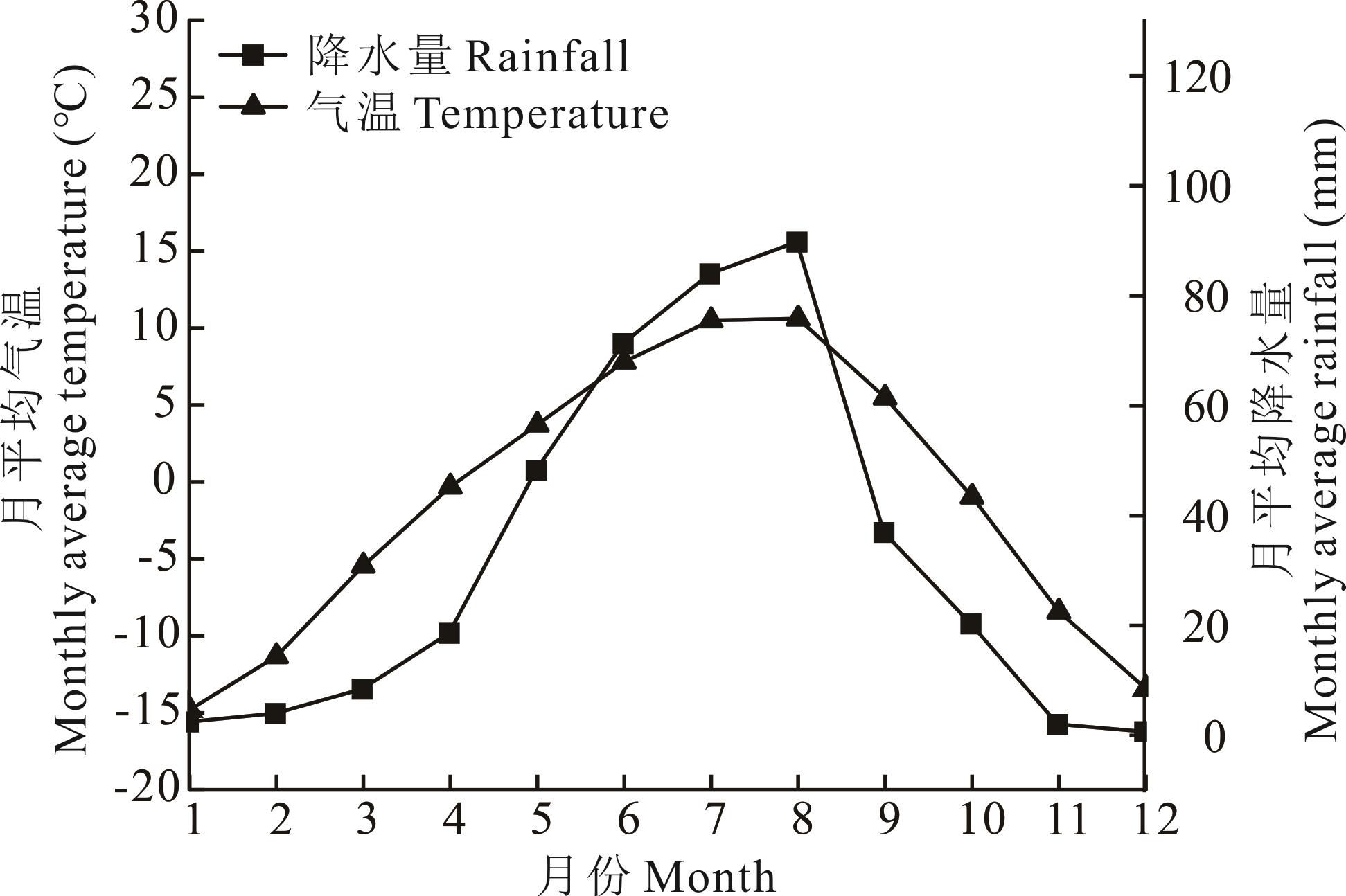
图1 天峻县阳康乡2016-2023年月平均气温和平均降水量
Fig.1 Monthly average temperature and rainfall in Yangkang township, Tianjun county (2016-2023)
序号 Number | 试验处理 Treatment | 浓度 Concentration | 序号 Number | 试验处理 Treatment | 浓度 Concentration |
|---|---|---|---|---|---|
| 1 | CK | 0.00 | 6 | Mo2 | 0.30 |
| 2 | Si1 | 0.10 | 7 | Mo3 | 0.45 |
| 3 | Si2 | 0.20 | 8 | B1 | 0.15 |
| 4 | Si3 | 0.40 | 9 | B2 | 0.30 |
| 5 | Mo1 | 0.15 | 10 | B3 | 0.45 |
表2 试验处理设置 (g·L-1)
Table 2 Experimental treatment group settings
序号 Number | 试验处理 Treatment | 浓度 Concentration | 序号 Number | 试验处理 Treatment | 浓度 Concentration |
|---|---|---|---|---|---|
| 1 | CK | 0.00 | 6 | Mo2 | 0.30 |
| 2 | Si1 | 0.10 | 7 | Mo3 | 0.45 |
| 3 | Si2 | 0.20 | 8 | B1 | 0.15 |
| 4 | Si3 | 0.40 | 9 | B2 | 0.30 |
| 5 | Mo1 | 0.15 | 10 | B3 | 0.45 |
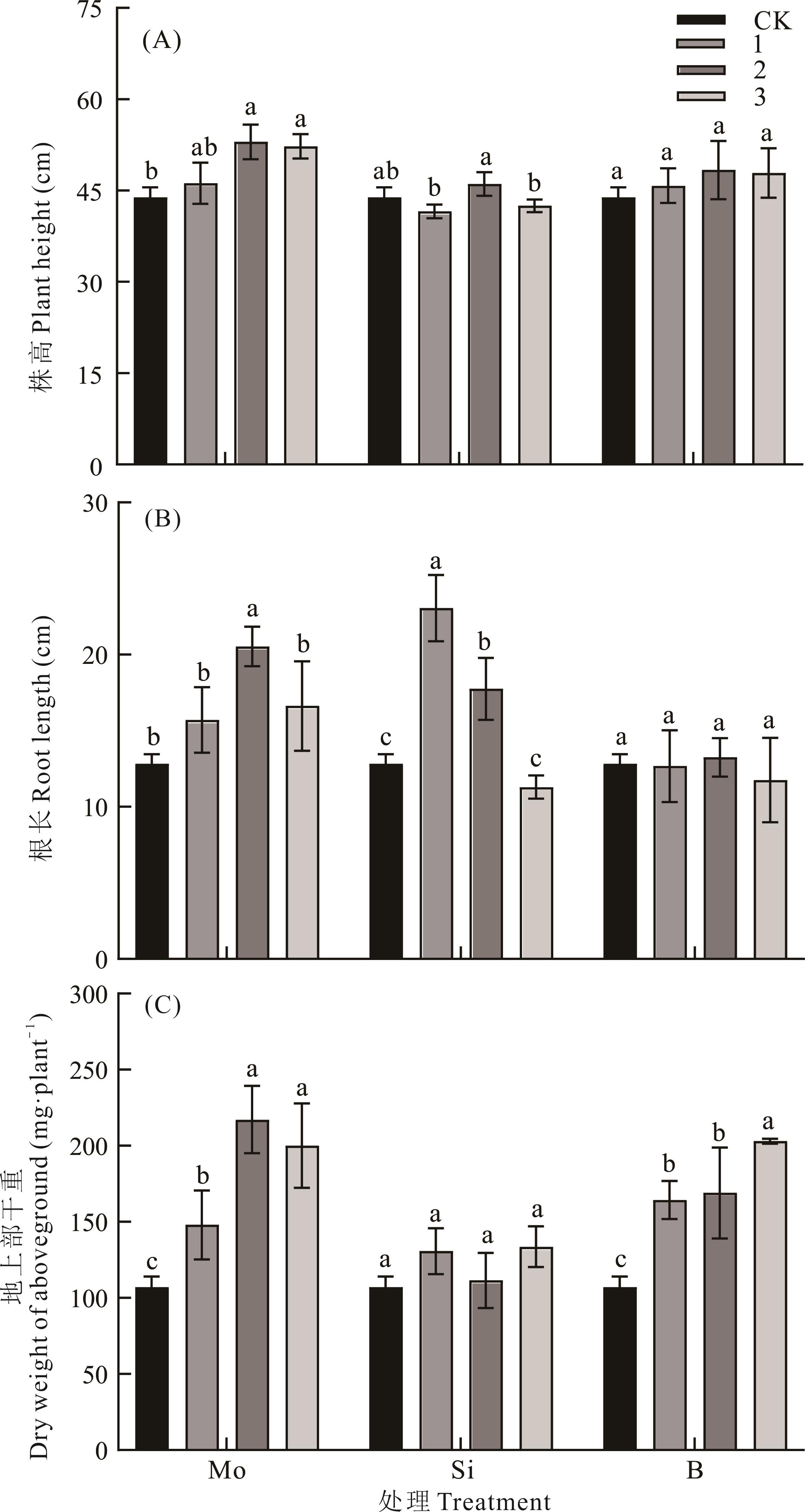
图2 钼硅硼添加对披碱草形态结构的影响图中数字1,2和3代表低、中等和高浓度处理。Mo代表钼处理、Si代表硅处理、B代表硼处理,不同小写字母表示在同一微量元素处理下不同浓度间差异显著(P<0.05)。下同。In the figure, 1, 2, and 3 indicate the low, medium, and high concentration treatments, respectively. Mo denotes molybdenum treatment, Si denotes silicon treatment, and B denotes boron treatment,different lowercase letters denote significant differences among concentrations within the same micronutrient treatment (P<0.05). The same below.
Fig.2 Effects of molybdenum, silicon and boron applications on morphological traits of E. breviaristatus
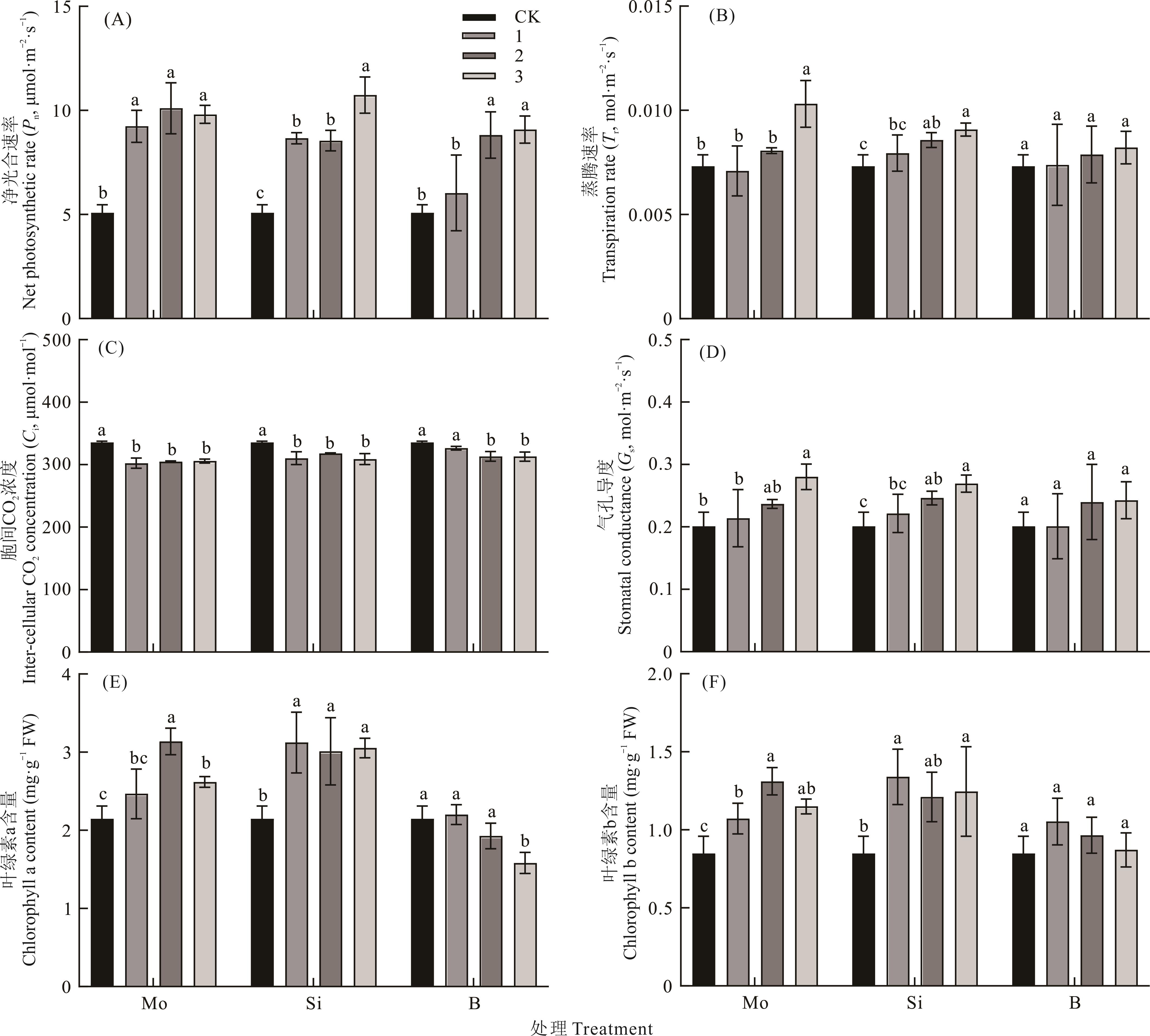
图3 钼硅硼添加对披碱草光合能力的影响
Fig.3 Effects of molybdenum, silicon and boron applications on photosynthetic capacity of E. breviaristatus

图4 钼硅硼添加对披碱草生理生化特性的影响
Fig.4 Effects of molybdenum, silicon and boron applications on the physiological and biochemical traits of E. breviaristatus
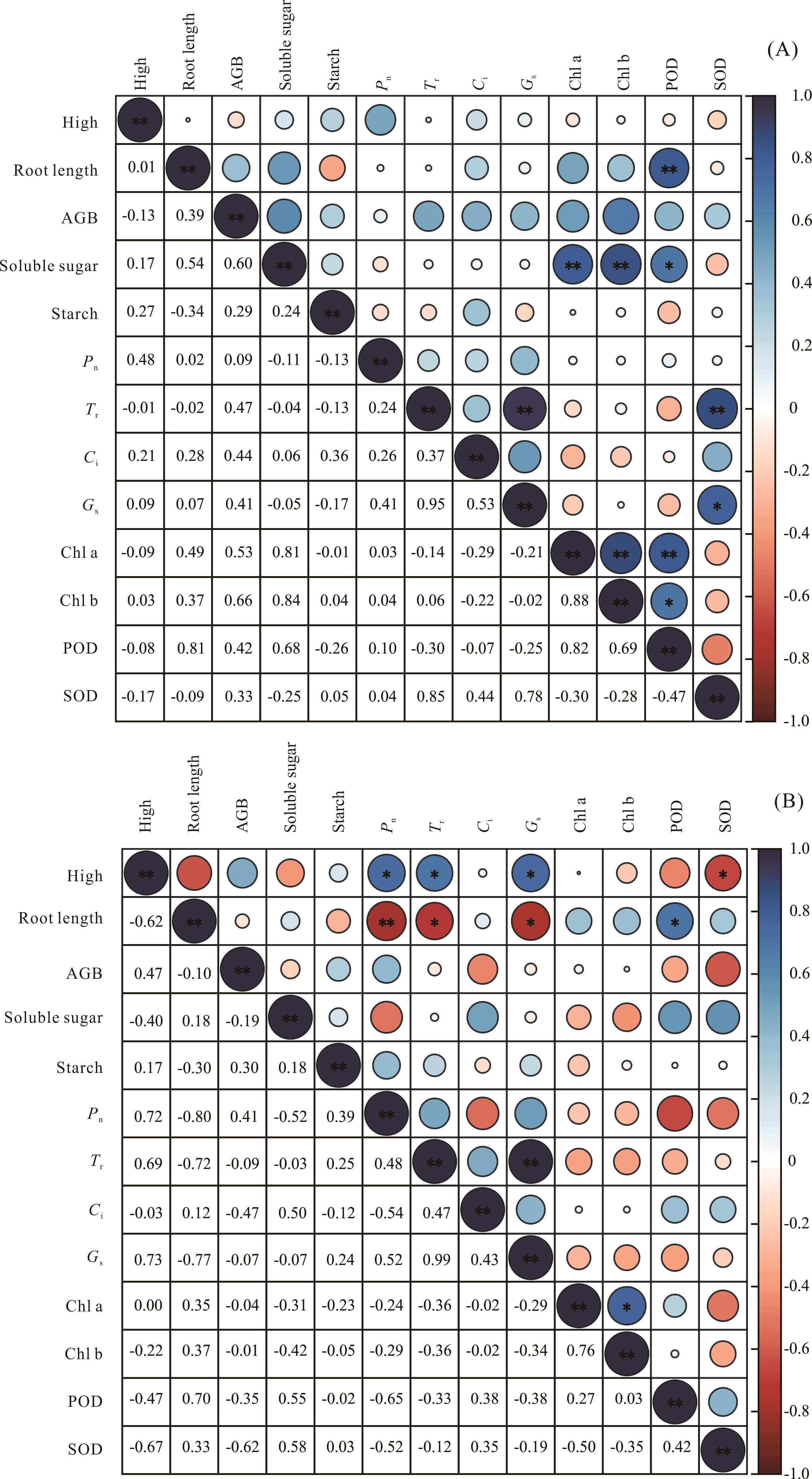
图5 钼硅硼添加后披碱草光合生理指标抗性系数的相关性分析图A、B、C分别代表钼、硅和硼添加处理。High:株高;Root length:根长;AGB:地上部干重;Soluble sugar:可溶性糖;Starch:淀粉;Pn:净光合速率;Tr:蒸腾速率;Ci:胞间CO2浓度;Gs:气孔导度;Chl a:叶绿素a;Chl b:叶绿素b;POD:过氧化物酶;SOD:超氧化物歧化酶。图中的蓝色和红色分别代表两个变量之间的正相关和负相关。颜色越深,相关性越强。下同。*表示P<0.05;**表示P<0.01;***表示P<0.001。Fig. A, B and C represents the molybdenum,silicon and boron addition treatment, respectively. High: Plant height; AGB: Dry weight of aboveground; Pn: Net photosynthetic rate; Tr: Transpiration rate; Ci: Inter-cellular CO2 concentration; Gs: Stomatal conductance; Chl a: Chlorophyll a; Chl b: Chlorophyll b; POD: Peroxidase; SOD: Superoxide dismutase. The blue and red colours in the graph represent positive and negative correlation between two variables, respectively. The darker the colour, the stronger the correlation. The same below. * indicates P<0.05; ** indicates P<0.01; *** indicates P<0.001.
Fig.5 Correlation analysis of resistance coefficients of photosynthetic physiological indices of E. breviaristatus following molybdenum, silicon and boron applications
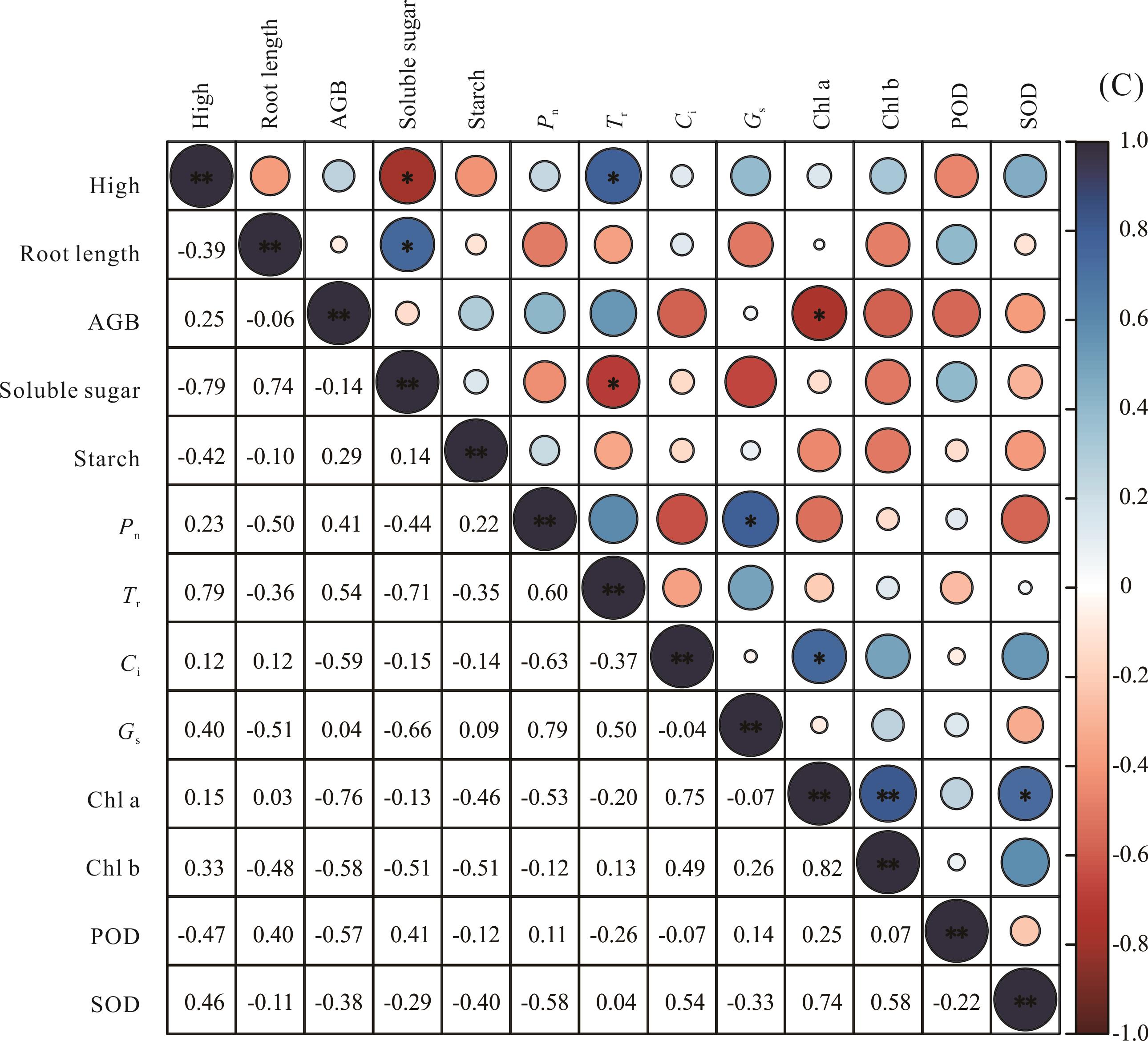
续图5 钼硅硼添加后披碱草光合生理指标抗性系数的相关性分析
Continued Fig.5 Correlation analysis of resistance coefficients of photosynthetic physiological indices of E. breviaristatus following molybdenum, silicon and boron applications
编号 Number | 特征根Eigenvalue | 主成分提取Principal component extraction | ||||
|---|---|---|---|---|---|---|
特征根 Eigenvalue | 方差解释率Variance explained ratio (%) | 累积贡献率Cumulative contribution rate (%) | 特征根 Eigenvalue | 方差解释率Variance explained ratio (%) | 累积贡献率Cumulative contribution rate (%) | |
| 1 | 4.481 | 34.466 | 34.466 | 4.481 | 34.466 | 34.466 |
| 2 | 2.500 | 19.234 | 53.700 | 2.500 | 19.234 | 53.700 |
| 3 | 2.008 | 15.446 | 69.147 | 2.008 | 15.446 | 69.146 |
| 4 | 1.106 | 8.511 | 77.658 | 1.106 | 8.511 | 77.657 |
| 5 | 0.724 | 5.570 | 83.228 | - | - | - |
| 6 | 0.662 | 5.090 | 88.318 | - | - | - |
| 7 | 0.468 | 3.598 | 91.915 | - | - | - |
| 8 | 0.428 | 3.292 | 95.207 | - | - | - |
| 9 | 0.256 | 1.972 | 97.179 | - | - | - |
| 10 | 0.191 | 1.471 | 98.650 | - | - | - |
| 11 | 0.085 | 0.655 | 99.305 | - | - | - |
| 12 | 0.064 | 0.492 | 99.797 | - | - | - |
| 13 | 0.026 | 0.203 | 100.000 | - | - | - |
表3 不同处理下同德短芒披碱草抗性的主成分分析
Table 3 Principal component analysis of resistance in E. breviaristatus under different treatments
编号 Number | 特征根Eigenvalue | 主成分提取Principal component extraction | ||||
|---|---|---|---|---|---|---|
特征根 Eigenvalue | 方差解释率Variance explained ratio (%) | 累积贡献率Cumulative contribution rate (%) | 特征根 Eigenvalue | 方差解释率Variance explained ratio (%) | 累积贡献率Cumulative contribution rate (%) | |
| 1 | 4.481 | 34.466 | 34.466 | 4.481 | 34.466 | 34.466 |
| 2 | 2.500 | 19.234 | 53.700 | 2.500 | 19.234 | 53.700 |
| 3 | 2.008 | 15.446 | 69.147 | 2.008 | 15.446 | 69.146 |
| 4 | 1.106 | 8.511 | 77.658 | 1.106 | 8.511 | 77.657 |
| 5 | 0.724 | 5.570 | 83.228 | - | - | - |
| 6 | 0.662 | 5.090 | 88.318 | - | - | - |
| 7 | 0.468 | 3.598 | 91.915 | - | - | - |
| 8 | 0.428 | 3.292 | 95.207 | - | - | - |
| 9 | 0.256 | 1.972 | 97.179 | - | - | - |
| 10 | 0.191 | 1.471 | 98.650 | - | - | - |
| 11 | 0.085 | 0.655 | 99.305 | - | - | - |
| 12 | 0.064 | 0.492 | 99.797 | - | - | - |
| 13 | 0.026 | 0.203 | 100.000 | - | - | - |
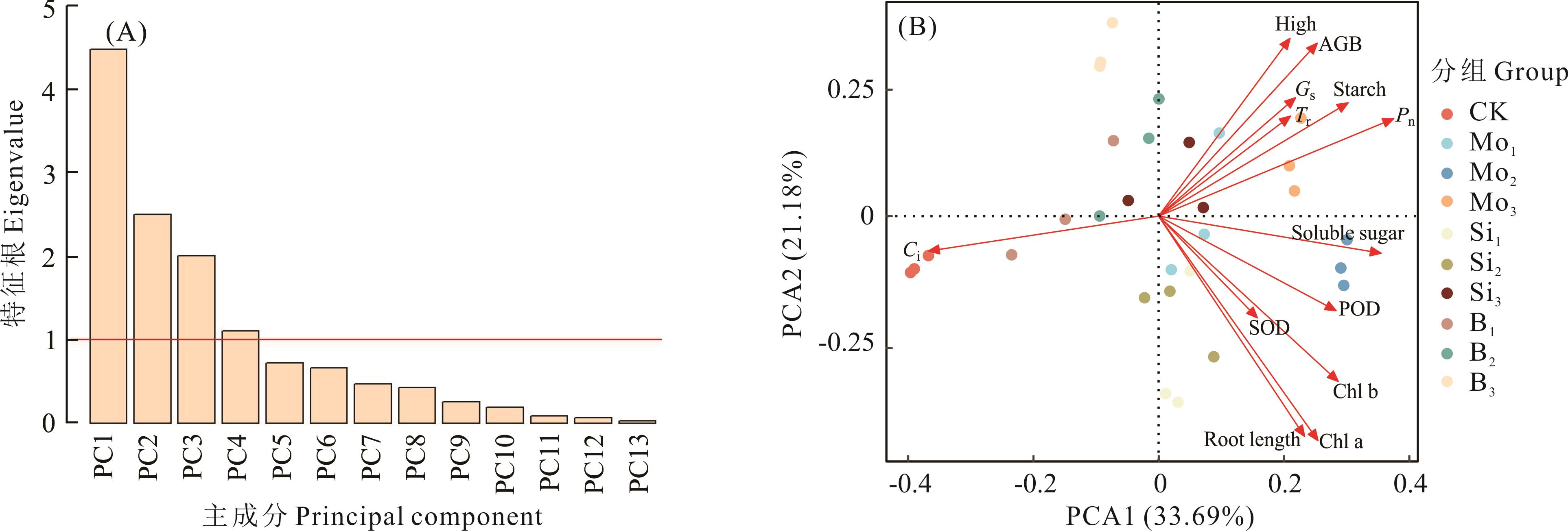
图6 各主成分特征值及主成分分析
Fig. 6 Eigenvalues of principal components and principal component analysis (PCA)
指标 Index | 载荷系数Loading factor | 共同度(公因子方差) Commonality (common factor variance) | |||
|---|---|---|---|---|---|
主成分1 Principal component 1 | 主成分2 Principal component 2 | 主成分3 Principal component 3 | 主成分4 Principal component 4 | ||
| 可溶性糖含量Soluble sugar content | 0.752 | 0.116 | -0.446 | 0.292 | 0.863 |
| 淀粉含量Starch content | 0.640 | -0.354 | -0.414 | 0.137 | 0.726 |
| 净光合速率Net photosynthetic rate | 0.794 | -0.305 | 0.251 | -0.333 | 0.898 |
| 胞间CO2浓度Inter-cellular CO2 concentration | -0.777 | 0.109 | 0.154 | 0.269 | 0.712 |
| 叶绿素b含量Chlorophyll b content | 0.607 | 0.517 | 0.294 | -0.284 | 0.803 |
| 过氧化物酶活性Peroxidase activity | 0.600 | 0.295 | -0.424 | -0.065 | 0.631 |
| 株高Plant height | 0.444 | -0.556 | -0.020 | -0.105 | 0.517 |
| 根长Root length | 0.493 | 0.688 | -0.150 | 0.114 | 0.752 |
| 地上部干重Dry weight of aboveground | 0.536 | -0.541 | -0.375 | 0.177 | 0.752 |
| 叶绿素a含量Chlorophyll a content | 0.538 | 0.701 | 0.291 | -0.197 | 0.906 |
| 蒸腾速率Transpiration rate | 0.445 | -0.313 | 0.713 | 0.279 | 0.882 |
| 气孔导度Stomatal conductance | 0.463 | -0.370 | 0.666 | 0.011 | 0.795 |
| 超氧化物酶活性Superoxide dismutase activity | 0.334 | 0.318 | 0.291 | 0.750 | 0.859 |
表4 综合评价主成分指标系数
Table 4 Coefficients of principal component indicators for comprehensive evaluation
指标 Index | 载荷系数Loading factor | 共同度(公因子方差) Commonality (common factor variance) | |||
|---|---|---|---|---|---|
主成分1 Principal component 1 | 主成分2 Principal component 2 | 主成分3 Principal component 3 | 主成分4 Principal component 4 | ||
| 可溶性糖含量Soluble sugar content | 0.752 | 0.116 | -0.446 | 0.292 | 0.863 |
| 淀粉含量Starch content | 0.640 | -0.354 | -0.414 | 0.137 | 0.726 |
| 净光合速率Net photosynthetic rate | 0.794 | -0.305 | 0.251 | -0.333 | 0.898 |
| 胞间CO2浓度Inter-cellular CO2 concentration | -0.777 | 0.109 | 0.154 | 0.269 | 0.712 |
| 叶绿素b含量Chlorophyll b content | 0.607 | 0.517 | 0.294 | -0.284 | 0.803 |
| 过氧化物酶活性Peroxidase activity | 0.600 | 0.295 | -0.424 | -0.065 | 0.631 |
| 株高Plant height | 0.444 | -0.556 | -0.020 | -0.105 | 0.517 |
| 根长Root length | 0.493 | 0.688 | -0.150 | 0.114 | 0.752 |
| 地上部干重Dry weight of aboveground | 0.536 | -0.541 | -0.375 | 0.177 | 0.752 |
| 叶绿素a含量Chlorophyll a content | 0.538 | 0.701 | 0.291 | -0.197 | 0.906 |
| 蒸腾速率Transpiration rate | 0.445 | -0.313 | 0.713 | 0.279 | 0.882 |
| 气孔导度Stomatal conductance | 0.463 | -0.370 | 0.666 | 0.011 | 0.795 |
| 超氧化物酶活性Superoxide dismutase activity | 0.334 | 0.318 | 0.291 | 0.750 | 0.859 |
处理 Treatment | 综合指标 Comprehensive indexes (CI) | 隶属函数值 Subordinate function value (U) | 综合评价值 Comprehensive evaluation ralues (D) | 排序 Ranking | ||||||
|---|---|---|---|---|---|---|---|---|---|---|
| CI1 | CI2 | CI3 | CI4 | U1 | U2 | U3 | U4 | |||
| CK | -2.070 | 0.527 | 0.116 | 0.389 | 0.016 | 0.640 | 0.461 | 0.620 | 0.326 | 9 |
| Mo1 | 0.341 | -0.040 | -0.869 | -0.283 | 0.659 | 0.500 | 0.191 | 0.442 | 0.503 | 6 |
| Mo2 | 1.593 | 0.513 | -1.059 | -0.089 | 0.993 | 0.637 | 0.139 | 0.493 | 0.680 | 2 |
| Mo3 | 1.172 | -0.616 | 0.643 | 1.529 | 0.881 | 0.357 | 0.606 | 0.922 | 0.701 | 1 |
| Si1 | 0.166 | 1.485 | 0.437 | -0.482 | 0.613 | 0.877 | 0.549 | 0.389 | 0.641 | 4 |
| Si2 | 0.150 | 1.055 | 0.654 | 0.570 | 0.608 | 0.771 | 0.609 | 0.668 | 0.655 | 3 |
| Si3 | 0.129 | -0.347 | 1.395 | -1.469 | 0.603 | 0.424 | 0.812 | 0.128 | 0.548 | 5 |
| B1 | -0.818 | -0.119 | -0.304 | 0.970 | 0.350 | 0.480 | 0.346 | 0.774 | 0.428 | 7 |
| B2 | -0.196 | -0.693 | -0.582 | -0.567 | 0.516 | 0.338 | 0.270 | 0.367 | 0.407 | 8 |
| B3 | -0.467 | -1.764 | -0.429 | -0.567 | 0.444 | 0.073 | 0.312 | 0.367 | 0.317 | 10 |
表5 不同处理下同德短芒披碱草的综合指标、隶属函数值、综合评价值及排序
Table 5 Comprehensive indexes, subordinate function values, comprehensive evaluation values and ranking of E. breviaristatus under different treatments
处理 Treatment | 综合指标 Comprehensive indexes (CI) | 隶属函数值 Subordinate function value (U) | 综合评价值 Comprehensive evaluation ralues (D) | 排序 Ranking | ||||||
|---|---|---|---|---|---|---|---|---|---|---|
| CI1 | CI2 | CI3 | CI4 | U1 | U2 | U3 | U4 | |||
| CK | -2.070 | 0.527 | 0.116 | 0.389 | 0.016 | 0.640 | 0.461 | 0.620 | 0.326 | 9 |
| Mo1 | 0.341 | -0.040 | -0.869 | -0.283 | 0.659 | 0.500 | 0.191 | 0.442 | 0.503 | 6 |
| Mo2 | 1.593 | 0.513 | -1.059 | -0.089 | 0.993 | 0.637 | 0.139 | 0.493 | 0.680 | 2 |
| Mo3 | 1.172 | -0.616 | 0.643 | 1.529 | 0.881 | 0.357 | 0.606 | 0.922 | 0.701 | 1 |
| Si1 | 0.166 | 1.485 | 0.437 | -0.482 | 0.613 | 0.877 | 0.549 | 0.389 | 0.641 | 4 |
| Si2 | 0.150 | 1.055 | 0.654 | 0.570 | 0.608 | 0.771 | 0.609 | 0.668 | 0.655 | 3 |
| Si3 | 0.129 | -0.347 | 1.395 | -1.469 | 0.603 | 0.424 | 0.812 | 0.128 | 0.548 | 5 |
| B1 | -0.818 | -0.119 | -0.304 | 0.970 | 0.350 | 0.480 | 0.346 | 0.774 | 0.428 | 7 |
| B2 | -0.196 | -0.693 | -0.582 | -0.567 | 0.516 | 0.338 | 0.270 | 0.367 | 0.407 | 8 |
| B3 | -0.467 | -1.764 | -0.429 | -0.567 | 0.444 | 0.073 | 0.312 | 0.367 | 0.317 | 10 |
| [1] | Cueto H T, Jacobsen B H, Laursen A S D, et al. Dietary folate intake and fecund ability in two preconception cohorts. Human Reproduction, 2022, 37(4): 828-837. |
| [2] | Noman M, Ahmed T, Wang J, et al. Micronutrient-microbiome interplay: a critical regulator of soil-plant health. Trends in Microbiology, 2024, 32(4): 319-320. |
| [3] | Qin X M, Zhao Y Y, Wu S W, et al. Progress on improving plant stress resistance with molybdenum. Journal of Huazhong Agricultural University, 2023, 42(6): 50-58. |
| 秦晓明, 赵优优, 武松伟, 等. 钼提高植物抗逆性研究进展. 华中农业大学学报, 2023, 42(6): 50-58. | |
| [4] | Jia L, Liu C K, Hu C X, et al. Research progress of molybdenum nutrition for wheat. Shandong Agricultural Sciences, 2024, 56(6): 173-180. |
| 贾琳, 刘春奎, 胡承孝, 等. 小麦钼营养研究进展. 山东农业科学, 2024, 56(6): 173-180. | |
| [5] | Epstein E. The anomaly of silicon in plant biology. Proceedings of the National Academy of Sciences of the United States of America, 1994, 91(1): 11-17. |
| [6] | Richmond K E, Sussman M. Got silicon the non-essential beneficial plant nutrient. Current Opinion in Plant Biology, 2003, 6(3): 268-272. |
| [7] | Zhang Y, Shi Y, Gong H J, et al. Beneficial effects of silicon on photosynthesis of tomato seedlings under water stress. Journal of Integrative Agriculture, 2018, 17: 2151-2159. |
| [8] | Cao G, Liang M Z. Boron-the essential microelement for plant in a balance culture system. Soils and Fertilizers, 2003(5): 54-56, 53. |
| 曹恭, 梁鸣早. 硼——平衡栽培体系中植物必需的微量元素. 土壤肥料, 2003 (5): 54-56, 53. | |
| [9] | Miao X R, Liu J Y, Zhang Q B, et al. Effects of spraying boron and molybdenum fertilizers on productivity and nutritional quality of alfalfa under drip irrigation. Acta Agriculturae Zhejiangensis, 2019, 31(10): 1583-1590. |
| 苗晓茸, 刘俊英, 张前兵, 等. 喷施硼、钼肥对滴灌紫花苜蓿生产性能及营养品质的影响. 浙江农业学报, 2019, 31(10): 1583-1590. | |
| [10] | Li Y H. Region trial report on Elymus breviaristatus cv. Tongde. Qinghai Prataculture, 2007, 16(4): 9-14. |
| 李永红. 同德短芒披碱草区域试验报告. 青海草业, 2007, 16(4): 9-14. | |
| [11] | Sun M D, Li Y H. Domestication and breeding of Elymus breviaristatus cv. Tongde. Qinghai Prataculture, 2008, 17(4): 2-7. |
| 孙明德, 李永红. 同德短芒披碱草的驯化选育. 青海草业, 2008, 17(4): 2-7. | |
| [12] | Tian M, Tian Y C, Zeng D. Spatiotemporal evolution and mechanism of multi-dimensional coordination of urbanization at county level in the Qinghai-Tibet Plateau. Acta Geographica Sinica, 2024, 79(8): 1940-1960. |
| 田明, 田一聪, 曾丹. 青藏高原县域城镇化多维协调时空演变及其机制. 地理学报, 2024, 79(8): 1940-1960. | |
| [13] | Lichtenthaler H K, Wellburn A R. Determinations of total carotenoids and chlorophylls a and b of leaf extracts in different solvents. Biochemical Society Transactions, 1983, 11(5):591-592. |
| [14] | Wang X F, Li Z H, Yuan J P, et al. The research between corn varieties canopy of NDVI and chlorophyll. Chinese Agricultural Science Bulletin, 2010, 26(16): 175-179. |
| 王晓飞, 李志洪, 袁家萍, 等. 玉米品种冠层NDVI与叶绿素的关系. 中国农学通报, 2010, 26(16): 175-179. | |
| [15] | Dong H J, Wang X C, Yuan D Y, et al. Radial distribution differences of non-structural carbohydrates in stems of tree species of different wood in a temperate forest. Chinese Journal of Plant Ecology, 2022, 46(6): 722-734. |
| 董涵君, 王兴昌, 苑丹阳, 等. 温带不同材性树种树干非结构性碳水化合物的径向分配差异. 植物生态学报, 2022, 46(6): 722-734. | |
| [16] | Deng J M, Xiong G S, Yuan X L, et al. Differences in SOD, POD, CAT activities and MDA content and their responses to high temperature stress at peak flowering stage in cotton lines with different tolerance to high temperature. Cotton Science, 2010, 22(3): 242-247. |
| 邓茳明, 熊格生, 袁小玲, 等.棉花不同耐高温品系的SOD、POD、CAT活性和MDA含量差异及其对盛花期高温胁迫的响应. 棉花学报, 2010, 22(3): 242-247. | |
| [17] | Cartes P, McManus M, Wulff-Zottele C, et al. Differential superoxide dismutase expression in ryegrass cultivars in response to short-term aluminium stress. Plant and Soil, 2012, 350(1): 353-363. |
| [18] | Li R Q, Wang Y X, Sun Y L, et al. Effects of salt stress on the growth, physiology, and biochemistry of five Bromus inermis varieties. Acta Prataculturae Sinica, 2023, 32(1): 99-111. |
| 李瑞强, 王玉祥, 孙玉兰, 等. 盐胁迫对5份无芒雀麦苗期生长和生理生化的影响及综合性评价. 草业学报, 2023, 32(1): 99-111. | |
| [19] | Cui J Q. Physiological responses and evaluation of drought resistance of three common greening plants on highway side slope to drought. Lhasa: Tibet University, 2021. |
| 崔佳奇. 三种公路边坡常用绿化植物对干旱的生理响应及其抗旱性评价. 拉萨: 西藏大学, 2021. | |
| [20] | Xie Y X, Bao P, Guo Y, et al. Changes of physiological characteristics of cold resistance of Hedychium and evaluation during natural overwintering period. Journal of Tropical and Subtropical Botany, 2021, 29(5): 509-518. |
| 谢雨萱, 包苹, 郭莺, 等. 自然越冬期姜花属植物生理指标变化及抗寒性评价. 热带亚热带植物学报, 2021, 29(5): 509-518. | |
| [21] | Wang H B, Fu Y Y, Yang H J, et al. Comprehensive evaluation of antioxidant ability of different genotypes of cotton in germination period based on subordinate function method. Cotton Science, 2021, 33(5): 393-403. |
| 王洪博, 付媛媛, 杨鸿基, 等. 基于隶属函数法对不同基因型棉种萌发期抗氧化能力的综合评价. 棉花学报, 2021, 33(5): 393-403. | |
| [22] | Yang X L, Zhu L J, Feng Z Z. Hyperspectral characteristics and chlorophyll content estimation of winter wheat under ozone stress. Acta Ecologica Sinica, 2023, 43(8): 3213-3223. |
| 杨熙来, 朱榴骏, 冯兆忠. 臭氧胁迫下冬小麦叶片高光谱特征和叶绿素含量估算. 生态学报, 2023, 43(8): 3213-3223. | |
| [23] | Ali E A. Effect of iron nutrient care sprayed on foliage at different physiological growth stages on yield and quality of some durum wheat (Triticum durum L.)varieties in sandy soil. Asian Journal of Crop Science, 2012, 4(4): 139-149. |
| [24] | Magalon A, Fedor J G, Walburger A, et al. Molybdenum enzymes in bacteria and their maturation. Coordination Chemistry Reviews, 2011, 255(9/10): 1159-1178. |
| [25] | Ma J F, Yamaji N. A cooperative system of silicon transport in plants. Trends in Plant Science, 2015, 20(7): 435-442. |
| [26] | Zhen Z G, Duan Y, Wu F, et al. Effects of Zn, B, Mo and Ca fertilizer on the yield and quality of peanut. Soils and Fertilizers, 2005(3): 48-50. |
| 甄志高, 段莹, 吴峰, 等. Zn、B、Mo、Ca 肥对花生产量和品质的影响. 土壤肥料, 2005(3): 48-50. | |
| [27] | Rana M S, Sun X, Imran M, et al. Molybdenum-induced effects on leaf ultra-structure and rhizosphere phosphorus transformation in Triticum aestivum L. Plant Physiology and Biochemistry, 2020, 153: 20-29. |
| [28] | Liu L, Xiao W, Ji M L, et al. Effects of molybdenum on nutrition, quality, and flavour compounds of strawberry (Fragaria×ananassa Duch. cv. Akihime) fruit. Journal of Integrative Agriculture, 2017, 16(7): 1502-1512. |
| [29] | Hadi F, Ali N, Fuller M P. Molybdenum (Mo) increases endogenous phenolics, proline and photosynthetic pigments and the phytoremediation potential of the industrially important plant Ricinus communis L. for removal of cadmium from contaminated soil. Environmental Science and Pollution Research, 2016, 23(20): 20408-20430. |
| [30] | Richards R A, Passioura J B. A breeding program to reduce the diameter of the major xylem vessel in the seminal roots of wheat and its effect on grain yield in rain-fed environments. Crop and Pasture Science, 1989, 40(5): 943-950. |
| [31] | Imran M, Hu C X, Hussain S, et al. Molybdenum-induced effects on photosynthetic efficacy of winter wheat (Triticum aestivum) under different nitrogen sources are associated with nitrogen assimilation. Plant Physiology and Biochemistry, 2019, 141: 154-163. |
| [32] | Wen X, Hu C X, Sun X C, et al. Research on the nitrogen transformation in rhizosphere of winter wheat (Triticum aestivum L.) under molybdenum addition. Environmental Science and Pollution Research, 2019, 26: 2363-2374. |
| [33] | Yang X D, Zhang H B, Wei T T, et al. Effects of different amounts of medium and microelement fertilizers on yield and quality of rice. Chinese Agricultural Science Bulletin, 2023, 39(15): 76-84. |
| 杨晓丹, 张宏波, 魏婷婷, 等. 中微量元素肥料不同用量对水稻产量及品质的影响. 中国农学通报, 2023, 39(15): 76-84. | |
| [34] | Zong Y Z, Wang W Y, Han Q F, et al. Effects of different levels of boron fertilizer on alfalfa photosynthesis and source-sink translocation of soluble carbohydrate in alfalfa. Acta Agronomica Sinica, 2010, 36(4): 665-672. |
| 宗毓铮, 王雯玥, 韩清芳, 等. 喷施硼肥对紫花苜蓿光合作用及可溶性糖源库间运转的影响. 作物学报, 2010, 36(4): 665-672. | |
| [35] | Ding Y L, Shi Y T, Yang S H. Molecular regulation of plant responses to environmental temperatures. Molecular Plant, 2020, 13(4): 544-564. |
| [36] | Yan A, Wang Y, Tan S N, et al. Phytoremediation: a promising approach for revegetation of heavy metal-polluted land. Frontiers in Plant Science, 2020, 11: 359. |
| [37] | Wu S W, Hu C X, Tan Q L, et al. Effects of molybdenum on water utilization, antioxidative defense system and osmotic adjustment ability in winter wheat (Triticum aestivum) under drought stress. Plant Physiology and Biochemistry, 2014, 83: 365-374. |
| [38] | Yang R. Regulatory effects of exogenous silicon on low temperature tolerance of tomato seedlings. Jinzhong: Shanxi Agricultural University, 2024. |
| 杨然. 外源硅对番茄幼苗低温耐受性的调控效应研究. 晋中: 山西农业大学, 2024. | |
| [39] | Morgan J M. Osmoregulation and water stress in higher plants. Annual Review of Plant Physiology, 2003, 35(1): 299-319. |
| [40] | Sun P, Duan X H. Effects of drought stress on soluble sugar and photosynthetic characteristics of Catharanthus roseus seedlings. Journal of Northeast Forestry University, 2010, 38(8): 54-56. |
| 孙萍, 段喜华. 干旱胁迫对长春花光合特性及可溶性糖的影响. 东北林业大学学报, 2010, 38(8): 54-56. |
| [1] | 赵颖, 张聪聪, 宋雨婷, 张翀敏, 安悦, 杨宾宾, 马永, 王宝强. 2,4-表油菜素内酯对盐碱胁迫下藜麦幼苗生长的促进效应[J]. 草业学报, 2026, 35(9): 100-112. |
| [2] | 胡国强, 马霜, 雍嘉仪, 邓文辉, 胡海英. 干旱及复水对不同种源河北木蓝气孔结构与内源激素等生理特征的影响[J]. 草业学报, 2026, 35(9): 34-46. |
| [3] | 刘昊臻, 赵士钦, 冯树蓉, 王成, 张景鈜, 孙守江. 豆科植物种子休眠的生理及分子机制研究进展[J]. 草业学报, 2026, 35(8): 207-220. |
| [4] | 杨金辉, 王晓彤, 马永龙, 余冬雯, 童玉花, 李淑霞. 喷施纳米氧化铈对紫花苜蓿幼苗耐盐性的影响[J]. 草业学报, 2026, 35(8): 45-54. |
| [5] | 黄德锋, 李珂珂, 赖可, 班洁, 王硕, 齐博康, 张晓雯, 钟志强, 邓孝琛, 原现军. 18个燕麦品种在日喀则的生产性能和青贮品质评价[J]. 草业学报, 2026, 35(8): 84-96. |
| [6] | 孙静, 孙延亮, 夏东杰, 魏孔钦, 杨开鑫, 隋晓青, 张前兵. 氮磷水肥耦合对无芒雀麦光合特性、生产性能及土壤养分的影响[J]. 草业学报, 2026, 35(7): 105-116. |
| [7] | 张博鸿, 马祥, 琚泽亮, 段连学, 王小军, 贾志锋. 不同生态条件下燕麦种质资源遗传多样性分析与综合评价[J]. 草业学报, 2026, 35(7): 151-164. |
| [8] | 苏志刚, 韩有健, 张建杭, 武俊喜, 徐雅梅, 包赛很那null, 苗彦军, 曹仲华. 施氮量与播种量对‘巴青’垂穗披碱草种子产量及质量的影响[J]. 草业学报, 2026, 35(7): 175-187. |
| [9] | 袁绍燕, 刘元坤, 蔡世杰, 雷婷馨, 周萍萍, 王俊珍, 颜红海. 多样性燕麦种质资源苗期耐盐性综合评价[J]. 草业学报, 2026, 35(6): 49-59. |
| [10] | 喻嘉玲, 连鹤娜, 杨婉宁, 周子童, 陈振江, 李春杰. 坪用驱鸟型醉马草种质资源评价与筛选[J]. 草业学报, 2026, 35(6): 73-82. |
| [11] | 牛浴林, 包明芳, 王文虎, 陈鑫, 刘凯强, 刘文辉, 秦燕. 三江源地区10份无芒雀麦资源农艺性状与生产性能综合评价[J]. 草业学报, 2026, 35(6): 83-92. |
| [12] | 李月琪, 马涛, 丁玉萍, 苏明, 李涛, 马小英, 马风兰, 万猛虎, 李清云, 张丹, 吴娜, 刘吉利. 基于生长-养分积累-产量协同调控的宁夏盐碱地玉米品种适应性研究[J]. 草业学报, 2026, 35(6): 93-107. |
| [13] | 李铮, 胡海英, 兰剑, 丁莉, 魏文博, 李玉莲, 马巧利. 小黑麦种质资源萌芽期耐盐性评价与筛选[J]. 草业学报, 2026, 35(5): 225-238. |
| [14] | 刘朝荣, 陈永成, 陈莹, 张旭东, 胡天宇, 苏力合, 张凡凡, 王旭哲, 姚琨, 马春晖. 新疆盐碱化土壤下不同羊草的耐盐碱性差异研究[J]. 草业学报, 2026, 35(4): 29-41. |
| [15] | 马祥, 李中兴, 杨容尘, 琚泽亮, 贾志锋, 杨培志. 盐胁迫对不同耐盐性燕麦糖类及内源激素含量变化的影响[J]. 草业学报, 2026, 35(3): 235-244. |
| 阅读次数 | ||||||
|
全文 |
|
|||||
|
摘要 |
|
|||||
