

ISSN 1004-5759 CN 62-1105/S
草业学报 ›› 2026, Vol. 35 ›› Issue (3): 235-244.DOI: 10.11686/cyxb2025154
马祥1( ), 李中兴1, 杨容尘1, 琚泽亮2, 贾志锋2, 杨培志1()
收稿日期:2025-04-24
修回日期:2025-06-25
出版日期:2026-03-20
发布日期:2026-01-19
通讯作者:
杨培志
作者简介:Corresponding author. E-mail: yangpeizhi@126.com基金资助:
Xiang MA1(), Zhong-xing LI1, Rong-chen YANG1, Ze-liang JU2, Zhi-feng JIA2, Pei-zhi YANG1()
Received:2025-04-24
Revised:2025-06-25
Online:2026-03-20
Published:2026-01-19
Contact:
Pei-zhi YANG
摘要:
土壤盐渍化通过盐胁迫影响作物生长发育,探讨燕麦耐盐生理机制对盐渍化治理具有重要意义。以耐盐型‘青永久461’和盐敏感型‘青引2号’燕麦为材料,通过测定盐胁迫下叶片和根系糖类物质及内源激素含量变化,系统分析两种材料在糖代谢途径和激素调控网络中的响应特征。结果表明,盐胁迫下两份燕麦叶片淀粉和蔗糖含量均表现为下降,而葡萄糖和果糖增加,且盐胁迫下敏盐材料‘青引2号’叶片中的葡萄糖和果糖含量分别是‘青永久461’的1.60和1.59倍。此外,盐胁迫下两份燕麦叶片和根系均能够大量合成和积累脱落酸(ABA),造成生长素(IAA)/ABA和玉米素(ZA)/ABA下降,同时调控根系12-氧代植物二烯酸(OPDA)向上运输,叶片OPDA含量积累并以此来促进燕麦气孔关闭来适应盐胁迫。耐盐燕麦‘青永久461’在盐胁迫下能够在体内积累更多的IAA和促进叶片SA的生物合成以抵抗盐胁迫,敏盐燕麦‘青引2号’则通过叶片中积累较高的ZA含量并调控体内茉莉酸(JA)向茉莉酸-异亮氨酸(JA-Ile)的转化以适应盐胁迫。本研究揭示了不同耐盐性燕麦在碳分配策略和激素互作网络的异同,为解析燕麦耐盐机制提供理论依据。
马祥, 李中兴, 杨容尘, 琚泽亮, 贾志锋, 杨培志. 盐胁迫对不同耐盐性燕麦糖类及内源激素含量变化的影响[J]. 草业学报, 2026, 35(3): 235-244.
Xiang MA, Zhong-xing LI, Rong-chen YANG, Ze-liang JU, Zhi-feng JIA, Pei-zhi YANG. The effect of salt stress on sugar and endogenous hormone content in oat varieties with contrasting salt tolerance[J]. Acta Prataculturae Sinica, 2026, 35(3): 235-244.

图1 盐胁迫对‘青永久461’和‘青引2号’淀粉和可溶性糖含量的影响*: P<0.05; **: P<0.01; ***: P<0.001; ns: P>0.05. 不同大写字母和小写字母表示组间差异显著(P<0.05)。下同。Different uppercase and lowercase letters show significant difference at P<0.05 among groups. The same below.
Fig.1 Effects of salt stress on starch and soluble sugar content in ‘Qingyongjiu 461’ and ‘Qingyin No.2’

图2 盐胁迫对不同耐盐燕麦材料IAA、ZA、SA和ABA含量的影响
Fig.2 Effects of salt stress on the contents of IAA, ZA, SA and ABA in ‘Qingyongjiu 461’ and ‘Qingyin No.2’

图3 盐胁迫对不同耐盐燕麦材料JA、JA-Ile和OPDA含量的影响
Fig.3 Effects of salt stress on the contents of JA, JA-Ile and OPDA in ‘Qingyongjiu 461’ and ‘Qingyin No.2’
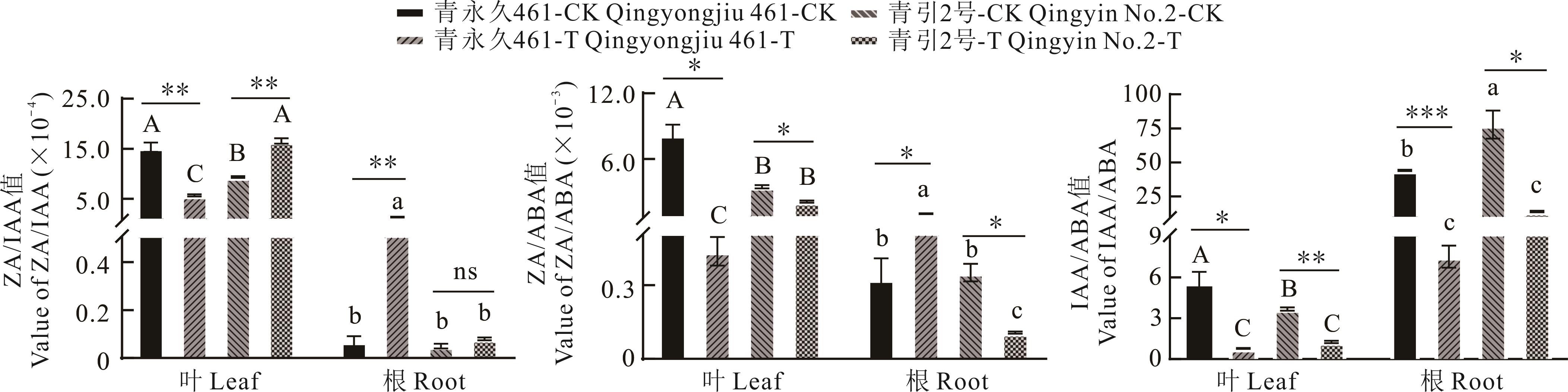
图4 盐胁迫对不同耐盐燕麦材料ZA/IAA、ZA/ABA和IAA/ABA的影响
Fig.4 Effects of salt stress on ZA/IAA, ZA/ABA和IAA/ABA in ‘Qingyongjiu 461’ and ‘Qingyin No.2’
| [1] | Zhu Y, Gong H. Beneficial effects of silicon on salt and drought tolerance in plants. Agronomy for Sustainable Development, 2014, 34: 455-472. |
| [2] | Wang J L, Huang X J, Zhong T Y, et al. Review on sustainable utilization of salt-affected land. Acta Geographica Sinica, 2011, 66(5): 673-684. |
| 王佳丽, 黄贤金, 钟太洋, 等. 盐碱地可持续利用研究综述. 地理学报, 2011, 66(5): 673-684. | |
| [3] | Li S H, Xu X, Hui H X, et al. Study on K+、Na+ selective absorption of different organs of spring wheat under soil saline sodic stress in different growth season. Acta Botanica Boreali-Occidentalia Sinica, 2002(3): 587-594. |
| 李树华, 许兴, 惠红霞, 等. 土壤盐碱胁迫对春小麦K+、Na+选择性吸收的影响. 西北植物学报, 2002(3): 587-594. | |
| [4] | Xie D Y, Wang H P, Wang F X, et al. Effects of salt stress on seed germination and seedling growth of cotton. China Cotton, 2000, 27(9): 12-13. |
| 谢得意, 王惠萍, 王付欣, 等. 盐胁迫对棉花种子萌发及幼苗生长的影响. 中国棉花, 2000, 27(9): 12-13. | |
| [5] | Yin L J, Zhu L. Physiological responses and adaptive faculty for Leymus chinensis seedlings to saline alkali stress. Journal of Northeast Normal University (Natural Science Edition), 1989(4): 87-95. |
| 殷立娟, 祝玲. 羊草苗对盐碱胁迫的反应和适应性. 东北师大学报(自然科学版), 1989(4): 87-95. | |
| [6] | Sun R G. Effects of salt on the physiological and biochemical characteristics of oat for late growth period and germination. Lanzhou: Gansu Agricultural University, 2010. |
| 孙仁国. 盐胁迫对燕麦萌发及生长后期生理生化特性的影响. 兰州: 甘肃农业大学, 2010. | |
| [7] | Paz R C, Rocco R A, Reinoso H, et al. Comparative study of alkaline, saline, and mixed saline-alkaline stresses with regard to their effects on growth, nutrient accumulation, and root morphology of Lotus tenuis. Journal of Plant Growth Regulation, 2012, 31: 448-459. |
| [8] | Wu Z H, Yang C W, Yang M Y. Photosynthesis, photosystem Ⅱ efficiency, amino acid metabolism and ion distribution in rice (Oryza sativa L.) in response to alkaline stress. Photosynthetica, 2014, 52(1): 157-160. |
| [9] | Lobo A K M, Marcio D O M, Lima Neto M C, et al. Exogenous sucrose supply changes sugar metabolism and reduces photosynthesis of sugarcane through the down-regulation of rubisco abundance and activity. Journal of Plant Physiology, 2015, 179: 113-121. |
| [10] | Blasing O E, Gibon Y, Gunther M, et al. Sugars and circadian regulation make major contributions to the global regulation of diurnal gene expression in Arabidopsis. The Plant Cell, 2005, 17(12): 3257-3281. |
| [11] | Sheng M, Tang M, Zhang F, et al. Influence of arbuscular mycorrhiza on organic solutes in maize leaves under salt stress. Mycorrhiza, 2011, 21: 423-430. |
| [12] | Hajlaoui H, El Ayeb N, Garrec J P, et al. Differential effects of salt stress on osmotic adjustment and solutes allocation on the basis of root and leaf tissue senescence of two silage maize (Zea mays L.) varieties. Industrial Crops and Products, 2010, 31(1): 122-130. |
| [13] | Zhang X P, Deng Y T, Yang R, et al. Evaluation of salt tolerance of forage oat germplasm resources at germination and seedling stages. Acta Agrestia Sinica, 2019, 11(1): 11-19. |
| 张晓澎, 邓焱天, 杨蕊, 等. 饲用燕麦种质资源萌发期及苗期耐盐性鉴定评价. 草地学报, 2019, 11(1): 11-19. | |
| [14] | Wang M M, Zhao G Q, Liang G L, et al. Physiological response of different salt-tolerant oats to salt stress. Pratacultural Science, 2021, 38(11): 2200-2209. |
| 王苗苗, 赵桂琴, 梁国玲, 等. 不同耐盐性燕麦对盐胁迫的生理响应. 草业科学, 2021, 38(11): 2200-2209. | |
| [15] | Sun Y M, Liu L J, Feng M F, et al. Research progress of sugar metabolism of plants under cold stress. Journal of Northeast Agricultural University, 2015, 46(7): 95-102, 108. |
| 孙永梅, 刘丽杰, 冯明芳, 等. 植物在低温胁迫下的糖代谢研究进展. 东北农业大学学报, 2015, 46(7): 95-102, 108. | |
| [16] | Li B, Sang T, He L, et al. Exogenous spermidine inhibits ethylene production in leaves of cucumber seedlings under NaCl stress. Journal of the American Society for Horticultural Science, 2013, 138(2): 108-113. |
| [17] | Javid M G, Sorooshzadeh A, Moradi F, et al. The role of phytohormones in alleviating salt stress in crop plants. Australian Journal of Crop Science, 2011, 5(6): 726-734. |
| [18] | Shen H, Zhang Y, Zhang X, et al. Change characteristics of phytohormones contents in rice seedlings under salt stress. Hunan Agricultural Sciences, 2021(12): 30-35. |
| 沈泓, 张樱, 张轩, 等. 盐胁迫下不同水稻品种苗期植物内源激素含量的变化特征. 湖南农业科学, 2021(12): 30-35. | |
| [19] | Gao C T, Liu J H, Xu S J, et al. Exploring the relationship of differentially expressed genes and physiological of oats in response to salt stress. Acta Botanica Boreali-Occidentalia Sinica, 2015, 35(7): 1385-1393. |
| 高彩婷, 刘景辉, 徐寿军, 等. 燕麦盐胁迫响应基因的差异表达与生理响应的关系. 西北植物学报, 2015, 35(7): 1385-1393. | |
| [20] | Li C Y, Zhang R R, Zhu H Y, et al.Effects of salt stress on physiological characteristics of alfalfa seedlings and evaluation of salt tolerance at seedling stage. Acta Agrestia sinica, 2025, 33(2): 516-523. |
| 李春燕, 张然然, 祝海燕, 等. 盐胁迫对紫花苜蓿幼苗生理特性的影响及苗期抗盐性评价. 草地学报, 2025, 33(2): 516-523. | |
| [21] | Cai Y F, Shi Z M, Fu X W, et al. Flower bud differentiation and endogenous hormone changes of Camellia ‘High Fragrance’. Molecular Plant Breeding, (2024-07-22)[2025-04-24]. http://kns.cnki.net/kcms/detail/46.1068.s.20240719.1241.008.html. |
| 蔡艳飞, 施自明, 付学维, 等. 山茶花‘烈香’花芽分化进程及内源激素变化. 分子植物育种, (2024-07-22)[2025-04-24]. http://kns.cnki.net/kcms/detail/46.1068.s.20240719.1241.008.html. | |
| [22] | Hübner S, Korol A B, Schmid K J. RNA-Seq analysis identifies genes associated with differential reproductive success under drought-stress in accessions of wild barley Hordeum spontaneum. BMC Plant Biology, 2015, 15(3): 134-149. |
| [23] | Han C, Xie W H, Li J G. Effects of salt stress on the osmotic regulation substances of Haloxylon ammodendron seedlings. Journal of Xinjiang Agricultural University, 2014, 37(3): 209-213. |
| 韩超, 谢文华, 李建贵. 盐胁迫对梭梭幼苗渗透调节物质含量的影响. 新疆农业大学学报, 2014, 37(3): 209-213. | |
| [24] | Hai X. Physiological mechanisms of spermidine alleviating salt stress in oat. Hohhot: Inner Mongolia Agricultural University, 2022. |
| 海霞. 亚精胺缓解燕麦盐胁迫的生理机制研究. 呼和浩特: 内蒙古农业大学, 2022. | |
| [25] | Pattanagul W, Thitisaksakul M. Effect of salinity stress on growth and carbohydrate metabolism in three rice (Oryza sativa L.) cultivars differing in salinity tolerance. Indian Journal of Experimental Biology, 2008, 46(10): 736-742. |
| [26] | Tang Z Y, Du Y, Yang H B, et al. Changes of endogenous hormone contents and expression analysis of related genes in leaves of tea plants under heat and drought stresses. Journal of Tea Science, 2023, 43(4): 489-500. |
| 唐子贻, 杜玥, 杨宏斌, 等. 高温和干旱胁迫下茶树叶片内源激素含量变化及其相关基因的表达分析. 茶叶科学, 2023, 43(4): 489-500. | |
| [27] | Peleg Z, Blumwald E. Hormone balance and abiotic stress tolerance in crop plants. Current Opinion in Plant Biology, 2011, 14(3): 290-295. |
| [28] | Yao M H, Liu L, Zeng Y L. Several kinds of phytohormone in plants responses to salt-stress. Biotechnology Bulletin, 2011(11): 1-5, 25. |
| 姚曼红, 刘琳, 曾幼玲. 五大类传统植物激素对植物响应盐胁迫的调控. 生物技术通报, 2011(11): 1-5, 25. | |
| [29] | Zhou Y J, Liu Y, Zhao D H, et al. Study on content change of endgenous hormones in Thellungiella halophilla and Arabidopsis thaliana under salt stress. Journal of Beijing Normal University (Natural Science), 2007(6): 657-660. |
| 周宜君, 刘玉, 赵丹华, 等. 盐胁迫下盐芥和拟南芥内源激素质量分数变化的研究. 北京师范大学学报(自然科学版), 2007(6): 657-660. | |
| [30] | Zhao Y K, Wang T, Zhang W S, et al. SOS3 mediates lateral root development under low salt stress through regulation of auxin redistribution and maxima in Arabidopsis. New Phytologist, 2010, 189(4): 1122-1134. |
| [31] | Zhou H B, Wang Y C, Shi S L, et al. Effects of NaCl stress on the content of endogenous hormones in Reaumuria trigyna seedling. Journal of Inner Mongolia University, 2010, 41(5): 531-535. |
| 周红兵, 王迎春, 石松利, 等. NaCl胁迫对盐生植物长叶红砂幼苗内源激素的影响. 内蒙古大学学报(自然科学版), 2010, 41(5): 531-535. | |
| [32] | Sun R Z, Jiang G B, Wu X Y, et al. Response of endogenous hormone in apoplast of two poplars to salt stress. Journal of Gansu Agricultural University, 2013, 48(2): 62-66, 73. |
| 孙若峥, 姜国斌, 吴祥云, 等. 2种杨树嫩茎质外体内源激素对盐胁迫的响应. 甘肃农业大学学报, 2013, 48(2): 62-66, 73. | |
| [33] | Li H Y, Li A X, Wang C, et al. Effects of salt stress on endogenous hormone contents in sunflower seedlings. Agricultural Research in the Arid Areas, 2018, 36(6): 92-97. |
| 李海洋, 李爱学, 王成, 等. 盐胁迫对苗期向日葵内源激素含量的影响. 干旱地区农业研究, 2018, 36(6): 92-97. | |
| [34] | Hartung W, Schraut D, Jiang F. Physiology of abscisic acid (ABA) in roots under stress-a review of the relationship between root ABA and radial water and ABA flows. Australian Journal of Agricultural Research, 2005, 56(11): 1253-1259. |
| [35] | Xiao Q, Wang G, Yi Y J, et al. Enhancing the salt tolerance of sweet potato seedlings through exogenous abscisic acid. Journal of Plant Nutrition & Fertilizer, 2016, 22(1): 201-208. |
| 肖强, 王刚, 衣艳君, 等. 外源脱落酸增强甘薯幼苗耐盐性的作用. 植物营养与肥料学报, 2016, 22(1): 201-208. | |
| [36] | Sha H J, Liu H L, Wang J G, et al. Physiological mechanism of salicylic acid regulating salt tolerance of crops. Journal of Northeast Agricultural University, 2017, 48(3): 80-88. |
| 沙汉景, 刘化龙, 王敬国, 等. 水杨酸调控作物耐盐性生理机制. 东北农业大学学报, 2017, 48(3): 80-88. | |
| [37] | Li T X, Hu Y T, Wei X, et al. Simultaneous determination of three endogenous hormones in Lonicera japonica under salt-alkali stress by UPLC-MS/MS. Jiangsu Agricultural Sciences, 2019, 47(11): 229-233. |
| 李天雪, 胡玉涛, 韦笑, 等. 超高效液相色谱-串联质谱同时测定盐碱胁迫金银花中3种内源激素. 江苏农业科学, 2019, 47(11): 229-233. | |
| [38] | Daszkowska-golec A, Szarejko I. Open or close the gate-stomata action under the control of phytohormones in drought stress conditions. Frontiers in Plant Science, 2013, 4: 138. |
| [39] | Avchenko T, Kolla V A, Wang C Q, et al. Functional convergence of oxylipin and abscisic acid pathways controls stomatal closure in response to drought. Plant Physiology, 2014, 164(3): 1151-1160. |
| [40] | Li Q Y. Responses of strawberry to salt stress and its regulation. Baoding: Hebei Agricultural University, 2005. |
| 李青云. 草莓对盐胁迫的反应及调控研究. 保定: 河北农业大学, 2005. |
| [1] | 魏孔涛, 张春平, 俞旸, 张正社, 周泽, 张雪, 王鑫鑫, 岳思玉, 曹铨, 董全民. 环青海湖共和盆地不同燕麦品种的产量、营养价值及对土壤理化性质的影响[J]. 草业学报, 2026, 35(1): 107-118. |
| [2] | 张志鹏, 蒋庆雪, 周昕越, 苗童, 唐俊, 仪登霞, 王学敏, 马琳. 转录组和蛋白组联合筛选饲用燕麦株高性状候选基因[J]. 草业学报, 2025, 34(9): 147-161. |
| [3] | 刘沂欣, 隋晓青, 王鑫尧, 郎梦卿, 孙凌子寅, 吉尔尔格. 外源褪黑素对盐胁迫下紫花苜蓿的缓解作用[J]. 草业学报, 2025, 34(9): 206-214. |
| [4] | 张晴晴, 马兴羽, 鲁艳, 赵广兴, 曾凡江, 黄彩变. 沙化盐渍土地不同生长时期油莎豆的耐盐性差异研究[J]. 草业学报, 2025, 34(6): 168-180. |
| [5] | 韩航琪, 王梓凡, 丁赫, 陈玉荣, 王琦, 张晓庆. 燕麦干草与燕麦草块对绵羊瘤胃发酵及微生物组成影响的比较分析[J]. 草业学报, 2025, 34(5): 212-222. |
| [6] | 胡泽龙, 梁国玲, 刘文辉, 王文虎. 两种粒色燕麦籽粒色素与光合特性动态变化[J]. 草业学报, 2025, 34(12): 145-156. |
| [7] | 鲍根生, 李媛, 冯晓云, 赵倩. 施氮量和混播方式对燕麦/饲用豌豆间作系统氮素吸收和干物质产量的影响[J]. 草业学报, 2025, 34(11): 161-173. |
| [8] | 马文艳, 李杰东, 周镇磊, 曹东, 刘宝龙, 张怀刚, 王东霞. 肥料、保水剂和播种量互作对燕麦综合生产性能的影响[J]. 草业学报, 2025, 34(10): 107-119. |
| [9] | 田戈, 南丽丽, 王利群, 马香香, 何蓉, 郭佳雨. 盐胁迫下外源ABA对红豆草幼苗生长与生理特性的影响[J]. 草业学报, 2025, 34(10): 95-106. |
| [10] | 郭璟, 王越, 祁存英, 李静. 内生真菌浸种对燕麦生长和根部内生真菌群落的影响[J]. 草业学报, 2025, 34(1): 151-160. |
| [11] | 蔡文祺, 李淑霞, 王晓彤, 宋文学, 麻旭霞, 马小梅, 李小红, 代昕瑶. 外源褪黑素与乙烯交互对盐胁迫下紫花苜蓿幼苗生长和生理特性的影响[J]. 草业学报, 2025, 34(1): 80-93. |
| [12] | 王宝, 谢占玲, 郭璟, 唐永鹏, 孟清, 彭清青, 杨家宝, 董德誉, 徐鸿雁, 高太侦, 张凡, 段迎珠. 真菌发酵液浸种燕麦对其抗旱性及根际真菌群落结构的影响[J]. 草业学报, 2024, 33(9): 126-139. |
| [13] | 关皓, 许多, 李海萍, 贾志锋, 马祥, 刘文辉, 陈有军, 李欣洋, 黄艳玲, 周青平, 陈仕勇. 高寒地区17个燕麦品种营养品质及瘤胃降解特性研究[J]. 草业学报, 2024, 33(9): 185-198. |
| [14] | 米春娇, 洪流, 马馼, 毛培胜. 谷胱甘肽引发对老化燕麦种胚线粒体抗氧化特性的影响[J]. 草业学报, 2024, 33(9): 51-59. |
| [15] | 马圆, 刘欢, 赵桂琴, 王敬龙, 张然, 姚瑞瑞. 燕麦sHSP基因家族的鉴定及其响应高温及老化的表达分析[J]. 草业学报, 2024, 33(8): 145-158. |
| 阅读次数 | ||||||
|
全文 |
|
|||||
|
摘要 |
|
|||||
