

ISSN 1004-5759 CN 62-1105/S
草业学报 ›› 2026, Vol. 35 ›› Issue (6): 24-34.DOI: 10.11686/cyxb2025262
任孟雨( ), 王利群, 南丽丽(), 郭佳雨
收稿日期:2025-06-26
修回日期:2025-07-21
出版日期:2026-06-20
发布日期:2026-04-13
通讯作者:
南丽丽
作者简介:Corresponding author. E-mail: nanll@gsau.edu.cn基金资助:
Meng-yu REN(), Li-qun WANG, Li-li NAN(), Jia-yu GUO
Received:2025-06-26
Revised:2025-07-21
Online:2026-06-20
Published:2026-04-13
Contact:
Li-li NAN
摘要:
为探讨紫花苜蓿新品系在盐胁迫下的变化及响应机制,以5份苜蓿新品系(P1、P2、P3、P4、P5)及中苜1号紫花苜蓿(ZM)为研究对象,在盐胁迫(200?mmol·L-1 NaCl)下分别处理0(CK)、8与16?d后测定其开花期形态、生理等指标。结果表明:随盐胁迫时间的延长,供试苜蓿的株高、叶面积、地上生物量、地下生物量和地上部及地下部K+含量呈降低趋势。同时,盐胁迫也抑制了供试苜蓿根系的生长,根总长、根总表面积、根平均直径、根体积和根尖数均降低。而总黄酮含量,苯丙氨酸解氨酶、肉桂酸-4-羟基化酶、4-香豆酸辅酶A连接酶活性和地上部及地下部Na+含量均增加。主成分分析表明,地下部K+及Na+含量、根尖数、株高与叶面积可视为评估苜蓿开花期耐盐性的关键指标。隶属函数综合评价表明,供试苜蓿耐盐性排名为P3>P4>P5>ZM>P2>P1。综上所述,P3为耐盐胁迫品系,P1为盐胁迫敏感品系。
任孟雨, 王利群, 南丽丽, 郭佳雨. 紫花苜蓿新品系对盐胁迫的响应[J]. 草业学报, 2026, 35(6): 24-34.
Meng-yu REN, Li-qun WANG, Li-li NAN, Jia-yu GUO. Responses of new alfalfa lines to salt stress[J]. Acta Prataculturae Sinica, 2026, 35(6): 24-34.
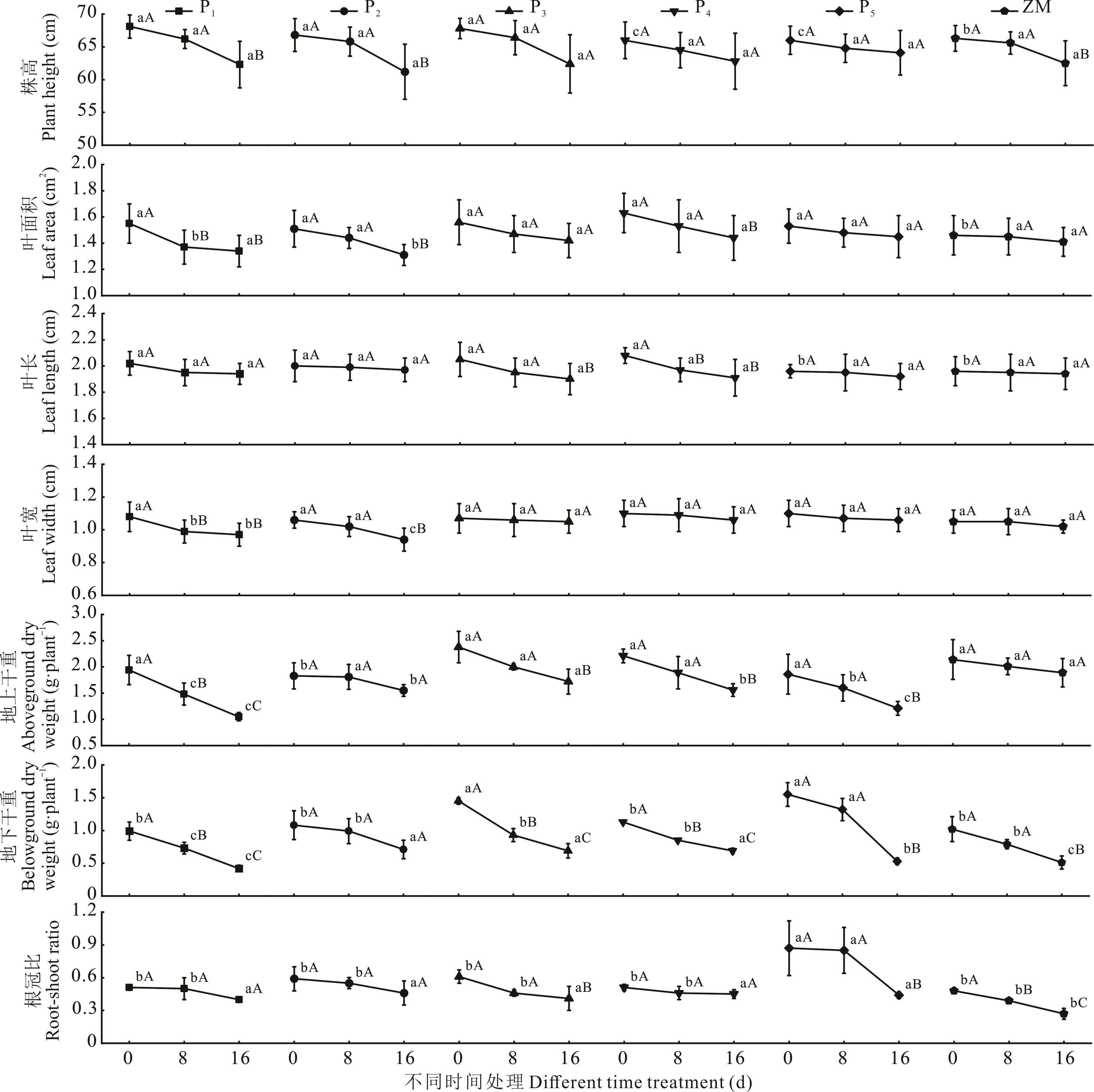
图1 盐胁迫下苜蓿新品系形态指标变化不同小写字母表示同一时间处理下各苜蓿种质间差异显著(P<0.05);不同大写字母表示相同苜蓿种质在不同时间处理下差异显著(P<0.05)。下同。The lowercase letters indicate significant differences among different alfalfa germplasms under the same time treatment (P<0.05), and different capital letters indicate significant differences in alfalfa germplasm under different time treatments (P<0.05). The same below.
Fig.1 Changes of morphological indexes of new alfalfa lines under salt stress
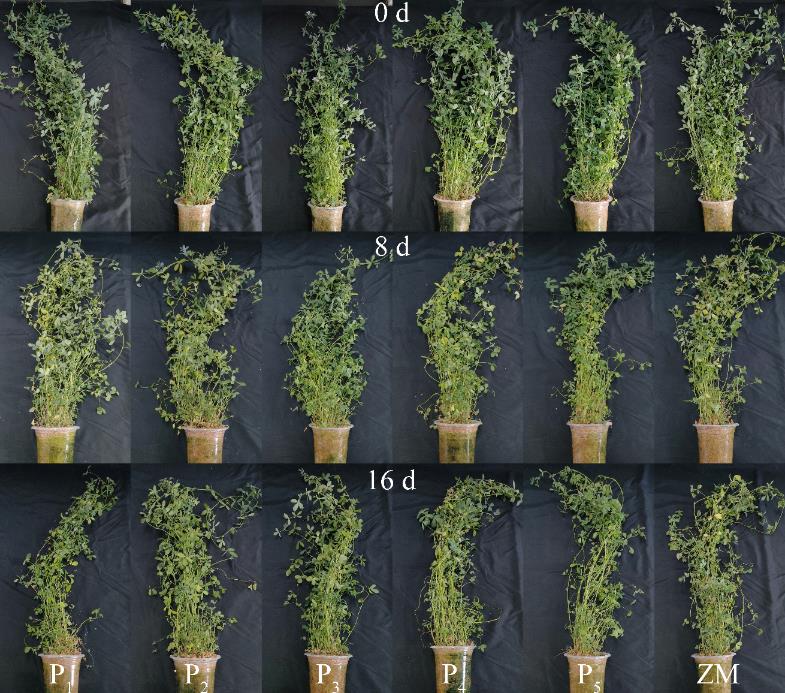
图2 盐胁迫下供试苜蓿的生长状况
Fig.2 Growth status of tested alfalfa under salt stress
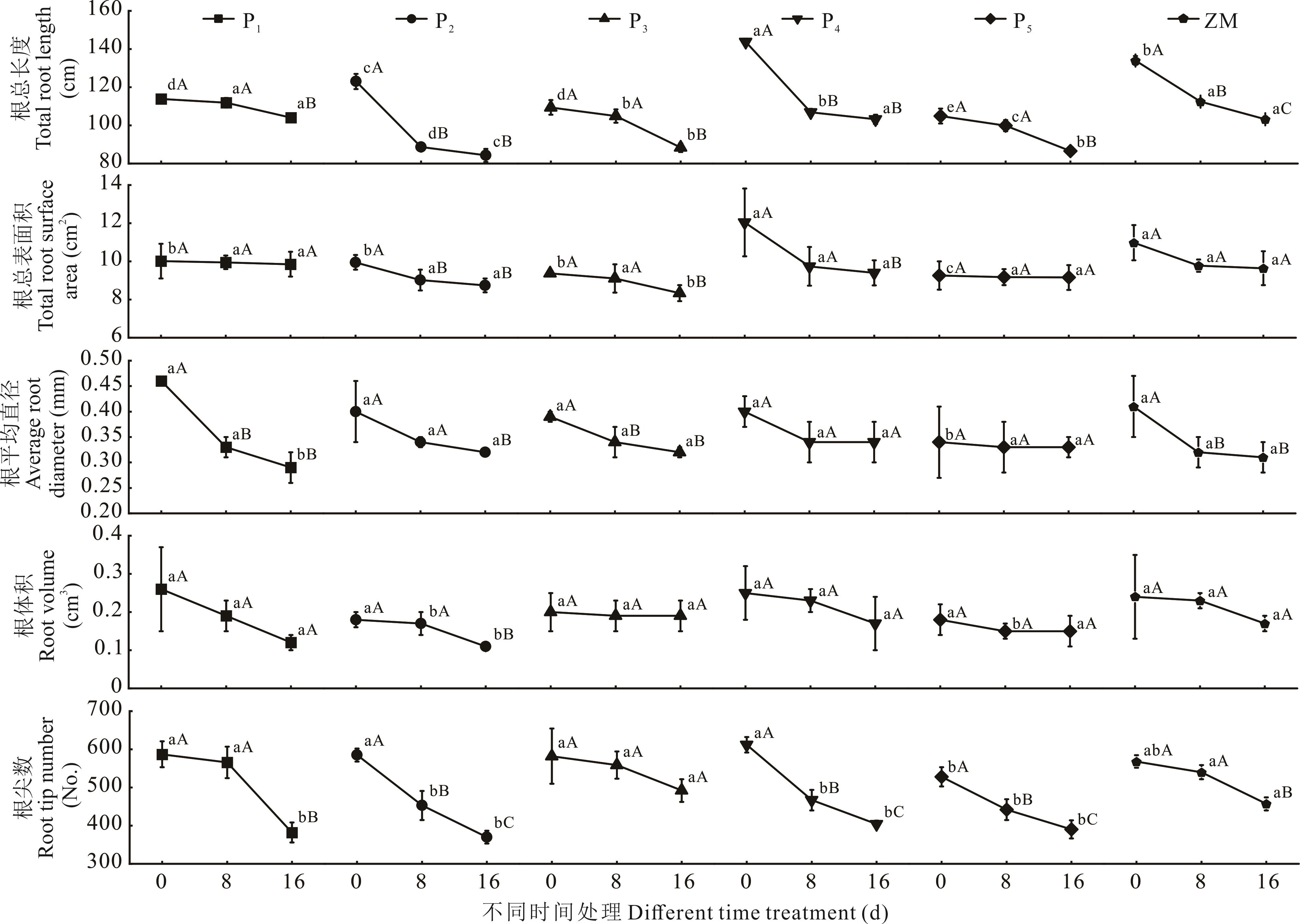
图3 盐胁迫下苜蓿新品系根系参数的变化
Fig.3 Changes of root parameters of new alfalfa lines under salt stress
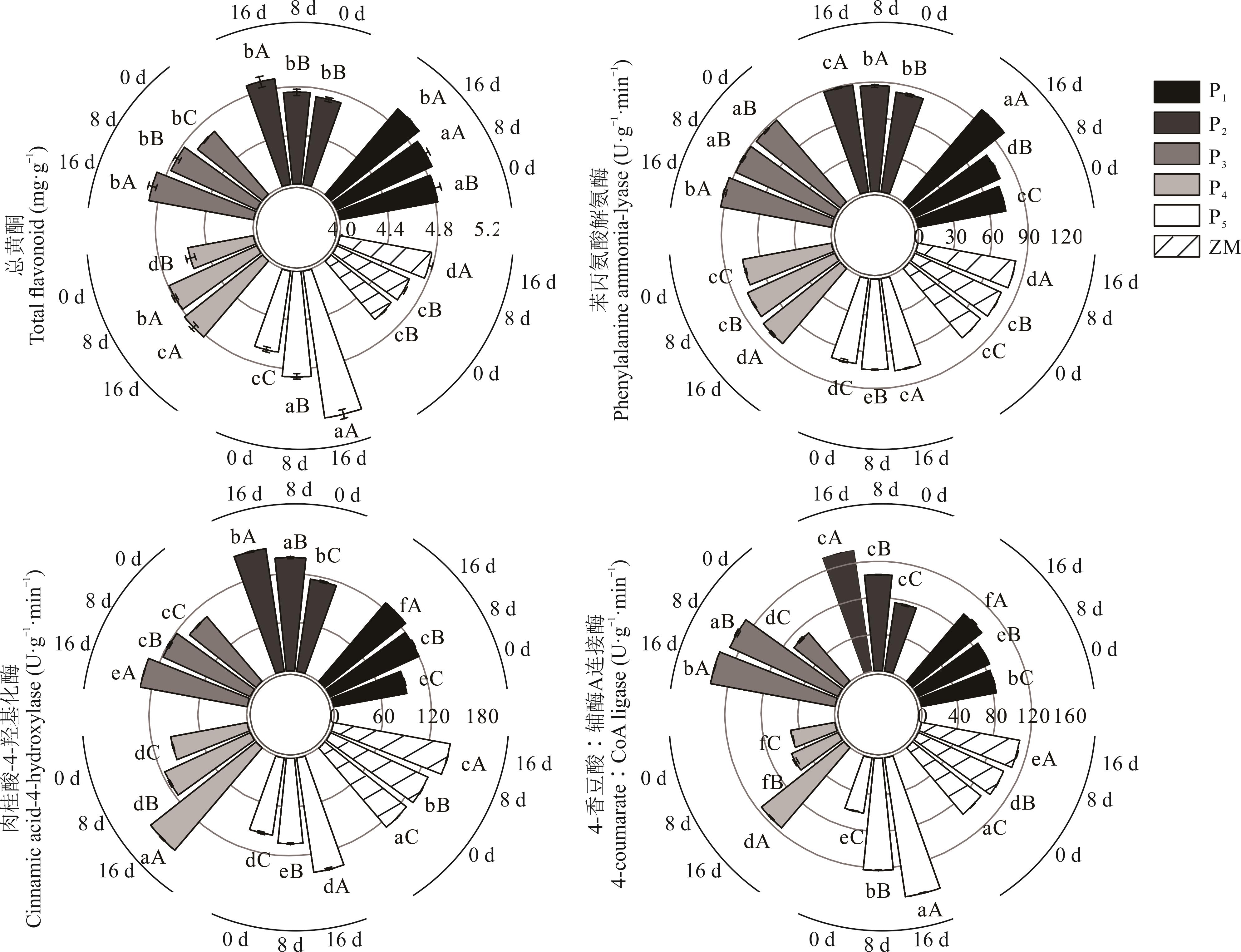
图4 盐胁迫下不同苜蓿材料的总黄酮含量及其关键酶活性
Fig.4 Total flavonoid content and its key enzymes activity of different alfalfa materials under salt stress
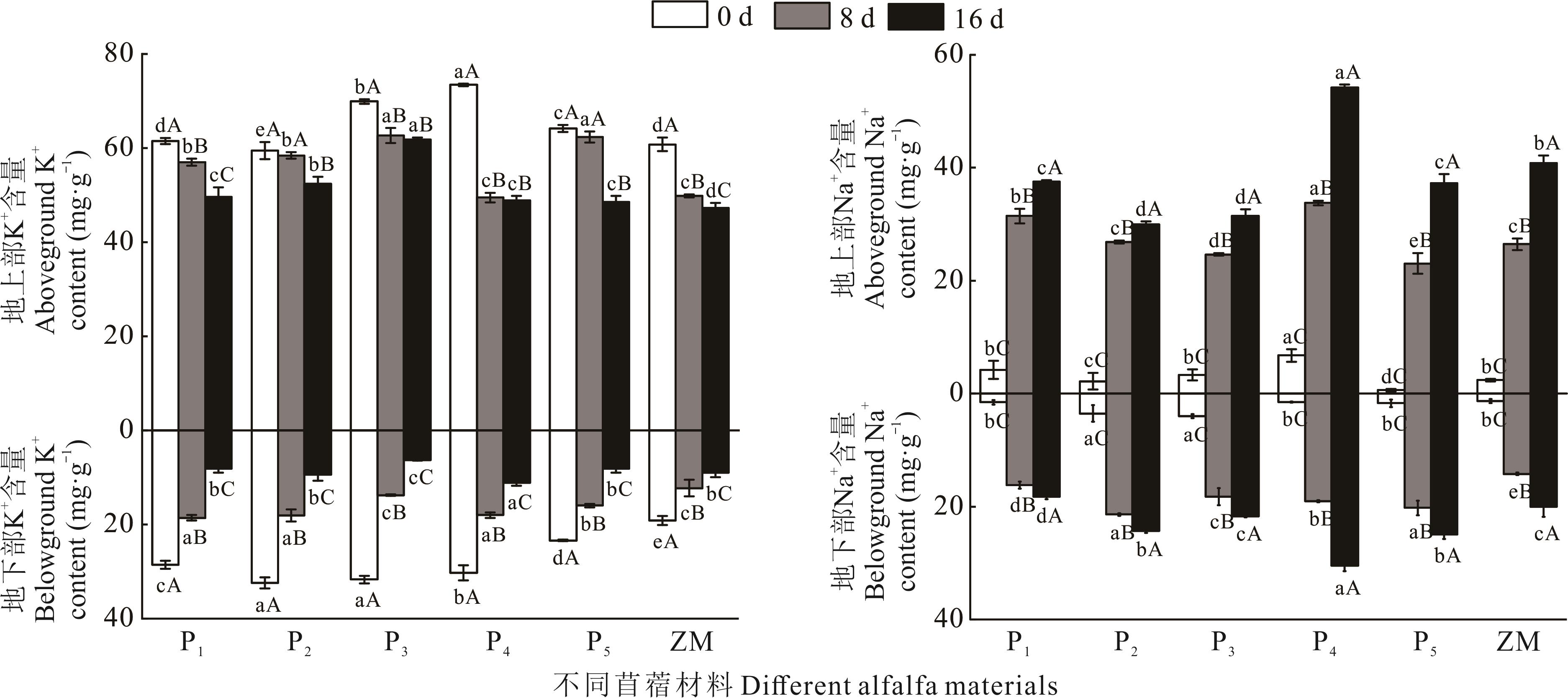
图5 盐胁迫对苜蓿钾离子和钠离子含量变化的影响
Fig.5 Effects of salt stress on the change of potassium ion and sodium ion content in alfalfa
指标 Index | 主成分 Principal component | ||||
|---|---|---|---|---|---|
| 1 | 2 | 3 | 4 | ||
| 株高 Plant height | 0.844 | 0.102 | 0.067 | 0.061 | |
| 叶面积 Leaf area | 0.861 | 0.081 | 0.315 | 0.098 | |
| 叶长 Leaf length | 0.792 | -0.066 | -0.350 | -0.079 | |
| 叶宽 Leaf width | 0.670 | 0.166 | 0.609 | 0.181 | |
| 地上干重 Aboveground dry weight | 0.774 | -0.148 | -0.038 | 0.537 | |
| 地下干重 Belowground dry weight | 0.775 | 0.565 | -0.041 | 0.077 | |
| 根冠比 Root-shoot ratio | 0.449 | 0.812 | 0.042 | -0.246 | |
| 总黄酮 Total flavonoid | -0.719 | 0.246 | 0.247 | -0.242 | |
| 苯丙氨酸解氨酶 Phenylalanine ammonia-lyase (PAL) | -0.516 | -0.035 | -0.665 | 0.303 | |
| 肉桂酸-4-羟基化酶 Cinnamic acid-4-hydroxylase (C4H) | -0.814 | -0.284 | 0.036 | 0.189 | |
| 4-香豆酸辅酶A连接酶 4-coumarate CoA ligase (4CL) | -0.761 | 0.169 | 0.133 | 0.282 | |
| 地上部K+含量 Aboveground K+ content | 0.775 | 0.311 | -0.256 | 0.172 | |
| 地下部K+含量Belowground K+ content | 0.916 | 0.097 | -0.157 | -0.127 | |
| 地上部Na+含量Aboveground Na+ content | -0.874 | -0.203 | 0.227 | 0.032 | |
| 地下部Na+含量Belowground Na+ content | -0.905 | 0.046 | 0.177 | 0.138 | |
| 根总长 Total root length | 0.775 | -0.495 | -0.019 | -0.222 | |
| 根总表面积 Total root surface area | 0.625 | -0.597 | 0.011 | -0.407 | |
| 根平均直径 Average root diameter | 0.807 | -0.114 | 0.058 | 0.008 | |
| 根体积 Root volume | 0.756 | -0.416 | 0.341 | 0.234 | |
| 根尖数 Root tip numbers | 0.877 | -0.171 | -0.053 | 0.193 | |
| 特征值 Eigenvalue | 11.964 | 2.185 | 1.420 | 1.045 | |
| 贡献率 Contributive rate (%) | 59.819 | 10.927 | 7.101 | 5.226 | |
| 累积贡献率 Cumulative contributive rate (%) | 59.819 | 70.746 | 77.847 | 83.073 | |
表1 各因子载荷矩阵和累积贡献率
Table 1 Matrix of factor loading and cumulative contribution rate
指标 Index | 主成分 Principal component | ||||
|---|---|---|---|---|---|
| 1 | 2 | 3 | 4 | ||
| 株高 Plant height | 0.844 | 0.102 | 0.067 | 0.061 | |
| 叶面积 Leaf area | 0.861 | 0.081 | 0.315 | 0.098 | |
| 叶长 Leaf length | 0.792 | -0.066 | -0.350 | -0.079 | |
| 叶宽 Leaf width | 0.670 | 0.166 | 0.609 | 0.181 | |
| 地上干重 Aboveground dry weight | 0.774 | -0.148 | -0.038 | 0.537 | |
| 地下干重 Belowground dry weight | 0.775 | 0.565 | -0.041 | 0.077 | |
| 根冠比 Root-shoot ratio | 0.449 | 0.812 | 0.042 | -0.246 | |
| 总黄酮 Total flavonoid | -0.719 | 0.246 | 0.247 | -0.242 | |
| 苯丙氨酸解氨酶 Phenylalanine ammonia-lyase (PAL) | -0.516 | -0.035 | -0.665 | 0.303 | |
| 肉桂酸-4-羟基化酶 Cinnamic acid-4-hydroxylase (C4H) | -0.814 | -0.284 | 0.036 | 0.189 | |
| 4-香豆酸辅酶A连接酶 4-coumarate CoA ligase (4CL) | -0.761 | 0.169 | 0.133 | 0.282 | |
| 地上部K+含量 Aboveground K+ content | 0.775 | 0.311 | -0.256 | 0.172 | |
| 地下部K+含量Belowground K+ content | 0.916 | 0.097 | -0.157 | -0.127 | |
| 地上部Na+含量Aboveground Na+ content | -0.874 | -0.203 | 0.227 | 0.032 | |
| 地下部Na+含量Belowground Na+ content | -0.905 | 0.046 | 0.177 | 0.138 | |
| 根总长 Total root length | 0.775 | -0.495 | -0.019 | -0.222 | |
| 根总表面积 Total root surface area | 0.625 | -0.597 | 0.011 | -0.407 | |
| 根平均直径 Average root diameter | 0.807 | -0.114 | 0.058 | 0.008 | |
| 根体积 Root volume | 0.756 | -0.416 | 0.341 | 0.234 | |
| 根尖数 Root tip numbers | 0.877 | -0.171 | -0.053 | 0.193 | |
| 特征值 Eigenvalue | 11.964 | 2.185 | 1.420 | 1.045 | |
| 贡献率 Contributive rate (%) | 59.819 | 10.927 | 7.101 | 5.226 | |
| 累积贡献率 Cumulative contributive rate (%) | 59.819 | 70.746 | 77.847 | 83.073 | |
指标 Index | P1 | P2 | P3 | P4 | P5 | ZM | ||||||
|---|---|---|---|---|---|---|---|---|---|---|---|---|
| Fij | Wij | Fij | Wij | Fij | Wij | Fij | Wij | Fij | Wij | Fij | Wij | |
| L1 | 0.447 | 0.052 | 0.330 | 0.054 | 0.470 | 0.050 | 0.359 | 0.053 | 0.473 | 0.054 | 0.418 | 0.054 |
| L2 | 0.133 | 0.056 | 0.202 | 0.056 | 0.411 | 0.053 | 0.545 | 0.056 | 0.480 | 0.055 | 0.371 | 0.053 |
| L3 | 0.160 | 0.075 | 0.475 | 0.056 | 0.610 | 0.062 | 0.507 | 0.066 | 0.267 | 0.070 | 0.677 | 0.057 |
| L4 | 0.138 | 0.087 | 0.383 | 0.066 | 0.345 | 0.088 | 0.311 | 0.075 | 0.450 | 0.103 | 0.205 | 0.084 |
| L5 | 0.296 | 0.055 | 0.387 | 0.060 | 0.275 | 0.068 | 0.298 | 0.058 | 0.622 | 0.076 | 0.099 | 0.076 |
| L6 | 0.509 | 0.048 | 0.399 | 0.051 | 0.412 | 0.048 | 0.383 | 0.048 | 0.735 | 0.049 | 0.244 | 0.051 |
| L7 | 0.609 | 0.042 | 0.592 | 0.049 | 0.699 | 0.048 | 0.316 | 0.047 | 0.172 | 0.050 | 0.318 | 0.049 |
| L8 | 0.429 | 0.036 | 0.741 | 0.041 | 0.464 | 0.041 | 0.665 | 0.036 | 0.434 | 0.043 | 0.644 | 0.048 |
| L9 | 0.400 | 0.045 | 0.673 | 0.033 | 0.815 | 0.026 | 0.349 | 0.034 | 0.852 | 0.024 | 0.542 | 0.047 |
| L10 | 0.232 | 0.056 | 0.311 | 0.055 | 0.572 | 0.055 | 0.073 | 0.076 | 0.314 | 0.061 | 0.049 | 0.065 |
| L11 | 0.633 | 0.006 | 0.519 | 0.004 | 0.513 | 0.006 | 0.809 | 0.008 | 0.551 | 0.001 | 0.617 | 0.004 |
| L12 | 0.271 | 0.117 | 0.285 | 0.131 | 0.143 | 0.173 | 0.315 | 0.111 | 0.220 | 0.111 | 0.165 | 0.095 |
| L13 | 0.545 | 0.004 | 0.739 | 0.008 | 0.640 | 0.010 | 0.804 | 0.003 | 0.729 | 0.004 | 0.543 | 0.004 |
| L14 | 0.398 | 0.051 | 0.037 | 0.073 | 0.207 | 0.055 | 0.348 | 0.070 | 0.150 | 0.059 | 0.395 | 0.065 |
| L15 | 0.423 | 0.049 | 0.148 | 0.058 | 0.104 | 0.053 | 0.333 | 0.064 | 0.226 | 0.053 | 0.372 | 0.059 |
| L16 | 0.119 | 0.073 | 0.247 | 0.062 | 0.249 | 0.057 | 0.323 | 0.059 | 0.246 | 0.056 | 0.145 | 0.068 |
| L17 | 0.295 | 0.086 | 0.203 | 0.070 | 0.537 | 0.052 | 0.601 | 0.064 | 0.288 | 0.063 | 0.600 | 0.062 |
| L18 | 0.429 | 0.061 | 0.172 | 0.073 | 0.642 | 0.054 | 0.271 | 0.072 | 0.189 | 0.067 | 0.530 | 0.059 |
| D值D value | 0.307 | 0.322 | 0.385 | 0.365 | 0.361 | 0.340 | ||||||
| 排序Order | 6 | 5 | 1 | 2 | 3 | 4 | ||||||
表2 供试苜蓿隶属值、权重、D值及排序
Table 2 Membership value, weight, D value and ranking of tested alfalfa
指标 Index | P1 | P2 | P3 | P4 | P5 | ZM | ||||||
|---|---|---|---|---|---|---|---|---|---|---|---|---|
| Fij | Wij | Fij | Wij | Fij | Wij | Fij | Wij | Fij | Wij | Fij | Wij | |
| L1 | 0.447 | 0.052 | 0.330 | 0.054 | 0.470 | 0.050 | 0.359 | 0.053 | 0.473 | 0.054 | 0.418 | 0.054 |
| L2 | 0.133 | 0.056 | 0.202 | 0.056 | 0.411 | 0.053 | 0.545 | 0.056 | 0.480 | 0.055 | 0.371 | 0.053 |
| L3 | 0.160 | 0.075 | 0.475 | 0.056 | 0.610 | 0.062 | 0.507 | 0.066 | 0.267 | 0.070 | 0.677 | 0.057 |
| L4 | 0.138 | 0.087 | 0.383 | 0.066 | 0.345 | 0.088 | 0.311 | 0.075 | 0.450 | 0.103 | 0.205 | 0.084 |
| L5 | 0.296 | 0.055 | 0.387 | 0.060 | 0.275 | 0.068 | 0.298 | 0.058 | 0.622 | 0.076 | 0.099 | 0.076 |
| L6 | 0.509 | 0.048 | 0.399 | 0.051 | 0.412 | 0.048 | 0.383 | 0.048 | 0.735 | 0.049 | 0.244 | 0.051 |
| L7 | 0.609 | 0.042 | 0.592 | 0.049 | 0.699 | 0.048 | 0.316 | 0.047 | 0.172 | 0.050 | 0.318 | 0.049 |
| L8 | 0.429 | 0.036 | 0.741 | 0.041 | 0.464 | 0.041 | 0.665 | 0.036 | 0.434 | 0.043 | 0.644 | 0.048 |
| L9 | 0.400 | 0.045 | 0.673 | 0.033 | 0.815 | 0.026 | 0.349 | 0.034 | 0.852 | 0.024 | 0.542 | 0.047 |
| L10 | 0.232 | 0.056 | 0.311 | 0.055 | 0.572 | 0.055 | 0.073 | 0.076 | 0.314 | 0.061 | 0.049 | 0.065 |
| L11 | 0.633 | 0.006 | 0.519 | 0.004 | 0.513 | 0.006 | 0.809 | 0.008 | 0.551 | 0.001 | 0.617 | 0.004 |
| L12 | 0.271 | 0.117 | 0.285 | 0.131 | 0.143 | 0.173 | 0.315 | 0.111 | 0.220 | 0.111 | 0.165 | 0.095 |
| L13 | 0.545 | 0.004 | 0.739 | 0.008 | 0.640 | 0.010 | 0.804 | 0.003 | 0.729 | 0.004 | 0.543 | 0.004 |
| L14 | 0.398 | 0.051 | 0.037 | 0.073 | 0.207 | 0.055 | 0.348 | 0.070 | 0.150 | 0.059 | 0.395 | 0.065 |
| L15 | 0.423 | 0.049 | 0.148 | 0.058 | 0.104 | 0.053 | 0.333 | 0.064 | 0.226 | 0.053 | 0.372 | 0.059 |
| L16 | 0.119 | 0.073 | 0.247 | 0.062 | 0.249 | 0.057 | 0.323 | 0.059 | 0.246 | 0.056 | 0.145 | 0.068 |
| L17 | 0.295 | 0.086 | 0.203 | 0.070 | 0.537 | 0.052 | 0.601 | 0.064 | 0.288 | 0.063 | 0.600 | 0.062 |
| L18 | 0.429 | 0.061 | 0.172 | 0.073 | 0.642 | 0.054 | 0.271 | 0.072 | 0.189 | 0.067 | 0.530 | 0.059 |
| D值D value | 0.307 | 0.322 | 0.385 | 0.365 | 0.361 | 0.340 | ||||||
| 排序Order | 6 | 5 | 1 | 2 | 3 | 4 | ||||||
| [1] | Xia J, Nan L L, Chen J, et al. Effects of low phosphorus stress on photosynthetic and chlorophyll fluorescence characteristics of alfalfa with different root types. Chinese Journal of Grassland, 2023, 45(10): 58-67. |
| 夏静, 南丽丽, 陈洁, 等. 低磷胁迫下不同根型苜蓿形态及生理响应. 中国草地学报, 2023, 45(10): 58-67. | |
| [2] | Li M, Zhang J H. Effects of different fertilization patterns on the bacterial community dynamic in saline-alkali paddy soil. Agricultural Research in the Arid Areas, 2018, 36(5): 142-148. |
| 李明, 张俊华. 不同施肥模式对盐碱化稻作土壤细菌群落的影响. 干旱地区农业研究, 2018, 36(5): 142-148. | |
| [3] | Li W Y, Wang H F, Zheng W, et al. Effect of exogenous calcium on growth and development of Taxus wallichiana var. mairei under saline-alkali and drought cross stress. Journal of Arid Land Resources and Environment, 2025, 39(6): 175-185. |
| 李文杨, 王慧芳, 郑伟, 等. 外源钙对盐碱干旱交叉胁迫下红豆杉生长发育的影响. 干旱区资源与环境, 2025, 39(6): 175-185. | |
| [4] | Guo L N, Lu L, Dong X R, et al. Effects of gibberellic acid, kinetin and indole butyric acid mixture on sorghum salinity tolerance and grain yield in saline-alkali coastal zone. Chinese Journal of Applied Ecology, 2023, 34(9): 2405-2412. |
| 郭丽娜, 卢霖, 董学瑞, 等. 赤霉素、激动素和吲哚丁酸合剂对滨海盐碱区粒用高粱耐盐性和产量的影响. 应用生态学报, 2023, 34(9): 2405-2412. | |
| [5] | Bhattarai S, Biswas D, Fu Y B, et al. Morphological, physiological, and genetic responses to salt stress in alfalfa: a review. Agronomy, 2020, 10(4): 577. |
| [6] | Ali M, Afzal S, Parveen A, et al. Silicon mediated improvement in the growth and ion homeostasis by decreasing Na+ uptake in maize (Zea mays L.) cultivars exposed to salinity stress. Plant Physiology and Biochemistry, 2021, 158: 208-218. |
| [7] | Zelm E V, Zhang Y X, Testerink C. Salt tolerance mechanisms of plants. Annual Review of Plant Biology, 2020, 71: 403-433. |
| [8] | Zhao S S, Zhang Q K, Liu M Y, et al. Regulation of plant responses to salt stress. International Journal of Molecular Sciences, 2021, 22(9): 4609. |
| [9] | Li S, Sun L L, Bai L L, et al. Flavonoid is associated with salt stress tolerance in Atriplex centralasiatica seedlings. Chinese Journal of Eco-Agriculture, 2017, 25(9): 1345-1350. |
| 李爽, 孙亮亮, 白丽丽, 等. 类黄酮参与调控中亚滨藜幼苗对盐胁迫的耐受性. 中国生态农业学报, 2017, 25(9): 1345-1350. | |
| [10] | Jiang M, Pan Y, Yu K C, et al. Metabolic profiling and gene expression analyses shed light on the cold adaptation mechanisms of Saposhnikovia divaricata (Turcz.) Schischk. Scientific Reports, 2025, 15(1): 7070. |
| [11] | Zhu K, Liu H J, Feng C L, et al. Comprehensive evaluation on the salt tolerance of seed germination of different alfalfa varieties under salt stress. Acta Agrestia Sinica, 2023, 31(12): 3724-3733. |
| 朱琨, 刘骅峻, 冯成龙, 等. 盐胁迫对不同苜蓿品种种子萌发的耐盐性综合评价. 草地学报, 2023, 31(12): 3724-3733. | |
| [12] | Wang L Q, Nan L L, Ma X X, et al. Comprehensive evaluation of salt tolerance of 30 alfalfa germplasms at seedling stage. Chinese Journal of Grassland, 2025, 47(7): 70-82. |
| 王利群, 南丽丽, 马香香, 等. 30份苜蓿种质苗期耐盐性综合评价. 中国草地学报, 2025, 47(7): 70-82. | |
| [13] | Xu Y Y, Wang Y, Yang W G. Extraction process and antioxidant activity of total flavonoids from alfalfa leaf. Acta Agrestia Sinica, 2018, 26(3): 757-763. |
| 许英一, 王宇, 杨伟光. 紫花苜蓿叶总黄酮提取及抗氧化性. 草地学报, 2018, 26(3): 757-763. | |
| [14] | Xu Y. Effects of temperature and light intensity on growth and secondary metabolites biosynthesis of ginkgo (Ginkgo biloba L.) leaves. Nanjing: Nanjing Forestry University, 2016. |
| 徐友. 温度和光强对银杏生长和次生代谢产物合成的影响. 南京: 南京林业大学, 2016. | |
| [15] | Lamb C J, Rubery P H. A spectrophotometric assay for trans-cinnamic acid 4-hydroxylase activity. Analytical Biochemistry, 1975, 68(2): 554-561. |
| [16] | Knobloch K H, Hahlbrock K. 4-coumarate: CoA ligase from cell suspension cultures of Petroselinum hortense Hoffm: Partial purification, substrate specificity, and further properties. Archives of Biochemistry and Biophysics, 1977, 184(1): 237-248. |
| [17] | Liu X, Wang K, Liang P F, et al. Screening and comprehensive evaluation of salt tolerant germplasm of sainfoin at seedling stage. Southwest China Journal of Agricultural Sciences, 2022, 35(9): 2171-2179. |
| 刘鑫, 汪堃, 梁鹏飞, 等. 红豆草苗期耐盐种质筛选及综合评价. 西南农业学报, 2022, 35(9): 2171-2179. | |
| [18] | He H P, Nan L L, Ma B, et al. Screening and evaluation of seedling stage cold tolerance in different sainfoin varieties. Chinese Journal of Grassland, 2023, 45(5): 41-49. |
| 何海鹏, 南丽丽, 马彪, 等. 红豆草种质苗期耐寒性筛选及评价. 中国草地学报, 2023, 45(5): 41-49. | |
| [19] | Mao S, Zhou W L, Yang F, et al. Research progress on mechanism of plant roots response to salt-alkali stress. Acta Agriculturae Zhejiangensis, 2021, 33(10): 1991-2000. |
| 毛爽, 周万里, 杨帆, 等. 植物根系应答盐碱胁迫机理研究进展. 浙江农业学报, 2021, 33(10): 1991-2000. | |
| [20] | Hao T, Zhao J Z, Du W J, et al. Effect of new modifiers on soybean germination under alkali stress. Journal of Shanxi Agricultural Sciences, 2019, 47(4): 548-552. |
| 郝统, 赵晋忠, 杜维俊, 等. 新型改良剂对碱胁迫下大豆萌发的影响. 山西农业科学, 2019, 47(4): 548-552. | |
| [21] | Chen F Y, Gu Y B, Bai J S, et al. Effects of flooding and salt stress on the growth of Zizania latifolia. Chinese Journal of Ecology, 2020, 39(5): 1484-1491. |
| 陈方圆, 古勇波, 白江珊, 等. 淹水和盐胁迫对湿地植物菰生长的影响. 生态学杂志, 2020, 39(5): 1484-1491. | |
| [22] | Zhang Q Y, Ma L, Xu H, et al. Mechanism of lignin content in root system affecting salt tolerance in maize. Current Biotechnology, 2025, 15(1): 67-77. |
| 张青云, 马蕾, 胥华, 等. 根系木质素含量影响玉米耐盐性的机制研究. 生物技术进展, 2025, 15(1): 67-77. | |
| [23] | Agati G, Azzarello E, Pollastri S, et al. Flavonoids as antioxidants in plants: location and functional significance. Plant Science, 2012, 196: 67-76. |
| [24] | Zhang Q G, Zheng Q, Wang J, et al. Molecular mechanisms of flavonoid accumulation in germinating common bean (Phaseolus vulgaris) under salt stress. Frontiers in Nutrition, 2022(9): 928805. |
| [25] | Qin X Y, Yin Y, Zhao J H, et al. Metabolomic and transcriptomic analysis of Lycium chinense and L. ruthenicum under salinity stress. BMC Plant Biology, 2022, 22(1): 8. |
| [26] | Yuan B L, Wang R M, Chen Y, et al. The regulation of methyl jasmonate on photosynthetic pigments, antioxidation and flavonoid metabolism in golden-leaf Ginkgo biloba seedlings under salinity treatment. Journal of Northwest Forestry University, 2020, 35(2): 64-71. |
| 袁斌玲, 王瑞敏, 陈颖, 等. NaCl处理下茉莉酸甲酯对金叶银杏光合色素、抗氧化性及黄酮代谢的调控作用. 西北林学院学报, 2020, 35(2): 64-71. | |
| [27] | Dong M, Zaituniguli K, Lv P, et al. Transcriptome analysis and gene mining of salt tolerance in sorghum seedlings (Sorghum bicolor L. Moench). Scientia Agricultura Sinica, 2019, 52(22): 3987-4001. |
| 董明, 再吐尼古丽·库尔班, 吕芃, 等. 高粱苗期耐盐性转录组分析和基因挖掘. 中国农业科学, 2019, 52(22): 3987-4001. | |
| [28] | Peel G J, Pang Y, Modolo L V, et al. The LAP1 MYB transcription factor orchestrates anthocyanidin biosynthesis and glycosylation in Medicago. The Plant Journal, 2009, 59(1): 136-149. |
| [29] | Xu X M, Ye H C, Li G F. Progress in research of plant tolerance to saline stress. Chinese Journal of Applied and Environmental Biology, 2000, 6(4): 379-387. |
| 许祥明, 叶和春, 李国凤. 植物抗盐机理的研究进展. 应用与环境生物学报, 2000, 6(4): 379-387. | |
| [30] | Jing Y X, Yuan Q H. Effects of salt stress on seedling growth of alfalfa (Medicago sativa) and ion distribution in different alfalfa organs. Acta Prataculturae Sinica, 2011, 20(2): 134-139. |
| 景艳霞, 袁庆华. NaCl胁迫对苜蓿幼苗生长及不同器官中盐离子分布的影响. 草业学报, 2011, 20(2): 134-139. | |
| [31] | Feng Y, Wang H, Han W. Effects of salt stress on absorption and distribution of Na+ and K+ ability of limiting sodium in winter wheat seedlings. Shandong Agricultural Sciences, 2019, 51(4): 35-38. |
| 丰燕, 王恒, 韩伟. 盐胁迫对冬小麦苗期Na+、K+吸收分配及限钠能力的影响. 山东农业科学, 2019, 51(4): 35-38. | |
| [32] | Shi L R, Bai L R, Cui X G. Effect of salt stress on absorption and distribution of Na+, K+, Cl- in triticale cultivars with different salt-tolerance. Journal of Triticeae Crops, 2014, 34(4): 546-551. |
| 时丽冉, 白丽荣, 崔兴国. NaCl胁迫对不同耐盐性小黑麦苗期Na+、K+、Cl-吸收及分配的影响. 麦类作物学报, 2014, 34(4): 546-551. | |
| [33] | Golldack D, Quigley F, Michalowski C B, et al. Salinity stress-tolerant and sensitive rice (Oryza sativa L.) regulate AKT1-type potassium channel transcripts differently. Plant Molecular Biology, 2003, 51(1): 71-81. |
| [34] | Yang L, Zhao G Q, Zhou X R, et al. K+, Na+ accumulation and AsSOS1 gene expression in response to salt stress in oat. Acta Agrestia Sinica, 2023, 31(2): 337-348. |
| 杨莉, 赵桂琴, 周向睿, 等. 燕麦K+, Na+积累与AsSOS1基因表达对盐胁迫的响应. 草地学报, 2023, 31(2): 337-348. | |
| [35] | Yang T Y, Zhang S, Hu Y B, et al. The role of a potassium transporter OsHAK5 in potassium acquisition and transport from roots to shoots in rice at low potassium supply levels. Plant Physiology, 2014, 166(2): 945-959. |
| [1] | 王涛, 李静, 卢强, 柯文灿, 黄帅. 蒲公英黄酮和枯草芽孢杆菌对燕麦青贮品质、抗氧化活性及微生物群落结构的影响[J]. 草业学报, 2026, 35(6): 108-121. |
| [2] | 李小聪, 闫聚辉, 王星, 胡鹏飞, 叶雨浓, 伏兵哲. 紫花苜蓿/无芒雀麦间作对草地生产性能和土壤理化特性的影响[J]. 草业学报, 2026, 35(5): 113-125. |
| [3] | 李铮, 胡海英, 兰剑, 丁莉, 魏文博, 李玉莲, 马巧利. 小黑麦种质资源萌芽期耐盐性评价与筛选[J]. 草业学报, 2026, 35(5): 225-238. |
| [4] | 马苹, 刘志国, 沙煜舒, 刘亚玲, 妥小梅, 伏兵哲, 高雪芹. 紫花苜蓿苗期氮利用特性及氮高效品种的筛选[J]. 草业学报, 2026, 35(4): 112-123. |
| [5] | 张钿, 冷华娟, 崔婧, 何飞, 王雪, 李明娜, 杨青川, 康俊梅. 紫花苜蓿突触结合蛋白家族成员鉴定与非生物胁迫下的表达分析[J]. 草业学报, 2026, 35(4): 158-168. |
| [6] | 张世超, 崔国文, 张德鹏, 韩福迎, 丁叮, 吕向丽, 林硕, 陈乐然, 李吉儒, 才华. 紫花苜蓿非组培遗传转化体系创建及在耐盐基因功能鉴定与基因编辑中的应用[J]. 草业学报, 2026, 35(3): 223-234. |
| [7] | 童玉花, 王晓彤, 马永龙, 杨金辉, 余冬雯, 李淑霞. 壳聚糖浸种对盐碱胁迫下紫花苜蓿种子萌发的影响[J]. 草业学报, 2026, 35(3): 245-256. |
| [8] | 陈丽娟, 高荣, 王建喜, 马晖玲. 紫花苜蓿与红豆草在不同生长时期缩合单宁合成差异的比较研究[J]. 草业学报, 2026, 35(2): 221-236. |
| [9] | 李瑒琨, 本转林, 张筠钰, 杨惠敏. 不同气候和土壤条件下施肥类型影响紫花苜蓿种子产量的整合分析[J]. 草业学报, 2026, 35(2): 54-67. |
| [10] | 张继元, 安海全, 潘靖一, 刘畅, 龙思思, 赵丽丽. 7个紫花苜蓿品种种子萌发及幼苗生长的抗旱性评价[J]. 草业学报, 2026, 35(2): 68-82. |
| [11] | 祁浩乐, 王思宁, 李晓霞, 石凤翎. 野牛草种质耐盐性综合评价及评价模型的初步构建[J]. 草业学报, 2026, 35(1): 119-129. |
| [12] | 张颖, 贺善睦, 何傲蕾, 李昌宁, 姚拓. 微生物菌剂与有机钙蛋白配施对紫花苜蓿生长和土壤酶活性的影响[J]. 草业学报, 2026, 35(1): 25-39. |
| [13] | 俞鸿千, 马雪鹏, 曾翰国, 单晓艳, 李曼莉, 王占军. 地下滴灌时期和水量对紫花苜蓿种子生产的影响[J]. 草业学报, 2026, 35(1): 53-64. |
| [14] | 邹苇鹏, 刘怡, 翟佳兴, 周思懿, 宫祉祎, 岑慧芳, 朱慧森, 许涛. 紫花苜蓿MsNAC053基因克隆及其对非生物胁迫的响应分析[J]. 草业学报, 2025, 34(9): 121-133. |
| [15] | 鲜燃, 邓雨, 付秋月, 蒋晶霞, 陶佳丽, 许涛, 朱慧森, 岑慧芳. 紫花苜蓿MsMYB86基因克隆及其对非生物胁迫的响应分析[J]. 草业学报, 2025, 34(9): 162-172. |
| 阅读次数 | ||||||
|
全文 |
|
|||||
|
摘要 |
|
|||||
