

ISSN 1004-5759 CN 62-1105/S
草业学报 ›› 2025, Vol. 34 ›› Issue (9): 162-172.DOI: 10.11686/cyxb2024416
• 研究论文 • 上一篇
鲜燃1( ), 邓雨1, 付秋月1, 蒋晶霞1, 陶佳丽1,2, 许涛1(), 朱慧森1(), 岑慧芳1
收稿日期:2024-10-24
修回日期:2024-12-25
出版日期:2025-09-20
发布日期:2025-07-02
通讯作者:
许涛,朱慧森
作者简介:xutao@sxau.edu.cn基金资助:
Ran XIAN1(), Yu DENG1, Qiu-yue FU1, Jing-xia JIANG1, Jia-li TAO1,2, Tao XU1(), Hui-sen ZHU1(), Hui-fang CEN1
Received:2024-10-24
Revised:2024-12-25
Online:2025-09-20
Published:2025-07-02
Contact:
Tao XU,Hui-sen ZHU
摘要:
紫花苜蓿作为营养价值高、适应性强的优质饲草,在草业生产中占据重要地位。MYB家族是植物中最大的转录因子家族之一,在植物生长发育、次生代谢以及对生物和非生物胁迫的响应中发挥关键作用。本试验以紫花苜蓿为研究对象,通过对MsMYB86基因进行克隆,利用ExPASy、Prabi以及SMART等在线网站和软件对MsMYB86基因编码蛋白的序列特性进行分析,包括相对分子质量、蛋白二级结构预测以及识别蛋白结合域等。采用RT-qPCR技术对MsMYB86基因的组织表达特异性及对不同非生物胁迫的响应情况进行分析。结果显示:MsMYB86基因全长为1104 bp,编码367个氨基酸。该蛋白质的相对分子质量为41.27 kDa,理论等电点(pI)为7.10,脂肪指数高达65.61,显示出明显的亲水性。MsMYB86蛋白质包含两个高度保守的SANT-MYB结构域,且主要定位于细胞核内。MsMYB86基因表达存在组织特异性,且在老茎中的表达水平显著高于其他组织。干旱、盐胁迫以及脱落酸处理下MsMYB86基因均表现出显著的响应性,推测其可能在调控紫花苜蓿对非生物胁迫的响应中发挥作用。研究结果可为阐释MsMYB86基因调控紫花苜蓿非生物胁迫响应机制提供理论基础。
鲜燃, 邓雨, 付秋月, 蒋晶霞, 陶佳丽, 许涛, 朱慧森, 岑慧芳. 紫花苜蓿MsMYB86基因克隆及其对非生物胁迫的响应分析[J]. 草业学报, 2025, 34(9): 162-172.
Ran XIAN, Yu DENG, Qiu-yue FU, Jing-xia JIANG, Jia-li TAO, Tao XU, Hui-sen ZHU, Hui-fang CEN. Cloning of alfalfa MsMYB86 and analysis of its transcriptional response to abiotic stress[J]. Acta Prataculturae Sinica, 2025, 34(9): 162-172.
| 名称Name | 上游引物序列Primer-forward sequence (5′-3′) | 下游引物序列Primer-reverse sequence (5′-3′) |
|---|---|---|
| MsMYB86 | ATGGGAAGACATTCTTGCTGCT | CTACATAGTTTGTCCAAAAGCCAC |
| q-MsMYB86 | GCAGCACAATTACCAGGAAGAACAG | CAGAGAGTGGTTTGTGAGTGTTTGG |
| Actin | CAAAAGATGGCAGATGCTGAGGAT | CATGACACCAGTATGACGAGGTCG |
表1 引物列表
Table 1 Primers list
| 名称Name | 上游引物序列Primer-forward sequence (5′-3′) | 下游引物序列Primer-reverse sequence (5′-3′) |
|---|---|---|
| MsMYB86 | ATGGGAAGACATTCTTGCTGCT | CTACATAGTTTGTCCAAAAGCCAC |
| q-MsMYB86 | GCAGCACAATTACCAGGAAGAACAG | CAGAGAGTGGTTTGTGAGTGTTTGG |
| Actin | CAAAAGATGGCAGATGCTGAGGAT | CATGACACCAGTATGACGAGGTCG |
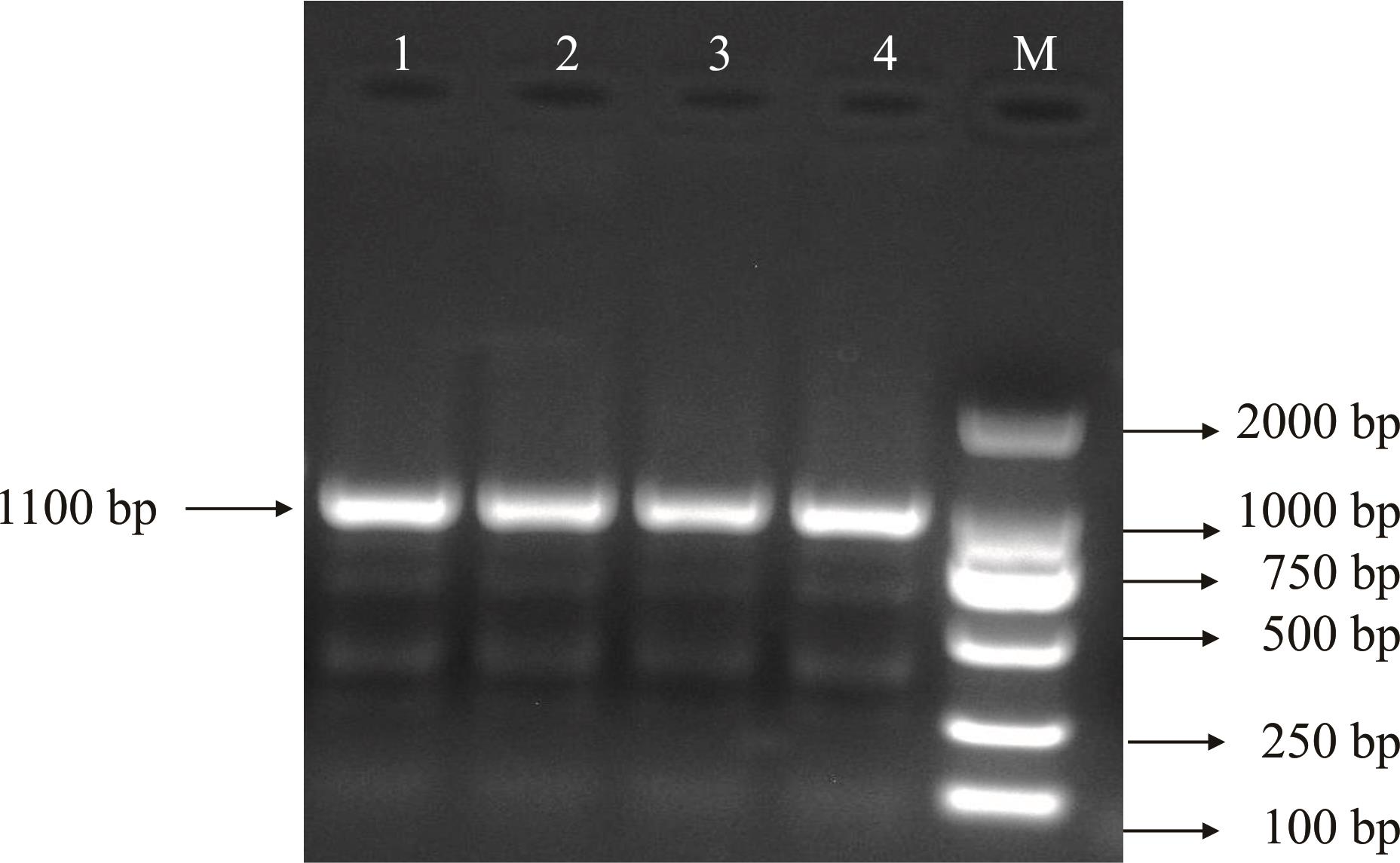
图1 MsMYB86基因扩增电泳结果M为DL 2000 DNA分子量标准,泳道1~4为紫花苜蓿MsMYB86基因克隆。M is DL 2000 DNA maker and lane 1 to 4 are the alfalfa MsMYB86 gene clones.
Fig.1 Electrophoresis results of MsMYB86 gene amplification

图2 紫花苜蓿MsMYB86 CDS全长及编码氨基酸序列
Fig.2 Alfalfa MsMYB86 CDS full length and coding amino acid sequence

图3 紫花苜蓿MsMYB86蛋白结构域位置预测(A)、MsMYB86蛋白磷酸化位点(B)、MsMYB86蛋白亲水性/疏水性(C)、MsMYB86蛋白糖基化位点(D)SANT区域(SWI3, ADA2, N-CoR, TFIIIB)是MYB家族蛋白的特征性DNA结构域。The SANT regions (SWI3, ADA2, N-CoR, TFIIIB) are characteristic DNA structural domains of MYB family proteins.
Fig.3 Prediction of structural domain positions of alfalfa MsMYB86 protein (A), MsMYB86 protein phosphorylation site (B), MsMYB86 protein hydrophilicity/hydrophobicity (C), MsMYB86 protein glycosylation site (D)
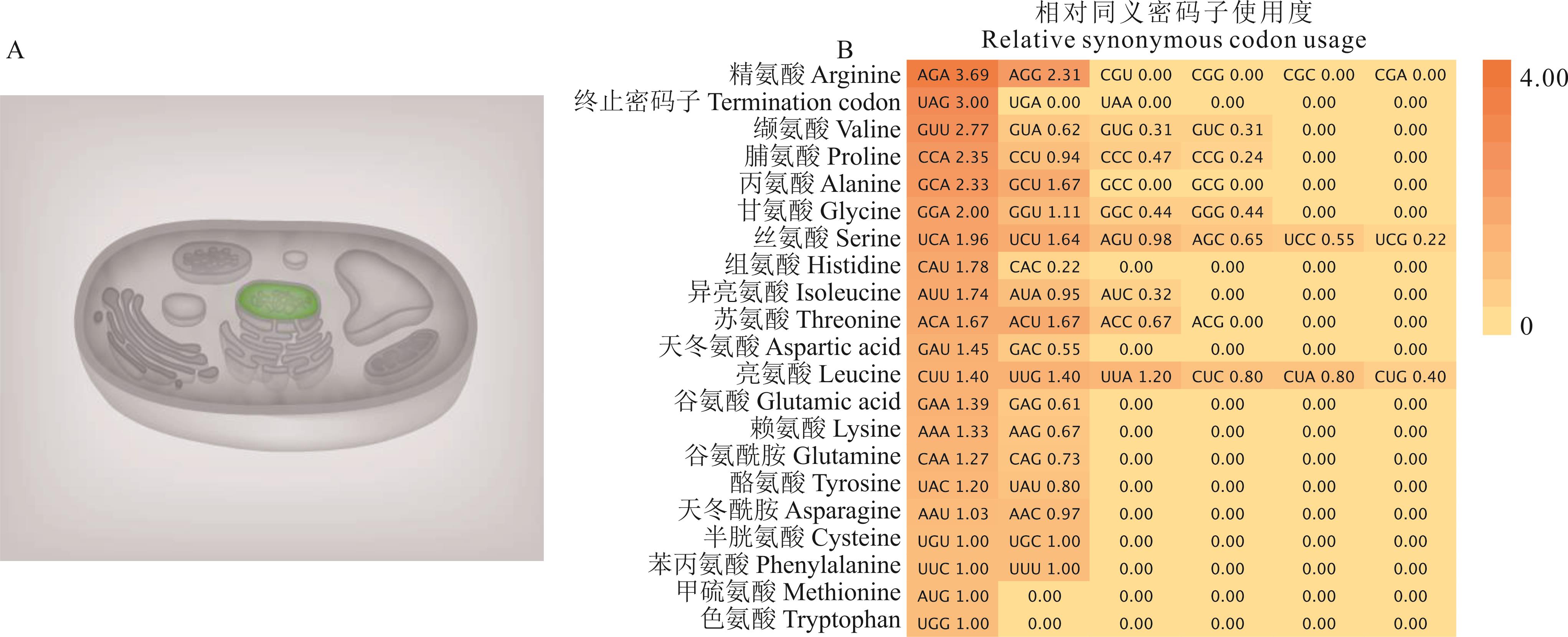
图4 亚细胞定位预测(A)和密码子偏好性分析(B)A为亚细胞定位预测细胞内定位示意图,预测定位结果(真核生物域):细胞核(GOID:GO:0005634),预测置信度为47%。A shows a schematic diagram of subcellular localisation predicting intracellular localisation with predicted localisation result (eukaryotic domain): nucleus (GOID: GO:0005634) with a predicted confidence of 47%.
Fig.4 Subcellular localisation prediction (A) and codon preference analysis (B)

图5 不同物种MsMYB86蛋白的同源序列对比Ms: 紫花苜蓿中苜1号M. sativa Zhongmu No.1; Msa: 紫花苜蓿中苜4号M. sativa Zhongmu No.4; At: 拟南芥A. thaliana; Mt: 蒺藜苜蓿M. truncatula; Gm: 大豆G. max; La: 狭叶羽扇豆L. angustifolius; Pp: 桃树P. persica; Pm: 梅树P. mume; Tc: 可可树T. cacao; Zj: 枣树Z. jujuba; Si: 芝麻S. indicum; Hl: 啤酒花H. lupulus; Cs: 大麻C. sativa; Ca: 榛子C. avellana; Os: 水稻O. sativa; Nt: 烟草N. tabacum; Ns: 林烟草N. sylvestris; Na: 渐狭叶烟草N. attenuata. 下同The same below. 红色方框标注为不同物种氨基酸序列高度保守区。Highly conserved regions of amino acid sequences of different species of MYB86 are marked by red boxes.
Fig.5 Homologous sequence comparison of MsMYB86 protein in different species

图6 不同物种MYB86氨基酸序列系统进化树
Fig.6 Phylogenetic tree of MYB86 amino acid sequences of different species
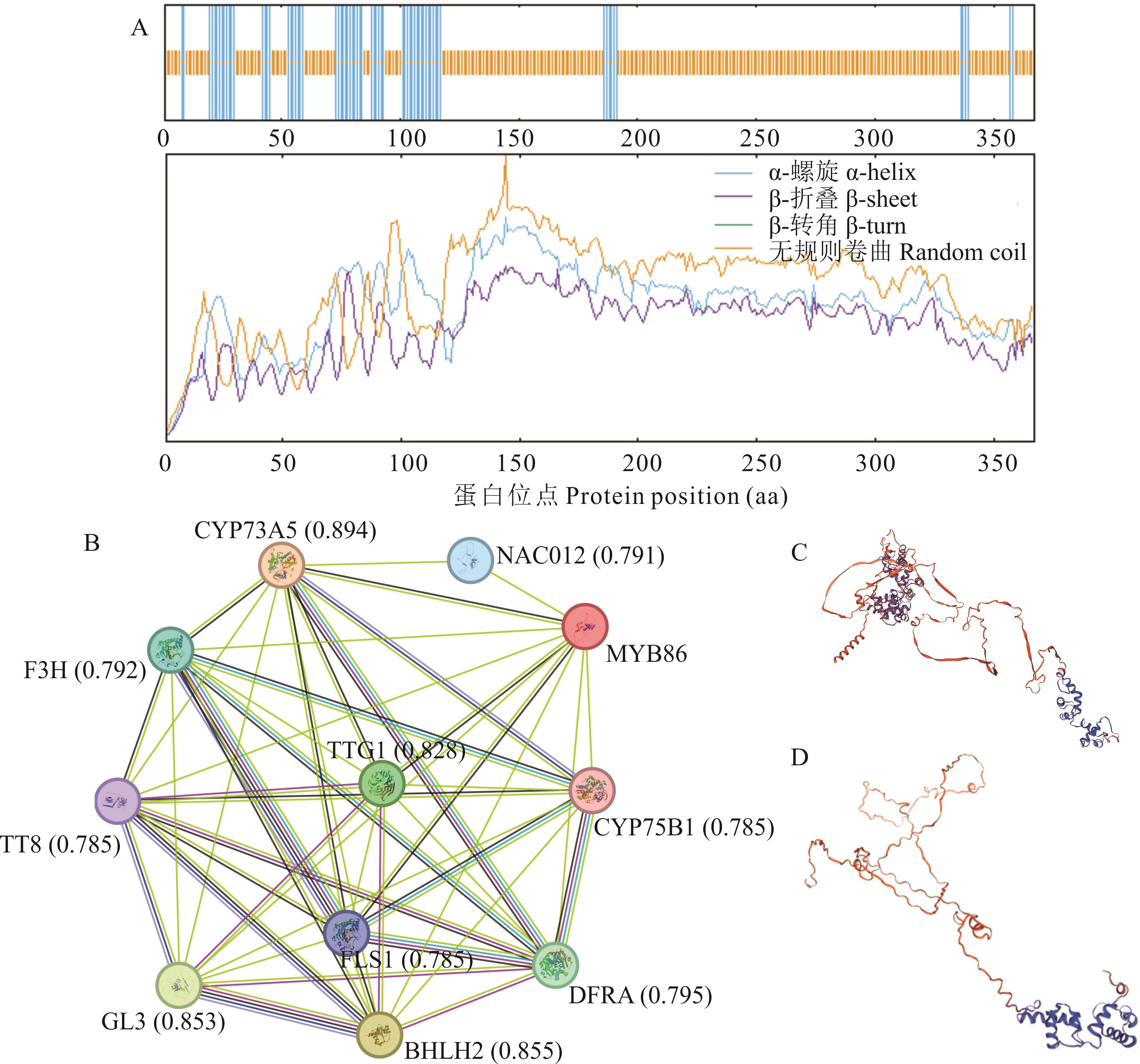
图7 紫花苜蓿MsMYB86氨基酸二级结构预测(A),蛋白互作网络分析(B),紫花苜蓿MsMYB86蛋白三级结构(C)以及大豆MYB/HD-like 转录因子蛋白三级结构(D)
Fig.7 Prediction of amino acid secondary structure of alfalfa MsMYB86 (A), protein interaction network analysis (B), tertiary structure of alfalfa MsMYB86 protein (C) and tertiary structure of soybean MYB/HD-like transcription factor protein(D)
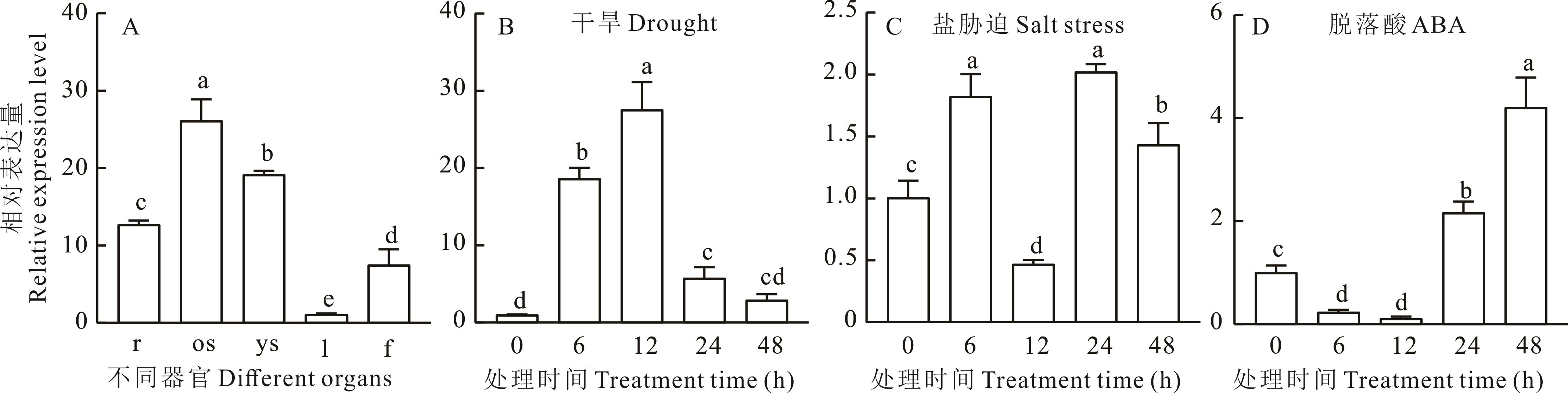
图8 MsMYB86基因植物组织特异性及在非生物胁迫下的表达模式A为MsMYB86基因植物组织特异性相对表达量,r为根,os为老茎,ys为幼茎,l为叶,f为花;B为模拟干旱胁迫(20% PEG 6000)处理下MsMYB86基因的相对表达量;C为盐胁迫(NaCl, 250 mmoL·L-1)处理下MsMYB86基因的相对表达量;D为脱落酸(ABA, 80 μmoL·L-1)处理下MsMYB86基因的相对表达量。不同小写字母代表在P<0.05水平下差异显著。A is the plant tissue-specific relative expression of MsMYB86 gene, r is root, os is old stem, ys is young stem, l is leaf, f is flower; B is the relative expression of MsMYB86 gene under simulated drought stress (20% PEG 6000) treatment; C is the relative expression of MsMYB86 gene under salt stress (NaCl, 250 mmoL·L-1) treatment; D is the relative expression of MsMYB86 gene under abscisic acid (ABA, 80 μmoL·L-1) treatment. Different lowercase letters represent significant differences at 0.05 level.
Fig.8 Plant organs specificity and expression pattern of MsMYB86 gene under abiotic stresses
| [1] | Pabo C O, Sauer R T. Transcription factors: structural families and principles of DNA recognition. Annual Review of Biochemistry, 1992, 61(1): 1053-1095. |
| [2] | Xu W J, Huang Y H, Han R R, et al. Systematic analysis of MYB transcription factors related to the geniposide biosynthesis in Gardenia jasminoides Ellis based on whole genome. Acta Pharmaceutica Sinica, 2023, 58(8): 2522-2531. |
| 许文杰, 黄远浩, 韩蓉蓉, 等. 基于全基因组的栀子苷生物合成相关MYB转录因子系统分析. 药学学报, 2023, 58(8): 2522-2531. | |
| [3] | Abe H, Urao T, Ito T, et al. Arabidopsis AtMYC2 (bHLH) and AtMYB2 (MYB) function as transcriptional activators in abscisic acid signaling. The Plant Cell, 2003, 15(1): 63-78. |
| [4] | Lv K, Wei H, Liu G F. A R2R3-MYB transcription factor gene, BpMYB123, regulates BpLEA14 to improve drought tolerance in Betula platyphylla. Frontiers in Plant Science, 2021, 22(12): 1-9. |
| [5] | Chen N, Zhan W W, Shao Q, et al. Cloning, expression, and functional analysis of the MYB transcription factor SlMYB86-like in tomato. Plants, 2024, 13(4): 488. |
| [6] | Jiang S H, Sun Q G, Zhang T L, et al. MdMYB114 regulates anthocyanin biosynthesis and functions downstream of MdbZIP4-like in apple fruit. Journal of Plant Physiology, 2021, 257(12): 153353. |
| [7] | Zhang Y, Hu Y F, Wang S M, et al. Bioinformatic analysis of MYB tanscription factors involved in catechins biosynthesis in tea plant (Camellia sinensis). Journal of Tea Science, 2018, 38(2): 162-173. |
| 张玥, 胡雲飞, 王树茂, 等. 茶树儿茶素合成相关MYB转录因子生物信息学分析. 茶叶科学, 2018, 38(2): 162-173. | |
| [8] | Chen C J, Bao M F, Wang W H, et al. Current situation and prospects for drought-resistance breeding in Medicago sativa. Acta Prataculturae Sinica, 2025, 34(3): 204-223. |
| 陈彩锦, 包明芳, 王文虎, 等. 紫花苜蓿抗旱育种研究现状及展望. 草业学报, 2025, 34(3): 204-223. | |
| [9] | Shen C, Du H, Chen Z, et al. The chromosome-level genome sequence of the autotetraploid alfalfa and resequencing of core germplasms provide genomic resources for alfalfa research. The Molecular Plant, 2020, 13(9): 1250-1261. |
| [10] | Cen H F, Huang J Q, Shen W H, et al. Cloning of the MsUGT87A1 gene inalfalfa and analysis of its expression in the response to abiotic stress. Acta Agrestia Sinica, 2023, 31(6): 1682-1692. |
| 岑慧芳, 黄洁琼, 申王晖, 等. 紫花苜蓿MsUGT87A1基因克隆及其对非生物胁迫的响应分析. 草地学报, 2023, 31(6): 1682-1692. | |
| [11] | Livak K J, Schmittgen T D. Analysis of relative gene expression data using real-time quantitative PCR and the 2-∆∆Ct method. Methods, 2001, 25(4): 402-408. |
| [12] | Kumar S M, Babu R P, Rao V K, et al. Organization and classification of cytochrome P450 genes in castor (Ricinus communis L.).Proceedings of the National Academy of Sciences, India Section B: Biological Sciences, 2014, 84(1): 131-143. |
| [13] | Feller A, Machemer K, Braun E L, et al. Evolutionary and comparative analysis of MYB and bHLH plant transcription factors. Plant Journal for Cell & Molecular Biology, 2011, 66(1): 94-116. |
| [14] | Payne C T, Zhang F, Lloyd A M. GL3 encodes a bHLH protein that regulates trichome development in Arabidopsis through interaction with GL1 and TTG1. Genetics, 2000, 156(3): 1349-1362. |
| [15] | Shan T L, Hong Y T, Du L P, et al. Development and characterization of TaMYB86-overexpressing transgenic wheat lines with resistance to common root rot. Acta Agronomica Sinica, 2016, 42(10): 1429-1436. |
| 单天雷, 洪彦涛, 杜丽璞, 等. 抗根腐病的TaMYB86过表达转基因小麦的创制与分子功能鉴定. 作物学报, 2016, 42(10): 1429-1436. | |
| [16] | Li L Z, Li S H, Ge H Y, et al. A light-responsive transcription factor SmMYB35 enhances anthocyanin biosynthesis in eggplant (Solanum melongena L.). Planta, 2021, 255(1): 12. |
| [17] | Chen Z H. Genetic regulatory network of MAPK-MYB86-CAD2 controls the leaf morphogenesis in rice. Beijing: Chinese Academy of Agricultural Sciences, 2022. |
| 陈振华. 控制水稻叶片形态MAPK-MYB86-CAD2遗传调控网络解析. 北京: 中国农业科学院, 2022. | |
| [18] | Zhou P N, Li Y, Pu T Z, et al. Cloning and bioinformatics analysis of the β-1,4-xylosyltransferase IRX9 gene from Dendrobium huoshanense. Chinese Traditional and Herbal Drugs, 2019, 50(5): 1212-1219. |
| 周佩娜, 李阳, 蒲天珍, 等. 霍山石斛β-1,4-木糖基转移酶(IRX9)基因克隆及生物信息学分析. 中草药, 2019, 50(5): 1212-1219. | |
| [19] | Jiang R P, Zhao C H, Li W J, et al. Codon bias of IPI gene in leguminous plants. Acta Agriculturae Zhejiangensis, 2022, 34(6): 1114-1123. |
| 蒋瑞平, 赵辰晖, 李文杰, 等. 豆科植物IPI基因密码子偏好性. 浙江农业学报, 2022, 34(6): 1114-1123. | |
| [20] | Yang G F, Su K L, Zhao Y R, et al. Analysis of codon usage in the chloroplast genome of Medicago truncatula. Acta Prataculturae Sinica, 2015, 24(12): 171-179. |
| 杨国锋, 苏昆龙, 赵怡然, 等. 蒺藜苜蓿叶绿体密码子偏好性分析. 草业学报, 2015, 24(12): 171-179. | |
| [21] | Li P H, Xia E H, Fu J M, et al. Diverse roles of MYB transcription factors in regulating secondary metabolite biosynthesis, shoot development, and stress responses in tea plants (Camellia sinensis). The Plant Journal, 2022(4): 110. |
| [22] | Wang S, Jia X Q, He L, et al. Research progress on the response mechanisms of crops to drought stress and regulatory measures to improve crop drought resistance. Chinese Agricultural Science Bulletin, 2022, 38(29): 31-44. |
| 王硕, 贾潇倩, 何璐, 等. 作物对干旱胁迫的响应机制及提高作物抗旱能力的调控措施研究进展. 中国农学通报, 2022, 38(29): 31-44. | |
| [23] | Li R X, Sun R J, Wang T C, et al. Research progress on identification and evaluation methods, and mechanism of drought resistance in plants. Biotechnology Bulletin, 2017, 33(7): 40-48. |
| 李瑞雪, 孙任洁, 汪泰初, 等. 植物抗旱性鉴定评价方法及抗旱机制研究进展. 生物技术通报, 2017, 33(7): 40-48. |
| [1] | 邹苇鹏, 刘怡, 翟佳兴, 周思懿, 宫祉祎, 岑慧芳, 朱慧森, 许涛. 紫花苜蓿MsNAC053基因克隆及其对非生物胁迫的响应分析[J]. 草业学报, 2025, 34(9): 121-133. |
| [2] | 李文秀, 姚拓, 李昌宁, 贾倩民, 何傲蕾, 周杨. “凹凸棒-有机基质”菌肥载体最佳配比的筛选及对紫花苜蓿的促生效果研究[J]. 草业学报, 2025, 34(8): 88-98. |
| [3] | 蒋学乾, 杨青川, 康俊梅. 紫花苜蓿在干旱胁迫下的产量损失与抗旱性遗传研究进展[J]. 草业学报, 2025, 34(7): 219-234. |
| [4] | 温小月, 赵颖, 王宝强, 王贤, 朱晓林, 王义真, 魏小红. 外源NO调控干旱胁迫下紫花苜蓿AP2/ERFs基因的表达分析[J]. 草业学报, 2025, 34(6): 154-167. |
| [5] | 张英豪, 刘楚波, 周坤, 郭家存, 刘世鹏, 孙娈姿. 果草系统中枣树对不同方位紫花苜蓿和鸭茅生长的影响[J]. 草业学报, 2025, 34(6): 203-212. |
| [6] | 崔灿, 王梦琦, 赵琬璐, 刘新颖, 鉴晶晶, 严俊鑫. 胺鲜酯浸种对NaCl胁迫下紫花苜蓿种子萌发及幼苗生长的影响[J]. 草业学报, 2025, 34(6): 46-58. |
| [7] | 曾燕霞, 陈志龙, 尚继红, 沙晓弟, 吴娟, 陈彩锦. 太空诱变对PEG-6000模拟干旱胁迫下紫花苜蓿材料苗期生长的影响[J]. 草业学报, 2025, 34(6): 59-69. |
| [8] | 魏孔钦, 张盈盈, 回金峰, 马春晖, 张前兵. 菌磷配施对紫花苜蓿根系非结构碳水化合物及碳氮磷化学计量特征的影响[J]. 草业学报, 2025, 34(5): 40-50. |
| [9] | 左志芳, 李永龙, 魏雨佳, 周生辉, 李岩, 杨国锋. 结缕草DREB基因家族的鉴定及非生物胁迫下的表达模式分析[J]. 草业学报, 2025, 34(5): 74-88. |
| [10] | 周昕越, 王丽萍, 蒋庆雪, 马晓冉, 仪登霞, 王学敏. 紫花苜蓿低温诱导蛋白MsLTI65的分离及其对不同逆境的响应[J]. 草业学报, 2025, 34(5): 89-104. |
| [11] | 罗天蓉, 马健芝, 杜明阳, 多杰措, 熊辉岩, 段瑞君. 紫花苜蓿LACS基因家族成员鉴定及表达分析[J]. 草业学报, 2025, 34(4): 124-136. |
| [12] | 冯雅琪, 陈嘉慧, 张静妮, 隋超, 陈基伟, 刘志鹏, 周强, 刘文献. 基于重测序紫花苜蓿高蛋白、高产关联InDel分子标记开发[J]. 草业学报, 2025, 34(4): 137-149. |
| [13] | 董拓轩, 陈训锋, 梅大海, 郭永莎, 魏旭红, 宋秋艳. 纳米铁与铜对苜蓿壳二孢及其引致春季黑茎病的抑制与防治作用[J]. 草业学报, 2025, 34(4): 201-211. |
| [14] | 陈彩锦, 包明芳, 王文虎, 尚继红, 曾燕霞, 沙晓弟, 朱新忠, 王学敏, 刘文辉. 紫花苜蓿抗旱育种研究现状及展望[J]. 草业学报, 2025, 34(3): 204-223. |
| [15] | 胡鹏飞, 叶雨浓, 王通锐, 王晶, 王星, 伏兵哲, 高雪芹. 紫花苜蓿半同胞家系农艺性状的遗传变异分析[J]. 草业学报, 2025, 34(3): 85-96. |
| 阅读次数 | ||||||
|
全文 |
|
|||||
|
摘要 |
|
|||||
