

ISSN 1004-5759 CN 62-1105/S
草业学报 ›› 2026, Vol. 35 ›› Issue (7): 135-150.DOI: 10.11686/cyxb2025280
• 研究论文 • 上一篇
刘昊臻( ), 晁嘉潞, 赵士钦, 王成, 张景鈜, 孙守江()
收稿日期:2025-07-08
修回日期:2025-09-09
出版日期:2026-07-20
发布日期:2026-05-21
通讯作者:
孙守江
作者简介:Corresponding author. E-mail: shoujiangsun@nxu.edu.cn基金资助:
Hao-zhen LIU(), Jia-lu CHAO, Shi-qin ZHAO, Cheng WANG, Jing-hong ZHANG, Shou-jiang SUN()
Received:2025-07-08
Revised:2025-09-09
Online:2026-07-20
Published:2026-05-21
Contact:
Shou-jiang SUN
摘要:
种子生产是支撑农业产业发展的核心环节,优质种子是培育高产、高抗逆性作物的基础。即使在最佳储存条件下,种子老化仍不可避免。活性氧(reactive oxygen species, ROS)造成的氧化应激被认为是导致种子活力下降的关键因素,种子活力取决于ROS产生和抗氧化能力之间的平衡。为了保持种子最佳活力,ROS水平的调节至关重要。Barley B Recombinant-Basic Pentacysteine (BBR净产出能量BPC,BBR-BPC)转录因子家族是一组相对保守的转录因子,在植物形态发生、器官发育和对非生物胁迫的反应中起关键作用。研究发现,BBR-BPC家族成员参与植物中活性氧平衡的调节,推测其可能参与种子活力的调控。然而,目前对该基因家族中哪些成员参与紫花苜蓿种子活力的调控尚不明确。基于此,本研究从‘新疆大叶’紫花苜蓿(Xinjiang Daye)全基因组水平鉴定BBR-BPC家族成员,利用转录组和RT-qPCR分析其在不同活力种子吸胀萌发过程中的表达模式,挖掘潜在参与种子老化调控的BBR-BPC家族成员,并预测与该成员潜在互作的相关蛋白。在紫花苜蓿中共鉴定到16个MsBBR-BPC基因家族成员;系统发育分析表明,MsBBR-BPC基因家族共分为8个基因亚族,不均匀地定位在13条染色体上;共线性分析表明,片段重复是该基因家族在进化过程中扩张的关键驱动力。基因表达模式分析发现,MsBBR-BPC10、MsBBR-BPC13和MsBBR-BPC16基因在种子老化24 d后显示高表达水平,在老化8 d,吸胀至12和24 h时也显示出高表达水平,推测其可能参与种子活力的调控。STRING数据库蛋白预测网络分析表明,MsBBR-BPC16与MsBBR-BPC11存在较强的互作关系。此外,MsBBR-BPC16与AGL11、PAT21、ZHD3和GPL3蛋白也存在一定的潜在互作关系。本研究挖掘到3个(MsBBR-BPC10、MsBBR-BPC13和MsBBR-BPC16)响应种子老化胁迫、潜在参与种子活力调控的MsBBR-BPC基因,还需进一步的研究来阐明其调控种子活力的确切途径,蛋白之间的互作关系也同样需要进一步验证。本研究为BBR-BPC基因调控紫花苜蓿种子老化、揭示ROS平衡与种子活力维持的分子调控系统提供了参考,也为后续蛋白功能验证提供了研究基础,并可用于紫花苜蓿种子活力的遗传改良。
刘昊臻, 晁嘉潞, 赵士钦, 王成, 张景鈜, 孙守江. 紫花苜蓿BBR-BPC全基因组鉴定及响应种子老化的表达模式分析[J]. 草业学报, 2026, 35(7): 135-150.
Hao-zhen LIU, Jia-lu CHAO, Shi-qin ZHAO, Cheng WANG, Jing-hong ZHANG, Shou-jiang SUN. Genome-wide identification of BBR-BPC genes in Medicago sativa and their transcript profiles in response to seed aging[J]. Acta Prataculturae Sinica, 2026, 35(7): 135-150.
编号 No. | 基因名称 Gene name | 引物序列 Primer sequence (5′-3′) | 产物大小 Product size (bp) | 解链温度值 Melting temperature value (℃) |
|---|---|---|---|---|
| 1 | MsBBR-BPC1 | F: GATGATGATGTGCTGAATATGC R: AACACTGCTATCATCCTTCG | 480 | 51.9 51.0 |
| 2 | MsBBR-BPC2 | F: TGGATGATGATGTGCTGAAT R: CTTGTTGGTGCCATGTCTA | 824 | 50.4 50.5 |
| 3 | MsBBR-BPC3 | F: GGAAGGCACAAAGCAGAT R: CCAATGGTCTTTAAGGTCAAC | 963 | 50.3 50.7 |
| 4 | MsBBR-BPC4 | F: TGGATGATGATGTGCTGAAT R: CTTGTTGGTGCCATGTCTA | 824 | 50.4 50.5 |
| 5 | MsBBR-BPC5 | F: TGGATGATGATGTGCTGAAT R: CTTGTTGGTGCCATGTCTA | 824 | 50.4 50.5 |
| 6 | MsBBR-BPC6 | F: GGAAGGCACAAAGCAGAT R: CCAATGGTCTTTAAGGTCAAC | 963 | 50.3 50.7 |
| 7 | MsBBR-BPC7 | F: TGGATGATGATGTGCTGAAT R: CTTGTTGGTGCCATGTCTA | 824 | 50.4 50.5 |
| 8 | MsBBR-BPC8 | F: GGAAGGCACAAAGCAGAT R: CCAATGGTCTTTAAGGTCAAC | 963 | 50.3 50.7 |
| 9 | MsBBR-BPC9 | F: GGATGGAGATAATGGACTTAAC R: AACTTGTTGGTGCCATGT | 852 | 49.9 49.9 |
| 10 | MsBBR-BPC10 | F: GGATGGAGATAATGGACTTAAC R: AACTTGTTGGTGCCATGT | 852 | 49.9 49.9 |
| 11 | MsBBR-BPC11 | F: AACGGTAGGCATAAGATGG R: TTGGTAGGTGTCTGTGATG | 557 | 49.7 49.5 |
| 12 | MsBBR-BPC12 | F: ACGATGACCGCCAATATG R: AACGATTTGTTCCATGTCTG | 918 | 50.0 50.1 |
| 13 | MsBBR-BPC13 | F: ACGATGACCGCCAATATG R: AACGATTTGTTCCATGTCTG | 918 | 50.0 50.1 |
| 14 | MsBBR-BPC14 | F: TGGATGATGATGTGCTGAAT R: CTTGTTGGTGCCATGTCTA | 824 | 50.4 50.5 |
| 15 | MsBBR-BPC15 | F: CATCAAGTAATTCCTTCTCTCG R: TTGTTGGTGCCATGTCTAG | 859 | 50.6 50.5 |
| 16 | MsBBR-BPC16 | F: GGATGGAGATAATGGACTTAAC R: AACTTGTTGGTGCCATGT | 852 | 49.9 49.9 |
| 17 | MsACTIN | F: CAAAAGATGGCAGATGCTGAGGAT R: CATGACACCAGTATGACGAGGTCG | 88 | 59.4 59.5 |
表1 qRT-PCR分析引物信息
Table 1 Primers for qRT-PCR analysis
编号 No. | 基因名称 Gene name | 引物序列 Primer sequence (5′-3′) | 产物大小 Product size (bp) | 解链温度值 Melting temperature value (℃) |
|---|---|---|---|---|
| 1 | MsBBR-BPC1 | F: GATGATGATGTGCTGAATATGC R: AACACTGCTATCATCCTTCG | 480 | 51.9 51.0 |
| 2 | MsBBR-BPC2 | F: TGGATGATGATGTGCTGAAT R: CTTGTTGGTGCCATGTCTA | 824 | 50.4 50.5 |
| 3 | MsBBR-BPC3 | F: GGAAGGCACAAAGCAGAT R: CCAATGGTCTTTAAGGTCAAC | 963 | 50.3 50.7 |
| 4 | MsBBR-BPC4 | F: TGGATGATGATGTGCTGAAT R: CTTGTTGGTGCCATGTCTA | 824 | 50.4 50.5 |
| 5 | MsBBR-BPC5 | F: TGGATGATGATGTGCTGAAT R: CTTGTTGGTGCCATGTCTA | 824 | 50.4 50.5 |
| 6 | MsBBR-BPC6 | F: GGAAGGCACAAAGCAGAT R: CCAATGGTCTTTAAGGTCAAC | 963 | 50.3 50.7 |
| 7 | MsBBR-BPC7 | F: TGGATGATGATGTGCTGAAT R: CTTGTTGGTGCCATGTCTA | 824 | 50.4 50.5 |
| 8 | MsBBR-BPC8 | F: GGAAGGCACAAAGCAGAT R: CCAATGGTCTTTAAGGTCAAC | 963 | 50.3 50.7 |
| 9 | MsBBR-BPC9 | F: GGATGGAGATAATGGACTTAAC R: AACTTGTTGGTGCCATGT | 852 | 49.9 49.9 |
| 10 | MsBBR-BPC10 | F: GGATGGAGATAATGGACTTAAC R: AACTTGTTGGTGCCATGT | 852 | 49.9 49.9 |
| 11 | MsBBR-BPC11 | F: AACGGTAGGCATAAGATGG R: TTGGTAGGTGTCTGTGATG | 557 | 49.7 49.5 |
| 12 | MsBBR-BPC12 | F: ACGATGACCGCCAATATG R: AACGATTTGTTCCATGTCTG | 918 | 50.0 50.1 |
| 13 | MsBBR-BPC13 | F: ACGATGACCGCCAATATG R: AACGATTTGTTCCATGTCTG | 918 | 50.0 50.1 |
| 14 | MsBBR-BPC14 | F: TGGATGATGATGTGCTGAAT R: CTTGTTGGTGCCATGTCTA | 824 | 50.4 50.5 |
| 15 | MsBBR-BPC15 | F: CATCAAGTAATTCCTTCTCTCG R: TTGTTGGTGCCATGTCTAG | 859 | 50.6 50.5 |
| 16 | MsBBR-BPC16 | F: GGATGGAGATAATGGACTTAAC R: AACTTGTTGGTGCCATGT | 852 | 49.9 49.9 |
| 17 | MsACTIN | F: CAAAAGATGGCAGATGCTGAGGAT R: CATGACACCAGTATGACGAGGTCG | 88 | 59.4 59.5 |
基因 Gene | 基因ID号 Gene ID | 等电点 Isoelectric point | 分子质量 Molecular weight (Da) | 氨基酸数目Amino acids numbers | 亚细胞定位 Subcellular localization | 不稳定系数Instability index | 染色体定位 Chromosomal localization |
|---|---|---|---|---|---|---|---|
| MsBBR-BPC1 | MS. gene36731 | 6.61 | 19788.53 | 176 | 细胞核Nucleus | 44.19 | 染色体8.2 Chr8.2 |
| MsBBR-BPC2 | MS. gene023254 | 9.66 | 30878.44 | 280 | 细胞核Nucleus | 42.74 | 染色体4.3 Chr4.3 |
| MsBBR-BPC3 | MS. gene63981 | 9.26 | 37781.66 | 339 | 细胞核Nucleus | 55.67 | 染色体1.4 Chr1.4 |
| MsBBR-BPC4 | MS. gene08364 | 9.66 | 30861.46 | 280 | 细胞核Nucleus | 45.33 | 染色体4.1 Chr4.1 |
| MsBBR-BPC5 | MS. gene34978 | 9.66 | 30888.48 | 280 | 细胞核Nucleus | 43.36 | 染色体4.4 Chr4.4 |
| MsBBR-BPC6 | MS. gene24195 | 9.26 | 37779.68 | 339 | 细胞核Nucleus | 55.36 | 染色体1.1 Chr1.1 |
| MsBBR-BPC7 | MS. gene31269 | 9.62 | 30866.43 | 280 | 细胞核Nucleus | 44.85 | 染色体2.4 Chr2.4 |
| MsBBR-BPC8 | MS. gene64186 | 9.26 | 37765.66 | 339 | 细胞核Nucleus | 55.11 | 染色体1.3Chr1.3 |
| MsBBR-BPC9 | MS. gene041646 | 9.68 | 32142.97 | 289 | 细胞核Nucleus | 53.71 | 染色体6.3 Chr6.3 |
| MsBBR-BPC10 | MS. gene27413 | 9.68 | 32124.93 | 289 | 细胞核Nucleus | 53.97 | 染色体6.2 Chr6.2 |
| MsBBR-BPC11 | MS. gene030483 | 6.71 | 22261.95 | 195 | 细胞核Nucleus | 43.49 | 染色体4.2 Chr4.2 |
| MsBBR-BPC12 | MS. gene79458 | 9.36 | 35360.99 | 312 | 细胞核Nucleus | 52.11 | 染色体4.1 Chr4.1 |
| MsBBR-BPC13 | MS. gene030481 | 9.36 | 35373.04 | 312 | 细胞核Nucleus | 51.83 | 染色体4.2 Chr4.2 |
| MsBBR-BPC14 | MS. gene028203 | 9.58 | 30908.43 | 280 | 细胞核Nucleus | 46.14 | 染色体4.2 Chr4.2 |
| MsBBR-BPC15 | MS. gene028699 | 9.60 | 32650.41 | 295 | 细胞核Nucleus | 45.92 | 染色体2.1 Chr2.1 |
| MsBBR-BPC16 | MS. gene000299 | 9.63 | 31986.78 | 288 | 细胞核Nucleus | 53.86 | 染色体6.4 Chr6.4 |
表2 MsBBR-BPC基因编码蛋白理化性质分析
Table 2 Physicochemical characterization of protein encoded by the MsBBR-BPC gene
基因 Gene | 基因ID号 Gene ID | 等电点 Isoelectric point | 分子质量 Molecular weight (Da) | 氨基酸数目Amino acids numbers | 亚细胞定位 Subcellular localization | 不稳定系数Instability index | 染色体定位 Chromosomal localization |
|---|---|---|---|---|---|---|---|
| MsBBR-BPC1 | MS. gene36731 | 6.61 | 19788.53 | 176 | 细胞核Nucleus | 44.19 | 染色体8.2 Chr8.2 |
| MsBBR-BPC2 | MS. gene023254 | 9.66 | 30878.44 | 280 | 细胞核Nucleus | 42.74 | 染色体4.3 Chr4.3 |
| MsBBR-BPC3 | MS. gene63981 | 9.26 | 37781.66 | 339 | 细胞核Nucleus | 55.67 | 染色体1.4 Chr1.4 |
| MsBBR-BPC4 | MS. gene08364 | 9.66 | 30861.46 | 280 | 细胞核Nucleus | 45.33 | 染色体4.1 Chr4.1 |
| MsBBR-BPC5 | MS. gene34978 | 9.66 | 30888.48 | 280 | 细胞核Nucleus | 43.36 | 染色体4.4 Chr4.4 |
| MsBBR-BPC6 | MS. gene24195 | 9.26 | 37779.68 | 339 | 细胞核Nucleus | 55.36 | 染色体1.1 Chr1.1 |
| MsBBR-BPC7 | MS. gene31269 | 9.62 | 30866.43 | 280 | 细胞核Nucleus | 44.85 | 染色体2.4 Chr2.4 |
| MsBBR-BPC8 | MS. gene64186 | 9.26 | 37765.66 | 339 | 细胞核Nucleus | 55.11 | 染色体1.3Chr1.3 |
| MsBBR-BPC9 | MS. gene041646 | 9.68 | 32142.97 | 289 | 细胞核Nucleus | 53.71 | 染色体6.3 Chr6.3 |
| MsBBR-BPC10 | MS. gene27413 | 9.68 | 32124.93 | 289 | 细胞核Nucleus | 53.97 | 染色体6.2 Chr6.2 |
| MsBBR-BPC11 | MS. gene030483 | 6.71 | 22261.95 | 195 | 细胞核Nucleus | 43.49 | 染色体4.2 Chr4.2 |
| MsBBR-BPC12 | MS. gene79458 | 9.36 | 35360.99 | 312 | 细胞核Nucleus | 52.11 | 染色体4.1 Chr4.1 |
| MsBBR-BPC13 | MS. gene030481 | 9.36 | 35373.04 | 312 | 细胞核Nucleus | 51.83 | 染色体4.2 Chr4.2 |
| MsBBR-BPC14 | MS. gene028203 | 9.58 | 30908.43 | 280 | 细胞核Nucleus | 46.14 | 染色体4.2 Chr4.2 |
| MsBBR-BPC15 | MS. gene028699 | 9.60 | 32650.41 | 295 | 细胞核Nucleus | 45.92 | 染色体2.1 Chr2.1 |
| MsBBR-BPC16 | MS. gene000299 | 9.63 | 31986.78 | 288 | 细胞核Nucleus | 53.86 | 染色体6.4 Chr6.4 |

图1 MsBBR-BPC基因家族成员的染色体定位左侧的刻度表示染色体长度,染色体的颜色强度表示基因密度。The scale on the left represents chromosome length, and the color intensity of the chromosome represents gene density.
Fig.1 Chromosomal location of MsBBR-BPC gene family members
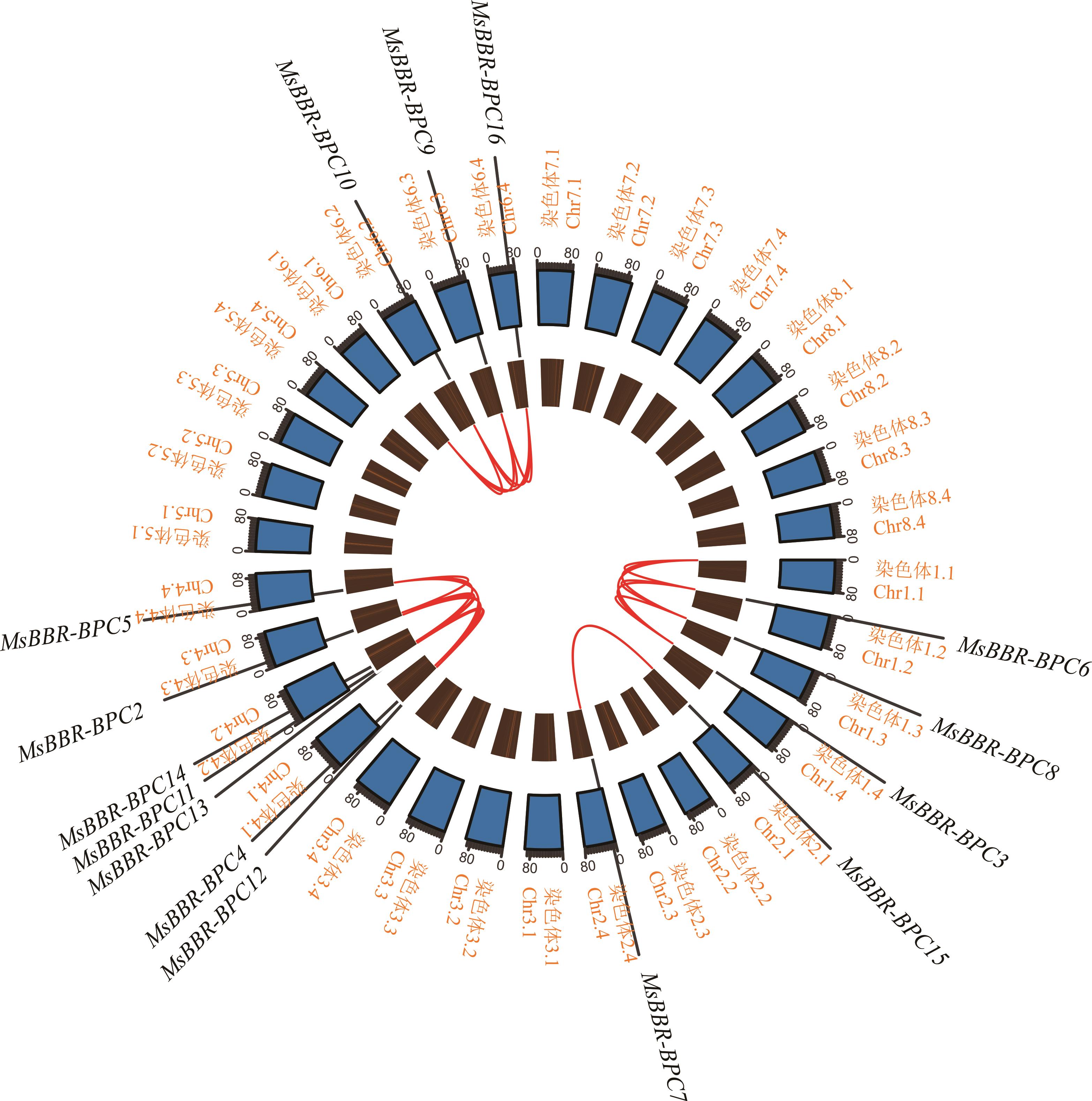
图2 MsBBR-BPC基因在紫花苜蓿内的共线性分析片段重复的基因用红线连接。Segmentally duplicated genes are connected by red lines.
Fig.2 Analysis of collinearity of MsBBR-BPC genes in alfalfa

图3 紫花苜蓿与多个物种间MsBBR-BPC基因的共线性分析数字代表不同染色体。The numbers represent different chromosomes.
Fig.3 Analysis of collinearity of MsBBR-BPC genes between alfalfa and multiple species
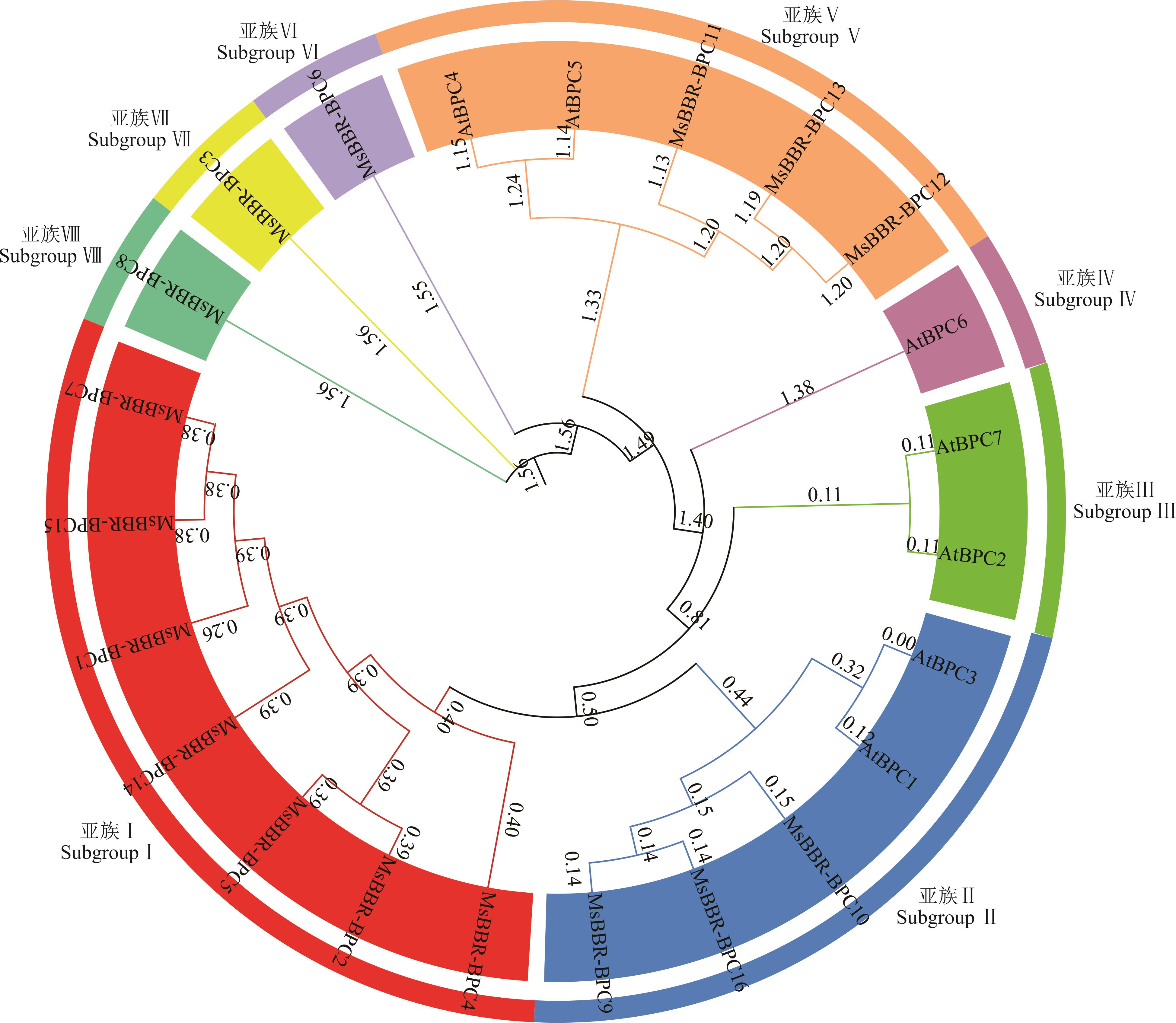
图4 MsBBR-BPC基因家族的系统发育树
Fig.4 Phylogenetic tree of the MsBBR-BPC gene family
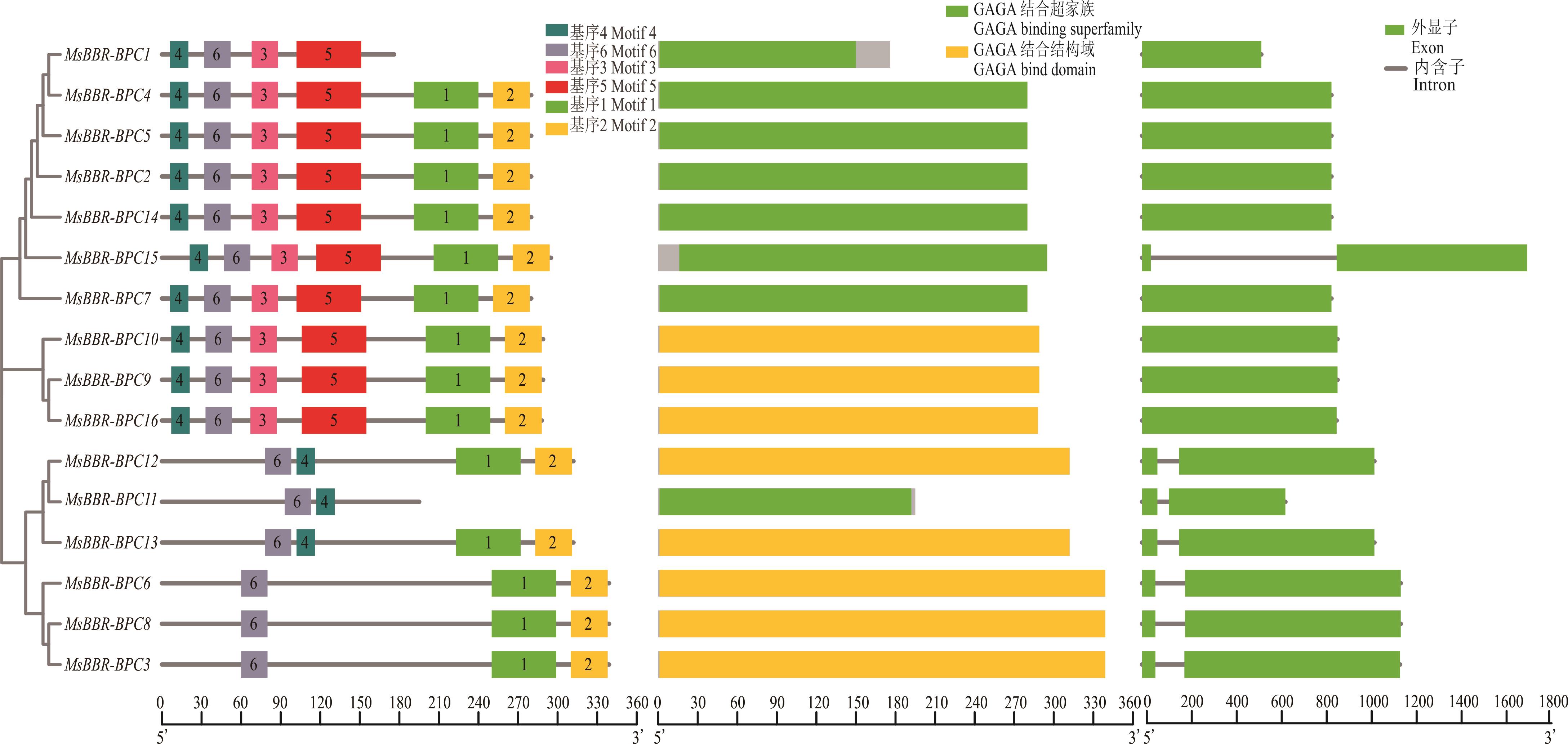
图5 MsBBR-BPC基因家族的保守基序和基因结构分析
Fig.5 Analysis of conserved motifs and gene structure of MsBBR-BPC gene family
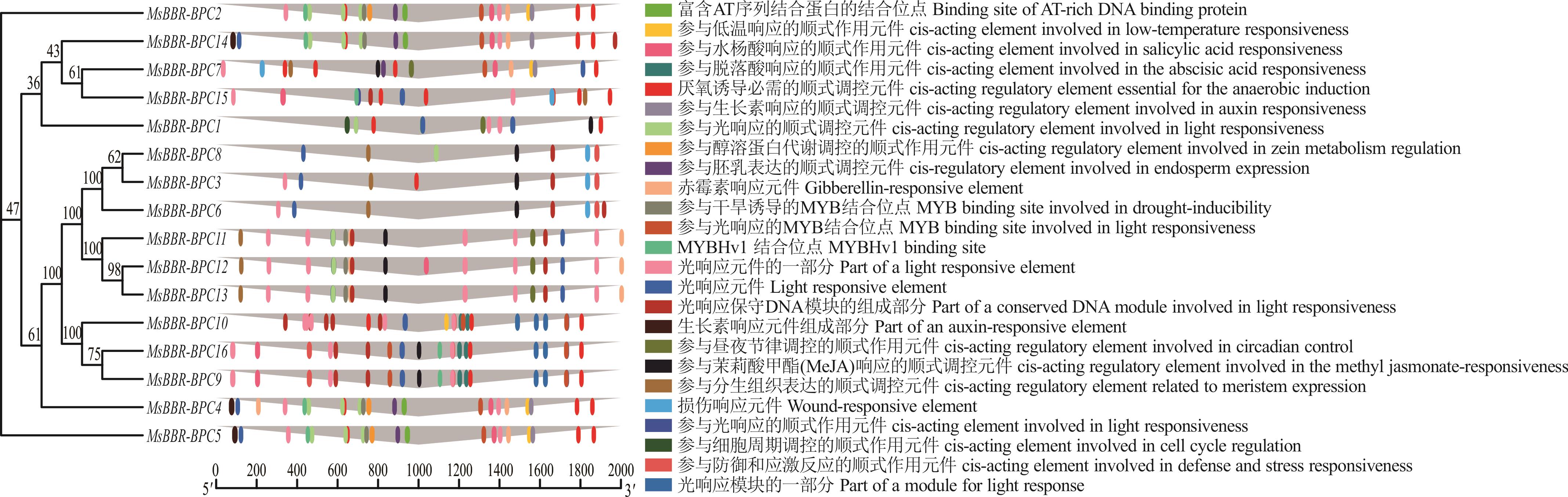
图6 MsBBR-BPC基因顺式作用元件的分布
Fig.6 Distribution of cis-acting elements in MsBBR-BPC gene
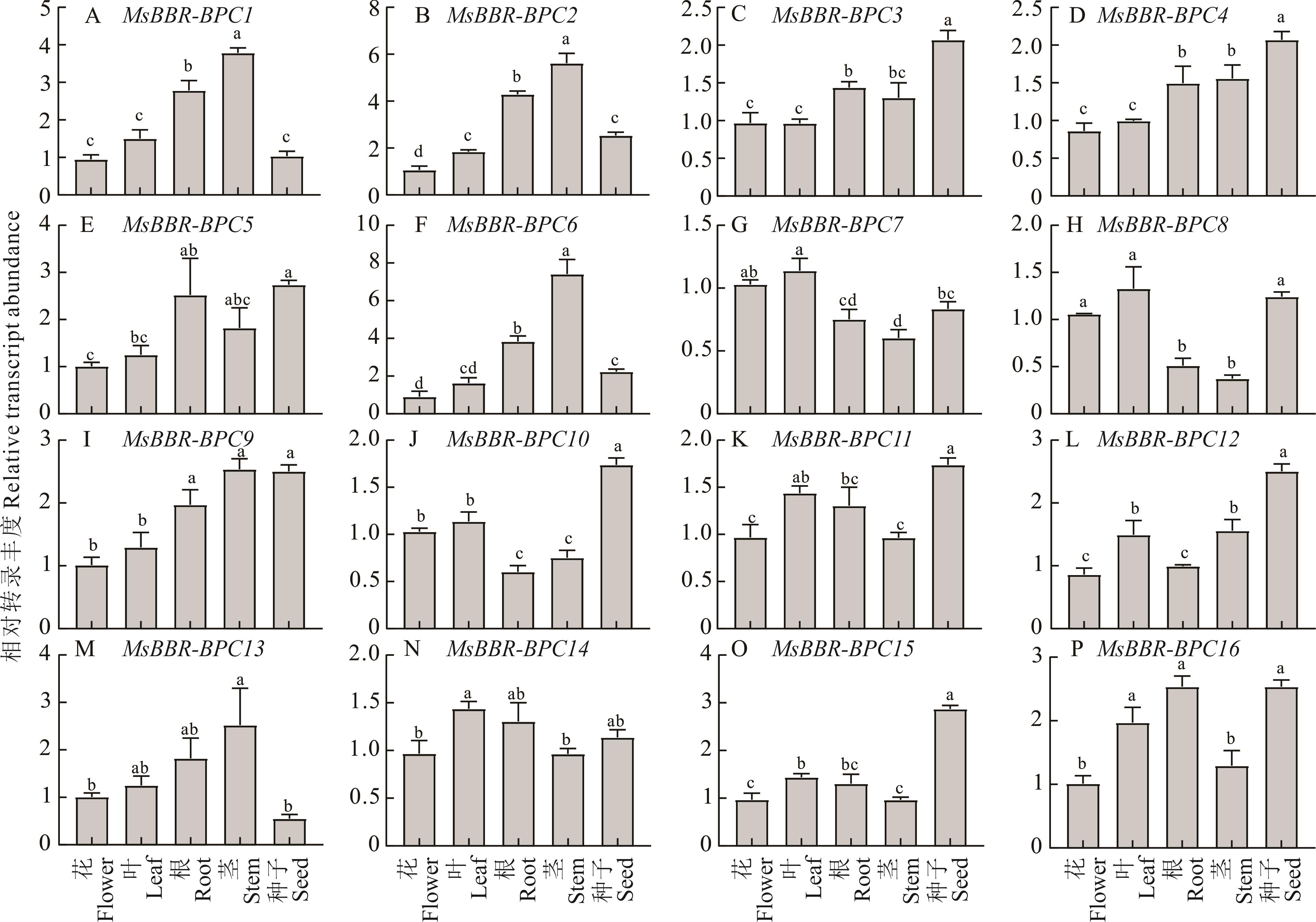
图7 MsBBR-BPC基因在紫花苜蓿不同组织的表达分析不同小写字母表示不同组织的相对转录丰度差异显著(P<0.05)。Different lowercase letters in the figure indicate that the relative transcript abundances of different tissues are significantly different (P<0.05).
Fig.7 Expression analysis of MsBBR-BPC genes in different tissues of alfalfa
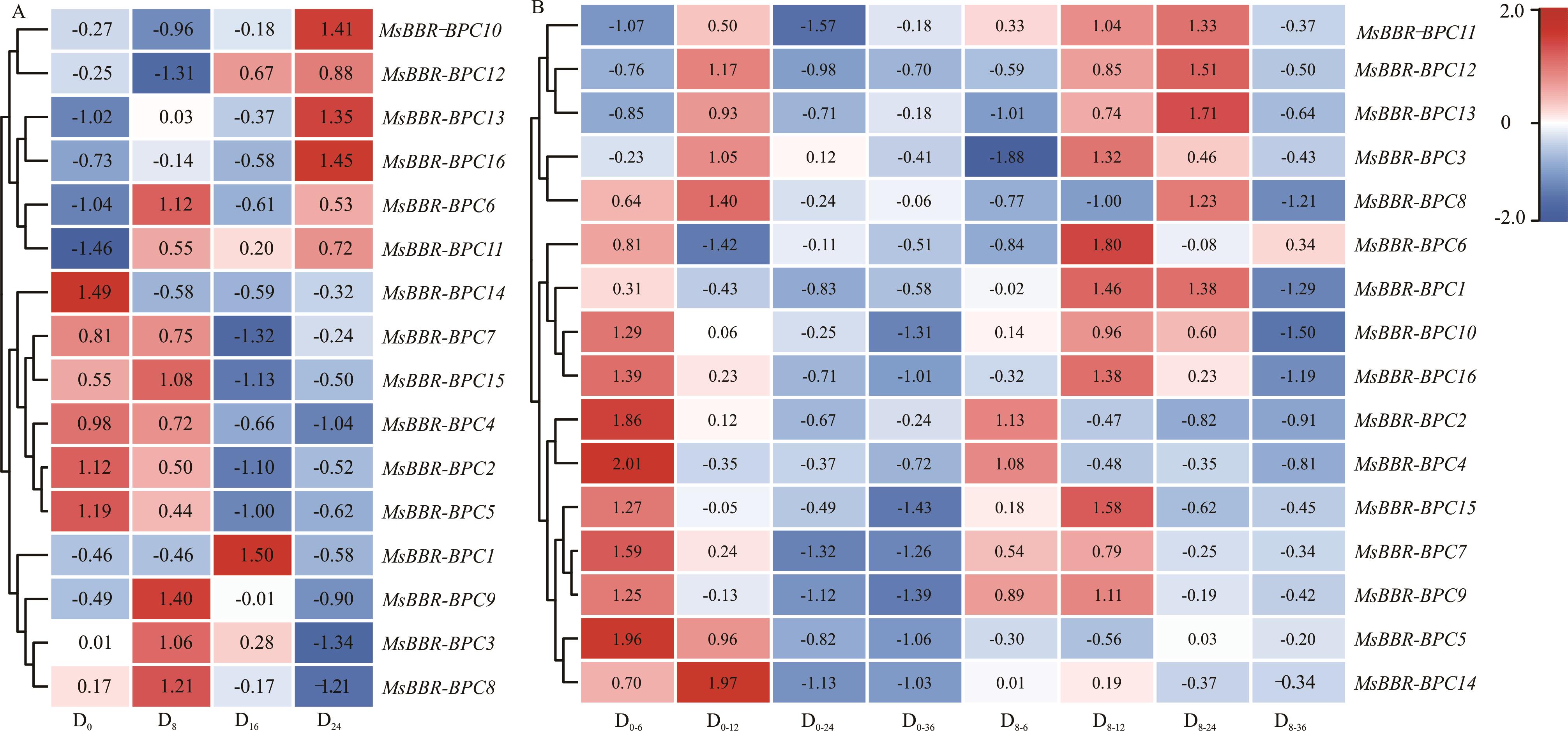
图8 MsBBR-BPC基因在不同活力水平下种子吸胀萌发过程中的表达模式A: MsBBR-BPC基因在不同活力水平D0、D8、D16和D24种子中的表达模式Expression patterns of MsBBR-BPC genes in seeds at different vigor levels at D0, D8, D16, and D24; B: 吸胀6、12、24、36 h的紫花苜蓿种子中16个BBR-BPC基因的表达模式Expression patterns of 16 BBR-BPC genes in alfalfa seeds at 6, 12, 24, and 36 hours of imbibition. 色标表示log10的表达值。红色表示上调表达,蓝色表示下调表达。The color scale indicates the log10 expression value. Red indicates up-regulated expression, and blue indicates down-regulated expression.
Fig.8 Expression patterns of MsBBR-BPC genes during seed imbibition and germination at different vigor levels
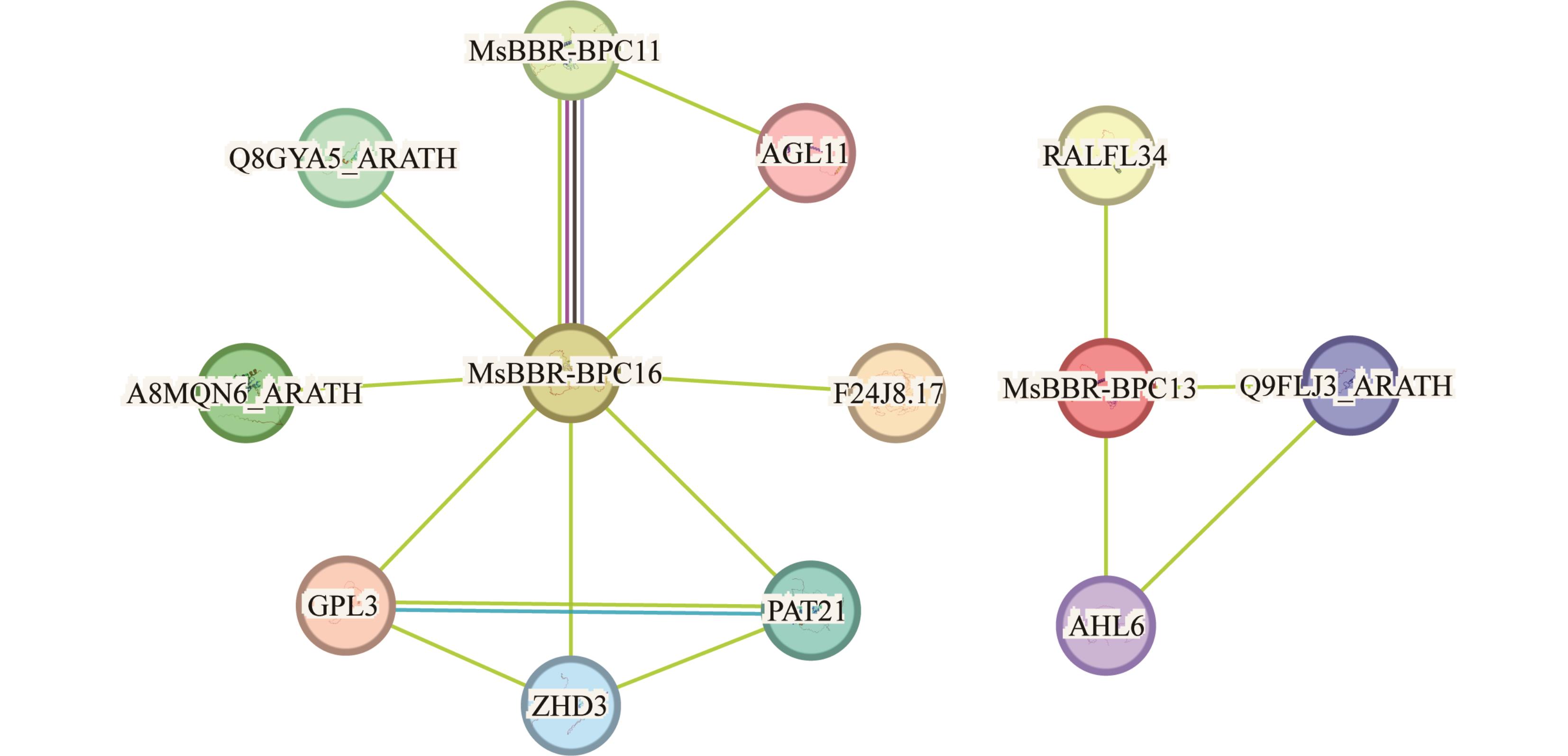
图9 紫花苜蓿中MsBBR-BPC蛋白与拟南芥中相关蛋白的互作网络线条越多代表关联越强。The more lines, the stronger the relationship.
Fig.9 Interaction network between MsBBR-BPC proteins in alfalfa and related proteins in arabidopsis
| [1] | Ge R, Luo Y J, Li Q, et al. Identification of key modules and candidate genes for seed aging resistance of Oryza sativa subsp.indica Kato. Seed, 2024, 43(10): 1-12. |
| 葛蓉, 罗永坚, 李清, 等. 籼稻种子抗老化关键模块及候选基因的鉴定. 种子, 2024, 43(10): 1-12. | |
| [2] | McDonald M B. Seed deterioration: physiology, repair and assessment. Seed Science and Technology, 1999, 27(1): 177-237. |
| [3] | Ebone L A N, Caverzan A, Chavarria G. Physiologic alterations in orthodox seeds due to deterioration processes. Plant Physiology and Biochemistry, 2019, 145: 34-42. |
| [4] | Zhang K L, Zhang Y, Sun J, et al. Deterioration of orthodox seeds during ageing: influencing factors, physiological alterations and the role of reactive oxygen species. Plant Physiology and Biochemistry, 2021, 158: 475-485. |
| [5] | Tan S Y, Cao J, Li S C, et al. Unraveling the mechanistic basis for control of seed longevity. Plants, 2025, 14(5): 805. |
| [6] | Sun S J, Ma W, Jia Z C, et al. Genomic identification and expression profiling of lesion simulating disease genes in alfalfa (Medicago sativa) elucidate their responsiveness to seed vigor. Antioxidants, 2023, 12(9): 1768. |
| [7] | Sangwan I, O'Brian M R. Identification of a soybean protein that interacts with GAGA element dinucleotide repeat DNA. Plant Physiology, 2002, 129(4): 1788-1794. |
| [8] | Santi L, Wang Y M, Stile M R, et al. The GA octodinucleotide repeat binding factor BBR participates in the transcriptional regulation of the homeobox gene Bkn3. The Plant Journal, 2003, 34(6): 813-826. |
| [9] | Meister R J, Williams L A, Monfared M M, et al. Definition and interactions of a positive regulatory element of the Arabidopsis INNER NOOUTER promoter. The Plant Journal, 2004, 37(3): 426-438. |
| [10] | Lee Y, Tsai P, Huang X, et al. Family members additively repress the ectopic expression of BASIC PENTACYSTEINE3 to prevent disorders in Arabidopsis circadian vegetative development. Frontiers in Plant Science, 2022, 13: DOI: 10.3389/fpls.2022.919946. |
| [11] | Sun H, Pang B, Yan J, et al. Comprehensive analysis of cucumber gibberellin oxidase family genes and functional characterization of CsGA20ox1 in root development in Arabidopsis. International Journal of Molecular Sciences, 2018, 19(10): 3135. |
| [12] | Monfared M M, Simon M K, Meister R J, et al. Overlapping and antagonistic activities of BASIC PENTACYSTEINE genes affect a range of developmental processes in Arabidopsis. The Plant Journal, 2011, 66(6): 1020-1031. |
| [13] | Gong R, Cao H, Zhang J, et al. Divergent functions of the GAGA-binding transcription factor family in rice. The Plant Journal, 2018, 94(1): 32-47. |
| [14] | Li S, Miao L, Huang B, et al. Genome-wide identification and characterization of cucumber BPC transcription factors and their responses to abiotic stresses and exogenous phytohormones. International Journal of Molecular Sciences, 2019, 20(20): 5048. |
| [15] | Ma X, Yu Y, Hu Z, et al. Characterizations of a class-i BASIC PENTACYSTEINE gene reveal conserved roles in the transcriptional repression of genes involved in seed development. Current Issues in Molecular Biology, 2022, 44(9): 4059-4069. |
| [16] | Simonini S, Kater M M. Class Ⅰ BASIC PENTACYSTEINE factors regulate HOMEOBOX genes involved in meristem size maintenance. Journal of Experimental Botany, 2014, 65(6): 1455-1465. |
| [17] | Petrella R, Caselli F, Villanova I R, et al. BPC transcription factors and a polycomb group protein confine the expression of the ovule identity gene SEEDSTICK in Arabidopsis. The Plant Journal, 2020, 102(3): 582-599. |
| [18] | Yan J, Liu Y, Yang L, et al. Cell wall β-1,4-galactan regulated by the BPC1/BPC2-GALS1 module aggravates salt sensitivity in Arabidopsis thaliana. Molecular Plant, 2021, 14(3): 411-425. |
| [19] | Zhou X Y, Jiang Q X, Jia H L, et al. Cloning and salt-tolerance functional analysis of alfalfa MsBBX20 gene. Acta Prataculturae Sinica, 2024, 33(10): 55-73. |
| 周昕越, 蒋庆雪, 贾会丽, 等. 紫花苜蓿MsBBX20基因克隆及耐盐功能分析. 草业学报, 2024, 33(10): 55-73. | |
| [20] | Chen C, Wu Y, Li J, et al. TBtools-Ⅱ: a “one for all, all for one” bioinformatics platform for biological big-data mining. Molecular Plant, 2023, 16(11): 1733-1742. |
| [21] | Kumar S, Stecher G, Li M, et al. MEGA x: molecular evolutionary genetics analysis across computing platforms. Molecular Biology and Evolution, 2018, 35(6): 1547-1549. |
| [22] | Zhang Y, Liu H, Ma X, et al. Genome-wide identification and expression analysis of the class Ⅲ peroxidase gene (PRXIII) family in Medicago sativa L. and its function in the abiotic stress response. BMC Plant Biology, 2025, 25(1): 1-15. |
| [23] | Kumar S P J, Prasad S R, Banerjee R, et al. Seed birth to death: dual functions of reactive oxygen species in seed physiology. Annals of Botany, 2015, 116(4): 663-668. |
| [24] | Rajjou L C, Lovigny Y, Groot S P C, et al. Proteome-wide characterization of seed aging in Arabidopsis: a comparison between artificial and natural aging protocols? Plant Physiology, 2008, 148(1): 620-641. |
| [25] | Groot S P C, Surki A A, de Vos R C H, et al. Seed storage at elevated partial pressure of oxygen, a fast method for analysing seed ageing under dry conditions. Annals of Botany, 2012, 110(6): 1149-1159. |
| [26] | Strader L, Weijers D, Wagner D. Plant transcription factors-being in the right place with the right company. Current Opinion in Plant Biology, 2022, 65: 102136. |
| [27] | Zhao D B, Guan P Y, Guo Z H, et al. Genome-wide identification and expression analysis of maize BBR-BPC gene family. Journal of Maize Sciences, 2023, 31(3): 58-66. |
| 赵东波, 管培燕, 郭智慧, 等. 玉米BBR-BPC基因家族全基因组鉴定及表达分析. 玉米科学, 2023, 31(3): 58-66. | |
| [28] | Zhao H Y. Molecular mechanism of apple BBR/BPC transcription tactor MdBPC2 on regulating plant growth. Yangling: Northwest A&F University, 2023. |
| 赵海艳. 苹果BBR/BPC转录因子MdBPC2在调控植株生长中的功能研究. 杨凌: 西北农林科技大学, 2023. | |
| [29] | Lespinet O, Wolf Y I, Koonin E V, et al. The role of lineage-specific gene family expansion in the evolution of Eukaryotes. Genome Research, 2002, 12(7): 1048-1059. |
| [30] | Panchy N, Lehti-Shiu M, Shiu S. Evolution of gene duplication in plants. Plant Physiology, 2016, 171(4): 2294-2316. |
| [31] | Birchler J A, Yang H. The multiple fates of gene duplications: deletion, hypofunctionalization, subfunctionalization, neofunctionalization, dosage balance constraints, and neutral variation. The Plant Cell, 2022, 34(7): 2466-2474. |
| [32] | Wang Z Y, Zhao S, Liu J F, et al. Genome-wide identification of tomato golden 2-like transcription factors and abiotic stress related members screening. BMC Plant Biology, 2022, 22(1): 82. |
| [33] | Wang L, Chen W, Zhao Z, et al. Genome-wide identification, conservation, and expression pattern analyses of the BBR-BPC gene family under abiotic stress in Brassica napus L. Genes, 2024, 16(1): 36. |
| [34] | Rogozin I B, Carmel L, Csuros M, et al. Origin and evolution of spliceosomal introns. Biology Direct, 2012, 7(1): 36. |
| [35] | Wen X Y, Zhao Y, Wang B Q, et al. Expression analysis of AP2/ERFs genes in alfalfa regulated by exogenous NO under drought stress. Acta Prataculturae Sinica, 2025, 34(6): 154-167. |
| 温小月, 赵颖, 王宝强, 等. 外源NO调控干旱胁迫下紫花苜蓿AP2/ERFs基因的表达分析. 草业学报, 2025, 34(6): 154-167. | |
| [36] | Cantalapiedra C P, Hernández-Plaza A, Letunic I, et al. EggNOG-mapper v2: functional annotation, orthology assignments, and domain prediction at the metagenomic scale. Molecular Biology and Evolution, 2021, 38(12): 5825-5829. |
| [37] | Zhang X Y, Zhao L J, Li Y J, et al. Expression of AtPUB18 after salt stress treatment and analysis of its promoter from Arabidopsis thaliana. Acta Botanica Boreali-Occidentalia Sinica, 2014, 34(1): 54-59. |
| 张新宇, 赵兰杰, 李艳军, 等. 盐胁迫对拟南芥AtPUB18基因的诱导表达及其启动子分析. 西北植物学报, 2014, 34(1): 54-59. | |
| [38] | Lee S, Kim S, Kim S. Drought inducible OsDhn1 promoter is activated by OsDREB1a and OsDREB1d. Journal of Plant Biology, 2013, 56(2): 115-121. |
| [1] | 陈奋奇, 张金青, 禹一箭, 李振宇. 紫花苜蓿AP2亚家族基因鉴定、生信分析及MsBBM基因克隆[J]. 草业学报, 2026, 35(7): 117-134. |
| [2] | 任孟雨, 王利群, 南丽丽, 郭佳雨. 紫花苜蓿新品系对盐胁迫的响应[J]. 草业学报, 2026, 35(6): 24-34. |
| [3] | 李小聪, 闫聚辉, 王星, 胡鹏飞, 叶雨浓, 伏兵哲. 紫花苜蓿/无芒雀麦间作对草地生产性能和土壤理化特性的影响[J]. 草业学报, 2026, 35(5): 113-125. |
| [4] | 马苹, 刘志国, 沙煜舒, 刘亚玲, 妥小梅, 伏兵哲, 高雪芹. 紫花苜蓿苗期氮利用特性及氮高效品种的筛选[J]. 草业学报, 2026, 35(4): 112-123. |
| [5] | 张钿, 冷华娟, 崔婧, 何飞, 王雪, 李明娜, 杨青川, 康俊梅. 紫花苜蓿突触结合蛋白家族成员鉴定与非生物胁迫下的表达分析[J]. 草业学报, 2026, 35(4): 158-168. |
| [6] | 张世超, 崔国文, 张德鹏, 韩福迎, 丁叮, 吕向丽, 林硕, 陈乐然, 李吉儒, 才华. 紫花苜蓿非组培遗传转化体系创建及在耐盐基因功能鉴定与基因编辑中的应用[J]. 草业学报, 2026, 35(3): 223-234. |
| [7] | 童玉花, 王晓彤, 马永龙, 杨金辉, 余冬雯, 李淑霞. 壳聚糖浸种对盐碱胁迫下紫花苜蓿种子萌发的影响[J]. 草业学报, 2026, 35(3): 245-256. |
| [8] | 陈丽娟, 高荣, 王建喜, 马晖玲. 紫花苜蓿与红豆草在不同生长时期缩合单宁合成差异的比较研究[J]. 草业学报, 2026, 35(2): 221-236. |
| [9] | 李瑒琨, 本转林, 张筠钰, 杨惠敏. 不同气候和土壤条件下施肥类型影响紫花苜蓿种子产量的整合分析[J]. 草业学报, 2026, 35(2): 54-67. |
| [10] | 张继元, 安海全, 潘靖一, 刘畅, 龙思思, 赵丽丽. 7个紫花苜蓿品种种子萌发及幼苗生长的抗旱性评价[J]. 草业学报, 2026, 35(2): 68-82. |
| [11] | 张颖, 贺善睦, 何傲蕾, 李昌宁, 姚拓. 微生物菌剂与有机钙蛋白配施对紫花苜蓿生长和土壤酶活性的影响[J]. 草业学报, 2026, 35(1): 25-39. |
| [12] | 俞鸿千, 马雪鹏, 曾翰国, 单晓艳, 李曼莉, 王占军. 地下滴灌时期和水量对紫花苜蓿种子生产的影响[J]. 草业学报, 2026, 35(1): 53-64. |
| [13] | 邹苇鹏, 刘怡, 翟佳兴, 周思懿, 宫祉祎, 岑慧芳, 朱慧森, 许涛. 紫花苜蓿MsNAC053基因克隆及其对非生物胁迫的响应分析[J]. 草业学报, 2025, 34(9): 121-133. |
| [14] | 鲜燃, 邓雨, 付秋月, 蒋晶霞, 陶佳丽, 许涛, 朱慧森, 岑慧芳. 紫花苜蓿MsMYB86基因克隆及其对非生物胁迫的响应分析[J]. 草业学报, 2025, 34(9): 162-172. |
| [15] | 刘沂欣, 隋晓青, 王鑫尧, 郎梦卿, 孙凌子寅, 吉尔尔格. 外源褪黑素对盐胁迫下紫花苜蓿的缓解作用[J]. 草业学报, 2025, 34(9): 206-214. |
| 阅读次数 | ||||||
|
全文 |
|
|||||
|
摘要 |
|
|||||
