

ISSN 1004-5759 CN 62-1105/S
草业学报 ›› 2026, Vol. 35 ›› Issue (7): 92-104.DOI: 10.11686/cyxb2025309
马江萍1,2,3( ), 曹立娟4, 张文文5, 赵梦雨5, 王腾飞1,2,3, 张译尹1,2,3, 王斌1,2,3, 李佳旺1,2,3, 王小兵1,2,3, 兰剑1,2,3()
收稿日期:2025-07-22
修回日期:2025-09-29
出版日期:2026-07-20
发布日期:2026-05-21
通讯作者:
兰剑
作者简介:Corresponding author. E-mail: ndlanjian@163.com基金资助:
Jiang-ping MA1,2,3(), Li-juan CAO4, Wen-wen ZHANG5, Meng-yu ZHAO5, Teng-fei WANG1,2,3, Yi-yin ZHANG1,2,3, Bin WANG1,2,3, Jia-wang LI1,2,3, Xiao-bing WANG1,2,3, Jian LAN1,2,3()
Received:2025-07-22
Revised:2025-09-29
Online:2026-07-20
Published:2026-05-21
Contact:
Jian LAN
摘要:
退化草地修复是草地复壮更新以及实现生态可持续发展的关键,补播和施磷是恢复和提升退化草地生产力的重要措施,针对黄土高原雨养区苜蓿草地中度退化问题,本研究于2018-2020年以苇状羊茅为试验材料,采用双因素随机区组试验设计,设置3个补播量(R1: 20.2 kg·hm-2; R2: 40.4 kg·hm-2; R3: 60.6 kg·hm-2),4个施磷梯度(F0: 0 kg·hm-2; F1: 75 kg·hm-2; F2: 150 kg·hm-2; F3: 225 kg·hm-2),对草地生产力、产量稳定性、可持续性及土壤养分进行研究。结果表明,补播和施磷均可在一定程度上促进牧草的株高和密度;2018年干草产量在R3F3处理时为最高,达9.3 t·hm-2,2019-2020年处理为R2F2时干草产量和总干草粗蛋白产量均达到最高(11.1、11.4 t·hm-2和2.4、2.2 t·hm-2),较F0R1分别提高了60.4%、51.8%和62.5%、59.1%;且该处理的变异系数较F0R1分别降低了50.0%和40.2%,产量可持续指数则分别提高了4.7%和7.7%。补播和施磷对0~20 cm和20~40 cm的土壤理化性质均产生影响,土壤有机质、全氮含量和土壤容重随补播量和施肥量的增加均先升高后降低,土壤孔隙度随补播量的变化趋势与之相反,随施磷量的增加而上升。综上,黄土高原雨养区退化苜蓿草地苇状羊茅补播量为40.4 kg·hm-2、施磷量为150 kg·hm-2是提高草地生产力、增加草地植被覆盖度、促进草地可持续生产和改良土壤环境的最佳补播量和施磷量。
马江萍, 曹立娟, 张文文, 赵梦雨, 王腾飞, 张译尹, 王斌, 李佳旺, 王小兵, 兰剑. 补播与施磷对退化苜蓿草地生产力及土壤理化性质的影响[J]. 草业学报, 2026, 35(7): 92-104.
Jiang-ping MA, Li-juan CAO, Wen-wen ZHANG, Meng-yu ZHAO, Teng-fei WANG, Yi-yin ZHANG, Bin WANG, Jia-wang LI, Xiao-bing WANG, Jian LAN. Effects of reseeding and phosphorus application on productivity and soil in improvement of degraded alfalfa stands[J]. Acta Prataculturae Sinica, 2026, 35(7): 92-104.
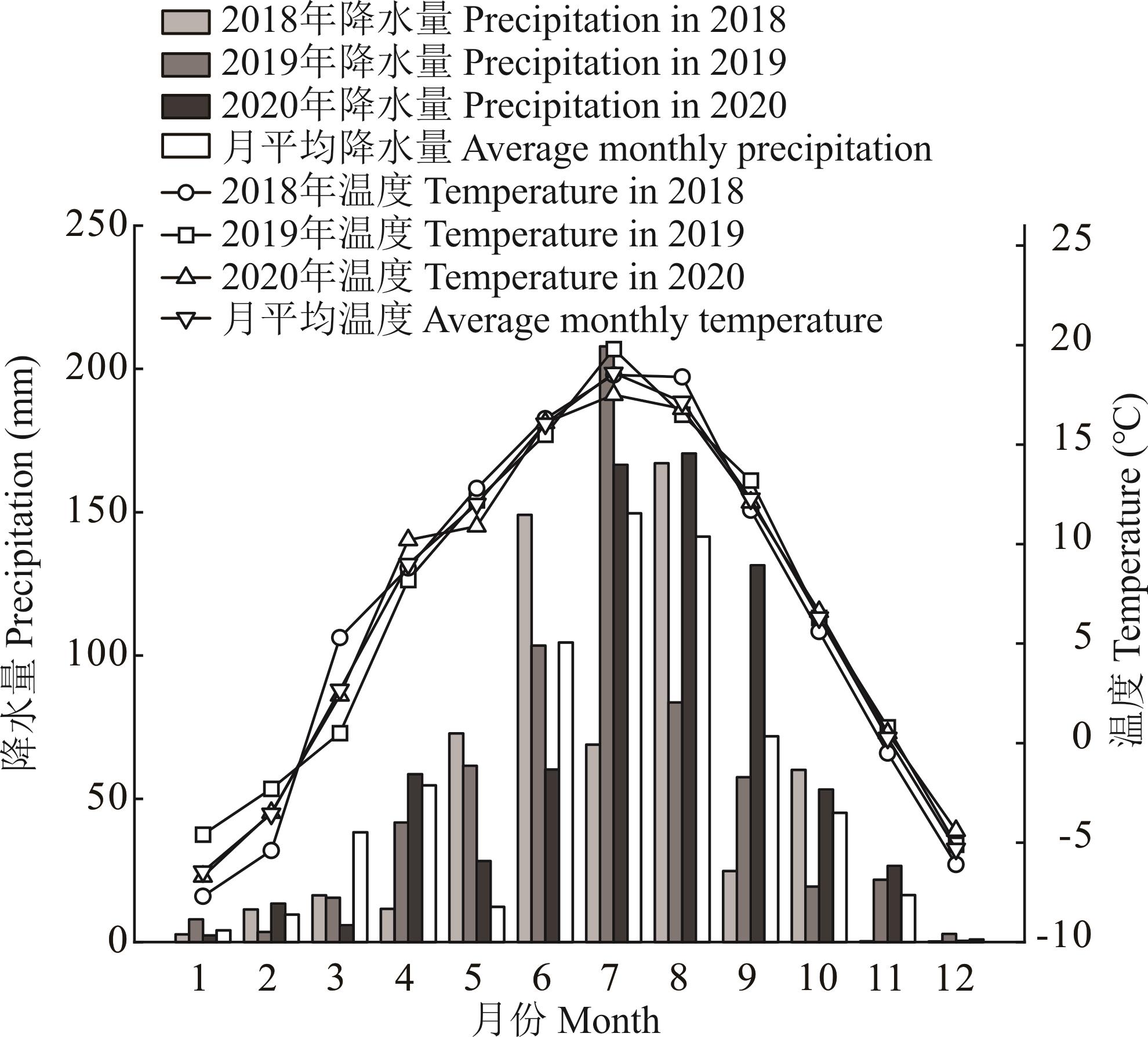
图1 试验区不同月份降水量和温度
Fig.1 Precipitation and temperature in different months of the pilot area
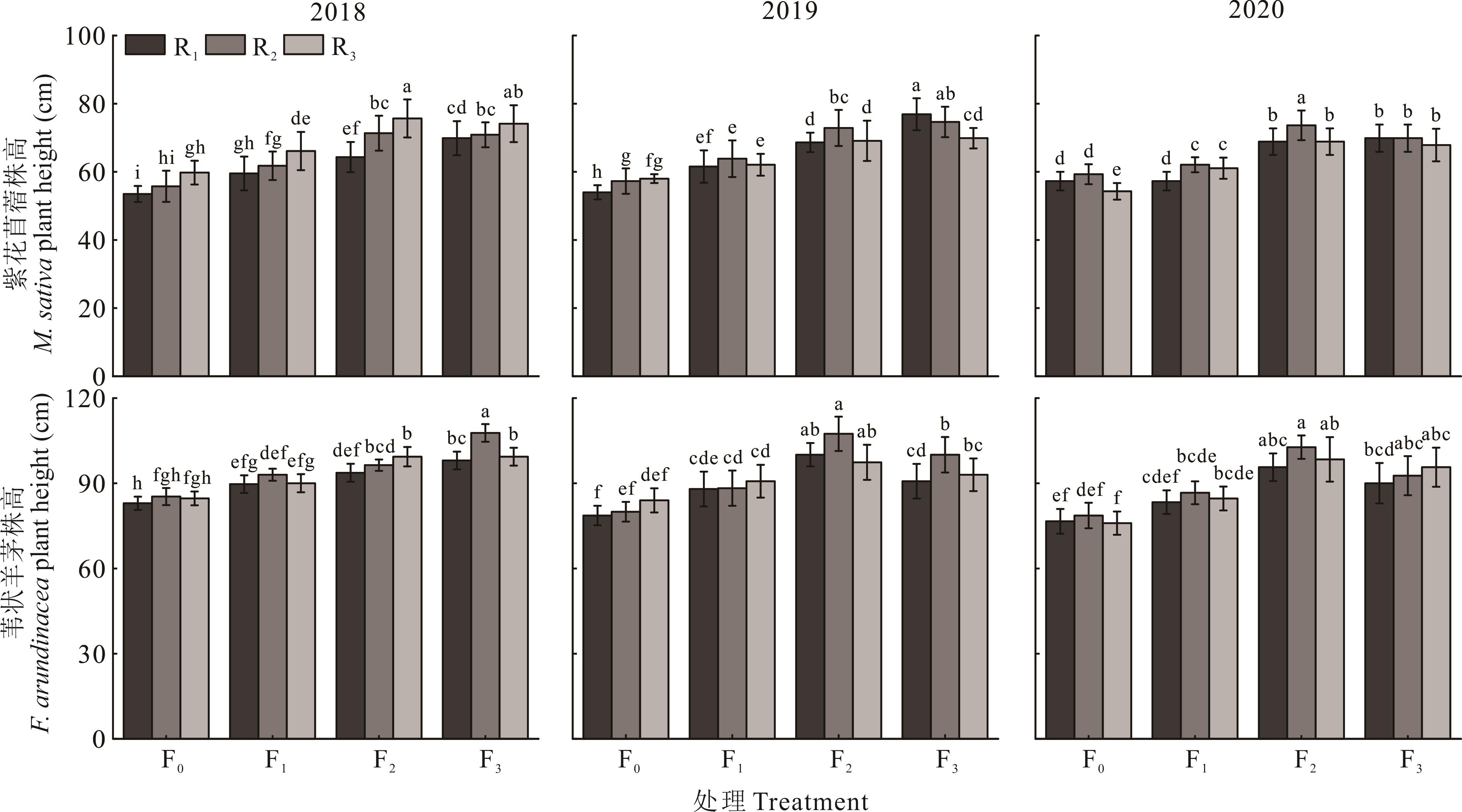
图2 补播-施磷对牧草株高的影响不同小写字母代表各处理间差异显著(P<0.05),下同。Different lowercase letters represent significant differences among different treatments (P<0.05). The same below.
Fig.2 Effect of reseeding-phosphorus application on plant height of forage
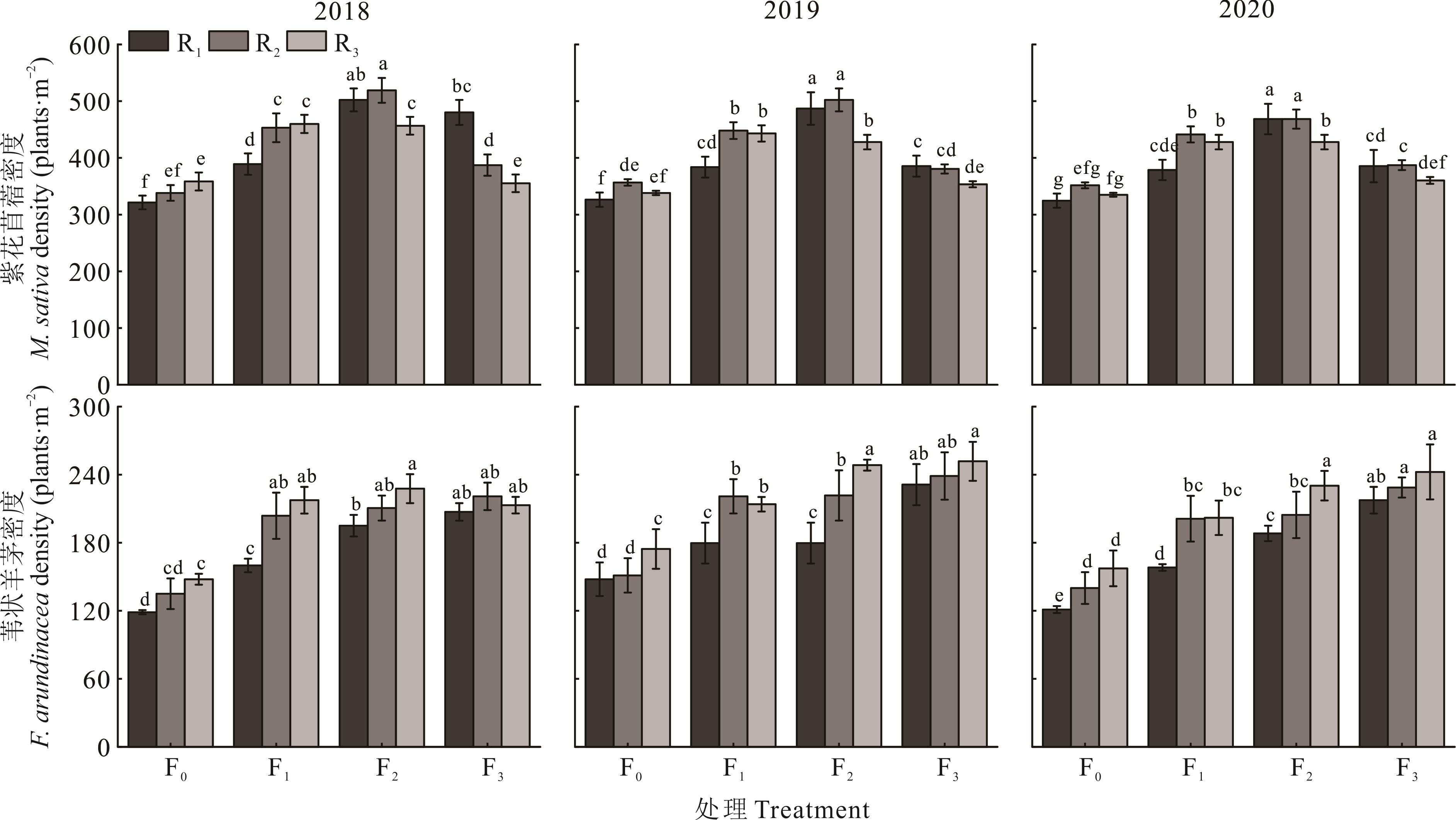
图3 补播-施磷对牧草密度的影响
Fig.3 Effect of reseeding-phosphorus application on forage density
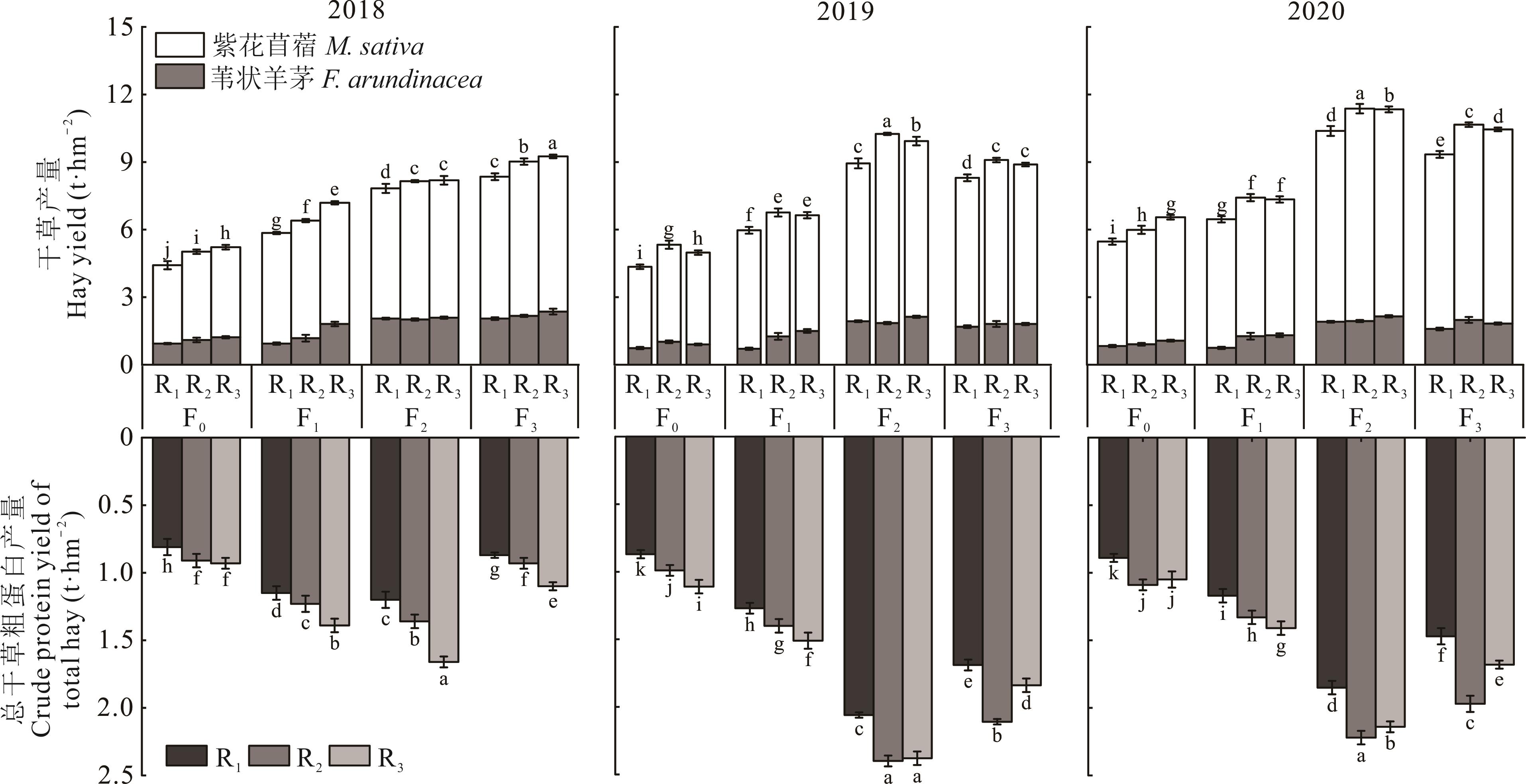
图4 补播-施磷对草地生产力和总干草粗蛋白产量的影响
Fig.4 Effects of reseeding-phosphorus application on grassland productivity and total hay crude protein yield
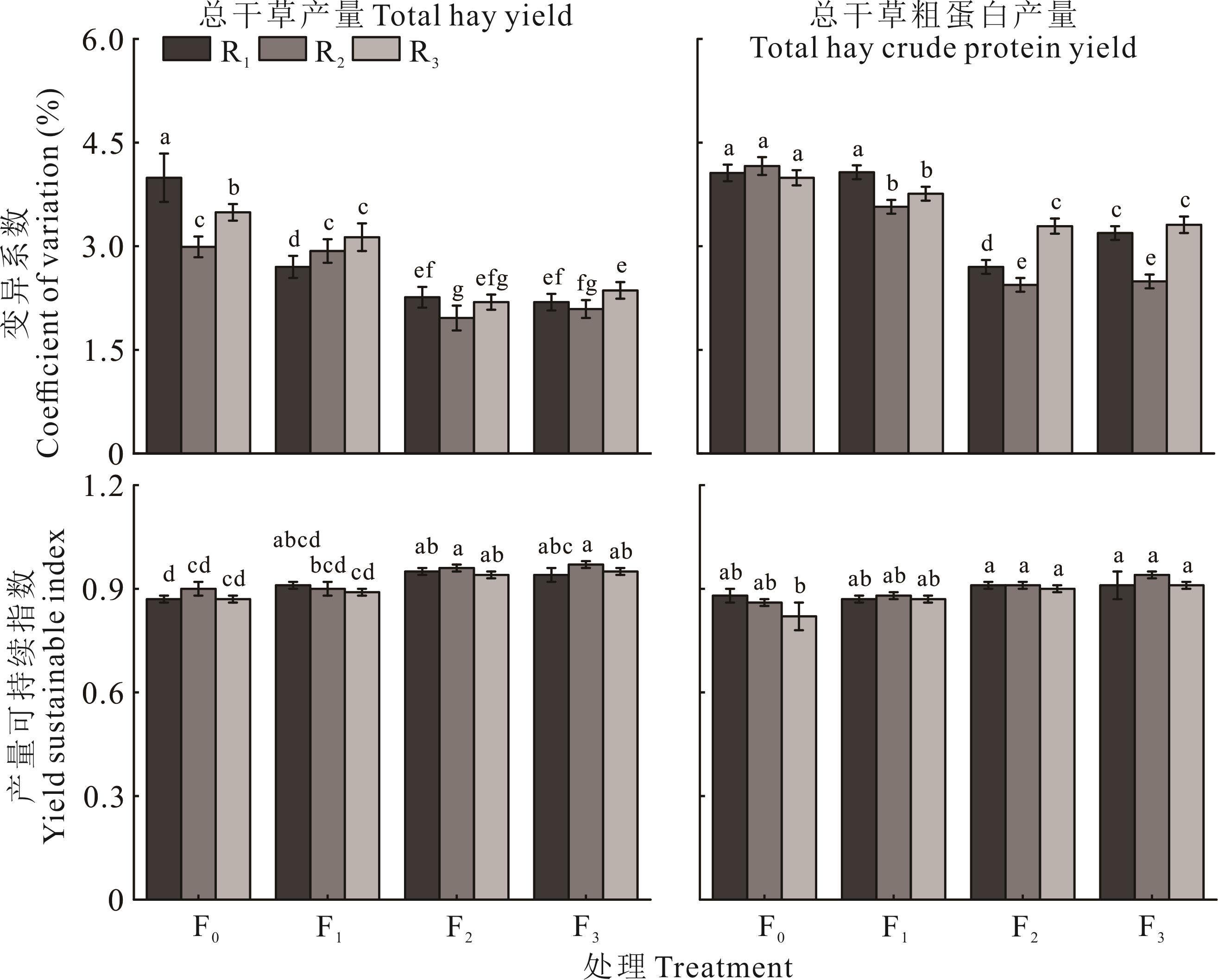
图5 补播-施磷对产量稳定性和可持续性的影响
Fig.5 Effects of reseeding-phosphorus application on yield stability and sustainability
| 因素Factor | HA | HF | DA | DF | DMA | DMF | CPY | CVDM | CVCPY | SYIDM | SYICPY |
|---|---|---|---|---|---|---|---|---|---|---|---|
| 年份Year | ** | *** | *** | *** | *** | *** | *** | ns | ns | ns | ns |
| 施磷量Phosphorus application | *** | *** | *** | *** | *** | *** | *** | * | ** | * | ** |
| 补播量Reseeding rate | *** | ** | *** | *** | *** | *** | *** | ns | ns | ns | ns |
| 年份×施磷量Year×phosphorus application | ** | ** | * | ns | *** | *** | *** | ns | ns | ns | ns |
| 年份×补播量Year×reseeding rate | *** | ns | * | ns | *** | *** | *** | ns | ns | ns | ns |
| 施磷量×补播量Phosphorus application×reseeding rate | *** | ns | *** | *** | ** | *** | *** | ns | ns | ns | ns |
| 年份×施磷量×补播量Year×phosphorus application×reseeding rate | * | ns | *** | ns | *** | *** | *** | ns | ns | ns | ns |
表1 牧草生长发育、产量以及产量稳定性和可持续性的方差分析
Table 1 Analysis of variance for forage growth and development, yield, and yield stability and sustainability
| 因素Factor | HA | HF | DA | DF | DMA | DMF | CPY | CVDM | CVCPY | SYIDM | SYICPY |
|---|---|---|---|---|---|---|---|---|---|---|---|
| 年份Year | ** | *** | *** | *** | *** | *** | *** | ns | ns | ns | ns |
| 施磷量Phosphorus application | *** | *** | *** | *** | *** | *** | *** | * | ** | * | ** |
| 补播量Reseeding rate | *** | ** | *** | *** | *** | *** | *** | ns | ns | ns | ns |
| 年份×施磷量Year×phosphorus application | ** | ** | * | ns | *** | *** | *** | ns | ns | ns | ns |
| 年份×补播量Year×reseeding rate | *** | ns | * | ns | *** | *** | *** | ns | ns | ns | ns |
| 施磷量×补播量Phosphorus application×reseeding rate | *** | ns | *** | *** | ** | *** | *** | ns | ns | ns | ns |
| 年份×施磷量×补播量Year×phosphorus application×reseeding rate | * | ns | *** | ns | *** | *** | *** | ns | ns | ns | ns |
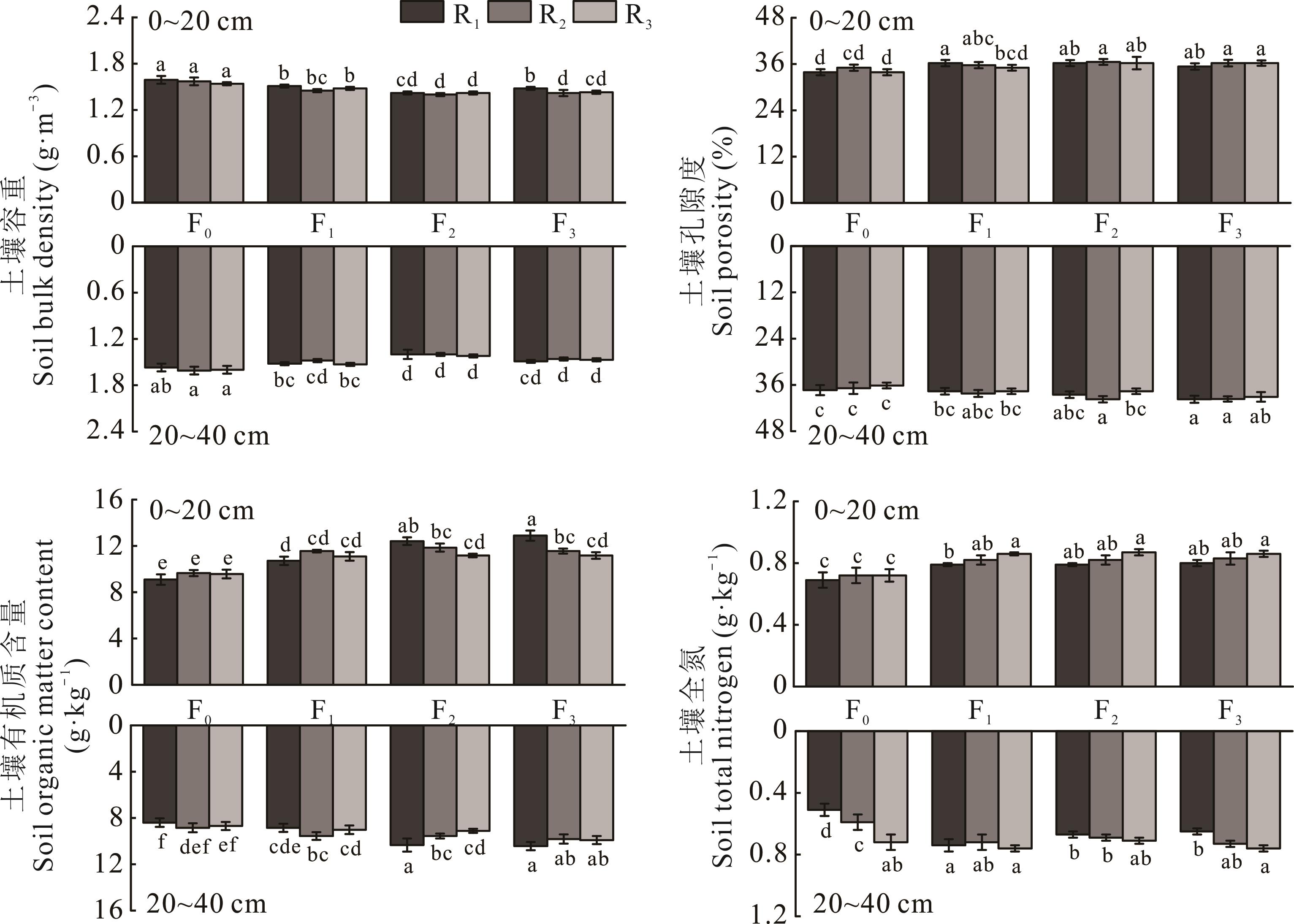
图6 补播-施磷对土壤理化性状的影响
Fig.6 Effects of reseeding-phosphorus application on soil physical and chemical properties
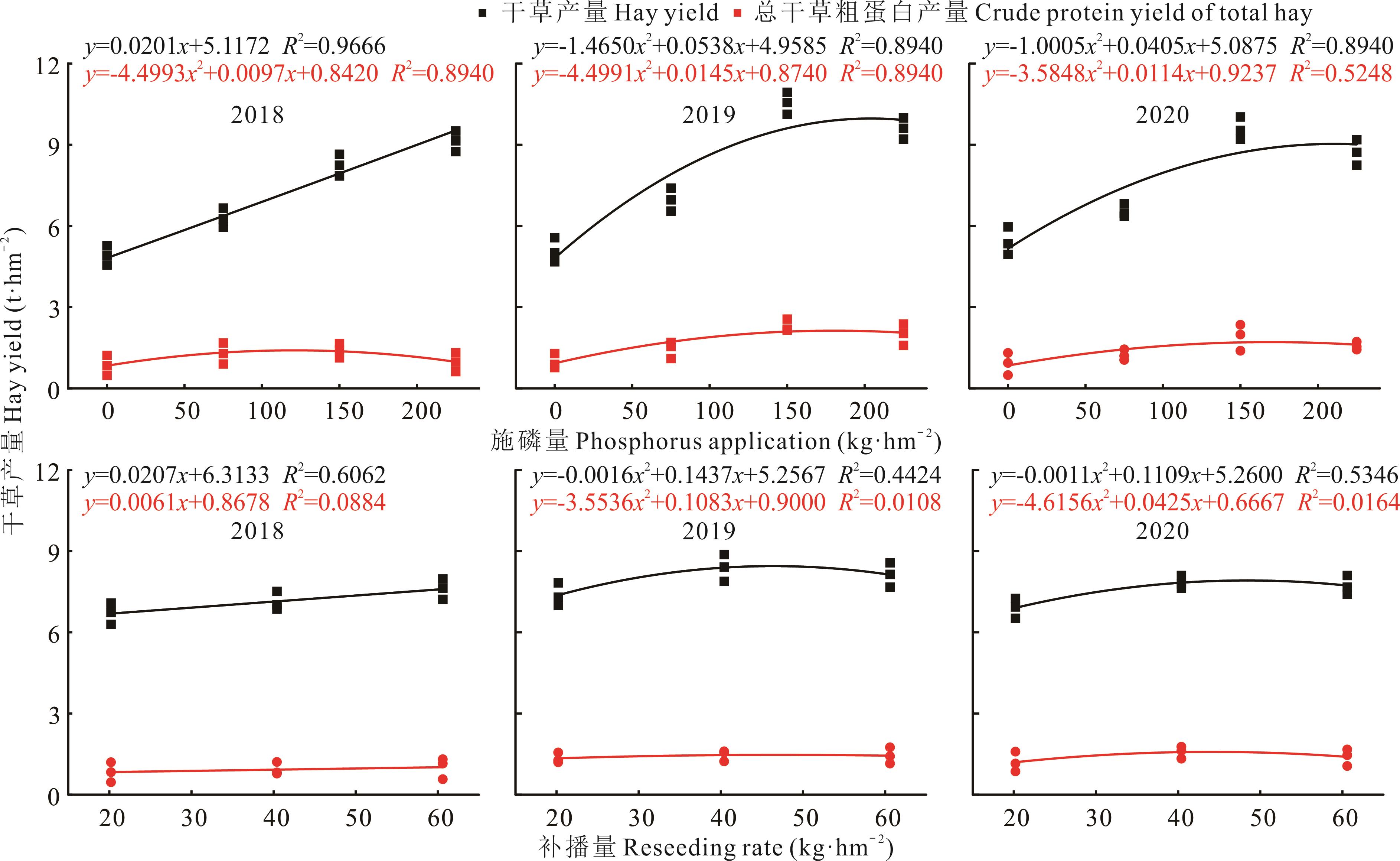
图7 干草产量和总干草粗蛋白产量与补播量和施磷量的关系
Fig.7 The relationship between hay yield and crude protein yield of total hay and phosphorus application rate and reseeding rate
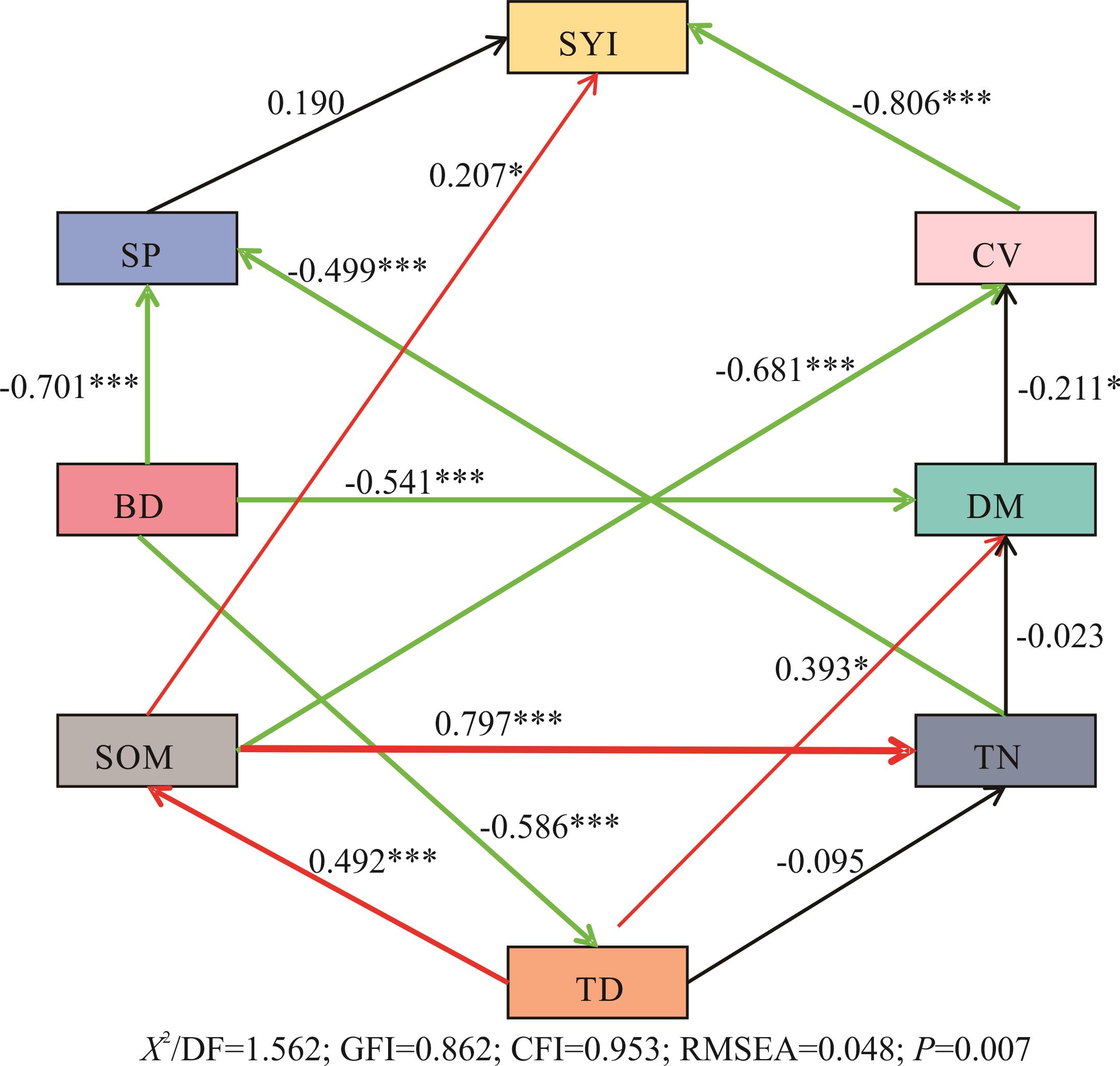
图8 结构方程模型SYI: 产量可持续指数Yield sustainable index; CV: 变异系数Coefficient of variation; SP: 土壤孔隙度Soil porosity; BD: 土壤容重Soil bulk density; SOM: 土壤有机质Soil organic matter; DM: 干草产量Hay yield; TN: 土壤全氮Soil total nitrogen; TD: 总密度Total density; X2/DF: 卡方自由度比Chi-square/degrees of freedom; GFI: 拟合优度指数Goodness-of-fit index; CFI: 比较拟合指数Comparative fit index; RMSEA: 近似误差均方根Root mean square error of approximation. 红色线条表示正相关关系,绿色线条表示负相关关系,黑色线条表示无显著相关关系;箭头宽度表示显著的标准化路径系数强度(P<0.05)。Red lines indicate positive correlations, green lines indicate negative correlations, and black lines indicate no significant correlations. Arrow widths indicate significant standardized path coefficient strengths (P<0.05). ***: P<0.001; **: P<0.01; *: P<0.05.
Fig.8 Structural equation model
| [1] | Zhu J X, Shang Z H, Jiang S J, et al. Key scientific questions of grassland protection, restoration and function improvement. Bulletin of National Natural Science Foundation of China, 2024, 38(4): 658-667. |
| 朱剑霄, 尚占环, 蒋胜竞, 等. 草地生态系统保护、修复与功能提升的关键科学问题. 中国科学基金, 2024, 38(4): 658-667. | |
| [2] | Hou F J, Huang X J, Chang S H, et al. Concepts and approaches of grassland improvement. Acta Ecologica Sinica, 2024, 44(19): 8897-8913. |
| 侯扶江, 黄小娟, 常生华, 等. 草地培育的内涵和方法. 生态学报, 2024, 44(19): 8897-8913. | |
| [3] | Liu Z, Lan J X, Li W, et al. Reseeding improved soil and plant characteristics of degraded alfalfa (Medicago sativa) grassland in Loess Hilly Plateau Region, China. Ecological Engineering, 2023, 190(1): 106933. |
| [4] | Wang J, Fu X, Ghimire R J, et al. Responses of soil bacterial community and enzyme activity to organic matter components under long-term fertilization on the Loess Plateau of China. Appled Soil Ecology, 2021, 166(10): 103992. |
| [5] | Wang B, Deng J Q, Wang T F, et al. Innovative tillage practices to establish productive and sustainable forage production systems in degraded alfalfa pastures in semiarid regions. Land Degradation & Development, 2024, 35(18): 5804-5816. |
| [6] | Wang B, Li M Y, Wang X P, et al. Combined ploughing and tilling to improve degraded alfalfa (Medicago sativa) stands in a semi-arid region. Acta Prataculturae Sinica, 2022, 31(1): 107-117. |
| 王斌, 李满有, 王欣盼, 等. 深松浅旋对半干旱区退化紫花苜蓿人工草地改良效果研究. 草业学报, 2022, 31(1): 107-117. | |
| [7] | Niu S L, Jiang G M. Function of artificial grassland in restoration of degraded natural grassland and its research advance. Chinese Journal of Applied Ecology, 2004, 15(9): 1662-1666. |
| 牛书丽, 蒋高明. 人工草地在退化草地恢复中的作用及其研究现状. 应用生态学报, 2004, 15(9): 1662-1666. | |
| [8] | Leger E A, Goergen E M, Forbis D Q T. Can native annual forbs reduce Bromus tectorum biomass and indirectly facilitate establishment of a native perennial grass? Journal of Arid Environments, 2014, 102: 9-16. |
| [9] | Zhu Y Q, Yu H, Zheng W, el al. Effects of different planting configurations on yield of Avena sativa and Vicia sativa mixed plantings with soybean in alpine pastures. Acta Prataculturae Sinica, 2020, 29(1): 74-85. |
| 朱亚琼, 于辉, 郑伟, 等. 燕麦+箭筈豌豆混播草地混播优势的测度与影响因素分析. 草业学报, 2020, 29(1): 74-85. | |
| [10] | Fan Y F, Wang Z L, Liao D P, et al. Uptake and utilization of nitrogen, phosphorus and potassium as related to yield advantage in maize-soybean intercropping under different row configurations. Scientific Reports, 2020, 10(1): 9504. |
| [11] | Chapagain T, Riseman A. Nitrogen and carbon transformations, water use efficiency and ecosystem productivity in monocultures and wheat-bean intercropping systems. Nutrient Cycling in Agroecosystems, 2015, 101(1): 107-121. |
| [12] | Wang B, Yang Y J, Dong X, et al. Effects of reseeding grass on production performance and forage quality of degraded alfalfa grassland. Acta Agrestia Sinica, 2021, 29(3): 618-624. |
| 王斌, 杨彦军, 董秀, 等. 补播禾草对退化苜蓿草地生产性能及牧草品质的影响. 草地学报, 2021, 29(3): 618-624. | |
| [13] | Zhou J Q. Effects of alfalfa reseeding on the productivity and diversity of degraded grassland. Beijing: China Agricultural University, 2017. |
| 周冀琼. 补播苜蓿对退化草地生产力和多样性的影响. 北京: 中国农业大学, 2017. | |
| [14] | Elser J J E A. Nutritional constraints in terrestrial and freshwater food webs. Nature, 2000, 408: 578-580. |
| [15] | Guo J B, Zhao G Q, Jia S G, et al. Comprehensive evaluation of effects of fertilization on grassland quality index and soil properties in alpine steppe. Acta Prataculturae Sinica, 2020, 29(9): 85-93. |
| 郭剑波, 赵国强, 贾书刚, 等. 施肥对高寒草原草地质量指数及土壤性质影响的综合评价. 草业学报, 2020, 29(9): 85-93. | |
| [16] | Yu T F, Liu X J, Hao F. Effect of phosphate fertilizer application on alfalfa yield, nutritive value and N and P use efficiency. Acta Prataculturae Sinica, 2018, 27(3): 154-163. |
| 于铁峰, 刘晓静, 郝凤. 施用磷肥对紫花苜蓿营养价值和氮磷利用效率的影响. 草业学报, 2018, 27(3): 154-163. | |
| [17] | Wang B, Deng J Q, Wang T F, et al. Effect of seeding options on interspecific competition in oat (Avena sativa L.)-common vetch (Vicia sativa L.) forage crops. Agronomy (Basel), 2022, 12(12): DOI: 10.3390/AGRONOMY12123119. |
| [18] | Luo S S, Yu L L, Liu Y, et al. Effects of reduced nitrogen input on productivity and N2O emissions in a sugarcane/soybean intercropping system. European Journal of Agronomy, 2016, 81: 78-85. |
| [19] | Wang T F, Wang B, Deng J Q, et al. Effect of sowing rate on yield and forage quality of a Dolichos lablab-Sorghum bicolor mixture under drip irrigation in arid areas of Ningxia. Acta Prataculturae Sinica, 2023, 32(3): 30-40. |
| 王腾飞, 王斌, 邓建强, 等. 宁夏干旱区滴灌条件下拉巴豆不同播种量与甜高粱混播饲草生产性能研究. 草业学报, 2023, 32(3): 30-40. | |
| [20] | Bao S D. Soil agrochemical analysis. Beijing: China Agriculture Press, 2005. |
| 鲍士旦. 土壤农化分析. 北京: 中国农业出版社, 2005. | |
| [21] | Gong H, Yang L, Li D D, et al. Response of alfalfa production and quality to fertilization and cutting frequency and benefit analysis in mollisol agricultural area in cold region. Scientia Agricultura Sinica, 2020, 53(13): 2657-2667. |
| 巩皓, 杨柳, 李丹丹, 等. 寒地黑土农区紫花苜蓿生产与品质对施肥和刈割频次的响应及效益分析. 中国农业科学, 2020, 53(13): 2657-2667. | |
| [22] | Liu J J, Yin Y L, Li S X, et al. Effects of regulation measure on soil and microbial biomass of moderately degraded alpine meadow in Qilian Mountain, China. Chinese Journal of Applied Ecology, 2022, 33(4): 988-994. |
| 刘晶晶, 尹亚丽, 李世雄, 等. 调控措施对祁连山中度退化高寒草甸土壤的影响. 应用生态学报, 2022, 33(4): 988-994. | |
| [23] | Li X L, Ma Y Q, Duan C W, et al. Effects of fertilization and reseeding on biomass and species diversity of patchy degraded alpine meadows with different slope directions. Chinese Journal of Grassland, 2024, 46(5): 1-13. |
| 李希来, 马昀峤, 段成伟, 等. 施肥和补播对不同坡向斑块化退化高寒草甸生物量和物种多样性的影响. 中国草地学报, 2024, 46(5): 1-13. | |
| [24] | Xiao Z X, Wang Y, Liu G F, et al. Effects of fertilizing time in early spring on alfalfa (Medicago sativa) production performance and nutritional quality in mollisol area in cold region. Scientia Agricultura Sinica, 2020, 53(13): 2668-2677. |
| 肖知新, 王洋, 刘国富, 等. 寒地黑土区春季施肥期对紫花苜蓿生产性能及营养品质的影响. 中国农业科学, 2020, 53(13): 2668-2677. | |
| [25] | Aponte A, Samarappuli D, Berti M T. Alfalfa-grass mixtures in comparison to grass and alfalfa monocultures. Agronomy Journal, 2019, 111(2): 628-638. |
| [26] | Carlsson G, Huss-Danell K. Does nitrogen transfer between plants confound ¹⁵N-based quantifications of N2 fixation? Plant and Soil, 2014, 374(1/2): 345-358. |
| [27] | Wang C T, Wang G X, Liu W, et al. Effects of fertilization gradients on plant community structure and soil characteristics in alpine meadow. Acta Ecologica Sinica, 2013, 33(10): 3103-3113. |
| 王长庭, 王根绪, 刘伟, 等. 施肥梯度对高寒草甸群落结构、功能和土壤质量的影响. 生态学报, 2013, 33(10): 3103-3113. | |
| [28] | Li W L, Shang X J, Yan H P, et al. Impact of restoration measures on plant and soil characteristics in the degraded alpine grasslands of the Qinghai Tibetan Plateau: A meta-analysis. Agriculture, Ecosystems & Environment, 2023, 347: 108394. |
| [29] | Su Z Y, Zhang J S, Wu W L, et al. Effects of conservation tillage practices on winter wheat water-use efficiency and crop yield on the Loess Plateau, China. Agricultural Water Management, 2007, 87(3): 307-314. |
| [30] | Chen L L, Xu H B, Sun J H, et al. The short-term impacts of soil disturbance on soil microbial community in a degraded Leymus chinensis steppe, north China. Soil and Tillage Research, 2021, 213: 105-112. |
| [31] | Ren Y J, Lu Y H, Fu B J. Quantifying the impacts of grassland restoration on biodiversity and ecosystem services in China: A meta-analysis. Ecological Engineering, 2016, 95: 542-550. |
| [32] | Xu X, Wang X Y, Bao X L, et al. Effects of long-term no-tillage and stover mulching on maize yield and its stability. Chinese Journal of Applied Ecology, 2022, 33(3): 671-676. |
| 徐欣, 王笑影, 鲍雪莲, 等. 长期免耕不同秸秆覆盖量对玉米产量及其稳定性的影响. 应用生态学报, 2022, 33(3): 671-676. | |
| [33] | Liu Z, Nan Z W, Lin S M, et al. Millet/peanut intercropping at a moderate N rate increases crop productivity and N use efficiency, as well as economic benefits, under rain-fed conditions. Journal of Integrative Agriculture, 2023, 22(3): 738-751. |
| [34] | Ji W Z, Wang Q H. Effects of over-seeding on plant community and soil physical and chemical properties of degraded grassland in Tianzhu County. Pratacultural Science, 2016, 33(5): 886-890. |
| 姬万忠, 王庆华. 补播对天祝高寒退化草地植被和土壤理化性质的影响. 草业科学, 2016, 33(5): 886-890. | |
| [35] | Zhang X. Effects of fertilization on yield sustainability and greenhouse gas emissions under wheat-soybean rotation system. Beijing: Chinese Academy of Agricultural Sciences, 2019. |
| 张鑫. 施肥对小麦-大豆轮作体系产量可持续性与温室气体排放的影响. 北京: 中国农业科学院, 2019. | |
| [36] | Yan P, Chen Y Q, Dadouma A, et al. Effect of nitrogen regimes on narrowing the magnitude of maize yield penalty caused by high temperature stress in north China Plain. Plant, Soil and Environment, 2017, 63(3): 131-138. |
| [37] | Tardella F M, Bricca A, Piermarteri K, et al. Context-dependent variation of SLA and plant height of a dominant, invasive tall grass (Brachypodium genuense) in sub-Mediterranean grasslands. Flora, 2017, 229: 116-123. |
| [1] | 翟勇全, 马尧, 宋丽华, 曹兵. 黑麦草间作密度对枣-草间作系统生产力、净效益和可持续性的影响[J]. 草业学报, 2026, 35(7): 68-79. |
| [2] | 刘瞳, 苏日力格null, 姜娜, 庞波, 乌日力格null, 杨陶阳, 张海芳, 赵建宁, 杨殿林. 狼毒大戟扩散对呼伦贝尔草原植物群落演替及土壤理化性质的影响[J]. 草业学报, 2026, 35(5): 72-84. |
| [3] | 金磊, 王彦平, 那日苏, 包永生, 张敬超. 日尺度下水热因子变化对呼伦贝尔草甸草原生产力的影响特征[J]. 草业学报, 2026, 35(3): 1-12. |
| [4] | 魏孔涛, 张春平, 俞旸, 张正社, 周泽, 张雪, 王鑫鑫, 岳思玉, 曹铨, 董全民. 环青海湖共和盆地不同燕麦品种的产量、营养价值及对土壤理化性质的影响[J]. 草业学报, 2026, 35(1): 107-118. |
| [5] | 罗叙, 马慧, 韩翠, 赵雅欣, 赵莹, 谢应忠, 李建平. 地上净初级生产力对植物物种丰富度的响应及影响因子分析[J]. 草业学报, 2025, 34(9): 26-37. |
| [6] | 张琨, 乔建霞, 李金升, 王育鹏, 刘克思. 不同修复材料对退化高寒草地土壤理化性质及微生物群落的影响[J]. 草业学报, 2025, 34(8): 132-148. |
| [7] | 郭楠, 杜鹉辰, 纪守坤, 刘建, 崔素倩, 袁辉, 韩旭, 刘计双, 高立杰. 施肥和补播对山地草甸牧草营养及瘤胃发酵的影响[J]. 草业学报, 2025, 34(4): 150-163. |
| [8] | 张晓娟, 魏娇娇, 陈彩锦, 李雪雪, 马宏秀, 李凯, 陈永伟, 孙权. 氮肥周年优化对灌区饲用小黑麦-青贮玉米复种系统生产力的影响[J]. 草业学报, 2025, 34(4): 38-52. |
| [9] | 吕娜, 高吉喜, 李政海, 尤春赫, 刘晓曼, 张彪, 莫宇, 朱萨宁, 彭阳, 杨雪. 植物生长中期施肥对草甸草原群落特征与物种多样性的影响[J]. 草业学报, 2025, 34(2): 109-122. |
| [10] | 欧翔, 连海, 陈荣强, 邱静芸, 吴丽娟, 操贤洪, 张强, 雷小文. 不同施肥处理种植王草后对稀土尾矿土壤理化性质和酶活性的影响[J]. 草业学报, 2025, 34(2): 94-108. |
| [11] | 贺聪, 马永才, 字洪标. 不同围封年限对高寒草地植物群落的影响[J]. 草业学报, 2025, 34(11): 17-30. |
| [12] | 韩大勇, 杨允菲, 李海燕, 张维. 基于天然草地12种根茎禾草种群构件年龄结构与衰老过程的趋同适应普遍模式[J]. 草业学报, 2025, 34(11): 217-226. |
| [13] | 鲍平安, 文志林, 王炎, 陈彦虎, 季波, 王占军, 吴旭东, 蒋齐. 不同牧草补播模式对荒漠草原植物群落结构及土壤特性的影响[J]. 草业学报, 2025, 34(10): 62-73. |
| [14] | 杜文盼, 赵桂琴, 柴继宽, 杨莉, 张建贵, 史怡超, 张官禄. 根系分隔方式对燕麦/豌豆间作地上生物量、土壤养分及根系性状的影响[J]. 草业学报, 2024, 33(8): 25-36. |
| [15] | 索晓晶, 项磊, 高贺, 运向军, 哈斯巴根, 吴金蕊, 董文成, 滑博伟, 牟金燚, 王琪. 不同利用方式对大针茅草原植被群落特征的影响[J]. 草业学报, 2024, 33(4): 12-21. |
| 阅读次数 | ||||||
|
全文 |
|
|||||
|
摘要 |
|
|||||
