

ISSN 1004-5759 CN 62-1105/S
草业学报 ›› 2026, Vol. 35 ›› Issue (7): 68-79.DOI: 10.11686/cyxb2025283
翟勇全1,2( ), 马尧1, 宋丽华1,2, 曹兵1,2()
收稿日期:2025-07-08
修回日期:2025-09-09
出版日期:2026-07-20
发布日期:2026-05-21
通讯作者:
曹兵
作者简介:Corresponding author. E-mail: bingcao2006@162.com基金资助:
Yong-quan ZHAI1,2(), Yao MA1, Li-hua SONG1,2, Bing CAO1,2()
Received:2025-07-08
Revised:2025-09-09
Online:2026-07-20
Published:2026-05-21
Contact:
Bing CAO
摘要:
为明确牧草间作密度对枣-草间作系统的影响,揭示牧草间作密度在调控系统生产力、资源竞争与互补和可持续性提升中的作用机制,确定西北干旱沙区灵武长枣行间最优间作密度。于2023和2024年在灵武长枣典型种植区设置了枣树单作(J)、黑麦草单作(G)、间作黑麦草15.0 kg·hm-2(J-G15)、间作黑麦草22.5 kg·hm-2(J-G22.5)和间作黑麦草30.0 kg·hm-2(J-G30)5个处理,系统研究了枣-草间作系统中草的种植密度对土地当量比、生产力、竞争效应和可持续性等方面的影响。结果表明:黑麦草间作密度对枣树产量、牧草产量和土地当量比(LER)均有显著影响(P<0.05),枣树和牧草产量均在J-G22.5处理下最高,相较于J和G处理,J-G22.5处理下2年枣树和牧草产量分别提高了53.69%、29.62%和12.14%、12.26%。。枣树和牧草产量年际间差异极显著(P<0.001),整体上表现为2024高于2023年。所有间作系统LER均大于1,表现出明显的间作优势,且在J-G22.5处理下最大(2.51和2.42)。J-G22.5处理在枣树和牧草增产率、竞争指数、净效应、互补效应和选择效应方面均优于其他处理。主成分和相关性分析表明,产量与净效应、互补效应及竞争指数(CI)呈极显著正相关(P<0.001)关系,即种间互补和资源协调利用性是间作系统产量提升的关键机制。可持续性分析表明,J-G22.5和J-G30处理的可持续性指数均高于J-G15,且CI和选择效应(SE)为主要权重因子。综合考量认为,间作黑麦草22.5 kg·hm-2是西北干旱沙区灵武长枣行间最优间作密度。
翟勇全, 马尧, 宋丽华, 曹兵. 黑麦草间作密度对枣-草间作系统生产力、净效益和可持续性的影响[J]. 草业学报, 2026, 35(7): 68-79.
Yong-quan ZHAI, Yao MA, Li-hua SONG, Bing CAO. Effects of ryegrass intercropping density on the productivity, net benefits, and sustainability of a jujube-grass intercropping system[J]. Acta Prataculturae Sinica, 2026, 35(7): 68-79.
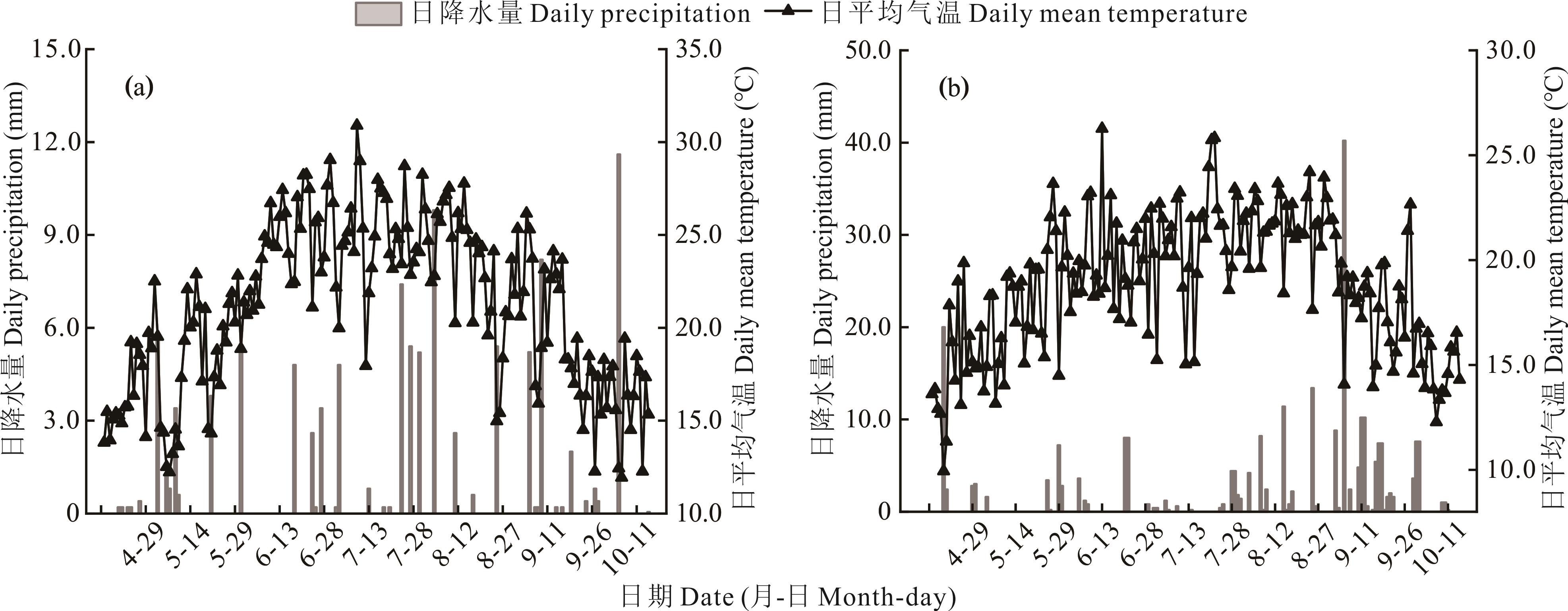
图1 2023(a)和2024(b)年试验开展期间日平均气温和日降水量
Fig.1 Daily mean temperature and precipitation during the experimental period in 2023 (a) and 2024 (b)
年份 Year | 处理 Treatment | 产量Yield (t·hm-2) | 牧草部分土地当量比Land equivalent ratio for grass (LERG) | 枣树部分土地当量比Land equivalent ratio for jujube (LERJ) | 土地当量比 Land equivalent ratio (LER) | |
|---|---|---|---|---|---|---|
枣树 Jujube | 牧草 Forage | |||||
| 2023 | J | 7.45±0.30c | - | - | - | - |
| G | - | 7.25±0.19b | - | - | - | |
| J-G15 | 9.44±0.25b | 6.98±0.27b | 0.96±0.05b | 1.27±0.06b | 2.23±0.07b | |
| J-G22.5 | 11.45±0.23a | 8.13±0.23a | 1.12±0.04a | 1.53±0.07a | 2.51±0.05a | |
| J-G30 | 7.08±0.17c | 7.19±0.22b | 0.99±0.03b | 0.95±0.05c | 1.95±0.07c | |
| 2024 | J | 24.98±0.14d | - | - | - | - |
| G | - | 7.83±0.18b | - | - | - | |
| J-G15 | 30.54±0.23b | 7.54±0.17b | 0.96±0.04b | 1.22±0.02b | 2.19±0.05b | |
| J-G22.5 | 32.38±0.20a | 8.79±0.13a | 1.12±0.03a | 1.29±0.01a | 2.42±0.03a | |
| J-G30 | 28.49±0.23c | 7.77±0.13b | 0.99±0.03b | 1.14±0.01c | 2.13±0.04b | |
| 年份Year (Y) | 82394.62*** | 91.14*** | 4.28** | 0.00ns | 2.74ns | |
| 密度Density (D) | 1253.91*** | 72.45*** | 177.40*** | 48.52*** | 222.07*** | |
| Y×D | 166.32*** | 0.13ns | 59.90*** | 0.00ns | 39.78*** | |
表1 黑麦草间作密度对枣树产量、牧草产量和土地当量比的影响
Table 1 Effects of ryegrass intercropping density on jujube yield, grass yield, and land equivalent ratio
年份 Year | 处理 Treatment | 产量Yield (t·hm-2) | 牧草部分土地当量比Land equivalent ratio for grass (LERG) | 枣树部分土地当量比Land equivalent ratio for jujube (LERJ) | 土地当量比 Land equivalent ratio (LER) | |
|---|---|---|---|---|---|---|
枣树 Jujube | 牧草 Forage | |||||
| 2023 | J | 7.45±0.30c | - | - | - | - |
| G | - | 7.25±0.19b | - | - | - | |
| J-G15 | 9.44±0.25b | 6.98±0.27b | 0.96±0.05b | 1.27±0.06b | 2.23±0.07b | |
| J-G22.5 | 11.45±0.23a | 8.13±0.23a | 1.12±0.04a | 1.53±0.07a | 2.51±0.05a | |
| J-G30 | 7.08±0.17c | 7.19±0.22b | 0.99±0.03b | 0.95±0.05c | 1.95±0.07c | |
| 2024 | J | 24.98±0.14d | - | - | - | - |
| G | - | 7.83±0.18b | - | - | - | |
| J-G15 | 30.54±0.23b | 7.54±0.17b | 0.96±0.04b | 1.22±0.02b | 2.19±0.05b | |
| J-G22.5 | 32.38±0.20a | 8.79±0.13a | 1.12±0.03a | 1.29±0.01a | 2.42±0.03a | |
| J-G30 | 28.49±0.23c | 7.77±0.13b | 0.99±0.03b | 1.14±0.01c | 2.13±0.04b | |
| 年份Year (Y) | 82394.62*** | 91.14*** | 4.28** | 0.00ns | 2.74ns | |
| 密度Density (D) | 1253.91*** | 72.45*** | 177.40*** | 48.52*** | 222.07*** | |
| Y×D | 166.32*** | 0.13ns | 59.90*** | 0.00ns | 39.78*** | |
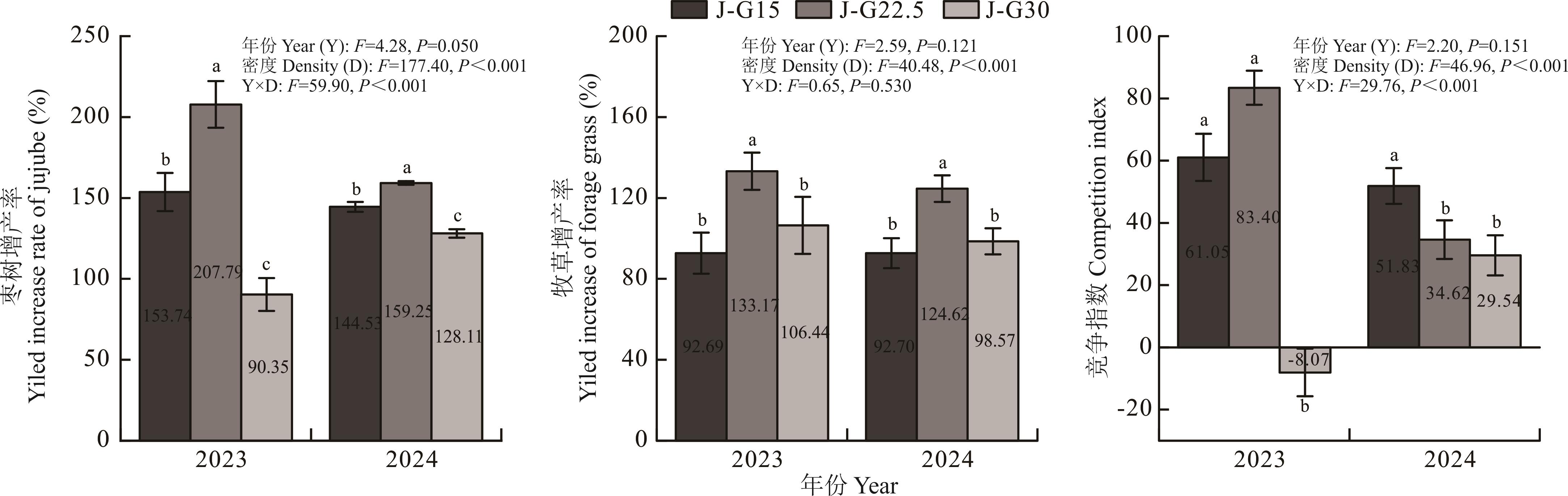
图2 黑麦草间作密度对枣树和牧草增产率及竞争指数的影响不同小写字母表示各处理在P<0.05水平上存在显著性差异,下同。Different lowercase letters mean significantly different among the different treatments (P<0.05). The same below.
Fig.2 Effects of ryegrass intercropping density on yield increase rate and competitive index of jujube and grass
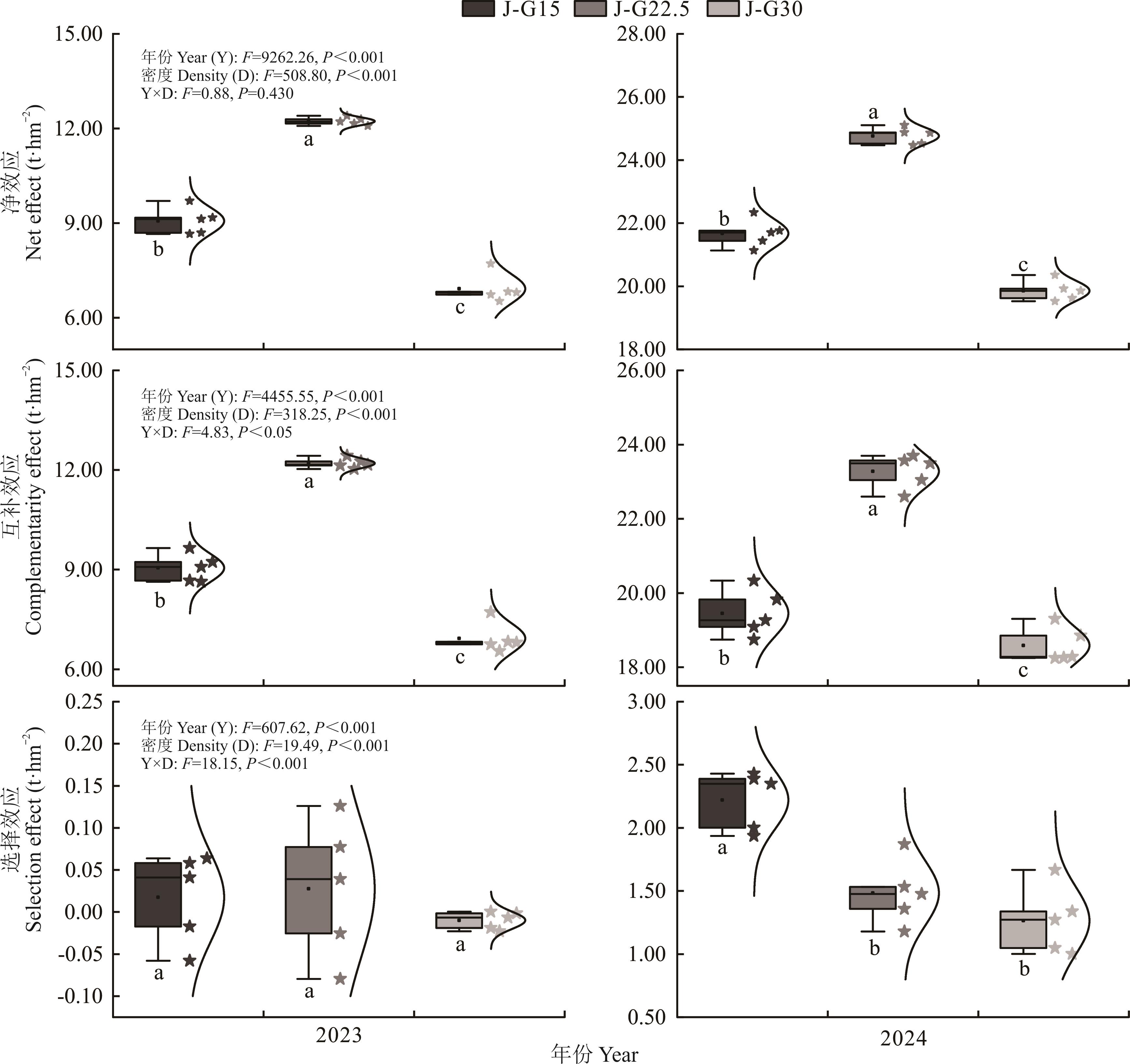
图3 不同密度黑麦草间作系统下的净效应、互补效应和选择效应
Fig.3 Net effect, complementarity effect, and selection effect under different ryegrass intercropping densities
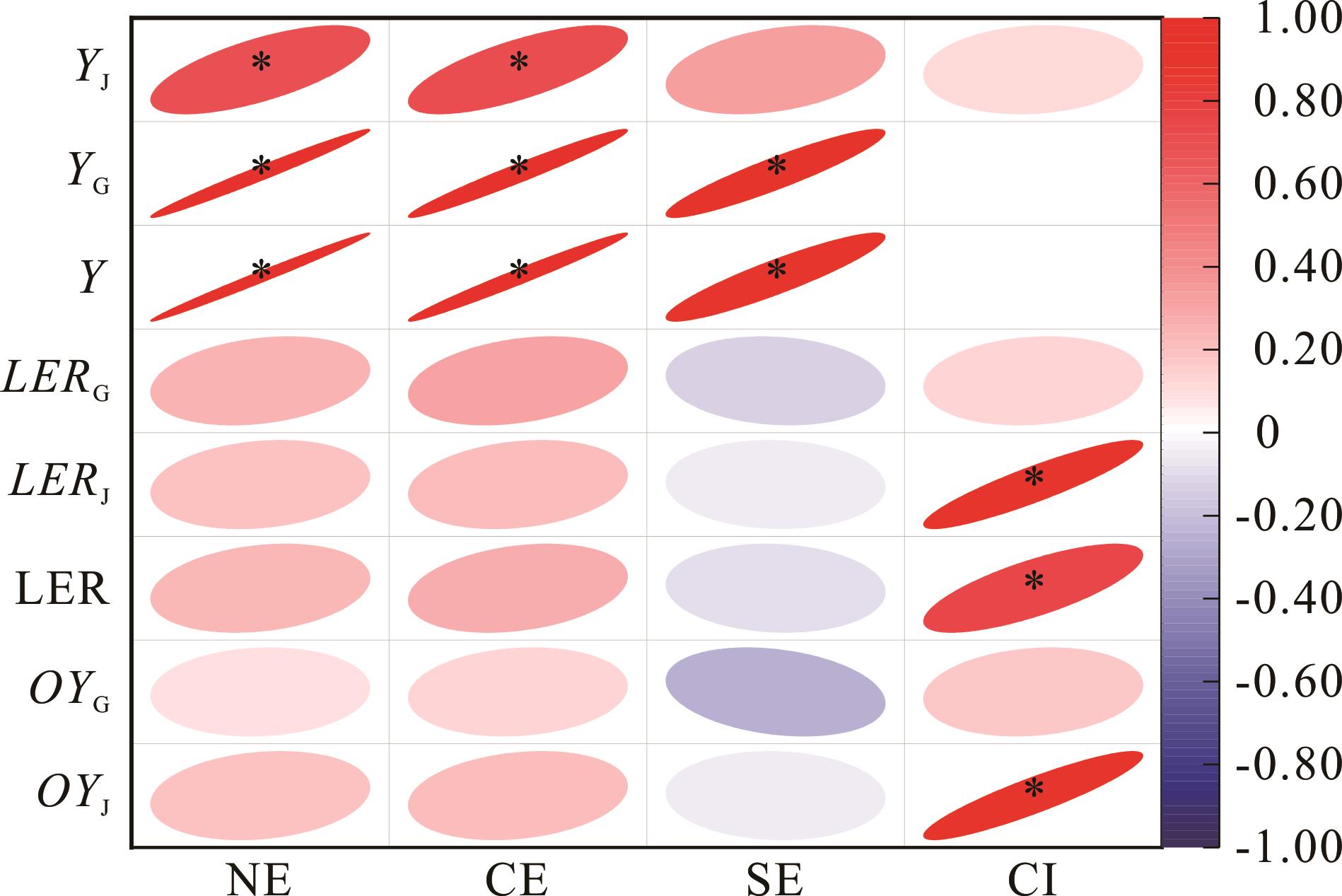
图4 竞争指数、净效应、互补效应和选择效应与产量和土地当量比间的相关关系*: P<0.001. NE: 净效应Net effect; CE: 互补效应Complementarity effect; SE: 选择效应Selection effect; CI: 竞争指数Competition index; OYJ: 间作枣树增产率Yiled increase rate of jujube under intercropping; OYG: 间作牧草增产率Yiled increase rate of grass under intercropping; LER: 土地当量比Land equivalent ratio; LERJ: 间作枣树部分土地当量比Partial LER of jujube; LERG: 间作牧草部分土地当量比Partial LER of grass; Y: 系统产量System yield; YJ: 间作枣树产量Jujube yield under intercropping; YG: 间作牧草产量Grass yield under intercropping. 下同The same below.
Fig.4 Correlation among competition index, net effect, complementarity effect and selection effect with yield and land equivalent ratio
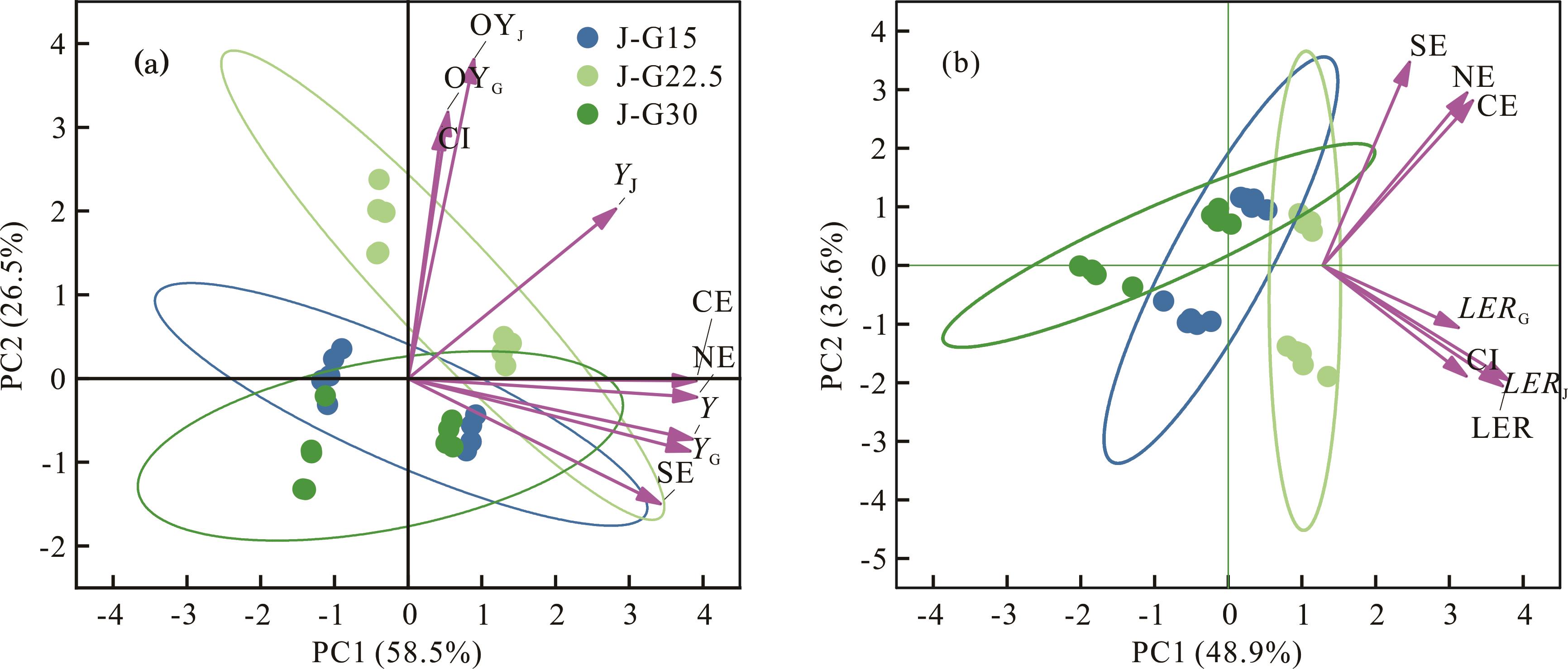
图5 竞争指数、净效应、互补效应和选择效应与产量(a)和土地当量比(b)间的主成分分析图中椭圆表示95%置信水平Ellipses in the figure represent the 95% confidence level.
Fig.5 Principal component analysis (PCA) of the relationships among competitive index, net effect, complementarity effect, selection effect and yield (a) and land equivalent ratio (b)
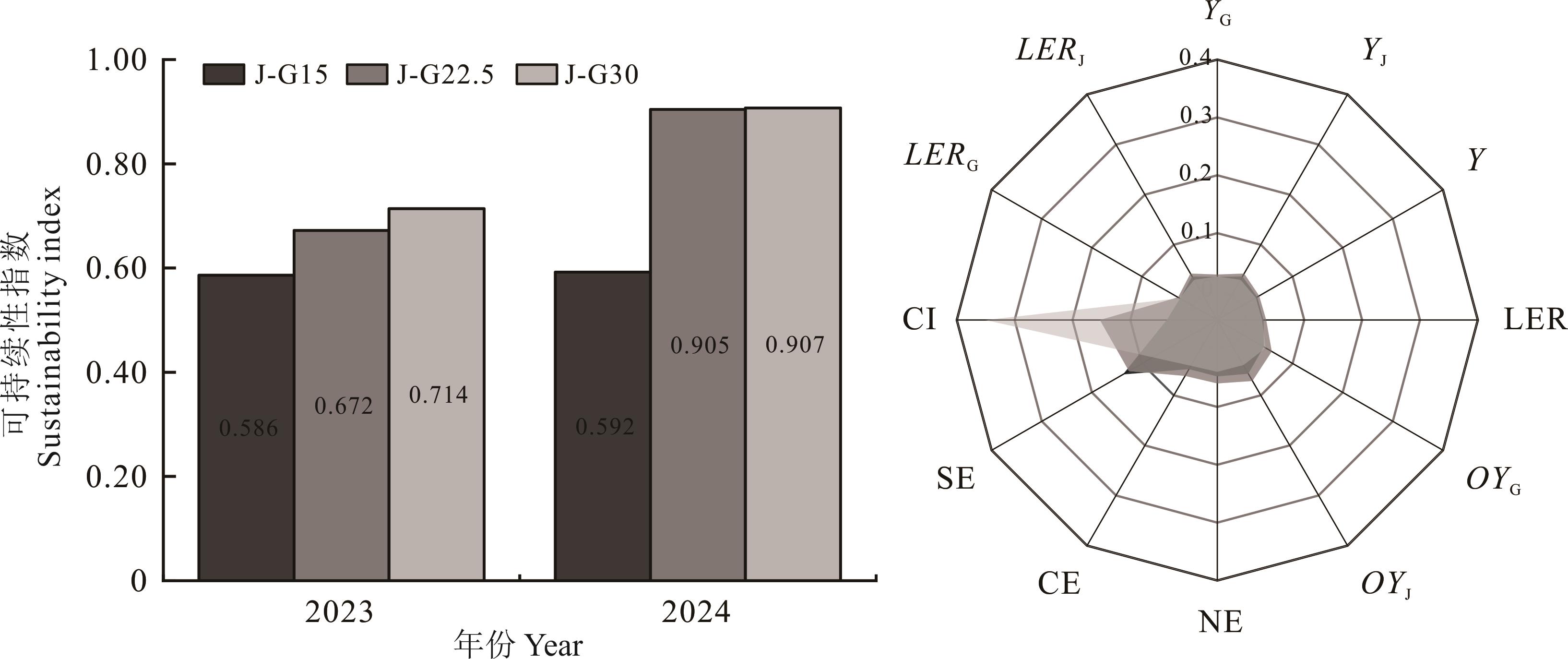
图6 不同密度黑麦草间作处理下的可持续性指数和权重值
Fig.6 Sustainability index and indicator weights under different ryegrass intercropping treatments
| [1] | Jin J B, Wang T, Cheng Y F, et al. Current situation and prospect of forage breeding in China. Bulletin of Chinese Academy of Sciences, 2021, 36(6): 660-665. |
| 金京波, 王台, 程佑发, 等. 我国牧草育种现状与展望. 中国科学院院刊, 2021, 36(6): 660-665. | |
| [2] | Oldoni H, Magalhães G S P, Oliveira G L A, et al. Management zones delineation: a proposal to overcome the crop-pasture rotation challenge. Precision Agriculture, 2025, 26: 21. |
| [3] | Feng Q, He X L, Wang B, et al. A study of mixed sowing effects for oat and common vetch in the Ningxia Yellow River Irrigation Area. Acta Prataculturae Sinica, 2024, 33(3): 107-119. |
| 冯琴, 何小莉, 王斌, 等. 宁夏引黄灌区燕麦与箭筈豌豆的混播效果研究. 草业学报, 2024, 33(3): 107-119. | |
| [4] | Xie J, Liu X Q, Luo M X, et al. Ethnobotanical study of traditional forage plants in the Gansu-Ningxia-Inner Mongolia junction zone: conservation and sustainable utilization for animal husbandry. Journal of Ethnobiology and Ethnomedicine, 2023, 19: DOI: 10.1186/s13002-023-00625-0. |
| [5] | Zhang C, Wang Y, Zhou L H, et al. Spatiotemporal distribution characteristics and driving factors of livestock feeding structure: A case study in Ningxia. Acta Prataculturae Sinica, 2024, 33(8): 37-49. |
| 张聪, 王娅, 周立华, 等. 牲畜饲养结构的时空分布特征及驱动因素——以宁夏为例. 草业学报, 2024, 33(8): 37-49. | |
| [6] | Wang W, Zhou L. Current situation, problems and countermeasures of the grass-livestock industry chain development in Ningxia. Ningxia Social Sciences, 2017(Supple1): 144-149. |
| 王微, 周蕾. 宁夏草畜产业链发展现状、存在问题及对策. 宁夏社会科学, 2017(增刊1): 144-149. | |
| [7] | Chen H X. Study on evaluation of forage planting benefits in Ningxia under background of food security. Acta Agriculturae Jiangxi, 2023, 35(3): 196-202. |
| 陈红翔. 粮食安全背景下的宁夏牧草种植效益评价研究. 江西农业学报, 2023, 35(3): 196-202. | |
| [8] | Guo T, Xue B, Zhou Y M, et al. Current status and enlightenment of production and trade of forage product in China. Acta Agrestia Sinica, 2019, 27(1): 8-14. |
| 郭婷, 薛彪, 周艳明, 等. 我国牧草产品生产、贸易现状及启示. 草地学报, 2019, 27(1): 8-14. | |
| [9] | Song X L, Mi N, Mi W B, et al. Spatial non-stationary characteristics between grass yield and its influencing factors in the Ningxia temperate grasslands based on a mixed geographically weighted regression model. Journal of Geographical Sciences, 2022, 32(6): 1076-1102. |
| [10] | Ni Y F. Study on forage production efficiency and its influencing factors in China. Beijing: Chinese Academy of Agricultural Sciences, 2019. |
| 倪印锋. 中国牧草生产效率及其影响因素研究. 北京: 中国农业科学院, 2019. | |
| [11] | Zhou F M, Su P H. Distribution variation of aboveground biomass and competitive intensity of Lycium barbarum-Medicago sativa intercropping. Bulletin of Soil and Water Conservation, 2022, 42(2): 53-58, 66. |
| 周孚明, 苏鹏海. 枸杞-苜蓿间作地上生物量分布变异及其竞争强度. 水土保持通报, 2022, 42(2): 53-58, 66. | |
| [12] | Krüger M A, Lima T M D P, Ovani V, et al. Ruminant grazing lands in the tropics: Silvopastoral systems and Tithonia diversifolia as tools with potential to promote sustainability. Agronomy, 2024, 14(7): 1386. |
| [13] | Wang X J. Study on the ‘Lingwu Changzao’ jujube-herbage intercropping patterns and productivity characteristics in the arid sandy area, Ningxia province. Yinchuan: Ningxia University, 2023. |
| 王晓佳. 宁夏干旱沙区灵武长枣-牧草间作模式及生产力特征研究. 银川: 宁夏大学, 2023. | |
| [14] | Ma Y, Cao B, Wang X J, et al. Intercropping ryegrass with ‘Lingwu Changzao’ (Ziziphus jujuba Mill. cv. Lingwu Changzao) enhances crop yield and quality in the arid regions of Northern China. Agroforestry Systems, 2025, 99(5): 103. |
| [15] | Wang X J, Cao B, Zou J, et al. Intercropping Gramineae herbage in semiarid jujube cultivar ‘Lingwu Changzao’ (Ziziphus jujuba Mill. cv. Lingwu Changzao) orchard improves productivity, plant nutritional quality, and soil quality. Horticulturae, 2022, 8(9): 834. |
| [16] | Dai Y S, Lu W H, Shen L, et al. Effects of intercropping poplar-alfalfa on growth and quality of alfalfa in forest-grass compound systems. Xinjiang Agricultural Sciences, 2024, 61(5): 1182-1189. |
| 代元帅, 鲁为华, 申磊, 等. 林草复合系统中杨树-紫花苜蓿间作对苜蓿生长发育及品质的影响. 新疆农业科学, 2024, 61(5): 1182-1189. | |
| [17] | Pan K L, Guo L, Chen X, et al. Advance in the research on agroforestry ecosystem services. Journal of Ecology and Rural Environment, 2022, 38(12): 1535-1544. |
| 潘康乐, 郭梁, 陈欣, 等. 农林复合生态系统服务功能研究进展. 生态与农村环境学报, 2022, 38(12): 1535-1544. | |
| [18] | Mathieu A, Guay M O M, Rivest D. Enhancement of agroecosystem multifunctionality by agroforestry: A global quantitative summary. Global Change Biology, 2025, 31(5): e70234. |
| [19] | Lu Y N, Gao L, Yang Y, et al. Effects of different fertilization models on soil characteristics and fruit characters of Ziziphus jujube cv. Lingwuchangzao. Xinjiang Agricultural Sciences, 2021, 58(12): 2282-2299. |
| 陆亚楠, 高露, 杨勇, 等. 不同培肥模式对灵武长枣种植园土壤特性和果实品质与产量的影响. 新疆农业科学, 2021, 58(12): 2282-2299. | |
| [20] | Khanal U, Stott K J, Armstrong R, et al. Intercropping-Evaluating the advantages to broadacre systems. Agriculture, 2021, 11(5): 453. |
| [21] | Zhu L Z, Li X Y, He J, et al. Development of Lycium barbarum-forage intercropping patterns. Agronomy, 2023, 13(5): DOI: 10.3390/agronomy13051365. |
| [22] | Wang D L, Li Y B, Zhang B B, et al. Explore the evolution of winter wheat production and its response to climate change under varying precipitation years in the Loess Plateau of China. Agricultural Water Management, 2025, 30(9): DOI: 10.1016/j.agwat.2025.109335. |
| [23] | Zhu L Z, He J, Tian Y, et al. Intercropping wolfberry with Gramineae plants improves productivity and soil quality. Scientia Horticulturae, 2022, 292: DOI: 10.1016/j.scienta.2021.110632. |
| [24] | Wang J B, Chen G D, Wang P J, et al. Optimizing cotton row configuration in jujube-cotton intercropping systems improves their productivity, net effects, and sustainability. Agronomy, 2024, 14(6): 1216. |
| [25] | Li R, Zhang Z X, Tang W, et al. Common vetch cultivars improve yield of oat row intercropping on the Qinghai-Tibetan Plateau by optimizing photosynthetic performance. European Journal of Agronomy, 2020, 117: 126088. |
| [26] | Li Y J, Ma L S, Wu P T, et al. Yield, yield attributes and photosynthetic physiological characteristics of dryland wheat (Triticum aestivum L.)/maize (Zea mays L.) strip intercropping. Field Crops Research, 2020, 24(8): 107656. |
| [27] | Ma J P, Zhang Y Y, Wang T F, et al. Interspecific relationship and forage productivity effects in mixed sowings of Sorghum bicolor and Dolichos lablab. Acta Prataculturae Sinica, 2025, 34(3): 111-122. |
| 马江萍, 张译尹, 王腾飞, 等. 饲用高粱与拉巴豆混播对种间关系及草地生产力的影响. 草业学报, 2025, 34(3): 111-122. | |
| [28] | Wang J R, Li H M, Gong D H, et al. Physiological responses and the dust retention ability of different turfgrass mixture ratios under continuous drought. Plants, 2025, 14(11): 1667. |
| [29] | Xiong X, Zhu G F, Wang J Q, et al. A comparative study of the shade tolerance physiology and growth characteristics among several varieties of tall fescue and perennial ryegrass. Chinese Journal of Grassland, 2025, 47(4): 142-148. |
| 熊雪, 朱国芬, 王佳琪, 等. 几种高羊茅和多年生黑麦草耐荫生理和生长特性的比较研究. 中国草地学报, 2025, 47(4): 142-148. | |
| [30] | Gu H, Wang Y, Liu S, et al. Enhanced soil stabilisation and growth of Lolium perenne through combined seeding with Cynodon dactylon. Rhizosphere, 2024, 32: 100977. |
| [31] | Gao C, Chen P, Du Q, et al. Effects of sowing date and density on stem, leaf growth, and yield formation in strip intercropping soybean. Acta Agronomica Sinica, 2023, 49(11): 3090-3099. |
| 高超, 陈平, 杜青, 等. 播期、密度对带状间作大豆茎叶生长及产量形成的影响. 作物学报, 2023, 49(11): 3090-3099. | |
| [32] | Wang P J, Li L, Zhai Y L, et al. Fine root distribution and effects on belowground interspecific competition in jujube and cotton intercropping system. Shandong Agricultural Sciences, 2021, 53(12): 25-32. |
| 王沛娟, 李玲, 翟云龙, 等. 枣棉间作复合系统细根分布及对种间地下竞争的影响. 山东农业科学, 2021, 53(12): 25-32. | |
| [33] | Liu J Y, Zhou Z C, Han W X. Effects of herbaceous root growth on soil resistance to erosion under different planting densities. Journal of Soil and Water Conservation, 2025, 39(2): 40-47. |
| 刘均阳, 周正朝, 韩玮霄. 不同种植密度下草本植物根系生长对土壤侵蚀阻力的影响. 水土保持学报, 2025, 39(2): 40-47. | |
| [34] | Hasyati·Tuoxunjiang, Liu C, Halidai·Rehemujiang, et al. Effects of intercropping of jujube and forage on orchard soil nutrients and microenvironment. Jiangsu Agricultural Sciences, 2015, 43(1): 327-329. |
| 哈斯亚提·托逊江, 刘晨, 哈丽代·热合木江, 等. 红枣与牧草间作对果园土壤养分及小环境的影响. 江苏农业科学, 2015, 43(1): 327-329. | |
| [35] | Björn R S, Inés P R, Lars A S, et al. Elymus repens biomass allocation and acquisition as affected by light and nutrient supply and companion crop competition. Annals of Botany, 2017, 119(3): 477-485. |
| [36] | Roush M L, Radosevich S R, Wagner R G, et al. A comparison of methods for measuring effects of density and proportion in plant competition experiments. Weed Science, 1989, 37(2): 268-275. |
| [37] | He Y, Qiu Z K, Liu R, et al. Impact of mulching on soil moisture and sap flow characteristics of jujube trees. Agronomy, 2023, 13(11): DOI: 10.3390/agronomy13112799. |
| [38] | Tang M, Gao X D, Wu P T, et al. Effects of living mulch and branches mulching on soil moisture, temperature and growth of rain-fed jujube trees. Plants, 2022, 11(19): 2654. |
| [39] | Zhang L H, Zhao T, Huang H L, et al. Physiological responses of ‘Zanhuang Jujube’ and ‘Dongzao’ to drought stress. Agricultural Research in the Arid Areas, 2023, 41(3): 104-113. |
| 张露荷, 赵通, 黄华梨, 等. ‘赞皇大枣’和‘冬枣’对干旱胁迫的生理响应. 干旱地区农业研究, 2023, 41(3): 104-113. | |
| [40] | Wang Q, Pan P, Ouyang X Z, et al. Intraspecific and interspecific competition intensity in mixed plantation with different proportion of Pinus massoniana and Schima superba. Chinese Journal of Ecology, 2021, 40(1): 49-57. |
| 汪清, 潘萍, 欧阳勋志, 等. 马尾松-木荷不同比例混交林种内和种间竞争强度. 生态学杂志, 2021, 40(1): 49-57. | |
| [41] | Feng C, Sun Z X, Zhang L Z, et al. Maize/peanut intercropping increases land productivity: A Meta-analysis. Field Crops Research, 2021, 270: 108208. |
| [42] | Mei X G, Zhang L, Xu H B, et al. Intercropping improves plant biochemistry and soil microecology to realize healthy and sustainable production of Platycodon grandiflorus. Journal of Cleaner Production, 2025, 50(7): 145529. |
| [43] | Thirukumaran K, Nagarajan K, Vadivel N, et al. Enhancing cotton production and sustainability through multi-tier cropping systems: growth, efficiency, and profitability analysis. Agronomy, 2024, 14(5): 1049. |
| [1] | 苏志刚, 韩有健, 张建杭, 武俊喜, 徐雅梅, 包赛很那null, 苗彦军, 曹仲华. 施氮量与播种量对‘巴青’垂穗披碱草种子产量及质量的影响[J]. 草业学报, 2026, 35(7): 175-187. |
| [2] | 孙波, 张均益, 白春艳, 冯帆, 兰剑, 邓建强. 宁夏中部干旱区一年生饲草轮作系统生产效益分析[J]. 草业学报, 2026, 35(6): 35-48. |
| [3] | 李月琪, 马涛, 丁玉萍, 苏明, 李涛, 马小英, 马风兰, 万猛虎, 李清云, 张丹, 吴娜, 刘吉利. 基于生长-养分积累-产量协同调控的宁夏盐碱地玉米品种适应性研究[J]. 草业学报, 2026, 35(6): 93-107. |
| [4] | 项凌飞, 张峰举, 李跃, 王学琴, 刘金龙, 马巧利. 不同行距和播量对盐碱地湖南稷子饲草及种子产量和质量的影响[J]. 草业学报, 2026, 35(5): 126-138. |
| [5] | 柴龙行, 赵锐, 刘晓燚, 白金顺. 绿肥对我国农田增产节氮效应的整合分析[J]. 草业学报, 2026, 35(5): 162-174. |
| [6] | 刘瞳, 苏日力格null, 姜娜, 庞波, 乌日力格null, 杨陶阳, 张海芳, 赵建宁, 杨殿林. 狼毒大戟扩散对呼伦贝尔草原植物群落演替及土壤理化性质的影响[J]. 草业学报, 2026, 35(5): 72-84. |
| [7] | 邓文辉, 赵小娜, 雍嘉仪, 管思雨, 胡国强, 王腾飞, 胡海英. 行比和燕麦密度对苜蓿种子产量及其构成因素的影响[J]. 草业学报, 2026, 35(4): 100-111. |
| [8] | 范菊凤, 潘浪, 彭德军, 彭亚军, 李巳夫, 农成银, 杜坚豪, 刘祥英, 马国兰. 稗草对水稻生长和产量性状的影响及其防除经济阈值研究[J]. 草业学报, 2026, 35(4): 124-134. |
| [9] | 王一博, 明雪花, 张建勇, 袁琦, 杜建明, 王斌, 王腾飞, 张译尹, 兰剑, 牟乐. 宁夏干旱区燕麦新种质生产性能和种子产量综合评价研究[J]. 草业学报, 2026, 35(4): 86-99. |
| [10] | 金磊, 王彦平, 那日苏, 包永生, 张敬超. 日尺度下水热因子变化对呼伦贝尔草甸草原生产力的影响特征[J]. 草业学报, 2026, 35(3): 1-12. |
| [11] | 臧家艺, 徐明杰, 谢济骋, 沈禹颖, 来兴发. 有机肥等氮替代化肥对旱作区青贮玉米/饲用大豆间作系统饲草产量和水分利用效率的影响[J]. 草业学报, 2026, 35(3): 83-95. |
| [12] | 李瑒琨, 本转林, 张筠钰, 杨惠敏. 不同气候和土壤条件下施肥类型影响紫花苜蓿种子产量的整合分析[J]. 草业学报, 2026, 35(2): 54-67. |
| [13] | 魏孔涛, 张春平, 俞旸, 张正社, 周泽, 张雪, 王鑫鑫, 岳思玉, 曹铨, 董全民. 环青海湖共和盆地不同燕麦品种的产量、营养价值及对土壤理化性质的影响[J]. 草业学报, 2026, 35(1): 107-118. |
| [14] | 俞鸿千, 马雪鹏, 曾翰国, 单晓艳, 李曼莉, 王占军. 地下滴灌时期和水量对紫花苜蓿种子生产的影响[J]. 草业学报, 2026, 35(1): 53-64. |
| [15] | 罗叙, 马慧, 韩翠, 赵雅欣, 赵莹, 谢应忠, 李建平. 地上净初级生产力对植物物种丰富度的响应及影响因子分析[J]. 草业学报, 2025, 34(9): 26-37. |
| 阅读次数 | ||||||
|
全文 |
|
|||||
|
摘要 |
|
|||||
