

ISSN 1004-5759 CN 62-1105/S
草业学报 ›› 2026, Vol. 35 ›› Issue (9): 8-21.DOI: 10.11686/cyxb2025410
陈雪姣1( ), 马黎华1(), 王喜1, 尹仲毅1, 靳皓琛2, 蒋先军1
收稿日期:2025-10-13
修回日期:2025-12-15
出版日期:2026-09-20
发布日期:2026-07-27
通讯作者:
马黎华
作者简介:Corresponding author. E-mail: malh@swu.edu.cn基金资助:
Xue-jiao CHEN1(), Li-hua MA1(), Xi WANG1, Zhong-yi YIN1, Hao-chen JIN2, Xian-jun JIANG1
Received:2025-10-13
Revised:2025-12-15
Online:2026-09-20
Published:2026-07-27
Contact:
Li-hua MA
摘要:
为探究水稻不同生育时期土壤无机氮的变化规律以及与土壤环境条件的响应关系,选取垄作(RT)、平作(CT)两种水稻耕作模式,开展连续两年(2021-2022)的田间监测试验。结果表明:1)RT和CT土壤铵态氮含量峰值出现在分蘖期-拔节期(RT:89.7 mg?kg-1,CT:52.1 mg?kg-1),硝态氮含量峰值出现在成熟期(RT:42.7 mg?kg-1,CT:58.4 mg?kg-1)。在0~20 cm深度的稻田土层中,不同耕作模式的铵态氮含量为RT>CT,硝态氮含量为CT>RT。2)两种耕作模式下植物全株平均含氮量最高出现在分蘖时期,氮利用率最高也出现在分蘖期,在拔节期-抽穗期全株氮素吸收量较大,并伴随着土壤铵态氮含量的明显降低。3)土壤温度和电导率呈上升趋势,而土壤含水率在不同生育时期因灌溉和排水呈现波动。在拔节期,RT的铵态氮与土壤温度呈现显著相关关系,硝态氮与土壤温度在抽穗期和成熟期呈现显著相关关系,CT的铵态氮在分蘖期和抽穗期与土壤温度均呈现显著相关关系,硝态氮在抽穗期与土壤含水率呈现显著相关关系。4)根据非线性回归的模拟结果,RT和CT的铵态氮含量表现为先增加后降低的变化趋势,RT的硝态氮含量变化也为先增加后降低的趋势,CT的硝态氮含量变化呈现非线性增加的趋势。铵态氮、硝态氮在生育早期主要受作物吸收调控,其贡献最高(78.5%),在生育后期环境因子的影响增强,贡献率升至61.1%,相较于硝态氮,铵态氮对环境因子的响应更为敏感。综上,水稻分蘖期的土壤无机氮变化最剧烈,分蘖期和成熟时期土壤无机氮对于土壤环境温度的变化最为敏感。垄作能够增加稻田铵态氮含量,降低硝态氮的积累。研究结果可为区域性水稻种植养分资源优化管理提供科学依据。
陈雪姣, 马黎华, 王喜, 尹仲毅, 靳皓琛, 蒋先军. 垄作稻田土壤无机氮变化及其对环境因子的响应[J]. 草业学报, 2026, 35(9): 8-21.
Xue-jiao CHEN, Li-hua MA, Xi WANG, Zhong-yi YIN, Hao-chen JIN, Xian-jun JIANG. Dynamics of soil inorganic nitrogen and its response characteristic to environmental factors in paddy fields under ridge tillage[J]. Acta Prataculturae Sinica, 2026, 35(9): 8-21.
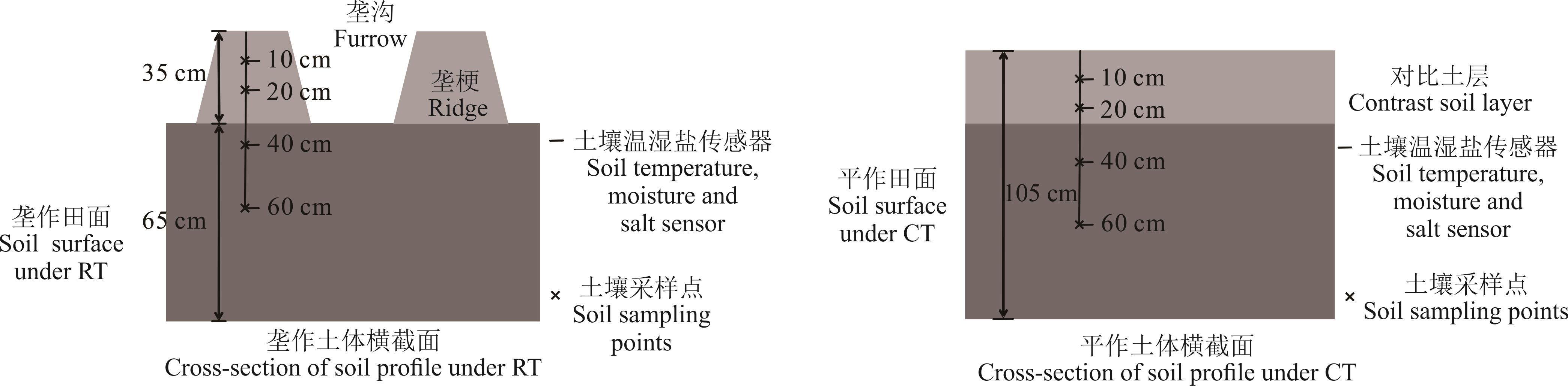
图1 垄作、平作田块土壤剖面结构及采样点分布
Fig. 1 The distribution of soil profile and sampling points under ridge tillage (RT) and conventional tillage (CT) in paddy fields
处理 Treatment | pH | 有机质 Organic matter (g?kg-1) | 速效钾 Available potassium (mg?kg-1) | 速效磷 Available phosphorus (mg?kg-1) | 速效氮 Available nitrogen (mg?kg-1) | 全钾 Total potassium (g?kg-1) | 全磷 Total phosphorus (g?kg-1) | 全氮 Total nitrogen (g?kg-1) | 容重 Bulk density (g?cm-3) | 孔隙度 Porosity (%) |
|---|---|---|---|---|---|---|---|---|---|---|
| RT | 7.5 | 28.2 | 65.5 | 20.2 | 149.5 | 19.7 | 0.84 | 1.64 | 1.25 | 49.8 |
| CT | 7.2 | 29.1 | 68.0 | 31.3 | 154.5 | 18.9 | 1.01 | 1.64 | 1.32 | 47.6 |
表1 不同耕作方式下耕作土壤的基本理化指标
Table 1 Basic physical and chemical properties of soil under different tillage practices
处理 Treatment | pH | 有机质 Organic matter (g?kg-1) | 速效钾 Available potassium (mg?kg-1) | 速效磷 Available phosphorus (mg?kg-1) | 速效氮 Available nitrogen (mg?kg-1) | 全钾 Total potassium (g?kg-1) | 全磷 Total phosphorus (g?kg-1) | 全氮 Total nitrogen (g?kg-1) | 容重 Bulk density (g?cm-3) | 孔隙度 Porosity (%) |
|---|---|---|---|---|---|---|---|---|---|---|
| RT | 7.5 | 28.2 | 65.5 | 20.2 | 149.5 | 19.7 | 0.84 | 1.64 | 1.25 | 49.8 |
| CT | 7.2 | 29.1 | 68.0 | 31.3 | 154.5 | 18.9 | 1.01 | 1.64 | 1.32 | 47.6 |
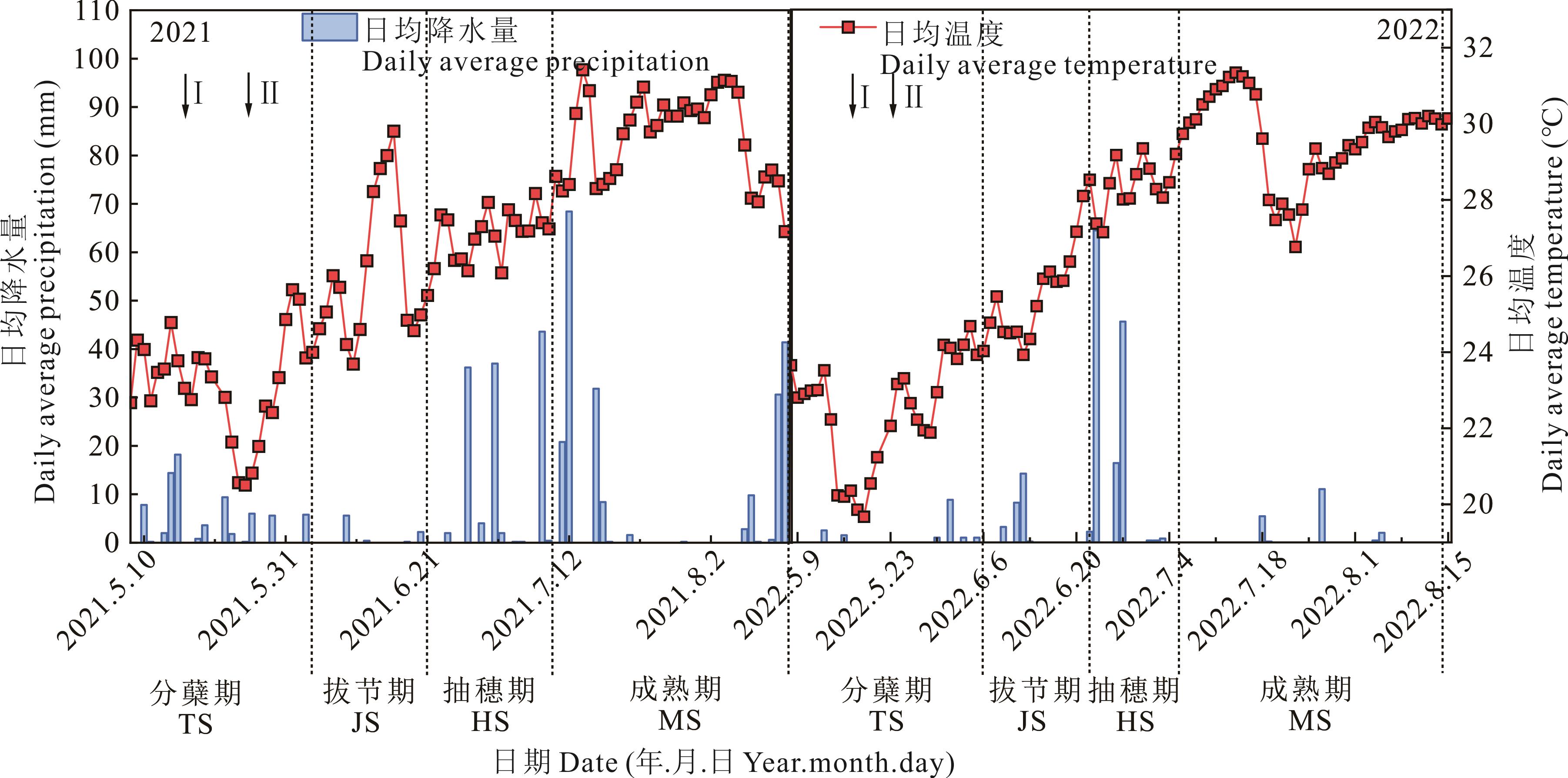
图2 2021-2022年日均降水量和气温Ⅰ:第1次施肥时间First fertilization time;Ⅱ:第2次施肥时间Second fertilization time. TS:分蘖期 Tillering stage;JS:拔节期 Jointing stage;HS:抽穗期 Heading stage;MS:成熟期 Maturation stage.下同The same below.
Fig.2 Daily mean precipitation and temperature during 2021-2022

图3 耕作模式与生育时期对0~20 cm土壤铵态氮和硝态氮含量的影响*表示P<0.05,**表示P<0.01,NS表示没有显著相关性,下同。* indicates P<0.05,** indicates P<0.01,NS indicates no significant correlation, the same below.
Fig. 3 Effets of tillage mode and growth stage on the content of ammonium nitrogen and nitrate nitrogen in the 0-20 cm soil layer
生育时期 Growth stage | 处理 Treatment | 含氮量Nitrogen content (g?kg-1) | 生物量Biomass (g?m-2) | 氮利用率Nitrogen use efficiency (%) | |||
|---|---|---|---|---|---|---|---|
| 2021 | 2022 | 2021 | 2022 | 2021 | 2022 | ||
分蘖期 Tillering stage | RT | 45.45 | 42.78 | 202.12 | 256.78 | 21.86 | 20.58 |
| CT | 38.64 | 41.48 | 208.88 | 198.45 | 18.59 | 19.95 | |
| P值 P value | 0.024 | 0.456 | 0.104 | 0.036 | 0.009 | 0.553 | |
拔节期 Jointing stage | RT | 42.88 | 42.33 | 404.53 | 492.89 | 20.63 | 20.36 |
| CT | 38.59 | 39.12 | 392.41 | 423.67 | 18.56 | 18.82 | |
| P值 P value | 0.057 | 0.043 | 0.098 | 0.100 | 0.204 | 0.040 | |
抽穗期 Heading stage | RT | 41.93 | 41.21 | 974.36 | 1086.56 | 20.17 | 19.82 |
| CT | 36.91 | 38.45 | 896.60 | 981.23 | 17.75 | 18.49 | |
| P值 P value | 0.061 | 0.067 | 0.126 | 0.021 | 0.131 | 0.219 | |
成熟期 Maturation stage | RT | 41.15 | 42.56 | 1497.44 | 1659.78 | 19.79 | 20.47 |
| CT | 36.03 | 37.80 | 1334.52 | 1517.89 | 17.33 | 18.18 | |
| P值 P value | 0.459 | 0.491 | 0.031 | 0.044 | 0.191 | 0.201 | |
表2 两种耕作模式下水稻在不同生育时期的含氮量、生物量和氮利用率
Table 2 The nitrogen content, biomass and nitrogen use efficiency of paddy rice under two tillage modes at different growth stages
生育时期 Growth stage | 处理 Treatment | 含氮量Nitrogen content (g?kg-1) | 生物量Biomass (g?m-2) | 氮利用率Nitrogen use efficiency (%) | |||
|---|---|---|---|---|---|---|---|
| 2021 | 2022 | 2021 | 2022 | 2021 | 2022 | ||
分蘖期 Tillering stage | RT | 45.45 | 42.78 | 202.12 | 256.78 | 21.86 | 20.58 |
| CT | 38.64 | 41.48 | 208.88 | 198.45 | 18.59 | 19.95 | |
| P值 P value | 0.024 | 0.456 | 0.104 | 0.036 | 0.009 | 0.553 | |
拔节期 Jointing stage | RT | 42.88 | 42.33 | 404.53 | 492.89 | 20.63 | 20.36 |
| CT | 38.59 | 39.12 | 392.41 | 423.67 | 18.56 | 18.82 | |
| P值 P value | 0.057 | 0.043 | 0.098 | 0.100 | 0.204 | 0.040 | |
抽穗期 Heading stage | RT | 41.93 | 41.21 | 974.36 | 1086.56 | 20.17 | 19.82 |
| CT | 36.91 | 38.45 | 896.60 | 981.23 | 17.75 | 18.49 | |
| P值 P value | 0.061 | 0.067 | 0.126 | 0.021 | 0.131 | 0.219 | |
成熟期 Maturation stage | RT | 41.15 | 42.56 | 1497.44 | 1659.78 | 19.79 | 20.47 |
| CT | 36.03 | 37.80 | 1334.52 | 1517.89 | 17.33 | 18.18 | |
| P值 P value | 0.459 | 0.491 | 0.031 | 0.044 | 0.191 | 0.201 | |

图4 不同生育时期水稻氮吸收总量与土壤无机氮浓度的变化
Fig. 4 Changes in total nitrogen uptake of paddy rice and concentration of soil inorganic nitrogen during different growth stages

图5 两种耕作模式和生育时期下土壤温度、含水率、电导率特征及其与无机氮含量的相关性土壤温度、含水率和电导率均为0~20 cm土层连续监测值,按生育期进行平均计算。The data in the soil temperature, moisture content, and electrical conductivity were continuously monitored at 0-20 cm depth and averaged by growth stage.
Fig.5 Soil temperature, moisture content and electrical conductivity characteristics and their relationships with inorganic nitrogen content under different tillage practices and growth stages

图6 土壤铵态氮、硝态氮含量随水稻移栽后种植天数的变化模拟RMSE:均方根误差 Root mean square error;MAE:平均绝对误差 Mean absolute error.
Fig.6 Changes simulated in soil NH4+-N and NO3--N content with days after transplanting of paddy rice
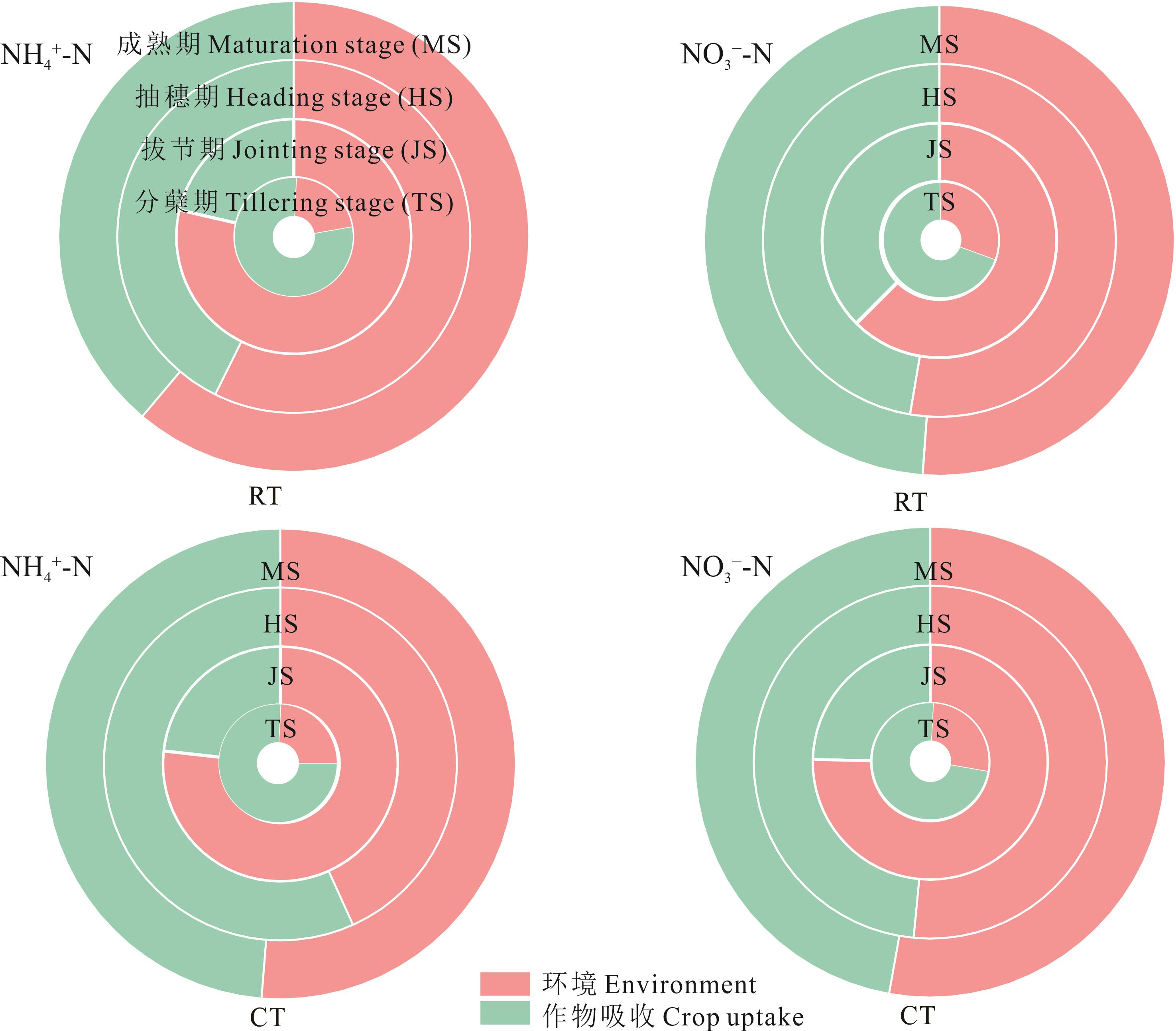
图7 环境因子与作物吸收对无机氮变化的贡献比例
Fig.7 Contribution proportions of environmental factors and crop uptake to inorganic nitrogen variation
| [1] | Lu B, Xu C S, Li Z Y, et al. Influence of the temperature during grain filling stage and nitrogen application rate on yield and quality of indica hybrid rice. Field Crops Research, 2024, 309: 109333. |
| [2] | Pandey A, Devi L L, Gupta S, et al. Jasmonate signaling modulates root growth by suppressing iron accumulation during ammonium stress. Plant Physiology, 2024, 196(4): 2213-2231. |
| [3] | Liu S Y, Chi Q D, Cheng Y, et al. Importance of matching soil N transformations, crop N form preference, and climate to enhance crop yield and reducing N loss. Science of the Total Environment, 2019, 657: 1265-1273. |
| [4] | Zhou Y, Sun T, Zhang Y H, et al. Effects of nitrogen fertilization levels on matter accumulation and nitrogen uptake in different source and library types of japonica rice. Scientia Agricultura Sinica, 2025, 58(11): 2096-2117. |
| 周宇, 孙童, 张艳红, 等. 施氮量对不同源库类型粳稻物质积累与氮素吸收的影响. 中国农业科学, 2025, 58(11): 2096-2117. | |
| [5] | Jin Z Q, Tao Y, Yue R, et al. Trade-off between grain yield and bioactive substance content of colored rice under coupled water and nitrogen conditions. Field Crops Research, 2024, 309: 109312. |
| [6] | Yan J, Wu Q X, Qi D L, et al. Rice yield, water productivity, and nitrogen use efficiency responses to nitrogen management strategies under supplementary irrigation for rain-fed rice cultivation. Agricultural Water Management, 2022, 263: 107486. |
| [7] | Khanam S, Ray K S, Bhuiyan H R, et al. Advancing nutrient management in agriculture: Rice straw to nitrogen, phosphorus and potassium-containing hydrogel as slow-release fertilizer. Industrial Crops & Products, 2025, 224: 120380. |
| [8] | Lin Y L, Feng Z, Asano H, et al. Genome-wide association study identifies key chromosomal regions in rice promoting the enrichment of diazotrophic iron-reducing bacteria in paddy soil. Plant and Soil, 2025, 514(1): 269-285. |
| [9] | Zhou G D, Wei C L, Li P H, et al. Modeling the effect of milk vetch-rice rotation on N runoff loss in the middle and lower reaches of the Yangtze River. Plants, 2024, 13(22): 3160. |
| [10] | Huang D L Y, Tang B R, Ma Y Y, et al. The effect of as on the transformation of nitrogen in paddy soil: A case study towards purple soil. Ecology and Environmental Sciences, 2025, 34(5): 784-795. |
| 黄邓铃尧, 唐炳然, 马媛媛, 等. 水稻土中砷对氮素转化的影响: 以紫色土为例. 生态环境学报, 2025, 34(5): 784-795. | |
| [11] | Hou Q, Ni Y M, Huang S, et al. Effects of substituting chemical fertilizers with manure on rice yield and soil labile nitrogen in paddy fields of China: A meta-analysis. Pedosphere, 2023, 33(1): 172-184. |
| [12] | Zhou L, Rong X M, Xie G X, et al. Effects of different nitrogen fertilizers on ammonia volatilization and its dynamic characteristics of double cropping rice. Journal of Soil and Water Conservation, 2014, 28(4): 143-147. |
| 周亮, 荣湘民, 谢桂先, 等. 不同氮肥施用对双季稻稻田氨挥发及其动力学特性的影响. 水土保持学报, 2014, 28(4): 143-147. | |
| [13] | Zhang Y, Zhang Y X, Lv X M, et al. Study on physiological mechanism of NO3⁻ alleviating NH4⁺ stress in wheat. Plant Physiology Journal, 2021, 57(2): 480-492. |
| 张燕, 张云秀, 吕雪梅, 等. NO₃⁻缓解小麦NH₄⁺胁迫的生理机制研究. 植物生理学报, 2021, 57(2): 480-492. | |
| [14] | Zhang X J, Wei J J, Chen C J, et al. Optimization of annual nitrogen fertilizer application to increase the productivity of a forage triticale-silage maize multiple cropping system in an irrigated area. Acta Prataculturae Sinica, 2025, 34(4): 38-52. |
| 张晓娟, 魏娇娇, 陈彩锦, 等. 氮肥周年优化对灌区饲用小黑麦-青贮玉米复种系统生产力的影响. 草业学报, 2025, 34(4): 38-52. | |
| [15] | Xiao A P, Ma R, Wang B, et al. Effects of combined application of nitrogen, phosphorus and potassium on seed yield and its components of Stipa bungeana. Pratacultural Science, 2026, 43(2): 321-333. |
| 肖爱萍, 马榕, 王斌, 等. 氮磷钾配施对长芒草种子生产性能和发芽特性的影响. 草业科学, 2026, 43(2): 321-333. | |
| [16] | Xu G W, Zhao X H, Jiang M M, et al. Nitrogen forms and irrigation regimes interact to affect rice yield by regulating the source and sink characteristics. Agronomy Journal, 2021, 113(5): 4022-4036. |
| [17] | Liu H, Wu S J, Chen X R, et al. Effects of oxygenation and nitrogen forms on root biological characteristics and cadmium accumulation in rice. Chinese Journal of Ecology, 2024, 44(6): 1971-1979. |
| 刘慧, 吴松瑾, 陈馨睿, 等. 充氧和氮素形态对水稻根系生物学特征及镉累积的影响. 生态学杂志, 2024, 44(6): 1971-1979. | |
| [18] | Fu S, Wang Y Q, Liu X M, et al. Dry matter,nitrogen accumulation of maize and soil nitrogen in response to different forms of nitrogen fertilizers. Soils and Fertilizers Sciences in China, 2023(4): 122-129. |
| 付帅, 王艳群, 刘晓明, 等. 不同形态氮肥对玉米干物质、氮素积累及土壤氮素的影响. 中国土壤与肥料, 2023(4): 122-129. | |
| [19] | Moises C, Andrade H F, Monzon P J, et al. Nitrogen deficiency in maize fields of the Southern Pampas does not affect kernel number but reduces weight per kernel. Field Crops Research, 2024, 312: 109394. |
| [20] | Yan E R, Wang X H, Huang J J, et al. Decline of soil nitrogen mineralization and nitrification during forest conversion of evergreen broad-leaved forest to plantations in the subtropical area of eastern China. Biogeochemistry, 2008, 89(2): 239-251. |
| [21] | Yin Z Y, Ma L H, Li Z L, et al. Impact of high temperature on soil water, heat and salt in purple paddy under different tillage patterns. Acta Prataculturae Sinica, 2024, 33(5): 80-91. |
| 尹仲毅, 马黎华, 李兆磊, 等. 高温条件对不同耕作模式紫色水稻土水、热、盐的影响. 草业学报, 2024, 33(5): 80-91. | |
| [22] | Xiong Z, Zheng F Z, Wu C, et al. Nitrogen supply mitigates temperature stress effects on rice photosynthetic nitrogen use efficiency and water relations. Plants, 2025, 14(6): 961. |
| [23] | Ouyang X J, Zhou G Y, Wei S G, et al. Soil organic carbon and nitrogen mineralization during the succession sequence of vegetation restoration in a south subtropical forest. Chinese Journal of Applied Ecology, 2007, 18(8): 1688-1694. |
| 欧阳学军, 周国逸, 魏识广, 等. 南亚热带森林植被恢复演替序列的土壤有机碳氮矿化. 应用生态学报, 2007, 18(8): 1688-1694. | |
| [24] | Bai X Y, Li J W, Jiang H B, et al. Effects of multiple temperature variations on nitrogen removal and microbial community structure in tidal flow constructed wetlands. Environmental Research, 2024, 266: 120616. |
| [25] | Wang G J, Tian D L, Zhu F, et al. Net nitrogen mineralization in soils under four forest communities in Hunan Province. Acta Ecologica Sinica, 2009, 29(3): 1607-1615. |
| 王光军, 田大伦, 朱凡, 等. 湖南省4种森林群落土壤氮的矿化作用. 生态学报, 2009, 29(3): 1607-1615. | |
| [26] | Song L C, Ma W W, Li G, et al. Effects of temperature changes on nitrogen mineralization in soils with different degradation gradients in the Gahai Wetland. Acta Prataculturae Sinica, 2021, 30(9): 27-37. |
| 宋良翠, 马维伟, 李广, 等. 温度变化对尕海湿地不同退化梯度土壤氮矿化的影响. 草业学报, 2021, 30(9): 27-37. | |
| [27] | Heumann S, Böttcher J. Temperature functions of the rate coefficients of net N mineralization in sandy arable soils. Part Ⅱ. Evaluation. Journal of Plant Nutrition and Soil Science, 2004, 167(4): 390-396. |
| [28] | Shrestha D, Masarik K, Kucharik C. Nitrate losses from Midwest US agroecosystems: Impacts of varied management and precipitation. Journal of Soil and Water Conservation, 2023, 78(2): 141-153. |
| [29] | Xu J B. Characteristics of nitrogen migration and transformation and numerical simulation in soils with different salinization degrees under nitrogen application conditions in Xinjiang. Xi’an: Xi’an University of Technology, 2023. |
| 徐金波. 施氮条件下新疆不同盐碱化程度土壤氮素迁移转化特性及数值模拟. 西安: 西安理工大学, 2023. | |
| [30] | Li Y S, Ai Z Y, Mu Y X, et al. Rice yield penalty and quality deterioration is associated with failure of nitrogen uptake from regreening to panicle initiation stage under salinity. Frontiers in Plant Science, 2023, 14: 1120755. |
| [31] | Musarrat R, Naila S, Liaqat A, et al. Nitrogen enriched chemically produced carbon supplementary impacts on maize growth under saline soil conditions. Journal of King Saud University Science, 2023, 35(1): 102292. |
| [32] | Zhang P, Zhang Z Z, Liu X Y, et al. Effect of mulching and biochar addition on the distribution and emission characteristics of N2O from furrow-ridge tillage soils. Journal of Environmental Management, 2023, 345: 118584. |
| [33] | Li H, Zeng S, Luo X W, et al. Effects of small ridge-and-furrow mulching degradable film on dry direct-seeded rice. Scientific Reports, 2021, 11(1): 317. |
| [34] | Xu Y G, Feng J Y, Li H S. Water management increased rhizosphere redox potential and decreased Cd uptake in a low-Cd rice cultivar but decreased redox potential and increased Cd uptake in a high-Cd rice cultivar under intercropping. Science of the Total Environment, 2021, 751: 141701. |
| [35] | Qin C. Study on the mechanism of improving soilnitrogen fertility by combination ridge with no-tillage in paddy field. Chongqing: Southwest University, 2021. |
| 秦川. 稻田垄作免耕提高土壤氮素肥力的作用机制研究. 重庆: 西南大学, 2021. | |
| [36] | Xiong Z H, Liu J Q, Ye L, et al. Characterization of crop yield and nutrient apparent balance between direct and burning straw return in rice-rapeseed rotation system. Scientia Agricultura Sinica, 2025, 58(16): 3293-3303. |
| 熊志豪, 刘君权, 叶琳, 等. 稻油轮作系统秸秆直接还田与焚烧还田的作物产量和养分表观平衡特征. 中国农业科学, 2025, 58(16): 3293-3303. | |
| [37] | Zhang P, Wang D M, Zhang Z Z, et al. How biochar curbs the negative impacts of plastic mulching on soil enzymes and microorganisms while elevating crop yields in ridge-furrow systems. Environmental Research, 2024, 263(P2): 120155. |
| [38] | Zhang F, Yang Q. Effects of co-utilization of Chinese milk vetch and rice straw on the potassium cycle and potassium balance in paddy soil. Acta Prataculturae Sinica, 2021, 30(1): 72-80. |
| 张帆, 杨茜. 紫云英与双季稻秸秆协同利用影响稻田土壤钾循环与平衡. 草业学报, 2021, 30(1): 72-80. | |
| [39] | Liu H, Jiao Y, Dou W Y, et al. Compensation effect and mechanism of nitrogen reduction combined with biochar application on soil fertility and rice yield. Transactions of the Chinese Society for Agricultural Machinery, 2024, 55(9): 391-401, 469. |
| 刘慧, 焦岩, 窦婉毓, 等. 减氮配施生物炭对土壤肥力和水稻产量的补偿效应与机制. 农业机械学报, 2024, 55(9): 391-401, 469. | |
| [40] | Liu L Y, Feng T J, Xiao H J, et al. Response of soil moisture storages and soil carbon stocks to typical patterns of farmland shelterbelt systems in the Hetao Irrigation area, China. Acta Pedologica Sinica, 2025, 62(5): 1495-1510. |
| 刘莉苑, 冯天骄, 肖辉杰, 等. 河套灌区典型农田防护林土壤水碳储量对林带配置的响应. 土壤学报, 2025, 62(5): 1495-1510. | |
| [41] | Kun H, Yao G X, Li Z, et al. Ridge and furrow cultivation raises water and nitrogen use efficiency and crop climate adaptability. Agricultural Water Management, 2025, 317: 109657. |
| [42] | Yin Z Y. Effects of ridging on water heat transport and nitrogen distribution in paddy soil. Chongqing: Southwest University, 2023. |
| 尹仲毅. 垄作对稻田土壤水热运移及氮素分布的影响. 重庆: 西南大学, 2023. | |
| [43] | Zhang C, Dong Z Y, Guo Q, et al. Ridge-furrow rainwater harvesting combined with supplementary irrigation: Water-saving and yield-maintaining mode for winter wheat in a semiarid region based on 8-year in-situ experiment. Agricultural Water Management, 2022, 259: 107239. |
| [44] | Wu K K, Li W T, Wei Z B, et al. Effects of mild alternate wetting and drying irrigation and rice straw application on N2O emissions in rice cultivation. Soil, 2022, 8(2): 645-654. |
| [45] | Wang H, Yan Z F, Ju X T, et al. Quantifying nitrous oxide production rates from nitrification and denitrification under various moisture conditions in agricultural soils: Laboratory study and literature synthesis. Frontiers in Microbiology, 2023, 13: 1110151. |
| [1] | 田吉鹏, 王欣, Mudasir Nazar, 刘蓓一, 王思然, 丁成龙, 程云辉, 李捷. 青贮前后水稻秸秆非结构性碳水化合物的变化及添加剂对发酵和微生物群落结构的影响[J]. 草业学报, 2026, 35(6): 131-144. |
| [2] | 范菊凤, 潘浪, 彭德军, 彭亚军, 李巳夫, 农成银, 杜坚豪, 刘祥英, 马国兰. 稗草对水稻生长和产量性状的影响及其防除经济阈值研究[J]. 草业学报, 2026, 35(4): 124-134. |
| [3] | 陈丹丹, 王垚, 郭田心, 梁秋雨, 张庆, 骈瑞琪. 纤维素降解菌的筛选以及对水稻秸秆的代谢利用[J]. 草业学报, 2025, 34(9): 185-193. |
| [4] | 李浩晶, 张丹珂, 李海润, 曹静, 徐国伟. 施氮对不同食味品质水稻根系生长及分泌有机酸的影响[J]. 草业学报, 2025, 34(2): 163-173. |
| [5] | 尹仲毅, 马黎华, 李兆磊, 冯桦, 蒋先军. 高温条件对不同耕作模式紫色水稻土水、热、盐的影响[J]. 草业学报, 2024, 33(5): 80-91. |
| [6] | 吕帅磊, 常单娜, 周国朋, 刘蕊, 赵鑫, 刘佳, 徐昌旭, 曹卫东. 江西红壤绿肥季施用磷矿粉的磷素效应[J]. 草业学报, 2024, 33(11): 149-160. |
| [7] | 黄丽娟, 孙镕基, 高文婧, 张志飞, 陈桂华. 全株水稻表面优势乳酸菌的筛选与鉴定[J]. 草业学报, 2024, 33(1): 117-125. |
| [8] | 徐蕊, 王峥, 王仪明, 苏连泰, 高鲤, 周鹏, 安渊. 紫花苜蓿对轮作水稻产量和蔗糖代谢的影响[J]. 草业学报, 2023, 32(8): 129-140. |
| [9] | 吴永杰, 丁浩, 邵涛, 赵杰, 董东, 代童童, 尹雪敬, 宗成, 李君风. 酶制剂对水稻秸秆青贮发酵品质及体外消化特性的影响[J]. 草业学报, 2022, 31(8): 167-177. |
| [10] | 甘凤玲, 韦杰, 李沙沙. 紫色土埂坎典型草本根系摩阻特性对土壤含水率的响应[J]. 草业学报, 2022, 31(7): 28-37. |
| [11] | 李君风, 赵杰, 唐小月, 代童童, 董东, 宗成, 邵涛. 瘤胃纤维素降解菌系对灭菌水稻秸秆结构性碳水化合物降解的影响[J]. 草业学报, 2022, 31(7): 85-95. |
| [12] | 米永伟, 龚成文, 邵武平, 彭云霞. 覆膜对高寒阴湿区土壤水热与当归根系生长的调控效应[J]. 草业学报, 2022, 31(12): 66-75. |
| [13] | 黄丽琴, 李松桥, 袁振中, 唐晶, 闫景彩, 唐启源. 全株水稻与平菇菌糠共发酵料对浏阳黑山羊屠宰性能、肉品质和器官指数的影响[J]. 草业学报, 2021, 30(6): 133-140. |
| [14] | 张茹, 李建平, 彭文栋, 王芳, 李志刚. 柠条枝条覆盖对宁夏荒漠草原土壤水热及补播牧草生物量的影响[J]. 草业学报, 2021, 30(4): 58-67. |
| [15] | 张帆, 杨茜. 紫云英与双季稻秸秆协同利用影响稻田土壤钾循环与平衡[J]. 草业学报, 2021, 30(1): 72-80. |
| 阅读次数 | ||||||
|
全文 |
|
|||||
|
摘要 |
|
|||||
