

ISSN 1004-5759 CN 62-1105/S
草业学报 ›› 2026, Vol. 35 ›› Issue (10): 48-60.DOI: 10.11686/cyxb2025425
赵炳森( ), 康文娟(), 师尚礼(), 关键, 陆保福, 韩宜霖, 王晶晶, 陈凤娇
收稿日期:2025-10-18
修回日期:2025-12-08
出版日期:2026-10-20
发布日期:2026-09-09
通讯作者:
康文娟,师尚礼
作者简介:shishangli@gsau.edu.cn基金资助:
Bing-sen ZHAO(), Wen-juan KANG(), Shang-li SHI(), Jian GUAN, Bao-fu LU, Yi-lin HAN, Jing-jing WANG, Feng-jiao CHEN
Received:2025-10-18
Revised:2025-12-08
Online:2026-10-20
Published:2026-09-09
Contact:
Wen-juan KANG,Shang-li SHI
摘要:
“甘农9号紫花苜蓿-根瘤菌株LL2”构成高效的固氮系统。为明确施氮量对该系统生产力的影响,试验设置4个氮(N)浓度添加处理:N 0 kg·hm-2(R)、N 35.09 kg·hm-2(NR1)、N 46.79 kg·hm-2(NR2)、N 58.48 kg·hm-2(NR3),于分枝期、现蕾期和初花期测定单株有效根瘤数、单株有效根瘤重、固氮酶活性、株高、根长、地上部与地下部干重、粗蛋白(CP)、粗脂肪(EE)、中性洗涤纤维(NDF)、酸性洗涤纤维(ADF)及饲草分级指数(FGI)等指标,以相同施氮水平下不接种根瘤菌LL2为对照组:N 0 kg·hm-2(CK1)、N 35.09 kg·hm-2(CK2)、N 46.79 kg·hm-2(CK3)、N 58.48 kg·hm-2(CK4),系统研究氮浓度添加处理对甘农9号-LL2共生系统的结瘤固氮、苜蓿生长及营养品质的影响。结果表明:NR2处理下,甘农9号-LL2共生系统在分枝期、现蕾期和初花期的单株有效根瘤数分别为22、32和35个,单株有效根瘤重分别为0.0353、0.0745和0.1013 g·株-1,固氮酶活性分别为4.79、26.51和28.13 μmol·g-1·h?1,均随生长进程呈递增趋势,初花期株高为51.92 cm、粗蛋白含量为20.42%,根长以及地上、地下干重均高于其他氮添加处理和对照(P<0.05),中性洗涤纤维和酸性洗涤纤维含量均低于其他氮添加处理和对照(P<0.05)。NR2处理的良好结瘤固氮效应和促生效应主要发生在分枝期,单株有效根瘤数相较于R处理增长率为84.44%,单株有效根瘤重、固氮酶活性分别为R处理的2.5和3.1倍,根长、地上和地下干重增长率亦均高于现蕾期和初花期。现蕾期,NR2处理对中性洗涤纤维、酸性洗涤纤维的降低效应突出,分别较R处理降低3.82%和6.03%,优于分枝期和初花期。初花期,NR2处理对粗蛋白的提高效应明显,较R处理提高了9.04%,优于分枝期和现蕾期。通过对初花期的饲草分级指数评定,NR2处理的FGI值为54.91 MJ·d?1,饲草等级为特级。46.79 kg·hm-2是优化甘农9号-LL2共生系统生产力的最适施氮量。研究结果为甘农9号紫花苜蓿-LL2高效共生系统的生产力提升提供了栽培理论依据。
赵炳森, 康文娟, 师尚礼, 关键, 陆保福, 韩宜霖, 王晶晶, 陈凤娇. 氮添加对甘农9号紫花苜蓿-LL2共生系统生产力的影响[J]. 草业学报, 2026, 35(10): 48-60.
Bing-sen ZHAO, Wen-juan KANG, Shang-li SHI, Jian GUAN, Bao-fu LU, Yi-lin HAN, Jing-jing WANG, Feng-jiao CHEN. Effects of nitrogen addition on the productivity of the Medicago sativa ‘Gannong No.9’-LL2 Rhizobium symbiotic system[J]. Acta Prataculturae Sinica, 2026, 35(10): 48-60.
分级 Grade | 饲草分级指数 Forage grading index |
|---|---|
| 特级Special grade | >53.68 |
| 1级Grade 1 | 33.50~53.68 |
| 2级Grade 2 | 19.20~29.29 |
| 3级Grade 3 | 11.10~16.44 |
| 4级Grade 4 | 6.28~10.67 |
| 5级Grade 5 | <6.28 |
表1 粗饲料质量等级标准
Table 1 Grade standard of roughage quality(MJ·d-1)
分级 Grade | 饲草分级指数 Forage grading index |
|---|---|
| 特级Special grade | >53.68 |
| 1级Grade 1 | 33.50~53.68 |
| 2级Grade 2 | 19.20~29.29 |
| 3级Grade 3 | 11.10~16.44 |
| 4级Grade 4 | 6.28~10.67 |
| 5级Grade 5 | <6.28 |
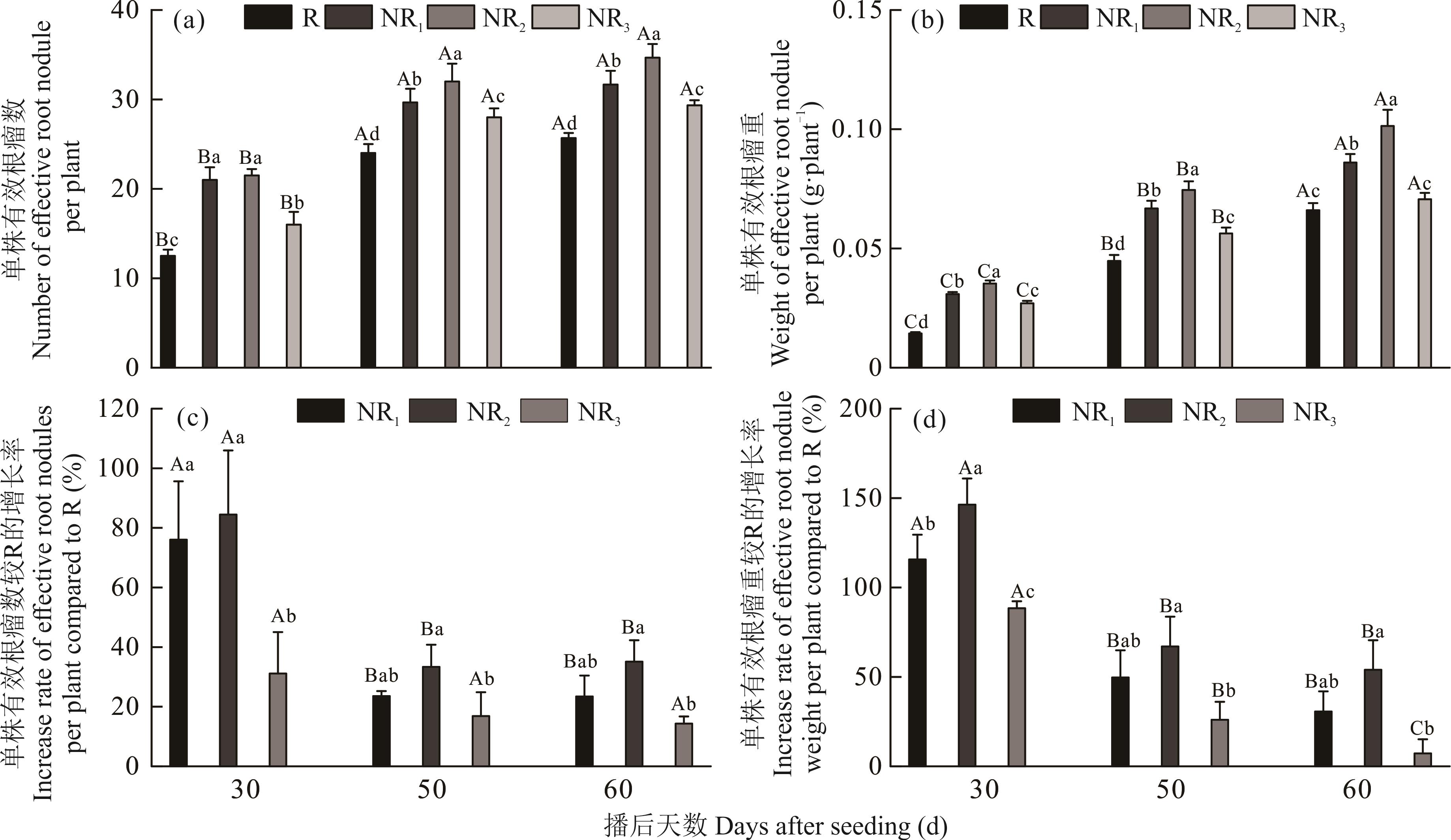
图1 不同氮素水平下甘农9号-LL2共生系统的结瘤差异不同大写字母表示同一处理在不同时间段差异显著(P<0.05),不同小写字母表示同一时期内不同处理间差异显著(P<0.05);R:N 0 kg·hm-2处理;NR1:N 35.09 kg·hm-2处理;NR2:N 46.79 kg·hm-2处理;NR3:N 58.48 kg·hm-2处理,4个处理均为接种中华根瘤菌LL2。下同。Different uppercase letters indicate significant differences within the same treatment across different time periods (P<0.05), while different lowercase letters indicate significant differences among treatments within the same stage (P<0.05); R: Nitrogen 0 kg·ha?1 treatment; NR1: Nitrogen 35.09 kg·ha?1 treatment; NR2: Nitrogen 46.79 kg·ha?1 treatment; NR3: Nitrogen 58.48 kg·ha?1 treatment, all four treatments were inoculated with rhizobium LL2. The same below.
Fig.1 Nodulation difference of the Gannong No.9-LL2 symbiotic system under different nitrogen levels
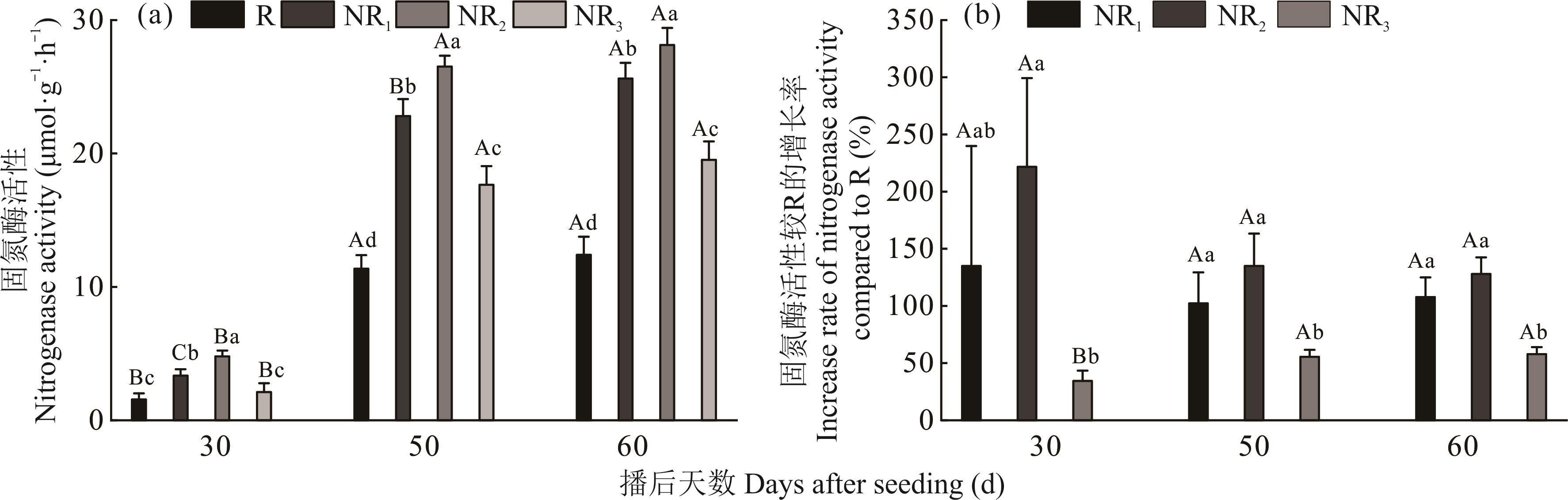
图2 不同氮素水平下甘农9号-LL2共生系统的固氮能力差异
Fig.2 Differences in the nitrogen-fixing capacity of the Gannong No.9-LL2 symbiotic system under different nitrogen levels

图3 甘农9号- LL2共生系统在不同氮素水平下的表型变化小写字母表示同一时期内不同处理间差异显著(P<0.05);CK1:N 0 kg·hm-2未接种根瘤菌LL2处理;CK2:N 35.09 kg·hm-2未接种根瘤菌LL2处理;CK3:N 46.79 kg·hm-2未接种根瘤菌LL2处理;CK4:N 58.48 kg·hm-2未接种根瘤菌LL2处理。下同。Different lowercase letters indicate significant differences among treatments within the same stage (P<0.05); CK1: Nitrogen 0 kg·ha?1 without inoculation of rhizobium LL2; CK2: Nitrogen 35.09 kg·ha?1 without inoculation of rhizobium LL2; CK3: Nitrogen 46.79 kg·ha?1 without inoculation of rhizobium LL2; CK4: Nitrogen 58.48 kg·ha?1 treatment without inoculation of rhizobium LL2. The same below.
Fig.3 Phenotypic changes of the Gannong No.9-LL2 symbiotic system under different nitrogen levels

图4 不同氮素水平下甘农9号-LL2共生系统的营养品质变化
Fig.4 Nutritional quality changes of the Gannong No.9-LL2 symbiotic system under different nitrogen levels
处理 Treatments | 饲草分级指数 Forage grading index (MJ·d-1) | 饲草分级指数级别 Forage grading index grade |
|---|---|---|
| CK1 | 42.67 | 1级Grade 1 |
| R | 45.80 | 1级Grade 1 |
| CK2 | 43.30 | 1级Grade 1 |
| CK3 | 42.21 | 1级Grade 1 |
| CK4 | 42.25 | 1级Grade 1 |
| NR1 | 51.12 | 1级Grade 1 |
| NR2 | 54.91 | 特级Special grade |
| NR3 | 47.46 | 1级Grade 1 |
表2 初花期8个处理的饲草分级指数级别
Table 2 Forage grading index grades of 8 treatments
处理 Treatments | 饲草分级指数 Forage grading index (MJ·d-1) | 饲草分级指数级别 Forage grading index grade |
|---|---|---|
| CK1 | 42.67 | 1级Grade 1 |
| R | 45.80 | 1级Grade 1 |
| CK2 | 43.30 | 1级Grade 1 |
| CK3 | 42.21 | 1级Grade 1 |
| CK4 | 42.25 | 1级Grade 1 |
| NR1 | 51.12 | 1级Grade 1 |
| NR2 | 54.91 | 特级Special grade |
| NR3 | 47.46 | 1级Grade 1 |
| [1] | He L. Study on the symbiotic nitrogen-fixing effect of alfalfa cultivars and rhizobium strains.Lanzhou: Gansu Agricultural University, 2023. |
| 何龙. 紫花苜蓿品种-根瘤菌株共生固氮效应研究. 兰州: 甘肃农业大学, 2023. | |
| [2] | Yang Q Y, Jie X L, Hua D L, et al. Effect of B, Mn and Mo combined application on grass yield and mineral element absorption of alfalfa. Chinese Agricultural Science Bulletin, 2009, 25(5): 182-185. |
| 杨秋云, 介晓磊, 化党领, 等. 硼锰钼配施对紫花苜蓿草产量和矿物质元素吸收的影响. 中国农学通报, 2009, 25(5): 182-185. | |
| [3] | Zhang C M, Wang C Z, Hu X F, et al. Research progress on the nutritional value and applications of alfalfa. China Feed, 2005(1): 15-17. |
| 张春梅, 王成章, 胡喜峰, 等. 紫花苜蓿的营养价值及应用研究进展. 中国饲料, 2005(1): 15-17. | |
| [4] | Zhu T Q. Study on establishment of alfalfa phosphorus efficiency evaluation system and difference metabolism in nitrogen and phosphorus. Lanzhou: Gansu Agricultural University, 2018. |
| 朱天琦. 紫花苜蓿磷效率评价体系建立及其氮磷代谢差异研究. 兰州: 甘肃农业大学, 2018. | |
| [5] | Yan W. Screening of rhizobium strains matched with Medicago varia Martyn cv. Caoyuan No.3 in three pilot planting areas. Hohhot: Inner Mongolia Agricultural University, 2018. |
| 闫伟. 草原3号杂花苜蓿在3个试点区适宜根瘤菌株的筛选. 呼和浩特: 内蒙古农业大学, 2018. | |
| [6] | Pavlo A, Leonid O, Iryna Z, et al. Endophytic bacteria enhancing growth and disease resistance of potato (Solanum tuberosum L.). Biological Control, 2011, 56(1): 43-49. |
| [7] | Miliute I, Buzaite O, Baniulis D, et al. Bacterial endophytes in agricultural crops and their role in stress tolerance: A review. Zemdirbyste-Agriculture, 2015, 102(4): 465-478. |
| [8] | Liu R, Li C, Zhang Y J, et al. Enhanced biological nitrogen fixation and nodulation in alfalfa through the synergistic interactions between Sinorhizobium meliloti and Priestia aryabhattai. World Journal of Microbiology and Biotechnology, 2025, 41(6): 180. |
| [9] | Provorov N, Saimnazarov U, Tanriverdiev T, et al. The contributions of plant and bacteria genotypes in the growth and nitrogen accumulation of inoculated alfalfa. Plant and Soil, 1994, 164(2): 213-219. |
| [10] | Kassaw T K. Molecular genetics of nodule number regulation: Cloning, characterization and functional studies of the root determined nodulator1( RDN1) gene in Medicago truncatula. Clemson: Clemson University, 2012. |
| [11] | Shi M L, Deng B, Liu Z K, et al. Inoculation effects of five rhizobial stains to alfalfa. Pratacultural Science, 2015, 32(1): 101-106. |
| 石茂玲, 邓波, 刘忠宽, 等. 5株根瘤菌接种紫花苜蓿的效果. 草业科学, 2015, 32(1): 101-106. | |
| [12] | Qu X Y, Kang W J, Guan J, et al. Differences in leaf characteristics, photosynthetic characteristics and yield traits between different varieties of alfalfa and rhizobia strains under symbiotic conditions. Grassland and Turf, 1-30 [2025-09-10]. |
| 屈欣怡, 康文娟, 关键, 等. 不同品种紫花苜蓿与根瘤菌株共生状态下叶特征、光合特性与产量性状的差异. 草原与草坪, 1-30[2025-09-10]. | |
| [13] | Yao Y B, Zhang S Q, Chai Y S, et al. Study on nitrogen accumulation characteristics of soybean varieties in different growth periods. Soil and Fertilizer Sciences in China, 2021(5): 169-175. |
| 姚玉波, 张树权, 柴永山, 等. 不同生育期大豆品种氮素积累特性研究. 中国土壤与肥料, 2021(5): 169-175. | |
| [14] | Kamran M, Yan Z G, Chang S H, et al. Enhancing resource use efficiency of alfalfa with appropriate irrigation and fertilization strategy mitigate greenhouse gases emissions in the arid region of Northwest China. Field Crops Research, 2022, 289: 108715. |
| [15] | Wang Q, Ji S R, Shen Y X. Interactive effects of soil moisture and nitrogen application rate on seedling growth of alfalfa. Acta Prataculturae Sinica, 2017, 26(12): 48-55. |
| 王茜, 纪树仁, 沈益新. 土壤水分和施氮水平对紫花苜蓿苗期生长的互作效应分析. 草业学报, 2017, 26(12): 48-55. | |
| [16] | Lv Y R, Wang J H, Yin M H, et al. Effects of planting and nitrogen application patterns on alfalfa yield, quality, water-nitrogen use efficiency, and economic benefits in the yellow river Irrigation region of Gansu Province, China, Water, 2023, 15(2): 251. |
| [17] | Tong C C, Liu X J, Wu Y, et al. Regulation of endogenous isoflavones on alfalfa nodulation and nitrogen fixation and nitrogen use efficiency. Acta Prataculturae Sinica, 2022, 31(3): 124-135. |
| 童长春, 刘晓静, 吴勇, 等. 内源异黄酮对紫花苜蓿结瘤固氮及氮效率的调控研究. 草业学报, 2022, 31(3): 124-135. | |
| [18] | Gao L M, Su J, Tian Q, et al. Effects of nitrogen application on nitrogen accumulation and root nitrogenase activity in Medicago sativa at different soil water contents. Acta Prataculturae Sinica, 2020, 29(3): 130-136. |
| 高丽敏, 苏晶, 田倩, 等. 施氮对不同水分条件下紫花苜蓿氮素吸收及根系固氮酶活性的影响. 草业学报, 2020, 29(3): 130-136. | |
| [19] | Ma X, Wang L L, Li W J, et al. Effects of different nitrogen levels on nitrogen fixation and seed production of alfalfa inoculated with rhizobia. Acta Prataculturae Sinica, 2013, 22(1): 95-102. |
| 马霞, 王丽丽, 李卫军, 等. 不同施氮水平下接种根瘤菌对苜蓿固氮效能及种子生产的影响. 草业学报, 2013, 22(1): 95-102. | |
| [20] | Neumann U. Soil factors exhibit greater influence than bacterial inoculation on alfalfa growth and nitrogen fixation. FEMS Microbiology Ecology, 2011, 77(3): 590-599. |
| [21] | Kang W J. Biotype classification of Medicago sativa rhizobia and its transcriptome analysis. Lanzhou: Gansu Agricultural University, 2019. |
| 康文娟. 紫花苜蓿根瘤菌生物型划分及其转录组学分析. 兰州: 甘肃农业大学, 2019. | |
| [22] | Ma C, Liu C Y, Yu Y Y, et al. GmTNRP1, associated with rhizobial type-Ⅲ effector NopT, regulates nitrogenase activity in the nodules of soybean (Glycine max). Food and Energy Security, 2023, 12(4): e466. |
| [23] | Zhang L Y. Feed analyses and quality test (the second edition). Beijing: China Agricultural University Press, 2006: 1615-1622. |
| 张丽英. 饲料分析及饲料质量检测技术(第2版). 北京: 中国农业大学出版社, 2006: 1615-1622. | |
| [24] | Zhang J K, Lu D X, Liu J X, et al. The present research situation and progress of crude fodder quality evaluation index. Pratacultural Science, 2004, 21(9): 55-61. |
| 张吉鹍, 卢德勋, 刘建新, 等. 粗饲料品质评定指数的研究现状及其进展. 草业科学, 2004, 21(9): 55-61. | |
| [25] | Li J, Cui J J, Yu L L, et al. Research the quality on whole-plant corn silage in Jidong area. China Feed, 2021(7): 131-134. |
| 李娟, 崔婧婧, 于玲玲, 等. 冀东地区全株玉米青贮饲料品质研究. 中国饲料, 2021(7): 131-134. | |
| [26] | Bushby H V A.Colonization of rhizospheres by Bradyrhizobium sp. in relation to strain persistence and nodulation of some pasture legumes. Soil Biology and Biochemistry, 1993, 25(5): 597-605. |
| [27] | Liu L, Zhou J C, Chen H K. The effect of different compound nitrogen concentration on the nodulation and nitrogen fixation in soybean. Scientia Agricultura Sinica, 1998, 31(4): 87-89. |
| 刘莉, 周俊初, 陈华葵. 不同化合态氮浓度对大豆根瘤菌结瘤和固氮作用的影响. 中国农业科学, 1998, 31(4): 87-89. | |
| [28] | Liu X J, Ye F, Zhang X L. Effects of exogenous nitrogen forms on root characteristics of alfalfa at different growth stages. Acta Prataculturae Sinica, 2015, 24(6): 53-63. |
| 刘晓静, 叶芳, 张晓玲. 外源氮素形态对紫花苜蓿不同生育期根系特性的影响. 草业学报, 2015, 24(6): 53-63. | |
| [29] | Ci E, Gao M. Research advances in the effects of environmental factors on the symbiotic nitrogen fixation of legumes. Acta Botanica Boreali-Occidentalia Sinica, 2005, 25(6): 1269-1274. |
| 慈恩, 高明. 环境因子对豆科共生固氮影响的研究进展. 西北植物学报, 2005, 25(6): 1269-1274. | |
| [30] | Yan Y H, Yang W Y, Zhang X Q, et al. Effects of different nitrogen levels on photosynthetic characteristics, dry matter accumulation and yield of relay strip intercropping Glycine max after blooming. Acta Prataculturae Sinica, 2011, 20(3): 233-238. |
| 闫艳红, 杨文钰, 张新全, 等. 施氮量对套作大豆花后光合特性、干物质积累及产量的影响. 草业学报, 2011, 20(3): 233-238. | |
| [31] | Liu Y H, Chen Y, Li H G, et al. Regulation of nitrogen application rate on nodulation, nitrogen fixation, yield, and crude protein content of different alfalfa varieties. Soil and Fertilizer Sciences in China, 2024(6): 186-198. |
| 刘雨涵, 陈杨, 李海港, 等. 施氮量对不同品种苜蓿结瘤固氮和产量及粗蛋白含量的调控. 中国土壤与肥料, 2024(6): 186-198. | |
| [32] | Wang Q, Li S S, Li J R, et al. The utilization and roles of nitrogen in plants. Forests, 2024, 15(7): 1191. |
| [33] | Kou J T, Shi S L, Cai Z S. Effects of ridge and furrow rainfall harvesting on growth characteristics and quality of Medicago sativa in dryland. Scientia Agricultura Sinica, 2010, 43(24): 5028-5036. |
| 寇江涛, 师尚礼, 蔡卓山. 垄沟集雨种植对旱作紫花苜蓿生长特性及品质的影响. 中国农业科学, 2010, 43(24): 5028-5036. | |
| [34] | Ma H X, Jiang P, Zhang X J, et al. Effects of nitrogen fertilization combined with subsurface irrigation on alfalfa yield, water and nitrogen use efficiency, quality, and economic benefits. Frontiers in Plant Science, 2024, 15: 1339417. |
| [35] | Lamb J F S, Sheaffer C C, Samac D A. Population density and harvest maturity effects on leaf and stem yield in alfalfa. Agronomy Journal, 2003, 95(3): 635-641. |
| [36] | Silvente S, Blanco L, Camas A, et al. Rhizobium etli mutant modulates carbon and nitrogen metabolism in Phaseolus vulgaris nodules. Molecular Plant-Microbe Interaction, 2002, 15(7): 728-733. |
| [37] | Kozyreva M Y, Basieva L Z, Nagham A N, et al. Growth and development of alfalfa depending on the type of nitrogen nutrition. BIO Web of Conferences, 2020, 23: 03007. |
| [38] | Hakl J, Kunzov E, Tocauerov S, et al. Impact of long-term manure and mineral fertilization on yield and nutritive value of lucerne (Medicago sativa) in relation to changes in canopy structure. European Journal Agronomy, 2021, 123: 126219. |
| [39] | Liu X J, Zhang J X, Li W Q, et al. Effects of fertilization and mowing on alfalfa yield and quality in arid regions. Journal of Desert Research, 2014, 34(6): 1516-1526. |
| 刘晓静, 张进霞, 李文卿, 等. 施肥及刈割对干旱地区紫花苜蓿产量和品质的影响. 中国沙漠, 2014, 34(6): 1516-1526. | |
| [40] | Zhan J S, Liu M M, Zhao G Q. Effects of flavonoids and their application in ruminants. China Feed, 2014(23), 13-15. |
| 占今舜, 刘明美, 赵国琦. 黄酮的作用及其在反刍动物上的应用. 中国饲料, 2014(23): 13-15. | |
| [41] | Herridge D F, Peoples M B, Boddey R M. Global inputs of biological nitrogen fixation in agricultural systems. Plant and Soil, 2008, 311(1/2): 1-18. |
| [1] | 余冬雯, 王晓彤, 马永龙, 吴轩, 杨金辉, 童玉花, 李淑霞. 2,4-表芸苔素内酯对干旱胁迫下紫花苜蓿生理特性的影响[J]. 草业学报, 2026, 35(9): 63-74. |
| [2] | 杨金辉, 王晓彤, 马永龙, 余冬雯, 童玉花, 李淑霞. 喷施纳米氧化铈对紫花苜蓿幼苗耐盐性的影响[J]. 草业学报, 2026, 35(8): 45-54. |
| [3] | 黄兆鹏, 何蓉, 南丽丽, 刘佳乐, 杨文科. 低磷胁迫下外源褪黑素对紫花苜蓿幼苗内源激素及有机酸的影响[J]. 草业学报, 2026, 35(8): 55-64. |
| [4] | 陈奋奇, 张金青, 禹一箭, 李振宇. 紫花苜蓿AP2亚家族基因鉴定、生信分析及MsBBM基因克隆[J]. 草业学报, 2026, 35(7): 117-134. |
| [5] | 刘昊臻, 晁嘉潞, 赵士钦, 王成, 张景鈜, 孙守江. 紫花苜蓿BBR-BPC全基因组鉴定及响应种子老化的表达模式分析[J]. 草业学报, 2026, 35(7): 135-150. |
| [6] | 翟勇全, 马尧, 宋丽华, 曹兵. 黑麦草间作密度对枣-草间作系统生产力、净效益和可持续性的影响[J]. 草业学报, 2026, 35(7): 68-79. |
| [7] | 马江萍, 曹立娟, 张文文, 赵梦雨, 王腾飞, 张译尹, 王斌, 李佳旺, 王小兵, 兰剑. 补播与施磷对退化苜蓿草地生产力及土壤理化性质的影响[J]. 草业学报, 2026, 35(7): 92-104. |
| [8] | 刘媛媛, 杨俊锋, 崔棋雯, 李明源, 王继莲. 新疆喀什盐碱地田菁根瘤中菌株分离及其促生效应[J]. 草业学报, 2026, 35(6): 155-165. |
| [9] | 任孟雨, 王利群, 南丽丽, 郭佳雨. 紫花苜蓿新品系对盐胁迫的响应[J]. 草业学报, 2026, 35(6): 24-34. |
| [10] | 李小聪, 闫聚辉, 王星, 胡鹏飞, 叶雨浓, 伏兵哲. 紫花苜蓿/无芒雀麦间作对草地生产性能和土壤理化特性的影响[J]. 草业学报, 2026, 35(5): 113-125. |
| [11] | 闫蒙, 高英志. 放牧对植物根瘤共生固氮影响的研究进展[J]. 草业学报, 2026, 35(5): 212-224. |
| [12] | 刘瞳, 苏日力格null, 姜娜, 庞波, 乌日力格null, 杨陶阳, 张海芳, 赵建宁, 杨殿林. 狼毒大戟扩散对呼伦贝尔草原植物群落演替及土壤理化性质的影响[J]. 草业学报, 2026, 35(5): 72-84. |
| [13] | 马苹, 刘志国, 沙煜舒, 刘亚玲, 妥小梅, 伏兵哲, 高雪芹. 紫花苜蓿苗期氮利用特性及氮高效品种的筛选[J]. 草业学报, 2026, 35(4): 112-123. |
| [14] | 张钿, 冷华娟, 崔婧, 何飞, 王雪, 李明娜, 杨青川, 康俊梅. 紫花苜蓿突触结合蛋白家族成员鉴定与非生物胁迫下的表达分析[J]. 草业学报, 2026, 35(4): 158-168. |
| [15] | 金磊, 王彦平, 那日苏, 包永生, 张敬超. 日尺度下水热因子变化对呼伦贝尔草甸草原生产力的影响特征[J]. 草业学报, 2026, 35(3): 1-12. |
| 阅读次数 | ||||||
|
全文 |
|
|||||
|
摘要 |
|
|||||
