

ISSN 1004-5759 CN 62-1105/S
草业学报 ›› 2027, Vol. 36 ›› Issue (1): 78-88.DOI: 10.11686/cyxb2026063
刘海军1( ), 杨钊1, 隋晓青1(), 王延飞2, 齐静1, 甘芮1
收稿日期:2026-02-11
修回日期:2026-04-23
出版日期:2027-01-20
发布日期:2026-11-25
通讯作者:
隋晓青
作者简介:E-mail: sxq303@163.com基金资助:
Hai-jun LIU1(), Zhao YANG1, Xiao-qing SUI1(), Yan-fei WANG2, Jing QI1, Rui GAN1
Received:2026-02-11
Revised:2026-04-23
Online:2027-01-20
Published:2026-11-25
Contact:
Xiao-qing SUI
摘要:
为明确不同脱叶剂对紫花苜蓿再生生长的影响及作用机制,以“新牧4号”紫花苜蓿为材料,采用田间随机区组设计,设置乙烯利、灭草松、敌草快的3种浓度梯度处理,探究其对紫花苜蓿再生生长特性、根系抗氧化系统、渗透调节物质及储藏物质的影响。结果表明:2200 mg·L-1乙烯利处理的紫花苜蓿再生茎粗可显著提升11.57%、分枝数提升15.63%,并对生物量积累具有一定促进作用;高浓度灭草松对再生生长抑制最显著,株高最大降幅达36.94%,生物量最大降低6.88%;1200 mg·L-1敌草快对再生的抑制作用最轻,仅株高降低6.07%,生物量无显著下降。灭草松与敌草快处理下,根系抗氧化酶活性呈先升后降趋势,脯氨酸、可溶性糖、可溶性蛋白含量最高分别增加44.98%、39.97%、46.19%,淀粉、谷氨酰胺含量最大降幅分别为28.71%、9.51%,而乙烯利对上述生理指标影响较小。相关性分析表明,紫花苜蓿再生生长指标与根系储藏物质呈显著正相关,与抗氧化酶活性及渗透调节物质呈显著负相关。主成分分析将14项测定指标归纳为氧化胁迫和再生生长两个核心因子,累计贡献率达76.1%。综合来看,1200 mg·L-1敌草快脱叶迅速且效果稳定,对紫花苜蓿再生生长抑制轻微,可作为苜蓿种子生产中优先选用的脱叶剂。
刘海军, 杨钊, 隋晓青, 王延飞, 齐静, 甘芮. 不同脱叶剂对紫花苜蓿再生生长及根系生理特性的影响[J]. 草业学报, 2027, 36(1): 78-88.
Hai-jun LIU, Zhao YANG, Xiao-qing SUI, Yan-fei WANG, Jing QI, Rui GAN. Effects on regrowth and root physiological characteristics of Medicago sativa of three different defoliants[J]. Acta Prataculturae Sinica, 2027, 36(1): 78-88.
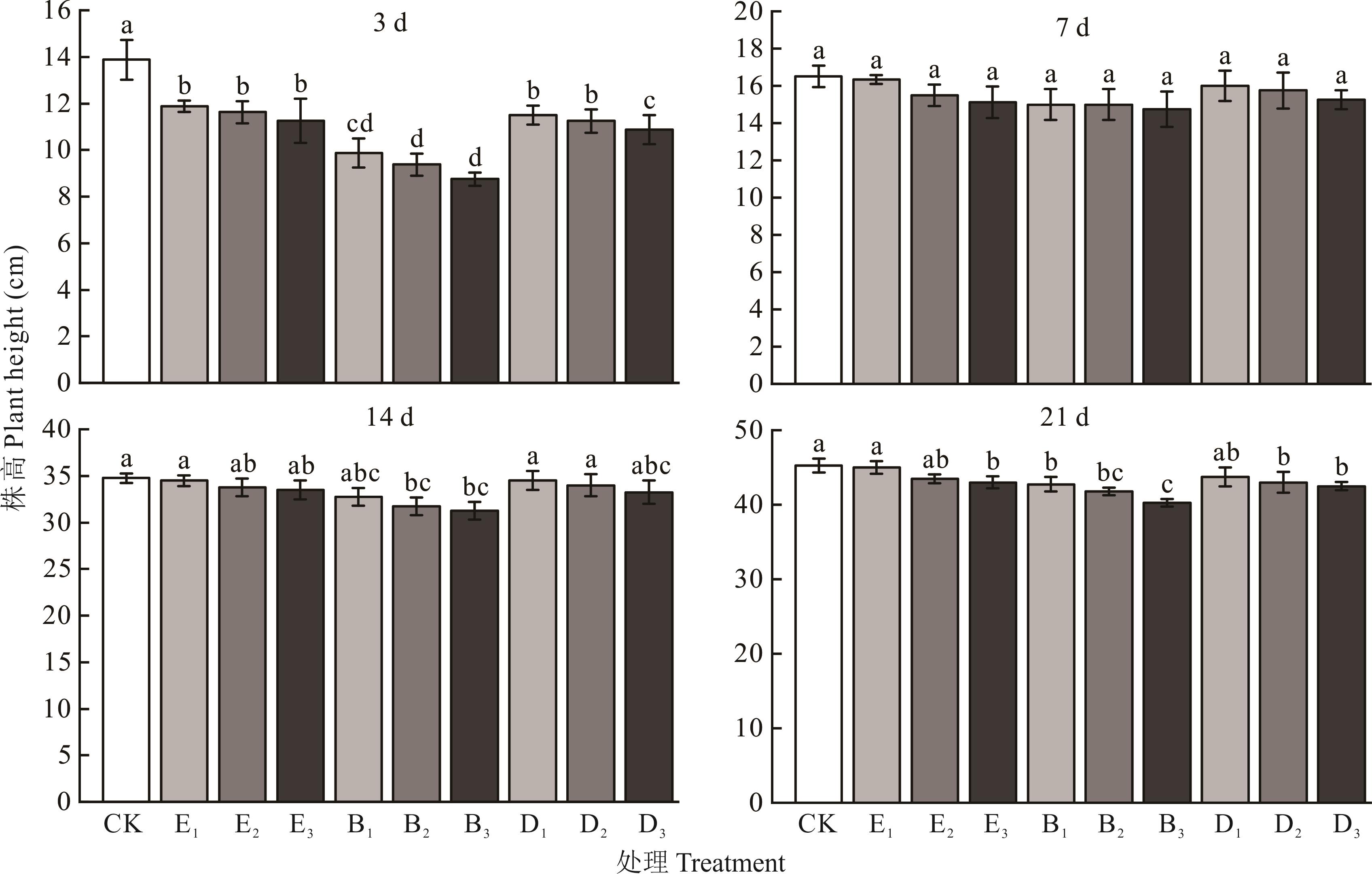
图1 不同脱叶剂对紫花苜蓿株高的影响CK: 清水Clear water; E1: 1200 mg·L-1乙烯利Ethephon; E2: 2200 mg·L-1乙烯利Ethephon; E3: 3200 mg·L-1乙烯利Ethephon; B1: 1200 mg·L-1灭草松Bentazone; B2: 2200 mg·L-1灭草松Bentazone; B3: 3200 mg·L-1灭草松Bentazone; D1: 600 mg·L-1敌草快Diquat; D2: 900 mg·L-1敌草快Diquat; D3: 1200 mg·L-1敌草快Diquat. 不同字母表示处理之间差异显著(P<0.05),下同。Different letters indicate significant differences among the treatments at P<0.05, the same below.
Fig.1 Effects of different defoliants on the plant height of alfalfa
处理 Treatment | 茎粗Stem diameter (mm) | 分枝数Branch number (No.) | 地上生物量Aboveground biomass (g·m-2) | |||
|---|---|---|---|---|---|---|
| 14 d | 21 d | 14 d | 21 d | 14 d | 21 d | |
| CK | 2.68±0.08bc | 3.25±0.05a | 8.00±0.82abc | 9.50±0.58b | 45.05±1.67ab | 50.57±1.39a |
| E1 | 2.80±0.06b | 3.23±0.03a | 8.75±0.50ab | 9.50±0.58b | 45.21±1.30ab | 51.69±1.28a |
| E2 | 2.99±0.05a | 3.26±0.04a | 9.25±0.50a | 11.25±0.50a | 46.98±1.40a | 52.11±1.79a |
| E3 | 2.58±0.17c | 3.21±0.02a | 8.00±0.82abc | 9.25±0.50b | 44.50±1.43ab | 50.48±2.07a |
| B1 | 2.61±0.02c | 3.23±0.02a | 7.75±0.50bc | 9.00±0.82b | 44.23±1.46ab | 50.17±2.20a |
| B2 | 2.59±0.03c | 3.21±0.02a | 7.50±0.58bc | 8.75±0.50b | 42.94±1.51ab | 48.16±1.09a |
| B3 | 2.43±0.03d | 3.13±0.05b | 7.25±0.50c | 8.25±0.50b | 41.95±1.64b | 47.55±1.51a |
| D1 | 2.68±0.03bc | 3.24±0.03a | 8.00±0.82abc | 9.25±0.50b | 44.78±1.36ab | 50.49±1.82a |
| D2 | 2.60±0.03c | 3.22±0.02a | 7.50±0.58bc | 8.75±0.50b | 44.70±1.20ab | 49.55±1.48a |
| D3 | 2.59±0.01c | 3.19±0.04ab | 7.25±0.50c | 9.00±0.82b | 44.03±1.20ab | 48.34±1.59a |
表1 不同脱叶剂对紫花苜蓿茎粗、分枝数及地上生物量的影响
Table 1 Effects of different defoliants on stem diameter, branch number, and aboveground biomass of alfalfa
处理 Treatment | 茎粗Stem diameter (mm) | 分枝数Branch number (No.) | 地上生物量Aboveground biomass (g·m-2) | |||
|---|---|---|---|---|---|---|
| 14 d | 21 d | 14 d | 21 d | 14 d | 21 d | |
| CK | 2.68±0.08bc | 3.25±0.05a | 8.00±0.82abc | 9.50±0.58b | 45.05±1.67ab | 50.57±1.39a |
| E1 | 2.80±0.06b | 3.23±0.03a | 8.75±0.50ab | 9.50±0.58b | 45.21±1.30ab | 51.69±1.28a |
| E2 | 2.99±0.05a | 3.26±0.04a | 9.25±0.50a | 11.25±0.50a | 46.98±1.40a | 52.11±1.79a |
| E3 | 2.58±0.17c | 3.21±0.02a | 8.00±0.82abc | 9.25±0.50b | 44.50±1.43ab | 50.48±2.07a |
| B1 | 2.61±0.02c | 3.23±0.02a | 7.75±0.50bc | 9.00±0.82b | 44.23±1.46ab | 50.17±2.20a |
| B2 | 2.59±0.03c | 3.21±0.02a | 7.50±0.58bc | 8.75±0.50b | 42.94±1.51ab | 48.16±1.09a |
| B3 | 2.43±0.03d | 3.13±0.05b | 7.25±0.50c | 8.25±0.50b | 41.95±1.64b | 47.55±1.51a |
| D1 | 2.68±0.03bc | 3.24±0.03a | 8.00±0.82abc | 9.25±0.50b | 44.78±1.36ab | 50.49±1.82a |
| D2 | 2.60±0.03c | 3.22±0.02a | 7.50±0.58bc | 8.75±0.50b | 44.70±1.20ab | 49.55±1.48a |
| D3 | 2.59±0.01c | 3.19±0.04ab | 7.25±0.50c | 9.00±0.82b | 44.03±1.20ab | 48.34±1.59a |
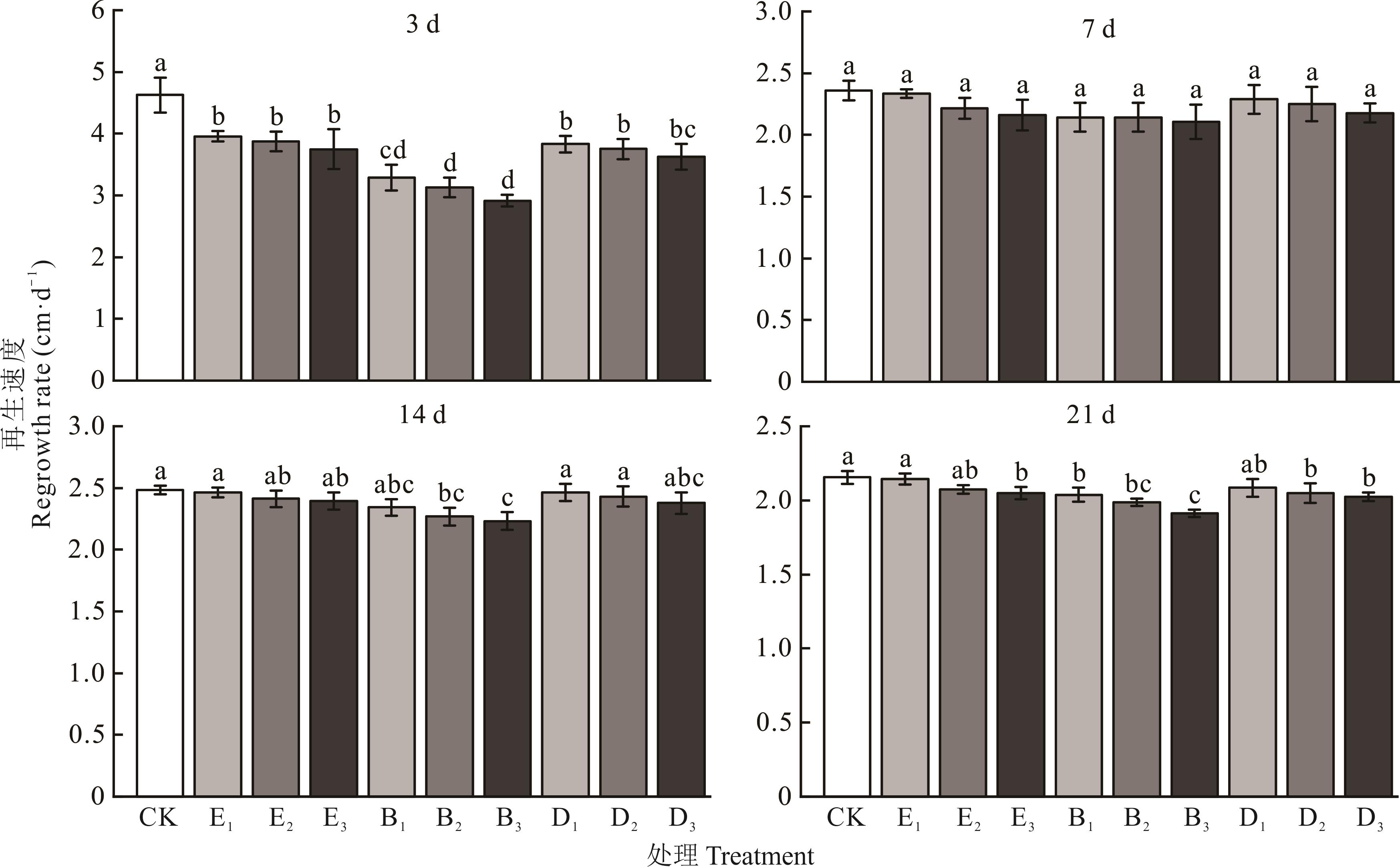
图2 不同脱叶剂对紫花苜蓿再生速度的影响
Fig.2 Effects of different defoliants on the regrowth rate of alfalfa
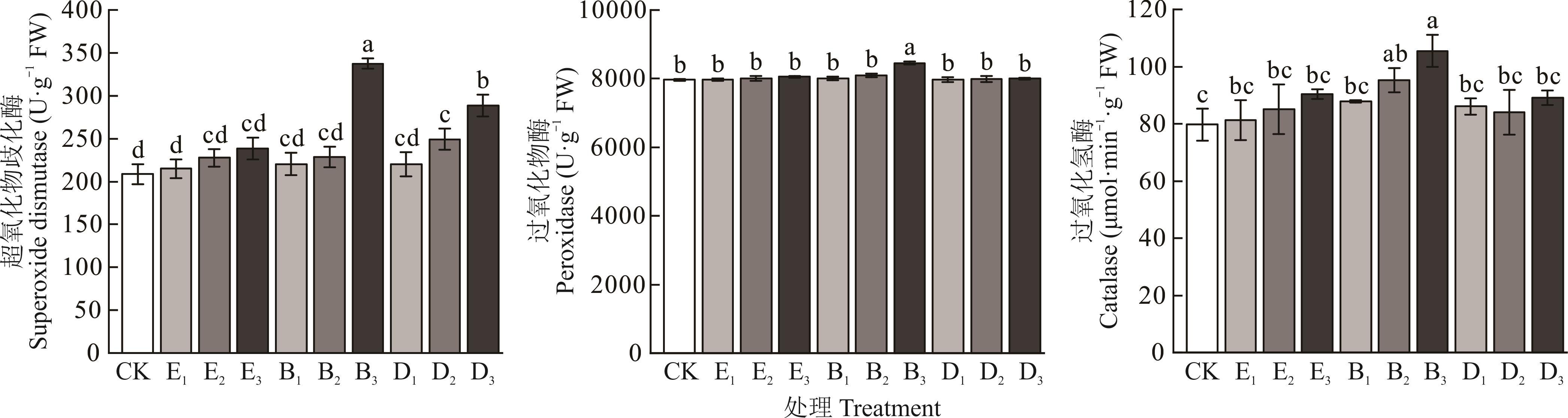
图3 不同脱叶剂对紫花苜蓿根系抗氧化酶活性的影响
Fig.3 Effects of different defoliants on the antioxidant enzyme activity in the roots of alfalfa
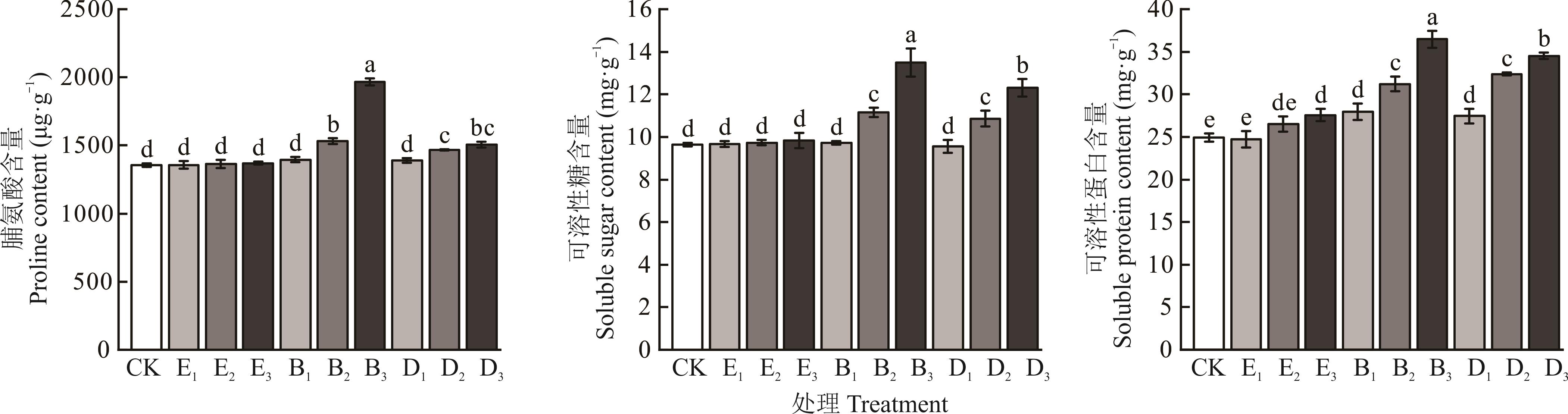
图4 不同脱叶剂对紫花苜蓿根系渗透调节物质的影响
Fig.4 Effects of different defoliants on osmotic adjustment substances in the roots of alfalfa
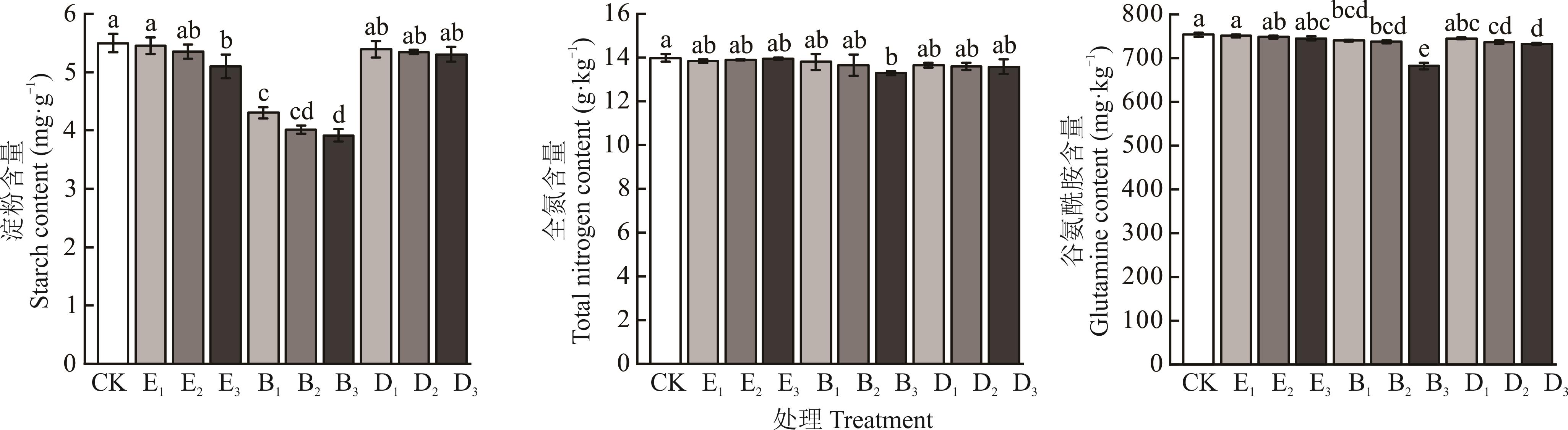
图5 不同脱叶剂对紫花苜蓿根系储藏物质的影响
Fig.5 Effects of different defoliants on the storage substances in the roots of alfalfa
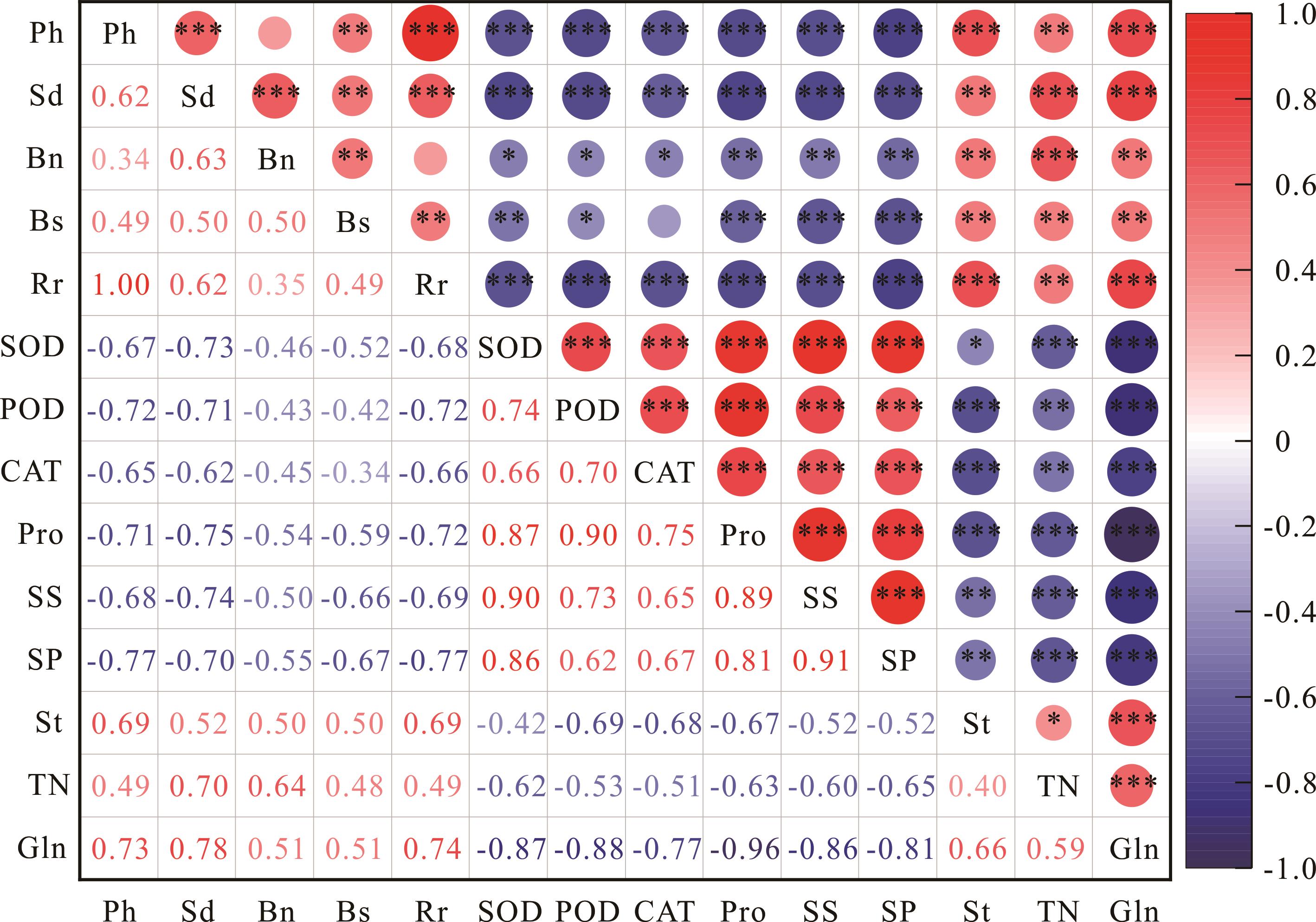
图6 脱叶剂对紫花苜蓿生长、生理特性及根系储藏物质的相关性分析*: P≤0.05; **: P≤0.01; ***: P≤0.001. Ph: 株高Plant height; Sd: 茎粗Stem diameter; Bn: 分枝数Branch number; Bs: 生物量Biomass; Rr: 再生速度Regrowth rate; SOD: 超氧化物歧化酶Superoxide dismutase; POD: 过氧化物酶Peroxidase; CAT: 过氧化氢酶Catalase; Pro: 脯氨酸Proline; SS: 可溶性糖Soluble sugar; SP: 可溶性蛋白Soluble protein; St: 淀粉Starch; TN: 全氮Total nitrogen; Gln: 谷氨酰胺Glutamine. 下同The same below.
Fig.6 Correlation analysis of growth, physiological characteristics and root storage substances of alfalfa under different defoliant treatments
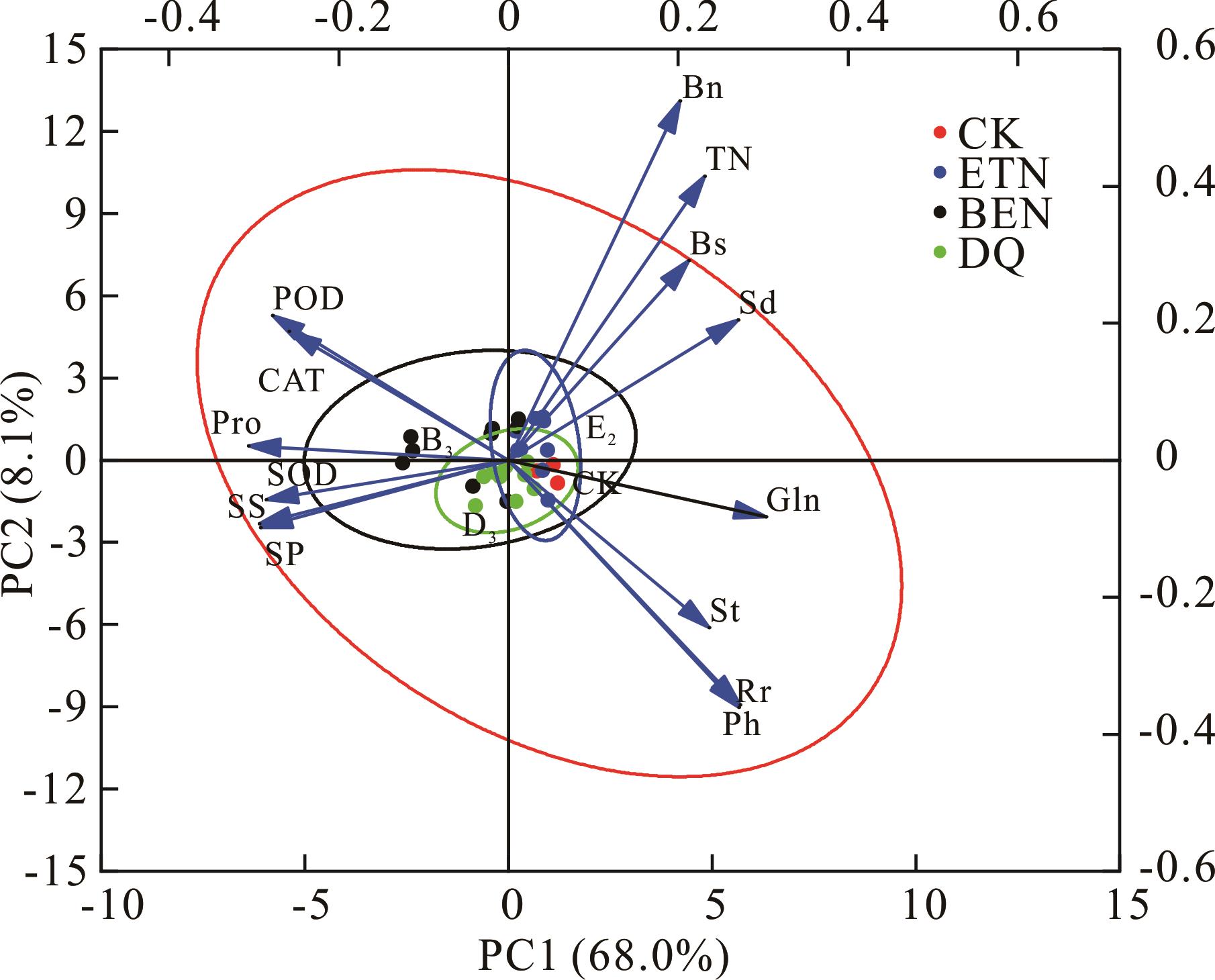
图7 脱叶剂对紫花苜蓿生长、生理特性及根系储藏物质的主成分分析CK: 清水Clear water; ETN: 乙烯利Ethephon; BEN: 灭草松Bentazone; DQ: 敌草快Diquat.
Fig.7 Principal component analysis of growth, physiological characteristics and root storage substances of alfalfa under different defoliant treatments
| [1] | Zhang F, Yang Q C. The breeding history, current status and prospects of alfalfa. Scientia Agricultura Sinica, 2025, 58(21): 4471-4481. |
| 张帆, 杨青川. 紫花苜蓿育种历史、现状与展望. 中国农业科学, 2025, 58(21): 4471-4481. | |
| [2] | Ma H X, Jiang P, Zhang X J, et al. Regulation of alfalfa growth, water and nitrogen utilization and distribution in arid region of Northwest China by optimizing irrigation method. Frontiers in Plant Science, 2025, 16: 1517398. |
| [3] | Peng X W, Sun Q C, Zhang S Z, et al. A comparative analysis of the efficacy of three plant growth regulators and dose optimization for improving agronomic traits and seed yield of purple-flowered alfalfa (Medicago sativa L.). Plants, 2025, 14(15): 2223-2247. |
| [4] | Wang Z W, Wang X G, Wang Q Z, et al. Effects of drying reagents on seed harvest and production performance of Medicago sativa. Journal of Anhui Agricultural Sciences, 2012, 40(6): 3359-3361. |
| 王正伟, 王显国, 王佺珍, 等. 干燥剂对紫花苜蓿种子收获及生产性能的影响. 安徽农业科学, 2012, 40(6): 3359-3361. | |
| [5] | Lu X, Li P B, Li M H, et al. Study on roofing effects of different concentration ethephon compound reagents on cotton. Xinjiang Agricultural Sciences, 2023, 60(2): 272-278. |
| 路茜, 李鹏兵, 李明华, 等. 不同浓度乙烯利复配剂对棉花的打顶效应. 新疆农业科学, 2023, 60(2): 272-278. | |
| [6] | Ma L J, Zhan D X, Chang J L. Progress in the application of chemical defoliation and ripening technology for cotton. Jiangsu Agricultural Sciences, 2025, 53(15): 23-31. |
| 马利军, 占东霞, 常锦乐. 棉花化学脱叶催熟技术应用进展. 江苏农业科学, 2025, 53(15): 23-31. | |
| [7] | Coelho J D S, Oliveira A L D, Souza C G M D, et al. Effect of the herbicides bentazon and diuron on the production of ligninolytic enzymes by Ganoderma lucidum. International Biodeterioration & Biodegradation, 2010, 64(2): 156-161. |
| [8] | Ou X M, Tang D X. Recent advances in research on the mechanisms of action of herbicides. World Agriculture, 2000(10): 28-30. |
| 欧晓明, 唐德秀. 除草剂作用机理研究的新进展. 世界农业, 2000(10): 28-30. | |
| [9] | Song M Q, Pang X P, Jin L, et al. Effects of mowing frequency and stubble height on yield and quality of alfalfa in the Qaidam Basin. Pratacultural Science, 2026, 43(6): 1558-1567. |
| 宋美琪, 庞晓攀, 金玲, 等. 刈割次数和留茬高度对柴达木盆地紫花苜蓿产量和品质的影响. 草业科学, 2026, 43(6): 1558-1567. | |
| [10] | Tian X H, Du W H. Effects of drying reagents on seed yield and quality of Medicago sativa. Acta Agrestia Sinica, 2007, 15(4): 359-362. |
| 田新会, 杜文华. 干燥剂对紫花苜蓿种子产量和质量的影响. 草地学报, 2007, 15(4): 359-362. | |
| [11] | An R J, Feng Y F, Xu Y L, et al. The experiment of screening and efficacy of treating stems and leaves to the control of weeds in the seedling period of alfalfa. Journal of Inner Mongolia Minzu University (Natural Sciences Edition), 2007, 22(2): 170-171. |
| 安瑞军, 冯一凡, 徐颖利, 等. 紫花苜蓿苗期茎叶处理剂筛选及防效试验. 内蒙古民族大学学报(自然科学版), 2007, 22(2): 170-171. | |
| [12] | Jing L L, Li M, Wang Z Y, et al. Effects of clothianidin application at different modes on root exudates and growth of tomato. Chinese Journal of Pesticide Science, 2025, 27(2): 332-340. |
| 荆莉莉, 李梅, 王中阳, 等. 噻虫胺不同方式施用对番茄根系分泌物及生长的影响. 农药学学报, 2025, 27(2): 332-340. | |
| [13] | Xia J, Nan L L, Wang K, et al. Effects of low phosphorus stress on root growth and rhizosphere bacteria of different root types alfalfa. Chinese Journal of Grassland, 2024, 46(6): 86-94. |
| 夏静, 南丽丽, 汪堃, 等. 低磷胁迫对不同根型苜蓿根系生长及根际细菌的影响. 中国草地学报, 2024, 46(6): 86-94. | |
| [14] | Hu X R, Tao M, Lu X X, et al. Study on the genetic integrity of ultra-dried seed of rice with isozyme of α-Amy and SOD. Journal of Plant Genetic Resources, 2007, 8(2): 228-230. |
| 胡小荣, 陶梅, 卢新雄, 等. α-淀粉酶和超氧化物歧化酶等位酶与水稻种子超干燥保存遗传完整性的研究. 植物遗传资源学报, 2007, 8(2): 228-230. | |
| [15] | Zhou J J, Wei W, Sang D, et al. Comparison between physiological characteristics and cold resistance of wild Poa root during the overwintering period in alpine regions in northern Tibet. Pratacultural Science, 2019, 36(8): 2008-2016. |
| 周娟娟, 魏巍, 桑旦, 等. 藏北高寒区越冬期间野生早熟禾根系生理特征及抗寒性比较. 草业科学, 2019, 36(8): 2008-2016. | |
| [16] | Gu T, Baosaihenna, Miao Y J, et al. Study on the adaptability of seed germination and physiology of three grasses to diurnal temperature change in alpine region. Acta Agrestia Sinica, 2026, 34(1): 266-274. |
| 顾涛, 包赛很那, 苗彦军, 等. 3种禾本科牧草种子萌发及生理对高寒昼夜变温的适应性研究. 草地学报, 2026, 34(1): 266-274. | |
| [17] | Thompson D I, Edwards T J, Van Staden J. A novel dual-phase culture medium promotes germination and seedling establishment from immature embryos in South African Disa (Orchidaceae) species. Plant Growth Regulation, 2007, 53(3): 163-171. |
| [18] | Zhu L, Li Z Y, Zhang X Q, et al. Unveiling the cold acclimation of alfalfa: insights into its starch-soluble sugar dynamic transformation. Plants, 2025, 14(9): 1313. |
| [19] | Zhang Y H, Liu C B, Zhou K, et al. Effects of jujube tree on the growth of alfalfa and orchardgrass in different positions within an orchard. Acta Prataculturae Sinica, 2025, 34(6): 203-212. |
| 张英豪, 刘楚波, 周坤, 等. 果草系统中枣树对不同方位紫花苜蓿和鸭茅生长的影响. 草业学报, 2025, 34(6): 203-212. | |
| [20] | Grant S L, Shulman Y, Tibbo P, et al. Determination of D-serine and related neuroactive amino acids in human plasma by high-performance liquid chromatography with fluorimetric detection. Journal of Chromatography B, 2006, 844(2): 278-282. |
| [21] | Chen X L, Lu M Y. Progress of studies on application of ethrel in plant flower-formation regulation. Journal of Southern Agriculture, 2005, 36(2): 110-112. |
| 陈香玲, 卢美英. 乙烯利在植物成花方面的应用及研究进展. 广西农业科学, 2005, 36(2): 110-112. | |
| [22] | Wang J, Shi W X, Sun R Q, et al. Effects of different kinds and levels of plant growth regulators on lodging resistance and yield of oat. Crops, (2025-12-04)[2026-02-11]. https://link-cnki-net-s.webvpn.xjau.edu.cn/urlid/11.1808.s.20251203. 1525.004. |
| 王婧, 石文鑫, 孙瑞卿, 等. 喷施不同植物生长调节剂及其浓度对燕麦倒伏性及产量的影响. 作物杂志, (2025-12-04)[2026-02-11]. https://link-cnki-net-s.webvpn.xjau.edu.cn/urlid/11.1808.s.20251203.1525.004. | |
| [23] | Shi Z L. Effects of plant growth regulators on lodging resistance and yield of winter wheat. Alaer: Tarim University, 2025. |
| 石志林. 植物生长调节剂对冬小麦抗倒伏能力和产量的影响. 阿拉尔: 塔里木大学, 2025. | |
| [24] | Wen T G, Wen Z R, Jiang W Q, et al. Effects of different exogenous plant growth regulators on stem lodging resistance and yield in a soybean-maize strip intercropping system. Jiangsu Journal of Agricultural Sciences, 2025, 41(10): 1936-1945. |
| 文廷刚, 文章荣, 蒋伟勤, 等. 外源植物生长调节剂对大豆玉米带状间作茎秆抗倒伏性状及产量的影响. 江苏农业学报, 2025, 41(10): 1936-1945. | |
| [25] | Hekmat S, Soltani N, Shropshire C, et al. Effect of imazamox plus bentazon on dry bean (Phaseolus vulgaris L.). Crop Protection, 2008, 27(12): 1491-1494. |
| [26] | Kuehne L, Heimer D. Efficacy and rates of diquat for reducing invasive knotweeds and potential for sequential use with imazapyr. Weed Biology and Management, 2023, 23(2): DOI: 10.1111/wbm.12265. |
| [27] | Ntanasi T, Karavidas I, Spyrou P G, et al. Plant biostimulants enhance tomato resilience to salinity stress: insights from two greek landraces. Plants, 2024, 13(10): 1404. |
| [28] | Ma L J. Effects of defoliants on defoliation effect and physiological characteristics of sea island cotton under different planting pattern. Urumqi: Xinjiang Agricultural University, 2025. |
| 马利军. 不同种植模式下脱叶剂对长绒棉脱叶效果及生理特性的影响. 乌鲁木齐: 新疆农业大学, 2025. | |
| [29] | Chen Y Q, Abudukadier·Kuerban, Deng C H, et al. Effect of different chemical regulators on physiological indicators of seed melon. Xinjiang Agricultural Sciences, 2025, 62(6): 1380-1387. |
| 陈友强, 阿不都卡地尔·库尔班, 邓超宏, 等. 不同化学调节剂对打瓜生理指标的影响. 新疆农业科学, 2025, 62(6): 1380-1387. | |
| [30] | Li Y T, Gao A X, Li Y J, et al.Effects of defoliants on the physiological characteristics of cotton varieties with different sensitivities. Xinjiang Agricultural Sciences, 2024, 61(9): 2094-2102. |
| 李永泰, 高阿香, 李艳军, 等. 脱叶剂对不同敏感性棉花品种生理特性的影响. 新疆农业科学, 2024, 61(9): 2094-2102. | |
| [31] | Ozturk M, Unal B T, Garcia-Caparros P, et al. Osmoregulation and its actions during the drought stress in plants. Physiologia Plantarum, 2021, 172(2): 1321-1335. |
| [32] | Hou L Y, Chen Y H, Wang Y C, et al. Influence of drought stress duration on quinoa physiological characteristics and drought tolerance evaluation at seedling stage. Journal of Nuclear Agricultural Sciences, 2024, 38(11): 2237-2246. |
| 侯丽媛, 陈禺怀, 王育川, 等. 干旱胁迫时间对藜麦苗期生理特性的影响及耐旱性评价. 核农学报, 2024, 38(11): 2237-2246. | |
| [33] | Wu Q H, Wang Y, Zhao Y N, et al. Effects of NPK ratio on yield nutrient absorption and economic benefit of high-yielding summer peanut in a fluvo-aquic soil. Soil and Fertilizer Sciences in China, 2019(2): 98-104. |
| 武庆慧, 汪洋, 赵亚南, 等. 氮磷钾配比对潮土区高产夏播花生产量、养分吸收和经济效益的影响. 中国土壤与肥料, 2019(2): 98-104. | |
| [34] | Ma Y X. Study on the dynamic growth of wheat root systems in different soils. Acta Agronomica Sinica, 1987, 13(1): 37-44. |
| 马元喜. 不同土壤对小麦根系生长动态的研究. 作物学报, 1987, 13(1): 37-44. | |
| [35] | Sun X Y. Effect of spraying ethephon on agronomic traits, yield and quality of peanut. Qinhuangdao: Hebei Normal University of Science & Technology, 2023. |
| 孙晓英. 喷施乙烯利对花生农艺性状、产量和品质的影响. 秦皇岛: 河北科技师范学院, 2023. | |
| [36] | The S V, Snyder R, Tegeder M. Targeting nitrogen metabolism and transport processes to improve plant nitrogen use efficiency. Frontiers in Plant Science, 2021, 11: 2330. |
| [37] | Liu H B, Wu Y, Cai J H, et al. Auxin controls root gravitropic response by affecting starch granule accumulation and cell wall modification in tomato. Plants, 2025, 14(7): 1020. |
| [38] | Hao Y. Effects of drought stress on physiological characteristics and non-structural carbohydrate allocation in Populus euphratica and Elaeagnus angustifolia seedlings. Alaer: Tarim University, 2025. |
| 郝瑜. 干旱胁迫对胡杨、沙枣幼苗生理特性与非结构性碳水化合物分配的影响. 阿拉尔: 塔里木大学, 2025. | |
| [39] | Zhang P, Li X X, Yan F N, et al. Regeneration and carbohydrate distribution in sweet sorghum after cutting. Acta Prataculturae Sinica, 2024, 33(5): 69-79. |
| 张盼, 李霄霄, 严发能, 等. 甜高粱刈割后再生及碳水化合物的分配规律. 草业学报, 2024, 33(5): 69-79. | |
| [40] | Zhang G H, Li R F, Tian L. Effects of epibrassinolide on cucumber seedlings under drought stress. China Cucurbits and Vegetables, 2025, 38(11): 77-84. |
| 张国恒, 李荣峰, 田玲. 表油菜素内酯对干旱胁迫条件下黄瓜幼苗的影响. 中国瓜菜, 2025, 38(11): 77-84. |
| [1] | 陈凤娇, 康文娟, 赵炳森, 韩宜霖, 李文凯. 32份紫花苜蓿材料遗传多样性分析及DNA分子身份证的构建[J]. 草业学报, 2027, 36(1): 163-179. |
| [2] | 杨波, 李彦忠. 紫花苜蓿真菌病害及其对植物雌激素积累与家畜健康的影响[J]. 草业学报, 2027, 36(1): 200-216. |
| [3] | 余冬雯, 王晓彤, 马永龙, 吴轩, 杨金辉, 童玉花, 李淑霞. 2,4-表芸苔素内酯对干旱胁迫下紫花苜蓿生理特性的影响[J]. 草业学报, 2026, 35(9): 63-74. |
| [4] | 杨金辉, 王晓彤, 马永龙, 余冬雯, 童玉花, 李淑霞. 喷施纳米氧化铈对紫花苜蓿幼苗耐盐性的影响[J]. 草业学报, 2026, 35(8): 45-54. |
| [5] | 黄兆鹏, 何蓉, 南丽丽, 刘佳乐, 杨文科. 低磷胁迫下外源褪黑素对紫花苜蓿幼苗内源激素及有机酸的影响[J]. 草业学报, 2026, 35(8): 55-64. |
| [6] | 陈奋奇, 张金青, 禹一箭, 李振宇. 紫花苜蓿AP2亚家族基因鉴定、生信分析及MsBBM基因克隆[J]. 草业学报, 2026, 35(7): 117-134. |
| [7] | 刘昊臻, 晁嘉潞, 赵士钦, 王成, 张景鈜, 孙守江. 紫花苜蓿BBR-BPC全基因组鉴定及响应种子老化的表达模式分析[J]. 草业学报, 2026, 35(7): 135-150. |
| [8] | 任孟雨, 王利群, 南丽丽, 郭佳雨. 紫花苜蓿新品系对盐胁迫的响应[J]. 草业学报, 2026, 35(6): 24-34. |
| [9] | 李小聪, 闫聚辉, 王星, 胡鹏飞, 叶雨浓, 伏兵哲. 紫花苜蓿/无芒雀麦间作对草地生产性能和土壤理化特性的影响[J]. 草业学报, 2026, 35(5): 113-125. |
| [10] | 马苹, 刘志国, 沙煜舒, 刘亚玲, 妥小梅, 伏兵哲, 高雪芹. 紫花苜蓿苗期氮利用特性及氮高效品种的筛选[J]. 草业学报, 2026, 35(4): 112-123. |
| [11] | 张钿, 冷华娟, 崔婧, 何飞, 王雪, 李明娜, 杨青川, 康俊梅. 紫花苜蓿突触结合蛋白家族成员鉴定与非生物胁迫下的表达分析[J]. 草业学报, 2026, 35(4): 158-168. |
| [12] | 张世超, 崔国文, 张德鹏, 韩福迎, 丁叮, 吕向丽, 林硕, 陈乐然, 李吉儒, 才华. 紫花苜蓿非组培遗传转化体系创建及在耐盐基因功能鉴定与基因编辑中的应用[J]. 草业学报, 2026, 35(3): 223-234. |
| [13] | 童玉花, 王晓彤, 马永龙, 杨金辉, 余冬雯, 李淑霞. 壳聚糖浸种对盐碱胁迫下紫花苜蓿种子萌发的影响[J]. 草业学报, 2026, 35(3): 245-256. |
| [14] | 陈丽娟, 高荣, 王建喜, 马晖玲. 紫花苜蓿与红豆草在不同生长时期缩合单宁合成差异的比较研究[J]. 草业学报, 2026, 35(2): 221-236. |
| [15] | 李瑒琨, 本转林, 张筠钰, 杨惠敏. 不同气候和土壤条件下施肥类型影响紫花苜蓿种子产量的整合分析[J]. 草业学报, 2026, 35(2): 54-67. |
| 阅读次数 | ||||||
|
全文 |
|
|||||
|
摘要 |
|
|||||
