
ISSN 1004-5759 CN 62-1105/S
Acta Prataculturae Sinica ›› 2025, Vol. 34 ›› Issue (12): 1-15.DOI: 10.11686/cyxb2025034
Yu-du JING1,2,3( ), Xiao-wei LIU4, Ke LIANG4, Jun-hao FENG4, Qiang YU5, Liang GUO5,6()
Received:2025-02-02
Revised:2025-04-03
Online:2025-12-20
Published:2025-10-20
Contact:
Liang GUO
Yu-du JING, Xiao-wei LIU, Ke LIANG, Jun-hao FENG, Qiang YU, Liang GUO. Impacts of shrub encroachment on the fraction and stability of soil organic carbon of grassland on the Loess Plateau, and the underlying microbial mechanisms[J]. Acta Prataculturae Sinica, 2025, 34(12): 1-15.
土壤指标 Soil property | 无灌木扩张 NSE | 半灌木扩张 SSE | 灌木扩张 SE |
|---|---|---|---|
| SWC (%) | 14.80±1.01b | 20.41±0.80a | 21.26±1.18a |
| pH | 8.18±0.01a | 8.05±0.01b | 8.06±0.02b |
SOC (g·kg-1) DOC (mg·kg-1) | 16.74±0.87c 51.99±2.06b | 25.77±0.87b 72.12±4.16a | 28.41±0.69a 74.88±2.70a |
| TN (g·kg-1) | 1.60±0.04b | 2.94±0.17a | 3.14±0.17a |
| TP (g·kg-1) | 0.58±0.01c | 0.67±0.01b | 0.77±0.02a |
| CA (g·kg-1) | 8.07±0.03b | 8.16±0.10b | 8.56±0.05a |
| BG (nmol·g-1·h-1) | 15.22±0.91c | 36.32±3.35a | 29.43±1.28b |
| CBH (nmol·g-1·h-1) | 9.69±0.60a | 9.48±1.51a | 10.38±0.17a |
Table 1 Impacts of shrub encroachment on soil physicochemical and biological properties
土壤指标 Soil property | 无灌木扩张 NSE | 半灌木扩张 SSE | 灌木扩张 SE |
|---|---|---|---|
| SWC (%) | 14.80±1.01b | 20.41±0.80a | 21.26±1.18a |
| pH | 8.18±0.01a | 8.05±0.01b | 8.06±0.02b |
SOC (g·kg-1) DOC (mg·kg-1) | 16.74±0.87c 51.99±2.06b | 25.77±0.87b 72.12±4.16a | 28.41±0.69a 74.88±2.70a |
| TN (g·kg-1) | 1.60±0.04b | 2.94±0.17a | 3.14±0.17a |
| TP (g·kg-1) | 0.58±0.01c | 0.67±0.01b | 0.77±0.02a |
| CA (g·kg-1) | 8.07±0.03b | 8.16±0.10b | 8.56±0.05a |
| BG (nmol·g-1·h-1) | 15.22±0.91c | 36.32±3.35a | 29.43±1.28b |
| CBH (nmol·g-1·h-1) | 9.69±0.60a | 9.48±1.51a | 10.38±0.17a |
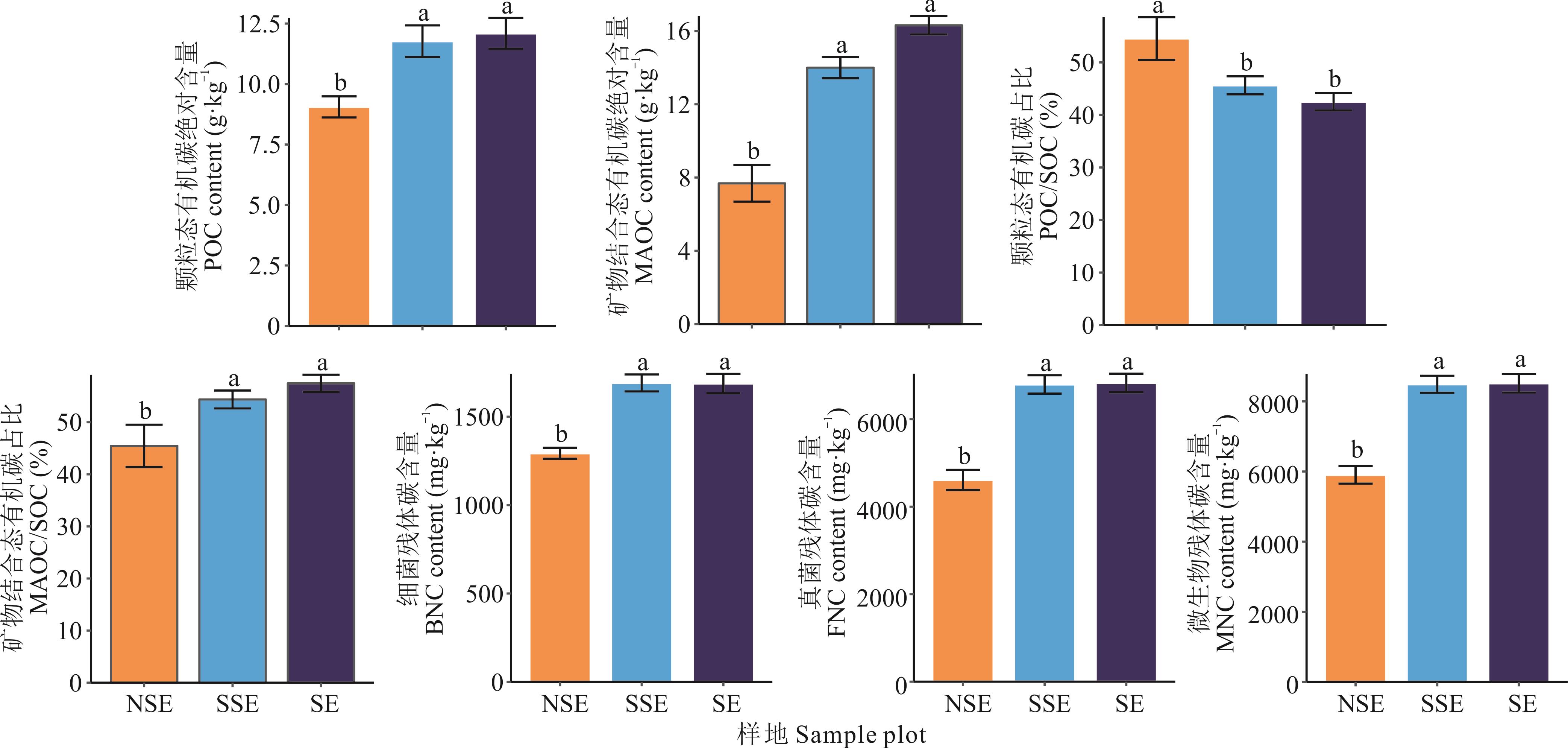
Fig.1 Impacts of shrub encroachment on the content and relative proportion of soil organic carbon fractions and microbial necromass carbon

Fig.2 Impacts of shrub encroachment on phylum-level community structures of soil bacteria and fungi

Fig.3 The phylogenetic trees of soil bacterial and fungal ASVs and the correlation between the ASVs and soil basic physicochemical properties

Fig.4 Impacts of shrub encroachment on soil bacterial functions and fungal trophic types

Fig.5 Analysis of the potential drivers of soil organic carbon fraction and the correlation between soil organic carbon fraction and soil microbial properties
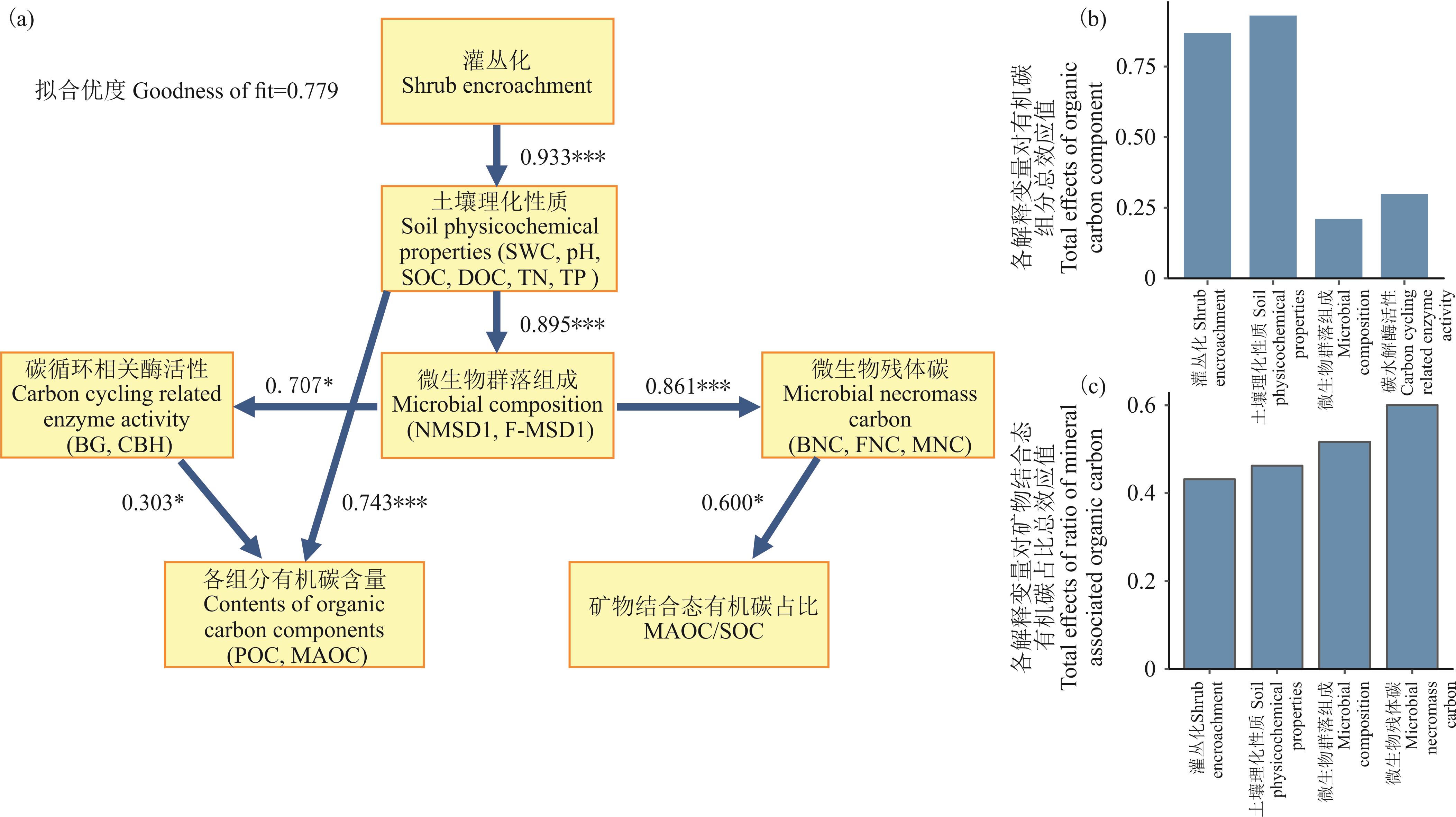
Fig.6 The partial-least square path modeling for the regulatory mechanisms of shrub encroachment on soil organic carbon fractions and their ratio to soil total organic carbon
| [1] | Van Auken O W. Causes and consequences of woody plant encroachment into western North American grasslands. Journal of Environmental Management, 2009, 90(10): 2931-2942. |
| [2] | Eldridge D J, Bowker M A, Maestre F T, et al. Impacts of shrub encroachment on ecosystem structure and functioning: Towards a global synthesis. Ecology Letters, 2011, 14(7): 709-722. |
| [3] | Li M H, Li Y H, Yan X H, et al. Characteristics of plant diversity and aboveground productivity and their relationship driven by subshrub expansion. Acta Prataculturae Sinica, 2023, 32(5): 27-39. |
| 李美慧, 李玉华, 晏昕辉, 等. 半灌木扩张驱动的草地植物多样性与地上生产力特征及其关系研究. 草业学报, 2023, 32(5): 27-39. | |
| [4] | Guo Q, Wen Z, Ghanizadeh H, et al. Shift in microbial communities mediated by vegetation-soil characteristics following subshrub encroachment in a semi-arid grassland. Ecological Indicators, 2022, 137: 108768. |
| [5] | Li H, Shen H H, Chen L Y, et al. Effects of shrub encroachment on soil organic carbon in global grasslands. Scientific Reports, 2016, 6(1): 28974. |
| [6] | Zhang D, Liu J Q, Ma W M, et al. Effects of shrub encroachment on soil organic carbon components in Qinghai-Tibetan alpine grassland. Acta Pedologica Sinica, 2023, 60(6): 1810-1821. |
| 张东, 刘金秋, 马文明, 等. 灌丛化对高寒草地土壤有机碳组分的分异研究. 土壤学报, 2023, 60(6): 1810-1821. | |
| [7] | Bai Y, Cotrufo M F. Grassland soil carbon sequestration: Current understanding, challenges, and solutions. Science, 2022, 377(6606): 603-608. |
| [8] | Thomas A D, Elliot D R, Dougill A J, et al. The influence of trees, shrubs, and grasses on microclimate, soil carbon, nitrogen, and CO2 efflux: Potential implications of shrub encroachment for Kalahari rangelands. Land Degradation & Development, 2018, 29(5): 1306-1316. |
| [9] | Wei Y Y, Cui L J, Zhang M Y, et al. Research advances in microbial mechanisms underlying priming effect of soil organic carbon mineralization. Chinese Journal of Ecology, 2019, 38(4): 1202-1211. |
| 魏圆云, 崔丽娟, 张曼胤, 等. 土壤有机碳矿化激发效应的微生物机制研究进展. 生态学杂志, 2019, 38(4): 1202-1211. | |
| [10] | Collins C G, Spasojevic M J, Alados C L, et al. Belowground impacts of alpine woody encroachment are determined by plant traits, local climate, and soil conditions. Global Change Biology, 2020, 26(12): 7112-7127. |
| [11] | Zhou Y, Li Y Y, Li N, et al. Contribution of soil microbial necromass carbon to soil organic carbon in grassland under precipitation change and its influencing factors in loess hilly region, Northwest China. Chinese Journal of Applied Ecology, 2024, 35(9): 2592-2598. |
| 周玥, 李娅芸, 李娜, 等. 黄土丘陵区降水变化下草地土壤微生物残体碳对土壤有机碳组分的贡献及其影响因素. 应用生态学报, 2024, 35(9): 2592-2598. | |
| [12] | Zhang G, Cao Z P, Hu C J. Soil organic carbon fraction methods and their applications in farmland ecosystem research: A review. Chinese Journal of Applied Ecology, 2011, 22(7): 1921-1930. |
| 张国, 曹志平, 胡婵娟. 土壤有机碳分组方法及其在农田生态系统研究中的应用. 应用生态学报, 2011, 22(7): 1921-1930. | |
| [13] | Zhang R B, Wang J S, Wang Q C, et al. Responses of soil particulate and mineral-associated organic carbon to climate warming: A review. Progress in Geography, 2023, 42(12): 2471-2484. |
| 张睿博, 汪金松, 王全成, 等. 土壤颗粒态有机碳与矿物结合态有机碳对气候变暖响应的研究进展. 地理科学进展, 2023, 42(12): 2471-2484. | |
| [14] | Lugato E, Lavallee J M, Haddix M L, et al. Different climate sensitivity of particulate and mineral-associated soil organic matter. Nature Geoscience, 2021, 14(5): 295-300. |
| [15] | Liu F, Qin S, Fang K, et al. Divergent changes in particulate and mineral-associated organic carbon upon permafrost thaw. Nature Communications, 2022, 13(1): 5073. |
| [16] | Ramesh T, Bolan N S, Kirkham M B, et al. Soil organic carbon dynamics: Impact of land use changes and management practices: A review. Advances in Agronomy, 2019, 156: 1-107. |
| [17] | Li X, Geng H, Gao Y H, et al. Effects of Caragana erinacea shrub expansion on soil organic carbon mineralization in alpine grassland. Acta Ecologica Sinica, 2024, 44(16): 7150-7159. |
| 黎萱, 耿行, 高永恒, 等. 川西锦鸡儿灌木扩张对高寒草地土壤有机碳矿化的影响. 生态学报, 2024, 44(16): 7150-7159. | |
| [18] | Abrigo M, Lezama F, Grela I, et al. Grazing exclusion effects on vegetation structure and soil organic matter in savannas of Río de la Plata grasslands. Journal of Vegetation Science, 2024, 35(5): e13304. |
| [19] | Li X, Chen D Y, Li L A, et al. Response of soil organic carbon active components to shrub encroachment in alpine meadows. Bulletin of Soil and Water Conservation, 2024, 44(3): 317-325, 334. |
| 黎萱, 陈东毅, 李良安, 等. 高寒草甸土壤有机碳活性组分对灌丛化的响应. 水土保持通报, 2024, 44(3): 317-325, 334. | |
| [20] | Su Y, He Z, Yang Y, et al. Linking soil microbial community dynamics to straw-carbon distribution in soil organic carbon. Scientific Reports, 2020, 10(1): 5526. |
| [21] | Tang X, Lyu S, Wang T, et al. Microbial traits affect soil organic carbon stability in degraded Moso bamboo forests. Plant and Soil, 2024: 1-21. DOI: 10.1007/s11104-024-06908-z. |
| [22] | Yuan X, Chen Y, Qin W, et al. Plant and microbial regulations of soil carbon dynamics under warming in two alpine swamp meadow ecosystems on the Tibetan Plateau. Science of the Total Environment, 2021, 790: 148072. |
| [23] | Li Z S, Yang L, Wang G L, et al. The management of soil and water conservation in the Loess Plateau of China: Present situations, problems, and counter-solutions. Acta Ecologica Sinica, 2019, 39(20): 7398-7409. |
| 李宗善, 杨磊, 王国梁, 等. 黄土高原水土流失治理现状、问题及对策. 生态学报, 2019, 39(20): 7398-7409. | |
| [24] | Dong L B, Hai X Y, Wang X Z, et al. Effects of plant community dynamics on ecosystem carbon stocks since returning farmlands to grasslands on the Loess Plateau. Acta Ecologica Sinica, 2020, 40(23): 8559-8569. |
| 董凌勃, 海旭莹, 汪晓珍, 等. 黄土高原退耕还草地植物群落动态对生态系统碳储量的影响. 生态学报, 2020, 40(23): 8559-8569. | |
| [25] | Guo L, Cheng J, Luedeling E, et al. Critical climate periods for grassland productivity on China’s Loess Plateau. Agricultural and Forest Meteorology, 2017, 233: 101-109. |
| [26] | Zhang Y W, Chang X F, Zhang Y W. Spatial pattern of shrub patches in a grassland fenced for a long term in Yunwu Mountain on the Loess Plateau. Acta Agrestia Sinica, 2023, 31(12): 3802-3808. |
| 张译文, 常小峰, 张玉薇. 黄土高原云雾山长期封育草地灌丛化空间分布格局. 草地学报, 2023, 31(12): 3802-3808. | |
| [27] | Liang C, Amelung W, Lehmann J, et al. Quantitative assessment of microbial necromass contribution to soil organic matter. Global Change Biology, 2019, 25(11): 3578-3590. |
| [28] | Shi Y P, Qiao L, Chen L X, et al. Spatiotemporal heterogeneity of soil particulate and mineral-associated organic carbon of forest gaps in Pinus koraiensis coniferous and broad-leaved mixed forest. Scientia Silvae Sinicae, 2014, 50(6): 18-27. |
| 石亚攀, 乔璐, 陈立新, 等. 红松针阔混交林林隙土壤颗粒有机碳和矿物结合有机碳的时空异质性. 林业科学, 2014, 50(6): 18-27. | |
| [29] | Zhang Y H, Li Y, Zhou Y, et al. Changes of soil nutrients and organic carbon fractions in Caragana korshinskii forests with different restoration years in mountainous areas of southern Ningxia, China. Chinese Journal of Applied Ecology, 2024, 35(3): 639-647. |
| 张羽涵, 李瑶, 周玥, 等. 宁南山区不同恢复年限柠条林土壤养分及有机碳组分变化特征. 应用生态学报, 2024, 35(3): 639-647. | |
| [30] | Liu Y, Chen L, Ma T, et al. EasyAmplicon: An easy-to-use, open-source, reproducible, and community-based pipeline for amplicon data analysis in microbiome research. iMeta, 2023, 2(1): e83. |
| [31] | Cole J R, Wang Q, Fish J A, et al. Ribosomal database project: Data and tools for high throughput rRNA analysis. Nucleic Acids Research, 2014, 42(D1): D633-D642. |
| [32] | Abarenkov K, Nilsson R H, Larsson K H, et al. The UNITE database for molecular identification and taxonomic communication of fungi and other eukaryotes: Sequences, taxa and classifications reconsidered. Nucleic Acids Research, 2024, 52(D1): D791-D797. |
| [33] | Xu S, Li L, Luo X, et al. ggtree: A serialized data object for visualization of a phylogenetic tree and annotation data. iMeta, 2022, 1(4): e56. |
| [34] | Lai J, Zou Y, Zhang J, et al. Generalizing hierarchical and variation partitioning in multiple regression and canonical analyses using the rdacca.hp R package. Methods in Ecology and Evolution, 2022, 13(4): 782-788. |
| [35] | Li H, Zhang J, Hu H, et al. Shift in soil microbial communities with shrub encroachment in Inner Mongolia grasslands, China. European Journal of Soil Biology, 2017, 79: 40-47. |
| [36] | Zhang Z H, Li X Y, Yang X, et al. Changes in soil properties following shrub encroachment in the semiarid Inner Mongolian grasslands of China. Soil Science and Plant Nutrition, 2020, 66(2): 369-378. |
| [37] | Pan J, An C P, Wu X D, et al. Distribution pattern of nutrients in the thicketization of 2 types of Caragana in desert steppe. Journal of Water and Soil Conservation, 2015, 29(6): 131-136. |
| 潘军, 安超平, 吴旭东, 等. 荒漠草原2种锦鸡儿灌丛化过程中土壤养分分布规律. 水土保持学报, 2015, 29(6): 131-136. | |
| [38] | Liu X L, Hu J, Zhou Q P, et al. Effects of typical shrub-encroached grassland on vegetation characteristics and soil nutrients in the Zoige Plateau. Acta Agretia Sinica, 2022, 30(4): 901-908. |
| 刘小龙, 胡健, 周青平, 等. 若尔盖高原典型草地灌丛化对植被特征和土壤养分的影响. 草地学报, 2022, 30(4): 901-908. | |
| [39] | Malik A A, Swenson T, Weihe C, et al. Drought and plant litter chemistry alter microbial gene expression and metabolite production. The ISME Journal, 2020, 14(9): 2236-2247. |
| [40] | Wei X R, Shao M A. Distribution characteristics of soil pH, CEC, and organic matter in a small watershed of the Loess Plateau. Chinese Journal of Applied Ecology, 2009, 20(11): 2710-2715. |
| 魏孝荣, 邵明安. 黄土高原小流域土壤pH、阳离子交换量和有机质分布特征. 应用生态学报, 2009, 20(11): 2710-2715. | |
| [41] | Sinsabaugh R L, Lauber C L, Weintraub M N, et al. Stoichiometry of soil enzyme activity at global scale. Ecology Letters, 2008, 11(11): 1252-1264. |
| [42] | Zhang S, Zhang Q, Li Y, et al. Shrubs have a greater influence on the nonstructural carbohydrates of desert mosses along precipitation decreased. Environmental and Experimental Botany, 2023, 216: 105530. |
| [43] | Zhang Y Y, Mo F, Han J, et al. Research progress on the native soil carbon priming after straw addition. Acta Pedologica Sinica, 2021, 58(6): 1381-1392. |
| 张叶叶, 莫非, 韩娟, 等. 秸秆还田下土壤有机质激发效应研究进展. 土壤学报, 2021, 58(6): 1381-1392. | |
| [44] | Xiang X, Gibbons S M, Li H, et al. Shrub encroachment is associated with changes in soil bacterial community composition in a temperate grassland ecosystem. Plant and Soil, 2018, 425(1/2): 539-551. |
| [45] | Hu X, Li X Y, Zhao Y, et al. Changes in soil microbial community during shrub encroachment process in the Inner Mongolia grassland of northern China. Catena, 2021, 202: 105230. |
| [46] | Voragen A G J, Coenen G J, Verhoef R P, et al. Pectin, a versatile polysaccharide present in plant cell walls. Structural Chemistry, 2009, 20(2): 263-275. |
| [47] | Zhang X, Zhao W, Kou Y, et al. Secondary forest succession drives differential responses of bacterial communities and interactions rather than bacterial functional groups in the rhizosphere and bulk soils in a subalpine region. Plant and Soil, 2023, 484(1/2): 293-312. |
| [48] | Zhang Y C, Jia B, Chen J, et al. Shrub expansion increases nitrification and denitrification in alpine meadow soils. Applied Soil Ecology, 2024, 201: 105524. |
| [49] | Hou J W, Xing C F, Yang L L, et al. Differences in soil fertility and bacterial community structure between carbon inputs such as biochar and organic fertilizer and their relationship. Environmental Science, 2024, 45(7): 4212-4227. |
| 侯建伟, 邢存芳, 杨莉琳, 等. 生物炭与有机肥等碳量投入土壤肥力与细菌群落结构差异及关系. 环境科学, 2024, 45(7): 4212-4227. | |
| [50] | Shu Q, Gao S H, Liu X M, et al. Soil enzyme activities and microbial carbon pump promote carbon storage by influencing bacterial communities under nitrogen-rich conditions in tea plantation. Agriculture, 2025, 15(3): 238. |
| [51] | Peltzer D A, Kochy M. Competitive effects of grasses and woody plants in mixed-grass prairie. Journal of Ecology, 2001, 89(4): 519-527. |
| [52] | Lal R. Soil carbon management and climate change. Carbon Management, 2013, 4(4): 439-462. |
| [1] | Xue-xi MA, Ying-zhi GAO. Impact of shrub encroachment on soil hydrological processes in grassland [J]. Acta Prataculturae Sinica, 2025, 34(4): 212-222. |
| [2] | Ze-hua LIU, Lin CHEN, Ya-qi ZHANG, Jin-xiao LONG, Xue-bin LI, Dan-bo PANG. The impact of shrub encroachment on species niches and interspecific associations of the Artemisia scoparia community in desert grassland [J]. Acta Prataculturae Sinica, 2025, 34(10): 1-15. |
| [3] | Yuan-fei MA, Yan-tao SONG, Yun-na WU, Cheng-feng FANG. Effects of fertilization and mowing for 5 years on soil microbial characteristics in Hulunbuir meadow steppe [J]. Acta Prataculturae Sinica, 2024, 33(9): 242-251. |
| [4] | Ya-nan ZHAO, Hong-mei WANG, Zhi-li LI, Zhen-jie ZHANG, Yan-shuo CHEN, Rong-xia SU. Responses of spatial pattern and driving factors for soil water deficit of desert grassland-shrubland transition sites [J]. Acta Prataculturae Sinica, 2024, 33(4): 22-34. |
| [5] | Dong ZHANG, Chen HOU, Wen-ming MA, Chang-ting WANG, Zhuo-ma DENGZENG, Ting ZHANG. Study on soil enzyme activities under shrub encroachment gradients in alpine grassland [J]. Acta Prataculturae Sinica, 2023, 32(9): 79-92. |
| [6] | Zhan-dong PAN, Qian-qian MA, Xiao-long CHEN, Li-qun CAI, Xue-mei CAI, Bo DONG, Jun WU, Ren-zhi ZHANG. Effects of biochar addition on nutrient levels and humus and its components in dry farmland soils on the Loess Plateau [J]. Acta Prataculturae Sinica, 2022, 31(2): 14-24. |
| [7] | Wen-ming MA, Chao-wen LIU, Qing-ping ZHOU, Zhuo-ma DENGzeng, Si-hong TANG, Diliyaer·mohetaer, Chen HOU. Effects of shrub encroachment on soil aggregate ecological stoichiometry and enzyme activity in alpine grassland [J]. Acta Prataculturae Sinica, 2022, 31(1): 57-68. |
| [8] | CHEN Hong, MA Wen-ming, ZHOU Qing-ping, YANG Zhi, LIU Chao-wen, LIU Jin-qiu, DU Zhong-man. Shrub encroachment effects on the stability of soil aggregates and the differentiation of Fe and Al oxides in Qinghai-Tibet alpine grassland [J]. Acta Prataculturae Sinica, 2020, 29(9): 73-84. |
| [9] | DONG Xue, HAO Yu-guang, XIN Zhi-ming, DUAN Rui-bing, HUANG Ya-ru, LI Xin-le, MA Yuan, LIU Fang. Fractal features of soil and their relationship with soil fertility under three shrub species in Otindag sandy land [J]. Acta Prataculturae Sinica, 2020, 29(6): 172-181. |
| [10] | XU Qi-wen, MA Shu-min, ZHU Bo, ZHANG Xiao-duan, XING Yi, DUAN Mei-chun, WANG Long-chang. Effects of the combined application of biochar and chemical fertilizer on fertility and microbial characteristics of purple soil and yield and quality of oilseed rape [J]. Acta Prataculturae Sinica, 2020, 29(5): 121-131. |
| [11] | ZHANG Zhi-Hua, LI Xiao-Yan, JIANG Zhi-Yun, WANG Yan-Mei. Relationship between shrub encroachment and soil properties in the typical steppe of Inner Mongolia [J]. Acta Prataculturae Sinica, 2017, 26(2): 224-230. |
| [12] | ZHAO Jing-Jing, LUO Zhu-Zhu, ZHANG Ren-Zhi, CAI Li-Qun, LI Ling-Ling, NIU Yi-Ning. Soil carbon fraction differences under different grass-crop rotations on the Loess Plateau, Central Gansu [J]. Acta Prataculturae Sinica, 2016, 25(2): 58-67. |
| [13] | LUO Zhu-Zhu, LI Ling-Ling, NIU Yi-Ning, CAI Li-Qun, ZHANG Ren-Zhi, XIE Jun-Hong. Response of soil aggregate stability and soil organic carbon fractions to different growth years of alfalfa [J]. Acta Prataculturae Sinica, 2016, 25(10): 40-47. |
| [14] | ZHU Ping, CHEN Ren-Sheng, SONG Yao-Xuan, LIU Guang-Xiu, CHEN Tuo, ZHANG Wei. Soil microbial community diversity under four vegetation types in the Qilian Mountains, China [J]. Acta Prataculturae Sinica, 2015, 24(6): 75-84. |
| [15] | GU Rui, CHAO Luo-Meng, ZHANG Li-Xin, SU Li-De, WAN Zhi-Qiang, YAN Yu-Long, CHEN Ya-Li, GAO Qing-Zhu. The influence of hydrothermal factors on soil respiration and soil temperature sensitivity of Stipa krylovii steppe, Inner Mongolia, China [J]. Acta Prataculturae Sinica, 2015, 24(4): 21-29. |
| Viewed | ||||||
|
Full text |
|
|||||
|
Abstract |
|
|||||
