
ISSN 1004-5759 CN 62-1105/S
Acta Prataculturae Sinica ›› 2026, Vol. 35 ›› Issue (7): 68-79.DOI: 10.11686/cyxb2025283
Previous Articles Next Articles
Yong-quan ZHAI1,2( ), Yao MA1, Li-hua SONG1,2, Bing CAO1,2()
Received:2025-07-08
Revised:2025-09-09
Online:2026-07-20
Published:2026-05-21
Contact:
Bing CAO
Yong-quan ZHAI, Yao MA, Li-hua SONG, Bing CAO. Effects of ryegrass intercropping density on the productivity, net benefits, and sustainability of a jujube-grass intercropping system[J]. Acta Prataculturae Sinica, 2026, 35(7): 68-79.
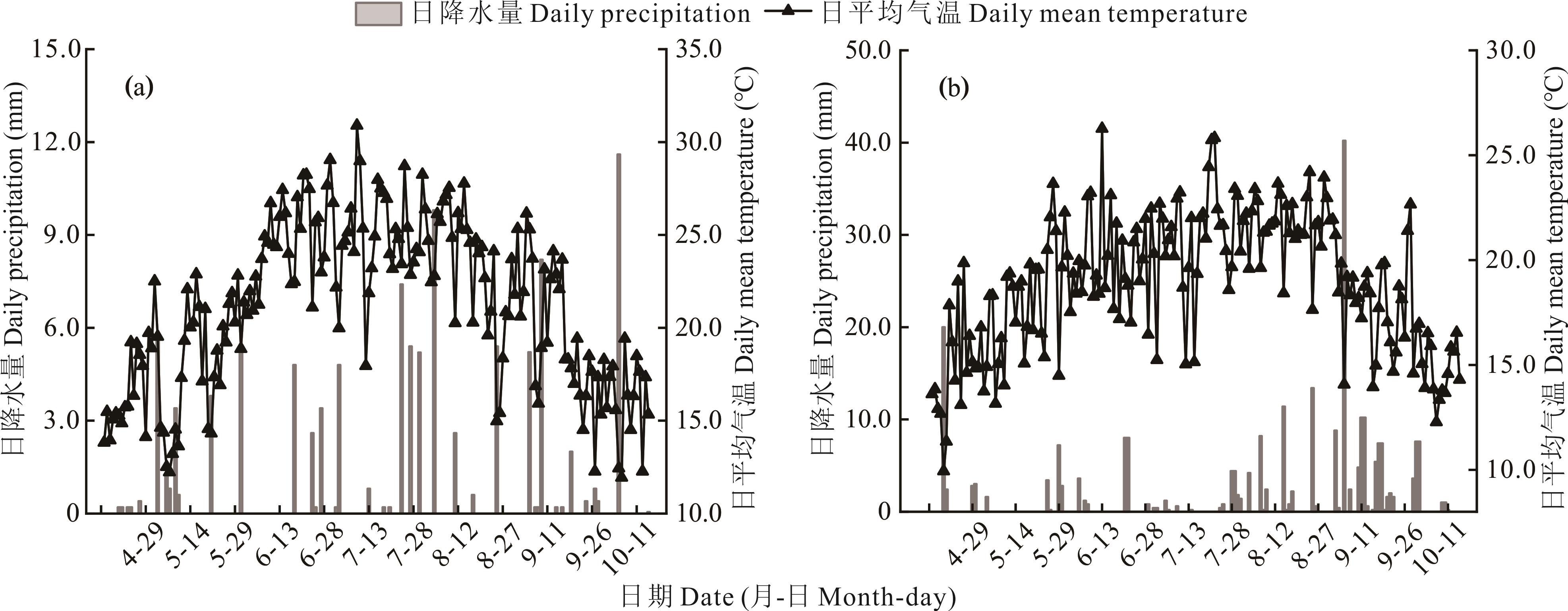
Fig.1 Daily mean temperature and precipitation during the experimental period in 2023 (a) and 2024 (b)
年份 Year | 处理 Treatment | 产量Yield (t·hm-2) | 牧草部分土地当量比Land equivalent ratio for grass (LERG) | 枣树部分土地当量比Land equivalent ratio for jujube (LERJ) | 土地当量比 Land equivalent ratio (LER) | |
|---|---|---|---|---|---|---|
枣树 Jujube | 牧草 Forage | |||||
| 2023 | J | 7.45±0.30c | - | - | - | - |
| G | - | 7.25±0.19b | - | - | - | |
| J-G15 | 9.44±0.25b | 6.98±0.27b | 0.96±0.05b | 1.27±0.06b | 2.23±0.07b | |
| J-G22.5 | 11.45±0.23a | 8.13±0.23a | 1.12±0.04a | 1.53±0.07a | 2.51±0.05a | |
| J-G30 | 7.08±0.17c | 7.19±0.22b | 0.99±0.03b | 0.95±0.05c | 1.95±0.07c | |
| 2024 | J | 24.98±0.14d | - | - | - | - |
| G | - | 7.83±0.18b | - | - | - | |
| J-G15 | 30.54±0.23b | 7.54±0.17b | 0.96±0.04b | 1.22±0.02b | 2.19±0.05b | |
| J-G22.5 | 32.38±0.20a | 8.79±0.13a | 1.12±0.03a | 1.29±0.01a | 2.42±0.03a | |
| J-G30 | 28.49±0.23c | 7.77±0.13b | 0.99±0.03b | 1.14±0.01c | 2.13±0.04b | |
| 年份Year (Y) | 82394.62*** | 91.14*** | 4.28** | 0.00ns | 2.74ns | |
| 密度Density (D) | 1253.91*** | 72.45*** | 177.40*** | 48.52*** | 222.07*** | |
| Y×D | 166.32*** | 0.13ns | 59.90*** | 0.00ns | 39.78*** | |
Table 1 Effects of ryegrass intercropping density on jujube yield, grass yield, and land equivalent ratio
年份 Year | 处理 Treatment | 产量Yield (t·hm-2) | 牧草部分土地当量比Land equivalent ratio for grass (LERG) | 枣树部分土地当量比Land equivalent ratio for jujube (LERJ) | 土地当量比 Land equivalent ratio (LER) | |
|---|---|---|---|---|---|---|
枣树 Jujube | 牧草 Forage | |||||
| 2023 | J | 7.45±0.30c | - | - | - | - |
| G | - | 7.25±0.19b | - | - | - | |
| J-G15 | 9.44±0.25b | 6.98±0.27b | 0.96±0.05b | 1.27±0.06b | 2.23±0.07b | |
| J-G22.5 | 11.45±0.23a | 8.13±0.23a | 1.12±0.04a | 1.53±0.07a | 2.51±0.05a | |
| J-G30 | 7.08±0.17c | 7.19±0.22b | 0.99±0.03b | 0.95±0.05c | 1.95±0.07c | |
| 2024 | J | 24.98±0.14d | - | - | - | - |
| G | - | 7.83±0.18b | - | - | - | |
| J-G15 | 30.54±0.23b | 7.54±0.17b | 0.96±0.04b | 1.22±0.02b | 2.19±0.05b | |
| J-G22.5 | 32.38±0.20a | 8.79±0.13a | 1.12±0.03a | 1.29±0.01a | 2.42±0.03a | |
| J-G30 | 28.49±0.23c | 7.77±0.13b | 0.99±0.03b | 1.14±0.01c | 2.13±0.04b | |
| 年份Year (Y) | 82394.62*** | 91.14*** | 4.28** | 0.00ns | 2.74ns | |
| 密度Density (D) | 1253.91*** | 72.45*** | 177.40*** | 48.52*** | 222.07*** | |
| Y×D | 166.32*** | 0.13ns | 59.90*** | 0.00ns | 39.78*** | |
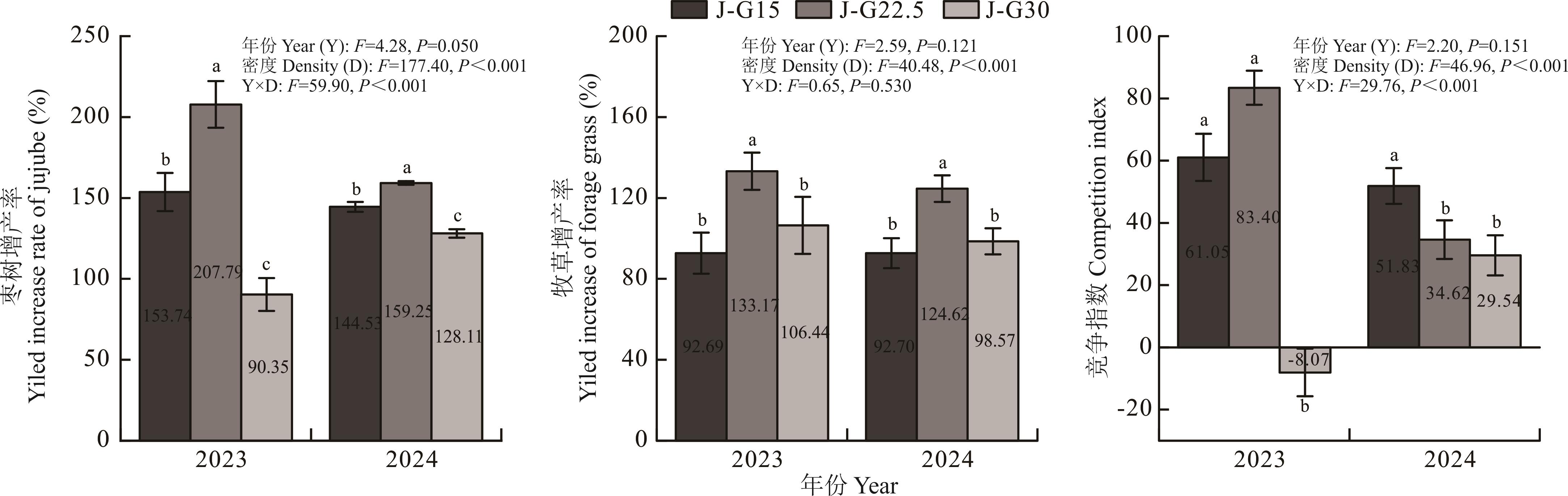
Fig.2 Effects of ryegrass intercropping density on yield increase rate and competitive index of jujube and grass
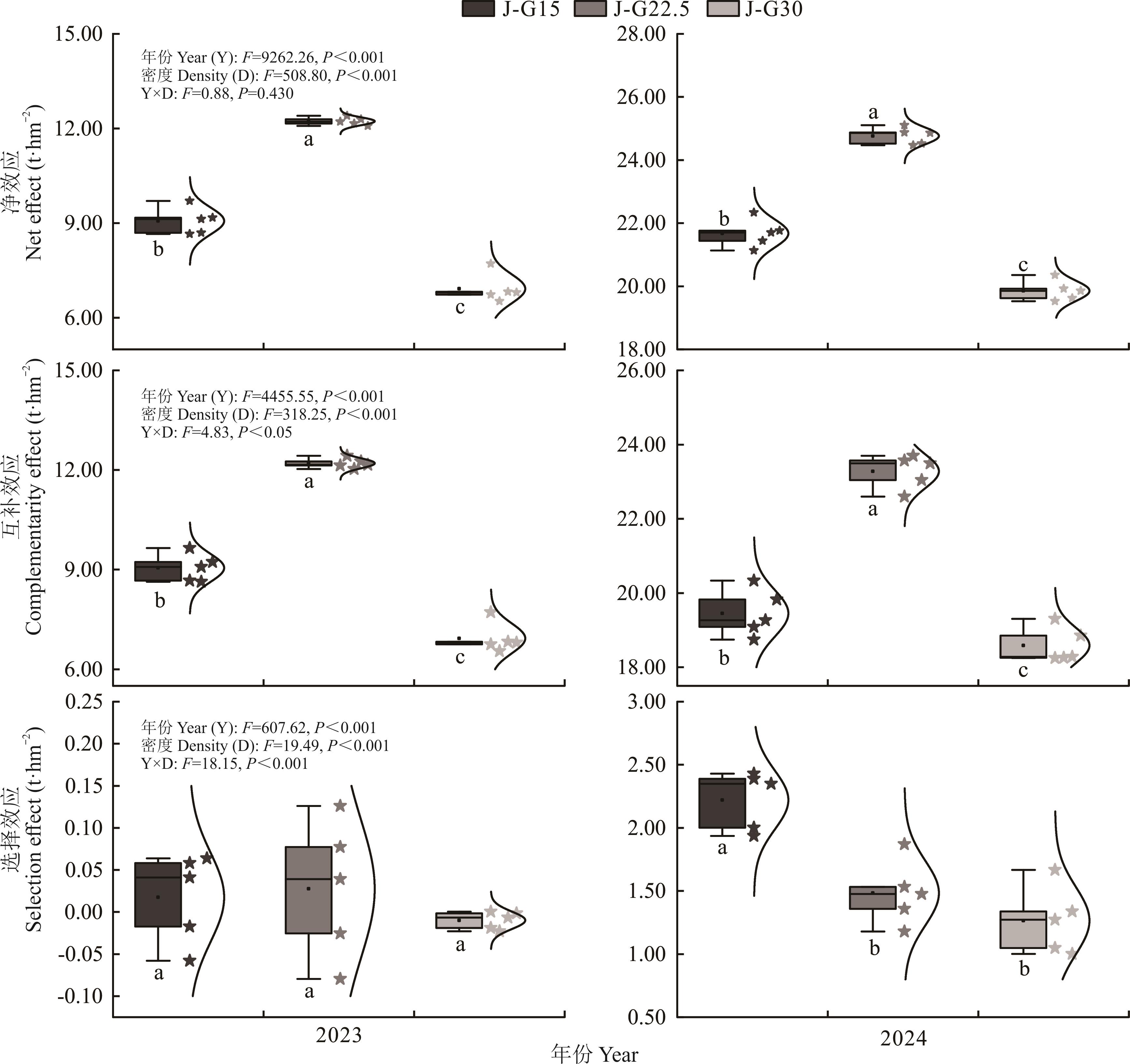
Fig.3 Net effect, complementarity effect, and selection effect under different ryegrass intercropping densities
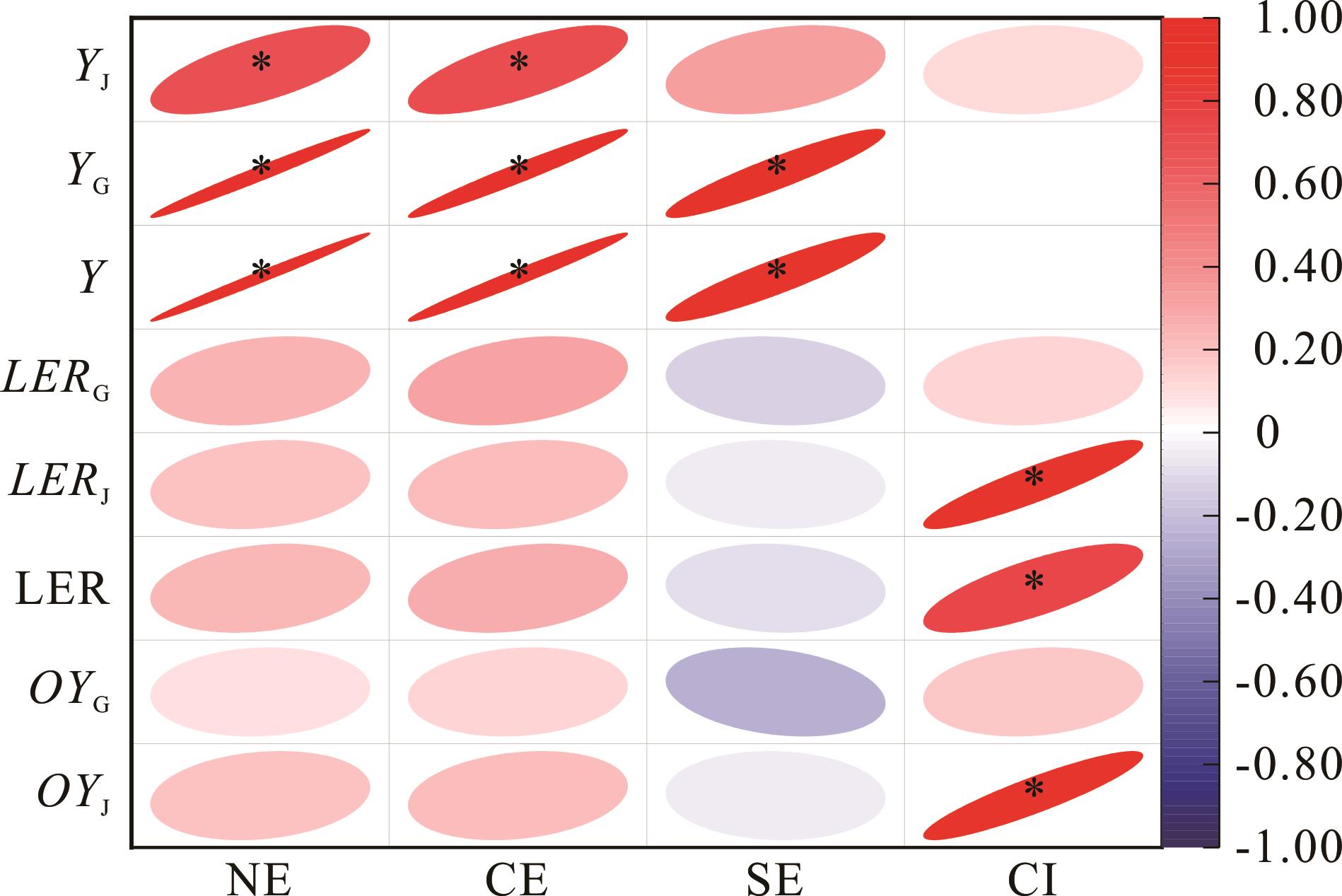
Fig.4 Correlation among competition index, net effect, complementarity effect and selection effect with yield and land equivalent ratio
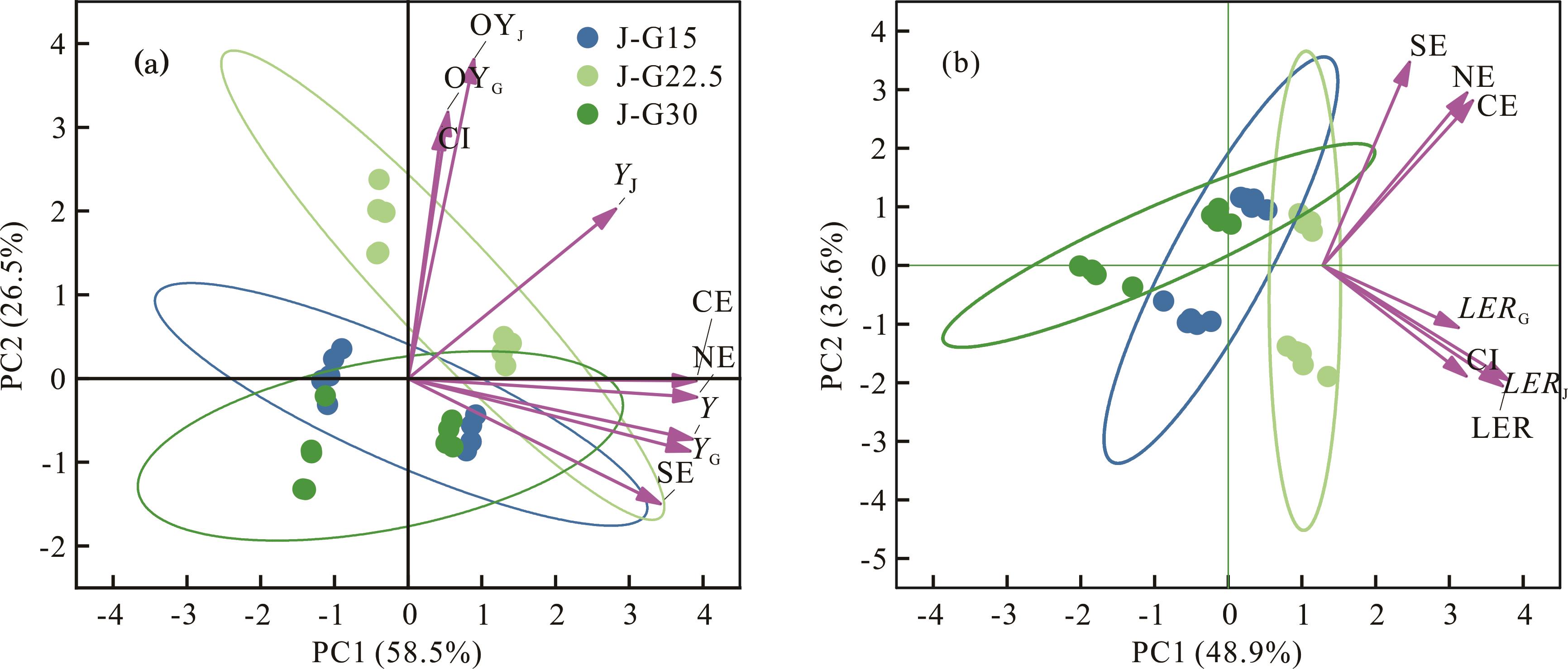
Fig.5 Principal component analysis (PCA) of the relationships among competitive index, net effect, complementarity effect, selection effect and yield (a) and land equivalent ratio (b)
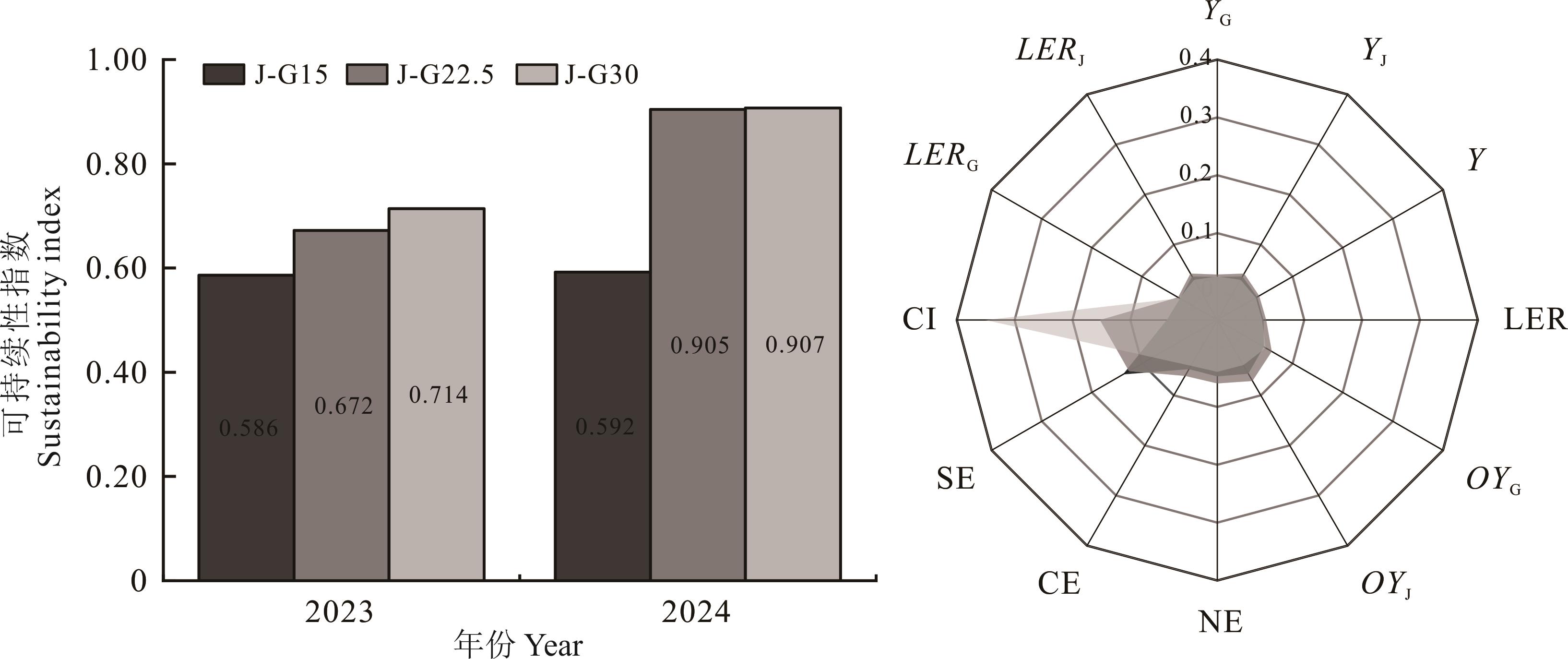
Fig.6 Sustainability index and indicator weights under different ryegrass intercropping treatments
| [1] | Jin J B, Wang T, Cheng Y F, et al. Current situation and prospect of forage breeding in China. Bulletin of Chinese Academy of Sciences, 2021, 36(6): 660-665. |
| 金京波, 王台, 程佑发, 等. 我国牧草育种现状与展望. 中国科学院院刊, 2021, 36(6): 660-665. | |
| [2] | Oldoni H, Magalhães G S P, Oliveira G L A, et al. Management zones delineation: a proposal to overcome the crop-pasture rotation challenge. Precision Agriculture, 2025, 26: 21. |
| [3] | Feng Q, He X L, Wang B, et al. A study of mixed sowing effects for oat and common vetch in the Ningxia Yellow River Irrigation Area. Acta Prataculturae Sinica, 2024, 33(3): 107-119. |
| 冯琴, 何小莉, 王斌, 等. 宁夏引黄灌区燕麦与箭筈豌豆的混播效果研究. 草业学报, 2024, 33(3): 107-119. | |
| [4] | Xie J, Liu X Q, Luo M X, et al. Ethnobotanical study of traditional forage plants in the Gansu-Ningxia-Inner Mongolia junction zone: conservation and sustainable utilization for animal husbandry. Journal of Ethnobiology and Ethnomedicine, 2023, 19: DOI: 10.1186/s13002-023-00625-0. |
| [5] | Zhang C, Wang Y, Zhou L H, et al. Spatiotemporal distribution characteristics and driving factors of livestock feeding structure: A case study in Ningxia. Acta Prataculturae Sinica, 2024, 33(8): 37-49. |
| 张聪, 王娅, 周立华, 等. 牲畜饲养结构的时空分布特征及驱动因素——以宁夏为例. 草业学报, 2024, 33(8): 37-49. | |
| [6] | Wang W, Zhou L. Current situation, problems and countermeasures of the grass-livestock industry chain development in Ningxia. Ningxia Social Sciences, 2017(Supple1): 144-149. |
| 王微, 周蕾. 宁夏草畜产业链发展现状、存在问题及对策. 宁夏社会科学, 2017(增刊1): 144-149. | |
| [7] | Chen H X. Study on evaluation of forage planting benefits in Ningxia under background of food security. Acta Agriculturae Jiangxi, 2023, 35(3): 196-202. |
| 陈红翔. 粮食安全背景下的宁夏牧草种植效益评价研究. 江西农业学报, 2023, 35(3): 196-202. | |
| [8] | Guo T, Xue B, Zhou Y M, et al. Current status and enlightenment of production and trade of forage product in China. Acta Agrestia Sinica, 2019, 27(1): 8-14. |
| 郭婷, 薛彪, 周艳明, 等. 我国牧草产品生产、贸易现状及启示. 草地学报, 2019, 27(1): 8-14. | |
| [9] | Song X L, Mi N, Mi W B, et al. Spatial non-stationary characteristics between grass yield and its influencing factors in the Ningxia temperate grasslands based on a mixed geographically weighted regression model. Journal of Geographical Sciences, 2022, 32(6): 1076-1102. |
| [10] | Ni Y F. Study on forage production efficiency and its influencing factors in China. Beijing: Chinese Academy of Agricultural Sciences, 2019. |
| 倪印锋. 中国牧草生产效率及其影响因素研究. 北京: 中国农业科学院, 2019. | |
| [11] | Zhou F M, Su P H. Distribution variation of aboveground biomass and competitive intensity of Lycium barbarum-Medicago sativa intercropping. Bulletin of Soil and Water Conservation, 2022, 42(2): 53-58, 66. |
| 周孚明, 苏鹏海. 枸杞-苜蓿间作地上生物量分布变异及其竞争强度. 水土保持通报, 2022, 42(2): 53-58, 66. | |
| [12] | Krüger M A, Lima T M D P, Ovani V, et al. Ruminant grazing lands in the tropics: Silvopastoral systems and Tithonia diversifolia as tools with potential to promote sustainability. Agronomy, 2024, 14(7): 1386. |
| [13] | Wang X J. Study on the ‘Lingwu Changzao’ jujube-herbage intercropping patterns and productivity characteristics in the arid sandy area, Ningxia province. Yinchuan: Ningxia University, 2023. |
| 王晓佳. 宁夏干旱沙区灵武长枣-牧草间作模式及生产力特征研究. 银川: 宁夏大学, 2023. | |
| [14] | Ma Y, Cao B, Wang X J, et al. Intercropping ryegrass with ‘Lingwu Changzao’ (Ziziphus jujuba Mill. cv. Lingwu Changzao) enhances crop yield and quality in the arid regions of Northern China. Agroforestry Systems, 2025, 99(5): 103. |
| [15] | Wang X J, Cao B, Zou J, et al. Intercropping Gramineae herbage in semiarid jujube cultivar ‘Lingwu Changzao’ (Ziziphus jujuba Mill. cv. Lingwu Changzao) orchard improves productivity, plant nutritional quality, and soil quality. Horticulturae, 2022, 8(9): 834. |
| [16] | Dai Y S, Lu W H, Shen L, et al. Effects of intercropping poplar-alfalfa on growth and quality of alfalfa in forest-grass compound systems. Xinjiang Agricultural Sciences, 2024, 61(5): 1182-1189. |
| 代元帅, 鲁为华, 申磊, 等. 林草复合系统中杨树-紫花苜蓿间作对苜蓿生长发育及品质的影响. 新疆农业科学, 2024, 61(5): 1182-1189. | |
| [17] | Pan K L, Guo L, Chen X, et al. Advance in the research on agroforestry ecosystem services. Journal of Ecology and Rural Environment, 2022, 38(12): 1535-1544. |
| 潘康乐, 郭梁, 陈欣, 等. 农林复合生态系统服务功能研究进展. 生态与农村环境学报, 2022, 38(12): 1535-1544. | |
| [18] | Mathieu A, Guay M O M, Rivest D. Enhancement of agroecosystem multifunctionality by agroforestry: A global quantitative summary. Global Change Biology, 2025, 31(5): e70234. |
| [19] | Lu Y N, Gao L, Yang Y, et al. Effects of different fertilization models on soil characteristics and fruit characters of Ziziphus jujube cv. Lingwuchangzao. Xinjiang Agricultural Sciences, 2021, 58(12): 2282-2299. |
| 陆亚楠, 高露, 杨勇, 等. 不同培肥模式对灵武长枣种植园土壤特性和果实品质与产量的影响. 新疆农业科学, 2021, 58(12): 2282-2299. | |
| [20] | Khanal U, Stott K J, Armstrong R, et al. Intercropping-Evaluating the advantages to broadacre systems. Agriculture, 2021, 11(5): 453. |
| [21] | Zhu L Z, Li X Y, He J, et al. Development of Lycium barbarum-forage intercropping patterns. Agronomy, 2023, 13(5): DOI: 10.3390/agronomy13051365. |
| [22] | Wang D L, Li Y B, Zhang B B, et al. Explore the evolution of winter wheat production and its response to climate change under varying precipitation years in the Loess Plateau of China. Agricultural Water Management, 2025, 30(9): DOI: 10.1016/j.agwat.2025.109335. |
| [23] | Zhu L Z, He J, Tian Y, et al. Intercropping wolfberry with Gramineae plants improves productivity and soil quality. Scientia Horticulturae, 2022, 292: DOI: 10.1016/j.scienta.2021.110632. |
| [24] | Wang J B, Chen G D, Wang P J, et al. Optimizing cotton row configuration in jujube-cotton intercropping systems improves their productivity, net effects, and sustainability. Agronomy, 2024, 14(6): 1216. |
| [25] | Li R, Zhang Z X, Tang W, et al. Common vetch cultivars improve yield of oat row intercropping on the Qinghai-Tibetan Plateau by optimizing photosynthetic performance. European Journal of Agronomy, 2020, 117: 126088. |
| [26] | Li Y J, Ma L S, Wu P T, et al. Yield, yield attributes and photosynthetic physiological characteristics of dryland wheat (Triticum aestivum L.)/maize (Zea mays L.) strip intercropping. Field Crops Research, 2020, 24(8): 107656. |
| [27] | Ma J P, Zhang Y Y, Wang T F, et al. Interspecific relationship and forage productivity effects in mixed sowings of Sorghum bicolor and Dolichos lablab. Acta Prataculturae Sinica, 2025, 34(3): 111-122. |
| 马江萍, 张译尹, 王腾飞, 等. 饲用高粱与拉巴豆混播对种间关系及草地生产力的影响. 草业学报, 2025, 34(3): 111-122. | |
| [28] | Wang J R, Li H M, Gong D H, et al. Physiological responses and the dust retention ability of different turfgrass mixture ratios under continuous drought. Plants, 2025, 14(11): 1667. |
| [29] | Xiong X, Zhu G F, Wang J Q, et al. A comparative study of the shade tolerance physiology and growth characteristics among several varieties of tall fescue and perennial ryegrass. Chinese Journal of Grassland, 2025, 47(4): 142-148. |
| 熊雪, 朱国芬, 王佳琪, 等. 几种高羊茅和多年生黑麦草耐荫生理和生长特性的比较研究. 中国草地学报, 2025, 47(4): 142-148. | |
| [30] | Gu H, Wang Y, Liu S, et al. Enhanced soil stabilisation and growth of Lolium perenne through combined seeding with Cynodon dactylon. Rhizosphere, 2024, 32: 100977. |
| [31] | Gao C, Chen P, Du Q, et al. Effects of sowing date and density on stem, leaf growth, and yield formation in strip intercropping soybean. Acta Agronomica Sinica, 2023, 49(11): 3090-3099. |
| 高超, 陈平, 杜青, 等. 播期、密度对带状间作大豆茎叶生长及产量形成的影响. 作物学报, 2023, 49(11): 3090-3099. | |
| [32] | Wang P J, Li L, Zhai Y L, et al. Fine root distribution and effects on belowground interspecific competition in jujube and cotton intercropping system. Shandong Agricultural Sciences, 2021, 53(12): 25-32. |
| 王沛娟, 李玲, 翟云龙, 等. 枣棉间作复合系统细根分布及对种间地下竞争的影响. 山东农业科学, 2021, 53(12): 25-32. | |
| [33] | Liu J Y, Zhou Z C, Han W X. Effects of herbaceous root growth on soil resistance to erosion under different planting densities. Journal of Soil and Water Conservation, 2025, 39(2): 40-47. |
| 刘均阳, 周正朝, 韩玮霄. 不同种植密度下草本植物根系生长对土壤侵蚀阻力的影响. 水土保持学报, 2025, 39(2): 40-47. | |
| [34] | Hasyati·Tuoxunjiang, Liu C, Halidai·Rehemujiang, et al. Effects of intercropping of jujube and forage on orchard soil nutrients and microenvironment. Jiangsu Agricultural Sciences, 2015, 43(1): 327-329. |
| 哈斯亚提·托逊江, 刘晨, 哈丽代·热合木江, 等. 红枣与牧草间作对果园土壤养分及小环境的影响. 江苏农业科学, 2015, 43(1): 327-329. | |
| [35] | Björn R S, Inés P R, Lars A S, et al. Elymus repens biomass allocation and acquisition as affected by light and nutrient supply and companion crop competition. Annals of Botany, 2017, 119(3): 477-485. |
| [36] | Roush M L, Radosevich S R, Wagner R G, et al. A comparison of methods for measuring effects of density and proportion in plant competition experiments. Weed Science, 1989, 37(2): 268-275. |
| [37] | He Y, Qiu Z K, Liu R, et al. Impact of mulching on soil moisture and sap flow characteristics of jujube trees. Agronomy, 2023, 13(11): DOI: 10.3390/agronomy13112799. |
| [38] | Tang M, Gao X D, Wu P T, et al. Effects of living mulch and branches mulching on soil moisture, temperature and growth of rain-fed jujube trees. Plants, 2022, 11(19): 2654. |
| [39] | Zhang L H, Zhao T, Huang H L, et al. Physiological responses of ‘Zanhuang Jujube’ and ‘Dongzao’ to drought stress. Agricultural Research in the Arid Areas, 2023, 41(3): 104-113. |
| 张露荷, 赵通, 黄华梨, 等. ‘赞皇大枣’和‘冬枣’对干旱胁迫的生理响应. 干旱地区农业研究, 2023, 41(3): 104-113. | |
| [40] | Wang Q, Pan P, Ouyang X Z, et al. Intraspecific and interspecific competition intensity in mixed plantation with different proportion of Pinus massoniana and Schima superba. Chinese Journal of Ecology, 2021, 40(1): 49-57. |
| 汪清, 潘萍, 欧阳勋志, 等. 马尾松-木荷不同比例混交林种内和种间竞争强度. 生态学杂志, 2021, 40(1): 49-57. | |
| [41] | Feng C, Sun Z X, Zhang L Z, et al. Maize/peanut intercropping increases land productivity: A Meta-analysis. Field Crops Research, 2021, 270: 108208. |
| [42] | Mei X G, Zhang L, Xu H B, et al. Intercropping improves plant biochemistry and soil microecology to realize healthy and sustainable production of Platycodon grandiflorus. Journal of Cleaner Production, 2025, 50(7): 145529. |
| [43] | Thirukumaran K, Nagarajan K, Vadivel N, et al. Enhancing cotton production and sustainability through multi-tier cropping systems: growth, efficiency, and profitability analysis. Agronomy, 2024, 14(5): 1049. |
| [1] | Jing SUN, Yan-liang SUN, Dong-jie XIA, Kong-qin WEI, Kai-xin YANG, Xiao-qing SUI, Qian-bing ZHANG. Effects of nitrogen-phosphorus and water coupling on soil nutrients and the photosynthetic characteristics and production performance of Bromus inermis [J]. Acta Prataculturae Sinica, 2026, 35(7): 105-116. |
| [2] | Shu-chao LIU, Quan-qin SHAO, Jiang-wen FAN, Hai-bo HUANG. Spatiotemporal dynamics of edible forage and its climatic driving mechanisms in the Three-River Headwaters Region from 1981 to 2020 [J]. Acta Prataculturae Sinica, 2026, 35(7): 15-31. |
| [3] | Zhi-gang SU, You-jian HAN, Jian-hang ZHANG, Jun-xi WU, Ya-mei XU, Baosaihenna, Yan-jun MIAO, Zhong-hua CAO. Effects of nitrogen application and sowing rates on the seed yield and quality of Elymus nutans ‘Baqing’ [J]. Acta Prataculturae Sinica, 2026, 35(7): 175-187. |
| [4] | Bo SUN, Jun-yi ZHANG, Chun-yan BAI, Fan FENG, Jian LAN, Jian-qiang DENG. Production benefit analysis of annual forage rotation systems in an arid area of central Ningxia [J]. Acta Prataculturae Sinica, 2026, 35(6): 35-48. |
| [5] | Yue-qi LI, Tao MA, Yu-ping DING, Ming SU, Tao LI, Xiao-ying MA, Feng-lan MA, Meng-hu WAN, Qing-yun LI, Dan ZHANG, Na WU, Ji-li LIU. Adaptation of maize varieties in saline and alkaline land in Ningxia based on growth-nutrient accumulation-yield synergistic regulation [J]. Acta Prataculturae Sinica, 2026, 35(6): 93-107. |
| [6] | Ling-fei XIANG, Feng-ju ZHANG, Yue LI, Xue-qin WANG, Jin-long LIU, Qiao-li MA. Effects of varied row spacings and sowing rates on forage and seed yield and quality of Echinochloa frumentacea in saline-alkali land [J]. Acta Prataculturae Sinica, 2026, 35(5): 126-138. |
| [7] | Long-hang CHAI, Rui ZHAO, Xiao-yi LIU, Jin-shun BAI. A meta-analysis of the effects of green manure on yield increase and chemical nitrogen fertilizer saving in Chinese farmlands [J]. Acta Prataculturae Sinica, 2026, 35(5): 162-174. |
| [8] | Tong LIU, Surilige, Na JIANG, Bo PANG, Wurilige, Tao-yang YANG, Hai-fang ZHANG, Jian-ning ZHAO, Dian-lin YANG. Impacts of Euphorbia fischeriana invasion on plant community succession and soil physicochemical properties in Hulunbuir grassland [J]. Acta Prataculturae Sinica, 2026, 35(5): 72-84. |
| [9] | Wen-hui DENG, Xiao-na ZHAO, Jia-yi YONG, Si-yu GUAN, Guo-qiang HU, Teng-fei WANG, Hai-ying HU. Effects of intercropping oat with different densities on alfalfa seed yield and its constituent factors [J]. Acta Prataculturae Sinica, 2026, 35(4): 100-111. |
| [10] | Ju-feng FAN, Lang PAN, De-jun PENG, Ya-jun PENG, Si-fu LI, Cheng-yin NONG, Jian-hao DU, Xiang-ying LIU, Guo-lan MA. Effects of barnyardgrass on rice growth and yield traits, and determination of its economic control threshold [J]. Acta Prataculturae Sinica, 2026, 35(4): 124-134. |
| [11] | Yi-bo WANG, Xue-hua MING, Jian-yong ZHANG, Qi YUAN, Jian-ming DU, Bin WANG, Teng-fei WANG, Yi-yin ZHANG, Jian LAN, Le MU. Multi-trait evaluation of the production performance and seed yield of new oat germplasm materials in the arid area of Ningxia [J]. Acta Prataculturae Sinica, 2026, 35(4): 86-99. |
| [12] | Lei JIN, Yan-ping WANG, Narisu, Yong-sheng BAO, Jing-chao ZHANG. Impacts of daily-scale hydrothermal factor variations on productivity of Hulun Buir meadow steppe [J]. Acta Prataculturae Sinica, 2026, 35(3): 1-12. |
| [13] | Jia-yi ZANG, Ming-jie XU, Ji-cheng XIE, Yu-ying SHEN, Xing-fa LAI. Effects of replacing chemical fertilizers with organic fertilizer at equivalent nitrogen levels on forage yield and water use efficiency in a silage maize/forage soybean intercropping system in dryland areas [J]. Acta Prataculturae Sinica, 2026, 35(3): 83-95. |
| [14] | Yang-kun LI, Zhuan-lin BEN, Jun-yu ZHANG, Hui-min YANG. A meta-analysis on the effect of fertilizer type on alfalfa seed yield under various climate and soil conditions [J]. Acta Prataculturae Sinica, 2026, 35(2): 54-67. |
| [15] | Kong-tao WEI, Chun-ping ZHANG, Yang YU, Zheng-she ZHANG, Ze ZHOU, Xue ZHANG, Xin-xin WANG, Si-yu YUE, Quan CAO, Quan-min DONG. Yield performance, nutritional quality, and soil physicochemical responses of oat (Avena sativa) cultivars in the Qinghai Lake-Gonghe Basin region [J]. Acta Prataculturae Sinica, 2026, 35(1): 107-118. |
| Viewed | ||||||
|
Full text |
|
|||||
|
Abstract |
|
|||||
