
ISSN 1004-5759 CN 62-1105/S
Acta Prataculturae Sinica ›› 2026, Vol. 35 ›› Issue (5): 162-174.DOI: 10.11686/cyxb2025287
Long-hang CHAI( ), Rui ZHAO, Xiao-yi LIU, Jin-shun BAI()
Received:2025-07-09
Revised:2025-09-10
Online:2026-05-20
Published:2026-03-11
Contact:
Jin-shun BAI
Long-hang CHAI, Rui ZHAO, Xiao-yi LIU, Jin-shun BAI. A meta-analysis of the effects of green manure on yield increase and chemical nitrogen fertilizer saving in Chinese farmlands[J]. Acta Prataculturae Sinica, 2026, 35(5): 162-174.
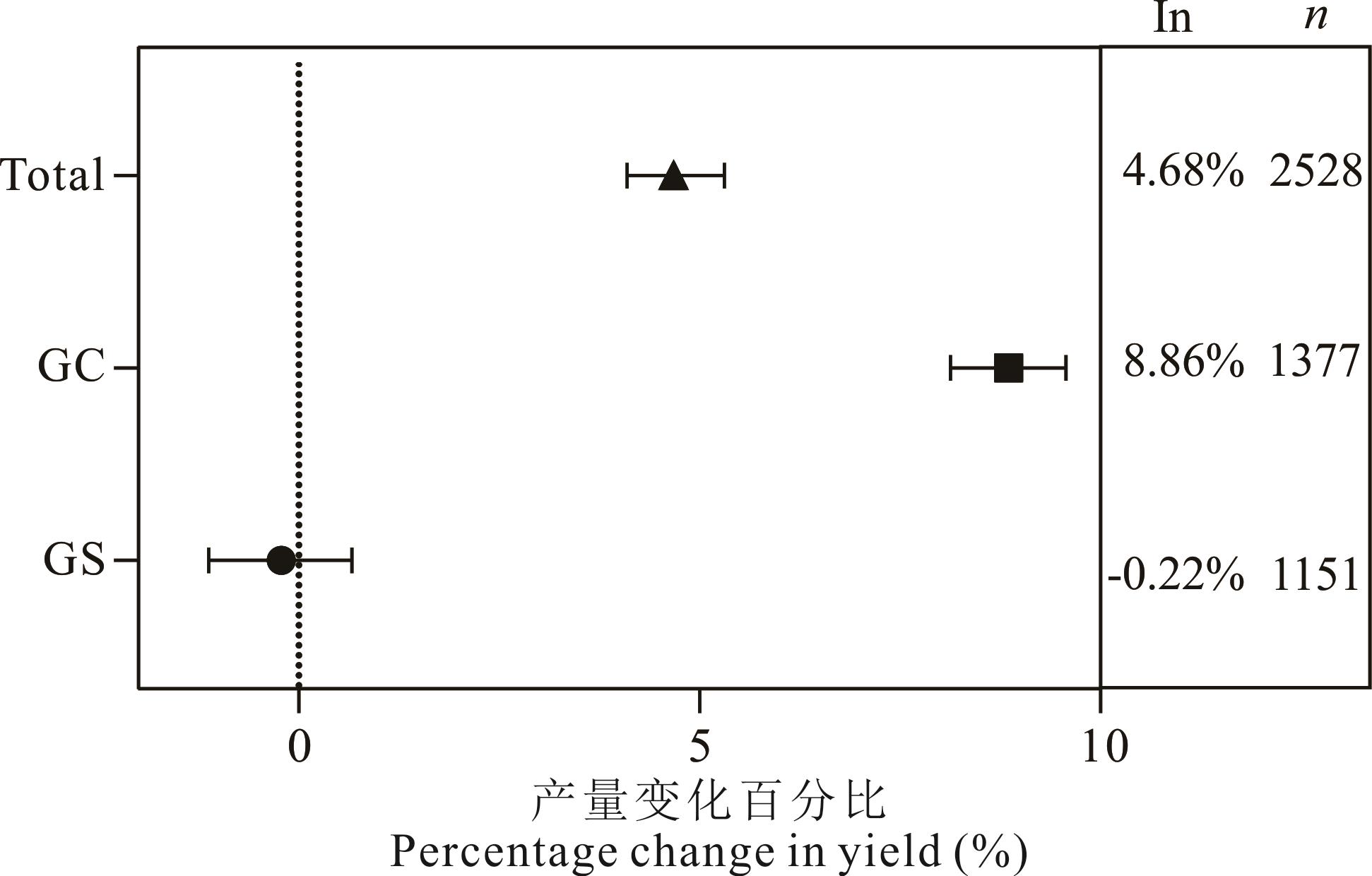
Fig.1 Effects of green manure incorporation on crop yields

Fig.2 Effects of green manure combined with nitrogen fertilizer on crop yields
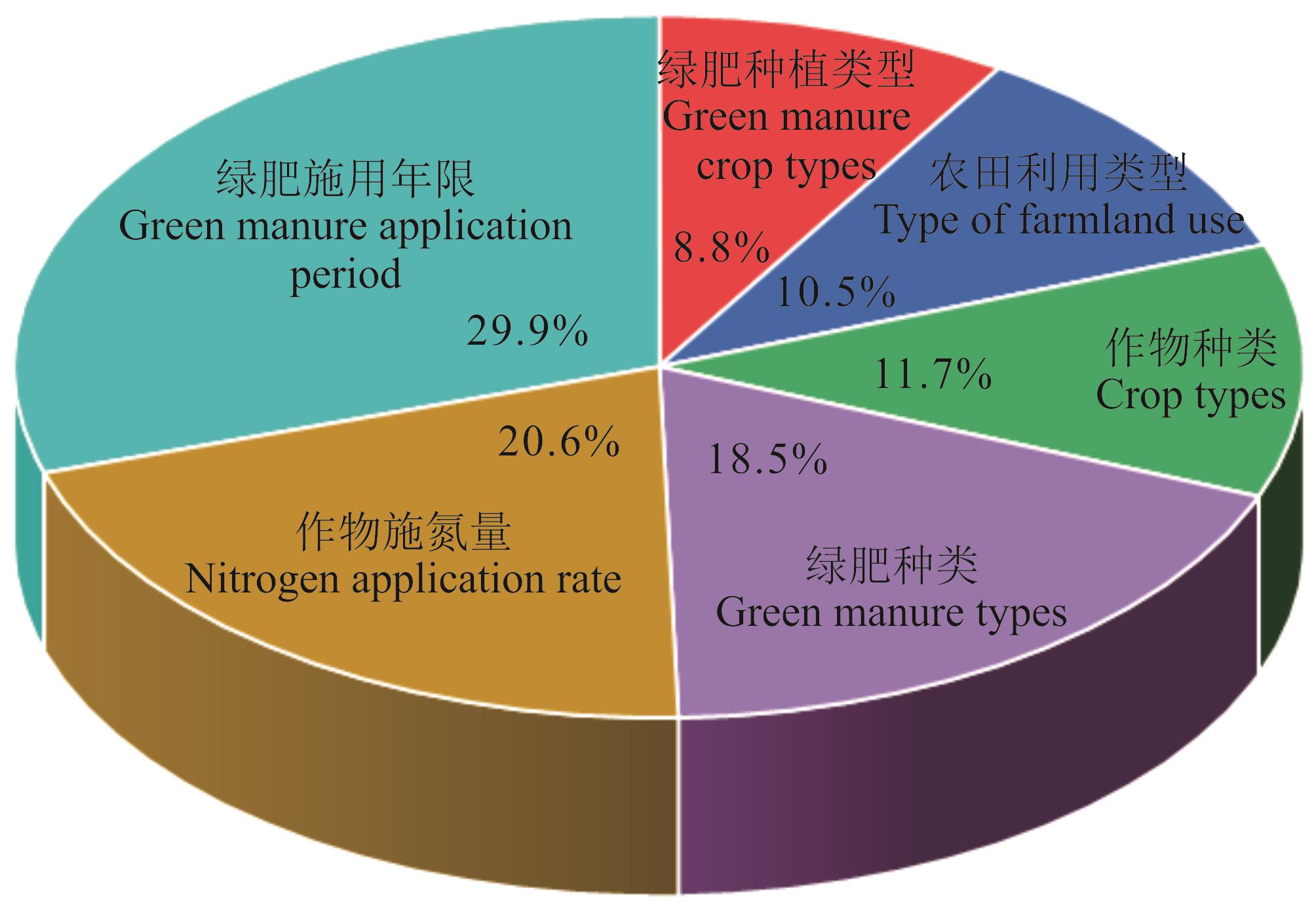
Fig.3 Relative contribution rates of various factors influencing yield response under the combination of green manure and nitrogen fertilizer

Fig.4 Effects of green manure substitution for nitrogen fertilizer on crop yields
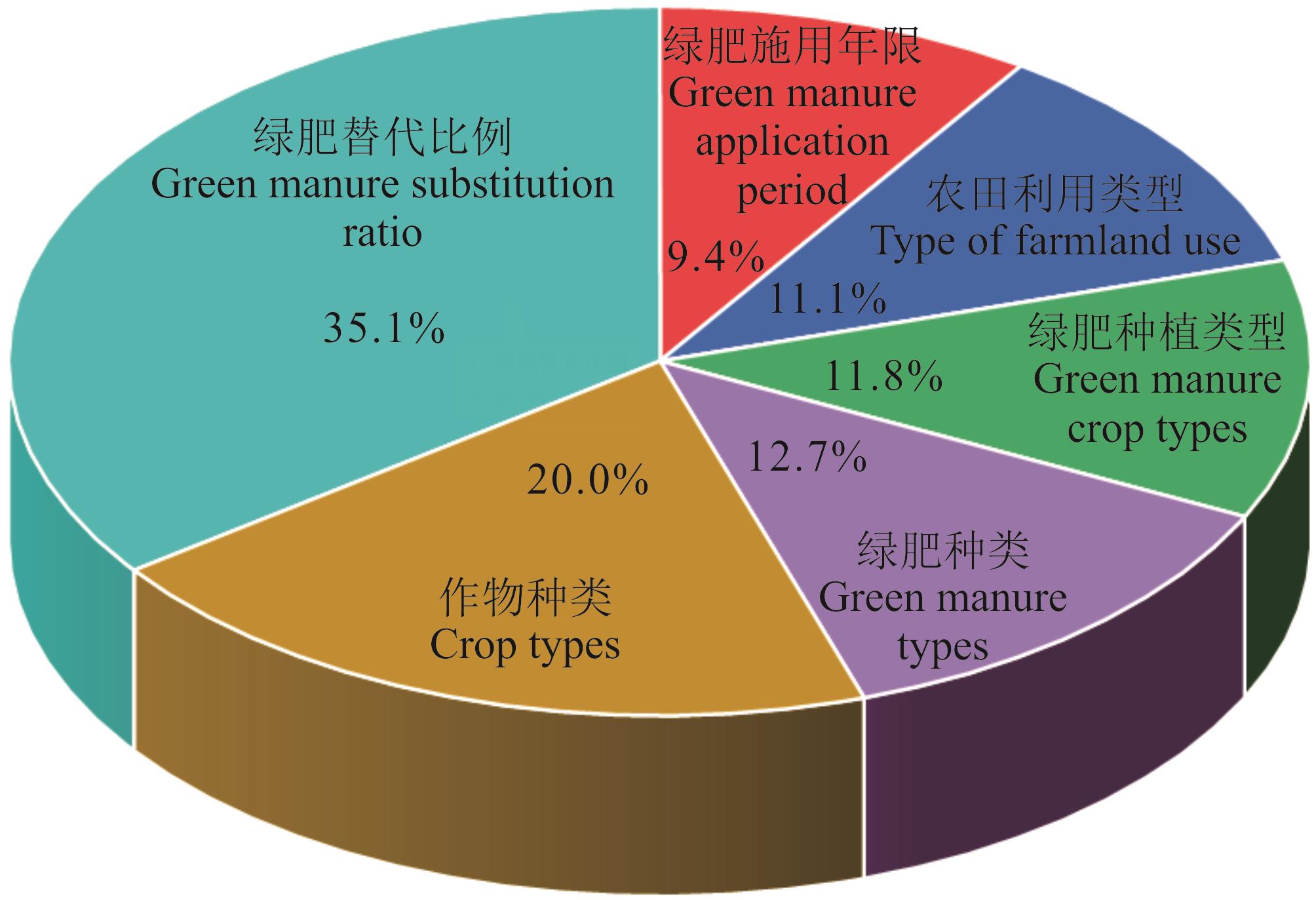
Fig.5 Relative contribution rates of various factors influencing yield response under green manure substitution for nitrogen fertilizer
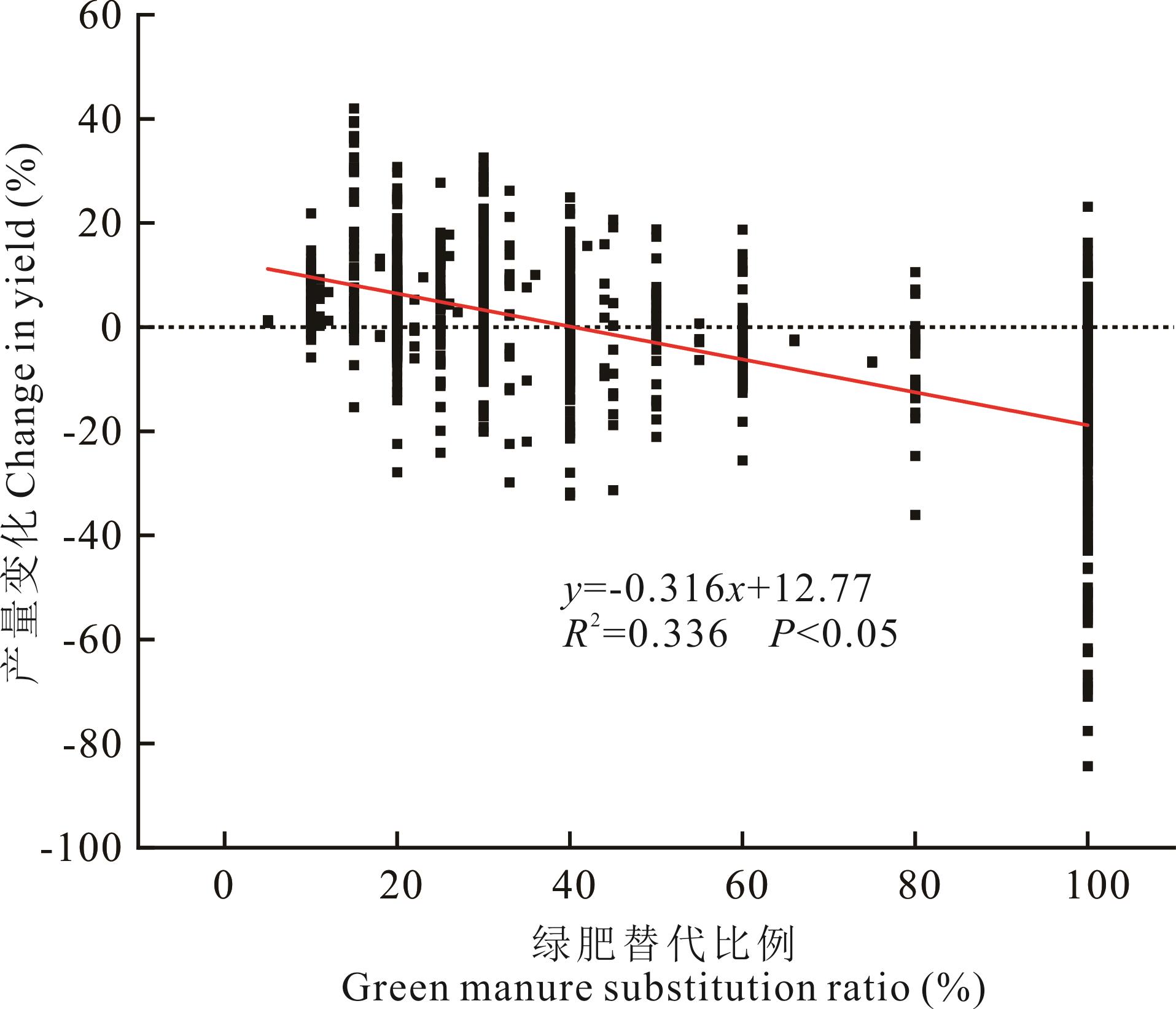
Fig.6 Linear correlation analysis between green manure substitution ratio for nitrogen fertilizer and crop yield change range
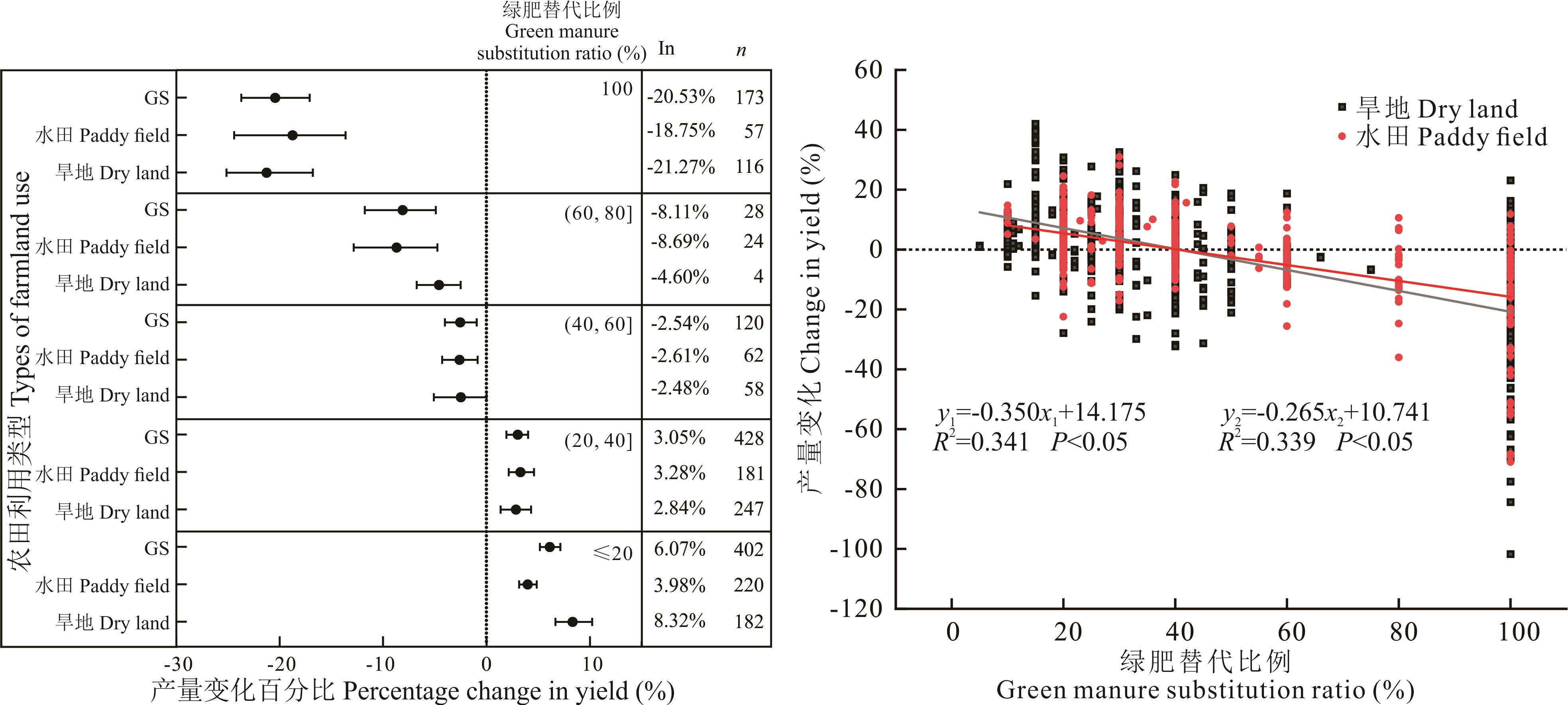
Fig.7 Effects of different green manure substitution ratios and farmland use types on crop yield and correlation analysis with crop yield changes
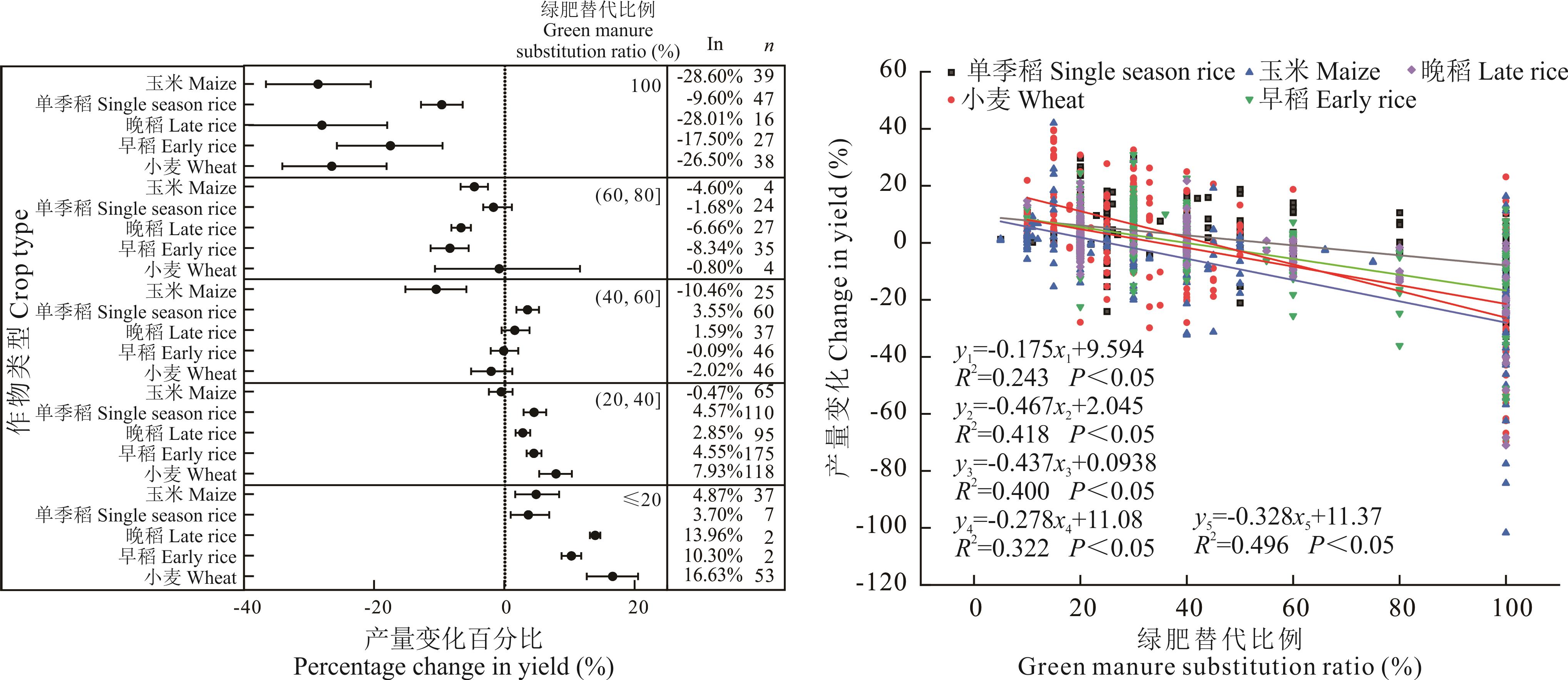
Fig.8 Effects of different green manure substitution ratios and crop types on crop yield and correlation analysis with crop yield changes
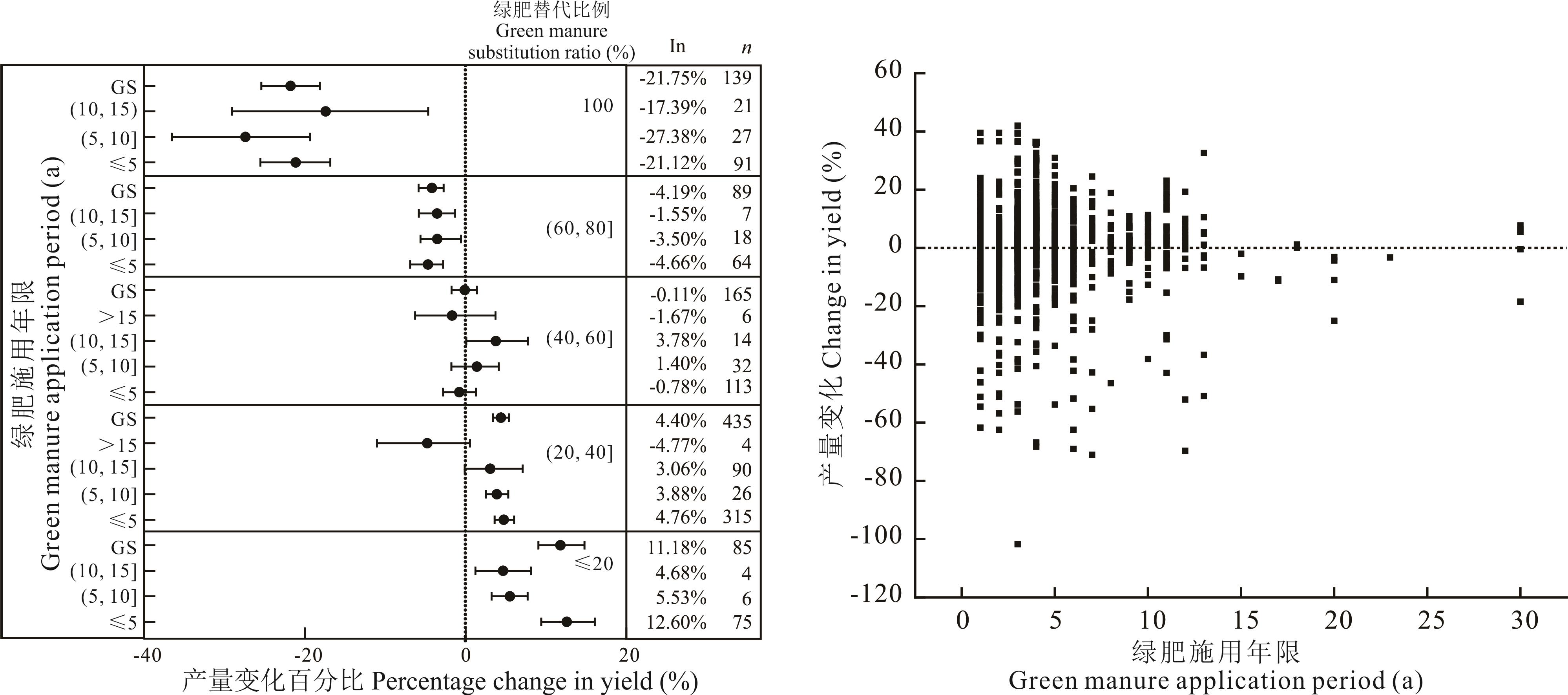
Fig.9 Effects of different green manure substitution ratios and green manure application period on crop yield and correlation analysis with crop yield changes
| [1] | Cao W D, Zhou G P, Gao S J. Effects and mechanisms of green manure on endogenous improving soil health. Journal of Plant Nutrition and Fertilizers, 2024, 30(7): 1274-1283. |
| 曹卫东, 周国朋, 高嵩涓. 绿肥内源驱动土壤健康的作用与机制. 植物营养与肥料学报, 2024, 30(7): 1274-1283. | |
| [2] | Feng X M, Alletto L, Cong F W, et al. Strategies to improve field establishment of cover crops: A review. Agronomy for Sustainable Development, 2024, 44(5): 47. |
| [3] | Liang K L, Wang X Q, Du Y T, et al. Effect of legume green manure on yield increases of three major crops in China, a Meta analysis. Agronomy, 2022, 8: 1753. |
| [4] | Gao S J, Zhou G P, Cao W D. Effects of milk vetch (Astragalus sinicus) as winter green manure on rice yield and rate of fertilizer application in rice paddies in south China. Journal of Plant Nutrition and Fertilizers, 2020, 26(12): 2115-2126. |
| 高嵩涓, 周国朋, 曹卫东. 南方稻田紫云英作冬绿肥的增产节肥效应与机制. 植物营养与肥料学报, 2020, 26(12): 2115-2126. | |
| [5] | Ding W C, Xu X P, He P, et al. Improving yield and nitrogen use efficiency through alternative fertilization options for rice in China: A meta-analysis. Field Crops Research, 2018, 227: 11-18. |
| [6] | Tonitto C, David M, Drinkwater L. Replacing bare fallows with cover crops in fertilizer-intensive cropping systems: A Meta-analysis of crop yield and N dynamics. Agriculture, Ecosystems and Environment, 2005, 112(1): 58-72. |
| [7] | Liang H, Li S, Zhang L, et al. Long-term green manuring enhances crop N uptake and reduces N losses in rice production system. Soil & Tillage Research, 2022, 220: 105369. |
| [8] | Huang H, Zhang Z H, Wu Q, et al. Global comprehensive evaluation shows that green manure enhances crop productivity while mitigating gaseous nitrogen losses. Resources, Conservation & Recycling, 2025, 220: 108351. |
| [9] | Yang R, Song S J, Chen S Y, et al. Adaptive evaluation of green manure rotation for a low fertility farmland system: Impacts on crop yield, soil nutrients, and soil microbial community. Catena, 2023, 222: 106873. |
| [10] | Cao W D, Bao X G, Xu C X, et al. Reviews and prospects on science and technology of green manure in China. Journal of Plant Nutrition and Fertilizers, 2017, 23(6): 1450-1461. |
| 曹卫东, 包兴国, 徐昌旭, 等. 中国绿肥科研60年回顾与未来展望. 植物营养与肥料学报, 2017, 23(6): 1450-1461. | |
| [11] | Li Y, Zhang W, Ma L, et al. An integrated analysis of agricultural management practices for enhancing carbon sequestration and ecosystem services in China. Agriculture, Ecosystems & Environment, 2023, 345: 108321. |
| [12] | Zhang D B, Yao P W, Zhao N, et al. Soil water balance and water use efficiency of dryland wheat in different precipitation years in response to green manure approach. Scientific Reports, 2016, 6(1): 26856. |
| [13] | Qin W L, Zhi J F, Xie N, et al. Effects of partial replacement of chemical fertilizers with green manure on dry matter accumulation and yield formation of maize. Scientia Agricultura Sinica, 2024, 57(13): 2549-2567. |
| 秦文利, 智健飞, 谢楠, 等. 绿肥部分替代化肥对玉米干物质积累与产量形成的影响. 中国农业科学, 2024, 57(13): 2549-2567. | |
| [14] | Su X X, Yu A Z, Lü H Q, et al. Effects of wheat multiple cropping with green manure on grain yield formation and nitrogen absorption and utilization of maize in oasis irrigation area in Northwest China. Journal of Plant Nutrition and Fertilizers, 2022, 28(7): 1208-1218. |
| 苏向向, 于爱忠, 吕汉强, 等. 绿洲灌区小麦复种绿肥并翻压还田对翌年玉米产量形成及氮素吸收利用的影响. 植物营养与肥料学报, 2022, 28(7): 1208-1218. | |
| [15] | Du G H, Zhang L, Ding L, et al. Effects of co-incorporation of Chinese milk vetch and rice straw with nitrogen fertilizer reduction on rice yield and nitrogen nutrition balance. Jiangsu Journal of Agricultural Sciences, 2024, 40(6): 1012-1019. |
| 杜光辉, 张琳, 丁丽, 等. 紫云英与水稻秸秆联合还田配合氮肥减施对水稻产量及氮素营养平衡的影响. 江苏农业学报, 2024, 40(6): 1012-1019. | |
| [16] | Nie L P, Guo L W, Zheng C F, et al. Effects of planting and plowing under Chinese milk vetch combined with chemical fertilizer application on soil physical and chemical properties and rice yield in paddy fields. Chinese Agricultural Science Bulletin, 2021, 37(27): 65-69. |
| 聂良鹏, 郭利伟, 郑春风, 等. 种植翻压紫云英配施化肥对稻田土壤理化性状和水稻产量的影响. 中国农学通报, 2021, 37(27): 65-69. | |
| [17] | Yu P, Wang L X, Jacinthe P A, et al. Global synthesis of cover crop impacts on main crop yield. Field Crops Research, 2024, 310: 109343. |
| [18] | Hedges L V, Gurevitch J, Curtis P S. Statistical issues in ecological Meta-analyses. Ecology, 1999, 80(4): 1142-1149. |
| [19] | Fan F, Wopke W D V, David M, et al. Cover crops promote primary crop yield in China: A Meta-regression of factors affecting yield gain. Field Crops Research, 2021, 271: 108237. |
| [20] | Ma J Y, Wang T, Liu X L, et al. Meta-analysis of yield effects and influencing factors of cover crops on main grain crops in China. Scientia Agricultura Sinica, 2023, 56(10): 1871-1880. |
| 马佳玉, 王涛, 刘小利, 等. 覆盖作物对我国粮食作物的产量效应及影响因素的Meta分析.中国农业科学, 2023, 56(10): 1871-1880. | |
| [21] | Liu J H, Yang R X, Wu G C, et al. Analysis of yield increasing effect of winter green manure on rice fields in south China. Chinese Journal of Grassland, 2024, 46(2): 111-120. |
| 刘俊海, 杨瑞雪, 吴桂成, 等. 我国南方稻田冬绿肥培肥增产效应的分析研究. 中国草地学报, 2024, 46(2): 111-120. | |
| [22] | Li X, Xiao D K, Hu Y, et al. Effects of green manure on rice yield and soil fertility in China: a Meta-analysis. Soil and Fertilizer Sciences in China, 2024(6): 79-88. |
| 李炫, 肖大康, 胡洋, 等. 种植绿肥对我国水稻产量和土壤肥力影响的整合分析. 中国土壤与肥料, 2024(6): 79-88. | |
| [23] | Ren K Y, Lu D M, Zou H Q, et al. Effects of substituting manure for fertilizer on yield and nitrogen content of rice grain in the Yangtze River basin. Journal of Agricultural Resources and Environment, 2022, 39(4): 716-725. |
| 任科宇, 陆东明, 邹洪琴, 等. 有机替代对长江流域水稻产量和籽粒含氮量的影响. 农业资源与环境学报, 2022, 39(4): 716-725. | |
| [24] | Zhang C L, Liu C Z, Li B Y, et al. Effects of Chinese milk vetch combined with chemical fertilizer on rice yield in China: a Meta-analysis. Soil and Fertilizer Sciences in China, 2023(3): 39-45. |
| 张成兰, 刘春增, 李本银, 等. 紫云英配施化肥对我国水稻产量效应的整合分析. 中国土壤与肥料, 2023(3): 39-45. | |
| [25] | Lehrer E J, Wang M, Sun Y L, et al. An introduction to Meta-analysis. International Journal of Radiation Oncology, Biology, Physics, 2023, 115(3): 564-571. |
| [26] | Feng Y, Liang H, Nie J, et al. Roles of microbial community and keystone taxa in rice productivity under green manuring in South China. Sustainability, 2024, 16(9): 3565. |
| [27] | Zhang L, Du J T, Fan Q Y, et al. Response of biological nitrogen fixation by milk vetch to soil fertility and rhizobium inoculation. Acta Prataculturae Sinica, 2025, 34(5): 51-63. |
| 张磊, 杜锦涛, 范倩玉, 等. 紫云英生物固氮对土壤肥力及根瘤菌的响应特征. 草业学报, 2025, 34(5): 51-63. | |
| [28] | Yao W, Yang Y, Beillouin D, et al. Legume-rice rotations increase rice yields and carbon sequestration potential globally. One Earth, 2025, 8(2): 101170. |
| [29] | Allen B L, Pikul J L, Waddell J T, et al. Long-term lentil green-manure replacement for fallow in the semiarid northern great plains. Agronomy Journal, 2011, 103: 1292-1298. |
| [30] | Xia Y H, Gao P, Lei W S, et al. Covering green manure increases rice yields via improving nitrogen cycling between soil and crops in paddy fields. Agriculture, Ecosystems & Environment, 2025, 383: 109517. |
| [31] | Cherr M C, Scholberg S M J, McSorley R. Green manure approaches to crop production: A synthesis. Agronomy Journal, 2006, 98(2): 302-319. |
| [32] | Muhammad I, Lyu J Z, Wang J, et al. Regulation of soil microbial community structure and biomass to mitigate soil greenhouse gas emission. Frontiers in Microbiology, 2022, 13: 868862. |
| [33] | Neely C B, Jr R F M, Morgan C L S, et al. Legume green manure and intercropping for high biomass sorghum production. Agricultural Sciences, 2024, 15(6): 605-621. |
| [34] | Kumar V, Ram V, Rajkumari P. Evaluating intercropping indices, yield attributes and yield of baby corn and green gram under different planting patterns. International Journal of Plant & Soil Science, 2024, 36(8): 460-469. |
| [35] | Mukhtar A I, Olalekan T K, Abdulraheem M I, et al. Green manure for agricultural sustainability and improvement of soil fertility. Farming and Management, 2022, 7(1): 1-8. |
| [36] | Muhammad I K, Hyo S G, Muhammad A A, et al. Short term effects of different green manure amendments on the composition of main microbial groups and microbial activity of a submerged rice cropping system. Applied Soil Ecology, 2020, 147: 103400. |
| [37] | Valkama E, Lemola R, Känkänen H E T. Meta-analysis of the effects of undersown catch crops on nitrogen leaching loss and grain yields in the Nordic countries. Agriculture Ecosystems & Environment, 2015, 20: 93-101. |
| [38] | Thorup-Kristensen K, Magid J, Jensen S L. Catch crops and green manures as biological tools in nitrogen management in temperate zones. Advances in Agronomy, 2003, 79: 227-302. |
| [39] | Xie Z J, Tu S X, Shah F, et al. Substitution of fertilizer-N by green manure improves the sustainability of yield in double-rice cropping system in south China. Field Crops Research, 2016, 188: 142-149. |
| [40] | Lyu H Q, Li Y, Wang Y L, et al. Drive soil nitrogen transformation and improve crop nitrogen absorption and utilization: A review of green manure applications. Frontiers in Plant Science, 2024, 14: 1305600. |
| [41] | Ma D K, Yin L N, Ju W L, et al. Meta-analysis of green manure effects on soil properties and crop yield in northern China. Field Crops Research, 2021, 266: 108146. |
| [42] | Wang X, Zhang J D, Zhao Y M, et al. Evaluation of farmland soil health and optimization of evaluation system under different green manure applications in a semi-arid irrigation area. Land Degradation & Development, 2024, 35(5): 1913-1926. |
| [43] | Meng Z L, Zhu Q, Ni X F, et al. Impact of conservation tillage on soil moisture utilization, wheat water requirements and yield. China Seed Industry, 2024(10): 35-37, 41. |
| 孟自力, 朱倩, 倪雪峰, 等. 保护性耕作对土壤水分利用与小麦需水特性和产量影响研究. 中国种业, 2024(10): 35-37, 41. |
| [1] | Yang-kun LI, Zhuan-lin BEN, Jun-yu ZHANG, Hui-min YANG. A meta-analysis on the effect of fertilizer type on alfalfa seed yield under various climate and soil conditions [J]. Acta Prataculturae Sinica, 2026, 35(2): 54-67. |
| [2] | Bang-yan ZHANG, Xiao-wei XIE, Zhao-hui ZHANG, Jin-min WU, Bin WANG, Xing XU. Effect of organic-inorganic amendments on the quality of saline-alkaline soil and yield of Echinochloa frumentacea [J]. Acta Prataculturae Sinica, 2025, 34(8): 15-29. |
| [3] | Shao-yu YUAN, Shi-hui HAN, Tian XIA, Ning-bo HE, Jian-jie ZHANG. Responses of soil pH to different fertilization practices in natural grasslands of northern China [J]. Acta Prataculturae Sinica, 2025, 34(7): 28-40. |
| [4] | Jing-jing MAI, Qi-sheng FENG, Rui-jing WANG, Sen-yao FENG, Zhe-ren JIN, Zhong-xue ZHANG, Tian-gang LIANG, Jia-ming JIN. Construction of a high-precision cultivated land identification model based on machine learning-using Zhangye City, Gansu Province as an example [J]. Acta Prataculturae Sinica, 2025, 34(2): 149-162. |
| [5] | Rui LIU, Dan-na CHANG, Guo-peng ZHOU, Song-juan GAO, Qiang CHAI, Wei-dong CAO. Techniques of N2O emission reduction in farmland and their synergistic application with green manure [J]. Acta Prataculturae Sinica, 2025, 34(2): 196-210. |
| [6] | Wen-jun ZHAO, Ting LIANG, Jian-song WANG, Kui LIU, Yu FENG, Zheng-xu WANG, Zi-he XU, Yun-cong ZHU, Meng-meng SUN, Xiang-wei LI, Li-bo FU, Mei YIN, Guo-peng ZHOU, Hua CHEN, Wei-dong CAO. Planting and incorporation of smooth vetch together with reduced nitrogen fertilizer application enhances tobacco yield and soil quality [J]. Acta Prataculturae Sinica, 2025, 34(10): 74-84. |
| [7] | Zheng WANG, Wei CHANG, Jun-cheng LI, Lian-tai SU, Li GAO, Peng ZHOU, Yuan AN. Effects of alfalfa green manure on the yield, nitrogen absorption, and nitrogen translocation of feed maize [J]. Acta Prataculturae Sinica, 2024, 33(8): 63-73. |
| [8] | Shou-xia XU. Meta-analysis of the effects of arbuscular mycorrhizae on the yield and quality of wheat [J]. Acta Prataculturae Sinica, 2024, 33(7): 192-204. |
| [9] | Yao SU, Su-mei YE, Meng-xing LU, Yue MA, Yu-bao WANG, Shan-shan WANG, Ru-shan CHAI, Xin-xin YE, Zhen ZHANG, Chao MA. Effects of straw return on farmland weed abundance and diversity: A meta-analysis [J]. Acta Prataculturae Sinica, 2024, 33(3): 150-160. |
| [10] | Shuai-lei LYU, Dan-na CHANG, Guo-peng ZHOU, Rui LIU, Xin ZHAO, Jia LIU, Chang-xu XU, Wei-dong CAO. The phosphorus effect of applying phosphate rock powder during the green manure season in red soil of Jiangxi Province [J]. Acta Prataculturae Sinica, 2024, 33(11): 149-160. |
| [11] | Wen-jun ZHAO, Rui LIU, Zheng-xu WANG, Yu FENG, Kai-zheng XUE, Kui LIU, Zi-he XU, Wei-dong CAO, Li-bo FU, Mei YIN, Hua CHEN. Effects of rotation with a green manure crop on soil quality and microbial nutrient limitation in a tobacco field in Yunnan [J]. Acta Prataculturae Sinica, 2024, 33(10): 147-158. |
| [12] | Hui-long ZHANG, Xiu-chun YANG, Dong YANG, Ang CHEN, Min ZHANG. Spatio-temporal changes in grassland fractional vegetation cover in Inner Mongolia from 2000 to 2020 and a future forecast [J]. Acta Prataculturae Sinica, 2023, 32(8): 1-13. |
| [13] | Cong-ze JIANG, Na SHOU, Wei GAO, Ren-shi MA, Yu-ying SHEN, Xian-long YANG. A multivariate evaluation of production performance and nutritional quality of different varieties of silage maize in the dry plateau area of Longdong [J]. Acta Prataculturae Sinica, 2023, 32(7): 216-228. |
| [14] | Min-hua YIN, Yan-lin MA, Yan-xia KANG, Qiong JIA, Guang-ping QI, Jing-hai WANG. Effects of nitrogen application on alfalfa yield and quality in China-A Meta-analysis [J]. Acta Prataculturae Sinica, 2022, 31(9): 36-49. |
| [15] | Yi-han ZHAO, Meng-jing HOU, Qi-sheng FENG, Hong-yuan GAO, Tian-gang LIANG, Jin-sheng HE, Da-wen QIAN. Estimation of aboveground biomass in Menyuan grassland based on Landsat 8 and random forest approach [J]. Acta Prataculturae Sinica, 2022, 31(7): 1-14. |
| Viewed | ||||||
|
Full text |
|
|||||
|
Abstract |
|
|||||
