
ISSN 1004-5759 CN 62-1105/S
Acta Prataculturae Sinica ›› 2026, Vol. 35 ›› Issue (7): 92-104.DOI: 10.11686/cyxb2025309
Previous Articles Next Articles
Jiang-ping MA1,2,3( ), Li-juan CAO4, Wen-wen ZHANG5, Meng-yu ZHAO5, Teng-fei WANG1,2,3, Yi-yin ZHANG1,2,3, Bin WANG1,2,3, Jia-wang LI1,2,3, Xiao-bing WANG1,2,3, Jian LAN1,2,3()
Received:2025-07-22
Revised:2025-09-29
Online:2026-07-20
Published:2026-05-21
Contact:
Jian LAN
Jiang-ping MA, Li-juan CAO, Wen-wen ZHANG, Meng-yu ZHAO, Teng-fei WANG, Yi-yin ZHANG, Bin WANG, Jia-wang LI, Xiao-bing WANG, Jian LAN. Effects of reseeding and phosphorus application on productivity and soil in improvement of degraded alfalfa stands[J]. Acta Prataculturae Sinica, 2026, 35(7): 92-104.
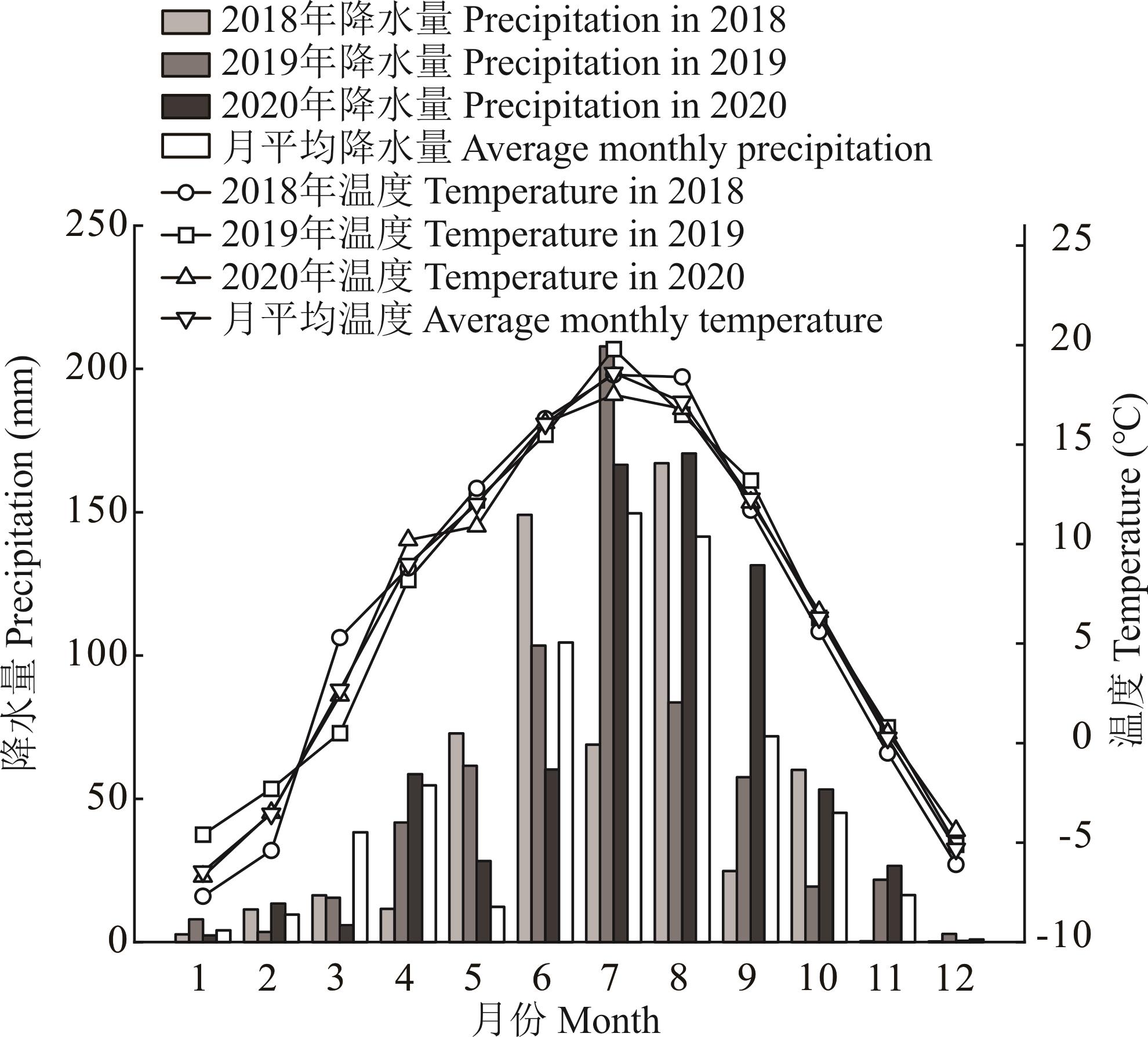
Fig.1 Precipitation and temperature in different months of the pilot area
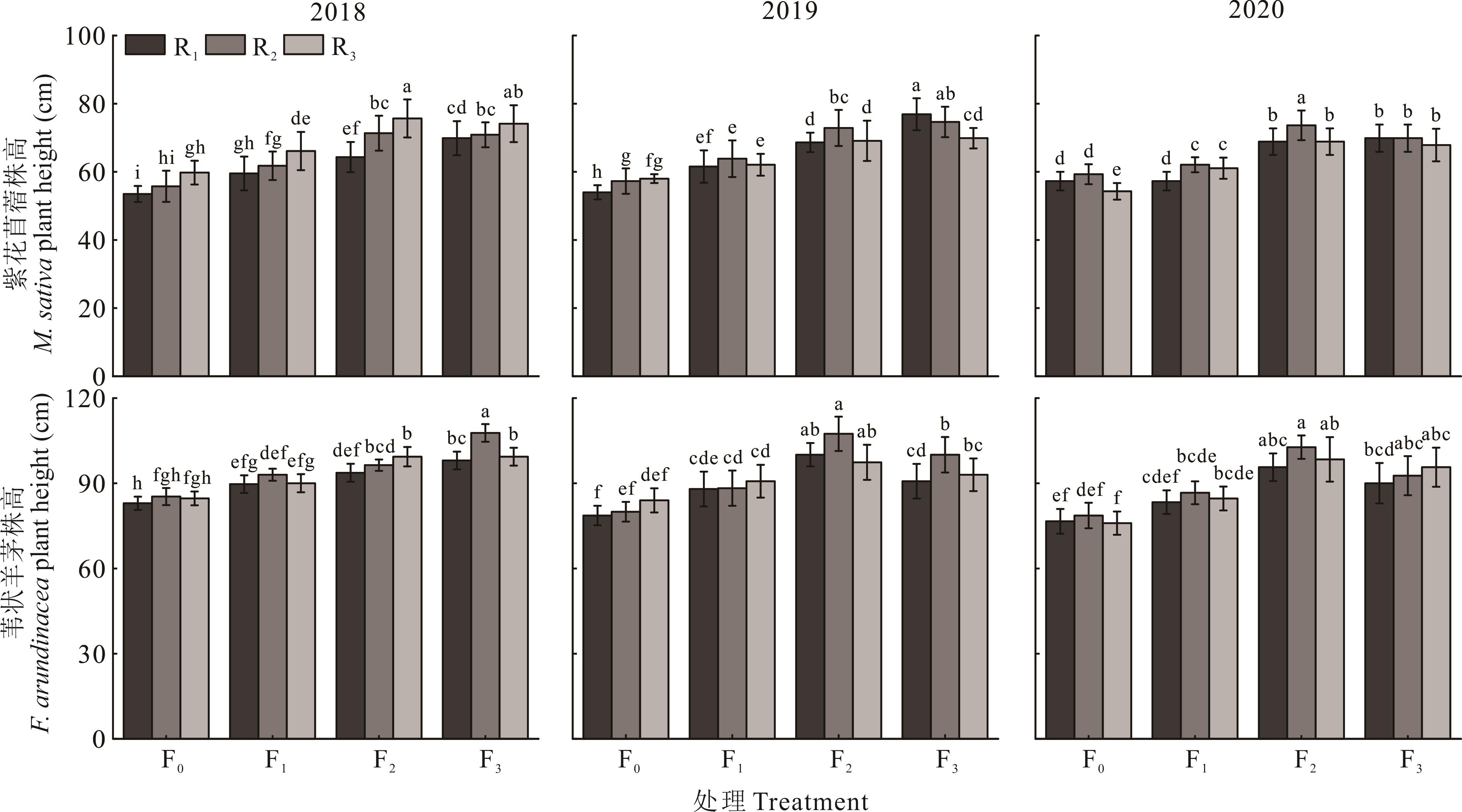
Fig.2 Effect of reseeding-phosphorus application on plant height of forage
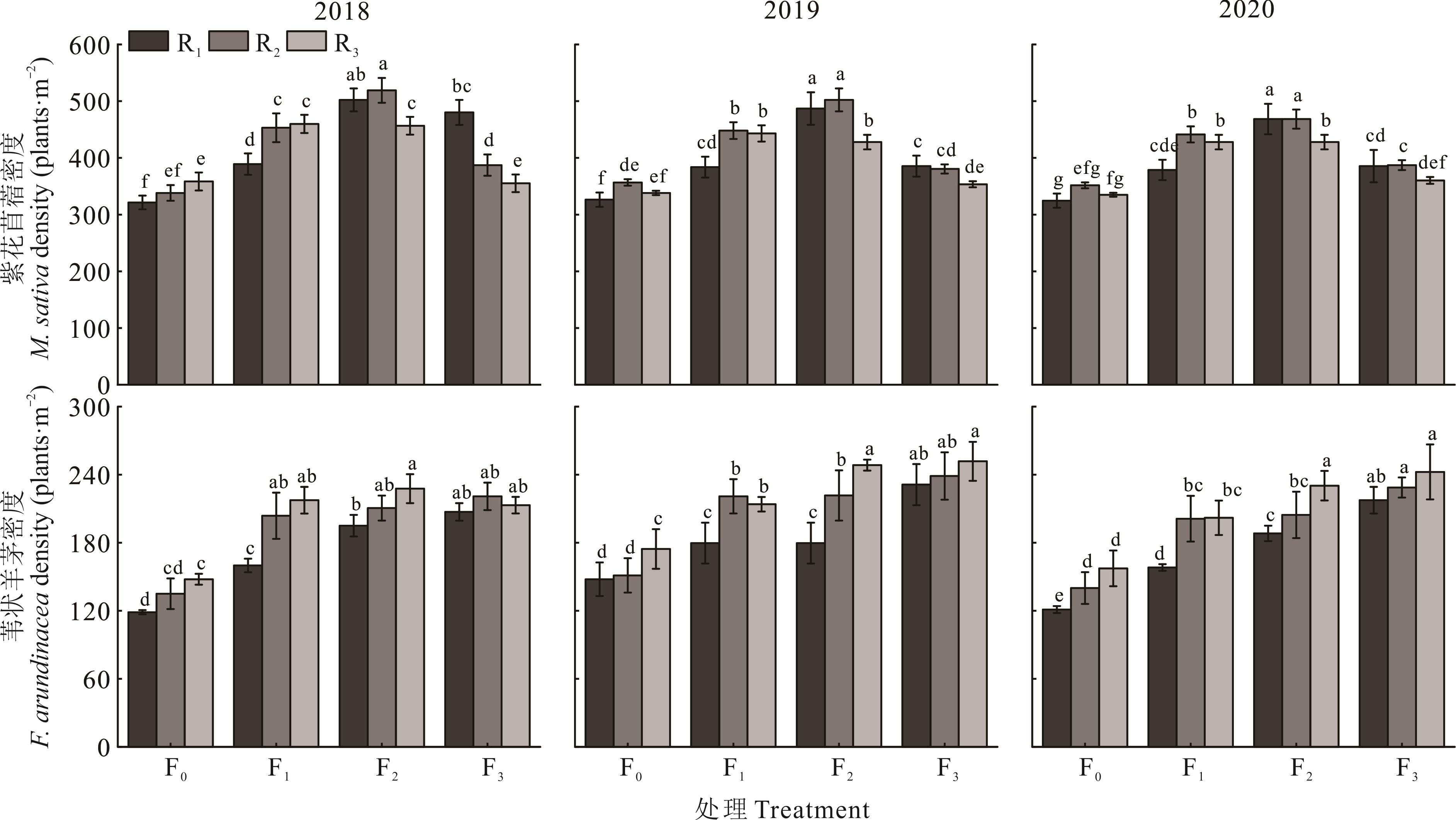
Fig.3 Effect of reseeding-phosphorus application on forage density
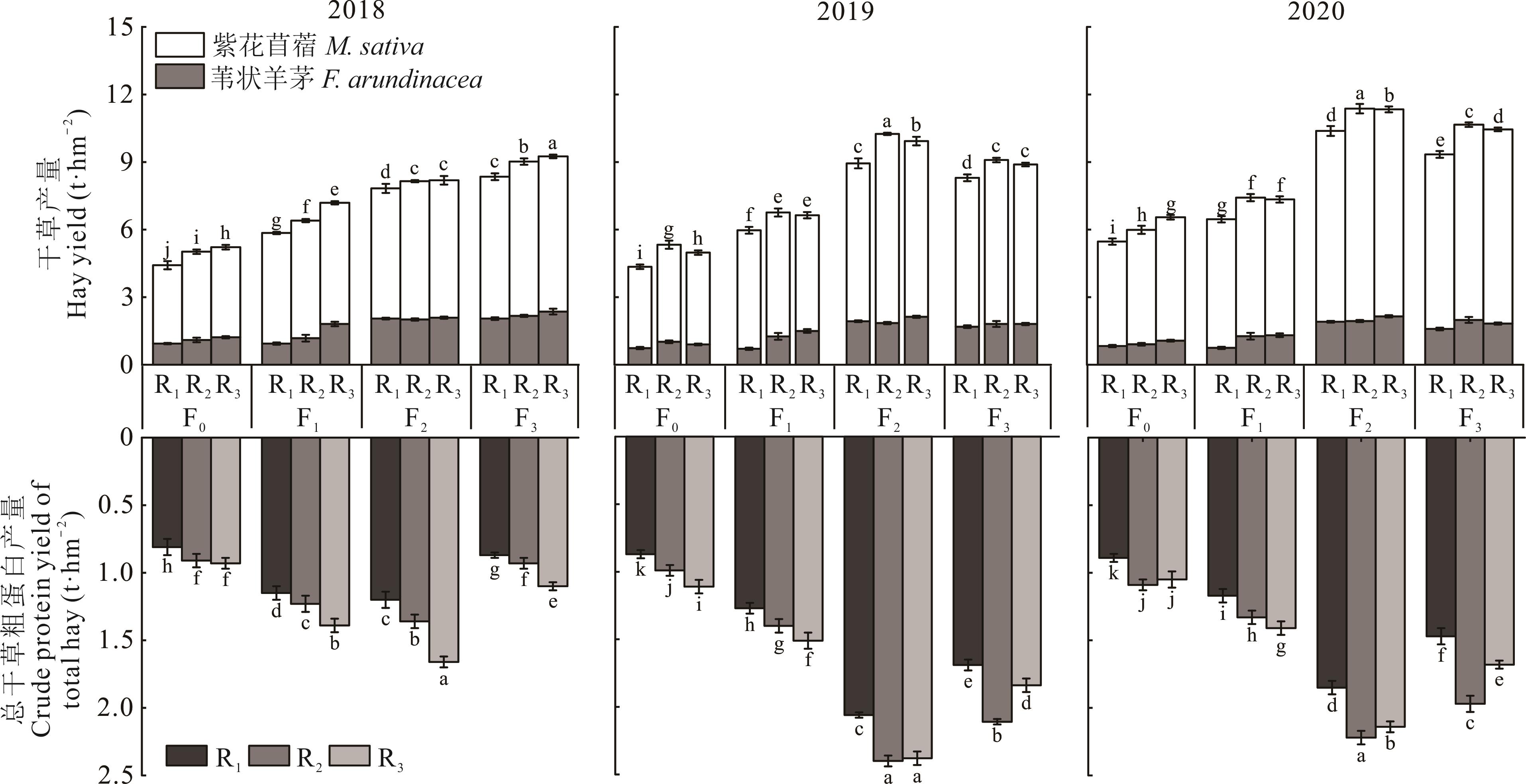
Fig.4 Effects of reseeding-phosphorus application on grassland productivity and total hay crude protein yield
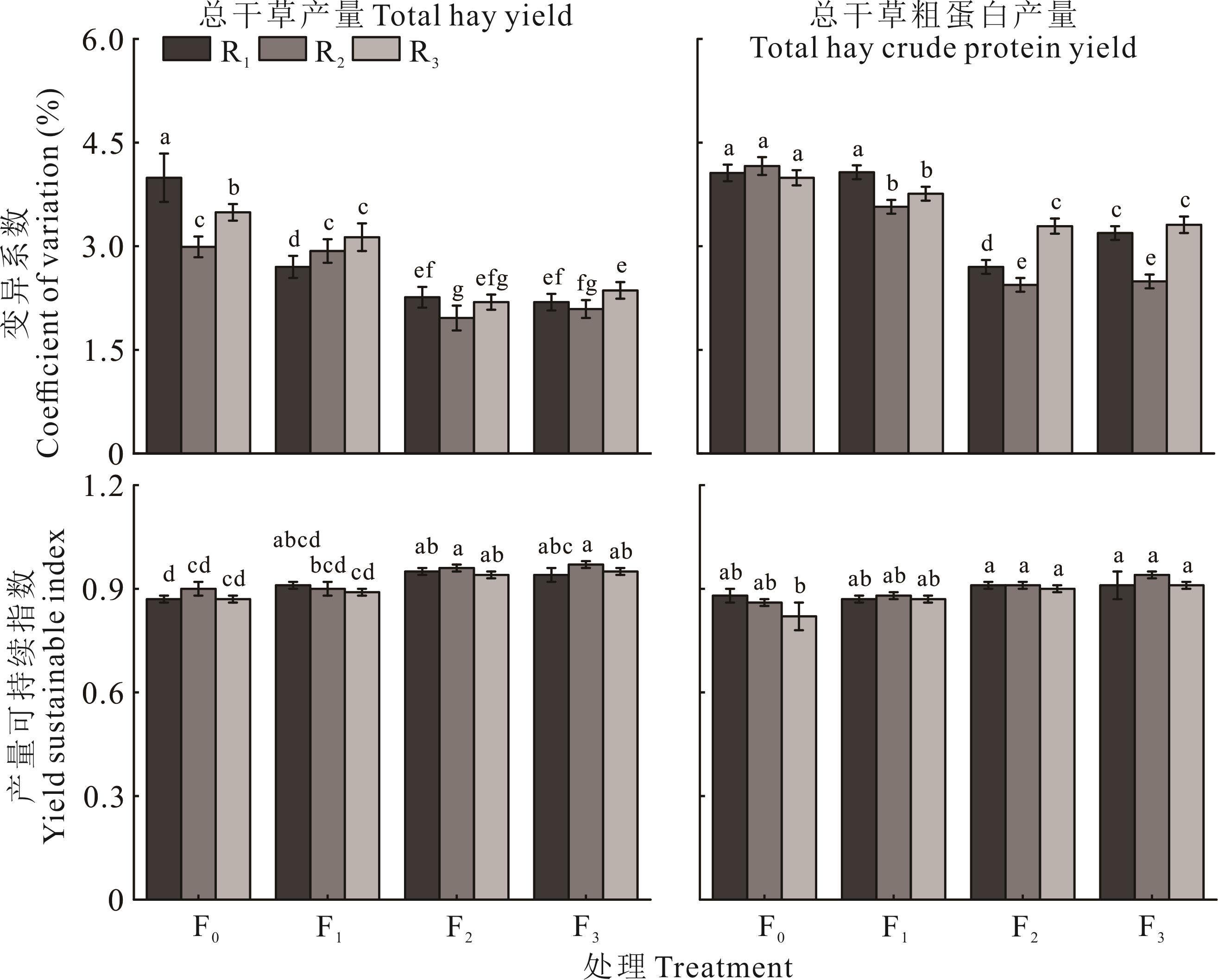
Fig.5 Effects of reseeding-phosphorus application on yield stability and sustainability
| 因素Factor | HA | HF | DA | DF | DMA | DMF | CPY | CVDM | CVCPY | SYIDM | SYICPY |
|---|---|---|---|---|---|---|---|---|---|---|---|
| 年份Year | ** | *** | *** | *** | *** | *** | *** | ns | ns | ns | ns |
| 施磷量Phosphorus application | *** | *** | *** | *** | *** | *** | *** | * | ** | * | ** |
| 补播量Reseeding rate | *** | ** | *** | *** | *** | *** | *** | ns | ns | ns | ns |
| 年份×施磷量Year×phosphorus application | ** | ** | * | ns | *** | *** | *** | ns | ns | ns | ns |
| 年份×补播量Year×reseeding rate | *** | ns | * | ns | *** | *** | *** | ns | ns | ns | ns |
| 施磷量×补播量Phosphorus application×reseeding rate | *** | ns | *** | *** | ** | *** | *** | ns | ns | ns | ns |
| 年份×施磷量×补播量Year×phosphorus application×reseeding rate | * | ns | *** | ns | *** | *** | *** | ns | ns | ns | ns |
Table 1 Analysis of variance for forage growth and development, yield, and yield stability and sustainability
| 因素Factor | HA | HF | DA | DF | DMA | DMF | CPY | CVDM | CVCPY | SYIDM | SYICPY |
|---|---|---|---|---|---|---|---|---|---|---|---|
| 年份Year | ** | *** | *** | *** | *** | *** | *** | ns | ns | ns | ns |
| 施磷量Phosphorus application | *** | *** | *** | *** | *** | *** | *** | * | ** | * | ** |
| 补播量Reseeding rate | *** | ** | *** | *** | *** | *** | *** | ns | ns | ns | ns |
| 年份×施磷量Year×phosphorus application | ** | ** | * | ns | *** | *** | *** | ns | ns | ns | ns |
| 年份×补播量Year×reseeding rate | *** | ns | * | ns | *** | *** | *** | ns | ns | ns | ns |
| 施磷量×补播量Phosphorus application×reseeding rate | *** | ns | *** | *** | ** | *** | *** | ns | ns | ns | ns |
| 年份×施磷量×补播量Year×phosphorus application×reseeding rate | * | ns | *** | ns | *** | *** | *** | ns | ns | ns | ns |
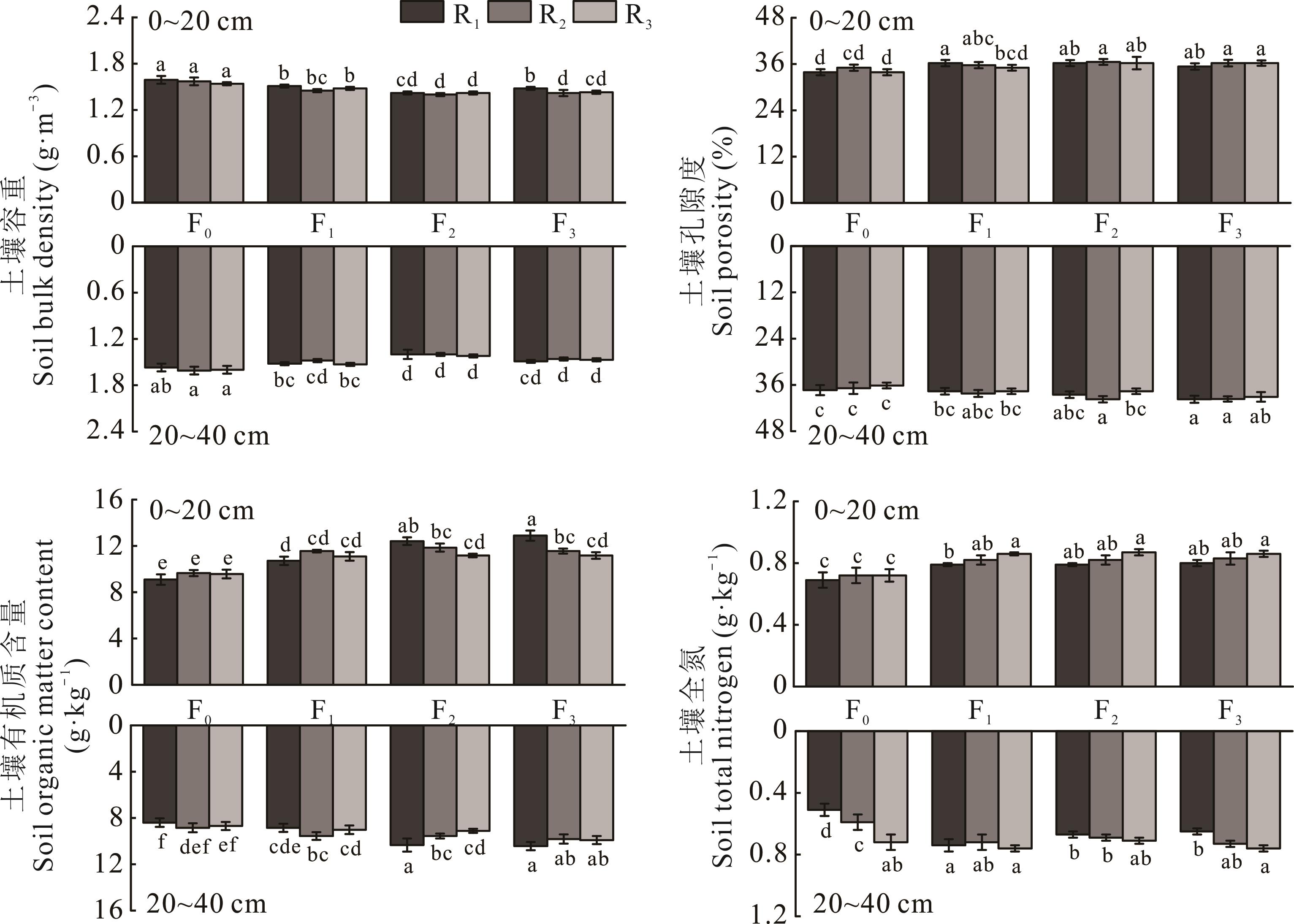
Fig.6 Effects of reseeding-phosphorus application on soil physical and chemical properties
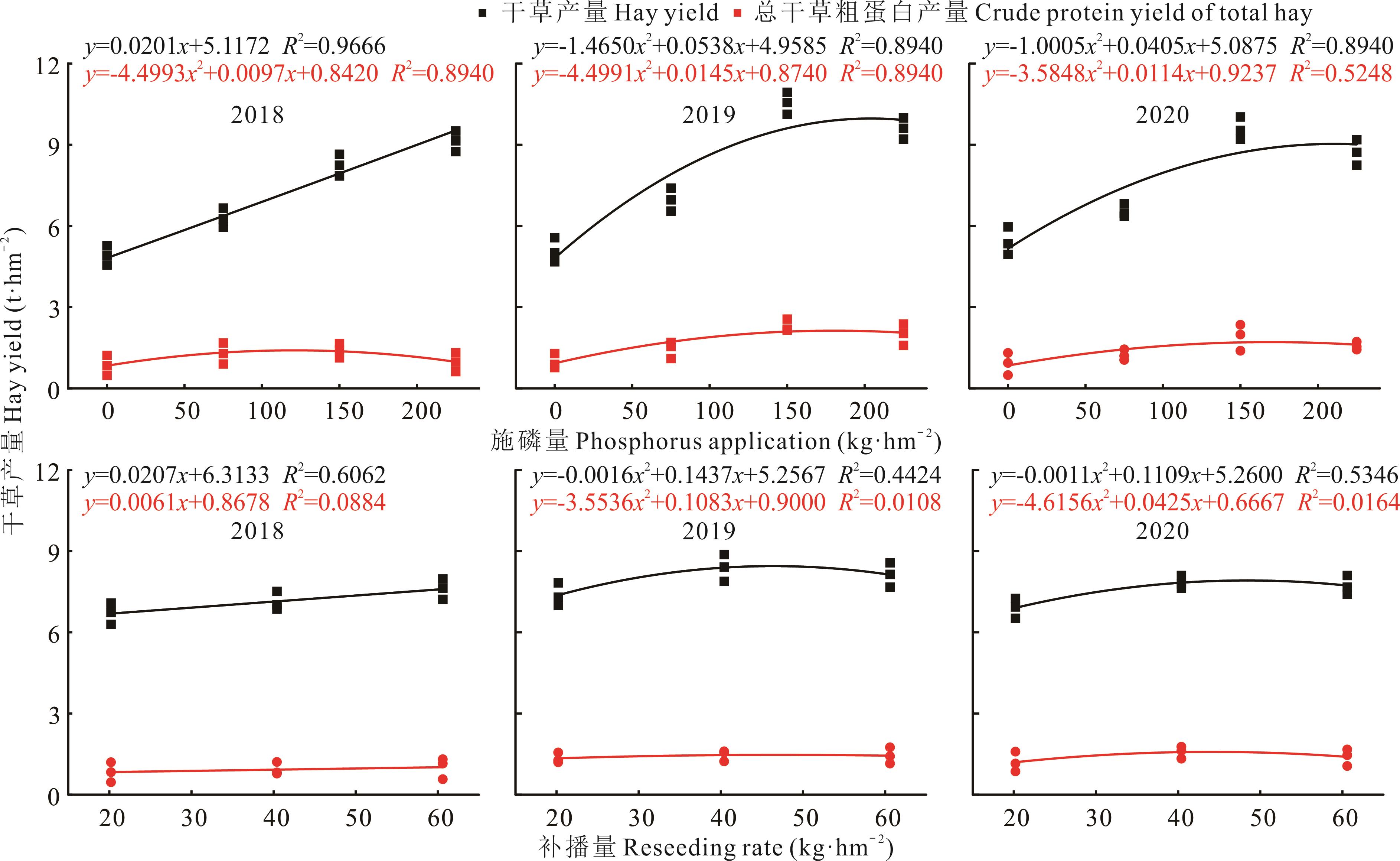
Fig.7 The relationship between hay yield and crude protein yield of total hay and phosphorus application rate and reseeding rate
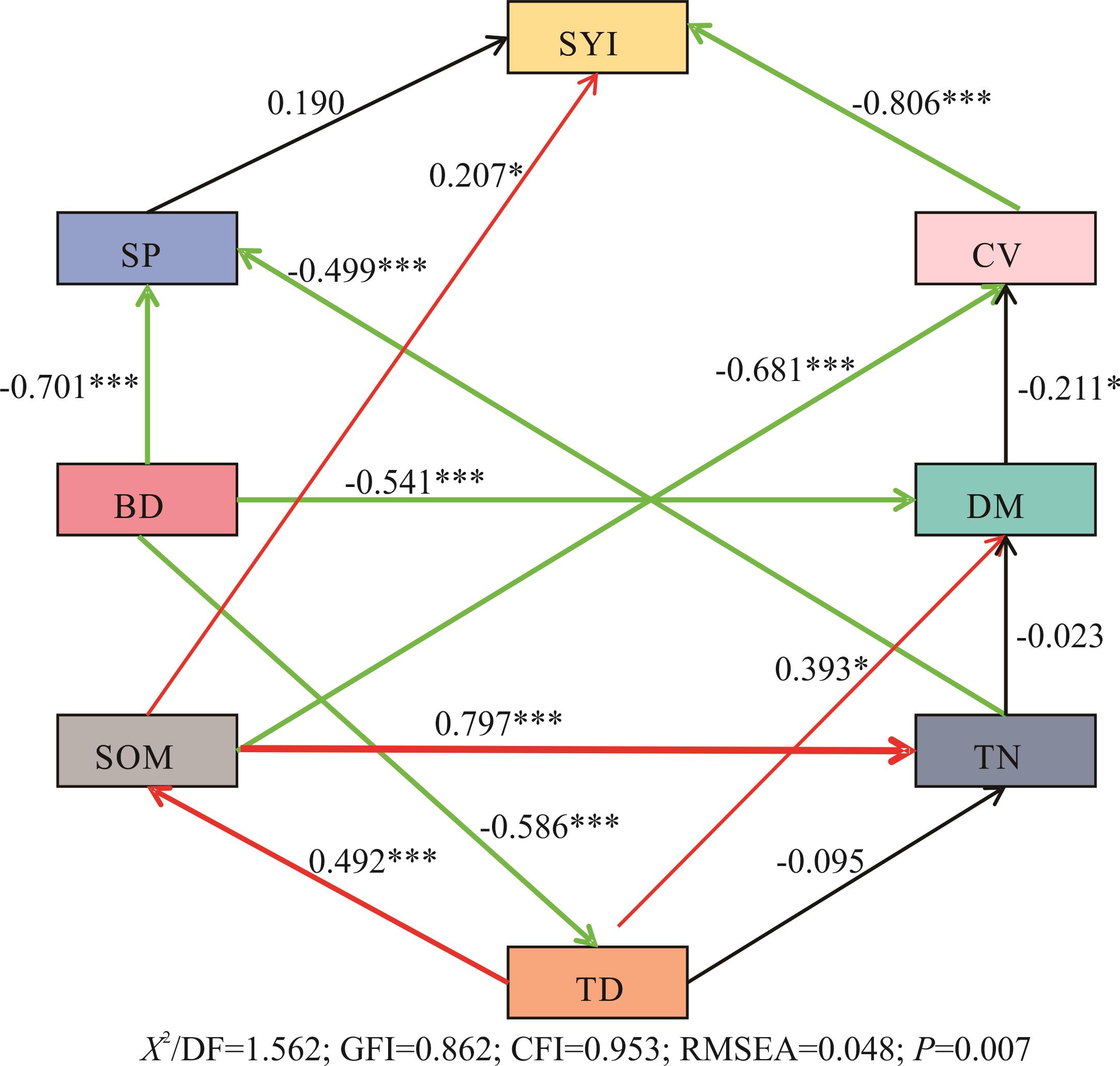
Fig.8 Structural equation model
| [1] | Zhu J X, Shang Z H, Jiang S J, et al. Key scientific questions of grassland protection, restoration and function improvement. Bulletin of National Natural Science Foundation of China, 2024, 38(4): 658-667. |
| 朱剑霄, 尚占环, 蒋胜竞, 等. 草地生态系统保护、修复与功能提升的关键科学问题. 中国科学基金, 2024, 38(4): 658-667. | |
| [2] | Hou F J, Huang X J, Chang S H, et al. Concepts and approaches of grassland improvement. Acta Ecologica Sinica, 2024, 44(19): 8897-8913. |
| 侯扶江, 黄小娟, 常生华, 等. 草地培育的内涵和方法. 生态学报, 2024, 44(19): 8897-8913. | |
| [3] | Liu Z, Lan J X, Li W, et al. Reseeding improved soil and plant characteristics of degraded alfalfa (Medicago sativa) grassland in Loess Hilly Plateau Region, China. Ecological Engineering, 2023, 190(1): 106933. |
| [4] | Wang J, Fu X, Ghimire R J, et al. Responses of soil bacterial community and enzyme activity to organic matter components under long-term fertilization on the Loess Plateau of China. Appled Soil Ecology, 2021, 166(10): 103992. |
| [5] | Wang B, Deng J Q, Wang T F, et al. Innovative tillage practices to establish productive and sustainable forage production systems in degraded alfalfa pastures in semiarid regions. Land Degradation & Development, 2024, 35(18): 5804-5816. |
| [6] | Wang B, Li M Y, Wang X P, et al. Combined ploughing and tilling to improve degraded alfalfa (Medicago sativa) stands in a semi-arid region. Acta Prataculturae Sinica, 2022, 31(1): 107-117. |
| 王斌, 李满有, 王欣盼, 等. 深松浅旋对半干旱区退化紫花苜蓿人工草地改良效果研究. 草业学报, 2022, 31(1): 107-117. | |
| [7] | Niu S L, Jiang G M. Function of artificial grassland in restoration of degraded natural grassland and its research advance. Chinese Journal of Applied Ecology, 2004, 15(9): 1662-1666. |
| 牛书丽, 蒋高明. 人工草地在退化草地恢复中的作用及其研究现状. 应用生态学报, 2004, 15(9): 1662-1666. | |
| [8] | Leger E A, Goergen E M, Forbis D Q T. Can native annual forbs reduce Bromus tectorum biomass and indirectly facilitate establishment of a native perennial grass? Journal of Arid Environments, 2014, 102: 9-16. |
| [9] | Zhu Y Q, Yu H, Zheng W, el al. Effects of different planting configurations on yield of Avena sativa and Vicia sativa mixed plantings with soybean in alpine pastures. Acta Prataculturae Sinica, 2020, 29(1): 74-85. |
| 朱亚琼, 于辉, 郑伟, 等. 燕麦+箭筈豌豆混播草地混播优势的测度与影响因素分析. 草业学报, 2020, 29(1): 74-85. | |
| [10] | Fan Y F, Wang Z L, Liao D P, et al. Uptake and utilization of nitrogen, phosphorus and potassium as related to yield advantage in maize-soybean intercropping under different row configurations. Scientific Reports, 2020, 10(1): 9504. |
| [11] | Chapagain T, Riseman A. Nitrogen and carbon transformations, water use efficiency and ecosystem productivity in monocultures and wheat-bean intercropping systems. Nutrient Cycling in Agroecosystems, 2015, 101(1): 107-121. |
| [12] | Wang B, Yang Y J, Dong X, et al. Effects of reseeding grass on production performance and forage quality of degraded alfalfa grassland. Acta Agrestia Sinica, 2021, 29(3): 618-624. |
| 王斌, 杨彦军, 董秀, 等. 补播禾草对退化苜蓿草地生产性能及牧草品质的影响. 草地学报, 2021, 29(3): 618-624. | |
| [13] | Zhou J Q. Effects of alfalfa reseeding on the productivity and diversity of degraded grassland. Beijing: China Agricultural University, 2017. |
| 周冀琼. 补播苜蓿对退化草地生产力和多样性的影响. 北京: 中国农业大学, 2017. | |
| [14] | Elser J J E A. Nutritional constraints in terrestrial and freshwater food webs. Nature, 2000, 408: 578-580. |
| [15] | Guo J B, Zhao G Q, Jia S G, et al. Comprehensive evaluation of effects of fertilization on grassland quality index and soil properties in alpine steppe. Acta Prataculturae Sinica, 2020, 29(9): 85-93. |
| 郭剑波, 赵国强, 贾书刚, 等. 施肥对高寒草原草地质量指数及土壤性质影响的综合评价. 草业学报, 2020, 29(9): 85-93. | |
| [16] | Yu T F, Liu X J, Hao F. Effect of phosphate fertilizer application on alfalfa yield, nutritive value and N and P use efficiency. Acta Prataculturae Sinica, 2018, 27(3): 154-163. |
| 于铁峰, 刘晓静, 郝凤. 施用磷肥对紫花苜蓿营养价值和氮磷利用效率的影响. 草业学报, 2018, 27(3): 154-163. | |
| [17] | Wang B, Deng J Q, Wang T F, et al. Effect of seeding options on interspecific competition in oat (Avena sativa L.)-common vetch (Vicia sativa L.) forage crops. Agronomy (Basel), 2022, 12(12): DOI: 10.3390/AGRONOMY12123119. |
| [18] | Luo S S, Yu L L, Liu Y, et al. Effects of reduced nitrogen input on productivity and N2O emissions in a sugarcane/soybean intercropping system. European Journal of Agronomy, 2016, 81: 78-85. |
| [19] | Wang T F, Wang B, Deng J Q, et al. Effect of sowing rate on yield and forage quality of a Dolichos lablab-Sorghum bicolor mixture under drip irrigation in arid areas of Ningxia. Acta Prataculturae Sinica, 2023, 32(3): 30-40. |
| 王腾飞, 王斌, 邓建强, 等. 宁夏干旱区滴灌条件下拉巴豆不同播种量与甜高粱混播饲草生产性能研究. 草业学报, 2023, 32(3): 30-40. | |
| [20] | Bao S D. Soil agrochemical analysis. Beijing: China Agriculture Press, 2005. |
| 鲍士旦. 土壤农化分析. 北京: 中国农业出版社, 2005. | |
| [21] | Gong H, Yang L, Li D D, et al. Response of alfalfa production and quality to fertilization and cutting frequency and benefit analysis in mollisol agricultural area in cold region. Scientia Agricultura Sinica, 2020, 53(13): 2657-2667. |
| 巩皓, 杨柳, 李丹丹, 等. 寒地黑土农区紫花苜蓿生产与品质对施肥和刈割频次的响应及效益分析. 中国农业科学, 2020, 53(13): 2657-2667. | |
| [22] | Liu J J, Yin Y L, Li S X, et al. Effects of regulation measure on soil and microbial biomass of moderately degraded alpine meadow in Qilian Mountain, China. Chinese Journal of Applied Ecology, 2022, 33(4): 988-994. |
| 刘晶晶, 尹亚丽, 李世雄, 等. 调控措施对祁连山中度退化高寒草甸土壤的影响. 应用生态学报, 2022, 33(4): 988-994. | |
| [23] | Li X L, Ma Y Q, Duan C W, et al. Effects of fertilization and reseeding on biomass and species diversity of patchy degraded alpine meadows with different slope directions. Chinese Journal of Grassland, 2024, 46(5): 1-13. |
| 李希来, 马昀峤, 段成伟, 等. 施肥和补播对不同坡向斑块化退化高寒草甸生物量和物种多样性的影响. 中国草地学报, 2024, 46(5): 1-13. | |
| [24] | Xiao Z X, Wang Y, Liu G F, et al. Effects of fertilizing time in early spring on alfalfa (Medicago sativa) production performance and nutritional quality in mollisol area in cold region. Scientia Agricultura Sinica, 2020, 53(13): 2668-2677. |
| 肖知新, 王洋, 刘国富, 等. 寒地黑土区春季施肥期对紫花苜蓿生产性能及营养品质的影响. 中国农业科学, 2020, 53(13): 2668-2677. | |
| [25] | Aponte A, Samarappuli D, Berti M T. Alfalfa-grass mixtures in comparison to grass and alfalfa monocultures. Agronomy Journal, 2019, 111(2): 628-638. |
| [26] | Carlsson G, Huss-Danell K. Does nitrogen transfer between plants confound ¹⁵N-based quantifications of N2 fixation? Plant and Soil, 2014, 374(1/2): 345-358. |
| [27] | Wang C T, Wang G X, Liu W, et al. Effects of fertilization gradients on plant community structure and soil characteristics in alpine meadow. Acta Ecologica Sinica, 2013, 33(10): 3103-3113. |
| 王长庭, 王根绪, 刘伟, 等. 施肥梯度对高寒草甸群落结构、功能和土壤质量的影响. 生态学报, 2013, 33(10): 3103-3113. | |
| [28] | Li W L, Shang X J, Yan H P, et al. Impact of restoration measures on plant and soil characteristics in the degraded alpine grasslands of the Qinghai Tibetan Plateau: A meta-analysis. Agriculture, Ecosystems & Environment, 2023, 347: 108394. |
| [29] | Su Z Y, Zhang J S, Wu W L, et al. Effects of conservation tillage practices on winter wheat water-use efficiency and crop yield on the Loess Plateau, China. Agricultural Water Management, 2007, 87(3): 307-314. |
| [30] | Chen L L, Xu H B, Sun J H, et al. The short-term impacts of soil disturbance on soil microbial community in a degraded Leymus chinensis steppe, north China. Soil and Tillage Research, 2021, 213: 105-112. |
| [31] | Ren Y J, Lu Y H, Fu B J. Quantifying the impacts of grassland restoration on biodiversity and ecosystem services in China: A meta-analysis. Ecological Engineering, 2016, 95: 542-550. |
| [32] | Xu X, Wang X Y, Bao X L, et al. Effects of long-term no-tillage and stover mulching on maize yield and its stability. Chinese Journal of Applied Ecology, 2022, 33(3): 671-676. |
| 徐欣, 王笑影, 鲍雪莲, 等. 长期免耕不同秸秆覆盖量对玉米产量及其稳定性的影响. 应用生态学报, 2022, 33(3): 671-676. | |
| [33] | Liu Z, Nan Z W, Lin S M, et al. Millet/peanut intercropping at a moderate N rate increases crop productivity and N use efficiency, as well as economic benefits, under rain-fed conditions. Journal of Integrative Agriculture, 2023, 22(3): 738-751. |
| [34] | Ji W Z, Wang Q H. Effects of over-seeding on plant community and soil physical and chemical properties of degraded grassland in Tianzhu County. Pratacultural Science, 2016, 33(5): 886-890. |
| 姬万忠, 王庆华. 补播对天祝高寒退化草地植被和土壤理化性质的影响. 草业科学, 2016, 33(5): 886-890. | |
| [35] | Zhang X. Effects of fertilization on yield sustainability and greenhouse gas emissions under wheat-soybean rotation system. Beijing: Chinese Academy of Agricultural Sciences, 2019. |
| 张鑫. 施肥对小麦-大豆轮作体系产量可持续性与温室气体排放的影响. 北京: 中国农业科学院, 2019. | |
| [36] | Yan P, Chen Y Q, Dadouma A, et al. Effect of nitrogen regimes on narrowing the magnitude of maize yield penalty caused by high temperature stress in north China Plain. Plant, Soil and Environment, 2017, 63(3): 131-138. |
| [37] | Tardella F M, Bricca A, Piermarteri K, et al. Context-dependent variation of SLA and plant height of a dominant, invasive tall grass (Brachypodium genuense) in sub-Mediterranean grasslands. Flora, 2017, 229: 116-123. |
| [1] | Jing SUN, Yan-liang SUN, Dong-jie XIA, Kong-qin WEI, Kai-xin YANG, Xiao-qing SUI, Qian-bing ZHANG. Effects of nitrogen-phosphorus and water coupling on soil nutrients and the photosynthetic characteristics and production performance of Bromus inermis [J]. Acta Prataculturae Sinica, 2026, 35(7): 105-116. |
| [2] | Yong-quan ZHAI, Yao MA, Li-hua SONG, Bing CAO. Effects of ryegrass intercropping density on the productivity, net benefits, and sustainability of a jujube-grass intercropping system [J]. Acta Prataculturae Sinica, 2026, 35(7): 68-79. |
| [3] | Tong LIU, Surilige, Na JIANG, Bo PANG, Wurilige, Tao-yang YANG, Hai-fang ZHANG, Jian-ning ZHAO, Dian-lin YANG. Impacts of Euphorbia fischeriana invasion on plant community succession and soil physicochemical properties in Hulunbuir grassland [J]. Acta Prataculturae Sinica, 2026, 35(5): 72-84. |
| [4] | Lei JIN, Yan-ping WANG, Narisu, Yong-sheng BAO, Jing-chao ZHANG. Impacts of daily-scale hydrothermal factor variations on productivity of Hulun Buir meadow steppe [J]. Acta Prataculturae Sinica, 2026, 35(3): 1-12. |
| [5] | Kong-tao WEI, Chun-ping ZHANG, Yang YU, Zheng-she ZHANG, Ze ZHOU, Xue ZHANG, Xin-xin WANG, Si-yu YUE, Quan CAO, Quan-min DONG. Yield performance, nutritional quality, and soil physicochemical responses of oat (Avena sativa) cultivars in the Qinghai Lake-Gonghe Basin region [J]. Acta Prataculturae Sinica, 2026, 35(1): 107-118. |
| [6] | Xu LUO, Hui MA, Cui HAN, Ya-xin ZHAO, Ying ZHAO, Ying-zhong XIE, Jian-ping LI. Response of aboveground net primary productivity to plant species richness and identification of the factors of influence [J]. Acta Prataculturae Sinica, 2025, 34(9): 26-37. |
| [7] | Kun ZHANG, Jian-xia QIAO, Jin-sheng LI, Yu-peng WANG, Ke-si LIU. Effects of different restoration materials on soil physicochemical properties and microbial communities in degraded alpine grassland [J]. Acta Prataculturae Sinica, 2025, 34(8): 132-148. |
| [8] | Wen-juan FAN, Jian-chao SONG, Xiao-juan ZHANG, Yu-hang SHENG, Jin-tao SHI, Long-ji ZHANG, Xiao-jun YU. The effects of combined nitrogen and phosphorus fertilization on seed yield and quality of Medicago ruthenica in the Wuwei irrigation district, Gansu Province [J]. Acta Prataculturae Sinica, 2025, 34(8): 54-65. |
| [9] | Xiao-juan ZHANG, Jiao-jiao WEI, Cai-jin CHEN, Xue-xue LI, Hong-xiu MA, Kai LI, Yong-wei CHEN, Quan SUN. Optimization of annual nitrogen fertilizer application to increase the productivity of a forage triticale-silage maize multiple cropping system in an irrigated area [J]. Acta Prataculturae Sinica, 2025, 34(4): 38-52. |
| [10] | Na LYU, Ji-xi GAO, Zheng-hai LI, Chun-he YOU, Xiao-man LIU, Biao ZHANG, Yu MO, Sa-ning ZHU, Yang PENG, Xue YANG. Effects of fertilizer application during mid-growing season on vegetation community biomass and species diversity in meadow grasslands [J]. Acta Prataculturae Sinica, 2025, 34(2): 109-122. |
| [11] | Cong HE, Yong-cai MA, Hong-biao ZI. Effects of the duration of grazing exclusion on plant communities in alpine grassland [J]. Acta Prataculturae Sinica, 2025, 34(11): 17-30. |
| [12] | Da-yong HAN, Yun-fei YANG, Hai-yan LI, Wei ZHANG. Universal models of convergent adaptation based on the age structure and senescence process of population modules of 12 rhizomatous grass species in natural grassland, China [J]. Acta Prataculturae Sinica, 2025, 34(11): 217-226. |
| [13] | Ping-an BAO, Zhi-lin WEN, Yan WANG, Yan-hu CHEN, Bo JI, Zhan-jun WANG, Xu-dong WU, Qi JIANG. Effects of different forage reseeding patterns on plant community structure and soil characteristics in desert steppe [J]. Acta Prataculturae Sinica, 2025, 34(10): 62-73. |
| [14] | Xiao-jing SUO, Lei XIANG, He GAO, Xiang-jun YUN, Ba-gen HASI, Jin-rui WU, Wen-cheng DONG, Bo-wei HUA, Jin-yi MOU, Qi WANG. Effects of different utilization methods on community characteristics of primary vegetation of Stipa grandis steppe, Inner Mongolia, China [J]. Acta Prataculturae Sinica, 2024, 33(4): 12-21. |
| [15] | Rui ZHANG, Xue-jiao AN, Jian-ye LI, Zeng-kui LU, Chun-e NIU, Zhen-fei XU, Jin-xia ZHANG, Zhi-guang GENG, Yao-jing YUE, Bo-hui YANG. Comparative analysis of growth performance, meat productivity, and meat quality in Hu sheep and its hybrids [J]. Acta Prataculturae Sinica, 2024, 33(3): 186-197. |
| Viewed | ||||||
|
Full text |
|
|||||
|
Abstract |
|
|||||
