
ISSN 1004-5759 CN 62-1105/S
Acta Prataculturae Sinica ›› 2025, Vol. 34 ›› Issue (9): 26-37.DOI: 10.11686/cyxb2024412
Previous Articles Next Articles
Xu LUO1( ), Hui MA2, Cui HAN1, Ya-xin ZHAO1, Ying ZHAO1, Ying-zhong XIE1,3, Jian-ping LI1,3()
Received:2024-10-22
Revised:2024-12-13
Online:2025-09-20
Published:2025-07-02
Contact:
Jian-ping LI
Xu LUO, Hui MA, Cui HAN, Ya-xin ZHAO, Ying ZHAO, Ying-zhong XIE, Jian-ping LI. Response of aboveground net primary productivity to plant species richness and identification of the factors of influence[J]. Acta Prataculturae Sinica, 2025, 34(9): 26-37.

Fig.1 Distribution of precipitation and air temperature in study area
物种丰富度 Species richness | 组合数量 Number of combinations | 功能群数量Number of functional groups | 物种名称及播种量 Species name and sowing quantity (g·25 m-2) |
|---|---|---|---|
单播 Monoculture | 10 | 1 | 甘草G. uralensis (187.50),牛枝子L. potaninii (160.00),草木樨A. melilotoides (300.00),苦豆子S. alopecuroides (375.00),沙芦草A. mongolicum (131.00),冰草A. cristatum (187.50),糙隐子草C. squarrosa (187.50),沙蒿A. desertorum (112.50),斜茎黄芪A. laxmannii (75.00),披碱草E. dahuricus (225.00) |
4种混播 4-species mixture | 3 | 2 | 糙隐子草C. squarrosa (25.00),牛枝子L. potaninii (53.30),斜茎黄芪A. laxmannii (67.00),草木樨A. melilotoides (25.00) |
| 3 | 甘草G. uralensis (62.50),糙隐子草C. squarrosa (37.50),沙蒿A. desertorum (37.50),牛枝子L. potaninii (53.30) | ||
| 3 | 牛枝子L. potaninii (53.30),冰草A. cristatum (62.50),沙蒿A. desertorum (57.50),草木樨A. melilotoides (25.00) | ||
6种混播 6-species mixture | 3 | 2 | 糙隐子草C. squarrosa (15.00),斜茎黄芪A. laxmannii (15.00),冰草A. cristatum (37.50),苦豆子S. alopecuroides (195.00),草木樨A. melilotoides (60.00),沙芦草A. mongolicum (54.00) |
| 3 | 甘草G. uralensis (73.50),糙隐子草C. squarrosa (67.50),沙蒿A. desertorum (67.50),冰草A. cristatum (89.50),草木樨A. melilotoides (60.00),沙芦草A. mongolicum (54.00) | ||
| 3 | 牛枝子L. potaninii (109.80),冰草A. cristatum (37.50),沙蒿A. desertorum (67.50),草木樨A. melilotoides (75.00),沙芦草A. mongolicum (80.20),甘草G. uralensis (36.00) | ||
8种混播 8-species mixture | 3 | 2 | 沙芦草A. mongolicum (39.73),牛枝子L. potaninii (82.37),斜茎黄芪A. laxmannii (10.73),冰草A. cristatum (26.80),苦豆子S. alopecuroides (105.58),甘草G. uralensis (64.80),糙隐子草C. squarrosa (44.81),草木樨A. melilotoides (10.71) |
| 3 | 甘草G. uralensis (64.80),糙隐子草C. squarrosa (16.08),沙蒿A. desertorum (49.08),冰草A. cristatum (26.80),草木樨A. melilotoides (42.88),牛枝子L. potaninii (98.37),沙芦草A. mongolicum (54.73),披碱草E. dahuricus (32.14) | ||
| 3 | 牛枝子L. potaninii (82.37),冰草A. cristatum (26.80),沙蒿A. desertorum (49.08),草木樨A. melilotoides (42.88),沙芦草A. mongolicum (47.73),苦豆子S. alopecuroides (105.58),糙隐子草C. squarrosa (10.73),甘草G. uralensis (38.00) | ||
10种混播 10-species mixture | 1 | 3 | 甘草G. uralensis (35.05),牛枝子L. potaninii (72.53),草木樨A. melilotoides (27.27),苦豆子S. alopecuroides (72.10),沙芦草A. mongolicum (25.93),冰草A. cristatum (17.05),糙隐子草C. squarrosa (37.08),沙蒿A. desertorum (30.25),斜茎黄芪A. laxmannii (21.83),披碱草E. dahuricus (20.30) |
Table 1 The combination of different species richness and sowing amount
物种丰富度 Species richness | 组合数量 Number of combinations | 功能群数量Number of functional groups | 物种名称及播种量 Species name and sowing quantity (g·25 m-2) |
|---|---|---|---|
单播 Monoculture | 10 | 1 | 甘草G. uralensis (187.50),牛枝子L. potaninii (160.00),草木樨A. melilotoides (300.00),苦豆子S. alopecuroides (375.00),沙芦草A. mongolicum (131.00),冰草A. cristatum (187.50),糙隐子草C. squarrosa (187.50),沙蒿A. desertorum (112.50),斜茎黄芪A. laxmannii (75.00),披碱草E. dahuricus (225.00) |
4种混播 4-species mixture | 3 | 2 | 糙隐子草C. squarrosa (25.00),牛枝子L. potaninii (53.30),斜茎黄芪A. laxmannii (67.00),草木樨A. melilotoides (25.00) |
| 3 | 甘草G. uralensis (62.50),糙隐子草C. squarrosa (37.50),沙蒿A. desertorum (37.50),牛枝子L. potaninii (53.30) | ||
| 3 | 牛枝子L. potaninii (53.30),冰草A. cristatum (62.50),沙蒿A. desertorum (57.50),草木樨A. melilotoides (25.00) | ||
6种混播 6-species mixture | 3 | 2 | 糙隐子草C. squarrosa (15.00),斜茎黄芪A. laxmannii (15.00),冰草A. cristatum (37.50),苦豆子S. alopecuroides (195.00),草木樨A. melilotoides (60.00),沙芦草A. mongolicum (54.00) |
| 3 | 甘草G. uralensis (73.50),糙隐子草C. squarrosa (67.50),沙蒿A. desertorum (67.50),冰草A. cristatum (89.50),草木樨A. melilotoides (60.00),沙芦草A. mongolicum (54.00) | ||
| 3 | 牛枝子L. potaninii (109.80),冰草A. cristatum (37.50),沙蒿A. desertorum (67.50),草木樨A. melilotoides (75.00),沙芦草A. mongolicum (80.20),甘草G. uralensis (36.00) | ||
8种混播 8-species mixture | 3 | 2 | 沙芦草A. mongolicum (39.73),牛枝子L. potaninii (82.37),斜茎黄芪A. laxmannii (10.73),冰草A. cristatum (26.80),苦豆子S. alopecuroides (105.58),甘草G. uralensis (64.80),糙隐子草C. squarrosa (44.81),草木樨A. melilotoides (10.71) |
| 3 | 甘草G. uralensis (64.80),糙隐子草C. squarrosa (16.08),沙蒿A. desertorum (49.08),冰草A. cristatum (26.80),草木樨A. melilotoides (42.88),牛枝子L. potaninii (98.37),沙芦草A. mongolicum (54.73),披碱草E. dahuricus (32.14) | ||
| 3 | 牛枝子L. potaninii (82.37),冰草A. cristatum (26.80),沙蒿A. desertorum (49.08),草木樨A. melilotoides (42.88),沙芦草A. mongolicum (47.73),苦豆子S. alopecuroides (105.58),糙隐子草C. squarrosa (10.73),甘草G. uralensis (38.00) | ||
10种混播 10-species mixture | 1 | 3 | 甘草G. uralensis (35.05),牛枝子L. potaninii (72.53),草木樨A. melilotoides (27.27),苦豆子S. alopecuroides (72.10),沙芦草A. mongolicum (25.93),冰草A. cristatum (17.05),糙隐子草C. squarrosa (37.08),沙蒿A. desertorum (30.25),斜茎黄芪A. laxmannii (21.83),披碱草E. dahuricus (20.30) |

Fig.2 Experimental plot layout and aerial photography (taken in August 2023)

Fig.3 Microbial community composition at different plant species richness (phylum level)

Fig.4 Nutrient limitation of microbial metabolism at different plant species richness

Fig.5 Physical and chemical properties of soil among plant species richness

Fig.6 Aboveground biomass and selection and complementary effects among plant species richness
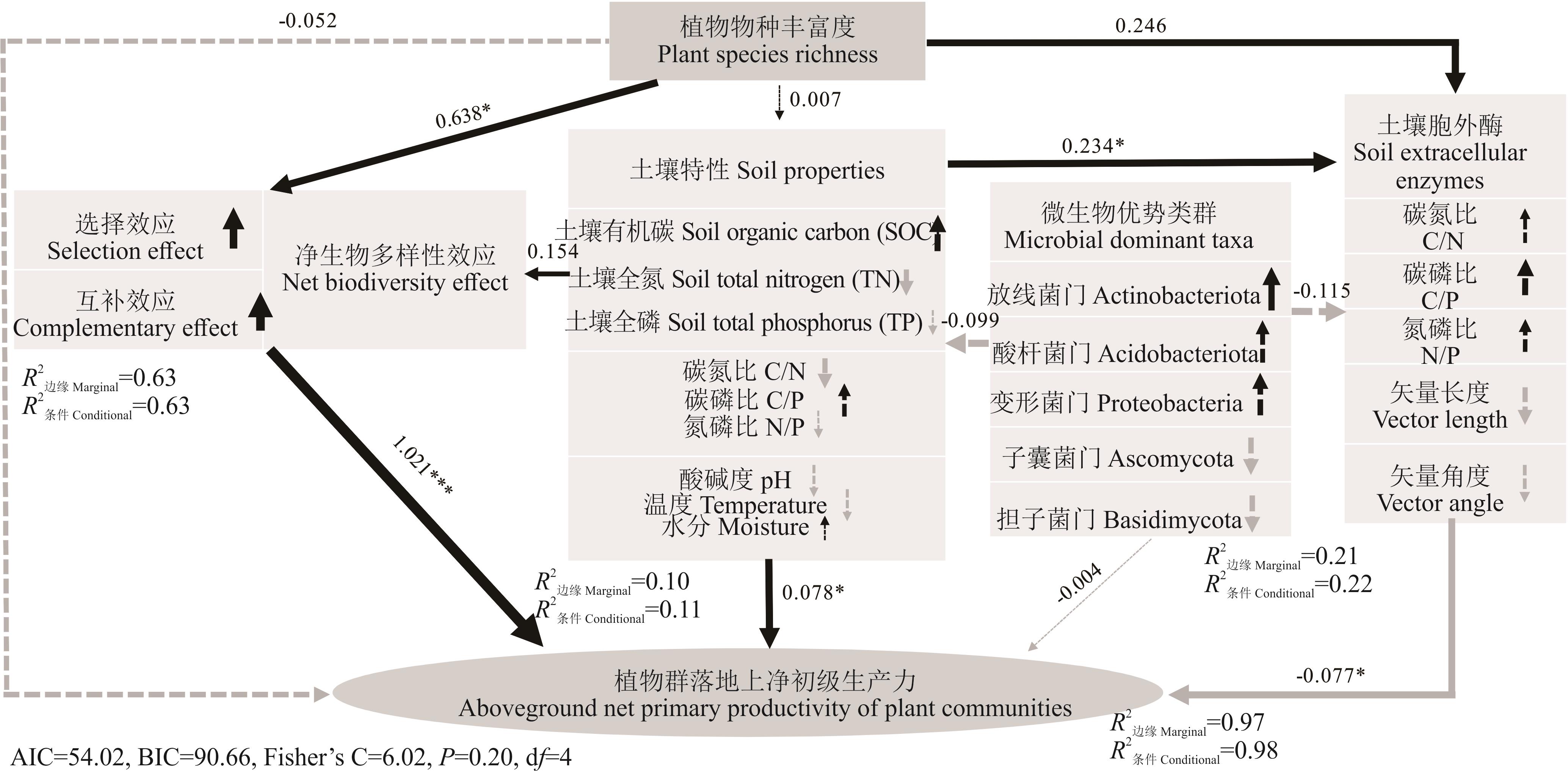
Fig.7 Main pathways driving plant aboveground biomass among plant species richness
| [1] | Isbell F, Balvanera P, Mori A S, et al. Expert perspectives on global biodiversity loss and its drivers and impacts on people. Frontiers in Ecology and the Environment, 2023, 21(2): 94-103. |
| [2] | Van K R, Bowler D E, Gongalsky K B, et al. Meta-analysis reveals declines in terrestrial but increases in freshwater insect abundances. Science, 2020, 368(6489): 417-420. |
| [3] | de Vries F T, Manning P, Tallowin J R B, et al. Abiotic drivers and plant traits explain landscape-scale patterns in soil microbial communities. Ecology Letters, 2012, 15(11): 1230-1239. |
| [4] | Liang J J, Crowther T W, Picard N, et al. Positive biodiversity-productivity relationship predominant in global forests. Science, 2016, 354(6309): 196. |
| [5] | Mace G M. Whose conservation? Science, 2014, 345(6204): 1558-1560. |
| [6] | Fraser L H, Pither J, Jentsch A, et al. Worldwide evidence of a unimodal relationship between productivity and plant species richness. Science, 2015, 349(6245): 302-305. |
| [7] | Zhu Y, Veen G F, Heinen R, et al. Large mammalian herbivores affect arthropod food webs via changes in vegetation characteristics and microclimate. Journal of Ecology, 2023, 111(9): 2077-2089. |
| [8] | Jiang X L, Yue J, Zhang W G, et al. Biodiversity, ecosystem functioning and spatio-temporal scales. Acta Prataculturae Sinica, 2010, 19(1): 219-225. |
| 江小雷, 岳静, 张卫国, 等. 生物多样性, 生态系统功能与时空尺度. 草业学报, 2010, 19(1): 219-225. | |
| [9] | Loreau M. Separating sampling and other effects in biodiversity experiments. Oikos, 1998, 82(3): 600-602. |
| [10] | Giling D P, Beaumelle L, Phillips H R P, et al. A niche for ecosystem multifunctionality in global change research. Global Change Biology, 2019, 25(3): 763-774. |
| [11] | Yang X Q, Li Y, Niu B, et al. Temperature and precipitation drive elevational patterns of microbial beta diversity in alpine grasslands. Microbial Ecology, 2022, 84(4): 1141-1153. |
| [12] | Xiao W, Chen X, Jing X, et al. A meta-analysis of soil extracellular enzyme activities in response to global change. Soil Biology & Biochemistry, 2018, 123: 21-32. |
| [13] | Nemergut D R, Costello E K, Hamady M, et al. Global patterns in the biogeography of bacterial taxa. Environmental Microbiology, 2011, 13(1): 135-144. |
| [14] | Saunders A M, Albertsen M, Vollertsen J, et al. The activated sludge ecosystem contains a core community of abundant organisms. The ISME Journal, 2016, 10(1): 11-20. |
| [15] | Jousset A, Bienhold C, Chatzinotas A, et al. Where less may be more: how the rare biosphere pulls ecosystems strings. The ISME Journal, 2017, 11(4): 853-862. |
| [16] | Banerjee S, Thrall P H, Bissett A, et al. Linking microbial co-occurrences to soil ecological processes across a woodland-grassland ecotone. Ecology and Evolution, 2018, 8(16): 8217-8230. |
| [17] | Steinweg J M, Dukes J S, Paul E A, et al. Microbial responses to multi-factor climate change: effects on soil enzymes. Frontiers in Microbiology, 2013, 4: 146. |
| [18] | Baldrian P, Merhautová V, Petránková M, et al. Distribution of microbial biomass and activity of extracellular enzymes in a hardwood forest soil reflect soil moisture content. Applied Soil Ecology, 2010, 46(2): 177-182. |
| [19] | Sinsabaugh R L, Shah J J F. Ecoenzymatic stoichiometry and ecological theory. Annual Review of Ecology, Evolution, and Systematics, 2012, 43: 313-343. |
| [20] | Wang Y T. Impacts of precipitation change and nitrogen deposition on ecosystem multifunctionality of typical steppe in the Loess Plateau. Yinchuan: Ningxia University, 2023. |
| 王誉陶. 降水变化与氮沉降对黄土高原典型草原生态系统多功能性的影响. 银川: 宁夏大学, 2023. | |
| [21] | Yang Y, Qiu K Y, Xie Y Z, et al. Geographical, climatic, and soil factors control the altitudinal pattern of rhizosphere microbial diversity and its driving effect on root zone soil multifunctionality in mountain ecosystems. Science of the Total Environment, 2023, 904: 166932. |
| [22] | Qi R M, Li J, Lin Z A, et al. Temperature effects on soil organic carbon, soil labile organic carbon fractions, and soil enzyme activities under long-term fertilization regimes. Applied Soil Ecology, 2016, 102: 36-45. |
| [23] | Xu W, Hao J Q, Jiang T Y, et al. Response characteristics of farmland soil enzyme activity and microbial nutrient restriction under long-term mulching measures in the Loess Plateau. Environmental Science, 2025, 46(2): 1056-1064. |
| 徐文, 郝嘉琪, 姜天宇, 等. 黄土高原长期覆盖措施下农田土壤酶活性与微生物养分限制的响应特征. 环境科学, 2025, 46(2): 1056-1064. | |
| [24] | Roscher C, Temperton V M, Scherer Lorenzen M, et al. Overyielding in experimental grassland communities- irrespective of species pool or spatial scale. Ecology Letters, 2005, 8(4): 419-429. |
| [25] | Tian P, Zhao X C, Liu S G, et al. Soil microbial respiration in forest ecosystems along a north-south transect of eastern China: Evidence from laboratory experiments. Catena, 2022, 211: 105980. |
| [26] | Shade A, Handelsman J. Beyond the Venn diagram: the hunt for a core microbiome. Environmental Microbiology, 2012, 14(1): 4-12. |
| [27] | Wang S K, Zuo X A, Zhao X A, et al. Dominant plant species shape soil bacterial community in semiarid sandy land of northern China. Ecology and Evolution, 2018, 8(3): 1693-1704. |
| [28] | Yang S D, Liu H W, Xie P H, et al. Emerging pathways for engineering the rhizosphere microbiome for optimal plant health. Journal of Agricultural and Food Chemistry, 2023, 71(11): 4441-4449. |
| [29] | Rousk J, Bååth E, Brookes P C, et al. Soil bacterial and fungal communities across a pH gradient in an arable soil. The ISME Journal, 2010, 4(10): 1340-1351. |
| [30] | Jian Z J, Ni Y Y, Zeng L X, et al. Latitudinal patterns of soil extracellular enzyme activities and their controlling factors in Pinus massoniana plantations in subtropical China. Forest Ecology and Management, 2021, 495: 119358. |
| [31] | Liu X W, Li X W, Li X L, et al. Dominant plant identity determines soil extracellular enzyme activities of its entire community in a semi-arid grassland. Applied Soil Ecology, 2021, 161: 103872. |
| [32] | Yang M, Yang Z, Xu X, et al. Effects of different vegetation restoration types on extracellular enzymes and stoichiometric characteristics of soil in Lu-shi expressway slopes, Sichuan Province. Chinese Journal of Soil Science, 2024, 55(1): 161-172. |
| 杨敏, 阳珍, 胥晓, 等. 不同植被恢复类型对四川泸石高速公路边坡土壤胞外酶及化学计量特征的影响. 土壤通报, 2024, 55(1): 161-172. | |
| [33] | Sun S Y, Lu S X, Lu Y M, et al. Effects of Chinese fir interplanted with broadleaved trees on soil ecological enzyme activity and stoichiometry. Forest Research, 2021, 34(1): 106-113. |
| 孙思怡, 卢胜旭, 陆宇明, 等. 杉木林下套种阔叶树对土壤生态酶活性及其化学计量比的影响. 林业科学研究, 2021, 34(1): 106-113. | |
| [34] | Cui Y X, Fang L C, Guo X B, et al. Natural grassland as the optimal pattern of vegetation restoration in arid and semi-arid regions: Evidence from nutrient limitation of soil microbes. Science of the Total Environment, 2019, 648: 388-397. |
| [35] | Ma W J, Li J, Gao Y, et al. Responses of soil extracellular enzyme activities and microbial community properties to interaction between nitrogen addition and increased precipitation in a semi-arid grassland ecosystem. Science of the Total Environment, 2020, 703: 134691. |
| [36] | Marquard E, Weigelt A, Temperton V M, et al. Plant species richness and functional composition drive overyielding in a six-year grassland experiment. Ecology, 2009, 90(12): 3290-3302. |
| [37] | Li A, Du G Z. Influence of community structure of artificial grassland and soil nutrient on selection effect in eastern Tibetan Plateau. Ecological Science, 2014, 33(2): 307-312. |
| 李昂, 杜国祯. 青藏高原东缘人工草地群落结构和土壤养分对选择效应的影响. 生态科学, 2014, 33(2): 307-312. | |
| [38] | Li S S, Wang N X, Zheng W, et al. Comparison of transgressive overyielding effect and plant diversity effects of annual and perennial legume-grass mixtures. Chinese Journal of Plant Ecology, 2021, 45(1): 23-37. |
| 黎松松, 王宁欣, 郑伟, 等. 一年生和多年生豆禾混播草地超产与多样性效应的比较. 植物生态学报, 2021, 45(1): 23-37. | |
| [39] | Li A, Zhang M, Du G Z. Impacts of species composition,richness,sowing density,and soil nutrients on the complementary effect of plant communities. Chinese Journal of Ecology, 2012, 31(10): 2443-2448. |
| 李昂, 张鸣, 杜国祯. 物种组成、丰富度、播种密度和土壤养分对群落补偿效应的影响. 生态学杂志, 2012, 31(10): 2443-2448. | |
| [40] | Jiang Y, Zang R, Letcher S G, et al. Associations between plant composition/diversity and the abiotic environment across six vegetation types in a biodiversity hotspot of Hainan Island, China. Plant and Soil, 2016, 403(1/2): 21-35. |
| [41] | Xu S, Eisenhauer N, Ferlian O, et al. Species richness promotes ecosystem carbon storage: evidence from biodiversity-ecosystem functioning experiments. Proceedings of the Royal Society B, 2020, 287(1939): 20202063. |
| [42] | Dietrich P, Eisenhauer N, Roscher C. Linking plant diversity-productivity relationships to plant functional traits of dominant species and changes in soil properties in 15-year-old experimental grasslands. Ecology and Evolution, 2023, 13(3): e9883. |
| [43] | Ding W Y, Li Y N, Guo J W, et al. Effects of plastic film mulching and straw returning on soil nutrients and water and fertilizer productivity of wheat. Water Saving Irrigation, 2021(12): 8-13. |
| 丁午阳, 李援农, 郭俊文, 等. 不同种植模式对冬小麦土壤养分及水肥利用效率的影响. 节水灌溉, 2021(12): 8-13. | |
| [44] | Chen R F, Zeng Q C, Hu M, et al. Ecological stoichiometry characteristics of soil extracellular enzymes under different citrus ages and analysis of their driving factors. Chinese Journal of Eco-Agriculture, 2024, 32(10): 1709-1718. |
| 陈锐峰, 曾全超, 胡漫, 等. 不同柑橘种植年限土壤胞外酶生态化学计量特征及其驱动因子解析. 中国生态农业学报, 2024, 32(10): 1709-1718. | |
| [45] | Yuan X B, Niu D C, Gherardi L A, et al. Linkages of stoichiometric imbalances to soil microbial respiration with increasing nitrogen addition: Evidence from a long-term grassland experiment. Soil Biology & Biochemistry, 2019, 138: 107580. |
| [46] | Liu Z H, Lu S J, Wang Y X, et al. Effects of biodiversity on primary productivity and its mechanism in artificially sown clonal plant communities of the Sanjiangyuan region. Acta Prataculturae Sinica, 2023, 32(9): 27-38. |
| 刘增辉, 卢素锦, 王雨欣, 等. 三江源地区人工克隆植物群落生物多样性对初级生产力的影响及机制. 草业学报, 2023, 32(9): 27-38. |
| [1] | Wen-hui DENG, Ke-chen SONG, Hao ZHANG, Si-yu GUAN, Jia-yi YONG, Hai-ying HU. Structure and diversity characteristics of the rhizosphere microbial community of dominant plants on the desert steppe under changing precipitation [J]. Acta Prataculturae Sinica, 2025, 34(5): 12-26. |
| [2] | Xiao-juan ZHANG, Jiao-jiao WEI, Cai-jin CHEN, Xue-xue LI, Hong-xiu MA, Kai LI, Yong-wei CHEN, Quan SUN. Optimization of annual nitrogen fertilizer application to increase the productivity of a forage triticale-silage maize multiple cropping system in an irrigated area [J]. Acta Prataculturae Sinica, 2025, 34(4): 38-52. |
| [3] | Na LYU, Ji-xi GAO, Zheng-hai LI, Chun-he YOU, Xiao-man LIU, Biao ZHANG, Yu MO, Sa-ning ZHU, Yang PENG, Xue YANG. Effects of fertilizer application during mid-growing season on vegetation community biomass and species diversity in meadow grasslands [J]. Acta Prataculturae Sinica, 2025, 34(2): 109-122. |
| [4] | Xiao-dong TU, Jun-fang CUI, Fu-hong KUANG, Chun-pei LI, Jiu-zhen DU, Hong-lan WANG, Xiang-yu TANG. Effects of conversion of alpine meadow to cultivated land on the soil microbial community in northwest Sichuan [J]. Acta Prataculturae Sinica, 2025, 34(2): 54-66. |
| [5] | Zheng-yan LI, Zhi-ming XU, Yan LI, Yang LI. Effects of short-term continuous cropping of alfalfa on the growth and soil microenvironment of subsequent sorghum-sudan grass hybrid crops in the Jianghuai area [J]. Acta Prataculturae Sinica, 2024, 33(9): 155-168. |
| [6] | Xiao-jing SUO, Lei XIANG, He GAO, Xiang-jun YUN, Ba-gen HASI, Jin-rui WU, Wen-cheng DONG, Bo-wei HUA, Jin-yi MOU, Qi WANG. Effects of different utilization methods on community characteristics of primary vegetation of Stipa grandis steppe, Inner Mongolia, China [J]. Acta Prataculturae Sinica, 2024, 33(4): 12-21. |
| [7] | Rui ZHANG, Xue-jiao AN, Jian-ye LI, Zeng-kui LU, Chun-e NIU, Zhen-fei XU, Jin-xia ZHANG, Zhi-guang GENG, Yao-jing YUE, Bo-hui YANG. Comparative analysis of growth performance, meat productivity, and meat quality in Hu sheep and its hybrids [J]. Acta Prataculturae Sinica, 2024, 33(3): 186-197. |
| [8] | Hao SHI, Cai-hong YANG, Fei XIA, Jun-qiang WANG, Wei WEI, Jing-long WANG, Yun-yin XUE, Shai-kun ZHENG, Hao-yang WU, Lin-ling RAN, Shuang YAN, Xiao-min JIANG. Initial effects of short-term warming on the productivity of alpine degraded grassland in northern Tibet during the restoration process [J]. Acta Prataculturae Sinica, 2024, 33(11): 30-45. |
| [9] | Wen-long LI, Feng LI, Zhong-juan ZHANG, Dian-qing WANG, Huan WANG, Hui-qing JIN, Mu-re TE, Zhi-ling HU, Ya TAO. A performance evaluation of two crops of forage oats per year in the northern Ordos Plateau [J]. Acta Prataculturae Sinica, 2024, 33(1): 159-168. |
| [10] | Qi-fei HAN, Long YIN, Chao-fan LI, Run-gang ZHANG, Wen-biao WANG, Zheng-nan CUI. Nitrogen fertilizer threshold and uncertainty analysis of typical grassland on the northern slopes of Tianshan Mountains [J]. Acta Prataculturae Sinica, 2024, 33(1): 19-32. |
| [11] | Zeng-hui LIU, Su-jin LU, Yu-xin WANG, Chun-hui ZHANG, Xin YIN. Effects of biodiversity on primary productivity and its mechanism in artificially sown clonal plant communities of the Sanjiangyuan region [J]. Acta Prataculturae Sinica, 2023, 32(9): 27-38. |
| [12] | Jie ZHAO, Xue-jing YIN, Si-ran WANG, Zhi-hao DONG, Jun-feng LI, Yu-shan JIA, Tao SHAO. Effects of storage time on the fermentation quality, bacterial community composition, and functional profile of sweet sorghum silage [J]. Acta Prataculturae Sinica, 2023, 32(8): 164-175. |
| [13] | Ting YE, Xiao-juan WU, Yi-xiao LU, Sheng-juan LIU, Zhuo-hui JIANG, Hui-min YANG. Effect of planting ratio on the stability of forage yield and population density in two alfalfa-grass mixtures [J]. Acta Prataculturae Sinica, 2023, 32(5): 127-137. |
| [14] | Mei-hui LI, Yu-hua LI, Xin-hui YAN, Hang-hang TUO, Meng-ru YANG, Zi-lin WANG, Wei LI. Characteristics of plant diversity and aboveground productivity and their relationship driven by subshrub expansion [J]. Acta Prataculturae Sinica, 2023, 32(5): 27-39. |
| [15] | Qi WANG, Jia-hua ZHENG, Meng-li ZHAO, Jun ZHANG. Effects of mowing intensity on community characteristics and soil physicochemical properties of Stipa grandis steppe, Inner Mongolia, China [J]. Acta Prataculturae Sinica, 2023, 32(2): 26-34. |
| Viewed | ||||||
|
Full text |
|
|||||
|
Abstract |
|
|||||
