
ISSN 1004-5759 CN 62-1105/S
Acta Prataculturae Sinica ›› 2025, Vol. 34 ›› Issue (11): 17-30.DOI: 10.11686/cyxb2024523
Previous Articles Next Articles
Cong HE1( ), Yong-cai MA2, Hong-biao ZI1()
Received:2024-12-30
Revised:2025-03-03
Online:2025-11-20
Published:2025-10-09
Contact:
Hong-biao ZI
Cong HE, Yong-cai MA, Hong-biao ZI. Effects of the duration of grazing exclusion on plant communities in alpine grassland[J]. Acta Prataculturae Sinica, 2025, 34(11): 17-30.
围封年限 Grazing exclusion durations (a) | 纬度 Latitude (N) | 经度 Longitude (E) | 海拔 Altitude (m) | 面积 Area (m2) |
|---|---|---|---|---|
| 0 | 37°36′38″ | 101°18′46″ | 3147 | 45×45 |
| 3 | 37°36′48″ | 101°18′14″ | 3144 | 45×45 |
| 5 | 37°36′42″ | 101°18′32″ | 3144 | 30×50 |
| 8 | 37°36′43″ | 101°17′45″ | 3145 | 40×40 |
| 10 | 37°36′39″ | 101°19′29″ | 3154 | 30×60 |
Table 1 Basic information of sample sites
围封年限 Grazing exclusion durations (a) | 纬度 Latitude (N) | 经度 Longitude (E) | 海拔 Altitude (m) | 面积 Area (m2) |
|---|---|---|---|---|
| 0 | 37°36′38″ | 101°18′46″ | 3147 | 45×45 |
| 3 | 37°36′48″ | 101°18′14″ | 3144 | 45×45 |
| 5 | 37°36′42″ | 101°18′32″ | 3144 | 30×50 |
| 8 | 37°36′43″ | 101°17′45″ | 3145 | 40×40 |
| 10 | 37°36′39″ | 101°19′29″ | 3154 | 30×60 |
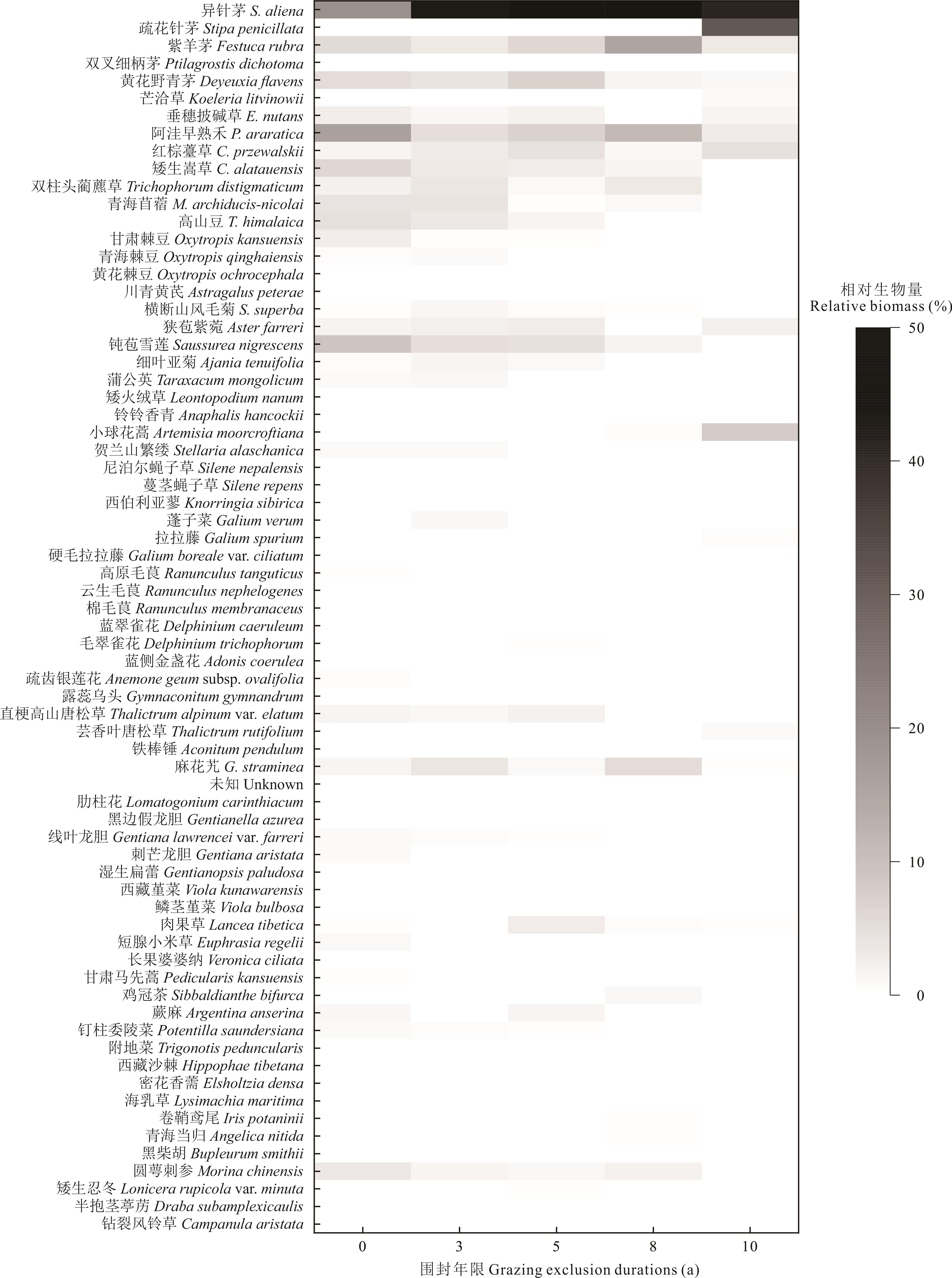
Fig.1 Relative biomass of species in plant community under different grazing exclusion durations
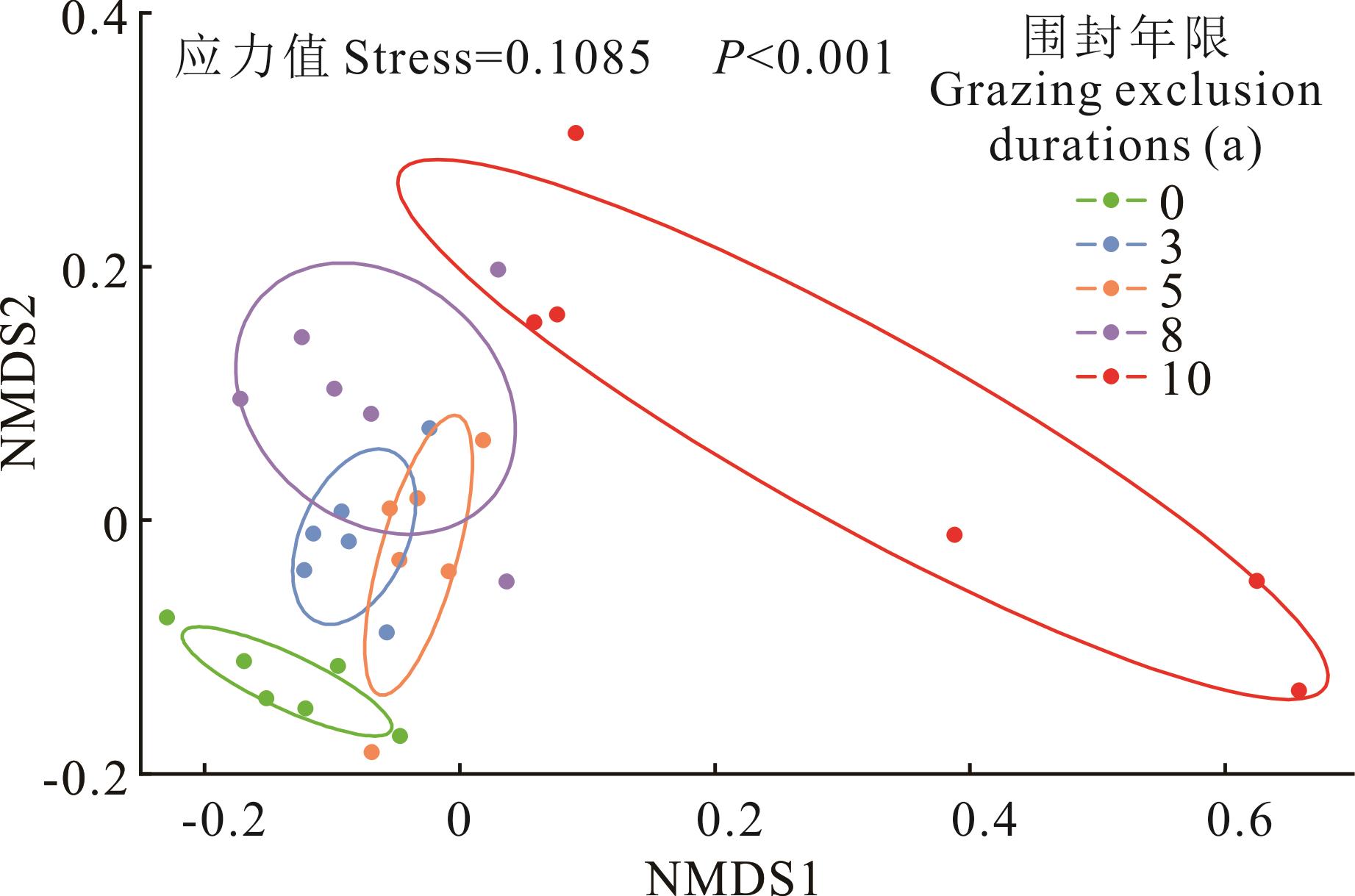
Fig.2 Non-metric multidimensional scaling analysis of vegetation based on species coverage
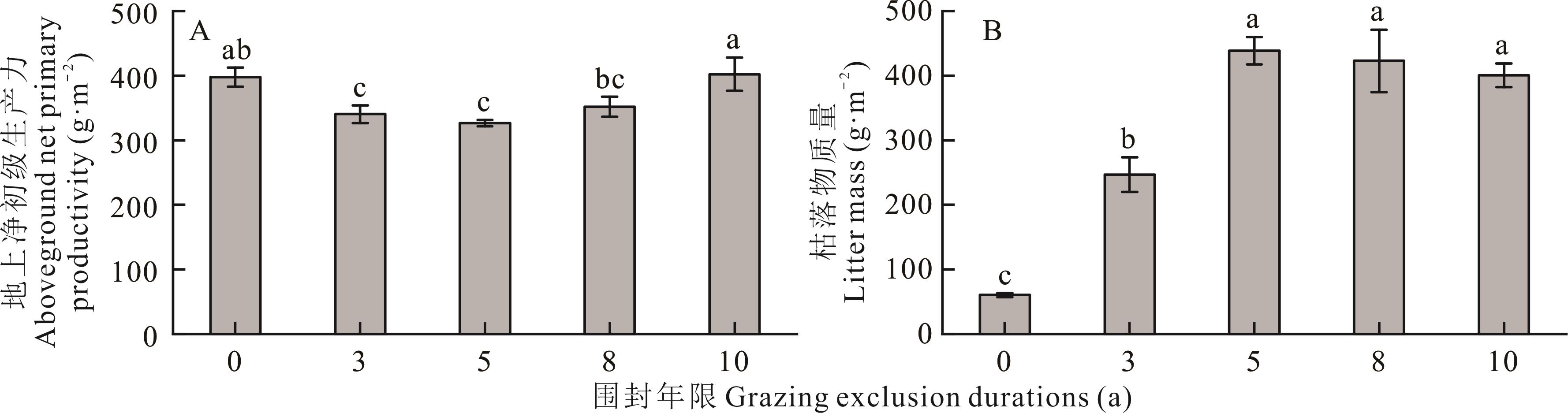
Fig.3 Aboveground net primary productivity and litter mass of plant communities with different grazing exclusion durations
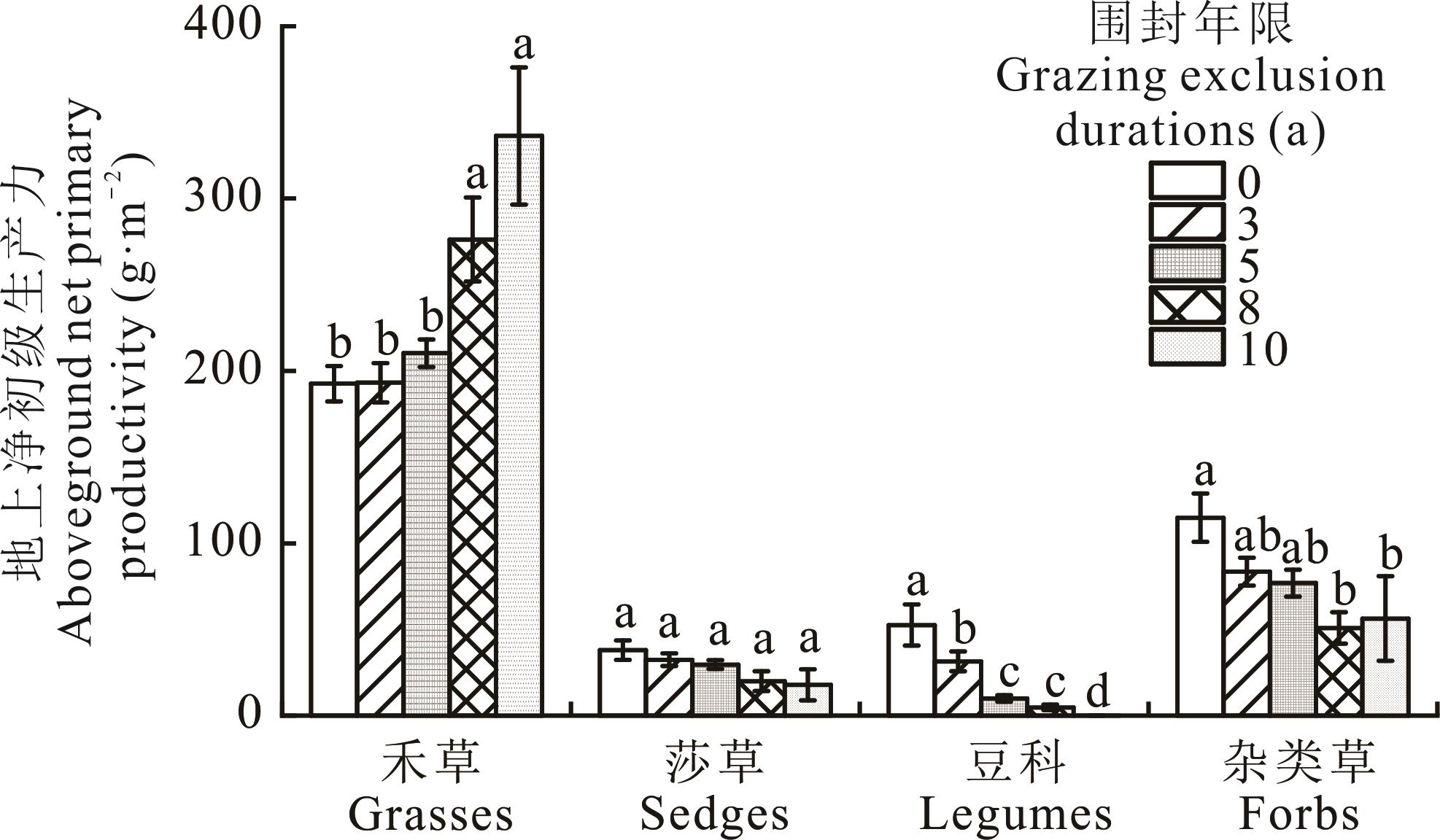
Fig.4 Aboveground net primary productivity in various plant functional groups of plant communities under different grazing exclusion durations
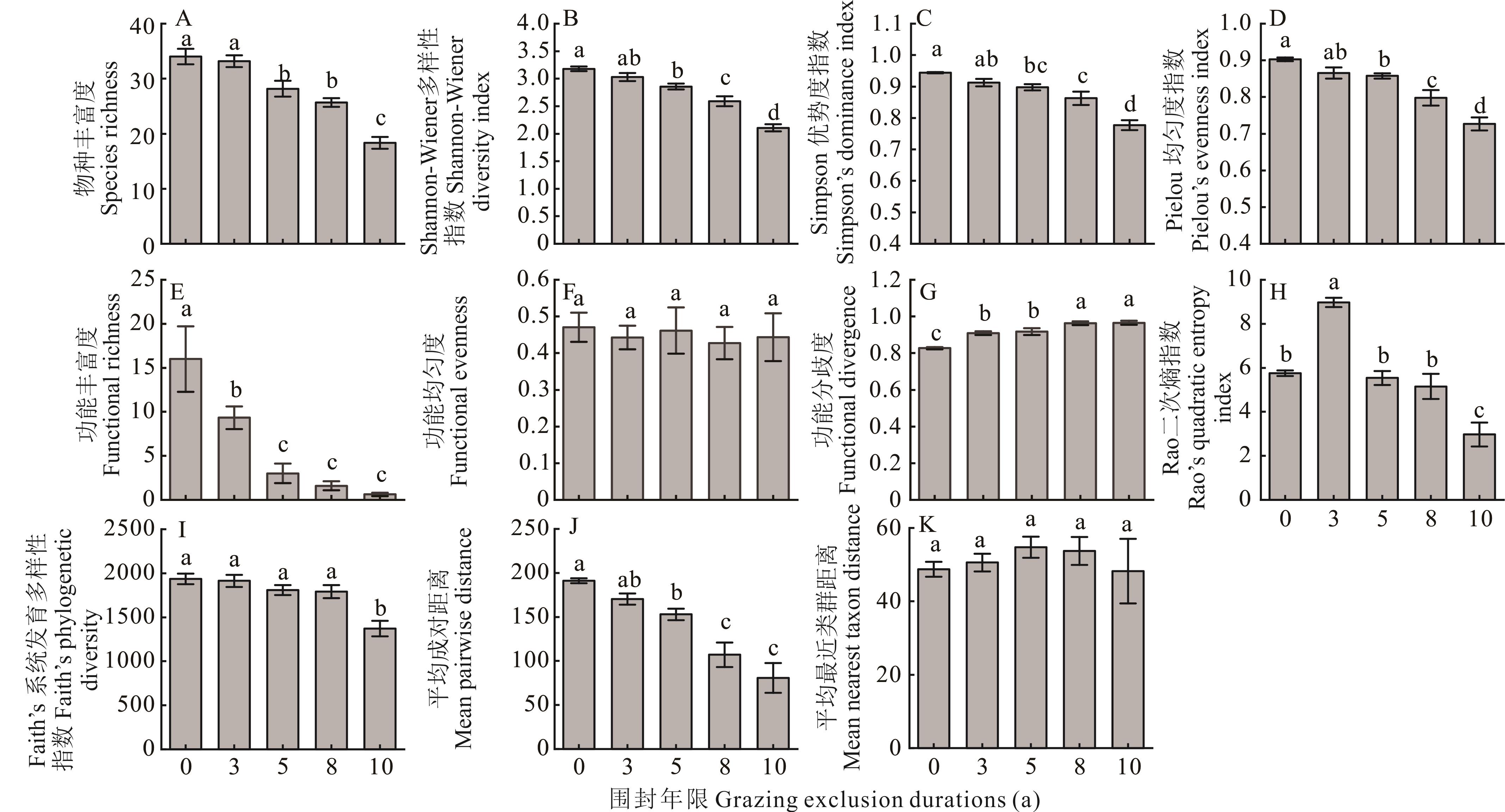
Fig.5 Species (A-D), functional (E-H) and phylogenetic (I-K) diversity of plant communities with different exclusion durations

Fig.6 Relationship between aboveground net primary productivity and species (A-D) , functional (E-H) and phylogenetic (I-K) diversity in plant communities with different grazing exclusion durations
| [1] | Zhang J, Yuan M S, Zhang J, et al. Responses of the NDVI of alpine grasslands on the Qinghai-Tibetan Plateau to climate change and human activities over the last 30 years. Acta Ecologica Sinica, 2020, 40(18): 6269-6281. |
| 张江, 袁旻舒, 张婧, 等. 近30年来青藏高原高寒草地NDVI动态变化对自然及人为因子的响应. 生态学报, 2020, 40(18): 6269-6281. | |
| [2] | Zhang Z H, Zhou H K, Zhao X Q, et al. Relationship between biodiversity and ecosystem functioning in alpine meadows of the Qinghai-Tibet Plateau. Biodiversity Science, 2018, 26(2): 111-129. |
| 张中华, 周华坤, 赵新全, 等. 青藏高原高寒草地生物多样性与生态系统功能的关系. 生物多样性, 2018, 26(2): 111-129. | |
| [3] | Hou F J, Yang Z Y. Effects of grazing of livestock on grassland. Acta Ecologica Sinica, 2006, 26(1): 244-264. |
| 侯扶江, 杨中艺. 放牧对草地的作用. 生态学报, 2006, 26(1): 244-264. | |
| [4] | Eby S, Burkepile D E, Fynn R W S, et al. Loss of a large grazer impacts savanna grassland plant communities similarly in North America and South Africa. Oecologia, 2014, 175(1): 293-303. |
| [5] | Ganjurjav H, Duan M J, Wan Y F, et al. Effects of grazing by large herbivores on plant diversity and productivity of semi-arid alpine steppe on the Qinghai-Tibetan Plateau. The Rangeland Journal, 2015, 37(4): 389-397. |
| [6] | Liu J, Feng C, Wang D L, et al. Impacts of grazing by different large herbivores in grassland depend on plant species diversity. Journal of Applied Ecology, 2015, 52(4): 1053-1062. |
| [7] | Olff H, Ritchie M E. Effects of herbivores on grassland plant diversity. Trends in Ecology & Evolution, 1998, 13(7): 261-265. |
| [8] | Koerner S E, Burkepile D E, Fynn R W S, et al. Plant community response to loss of large herbivores differs between North American and South African Savanna grasslands. Ecology, 2014, 95(4): 808-816. |
| [9] | Borer E T, Seabloom E W, Gruner D S, et al. Herbivores and nutrients control grassland plant diversity via light limitation. Nature, 2014, 508(7497): 517-520. |
| [10] | Connell J H. Diversity in tropical rain forests and coral reefs: High diversity of trees and corals is maintained only in a nonequilibrium state. Science, 1978, 199(4335): 1302-1310. |
| [11] | Hilbert D W, Swift D M, Detling J K, et al. Relative growth rates and the grazing optimization hypothesis. Oecologia, 1981, 51(1): 14-18. |
| [12] | Oesterheld M, McNaughton S J. Effect of stress and time for recovery on the amount of compensatory growth after grazing. Oecologia, 1991, 85(3): 305-313. |
| [13] | Bakker E S, Ritchie M E, Olff H, et al. Herbivore impact on grassland plant diversity depends on habitat productivity and herbivore size. Ecology Letters, 2006, 9(7): 780-788. |
| [14] | Ma K P. A significant achievement in the development of national parks in China. Biodiversity Science, 2017, 25(10): 1031-1032. |
| 马克平. 中国国家公园建设取得标志性进展. 生物多样性, 2017, 25(10): 1031-1032. | |
| [15] | Zang Z H, Zhang D, Wang N, et al. Experiences, achievement, problems and recommendations of the first batch of China’s national park system pilots. Acta Ecologica Sinica, 2020, 40(24): 8839-8850. |
| 臧振华, 张多, 王楠, 等. 中国首批国家公园体制试点的经验与成效、问题与建议. 生态学报, 2020, 40(24): 8839-8850. | |
| [16] | Wang J, Zhang D S, Xiao Y M, et al. Diversity of species and functional traits drive jointly responses of aboveground biomass to long-term grazing exclusion at alpine steppe. Acta Ecologica Sinica, 2023, 43(6): 1-11. |
| 王娟, 张登山, 肖元明, 等. 物种多样性和功能性状驱动高寒草原地上生物量对长期禁牧的响应. 生态学报, 2023, 43(6): 1-11. | |
| [17] | Wang Q Y, Zhou D Y, An P L, et al. Impacts of nature reserve policy on regional ecological environment quality: A case study of Sanjiangyuan Region. Chinese Journal of Applied Ecology, 2023, 34(5): 1349-1359. |
| 王清韵, 周丁扬, 安萍莉, 等. 自然保护地政策对区域生态环境质量的影响——以三江源地区为例. 应用生态学报, 2023, 34(5): 1349-1359. | |
| [18] | Peco B, de Pablos I, Traba J, et al. The effect of grazing abandonment on species composition and functional traits: The case of dehesa grasslands. Basic and Applied Ecology, 2005, 6(2): 175-183. |
| [19] | Hu Y K, Gao G G, Li K H, et al. The succession of plant communities in alpine grasslands in different ages of enclosing. Journal of Glaciology and Geocryology, 2009, 31(6): 1186-1194. |
| 胡玉昆, 高国刚, 李凯辉, 等. 巴音布鲁克草原不同围封年限高寒草地植物群落演替分析. 冰川冻土, 2009, 31(6): 1186-1194. | |
| [20] | Wu G L, Du G Z, Liu Z H, et al. Effect of fencing and grazing on a Kobresia-dominated meadow in the Qinghai-Tibetan Plateau. Plant and Soil, 2009, 319(1): 115-126. |
| [21] | Zhang P, Ma J J, Cheng J H, et al. Effects of enclosure on vegetation characteristics and soil physical and chemical properties of temperate grassland. Chinese Journal of Grassland, 2021, 43(5): 41-50. |
| 张攀, 马婧婧, 程军回, 等. 围封对天山北坡中段温性草原植被特征和土壤理化性质的影响. 中国草地学报, 2021, 43(5): 41-50. | |
| [22] | Liu Y, Li B L, Yuan Y C, et al. Assessment of grazing exclusion on grassland restoration through the changes of plant community structure of alpine meadow in the Three River Headwater Region. Acta Ecologica Sinica, 2021, 41(18): 7125-7137. |
| 刘岩, 李宝林, 袁烨城, 等. 基于三江源高寒草甸群落结构变化评估围栏封育对草地恢复的影响. 生态学报, 2021, 41(18): 7125-7137. | |
| [23] | Jing Z B, Cheng J M, Su J S, et al. Changes in plant community composition and soil properties under 3-decade grazing exclusion in semiarid grassland. Ecological Engineering, 2014, 64: 171-178. |
| [24] | Song S S, Zhu J L, Zheng T L, et al. Long-term grazing exclusion reduces species diversity but increases community heterogeneity in an alpine grassland. Frontiers in Ecology and Evolution, 2020, 8: 66. |
| [25] | Wu X W, Wang Y C, Sun S C. Long-term fencing decreases plant diversity and soil organic carbon concentration of the Zoige alpine meadows on the eastern Tibetan Plateau. Plant and Soil, 2021, 458(1): 191-200. |
| [26] | Linnell J D C. Refugee fences fragment wildlife. Nature, 2016, 529(7585): 156. |
| [27] | Sun J, Liu M, Fu B J, et al. Reconsidering the efficiency of grazing exclusion using fences on the Tibetan Plateau. Science Bulletin, 2020, 65(16): 1405-1414. |
| [28] | Sun J, Zhou T C, Zhang J T. Climate change adaptive management of alpine grassland on the Tibetan Plateau. Environment and Sustainable Development, 2021, 46(5): 55-60. |
| 孙建, 周天财, 张锦涛. 青藏高原高寒草地的气候变化适应性管理探讨. 环境与可持续发展, 2021, 46(5): 55-60. | |
| [29] | Xiong D P, Shi P L, Zhang X Z, et al. Effects of grazing exclusion on carbon sequestration and plant diversity in grasslands of China—A meta-analysis. Ecological Engineering, 2016, 94: 647-655. |
| [30] | Yan Y C, Tang H P, Xin X P, et al. Advances in research on the effects of exclosure on grasslands. Acta Ecologica Sinica, 2009, 29(9): 5039-5046. |
| 闫玉春, 唐海萍, 辛晓平, 等. 围封对草地的影响研究进展. 生态学报, 2009, 29(9): 5039-5046. | |
| [31] | Grime J P. Biodiversity and ecosystem function: The debate deepens. Science, 1997, 277(5330): 1260-1261. |
| [32] | Gamfeldt L, Roger F. Revisiting the biodiversity-ecosystem multifunctionality relationship. Nature Ecology & Evolution, 2017, 1(7): 1-7. |
| [33] | Hong P B, Schmid B, De Laender F, et al. Biodiversity promotes ecosystem functioning despite environmental change. Ecology Letters, 2022, 25(2): 555-569. |
| [34] | Zhang Y, Cheng J, Su J S, et al. Diversity-productivity relationship of plant communities in typical grassland during the long-term grazing exclusion succession. Chinese Journal of Plant Ecology, 2022, 46(2): 176-187. |
| 张义, 程杰, 苏纪帅, 等. 长期封育演替下典型草原植物群落生产力与多样性关系. 植物生态学报, 2022, 46(2): 176-187. | |
| [35] | Brun P, Zimmermann N E, Graham C H, et al. The productivity-biodiversity relationship varies across diversity dimensions. Nature Communications, 2019, 10(1): 1-11. |
| [36] | Lei S L, Liao L R, Wang J, et al. The diversity-Godron stability relationship of alpine grassland and its environmental drivers. Acta Prataculturae Sinica, 2023, 32(3): 1-12. |
| 雷石龙, 廖李容, 王杰, 等. 高寒草地植物多样性与Godron群落稳定性关系及其环境驱动因素. 草业学报, 2023, 32(3): 1-12. | |
| [37] | Chen Z Y, Xie Y X, Liu M. Responses of aboveground biomass and species richness to environmental factors in a fenced alpine grassland. Pratacultural Science, 2019, 36(4): 1000-1009. |
| 陈智勇, 谢迎新, 刘苗. 围栏封育高寒草地植物地上生物量和物种多样性对关键调控因子的响应. 草业科学, 2019, 36(4): 1000-1009. | |
| [38] | Yao X X, Wu J P, Gong X Y, et al. Effects of long term fencing on biomass, coverage, density, biodiversity and nutritional values of vegetation community in an alpine meadow of the Qinghai-Tibet Plateau. Ecological Engineering, 2019, 130: 80-93. |
| [39] | Dı́az S, Cabido M. Vive la différence: plant functional diversity matters to ecosystem processes. Trends in Ecology & Evolution, 2001, 16(11): 646-655. |
| [40] | Mouchet M A, Villéger S, Mason N W H, et al. Functional diversity measures: An overview of their redundancy and their ability to discriminate community assembly rules. Functional Ecology, 2010, 24(4): 867-876. |
| [41] | Cadotte M W, Jonathan Davies T, Regetz J, et al. Phylogenetic diversity metrics for ecological communities: Integrating species richness, abundance and evolutionary history. Ecology Letters, 2010, 13(1): 96-105. |
| [42] | Webb C O, Ackerly D D, McPeek M A, et al. Phylogenies and community ecology. Annual Review of Ecology and Systematics, 2002, 33(1): 475-505. |
| [43] | Pan Q M, Symstad A J, Bai Y F, et al. Biodiversity-productivity relationships in a natural grassland community vary under diversity loss scenarios. Journal of Ecology, 2022, 110(1): 210-220. |
| [44] | Adler P B, Seabloom E W, Borer E T, et al. Productivity is a poor predictor of plant species richness. Science, 2011, 333(6050): 1750-1753. |
| [45] | Mittelbach G G, Steiner C F, Scheiner S M, et al. What is the observed relationship between species richness and productivity? Ecology, 2001, 82(9): 2381-2396. |
| [46] | Qiu B, Wang G. Advance in the study of the relationship between productivity and biodiversity. Ecologic Science, 2003, 22(3): 265-270. |
| 邱波, 王刚. 生产力与生物多样性关系研究进展. 生态科学, 2003, 22(3): 265-270. | |
| [47] | Zhao F X, Xu M. Research progress on the relationship between productivity and biodiversity. Journal of Natural Resources, 2018, 33(11): 2046-2056. |
| 赵峰侠, 徐明. 生产力与生物多样性关系的研究进展. 自然资源学报, 2018, 33(11): 2046-2056. | |
| [48] | He C. Effects of grazing exclusion duration on plant functional traits, diversity and productivity in an alpine meadow. Lanzhou: Lanzhou University, 2023. |
| 贺聪. 围封年限对高寒草甸植物功能性状、多样性和生产力的影响. 兰州: 兰州大学, 2023. | |
| [49] | Liu H Y, Mi Z R, Lin L, et al. Shifting plant species composition in response to climate change stabilizes grassland primary production. Proceedings of the National Academy of Sciences, 2018, 115(16): 4051-4056. |
| [50] | Li Y N, Bao X K, Cao G M. Comparision of the earth temperature between fiborthic histosols and mat-cryic cambisols in Tibet Plateau. Acta Pedologica Sinica, 2001, 38(2): 145-152. |
| 李英年, 鲍新奎, 曹广民. 青藏高原正常有机土与草毡寒冻雏形土地温观测的比较研究. 土壤学报, 2001, 38(2): 145-152. | |
| [51] | Cao J J, Jiao Y M, Che R, et al. The effects of grazer exclosure duration on soil microbial communities on the Qinghai-Tibetan Plateau. Science of the Total Environment, 2022, 839: 156238. |
| [52] | Li H Q, Wu X L, Zhang F W, et al. The response of soil water holding capacity of alpine meadow in winter pasture to enclosure. Chinese Journal of Grassland, 2021, 43(8): 1-8. |
| 李红琴, 吴夏璐, 张法伟, 等. 高寒草甸冬季牧场土壤持水能力对草地封育的响应. 中国草地学报, 2021, 43(8): 1-8. | |
| [53] | Fang J Y, Wang X P, Shen Z H, et al. Methods and protocols for plant community inventory. Biodiversity Science, 2009, 17(6): 533-548. |
| 方精云, 王襄平, 沈泽昊, 等. 植物群落清查的主要内容、方法和技术规范. 生物多样性, 2009, 17(6): 533-548. | |
| [54] | Jin Y, Qian H. V.PhyloMaker 2: An updated and enlarged R package that can generate very large phylogenies for vascular plants. Plant Diversity, 2022, 44(4): 335-339. |
| [55] | Faith D P. Conservation evaluation and phylogenetic diversity. Biological Conservation, 1992, 61(1): 1-10. |
| [56] | Shan G L, Xu Z, Ning F, et al. Influence of exclosure year on community structure and species diversity on a typical steppe. Acta Prataculturae Sinica, 2008, 17(6): 1-8. |
| 单贵莲, 徐柱, 宁发, 等. 围封年限对典型草原群落结构及物种多样性的影响. 草业学报, 2008, 17(6): 1-8. | |
| [57] | Qiao R, Cui X X, Lv X F, et al. Effect of enclosure and grazing prohibition on soil properties of degraded grassland. Bulletin of Soil and Water Conservation, 2014, 34(5): 162-165. |
| 乔荣, 崔向新, 吕新丰, 等. 围封禁牧对退化草原土壤性状的影响. 水土保持通报, 2014, 34(5): 162-165. | |
| [58] | Schäfer N, Maierhofer T, Herrmann J, et al. Tandem amino acid residue motif in guard cell SLAC1 anion channel of grasses allows for the control of stomatal aperture by nitrate. Current Biology, 2018, 28(9): 1370-1379. |
| [59] | Gao K, Zhu T X, Han G D. Impact of enclosure duration on plant functional and species diversity in Inner Mongolian grassland. Acta Prataculturae Sinica, 2013, 22(6): 39-45. |
| 高凯, 朱铁霞, 韩国栋. 围封年限对内蒙古羊草-针茅典型草原植物功能群及其多样性的影响. 草业学报, 2013, 22(6): 39-45. | |
| [60] | Liu Z K, Wang S H, Chen Z Z, et al. Properties of soil nutrients and plant community after rest grazing in Inner Mongolia steppe China. Acta Ecologica Sinica, 2006, 26(6): 2048-2056. |
| 刘忠宽, 汪诗平, 陈佐忠, 等. 不同放牧强度草原休牧后土壤养分和植物群落变化特征. 生态学报, 2006, 26(6): 2048-2056. | |
| [61] | An Q Q, Qiao W Y, Li W J, et al. Effect of shrub encroachment on grassland community structure and above-ground biomass on the Loess Plateau. Acta Botanica Boreali-Occidentalia Sinica, 2021, 41(4): 664-671. |
| 安琪琪, 乔文英, 李维军, 等. 灌丛化对黄土高原草地植物群落结构和地上生物量的影响. 西北植物学报, 2021, 41(4): 664-671. | |
| [62] | Liu S S, Zhou L H, Li H, et al. Shrub encroachment decreases soil inorganic carbon stocks in Mongolian grasslands. Journal of Ecology, 2019, 108(2): 678-686. |
| [63] | Zhang R, Du G Z. Redundance and compensation of grazed grassland communities. Acta Prataculturae Sinica, 1998, 7(4): 14-20. |
| 张荣, 杜国祯. 放牧草地群落的冗余与补偿. 草业学报, 1998, 7(4): 14-20. | |
| [64] | Li Y H, Wang S P. Response of plant and plant community to different stocking rates. Grassland of China, 1999(3): 12-20. |
| 李永宏, 汪诗平. 放牧对草原植物的影响. 中国草地, 1999(3): 12-20. | |
| [65] | Tilman D, Isbell F, Cowles J M. Biodiversity and ecosystem functioning. Annual Review of Ecology, Evolution, and Systematics, 2014, 45(1): 471-493. |
| [66] | Li B B. Creating synergy between biodiversity conservation and human health——One Health. Biodiversity Science, 2020, 28(5): 596-605. |
| 李彬彬. 推进生物多样性保护与人类健康的共同发展——One Health. 生物多样性, 2020, 28(5): 596-605. | |
| [67] | Nie Y Y, Du G M, Wang G Q, et al. Effects of enclosure on species diversity of community in Hunlunbuir meadow steppe. Chinese Journal of Grassland, 2016, 38(6): 106-110. |
| 聂莹莹, 杜广明, 王国庆, 等. 围栏封育对呼伦贝尔草甸草原群落物种多样性的影响. 中国草地学报, 2016, 38(6): 106-110. | |
| [68] | Price J N, Sitters J, Ohlert T, et al. Evolutionary history of grazing and resources determine herbivore exclusion effects on plant diversity. Nature Ecology & Evolution, 2022, 6(9): 1290-1298. |
| [69] | Zhang Z J, Liu Y J, Yuan L, et al. Effect of allelopathy on plant performance: A meta-analysis. Ecology Letters, 2021, 24(2): 348-362. |
| [70] | Mason N W H, Mouillot D, Lee W G, et al. Functional richness, functional evenness and functional divergence: The primary components of functional diversity. Oikos, 2005, 111(1): 112-118. |
| [71] | Botta-Dukát Z. Rao’s quadratic entropy as a measure of functional diversity based on multiple traits. Journal of Vegetation Science, 2005, 16(5): 533-540. |
| [72] | Petchey O L. Integrating methods that investigate how complementarity influences ecosystem functioning. Oikos, 2003, 101(2): 323-330. |
| [73] | Jia P, Du G Z. Measuring functional and phylogenetic diversity in community ecology. Chinese Bulletin of Life Sciences, 2014, 26(2): 153-157. |
| 贾鹏, 杜国祯. 生态学的多样性指数:功能与系统发育. 生命科学, 2014, 26(2): 153-157. | |
| [74] | Wang M Q, Li Y, Chesters D, et al. Multiple components of plant diversity loss determine herbivore phylogenetic diversity in a subtropical forest experiment. Journal of Ecology, 2019, 107(6): 2697-2712. |
| [75] | Wang T, Xin L Y, Ma T S, et al. Effect of phylogenetic diversity on the stability of alpine meadows on the Tibetan Plateau. Chinese Journal of Ecology, 2022, 41(12): 2368-2373. |
| 王婷, 辛丽雨, 马铁帅, 等. 系统发育多样性对青藏高原高寒草甸的稳定性影响. 生态学杂志, 2022, 41(12): 2368-2373. | |
| [76] | Grime J P. Benefits of plant diversity to ecosystems: immediate, filter and founder effects. Journal of Ecology, 1998, 86(6): 902-910. |
| [77] | Dong L W, Ren Z W, Zhang R, et al. Functional diversity rather than species diversity can explain community biomass variation following short-term nitrogen addition in an alpine grassland. Chinese Journal of Plant Ecology, 2022, 46(8): 871-881. |
| 董六文, 任正炜, 张蕊, 等. 功能多样性比物种多样性更好解释氮添加对高寒草地生物量的影响. 植物生态学报, 2022, 46(8): 871-881. | |
| [78] | Mokany K, Ash J, Roxburgh S. Functional identity is more important than diversity in influencing ecosystem processes in a temperate native grassland. Journal of Ecology, 2008, 96(5): 884-893. |
| [79] | Griffin J N, Méndez V, Johnson A F, et al. Functional diversity predicts overyielding effect of species combination on primary productivity. Oikos, 2009, 118(1): 37-44. |
| [80] | Cadotte M W, Cardinale B J, Oakley T H. Evolutionary history and the effect of biodiversity on plant productivity. Proceedings of the National Academy of Sciences, 2008, 105(44): 17012-17017. |
| [81] | Pu Z, Daya P, Tan J, et al. Phylogenetic diversity stabilizes community biomass. Journal of Plant Ecology, 2014, 7(2): 176-187. |
| [82] | Wang Y F, Du J Q, Pang Z, et al. Unimodal productivity-biodiversity relationship along the gradient of multidimensional resources across Chinese grasslands. National Science Review, 2022, 9(12): nwac165. |
| [83] | Hagan J G, Vanschoenwinkel B, Gamfeldt L. We should not necessarily expect positive relationships between biodiversity and ecosystem functioning in observational field data. Ecology Letters, 2021, 24(12): 2537-2548. |
| [84] | Cardinale B J, Duffy J E, Gonzalez A, et al. Biodiversity loss and its impact on humanity. Nature, 2012, 486(7401): 59-67. |
| [1] | Ze-yu XIANG, Zhong-bing TANG, Xin-heng PENG, Xiao-long YANG, Chuang-ming YANG, Xiang-dong QIU, Chun-fa CHEN, Yan-song PENG, Sai-xia ZHOU. Plant community characteristics and niches in mountain meadows of Wugong Mountain [J]. Acta Prataculturae Sinica, 2025, 34(9): 12-25. |
| [2] | Xu LUO, Hui MA, Cui HAN, Ya-xin ZHAO, Ying ZHAO, Ying-zhong XIE, Jian-ping LI. Response of aboveground net primary productivity to plant species richness and identification of the factors of influence [J]. Acta Prataculturae Sinica, 2025, 34(9): 26-37. |
| [3] | Kun ZHANG, Jian-xia QIAO, Jin-sheng LI, Yu-peng WANG, Ke-si LIU. Effects of different restoration materials on soil physicochemical properties and microbial communities in degraded alpine grassland [J]. Acta Prataculturae Sinica, 2025, 34(8): 132-148. |
| [4] | Wei TANG, Zi-guang LI, Qing-tian ZHAO, Juan SUN. Effects of oat (Avena sativa) planting density on the growth and rhizosphere fungal community structure of Digitaria sanguinalis and Echinochloa crusgalli [J]. Acta Prataculturae Sinica, 2025, 34(8): 149-164. |
| [5] | Shan-shan TANG, Min HU. Differences in enzyme activity and bacterial community structure in rhizosphere soil of four grass species [J]. Acta Prataculturae Sinica, 2025, 34(8): 99-108. |
| [6] | Bing-shu ZHU, Jiang-wen FAN, Hai-yan ZHANG, Lin HUANG, Hai-jing TIAN, Lin WANG, Shou-xing WANG, Ming-xin YANG, Yan-ming GUO. Grassland health assessment of alpine grassland in the Yellow River Source Park of Three-Rivers Headwaters National Park [J]. Acta Prataculturae Sinica, 2025, 34(7): 13-27. |
| [7] | Tian-ci KONG, Xue-qing MA, Chen-bang HE, Tai-yan FAN, Guang-xin LU, He-xing QI. Effects of fungal diseases of silage maize on microbial diversity of silage fermentation [J]. Acta Prataculturae Sinica, 2025, 34(7): 95-106. |
| [8] | Shuang YAN, Fei XIA, Wei WEI, Jing-long WANG, Hao-yang WU, Lin-ling RAN, Yun-yin XUE, Hao SHI, Shai-kun ZHENG, Jun-qiang WANG, Jun-dong HE. Differences along an erosion gradient in alpine meadow plant community diversity and factors influencing diversity [J]. Acta Prataculturae Sinica, 2025, 34(6): 1-13. |
| [9] | Ruo-xuan LI, Sheng-zhi-can LI, Yi-tong CHEN, Yu-hao SUN, Pei-zhi YANG, Yan-nong CUI, Ming-xiu LONG, Shu-bin HE. Effects of different planting ratios of broomcorn millet (Panicum miliaceum) on ammonia-oxidizing and denitrifying microorganisms in rhizosphere soil of alfalfa (Medicago sativa) [J]. Acta Prataculturae Sinica, 2025, 34(6): 110-121. |
| [10] | Shun-hua LUO, Xin-yu LIU, Bao-ping MENG, Xuan-li CHEN, Ren-jie HU, Hong-yan YU, Xian-ying WANG, Bo ZHANG, Yu QIN. A study of functional group diversity and productivity of alpine grassland in Qilian Mountain National Park [J]. Acta Prataculturae Sinica, 2025, 34(6): 14-26. |
| [11] | Xue-ping LI, Shi-yang XU, Jian-jun LI, Yong-hong QI. Bacterial diversity and community structural changes in rhizosphere soil of naked barley disturbed by root rot [J]. Acta Prataculturae Sinica, 2025, 34(5): 118-129. |
| [12] | Xiao-hui DONG, Shang-li SHI, Guo-li YIN, San-dong CHEN, Hai-qiang GONG, Lin-bo LIU. Diversity of endophytic bacterial and fungal communities in different maize organs [J]. Acta Prataculturae Sinica, 2025, 34(5): 130-145. |
| [13] | Shou-xing WANG, Hua-kun ZHOU, Li-peng OU, Cheng-xian LI, Yan-he WANG, Xiao-chun NING, Qiang GU, Dai-jun WEI, Ming-xin YANG. Vegetation and soil microbial diversity and their relationships with soil factors in different grassland types of the three river headwaters region [J]. Acta Prataculturae Sinica, 2025, 34(4): 16-26. |
| [14] | Xin-zhu CHEN, Ping-dong LIN, Wen YUE, Ya-ni YANG, Shui-ling QIU, Xiang-li ZHENG. Effects of various additives on the quality and microbial diversity of broad bean straw silage [J]. Acta Prataculturae Sinica, 2025, 34(4): 164-174. |
| [15] | Xiao-juan ZHANG, Jiao-jiao WEI, Cai-jin CHEN, Xue-xue LI, Hong-xiu MA, Kai LI, Yong-wei CHEN, Quan SUN. Optimization of annual nitrogen fertilizer application to increase the productivity of a forage triticale-silage maize multiple cropping system in an irrigated area [J]. Acta Prataculturae Sinica, 2025, 34(4): 38-52. |
| Viewed | ||||||
|
Full text |
|
|||||
|
Abstract |
|
|||||
