
ISSN 1004-5759 CN 62-1105/S
Acta Prataculturae Sinica ›› 2025, Vol. 34 ›› Issue (8): 99-108.DOI: 10.11686/cyxb2024358
Previous Articles Next Articles
Shan-shan TANG( ), Min HU()
Received:2024-09-23
Revised:2024-11-06
Online:2025-08-20
Published:2025-06-16
Contact:
Min HU
Shan-shan TANG, Min HU. Differences in enzyme activity and bacterial community structure in rhizosphere soil of four grass species[J]. Acta Prataculturae Sinica, 2025, 34(8): 99-108.
| 处理Treatment | pH | SOC (g·kg-1) | DOC (mg·kg-1) | NO3--N (mg·kg-1) | NH4+-N (mg·kg-1) | AP (mg·kg-1) |
|---|---|---|---|---|---|---|
| CK | 7.94±0.03a | 5.99±0.03a | 153.04±2.91c | 4.56±0.38a | 3.85±0.07b | 15.87±0.20b |
| 百喜草P. notatum | 7.97±0.05a | 6.07±0.08a | 166.32±5.22b | 1.65±0.19c | 4.16±0.23a | 15.29±0.34c |
| 黑麦草L. perenne | 7.91±0.06a | 6.00±0.21a | 179.53±11.21a | 3.62±0.95b | 4.00±0.09ab | 16.46±0.15a |
| 高羊茅F. arundinacea | 7.89±0.14a | 6.13±0.14a | 187.97±7.02a | 2.38±0.18c | 4.13±0.02a | 16.49±0.46a |
| 苏丹草S. sudanense | 7.94±0.07a | 6.19±0.05a | 166.25±5.04b | 1.76±0.19c | 3.86±0.06b | 15.25±0.34c |
Table 1 Differences in physical and chemical properties of rhizosphere soil of different grasses
| 处理Treatment | pH | SOC (g·kg-1) | DOC (mg·kg-1) | NO3--N (mg·kg-1) | NH4+-N (mg·kg-1) | AP (mg·kg-1) |
|---|---|---|---|---|---|---|
| CK | 7.94±0.03a | 5.99±0.03a | 153.04±2.91c | 4.56±0.38a | 3.85±0.07b | 15.87±0.20b |
| 百喜草P. notatum | 7.97±0.05a | 6.07±0.08a | 166.32±5.22b | 1.65±0.19c | 4.16±0.23a | 15.29±0.34c |
| 黑麦草L. perenne | 7.91±0.06a | 6.00±0.21a | 179.53±11.21a | 3.62±0.95b | 4.00±0.09ab | 16.46±0.15a |
| 高羊茅F. arundinacea | 7.89±0.14a | 6.13±0.14a | 187.97±7.02a | 2.38±0.18c | 4.13±0.02a | 16.49±0.46a |
| 苏丹草S. sudanense | 7.94±0.07a | 6.19±0.05a | 166.25±5.04b | 1.76±0.19c | 3.86±0.06b | 15.25±0.34c |
| 处理Treatment | βG | CBH | βX | NAG | ALP |
|---|---|---|---|---|---|
| CK | 32.41±3.14c | 5.00±0.86c | 6.19±0.47b | 4.53±0.52c | 20.95±0.53c |
| 百喜草P. notatum | 40.29±5.87bc | 5.53±0.32c | 6.38±1.29b | 6.35±0.65b | 24.16±1.70bc |
| 黑麦草L. perenne | 48.42±7.17ab | 5.55±1.80c | 7.23±1.59b | 4.74±0.37c | 26.26±0.66b |
| 高羊茅F. arundinacea | 49.44±6.92ab | 8.88±1.72b | 10.48±1.58a | 6.36±0.84b | 33.21±3.56a |
| 苏丹草S. sudanense | 57.97±5.12a | 13.00±1.82a | 11.58±0.93a | 11.68±1.13a | 31.90±1.68a |
Table 2 Differences of enzyme activities in rhizosphere soil of different grasses (nmol·g-1·h-1)
| 处理Treatment | βG | CBH | βX | NAG | ALP |
|---|---|---|---|---|---|
| CK | 32.41±3.14c | 5.00±0.86c | 6.19±0.47b | 4.53±0.52c | 20.95±0.53c |
| 百喜草P. notatum | 40.29±5.87bc | 5.53±0.32c | 6.38±1.29b | 6.35±0.65b | 24.16±1.70bc |
| 黑麦草L. perenne | 48.42±7.17ab | 5.55±1.80c | 7.23±1.59b | 4.74±0.37c | 26.26±0.66b |
| 高羊茅F. arundinacea | 49.44±6.92ab | 8.88±1.72b | 10.48±1.58a | 6.36±0.84b | 33.21±3.56a |
| 苏丹草S. sudanense | 57.97±5.12a | 13.00±1.82a | 11.58±0.93a | 11.68±1.13a | 31.90±1.68a |
| 项目Item | pH | SOC | DOC | NO3--N | NH4+-N | AP |
|---|---|---|---|---|---|---|
| βG | -0.451 | 0.529* | 0.445 | -0.536* | -0.048 | 0.038 |
| CBH | 0.001 | 0.320 | 0.256 | -0.470 | -0.208 | -0.199 |
| βX | 0.116 | 0.314 | 0.417 | -0.385 | -0.058 | 0.024 |
| NAG | 0.021 | 0.546* | 0.001 | -0.634* | -0.153 | -0.512 |
| ALP | 0.014 | 0.519* | 0.594* | -0.511 | 0.123 | 0.091 |
Table 3 Correlation between enzyme activity and physical and chemical properties in rhizosphere soil of different grasses
| 项目Item | pH | SOC | DOC | NO3--N | NH4+-N | AP |
|---|---|---|---|---|---|---|
| βG | -0.451 | 0.529* | 0.445 | -0.536* | -0.048 | 0.038 |
| CBH | 0.001 | 0.320 | 0.256 | -0.470 | -0.208 | -0.199 |
| βX | 0.116 | 0.314 | 0.417 | -0.385 | -0.058 | 0.024 |
| NAG | 0.021 | 0.546* | 0.001 | -0.634* | -0.153 | -0.512 |
| ALP | 0.014 | 0.519* | 0.594* | -0.511 | 0.123 | 0.091 |
处理 Treatment | Chao1指数 Chao1 index | Shannon指数 Shannon index | 覆盖度 Coverage |
|---|---|---|---|
| CK | 5250±140a | 7.12±0.05b | 0.98±0.000a |
| 百喜草P. notatum | 5353±112a | 7.11±0.05b | 0.98±0.000a |
| 黑麦草L. perenne | 5470±143a | 7.21±0.02a | 0.98±0.000a |
| 高羊茅F. arundinacea | 4918±171b | 7.04±0.04b | 0.98±0.000a |
| 苏丹草S. sudanense | 5205±34a | 6.90±0.02c | 0.98±0.000a |
Table 4 Effects of different grasses on the Alpha diversity index of rhizosphere soil bacteria
处理 Treatment | Chao1指数 Chao1 index | Shannon指数 Shannon index | 覆盖度 Coverage |
|---|---|---|---|
| CK | 5250±140a | 7.12±0.05b | 0.98±0.000a |
| 百喜草P. notatum | 5353±112a | 7.11±0.05b | 0.98±0.000a |
| 黑麦草L. perenne | 5470±143a | 7.21±0.02a | 0.98±0.000a |
| 高羊茅F. arundinacea | 4918±171b | 7.04±0.04b | 0.98±0.000a |
| 苏丹草S. sudanense | 5205±34a | 6.90±0.02c | 0.98±0.000a |
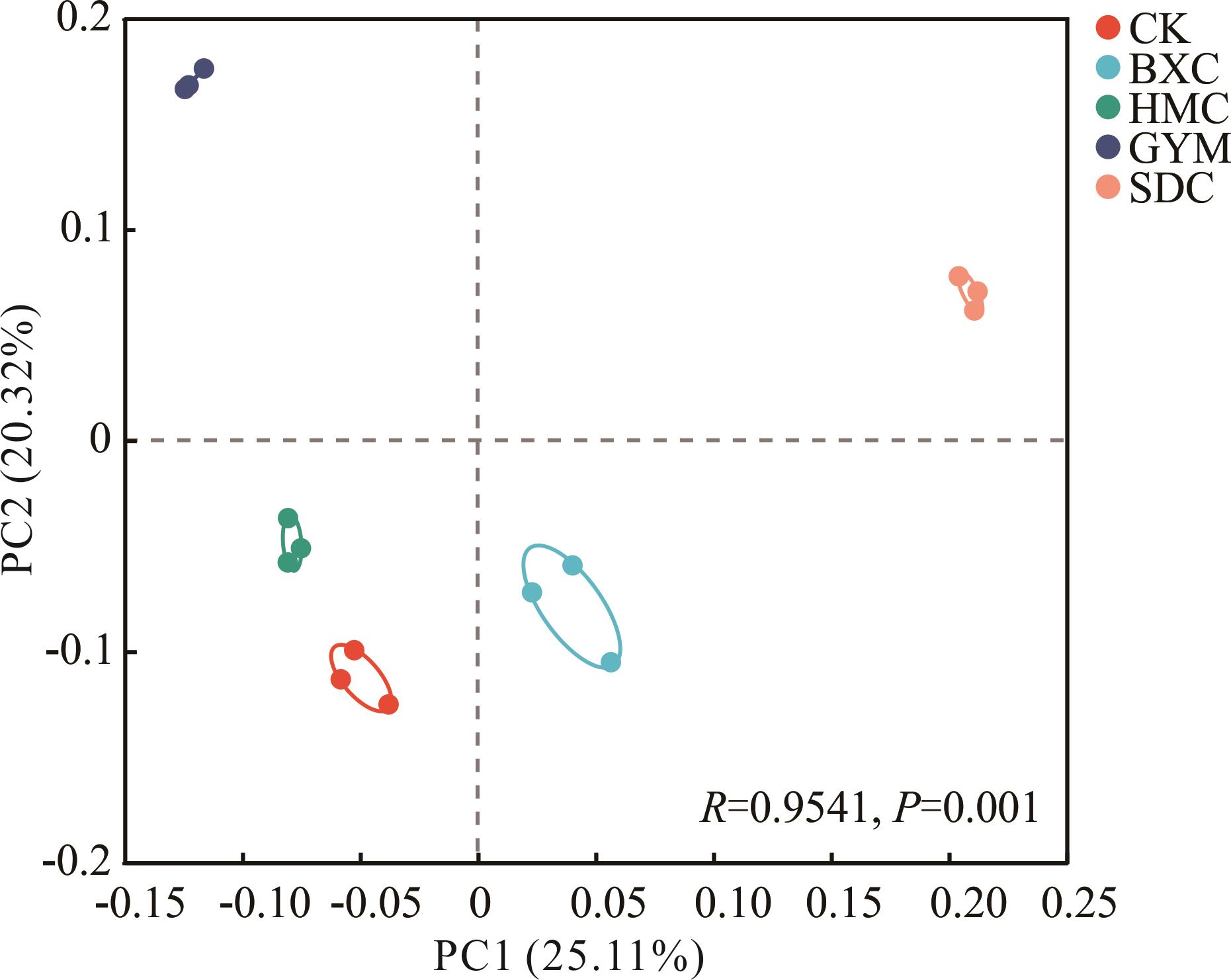
Fig.1 Principal co-ordinates analysis of soil bacterial community structure
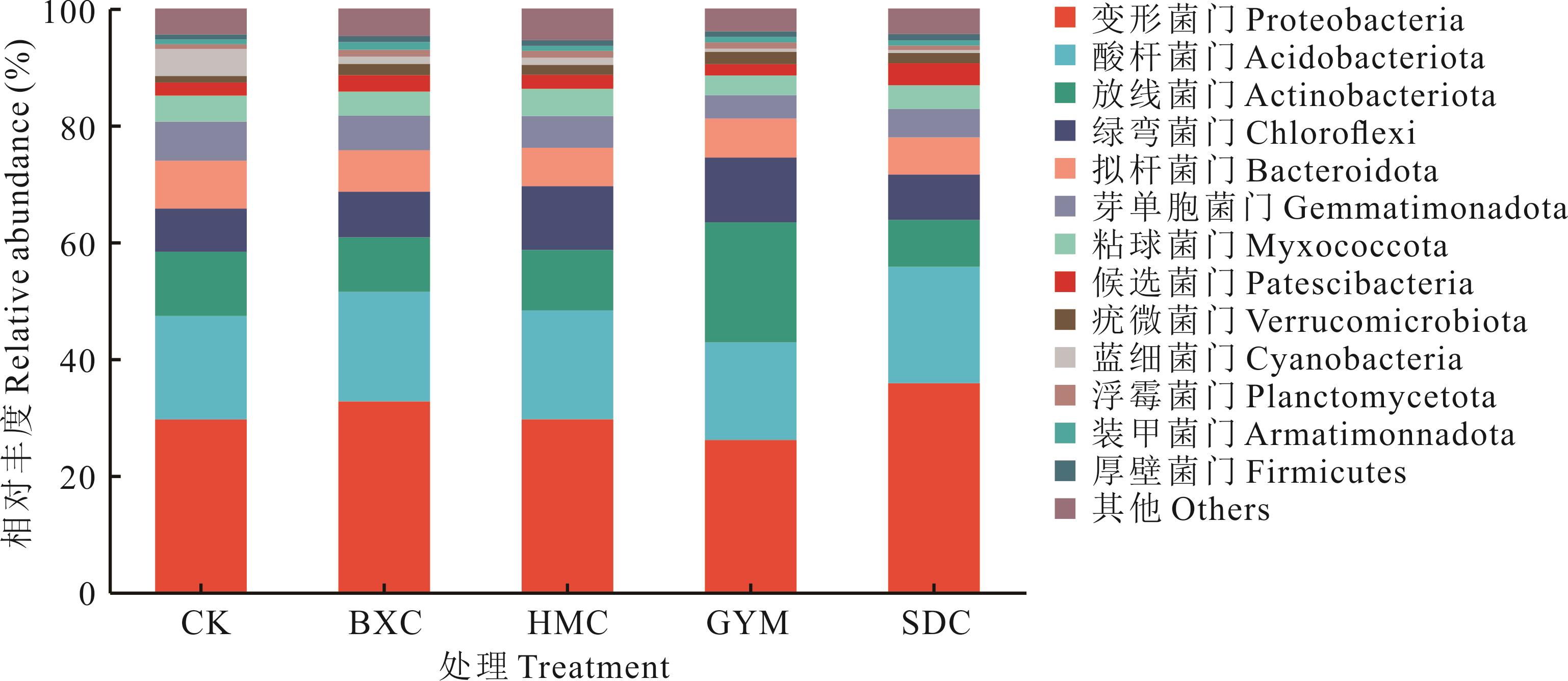
Fig.2 The relative abundance of bacterial communities in rhizosphere soil of different grasses at the phylum level
| 项目Item | pH | SOC | DOC | NO3--N | NH4+-N | AP |
|---|---|---|---|---|---|---|
| Chao1指数 Chao1 index | 0.456 | -0.378 | -0.275 | 0.238 | -0.025 | -0.231 |
| Shannon指数 Shannon index | 0.016 | -0.593* | 0.071 | 0.533* | 0.298 | 0.457 |
Table 5 Correlation analysis between bacterial Alpha diversity index and soil physical and chemical properties
| 项目Item | pH | SOC | DOC | NO3--N | NH4+-N | AP |
|---|---|---|---|---|---|---|
| Chao1指数 Chao1 index | 0.456 | -0.378 | -0.275 | 0.238 | -0.025 | -0.231 |
| Shannon指数 Shannon index | 0.016 | -0.593* | 0.071 | 0.533* | 0.298 | 0.457 |
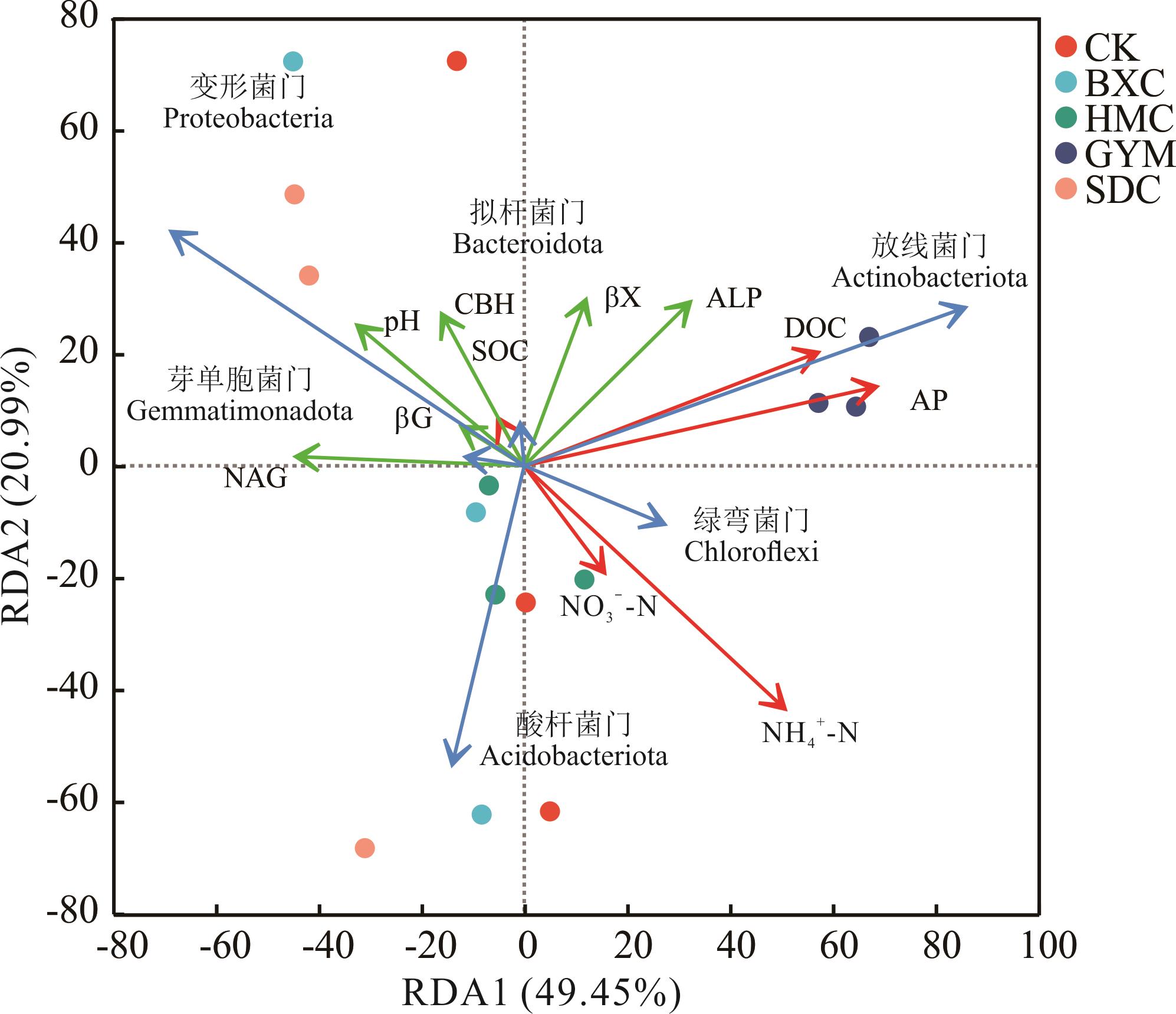
Fig.3 Redundancy analysis of bacterial community composition, soil physical and chemical properties and enzyme activity
| 1 | Aqeel M, Ran J Z, Hu W G, et al. Plant-soil-microbe interactions in maintaining ecosystem stability and coordinated turnover under changing environmental conditions. Chemosphere, 2023, 318: 137924. |
| 2 | Mueller C W, Baumert V, Carminati A, et al. From rhizosphere to detritusphere-Soil structure formation driven by plant roots and the interactions with soil biota. Soil Biology and Biochemistry, 2024, 193: 109396. |
| 3 | Borowik A, Wyszkowska J, Kucharski J. Impact of various grass species on soil bacteriobiome. Diversity, 2020, 12(6): 212. |
| 4 | Stefanowicz A M, Kapusta P, Stanek M, et al. Herbaceous plant species and their combinations positively affect soil microorganisms and processes and modify soil physicochemical properties in a mesocosm experiment. Forest Ecology and Management, 2023, 532: 120826. |
| 5 | Xiao L, Ma Y Y, Yuwen P Y, et al. Mixed grass species differ in rhizosphere microbial community structure and function response to drought compared to monocultures. Rhizosphere, 2022, 24: 100615. |
| 6 | Berendsen R L, Pieterse C M J, Bakker P A H M. The rhizosphere microbiome and plant health. Trends in Plant Science, 2012, 17(8): 478-486. |
| 7 | Zhou J, Liu C Y, Shi L L, et al. Rhizosphere influence on microbial functions: consequence for temperature sensitivity of soil organic matter decomposition at early stage of plant growth. Plant and Soil, 2024, 494(1): 95-109. |
| 8 | Mencel J, Mocek-Płóciniak A, Kryszak A. Soil microbial community and enzymatic activity of grasslands under different use practices: A review. Agronomy, 2022, 12(5): 1136. |
| 9 | Bardgett R D, Bullock J M, Lavorel S, et al. Combatting global grassland degradation. Nature Reviews Earth & Environment, 2021, 2(10): 720-735. |
| 10 | Chang J F, Ciais P, Gasser T, et al. Climate warming from managed grasslands cancels the cooling effect of carbon sinks in sparsely grazed and natural grasslands. Nature Communications, 2021, 12(1): 118. |
| 11 | Bardgett R D. Linking aboveground-belowground ecology: a short historical perspective. Aboveground-Belowground Community Ecology, 2018, 234: 1-17. |
| 12 | Ma Y, Zhang D G. Regulation mechanisms of rhizosphere nutrient cycling processes in grassland: A review. Acta Prataculturae Sinica, 2020, 29(11): 172-182. |
| 马源, 张德罡. 草地根际过程对养分循环调控机制研究进展. 草业学报, 2020, 29(11): 172-182. | |
| 13 | Wang Z, Jin K, Ding Y, et al. The mechanism of plants-soil microbial feedback in grassland succession. Chinese Journal of Grassland, 2022, 44(1): 95-103. |
| 王珍, 金轲, 丁勇, 等. 植物-土壤微生物反馈在草地演替过程中的作用机制. 中国草地学报, 2022, 44(1): 95-103. | |
| 14 | Rumpel C, Crème A, Ngo P T, et al. The impact of grassland management on biogeochemical cycles involving carbon, nitrogen and phosphorus. Journal of Soil Science and Plant Nutrition, 2015, 15(2): 353-371. |
| 15 | Gong X W, Feng Y, Dang K, et al. Linkages of microbial community structure and root exudates: Evidence from microbial nitrogen limitation in soils of crop families. Science of the Total Environment, 2023, 881: 163536. |
| 16 | Qi J J, Fu D Q, Wang X Z, et al. The effect of alfalfa cultivation on improving physicochemical properties soil microorganisms community structure of grey desert soil. Scientific Reports, 2023, 13(1): 13747. |
| 17 | Haney R L, Kiniry J R, Johnson M V V. Soil microbial activity under different grass species: Underground impacts of biofuel cropping. Agriculture Ecosystems & Environment, 2010, 139(4): 754-758. |
| 18 | Jian T K, Xia Y, He R P, et al. The influence of planting Carex praeclara and Leymus secalinus on soil properties and microbial community in a Zoige desertified alpine grassland. Global Ecology and Conservation, 2022, 34: e02002. |
| 19 | Tomazelli D, Peron R A D, Mendes S D C, et al. Plant diversity and root traits shape rhizosphere microbial communities in natural grasslands and cultivated pastures. Rhizosphere, 2024, 29: 100864. |
| 20 | Tomaskin J, Tomaskinova J. Evaluation of assortment of ornamental grasses and their environmental importance in the urban landscape. Journal of Environmental Protection and Ecology, 2020, 21(5): 1673-1682. |
| 21 | Sun D Y, Li J Z, Gong Y B. Effects of planting density of Poaceae species on slope community characteristics and artificial soil nutrients in high-altitude areas. Sustainability, 2023, 15(10): 8321. |
| 22 | Zhao Y F, Mao W, Pang L X, et al. Influence of Phragmites communis and Zizania aquatica on rhizosphere soil enzyme activity and bacterial community structure in a surface flow constructed wetland treating secondary domestic effluent in China. Environmental Science and Pollution Research, 2020, 27(21): 26141-26152. |
| 23 | Wang P, Wang Y, Wu Q S. Effects of soil tillage and planting grass on arbuscular mycorrhizal fungal propagules and soil properties in citrus orchards in southeast China. Soil & Tillage Research, 2016, 155: 54-61. |
| 24 | Bao S D. Soil agrochemical analysis (the third edition). Beijing: China Agriculture Press, 2000. |
| 鲍士旦. 土壤农化分析(第三版). 北京: 中国农业出版社, 2000. | |
| 25 | Saiya-Cork K R, Sinsabaugh R L, Zak D R. The effects of long term nitrogen deposition on extracellular enzyme activity in an Acer saccharum forest soil. Soil Biology and Biochemistry, 2002, 34(9): 1309-1315. |
| 26 | Magoč T, Salzberg S L. FLASH: fast length adjustment of short reads to improve genome assemblies. Bioinformatics, 2011, 27(21): 2957-2963. |
| 27 | Chen S, Zhou Y, Chen Y, et al. Fastp: an ultra-fast all-in-one FASTQ preprocessor. Bioinformatics, 2018, 34(17): i884-i890. |
| 28 | Edgar R C. UPARSE: highly accurate OTU sequences from microbial amplicon reads. Nature Methods, 2013, 10(10): 996-998. |
| 29 | Lan Y M, Wang Q, Cole J R, et al. Using the RDP classifier to predict taxonomic novelty and reduce the search space for finding novel organisms. PLoS One, 2012, 7(3): e32491. |
| 30 | Quast C, Pruesse E, Yilmaz P, et al. The SILVA ribosomal RNA gene database project: improved data processing and web-based tools. Nucleic Acids Research, 2012, 41(D1): D590-D596. |
| 31 | Song Q, Song X S, Deng X, et al. Effects of plant growth promoting rhizobacteria microbial inoculants on the growth, rhizosphere soil properties, and bacterial community of Pinus sylvestris var. mongolica annual seedlings. Scandinavian Journal of Forest Research, 2020, 36(4): 249-262. |
| 32 | Caporaso J G, Kuczynski J, Stombaugh J, et al. QIIME allows analysis of high-throughput community sequencing data. Nature Methods, 2010, 7(5): 335-336. |
| 33 | Smith D J, Duston S, Barney J N, et al. Dissolved organic carbon characteristics are associated with changes in soil microbiome under different plant species. Applied Soil Ecology, 2024, 196: 105313. |
| 34 | Khalid M, Soleman N, Jones D L. Grassland plants affect dissolved organic carbon and nitrogen dynamics in soil. Soil Biology and Biochemistry, 2007, 39(1): 378-381. |
| 35 | Chen X L, Chen H Y H, Chang S X. Meta-analysis shows that plant mixtures increase soil phosphorus availability and plant productivity in diverse ecosystems. Nature Ecology & Evolution, 2022, 6(8): 1112-1121. |
| 36 | Luo L, Meng H, Gu J D. Microbial extracellular enzymes in biogeochemical cycling of ecosystems. Journal of Environmental Management, 2017, 197: 539-549. |
| 37 | Delgado-Baquerizo M, Maestre F T, Reich P B, et al. Microbial diversity drives multifunctionality in terrestrial ecosystems. Nature Communications, 2016, 7(1): 10541. |
| 38 | Daunoras J, Kačergius A, Gudiukaitė R. Role of soil microbiota enzymes in soil health and activity changes depending on climate change and the type of soil ecosystem. Biology, 2024, 13(2): 85. |
| 39 | Sinsabaugh R L, Lauber C L, Weintraub M N, et al. Stoichiometry of soil enzyme activity at global scale. Ecology Letters, 2008, 11(11): 1252-1264. |
| 40 | Yang F, Tian J, Fang H J, et al. Spatial heterogeneity of microbial community and enzyme activities in a broad-leaved Korean pine mixed forest. European Journal of Soil Biology, 2018, 88: 65-72. |
| 41 | Zheng Z M. Changes in soil physicochemical and biological properties of grassland in different years of enclosure on the Loess Plateau. Yangling: Northwest A & F University, 2019. |
| 郑周敏. 黄土高原不同封育年限草地土壤理化和生物学性质变化. 杨凌: 西北农林科技大学, 2019. | |
| 42 | Zhang C, Liu G B, Xue S, et al. Changes in rhizospheric microbial community structure and function during the natural recovery of abandoned cropland on the Loess Plateau, China. Ecological Engineering, 2015, 75: 161-171. |
| 43 | Ladygina N, Hedlund K. Plant species influence microbial diversity and carbon allocation in the rhizosphere. Soil Biology and Biochemistry, 2010, 42(2): 162-168. |
| 44 | Saleh D, Jarry J, Rani M, et al. Diversity, distribution and multi-functional attributes of bacterial communities associated with the rhizosphere and endosphere of timothy (Phleum pratense L.). Journal of Applied Microbiology, 2019, 127(3): 794-811. |
| 45 | Zhang H R, Fu G. Responses of plant, soil bacterial and fungal communities to grazing vary with pasture seasons and grassland types, northern Tibet. Land Degradation & Development, 2021, 32(4): 1821-1832. |
| 46 | Li Q M, Li S J, Wang X L, et al. Influences of changing carbon inputs on soil microbial carbon metabolism in natural secondary forest in Yimeng mountainous area. Acta Ecologica Sinica, 2021, 41(10): 4110-4119. |
| 李秋梅, 黎胜杰, 王欣丽, 等. 改变碳输入对沂蒙山区典型次生林土壤微生物碳源代谢功能的影响. 生态学报, 2021, 41(10): 4110-4119. | |
| 47 | Das R, Bharadwaj P, Thakur D. Insights into the functional role of Actinomycetia in promoting plant growth and biocontrol in tea (Camellia sinensis) plants. Archives of Microbiology, 2024, 206(2): 65. |
| 48 | Chen H S, Liu S P, Liang G Q, et al. Effects of three cropping patterns on bacterial community structure and diversity in rhizosphere of broccoli. Journal of Nuclear Agricultural Sciences, 2021, 35(6): 1457-1465. |
| 陈海生, 刘守平, 梁国钱, 等. 3种西兰花种植方式对根际土壤细菌群落结构和多样性的影响研究. 核农学报, 2021, 35(6): 1457-1465. | |
| 49 | Li M, Zhang K R, Yan Z Q, et al. Soil water content shapes microbial community along gradients of wetland degradation on the Tibetan Plateau. Frontiers in Microbiology, 2022, 13: 824267. |
| 50 | Ma X W, Ren B H, Yu J X, et al. Changes in grassland soil types lead to different characteristics of bacterial and fungal communities in Northwest Liaoning, China. Frontiers in Microbiology, 2023, 14: 1205574. |
| 51 | Shu X Y, Hu Y F, Liu W J, et al. Linking between soil properties, bacterial communities, enzyme activities, and soil organic carbon mineralization under ecological restoration in an alpine degraded grassland. Frontiers in Microbiology, 2023, 14: 1131836. |
| 52 | Philippot L, Chenu C, Kappler A, et al. The interplay between microbial communities and soil properties. Nature Reviews Microbiology, 2024, 22(4): 226-239. |
| 53 | Wang L X, Pang X Y, Li N, et al. Effects of vegetation type, fine and coarse roots on soil microbial communities and enzyme activities in eastern Tibetan Plateau. Catena, 2020, 194: 104694. |
| 54 | Gong B, He Y, Luo Z B, et al. Response of rhizosphere soil physicochemical properties and microbial community structure to continuous cultivation of tobacco. Annals of Microbiology, 2024, 74(1): 4. |
| 55 | Li L S, Wang Z Y, Bai H H, et al. Structure and diversity of bacterial communities in rhizosphere soil of four plant species in Mu Us Sandy Land. Journal of Arid Land Resources and Environment, 2024, 38(2): 142-149. |
| 李林山, 王梓瑜, 白慧慧, 等. 毛乌素沙地4种不同植物根际土壤细菌群落结构和多样性特征. 干旱区资源与环境, 2024, 38(2): 142-149. |
| [1] | Hong-yu MA, Xiao-guo ZHOU, Bao WANG, Yu-chuan SONG, Aikeremu·Abulatijiang, Shao-li JIANG, Jiu-zhou MIN, Hong-mei ZHAO, Jun-hui CHENG. Differences in soil microbial functional gene abundance between rhizosphere soils of Haloxylon ammodendron and Tamarix chinensis in the Junggar Desert [J]. Acta Prataculturae Sinica, 2025, 34(8): 109-122. |
| [2] | Hao PENG, Bao-zhu DONG, Li-juan MA, Xiao-dong YU, Yi-fan ZHANG, Xiao-fang LI. Composition and carbon-fixation pathways of carbon-fixing microorganisms in soils of a typical steppe and desert steppe in Inner Mongolia [J]. Acta Prataculturae Sinica, 2025, 34(8): 123-131. |
| [3] | Kun ZHANG, Jian-xia QIAO, Jin-sheng LI, Yu-peng WANG, Ke-si LIU. Effects of different restoration materials on soil physicochemical properties and microbial communities in degraded alpine grassland [J]. Acta Prataculturae Sinica, 2025, 34(8): 132-148. |
| [4] | Bing-shu ZHU, Jiang-wen FAN, Hai-yan ZHANG, Lin HUANG, Hai-jing TIAN, Lin WANG, Shou-xing WANG, Ming-xin YANG, Yan-ming GUO. Grassland health assessment of alpine grassland in the Yellow River Source Park of Three-Rivers Headwaters National Park [J]. Acta Prataculturae Sinica, 2025, 34(7): 13-27. |
| [5] | Shao-yu YUAN, Shi-hui HAN, Tian XIA, Ning-bo HE, Jian-jie ZHANG. Responses of soil pH to different fertilization practices in natural grasslands of northern China [J]. Acta Prataculturae Sinica, 2025, 34(7): 28-40. |
| [6] | Ying WANG, Ming-yuan LI, Mairiyangu·Yasheng, Ji-lian WANG. Comparative study of rhizosphere soil fungal community structure among different plants in Tomur Peak, Xinjiang [J]. Acta Prataculturae Sinica, 2025, 34(7): 83-94. |
| [7] | Qian XU, Shuai GUO, Liang-liang ZHANG, Zhan-jun WANG, Guo-sheng XIN. Effects of supplemental feeding on growth rate, and serum biochemical and metabolomic parameters of grazing Tan sheep [J]. Acta Prataculturae Sinica, 2025, 34(6): 122-138. |
| [8] | Shun-hua LUO, Xin-yu LIU, Bao-ping MENG, Xuan-li CHEN, Ren-jie HU, Hong-yan YU, Xian-ying WANG, Bo ZHANG, Yu QIN. A study of functional group diversity and productivity of alpine grassland in Qilian Mountain National Park [J]. Acta Prataculturae Sinica, 2025, 34(6): 14-26. |
| [9] | Ying-hao ZHANG, Chu-bo LIU, Kun ZHOU, Jia-cun GUO, Shi-peng LIU, Luan-zi SUN. Effects of jujube tree on the growth of alfalfa and orchardgrass in different positions within an orchard [J]. Acta Prataculturae Sinica, 2025, 34(6): 203-212. |
| [10] | Si-ran WANG, Bei-yi LIU, Ji-peng TIAN, Yun-hui CHENG, Neng-xiang XU, Wen-jie ZHANG, Xin WANG, Cheng-long DING. Improvement in the fermentation quality of Italian ryegrass silage by ensiling with combined lactic acid bacteria inoculants at low temperature [J]. Acta Prataculturae Sinica, 2025, 34(5): 159-170. |
| [11] | Dong-liang SHANG, Hui ZANG. Research progress on the chemical control of annual bluegrass in established golf turf [J]. Acta Prataculturae Sinica, 2025, 34(5): 223-236. |
| [12] | Xue-mei XU, Jia-chang JIANG, Xin NIU, Hong-wei ZHOU, Tian-hu HAN, Xiao-ming CAO, Chun-yan LIANG, Xu-dong LI, De-cao NIU. Evaluation of forage-livestock balance implementation via remote sensing inversion: A case study in Shandan County, Gansu Province [J]. Acta Prataculturae Sinica, 2025, 34(4): 1-15. |
| [13] | Xue-xi MA, Ying-zhi GAO. Impact of shrub encroachment on soil hydrological processes in grassland [J]. Acta Prataculturae Sinica, 2025, 34(4): 212-222. |
| [14] | Xiao-juan ZHANG, Jiao-jiao WEI, Cai-jin CHEN, Xue-xue LI, Hong-xiu MA, Kai LI, Yong-wei CHEN, Quan SUN. Optimization of annual nitrogen fertilizer application to increase the productivity of a forage triticale-silage maize multiple cropping system in an irrigated area [J]. Acta Prataculturae Sinica, 2025, 34(4): 38-52. |
| [15] | Jiang-ping MA, Yi-yin ZHANG, Teng-fei WANG, Bin WANG, Jian LAN. Interspecific relationship and forage productivity effects in mixed sowings of Sorghum bicolor and Dolichos lablab [J]. Acta Prataculturae Sinica, 2025, 34(3): 111-122. |
| Viewed | ||||||
|
Full text |
|
|||||
|
Abstract |
|
|||||
