
ISSN 1004-5759 CN 62-1105/S
Acta Prataculturae Sinica ›› 2026, Vol. 35 ›› Issue (11): 184-200.DOI: 10.11686/cyxb2025475
Xiang OU1( ), Qiang ZHANG1, Xian-hong CAO1, Rong-qiang CHEN1, Hai LIAN1, Zhi-wen HUANG2, Mei-ru KANG1, Zheng LIU1, Xiao-wen LEI1()
Received:2025-11-19
Revised:2026-01-05
Online:2026-11-20
Published:2026-10-12
Contact:
Xiao-wen LEI
Xiang OU, Qiang ZHANG, Xian-hong CAO, Rong-qiang CHEN, Hai LIAN, Zhi-wen HUANG, Mei-ru KANG, Zheng LIU, Xiao-wen LEI. Effects of different exogenous selenium application on the growth, nutritional quality and enrichment of cadmium and selenium of king grass in cadmium contaminated land[J]. Acta Prataculturae Sinica, 2026, 35(11): 184-200.
| 项目Items | 含量Content |
|---|---|
| pH | 6.17±0.13 |
| 总镉Total cadmium (mg·kg-1) | 0.56±0.03 |
| 有效镉Available cadmium (mg·kg-1) | 0.25±0.02 |
| 总硒Total selenium (mg·kg-1) | 0.21±0.02 |
| 全氮Total nitrogen (g·kg-1) | 1.42±0.07 |
| 碱解氮Alkaline hydrolysis nitrogen (mg·kg-1) | 118.53±5.86 |
| 全磷Total phosphorus (g·kg-1) | 0.85±0.05 |
| 速效磷Available phosphorus (mg·kg-1) | 78.13±4.08 |
| 全钾Total kalium (g·kg-1) | 21.04±0.95 |
| 速效钾Available kalium (mg·kg-1) | 83.56±3.93 |
| 有机质Organic matter (g·kg-1) | 30.02±1.35 |
Table 1 Basic physical and chemical properties of soil from experimental field
| 项目Items | 含量Content |
|---|---|
| pH | 6.17±0.13 |
| 总镉Total cadmium (mg·kg-1) | 0.56±0.03 |
| 有效镉Available cadmium (mg·kg-1) | 0.25±0.02 |
| 总硒Total selenium (mg·kg-1) | 0.21±0.02 |
| 全氮Total nitrogen (g·kg-1) | 1.42±0.07 |
| 碱解氮Alkaline hydrolysis nitrogen (mg·kg-1) | 118.53±5.86 |
| 全磷Total phosphorus (g·kg-1) | 0.85±0.05 |
| 速效磷Available phosphorus (mg·kg-1) | 78.13±4.08 |
| 全钾Total kalium (g·kg-1) | 21.04±0.95 |
| 速效钾Available kalium (mg·kg-1) | 83.56±3.93 |
| 有机质Organic matter (g·kg-1) | 30.02±1.35 |
项目 Items | 处理组Treatment group | 年份Year | 处理组×年份Treatment group×year | |||
|---|---|---|---|---|---|---|
| F | P | F | P | F | P | |
| 株高Plant height | 8.56 | <0.001 | 42.99 | <0.001 | 1.29 | 0.227 |
| 鲜草产量Fresh grass yield | 93.79 | <0.001 | 628.12 | <0.001 | 2.68 | <0.01 |
| 粗蛋白Crude protein | 1.65 | 0.121 | 9.87 | <0.001 | 0.20 | 1.000 |
| 粗脂肪Ether extract | 61.76 | <0.001 | 2.80 | 0.069 | 0.81 | 0.678 |
| 酸性洗涤纤维Acid detergent fiber | 0.07 | 1.000 | 0.80 | 0.455 | 0.06 | 1.000 |
| 中性洗涤纤维Neutral detergent fiber | 0.32 | 0.965 | 0.17 | 0.847 | 0.05 | 1.000 |
| 粗灰分Crude ash | 1.88 | 0.073 | 2.12 | 0.129 | 0.34 | 0.994 |
Table 2 Two-way analysis of variance of different exogenous selenium on the plant height, yield, and nutritional quality of king grass under cadmium stress
项目 Items | 处理组Treatment group | 年份Year | 处理组×年份Treatment group×year | |||
|---|---|---|---|---|---|---|
| F | P | F | P | F | P | |
| 株高Plant height | 8.56 | <0.001 | 42.99 | <0.001 | 1.29 | 0.227 |
| 鲜草产量Fresh grass yield | 93.79 | <0.001 | 628.12 | <0.001 | 2.68 | <0.01 |
| 粗蛋白Crude protein | 1.65 | 0.121 | 9.87 | <0.001 | 0.20 | 1.000 |
| 粗脂肪Ether extract | 61.76 | <0.001 | 2.80 | 0.069 | 0.81 | 0.678 |
| 酸性洗涤纤维Acid detergent fiber | 0.07 | 1.000 | 0.80 | 0.455 | 0.06 | 1.000 |
| 中性洗涤纤维Neutral detergent fiber | 0.32 | 0.965 | 0.17 | 0.847 | 0.05 | 1.000 |
| 粗灰分Crude ash | 1.88 | 0.073 | 2.12 | 0.129 | 0.34 | 0.994 |
项目 Items | 年份 Year | CK | Y1 | Y2 | Y3 | J1 | J2 | J3 | Q1 | Q2 | Q3 |
|---|---|---|---|---|---|---|---|---|---|---|---|
株高 Plant height (cm) | 2022 | 189.99±8.95Bd | 180.81±11.01Bd | 208.61±7.92Abc | 211.22±11.97Abc | 183.57±8.65Bd | 214.88±11.37Aabc | 196.70±10.12Bcd | 218.46±10.01Aab | 232.90±13.28Aa | 224.47±8.10Aab |
| 2023 | 214.44±13.39Ab | 217.81±13.60Ab | 223.02±10.22Aab | 223.02±8.12Aab | 226.33±12.91Aab | 233.82±10.19Aab | 232.52±12.01ABab | 226.57±11.99Aab | 243.73±11.56Aa | 233.96±11.09Aab | |
| 2024 | 222.82±10.57Ab | 219.76±13.72Ab | 225.77±11.95Ab | 228.53±12.95Ab | 228.95±13.06Ab | 238.87±12.64Aab | 233.35±12.35Aab | 228.40±8.62Ab | 253.53±11.94Aa | 234.16±12.39Aab | |
产量 Yield (t·hm-2) | 2022 | 117.87±6.47Ce | 125.04±6.86Ce | 145.29±8.01Cd | 145.24±7.36Cd | 145.95±7.39Cd | 209.04±12.52Cb | 188.97±9.45Cc | 205.94±11.31Cbc | 266.20±14.67Ca | 201.65±9.12Cbc |
| 2023 | 187.10±10.24Bf | 198.00±9.80Bf | 249.97±14.26Bcde | 242.33±14.24Bde | 229.90±13.16Be | 295.93±19.40Bb | 270.27±13.25Bc | 247.20±11.73Bcde | 339.79±19.98Ba | 252.76±12.76Bcd | |
| 2024 | 246.31±10.74Af | 244.91±10.68Af | 305.72±12.69Acd | 287.99±15.97Ade | 267.28±15.15Aef | 339.25±21.82Ab | 316.80±14.92Abc | 282.83±14.96Ade | 381.77±19.28Aa | 294.79±16.18Acde |
Table 3 Effects of different exogenous selenium on the plant height and yield of king grass
项目 Items | 年份 Year | CK | Y1 | Y2 | Y3 | J1 | J2 | J3 | Q1 | Q2 | Q3 |
|---|---|---|---|---|---|---|---|---|---|---|---|
株高 Plant height (cm) | 2022 | 189.99±8.95Bd | 180.81±11.01Bd | 208.61±7.92Abc | 211.22±11.97Abc | 183.57±8.65Bd | 214.88±11.37Aabc | 196.70±10.12Bcd | 218.46±10.01Aab | 232.90±13.28Aa | 224.47±8.10Aab |
| 2023 | 214.44±13.39Ab | 217.81±13.60Ab | 223.02±10.22Aab | 223.02±8.12Aab | 226.33±12.91Aab | 233.82±10.19Aab | 232.52±12.01ABab | 226.57±11.99Aab | 243.73±11.56Aa | 233.96±11.09Aab | |
| 2024 | 222.82±10.57Ab | 219.76±13.72Ab | 225.77±11.95Ab | 228.53±12.95Ab | 228.95±13.06Ab | 238.87±12.64Aab | 233.35±12.35Aab | 228.40±8.62Ab | 253.53±11.94Aa | 234.16±12.39Aab | |
产量 Yield (t·hm-2) | 2022 | 117.87±6.47Ce | 125.04±6.86Ce | 145.29±8.01Cd | 145.24±7.36Cd | 145.95±7.39Cd | 209.04±12.52Cb | 188.97±9.45Cc | 205.94±11.31Cbc | 266.20±14.67Ca | 201.65±9.12Cbc |
| 2023 | 187.10±10.24Bf | 198.00±9.80Bf | 249.97±14.26Bcde | 242.33±14.24Bde | 229.90±13.16Be | 295.93±19.40Bb | 270.27±13.25Bc | 247.20±11.73Bcde | 339.79±19.98Ba | 252.76±12.76Bcd | |
| 2024 | 246.31±10.74Af | 244.91±10.68Af | 305.72±12.69Acd | 287.99±15.97Ade | 267.28±15.15Aef | 339.25±21.82Ab | 316.80±14.92Abc | 282.83±14.96Ade | 381.77±19.28Aa | 294.79±16.18Acde |
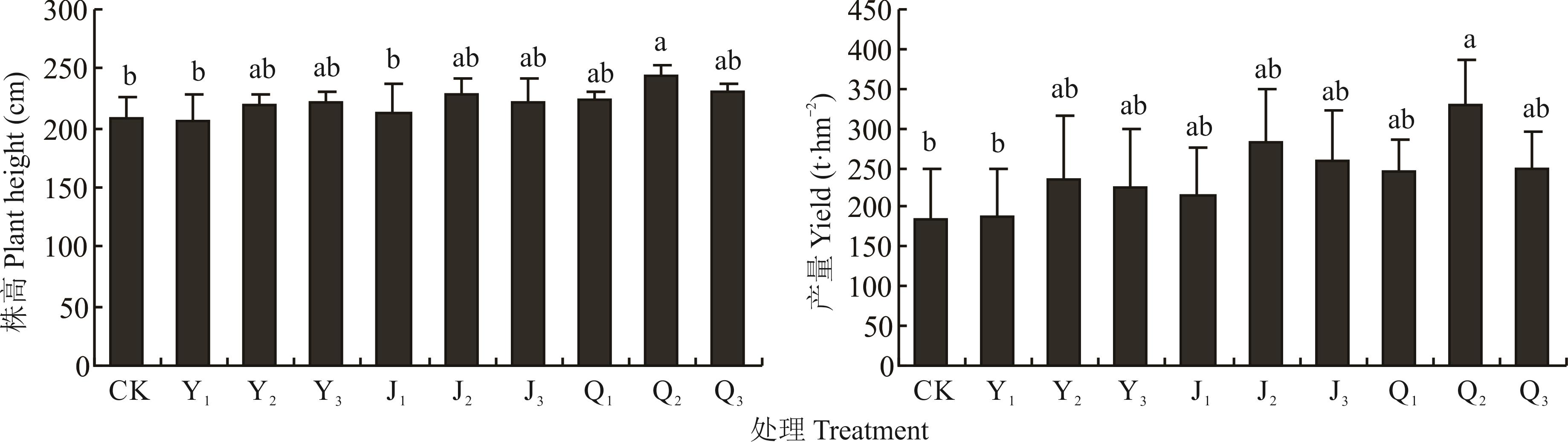
Fig.1 Effects of different exogenous selenium on the average plant height and yield of king grass in 3 years
项目 Items | 年份 Year | CK | Y1 | Y2 | Y3 | J1 | J2 | J3 | Q1 | Q2 | Q3 |
|---|---|---|---|---|---|---|---|---|---|---|---|
粗蛋白 Crude protein | 2022 | 6.08±0.32Aa | 6.14±0.31Aa | 6.35±0.31Aa | 6.21±0.29Aa | 6.21±0.28Aa | 6.33±0.37Aa | 6.28±0.33Aa | 6.36±0.33Aa | 6.58±0.30Aa | 6.43±0.34Aa |
| 2023 | 6.28±0.29Aa | 6.56±0.41Aa | 6.75±0.34Aa | 6.44±0.30Aa | 6.53±0.34Aa | 6.70±0.27Aa | 6.49±0.28Aa | 6.78±0.31Aa | 6.90±0.34Aa | 6.62±0.29Aa | |
| 2024 | 6.41±0.40Aa | 6.62±0.30Aa | 6.53±0.34Aa | 6.48±0.29Aa | 6.63±0.31Aa | 6.63±0.34Aa | 6.79±0.32Aa | 6.76±0.32Aa | 6.80±0.35Aa | 6.65±0.29Aa | |
| 平均Average | 6.26±0.17a | 6.44±0.26a | 6.54±0.20a | 6.38±0.15a | 6.46±0.22a | 6.55±0.20a | 6.52±0.26a | 6.63±0.24a | 6.76±0.16a | 6.57±0.12a | |
粗脂肪 Ether extract | 2022 | 2.45±0.15Ae | 3.40±0.18Ad | 4.18±0.15Acd | 3.53±0.20Acd | 3.64±0.30Acd | 4.43±0.26Ac | 3.79±0.19Acd | 5.65±0.23Ab | 6.56±0.34Aa | 4.43±0.24Ac |
| 2023 | 2.23±0.08Ae | 3.73±0.20Ad | 4.29±0.15Acd | 3.51±0.10Ad | 3.49±0.13Ad | 4.19±0.30Acd | 3.77±0.11Ad | 5.34±0.22Ab | 6.21±0.38Aa | 4.83±0.21Abc | |
| 2024 | 2.89±0.09Af | 3.72±0.11Ae | 4.34±0.14Acde | 3.90±0.19Ade | 3.95±0.17Ade | 4.64±0.19Acd | 4.18±0.22Acde | 4.93±0.21Abc | 6.34±0.28Aa | 5.54±0.22Ab | |
| 平均Average | 2.52±0.34e | 3.62±0.19d | 4.27±0.08c | 3.65±0.22d | 3.69±0.24d | 4.42±0.22c | 3.91±0.23cd | 5.31±0.36b | 6.37±0.18a | 4.93±0.56b | |
酸性洗涤纤维 Acid detergent fiber | 2022 | 38.21±2.23Aa | 38.45±2.04Aa | 37.94±1.80Aa | 37.89±1.87Aa | 38.03±1.92Aa | 37.72±1.99Aa | 38.31±1.76Aa | 37.82±1.73Aa | 38.37±1.81Aa | 38.00±2.12Aa |
| 2023 | 38.36±1.76Aa | 38.64±1.99Aa | 38.21±1.75Aa | 37.93±1.66Aa | 38.03±1.66Aa | 38.58±1.82Aa | 38.65±2.05Aa | 38.20±1.95Aa | 38.36±2.40Aa | 38.64±1.82Aa | |
| 2024 | 37.71±1.99Aa | 37.62±1.72Aa | 38.16±1.66Aa | 37.41±2.08Aa | 37.84±1.73Aa | 38.03±1.66Aa | 37.38±1.98Aa | 37.57±1.35Aa | 38.15±1.80Aa | 37.61±1.90Aa | |
| 平均Average | 38.09±0.34a | 38.24±0.54a | 38.10±0.14a | 37.74±0.29a | 37.97±0.11a | 38.11±0.43a | 38.11±0.66a | 37.86±0.32a | 38.29±0.12a | 38.08±0.52a | |
中性洗涤纤维 Neutral detergent fiber | 2022 | 61.65±2.83Aa | 60.59±3.38Aa | 61.26±2.21Aa | 62.09±2.92Aa | 62.53±3.48Aa | 62.07±2.70Aa | 61.27±3.60Aa | 61.18±3.24Aa | 61.47±3.84Aa | 62.63±2.87Aa |
| 2023 | 61.67±2.58Aa | 61.09±3.57Aa | 61.83±3.18Aa | 61.26±2.55Aa | 62.32±2.86Aa | 62.68±2.26Aa | 61.83±3.27Aa | 61.72±2.83Aa | 61.12±3.15Aa | 62.96±2.75Aa | |
| 2024 | 61.49±2.82Aa | 60.35±2.76Aa | 61.14±3.07Aa | 61.56±2.90Aa | 61.05±3.14Aa | 62.29±2.71Aa | 61.72±3.44Aa | 60.59±2.53Aa | 61.56±2.32Aa | 62.31±3.30Aa | |
| 平均Average | 61.60±0.10a | 60.68±0.38a | 61.42±0.37a | 61.64±0.41a | 61.97±0.80a | 62.35±0.31a | 61.61±0.30a | 61.16±0.57a | 61.38±0.23a | 62.63±0.33a | |
粗灰分 Crude ash | 2022 | 9.74±0.51Aa | 9.94±0.66Aa | 9.63±0.51Aa | 9.34±0.39Aa | 9.65±0.49Aa | 10.09±0.38Aa | 9.83±0.45Aa | 9.28±0.44Aa | 9.81±0.45Aa | 9.49±0.45Aa |
| 2023 | 9.57±0.44Aa | 9.77±0.41Aa | 9.38±0.48Aa | 9.30±0.35Aa | 9.68±0.51Aa | 9.89±0.46Aa | 9.55±0.35Aa | 9.07±0.41Aa | 9.46±0.39Aa | 9.55±0.50Aa | |
| 2024 | 9.87±0.45Aa | 9.88±0.37Aa | 9.49±0.38Aa | 9.69±0.46Aa | 9.99±0.47Aa | 9.84±0.45Aa | 10.18±0.52Aa | 9.48±0.59Aa | 9.40±0.55Aa | 9.86±0.52Aa | |
| 平均Average | 9.73±0.15a | 9.86±0.08a | 9.50±0.12a | 9.44±0.21a | 9.78±0.19a | 9.94±0.13a | 9.85±0.31a | 9.28±0.21a | 9.56±0.22a | 9.63±0.20a |
Table 4 Effects of different exogenous selenium on the nutritional quality of king grass (%)
项目 Items | 年份 Year | CK | Y1 | Y2 | Y3 | J1 | J2 | J3 | Q1 | Q2 | Q3 |
|---|---|---|---|---|---|---|---|---|---|---|---|
粗蛋白 Crude protein | 2022 | 6.08±0.32Aa | 6.14±0.31Aa | 6.35±0.31Aa | 6.21±0.29Aa | 6.21±0.28Aa | 6.33±0.37Aa | 6.28±0.33Aa | 6.36±0.33Aa | 6.58±0.30Aa | 6.43±0.34Aa |
| 2023 | 6.28±0.29Aa | 6.56±0.41Aa | 6.75±0.34Aa | 6.44±0.30Aa | 6.53±0.34Aa | 6.70±0.27Aa | 6.49±0.28Aa | 6.78±0.31Aa | 6.90±0.34Aa | 6.62±0.29Aa | |
| 2024 | 6.41±0.40Aa | 6.62±0.30Aa | 6.53±0.34Aa | 6.48±0.29Aa | 6.63±0.31Aa | 6.63±0.34Aa | 6.79±0.32Aa | 6.76±0.32Aa | 6.80±0.35Aa | 6.65±0.29Aa | |
| 平均Average | 6.26±0.17a | 6.44±0.26a | 6.54±0.20a | 6.38±0.15a | 6.46±0.22a | 6.55±0.20a | 6.52±0.26a | 6.63±0.24a | 6.76±0.16a | 6.57±0.12a | |
粗脂肪 Ether extract | 2022 | 2.45±0.15Ae | 3.40±0.18Ad | 4.18±0.15Acd | 3.53±0.20Acd | 3.64±0.30Acd | 4.43±0.26Ac | 3.79±0.19Acd | 5.65±0.23Ab | 6.56±0.34Aa | 4.43±0.24Ac |
| 2023 | 2.23±0.08Ae | 3.73±0.20Ad | 4.29±0.15Acd | 3.51±0.10Ad | 3.49±0.13Ad | 4.19±0.30Acd | 3.77±0.11Ad | 5.34±0.22Ab | 6.21±0.38Aa | 4.83±0.21Abc | |
| 2024 | 2.89±0.09Af | 3.72±0.11Ae | 4.34±0.14Acde | 3.90±0.19Ade | 3.95±0.17Ade | 4.64±0.19Acd | 4.18±0.22Acde | 4.93±0.21Abc | 6.34±0.28Aa | 5.54±0.22Ab | |
| 平均Average | 2.52±0.34e | 3.62±0.19d | 4.27±0.08c | 3.65±0.22d | 3.69±0.24d | 4.42±0.22c | 3.91±0.23cd | 5.31±0.36b | 6.37±0.18a | 4.93±0.56b | |
酸性洗涤纤维 Acid detergent fiber | 2022 | 38.21±2.23Aa | 38.45±2.04Aa | 37.94±1.80Aa | 37.89±1.87Aa | 38.03±1.92Aa | 37.72±1.99Aa | 38.31±1.76Aa | 37.82±1.73Aa | 38.37±1.81Aa | 38.00±2.12Aa |
| 2023 | 38.36±1.76Aa | 38.64±1.99Aa | 38.21±1.75Aa | 37.93±1.66Aa | 38.03±1.66Aa | 38.58±1.82Aa | 38.65±2.05Aa | 38.20±1.95Aa | 38.36±2.40Aa | 38.64±1.82Aa | |
| 2024 | 37.71±1.99Aa | 37.62±1.72Aa | 38.16±1.66Aa | 37.41±2.08Aa | 37.84±1.73Aa | 38.03±1.66Aa | 37.38±1.98Aa | 37.57±1.35Aa | 38.15±1.80Aa | 37.61±1.90Aa | |
| 平均Average | 38.09±0.34a | 38.24±0.54a | 38.10±0.14a | 37.74±0.29a | 37.97±0.11a | 38.11±0.43a | 38.11±0.66a | 37.86±0.32a | 38.29±0.12a | 38.08±0.52a | |
中性洗涤纤维 Neutral detergent fiber | 2022 | 61.65±2.83Aa | 60.59±3.38Aa | 61.26±2.21Aa | 62.09±2.92Aa | 62.53±3.48Aa | 62.07±2.70Aa | 61.27±3.60Aa | 61.18±3.24Aa | 61.47±3.84Aa | 62.63±2.87Aa |
| 2023 | 61.67±2.58Aa | 61.09±3.57Aa | 61.83±3.18Aa | 61.26±2.55Aa | 62.32±2.86Aa | 62.68±2.26Aa | 61.83±3.27Aa | 61.72±2.83Aa | 61.12±3.15Aa | 62.96±2.75Aa | |
| 2024 | 61.49±2.82Aa | 60.35±2.76Aa | 61.14±3.07Aa | 61.56±2.90Aa | 61.05±3.14Aa | 62.29±2.71Aa | 61.72±3.44Aa | 60.59±2.53Aa | 61.56±2.32Aa | 62.31±3.30Aa | |
| 平均Average | 61.60±0.10a | 60.68±0.38a | 61.42±0.37a | 61.64±0.41a | 61.97±0.80a | 62.35±0.31a | 61.61±0.30a | 61.16±0.57a | 61.38±0.23a | 62.63±0.33a | |
粗灰分 Crude ash | 2022 | 9.74±0.51Aa | 9.94±0.66Aa | 9.63±0.51Aa | 9.34±0.39Aa | 9.65±0.49Aa | 10.09±0.38Aa | 9.83±0.45Aa | 9.28±0.44Aa | 9.81±0.45Aa | 9.49±0.45Aa |
| 2023 | 9.57±0.44Aa | 9.77±0.41Aa | 9.38±0.48Aa | 9.30±0.35Aa | 9.68±0.51Aa | 9.89±0.46Aa | 9.55±0.35Aa | 9.07±0.41Aa | 9.46±0.39Aa | 9.55±0.50Aa | |
| 2024 | 9.87±0.45Aa | 9.88±0.37Aa | 9.49±0.38Aa | 9.69±0.46Aa | 9.99±0.47Aa | 9.84±0.45Aa | 10.18±0.52Aa | 9.48±0.59Aa | 9.40±0.55Aa | 9.86±0.52Aa | |
| 平均Average | 9.73±0.15a | 9.86±0.08a | 9.50±0.12a | 9.44±0.21a | 9.78±0.19a | 9.94±0.13a | 9.85±0.31a | 9.28±0.21a | 9.56±0.22a | 9.63±0.20a |
项目 Items | 处理组Treatment group | 年份Year | 处理组×年份Treatment group×year | |||
|---|---|---|---|---|---|---|
| F | P | F | P | F | P | |
| 王草总镉King grass total cadmium content | 486.30 | <0.001 | 52.52 | <0.001 | 2.12 | 0.016 |
| 土壤总镉Soil total cadmium content | 3.63 | <0.010 | 123.86 | <0.001 | 0.31 | 0.996 |
| 土壤有效镉Available cadmium content in soil | 51.61 | <0.001 | 205.54 | <0.001 | 0.43 | 0.976 |
| 镉富集系数Cadmium enrichment coefficient | 615.24 | <0.001 | 6.05 | <0.010 | 1.29 | 0.229 |
Table 5 Two-way analysis of variance of different exogenous selenium on the cadmium content of king grass and soil
项目 Items | 处理组Treatment group | 年份Year | 处理组×年份Treatment group×year | |||
|---|---|---|---|---|---|---|
| F | P | F | P | F | P | |
| 王草总镉King grass total cadmium content | 486.30 | <0.001 | 52.52 | <0.001 | 2.12 | 0.016 |
| 土壤总镉Soil total cadmium content | 3.63 | <0.010 | 123.86 | <0.001 | 0.31 | 0.996 |
| 土壤有效镉Available cadmium content in soil | 51.61 | <0.001 | 205.54 | <0.001 | 0.43 | 0.976 |
| 镉富集系数Cadmium enrichment coefficient | 615.24 | <0.001 | 6.05 | <0.010 | 1.29 | 0.229 |
项目 Items | 年份 Year | CK | Y1 | Y2 | Y3 | J1 | J2 | J3 | Q1 | Q2 | Q3 |
|---|---|---|---|---|---|---|---|---|---|---|---|
王草镉含量 King grass cadmium content (mg·kg-1) | 2022 | 0.72±0.04Aa | 0.48±0.02Ab | 0.44±0.03Ac | 0.40±0.02Ad | 0.38±0.02Ad | 0.31±0.02Ae | 0.27±0.01Ae | 0.30±0.02Ae | 0.21±0.01Af | 0.14±0.01Ag |
| 2023 | 0.66±0.04ABa | 0.41±0.03Bb | 0.38±0.02Bbc | 0.37±0.02ABcd | 0.33±0.02Bd | 0.29±0.02ABe | 0.26±0.01Ae | 0.28±0.01ABe | 0.20±0.02Af | 0.14±0.01Ag | |
| 2024 | 0.62±0.03Ba | 0.38±0.03Bb | 0.35±0.02Bbc | 0.34±0.02Bc | 0.30±0.02Bd | 0.27±0.01Bde | 0.26±0.01Ae | 0.26±0.01Be | 0.19±0.01Af | 0.14±0.01Ag | |
镉富集系数 Cadmium enrichment coefficient | 2022 | 1.40±0.06Aa | 0.93±0.04Ab | 0.86±0.03Ab | 0.78±0.01Ac | 0.74±0.06Ac | 0.62±0.04Ad | 0.54±0.04Be | 0.59±0.01Ade | 0.44±0.04Bf | 0.29±0.01Ag |
| 2023 | 1.39±0.04Aa | 0.89±0.05Ab | 0.84±0.01Abc | 0.81±0.06Ac | 0.73±0.02Ad | 0.65±0.04Ae | 0.59±0.02ABf | 0.62±0.03Aef | 0.46±0.04ABg | 0.32±0.01Ah | |
| 2024 | 1.40±0.01Aa | 0.89±0.06Ab | 0.86±0.02Abc | 0.81±0.02Ac | 0.72±0.02Ad | 0.69±0.04Ade | 0.63±0.03Af | 0.66±0.05Aef | 0.51±0.01Ag | 0.34±0.01Ah |
Table 6 Effects of different exogenous selenium on the total cadmium (Cd) content and Cd enrichment coefficients of king grass
项目 Items | 年份 Year | CK | Y1 | Y2 | Y3 | J1 | J2 | J3 | Q1 | Q2 | Q3 |
|---|---|---|---|---|---|---|---|---|---|---|---|
王草镉含量 King grass cadmium content (mg·kg-1) | 2022 | 0.72±0.04Aa | 0.48±0.02Ab | 0.44±0.03Ac | 0.40±0.02Ad | 0.38±0.02Ad | 0.31±0.02Ae | 0.27±0.01Ae | 0.30±0.02Ae | 0.21±0.01Af | 0.14±0.01Ag |
| 2023 | 0.66±0.04ABa | 0.41±0.03Bb | 0.38±0.02Bbc | 0.37±0.02ABcd | 0.33±0.02Bd | 0.29±0.02ABe | 0.26±0.01Ae | 0.28±0.01ABe | 0.20±0.02Af | 0.14±0.01Ag | |
| 2024 | 0.62±0.03Ba | 0.38±0.03Bb | 0.35±0.02Bbc | 0.34±0.02Bc | 0.30±0.02Bd | 0.27±0.01Bde | 0.26±0.01Ae | 0.26±0.01Be | 0.19±0.01Af | 0.14±0.01Ag | |
镉富集系数 Cadmium enrichment coefficient | 2022 | 1.40±0.06Aa | 0.93±0.04Ab | 0.86±0.03Ab | 0.78±0.01Ac | 0.74±0.06Ac | 0.62±0.04Ad | 0.54±0.04Be | 0.59±0.01Ade | 0.44±0.04Bf | 0.29±0.01Ag |
| 2023 | 1.39±0.04Aa | 0.89±0.05Ab | 0.84±0.01Abc | 0.81±0.06Ac | 0.73±0.02Ad | 0.65±0.04Ae | 0.59±0.02ABf | 0.62±0.03Aef | 0.46±0.04ABg | 0.32±0.01Ah | |
| 2024 | 1.40±0.01Aa | 0.89±0.06Ab | 0.86±0.02Abc | 0.81±0.02Ac | 0.72±0.02Ad | 0.69±0.04Ade | 0.63±0.03Af | 0.66±0.05Aef | 0.51±0.01Ag | 0.34±0.01Ah |
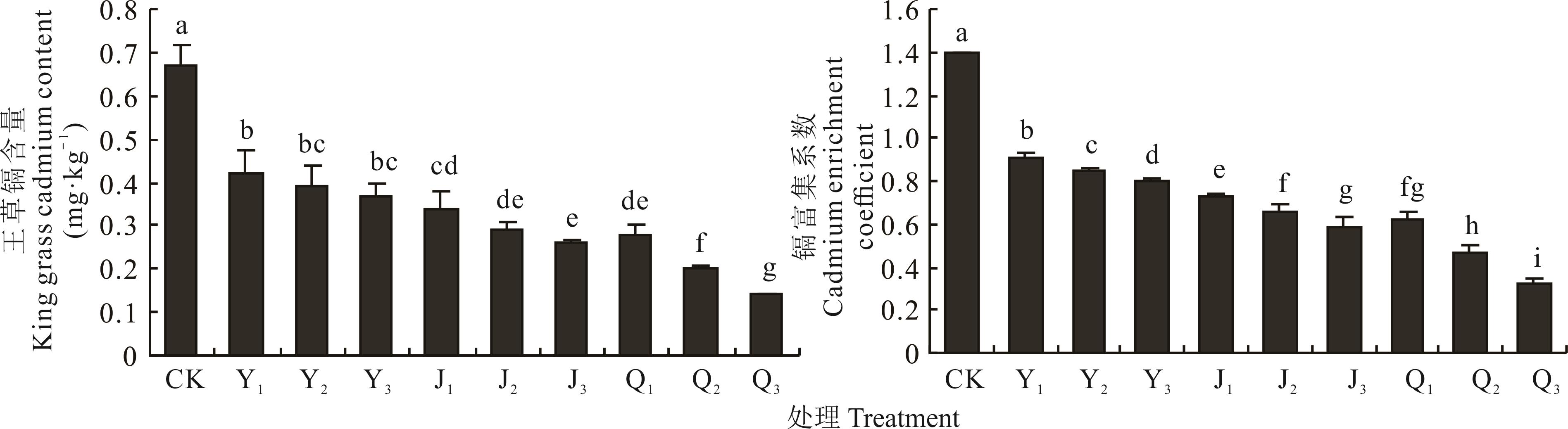
Fig.2 Effects of different exogenous selenium on the average total cadmium (Cd) content and Cd enrichment coefficients of king grass in 3 years
项目 Items | 年份 Year | CK | Y1 | Y2 | Y3 | J1 | J2 | J3 | Q1 | Q2 | Q3 |
|---|---|---|---|---|---|---|---|---|---|---|---|
土壤镉含量 Soil cadmium content | 2022 | 0.52±0.03Aa | 0.52±0.04Aa | 0.50±0.02Aa | 0.51±0.02Aa | 0.51±0.02Aa | 0.50±0.03Aa | 0.51±0.02Aa | 0.50±0.03Aa | 0.49±0.02Aa | 0.51±0.03Aa |
| 2023 | 0.47±0.02ABa | 0.47±0.04ABab | 0.46±0.02Bab | 0.45±0.02Bab | 0.46±0.02Bab | 0.44±0.02Bab | 0.45±0.03Bab | 0.44±0.02Bab | 0.43±0.02Bb | 0.44±0.02Bab | |
| 2024 | 0.45±0.02Ba | 0.43±0.02Bab | 0.41±0.01Cabc | 0.42±0.02Babc | 0.42±0.02Cabc | 0.40±0.01Cbcd | 0.41±0.03Babc | 0.39±0.02Ccd | 0.37±0.02Cd | 0.40±0.01Bbcd | |
土壤有效镉含量 Available cadmium content in soil | 2022 | 0.22±0.01Aa | 0.20±0.01Abc | 0.18±0.01Ade | 0.18±0.01Acde | 0.21±0.01Aab | 0.19±0.01Acd | 0.18±0.01Acde | 0.18±0.01Acde | 0.17±0.01Ae | 0.17±0.01Ae |
| 2023 | 0.20±0.01Ba | 0.17±0.01Bbc | 0.15±0.01Bde | 0.14±0.01Bef | 0.18±0.01Bb | 0.16±0.01Bcd | 0.15±0.01Bde | 0.15±0.01Bde | 0.14±0.01Bef | 0.14±0.01Bf | |
| 2024 | 0.19±0.01Ba | 0.16±0.01Bb | 0.14±0.01Cc | 0.14±0.01Bc | 0.16±0.01Bb | 0.14±0.01Cc | 0.14±0.01Bc | 0.14±0.01Bc | 0.12±0.01Cd | 0.12±0.01Cd |
Table 7 Effects of different exogenous selenium on the content of total cadmium (Cd) and available Cd in soil (mg·kg-1)
项目 Items | 年份 Year | CK | Y1 | Y2 | Y3 | J1 | J2 | J3 | Q1 | Q2 | Q3 |
|---|---|---|---|---|---|---|---|---|---|---|---|
土壤镉含量 Soil cadmium content | 2022 | 0.52±0.03Aa | 0.52±0.04Aa | 0.50±0.02Aa | 0.51±0.02Aa | 0.51±0.02Aa | 0.50±0.03Aa | 0.51±0.02Aa | 0.50±0.03Aa | 0.49±0.02Aa | 0.51±0.03Aa |
| 2023 | 0.47±0.02ABa | 0.47±0.04ABab | 0.46±0.02Bab | 0.45±0.02Bab | 0.46±0.02Bab | 0.44±0.02Bab | 0.45±0.03Bab | 0.44±0.02Bab | 0.43±0.02Bb | 0.44±0.02Bab | |
| 2024 | 0.45±0.02Ba | 0.43±0.02Bab | 0.41±0.01Cabc | 0.42±0.02Babc | 0.42±0.02Cabc | 0.40±0.01Cbcd | 0.41±0.03Babc | 0.39±0.02Ccd | 0.37±0.02Cd | 0.40±0.01Bbcd | |
土壤有效镉含量 Available cadmium content in soil | 2022 | 0.22±0.01Aa | 0.20±0.01Abc | 0.18±0.01Ade | 0.18±0.01Acde | 0.21±0.01Aab | 0.19±0.01Acd | 0.18±0.01Acde | 0.18±0.01Acde | 0.17±0.01Ae | 0.17±0.01Ae |
| 2023 | 0.20±0.01Ba | 0.17±0.01Bbc | 0.15±0.01Bde | 0.14±0.01Bef | 0.18±0.01Bb | 0.16±0.01Bcd | 0.15±0.01Bde | 0.15±0.01Bde | 0.14±0.01Bef | 0.14±0.01Bf | |
| 2024 | 0.19±0.01Ba | 0.16±0.01Bb | 0.14±0.01Cc | 0.14±0.01Bc | 0.16±0.01Bb | 0.14±0.01Cc | 0.14±0.01Bc | 0.14±0.01Bc | 0.12±0.01Cd | 0.12±0.01Cd |

Fig.3 Effects of different exogenous selenium on the average content of total cadmium (Cd) and available Cd in soil in 3 years
项目 Items | 处理组Treatment group | 年份Year | 处理组×年份Treatment group×year | |||
|---|---|---|---|---|---|---|
| F | P | F | P | F | P | |
| 王草总硒King grass total selenium content (mg·kg-1) | 831.25 | <0.001 | 849.57 | <0.001 | 34.19 | <0.001 |
| 土壤总硒Soil total selenium content (mg·kg-1) | 1445.73 | <0.001 | 269.32 | <0.001 | 5.43 | <0.001 |
| 硒富集系数Selenium enrichment coefficient | 387.41 | <0.001 | 141.55* | <0.001 | 14.83 | <0.001 |
Table 8 Two-way analysis of variance of different exogenous selenium on the selenium content of king grass and soil
项目 Items | 处理组Treatment group | 年份Year | 处理组×年份Treatment group×year | |||
|---|---|---|---|---|---|---|
| F | P | F | P | F | P | |
| 王草总硒King grass total selenium content (mg·kg-1) | 831.25 | <0.001 | 849.57 | <0.001 | 34.19 | <0.001 |
| 土壤总硒Soil total selenium content (mg·kg-1) | 1445.73 | <0.001 | 269.32 | <0.001 | 5.43 | <0.001 |
| 硒富集系数Selenium enrichment coefficient | 387.41 | <0.001 | 141.55* | <0.001 | 14.83 | <0.001 |
项目 Items | 年份 Year | CK | Y1 | Y2 | Y3 | J1 | J2 | J3 | Q1 | Q2 | Q3 |
|---|---|---|---|---|---|---|---|---|---|---|---|
王草硒含量 King grass selenium content (mg·kg-1) | 2022 | 0.13±0.01Ai | 0.48±0.03Ah | 0.88±0.04Af | 1.21±0.05Ac | 0.55±0.03Ag | 1.00±0.05Ae | 1.40±0.05Ab | 0.58±0.03Ag | 1.10±0.04Ad | 1.65±0.07Aa |
| 2023 | 0.12±0.01Ai | 0.43±0.03Ah | 0.69±0.04Bf | 0.96±0.04Bc | 0.49±0.03Bgh | 0.78±0.03Be | 1.09±0.05Bb | 0.50±0.02Bg | 0.86±0.05Bd | 1.27±0.06Ba | |
| 2024 | 0.08±0.01Bf | 0.35±0.01Be | 0.52±0.03Cd | 0.69±0.03Cb | 0.33±0.01Ce | 0.56±0.03Cd | 0.78±0.05Ca | 0.38±0.02Ce | 0.62±0.02Cc | 0.82±0.04Ca | |
土壤硒含量 Soil selenium content (mg·kg-1) | 2022 | 0.18±0.01Ad | 0.65±0.04Ac | 1.05±0.06Ab | 2.04±0.09Aa | 0.64±0.03Ac | 1.03±0.06Ab | 2.02±0.07Aa | 0.62±0.02Ac | 0.99±0.04Ab | 1.99±0.09Aa |
| 2023 | 0.16±0.01Bf | 0.58±0.04Ae | 0.87±0.04Bc | 1.84±0.05Ba | 0.56±0.03Be | 0.83±0.04Bcd | 1.80±0.06Bab | 0.52±0.03Bd | 0.77±0.02Bd | 1.74±0.06Bb | |
| 2024 | 0.12±0.01Cg | 0.49±0.03Be | 0.73±0.03Cc | 1.67±0.06Ca | 0.49±0.03Ce | 0.68±0.04Cc | 1.65±0.08Ca | 0.38±0.02Cd | 0.58±0.02Cd | 1.53±0.07Cb | |
硒富集系数 Selenium enrichment coefficient | 2022 | 0.71±0.02Bde | 0.74±0.01Ad | 0.84±0.01Ac | 0.59±0.02Af | 0.86±0.02Ac | 0.97±0.02Ab | 0.69±0.05Ae | 0.94±0.03Bb | 1.10±0.01Aa | 0.83±0.04Ac |
| 2023 | 0.75±0.01Ade | 0.74±0.06Ade | 0.79±0.02Bd | 0.52±0.01Bg | 0.87±0.01Ac | 0.94±0.01Bb | 0.60±0.04Bf | 0.97±0.01ABb | 1.12±0.03Aa | 0.73±0.01Be | |
| 2024 | 0.72±0.01Bd | 0.72±0.02Ad | 0.72±0.01Cd | 0.42±0.03Cg | 0.68±0.05Bd | 0.82±0.01Cc | 0.48±0.02Cf | 1.00±0.04Ab | 1.08±0.01Aa | 0.53±0.05Ce |
Table 9 Effects of different exogenous selenium on the total selenium (Se) content and Se enrichment coefficients of king grass
项目 Items | 年份 Year | CK | Y1 | Y2 | Y3 | J1 | J2 | J3 | Q1 | Q2 | Q3 |
|---|---|---|---|---|---|---|---|---|---|---|---|
王草硒含量 King grass selenium content (mg·kg-1) | 2022 | 0.13±0.01Ai | 0.48±0.03Ah | 0.88±0.04Af | 1.21±0.05Ac | 0.55±0.03Ag | 1.00±0.05Ae | 1.40±0.05Ab | 0.58±0.03Ag | 1.10±0.04Ad | 1.65±0.07Aa |
| 2023 | 0.12±0.01Ai | 0.43±0.03Ah | 0.69±0.04Bf | 0.96±0.04Bc | 0.49±0.03Bgh | 0.78±0.03Be | 1.09±0.05Bb | 0.50±0.02Bg | 0.86±0.05Bd | 1.27±0.06Ba | |
| 2024 | 0.08±0.01Bf | 0.35±0.01Be | 0.52±0.03Cd | 0.69±0.03Cb | 0.33±0.01Ce | 0.56±0.03Cd | 0.78±0.05Ca | 0.38±0.02Ce | 0.62±0.02Cc | 0.82±0.04Ca | |
土壤硒含量 Soil selenium content (mg·kg-1) | 2022 | 0.18±0.01Ad | 0.65±0.04Ac | 1.05±0.06Ab | 2.04±0.09Aa | 0.64±0.03Ac | 1.03±0.06Ab | 2.02±0.07Aa | 0.62±0.02Ac | 0.99±0.04Ab | 1.99±0.09Aa |
| 2023 | 0.16±0.01Bf | 0.58±0.04Ae | 0.87±0.04Bc | 1.84±0.05Ba | 0.56±0.03Be | 0.83±0.04Bcd | 1.80±0.06Bab | 0.52±0.03Bd | 0.77±0.02Bd | 1.74±0.06Bb | |
| 2024 | 0.12±0.01Cg | 0.49±0.03Be | 0.73±0.03Cc | 1.67±0.06Ca | 0.49±0.03Ce | 0.68±0.04Cc | 1.65±0.08Ca | 0.38±0.02Cd | 0.58±0.02Cd | 1.53±0.07Cb | |
硒富集系数 Selenium enrichment coefficient | 2022 | 0.71±0.02Bde | 0.74±0.01Ad | 0.84±0.01Ac | 0.59±0.02Af | 0.86±0.02Ac | 0.97±0.02Ab | 0.69±0.05Ae | 0.94±0.03Bb | 1.10±0.01Aa | 0.83±0.04Ac |
| 2023 | 0.75±0.01Ade | 0.74±0.06Ade | 0.79±0.02Bd | 0.52±0.01Bg | 0.87±0.01Ac | 0.94±0.01Bb | 0.60±0.04Bf | 0.97±0.01ABb | 1.12±0.03Aa | 0.73±0.01Be | |
| 2024 | 0.72±0.01Bd | 0.72±0.02Ad | 0.72±0.01Cd | 0.42±0.03Cg | 0.68±0.05Bd | 0.82±0.01Cc | 0.48±0.02Cf | 1.00±0.04Ab | 1.08±0.01Aa | 0.53±0.05Ce |
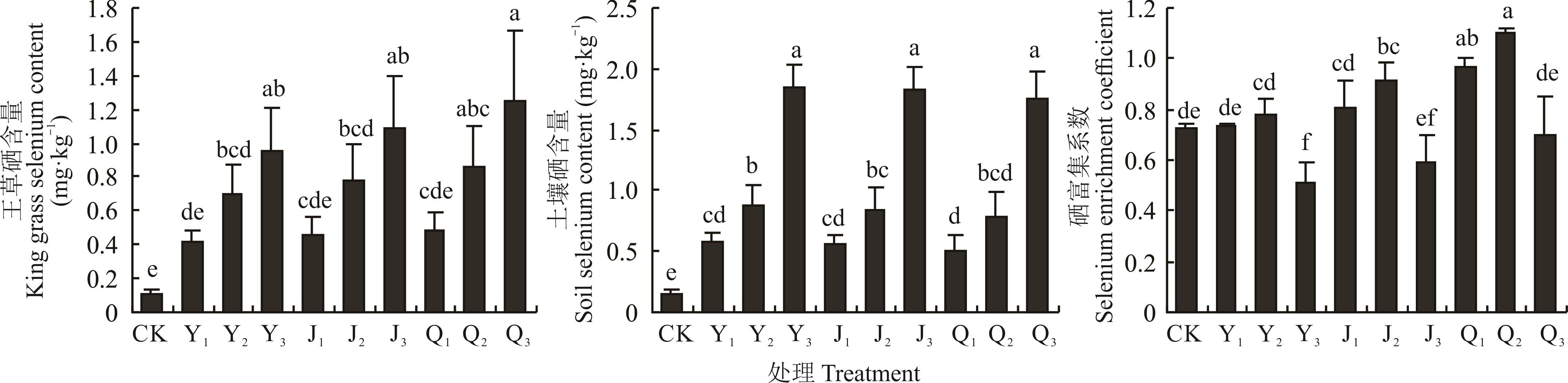
Fig.4 Effects of different exogenous selenium on the average total selenium (Se) content and Se enrichment coefficients of king grass in 3 years
| 年份Year | CK | Y1 | Y2 | Y3 | J1 | J2 | J3 | Q1 | Q2 | Q3 |
|---|---|---|---|---|---|---|---|---|---|---|
| 2022 | 0.1575 | 0.2426 | 0.5013 | 0.4955 | 0.3073 | 0.5233 | 0.4708 | 0.6774 | 0.7268 | 0.6497 |
| 2023 | 0.1803 | 0.3039 | 0.5198 | 0.5488 | 0.3990 | 0.4340 | 0.4707 | 0.6021 | 0.8266 | 0.4868 |
| 2024 | 0.1547 | 0.4265 | 0.4449 | 0.5084 | 0.4171 | 0.4773 | 0.6030 | 0.6432 | 0.7801 | 0.5953 |
| 平均值Average | 0.1642 | 0.3243 | 0.4886 | 0.5176 | 0.3744 | 0.4782 | 0.5148 | 0.6409 | 0.7778 | 0.5773 |
| 排序Rank | 10 | 9 | 6 | 4 | 8 | 7 | 5 | 2 | 1 | 3 |
Table 10 Subordinate function values of the planting effect of king grass under different exogenous selenium treatments
| 年份Year | CK | Y1 | Y2 | Y3 | J1 | J2 | J3 | Q1 | Q2 | Q3 |
|---|---|---|---|---|---|---|---|---|---|---|
| 2022 | 0.1575 | 0.2426 | 0.5013 | 0.4955 | 0.3073 | 0.5233 | 0.4708 | 0.6774 | 0.7268 | 0.6497 |
| 2023 | 0.1803 | 0.3039 | 0.5198 | 0.5488 | 0.3990 | 0.4340 | 0.4707 | 0.6021 | 0.8266 | 0.4868 |
| 2024 | 0.1547 | 0.4265 | 0.4449 | 0.5084 | 0.4171 | 0.4773 | 0.6030 | 0.6432 | 0.7801 | 0.5953 |
| 平均值Average | 0.1642 | 0.3243 | 0.4886 | 0.5176 | 0.3744 | 0.4782 | 0.5148 | 0.6409 | 0.7778 | 0.5773 |
| 排序Rank | 10 | 9 | 6 | 4 | 8 | 7 | 5 | 2 | 1 | 3 |
| [1] | Cao X F, Sun B, Chen H B, et al. Approaches and research progresses of marginal land productivity expansion and ecological benefit improvement in China. Bulletin of Chinese Academy of Sciences, 2021, 36(3): 336-348. |
| 曹晓风, 孙波, 陈化榜, 等. 我国边际土地产能扩增和生态效益提升的途径与研究进展. 中国科学院院刊, 2021, 36(3): 336-348. | |
| [2] | Ministry of Environmental Protection, Ministry of Land and Resources. Report of national soil pollution survey. Beijing: Ministry of Environmental Protection, 2014. |
| 环境保护部, 国土资源部. 全国土壤污染状况调查公报. 北京: 环境保护部, 2014. | |
| [3] | Zhang Y Y. Temporal and spatial distribution and risk assessment of cadmium in farmland soils in China based on bibliometrics. Taiyuan: Shanxi University, 2019. |
| 张云芸. 基于海量文献的中国农田土壤重金属镉的时空分布及风险评价. 太原: 山西大学, 2019. | |
| [4] | Nanjing Institute of Environmental Sciences, Ministry of Ecology and Environment. Soil environmental quality-risk control standard for soil contamination of agricultural land: GB 15618-2018. Beijing: Standards Press of China, 2018. |
| 生态环境部南京环境科学研究所. 土壤环境质量-农用地土壤污染风险管控标准(试行): GB 15618-2018. 北京: 中国标准出版社, 2018. | |
| [5] | Welikala D, Robinson B H, Moltchanova E, et al. Soil cadmium mobilisation by dissolved organic matter from soil amendments. Chemosphere, 2021, 271(5): 129536-129545. |
| [6] | Cao Q M, Zhang Y B, Wang B, et al. Effects of cutting and fertilization on biomass of Pennisetum purpureum Rich.×P. americana King grass cv. Reyan No. 4. Guangdong Agricultural Sciences, 2018, 45(10): 50-54. |
| 曹启民, 张永北, 王博, 等. 刈割和施肥对热研4号王草生物量影响初报. 广东农业科学, 2018, 45(10): 50-54. | |
| [7] | Zhao J M, Xia B, Meng Y, et al. Transcriptome analysis to shed light on the molecular mechanisms of early responses to cadmium in roots and leaves of king grass (Pennisetum americanum×P. purpureum). International Journal of Molecular Sciences, 2019, 20(10): 2532. |
| [8] | Zhang K L, Zhang H X, Xie C, et al. Piriformospora indica colonization enhances remediation of cadmium and chromium co-contaminated soils by king grass through plant growth promotion and rhizosphere microecological regulation. Journal of Hazardous Materials, 2024, 462(1): 132728. |
| [9] | China Feed Industry Association. Hygienical standard for feeds: GB 13078-2017. Beijing: Standards Press of China, 2017. |
| 中国饲料工业协会. 饲料卫生标准: GB 13078-2017. 北京: 中国标准出版社, 2017. | |
| [10] | Guo Y K, Mao K, Cao H R, et al. Exogenous selenium (cadmium) inhibits the absorption and transportation of cadmium (selenium) in rice. Environmental Pollution, 2021, 268(1): 115829. |
| [11] | Zhou X B, Yang J, Kronzucker H J, et al. Selenium biofortification and interaction with other elements in plants: a review. Frontiers in Plant Science, 2020, 11: 586421. |
| [12] | Cui J H, Liu T X, Li Y D, et al. Selenium reduces cadmium uptake into rice suspension cells by regulating the expression of lignin synthesis and cadmium-related genes. Science of the Total Environment, 2018, 644(4): 602-610. |
| [13] | Qin X M. Effects of selenium on cadmium uptake, transport and physiological characteristics of winter wheat. Zhengzhou: Henan Agricultural University, 2019. |
| 秦晓明. 硒对冬小麦镉吸收、转运及生理特性的影响. 郑州: 河南农业大学, 2019. | |
| [14] | Si Z X, Liang Z Z, Qian J C, et al. Research progress on absorption, transportation and metabolism mechanism of selenium in plants. Crops, 2023(2): 1-9. |
| 司振兴, 梁郅哲, 钱建财, 等. 植物对硒的吸收、转运及代谢机制研究进展. 作物杂志, 2023(2): 1-9. | |
| [15] | Wang Q, Huang S Y, Huang Q Q, et al. Absorption and biotransformation of selenomethionine and selenomethionine-oxide by wheat seedlings (Triticum aestivum L.). Plants, 2024, 13(3): 13030380. |
| [16] | Li L, Liu Q H, Yin C Y. Selenium biofortification in plants and application potential of microorganisms in selenium biofortification. Chinese Journal of Plant Ecology, 2023, 47(6): 756-769. |
| 李柳, 刘庆华, 尹春英. 植物硒生物强化及微生物在其中的应用潜力. 植物生态学报, 2023, 47(6): 756-769. | |
| [17] | Di X R, Jing R, Qin X, et al. Transcriptome analysis reveals the molecular mechanism of different forms of selenium in reducing cadmium uptake and accumulation in wheat seedlings. Chemosphere, 2023, 340: 139888-139888. |
| [18] | Hubei Feed Industry Association. Feed additive-Yeast selenium: T/ESL 32002-2023. Animal Breeding and Feed, 2025, 24(2): 147-150. |
| 湖北省饲料工业协会. 饲料添加剂 酵母硒: T/ESL 32002-2023. 养殖与饲料, 2025, 24(2): 147-150. | |
| [19] | Gong T Z, Zhang D J. Effect of exogenous selenium application on selenium content and fruit quality as well as its physiological mechanism in walnut. Journal of Fruit Science, 2022, 39(8): 1443-1449. |
| 龚天芝, 张德健. 外源硒对核桃硒含量和果实品质的影响及生理作用机制. 果树学报, 2022, 39(8): 1443-1449. | |
| [20] | Ma Y R, Ye C Z, Qiu F, et al. The effects of exogenous selenium on selenium-cadmium absorption, yield, and quality of cherry tomato in cadmium-contaminated soil. Journal of Yichun University, 2025, 47(6): 7-12, 25. |
| 马彦如, 叶成长, 邱凤, 等. 外源硒对镉污染土壤樱桃番茄硒镉吸收、产量和品质的影响. 宜春学院学报, 2025, 47(6): 7-12, 25. | |
| [21] | Yue S Z, Wang R P, Cao Z X, et al. Research progress on selenium enrichment and transformation by earthworm Eisenia fetida and its potential application. Journal of Agricultural Science and Technology, 2021, 23(11): 156-163. |
| 岳士忠, 王瑞萍, 曹赞霞, 等. 蚯蚓(Eisenia fetida)对硒的富集转化研究进展及其应用潜力. 中国农业科技导报, 2021, 23(11): 156-163. | |
| [22] | Liu Z N, Wu L J, Tian Y L, et al. Optimization of the preparation process of selenium-enriched earthworm and its application effects in Muscovy Ducks. Jiangsu Agricultural Sciences, 2024, 52(16): 214-220. |
| 刘珍妮, 吴丽娟, 田玉玲, 等. 蚯蚓硒制备工艺优化及其在番鸭中的应用效果. 江苏农业科学, 2024, 52(16): 214-220. | |
| [23] | Yue S Z, Zhang H O, Zhen H Y, et al. Selenium accumulation, speciation and bioaccessibility in selenium-enriched earthworm (Eisenia fetida). Microchemical Journal, 2019, 145(3): 1-8. |
| [24] | Zhang J, Xing J, Li X Y, et al. Study on the growth and development of tomato by earthworm hydrolysate. Horticulture & Seed, 2020, 40(4): 13-14. |
| 张见, 邢军, 李欣屹, 等. 蚯蚓水解液对番茄生长发育的研究. 园艺与种苗, 2020, 40(4): 13-14. | |
| [25] | Huang Y B, Liang L, Zhuang Q L, et al. Earthworm nutrient solution promotes tomato growth and improves fruit quality. Northern Horticulture, 2025(1): 44-51. |
| 黄玉波, 梁路, 庄秋丽, 等. 蚯蚓营养液促进番茄生长并改善其果实品质. 北方园艺, 2025(1): 44-51. | |
| [26] | Xu J M, Gu M H, Wei Y Y, et al. Effects of nano-selenium and sodium selenite application on cadmium accumulation in rice planting in cadmium contaminated soil. Journal of Southern Agriculture, 2021, 52(10): 2727-2734. |
| 徐境懋, 顾明华, 韦燕燕, 等. 纳米硒和亚硒酸盐对镉污染土壤中水稻镉积累的影响. 南方农业学报, 2021, 52(10): 2727-2734. | |
| [27] | Chen Z D, Qiu S L, Feng D Q, et al. Effects of selenium application on the production and selenium accumulation of hybrid Pennisetum. Acta Agrestia Sinica, 2024, 32(3): 838-847. |
| 陈钟佃, 邱水玲, 冯德庆, 等. 土壤施硒量对杂交狼尾草生长和硒积累的影响. 草地学报, 2024, 32(3): 838-847. | |
| [28] | National Soil Quality Standardization Technical Committee. Soil quality-Guidance on sampling techniques: GB/T 36197-2018. Beijing: Standards Press of China, 2018. |
| 全国土壤质量标准化技术委员会. 土壤质量 土壤采样技术指南: GB/T 36197-2018. 北京: 中国标准出版社, 2018. | |
| [29] | Fujian Inspection and Research Institute for Product Quality. Determination of arsenic, lead, copper, zinc, cadmium, chromium, nickel, magnesium, potassium, calcium, manganese, iron, selenium, molybdenum in soil by inductively coupled plasma mass spectrometry: DB35/T 1142-2020. Fuzhou: Fujian Provincial Market Supervision and Administration Bureau, 2020. |
| 福建省产品质量检验研究院. 土壤中砷、铅、铜、锌、镉、铬、镍、镁、钾、钙、锰、铁、硒、钼的测定 电感耦合等离子体质谱法: DB35/T 1142-2020. 福州: 福建省市场监督管理局, 2020. | |
| [30] | Ministry of Agriculture of the People’s Republic of China. Soil quality-Analysis of available lead and cadmium contents in soils-Atomic absorption spectrometry: GB/T 23739-2009. Beijing: Standards Press of China, 2009. |
| 中华人民共和国农业部. 土壤质量 有效态铅和镉的测定 原子吸收法: GB/T 23739-2009. 北京: 中国标准出版社, 2009. | |
| [31] | State Forestry Administration. Nitrogen determination methods of forest soils: LY/T 1228-2015. Beijing: Standards Press of China, 2015. |
| 国家林业局. 森林土壤氮的测定: LY/T 1228-2015. 北京: 中国标准出版社, 2015. | |
| [32] | State Forestry Administration. Phosphorus determination methods of forest soils: LY/T 1232-2015. Beijing: Standards Press of China, 2015. |
| 国家林业局. 森林土壤磷的测定: LY/T 1232-2015. 北京: 中国标准出版社, 2015. | |
| [33] | Ministry of Agriculture of the People’s Republic of China. Soil testing-Part 7: Method for determination of available phosphorus in soil: NY/T 1121.7-2014. Beijing: Standards Press of China, 2014. |
| 中华人民共和国农业部. 土壤检测第7部分:土壤有效磷的测定: NY/T 1121.7-2014. 北京: 中国标准出版社, 2014. | |
| [34] | State Forestry Administration. Potassium determination methods of forest soils: LY/T 1234-2015. Beijing: Standards Press of China, 2015. |
| 国家林业局. 森林土壤钾的测定: LY/T 1234-2015. 北京: 中国标准出版社, 2015. | |
| [35] | Ministry of Agriculture of the People’s Republic of China. Determination of exchangeable potassium and non-exchangeable potassium content in soil: NY/T 889-2004. Beijing: Standards Press of China, 2004. |
| 中华人民共和国农业部. 土壤速效钾和缓效钾含量的测定: NY/T 889-2004. 北京: 中国标准出版社, 2004. | |
| [36] | Ministry of Agriculture of the People’s Republic of China. Soil testing-Part 6: Method for determination of soil organic matter: NY/T 1121.6-2006. Beijing: Standards Press of China, 2006. |
| 中华人民共和国农业部. 土壤检测.第6部分:土壤有机质的测定: NY/T 1121.6-2006. 北京: 中国标准出版社, 2006. | |
| [37] | Ministry of Agriculture of the People’s Republic of China. Soil testing-Part 2: Method for determination of soil pH: NY/T 1121.2-2006. Beijing: Standards Press of China, 2006. |
| 中华人民共和国农业部. 土壤检测.第2部分:土壤pH的测定: NY/T 1121.2-2006. 北京: 中国标准出版社, 2006. | |
| [38] | Feed Industry National Technical Committee. Determination of crude protein in feeds-Kjeldahl method: GB/T 6432-2018. Beijing: Standards Press of China, 2018. |
| 全国饲料工业标准化技术委员会. 饲料中粗蛋白的测定 凯氏定氮法: GB/T 6432-2018. 北京: 中国标准出版社, 2018. | |
| [39] | Feed Industry National Technical Committee. Determination of crude fat in feeds: GB/T 6433-2006. Beijing: Standards Press of China, 2006. |
| 全国饲料工业标准化技术委员会. 饲料中粗脂肪的测定: GB/T 6433-2006. 北京: 中国标准出版社, 2006. | |
| [40] | Ministry of Agriculture of the People’s Republic of China. Determination of acid detergent fiber (ADF) in feeds: NY/T 1459-2022. Beijing: Standards Press of China, 2022. |
| 中华人民共和国农业农村部. 饲料中酸性洗涤纤维的测定: NY/T 1459-2022. 北京: 中国标准出版社, 2022. | |
| [41] | Feed Industry National Technical Committee. Determination of neutral detergent fiber (NDF) in feeds: GB/T 20806-2022. Beijing: Standards Press of China, 2022. |
| 全国饲料工业标准化技术委员会. 饲料中中性洗涤纤维(NDF)的测定: GB/T 20806-2022. 北京: 中国标准出版社, 2022. | |
| [42] | Feed Industry National Technical Committee. Animal feeding stuffs-Determination of crude ash: GB/T 6438-2007. Beijing: Standards Press of China, 2007. |
| 全国饲料工业标准化技术委员会. 饲料中粗灰分的测定: GB/T 6438-2007. 北京: 中国标准出版社, 2007. | |
| [43] | Feed Industry National Technical Committee. Determination of cadmium in feeds: GB/T 13082-2021. Beijing: Standards Press of China, 2021. |
| 全国饲料工业标准化技术委员会. 饲料中镉的测定: GB/T 13082-2021. 北京: 中国标准出版社, 2021. | |
| [44] | Feed Industry National Technical Committee. Determination of selenium in feeds: GB/T 13883-2023. Beijing: Standards Press of China, 2023. |
| 全国饲料工业标准化技术委员会. 饲料中硒的测定: GB/T 13883-2023. 北京: 中国标准出版社, 2023. | |
| [45] | Ding H N, Pan R Q, Lv H N, et al. Effects of foliar application of organic selenium and organic silicon on accumulation of cadmium and arsenic in rice. Jiangsu Agricultural Sciences, 2023, 51(14): 215-220. |
| 丁浩男, 潘荣庆, 吕浩能, 等. 叶面施用有机硒、有机硅对水稻累积镉、砷的影响. 江苏农业科学, 2023, 51(14): 215-220. | |
| [46] | Guo F, Wu W F, Feng Y, et al. Interactive effects of selenium and cadmium on the growth and antioxidative enzymes in zucchini seedling. Journal of Nuclear Agricultural Sciences, 2020, 34(10): 2335-2342. |
| 郭锋, 吴伟锋, 冯瑜, 等. 硒镉交互作用对西葫芦幼苗生长及抗氧化酶活性的影响. 核农学报, 2020, 34(10): 2335-2342. | |
| [47] | Christian T, Michel H. Singlet oxygen in plants: Production, detoxification and signaling. Trends in Plant Science, 2009, 14(4): 219-228. |
| [48] | Ebrahimi N, Stoddard F L, Hartikainen H, et al. Plant species and growing season weather influence the efficiency of selenium biofortification. Nutrient Cycling in Agroecosystems, 2019, 114: 111-124. |
| [49] | Ganguly R, Sarkar A, Dasgupta D, et al. Unravelling the efficient applications of zinc and selenium for mitigation of abiotic stresses in plants. Agriculture, 2022, 12(10): 1551. |
| [50] | Bai B Q, Wang Z, Gao L M, et al. Effects of selenite on the growth of alfalfa (Medicago sativa L. cv. Sadie 7) and related physiological mechanisms. Acta Physiologiae Plantarum, 2019, 41(6): 1-11. |
| [51] | Rizwan M, Ali S, Zia-Ur-Rehman M, et al. Effects of selenium on the uptake of toxic trace elements by crop plants: A review. Critical Reviews in Environmental Science and Technology, 2021, 51(21): 2531-2566. |
| [52] | Bai X Q, Jia C Y, Li W S, et al. An investigation of foliar spraying of selenium fertilizer for selenium enrichment and cadmium reduction in alfalfa. Acta Prataculturae Sinica, 2024, 33(1): 50-60. |
| 白旭琴, 贾春云, 李文栓, 等. 叶面喷施硒肥对紫花苜蓿富硒降镉效果的影响. 草业学报, 2024, 33(1): 50-60. | |
| [53] | Zhang Y W. Effects of different selenium types on cadmium uptake and transport in rice. Hefei: Anhui Agricultural University, 2021. |
| 张祎雯. 不同类型硒对水稻吸收转运镉的影响机制. 合肥: 安徽农业大学, 2021. | |
| [54] | Li G L, Liao M, Zhang N, et al. The process of autolytic hydrolysis of protein by enzymatic hydrolysis in earthworm and the component characteristics of its enzymatic hydrolysates. Acta Agriculturae Universitatis Jiangxiensis, 2014, 36(6): 1373-1379. |
| 李国雷, 廖敏, 张楠, 等. 蚯蚓蛋白水解酶自溶水解蚯蚓工艺及其产物组成特征. 江西农业大学学报, 2014, 36(6): 1373-1379. | |
| [55] | Jia J H, Liu P Y, Liu W, et al. Extraction technology and application of active ingredients in earthworm. Farm Products Processing, 2024(6): 103-107, 111. |
| 贾京华, 刘蓬宇, 刘薇, 等. 蚯蚓中活性成分提取技术及应用研究. 农产品加工, 2024(6): 103-107, 111. | |
| [56] | Bao H D, Ma S J, Chen W F, et al. Effects of exogenous selenium combined with rhizobium treatment on growth and active components of Astragalus membranaceus var. mongholicus. China Food Additives, 2024, 35(1): 51-59. |
| 保虎德, 马生军, 陈文峰, 等. 外源硒结合根瘤菌处理对蒙古黄芪生长及其活性成分的影响. 中国食品添加剂, 2024, 35(1): 51-59. | |
| [57] | Hu H F, Jie X L, Guo X, et al. Effects of Se application as basal fertilizer on the nutrient contents and distribution rates of alfalfa at different growth stages. Acta Agrestia Sinica, 2014, 22(4): 871-877. |
| 胡华锋, 介晓磊, 郭孝, 等. 基施硒肥对不同生育期紫花苜蓿营养含量及分配的影响. 草地学报, 2014, 22(4): 871-877. | |
| [58] | Chen S M, Li Z W, Zhang L X, et al. Research advances on the role of selenium in plants resistance to stress. Journal of Agricultural Science and Technology, 2020, 22(3): 6-13. |
| 陈思蒙, 李子玮, 张璐翔, 等. 硒在植物抵御胁迫中作用的研究进展. 中国农业科技导报, 2020, 22(3): 6-13. | |
| [59] | Li H X, Cai Y P, Chen H L, et al. Influence of selenium on peanut seedling growth and lipase activity. Journal of Shijiazhuang University, 2012, 14(6): 22-25. |
| 李红侠, 蔡永萍, 陈红玲, 等. 不同浓度的硒对花生幼苗生长及脂肪酶活力的影响. 石家庄学院学报, 2012, 14(6): 22-25. | |
| [60] | Zhu J J, Yu C M, Chen J K, et al. Effects of exogenous selenium on grass yield and nutritive value of forage ramie. Acta Prataculturae Sinica, 2019, 28(10): 144-155. |
| 朱娟娟, 喻春明, 陈继康, 等. 外源硒对饲用苎麻草产量和营养价值的影响. 草业学报, 2019, 28(10): 144-155. | |
| [61] | Wu M L, Lu H N. Selenium improves wheat antioxidant capacity, photosynthetic capacity, and growth under cadmium stress. Photosynthetica, 2024, 62(3): 232-239. |
| [62] | Zeng Z L, Huang Y J, Wu C B, et al. Screening of dominant plants for phytoremediation potential in the waste dump of the Shilu iron mining area contaminated with heavy metals. Chinese Journal of Tropical Agriculture, 2024, 44(5): 94-99. |
| 曾志良, 黄钰洁, 吴春标, 等. 昌江石碌铁矿排土场边坡重金属污染土壤修复植物筛选. 热带农业科学, 2024, 44(5): 94-99. | |
| [63] | Chen J P, Liu Y X, Zeng C C, et al. Advance on uptake and transformation of selenium from soil to plants. Current Biotechnology, 2017, 7(5): 421-427. |
| 陈锦平, 刘永贤, 曾成城, 等. 植物对土壤硒的吸收转化研究进展. 生物技术进展, 2017, 7(5): 421-427. | |
| [64] | Chen S C, Chen H W, Gao X, et al. Research progress on the mechanism of selenium uptake and metabolism by Saccharomyces cerevisiae and the breeding. China Brewing, 2025, 44(9): 14-21. |
| 陈世超, 陈红卫, 高祥, 等. 酿酒酵母吸收和转化硒的机制及菌种选育进展. 中国酿造, 2025, 44(9): 14-21. | |
| [65] | Qin H S, Jiang D H, Huang X J, et al.Effect of organic matter on Se (Ⅳ) sorption in acidic selenium-rich latosolic red soil in Guangxi. Soils, 2023, 55(2): 363-371. |
| 覃惠松, 蒋代华, 黄雪娇, 等. 有机质对广西酸性富硒土中Se(Ⅳ)吸附解吸特性的影响. 土壤, 2023, 55(2): 363-371. |
| [1] | Jia-yi YONG, Jia-xi YONG, Ying ZHANG, Hai-ying HU. Regrowth and forage quality responses to stubble height in five oat varieties [J]. Acta Prataculturae Sinica, 2026, 35(8): 97-111. |
| [2] | Juan SONG, Gen ZHAO, Jing-han WANG, Wei GU, Jin-kai LIN, Dong-rui HONG, Li-qin ZHANG, Li-jing MIN. Screening of cadmium-resistant bacteria and its effect on the growth and cadmium accumulation of Pharbitis nil seedlings [J]. Acta Prataculturae Sinica, 2026, 35(10): 106-116. |
| [3] | Nan GUO, Wu-chen DU, Shou-kun JI, Jian LIU, Su-qian CUI, Hui YUAN, Xu HAN, Ji-shuang LIU, Li-jie GAO. Effects of different fertilization and reseeding rates on the nutrient content of forage in a mountain meadow and its rumen fermentation parameters [J]. Acta Prataculturae Sinica, 2025, 34(4): 150-163. |
| [4] | Xiang OU, Hai LIAN, Rong-qiang CHEN, Jing-yun QIU, Li-juan WU, Xian-hong CAO, Qiang ZHANG, Xiao-wen LEI. Effects of different fertilization treatments on soil physical and chemical properties and enzyme activity of rare earth mine tailings after planting king grass [J]. Acta Prataculturae Sinica, 2025, 34(2): 94-108. |
| [5] | Yi-lin HAN, Wen-juan KANG, Shang-li SHI, Yuan-yuan DU, Fu-qiang HE, Yan WANG, Wen-lu HOU, Xi-lin XIE. Studies of the difference in symbiotic interaction between Sinorhizobium meliloti strain QL2 and different alfalfa varieties [J]. Acta Prataculturae Sinica, 2025, 34(10): 132-150. |
| [6] | Zhong-li LI, Cong-ze JIANG, Ren-shi MA, Wei GAO, Na SHOU, Yu-ying SHEN, Xian-long YANG. Suitability of five forage sweet sorghum varieties for production in the dry plateau area of Longdong [J]. Acta Prataculturae Sinica, 2024, 33(8): 50-62. |
| [7] | Xu-qin BAI, Chun-yun JIA, Wen-shuan LI, Ya-min LI, Chang-feng LIU, Xiu-yun HAN, Mei-han CHU, Zong-qiang GONG, Xiao-jun LI. An investigation of foliar spraying of selenium fertilizer for selenium enrichment and cadmium reduction in alfalfa [J]. Acta Prataculturae Sinica, 2024, 33(1): 50-60. |
| [8] | You-shun JIN, Fu-jiang HOU. Determination of the nutrient digestibility of herbage consumed by grazing animals [J]. Acta Prataculturae Sinica, 2022, 31(5): 200-212. |
| [9] | Hai-yan WU, Ni QU, Zhen QU, Tongsangcuomu, Dawazhuoga, Deyang, Nimazhuoga, Zhao-ming LIU, Yu-shou MA. Comparison of crop yield and forage quality of six oat varieties in Angren County, Shigatse [J]. Acta Prataculturae Sinica, 2022, 31(4): 72-80. |
| [10] | Jing-dong ZHAO, Wuyunna, Yan-tao SONG. Effect of short-term fencing on the forage quality of plant communities in degraded grassland in Northwestern Liaoning [J]. Acta Prataculturae Sinica, 2021, 30(9): 51-61. |
| [11] | Jing-dong ZHAO, Yan-tao SONG, Xin-lei XU, Wuyunna. Effects of nitrogen application and mowing on yield and quality of forage in degraded grassland in northwest Liaoning Province [J]. Acta Prataculturae Sinica, 2021, 30(8): 36-48. |
| [12] | Xin-lei XU, Yan-tao SONG, Jing-dong ZHAO, Yun-na WU. Changes in forage quality and its relationship with plant diversity under fertilization and mowing in Hulun Buir meadow steppe [J]. Acta Prataculturae Sinica, 2021, 30(7): 1-10. |
| [13] | Xin-you WANG, Wen-xia CAO, Xiao-jun WANG, Yu-zhen LIU, Rui GAO, Shi-lin WANG, Hai-tao AN, Xiu-xia DENG, Wen-hu WANG. Herbage production and forage quality responses to cutting height and fertilization of legume-grass mixtures in the Hexi region [J]. Acta Prataculturae Sinica, 2021, 30(4): 99-110. |
| [14] | Hui-xin JIANG, Shan-shan BAI, Bo WU, Jing-yi SONG, Guo-liang WANG. A multivariate evaluation of agronomic straits and forage quality of 22 oat varieties in the Huang-Huai-Hai area of China [J]. Acta Prataculturae Sinica, 2021, 30(1): 140-149. |
| [15] | Xin-zhu CHEN, Jian-guo ZHANG. Effects of cutting time and plant height of ‘Reyan No.4’ king grass on distribution of lactic acid bacteria and silage fermentation quality [J]. Acta Prataculturae Sinica, 2021, 30(1): 150-158. |
| Viewed | ||||||
|
Full text |
|
|||||
|
Abstract |
|
|||||
